
Encyclopedia
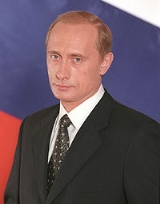
Vladimir Vladimirovich Putin is a
Russian politician, and the current President of the
Russian Federation. He succeeded
Boris Yeltsin on December 31, 1999.
Life and career
Putin was born in
Leningrad . His biography,
Ot Pervogo Litsa, translated into
English under the title
First Person and based on interviews conducted with Putin in 2000 was paid for by his election campaign. It speaks of humble beginnings, including early years in a rat-infested
tenement in a communal apartment. According to his biography, in his youth he was eager to emulate the intelligence officer characters played on the
Soviet screen by actors such as
Vyacheslav Tikhonov and
Georgiy Zhzhonov.
In the same book, Putin notes that his paternal grandfather, a chef by profession, was brought to the
Moscow suburbs to serve as a cook, at one of
Stalin's
dachas. In "
The Court of the Red Tsar" by Simon Sebag Montefiore, a footnote on page 300 cites Putin as saying that while his grandfather did not discuss his work very often, he recalled serving meals to
Rasputin as a boy and also prepared food for
Lenin. His mother was a factory worker and his father was conscripted into the navy, where he served in the submarine fleet in the early 1930s. His father subsequently served with the land forces during the
Second World War. Two older brothers were born in the mid-1930s; one died within a few months of birth; the second succumbed to
diphtheria during the
siege of Leningrad.
Putin graduated from the International Department of the Law Faculty of the
Leningrad State University in 1975 and was recruited into the
KGB. In
First Person, Putin described to journalists his early duties in the KGB, which included suppressing dissident activities in Leningrad.
From 1985 to 1990 the KGB stationed Putin in
Dresden,
East Germany, in what he regards as a minor position. Following the collapse of the East German regime, Putin was recalled to the Soviet Union and returned to Leningrad, where in June 1990 he assumed a position with the International Affairs section of Leningrad State University, reporting to the Vice-Rector. In June 1991, he was appointed head of the International Committee of the St Petersburg Mayor's office, with responsibility for promoting international relations and foreign investments.
Putin formally resigned from the state security services on August 20, 1991, during the KGB-supported abortive
putsch against Soviet President
Mikhail Gorbachev. In 1994 he became First Deputy Chairman of the city of Saint Petersburg, a position he retained until he was called to Moscow, in August 1996, to serve in a variety of senior positions in
Boris Yeltsin 's second Administration. He was the first civilian head of the
FSB from July 1998 to August 1999, and also served as Secretary of the Security Council from March to August 1999.
During the 1990s, Putin received a sub-doctoral level degree in economics from a mining institute in St Petersburg. His dissertation was titled "The Strategic Planning of Regional Resources Under the Formation of Market Relations".
Prime Minister and first term as President
Putin was appointed Chairman of the Government of the Russian Federation by President
Boris Yeltsin in August 1999, making him Russia's fifth prime minister in less than eighteen months. On his appointment, few expected Putin, a virtual unknown, to last any longer than his predecessors. Yeltsin's main opponents and would-be successors, Moscow Mayor
Yuriy Luzhkov and former Chairman of the Russian Government
Yevgeniy Primakov, were already campaigning to replace the ailing president, and fought hard to prevent Putin's emergence as a potential successor. Putin's law-and-order image and his unrelenting approach to the renewed crisis in Chechnya soon combined to raise his popularity and allowed him to overtake all rivals. While not formally associated with any party, Putin was supported by the newly formed
Edinstvo faction, which won the largest percentage of the popular vote in the December 1999
Duma elections. Putin was reappointed as Chairman of the Government, and seemed ideally positioned to win the presidency in elections due the following summer. His rise to Russia's highest office ended up being even more rapid: on December 31, 1999, Yeltsin unexpectedly resigned and, according to the constitution, Putin was appointed as the second President of the Russian Federation. While his opponents were preparing for an election later that year in the fall, the new acting President moved to have the elections held right away, in March. This put all of his opponents at a disadvantage, giving him the element of surprise and an eventual victory. Presidential elections were held March 26, 2000, which Putin won in the first round. Later Putin granted the former president and his family full immunity from prosecution . Shortly before, Yeltsin and his family had been under scrutiny for charges related to money-laundering by the Russian and Swiss authorities.

After many years of scandal, erratic policy making and a general sense of national malaise under the aged, awkward and ailing Yeltsin, Putin's election appeared to mark a new beginning in Russia's post-Soviet history. However, the new president's election was due in no small measure to Yeltsin's inner circle, who had selected and supported Putin with a view to maintaining their own power and privilege. As Putin's new administration took shape, members of the Yeltsin-era nomenklatura – including Chief of Staff Alexander Voloshin and Prime Minister
Mikhail Kasyanov – retained significant control over the policies and direction of the new government. On the other hand, Putin was also backed by a team of economic reformers from his native St Petersburg, and could rely as well on support from the
siloviki. The tension – and cooperation – between these various groups was a central feature of Putin's first term in office.
Upon his election, Putin undertook measures to restore the primacy of the Kremlin in Russia's political life. Under Yeltsin, Russia's 89
sub-federal political territories had been granted unprecedented autonomy. While this radical move had been intended to help Yeltsin's political maneuvers in the early 1990s, it also led to a highly irregular federalism and contributed to the growth of separatist movements, most notably in Chechnya. One of Putin's first acts, therefore, was to attempt to restore what he referred to as the "power vertical" – i.e. a return to the traditional top-down federal system. As a first step, Putin announced the appointment of seven presidential "plenipotentiary representatives" who were explicitly charged with coordinating federal activity in newly-defined super-regions. While billed as a seminal break with Yeltsin-era federalism, for a variety of reasons the plenipotentiary system has encountered mixed success. Of more lasting significance, Putin also instituted a major reform of Russia's upper house of parliament, the Federation Council. Putin and his team also entered into head-on confrontations with several uncooperative governors accused of
corruption, though with only mixed success.
The initial months of Putin's first term were also marked by a settling of scores among elite financial-industrial groups, whose monetary resources and media empires had been critical weapons in the domestic political war that had been waged over the previous year. Leading members of the old Yeltsin group – known informally as "the Family" – were determined to punish the losing camp, headed by
Vladimir Gusinsky, which had backed the Primakov/Luzhkov ticket. Gusinsky had rendered himself vulnerable since his media empire was a chronic money loser and was deeply indebted, surviving on loans from Gazprom and the Luzkhov-controlled Bank of Moscow. Within a year of Putin's election, Gusinsky went from being a would-be kingmaker to living in self-imposed exile; his once-influential media conglomerate dissolved into bankruptcy due to a cut off in credits by state-owned and state-allied businesses and under the weight of criminal and civil court decisions.
The first acute crisis which Putin faced as president arose in August 2000, when the Russian nuclear submarine
Kursk sank off the Kola peninsula, killing 118 sailors on board. Many people across a wide spectrum of Russian society were angered by the failure of the government and the military to release credible information about the scale and certainty of the disaster in first days of the tragedy. After several days of mounting public confusion and anger, Putin cut short his vacation and returned to Moscow to take charge of the crisis. Until the submarine was raised, the governmental commission of investigation into the disaster took into account various versions including a collision with a "NATO" submarine . While Putin was criticized by the Russian media for his inaction during the initial stages of the crisis, it did not have a lasting effect on his image and popularity.
Putin has been unenthusiastic about erasing Russia's
Soviet past from memory — the previous policy of
Boris Yeltsin aimed primarily at his Communist rivals. He has stated his belief that whatever the crimes of the
Communist regime, it was nevertheless an important part of
Russian history and has a formative influence on the creation of modern Russian society. As a result, some Soviet-era symbols have been allowed to return to Russia, such as the trademark red military flag, the "Soviet Star" crest, and the
Soviet national anthem – all of which have resonated well with the majority of Russia's population. In responding to critics of these moves, Putin has argued that he is the president of all Russians — including those such as the retirees who lost out in the post-Soviet transformation, and who understandably cling to symbols of the past.
A pro-Putin
United Russia party won a landslide victory in the
2003 parliamentary elections. Official foreign observers called the election itself free, but noted that the largely government-run
media, especially Russian national TV, had massively and unfairly campaigned for the governing party only. Indeed, most Russian TV stations are now controlled directly or indirectly by the Kremlin. While reaching a much more limited audience, newspapers are more diverse; some are critical of the Kremlin, while others promote the government line. One of the two main business newspapers,
Kommersant, is controlled by
Boris Berezovsky, while the other – the highly respected Vedomosti – is co-owned by the
Financial Times and the
Wall Street Journal.
Domestic and foreign critics accuse Putin of having orchestrated the trials of oligarchs such as
Boris Berezovsky,
Vladimir Gusinsky, and later
Mikhail Khodorkovsky as part of an effort by his Kremlin to gain control over the media and large sectors of the Russian economy. For its part, Putin's administration has argued that its actions against the oligarchs are founded in the letter and spirit of the law, and are intended to contain and reverse serious damage inflicted on Russia's economy by years of insider capitalism.
On 24 February 2004, less than a month prior to the elections, Putin dismissed Prime Minister Kasyanov and the entire Russian cabinet and appointed
Viktor Khristenko acting prime minister. On March 1, he appointed
Mikhail Fradkov to the position.
Second term as President
On March 14, 2004, Putin won re-election to the presidency for a second term, earning 71 percent of the vote. Again, there was massive and one-sided campaigning for Putin by Russian television channels, most of which are state owned and controlled. Nevertheless, the election campaign and the actual balloting were both declared "free and fair" by an international observation mission run by the Organization for Security and Cooperation in Europe's Office for Democratic Institutions and Human Rights.
On September 13, 2004, following the
Beslan school hostage crisis, and nearly-concurrent Chechen
terrorist attacks in Moscow, Putin launched an initiative to replace the election of regional governors with a system whereby they would be proposed by the President and approved or disapproved by regional
legislatures. Opponents of this measure, including
Mikhail Gorbachev,
Boris Yeltsin, and
Colin Powell, criticised it as a step away from democracy in Russia and a return to the centrally run political apparatus of the Soviet era. On that same day, Putin also publicly backed a plan by the Central Elections Commission for the election of Duma deputies based entirely on proportional representation, ending the election of half of the legislators from single-member constituencies.
On April 25, 2005, Putin caused some controversy when, in a nationally televised speech before the
Federal Assembly, he
referred to the
collapse of the Soviet Union as "the greatest geopolitical catastrophe of the century." This remark was critically received in the West and in some neighboring states; Putin subsequently clarified that he was not praising the former Soviet Union but rather highlighting in an altogether objective fashion the dramatic impact the collapse of the USSR had had on the world, particularly on the economic and social well-being of the populace from countries making up the former USSR and the displacement of people caused in part by the anti-Russian backlash in many of these countries .
One of the most controversial aspects of Putin's second term was the prosecution of Russia's richest man,
Mikhail Khodorkovsky, President of Yukos oil company. While much of the international press saw this as a reaction against a man who was funding political opponents of the Kremlin, both liberal and Communist, the Russian government has argued that Khodorkovsky was in fact engaged in corrupting a large segment of the Duma to prevent changes in the tax code aimed at taxing windfall profits and closing offshore tax evasion vehicles. Certainly, many of the initial privatizations, including that of Yukos, are widely believed to have been fraudulent , and like the other oligarchic groups, the Yukos-Menatep name has been frequently tarred with accusations of links to criminal organisations. Oligarchs who have been more willing to toe the Kremlin line, such as
Roman Abramovich and Vladimir Potanin, have not had their fortunes subjected to the same intense and critical examination.
Chechnya
- See also: Second Chechen War.
Putin's rise to public office in August 1999 coincided with an aggressive resurgence of the near-dormant conflict in the North Caucasus, when
Chechen extremists regrouped and invaded neighbouring
Daghestan. Both in Russia and abroad, Putin's public image was forged by his tough handling of this dire challenge. During the autumn 1999 campaign for the Duma, Kremlin-controlled or allied media accused Putin's chief rivals of being soft on terrorism. On assuming the role of acting President on December 31, 1999, Putin proceeded on a previously scheduled visit to Russian troops in Chechnya; one of the earliest images Russians saw of their new leader was the acting president presenting hunting knives to soldiers. Throughout the winter of 2000, Putin's government regularly claimed that victory was at hand. In recent years, with the situation stalemated, Putin has distanced himself from the management of the continuing conflict.
Foreign policy
While President Putin is criticized as an autocrat by some of his Western counterparts, his relationships with US President
George W. Bush, former German Chancellor
Gerhard Schröder, French President
Jacques Chirac, and the former Italian Prime Minister
Silvio Berlusconi are apparently friendly. Putin's relationship with Germany's new Chancellor,
Angela Merkel, is expected to be "cooler" and "more business-like" than his partnership with Gerhard Schröder .
During his time in office, Putin has attempted to strengthen relations with other members of the
CIS. The "near abroad" zone of traditional Russian influence has again become a foreign policy priority under Putin, as the
EU and
NATO have grown to encompass much of
Central Europe and, more recently, the
Baltic states. While tacitly accepting the enlargement of NATO into the Baltic states, Putin attempted to increase Russia's influence over
Belarus and
Ukraine.
Putin surprised many Russian nationalists and even his own defense minister when, in the wake of the September 11 attacks in the United States, he agreed to the establishment of coalition military bases in Central Asia before and during the US-led invasion of Afghanistan. Russian nationalists objected to the establishment of any US military presence on the territory of the former Soviet Union, and had expected Putin to keep the US out of the Central Asian republics, or at the very least extract a commitment from Washington to withdraw from these bases as soon as the immediate military purpose had passed.
During the
Iraq crisis of 2003, Putin opposed Washington's move to invade
Iraq without the benefit of a
United Nations Security Council resolution explicitly authorizing the use of military force. After the official end of the war was announced, American president
George W. Bush asked the United Nations to lift sanctions on
Iraq. Putin supported lifting of the sanctions in due course, arguing that the
UN commission first be given a chance to complete its work on the search for weapons of mass destruction in Iraq.
During the
2004 Ukrainian presidential election, Putin visited Ukraine twice before the election to show his support for Ukrainian Prime Minister
Viktor Yanukovych and congratulated him on his alleged victory before the official election results had been announced. Putin's direct support for pro-Russian Yanukovych was widely criticized as unwarranted interference in the affairs of post-Soviet Ukraine.
In 2005, Putin and former German Chancellor Gerhard Schröder negotiated the construction of a major oil pipeline over the Baltic exclusively between Russia and Germany. Schröder also attended Putin's 53rd birthday in Saint Petersburg the same year.
Family and personal life
Putin is married to
Lyudmila Putina, a former airline stewardess and teacher of German, who was born in
Kaliningrad, . They have two daughters, Maria and Yekaterina . The daughters attended the German School in Moscow until his appointment as prime minister.
Putin is a practising member of the
Russian Orthodox Church. His conversion, which most observers agree was sincere, followed a life-threatening fire at his
dacha in the early 1990s. Very unusual for communist Russia, his mother had been a regular church-goer. His father was a communist and atheist .
Putin speaks
German with near-native fluency. His family used to speak German at home as well.
Putin also speaks passable
English.
Popular Support across the world for President Putin
Despite the many critical voices in the Western media of the many reforms that have taken and are taking place in modern Russia under Vladimir Putin’s rule no one can argue that the transformation has been dramatic and/or enjoys popular support inside and outside Russia.
As proven in a joint Poll by in the United States, June 26-July 2nd 2006 and by the Levada Center in Russia, June 9th - 14th 2006. President Putin's Government enjoys a majority of homegrown support for even his most "controversial" reforms.
Trivia
Judo
Putin works out regularly, spending much of his free time exercising. One of Putin's favorite sports is the martial art of
judo. Putin began judo at the age of 13 and he continues to study judo even today. Putin won competitions in his hometown of
Leningrad , including the senior championship of Leningrad. He is President of the Yawara Dojo, the same
St. Petersburg dojo he studied at as a youth. Putin co-authored a book on his favorite sport, published in English under the title
Judo: History, Theory, Practice.Though he is not the first world leader to practice judo, Putin is the first leader to move forward in the advanced levels. Currently, Putin is a black belt and is best known for his Harai goshi, a sweeping hip throw.
After a state visit to
Japan, Putin was invited to the
Kodokan Institute and showed the students and Japanese officials different judo techniques. Although he is right handed, he wears the watch on his right hand because "
...if I wear it on the left wrist, the little winding mechanism faces the hand and is always rubbing against it."
Accusation of plagiarism
Vladimir Putin has been accused by fellows at the Brookings Institution of plagiarism. It has been alleged that "[l]arge chunks of Putin's economics dissertation on planning in the natural resources sector were lifted straight out of a management text published by two
University of Pittsburgh academics nearly 20 years earlier."
Quotations
- Putin on Chechen extremists, on September 24, 1999: "We'll follow terrorists everywhere. Should we catch them in the shithouse, we'll whack them in the shithouse." :
- In response to those who called Putin to enter talks with Chechen separatists after the Beslan school hostage crisis, on September, 2004: "Why don't you meet Osama bin Laden, invite him to Brussels or to the White House and engage in talks, ask him what he wants and give it to him so he leaves you in peace? You find it possible to set some limitations in your dealings with these bastards, so why should we talk to people who are child-killers? No one has a moral right to tell us to talk to childkillers."
- "If you are a Christian, you are in danger. Even if you are an atheist, you are in danger, and if you decide to convert to Islam, this will not save you, either, because traditional Islam is inimical to the conditions and objectives set by the terrorists. If you are prepared to become a most radical Islamist and are prepared to circumcise yourself, I invite you to come to Moscow. I will recommend having the operation done in such a way that nothing will grow for you there anymore." Putin snapping back at a reporter from Le Monde who asked a critical question about the conduct of the war in Chechnya, in November 2002. The quotation was rendered innocuous by his interpreter, but the original was recorded on audio and widely reprinted in Russia.
- When a reporter asked Putin why his government didn't negotiate with the leaders of Chechen separatists, Putin answered "Russia doesn't negotiate with terrorists. Russia destroys them."
- When a reporter asked why he invited Hamas to the Kremlin for talks, Putin answered "Burning bridges – especially in politics – is the easiest, but not the most effective thing to do. This is why we don't rush to declare an organization to be terrorist, and try to work with everyone in this explosive region."
- After the tragedy of Beslan, Putin explained the failure of Russia's Security Services with the sentence "We were weak. And the weak are being beaten."
See also Putin's on March 17, 2003.
Democracy
In response to criticism from US journalist Mike Wallace that his plan to end the direct election of governors and appoint them ran counter to the spirit of democracy, Putin replied:
- "The principle of appointing regional leaders is not a sign of a lack of democracy. For instance, India is called the largest world democracy. But their governors have always been appointed by the central government and nobody disputes that India is a democracy."
- "In the United States, you first elect the electors and then they vote for the presidential candidates. In Russia, the president is elected through the direct vote of the whole population. That might be even more democratic," Putin says. "And you have other problems in your elections," he tells Wallace. "Four years ago your presidential election was decided by the court. The judicial system was brought into it. But we're not going to poke our noses into your democratic system because that's up to the American people."
Answering the question of Netherlands TV "
Can you imagine a situation in which you would decide to remain in office for a third term?", Putin said:
- "I realise that 2008 will be an important test for Russia, and not an easy one.
- At the same time, the Constitution of the Russian Federation states that the President, the head of state, is elected for four years through direct secret ballot and cannot stay in office for more than two consecutive terms.
- I am not indifferent of course to the question of who will take in their hands the destiny of the country I have devoted my life to serving. But if each successive head of state were to change the Constitution to suit them, we would soon find ourselves without a state at all."
At , Putin said:
- "Russia has made its choice in favor of democracy. Fourteen years ago, independently, without any pressure from outside, it made that decision in the interests of itself and interests of its people — of its citizens. This is our final choice, and we have no way back. There can be no return to what we used to have before. And the guarantee for this is the choice of the Russian people, themselves. No, guarantees from outside cannot be provided. This is impossible. It would be impossible for Russia today. Any kind of turn towards totalitarianism for Russia would be impossible, due to the condition of the Russian society.
- As far as the questions that are being discussed among our partners in the media, I can only repeat what has been said by the President of the United States. First, we are not going to make up — to invent any kind of special Russian democracy; we are going to remain committed to the fundamental principles of democracy that have been established in the world. But, of course, all the modern institutions of democracy — the principles of democracy should be adequate to the current status of the development of Russia, to our history and our traditions."
And, after discussing media freedom,
- "When we discuss these issues, absolutely frankly, we, and I, in particular, do not think that this has to be pushed to the foreground, that new problems should be created from nothing. And I do not think that we should jeopardize the Russian-American relationship, because we're interested in the development of this relationship. We are paying close attention to all the comments of the press or opposing forces, but our responsibility is to, in spite of all these problems of which there are plenty, our responsibility is to positively develop the Russian-American relationship."
Life in Russia
Putin about emigration of talented people from Russia, on June 6, 2003: "If brains are draining, then they exist. It's already good. It means, they are of high quality, otherwise nobody would need them."
From Putin's Annual Address to the Federal Assembly, 2005:
- "I will recall once more Russia’s most recent history.
- Above all, we should acknowledge that the collapse of the Soviet Union was a major geopolitical disaster of the century. As for the Russian nation, it became a genuine drama. Tens of millions of our co-citizens and compatriots found themselves outside Russian territory. Moreover, the epidemic of disintegration infected Russia itself.
- Individual savings were depreciated, and old ideals destroyed. Many institutions were disbanded or reformed carelessly. Terrorist intervention and the Khasavyurt capitulation that followed damaged the country's integrity. Oligarchic groups — possessing absolute control over information channels — served exclusively their own corporate interests. Mass poverty began to be seen as the norm. And all this was happening against the backdrop of a dramatic economic downturn, unstable finances, and the paralysis of the social sphere.
- Many thought or seemed to think at the time that our young democracy was not a continuation of Russian statehood, but its ultimate collapse, the prolonged agony of the Soviet system.
- But they were mistaken.
- That was precisely the period when the significant developments took place in Russia. Our society was generating not only the energy of self-preservation, but also the will for a new and free life."
From Putin's :
- "Our efforts today focus precisely on the areas that directly determine the quality of life for our citizens. We are carrying out national projects in the areas of healthcare, education, agriculture and housing construction. As you know, the problems in these areas have accumulated not just over a period of years but over entire decades."
- "In the working out of a great national program which seeks the primary good of the greater number, it is true that the toes of some people are being stepped on and are going to be stepped on. But these toes belong to the comparative few who seek to retain or to gain position or riches or both by some short cut which is harmful to the greater good. These are fine words and it is a pity that it was not I who thought them up. It was Franklin Delano Roosevelt, the President of the United States of America, in 1934."
- "We have spoken on many occasions of the need to achieve high economic growth as an absolute priority for our country. The annual address for 2003 set for the first time the goal of doubling gross domestic product within a decade."
- "We have already begun taking concrete steps to change the structure of our economy and, as we have discussed a great deal, to give it a more innovative quality."
- "Russia must realise its full potential in high-tech sectors such as modern energy technology, transport and communications, space and aircraft building."
- "We must also continue the process of devolution of powers. It is high time to stop overseeing the construction of schools, bathhouses and sewerage systems from Moscow."
- "You know that our country’s population is declining by an average of almost 700,000 people a year. We have raised this issue on many occasions but have for the most part done very little to address it."
- "Regarding migration policy, our priority remains to attract our compatriots from abroad. In this regard we need to encourage skilled migration to our country, encourage educated and law-abiding people to come to Russia. People coming to our country must treat our culture and national traditions with respect."
- "The terrorist threat remains very real. Local conflicts remain a fertile breeding ground for terrorists, a source of their arms and a field upon which they can test their strength in practice. These conflicts often arise on ethnic grounds, often with inter-religious conflict thrown in, which is artificially fomented and manipulated by extremists of all shades.
- I know that there are those out there who would like to see Russia become so mired in these problems that it will not be able to resolve its own problems and achieve full development."
- "I stress that we unambiguously support strengthening the non-proliferation regime, without any exceptions, on the basis of international law."
On comparing Russia's defence spending as a share of
GDP to that of France and Britain, Putin mentioned the United States:
- "Their defence budget in absolute figures is almost 25 times bigger than Russia's. This is what in defence is referred to as 'their home — their fortress'. And good on them, I say. Well done!
- But this means that we also need to build our home and make it strong and well protected. We see, after all, what is going on in the world. The wolf knows who to eat, as the saying goes. It knows who to eat and is not about to listen to anyone, it seems."
- "When the need arose to counter a large-scale attack by international terrorists in the North Caucasus in 1999, the problems in the armed forces became painfully evident. Our armed forces came to a total of 1,400,000 men but there wasn’t enough men to fight. This is how kids who had never seen combat before were sent in to fight. I will not forget this ever."
- "We need armed forces that guarantee Russia’s security and territorial integrity no matter what the scenario."
- "By 2008, professional servicemen should account for two thirds of the armed forces. All of this will enable us to reduce compulsory military service to one year."
Foreign policy
After saying the US shouldn't have gone into Iraq in the first place: "But if the U.S. were to leave and abandon Iraq without establishing the grounds for a united and sovereign country, that would definitely be a second mistake."
From :
- "Russia’s modern foreign policy is based on the principles of pragmatism, predictability and the supremacy of international law."
- "I wish to stress that at this time of globalisation when a new international architecture is in the process of formation, the role of the United Nations Organisation has taken on new importance. This is the most representative and universal international forum and it remains the backbone of the modern world order. It is clear that the foundations of this global organisation were laid during an entirely different era and that reform is indisputably necessary.
- Russia, which is taking an active part in this work, sees two points of being of principle importance.
- First, reform should make the UN’s work more effective. Second, reform should have the broad support of a maximum number of the UN’s member states. Without consensus in the UN it will be very difficult to ensure harmony in the world."
From :
- [About role of UN] "The fact that today issues are discussed openly within the UN
Nations Unies...
and that the UN remains a platform for settling international problems rather than serving the foreign policy interests of any one state makes it not only more universal but absolutely necessary for developing acceptable decisions in today’s international arena. We do not have any other such universal international organization."
- [About problem of Iran] "First of all we must develop common approaches with our partners, approaches that would be acceptable to our Iranian partners and that would not restrict their possibilities for using modern technology. At the same time these approaches must completely assuage the international community’s concerns about the non-proliferation of nuclear weapons and nuclear technologies that could prove dangerous for international peace.
- What form these decisions will take will become clear in the course of discussions with our European and American partners. In any case we welcome the fact that the USA has decided to join the negotiation process. I consider that the American administration has taken a very important step. And this allows the whole process to take on an absolutely new character. In my last conversation with the President of the United States I agreed that Russia should participate in this process. Of course we will also participate in this process.
- Our main position is well known. We are against the use force in any circumstances. That is clear.
- We also think it is too early to talk about sanctions. We must engage in a detailed and profound discussion with the Iranian leadership. Only after that will it be possible to speak about the process’ prospects for development. But in any case Russia is ready to participate actively in this process."
- [About Ukraine gas scandal] "Russia has been delivering energy to Europe for 40 years. There was never a day or any hour that witnessed a failure. And at the beginning of this year Russia provided full, and I want to stress it, the full amount of deliveries to our western European partners and European consumers. To understand why Ukraine, a transit country, illegally siphoned off a significant part of European resources, you must not ask us: you must ask Ukraine."
- [About separatism] "Russia never raised the issue about joining any territories beyond its borders to the Russian state. And we have no plans to do so.
- I consider that we must develop uniform rules, norms and approaches to punctual events in different regions of the world. Otherwise there will be chaos.
- I am very worried about this. And I would like Russia’s concern to be transmitted and shared by all. We must understand that this is not a sports competition in which someone wins something back from someone else."
See also
at the official .
Putin-related humour
- The weekly TV show Kukly used puppets representing the most recognizable and powerful Russian politicians, including a puppet-president, to satirize current events. The show was aired on NTV channel from 1994 to 2002. The success of Kukly was to a great extent due to its scriptwriter Victor Shenderovich.
- Short humorous stories about Vladimir Vladimirovich's everyday life and work are regularly published by journalist Maxim Kononenko, popularly known under the sobriquet "Mr. Parker". In these essays, often alluding to contemporary events, Parliament is depicted as consisting of androids, a Deputy Chief of Staff being both their constructor and programmer; Vladimir Vladimirovich is fond of collecting things concerned with key historical events or people, etc. A collection of these stories, thoroughly commented, in August 2005. and versions of these anecdotes are available as well. Kononenko wrote that some of these stories were brought to Putin.
- Screen versions of the Vladimir Vladimirovich™ series are shown in a weekly analytical programme "Realnaya politika" with Gleb Pavlovsky, aired on NTV channel .
- compares Putin to Dzerzhinsky, the founder of the KGB.
- In , Putin is depicted as Yeltsin's successor determined to follow a better political approach .
- On June 28, 2005, Putin made headlines in an unusual incident involving a New England Patriots Super Bowl XXXIX championship ring. Three days earlier Putin had met with U.S. business executives, including Patriots owner Robert Kraft. Near the end of the meeting Kraft showed Putin the ring, which features 124 diamonds, and the president was clearly impressed. At this point Kraft handed the ring to Putin who tried it on for a moment, then slipped it into his pocket and promptly left. The event caused a brief stir as the New York Sun and other news outlets suggested that Kraft had not intended to give away the very valuable ring. Kraft, who has Russian ancestors, later told the Associated Press that he gave the ring to Putin as a gift and token of respect.
- In the South Park episode Free Willzyx, Putin is shown as a president that badly needs money for the Russian economy. He is shown to be extremely excited when he is asked to fly a whale to the moon for 20 million dollars as this money will save Russia.
- On June 28, 2006 Putin, while walking by a small crowd of tourists in a Kremlin courtyard, gave a "belly kiss" to a young boy of five or six years old. As he talked with the boy for a few seconds, he tugged at the boy's shirt before finally lifting it up and kissing him on his bare stomach. This raised a few eyebrows around the world. Though, the Russian president had to say, "He was very sweet. I'll be honest, I felt an urge to cuddle him like a kitten and that led to the gesture that I made. There was nothing behind it really."
- In a published July 12th, 2006, Putin is reported to have responded to U.S. Vice President Dick Cheney's political criticism by saying, "I think the statements of your Vice-President of this sort are the same as an unsuccessful hunting shot." U.S. President George W. Bush later remarked that the comment was "pretty clever, actually, quite humorous."
- During the 32nd G8 summit in July of 2006, Putin was as saying, "We certainly would not want to have the same kind of democracy as they have in Iraq, I will tell you quite honestly." in response to Bush's accusations of the decline of democracy in modern Russia.
- Also during the 32nd G8 summit, following journalists' criticisms of the Russian government's record on Human rights, Putin was quoted as remarking that, "There are also other questions, questions let's say about the fight against corruption. We'd be interested in hearing your experience, including how it applies to Lord Levy." Lord Levy, a member of the British House of Lords, had been arrested the previous week in relation to the "Cash for Peerages" police inquiry into the soliciting of financial donations to British political parties in return for honours.
- Several comedic sources have commented on the fact that Putin bears a resemblance to Dobby from the film version of Harry Potter and the Chamber of Secrets.
See also
References and notes
External links and references
- , in The Atlantic Monthly, March 2005
- Russia's Foreign Policy in a resurgent mode: An Analysis
- with the President, held on July 7, 2006 .