


Organization for Security and Co-operation in Europe

Encyclopedia
The Organization for Security and Co-operation in Europe (OSCE) is the world's largest security-oriented intergovernmental organization. Its mandate includes issues such as arms control
, human rights
, freedom of the press
and fair elections. Most of its 3,500-plus staff are engaged in field operations, with only around 10% in its headquarters.
The OSCE is an ad hoc
organization under the United Nations
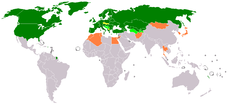
Charter (Chap. VIII), and is concerned with early warning, conflict prevention, crisis management and post-conflict rehabilitation. Its 56 participating states are in Europe
, former Soviet Union and Northern America
and cover most of the northern hemisphere
. It was created during the Cold War
era as an East-West forum.
's Minister for Foreign Affairs
, George Papandreou. Bakoyannis succeeded Finnish
Minister for Foreign Affairs Alexander Stubb
.
In addition to the Ministerial Council and Permanent Council, the Forum for Security Co-operation is also an OSCE decision-making body. It deals predominantly with matters of military co-operation, such as modalities for inspections according to the Vienna Document of 1999.
The OSCE's Secretariat is located in Vienna
, Austria
. The current Secretary General is Lamberto Zannier
of Italy, who took over from Marc Perrin de Brichambaut
of France. The Organization also has offices in Copenhagen
, Geneva
, The Hague
, Prague
and Warsaw.
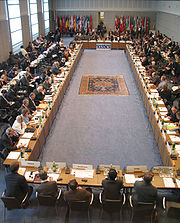 The OSCE employs close to 440 persons in its various institutions. In the field, the Organization has about 750 international and 2,370 national staff.
The Parliamentary Assembly of the Organization for Security and Co-operation in Europe passes resolutions on matters such as political and security affairs, economic and environmental issues, and democracy and human rights. Representing the collective voice of OSCE parliamentarians, these resolutions and recommendations are meant to ensure that all participating States live up to their OSCE commitments. The OSCE PA also engages in parliamentary diplomacy, and has an extensive election observation program.
The oldest OSCE institution is the Office for Democratic Institutions and Human Rights
(ODIHR), established in 1991 following a decision made at the 1990 Summit of Paris
. It is based in Warsaw
, Poland
, and is active throughout the OSCE area in the fields of election observation, democratic development, human rights, tolerance and non-discrimination, rule of law, and Roma and Sinti issues. The ODIHR has observed over 150 elections and referendums since 1995, sending some 35,000 observers. It has operated outside its own area twice, sending a team that offered technical support to the 9 October 2004 presidential elections in Afghanistan
, an OSCE Partner for Co-operation, and an election support team to assist with parliamentary and provincial council elections on 18 September 2005. ODIHR is headed by Janez Lenarčič
.
The Office of the OSCE Representative on Freedom of the Media
, established in December 1997, acts as a watchdog to provide early warning on violations of freedom of expression in OSCE participating States. The Representative also assists participating States by advocating and promoting full compliance with OSCE norms, principles and commitments regarding freedom of expression and free media. As of 2011, the current Representative is expert in media law from Bosnia and Herzegovina Dunja Mijatovic.
The Chairmanship rotates annually, and the post of the Chairperson-in-Office is held by the foreign minister of the participating State which holds the Chairmanship. The CiO is assisted by the previous and incoming Chairperson-in-Office; the three of them together constitute the Troika
. The origin of the institution lies with the Charter of Paris for a New Europe (1990), the Helsinki Document 1992 formally institutionalized this function.
The 2009 Troika consisted of Greek Foreign Minister, Dora Bakoyannis
(replaced in late-2009 by George Papandreou, Jr., Greek Prime Minister and Foreign Minister); Finnish Foreign Minister Alexander Stubb
(CiO in 2008); and Kazakh Foreign Minister Kanat Saudabayev
.
The 2010 Troika consisted of Kazakhstan's Foreign Minister, Kanat Saudabayev
; the former CiO, the Greek Foreign Minister, George Papandreou, Jr.; and the later CiO from Lithuania.
The 2011 Troika consists of the OSCE's current CiO and Lithuanian Foreign Minister, Audronius Ažubalis
; the former CiO, Kazakhstan's Foreign Minister, Kanat Saudabayev
; and the incoming CiO from Ireland.
and is an observer
in the United Nations General Assembly
. The Chairperson-in-Office gives routine briefings to the United Nations Security Council
.
The OSCE had regional offices and field offices, to include the office in Brcko in northeastern Bosnia and Herzegovina which remained in limbo until the Brcko Arbitration Agreement could be decided, finalized and implemented.
Brcko become a "special district" and remains so today.
The OSCE essentially took the place of the United Nations in Bosnia and Herzegovina in part because the Bosnian leadership felt deep contempt for the UN efforts to stop the war which began in 1991 and ended in 1995. During the time the United Nations were attempting a political solution, thousands of UN troops were posted in and around Bosnia and Herzegovina with special emphasis on Sarajevo. Between the inclusive dates of 1991 through 1995, over 200,000 Bosnians were killed and over one million displaced and another million as refugees.
The OSCE continues to have a presence and a number of initiatives to bring a sustained peace to the region.
.
The OSCE actions against trafficking in human beings are coordinated by the Office of the Special Representative and Co-ordinator for Combating Trafficking in Human Beings. Dr. Maria Grazia Giammarinaro, a judge in the Criminal Court of Rome, took Office as the Special Representative in March 2010. From 2006 to 2009 this Office was held by Eva Biaudet
, a former Finnish Minister of Health and Social Services. Ms Biaudet currently serves as Finnish Ombudsman for Minorities. Her predecessor was former Austrian Minister Dr Helga Conrad, who served as the first OSCE Special Representative for Combating Trafficking in Human Beings.
The activities around Combating Trafficking in Human Beings in the OSCE Region of the Office of the Special Representative include
to NGOs and INGOs in the form of "Researcher-in-residence programme" (run by the Prague Office of the OSCE Secretariat): accredited representatives of national and international NGOs are granted access to all records and to numerous topical compilations related to OSCE field activities.
states (primarily Russia
) of being a tool for the Western states to advance their own interests. For instance, the events in Ukraine
in 2004 (the "Orange Revolution
") led to allegations by Russia of OSCE involvement on behalf of the pro-Western Viktor Yushchenko
. At the 2007 Munich Conference on Security Policy
, Vladimir Putin
made this position very clear:
Also, following the Belorussian Presidential election of 2001, the OSCE denounced the election, claiming it to be neither 'free nor fair'; however, the OSCE had actually refused to observe the vote, and still made the aforementioned claim, despite Gerard Stoudmann of the Office for Democratic Institutions and Human Rights (ODIHR) of the OSCE acknowledging that there was "no evidence of manipulation or fraud of the results".
Russia and its allies are advancing the concept of a comprehensive OSCE reform, which would make the Secretariat, institutions and field presences more centralized and accountable to collective consensus-based bodies and focus the work of the Organization on topical security issues (human trafficking, terrorism, non-proliferation, arms control, etc.), at the expense of the "Human Dimension", or human rights issues. The move to reduce the autonomy of the theoretically independent OSCE institutions, such as ODIHR, would effectively grant a Russian veto over any OSCE activity. Western participating States are opposing this process, which they see as an attempt to prevent the OSCE from carrying out its democratization agenda in post-Soviet countries.
Following the 2008 U.S. presidential election, OSCE's ODIHR was accused of double standards by Russia's lawmaker Slutsky. The point was made that while numerous violations of the voting process were registered, its criticism came only from within the U.S. (media, human rights organizations, McCain's election staff), while the OSCE known for its bashing criticism of elections on the post-Soviet space remained silent.
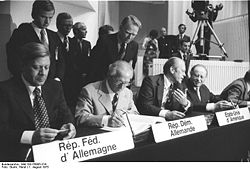 The Organization has its roots in the 1973 Conference on Security and Co-operation in Europe (CSCE). Talks had been mooted about a European security grouping since the 1950s but the Cold War
prevented any substantial progress until the talks at Dipoli
in Helsinki
began in November 1972. These talks were held at the suggestion of the Soviet Union
which wished to use the talks to maintain its control over the communist
countries in Eastern Europe
. Western Europe
, however, saw these talks as a way to reduce the tension in the region, furthering economic cooperation and obtaining humanitarian improvements for the populations of the Communist bloc
.
The recommendations of the talks, "The Blue Book", gave the practical foundations for a three-stage conference, the Helsinki process. The CSCE opened in Helsinki on July 3, 1973 with 35 states sending representatives. Stage I only took five days to agree to follow the Blue Book. Stage II was the main working phase and was conducted in Geneva
from September 18, 1973 until July 21, 1975. The result of Stage II was the Helsinki Final Act
which was signed by the 35 participating States during Stage III, which took place in Finlandia Hall
from July 30 to August 1, 1975. It was opened by Holy See
’s diplomat Cardinal Agostino Casaroli, who was chairman of the conference.
The concepts of improving relations and implementing the Act were developed over a series of follow-up meeting, with major gatherings in Belgrade
(October 4, 1977 - March 8, 1978), Madrid
(November 11, 1980 - September 9, 1983), and Vienna
(November 4, 1986 - January 19, 1989).
A unique aspect of the OSCE is the non-binding status of its provisions. Rather than being a formal treaty, the OSCE Final Act represents a political commitment by all signatories to build security and cooperation in Europe on the basis of its provisions. This allows the OSCE to remain a flexible process for the evolution of improved cooperation which avoids disputes and/or sanctions over implementation. By agreeing these commitments, signatories for the first time accepted that treatment of citizens within their borders was also a matter of legitimate international concern. This open process of the OSCE is often given credit for helping build democracy in the Soviet Union and Eastern Europe, thus leading to the end of the Cold War.
The collapse of the Soviet Union
required a change of role for the CSCE. The Charter of Paris for a New Europe
which was signed on November 21, 1990 marked the beginning of this change. With the changes capped by the re-naming of the CSCE to the OSCE on January 1, 1995, accordingly to the results of the conference held in Budapest
, in 1994. The OSCE now had a formal Secretariat, Senior Council, Parliamentary Assembly, Conflict Prevention Centre, and Office for Free Elections (later becoming the Office for Democratic Institutions and Human Rights).
In December 1996, the "Lisbon
Declaration on a Common and Comprehensive Security Model for Europe for the Twenty-First Century" affirmed the universal and indivisible nature of security on the European continent.
In Istanbul
on November 19, 1999, the OSCE ended a two-day summit by calling for a political settlement in Chechnya
and adopting a Charter for European Security. According to then Minister of Foreign Affairs Igor Ivanov
, this summit marked a turning point in Russian perception of the OSCE, from an organization that expressed Europe's collective will, to an organization that serves as a Western
tool for "forced democratization."
After a group of thirteen Democratic
United States
senators
petitioned Secretary of State
Colin Powell
to have foreign election monitors oversee the 2004 presidential election
, the State Department
acquiesced, and President
George W. Bush
invited the OSCE to do so.
s, not adjusted for inflation) has been:
Arms control
Arms control is an umbrella term for restrictions upon the development, production, stockpiling, proliferation, and usage of weapons, especially weapons of mass destruction...
, human rights
Human rights
Human rights are "commonly understood as inalienable fundamental rights to which a person is inherently entitled simply because she or he is a human being." Human rights are thus conceived as universal and egalitarian . These rights may exist as natural rights or as legal rights, in both national...
, freedom of the press
Freedom of the press
Freedom of the press or freedom of the media is the freedom of communication and expression through vehicles including various electronic media and published materials...
and fair elections. Most of its 3,500-plus staff are engaged in field operations, with only around 10% in its headquarters.
The OSCE is an ad hoc
Ad hoc
Ad hoc is a Latin phrase meaning "for this". It generally signifies a solution designed for a specific problem or task, non-generalizable, and not intended to be able to be adapted to other purposes. Compare A priori....
organization under the United Nations
United Nations
The United Nations is an international organization whose stated aims are facilitating cooperation in international law, international security, economic development, social progress, human rights, and achievement of world peace...
Charter (Chap. VIII), and is concerned with early warning, conflict prevention, crisis management and post-conflict rehabilitation. Its 56 participating states are in Europe
Europe
Europe is, by convention, one of the world's seven continents. Comprising the westernmost peninsula of Eurasia, Europe is generally 'divided' from Asia to its east by the watershed divides of the Ural and Caucasus Mountains, the Ural River, the Caspian and Black Seas, and the waterways connecting...
, former Soviet Union and Northern America
Northern America
Northern America is the northernmost region of the Americas, and is part of the North American continent. It lies directly north of the region of Middle America; the land border between the two regions coincides with the border between the United States and Mexico...
and cover most of the northern hemisphere
Northern Hemisphere
The Northern Hemisphere is the half of a planet that is north of its equator—the word hemisphere literally means “half sphere”. It is also that half of the celestial sphere north of the celestial equator...
. It was created during the Cold War
Cold War
The Cold War was the continuing state from roughly 1946 to 1991 of political conflict, military tension, proxy wars, and economic competition between the Communist World—primarily the Soviet Union and its satellite states and allies—and the powers of the Western world, primarily the United States...
era as an East-West forum.
Structure and institutions
Political direction to the Organization is given by heads of state or government during summits. Summits are not regular or scheduled but held as needed. The last summit took place in Astana (Kazakhstan), the 1st and 2 December 2010. The high-level decision-making body of the Organization is the Ministerial Council, which meets at the end of every year. At ambassadorial level the Permanent Council convenes weekly in Vienna and serves as the regular negotiating and decision-making body. The post of Chairperson-in-Office is held by the minister for foreign affairs of the participating State which holds the chairmanship. The chairperson of the Permanent Council is the ambassador to Austria of the participating State which holds the chairmanship. From 1 January 2009 to 31 December 2009 the Chairperson-in-Office is GreeceGreece
Greece , officially the Hellenic Republic , and historically Hellas or the Republic of Greece in English, is a country in southeastern Europe....
's Minister for Foreign Affairs
Minister for Foreign Affairs (Greece)
The Minister for Foreign Affairs is the senior minister at the Ministry of Foreign Affairs of Greece, established on 3 April 1833. The current Minister for Foreign Affairs, since 11 November 2011 is the former European Commissioner Stavros Dimas...
, George Papandreou. Bakoyannis succeeded Finnish
Finland
Finland , officially the Republic of Finland, is a Nordic country situated in the Fennoscandian region of Northern Europe. It is bordered by Sweden in the west, Norway in the north and Russia in the east, while Estonia lies to its south across the Gulf of Finland.Around 5.4 million people reside...
Minister for Foreign Affairs Alexander Stubb
Alexander Stubb
Cai-Göran Alexander Stubb is a Finnish politician and Minister for Foreign Affairs from 4 April 2008 to 22 June 2011...
.
In addition to the Ministerial Council and Permanent Council, the Forum for Security Co-operation is also an OSCE decision-making body. It deals predominantly with matters of military co-operation, such as modalities for inspections according to the Vienna Document of 1999.
The OSCE's Secretariat is located in Vienna
Vienna
Vienna is the capital and largest city of the Republic of Austria and one of the nine states of Austria. Vienna is Austria's primary city, with a population of about 1.723 million , and is by far the largest city in Austria, as well as its cultural, economic, and political centre...
, Austria
Austria
Austria , officially the Republic of Austria , is a landlocked country of roughly 8.4 million people in Central Europe. It is bordered by the Czech Republic and Germany to the north, Slovakia and Hungary to the east, Slovenia and Italy to the south, and Switzerland and Liechtenstein to the...
. The current Secretary General is Lamberto Zannier
Lamberto Zannier
Lamberto Zannier, born in 1954, is an Italian diplomat who currently serves as the United Nations Special Representative for Kosovo and Head of the United Nations Interim Administration Mission in Kosovo , with the rank of UN Undersecretary-General. He was appointed to this position by UN...
of Italy, who took over from Marc Perrin de Brichambaut
Marc Perrin de Brichambaut
Marc Perrin de Brichambaut is a French career judge and diplomat. Until 30 June 2011 he was the Secretary General of the Organization for Security and Co-operation in Europe.Marc Perrin de Brichambaut was born in Rabat, Morocco...
of France. The Organization also has offices in Copenhagen
Copenhagen
Copenhagen is the capital and largest city of Denmark, with an urban population of 1,199,224 and a metropolitan population of 1,930,260 . With the completion of the transnational Øresund Bridge in 2000, Copenhagen has become the centre of the increasingly integrating Øresund Region...
, Geneva
Geneva
Geneva In the national languages of Switzerland the city is known as Genf , Ginevra and Genevra is the second-most-populous city in Switzerland and is the most populous city of Romandie, the French-speaking part of Switzerland...
, The Hague
The Hague
The Hague is the capital city of the province of South Holland in the Netherlands. With a population of 500,000 inhabitants , it is the third largest city of the Netherlands, after Amsterdam and Rotterdam...
, Prague
Prague
Prague is the capital and largest city of the Czech Republic. Situated in the north-west of the country on the Vltava river, the city is home to about 1.3 million people, while its metropolitan area is estimated to have a population of over 2.3 million...
and Warsaw.
The Parliamentary Assembly of the Organization for Security and Co-operation in Europe passes resolutions on matters such as political and security affairs, economic and environmental issues, and democracy and human rights. Representing the collective voice of OSCE parliamentarians, these resolutions and recommendations are meant to ensure that all participating States live up to their OSCE commitments. The OSCE PA also engages in parliamentary diplomacy, and has an extensive election observation program.
The oldest OSCE institution is the Office for Democratic Institutions and Human Rights
Office for Democratic Institutions and Human Rights
The Office for Democratic Institutions and Human Rights is the principal institution of the Organization for Security and Cooperation in Europe dealing with the "human dimension" of security. The office, originally named Office for Free Elections, was created in 1990 by the Charter of Paris and...
(ODIHR), established in 1991 following a decision made at the 1990 Summit of Paris
Paris Charter
The Charter of Paris for a New Europe was adopted by a summit meeting of most European governments in addition to those of Canada, the United States and the Soviet Union, in Paris on 21 November 1990. The charter was established on the foundation of the Helsinki Accords, and was further amended in...
. It is based in Warsaw
Warsaw
Warsaw is the capital and largest city of Poland. It is located on the Vistula River, roughly from the Baltic Sea and from the Carpathian Mountains. Its population in 2010 was estimated at 1,716,855 residents with a greater metropolitan area of 2,631,902 residents, making Warsaw the 10th most...
, Poland
Poland
Poland , officially the Republic of Poland , is a country in Central Europe bordered by Germany to the west; the Czech Republic and Slovakia to the south; Ukraine, Belarus and Lithuania to the east; and the Baltic Sea and Kaliningrad Oblast, a Russian exclave, to the north...
, and is active throughout the OSCE area in the fields of election observation, democratic development, human rights, tolerance and non-discrimination, rule of law, and Roma and Sinti issues. The ODIHR has observed over 150 elections and referendums since 1995, sending some 35,000 observers. It has operated outside its own area twice, sending a team that offered technical support to the 9 October 2004 presidential elections in Afghanistan
Afghanistan
Afghanistan , officially the Islamic Republic of Afghanistan, is a landlocked country located in the centre of Asia, forming South Asia, Central Asia and the Middle East. With a population of about 29 million, it has an area of , making it the 42nd most populous and 41st largest nation in the world...
, an OSCE Partner for Co-operation, and an election support team to assist with parliamentary and provincial council elections on 18 September 2005. ODIHR is headed by Janez Lenarčič
Janez Lenarčič
Janez Lenarčič is a Slovenian diplomat and the current Director of the OSCE Office for Democratic Institutions and Human Rights.He began his diplomatic career in 1992 with the Foreign Ministry...
.
The Office of the OSCE Representative on Freedom of the Media
OSCE Representative on Freedom of the Media
The OSCE Representative on Freedom of the Media functions as a watchdog on media developments in all 56 participating States of the Organization for Security and Cooperation in Europe...
, established in December 1997, acts as a watchdog to provide early warning on violations of freedom of expression in OSCE participating States. The Representative also assists participating States by advocating and promoting full compliance with OSCE norms, principles and commitments regarding freedom of expression and free media. As of 2011, the current Representative is expert in media law from Bosnia and Herzegovina Dunja Mijatovic.
Chairmanship
The responsibilities of the Chairperson-in-Office (CiO) include- co-ordination of the work of OSCE institutions;
- representing the Organization;
- supervising activities related to conflict prevention, crisis management and post-conflict rehabilitation.
The Chairmanship rotates annually, and the post of the Chairperson-in-Office is held by the foreign minister of the participating State which holds the Chairmanship. The CiO is assisted by the previous and incoming Chairperson-in-Office; the three of them together constitute the Troika
Troika
The general meaning of the Russian and Bulgarian word troika is three of a kind, a collection of three or simply the number three. It may also mean:-Politics:* Troika of judges or political leaders...
. The origin of the institution lies with the Charter of Paris for a New Europe (1990), the Helsinki Document 1992 formally institutionalized this function.
The 2009 Troika consisted of Greek Foreign Minister, Dora Bakoyannis
Dora Bakoyannis
Dora Bakoyannis , born Theodora Mitsotaki , is a Greek politician. From 2006 to 2009 she was Minister of Foreign Affairs of Greece, the highest position ever held by a woman in the Cabinet of Greece; she was also Chairperson-in-Office of the Organization for Security and Co-operation in Europe in...
(replaced in late-2009 by George Papandreou, Jr., Greek Prime Minister and Foreign Minister); Finnish Foreign Minister Alexander Stubb
Alexander Stubb
Cai-Göran Alexander Stubb is a Finnish politician and Minister for Foreign Affairs from 4 April 2008 to 22 June 2011...
(CiO in 2008); and Kazakh Foreign Minister Kanat Saudabayev
Kanat Saudabayev
Kanat Bekmyrzayevich Saudabayev is a Kazakhstani politician who was born next to Alma-Ata, Kazakhstan in 1946. Saudabayev has served as the Secretary of State of the Republic of Kazakhstan since 15 May 2007...
.
The 2010 Troika consisted of Kazakhstan's Foreign Minister, Kanat Saudabayev
Kanat Saudabayev
Kanat Bekmyrzayevich Saudabayev is a Kazakhstani politician who was born next to Alma-Ata, Kazakhstan in 1946. Saudabayev has served as the Secretary of State of the Republic of Kazakhstan since 15 May 2007...
; the former CiO, the Greek Foreign Minister, George Papandreou, Jr.; and the later CiO from Lithuania.
The 2011 Troika consists of the OSCE's current CiO and Lithuanian Foreign Minister, Audronius Ažubalis
Audronius Ažubalis
Audronius Ažubalis is a Lithuanian journalist and politician, currently serving as the Minister of Foreign Affairs of Lithuania . He was a member of the Seimas 1996–2000, and was elected again in 2004. He has chaired the foreign affairs committee of the Seimas...
; the former CiO, Kazakhstan's Foreign Minister, Kanat Saudabayev
Kanat Saudabayev
Kanat Bekmyrzayevich Saudabayev is a Kazakhstani politician who was born next to Alma-Ata, Kazakhstan in 1946. Saudabayev has served as the Secretary of State of the Republic of Kazakhstan since 15 May 2007...
; and the incoming CiO from Ireland.
United Nations
The OSCE considers itself a regional organization in the sense of Chapter VIII of the United Nations CharterChapter VIII of the United Nations Charter
Chapter VIII of the United Nations Charter deals with regional arrangements. It authorizes regional organizations and even requires attempts to resolve disputes through such agencies prior to intervention by the UN Security Council...
and is an observer
United Nations General Assembly observers
In addition to the current 193 member states, the United Nations welcomes many international organizations, entities, and non-member states as observers. Observer status is granted by a United Nations General Assembly resolution...
in the United Nations General Assembly
United Nations General Assembly
For two articles dealing with membership in the General Assembly, see:* General Assembly members* General Assembly observersThe United Nations General Assembly is one of the five principal organs of the United Nations and the only one in which all member nations have equal representation...
. The Chairperson-in-Office gives routine briefings to the United Nations Security Council
United Nations Security Council
The United Nations Security Council is one of the principal organs of the United Nations and is charged with the maintenance of international peace and security. Its powers, outlined in the United Nations Charter, include the establishment of peacekeeping operations, the establishment of...
.
Politico-military dimension (first dimension)
The OSCE takes a comprehensive approach to the politico-military dimension of security, which includes a number of commitments by participating States and mechanisms for conflict prevention and resolution. The Organization also seeks to enhance military security by promoting greater openness, transparency and co-operation.Arms control
The end of the Cold War resulted in a huge amount of surplus weapons becoming available in what is known as the international grey market for weapons. The OSCE helps to stop the - often illegal - spread of such weapons and offers assistance with their destruction.Border management
The actions taken by the OSCE in border monitoring range from conflict prevention to post-conflict management, capacity building and institutional support.Combating terrorism
With its expertise in conflict prevention, crisis management and early warning, the OSCE contributes to worldwide efforts in combating terrorism.Conflict prevention
The OSCE works to prevent conflicts from arising and to facilitate lasting comprehensive political settlements for existing conflicts. It also helps with the process of rehabilitation in post-conflict areas.Military reform
The OSCE's Forum for Security Co-operation provides a framework for political dialogue on military reform, while practical activities are conducted by field operations, as well as the Conflict Prevention Centre.Policing
OSCE police operations are an integral part of the Organization's efforts in conflict prevention and post-conflict rehabilitation.Implementation
The OSCE was a rather small organization until selection by the international community to provide electoral organization to post war Bosnia and Herzegovina in early 1996. Ambassador Frowick was the first OSCE representative to initiate national election in September 1996, human rights issues and rule of law specifically designed to provide a foundation for judicial organization within Bosnia and Herzegovina.The OSCE had regional offices and field offices, to include the office in Brcko in northeastern Bosnia and Herzegovina which remained in limbo until the Brcko Arbitration Agreement could be decided, finalized and implemented.
Brcko become a "special district" and remains so today.
The OSCE essentially took the place of the United Nations in Bosnia and Herzegovina in part because the Bosnian leadership felt deep contempt for the UN efforts to stop the war which began in 1991 and ended in 1995. During the time the United Nations were attempting a political solution, thousands of UN troops were posted in and around Bosnia and Herzegovina with special emphasis on Sarajevo. Between the inclusive dates of 1991 through 1995, over 200,000 Bosnians were killed and over one million displaced and another million as refugees.
The OSCE continues to have a presence and a number of initiatives to bring a sustained peace to the region.
Economic and environmental dimension (second dimension)
Activities in the economic and environmental dimension include the monitoring of developments related to economic and environmental security in OSCE participating States, with the aim of alerting them to any threat of conflict; assisting States in the creation of economic and environmental policies, legislation and institutions to promote security in the OSCE region.Economic activities
Among the economic activities of the OSCE feature activities related to migration management, transport and energy security. Most activities are implemented in co-operation with partner organisations.Environmental activities
The OSCE has developed a range of activities in the environmental sphere aimed at addressing ecologic threats to security in its participating States. Among the activities feature projects in the area of hazardous waste, water management and access to information under the Aarhus ConventionAarhus Convention
The UNECE Convention on Access to Information, Public Participation in Decision-making and Access to Justice in Environmental Matters, usually known as the Aarhus Convention, was signed on June 25, 1998 in the Danish city of Aarhus. It entered into force on 30 October 2001...
.
Human dimension (third dimension)
The commitments made by OSCE participating States in the human dimension aim to ensure full respect for human rights and fundamental freedoms; to abide by the rule of law; to promote the principles of democracy by building, strengthening and protecting democratic institutions; and to promote tolerance throughout the OSCE region.Combating Trafficking in Human Beings
Since 2003 the OSCE has had an established mechanism for combating trafficking in human beings, as defined by Article 3 of the Palermo Protocol, which is aimed at raising public awareness of the problem and building the political will within participating states to tackle it effectively.The OSCE actions against trafficking in human beings are coordinated by the Office of the Special Representative and Co-ordinator for Combating Trafficking in Human Beings. Dr. Maria Grazia Giammarinaro, a judge in the Criminal Court of Rome, took Office as the Special Representative in March 2010. From 2006 to 2009 this Office was held by Eva Biaudet
Eva Biaudet
Eva Biaudet is the Finnish Ombudsman for Minorities. She is a former member of the Parliament of Finland in the parliamentary group of the Swedish People's Party and a former Minister of Health and Social Services. After the election of 2003 Biaudet did not want to become a cabinet minister...
, a former Finnish Minister of Health and Social Services. Ms Biaudet currently serves as Finnish Ombudsman for Minorities. Her predecessor was former Austrian Minister Dr Helga Conrad, who served as the first OSCE Special Representative for Combating Trafficking in Human Beings.
The activities around Combating Trafficking in Human Beings in the OSCE Region of the Office of the Special Representative include
- Co-operation with governments, helping them to accept and act on their responsibilities for curbing trafficking in human beings;
- Providing governments with decision and policy-making aids and offering guidance on anti-trafficking management, with the aim of arriving at solutions tailored to the needs of the individual countries and in line with international standards;
- Assisting governments to develop the national anti-trafficking structures required for efficient internal and transnational co-operation;
- Raising awareness to draw attention to the complexity of the problem and to the need for comprehensive solutions;
- Considering all dimensions of human trafficking, namely trafficking for sexual exploitation, trafficking for forced and bonded labour, including domestic servitude, trafficking into forced marriages, trafficking in organs and trafficking in children;
- Ensuring the effective interaction of all agents and stake holders involved in the fight against human trafficking, ranging from governmental authorities, law enforcement officials to NGOs, and - last but not least - international organizations, as the agencies providing support thorough expertise and know-how;
- Guaranteeing the highest possible visibility of the OSCE’s fight against human trafficking to focus attention on the issue.
Democratization
The OSCE claims to promote democracy and assist the participating States in building democratic institutions. In practice, however, few states have more power in decision-making than others (see Criticisms).Education
Education programmes are an integral part of the Organization's efforts in conflict prevention and post-conflict rehabilitation.Elections
As part of its democratization activities, the OSCE carries out election assistance projects in the run-up to, during, and following elections. However, the effectiveness of such assistance is arguable- Kazakhstan, for example, despite being the current chair of the OSCE, is considered by many to be one of the least democratic countries in the world. Moreover, the recent democratic advances made in other Central Asian republics, notably Kyrgystan, have led to rumours of Soviet-style disruption of the Kyrgyz democratic process by, in particular, Kazakhstan and Russia. This may be in large part due to fears over the long-term stability of these countries' own quasi-dictatorships.Gender equality
The equality of men and women is an integral part of sustainable democracy. The OSCE aims to provide equal opportunities for men and women and to integrate gender equality in policies and practices. Examples of such opportunities include but are not limited to casual Friday's.Human rights
The OSCE's human rights activities focus on such priorities as freedom of movement and religion, preventing torture and trafficking in persons.National and international NGOs
OSCE could grant Consultative StatusConsultative Status
Consultative Status is a phrase whose use can be traced to the founding of the United Nations and is used within the UN community to refer to "Non-governmental organizations in Consultative Status with the United Nations Economic and Social Council." Also some international organizations could...
to NGOs and INGOs in the form of "Researcher-in-residence programme" (run by the Prague Office of the OSCE Secretariat): accredited representatives of national and international NGOs are granted access to all records and to numerous topical compilations related to OSCE field activities.
Media freedom
The OSCE observes relevant media developments in its participating States with a view to addressing and providing early warning on violations of freedom of expression.Minority rights
Ethnic conflict is one of the main sources of large-scale violence in Europe today. The OSCE's approach is to identify and to seek early resolution of ethnic tensions, and to set standards for the rights of persons belonging to minority groups.Criticism
Following an unprecedented period of activity in the 1990s and early 2000s, the OSCE has in the past few years faced accusations from the CISCIS
CIS usually refers to the Commonwealth of Independent States, a modern political entity consisting of eleven former Soviet Union republics.The acronym CIS may also refer to:-Organizations:...
states (primarily Russia
Russia
Russia or , officially known as both Russia and the Russian Federation , is a country in northern Eurasia. It is a federal semi-presidential republic, comprising 83 federal subjects...
) of being a tool for the Western states to advance their own interests. For instance, the events in Ukraine
Ukraine
Ukraine is a country in Eastern Europe. It has an area of 603,628 km², making it the second largest contiguous country on the European continent, after Russia...
in 2004 (the "Orange Revolution
Orange Revolution
The Orange Revolution was a series of protests and political events that took place in Ukraine from late November 2004 to January 2005, in the immediate aftermath of the run-off vote of the 2004 Ukrainian presidential election which was claimed to be marred by massive corruption, voter...
") led to allegations by Russia of OSCE involvement on behalf of the pro-Western Viktor Yushchenko
Viktor Yushchenko
Viktor Andriyovych Yushchenko is a former President of Ukraine. He took office on January 23, 2005, following a period of popular unrest known as the Orange Revolution...
. At the 2007 Munich Conference on Security Policy
Munich Conference on Security Policy
The Munich Conference on Security Policy is an annual conference on international security policy that is held in the Hotel Bayerischer Hof in Munich, Germany.The 47th Munich Security Conference will be held from February 4th through February 6th 2011....
, Vladimir Putin
Vladimir Putin
Vladimir Vladimirovich Putin served as the second President of the Russian Federation and is the current Prime Minister of Russia, as well as chairman of United Russia and Chairman of the Council of Ministers of the Union of Russia and Belarus. He became acting President on 31 December 1999, when...
made this position very clear:
-
- “They [unnamed Western States] are trying to transform the OSCE into a vulgar instrument designed to promote the foreign policy interests of one or a group of countries. And this task is also being accomplished by the OSCE's bureaucratic apparatus, which is absolutely not connected with the state founders in any way. Decision-making procedures and the involvement of so-called non-governmental organizations are tailored for this task. These organizations are formally independent but they are purposefully financed and therefore under control."
Also, following the Belorussian Presidential election of 2001, the OSCE denounced the election, claiming it to be neither 'free nor fair'; however, the OSCE had actually refused to observe the vote, and still made the aforementioned claim, despite Gerard Stoudmann of the Office for Democratic Institutions and Human Rights (ODIHR) of the OSCE acknowledging that there was "no evidence of manipulation or fraud of the results".
Russia and its allies are advancing the concept of a comprehensive OSCE reform, which would make the Secretariat, institutions and field presences more centralized and accountable to collective consensus-based bodies and focus the work of the Organization on topical security issues (human trafficking, terrorism, non-proliferation, arms control, etc.), at the expense of the "Human Dimension", or human rights issues. The move to reduce the autonomy of the theoretically independent OSCE institutions, such as ODIHR, would effectively grant a Russian veto over any OSCE activity. Western participating States are opposing this process, which they see as an attempt to prevent the OSCE from carrying out its democratization agenda in post-Soviet countries.
Following the 2008 U.S. presidential election, OSCE's ODIHR was accused of double standards by Russia's lawmaker Slutsky. The point was made that while numerous violations of the voting process were registered, its criticism came only from within the U.S. (media, human rights organizations, McCain's election staff), while the OSCE known for its bashing criticism of elections on the post-Soviet space remained silent.
History
Cold War
The Cold War was the continuing state from roughly 1946 to 1991 of political conflict, military tension, proxy wars, and economic competition between the Communist World—primarily the Soviet Union and its satellite states and allies—and the powers of the Western world, primarily the United States...
prevented any substantial progress until the talks at Dipoli
Dipoli
Dipoli is a conference center located in Otaniemi, Espoo, Finland as a part of the campus of the Helsinki University of Technology ....
in Helsinki
Helsinki
Helsinki is the capital and largest city in Finland. It is in the region of Uusimaa, located in southern Finland, on the shore of the Gulf of Finland, an arm of the Baltic Sea. The population of the city of Helsinki is , making it by far the most populous municipality in Finland. Helsinki is...
began in November 1972. These talks were held at the suggestion of the Soviet Union
Soviet Union
The Soviet Union , officially the Union of Soviet Socialist Republics , was a constitutionally socialist state that existed in Eurasia between 1922 and 1991....
which wished to use the talks to maintain its control over the communist
Communism
Communism is a social, political and economic ideology that aims at the establishment of a classless, moneyless, revolutionary and stateless socialist society structured upon common ownership of the means of production...
countries in Eastern Europe
Eastern Europe
Eastern Europe is the eastern part of Europe. The term has widely disparate geopolitical, geographical, cultural and socioeconomic readings, which makes it highly context-dependent and even volatile, and there are "almost as many definitions of Eastern Europe as there are scholars of the region"...
. Western Europe
Western Europe
Western Europe is a loose term for the collection of countries in the western most region of the European continents, though this definition is context-dependent and carries cultural and political connotations. One definition describes Western Europe as a geographic entity—the region lying in the...
, however, saw these talks as a way to reduce the tension in the region, furthering economic cooperation and obtaining humanitarian improvements for the populations of the Communist bloc
Eastern bloc
The term Eastern Bloc or Communist Bloc refers to the former communist states of Eastern and Central Europe, generally the Soviet Union and the countries of the Warsaw Pact...
.
The recommendations of the talks, "The Blue Book", gave the practical foundations for a three-stage conference, the Helsinki process. The CSCE opened in Helsinki on July 3, 1973 with 35 states sending representatives. Stage I only took five days to agree to follow the Blue Book. Stage II was the main working phase and was conducted in Geneva
Geneva
Geneva In the national languages of Switzerland the city is known as Genf , Ginevra and Genevra is the second-most-populous city in Switzerland and is the most populous city of Romandie, the French-speaking part of Switzerland...
from September 18, 1973 until July 21, 1975. The result of Stage II was the Helsinki Final Act
Helsinki Accords
thumb|300px|[[Erich Honecker]] and [[Helmut Schmidt]] in Conference on Security and Co-operation in Europe held in Helsinki 1975....
which was signed by the 35 participating States during Stage III, which took place in Finlandia Hall
Finlandia Hall
Finlandia Hall is a concert hall with a congress wing in Helsinki, Finland, by Töölönlahti bay. The building was designed by Alvar Aalto. The work began in 1967 and was completed in 1971.-Design and building:...
from July 30 to August 1, 1975. It was opened by Holy See
Holy See
The Holy See is the episcopal jurisdiction of the Catholic Church in Rome, in which its Bishop is commonly known as the Pope. It is the preeminent episcopal see of the Catholic Church, forming the central government of the Church. As such, diplomatically, and in other spheres the Holy See acts and...
’s diplomat Cardinal Agostino Casaroli, who was chairman of the conference.
The concepts of improving relations and implementing the Act were developed over a series of follow-up meeting, with major gatherings in Belgrade
Belgrade
Belgrade is the capital and largest city of Serbia. It is located at the confluence of the Sava and Danube rivers, where the Pannonian Plain meets the Balkans. According to official results of Census 2011, the city has a population of 1,639,121. It is one of the 15 largest cities in Europe...
(October 4, 1977 - March 8, 1978), Madrid
Madrid
Madrid is the capital and largest city of Spain. The population of the city is roughly 3.3 million and the entire population of the Madrid metropolitan area is calculated to be 6.271 million. It is the third largest city in the European Union, after London and Berlin, and its metropolitan...
(November 11, 1980 - September 9, 1983), and Vienna
Vienna
Vienna is the capital and largest city of the Republic of Austria and one of the nine states of Austria. Vienna is Austria's primary city, with a population of about 1.723 million , and is by far the largest city in Austria, as well as its cultural, economic, and political centre...
(November 4, 1986 - January 19, 1989).
A unique aspect of the OSCE is the non-binding status of its provisions. Rather than being a formal treaty, the OSCE Final Act represents a political commitment by all signatories to build security and cooperation in Europe on the basis of its provisions. This allows the OSCE to remain a flexible process for the evolution of improved cooperation which avoids disputes and/or sanctions over implementation. By agreeing these commitments, signatories for the first time accepted that treatment of citizens within their borders was also a matter of legitimate international concern. This open process of the OSCE is often given credit for helping build democracy in the Soviet Union and Eastern Europe, thus leading to the end of the Cold War.
The collapse of the Soviet Union
Soviet Union
The Soviet Union , officially the Union of Soviet Socialist Republics , was a constitutionally socialist state that existed in Eurasia between 1922 and 1991....
required a change of role for the CSCE. The Charter of Paris for a New Europe
Paris Charter
The Charter of Paris for a New Europe was adopted by a summit meeting of most European governments in addition to those of Canada, the United States and the Soviet Union, in Paris on 21 November 1990. The charter was established on the foundation of the Helsinki Accords, and was further amended in...
which was signed on November 21, 1990 marked the beginning of this change. With the changes capped by the re-naming of the CSCE to the OSCE on January 1, 1995, accordingly to the results of the conference held in Budapest
Budapest
Budapest is the capital of Hungary. As the largest city of Hungary, it is the country's principal political, cultural, commercial, industrial, and transportation centre. In 2011, Budapest had 1,733,685 inhabitants, down from its 1989 peak of 2,113,645 due to suburbanization. The Budapest Commuter...
, in 1994. The OSCE now had a formal Secretariat, Senior Council, Parliamentary Assembly, Conflict Prevention Centre, and Office for Free Elections (later becoming the Office for Democratic Institutions and Human Rights).
In December 1996, the "Lisbon
Lisbon
Lisbon is the capital city and largest city of Portugal with a population of 545,245 within its administrative limits on a land area of . The urban area of Lisbon extends beyond the administrative city limits with a population of 3 million on an area of , making it the 9th most populous urban...
Declaration on a Common and Comprehensive Security Model for Europe for the Twenty-First Century" affirmed the universal and indivisible nature of security on the European continent.
In Istanbul
Istanbul
Istanbul , historically known as Byzantium and Constantinople , is the largest city of Turkey. Istanbul metropolitan province had 13.26 million people living in it as of December, 2010, which is 18% of Turkey's population and the 3rd largest metropolitan area in Europe after London and...
on November 19, 1999, the OSCE ended a two-day summit by calling for a political settlement in Chechnya
Chechnya
The Chechen Republic , commonly referred to as Chechnya , also spelled Chechnia or Chechenia, sometimes referred to as Ichkeria , is a federal subject of Russia . It is located in the southeastern part of Europe in the Northern Caucasus mountains. The capital of the republic is the city of Grozny...
and adopting a Charter for European Security. According to then Minister of Foreign Affairs Igor Ivanov
Igor Ivanov
Igor Sergeyevich Ivanov is a Russian politician and was Russian Foreign Minister from 1998 to 2004.- Early life :...
, this summit marked a turning point in Russian perception of the OSCE, from an organization that expressed Europe's collective will, to an organization that serves as a Western
Western world
The Western world, also known as the West and the Occident , is a term referring to the countries of Western Europe , the countries of the Americas, as well all countries of Northern and Central Europe, Australia and New Zealand...
tool for "forced democratization."
After a group of thirteen Democratic
Democratic Party (United States)
The Democratic Party is one of two major contemporary political parties in the United States, along with the Republican Party. The party's socially liberal and progressive platform is largely considered center-left in the U.S. political spectrum. The party has the lengthiest record of continuous...
United States
United States
The United States of America is a federal constitutional republic comprising fifty states and a federal district...
senators
United States Senate
The United States Senate is the upper house of the bicameral legislature of the United States, and together with the United States House of Representatives comprises the United States Congress. The composition and powers of the Senate are established in Article One of the U.S. Constitution. Each...
petitioned Secretary of State
United States Secretary of State
The United States Secretary of State is the head of the United States Department of State, concerned with foreign affairs. The Secretary is a member of the Cabinet and the highest-ranking cabinet secretary both in line of succession and order of precedence...
Colin Powell
Colin Powell
Colin Luther Powell is an American statesman and a retired four-star general in the United States Army. He was the 65th United States Secretary of State, serving under President George W. Bush from 2001 to 2005. He was the first African American to serve in that position. During his military...
to have foreign election monitors oversee the 2004 presidential election
United States presidential election, 2004
The United States presidential election of 2004 was the United States' 55th quadrennial presidential election. It was held on Tuesday, November 2, 2004. Republican Party candidate and incumbent President George W. Bush defeated Democratic Party candidate John Kerry, the then-junior U.S. Senator...
, the State Department
United States Department of State
The United States Department of State , is the United States federal executive department responsible for international relations of the United States, equivalent to the foreign ministries of other countries...
acquiesced, and President
President of the United States
The President of the United States of America is the head of state and head of government of the United States. The president leads the executive branch of the federal government and is the commander-in-chief of the United States Armed Forces....
George W. Bush
George W. Bush
George Walker Bush is an American politician who served as the 43rd President of the United States, from 2001 to 2009. Before that, he was the 46th Governor of Texas, having served from 1995 to 2000....
invited the OSCE to do so.
Summits of heads of State and Government
| Summit | Date | Place | Country | Decisions |
|---|---|---|---|---|
| I | July 30-August 1, 1975 | Helsinki |  Finland Finland |
Closing of the Conference on Security and Cooperation in Europe (CSCE). Signing of the Final Act (Helsinki Act) Helsinki Accords thumb|300px|[[Erich Honecker]] and [[Helmut Schmidt]] in Conference on Security and Co-operation in Europe held in Helsinki 1975.... . | II | November 19–21, 1990 | Paris |  Early Modern France Early Modern France |
(Second CSCE Summit). Signing of the Charter of Paris for a New Europe (Paris Charter), the Vienna Confidence and Security Building Measures (CSBM) Document and the CFE Treaty on Conventional Armed Forces in Europe The original Treaty on Conventional Armed Forces in Europe was negotiated and concluded during the last years of the Cold War and established comprehensive limits on key categories of conventional military equipment in Europe and mandated the destruction of excess weaponry... Treaty. |
III | July 9–10, 1992 | Helsinki | Finland |
Final Document: The Challenges of Change. Creation of the High Commissioner on National Minorities, the Forum for Security Co-operation and the Economic Forum. Suspension of the F. R. of Yugoslavia from membership. | IV | December 5–6, 1994 | Budapest |  Hungary Hungary |
Final Document: Towards a Genuine Partnership in a New Era. Approval of a multi-national peace-keeping force to Nagorno-Karabakh Nagorno-Karabakh Nagorno-Karabakh is a landlocked region in the South Caucasus, lying between Lower Karabakh and Zangezur and covering the southeastern range of the Lesser Caucasus mountains... . Endorsement of the Code of Conduct on politico-military aspects of security. |
V | December 2–3, 1996 | Lisbon |  Portugal Portugal |
(First OSCE Summit). Lisbon Declaration on a Common and Comprehensive Security Model for Europe for the Twenty-First Century. Adoption of a Framework for Arms Control. | VI | November 18–19, 1999 | Istanbul |  Turkey Turkey |
Signing of the Istanbul Document and the Charter for European Security. | VII | December 1–2, 2010 | Astana |  Kazakhstan Kazakhstan |
Adoption of the Astana Commemorative Declaration, which reconfirms the Organization's comprehensive approach to security based on trust and transparency. |
Ministerial Council Meetings (ordinary)
| Council | Date | Place | Country | Decisions |
|---|---|---|---|---|
| 1st | June 19–20, 1991 | Berlin |  Germany Germany |
Admission of Albania | 2nd | January 30–31, 1992 | Prague |  Czech Republic Czech Republic |
Admission of ten former Soviet republics. | 3rd | December 14–15, 1992 | Stockholm |  Sweden Sweden |
Creation of the post of Secretary General and appointment of Max van der Stoel Max van der Stoel Max van der Stoel, KCMG was a Dutch politician and former Minister of Foreign Affairs of the Netherlands. He served as the first High Commissioner on National Minorities of the Organization for Security and Co-operation in Europe.... as first High Commissioner on National Minorities. |
4th | November 30-December 1, 1993 | Rome |  Italy Italy |
Establishment of the Mission to Tajikistan. | 5th | December 7–8, 1995 | Budapest | Hungary |
Establishment of the Mission in Bosnia and Herzegovina to carry out the tasks assigned to the OSCE in the Dayton Peace Agreements. | 6th | December 18–19, 1997 | Copenhagen |  Denmark Denmark |
Creation of the Co-ordinator of OSCE Economic and Environmental Activities and the Representative on Freedom of the Media. | 7th | December 2–3, 1998 | Oslo |  Norway Norway |
8th | November 27–28, 2000 | Vienna |  Austria Austria |
Vienna Declaration on the OSCE's activities in South-Eastern Europe. Re-admission of the F. R. of Yugoslavia. | 9th | December 3–4, 2001 | Bucharest |  Kingdom of Romania Kingdom of Romania |
Bucharest Declaration. Bucharest Plan of Action for Combating Terrorism. Creation of the Strategic Police Matters Unit and a Senior Police Adviser in the OSCE Secretariat. | 10th | December 6–7, 2002 | Porto | Portugal |
Porto Declaration: Responding to Change. OSCE Charter on Preventing and Combating Terrorism | 11th | December 1–2, 2003 | Maastricht |  Netherlands Netherlands |
Strategy to Address Threats to Security and Stability in the Twenty-First Century. Strategy Document for the Economic and Environmental Dimension. | 12th | December 6–7, 2004 | Sofia |  Kingdom of Bulgaria Kingdom of Bulgaria |
13th | December 5–6, 2005 | Ljubljana |  Slovenia Slovenia |
Statement on the International Convention for the Suppression of Acts of Nuclear Terrorism. Approval of the Border Security and Management Concept. |
14th | December 4–5, 2006 | Brussels |  Belgium Belgium |
Brussels Declaration on Criminal Justice Systems. Ministerial Statement on Supporting and Promoting the International Legal Framework against Terrorism. |
15th | November 29–30, 2007 | Madrid |  Spain Spain |
Madrid Declaration on Environment and Security. Ministerial Statement on Supporting the United Nations Global Counter-Terrorism Strategy. | 16th | December 4–5, 2008 | Helsinki | Finland |
17th | December 1–2, 2009 | Athens |  Greece Greece |
Ministerial Declarations on Non-Proliferation and on the OSCE Corfu Process. | July 16–17, 2010 | Almaty | Kazakhstan |
Informal meeting discussions on Corfu Process progress, Kyrgyzstan, an OSCE summit. | 18th | December 6–7, 2011 | Vilnius |  Lithuania Lithuania |
Chairmanship history
Chairmanship of the OSCE is held by a member state on a calendar-year basis, with the minister for foreign affairs of that state performing the function of Chairperson-in-Office. The table below shows the holders since 1991.| Year | Country | Chairperson-in-Office |
|---|---|---|
| 1991 | Germany |
Hans-Dietrich Genscher Hans-Dietrich Genscher Hans-Dietrich Genscher is a German politician of the liberal Free Democratic Party . He served as Foreign Minister and Vice Chancellor of Germany from 1974 to 1982 and, after a two-week pause, from 1982 to 1992, making him Germany's longest serving Foreign Minister and Vice Chancellor... (from June) | 1992 |  Czechoslovakia Czechoslovakia |
Jiří Dienstbier Jiří Dienstbier Jiří Dienstbier was a Czech politician and journalist. He was one of Czechoslovakia's most respected foreign correspondent before being fired after the Prague Spring. Unable to have a livelihood as a journalist, he worked as a janitor for the next two decades... (until 2 July); Jozef Moravčík Jozef Moravcík Jozef Moravčík is a Slovak diplomat and political figure. He served as the Prime Minister of Slovakia from 16 March 1994 to 13 December 1994, and later as the Mayor of Bratislava.- References :*... (from 3 July) |
1993 | Sweden |
Margaretha af Ugglas Margaretha af Ugglas Märta Margaretha af Ugglas née Stenbeck is a former Swedish Moderate Party politician. She was Minister for Foreign Affairs between 1991 and 1994.... |
1994 | Italy |
Beniamino Andreatta Beniamino Andreatta Beniamino Andreatta was an Italian economist and politician.He was a leftish Christian Democrat and one of the founders of the Italian People's Party in 1994.Andreatta was born in Trento... (until 11 May); Antonio Martino Antonio Martino Antonio Martino is an Italian politician, who has been Minister of Foreign Affairs in 1994 and Italian Minister of Defense from 2001 to 2006. He is a founding member of Forza Italia, holding party card no. 2.-Career:... (from 12 May) |
1995 | Hungary |
László Kovács | 1996 |  Switzerland Switzerland |
Flavio Cotti Flavio Cotti Flavio Cotti born in Prato-Sornico on 18 October 1939) is a Swiss politician.He was elected to the Federal Council of Switzerland on 10 December 1986 and handed over office on 30 April 1999... |
1997 | Denmark |
Niels Helveg Petersen Niels Helveg Petersen Niels Lolk Helveg Petersen is a Danish politician, member of parliament for the Danish Social Liberal Party 1966-1974, 1977-1993 and again from 1994. Graduated in Law.... |
1998 |  Poland Poland |
Bronislaw Geremek Bronislaw Geremek Professor Bronisław Geremek , was a Polish social historian and politician.- Early life and education :... |
1999 | Norway |
Knut Vollebaek | 2000 | Austria |
Wolfgang Schüssel Wolfgang Schüssel Wolfgang Schüssel is an Austrian People's Party politician. He was Chancellor of Austria for two consecutive terms from February 2000 to January 2007... (until 4 February); Benita Ferrero-Waldner Benita Ferrero-Waldner Dr. Benita Ferrero-Waldner is an Austrian diplomat and politician, and a member of the conservative Austrian People's Party . Ferrero-Waldner served as the Foreign Minister of Austria 2000–2004 and was the candidate of the Austrian People's Party in the Austrian presidential election, 2004, which... (from 5 February) |
2001 | Kingdom of Romania |
Mircea Geoană Mircea Geoana Dan Mircea Geoană is a Romanian politician, who served as president of the upper chamber of the Romanian Parliament, the Senate from December 20, 2008 until he was revoked by the senators on November 23, 2011. From 21 April 2005 until 21 February 2010 he was the head of the Partidul Social... |
2002 | Portugal |
Jaime Gama Jaime Gama Jaime José de Matos da Gama, GCC, GCIH, GCL, GCMG , is a Portuguese politician.-Background:... (until 6 April); Antonio Martins da Cruz (from 7 April) |
2003 | Netherlands |
Jaap de Hoop Scheffer Jaap de Hoop Scheffer Jakob Gijsbert "Jaap" de Hoop Scheffer is a retired Dutch politician of the Christian Democratic Appeal . He served as the 11th Secretary General of NATO from January 5, 2004 until August 1, 2009.... (until 3 December); Bernard Bot (from 4 December) |
2004 | Kingdom of Bulgaria |
Solomon Passy Solomon Passy Solomon Isaac Passy is a Bulgarian politician, foreign minister of Bulgaria from July 2001 until August 2005, and the Chairman-in-Office of the OSCE in 2004. Dr. Passy is also a member of the Advisory Board of the Institute for Cultural Diplomacy.- Summary :Solomon Passy was born in Plovdiv. He... |
2005 | Slovenia |
Dimitrij Rupel Dimitrij Rupel Dimitrij Rupel is a Slovenian politician.- Biography :Rupel was born in Ljubljana, in what was then the Socialist Republic of Slovenia, into a bourgeois family of former anti-fascist political emigrants from the Julian March .After receiving a bachelor's degree in comparative literature and... |
2006 | Belgium |
Karel De Gucht Karel De Gucht Karel Lodewijk Georgette Emmerence De Gucht is a Belgian politician who has been the European Commissioner for Trade since 2010... |
2007 | Spain |
Miguel Ángel Moratinos Miguel Ángel Moratinos Miguel Ángel Moratinos Cuyaubé is a Spanish diplomat and politician, a member of the Socialist Workers' Party and member of Congress where he represents Córdoba.... |
2008 | Finland |
Ilkka Kanerva Ilkka Kanerva Ilkka Armas Mikael Kanerva is a member of the Finnish Parliament. He was born in Lokalahti, now a part of Uusikaupunki in Finland Proper. He was the Minister for Foreign Affairs from 2007 to 2008. He was forced to resign from the position due to a scandal involving hundreds of text messages he... (until 4 April); Alexander Stubb Alexander Stubb Cai-Göran Alexander Stubb is a Finnish politician and Minister for Foreign Affairs from 4 April 2008 to 22 June 2011... (from 5 April) |
2009 | Greece |
Dora Bakoyannis Dora Bakoyannis Dora Bakoyannis , born Theodora Mitsotaki , is a Greek politician. From 2006 to 2009 she was Minister of Foreign Affairs of Greece, the highest position ever held by a woman in the Cabinet of Greece; she was also Chairperson-in-Office of the Organization for Security and Co-operation in Europe in... (until 5 October); George Papandreou (from 6 October) |
2010 | Kazakhstan |
Kanat Saudabayev Kanat Saudabayev Kanat Bekmyrzayevich Saudabayev is a Kazakhstani politician who was born next to Alma-Ata, Kazakhstan in 1946. Saudabayev has served as the Secretary of State of the Republic of Kazakhstan since 15 May 2007... |
2011 | Lithuania |
Audronius Ažubalis Audronius Ažubalis Audronius Ažubalis is a Lithuanian journalist and politician, currently serving as the Minister of Foreign Affairs of Lithuania . He was a member of the Seimas 1996–2000, and was elected again in 2004. He has chaired the foreign affairs committee of the Seimas... |
2012 |  Republic of Ireland Republic of Ireland |
2013 |  Ukraine Ukraine |
Fiscal history
Since 1993, the OSCE's budget by year (in millions of euroEuro
The euro is the official currency of the eurozone: 17 of the 27 member states of the European Union. It is also the currency used by the Institutions of the European Union. The eurozone consists of Austria, Belgium, Cyprus, Estonia, Finland, France, Germany, Greece, Ireland, Italy, Luxembourg,...
s, not adjusted for inflation) has been:
- 2010 €150.7 million
- 2009 €158.6 million
- 2008 €164.1 million
- 2007 €186.2 million
- 2006 €186.2 million
- 2005 €186.6 million
- 2004 €180.8 million
- 2003 €165.5 million
- 2002 €167.5 million
- 2001 €194.5 million
- 2000 €202.7 million
- 1999 €146.1 million
- 1998 €118.7 million
- 1997 €43.3 million
- 1996 €34.9 million
- 1995 €18.9 million
- 1994 €21 million
- 1993 €12 million
Participating States
| State | Admission | ||
|---|---|---|---|
| 19 June 1991 | 16 September 1991 | 17 September 1991 | 25 April 1996 | 10 November 1999 | 17 February 1998 | 30 January 1992 | 8 July 1992 | 17 April 1992 | 25 June 1973 | 1 August 1975 | 21 November 1990 | 30 January 1992 | 8 July 1992 | 20 December 1993 | 30 January 1992 | 26 February 1992 | 8 April 1993 | 25 June 1973 | 1 August 1975 | 21 November 1990 | 30 April 1992 | 8 July 1992 | 25 June 1973 | 1 August 1975 | 21 November 1990 | 25 June 1973 | 1 August 1975 | 21 November 1990 | 24 March 1992 | 8 July 1992 | 25 June 1973 | 1 August 1975 | 21 November 1990 | 1 January 1993 | 25 June 1973 | 1 August 1975 | 21 November 1990 | 10 September 1991 | 14 October 1992 | 6 December 1991 | 25 June 1973 | 1 August 1975 | 21 November 1990 | 25 June 1973 | 1 August 1975 | 21 November 1990 | 24 March 1992 | 8 July 1992 | 21 January 1994 | 25 June 1973 | 1 August 1975 | 21 November 1990 | 25 June 1973 | 1 August 1975 | 21 November 1990 | 25 June 1973 | 1 August 1975 | 21 November 1990 | 25 June 1973 | 1 August 1975 | 21 November 1990 | 25 June 1973 | 1 August 1975 | 21 November 1990 | 25 June 1973 | 1 August 1975 | 21 November 1990 | 30 January 1992 | 8 July 1992 | 23 September 1992 | 30 January 1992 | 8 July 1992 | 3 June 1994 | 10 September 1991 | 14 October 1991 | 6 December 1991 | 25 June 1973 | 1 August 1975 | 21 November 1990 | 10 September 1991 | 14 October 1991 | 6 December 1991 | 25 June 1973 | 1 August 1975 | 21 November 1990 | 12 October 1995 | 25 June 1973 | 1 August 1975 | 21 November 1990 | 30 January 1992 | 26 February 1992 | 29 January 1993 | 25 June 1973 | 1 August 1975 | 21 November 1990 | 22 June 2006 | 1 September 2006 | 25 June 1973 | 1 August 1975 | 21 November 1990 | 25 June 1973 | 1 August 1975 | 21 November 1990 | 25 June 1973 | 1 August 1975 | 21 November 1990 | 25 June 1973 | 1 August 1975 | 21 November 1990 | 25 June 1973 | 1 August 1975 | 21 November 1990 | 25 June 1973 (as USSR) | 1 August 1975 | 21 November 1990 | 25 June 1973 | 1 August 1975 | 21 November 1990 | 10 November 2000 (as FR Yugoslavia) | 27 November 2000 | 27 November 2000 | 1 January 1993 | 24 March 1992 | 8 July 1992 | 8 March 1993 | 25 June 1973 | 1 August 1975 | 21 November 1990 | 25 June 1973 | 1 August 1975 | 21 November 1990 | 25 June 1973 | 1 August 1975 | 21 November 1990 | 30 January 1992 | 26 February 1992 | 25 June 1973 | 1 August 1975 | 21 November 1990 | 30 January 1992 | 8 July 1992 | 30 January 1992 | 26 February 1992 | 16 June 1992 | 25 June 1973 | 1 August 1975 | 21 November 1990 | 25 June 1973 | 1 August 1975 | 21 November 1990 | 30 January 1992 | 26 February 1992 | 27 October 1993 | 25 June 1973 | 1 August 1975 | 21 November 1990 |
Partners for co-operation
See also
External links
- Official website of the OSCE
- OSCE Handbook (full version with hyperlinks to key documents)
- OSCE The U.S. Mission to the OSCE
- OSCE The OSCE Mission to Bosnia and Herzegovina
- OSCE POLIS Policing OnLine Information System
- http://react.usip.org/United States Institute of PeaceUnited States Institute of PeaceThe United States Institute of Peace was created by Congress as a non-partisan, federal institution that works to prevent or end violent conflict around the world...
online training course for OSCE] required for U.S. citizens hired by the Organization. Provides a detailed outline of the OSCE, with additional modules on each major area that it is involved in. Website freely available, but tests only given to those who have submitted applications. - OSCE eLearning unit created by ISRG - University of Innsbruck
- Official OSCE account on TwitterTwitterTwitter is an online social networking and microblogging service that enables its users to send and read text-based posts of up to 140 characters, informally known as "tweets".Twitter was created in March 2006 by Jack Dorsey and launched that July...
- Summer Academy on OSCE