


Urmia

Encyclopedia
Demographics
According to official census of 2006, the population of Urmia is about 871,204.Language
The population of Urmia is mainly Azerbaijani peopleAzerbaijani people
The Azerbaijanis are a Turkic-speaking people living mainly in northwestern Iran and the Republic of Azerbaijan, as well as in the neighbourhood states, Georgia, Russia and formerly Armenia. Commonly referred to as Azeris or Azerbaijani Turks , they also live in a wider area from the Caucasus to...
, with Kurdish, Assyrian Christian, and Armenian minorities. No trustworthy linguistic figures based on systematic statistics are available for the city, as various Iranian governments have avoided getting ensnared and entangled by producing data that could be perceived as ethnically provocative .
However the specific Azerbaijani dialect spoken in the city demonstrates a formerly Azari
Azari language
Azari language may refer to:*Azerbaijani language*Azari language...
ground on which the current Azerbaijani (a Turkic) speech is based. Words such as "axir" and "naxir" (rural terms for grazing, from Old Iranian "ahwara*" and "na-hwara*"), "bafa" (also Kurdish "bafe" ~ "bouquet", both from Old Iranian root "wafa-" ~ "weave"), "tun ba tun" or "tumbettun" (a swearword, also Kurdish "tun" ~ "inferno"), which are in common usage in the daily speech of the local Azerbaijani speaking folk, are traced back to an Iranian context .
Religion
The majority of people are followers of Shia IslamIslam
Islam . The most common are and . : Arabic pronunciation varies regionally. The first vowel ranges from ~~. The second vowel ranges from ~~~...
. Also there are Catholic, Protestant
Protestantism
Protestantism is one of the three major groupings within Christianity. It is a movement that began in Germany in the early 16th century as a reaction against medieval Roman Catholic doctrines and practices, especially in regards to salvation, justification, and ecclesiology.The doctrines of the...
and Orthodox
Eastern Orthodox Church
The Orthodox Church, officially called the Orthodox Catholic Church and commonly referred to as the Eastern Orthodox Church, is the second largest Christian denomination in the world, with an estimated 300 million adherents mainly in the countries of Belarus, Bulgaria, Cyprus, Georgia, Greece,...
Christians
Christian
A Christian is a person who adheres to Christianity, an Abrahamic, monotheistic religion based on the life and teachings of Jesus of Nazareth as recorded in the Canonical gospels and the letters of the New Testament...
, followers of Sunni Islam
Sunni Islam
Sunni Islam is the largest branch of Islam. Sunni Muslims are referred to in Arabic as ʾAhl ūs-Sunnah wa āl-Ǧamāʿah or ʾAhl ūs-Sunnah for short; in English, they are known as Sunni Muslims, Sunnis or Sunnites....
, followers of Bahá'í Faith
Bahá'í Faith
The Bahá'í Faith is a monotheistic religion founded by Bahá'u'lláh in 19th-century Persia, emphasizing the spiritual unity of all humankind. There are an estimated five to six million Bahá'ís around the world in more than 200 countries and territories....
, Jews
Jews
The Jews , also known as the Jewish people, are a nation and ethnoreligious group originating in the Israelites or Hebrews of the Ancient Near East. The Jewish ethnicity, nationality, and religion are strongly interrelated, as Judaism is the traditional faith of the Jewish nation...
and followers of different kinds of Sufism
Sufism
Sufism or ' is defined by its adherents as the inner, mystical dimension of Islam. A practitioner of this tradition is generally known as a '...
, while a large part of the population is Atheist
Atheism
Atheism is, in a broad sense, the rejection of belief in the existence of deities. In a narrower sense, atheism is specifically the position that there are no deities...
.
Parks and Touristic Centers
Urmia has many parks and touristic costal villages in the shore of Urmia Lake. The oldest park in Urmia, called Park-e Saat, was established in the first PahlaviPahlavi dynasty
The Pahlavi dynasty consisted of two Iranian/Persian monarchs, father and son Reza Shah Pahlavi and Mohammad Reza Shah Pahlavi The Pahlavi dynasty consisted of two Iranian/Persian monarchs, father and son Reza Shah Pahlavi (reg. 1925–1941) and Mohammad Reza Shah Pahlavi The Pahlavi dynasty ...
's era. Urmia's largest park is Ellar Bagi Park (Azerbaijani "Garden of the Peoples") along the Shahar Chayi, or the "City River".
Parks:
- Park-e Saat (Clock Park)
- Park-e Jangali (Jungle Park)
- Ellar Bagi (Garden of the Peoples)
- Park-e Shahr (City Park)
- Park-e Saheli (Riverside Park)
- Park-e Shaghayegh
- ...
Touristic Costal Villages:
- Chichest
- Bari
- Fanoos
- ...
Sport
Sport is an important part of Urmia's culture. The most popular sport in Urmia is volleyball. Urmia is Iran's volleyball capital ,its because of ranks that Heyat Volleyball Urmia VCHeyat Volleyball Urmia VC
Shahrdari Urmia Club is an Iranian professional volleyball team based in Urmia, Iran. They compete in the Iranian Volleyball Super League.-Sponsorship names:*Moghavemat *Moghavemat Esteghlal *Moghavemat...
got in Iranian Volleyball Super League
Iranian Volleyball Super League
The Iranian Super League is a professional volleyball league in Iran.- 2011/12 teams :* Aluminium Almahdi Bandar Abbas* Barij Esans Kashan* Havosh Gonbad* Giti Pasand Isfahan* Gostaresh Novin Keshavarzi Tehran* Heyat Volleyball Kerman...
and for the great volleyball players that are in Iran men's national volleyball team
Iran men's national volleyball team
The Iran men's national volleyball team is the national men's volleyball team of Iran.Tournament records Summer Olympics -: World Championship -: World Cup -:World Grand Champions Cup-: Asian Championship -: Asian Games -...
and first class coaches in Iran.
2010 Asian Men's Cup Volleyball Championship
2010 Asian Men's Cup Volleyball Championship
The 2010 Asian Men's Cup Volleyball Championship was held at the Ghadir Arena, in Urmia, Iran.-Pools composition:The teams are seeded based on their final ranking at the 2009 Asian Men's Volleyball Championship.* Indonesia withdrew and replaced by ....
was be held in Ghadir Arena in Urmia.
Consulates
| Flag | Country | Address |
|---|---|---|
| Turkey Turkey Turkey , known officially as the Republic of Turkey , is a Eurasian country located in Western Asia and in East Thrace in Southeastern Europe... |
Beheshti Ave., Urmia, Iran |
Ethnography
In accordance with the foreign and old sources, in the lack of accurate and up-to-date estimations, Azerbaijanis form the major ethnic group in the city, while accompanied by KurdishKürd
Kürd or Kyurd or Kyurt may refer to:*Kürd Eldarbəyli, Azerbaijan*Kürd Mahrızlı, Azerbaijan*Kürd, Goychay, Azerbaijan*Kürd, Jalilabad, Azerbaijan*Kürd, Qabala, Azerbaijan*Qurdbayram, Azerbaijan...
, Assyrian
Assyrians in Iran
Assyrians in Iran was a thriving community, but was diminished from around 200,000 prior to the Islamic Revolution in Iran to a mere 50,000....
, and Armenian
Armenians in Iran
Iranian-Armenians , sometimes called Persian-Armenians, are Iranian citizens of Armenian origin. Their number is about 100,000. However, recent estimates put the numbers between 40,000-80,000 due to emigration. They mostly live in Tehran and Jolfa district, Isfahan...
minorities, plus the Karapapakh and some Persian
Persian language
Persian is an Iranian language within the Indo-Iranian branch of the Indo-European languages. It is primarily spoken in Iran, Afghanistan, Tajikistan and countries which historically came under Persian influence...
-speaking Iranians
Iranian peoples
The Iranian peoples are an Indo-European ethnic-linguistic group, consisting of the speakers of Iranian languages, a major branch of the Indo-European language family, as such forming a branch of Indo-European-speaking peoples...
forming the remainder of the population.
The city has been home to various ethnic groups during its long history. For this reason, the demographics of the city have undergone numerous changes. Some historical documents show that at the beginning of the 20th century, the city's population had a significant Christian minority (Assyrians and Armenians). According to Macuch, and Ishaya, the city was the spiritual capital of the Assyrians
Assyrian people
The Assyrian people are a distinct ethnic group whose origins lie in ancient Mesopotamia...
from 1830 to the end of World War I
World War I
World War I , which was predominantly called the World War or the Great War from its occurrence until 1939, and the First World War or World War I thereafter, was a major war centred in Europe that began on 28 July 1914 and lasted until 11 November 1918...
by the influence of four Christian missions. Most of the Assyrian and Armenian population was massacred in 1914 by Ottoman
Ottoman Empire
The Ottoman EmpireIt was usually referred to as the "Ottoman Empire", the "Turkish Empire", the "Ottoman Caliphate" or more commonly "Turkey" by its contemporaries...
forces in what is now referred to as the Assyrian Genocide
Assyrian genocide
The Assyrian Genocide refers to the mass slaughter of the Assyrian/Chaldean/Syriac population of the Ottoman Empire during the 1890s, the First World War, and the period of 1922-1925...
. This led to a shift in the city's demographics. During the era of Reza Shah Pahlavi, Iranian Assyrians were invited to return to the region and several thousand did return.
Museums
- Natural History Museum - Displays the animals native to the vicinity of Urmia.
- Urmia Museum - Archaeological museum affiliated with the faculty of Shahid Beheshti UniversityShahid Beheshti UniversityShahid Beheshti University was formerly The National University of Iran . The university's name was changed during the cultural revolution in Iranian universities, 1980-82. It is located in Evin District and extends into Velenjak District in northwestern Tehran, Iran, on a main campus of...
.
Education
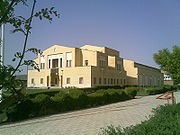
Higher education
Urmia was an important center for higher educationHigher education
Higher, post-secondary, tertiary, or third level education refers to the stage of learning that occurs at universities, academies, colleges, seminaries, and institutes of technology...
approximately a century ago, indeed, medical faculty of Urmia which was built by Joseph Cochran
Joseph Cochran
Joseph Plumb Cochran, M.D. , was an American Presbyterian missionary. He is credited as the founding father of Iran’s first modern Medical School....
and a team of American medical associates in 1878, is the first University of Iran. Unfortunately the faculty became shut down even before establishment of first official university of Iran, University of Tehran
University of Tehran
The University of Tehran , also known as Tehran University and UT, is Iran's oldest university. Located in Tehran, the university is among the most prestigious in the country, and is consistently selected as the first choice of many applicants in the annual nationwide entrance exam for top Iranian...
.
Nowadays Urmia has become a considerable educational city. The city owns state and private universities and institutes listed below.
Universities in Urmia:
| University | Web Site |
|---|---|
| Urmia University Urmia University Urmia University , is a major university in the city of Urmia the Capital of West Azarbaijan province of Iran.... |
http://www.urmia.ac.ir |
| Urmia University of Medical Sciences Urmia University of Medical Sciences Urmia University of Medical Sciences, is a medical school in West Azarbaijan of Iran.Located in the northwestern city of Urmia, the university has been under the Ministry of Health and Medical Education since 1986.... |
http://www.umsu.ac.ir/ |
| Urmia University of Technology | http://www.uut.ac.ir/ |
| Islamic Azad University of Urmia Islamic Azad University Islamic Azad University is a private chain of universities in Iran.Headquartered in Tehran, Iran, the Islamic Azad University was founded in 1982 and currently has an enrollment of 1.5 million students, making it the world's third largest... |
http://www.iaurmia.ac.ir |
| Payame Noor University of Urmia Payame Noor University Payame Noor University is a state distance education university with the headquarters based in Tehran, 30 provincial centers, 485 local study centers and campuses all around the country and one International Study Center located in the headquarters... |
http://umpnu.ac.ir/ |
| Elmi Karbordi University of Urmia | |
| University College of Saba | http://saba.ac.ir/ |
| University College of Azarabadegan | http://uca.ac.ir/ |
| University College of Elm O fan | |
| University College of Kamal | |
| University College of Najand | |
Libraries
- Central Library of Urmia
- Shahid BahonarMohammad Javad BahonarHojatoleslam Mohammad Javad Bahonar was an Iranian scholar, Shiite theologian and politician who served as the Prime minister of Iran from 15 to 30 August 1981 when he was assassinated by Mujahideen-e Khalq MEK, also known as PMOI and KMO...
Library - Library of I.R.Iran Education Ministry
- Library of Urmia Cultural and Artistical Center
- Allame Tabatabayee Library
- Library of Khane-ye-Javan
- Library of Shahid MotahhariMorteza MotahhariAyatollah Murtaza Motahhari was an Iranian scholar, cleric, lecturer, and politician.Motahhari is considered among the important influences on the ideologies of the Islamic Republic, and was a co-founder of Hosseiniye Ershad and the Combatant Clergy Association...
- Library of kanoon parvaresh fekri
- Library of Ghaem
- Library of Imam Ali
Television
Urmia has one state television channel that broadcasts in both PersianPersian language
Persian is an Iranian language within the Indo-Iranian branch of the Indo-European languages. It is primarily spoken in Iran, Afghanistan, Tajikistan and countries which historically came under Persian influence...
and Azerbaijani language
Azerbaijani language
Azerbaijani or Azeri or Torki is a language belonging to the Turkic language family, spoken in southwestern Asia by the Azerbaijani people, primarily in Azerbaijan and northwestern Iran...
. It broadcasts internationally through satellite Intelsat 902.
Radio
Urmia has one radio channel broadcasting in both PersianPersian language
Persian is an Iranian language within the Indo-Iranian branch of the Indo-European languages. It is primarily spoken in Iran, Afghanistan, Tajikistan and countries which historically came under Persian influence...
, Kurdish
Kurdish language
Kurdish is a dialect continuum spoken by the Kurds in western Asia. It is part of the Iranian branch of the Indo-Iranian group of Indo-European languages....
and Azerbaijani language
Azerbaijani language
Azerbaijani or Azeri or Torki is a language belonging to the Turkic language family, spoken in southwestern Asia by the Azerbaijani people, primarily in Azerbaijan and northwestern Iran...
s.and has a local radio that call Chichest.
Health systems
The government of Iran operates the public hospitalHospital
A hospital is a health care institution providing patient treatment by specialized staff and equipment. Hospitals often, but not always, provide for inpatient care or longer-term patient stays....
s in the Urmia metropolitan region, some of which are aligned with medical faculties. There are also a number of private hospitals and medical centers in the city.
Transportation
Inner City:Most Urmia residents travel by car through the system of roads and highway
Highway
A highway is any public road. In American English, the term is common and almost always designates major roads. In British English, the term designates any road open to the public. Any interconnected set of highways can be variously referred to as a "highway system", a "highway network", or a...
s. Urmia is also served by taxi and bus.
- TaxiTaxicabA taxicab, also taxi or cab, is a type of vehicle for hire with a driver, used by a single passenger or small group of passengers, often for a non-shared ride. A taxicab conveys passengers between locations of their choice...
and Public BusBusA bus is a road vehicle designed to carry passengers. Buses can have a capacity as high as 300 passengers. The most common type of bus is the single-decker bus, with larger loads carried by double-decker buses and articulated buses, and smaller loads carried by midibuses and minibuses; coaches are...
Urmia has taxi and public bus network. There are also some private groups, which provide services called Phone-taxi.
and urmia metro lines is under the research.
International:
- Roads
Urmia is linked to Europe
Europe
Europe is, by convention, one of the world's seven continents. Comprising the westernmost peninsula of Eurasia, Europe is generally 'divided' from Asia to its east by the watershed divides of the Ural and Caucasus Mountains, the Ural River, the Caspian and Black Seas, and the waterways connecting...
through Turkey
Turkey
Turkey , known officially as the Republic of Turkey , is a Eurasian country located in Western Asia and in East Thrace in Southeastern Europe...
's roads
Road 32 (Iran)
Road 32 is a road in Northwestern part of Iran. It starts from Tehran and it runs from Tehran to Tabriz along Freeway 2 and from Tabriz to Bazargan, Turkish border....
and Sero border.
- Railways
The city is going to link to Iran
Iran
Iran , officially the Islamic Republic of Iran , is a country in Southern and Western Asia. The name "Iran" has been in use natively since the Sassanian era and came into use internationally in 1935, before which the country was known to the Western world as Persia...
National Railways (IRIR, Persian
Persian language
Persian is an Iranian language within the Indo-Iranian branch of the Indo-European languages. It is primarily spoken in Iran, Afghanistan, Tajikistan and countries which historically came under Persian influence...
: رجا ).
- Airport
Urmia Airport
Urmia Airport
Urmia Airport is an airport in Urmia, a city in the West Azarbaijan Province of Iran. Alternate spellings of the city and airport name include Urmieh, Uromiyeh, Orumieh, and Orumiyeh.-Airlines and destinations:-Accidents and incidents:...
opened in 1964 and is the first international airport in West Azerbaijan county, Iran
Iran
Iran , officially the Islamic Republic of Iran , is a country in Southern and Western Asia. The name "Iran" has been in use natively since the Sassanian era and came into use internationally in 1935, before which the country was known to the Western world as Persia...
.
Its international air routes are to the following cities:
-
 DubaiDubaiDubai is a city and emirate in the United Arab Emirates . The emirate is located south of the Persian Gulf on the Arabian Peninsula and has the largest population with the second-largest land territory by area of all the emirates, after Abu Dhabi...
-
 IstanbulIstanbulIstanbul , historically known as Byzantium and Constantinople , is the largest city of Turkey. Istanbul metropolitan province had 13.26 million people living in it as of December, 2010, which is 18% of Turkey's population and the 3rd largest metropolitan area in Europe after London and...
-
 MeccaMeccaMecca is a city in the Hijaz and the capital of Makkah province in Saudi Arabia. The city is located inland from Jeddah in a narrow valley at a height of above sea level...
-
 DamascusDamascusDamascus , commonly known in Syria as Al Sham , and as the City of Jasmine , is the capital and the second largest city of Syria after Aleppo, both are part of the country's 14 governorates. In addition to being one of the oldest continuously inhabited cities in the world, Damascus is a major...
-
 BakuBakuBaku , sometimes spelled as Baki or Bakou, is the capital and largest city of Azerbaijan, as well as the largest city on the Caspian Sea and of the Caucasus region. It is located on the southern shore of the Absheron Peninsula, which projects into the Caspian Sea. The city consists of two principal...
-
 YerevanYerevanYerevan is the capital and largest city of Armenia and one of the world's oldest continuously-inhabited cities. Situated along the Hrazdan River, Yerevan is the administrative, cultural, and industrial center of the country...
-
 ArbilArbilArbil / Hewlêr is the fourth largest city in Iraq after Baghdad, Basra and Mosul...
and Dohuk and KarbalaKarbalaKarbala is a city in Iraq, located about southwest of Baghdad. Karbala is the capital of Karbala Governorate, and has an estimated population of 572,300 people ....
Other west azerbaijan international airport is Khoy airport.
Domestic air routes to:Tehran
Tehran
Tehran , sometimes spelled Teheran, is the capital of Iran and Tehran Province. With an estimated population of 8,429,807; it is also Iran's largest urban area and city, one of the largest cities in Western Asia, and is the world's 19th largest city.In the 20th century, Tehran was subject to...
, Mashhad
Mashhad
Mashhad , is the second largest city in Iran and one of the holiest cities in the Shia Muslim world. It is also the only major Iranian city with an Arabic name. It is located east of Tehran, at the center of the Razavi Khorasan Province close to the borders of Afghanistan and Turkmenistan. Its...
, Kish Island, Shiraz
Shiraz
Shiraz may refer to:* Shiraz, Iran, a city in Iran* Shiraz County, an administrative subdivision of Iran* Vosketap, Armenia, formerly called ShirazPeople:* Hovhannes Shiraz, Armenian poet* Ara Shiraz, Armenian sculptor...
, Esfahan.
Notable people
- Joseph CochranJoseph CochranJoseph Plumb Cochran, M.D. , was an American Presbyterian missionary. He is credited as the founding father of Iran’s first modern Medical School....
(جوزف کاکرن) : the founding father of Iran’s first modern Medical School - Dada Katyb (دده کاتیب): One of the great poets of AzerbaijanAzerbaijan (Iran)Azerbaijan or Azarbaijan , also Iranian Azerbaijan, Persian Azarbaijan is a region in northwestern Iran. It is also historically known as Atropatene and Aturpatakan....
- Safi al-Din al-Urmawi (صفی الدین اورموی): Iranian AzerbaijaniIranian AzerbaijanisIranian Azerbaijanis also known as Iranian Azeris, Iranian Turks, Azeri Turks or Persian Azerbaijanis, are Iranians of Azerbaijani ethnicity. Iranian Azeris are mainly found in the northwest provinces of East Azerbaijan, Ardabil, Zanjan, parts of West Azerbaijan, and in smaller numbers, in other...
Music Theorist - Heidar Amou OghlyHaydar Khan e Amo-oghliHaydar Khan e Amo-oghli or Haidar Khan Amu Ogly Tariverdiev - a revolutionary activist who acted in Iran, Republic of Azerbaijan and Central Asia and used terror to radicalize Persian politics in the early 20th century.-Early years:He was born in Salmas or Urmiainto the Tariverdiev family and...
(حیدرخان عمواوغلی): founder of the Communist Party of IranCommunist Party of Iran (1920)The Communist Party of Iran was an Iranian communist party founded in June 1920 in Bandar-e Anzali .Haydar Khan e Amo-oghli, one of the leaders of the Constitutional Revolution of Iran, was elected as its general secretary...
and the first Secretary of the Communist Party of Iran and effective activist movement Constitutional - Reza MoridiReza MoridiReza Moridi is a Canadian politician, and the first Iranian-Canadian elected to a provincial or federal legislature in Canada. He was elected to the Legislative Assembly of Ontario in the 2007 provincial election, representing the riding of Richmond Hill...
(رضا مریدی): FirstIranian AzerbaijaniIranian AzerbaijanisIranian Azerbaijanis also known as Iranian Azeris, Iranian Turks, Azeri Turks or Persian Azerbaijanis, are Iranians of Azerbaijani ethnicity. Iranian Azeris are mainly found in the northwest provinces of East Azerbaijan, Ardabil, Zanjan, parts of West Azerbaijan, and in smaller numbers, in other...
and second Iranian who is Canadian politician and is in legislative assembly of this country - Habib MohebianHabib MohebianHabib is a Persian singer-songwriter, first became seriously passionate about music and playing guitar in the last years of high school. He participated in a nationwide competition held by the Iranian Radio and Television Broadcasting and was chosen as one of the 16 short listed candidates...
(حبیب محبیان): known as Habib, a pop musician - Ali Abdolalizadeh (علی عبدالعلی زاده):Minister of Housing and Urban Development in the government of Mohammad KhatamiMohammad KhatamiSayyid Mohammad Khātamī is an Iranian scholar, philosopher, Shiite theologian and Reformist politician. He served as the fifth President of Iran from August 2, 1997 to August 3, 2005. He also served as Iran's Minister of Culture in both the 1980s and 1990s...
- Masoud PezeshkianMasoud PezeshkianMasood Pezeshkian was Minister of Health and Medical Education of Iran between 2001 and 2005. He was also the chancellor of Tabriz University of Medical Sciences for 7 years. He is a heart surgeon and he is an academic member of Tabriz University of Medical Sciences at the present time. He is...
(مسعود پزشکیان): Minister of Health and Medical Education in the government of Mohammad KhatamiMohammad KhatamiSayyid Mohammad Khātamī is an Iranian scholar, philosopher, Shiite theologian and Reformist politician. He served as the fifth President of Iran from August 2, 1997 to August 3, 2005. He also served as Iran's Minister of Culture in both the 1980s and 1990s... - Abdul Rahman GhassemlouAbdul Rahman GhassemlouAbdul Rahman Ghassemlou was a Kurdish political leader.Ghassemlou was the leader of the Kurdistan Democratic Party of Iran from 1973 to 1989, when he was assassinated by perpetrators thought to be agents of the Islamic...
(عەبدولڕەحمان قاسملوو): the leader of the Democratic Party of Iranian Kurdistan (Partiya Demokrata Kurdistana Îranê - PDKÎ) from 1973 to 1989. - Gholamreza HassaniGholamreza HassaniHojatoleslam Gholamreza Hassani is the Friday prayer imam at the Masjid-e-Jamé mosque in the city of Urmia in northwest Iran, and representative of the Iranian Supreme Leader in East Azarbaijan Province. He has been described as one of the most, if not the most, conservative voices in Iran...
(غلامرضا حسنی): Supreme leader's representative in province. - Parviz FattahParviz FattahParviz Fattah is an Iranian politician, former member of Revolutionary Guard and former Iran's Minister of Energy in Mahmoud Ahmadinejad's cabinet -Biography:...
(سید پرویز فتاح) : Energy Minister in the ninth government - Sadeg Mahsouli (صادق محصولی) : prime minister ninth government
- Eskandar Neemati (اسکندر نعمتی): To deliver victory in the Islamic Revolution and the role in war, and developed many students.
- Nasrin Moghanlu (نسرین مقانلو): is an Iranian AzerbaijaniIranian AzerbaijanisIranian Azerbaijanis also known as Iranian Azeris, Iranian Turks, Azeri Turks or Persian Azerbaijanis, are Iranians of Azerbaijani ethnicity. Iranian Azeris are mainly found in the northwest provinces of East Azerbaijan, Ardabil, Zanjan, parts of West Azerbaijan, and in smaller numbers, in other...
actress - Homa Nateg (هما ناطق): writer, researcher and professor in the field of history. Who in 1359 returned to France to research and teaching at the Sorbonne payment.
- Sepehr Haghighat Afshar Rogu (سپهر حقیقت افشار روقو) :Iranian AzerbaijaniIranian AzerbaijanisIranian Azerbaijanis also known as Iranian Azeris, Iranian Turks, Azeri Turks or Persian Azerbaijanis, are Iranians of Azerbaijani ethnicity. Iranian Azeris are mainly found in the northwest provinces of East Azerbaijan, Ardabil, Zanjan, parts of West Azerbaijan, and in smaller numbers, in other...
Professor in the field of sociology. Graduated from Sharif University of Technology. - Shahid Mehdi BakeriMehdi BakeriMehdi Bakeri was an Iranian war hero in the Iran–Iraq War. He was graduated in Mechanical Engineering from University of Tabriz. During the revolution on 1979 he joined to the revolution and just after revolution he was chosen as the mayor of Urmia, West Azerbaijan, Iran...
and Hamid Bakeri (شهید مهدی و حمید باکری):Iranian AzerbaijaniIranian AzerbaijanisIranian Azerbaijanis also known as Iranian Azeris, Iranian Turks, Azeri Turks or Persian Azerbaijanis, are Iranians of Azerbaijani ethnicity. Iranian Azeris are mainly found in the northwest provinces of East Azerbaijan, Ardabil, Zanjan, parts of West Azerbaijan, and in smaller numbers, in other...
Sardars in iran -iraq war and urmia mayior. - Shahid Mehdi Amini (شهید مهدی امینی) : Iranian AzerbaijaniIranian AzerbaijanisIranian Azerbaijanis also known as Iranian Azeris, Iranian Turks, Azeri Turks or Persian Azerbaijanis, are Iranians of Azerbaijani ethnicity. Iranian Azeris are mainly found in the northwest provinces of East Azerbaijan, Ardabil, Zanjan, parts of West Azerbaijan, and in smaller numbers, in other...
Sardar in iran-iraq war. - Hesam aldin Chalabi (حسام الدین چلبی) :Iranian AzerbaijaniIranian AzerbaijanisIranian Azerbaijanis also known as Iranian Azeris, Iranian Turks, Azeri Turks or Persian Azerbaijanis, are Iranians of Azerbaijani ethnicity. Iranian Azeris are mainly found in the northwest provinces of East Azerbaijan, Ardabil, Zanjan, parts of West Azerbaijan, and in smaller numbers, in other...
who was Molana Rumi's follower. - Ayatollah Khoei (آیت الله خویی) : Islamic Regional Leadedr.
- Dr HadidiHadidiOne of the families of Jordan. The tribe is situated in As-Salt, the first capital of Jordan, which is located in the middle of the Hashemite kingdom of Jordan. Most of the members of this family are highly educated people and occupying very good positions in Jordan.There are also parts of the...
(دکتر حدیدی) :Iranian AzerbaijaniIranian AzerbaijanisIranian Azerbaijanis also known as Iranian Azeris, Iranian Turks, Azeri Turks or Persian Azerbaijanis, are Iranians of Azerbaijani ethnicity. Iranian Azeris are mainly found in the northwest provinces of East Azerbaijan, Ardabil, Zanjan, parts of West Azerbaijan, and in smaller numbers, in other...
Professor of Electronic. He desighn a high spead proccesors. - Professor Khodabakhsh (پروفسور خدابخش) :Iranian AzerbaijaniIranian AzerbaijanisIranian Azerbaijanis also known as Iranian Azeris, Iranian Turks, Azeri Turks or Persian Azerbaijanis, are Iranians of Azerbaijani ethnicity. Iranian Azeris are mainly found in the northwest provinces of East Azerbaijan, Ardabil, Zanjan, parts of West Azerbaijan, and in smaller numbers, in other...
Professor of Nicular Physics.
See also
- Urmia CountyUrmia CountyUrmia County is a county in West Azerbaijan Province in Iran. The capital of the county is Urmia. At the 2006 census, the county's population was 856,914, in 215,342 families...
- Lake UrmiaLake UrmiaLake Urmia , ancient name: Lake Matiene) is a salt lake in northwestern Iran, near Iran's border with Turkey. The lake is between the Iranian provinces of East Azerbaijan and West Azerbaijan, west of the southern portion of the similarly shaped Caspian Sea...
- West Azerbaijan Province
- TabrizTabrizTabriz is the fourth largest city and one of the historical capitals of Iran and the capital of East Azerbaijan Province. Situated at an altitude of 1,350 meters at the junction of the Quri River and Aji River, it was the second largest city in Iran until the late 1960s, one of its former...
- ArdabilArdabilArdabil is a historical city in north-western Iran. The name Ardabil probably comes from the Zoroastrian name of "Artavil" which means a holy place. Ardabil is the center of Ardabil Province. At the 2006 census, its population was 412,669, in 102,818 families...
- Zanjan ProvinceZanjan ProvinceZanjan Province is one of the 31 provinces of Iran. Located in the North West of Iran, its capital is Zanjan city. Zanjan province with an area of 36,400 km² has a mostly rural, population of 964,601 . The province lies 330 km northwest of Tehran, connected to it via a freeway.Zanjan...
- Azerbaijanis
External links
- www.urmia.ir
- The Governor of West Azarbaijan Province
- Urmia sport news agency
- Urmia Branch of Ministry of Economic Affairs and Finance
- Urmia Branch of Ministry of Internal Affairs
- Urmia Road and Transportation Office
- Urmiya, By V. Minorsky and C.E. Bosworth, in Encyclopaedia of IslamEncyclopaedia of IslamThe Encyclopaedia of Islam is an encyclopaedia of the academic discipline of Islamic studies. It embraces articles on distinguished Muslims of every age and land, on tribes and dynasties, on the crafts and sciences, on political and religious institutions, on the geography, ethnography, flora and...
. - Columbia Free Dictionary: Urmia