

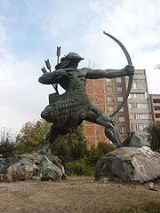
Haik

Encyclopedia
Hayk Nahapet is the legendary patriarch and founder of the Armenian nation
. His story is told in the History of Armenia
attributed to the Armenian historian Movses Khorenatsi (410 to 490 AD).
), the self-designation of the Armenians.
Hayk would then be an aitiological founding figure, like e.g. Asshur
for the Assyrians, Indra
for the India
ns, etc. One of Hayk's most famous scions, Aram
, settled in Eastern Armenia
from the Mitanni
kingdom (Western Armenia
), when Sargon II
mentions a king of part of Armenia who bore the (Armenian
-Indo-Iranian
) name Bagatadi ("Theodore").
A connection was made in Armenian historiography of the Soviet era, with Hayasa mentioned in Hittite
inscriptions.
The Armenian word haykakan finds its stem in this progenitor.
& Tiras
, Torgom
, Hayk, and his descendants as Armanak, Aramais, Amasya
, Gegham, Harma, Aram
and Ara Geghetsik. Hayk was also the founder of the Haykazuni Dynasty. Some of the prominent Armenian royal houses such as the Bagratuni
, Khorkhoruni
, Bznuni
, Syuni, Vahevuni
, Manavazian
, Arran among others, had traced their genealogy to Hayk Nahapet. According to Juansher
Hayk "..was prince of the seven brothers and stood in service to the giant Nimrod (Nebrovt') who first ruled the entire world as king."
had a child named Armanak while he was living in Babylon
. After the arrogant Titan
id Bel
made himself king over all, Hayk emigrated to the region near Mount Ararat
with an extended household of at least 300 and settled there, founding a village he named Haykashen. On the way he had left a detachment in another settlement with his grandson Kadmos. Bel sent one of his sons to entreat him to return, but was refused. Bel decided to march against him with a massive force, but Hayk was warned ahead of time by Kadmos of his pending approach. He assembled his own army along the shore of Lake Van
and told them that they must defeat and kill Bel, or die trying to do so, rather than become his slaves. In his writings Movses states that:
), with the king in the vanguard.
At Dyutsaznamart , near Julamerk southeast of Lake Van
, on August 11, 2492 BC (according to the Armenian traditional chronology) or 2107 BC (according to "The Chronological table" of Mikael Chamchian), Hayk slew Bel with a nearly impossible shot using a long bow, sending the king's forces into disarray.
The hill where Bel with his warriors fell, Hayk named Gerezmank meaning "tombs". He embalmed the corpse of Bel and ordered it to be taken to Hark where it was to be buried in a high place in the view of the wives and sons of the king.
Soon after, Hayk established the fortress of Haykaberd
at the battle site and the town of Haykashen in the Armenian province of Taron
(modern-day Turkey). He named the region of the battle Hayk, and the site of the battle Hayots Dzor
or Nimrod. Hayk is also the name of the Orion constellation in the Armenian translation of the Bible. Just as Hayk fled from Babylon because of Bel, whom he eventually killed, so Zeus
had escaped to the mountains of the Caucasus, later to return to Sicily and hurl fatal arrows into the bodies of his titanic foes. Some Armenians hold that the Greek stories of Hercules are based on Hayk.
Armenians
Armenian people or Armenians are a nation and ethnic group native to the Armenian Highland.The largest concentration is in Armenia having a nearly-homogeneous population with 97.9% or 3,145,354 being ethnic Armenian....
. His story is told in the History of Armenia
History of Armenia (Moses of Chorene)
The History of Armenia attributed to Moses Khorenatsi is an early account of Armenia, covering the mythological origins of the Armenian people as well as Armenia's interaction with Sassanid, Byzantine and Arsacid empires down to the 5th century....
attributed to the Armenian historian Movses Khorenatsi (410 to 490 AD).
Etymology
The name of the patriarch, Hayk is not exactly homophonous with the name for "Armenia", Hayk’. Հայք Hayk’ is the nominative plural in Classical Armenian of հայ (hay), the Armenian term for "Armenian." Some claim that the etymology of Hayq (Հայք) from Hayk (Հայկ) is impossible and that origin of the term Hay ("Armenian") is verifiable. Nevertheless, Hayk and Hayq are usually connected to hay (հայ) and hayer (հայեր, the nominative plural in Modern ArmenianModern Armenian
Modern Armenian is the written form of the Armenian language which came to be used starting in the 18th century.Modern Armenian has two branches:#Western Armenian...
), the self-designation of the Armenians.
Hayk would then be an aitiological founding figure, like e.g. Asshur
Assur
Assur , was one of the capitals of ancient Assyria. The remains of the city are situated on the western bank of river Tigris, north of the confluence with the tributary Little Zab river, in modern day Iraq, more precisely in the Al-Shirqat District .Assur is also...
for the Assyrians, Indra
Indra
' or is the King of the demi-gods or Devas and Lord of Heaven or Svargaloka in Hindu mythology. He is also the God of War, Storms, and Rainfall.Indra is one of the chief deities in the Rigveda...
for the India
India
India , officially the Republic of India , is a country in South Asia. It is the seventh-largest country by geographical area, the second-most populous country with over 1.2 billion people, and the most populous democracy in the world...
ns, etc. One of Hayk's most famous scions, Aram
Aram
-Bible:* Aram, son of Shem, according to the "Table of Nations" in Genesis 10* Aram-Naharaim , the land in which the city of Haran lay* Aram , an ancient region containing the state of Aram Damascus...
, settled in Eastern Armenia
Eastern Armenia
Eastern Armenia or Caucasian Armenia was the portion of Ottoman Armenia and Persian Armenia that was ceded to the Russian Empire following the Russo-Turkish War, 1828-1829...
from the Mitanni
Mitanni
Mitanni or Hanigalbat was a loosely organized Hurrian-speaking state in northern Syria and south-east Anatolia from ca. 1500 BC–1300 BC...
kingdom (Western Armenia
Western Armenia
Western Armenia is a term, primarily used by Armenians, to refer to Armenian-inhabited areas of the Armenian Highland that were part of the Ottoman Empire and now are part of the Republic of Turkey....
), when Sargon II
Sargon II
Sargon II was an Assyrian king. Sargon II became co-regent with Shalmaneser V in 722 BC, and became the sole ruler of the kingdom of Assyria in 722 BC after the death of Shalmaneser V. It is not clear whether he was the son of Tiglath-Pileser III or a usurper unrelated to the royal family...
mentions a king of part of Armenia who bore the (Armenian
Armenian language
The Armenian language is an Indo-European language spoken by the Armenian people. It is the official language of the Republic of Armenia as well as in the region of Nagorno-Karabakh. The language is also widely spoken by Armenian communities in the Armenian diaspora...
-Indo-Iranian
Indo-Iranian languages
The Indo-Iranian language group constitutes the easternmost extant branch of the Indo-European family of languages. It consists of three language groups: the Indo-Aryan, Iranian and Nuristani...
) name Bagatadi ("Theodore").
A connection was made in Armenian historiography of the Soviet era, with Hayasa mentioned in Hittite
Hittite language
Hittite is the extinct language once spoken by the Hittites, a people who created an empire centred on Hattusa in north-central Anatolia...
inscriptions.
The Armenian word haykakan finds its stem in this progenitor.
Genealogy
Movses gave Hayk's genealogy as follows: Japhet, GomerGomer (Bible)
Gomer was the eldest son of Japheth , and father of Ashkenaz, Riphath, and Togarmah, according to the "Table of Nations" in the Hebrew Bible, ....
& Tiras
Tiras
Tiras was, according to and Chronicles 1, the last-named son of Japheth who is otherwise unmentioned in the Hebrew Bible. According to the Book of Jubilees, the inheritance of Tiras consisted of four large islands in the ocean....
, Torgom
Togarmah
Togarmah third son of Gomer, and grandson of Japheth, brother of Ashkenaz and Riphat...
, Hayk, and his descendants as Armanak, Aramais, Amasya
Amasya
- History :Its location in this steep valley makes the city a mountain stronghold, easy to defend, and thus Amasya has had a long and prominent history.-Antiquity:...
, Gegham, Harma, Aram
Aram
-Bible:* Aram, son of Shem, according to the "Table of Nations" in Genesis 10* Aram-Naharaim , the land in which the city of Haran lay* Aram , an ancient region containing the state of Aram Damascus...
and Ara Geghetsik. Hayk was also the founder of the Haykazuni Dynasty. Some of the prominent Armenian royal houses such as the Bagratuni
Bagratuni Dynasty
The Bagratuni, Bagratid or alternatively Pakradouni royal dynasty of Armenia was a royal family whose branches formerly ruled many regional polities, including the Armenian lands of Sper|presently Ispir in Tayk Province of the Armenian Kingdom, Bagrevand in Ayrarat Province of the Armenian...
, Khorkhoruni
Khorkhoruni
Khorkhoruni was a region and a noble family of ancient and medieval Armenia c. 400–800.The known rulers are:*Gadecho Khorkhoruni c. 445*Khoren I Khorkhoruni c. 450*Gadich Khorkhoruni c. 451*Khoren II Khorkoruni c. 451*Gardchuyl Khorkhoruni c. 480...
, Bznuni
Bznuni
Bznuni was a minor noble family of old Armenia that ruled Bznuniq until c. 335....
, Syuni, Vahevuni
Vahevuni
Vahevuni was a region and family of the old Armenia c. 400–800.The main known rulers are:*Many Vahevuni c. 445*Gut or Giut Vahevuni c. 445*Bachel or Barchel Vahevuni c. 480*Samuel Vahevuni c. 590*Khosrov c. 595*Theodoros c. 640...
, Manavazian
Manavazian
Manavazian was a region and a family of the old Armenia c. 300–800, in the region of Manazkert....
, Arran among others, had traced their genealogy to Hayk Nahapet. According to Juansher
Juansheriani
Juansheriani were an offshoot of the royal Chosroid dynasty of Iberia whose appanage consisted of lands in Inner Iberia and in Kakheti....
Hayk "..was prince of the seven brothers and stood in service to the giant Nimrod (Nebrovt') who first ruled the entire world as king."
Hayk and King Bel
In Movses Khorenatsi's account, Hayk son of TorgomTogarmah
Togarmah third son of Gomer, and grandson of Japheth, brother of Ashkenaz and Riphat...
had a child named Armanak while he was living in Babylon
Babylon
Babylon was an Akkadian city-state of ancient Mesopotamia, the remains of which are found in present-day Al Hillah, Babil Province, Iraq, about 85 kilometers south of Baghdad...
. After the arrogant Titan
Titan (mythology)
In Greek mythology, the Titans were a race of powerful deities, descendants of Gaia and Uranus, that ruled during the legendary Golden Age....
id Bel
Belus (Assyrian)
Belus or Belos in classical Greek or classical Latin texts in an Assyrian context refers to one or another purportedly ancient and historically nonexistent Assyrian king, such king in part at least a euhemerization of the Babylonian god Bel Marduk.Belus most commonly appears as the father of...
made himself king over all, Hayk emigrated to the region near Mount Ararat
Mount Ararat
Mount Ararat is a snow-capped, dormant volcanic cone in Turkey. It has two peaks: Greater Ararat and Lesser Ararat .The Ararat massif is about in diameter...
with an extended household of at least 300 and settled there, founding a village he named Haykashen. On the way he had left a detachment in another settlement with his grandson Kadmos. Bel sent one of his sons to entreat him to return, but was refused. Bel decided to march against him with a massive force, but Hayk was warned ahead of time by Kadmos of his pending approach. He assembled his own army along the shore of Lake Van
Lake Van
Lake Van is the largest lake in Turkey, located in the far east of the country in Van district. It is a saline and soda lake, receiving water from numerous small streams that descend from the surrounding mountains. Lake Van is one of the world's largest endorheic lakes . The original outlet from...
and told them that they must defeat and kill Bel, or die trying to do so, rather than become his slaves. In his writings Movses states that:
The Battle of Giants and Defeat of Bel
Hayk and his men soon discovered Bel's army positioned in a mountain pass (Moses of Chorene located the site as DastakertDastakert
Dastakert is a town in the Syunik Province of Armenia. It is located on a distance of 236 km south to the capital Yerevan and 127 km north-west to the city of Kapan. Dastakert was known as a town since 1951. The town is situated on the foot of the mountain Airy, at the root of the river...
), with the king in the vanguard.
At Dyutsaznamart , near Julamerk southeast of Lake Van
Lake Van
Lake Van is the largest lake in Turkey, located in the far east of the country in Van district. It is a saline and soda lake, receiving water from numerous small streams that descend from the surrounding mountains. Lake Van is one of the world's largest endorheic lakes . The original outlet from...
, on August 11, 2492 BC (according to the Armenian traditional chronology) or 2107 BC (according to "The Chronological table" of Mikael Chamchian), Hayk slew Bel with a nearly impossible shot using a long bow, sending the king's forces into disarray.
The hill where Bel with his warriors fell, Hayk named Gerezmank meaning "tombs". He embalmed the corpse of Bel and ordered it to be taken to Hark where it was to be buried in a high place in the view of the wives and sons of the king.
Soon after, Hayk established the fortress of Haykaberd
Haykaberd
Haykaberd , currently known as , is a fortified site in the Hayots Dzor region of historic Armenia . It is located approximately 25 kilometers southeast of Van along the road leading to the city of Hakkâri...
at the battle site and the town of Haykashen in the Armenian province of Taron
Taron (historic Armenia)
Taron was a canton of the Turuberan province of Greater Armenia, now in the Muş Province, Turkey. It was divided into four districts: Mamikonian, Palauni, , Artokh Taron was a canton of the Turuberan province of Greater Armenia, now in the Muş Province, Turkey. It was divided into four districts:...
(modern-day Turkey). He named the region of the battle Hayk, and the site of the battle Hayots Dzor
Comparative mythology
The figure slain by Hayk's arrow is variously given as BelBelus (Assyrian)
Belus or Belos in classical Greek or classical Latin texts in an Assyrian context refers to one or another purportedly ancient and historically nonexistent Assyrian king, such king in part at least a euhemerization of the Babylonian god Bel Marduk.Belus most commonly appears as the father of...
or Nimrod. Hayk is also the name of the Orion constellation in the Armenian translation of the Bible. Just as Hayk fled from Babylon because of Bel, whom he eventually killed, so Zeus
Zeus
In the ancient Greek religion, Zeus was the "Father of Gods and men" who ruled the Olympians of Mount Olympus as a father ruled the family. He was the god of sky and thunder in Greek mythology. His Roman counterpart is Jupiter and his Etruscan counterpart is Tinia.Zeus was the child of Cronus...
had escaped to the mountains of the Caucasus, later to return to Sicily and hurl fatal arrows into the bodies of his titanic foes. Some Armenians hold that the Greek stories of Hercules are based on Hayk.
See also
- Aram (given name)Aram (given name)Aram is a popular masculine name in Armenian. It also appears in Hebrew and Aramaic.-Famous bearers:* Aram Khachaturian , Armenian composer...
- Belus (Assyrian)Belus (Assyrian)Belus or Belos in classical Greek or classical Latin texts in an Assyrian context refers to one or another purportedly ancient and historically nonexistent Assyrian king, such king in part at least a euhemerization of the Babylonian god Bel Marduk.Belus most commonly appears as the father of...
- Nimrod
- List of Armenian patriarchs
- Hayasa
- Armens
- Sisak (eponym)Sisak (eponym)Sisak was the legendary ancestor of the Armenian princely house of Syuni, also called Siunids, Syunid and Syuni. The Armenian historian Movses Khorenatsi states that Sisak was the brother of Harmar who was known as Arma, son of Gegham and a descendant of the legendary patriarch of the Armenians,...