
All Topics  
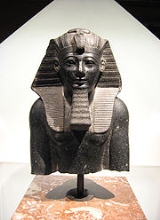
Thutmose III

 
Thutmose III

   Email Print
   Bookmark   Link


Thutmose III


Thutmose III (sometimes read as Thutmosis or Tuthmosis III and meaning Son of Thoth
Thoth

Thoth, , though variations are accepted , was considered one of the more important god of the Egyptian pantheon, often depicted with the head of an Sacred Ibis....
) was the sixth Pharaoh
Pharaoh

Pharaoh is a title used in many modern discussions of the ancient Egyptian rulers of all periods. In antiquity this title began to be used for the ruler who was the religious and political leader of united ancient Egypt, only during the New Kingdom, specifically, during the middle of the Eighteenth dynasty of Egypt....
 of the Eighteenth Dynasty
Eighteenth dynasty of Egypt

The Eighteenth Dynasty is perhaps the best known of all the dynasties of ancient Egypt. As well as a number of Egypt's most powerful pharaohs, it included Tutankhamun, whose tomb, uncovered by Howard Carter in 1922, was one of the greatest of all archaeological discoveries, being completely undisturbed by tomb robbers....
. During the first twenty-two years of Thutmose's reign he was co-regent with his aunt, Hatshepsut
Hatshepsut

Hatshepsut , meaning, Foremost of Noble Ladies, was the fifth pharaoh of the Eighteenth dynasty of Egypt of Ancient Egypt. She is generally regarded by Egyptologists as one of the most successful pharaohs, reigning longer than any other woman of an Indigenous peoples Egyptian dynasty....
, who was named the pharaoh. While she is shown first on surviving monuments, both were assigned the usual royal names and insignia and neither is given any obvious seniority over the other.


Discussion
Ask a question about 'Thutmose III'
Start a new discussion about 'Thutmose III'
Answer questions from other users
Full Discussion Forum


Recent Posts


Encyclopedia


Thutmose III (sometimes read as
Thutmosis or Tuthmosis III and meaning Son of Thoth
Thoth

Thoth, , though variations are accepted , was considered one of the more important god of the Egyptian pantheon, often depicted with the head of an Sacred Ibis....
) was the sixth Pharaoh
Pharaoh

Pharaoh is a title used in many modern discussions of the ancient Egyptian rulers of all periods. In antiquity this title began to be used for the ruler who was the religious and political leader of united ancient Egypt, only during the New Kingdom, specifically, during the middle of the Eighteenth dynasty of Egypt....
 of the Eighteenth Dynasty
Eighteenth dynasty of Egypt

The Eighteenth Dynasty is perhaps the best known of all the dynasties of ancient Egypt. As well as a number of Egypt's most powerful pharaohs, it included Tutankhamun, whose tomb, uncovered by Howard Carter in 1922, was one of the greatest of all archaeological discoveries, being completely undisturbed by tomb robbers....
. During the first twenty-two years of Thutmose's reign he was co-regent with his aunt, Hatshepsut
Hatshepsut

Hatshepsut , meaning, Foremost of Noble Ladies, was the fifth pharaoh of the Eighteenth dynasty of Egypt of Ancient Egypt. She is generally regarded by Egyptologists as one of the most successful pharaohs, reigning longer than any other woman of an Indigenous peoples Egyptian dynasty....
, who was named the pharaoh. While she is shown first on surviving monuments, both were assigned the usual royal names and insignia and neither is given any obvious seniority over the other. He served as the head of her armies.

After her death and his later rise to being the pharaoh of the kingdom, he created the largest empire Egypt
Egypt

Egypt is a country mainly in North Africa, with the Sinai Peninsula forming a land bridge in Western Asia. Covering an area of about , Egypt borders the Mediterranean Sea to the north, the Gaza Strip and Israel to the northeast, the Red Sea to the east, Sudan to the south and Libya to the west....
 had ever seen; no fewer than seventeen campaigns were conducted, and he conquered from Niy in north Syria
Syria

Syria , officially the Syrian Arab Republic , is an Arab-majority country in Southwest Asia, bordering Lebanon and the Mediterranean Sea to the west, Israel to the southwest, Jordan to the south, Iraq to the east, and Turkey to the north....
 to the fourth waterfall of the Nile
Nile

The Nile is a major north-flowing river in Africa, generally regarded as the List of rivers by length in the world.The Nile has two major tributary, the White Nile and Blue Nile, the latter being the source of most of the Nile's water and silt, but the former being the longer of the two....
 in Nubia
Nubia

Nubia is a region in Southern Egypt along the Nile and in what is now northern Sudan. Most of Nubia is situated in Sudan with about a quarter of its territory in Egypt....
.during his reign, as well as unique architectural
Architecture

The term architecture can refer to a process, a profession or documentation.As a process, architecture is the activity of designing and construction buildings and other physical structures by a person or a computer, primarily to provide shelter....
 developments never seen before and never again after his reign.

Officially, Thutmose III ruled Egypt for almost fifty-four years, and his reign is usually dated from April 24, 1479 to March 11, 1425 BCE; however, the first twenty-two years of his reign was as the co-regent to Hatshepsut
Hatshepsut

Hatshepsut , meaning, Foremost of Noble Ladies, was the fifth pharaoh of the Eighteenth dynasty of Egypt of Ancient Egypt. She is generally regarded by Egyptologists as one of the most successful pharaohs, reigning longer than any other woman of an Indigenous peoples Egyptian dynasty....
--his stepmother and aunt
Aunt

An Aunt is a person who is either the sister of a parent or the wife of a brother of a parent. A man with an equivalent relationship is an uncle, and the reciprocal relationship is that of a nephew or niece....
--who was named as the pharaoh. During the last two years of his reign he became a coregent again, with his son, Amenhotep II
Amenhotep II

Amenhotep II was the seventh Pharaoh of the Eighteenth dynasty of Egypt of History of Ancient Egypt. Amenhotep inherited a vast kingdom from his father Thutmose III, and held it by means of a few military campaigns in Syria; however, he fought much less than his father, and his reign saw the effective cessation of hostilities between Egypt a...
, who would succeed him. When he died he was buried in the Valley of the Kings
Valley of the Kings

The Valley of the Kings is a valley in Egypt where, for a period of nearly 500 years from the 16th century BC to 11th century BC, tombs were constructed for the Pharaoh and powerful nobles of the Conventional Egyptian chronology#New Kingdom ....
 as were the rest of the kings from this period in Egypt.

Family

Thutmosis III was the son of Pharaoh the second Thutmose II
Thutmose II

Thutmose II was the fourth Pharaoh of the Eighteenth dynasty of Egypt. He built some minor monuments and initiated at least two minor campaigns but did little else during his rule and was probably strongly influenced by his wife, Hatshepsut....
 and Iset
Iset (queen)

'Iset' was a queen of the eighteenth dynasty of Egypt. She was a secondary wife or concubine of Thutmose II.Iset was the mother of Thutmose III, the only son of Thutmose II....
 (sometimes transliterated
Isis), a secondary wife of Thutmosis II. Because he was the pharaoh's only son, he would have become the first in line for the throne when Thutmosis II died; however, because he was not the son of his father's royal queen, his "degree" of royalty was less than ideal. To bolster his qualifications, he may have married a daughter of Thutmose II and Hatshepsut. It has been suggested that the daughter in question may have been Merytre-Hatshepsut
Merytre-Hatshepsut

Queen Merytre-Hatshepsut was the principal wife of Pharaoh Thutmose III after the death of Satiah. She was the mother of Pharaoh Amenhotep II. Of noble birth, she was the daughter of the Adoratrix Huy, whose statue in the British Museum shows Huy holding a grandchild and represents the other children of Thutmose III and Merytre-Hatshepsut a...
, however, she is now proven not to have been a daughter of Hatshepsut's.

Regardless of this, when Thutmosis II died Thutmosis III was too young to rule, so Hatshepsut became his regent
Regent

A regent, from the Latin regens "reigning", is a person selected to act as head of state because the ruler is a minor, not present or debilitated....
, soon his coregent, and shortly thereafter, she was declared to be the pharaoh. Thutmosis III had little power over the empire while Hatshepsut exercised the formal titulary of kingship, complete with a royal prenomen—Maatkare. Her rule was quite prosperous and marked by great advancements. When he reached a suitable age and demonstrated the capability, she appointed him to head her armies. After the death of Hatshepsut, Thutmosis III ruled Egypt on his own for thirty years, until the last two years of his reign, when his son became a coregent for two years. He died in his fifty-fourth regnal year.

Thutmosis III had two known wives: Satiah
Satiah

Satiah was an Ancient Egyptian queen, the Great Royal Wife of Thutmose III.Her mother was the royal nurse Ipu . It is possible that her father was the important official Ahmose Pen-Nekhebet....
 and Merytre-Hatshepsut. Satiah bore him his firstborn son, Amenemhat, but the child predeceased his father. His successor, the crown prince and future king Amenhotep II
Amenhotep II

Amenhotep II was the seventh Pharaoh of the Eighteenth dynasty of Egypt of History of Ancient Egypt. Amenhotep inherited a vast kingdom from his father Thutmose III, and held it by means of a few military campaigns in Syria; however, he fought much less than his father, and his reign saw the effective cessation of hostilities between Egypt a...
, was born to Merytre-Hatshepsut
Merytre-Hatshepsut

Queen Merytre-Hatshepsut was the principal wife of Pharaoh Thutmose III after the death of Satiah. She was the mother of Pharaoh Amenhotep II. Of noble birth, she was the daughter of the Adoratrix Huy, whose statue in the British Museum shows Huy holding a grandchild and represents the other children of Thutmose III and Merytre-Hatshepsut a...
.
Tuthmosisiii

Dates and Length of Reign

Thutmose III reigned from 1479 BCE to 1425 BCE according to the Low Chronology
Low chronology

The term Low Chronology most often refers to the*Low Chronology of the Ancient Near East*Low Egyptian chronology of the Eighteenth dynasty of Egypt...
 of Ancient Egypt
Ancient Egypt

Ancient Egypt was an Ancient history civilization in eastern North Africa, concentrated along the lower reaches of the Nile in what is now the modern nation of Egypt....
. This has been the conventional Egyptian chronology
Conventional Egyptian chronology

This is a Conventional Egyptian chronology....
 in academic circles since the 1960s, though in some circles the older dates 1504 BC to 1450 BC is preferred from the High Chronology. These dates, just as all the dates of the eighteenth Dynasty, are open to dispute because of uncertainty about the circumstances surrounding the recording of a Heliacal Rise
Sothic cycle

The Sothic cycle or Canicular period is a period of 1461 ancient Egyptian years or 1460 Julian calendar years . During a Sothic cycle, the 365-day year loses enough time that the start of the year once again coincides with the heliacal rising of the star Sirius ....
 of Sothis
Sirius

Sirius is the list of brightest stars in the night sky with a visual apparent magnitude of −1.46, almost twice as bright as Canopus, the next brightest star....
 in the reign of Amenhotep I
Amenhotep I

Amenhotep I was the second Pharaoh of the Eighteenth dynasty of Egypt of History of Ancient Egypt. His reign is Amenhotep I#Dates and length of reign....
. A papyrus from Amenhotep I's reign records this astronomical observation which, theoretically, could be used to perfectly correlate the Egyptian chronology with the modern calendar, however, to do this the latitude
Latitude

Latitude, usually denoted symbolically by the Greek letter phi gives the location of a place on Earth north or south of the equator. Lines of Latitude are the horizontal lines shown running east-to-west on maps ....
 where the observation was taken must also be known. This document has no note of the place of observation, but it can safely be assumed that it was taken in either a delta city such as Memphis or Heliopolis, or in Thebes. These two latitudes give dates twenty years apart, the High and Low chronologies, respectively.

The length of Thutmose III's reign is known to the day thanks to information found in the tomb of the court official Amenemheb. Amenemheb records Thutmose III's death to his master's fifty-fourth regnal year, on the thirtieth day of the third month of
Peret
Season of the Emergence

The Season of the Emergence , or Peret , etc, was the second or Winter season of the ancient Egyptian calendar , following the Season of the Inundation....
. The day of Thutmose III's accession is known to be I Shemu day 4, and astronomical observations can be used to establish the exact dates of the beginning and end of the king's reign (assuming the low chronology) from April 24 1479 BC to March 11 1425 BC respectively.

Thutmose's military campaigns

Widely considered a military genius by historians, Thutmose III made 16 raids in 20 years. He was an active expansionist ruler, sometimes called Egypt's greatest conqueror or "the Napoleon of Egypt." He is recorded to have captured 350 cities during his rule and conquered much of the Near East
Near East

Near East today is an ambiguous term that covers different countries for archeologists and historians, on one hand, and for political scientists, economists, and journalists, on the other....
 from the Euphrates
Euphrates

The Euphrates is the western of the two great rivers that define Mesopotamia which flows from Anatolia....
 to Nubia
Nubia

Nubia is a region in Southern Egypt along the Nile and in what is now northern Sudan. Most of Nubia is situated in Sudan with about a quarter of its territory in Egypt....
 during seventeen known military campaigns. He was the first Pharaoh after Thutmose I
Thutmose I

Thutmose I was the third Pharaoh of the Eighteenth dynasty of Egypt of History of Ancient Egypt. He was given the throne after the death of the previous king Amenhotep I....
 to cross the Euphrates, doing so during his campaign against Mitanni
Mitanni

Mitanni or Hanigalbat was a loosely organized Hurrian-speaking Hittite vassal state in northern Syria from ca. 1500 BC-1300 BC."The Assyrians called the lands of Mitanni Hanigalbat while to the Hittites it was the land of the Hurrians....
. His campaign records were transcribed onto the walls of the temple of Amun
Amun

Amun, reconstructed Egyptian language Yamanu , was the name of a deity in Egyptian mythology who gradually rose from being an abstract concept to the patron deity of Thebes, Egypt and one of the most important deities in Ancient Egypt before fading into obscurity....
 at Karnak
Karnak

The Karnak temple complex, universally known only as Karnak, describes a vast conglomeration of ruined temples, chapels, pylons and other buildings....
, and are now transcribed into Urkunden IV
Urkunden der 18. Dynastie

Urkunden der 18. Dynastie is a collection of Ancient Egypt documents in Egyptian hieroglyphs printed in German. It began in 1906 under the editorship of Kurt Heinrich Sethe; a second edition appeared in 1961....
. He is consistently regarded as one of the greatest of Egypt's warrior pharaohs, who transformed Egypt
Egypt

Egypt is a country mainly in North Africa, with the Sinai Peninsula forming a land bridge in Western Asia. Covering an area of about , Egypt borders the Mediterranean Sea to the north, the Gaza Strip and Israel to the northeast, the Red Sea to the east, Sudan to the south and Libya to the west....
 into an international superpower by creating an empire that stretched from southern Syria through to Canaan and Nubia. In most of his campaigns his enemies were defeated town by town, until being beaten into submission. The preferred tactic was to subdue a much weaker city or state one at a time resulting in surrender of each fraction until complete domination was achieved.

Much is known about Thutmosis "the warrior", not only because of his military achievements, but also because of his royal scribe and army commander, Thanuny, who wrote about his conquests and reign. The prime reason why Thutmosis was able to conquer such a large number of lands, is because of the revolution and improvement in army weapons. He encountered only little resistance from neighbouring kingdoms, allowing him to expand his realm of influence easily. His army also had carried boats on dry land.

First Campaign

When Hatshepsut died on the tenth day of the sixth month of Thutmose III's twenty second year--according to information from a single stela from Armant--the king of Kadesh
Kadesh

This article is about Kadesh in the lands of the Amurru, bordering on Damascus Syria up to Hammath; see also Kadesh orKedesh Kadesh was an Cities of the Ancient Near East of the Levant, located on or near the headwaters or ford of the Orontes River It is surmised by Kenneth Kitchen to be the ruins at Tell Nebi Mend, about south...
 advanced his army to Megiddo. Thutmose III mustered his own army and departed Egypt, passing through the border fortress of Tjaru
Zarw

Tjaru was an ancient Egyptian fortress on the Way of Horus, the major road leading out of Egypt into Canaan. It also appeared, though much less commonly, under the names Zaru, Tharu and Djaru, and was known to the Greeks as Zele or Sile....
 (Sile) on the twenty-fifth day of the eighth month. Thutmose marched his troops through the coastal plain as far as Jamnia, then inland to Yehem, a small city near Megiddo, which he reached in the middle of the ninth month of the same year. The ensuing Battle of Megiddo
Battle of Megiddo (15th century BC)

The Battle of Megiddo was fought between Ancient Egypt forces under the command of the pharaoh Thutmose III and a large Canaanite coalition under the King of Kadesh....
 probably was the largest battle in any of Thutmose's seventeen campaigns. A ridge of mountains jutting inland from Mount Carmel
Mount Carmel

Mount Carmel is a coastal mountain range in northern Israel stretching from the Mediterranean Sea towards the southeast. Archaeologists have discovered ancient wine and oil presses at various locations on Mt....
 stood between Thutmose and Megiddo, and he had three potential routes to take. The northern route and the southern route, both of which went around the mountain, were judged by his council of war to be the safest, but Thutmose, in an act of great bravery (or so he boasts, but such self praise is normal in Egyptian texts), accused the council of cowardice and took a dangerous route through a mountain pass which he alleged was only wide enough for the army to pass "horse after horse and man after man."

Despite the laudatory nature of Thutmose's annals, such a pass does indeed exist (although it is not quite so narrow as Thutmose indicates) and taking it was a brilliant strategic move, since when his army emerged from the pass they were situated on the plain of Esdraelon, directly between the rear of the Canaanite forces and Megiddo itself. For some reason, the Canaanite forces did not attack him as his army emerged, and his army routed them decisively. The size of the two forces is difficult to determine, but if, as Redford suggests, the amount of time it took to move the army through the pass may be used to determine the size of the Egyptian force, and if the number of sheep and goats captured may be used to determine the size of the Canaanite force, then both armies were around 10,000 men. However most scholars do believe that the Egyptian army was more numerous. According to Thutmose III's Hall of Annals in the Temple of Amun at Karnak, the battle occurred on "
Year 23, I Shemu [day] 21, the exact day of the feast of the new moon" – a lunar date. This date corresponds to May 9, 1457 BC based on Thutmose III's accession in 1479 BC. After victory in battle, however, his troops stopped to plunder the enemy and the enemy was able to escape into Megiddo.. Thutmose was forced to besiege the city instead, but he finally succeeded in conquering it after a siege of seven or eight months (see Siege of Megiddo).

This campaign drastically changed the political situation in the ancient Near East. By taking Megiddo, Thutmose gained control of all of northern Canaan
Canaan

Canaan is an ancient term for a region encompassing modern-day Israel and Lebanon, the Palestinian Territories, plus adjoining coastal lands and parts of Jordan, Syria and northeastern Egypt....
, and the Syrian princes were obligated to send tribute and their own sons as hostages to Egypt. Beyond the Euphrates, the Assyria
Assyria

Assyria was a political state centered on the Upper Tigris river, in Mesopotamia , that came to rule regional empires a number of times in history....
n, Babylonian
Kassites

The Kassites were an ancient Near Eastern tribe who gained control of Babylonia after the fall of the Old Babylonian Empire after ca. 1531 BC to ca....
, and Hittite
Hittites

The Hittites were an ancient Anatolian people who spoke a Hittite language of the Anatolian languages of the Indo-European languages family, and established a kingdom centered at Hattusa in north-central Anatolia ca....
 kings all gave Thutmose gifts, which he alleged to be "tribute" when he recorded it on the walls of Karnak. The only noticeable absence is Mitanni, which would bear the brunt of the following Egyptian campaigns into Asia.

Tours of Canaan and Syria


Thutmose Iii At Karnak
Thutmose's second, third, and fourth campaigns appear to have been nothing more than tours of Syria and Canaan
Canaan

Canaan is an ancient term for a region encompassing modern-day Israel and Lebanon, the Palestinian Territories, plus adjoining coastal lands and parts of Jordan, Syria and northeastern Egypt....
 to collect tribute. Traditionally, the material directly after the text of the first campaign has been considered to be the second campaign. This text records tribute from the area which the Egyptians called Retenu
Retenu

Retjenu , was an Ancient Egyptian name for the region north of Canaan the watershed of the Orontes River overlapping the borders of lebanon and Syria....
, (roughly equivalent to Canaan), and it was also at this time that Assyria paid a second "tribute" to Thutmose III. However, it is probable that these texts come from Thutmose's fortieth year or later, and thus have nothing to do with the second campaign at all. If so, then so far, no records of this campaign have been found at all.. This survey is dated to Thutmose's twenty-fifth year. No record remains of Thutmose's fourth campaign whatsoever, but at some point in time a fort was built in lower Lebanon and timber was cut for construction of a processional barque, and this probably fits best during this time frame.

Conquest of Syria

The fifth, sixth, and seventh campaigns of Thutmose III were directed against the Phoenicia
Phoenicia

Phoenicia was an ancient civilization centered in the north of ancient Canaan, with its heartland along the coastal regions of modern day Lebanon, extending to parts of Israel, Syria and the Palestinian territories....
n cities in Syria
Syria

Syria , officially the Syrian Arab Republic , is an Arab-majority country in Southwest Asia, bordering Lebanon and the Mediterranean Sea to the west, Israel to the southwest, Jordan to the south, Iraq to the east, and Turkey to the north....
 and against Kadesh
Kadesh

This article is about Kadesh in the lands of the Amurru, bordering on Damascus Syria up to Hammath; see also Kadesh orKedesh Kadesh was an Cities of the Ancient Near East of the Levant, located on or near the headwaters or ford of the Orontes River It is surmised by Kenneth Kitchen to be the ruins at Tell Nebi Mend, about south...
 on the Orontes
Orontes River

The Orontes or ?A?i is a river of Lebanon, Syria and TurkeyIt was anciently the chief river of the Levant, also called Draco, Typhon and Axius....
. In Thutmose's twenty-ninth year, he began his fifth campaign wherein he first took an unknown city (the name falls in a lacuna
Lacuna (manuscripts)

A lacuna is a gap in a manuscript, inscription, text, painting, or a musical work.The state of old manuscripts or inscriptions which have weathered or been damaged sometimes gives rise to lacunae ? passages consisting of a word or words that are missing or illegible....
) which had been garrisoned by Tunip
Tunip

Tunip was a city/'city-state' in western Syria during the 1350 BC-1335 BC, , Amarna letters Text corpus. The name "Syria" did not exist, though Assyria was beginning....
. He then moved inland and took the city and territory around Ardata; unlike previous plundering raids, however, Thutmose III subsequently garrisoned the area known as Djahy, which is probably a reference to southern Syria. This subsequently permitted him to ship supplies and troops between Syria and Egypt. Although there is no direct evidence for it, it is for this reason that some have supposed that Thutmose's sixth campaign, in his thirtieth year, commenced with a naval transportation of troops directly into to Byblos
Byblos

Byblos is the Greek language name of the Phoenician city Gebal . It is a Mediterranean city in the Mount Lebanon Governorate of present-day Lebanon under the current Arabic language name of Jbeil and was also referred to as Gibelet during the Crusades....
, bypassing Canaan
Canaan

Canaan is an ancient term for a region encompassing modern-day Israel and Lebanon, the Palestinian Territories, plus adjoining coastal lands and parts of Jordan, Syria and northeastern Egypt....
 entirely. After the troops arrived in Syria by whatever means, they proceeded into the Jordan river valley and moved north from there, pillaging Kadesh's lands. Turning west again, Thutmose took Simyra and quelled a rebellion in Ardata, which apparently had rebelled once again. To stop such rebellions, Thutmose began taking hostages from the cities in Syria. The cities in Syria were not guided by the popular sentiment of the people so much as they were by the small number of nobles who were aligned to Mitanni: a king and a small number of foreign Maryannu. Thutmose III found that by taking family members of these key people to Egypt as hostages, he could drastically increase their loyalty to him. However, Syria did rebel yet again in Thutmose's thirty-first year, and he returned to Syria for his seventh campaign, took the port city of Ullaza and the smaller Phoenician ports, and took even more measures to prevent further rebellions. All the excess grain which was produced in Syria was stored in the harbors he had recently conquered, and was used for the support of the military and civilian Egyptian presence ruling Syria. This furthermore left the cities in Syria desperately impoverished, and with their economies in ruins, they had no means of funding a rebellion.

Attack on Mitanni

After Thutmose III had taken control of the Syrian cities, the obvious target for his eighth campaign was the state of Mitanni
Mitanni

Mitanni or Hanigalbat was a loosely organized Hurrian-speaking Hittite vassal state in northern Syria from ca. 1500 BC-1300 BC."The Assyrians called the lands of Mitanni Hanigalbat while to the Hittites it was the land of the Hurrians....
, a Hurrian country with an Indo-Aryan
Indo-Aryans

Indo-Aryan is an ethno-linguistic term referring to the wide collection of peoples united as native speakers of the Indo-Iranian languages of the family of Indo-European languages....
 ruling class. However, to reach Mitanni, he had to cross the Euphrates river. Therefore, Thutmose III enacted the following strategy. He sailed directly to Byblos
Byblos

Byblos is the Greek language name of the Phoenician city Gebal . It is a Mediterranean city in the Mount Lebanon Governorate of present-day Lebanon under the current Arabic language name of Jbeil and was also referred to as Gibelet during the Crusades....
 and then made boats which he took with him over land on what appeared to otherwise be just another tour of Syria, and he proceeded with the usual raiding and pillaging as he moved north through the lands he had already taken. However, here he continued north through the territory belonging to the still unconquered cities of Aleppo
Aleppo

Aleppo is a city in northern Syria, capital of the Aleppo Governorate; the Governorate extends around the city for over 16,000 km? and has a population of 4,393,000, making it the largest Governorate in Syria by population....
 and Carchemish
Carchemish

Carchemish was an important ancient city of the Mitanni and Hittites empires, now on the frontier between Turkey and Syria. It was the location of an Battle of Carchemish between the Babylonians and Egyptians, mentioned in the Bible....
, and then quickly crossed the Euphrates in his boats, taking the Mitannian king entirely by surprise. It appears that Mitanni was not expecting an invasion, so they had no army of any kind ready to defend against Thutmose, although their ships on the Euphrates did try to defend against the Egyptian crossing. Thutmose III then went freely from city to city and pillaged them while the nobles hid in caves (or at least this is the typically ignoble way Egyptian records chose to record it). During this period of no opposition, Thutmose put up a second stele commemorating his crossing of the Euphrates, next to the one his grandfather Thutmose I had put up several decades earlier. Eventually a militia was raised to fight the invaders, but it fared very poorly. Thutmose III then returned to Syria by way of Niy, where he records that he engaged in an elephant
Elephant

Elephants are large land mammals of the order Proboscidea and the family Elephantidae. There are three living species: the African Bush Elephant, the African Forest Elephant and the Asian Elephant ....
 hunt. He then collected tribute from foreign powers and returned to Egypt in victory.

Tours of Syria

Thutmose III returned to Syria for his ninth campaign in his thirty-fourth year, but this appears to have been just a raid of the area called Nukhashshe
Nuhašše

Nuha??e, also Nuha??a, was a territory in the Syria region mentioned in various Middle East documents as between Mari on the Euphrates and Hammath....
, a region populated by semi-nomadic people. The plunder recorded is minimal, so it was probably just a minor raid. Records from his tenth campaign indicate much more fighting, however. By Thutmose's thirty-fifth year, the king of Mitanni had raised a large army and engaged the Egyptians around Aleppo
Aleppo

Aleppo is a city in northern Syria, capital of the Aleppo Governorate; the Governorate extends around the city for over 16,000 km? and has a population of 4,393,000, making it the largest Governorate in Syria by population....
. As usual for any Egyptian king, Thutmose boasted a total crushing victory, but this statement is suspect. Specifically, it is doubted that Thutmose accomplished any great victory here due to the very small amount of plunder taken. Specifically, Thutmose's annals at Karnak indicate he only took a total of ten prisoners of war. He may simply have fought the Mitannians to a stalemate, yet he did receive tribute from the Hittites after that campaign, which seems to indicate the outcome of the battle was in Thutmose's favor.

The next two campaigns are lost. His eleventh is presumed to have happened in his thirty-sixth regnal year, and his twelfth is presumed to have happened in his thirty-seventh, since his thirteenth is mentioned at Karnak as happening in his thirty-eighth regnal year. Part of the tribute list for his twelfth campaign remains immediately before his thirteenth begins, and the contents recorded (specifically wild game and certain minerals of uncertain identification) might indicate that it took place on the steppe around Nukhashashe, but this remains mere speculation.

In his thirteenth campaign Thutmose returned to Nukhashashe for a very minor campaign. The next year, his thirty-ninth year, he mounted his fourteenth campaign against the Shasu
Shasu

Shasu is an Egyptian language term for nomads who appeared in the Levant from the fifteenth century BCE all the way to the Third Intermediate Period....
. The location of this campaign is impossible to determine definitely, since the Shasu were nomads who could have lived anywhere from Lebanon to the Transjordan, to Edom. After this point, the numbers given by Thutmose's scribes to his campaigns all fall in lacunae, so campaigns can only be counted by date. In his fortieth year, tribute was collected from foreign powers, but it is unknown if this was considered a campaign (i.e. if the king went with it or if it was lead by an official). Only the tribute list remains from Thutmose's next campaign in the annals, and nothing may be deduced about it, except that it probably was another raid to the frontiers around Niy. His final Asian campaign is better documented, however. Sometime before Thutmose's forty-second year, Mitanni apparently began spreading revolt among all the major cities in Syria. Thutmose moved his troops by land up the coastal road and put down rebellions in the Arka plain and moved on Tunip. After taking Tunip, his attention turned to Kadesh
Kadesh

This article is about Kadesh in the lands of the Amurru, bordering on Damascus Syria up to Hammath; see also Kadesh orKedesh Kadesh was an Cities of the Ancient Near East of the Levant, located on or near the headwaters or ford of the Orontes River It is surmised by Kenneth Kitchen to be the ruins at Tell Nebi Mend, about south...
 again. He engaged and destroyed three surrounding Mitannian garrisons and returned to Egypt in victory. However, his victory in this final campaign was neither complete, nor permanent, since he did not take Kadesh, and Tunip could not have remained aligned to him for very long, certainly not beyond his own death.

Nubian Campaign

Thutmose took one last campaign in his fiftieth regnal year, very late in his life. He attacked Nubia, but only went so far as the fourth cataract of the Nile. Although no king of Egypt had ever penetrated so far as he did with an army, previous kings' campaigns had spread Egyptian culture that far already, and the earliest Egyptian document found at Gebel Barkal, in fact, comes from three years
before Thutmose's campaign.

Monumental Construction

Thutmose III was a great builder pharaoh and constructed over fifty temples, although some of these are now lost and only mentioned in written records. He also commissioned the building of many tombs for nobles, which were made with greater craftsmanship than ever before. His reign was also a period of great stylistic changes in the sculpture, paintings, and reliefs associated with construction, much of it beginning during the reign of Hatshepsut.

Artistic developments

Thutmose's architects and artisans showed great continuity with the formal style of previous kings, but several developments set him apart from his predecessors. Although he followed the traditional relief styles for most of his reign, after his forty-second year, he began having himself depicted wearing the red crown of Lower Egypt and a šndyt-kilt, an unprecedented style. Architecturally, his use of pillars also was unprecedented. He built Egypt's only known set of heraldic pillars, two large columns standing alone instead of being part of a set supporting the roof. His jubilee hall was also revolutionary, and is arguably the earliest known building created in the basilica
Basilica

The Latin word basilica , was originally used to describe a ancient Rome public building , usually located in the Forum of a Roman town. In Hellenistic cities, public basilicas appeared in the 2nd century BC....
 style. Thutmose's artisans achieved new heights of skill in painting, and tombs from his reign were the earliest to be entirely painted, instead of painted reliefs. Finally, although not directly pertaining to his monuments, it appears that Thutmose's artisans finally had learned how to use the skill of glass making—developed in the early eighteenth dynasty—to create drinking vessels by the core-formed method
Glass

Glass generally refers to a Hardness, brittle, transparency amorphous solid, such as that used for windows, many Glass Bottles, or eyewear, including, but not limited to, soda-lime glass, borosilicate glass, acrylic glass, sugar glass, Muscovite , or aluminium oxynitride....
.

Karnak


Thutmose dedicated far more attention to Karnak
Karnak

The Karnak temple complex, universally known only as Karnak, describes a vast conglomeration of ruined temples, chapels, pylons and other buildings....
 than any other site. In the Iput-isut, the temple proper in the center, he rebuilt the hypostyle hall of his grandfather Thutmose I
Thutmose I

Thutmose I was the third Pharaoh of the Eighteenth dynasty of Egypt of History of Ancient Egypt. He was given the throne after the death of the previous king Amenhotep I....
, dismantled the red chapel of Hatshepsut, built Pylon VI, a shrine for the bark of Amun in its place, and built an antechamber in front of it, the ceiling of which was supported by his heraldic pillars. He built a
temenos wall around the central chapel containing smaller chapels, along with workshops and storerooms. East of the main sanctuary, he built a jubilee hall in which to celebrate his Sed festival
Sed festival

The sed festival was an ancient Egyptian ceremony which was held to celebrate the continued rule of a pharaoh. The name derives from the name of an Egyptian wolf god, one of whose names was Wepwawet or Sed....
. The main hall was built in basilica style, with rows of pillars supporting the ceiling on each side of the aisle. The central two rows were higher than the others to create windows where the ceiling was split. Two of the smaller rooms in this temple contained the reliefs of the survey of the plants and animals of Canaan which he took in his third campaign.

Obelisk Lateran
East of the Iput-Isut, he erected another temple to Aten where he was depicted as being supported by Amun. It was inside this temple that Thutmose planned on erecting his
tekhen waty, or "unique obelisk." The tekhen waty was designed to stand alone, instead as part of a pair, and is the tallest obelisk
Obelisk

An obelisk An Obelisks is a tall, narrow, four-sided, tapering monument which ends in a pyramid like shape at the top. Ancient obelisks were made of a single piece of stone, a monolith; however, most modern obelisks are made of individual stones, and can even have interior spaces....
 ever successfully cut. It was not, however, erected until Thutmose IV raised it, thirty five years later. It was later moved to Rome and is known as the Lateran Obelisk.

Another Christian Roman Emperor Theodosius I
Theodosius I

Flavius Theodosius , also called Theodosius I and Theodosius the Great , was Roman Emperor from 379 to 395. Reuniting the eastern and western portions of the empire, Theodosius was the last emperor of both the Eastern Roman Empire and Western Roman Empire....
 re-erected another obelisk from the Temple of Karnak in the Hippodrome of Constantinople
Hippodrome of Constantinople

The Hippodrome of Constantinople was a Race track that was the sporting and social centre of Constantinople, capital of the Byzantine Empire and the largest city in Europe....
, in 390 CE. Thus, two obelisks of Tuthmosis III's Karnak temple stand in Papal Rome and in Caesaropapist Constantinople, the two main historical capitals of the Roman Empire.

Thutmose also undertook building projects to the south of the main temple, between the sanctuary of Amun and the temple of Mut
Mut

Mut, which meant mother in the ancient Egyptian language, was an ancient Egyptian mother goddess with multiple aspects that changed over the thousands of years of the culture....
. Immediately to the south of the main temple, he built the seventh pylon on the north-south road which entered the temple between the fourth and fifth pylons. It was built for use during his jubilee, and was covered with scenes of defeated enemies. He set royal colossi on both sides of the pylon, and put two more obelisks on the south face in front of the gateway. The eastern one's base remains in place, but the western one was transported to hippodrome in Constantinople. farther south, alone the road, he put up pylon VIII which Hatshepsut had begun. East of the road, he dug a sacred lake of 250 by 400 feet, and then placed another alabaster bark shrine near it.

Hippodrome of Constantinople Obelisk 3

Tomb

Egypt
Thutmose's tomb, discovered by Victor Loret
Victor Loret

Victor Clement Georges Philippe Loret was a France Egyptologist.Loret studied with Gaston Maspero at the ?cole des Hautes ?tudes In 1897 he became the head of the Egyptian Antiquities Service....
 in 1898, was in the Valley of the Kings
Valley of the Kings

The Valley of the Kings is a valley in Egypt where, for a period of nearly 500 years from the 16th century BC to 11th century BC, tombs were constructed for the Pharaoh and powerful nobles of the Conventional Egyptian chronology#New Kingdom ....
. It uses a plan which is typical of eighteenth dynasty tombs, with a sharp turn at the vestibule preceding the burial chamber. Two stairways and two corridors provide access to the vestibule which is preceded by a quadrangular shaft, or "well". The vestibule is decorated with the full story of the Book of Amduat
Amduat

The Amduat is an important Ancient Egyptian funerary text of the New Kingdom. Like many funerary texts, it was written on the inside of the tomb for reference by the deceased....
, the first tomb to do so in its entirety. The burial chamber, which is supported by two pillars, is oval-shaped and its ceiling decorated with stars, symbolizing the cave of the deity Sokar. In the middle lies a large red quartzite sarcophagus in the shape of a cartouche. On the two pillars in the middle of the chamber there are passages from the Litanies of Re, a text that celebrates the later sun deity, who is identified with the pharaoh at this time. On the other pillar is a unique image depicting Thutmosis III being suckled by the goddess Isis
ISIS

ISIS is an industry standard interface for technologies, developed by Pixel Translations in 1990 .ISIS is an open standard for scanner control and a complete image-processing framework....
 in the guise of the tree.

Thutmose III's tomb in the Valley of the Kings, (KV34
KV34

Tomb KV34 in the Valley of the Kings was the final resting place of Eighteenth dynasty of Egypt Pharaoh Thutmose III.One of the first tombs to be dug in the Valley, it was cut high in the cliff face of the furthermost wadi....
), is the first one in which Egyptologists found the complete Amduat
Amduat

The Amduat is an important Ancient Egyptian funerary text of the New Kingdom. Like many funerary texts, it was written on the inside of the tomb for reference by the deceased....
, an important New Kingdom
New Kingdom

The New Kingdom, sometimes referred to as the Egyptian Empire, is the period in ancient Egyptian History of Ancient Egypt between the 16th century BC and the 11th century BC, covering the Eighteenth dynasty of Egypt, Nineteenth dynasty of Egypt, and Twentieth dynasty of Egypt....
 funerary text. The wall decorations are executed in a simple, "diagrammatic" way, imitating the manner of the cursive script one might expect to see on a funerary papyrus rather than the more typically lavish wall decorations seen on most other royal tomb walls. The colouring is similarly muted, executed in simple black figures accompanied by text on a cream background with highlights in red and pink. The decorations depict the pharaoh aiding the deities in defeating Apep
Apep

In Egyptian mythology, Apep was an evil demon, the deification of darkness and chaos , and thus opponent of light and Ma'at , whose existence was believed from the Middle Kingdom of Egypt onwards....
, the serpent
Serpent (symbolism)

Serpent is a word of Latin origin that is commonly used in a specifically mythology or religion context, signifying a snake that is to be regarded not as a mundane natural phenomenon nor as an object of scientific zoology, but as the bearer of some symbolic value....
 of chaos
Chaos

Chaos typically refers to unpredictability, and is the antithesis of cosmos.The word did not mean "disorder" in classical-period ancient Greece....
, thereby helping to ensure the daily rebirth of the sun as well as the pharaoh's own resurrection.

Defacing of Hatshepsut's monuments

Until recently, a general theory has been that after the death of her husband Thutmose II
Thutmose II

Thutmose II was the fourth Pharaoh of the Eighteenth dynasty of Egypt. He built some minor monuments and initiated at least two minor campaigns but did little else during his rule and was probably strongly influenced by his wife, Hatshepsut....
, Hatshepsut
Hatshepsut

Hatshepsut , meaning, Foremost of Noble Ladies, was the fifth pharaoh of the Eighteenth dynasty of Egypt of Ancient Egypt. She is generally regarded by Egyptologists as one of the most successful pharaohs, reigning longer than any other woman of an Indigenous peoples Egyptian dynasty....
 'usurped' the throne from Thutmose III. Although Thutmose III was a co-regent during this time, early historians have speculated that Thutmose III never forgave his stepmother for denying him access to the throne for the first two decades of his reign. However, in recent times this theory has been revised after questions arose as to why Hatshepsut would have allowed a resentful heir to control armies, which it is known he did. This view is supported further by the fact that no strong evidence has been found to show Thutmose III sought to claim the throne. He kept Hatshepsut's religious and administrative leaders. Added to this is the fact that the monuments of Hatshepsut were not damaged until at least twenty years after her death in the late reign of Thutmose III when he was quite elderly and in another coregency—with his son who would become Amenhotep II
Amenhotep II

Amenhotep II was the seventh Pharaoh of the Eighteenth dynasty of Egypt of History of Ancient Egypt. Amenhotep inherited a vast kingdom from his father Thutmose III, and held it by means of a few military campaigns in Syria; however, he fought much less than his father, and his reign saw the effective cessation of hostilities between Egypt a...
—who is known to have attempted to identify her works as his own.

After her death, many of Hatshepsut's monuments and depictions were subsequently defaced or destroyed, including those in her famous mortuary temple
Mortuary temple

Mortuary temples were temples constructed adjacent to, or in the vicinity of, royal tombs in the Middle Kingdom of Egypt and New Kingdom periods of Ancient Egypt....
 complex at Deir el-Bahri
Deir el-Bahri

Deir el-Bahri is a complex of mortuary temples and tombs located on the west bank of the Nile, opposite the city of Luxor, Egypt.In 1997, 58 tourists and 4 Egyptians were massacred here by Islamic terrorists from Al-Gama'a al-Islamiyya in what has become to be known as The 'Luxor massacre'....
. Traditionally, these have been interpreted by early modern scholars to be evidence of acts of damnatio memoriae
Damnatio memoriae

Damnatio memoriae is the Latin language literally meaning "damnation of memory", in the sense of removed from the remembrance. It was a form of dishonor that could be passed by the Roman Senate upon treachery or others who brought discredit to the Roman State....
 (condemning a person by erasure from recorded existence) by Thutmose III. However, recent research by scholars such as Charles Nims and Peter Dorman
Peter Dorman

Peter Fitzgerald Dorman is an epigraphist, philologist, and cultural anthropologist. He currently serves as the 15th President of the American University of Beirut ....
, has re-examined these erasures and found that the acts of erasure which could be dated, only began sometime during year forty-six or forty-seven of Thutmose's reign (c. 1433/2 BC). Another often overlooked fact is that Hatshepsut was not only one who received this treatment. The monuments of her chief steward Senenmut, who was closely associated with her rule, were similarly defaced where they were found. All of this evidence casts serious doubt upon the popular theory that Thutmose III order the destruction in a fit of vengeful rage shortly after his accession.

Currently, the purposeful destruction of the memory of Hatshepsut is seen as a measure designed to ensure a smooth succession for the son of Thutmose III, the future Amenhotep II, as opposed to any of surviving relatives of Hatshepsut who may have had an equal, or better, claim to the throne. It also may be likely that this measure could not have been taken earlier—until the passing of powerful religious and administrative officials who had served under both Hatshepsut and Thutmose III had occurred. Later, Amenhotep II even claimed that he had built the items he defaced.

Death and burial


According to the American Egyptologist, Peter Der Manuelian, a statement in the tomb biography of an official named Amenemheb establishes that Thutmose III died on Year 54, III Peret day 30 of his reign after ruling Egypt for 53 years, 10 months, and 26 days. (Urk. 180.15) Thutmose III, hence, died just one month and four days shy of the start of his fifty-fourth regnal year. When the co-regencies with Hatshepsut and Amenhotep II are deducted, he ruled alone as pharaoh for just over thirty of those years.

Mummy

Thutmose III's mummy was discovered in the Deir el-Bahri
Deir el-Bahri

Deir el-Bahri is a complex of mortuary temples and tombs located on the west bank of the Nile, opposite the city of Luxor, Egypt.In 1997, 58 tourists and 4 Egyptians were massacred here by Islamic terrorists from Al-Gama'a al-Islamiyya in what has become to be known as The 'Luxor massacre'....
 Cache
DB320

Tomb DB320 is located next to Deir el-Bahri, in the Theban Necropolis, opposite modern Luxor contained an extraordinary cache of mummified remains and funeral equipment of more than 50 kings, queens, royals and various nobility....
 above the Mortuary Temple of Hatshepsut
Mortuary temple

Mortuary temples were temples constructed adjacent to, or in the vicinity of, royal tombs in the Middle Kingdom of Egypt and New Kingdom periods of Ancient Egypt....
 in 1881. He was interred along with those of other eighteenth and nineteenth dynasty leaders Ahmose I
Ahmose I

Ahmose I was a pharaoh of ancient Egypt and the founder of the Eighteenth dynasty of Egypt. He was a member of the Thebes, Egypt royal house, the son of pharaoh Tao II the Brave and brother of the last pharaoh of the Seventeenth dynasty of Egypt, King Kamose....
, Amenhotep I
Amenhotep I

Amenhotep I was the second Pharaoh of the Eighteenth dynasty of Egypt of History of Ancient Egypt. His reign is Amenhotep I#Dates and length of reign....
, Thutmose I
Thutmose I

Thutmose I was the third Pharaoh of the Eighteenth dynasty of Egypt of History of Ancient Egypt. He was given the throne after the death of the previous king Amenhotep I....
, Thutmose II
Thutmose II

Thutmose II was the fourth Pharaoh of the Eighteenth dynasty of Egypt. He built some minor monuments and initiated at least two minor campaigns but did little else during his rule and was probably strongly influenced by his wife, Hatshepsut....
, Ramesses I
Ramesses I

Menpehtyre Ramesses I was the founding Pharaoh of Ancient Egypt's Nineteenth dynasty of Egypt. The dates for his short reign are not completely known but the time-line of late 1290s BC is frequently cited as well as 1290s BC....
, Seti I
Seti I

Menmaatre Seti I was a Pharaoh of Ancient Egypt , the son of Ramesses I and Queen Sitre, and the father of Ramesses II. As with all dates in Ancient Egypt, the actual dates of his reign are unclear, and various historians claim different dates, with 1294 BC – 1279 BC and 1290 BC to 1279 BC being the most commonly used by scholars today...
, Ramesses II
Ramesses II

Ramesses II was the third Egyptian pharaoh of the Nineteenth dynasty of Egypt. He is often regarded as Ancient Egypt's greatest, most celebrated, and most powerful pharaoh....
, and Ramesses IX
Ramesses IX

Ramesses IX...
, as well as the twenty-first dynasty pharaohs Pinedjem I
Pinedjem I

Pinedjem I was the High Priests of Amun at Thebes in Ancient Egypt from 1070 BC to 1032 BC and the de facto ruler of the south of the country from 1054 BC....
, Pinedjem II
Pinedjem II

Pinedjem II was a High Priests of Amun at Thebes in Ancient Egypt from 990 BC to 969 BC and was the de facto ruler of the south of the country....
, and Siamun
Siamun

Neterkheperre or Netjerkheperre-setepenamun Siamun was the sixth pharaoh of Ancient Egypt during the Twenty-first dynasty of Egypt. He built extensively in Lower Egypt for a king of the Third Intermediate Period and is regarded as one of the most powerful rulers of this Dynasty after Psusennes I....
.

While it is popularly thought that his mummy originally was unwrapped by Gaston Maspero
Gaston Maspero

Gaston Camille Charles Maspero was a France Egyptologist....
 in 1886, it was in fact first unwrapped by Émile Brugsch
Émile Brugsch

?mile Brugsch was a German-born Egyptologist whose career spanned the late 19th and early 20th centuries. He is best known as the official who "evacuated" the mummies from the Deir el-Bahri DB320 in 1881....
, the Egyptologist who supervised the evacuation of the mummies from the Deir el-Bahri Cache five years previously in 1881, soon after its arrival in the Boulak Museum
Egyptian Museum

The Museum of Egyptian Antiquities, known commonly as the Egyptian Museums, in Cairo, Egypt, is home to the most extensive collection of ancient Egyptian antiquities in the world....
. This was while Maspero was away in France, and the Director General of the Egyptian Antiquities Service ordered the mummy re-wrapped. So when it was "officially" unwrapped by Maspero in 1886, he almost certainly knew it was in relatively poor condition.

The mummy had been damaged extensively in antiquity by tomb robbers, and its wrappings subsequently cut into and torn by the Rassul family who had rediscovered the tomb and its contents only a few years before. Maspero's description of the body provides an idea as to the magnitude of the damage done to the body:

His mummy was not securely hidden away, for towards the close of the 20th dynasty it was torn out of the coffin by robbers, who stripped it and rifled it of the jewels with which it was covered, injuring it in their haste to carry away the spoil. It was subsequently re-interred, and has remained undisturbed until the present day; but before re-burial some renovation of the wrappings was necessary, and as portions of the body had become loose, the restorers, in order to give the mummy the necessary firmness, compressed it between four oar-shaped slips of wood, painted white, and placed, three inside the wrappings and one outside, under the bands which confined the winding-sheet.


Of the face, which was undamaged, Maspero's says the following:

Happily the face, which had been plastered over with pitch at the time of embalming, did not suffer at all from this rough treatment, and appeared intact when the protecting mask was removed. Its appearance does not answer to our ideal of the conqueror. His statues, though not representing him as a type of manly beauty, yet give him refined, intelligent features, but a comparison with the mummy shows that the artists have idealised their model. The forehead is abnormally low, the eyes deeply sunk, the jaw heavy, the lips thick, and the cheek-bones extremely prominent; the whole recalling the physiognomy of Thûtmosis II, though with a greater show of energy.


Maspero was so disheartened at the state of the mummy, and the prospect that all of the other mummies were similarly damaged (as it turned out, few were in so poor a state), that he would not unwrap another for several years.

Unlike many other examples from the Deir el-Bahri Cache, the wooden mummiform coffin that contained the body was original to the pharaoh, though any gilding or decoration it might have had had been hacked off in antiquity.

In his examination of the mummy, the anatomist, G. Eliot Smith, stated the height of Thutmose III's mummy to be 1.615m (5ft. 3.58in.). This has led people to believe that Thutmose was a short man, but Smith measured the height of a body whose feet were absent, so he was undoubtedly taller than the figure given by Smith. The mummy of Thutmose III now resides in the Royal Mummies Hall of the Cairo Museum, catalog number 61068.

See also

  • Cleopatra's Needles
  • History of ancient Egypt
    History of Ancient Egypt

    The History of ancient Egypt spans the period from the early Predynastic Egypt settlements of the northern Nile Valley to the History of Roman Egypt in 30 BC....
  • Eighteenth dynasty of Egypt Family Tree


Further reading

  • Redford, Donald B.
    Donald B. Redford

    Donald B. Redford is an influential Canada Egyptologist and archaeologist, currently Professor of Classics and Ancient Mediterranean Studies at Pennsylvania State University....
    ,
    The Wars in Syria and Palestine of Thutmose III, [Culture and History of the Ancient Near East 16], Leiden: Brill, 2003. ISBN 90-04-12989-8, treats the military annals of Thutmose III, with regard to his conquests in the Levant
  • Der Manuelian, Peter, Studies in the Reign of Amenophis II, Hildesheimer Ägyptologische Beiträge(HÄB) Verlag: 1987
  • Cline, Eric H.
    Eric H. Cline

    Eric H. Cline is an author, historian, archaeologist, and anthropology professor at George Washington University, where he is the Chair of the Department of Classical and Semitic Languages and Literatures....
     and O'Connor,
David
David O'Connor (Egyptologist)

David O'Connor is an Australia Egyptologist, currently residing in Philadelphia, Pennsylvania, United States. O'Connor holds the position of Lila Acheson Wallace Professor of Ancient Egyptian Art, in the Institute of Fine Arts of New York University....
,
Thutmose III : A New Biography, University of Michigan Press, 2006. ISBN 0-472-11467-0, incorporates a number of important new survey articles regarding the reign of Thutmose III, including administration, art, religion and foreign affairs
  • Reisinger, Magnus, Entwicklung der ägyptischen Königsplastik in der frühen und hohen 18. Dynastie, Agnus-Verlag, Münster 2005, ISBN 3-00-015864-2
  • Breasted, James Henry.
    James Henry Breasted

    James Henry Breasted was an American archaeologist and historian....
    Ancient Records of Egypt, [Volume Two, The Eighteenth Dynasty], University of Illinois Press, 2001.ISBN 0-252-06974-9
  • River God by Smith, Wilbur
    Wilbur Smith

    Wilbur Addison Smith, born January 9, 1933 in Kabwe, Northern Rhodesia , is a best-selling novelist. His books often fall into one of three book series....
     along with the rest of his Egyptian series of historical fiction novels are based in a large part on Thutmose III's time along with his story and that of his mother through the eyes of his mother's vizier mixing in elements of the Hyskos' domination and eventual overthrow.


External links