

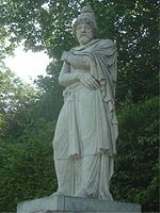
Tiridates I of Armenia

Encyclopedia
Tiridates I was King of Armenia beginning in AD 53 and the founder of the Arshakuni Dynasty
, the Armenian line of the Arsacid Dynasty
. The dates of his birth and death are unknown. His early reign was marked by a brief interruption towards the end of the year 54 and a much longer one from 58 to 63. In an agreement to resolve the Roman-Parthian conflict in and over Armenia, Tiridates (who was the brother of Vologases I of Parthia
) was crowned king of Armenia by the Roman emperor Nero
in AD 66; in the future, the king of Armenia was to be a Parthian prince, but his appointment required approval from the Romans. Even though this made Armenia a client kingdom
, various contemporary Roman sources thought that Nero had de facto
ceded Armenia to the Parthian Empire
.
In addition to being a king, Tiridates was also a Zoroastrian
priest and was accompanied by other magi
on his journey to Rome in AD 66. In the early 20th century, Franz Cumont
speculated that Tiridates was instrumental in the development of Mithraism
, which—in Cumont's view—was simply Romanized Zoroastrianism. This "continuity" theory has since been questioned. Tiridates is one of the principal characters in George Frideric Handel
's opera Radamisto
and Reinhard Keiser
's opera Octavia
.
and a Greek concubine. Virtually nothing is known about his minority and youth, which he spent in Media
, where his father was governor under the reign of his brother Gotarzes II. Tiridates' name meant given by Tir, Tir was an Armeno-Parthian god of literature, science and art based on the Avestan Tishtrya
and fused with the Greek
Apollo
. In 51 the Roman procurator
of Cappadocia
, Julius Paelignus, invaded Armenia and ravaged the country, then under an Iberia
n usurper Rhadamistus
. Rhadamistus had killed his uncle Mithridates
who was the legitimate king of Armenia by luring the Roman garrison that was protecting him outside of the fortress of Gornea
.
 Acting without instruction, Paelignus recognized Rhadamistus as the new king of Armenia. Syrian governor Ummidius Quadratus sent Helvidius Priscus with a legion to repair these outrages; he was recalled so as not to provoke a war with Parthia. In 52, King Vologases I (Vagharshak in Armenian) of Parthia
took the opportunity and invaded Armenia, conquering Artaxata (Artashat in Armenia) and proclaiming his younger brother Tiridates as king. This action violated the treaty that had been signed by the Roman emperor Augustus
and Parthian king Phraates IV which gave the Romans the explicit right to appoint and crown the kings of Armenia. Vologases considered the throne of Armenia to have been once the property of his ancestors, now usurped by a foreign monarch in virtue of a crime. A winter epidemic as well as an insurrection initiated by his son Vardanes
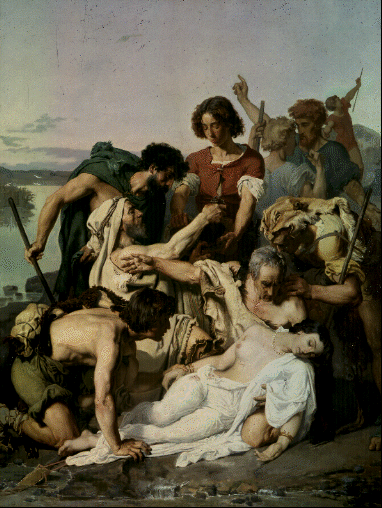
forced him to withdraw his troops from Armenia, allowing Rhadamistus to come back and punish locals as traitors; they eventually revolted and replaced him with the Parthian prince Tiridates in early 55. Rhadamistus escaped along with his wife Zenobia who was pregnant. Unable to continue fleeing, she asked her husband to end her life rather than be captured. Rhadamistus stabbed her with a Median dagger and flung her body into the river Araxes. Zenobia was not fatally injured and was recovered by shepherds who sent her to Tiridates. Tiridates received her kindly and treated her as a member of the monarchy. Rhadamistus himself returned to Iberia and was soon put to death by his father Parasmanes I
of Iberia for having plotted against the royal power.
n influence at their doorstep, Roman Emperor Nero sent General Corbulo
with a large army to the east in order to restore Roman client kings. A Hasmonean
named Aristobulus was given Lesser Armenia
(Nicopolis
and Satala
) and Sohaemus of Emesa
received Armenia Sophene
. In the spring of 58, Corbulo entered Greater Armenia from Cappadocia and advanced towards Artaxata, while Parasmanes I of Iberia attacked from the north, and Antiochus IV of Commagene
attacked from the southwest. Supported by his brother, Tiridates sent flying columns to raid the Romans far and wide. Corbulo retaliated using the same tactics and the use of the Moschoi tribes who raided outlying regions of Armenia. Tiridates fled from the capital, and Corbulo burned Artaxata to the ground. In the summer, Corbulo began moving towards Tigranocerta through rough terrain and passing through the Taronitida (Taron), where several of his commanders died in an ambush by the Armenian resistance; however, the city opened its doors, with the exception of one of the citadels, which was destroyed in the ensuing assault. By this time the majority of Armenians had abandoned resistance and accepted the prince favored by Rome.
Nero gave the crown to the last royal descendant of the Kings of Cappadocia, the grandson of Glaphyra
(daughter of Archelaus of Cappadocia
) and Alexander of Judea
(the brother of Herod Archelaus
and the son of Herod the Great
), who assumed the Armenian name Tigranes (his uncle was Tigranes V). His son, named Alexander, married Iotapa
, the daughter of Antiochus IV of Commagene
and was made King of Cilicia. Nero was hailed vigorously in public for this initial victory and Corbulo was appointed governor of Syria as a reward. A guard of 1000 legionary soldiers, three auxiliary cohorts and two wings of horses were allotted to Tigranes in order to defend the country. Border districts were bestowed to Roman allies that assisted Corbulo including Polemon
, Parasmanes, Aristobolus
and Antiochus.
Vologases was infuriated by the fact that an alien now sat on the Armenian throne but hesitated to reinstate his brother as he was engaged in a conflict with the Hyrcania
ns who were revolting. Tigranes invaded the Kingdom of Adiabene
and deposed its King Monobazes
in 61, who was a vassal of Parthians.
Vologases considered this an act of aggression from Rome and started a campaign to restore Tiridates to the Armenian throne. He placed under the command of spahbod
Moneses a well-disciplined force of cataphracts along with Adiabenian auxiliaries and ordered him to expel Tigranes from Armenia. Having quelled the Hyrcanian revolt, Vologases gathered the strength of his dominions and embarked toward Armenia. Corbulo, having been informed of the impending attack, sent two legions under the commands of Verulanus Severus and Vettius Bolanus to the assistance of Tigranes with secret directions that they should act with caution rather than vigour. He also dispatched a message to Nero, urging him to send a second commander with the explicit purpose of defending Armenia as Syria was now also in peril. Corbulo placed the remainder of the legions on the banks of the Euphrates
and armed irregular troops of the nearby provinces. Since the region was deficient in water, he erected forts over the fountains and concealed the rivulets by heaping sand over them.
Moneses marched towards Tigranocerta but failed to break the defense of the city walls as his troops were unfit for a long siege. Corbulo, although eminently successful thought it prudent to use his good fortune with moderation. He sent a Roman centurion by the name of Casperius to the camp of Vologases in Nisibis located 37 miles (59.5 km) from Tigranocerta with the demand to raise the siege. Because of a recent locust storm and the scarcity of fodder for his horses Vologases agreed to raise the siege of Tigranocerta and petitioned to be granted Armenia in order to achieve a firm peace. Vologases demanded that both the Roman and Parthian troops should evacuate Armenia, that Tigranes should be dethroned, and that the position of Tiridates be recognized. The Roman government declined to accede to these arrangements and sent Lucius Caesennius Paetus, governor of Cappadocia, to settle the question by bringing Armenia under direct Roman administration.
Paetus was an incapable commander and suffered a humiliating defeat at the Battle of Rhandeia in 62, losing the legions of XII Fulminata
commanded by Calvisius Sabinus and IIII Scythica
commanded by Funisulanus Vettonianus. The command of the troops was returned to Corbulo, who the following year led a strong army into Melitene and beyond into Armenia, eliminating all of the regional governors he suspected were pro-Parthian. Finally in Rhandeia, Corbulo and Tiridates met to make a peace agreement. The location of Rhandeia suited both Tiridates and Corbulo. It appealed to Tiridates because that is where his army had beaten the Romans and sent them away under a capitulation; on the other hand, it appealed to Corbulo because he was about to wipe out the ill repute earned before in the same location. When Tiridates arrived at the Roman camp he took off his royal diadem and placed it on the ground near a statue of Nero, agreeing to receive it back only from Nero in Rome. Tiridates was recognized as the vassal king of Armenia; a Roman garrison would remain in the country permanently, in Sophene while Artaxata would be reconstructed. Corbulo left his son-in-law Annius Vinicianus to accompany Tiridates to Rome in order to attest his own fidelity to Nero.
, through Illyria
, on the eastern shores of the Adriatic and Picenum
, in northeastern Italy
. The journey took nine months, and Tiridates rode on horseback, with his children and queen at his side. The children of Vologases, Monobazes and Pacorus also accompanied Tiridates.
Dio Cassius
, a second-century Roman historian, described Tiridates favorably at the time of his arrival: "Tiridates himself was in the prime of his life, a notable figure by reason of his youth, beauty, family, and intelligence." Nero greeted Tiridates at Neapolis (Naples
) in October, sending a state chariot to carry the visitor over the last few miles. No one was allowed to approach the emperor armed, but Tiridates maintained his dignity by refusing to remove his sword as he approached the ruler of the Roman Empire (though as a compromise, he agreed to have his sword firmly fastened in the sheath, so that it could not be drawn). At Puteolis (modern Pozzuoli
, near Naples) Nero ordered athletic games to be staged in honor of his guest. The Armenian king himself had an opportunity to display his ability as a marksman by shooting an arrow through the bodies of two buffaloes. The event at Puteolis also marked the first attested appearance of female gladiator
s:
The climax of the ceremonies was reserved for the capital. Rome was profusely decorated with flags, torches, garlands and bunting, and was gorgeously illuminated at night with great crowds of people seen everywhere.
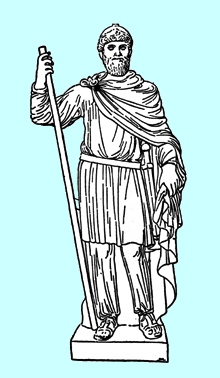 On the day after Tiridates' arrival, Nero came to the Forum
clothed in triumphal vestments and surrounded by dignitaries and soldiers, all resplendent in expensive attire and glittering armor. While Nero sat on the imperial throne, Tiridates and his retinue advanced between two lines of soldiers. Arriving in front of the dais
, Tiridates knelt, with hands clasped on his breast. After the thundering shouts and acclamations excited by this spectacle had subsided, Tiridates addressed the emperor:
To which Nero replied:
Tiridates then mounted the steps of the platform and knelt, while Nero placed the royal diadem on his head. As the young king was about to kneel a second time, Nero lifted him by his right hand and after kissing him, made him sit at his side on a chair a little lower than his own. Meanwhile, the populace gave tumultuous ovations to both rulers. A Praetor
, speaking to the audience, interpreted and explained the words of Tiridates, who spoke in Greek. According to Pliny the Elder
, Tiridates then introduced Nero to magian feasts (magicis cenis). Tacitus
claimed that Tiridates was also interested in all things Roman.
Public festivities continued for some time after the coronation ceremony. The interior of the Theatre of Pompey
and every piece of its furniture was entirely gilded for the occasion; for this reason, Rome thenceforth recalled that date as "the Golden Day." Daytime festivities were on a scale no less lavish than those of the night: Royal purple awnings stretched as protection against the heat of the sun. Nero, clad in green and wearing a chariot driver's headdress, took part in a chariot race. At the evening banquets, Nero, in gold-embroidered vestments, sang and played the lyre with zither
accompaniment. Tiridates was amazed and disgusted by Nero's extravagance, but he had only praise for Corbulo and expressed to Corbulo his surprise at his serving such a master. He made no concealment of his views to Nero's face and said to him sarcastically: "Sire, you have a wonderful servant in the person of Corbulo."
In memory of these events, the Senate honored Nero with the laurel wreath and the title of Imperator
, or commander-in-chief of the armies. No reception comparable to this in magnitude and splendor is recorded in the history of Rome. Besides the enormous sum spent in festivities, the Roman Government bore the entire cost of the journey of Tiridates and his retinue, both from and to their homeland. Nero also made a gift to Tiridates of fifty million sesterces.
On his journey back to Armenia, Tiridates viewed an exhibition of pancratium
. When seeing that one of the contestants fell on his back and was being beaten by his opponents, Tiridates saw exclaimed: "That's an unfair contest. It isn't fair that a man who has fallen should be beaten."
Later, Nero summoned the Parthian King Vologases to Rome several times, but when the invitations became burdensome to Vologases, he sent back a dispatch to this effect: "It is far easier for you than for me to traverse so great a body of water. Therefore, if you will come to Asia, we can then arrange to meet each other."
The visit of Tiridates, an event that greatly impressed contemporaries, apparently was adapted by Christians to become the story of the adoration of the Christ Child by the Three Magi. The Christian legend changed Rome into Bethlehem, the birth-place of the Ruler of the coming Kingdom of God, and replaced Tiridates with that contemporary king who was already connected with Christianity through the Acts of St. Thomas: Gondophares
, otherwise known as Kaspar.
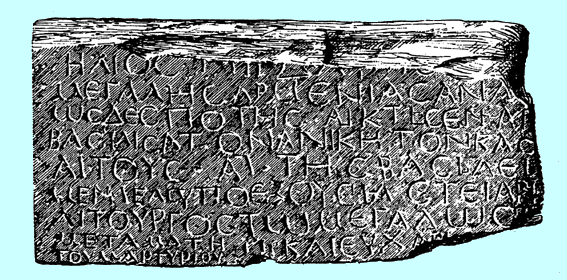 Peace prevailed at this time throughout the Roman Empire. Nero therefore closed the gates of the Temple of Janus, which were never shut save in times of universal peace. When Tiridates returned to Armenia, he took with him a great number of skilled artisans for the reconstruction of Artaxata. He renamed the capital Neronia in honor of the emperor; he embellished the royal residence at Garni
, nearby, with colonnades and monuments of dazzling richness and also the addition of a new temple. Trade between the two continents also grew, allowing Armenia to secure its independence from Rome. Rome now counted upon Armenia as a loyal ally, even after Nero's death and through the entire duration of Vespasian
's rule in the East. Peace was a considerable victory for Nero politically.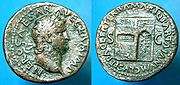 The immediate dividend of the peace was Rome's ability to turn its full attention to the mounting problems at Judea, which broke into open warfare culminating in the First Jewish-Roman War
just one year after Tiridates' coronation. Large numbers of legions were diverted to Judea from Syria, which would otherwise have been impossible. Nero became very popular in the eastern provinces of Rome and with the Armenians and Parthians. The name of Legio XII Fulminata
discovered carved on a mountain in Gobustan
(in modern Azerbaijan
), attests to the presence of Roman soldiers by the shores of the Caspian Sea
in 89 AD, farther east than any previously known Roman inscription. The peace between Parthia and Rome lasted 50 years, until emperor Trajan
invaded Armenia in 114.
, a warlike nomadic Sarmatian tribe, made an incursion into Media Atropatene as well as various districts of northern Armenia. Tiridates and his brother Pacorus
, King of Media Atropatene, faced them at a number of battles, during one of which Tiridates was briefly captured, narrowly escaping being taken alive. He was lassoed from a distance and caught, but he quickly managed to whip out his sword and slash the rope in time. The Alans withdrew with a lot of booty after plundering Armenia and Media Atropatene. The king of Iberia asked for protection against the Alans from Vespasian
, who helped reconstruct the fortress of Harmozica around the Iberian capital Mtskheta
, near modern Tbilisi
. An Aramaic
inscription found near Tbilisi indicates that Tiridates also warred with Iberia during his final years. The exact date of the end of Tiridates' reign is unknown; various sources name Sanatruces as his successor. It is known that Tiridates' nephew, Axidares, the son of Pacorus II of Parthia, was King of Armenia by 110.
Arsacid Dynasty of Armenia
The Arsacid dynasty or Arshakuni dynasty ruled the Kingdom of Armenia from 54 AD to 428 AD. Formerly a branch of the Iranian Parthian Arsacids, they became a distinctly Armenian dynasty. Arsacid Kings reigned intermittently throughout the chaotic years following the fall of the Artaxiad Dynasty...
, the Armenian line of the Arsacid Dynasty
Arsacid Dynasty of Armenia
The Arsacid dynasty or Arshakuni dynasty ruled the Kingdom of Armenia from 54 AD to 428 AD. Formerly a branch of the Iranian Parthian Arsacids, they became a distinctly Armenian dynasty. Arsacid Kings reigned intermittently throughout the chaotic years following the fall of the Artaxiad Dynasty...
. The dates of his birth and death are unknown. His early reign was marked by a brief interruption towards the end of the year 54 and a much longer one from 58 to 63. In an agreement to resolve the Roman-Parthian conflict in and over Armenia, Tiridates (who was the brother of Vologases I of Parthia
Vologases I of Parthia
Vologases I of Parthia, sometimes called Vologaeses or Vologeses or, following Zoroastrian usage, Valakhsh ruled the Parthian Empire from about 51 to 78. Son of Vonones II by a Thracian concubine, he succeeded his father in 51 AD. He gave the kingdom of Media Atropatene to his brother Pacorus II,...
) was crowned king of Armenia by the Roman emperor Nero
Nero
Nero , was Roman Emperor from 54 to 68, and the last in the Julio-Claudian dynasty. Nero was adopted by his great-uncle Claudius to become his heir and successor, and succeeded to the throne in 54 following Claudius' death....
in AD 66; in the future, the king of Armenia was to be a Parthian prince, but his appointment required approval from the Romans. Even though this made Armenia a client kingdom
Client state
Client state is one of several terms used to describe the economic, political and/or military subordination of one state to a more powerful state in international affairs...
, various contemporary Roman sources thought that Nero had de facto
De facto
De facto is a Latin expression that means "concerning fact." In law, it often means "in practice but not necessarily ordained by law" or "in practice or actuality, but not officially established." It is commonly used in contrast to de jure when referring to matters of law, governance, or...
ceded Armenia to the Parthian Empire
Parthian Empire
The Parthian Empire , also known as the Arsacid Empire , was a major Iranian political and cultural power in ancient Persia...
.
In addition to being a king, Tiridates was also a Zoroastrian
Zoroastrianism
Zoroastrianism is a religion and philosophy based on the teachings of prophet Zoroaster and was formerly among the world's largest religions. It was probably founded some time before the 6th century BCE in Greater Iran.In Zoroastrianism, the Creator Ahura Mazda is all good, and no evil...
priest and was accompanied by other magi
Magi
Magi is a term, used since at least the 4th century BC, to denote a follower of Zoroaster, or rather, a follower of what the Hellenistic world associated Zoroaster with, which...
on his journey to Rome in AD 66. In the early 20th century, Franz Cumont
Franz Cumont
Franz-Valéry-Marie Cumont was a Belgian archaeologist and historian, a philologist and student of epigraphy, who brought these often isolated specialties to bear on the syncretic mystery religions of Late Antiquity, notably Mithraism. Cumont was a graduate of the University of Ghent...
speculated that Tiridates was instrumental in the development of Mithraism
Mithraism
The Mithraic Mysteries were a mystery religion practised in the Roman Empire from about the 1st to 4th centuries AD. The name of the Persian god Mithra, adapted into Greek as Mithras, was linked to a new and distinctive imagery...
, which—in Cumont's view—was simply Romanized Zoroastrianism. This "continuity" theory has since been questioned. Tiridates is one of the principal characters in George Frideric Handel
George Frideric Handel
George Frideric Handel was a German-British Baroque composer, famous for his operas, oratorios, anthems and organ concertos. Handel was born in 1685, in a family indifferent to music...
's opera Radamisto
Radamisto (Handel)
Radamisto is an opera in three acts by George Frideric Handel to an Italian libretto by Nicola Francesco Haym, based on L'amor tirannico, o Zenobia by Domenico Lalli and Zenobia by Matteo Noris...
and Reinhard Keiser
Reinhard Keiser
Reinhard Keiser was a popular German opera composer based in Hamburg. He wrote over a hundred operas, and in 1745 Johann Adolph Scheibe considered him an equal to Johann Kuhnau, George Frideric Handel and Georg Philipp Telemann , but his work was largely forgotten for many...
's opera Octavia
Octavia (opera)
The Roman Unrest, or The Noble-Minded Octavia , commonly called Octavia, is a singspiel in three acts by Reinhard Keiser to a German libretto by Barthold Feind...
.
Ascension
Tiridates was the son of Vonones II of ParthiaVonones II of Parthia
Vonones II of Parthia ruled the Parthian Empire briefly in 51. During the reign of his brother Gotarzes II he was governor of Media, and was raised to the throne on Gotarzes' death. However, he died after a few months and was succeeded by his son Vologases I....
and a Greek concubine. Virtually nothing is known about his minority and youth, which he spent in Media
Medes
The MedesThe Medes...
, where his father was governor under the reign of his brother Gotarzes II. Tiridates' name meant given by Tir, Tir was an Armeno-Parthian god of literature, science and art based on the Avestan Tishtrya
Tishtrya
Tishtrya is the Avestan language name of an Zoroastrian benevolent divinity associated with life-bringing rainfall and fertility. Tishtrya is Tir in Middle- and Modern Persian...
and fused with the Greek
Greek mythology
Greek mythology is the body of myths and legends belonging to the ancient Greeks, concerning their gods and heroes, the nature of the world, and the origins and significance of their own cult and ritual practices. They were a part of religion in ancient Greece...
Apollo
Apollo
Apollo is one of the most important and complex of the Olympian deities in Greek and Roman mythology...
. In 51 the Roman procurator
Promagistrate
A promagistrate is a person who acts in and with the authority and capacity of a magistrate, but without holding a magisterial office. A legal innovation of the Roman Republic, the promagistracy was invented in order to provide Rome with governors of overseas territories instead of having to elect...
of Cappadocia
Cappadocia
Cappadocia is a historical region in Central Anatolia, largely in Nevşehir Province.In the time of Herodotus, the Cappadocians were reported as occupying the whole region from Mount Taurus to the vicinity of the Euxine...
, Julius Paelignus, invaded Armenia and ravaged the country, then under an Iberia
Caucasian Iberia
Iberia , also known as Iveria , was a name given by the ancient Greeks and Romans to the ancient Georgian kingdom of Kartli , corresponding roughly to the eastern and southern parts of the present day Georgia...
n usurper Rhadamistus
Rhadamistus
Rhadamistus was an Iberian prince who reigned in Armenia from 51 to 53 and 54 to 55 CE. Considered to be an usurper and tyrant, he was overthrown in a rebellion supported by the Parthian Empire.- Life :...
. Rhadamistus had killed his uncle Mithridates
Mithridates of Armenia
Mithridates of Armenia was an Iberian prince and a king of Armenia under the protection of the Roman Empire.Mithridates was installed by his brother Pharasmanes I of Iberia who, encouraged by Tiberius, invaded Armenia and captured its capital Artaxata in 35...
who was the legitimate king of Armenia by luring the Roman garrison that was protecting him outside of the fortress of Gornea
Garni
Garni is a village in the Kotayk Province of Armenia, situated approximately 28 km southeast from Yerevan.- History :...
.
Parthia
Parthia is a region of north-eastern Iran, best known for having been the political and cultural base of the Arsacid dynasty, rulers of the Parthian Empire....
took the opportunity and invaded Armenia, conquering Artaxata (Artashat in Armenia) and proclaiming his younger brother Tiridates as king. This action violated the treaty that had been signed by the Roman emperor Augustus
Augustus
Augustus ;23 September 63 BC – 19 August AD 14) is considered the first emperor of the Roman Empire, which he ruled alone from 27 BC until his death in 14 AD.The dates of his rule are contemporary dates; Augustus lived under two calendars, the Roman Republican until 45 BC, and the Julian...
and Parthian king Phraates IV which gave the Romans the explicit right to appoint and crown the kings of Armenia. Vologases considered the throne of Armenia to have been once the property of his ancestors, now usurped by a foreign monarch in virtue of a crime. A winter epidemic as well as an insurrection initiated by his son Vardanes
Vardanes II of Parthia
Vardanes II of Parthia was the son of Vologases I and briefly ruler of part of the Parthian Empire. He rebelled against his father from about 55 to 58 CE and must have occupied Ecbatana, since he issued coins from the mint there, bearing the likeness of a young beardless king wearing a diadem with...
forced him to withdraw his troops from Armenia, allowing Rhadamistus to come back and punish locals as traitors; they eventually revolted and replaced him with the Parthian prince Tiridates in early 55. Rhadamistus escaped along with his wife Zenobia who was pregnant. Unable to continue fleeing, she asked her husband to end her life rather than be captured. Rhadamistus stabbed her with a Median dagger and flung her body into the river Araxes. Zenobia was not fatally injured and was recovered by shepherds who sent her to Tiridates. Tiridates received her kindly and treated her as a member of the monarchy. Rhadamistus himself returned to Iberia and was soon put to death by his father Parasmanes I
Pharsman I of Iberia
Pharasmanes I was a king of Iberia who plays a prominent role in Tacitus’ account of Rome’s eastern policy and campaigns under Tiberius, Claudius, and Nero...
of Iberia for having plotted against the royal power.
War with Rome
Unhappy with the growing ParthiaParthia
Parthia is a region of north-eastern Iran, best known for having been the political and cultural base of the Arsacid dynasty, rulers of the Parthian Empire....
n influence at their doorstep, Roman Emperor Nero sent General Corbulo
Gnaeus Domitius Corbulo
Gnaeus Domitius Corbulo was a Roman general and a brother-in-law of the emperor Caligula.-Descent:Corbulo was born in Italy into a senatorial family...
with a large army to the east in order to restore Roman client kings. A Hasmonean
Hasmonean
The Hasmonean dynasty , was the ruling dynasty of Judea and surrounding regions during classical antiquity. Between c. 140 and c. 116 BCE, the dynasty ruled semi-autonomously from the Seleucids in the region of Judea...
named Aristobulus was given Lesser Armenia
Lesser Armenia
Lesser Armenia , also known as Armenia Minor and Armenia Inferior, refers to the Armenian populated regions, primarily to the West and North-West of the ancient Armenian Kingdom...
(Nicopolis
Nicopolis
Nicopolis — or Actia Nicopolis — was an ancient city of Epirus, founded 31 BC by Octavian in memory of his victory over Antony and Cleopatra at Actium the previous year. It was later the capital of Epirus Vetus...
and Satala
Satala
Located in Turkey, the city of Satala , according to the ancient geographers, was situated in a valley surrounded by mountains, a little north of the Euphrates, where the road from Trapezus to Samosata crossed the boundary of the Roman Empire...
) and Sohaemus of Emesa
Sohaemus of Emesa
Gaius Julius Sohaemus, also known as Sohaemus of Emesa and Sohaemus of Sophene , was a prince and a Roman Client Priest King from Syria who lived in the 1st century....
received Armenia Sophene
Sophene
Sophene , or ) was a province of the Armenian Kingdom and of the Roman Empire, located in the south-west of the kingdom. It currently lies in modern-day southeastern Turkey....
. In the spring of 58, Corbulo entered Greater Armenia from Cappadocia and advanced towards Artaxata, while Parasmanes I of Iberia attacked from the north, and Antiochus IV of Commagene
Antiochus IV of Commagene
Gaius Julius Antiochus IV Epiphanes , the last king of Commagene, reigned between 38-72 as a client king to the Roman Empire.-Life:Antiochus was a prince and son of Antiochus III of Commagene and his mother was Queen Iotapa of Commagene. The parents of Antiochus IV were full-blooded siblings, who...
attacked from the southwest. Supported by his brother, Tiridates sent flying columns to raid the Romans far and wide. Corbulo retaliated using the same tactics and the use of the Moschoi tribes who raided outlying regions of Armenia. Tiridates fled from the capital, and Corbulo burned Artaxata to the ground. In the summer, Corbulo began moving towards Tigranocerta through rough terrain and passing through the Taronitida (Taron), where several of his commanders died in an ambush by the Armenian resistance; however, the city opened its doors, with the exception of one of the citadels, which was destroyed in the ensuing assault. By this time the majority of Armenians had abandoned resistance and accepted the prince favored by Rome.
Nero gave the crown to the last royal descendant of the Kings of Cappadocia, the grandson of Glaphyra
Glaphyra
Glaphyra was an Anatolian Princess from Cappadocia and through marriage was related to the Herodian Dynasty. -Family and early life:Glaphyra was a royal princess of Greek, Armenian and Persian descent. Her father was the Roman ally king Archelaus of Cappadocia, her only natural sibling was her...
(daughter of Archelaus of Cappadocia
Archelaus of Cappadocia
-Family & Early Life:Archelaus was a Cappadocian Greek nobleman, possibly of Macedonian descent. His full name was Archelaus Sisines. He was the first born son, namesake of the Roman Client and High Priest Ruler Archelaus, of the temple state of Comana, Cappadocia and Glaphyra. Archelaus’ father...
) and Alexander of Judea
Iudaea Province
Judaea or Iudaea are terms used by historians to refer to the Roman province that extended over parts of the former regions of the Hasmonean and Herodian kingdoms of Israel...
(the brother of Herod Archelaus
Herod Archelaus
Herod Archelaus was the ethnarch of Samaria, Judea, and Idumea from 4 BC to 6 AD. He was the son of Herod the Great and Malthace the Samaritan, the brother of Herod Antipas, and the half-brother of Herod Philip I....
and the son of Herod the Great
Herod the Great
Herod , also known as Herod the Great , was a Roman client king of Judea. His epithet of "the Great" is widely disputed as he is described as "a madman who murdered his own family and a great many rabbis." He is also known for his colossal building projects in Jerusalem and elsewhere, including his...
), who assumed the Armenian name Tigranes (his uncle was Tigranes V). His son, named Alexander, married Iotapa
Iotapa
Iotapa or Iotape also known as Iotapi was the name of various queens and princesses who lived in between the 2nd century BC, 1st century BC, 1st century and 2nd century. The name Iotapa or Iotape originally derives from the name Jotapa or Jotape, which was a name of Persian origin...
, the daughter of Antiochus IV of Commagene
Antiochus IV of Commagene
Gaius Julius Antiochus IV Epiphanes , the last king of Commagene, reigned between 38-72 as a client king to the Roman Empire.-Life:Antiochus was a prince and son of Antiochus III of Commagene and his mother was Queen Iotapa of Commagene. The parents of Antiochus IV were full-blooded siblings, who...
and was made King of Cilicia. Nero was hailed vigorously in public for this initial victory and Corbulo was appointed governor of Syria as a reward. A guard of 1000 legionary soldiers, three auxiliary cohorts and two wings of horses were allotted to Tigranes in order to defend the country. Border districts were bestowed to Roman allies that assisted Corbulo including Polemon
Polemon (Cilicia)
Marcus Antonius Polemon Pythodoros, also known as Polemon II of Pontus and Polemon of Cilicia was a prince and Roman Client King of Pontus, Colchis and Cilicia....
, Parasmanes, Aristobolus
Aristobulus of Chalcis
Aristobulus of Chalcis was a son of Herod of Chalcis and his first wife Mariamne, hence a great-grandson of Herod the Great.In 55 AD, he was appointed by Nero as King of Armenia Minor, and participated with his forces in the Roman-Parthian War of 58–63, where he received a small portion of Armenia...
and Antiochus.
Vologases was infuriated by the fact that an alien now sat on the Armenian throne but hesitated to reinstate his brother as he was engaged in a conflict with the Hyrcania
Hyrcania
Hyrcania was the name of a satrapy located in the territories of present day Gilan, Golestan, Mazandaran and part of Turkmenistan, lands south of the Caspian Sea. To the Greeks, the Caspian Sea was the "Hyrcanian Sea".-Etymology:...
ns who were revolting. Tigranes invaded the Kingdom of Adiabene
Adiabene
Adiabene was an ancient Assyrian independent kingdom in Mesopotamia, with its capital at Arbela...
and deposed its King Monobazes
Monobaz II
Monobaz II or Monobaz bar Monobaz was the son of Helena of Adiabene and Monobaz I. Like his younger brother Izates bar Monobaz and his mother, Monobaz became a convert to Judaism. He ruled as king of Adiabene after the death of his brother Izates around 55 CE...
in 61, who was a vassal of Parthians.
Vologases considered this an act of aggression from Rome and started a campaign to restore Tiridates to the Armenian throne. He placed under the command of spahbod
Spahbod
Spahbod or Spahbed , is derived from the words Spah and bod ; or "Aspah'Paeity" , and means commander of cavaliers/ knights; alternatively Spah Salar was a rank used in the Parthian empire and more widely in the Sassanid Empire of Persia...
Moneses a well-disciplined force of cataphracts along with Adiabenian auxiliaries and ordered him to expel Tigranes from Armenia. Having quelled the Hyrcanian revolt, Vologases gathered the strength of his dominions and embarked toward Armenia. Corbulo, having been informed of the impending attack, sent two legions under the commands of Verulanus Severus and Vettius Bolanus to the assistance of Tigranes with secret directions that they should act with caution rather than vigour. He also dispatched a message to Nero, urging him to send a second commander with the explicit purpose of defending Armenia as Syria was now also in peril. Corbulo placed the remainder of the legions on the banks of the Euphrates
Euphrates
The Euphrates is the longest and one of the most historically important rivers of Western Asia. Together with the Tigris, it is one of the two defining rivers of Mesopotamia...
and armed irregular troops of the nearby provinces. Since the region was deficient in water, he erected forts over the fountains and concealed the rivulets by heaping sand over them.
Moneses marched towards Tigranocerta but failed to break the defense of the city walls as his troops were unfit for a long siege. Corbulo, although eminently successful thought it prudent to use his good fortune with moderation. He sent a Roman centurion by the name of Casperius to the camp of Vologases in Nisibis located 37 miles (59.5 km) from Tigranocerta with the demand to raise the siege. Because of a recent locust storm and the scarcity of fodder for his horses Vologases agreed to raise the siege of Tigranocerta and petitioned to be granted Armenia in order to achieve a firm peace. Vologases demanded that both the Roman and Parthian troops should evacuate Armenia, that Tigranes should be dethroned, and that the position of Tiridates be recognized. The Roman government declined to accede to these arrangements and sent Lucius Caesennius Paetus, governor of Cappadocia, to settle the question by bringing Armenia under direct Roman administration.
Paetus was an incapable commander and suffered a humiliating defeat at the Battle of Rhandeia in 62, losing the legions of XII Fulminata
Legio XII Fulminata
Legio duodecima Fulminata , also known as Paterna, Victrix, Antiqua, Certa Constans, and Galliena, was a Roman legion, levied by Julius Caesar in 58 BC and which accompanied him during the Gallic wars until 49 BC. The unit was still guarding the Euphrates River crossing near Melitene at the...
commanded by Calvisius Sabinus and IIII Scythica
Legio IV Scythica
Legio quarta Scythica was a Roman legion levied by Mark Antony around 42 BC, for his campaign against the Parthian Empire, hence its other cognomen, Parthica. The legion was still active in Syria in the early 5th century...
commanded by Funisulanus Vettonianus. The command of the troops was returned to Corbulo, who the following year led a strong army into Melitene and beyond into Armenia, eliminating all of the regional governors he suspected were pro-Parthian. Finally in Rhandeia, Corbulo and Tiridates met to make a peace agreement. The location of Rhandeia suited both Tiridates and Corbulo. It appealed to Tiridates because that is where his army had beaten the Romans and sent them away under a capitulation; on the other hand, it appealed to Corbulo because he was about to wipe out the ill repute earned before in the same location. When Tiridates arrived at the Roman camp he took off his royal diadem and placed it on the ground near a statue of Nero, agreeing to receive it back only from Nero in Rome. Tiridates was recognized as the vassal king of Armenia; a Roman garrison would remain in the country permanently, in Sophene while Artaxata would be reconstructed. Corbulo left his son-in-law Annius Vinicianus to accompany Tiridates to Rome in order to attest his own fidelity to Nero.
Visiting Rome
Prior to embarking for Rome, Tiridates visited his mother and two brothers in Media Atropatene and Parthia. On his long trek he was accompanied by his family and an imposing retinue, comprising many feudal lords and 3,000 horsemen. His route lay across ThraceThrace
Thrace is a historical and geographic area in southeast Europe. As a geographical concept, Thrace designates a region bounded by the Balkan Mountains on the north, Rhodope Mountains and the Aegean Sea on the south, and by the Black Sea and the Sea of Marmara on the east...
, through Illyria
Illyria
In classical antiquity, Illyria was a region in the western part of the Balkan Peninsula inhabited by the Illyrians....
, on the eastern shores of the Adriatic and Picenum
Picenum
Picenum was a region of ancient Italy. The name is an exonym assigned by the Romans, who conquered and incorporated it into the Roman Republic. Picenum was the birthplace of such notables as Pompey the Great and his father Pompeius Strabo. It was situated in what is now Marche...
, in northeastern Italy
Italy
Italy , officially the Italian Republic languages]] under the European Charter for Regional or Minority Languages. In each of these, Italy's official name is as follows:;;;;;;;;), is a unitary parliamentary republic in South-Central Europe. To the north it borders France, Switzerland, Austria and...
. The journey took nine months, and Tiridates rode on horseback, with his children and queen at his side. The children of Vologases, Monobazes and Pacorus also accompanied Tiridates.
Dio Cassius
Dio Cassius
Lucius Cassius Dio Cocceianus , known in English as Cassius Dio, Dio Cassius, or Dio was a Roman consul and a noted historian writing in Greek...
, a second-century Roman historian, described Tiridates favorably at the time of his arrival: "Tiridates himself was in the prime of his life, a notable figure by reason of his youth, beauty, family, and intelligence." Nero greeted Tiridates at Neapolis (Naples
Naples
Naples is a city in Southern Italy, situated on the country's west coast by the Gulf of Naples. Lying between two notable volcanic regions, Mount Vesuvius and the Phlegraean Fields, it is the capital of the region of Campania and of the province of Naples...
) in October, sending a state chariot to carry the visitor over the last few miles. No one was allowed to approach the emperor armed, but Tiridates maintained his dignity by refusing to remove his sword as he approached the ruler of the Roman Empire (though as a compromise, he agreed to have his sword firmly fastened in the sheath, so that it could not be drawn). At Puteolis (modern Pozzuoli
Pozzuoli
Pozzuoli is a city and comune of the province of Naples, in the Italian region of Campania. It is the main city of the Phlegrean peninsula.-History:Pozzuoli began as the Greek colony of Dicaearchia...
, near Naples) Nero ordered athletic games to be staged in honor of his guest. The Armenian king himself had an opportunity to display his ability as a marksman by shooting an arrow through the bodies of two buffaloes. The event at Puteolis also marked the first attested appearance of female gladiator
Female gladiator
A gladiatrix was the female counterpart to the male gladiator, an armed fighter who engaged in violent combat with humans or animals for the entertainment of audiences in the arenas of the Roman Republic and Roman Empire...
s:
The climax of the ceremonies was reserved for the capital. Rome was profusely decorated with flags, torches, garlands and bunting, and was gorgeously illuminated at night with great crowds of people seen everywhere.
Roman Forum
The Roman Forum is a rectangular forum surrounded by the ruins of several important ancient government buildings at the center of the city of Rome. Citizens of the ancient city referred to this space, originally a marketplace, as the Forum Magnum, or simply the Forum...
clothed in triumphal vestments and surrounded by dignitaries and soldiers, all resplendent in expensive attire and glittering armor. While Nero sat on the imperial throne, Tiridates and his retinue advanced between two lines of soldiers. Arriving in front of the dais
Dais
Dais is any raised platform located either in or outside of a room or enclosure, often for dignified occupancy, as at the front of a lecture hall or sanctuary....
, Tiridates knelt, with hands clasped on his breast. After the thundering shouts and acclamations excited by this spectacle had subsided, Tiridates addressed the emperor:
To which Nero replied:
Tiridates then mounted the steps of the platform and knelt, while Nero placed the royal diadem on his head. As the young king was about to kneel a second time, Nero lifted him by his right hand and after kissing him, made him sit at his side on a chair a little lower than his own. Meanwhile, the populace gave tumultuous ovations to both rulers. A Praetor
Praetor
Praetor was a title granted by the government of Ancient Rome to men acting in one of two official capacities: the commander of an army, usually in the field, or the named commander before mustering the army; and an elected magistratus assigned varied duties...
, speaking to the audience, interpreted and explained the words of Tiridates, who spoke in Greek. According to Pliny the Elder
Pliny the Elder
Gaius Plinius Secundus , better known as Pliny the Elder, was a Roman author, naturalist, and natural philosopher, as well as naval and army commander of the early Roman Empire, and personal friend of the emperor Vespasian...
, Tiridates then introduced Nero to magian feasts (magicis cenis). Tacitus
Tacitus
Publius Cornelius Tacitus was a senator and a historian of the Roman Empire. The surviving portions of his two major works—the Annals and the Histories—examine the reigns of the Roman Emperors Tiberius, Claudius, Nero and those who reigned in the Year of the Four Emperors...
claimed that Tiridates was also interested in all things Roman.
Public festivities continued for some time after the coronation ceremony. The interior of the Theatre of Pompey
Theatre of Pompey
The Theatre of Pompey was a structure in Ancient Rome built during the later part of the Roman Republican era. It was completed in seven years, starting from 55 BC, and was dedicated early in 52 BC before the structure was fully completed...
and every piece of its furniture was entirely gilded for the occasion; for this reason, Rome thenceforth recalled that date as "the Golden Day." Daytime festivities were on a scale no less lavish than those of the night: Royal purple awnings stretched as protection against the heat of the sun. Nero, clad in green and wearing a chariot driver's headdress, took part in a chariot race. At the evening banquets, Nero, in gold-embroidered vestments, sang and played the lyre with zither
Zither
The zither is a musical string instrument, most commonly found in Slovenia, Austria, Hungary citera, northwestern Croatia, the southern regions of Germany, alpine Europe and East Asian cultures, including China...
accompaniment. Tiridates was amazed and disgusted by Nero's extravagance, but he had only praise for Corbulo and expressed to Corbulo his surprise at his serving such a master. He made no concealment of his views to Nero's face and said to him sarcastically: "Sire, you have a wonderful servant in the person of Corbulo."
In memory of these events, the Senate honored Nero with the laurel wreath and the title of Imperator
Imperator
The Latin word Imperator was originally a title roughly equivalent to commander under the Roman Republic. Later it became a part of the titulature of the Roman Emperors as part of their cognomen. The English word emperor derives from imperator via Old French Empreur...
, or commander-in-chief of the armies. No reception comparable to this in magnitude and splendor is recorded in the history of Rome. Besides the enormous sum spent in festivities, the Roman Government bore the entire cost of the journey of Tiridates and his retinue, both from and to their homeland. Nero also made a gift to Tiridates of fifty million sesterces.
On his journey back to Armenia, Tiridates viewed an exhibition of pancratium
Pankration
Pankration was a martial art introduced into the Greek Olympic Games in 648 BC and founded as a blend of boxing and wrestling but without any rules. The term comes from the Greek , literally meaning "all powers" from "all" + "strength, power". Spartans were taught to use this ancient...
. When seeing that one of the contestants fell on his back and was being beaten by his opponents, Tiridates saw exclaimed: "That's an unfair contest. It isn't fair that a man who has fallen should be beaten."
Later, Nero summoned the Parthian King Vologases to Rome several times, but when the invitations became burdensome to Vologases, he sent back a dispatch to this effect: "It is far easier for you than for me to traverse so great a body of water. Therefore, if you will come to Asia, we can then arrange to meet each other."
The visit of Tiridates, an event that greatly impressed contemporaries, apparently was adapted by Christians to become the story of the adoration of the Christ Child by the Three Magi. The Christian legend changed Rome into Bethlehem, the birth-place of the Ruler of the coming Kingdom of God, and replaced Tiridates with that contemporary king who was already connected with Christianity through the Acts of St. Thomas: Gondophares
Gondophares
Gondophares I a Seistani representative of the house of Suren as well as founder and first king of the Indo-Parthian Kingdom. He seems to have ruled c...
, otherwise known as Kaspar.
Fragile peace
Garni
Garni is a village in the Kotayk Province of Armenia, situated approximately 28 km southeast from Yerevan.- History :...
, nearby, with colonnades and monuments of dazzling richness and also the addition of a new temple. Trade between the two continents also grew, allowing Armenia to secure its independence from Rome. Rome now counted upon Armenia as a loyal ally, even after Nero's death and through the entire duration of Vespasian
Vespasian
Vespasian , was Roman Emperor from 69 AD to 79 AD. Vespasian was the founder of the Flavian dynasty, which ruled the Empire for a quarter century. Vespasian was descended from a family of equestrians, who rose into the senatorial rank under the Emperors of the Julio-Claudian dynasty...
's rule in the East. Peace was a considerable victory for Nero politically.
First Jewish-Roman War
The First Jewish–Roman War , sometimes called The Great Revolt , was the first of three major rebellions by the Jews of Judaea Province , against the Roman Empire...
just one year after Tiridates' coronation. Large numbers of legions were diverted to Judea from Syria, which would otherwise have been impossible. Nero became very popular in the eastern provinces of Rome and with the Armenians and Parthians. The name of Legio XII Fulminata
Legio XII Fulminata
Legio duodecima Fulminata , also known as Paterna, Victrix, Antiqua, Certa Constans, and Galliena, was a Roman legion, levied by Julius Caesar in 58 BC and which accompanied him during the Gallic wars until 49 BC. The unit was still guarding the Euphrates River crossing near Melitene at the...
discovered carved on a mountain in Gobustan
Gobustan State Reserve
Gobustan National Park officially Gobustan Rock Art Cultural Landscape is a hill and mountain site occupying the southeast ending of the Big Caucasian Ridge, mainly in the basin of Jeyrankechmaz River, between the rivers Pirsagat and Sumgait...
(in modern Azerbaijan
Azerbaijan
Azerbaijan , officially the Republic of Azerbaijan is the largest country in the Caucasus region of Eurasia. Located at the crossroads of Western Asia and Eastern Europe, it is bounded by the Caspian Sea to the east, Russia to the north, Georgia to the northwest, Armenia to the west, and Iran to...
), attests to the presence of Roman soldiers by the shores of the Caspian Sea
Caspian Sea
The Caspian Sea is the largest enclosed body of water on Earth by area, variously classed as the world's largest lake or a full-fledged sea. The sea has a surface area of and a volume of...
in 89 AD, farther east than any previously known Roman inscription. The peace between Parthia and Rome lasted 50 years, until emperor Trajan
Trajan
Trajan , was Roman Emperor from 98 to 117 AD. Born into a non-patrician family in the province of Hispania Baetica, in Spain Trajan rose to prominence during the reign of emperor Domitian. Serving as a legatus legionis in Hispania Tarraconensis, in Spain, in 89 Trajan supported the emperor against...
invaded Armenia in 114.
War with Alans and aftermath
In 72 the AlansAlans
The Alans, or the Alani, occasionally termed Alauni or Halani, were a group of Sarmatian tribes, nomadic pastoralists of the 1st millennium AD who spoke an Eastern Iranian language which derived from Scytho-Sarmatian and which in turn evolved into modern Ossetian.-Name:The various forms of Alan —...
, a warlike nomadic Sarmatian tribe, made an incursion into Media Atropatene as well as various districts of northern Armenia. Tiridates and his brother Pacorus
Pacorus II of Parthia
Pacorus II of Parthia ruled the Parthian Empire from about 78 to 105. A son of Vonones II and brother of Vologases I, he was given the kingdom of Media Atropatene by the latter after his succession to the throne. After Vologases' death, Pacorus revolted against his brother's son and successor,...
, King of Media Atropatene, faced them at a number of battles, during one of which Tiridates was briefly captured, narrowly escaping being taken alive. He was lassoed from a distance and caught, but he quickly managed to whip out his sword and slash the rope in time. The Alans withdrew with a lot of booty after plundering Armenia and Media Atropatene. The king of Iberia asked for protection against the Alans from Vespasian
Vespasian
Vespasian , was Roman Emperor from 69 AD to 79 AD. Vespasian was the founder of the Flavian dynasty, which ruled the Empire for a quarter century. Vespasian was descended from a family of equestrians, who rose into the senatorial rank under the Emperors of the Julio-Claudian dynasty...
, who helped reconstruct the fortress of Harmozica around the Iberian capital Mtskheta
Mtskheta
Mtskheta , one of the oldest cities of the country of Georgia , is located approximately 20 kilometers north of Tbilisi at the confluence of the Aragvi and Kura rivers. The city is now the administrative centre of the Mtskheta-Mtianeti region...
, near modern Tbilisi
Tbilisi
Tbilisi is the capital and the largest city of Georgia, lying on the banks of the Mt'k'vari River. The name is derived from an early Georgian form T'pilisi and it was officially known as Tiflis until 1936...
. An Aramaic
Aramaic alphabet
The Aramaic alphabet is adapted from the Phoenician alphabet and became distinctive from it by the 8th century BC. The letters all represent consonants, some of which are matres lectionis, which also indicate long vowels....
inscription found near Tbilisi indicates that Tiridates also warred with Iberia during his final years. The exact date of the end of Tiridates' reign is unknown; various sources name Sanatruces as his successor. It is known that Tiridates' nephew, Axidares, the son of Pacorus II of Parthia, was King of Armenia by 110.
External links
- Corbulo, Armenia and Parthia Domicio Corbulon: Y la Guerra de Armenia (analysis of the conflict with Corbulo, includes detailed maps.)
- History into fiction: the metamorphosis of the Mithras myths
- PERCEPTIONS OF CLASSICAL ARMENIA:. ROMANO-PARTHIAN RELATIONS, 70 BC-220 AD.