


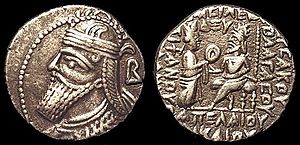
Vologases IV of Parthia

Encyclopedia
Parthia
Parthia is a region of north-eastern Iran, best known for having been the political and cultural base of the Arsacid dynasty, rulers of the Parthian Empire....
from 147 to 191. The son of Mithridates IV of Parthia
Mithridates IV of Parthia
Mithridates IV of Parthia ruled the western Parthian Empire from 129 to 140. He was the brother of Osroes I of Parthia . He was the youngest son of the Parthian King Vonones II. During the invasion of Mesopotamia by the Roman emperor Trajan in 116 he and his son Sanatruces II took up the diadem...
(129–140), he united the two halves of the empire which had been split between his father and Vologases III of Parthia
Vologases III of Parthia
Vologases III of Parthia claimed the throne of the Parthian Empire about 105, in the last days of Pacorus II of Parthia . He reigned over the eastern portion of the kingdom from 105 to 147...
(105–147). He also reconquered the kingdom of Characene
Characene
Characene, also known as Mesene , was a kingdom within the Parthian Empire at the head of the Persian Gulf. Its capital was Charax Spasinou, "The Fort of Hyspaosines"...
which seems to have been independent since the Roman invasion of the Parthian empire under Trajan
Trajan
Trajan , was Roman Emperor from 98 to 117 AD. Born into a non-patrician family in the province of Hispania Baetica, in Spain Trajan rose to prominence during the reign of emperor Domitian. Serving as a legatus legionis in Hispania Tarraconensis, in Spain, in 89 Trajan supported the emperor against...
(98–117). Vologases IV may be the king Volgash of the Zoroastrian tradition, who began the gathering of the writings of Zoroaster
Zoroaster
Zoroaster , also known as Zarathustra , was a prophet and the founder of Zoroastrianism who was either born in North Western or Eastern Iran. He is credited with the authorship of the Yasna Haptanghaiti as well as the Gathas, hymns which are at the liturgical core of Zoroastrianism...
.
Conflicts with Rome
Rome
Rome is the capital of Italy and the country's largest and most populated city and comune, with over 2.7 million residents in . The city is located in the central-western portion of the Italian Peninsula, on the Tiber River within the Lazio region of Italy.Rome's history spans two and a half...
began in about 155 with a dispute, as usual, over the kingdom of Armenia. In 162–166 the Parthians attacked the Roman Empire
Roman Empire
The Roman Empire was the post-Republican period of the ancient Roman civilization, characterised by an autocratic form of government and large territorial holdings in Europe and around the Mediterranean....
under Roman emperor
Roman Emperor
The Roman emperor was the ruler of the Roman State during the imperial period . The Romans had no single term for the office although at any given time, a given title was associated with the emperor...
Marcus Aurelius. In this war the city of Seleucia on the Tigris
Seleucia on the Tigris
Seleucia , also known as Seleucia on the Tigris, was one of the great cities of the world during Hellenistic and Roman times. It stood in Mesopotamia, on the west bank of the Tigris River, opposite the smaller town of Ctesiphon, in present day Babil Governorate, Iraq.-Seleucid empire:Seleucia,...
was destroyed and the palace at the capital Ctesiphon
Ctesiphon
Ctesiphon, the imperial capital of the Parthian Arsacids and of the Persian Sassanids, was one of the great cities of ancient Mesopotamia.The ruins of the city are located on the east bank of the Tigris, across the river from the Hellenistic city of Seleucia...
was burned to the ground by Avidius Cassius
Avidius Cassius
Gaius Avidius Cassius was a Roman general and usurper who briefly ruled Egypt and Syria in 175.-Origins:He was the son of Gaius Avidius Heliodorus, a noted orator who was Prefect of Egypt from 137 to 142 under Hadrian, and wife Junia Cassia Alexandra...
in 165. The Roman legions advanced as far as Media
Medes
The MedesThe Medes...
. Vologases IV made peace but was forced to cede western Mesopotamia
Mesopotamia
Mesopotamia is a toponym for the area of the Tigris–Euphrates river system, largely corresponding to modern-day Iraq, northeastern Syria, southeastern Turkey and southwestern Iran.Widely considered to be the cradle of civilization, Bronze Age Mesopotamia included Sumer and the...
to the Romans.
The end of his reign was marred by the revolt of Osroes II of Parthia
Osroes II of Parthia
Osroes II of Parthia was a claimant of the throne of the Parthian Empire c. 190. He is unknown to history except for the coins he issued. The date of his reign suggests that he rebelled against Vologases IV but was unable to maintain himself against Vologases V. His coins were issued by the mint at...
(190), who appears to have set himself up in Media
Medes
The MedesThe Medes...
as a rival King in hope of succeeding Vologases IV. In the event, Vologases V
Vologases V of Parthia
Vologases V of Parthia ruled the Parthian Empire from 191 to 208. He was the son of Vologases IV . His succession was not uncontested; a rival King Osroes II had already set himself up in Media before the death of the previous ruler, but Vologases V appears to have quickly put him down.Vologases...
(191–208) of the Arsacid dynasty's Armenian cadet branch won the succession, and appears to have quickly put down Osroes II.