
All Topics  
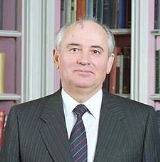
Mikhail Gorbachev


Mikhail Gorbachev


Mikhail Sergeyevich Gorbachev (
Gorbachev's attempts at reform—perestroikaPerestroika

Perestroika is the Russian word for the economic reforms introduced in June 1987 by the Soviet leader Mikhail Gorbachev....
and glasnostGlasnost

Glasnost was one of Mikhail Gorbachev's policies introduced to the Soviet Union in 1985....
—as well as summit conferences with United StatesUnited States

The United States of America, also known as the United States, the U.S., the U.S.A., and America, is...
 President Ronald ReaganRonald Reagan

Ronald Wilson Reagan was the 40th President of the United States and the 33rd Governor of California ....
, contributed to the end of the Cold WarCold War

The Cold War was the protracted geopolitical, ideological, and economic struggle that emerged after World War II between dem...
, and also ended the political supremacy of the Communist Party of the Soviet UnionCommunist Party of the Soviet Union

The Communist Party of the Soviet Union was the name used by the successors of the Bolshevik faction of the Russian Social-...
 (CPSU) and led to the dissolution of the Soviet Union. He was awarded the Nobel Peace PrizeNobel Peace Prize

The Nobel Peace Prize is one of five Nobel Prizes bequested by the Swedish industrialist and inventor Alfred Nobel....
 in 1990. Gorbachev is currently the leader of the Union of Social-Democrats, a political party founded after the official dissolution of the Social Democratic Party of RussiaFacts About Social Democratic Party of Russia

The Social Democratic Party of Russia is a political party founded in Russia by Mikhail Gorbachev on November 26, 2001....
 on October 20, 2007.
Early lifeGorbachev faced a very tough childhood under the totalitarian leadership of Joseph StalinJoseph Stalin

Joseph Vissarionovich Stalin , alternatively transliterated Josef Stalin, was the de facto leader and dictator of ...
. His paternal grandfather was sentenced to nine years in the gulagGulag Summary

Gulag is an acronym for ??????? ?????????? ????????????????????? ??????? ? ???????, "Glavnoye...
 for withholding grain from the collective's harvest.


Discussion
Ask a question about 'Mikhail Gorbachev'
Start a new discussion about 'Mikhail Gorbachev'
Answer questions from other users
Full Discussion Forum


Timeline

1931   Born

1985   Mikhail Gorbachev becomes the General Secretary of the Soviet Communist Party and ''de facto'' leader of the Soviet Union.

1985   Cold War: In Geneva, U.S. President Ronald Reagan and Soviet Union leader Mikhail Gorbachev meet for the first time.

1986   Cold War: Ronald Reagan and Soviet leader Mikhail Gorbachev meet in Reykjavík, Iceland, in an effort to continue discussions about scaling back their intermediate missile arsenals in Europe (the talks break down in failure).

1987   During a visit to Berlin, Germany, U.S. President Ronald Reagan challenges Soviet Premier Mikhail Gorbachev to tear down the Berlin Wall.

1987   The Intermediate-Range Nuclear Forces Treaty is signed in Washington, D.C. by U.S. President Ronald Reagan and Soviet leader Mikhail Gorbachev.

1989   Mikhail Gorbachev visits China, the first Soviet leader to do so since the 1960s.

1989   Cold War: In a meeting off the coast of Malta, US President George Bush and Soviet leader Mikhail Gorbachev release statements indicating that the Cold War between their nations may be coming to an end.

1990   Mikhail Gorbachev is elected as the first executive president of the Soviet Union.

1990   U.S. President George H. W. Bush and Soviet Union leader Mikhail Gorbachev sign a treaty to end chemical weapon production and begin destroying their respective stocks.


Quotations


Americans have a severe disease - worse than AIDS. It's called the winner's complex.

ABC News, July 12 2006


Encyclopedia


Mikhail Sergeyevich Gorbachev (
Gorbachev's attempts at reform—perestroikaPerestroika

Perestroika is the Russian word for the economic reforms introduced in June 1987 by the Soviet leader Mikhail Gorbachev....
and glasnostGlasnost

Glasnost was one of Mikhail Gorbachev's policies introduced to the Soviet Union in 1985....
—as well as summit conferences with United StatesUnited States

The United States of America, also known as the United States, the U.S., the U.S.A., and America, is...
 President Ronald ReaganRonald Reagan

Ronald Wilson Reagan was the 40th President of the United States and the 33rd Governor of California ....
, contributed to the end of the Cold WarCold War

The Cold War was the protracted geopolitical, ideological, and economic struggle that emerged after World War II between dem...
, and also ended the political supremacy of the Communist Party of the Soviet UnionCommunist Party of the Soviet Union

The Communist Party of the Soviet Union was the name used by the successors of the Bolshevik faction of the Russian Social-...
 (CPSU) and led to the dissolution of the Soviet Union. He was awarded the Nobel Peace PrizeNobel Peace Prize

The Nobel Peace Prize is one of five Nobel Prizes bequested by the Swedish industrialist and inventor Alfred Nobel....
 in 1990. Gorbachev is currently the leader of the Union of Social-Democrats, a political party founded after the official dissolution of the Social Democratic Party of RussiaFacts About Social Democratic Party of Russia

The Social Democratic Party of Russia is a political party founded in Russia by Mikhail Gorbachev on November 26, 2001....
 on October 20, 2007.

Early life

Gorbachev faced a very tough childhood under the totalitarian leadership of Joseph StalinJoseph Stalin

Joseph Vissarionovich Stalin , alternatively transliterated Josef Stalin, was the de facto leader and dictator of ...
. His paternal grandfather was sentenced to nine years in the gulagGulag Summary

Gulag is an acronym for ??????? ?????????? ????????????????????? ??????? ? ???????, "Glavnoye...
 for withholding grain from the collective's harvest. He lived through World War IIWorld War II

World War II, or the Second World War, was a worldwide conflict fought between the Allied Powers and the Axis Powers ,...
, during which, starting in August 1942, GermanGermany

Germany , officially the Federal Republic of Germany , is a country in central Europe....
 troops occupied StavropolStavropol

Stavropol is a city located in south-western Russia....
. Although they left by February 1943, the occupation increased the hardship of the community and left a deep impression on the young Gorbachev. From 1946 to 1950, he worked during the summers as an assistant combine harvesterCombine harvester

The combine harvester, or simply combine, is a machine that harvests, threshes, and cleans grain plants....
 operator at the collective farms in his area. He would take an increasing part in promoting peasant labour, which he describes as "very hard" because of enforced state quotas and taxes on private plots. Furthermore, as peasants were not issued passports, their only opportunity to leave their peasant existence was through enlisting in 'orgnabor' (organised recruitment) labour projects, which prompted Gorbachev to ask "what difference was there between this life and serfdomSerfdom

Serfdom refers to the legal and economic status of some peasants under feudalism, specifically in the manorial economic syst...
?"

Political career

Despite the hardship of his background, Gorbachev excelled in the fields and in the classroom. He was considered one of the most intelligent in his class , with a particular interest in history and mathematics. After he left school he helped his father harvest a record crop on his collective farm. As a result, he was awarded the Order of the Red Banner of LabourOrder of the Red Banner of Labour

The Order of the Red Banner of Labour was an order of the Soviet Union for accomplishments in labour and civil service....
, at just 16 (1947). It was rare for someone his age to be given such an honour. It was almost certain that this award, coupled with his intelligence, helped secure his place at Moscow University, where he studied law from September 1950. Gorbachev may never have intended to practice law, however he simply may have seen it as preparation for working in the Communist Party of the Soviet UnionCommunist Party of the Soviet Union

The Communist Party of the Soviet Union was the name used by the successors of the Bolshevik faction of the Russian Social-...
 (CPSU). He became a candidate member of the Party that same year. While living in Moscow, he met his future wife, Raisa Maksimovna Titarenko. They married on 25 September, 1953 and moved to Gorbachev's home region of StavropolStavropol

Stavropol is a city located in south-western Russia....
 in southern Russia when he graduated in June 1955, where he immersed himself in party work. Upon graduating, he briefly worked in the Prokuratura (Soviet State ProcuracyPublic procurator

A public procurator is an officer of a state charged with both the investigation and prosecution of crime....
) before transferring to the KomsomolKomsomol

Komsomol is a syllabic abbreviation word, from the Russian Kommunisticheskiy Soyuz Molodiozhi, or "Co...
, or Communist Union of Youth. He served as First Secretary of the StavropolStavropol Summary

Stavropol is a city located in south-western Russia....
 City Komsomol Committee from September, 1956, later moving up to the Stavropol KraiKrai Overview

Krai is a term used to refer to seven of Russia's 88 federal subjects....
 (regional) Komsomol Committee, where he worked as Second Secretary from April 1958 and as First Secretary from March 1961. Raisa would give birth to their first child, a daughter named Irina, on 6 January, 1957.

Gorbachev attended the important XXII CPSU Party Congress in October 1961, where KhrushchevNikita Khrushchev

Nikita Sergeyevich Khrushchyov was the leader of the Soviet Union after the death of Joseph Stalin....
 announced a plan to move to a Communist society within 20 years and surpass the U.S. in per capita production. Gorbachev was promoted to Head of the Department of Party Organs in the Stavropol Agricultural Kraikom in 1963. By 1966, at age 35, he obtained a correspondence degree as an agronomist-economist from the Agricultural Institute. His career moved forward rapidly. In 1970, he was appointed First Party Secretary of the StavropolStavropol

Stavropol is a city located in south-western Russia....
 Kraikom, becoming one of the youngest provincial party chiefs in the USSR. In this position he helped to reorganise the collective farms, improve workers' living conditions, expand the size of their private plots, and give them a greater voice in planning. His work was evidently effective, because he was made a member of the CPSU Central CommitteeCentral Committee of the Communist Party of the Soviet Union

The Central Committee, abbreviated in Russian as ??, "Tseka", was the highest body of the Communist Party of the Sovi...
 in 1971. In 1972, he headed a Soviet delegation to BelgiumBelgium

The Kingdom of Belgium is a country in northwest Europe bordered by the Netherlands, Germany, Luxembourg and France and is...
, and two years later, in 1974, he was made a Representative to the Supreme SovietSupreme Soviet

The Supreme Soviet comprised the highest legislative body in the Soviet Union in the interim of the sessions of the Congres...
, and Chairman of the Standing Commission on Youth Affairs. He was subsequently appointed to the Central CommitteeCentral Committee of the Communist Party of the Soviet Union

The Central Committee, abbreviated in Russian as ??, "Tseka", was the highest body of the Communist Party of the Sovi...
 Secretariat for Agriculture in 1978, replacing Fyodor Kulakov, who had backed his rise to power, after Kulakov died of a heart attack.

In 1979, Gorbachev was promoted to the PolitburoPolitburo

Politburo is short for Political Bureau....
 as a candidate member, and received full membership in 1980. Gorbachev owed his steady rise to power to the patronage of Mikhail SuslovMikhail Suslov

Mikhail Andreyevich Suslov was a Soviet politician and ideologist, and a member of the Politburo and Secretariat of the Comm...
, the powerful chief ideologist of the CPSU, and Yuri AndropovYuri Andropov

Yuri Vladimirovich Andropov was a Soviet politician and General Secretary of the CPSU from November 12, 1982 until his deat...
, head of the KGBKGB

KGB is the Russian-language abbreviation for Committee for State Security, ....
 and also a native of StavropolStavropol

Stavropol is a city located in south-western Russia....
, and was promoted during Andropov's brief time as leader of the Party before Andropov's death in 1984. With responsibility over personnel, working together with Andropov, 20% of the top echelon of government ministers and regional governors were replaced, often with younger men. During this time Grigory RomanovGrigory Romanov

Grigory Vasilyevich Romanov, born February 7, 1923, was a Soviet politician and member of the Politburo and Secretariat of t...
, Nikolai RyzhkovNikolai Ryzhkov

Nikolai Ivanovich Ryzhkov was a Soviet official and, after the breakup of the Soviet Union, a Russian politician....
 and Yegor LigachevYegor Ligachev

egory:Russian politicians|Ligachev, Yegor]]...
 were elevated, the latter two working closely with Gorbachev, Ryzhkov on economics, Ligachev on personnel. He was also close to Konstantin ChernenkoKonstantin Chernenko

Konstantin Ustinovich Chernenko was a Soviet politician and General Secretary of the CPSU who led the Soviet Union from Feb...
, Andropov's successor, serving as Second Secretary.

Gorbachev's positions within the CPSU created more opportunities to travel abroad and this would profoundly affect his political and social views in the future as leader of the country. In 1975, he led a delegation to West GermanyWest Germany Summary

West Germany was the informal English name for the Federal Republic of Germany, or FRG from 1949 to 1990....
, and in 1983 he headed a delegation to CanadaCanada

Canada is the world's second-largest country by total area, occupying most of northern North America....
 to meet with Prime MinisterPrime Minister of Canada

The Prime Minister of Canada , is the head of the Government of Canada....
 Pierre TrudeauPierre Trudeau

Joseph Philippe Pierre Yves Elliott Trudeau PC, CC, CH, QC, MA, LLD, FRSC was the fifteenth Prime Minister of Canada from A...
 and members of the CommonsCanadian House of Commons

The House of Commons is a component of the Parliament of Canada, along with the Sovereign and the Senate....
 and SenateCanadian Senate

The Senate of Canada is a component of the Parliament of Canada, along with the Sovereign and the House of Commons....
. In 1984, he travelled to the UKUnited Kingdom

The United Kingdom of Great Britain and Northern Ireland is a country and sovereign state that lies off the northwest coast...
, where he met the British Prime Minister, Margaret ThatcherMargaret Thatcher

Margaret Hilda Thatcher, Baroness Thatcher, LG, OM, PC, FRS was Prime Minister of the United Kingdom from 1979 to 1990....
.

General Secretary of the CPSU

Only 3 hours after the death of Konstantin ChernenkoKonstantin Chernenko

Konstantin Ustinovich Chernenko was a Soviet politician and General Secretary of the CPSU who led the Soviet Union from Feb...
, Mikhail Gorbachev, at the age of 54, was elected General Secretary of the Communist PartyGeneral Secretary of the Communist Party of the Soviet Union

The General Secretary of the Communist Party of the Soviet Union was the title synonymous with leader of the Soviet Union af...
 on 11 March, 1985 when PolitburoPolitburo

Politburo is short for Political Bureau....
 supporters of Grigory RomanovGrigory Romanov

Grigory Vasilyevich Romanov, born February 7, 1923, was a Soviet politician and member of the Politburo and Secretariat of t...
 had been out of Moscow

He became the Party's first leader to have been born after the RevolutionRussian Revolution of 1917

The Russian Revolution of 1917 was a series of political events in Russia, which, after the elimination of the Russian autoc...
. As de facto ruler of the USSR, he tried to reform the stagnating Party and the state economy by introducing glasnostGlasnost

Glasnost was one of Mikhail Gorbachev's policies introduced to the Soviet Union in 1985....
("openness"), perestroikaPerestroika

Perestroika is the Russian word for the economic reforms introduced in June 1987 by the Soviet leader Mikhail Gorbachev....
("restructuring"), demokratizatsiyaDemokratizatsiya

Demokratizatsiya was a slogan introduced by General Secretary Mikhail Gorbachev in January 1987 calling for the infusion...
("democratization"), and uskoreniyeUskoreniye

Uskoreniye was a slogan and a politics announced by Mikhail Gorbachev on April 20, 1985 at a Party Plenum, aimed at the acce...
("acceleration", of economic development), which were launched at the 27th Congress of the CPSU in February 1986.

Domestic reforms

Domestically, Gorbachev implemented economic reforms that he hoped would improve living standards and worker productivity as part of his perestroika programme. However, many of his reforms were considered radical at the time by orthodox apparatchikApparatchik

Apparatchik is a Russian colloquial term for a full-time, professional functionary of the Communist Party or government; i.e...
s in the Soviet government.
1986
PerestroikaPerestroika

Perestroika is the Russian word for the economic reforms introduced in June 1987 by the Soviet leader Mikhail Gorbachev....
 and its attendant radical reforms were enunciated at the XXVIIth Party Congress between February and March, 1986. Nonetheless, many found the pace of reform too slow. Many historians, including Robert D. English, have explained this by the rapid mutual estrangement within the Soviet elite of the 'New Thinkers' and conservatives; conservatives were deliberately blocking the process of change. This was exposed in the aftermath of the Chernobyl disasterChernobyl disaster

The Chernobyl disaster occurred at 01:23 a.m....
. In this incident, as English observes, Gorbachev and his allies were "misinformed by the military-industrial complex" and "betrayed" by conservatives, who blocked information concerning the incident and thus delayed an official response. Jack F. Matlock Jr.Jack F. Matlock, Jr.

Jack Foust Matlock, Jr. is a former American ambassador, career Foreign Service Officer, a teacher, a historian, and a ling...
 stresses that at the time Gorbachev demanded the authorities give "full information" but that the "Soviet bureaucracy blocked the flow". This situation brought international ire upon the Soviets and many blamed Gorbachev himself. Despite this, English suggests that there was a "positive fallout" to ChernobylChernobyl disaster

The Chernobyl disaster occurred at 01:23 a.m....
, as Gorbachev and his fellow reformers received an increased domestic and international impetus for reform.

Domestic changes continued apace. In a bombshell speech during Armenian SSRArmenian SSR

The Armenian SSR or Soviet Socialist Republic of Armenia came into being when the Communist Party of Armenia proclaime...
's Central Committee Plenum of the Communist Party the young First Secretary of Armenia's Hrazdan Regional Communist Party, Hayk Kotanjian, criticised rampant corruption in the Armenian Communist Party's highest echelons, implicating Armenian SSR Communist Party First Secretary Karen DemirchyanKaren Demirchyan

Karen Demirchyan was an Armenian communist and later independent politician, Armenian Communist Party first secretary from...
 and calling for his resignation. Symbolically, intellectual Andrei SakharovAndrei Sakharov

Dr. Andrei Dmitrievich Sakharov , was an eminent Soviet nuclear physicist, dissident and human rights activist....
 was invited to return to Moscow by Gorbachev in December 1986 after six years of internal exile in GorkyNizhny Novgorod

Nizhny Novgorod , colloquially shortened as Nizhny and also transliterated into English as Nizhniy Novgorod or Niz...
. During the same month, however, signs of the nationalities problem that would haunt the later years of the Soviet Union surfaced as riots, named JeltoqsanJeltoqsan

Jeltoqsan riot of 1986 was a spontaneous nationwideevents lasted from December 16 until December 19, 1986....
, occurred in KazakhstanKazakhstan Summary

Kazakhstan, also spelled Kazakstan, , officially the Republic of Kazakhstan, is a country that stretches over a ...
 after Dinmukhamed KunayevDinmukhamed Kunayev

Dinmukhamed Akhmedovich Kunayev was a Kazakh Soviet Communist political figure....
 was replaced as First Secretary of the Communist Party of KazakhstanCommunist Party of Kazakhstan

The Communist Party of Kazakhstan is a political party in Kazakhstan....
.
1987
The Central CommitteeCentral Committee of the Communist Party of the Soviet Union Summary

The Central Committee, abbreviated in Russian as ??, "Tseka", was the highest body of the Communist Party of the Sovi...
 Plenum in January 1987 would see the crystallisation of Gorbachev's political reforms, including proposals for multi-candidate elections and the appointment of non-Party members to government positions. He also first raised the idea of expanding co-operatives at the plenum. Later that year, May would be a month of crisis. In an almost incredible incident, a young West German, Mathias RustMathias Rust Summary

Mathias Rust is a German pilot who, in 1987, at the age of 19, flew from Uetersen to Iceland and then via Norway and Finlan...
, managed to fly a plane into Moscow and land near Red SquareRed Square

Red Square is the most famous city square in Moscow....
 without being stopped. This massively embarrassed the military and Gorbachev made sweeping personnel changes, beginning at the top, where he appointed Dmitry YazovDmitry Yazov

Dmitri Timofeyevich Yazov was the last Marshal of the Soviet Union to be appointed before the collapse of the Soviet Union....
 as Minister of Defence.

Economic reforms took up much of the rest of 1987, as a new law giving enterprises more independence was passed in June and Gorbachev released a book, Perestroika: New Thinking for Our Country and the World, in November, elucidating his main ideas for reform. Nevertheless, at the same time, the personal and professional acrimony between Gorbachev and Boris YeltsinBoris Yeltsin

Boris Nikolayevich Yeltsin was the first President of Russia from 1991 to 1999. ...
 increased; after Yeltsin criticised Gorbachev and others at the October Plenum, he was replaced as First Secretary of the Moscow Gorkom Party. This move only temporarily removed Yeltsin's influence.

In 1987 he rehabilitated many opponents of Stalin, another part of the De-Stalinization, which began 1956, when Lenin's Testament was published as a booklet there.
1988
1988 would see Gorbachev's introduction of glasnostGlasnost

Glasnost was one of Mikhail Gorbachev's policies introduced to the Soviet Union in 1985....
, which gave new freedoms to the people, such as a greater freedom of speech. This was a radical change, as control of speech and suppression of government criticism had previously been a central part of the Soviet system. The press became far less controlled, and thousands of political prisoners and many dissidents were released. Gorbachev's goal in undertaking glasnost was to pressure conservatives within the CPSU who opposed his policies of economic restructuring, and he also hoped that through different ranges of openness, debate and participation, the Soviet people would support his reform initiatives. At the same time, he opened himself and his reforms up for more public criticism, evident in Nina Andreyeva's critical letter in a March edition of Sovetskaya Rossiya. Gorbachev acknowledged that his liberalising policies of glasnostGlasnost

Glasnost was one of Mikhail Gorbachev's policies introduced to the Soviet Union in 1985....
and perestroikaPerestroika Overview

Perestroika is the Russian word for the economic reforms introduced in June 1987 by the Soviet leader Mikhail Gorbachev....
owed a great deal to Alexander DubcekAlexander Dubcek

Alexander Dubcek was a Slovak politician and briefly leader of Czechoslovakia , famous for his attempt to reform the Commun...
's "Socialism with a human face". When asked what the difference was between the Prague SpringPrague Spring

The Prague Spring was a period of political liberalization in Czechoslovakia starting January 5 1968 when Alexander Dubcek ...
 and his own reforms, Gorbachev replied, "’’Nineteen years’’".

The Law on CooperativesFacts About Law on Cooperatives

The Soviet Law on Cooperatives, enacted in May 1988, was perhaps the most radical of the economic reforms during the early p...
 enacted in May 1988 was perhaps the most radical of the economic reforms during the early part of the Gorbachev era. For the first time since Vladimir LeninVladimir Lenin

Vladimir Ilyich Ulyanov, better known to the world as Vladimir Lenin , was the founder of Russian Communism and the fi...
's New Economic PolicyNew Economic Policy

The New Economic Policy was officially decided in the course of the 10th Congress of the Communist Party of the Soviet Union...
, the law permitted private ownership of businesses in the services, manufacturing, and foreign-trade sectors. The law initially imposed high taxes and employment restrictions, but these were later revised to avoid discouraging private-sector activity. Under this provision, cooperative restaurants, shops, and manufacturers became part of the Soviet scene. It should be noted that some of the SSRs ignored these restrictions. In EstoniaEstonia

Estonia, officially the Republic of Estonia , is a country in Northern Europe....
, for example, cooperatives were permitted to cater to the needs of foreign visitors and forge partnerships with foreign companies. The large 'All-Union' industrial organisations started to be restructured. AeroflotAeroflot Overview

irline=Aeroflot - Russian Airlines|logo=Aeroflot.png|...
, for example, was split into a number of independent enterprises, some of which became the nucleus for future independent airlines. These newly autonomous business organisations were encouraged to seek foreign investment.

In June 1988, at the CPSU's XIXth Party Conference, Gorbachev launched radical reforms meant to reduce party control of the government apparatus. He proposed a new executive in the form of a presidential system, as well as a new legislative element, to be called the Congress of People's Deputies.
1989
Elections to the Congress of People's Deputies were held throughout the Soviet Union in March and April 1989. This was the first free election in the Soviet Union since 1917. He became Chairman of the Supreme SovietList of leaders of the Soviet Union

An approximately chronological list of leaders of the Soviet Union ....
 on May 25, 1989. On March 15, 1990, Gorbachev was elected as the first executive President of the Soviet UnionPresident of the Soviet Union

The President of the Soviet Union was the Head of State of the USSR from March 15, 1990 to December 25, 1991....
 with 59% of the Deputies' votes being an unopposed candidate. The Congress met for the first time on May 25. Their first task was to elect representatives from Congress to sit on the Supreme SovietSupreme Soviet

The Supreme Soviet comprised the highest legislative body in the Soviet Union in the interim of the sessions of the Congres...
. Nonetheless, the Congress posed problems for Gorbachev. Its sessions were televised, airing more criticism and encouraging people to expect evermore rapid reform. In the elections, many Party candidates were defeated. Furthermore, YeltsinBoris Yeltsin

Boris Nikolayevich Yeltsin was the first President of Russia from 1991 to 1999. ...
 was elected in Moscow and returned to political prominence to become an increasingly vocal critic of Gorbachev.

The rest of 1989 was taken up by the increasingly problematic nationalities question and the dramatic collapse of the Eastern BlocEastern bloc

During the Cold War, the term Eastern Bloc was used to refer to the Soviet Union and its allies in Central and Eastern Europ...
. Despite international détente reaching unprecedented levels, with the Soviet withdrawal from AfghanistanSoviet war in Afghanistan

The Soviet war in Afghanistan was a nine-year war between the Soviet forces and the anti-government Mujahideen insurgents th...
 completed in January and U.S.-Soviet talks continuing between Gorbachev and George H. W. BushGeorge H. W. Bush Overview

George Herbert Walker Bush was the 41st President of the United States of America ....
, domestic reforms were suffering from increasing divergence between reformists, who criticised the pace of change, and conservatives, who criticised the extent of change. Gorbachev states that he tried to find the middle ground between both groups, but this would draw more criticism towards him. The story from this point on moves away from reforms and becomes one of the nationalities question and the eventual collapse of the Soviet Union.

On November 9, people in the "German Democratic RepublicGerman Democratic Republic

The German Democratic Republic was a Socialist state, which existed from 1949 to 1990 in the Soviet Zone of occupied German...
" broke down the Berlin WallBerlin Wall

The Berlin Wall , an iconic symbol of the Cold War, was initially constructed starting on August 13, 1961 and dismantled in ...
 after a peaceful protest against the country's dictatorial administration, including a demonstration by some one million people in East BerlinEast Berlin

East Berlin was the name given to the eastern part of Berlin between 1949 and 1990....
 on November 4. Unlike earlier riots which were ended by military force with the help of USSR, Gorbachev, who came to be lovingly called "Gorby" in West GermanyWest Germany

West Germany was the informal English name for the Federal Republic of Germany, or FRG from 1949 to 1990....
, now decided not to interfere with the process in Germany. He stated that German reunification was an internal German matter.

'New Thinking' Abroad

In contrast to his controversial domestic reforms, Gorbachev was largely hailed in the West for his 'New Thinking' in foreign affairs. During his tenure, he sought to improve relations and trade with the West by reducing Cold War tensions. He established close relationships with several Western leaders, such as West GermanWest Germany

West Germany was the informal English name for the Federal Republic of Germany, or FRG from 1949 to 1990....
 Chancellor Helmut KohlHelmut Kohl

Dr. Helmut Josef Michael Kohl is a Catholic German conservative politician and statesman....
, U.S.United States

The United States of America, also known as the United States, the U.S., the U.S.A., and America, is...
 President Ronald ReaganRonald Reagan

Ronald Wilson Reagan was the 40th President of the United States and the 33rd Governor of California ....
, and BritishUnited Kingdoms

United Kingdoms is an album released in 1993 by the British electronic band Ultramarine on Blanco y Negro records....
 Prime Minister Margaret ThatcherMargaret Thatcher

Margaret Hilda Thatcher, Baroness Thatcher, LG, OM, PC, FRS was Prime Minister of the United Kingdom from 1979 to 1990....
 - who famously remarked: "I like Mr Gorbachev, we can do business together".

Gorbachev understood the link between achieving international détente and domestic reform and thus began extending 'New Thinking' abroad immediately. On April 8, 1986, he announced the suspension of the deployment of SS-20sRT-21M Pioneer Overview

The RT-21M Pioneer was a medium-range ballistic missile with a nuclear warhead deployed by the Soviet Union from 1976 to...
 in Europe as a move towards resolving intermediate-range nuclear weapons (INF) issues. Later that year, in September, Gorbachev proposed that the Soviets and Americans both cut their nuclear arsenals in half. He went to FranceFrance Summary

France, officially the French Republic, is a country whose metropolitan territory is located in Western Europe and whi...
 on his first trip abroad as Soviet leader in October. November saw the Geneva SummitGeneva Summit

The Geneva Summit was an international summit meeting held in Geneva, Switzerland, July 18-23, 1955....
 between Gorbachev and Ronald ReaganRonald Reagan Summary

Ronald Wilson Reagan was the 40th President of the United States and the 33rd Governor of California ....
. Though no concrete agreement was made, Gorbachev and Reagan struck a personal relationship and decided to hold further meetings.

January 1986 would see Gorbachev make his boldest international move so far, when he announced his proposal for the elimination of intermediate-range nuclear weapons in Europe and his strategy for eliminating all nuclear weapons by the year 2000 (often referred to as the 'January Proposal'). He also began the process of withdrawing troops from AfghanistanAfghanistan

Afghanistan ; Persian : ?????? ?????? ?????????, Pashto: ? ????????? ?????? ???????) is a landlocked country at ...
 and MongoliaMongolia

Mongolia is a landlocked country located in East Asia....
 on 28 July. Nonetheless, many observers, such as Jack F. Matlock Jr.Jack F. Matlock, Jr.

Jack Foust Matlock, Jr. is a former American ambassador, career Foreign Service Officer, a teacher, a historian, and a ling...
 (despite generally praising Gorbachev as well as Reagan), have criticised Gorbachev for taking too long to achieve withdrawal from the Afghanistan WarSoviet war in Afghanistan

The Soviet war in Afghanistan was a nine-year war between the Soviet forces and the anti-government Mujahideen insurgents th...
, citing it as an example of lingering elements of 'old thinking' in Gorbachev.

On October 11, 1986, Gorbachev and Reagan met in ReykjavíkFacts About Reykjavík

Reykjavk is the capital of Iceland, its largest city and the world's most northern national capital, its latitude being 640...
, IcelandIceland

Iceland, officially the Republic of Iceland is a volcanic island nation in the northern Atlantic Ocean between Greenl...
 to discuss reducing intermediate-range nuclear weapons in Europe. To the immense surprise of both men's advisers, the two agreed in principle to removing INF systems from Europe and to equal global limits of 100 INF missile warheads. They also essentially agreed in principle to eliminate all nuclear weapons in 10 years (by 1996), instead of by the year 2000 as in Gorbachev's original outline. Continuing trust issues, particularly over reciprocity and Reagan's Strategic Defense Initiative (SDI)Strategic Defense Initiative Overview

The Strategic Defense Initiative , commonly called Star Wars after the popular science fiction movies of the time, was...
, meant that the summit is often regarded as a failure for not producing a concrete agreement immediately, or for leading to a staged elimination of nuclear weapons. In the long term, nevertheless, this would culminate in the signing of the Intermediate-Range Nuclear Forces (INF) TreatyIntermediate-Range Nuclear Forces Treaty Overview

The Intermediate-Range Nuclear Forces Treaty was an agreement between the United States and the Soviet Union signed in Washi...
 in 1987, after Gorbachev had proposed this elimination on 22 July 1987 (and it was subsequently agreed on in Geneva on 24 November).

In February, 1988, Gorbachev announced the full withdrawal of Soviet forces from Afghanistan. The withdrawal was completed the following year, although the civil war continued as the Mujahedin pushed to overthrow the pro-Soviet NajibullahMohammad Najibullah

Dr. Mohammad Najibullah was the fourth and last President of Afghanistan during the period of the communist Democratic Repu...
 regime. An estimated 28,000 Soviets were killed between 1979 and 1989 as a result of the Afghanistan WarSoviet war in Afghanistan

The Soviet war in Afghanistan was a nine-year war between the Soviet forces and the anti-government Mujahideen insurgents th...
.

Also during 1988, Gorbachev announced that the Soviet Union would abandon the Brezhnev DoctrineBrezhnev Doctrine

The Brezhnev Doctrine was a model of Soviet foreign policy, first and most clearly outlined by S....
, and allow the Eastern blocEastern bloc

During the Cold War, the term Eastern Bloc was used to refer to the Soviet Union and its allies in Central and Eastern Europ...
 nations to freely determine their own internal affairs. Jokingly dubbed the "Sinatra DoctrineSinatra Doctrine

The Sinatra Doctrine was the name that the Soviet government of Mikhail Gorbachev used jokingly to describe its policy of al...
" by Gorbachev's Foreign Ministry spokesman Gennadi GerasimovGennadi Gerasimov

Gennadi Ivanovich Gerasimov was the Soviet ambassador to Portugal and then-occupied Afghanistan, afterwards foreign sp...
, this policy of non-intervention in the affairs of the other Warsaw PactWarsaw Pact

he Warsaw Pact or Warsaw Treaty, officially named the Treaty of Friendship, Co-operation and Mutual Assistance ,...
 states proved to be the most momentous of Gorbachev's foreign policy reforms. In his July 6, 1989 speech arguing for a "common European homeCommon European Home

The "Common European Home" was a concept created and espoused by former Soviet President Mikhail Gorbachev....
" before the Council of EuropeCouncil of Europe

The Council of Europe is an international organization of 46 member states in the European region....
 in StrasbourgStrasbourg Overview

Strasbourg is the capital and principal city of the Alsace rgion of northeastern France, with approximately 650,000 inh...
, FranceFrance

France, officially the French Republic, is a country whose metropolitan territory is located in Western Europe and whi...
, Gorbachev declared: "The social and political order in some countries changed in the past, and it can change in the future too, but this is entirely a matter for each people to decide. Any interference in the internal affairs, or any attempt to limit the sovereignty of another state, friend, ally, or another, would be inadmissible."

Moscow's abandonment of the Brezhnev Doctrine led to a string of revolutions in Eastern EuropeEastern Europe

Eastern Europe is the eastern region of Europe variably defined....
 throughout 1989, in which Communism collapsed. By the end of 1989, mass revolts had spread from one Eastern European capital to another, ousting the regimes imposed on Eastern Europe after World War IIWorld War II

World War II, or the Second World War, was a worldwide conflict fought between the Allied Powers and the Axis Powers ,...
. With the exception of RomaniaRomania

Romania: is a country in Southeastern Europe....
, the popular upheavals against the pro-Soviet Communist regimes were all peaceful ones. (See Revolutions of 1989Revolutions of 1989

The Revolutions of 1989, sometimes called the Autumn of Nations, were a revolutionary wave in Central and Eastern Euro...
) The loosening of Soviet hegemony over Eastern Europe effectively ended the Cold WarCold War Overview

The Cold War was the protracted geopolitical, ideological, and economic struggle that emerged after World War II between dem...
, and for this, Gorbachev was awarded the Otto Hahn Peace Medal in GoldOtto Hahn Peace Medal

The Otto Hahn Peace Medal in Gold is named after the German nuclear chemist and 1944 Nobel Laureate Otto Hahn, a honorary ci...
 in 1989 and the Nobel Peace PrizeNobel Peace Prize

The Nobel Peace Prize is one of five Nobel Prizes bequested by the Swedish industrialist and inventor Alfred Nobel....
 on October 15, 1990.

Coit D. BlackerCoit D. Blacker

Dr. Coit Dennis Blacker served as Special Assistant to the President for National Security Affairs and Senior Director for R...
 wrote in 1990 that the Soviet leadership "appeared to have believed that whatever loss of authority the Soviet Union might suffer in Eastern Europe would be more than offset by a net increase in its influence in Western Europe." Nevertheless, it is unlikely that Gorbachev ever intended for the complete dismantling of Communism in the Warsaw Pact countries. Rather, Gorbachev assumed that the Communist parties of Eastern Europe could be reformed in a similar way to the reforms he hoped to achieve in the CPSU. Just as perestroika was aimed at making the USSR more efficient economically and politically, Gorbachev believed that the ComeconComecon

The Council for Mutual Economic Assistance, 1949 – 1991, was an economic organization of communist states and a kind o...
 and Warsaw Pact could be reformed into more effective entities. Alexander YakovlevAlexander Nikolaevich Yakovlev

Alexander Nikolaevich Yakovlev, ????????? ?????????? ??????? was a Russian economist who was a Soviet governmental official ...
, a close advisor to Gorbachev, would later state that it would have been "absurd to keep the system" in Eastern Europe. In contrast to Gorbachev, Yakovlev had come to the conclusion that the Soviet-dominated Comecon was inherently unworkable and that the Warsaw Pact had "no relevance to real life."

Collapse of the Soviet Union


While Gorbachev's political initiatives were positive for freedomFreedom (political)

Political freedom is the right, or the capacity, of self-determination as an expression of the individual will....
 and democracyDemocracy

Democracy is a form of government for a nation state, or for an organization in which the citizens have a vote or voice in ...
 in the Soviet UnionSoviet Union Overview

The Union of Soviet Socialist Republics , more commonly known as the Soviet Union, was a Communist state that existed...
 and its Eastern blocEastern bloc

During the Cold War, the term Eastern Bloc was used to refer to the Soviet Union and its allies in Central and Eastern Europ...
 allies, the economic policy of his government gradually brought the country close to disaster. By the end of the 1980s, severe shortages of basic food supplies led to the reintroduction of the war-time system of distribution using food cards that limited each citizen to a certain amount of product per month. Compared to 1985, the state deficit grew from 0 to 109 billion rubles; gold funds decreased from 2,000 to 200 tons; and external debt grew from 0 to 120 billion dollars.

Furthermore, the democratisationDemokratizatsiya

Demokratizatsiya was a slogan introduced by General Secretary Mikhail Gorbachev in January 1987 calling for the infusion...
 of the Soviet Union and Eastern Europe had irreparably undermined the power of the CPSUCommunist Party of the Soviet Union

The Communist Party of the Soviet Union was the name used by the successors of the Bolshevik faction of the Russian Social-...
 and Gorbachev himself. The relaxation of censorship and attempts to create more political openness had the unintended effect of re-awakening long-suppressed nationalist and anti-Russian feelings in the Soviet republicsRepublics of the Soviet Union

In its final decades of its existence, the Soviet Union consisted of 15 Soviet Socialist Republics , often called simply ...
. Calls for greater independence from Moscow's rule grew louder, especially in the Baltic republics of LithuaniaLithuania

Lithuania, officially the Republic of Lithuania , is a country in northern Europe....
, LatviaLatvia

Latvia, officially the Republic of Latvia , is a country in Eastern Europe....
, and EstoniaEstonia

Estonia, officially the Republic of Estonia , is a country in Northern Europe....
 which had been annexed into the Soviet Union by Stalin in 1940. Nationalist feeling also took hold in GeorgiaGeorgia (country)

Georgia , known officially from 1990 to 1995 as the Republic of Georgia, is a country in Eurasia to the east of the Bl...
, UkraineUkraine

Ukraine is a country in Eastern Europe....
, ArmeniaArmenia

Armenia , officially the Republic of Armenia, is a landlocked mountainous country in the Southern Caucasus , bordered ...
 and AzerbaijanAzerbaijan Overview

Azerbaijan , officially the Republic of Azerbaijan , is a country in the South Caucasus....
.

In December 1986, the first signs of the nationalities problem that would haunt the later years of the Soviet Union's existence surfaced as riots, named JeltoqsanJeltoqsan

Jeltoqsan riot of 1986 was a spontaneous nationwideevents lasted from December 16 until December 19, 1986....
, occurred in Alma Ata and other areas of KazakhstanKazakhstan

Kazakhstan, also spelled Kazakstan, , officially the Republic of Kazakhstan, is a country that stretches over a ...
 after Dinmukhamed KunayevDinmukhamed Kunayev

Dinmukhamed Akhmedovich Kunayev was a Kazakh Soviet Communist political figure....
 was replaced as First Secretary of the Communist Party of KazakhstanCommunist Party of Kazakhstan

The Communist Party of Kazakhstan is a political party in Kazakhstan....
. Nationalism would then surface in Russia in May 1987, as 600 members of PamyatPamyat

----Pamyat is a Russian ultra-nationalist, anti-semetic organization identifying itself as the "People's National-patriotic...
, a nascent Russian nationalist group, demonstrated in Moscow and were becoming increasingly linked to Boris YeltsinBoris Yeltsin Summary

Boris Nikolayevich Yeltsin was the first President of Russia from 1991 to 1999. ...
, who received their representatives at a meeting.

GlasnostGlasnost

Glasnost was one of Mikhail Gorbachev's policies introduced to the Soviet Union in 1985....
 hastened the development of the nationalities problem. Violence erupted in Nagorno-KarabakhNagorno-Karabakh

Nagorno-Karabakh is a de facto independent republic in the South Caucasus, officially part of the Republic of Azerbaijan...
 - an Armenian-populated enclave within AzerbaijanAzerbaijan

Azerbaijan , officially the Republic of Azerbaijan , is a country in the South Caucasus....
 - between February and April, when Armenians living in the area began a new wave of protests over the arbitrary transfer of the historically Armenian region from ArmeniaArmenia

Armenia , officially the Republic of Armenia, is a landlocked mountainous country in the Southern Caucasus , bordered ...
 to Azerbaijan in 1920 upon Joseph Stalin's decision. Gorbachev imposed a temporary solution, but it did not last, as fresh trouble arose in Nagorno-Karabakh between June and July. Turmoil would once again return in December 1988, this time in Armenia itself, when the Leninakan EarthquakeLeninakan Earthquake

The Leninakan Earthquake was a tremor with a moment magnitude of 7.2, that took place on December 7, 1988 at 11:41 local tim...
 hit the region on December 7. Poor local infrastructure magnified the hazard and some 25,000 people died. Gorbachev was forced to break off his trip to the U.S. and cancel planned travels to CubaCuba

Cuba, officially the Republic of Cuba, consists of the island of Cuba, the Isle of Youth and adjacent small islands....
 and BritainUnited Kingdom

The United Kingdom of Great Britain and Northern Ireland is a country and sovereign state that lies off the northwest coast...
.

Elections to the Congress of People's Deputies, which took place throughout the Soviet Union in March and April 1989, returned many pro-independence republicans, as many CPSUCommunist Party of the Soviet Union Overview

The Communist Party of the Soviet Union was the name used by the successors of the Bolshevik faction of the Russian Social-...
 candidates were rejected. The televised Congress debates allowed the dissemination of pro-independence propositions. Indeed, 1989 would see numerous nationalistic expressions protests. Initiated by the Baltic republics in January, laws were passed in most non-Russian republics giving precedence for the republican language over Russian. April 9 would see the crackdown of nationalist demonstrations by Soviet troops in TbilisiTbilisi

Tbilisi is the capital city of the country of Georgia, lying on the banks of the Kura river, at ....
. There would be further bloody protests in UzbekistanUzbekistan

Uzbekistan, officially the Republic of Uzbekistan , is a doubly landlocked country in Central Asia....
 in June, where Uzbeks and Meskhetian Turks clashed in Fergana. Apart from this violence, three major events that altered the face of the nationalities issue occurred in 1989. Estonia had declared its sovereignty in November, 1988, to be followed by Lithuania in May 1989 and by Latvia in July (the Communist Party of LithuaniaCommunist Party of Lithuania

Communist Party of Lithuania - communist party in Lithuania, established in early October 1918....
 would also declare its independence from the CPSUCommunist Party of the Soviet Union

The Communist Party of the Soviet Union was the name used by the successors of the Bolshevik faction of the Russian Social-...
 in December). This brought the Union and the republics into clear confrontation and would form a precedent for other republics.

Following this, in July, on the eve of the anniversary of the signing of the Nazi-Soviet PactMolotov-Ribbentrop Pact

The Molotov-Ribbentrop Pact, also known as the Hitler-Stalin Pact or Ribbentrop-Molotov Pact or Nazi-Soviet P...
, it was formally revealed that the treaty did indeed include a plan for the annexation of the Baltic countries into the USSR (as happened in 1940) and the division of PolandPoland

Poland , officially the Republic of Poland , is a country located in Central Europe....
 between the two countries. The unsavory past was exposed and gave impetus to the peoples of the Baltic countries who could now even more legitimately claim that they were subject to oppression. Finally, the Eastern blocEastern bloc

During the Cold War, the term Eastern Bloc was used to refer to the Soviet Union and its allies in Central and Eastern Europ...
 collapsed in the autumn of 1989, raising hopes that Gorbachev would extend his non-interventionist doctrine to the internal workings of the USSR.
The August 1991 coup
In contrast to the reformers' lukewarm approach to the new treaty, the hard-line apparatchikApparatchik

Apparatchik is a Russian colloquial term for a full-time, professional functionary of the Communist Party or government; i.e...
s, still strong within the CPSU and military establishment, were completely opposed to anything which might lead to the break-up of the Soviet Union. On the eve of the treaty's signing, the hardliners struck.

Hardliners in the Soviet leadership, calling themselves the 'State Emergency Committee', launched the August coup in 1991 in an attempt to remove Gorbachev from power and prevent the signing of the new union treaty. During this time, Gorbachev spent three days (August 19, 20 and 21) under house arrest at a dachaDacha

Dacha listen is a Russian word for a house in the countryside....
 in the CrimeaCrimea

Crimea /kra?'mia/ or the Autonomous Republic of Crimea is an autonomous republic of Ukraine on the northern coast of ...
 before being freed and restored to power. However, upon his return, Gorbachev found that neither union nor Russian power structures heeded his commands as support had swung over to Yeltsin, whose defiance had led to the coup's collapse. Furthermore, Gorbachev was forced to fire large numbers of his Politburo and, in several cases, arrest them. Those arrested for high treason included the "Gang of EightGang of Eight (Soviet Union)

The Gang of Eight was a group of eight conspirators holding top level positions within the KGB and the CPSU who conspired a ...
" that had led the coup, including KryuchkovVladimir Kryuchkov

Vladimir Alexandrovich Kryuchkov is a hard-line Soviet politician, Communist Party member from 1944....
, Yazov, PavlovFacts About Valentin Pavlov

Valentin Sergeyevich Pavlov was the Prime Minister of the Soviet Union from January to August 1991....
 and YanayevGennady Yanayev

Gennady Ivanovich Yanayev, Russian politician and statesman....
. Pugo was found shot; and AkhromeyevSergei Akhromeyev

Sergei Feodorovich Akhromeev, Russian military figure, Hero of the Soviet Union, Marshal of the Soviet Union....
, who had offered his assistance but was never implicated, was found hanging in his Kremlin office. Most of these men had been former allies of Gorbachev's or promoted by him, which drew fresh criticism.
Aftermath of the coup and the final collapse
Between August 21 and September 22, EstoniaEstonia

Estonia, officially the Republic of Estonia , is a country in Northern Europe....
, LatviaLatvia

Latvia, officially the Republic of Latvia , is a country in Eastern Europe....
, LithuaniaLithuania

Lithuania, officially the Republic of Lithuania , is a country in northern Europe....
, UkraineUkraine

Ukraine is a country in Eastern Europe....
, BelarusBelarus

Belarus is a landlocked nation-state in Eastern Europe, which borders Russia, Ukraine, Poland, Lithuania, and Latvia....
, MoldovaMoldova

The Republic of Moldova is a landlocked country in eastern Europe, located between Romania to the west and Ukraine to the e...
, GeorgiaGeorgia (country)

Georgia , known officially from 1990 to 1995 as the Republic of Georgia, is a country in Eurasia to the east of the Bl...
, ArmeniaArmenia

Armenia , officially the Republic of Armenia, is a landlocked mountainous country in the Southern Caucasus , bordered ...
, AzerbaijanAzerbaijan

Azerbaijan , officially the Republic of Azerbaijan , is a country in the South Caucasus....
, KazakhstanKazakhstan

Kazakhstan, also spelled Kazakstan, , officially the Republic of Kazakhstan, is a country that stretches over a ...
, KyrgyzstanKyrgyzstan

Kyrgyzstan, formerly the Kyrgyz Republic, is a country in Central Asia....
, UzbekistanUzbekistan

Uzbekistan, officially the Republic of Uzbekistan , is a doubly landlocked country in Central Asia....
, Tajikstan, and TurkmenistanTurkmenistan

Turkmenistan is a country in Central Asia....
 declared their independence. Simultaneously, Boris YeltsinBoris Yeltsin

Boris Nikolayevich Yeltsin was the first President of Russia from 1991 to 1999. ...
 ordered the CPSUCommunist Party of the Soviet Union

The Communist Party of the Soviet Union was the name used by the successors of the Bolshevik faction of the Russian Social-...
 to suspend its activities on the territory of RussiaRussia

Russia , also the Russian Federation , is a country that stretches over a vast expanse of Eurasia....
 and closed the Central CommitteeCentral Committee

Central Committee most commonly refers to the central executive unit of a communist party, whether ruling or non-ruling....
 building at Staraya Ploschad. The Russian flag now flew beside the Soviet flag at the KremlinKremlin

Kremlin is the Russian word for "fortress", "citadel", or "castle" and refers to any major fortified central complex found ...
. In light of these circumstances, Gorbachev resigned as General Secretary of the CPSU on August 24 and advised the Central Committee to dissolve. Gorbachev's hopes of a new Union were further hit when the Congress of People's Deputies dissolved itself on September 5. Though Gorbachev and the representatives of 8 republics (excluding AzerbaijanAzerbaijan

Azerbaijan , officially the Republic of Azerbaijan , is a country in the South Caucasus....
, GeorgiaGeorgian SSR

The Georgian SSR was the name given to Georgia when it was part of the Soviet Union from 1936 to 1991....
, MoldaviaFacts About Moldavia

Moldavia is a geographical and historical region in north-eastern Romania....
, UkraineUkraine

Ukraine is a country in Eastern Europe....
, LithuaniaLithuania

Lithuania, officially the Republic of Lithuania , is a country in northern Europe....
, LatviaLatvia

Latvia, officially the Republic of Latvia , is a country in Eastern Europe....
 and EstoniaEstonia

Estonia, officially the Republic of Estonia , is a country in Northern Europe....
) signed an agreement on forming a new economic community on October 18, events were overtaking Gorbachev.

The final blow to Gorbachev's vision was effectively dealt by a Ukrainian referendum on December 1, where the Ukrainian people voted for independence. The presidents of RussiaFacts About Russia

Russia , also the Russian Federation , is a country that stretches over a vast expanse of Eurasia....
, UkraineUkraine

Ukraine is a country in Eastern Europe....
 and BelarusBelarus

Belarus is a landlocked nation-state in Eastern Europe, which borders Russia, Ukraine, Poland, Lithuania, and Latvia....
 met in Belovezh Forest, near Brest, BelarusBrest, Belarus

Brest, formerly Brest-on-the-Bug and Brest-Litovsk, is a city in Belarus close to the Polish border where the W...
, on December 8, founding the Commonwealth of Independent StatesCommonwealth of Independent States

|+ style="font-size: larger; margin-left: inherit;" | ??????????? ??????????? ??????????'Commonwealth of Independent State...
 and declaring the end of the Soviet UnionSoviet Union Summary

The Union of Soviet Socialist Republics , more commonly known as the Soviet Union, was a Communist state that existed...
 in the Belavezha AccordsBelavezha Accords

The Belavezha Accords is the agreement signed at the state Dacha near Visculi in Belarussian part of the Bialowieza Forest o...
.