

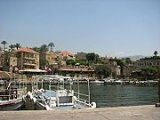
Byblos

Encyclopedia
Byblos is the Greek
name of the Phoenicia
n city Gebal . It is a Mediterranean city in the Mount Lebanon Governorate
of present-day Lebanon
under the current Arabic
name of Jubayl and was also referred to as Gibelet during the Crusades
. It is believed to have been founded around 5000 BC, and according to fragments attributed to the semi-legendary pre-Trojan war
Phoenician historian Sanchuniathon
, it was built by Cronus
as the first city in Phoenicia. Today it is believed by many to be the oldest continuously-inhabited city in the world.
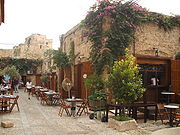 The name Byblos is Greek; papyrus received its early Greek name (byblos, byblinos) from its being exported to the Aegean through Byblos. Hence the English word Bible
is derived from byblos as "the (papyrus) book." The city's Canaanite/Phoenician name "GB'L" derived from "gb", meaning well or origin, and El
the supreme god of Byblos's pantheon. The present day city is now known by the Arabic name Jubayl or Jbeil (جبيل), a direct descendant of the Canaanite
name.
Byblos (Greek
) or Gebal (Phoenician) is located on the Mediterranean coast of present-day Lebanon
, about 26 miles (42 kilometers) north of Beirut
. It is attractive to archaeologists because of the successive layers of debris resulting from centuries of human habitation. It was first excavated by Pierre Montet
from 1921 until 1924, followed by Maurice Dunand from 1925 over a period of forty years.
The site first appears to have been settled during the PPNB period, approximately 6230 BC. Neolithic
remains of some buildings can be observed at the site. According to the writer Philo of Byblos
(quoting Sanchuniathon, and quoted in Eusebius), Byblos had the reputation of being the oldest city in the world, founded by Cronus. During the 3rd millennium BC, the first signs of a town
can be observed, with the remains of well-built houses of uniform size. This was the period when the Phoenicia
n civilization began to develop.
Jacques Cauvin
published studies of flint
tools from the stratified Neolithic and Chalcolithic sites in 1962. Remains of humans found in Chalcolithic burials have been published by H.V. Vallois in 1937. Tombs from this era were discussed by Emir M. Chehab in 1950. Early pottery found at the tell was published by E.S. Boynton in 1960 with further studies by R. Erich in 1954 and Van Liere and Henri de Contenson
in 1964.
Prehistoric settlements at Byblos were divided up by Dunand into the following five periods; Néolithique Ancien (Ancient Neolithic), Néolithique Moyen (Middle Neolithic), Néolithique Récent (Late Neolithic), Énéolithique Ancien (Ancient Chalcolithic), Énéolithique Récent (Late Chacolicthic) and Early Bronze Age
. Néolithique Ancien was a later settlement than others in the Beqaa Valley
such as Labweh
and Ard Tlaili
. It was located on the seaward slope of the larger of the two hills that used to compose ancient Bylbos, with a watered valley in between. The original site spread down into the valley and covered and area of 1.2 hectares (12,000 m²) providing fertile soils and a protected landing place for boats. Dunand discovered around twenty houses although some of the settlement was suggested to have been lost to the sea, robbed or destroyed.Dwellings were rectangular with plastered floors, pottery
was usually Dark faced burnished ware
with some shell impressions. Néolithique Moyen was a smaller settlement of no more than 0.15 hectares (1,500 m²) adjacent to the older site. The pottery was more developed with red washes and more varied forms and elaborate decorations, buildings were poorer with unplastered floors. The Néolithique Récent period showed development from the Moyen in building design, a wider range of more developed flint tools, and a far larger variety of pottery with fabrication including silica. Énéolithique Ancien featured developments of "Canaanean blade
s" and fan scrapers. Adult burials in jars started to appear along with metal in the form of one copper
hook, found in a jar. Some jars were lined with white plaster that was applied and self-hardened after firing. Copper appeared more frequently in the Énéolithique Récent period along with multiple burials in tombs and jar handles with impressed signs. Early Bronze Age remains were characterized by the development of Byblos combed ware and a lithic assemblage studied by Jacques Cauvin.
, Byblos was virtually an Egyptian colony. The growing city was evidently a wealthy one, and seems to have been an ally "those who are on his waters" of Egypt
for many centuries. First Dynasty tombs used timbers from Byblos. One of the oldest Egyptian words for an ocean going boat was "Byblos ship". Beginning with Kha'skehemwy most first dynasty rulers sent a signed gift to the shrine of the "Mistress of Byblos". Archaeologists have recovered Egyptian
-made artifacts dated as early as the Fourth dynasty of Egypt
. Objects have been found at Byblos naming the 13th dynasty Egyptian king Neferhotep I
, and the rulers of Byblos maintained close relationships with the New Kingdom pharaohs of Ancient Egypt. Around 1350 BC, the Amarna tablets include 60 letters from Rib-Hadda
and his successor Ili-Rapih
who where rulers of Byblos, writing to the Egyptian government. This is mainly due to Rib-Hadda's constant pleas for military assistance from Akhenaten
. They also deal with the conquest of neighboring city-states by the Hapiru.
It appears Egyptian contact peaked during the 19th dynasty
, only to decline during the 20th
and 21st
dynasties. Although the archaeological evidence seems to indicate a brief resurgence during the 22nd
and 23rd
dynasties, it is clear after the Third Intermediate Period the Egyptians started favoring Tyre and Sidon
instead of Byblos.
Archaeological evidence at Byblos, dating back to around 1200 BC, shows existence of a Phoenician alphabet
ic script of twenty-two characters; an important example of this script is the sarcophagus
of king Ahiram
. The use of the alphabet was spread by Phoenician merchants through their maritime trade into parts of North Africa and Europe. One of the most important monuments of this period is the temple of Resheph
, a Canaan
ite war god, but this had fallen into ruins by the time of Alexander.
n period, Sibittibaal of Byblos became tributary to Tiglath-pileser III
in 738 BC, and in 701 BC, when Sennacherib
conquered all Phoenicia, the king of Byblos was Urumilki. Byblos was also subject to Assyrian kings Esarhaddon
(r. 681–669 BCE) and Ashurbanipal
(r. 668–627 BCE), under its own kings Milkiasaph and Yehawmelek.
In the Persian period (538–332 BC), Byblos was the fourth of four Phoenician vassal kingdoms established by the Persians; the first three being Sidon
, Tyre, and Arwad
.
was in use, and there is abundant evidence of continued trade with other Mediterranean countries.
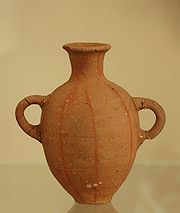 During the Greco-Roman
period, the temple of Resheph was elaborately rebuilt, and the city, though smaller than its neighbours such as Tyre and Sidon, was a center for the cult of Adonis
. In the 3rd century, a small but impressive theater was constructed. With the rise of Christianity
, a bishopric
was established in Byblos, and the town grew rapidly. Although a Persian colony is known to have been established in the region following the Moslem
conquest of 636, there is little archaeological evidence for it. Trade with Europe effectively dried up, and it was not until the coming of the First Crusade
in 1098 that prosperity returned to Byblos, known then as Giblet.
Byblos, under the name of Gibelet or Giblet, was an important military base in the crusader Kingdom of Jerusalem
in the 11th and 12th century, and the remains of its crusader castle are among the most impressive architectural structures now visible at its center. The town was taken by Saladin
in 1187, re-taken by the Crusaders, and eventually conquered by Baibars
in 1266. Its fortifications were subsequently restored. From 1516 until 1918, the town and the whole region were part of the Ottoman Empire
. Byblos and all of Lebanon was placed under French Mandate
from 1920 until 1943 when Lebanon achieved independence.
. The LAU Byblos Campus houses the Medical School, the Engineering School, the Pharmacy School, the School of Business, and the School of Arts and Sciences. The Campus is situated on a hill overlooking the city and the Mediterranean Sea
.
Byblos is re-emerging as an upscale touristic hub. With its ancient port, Phoenicia
n, Roman and Crusader ruins, sandy beaches and the picturesque mountains that surround it make it an ideal tourist destination. The city is known for its fish restaurants, open-air bars, and outdoor cafes. Yachts cruise into its harbor today like they did in the sixties and seventies when Marlon Brando and Frank Sinatra were regular visitors to the city.
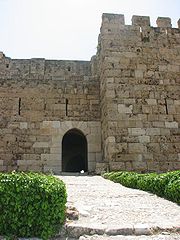
In the archaeological site of Byblos there are the remains of the Great Temple (also known as L-Shaped temple) built in 2700 BC, Temple of Baalat Gebal built in 2700 BC and Temple of the Obelisks built around 1600 BC.
Byblos Castle was built by the crusaders in the 12th century. It is located in the archaeological site near the port.
The old medieval part of Byblos is surrounded by walls running about 270m from east to west and 200m from north to south
This museum displays wax statues of characters from Phoenicia
n times to current days
Work on the church started during the crusades in 1116. It was considered a cathedral and was partially destroyed during an earthquake in 1176 AD. It was transformed into stables by Islamic forces after the fall of the city, and was given to the Maronites as a gift by Prince Youssef Chehab of Lebanon in the mid 1700s, after they aided him in capturing the city.
Byblos Fossil Museum has a collection of fossilized fish, sharks, eel, flying fish, and other marine life, some millions of years old.
In the southeast section of the historic city, near the entrance of the archaeological site, is an old market where tourists can shop for souvenirs and antiques, or simply stroll along the old cobblestone streets and enjoy the architecture.
This summer music festival is an annual event that takes place in the historic quarter.
. There are also some Shia Muslims, whose ancestors escaped expulsion by the Seljuk Turks
in the Middle Ages. It is said that the city of Bint Jbeil
("daughter of Jbeil") in southern Lebanon was founded by those displaced Shi'a. Byblos has three representatives in the Parliament of Lebanon
: two Maronites and one Shi'a.
Greek language
Greek is an independent branch of the Indo-European family of languages. Native to the southern Balkans, it has the longest documented history of any Indo-European language, spanning 34 centuries of written records. Its writing system has been the Greek alphabet for the majority of its history;...
name of the Phoenicia
Phoenicia
Phoenicia , was an ancient civilization in Canaan which covered most of the western, coastal part of the Fertile Crescent. Several major Phoenician cities were built on the coastline of the Mediterranean. It was an enterprising maritime trading culture that spread across the Mediterranean from 1550...
n city Gebal . It is a Mediterranean city in the Mount Lebanon Governorate
Mount Lebanon Governorate
Mount Lebanon is one of the Governorates of Lebanon. Its capital is Baabda. The overwhelming majority of its population is Maronites, Greek Orthodox, and Melkite Greek Catholic Christians...
of present-day Lebanon
Lebanon
Lebanon , officially the Republic of LebanonRepublic of Lebanon is the most common term used by Lebanese government agencies. The term Lebanese Republic, a literal translation of the official Arabic and French names that is not used in today's world. Arabic is the most common language spoken among...
under the current Arabic
Arabic language
Arabic is a name applied to the descendants of the Classical Arabic language of the 6th century AD, used most prominently in the Quran, the Islamic Holy Book...
name of Jubayl and was also referred to as Gibelet during the Crusades
Crusades
The Crusades were a series of religious wars, blessed by the Pope and the Catholic Church with the main goal of restoring Christian access to the holy places in and near Jerusalem...
. It is believed to have been founded around 5000 BC, and according to fragments attributed to the semi-legendary pre-Trojan war
Trojan War
In Greek mythology, the Trojan War was waged against the city of Troy by the Achaeans after Paris of Troy took Helen from her husband Menelaus, the king of Sparta. The war is among the most important events in Greek mythology and was narrated in many works of Greek literature, including the Iliad...
Phoenician historian Sanchuniathon
Sanchuniathon
Sanchuniathon is the purported Phoenician author of three lost works originally in the Phoenician language, surviving only in partial paraphrase and summary of a Greek translation by Philo of Byblos, according to the Christian bishop Eusebius of Caesarea...
, it was built by Cronus
Cronus
In Greek mythology, Cronus or Kronos was the leader and the youngest of the first generation of Titans, divine descendants of Gaia, the earth, and Uranus, the sky...
as the first city in Phoenicia. Today it is believed by many to be the oldest continuously-inhabited city in the world.
History and Archaeology
Bible
The Bible refers to any one of the collections of the primary religious texts of Judaism and Christianity. There is no common version of the Bible, as the individual books , their contents and their order vary among denominations...
is derived from byblos as "the (papyrus) book." The city's Canaanite/Phoenician name "GB'L" derived from "gb", meaning well or origin, and El
El
EL, El or el may refer to:* El , a Semitic word for "God"; also a senior god mentioned in the Ugarit and Ebla texts found in ancient Syria.* El , a letter of the Cyrillic alphabet* El , the letter L...
the supreme god of Byblos's pantheon. The present day city is now known by the Arabic name Jubayl or Jbeil (جبيل), a direct descendant of the Canaanite
Canaanite languages
The Canaanite languages are a subfamily of the Semitic languages, which were spoken by the ancient peoples of the Canaan region, including Canaanites, Israelites and Phoenicians...
name.
Byblos (Greek
Greek language
Greek is an independent branch of the Indo-European family of languages. Native to the southern Balkans, it has the longest documented history of any Indo-European language, spanning 34 centuries of written records. Its writing system has been the Greek alphabet for the majority of its history;...
) or Gebal (Phoenician) is located on the Mediterranean coast of present-day Lebanon
Lebanon
Lebanon , officially the Republic of LebanonRepublic of Lebanon is the most common term used by Lebanese government agencies. The term Lebanese Republic, a literal translation of the official Arabic and French names that is not used in today's world. Arabic is the most common language spoken among...
, about 26 miles (42 kilometers) north of Beirut
Beirut
Beirut is the capital and largest city of Lebanon, with a population ranging from 1 million to more than 2 million . Located on a peninsula at the midpoint of Lebanon's Mediterranean coastline, it serves as the country's largest and main seaport, and also forms the Beirut Metropolitan...
. It is attractive to archaeologists because of the successive layers of debris resulting from centuries of human habitation. It was first excavated by Pierre Montet
Pierre Montet
Pierre Montet was a respected French Egyptologist.-Biography:Montet first began his studies under Victor Loret at the University of Lyon....
from 1921 until 1924, followed by Maurice Dunand from 1925 over a period of forty years.
The site first appears to have been settled during the PPNB period, approximately 6230 BC. Neolithic
Neolithic
The Neolithic Age, Era, or Period, or New Stone Age, was a period in the development of human technology, beginning about 9500 BC in some parts of the Middle East, and later in other parts of the world. It is traditionally considered as the last part of the Stone Age...
remains of some buildings can be observed at the site. According to the writer Philo of Byblos
Philo of Byblos
Philo of Byblos was an antiquarian writer of grammatical, lexical and historical works in Greek. He is chiefly known for his Phoenician history assembled from the writings of Sanchuniathon.-Life:...
(quoting Sanchuniathon, and quoted in Eusebius), Byblos had the reputation of being the oldest city in the world, founded by Cronus. During the 3rd millennium BC, the first signs of a town
Town
A town is a human settlement larger than a village but smaller than a city. The size a settlement must be in order to be called a "town" varies considerably in different parts of the world, so that, for example, many American "small towns" seem to British people to be no more than villages, while...
can be observed, with the remains of well-built houses of uniform size. This was the period when the Phoenicia
Phoenicia
Phoenicia , was an ancient civilization in Canaan which covered most of the western, coastal part of the Fertile Crescent. Several major Phoenician cities were built on the coastline of the Mediterranean. It was an enterprising maritime trading culture that spread across the Mediterranean from 1550...
n civilization began to develop.
Jacques Cauvin
Jacques Cauvin
Professor Jacques Cauvin was a French archaeologist who specialised in the prehistory of the Levant and Near East.-Biography:...
published studies of flint
Flint
Flint is a hard, sedimentary cryptocrystalline form of the mineral quartz, categorized as a variety of chert. It occurs chiefly as nodules and masses in sedimentary rocks, such as chalks and limestones. Inside the nodule, flint is usually dark grey, black, green, white, or brown in colour, and...
tools from the stratified Neolithic and Chalcolithic sites in 1962. Remains of humans found in Chalcolithic burials have been published by H.V. Vallois in 1937. Tombs from this era were discussed by Emir M. Chehab in 1950. Early pottery found at the tell was published by E.S. Boynton in 1960 with further studies by R. Erich in 1954 and Van Liere and Henri de Contenson
Henri de Contenson
right|250px|thumb|Henri de ContensonHenri de Contenson , is a French Archaeologist and was Research Director at CNRS, The Centre National de la Recherche Scientifique , a research organization funded by France's Ministry of Research.A student of André Parrot, Raymond Lantier and André...
in 1964.
Prehistoric settlements at Byblos were divided up by Dunand into the following five periods; Néolithique Ancien (Ancient Neolithic), Néolithique Moyen (Middle Neolithic), Néolithique Récent (Late Neolithic), Énéolithique Ancien (Ancient Chalcolithic), Énéolithique Récent (Late Chacolicthic) and Early Bronze Age
Bronze Age
The Bronze Age is a period characterized by the use of copper and its alloy bronze as the chief hard materials in the manufacture of some implements and weapons. Chronologically, it stands between the Stone Age and Iron Age...
. Néolithique Ancien was a later settlement than others in the Beqaa Valley
Beqaa Valley
The Beqaa Valley is a fertile valley in east Lebanon. For the Romans, the Beqaa Valley was a major agricultural source, and today it remains Lebanon’s most important farming region...
such as Labweh
Labweh
Labweh , Laboue, Labwe or Al-Labweh is a village at an altitude of on a foothill of the Anti-Lebanon mountains in the Baalbek District of Lebanon.-History:...
and Ard Tlaili
Ard Tlaili
Ard Tlaili or Tell Ard Tlaili is a small tell mound archaeological site in a plain at the foot of the Lebanon Mountains 11km northwest of Baalbeck, in the Beqaa Valley in Lebanon....
. It was located on the seaward slope of the larger of the two hills that used to compose ancient Bylbos, with a watered valley in between. The original site spread down into the valley and covered and area of 1.2 hectares (12,000 m²) providing fertile soils and a protected landing place for boats. Dunand discovered around twenty houses although some of the settlement was suggested to have been lost to the sea, robbed or destroyed.Dwellings were rectangular with plastered floors, pottery
Pottery
Pottery is the material from which the potteryware is made, of which major types include earthenware, stoneware and porcelain. The place where such wares are made is also called a pottery . Pottery also refers to the art or craft of the potter or the manufacture of pottery...
was usually Dark faced burnished ware
Dark faced burnished ware
Dark Faced Burnished Ware or DFBW is the earliest form of pottery developed in the western world.It was produced after the earliest examples from the indepenent phenomenon of the Jomon culture in Japan and is predominantly found at archaeological sites in Lebanon, Israel and southwest Syria...
with some shell impressions. Néolithique Moyen was a smaller settlement of no more than 0.15 hectares (1,500 m²) adjacent to the older site. The pottery was more developed with red washes and more varied forms and elaborate decorations, buildings were poorer with unplastered floors. The Néolithique Récent period showed development from the Moyen in building design, a wider range of more developed flint tools, and a far larger variety of pottery with fabrication including silica. Énéolithique Ancien featured developments of "Canaanean blade
Canaanean blade
A Canaanean blade is an archaeological term for a long, wide blade made out of stone or flint, predominantly found at sites in Lebanon . They were first manufactured and used in the Neolithic Stone Age to be used as weapons such as javelins or arrowheads...
s" and fan scrapers. Adult burials in jars started to appear along with metal in the form of one copper
Copper
Copper is a chemical element with the symbol Cu and atomic number 29. It is a ductile metal with very high thermal and electrical conductivity. Pure copper is soft and malleable; an exposed surface has a reddish-orange tarnish...
hook, found in a jar. Some jars were lined with white plaster that was applied and self-hardened after firing. Copper appeared more frequently in the Énéolithique Récent period along with multiple burials in tombs and jar handles with impressed signs. Early Bronze Age remains were characterized by the development of Byblos combed ware and a lithic assemblage studied by Jacques Cauvin.
Egyptian contact
Watson Mills and Roger Bullard suggest that during the Old KingdomOld Kingdom
Old Kingdom is the name given to the period in the 3rd millennium BC when Egypt attained its first continuous peak of civilization in complexity and achievement – the first of three so-called "Kingdom" periods, which mark the high points of civilization in the lower Nile Valley .The term itself was...
, Byblos was virtually an Egyptian colony. The growing city was evidently a wealthy one, and seems to have been an ally "those who are on his waters" of Egypt
Egypt
Egypt , officially the Arab Republic of Egypt, Arabic: , is a country mainly in North Africa, with the Sinai Peninsula forming a land bridge in Southwest Asia. Egypt is thus a transcontinental country, and a major power in Africa, the Mediterranean Basin, the Middle East and the Muslim world...
for many centuries. First Dynasty tombs used timbers from Byblos. One of the oldest Egyptian words for an ocean going boat was "Byblos ship". Beginning with Kha'skehemwy most first dynasty rulers sent a signed gift to the shrine of the "Mistress of Byblos". Archaeologists have recovered Egyptian
Ancient Egypt
Ancient Egypt was an ancient civilization of Northeastern Africa, concentrated along the lower reaches of the Nile River in what is now the modern country of Egypt. Egyptian civilization coalesced around 3150 BC with the political unification of Upper and Lower Egypt under the first pharaoh...
-made artifacts dated as early as the Fourth dynasty of Egypt
Fourth dynasty of Egypt
The fourth dynasty of ancient Egypt is characterized as a "golden age" of the Old Kingdom. Dynasty IV lasted from ca. 2613 to 2494 BC...
. Objects have been found at Byblos naming the 13th dynasty Egyptian king Neferhotep I
Neferhotep I
Neferhotep I was an Egyptian king of the Thirteenth Dynasty and one of the most powerful rulers of this dynasty. The Turin Canon assigned him a reign length of 11 years....
, and the rulers of Byblos maintained close relationships with the New Kingdom pharaohs of Ancient Egypt. Around 1350 BC, the Amarna tablets include 60 letters from Rib-Hadda
Rib-Hadda
Rib-Hadda was king of Byblos during the mid fourteenth century BCE. He is the author of some sixty of the Amarna letters all to Akhenaten...
and his successor Ili-Rapih
Ili-Rapih
Ili-Rapih was the follow-on mayor in Gubla-, and the brother of Rib-Hadda, the former mayor of Gubla, ; Ili-Rapih is in the 1350-1335 BC Amarna letters correspondence, and wrote 2 follow-on letters to the Pharaoh after the death of Rib-Haddi.Of note, Ili-Rapih's name is referenced in only one...
who where rulers of Byblos, writing to the Egyptian government. This is mainly due to Rib-Hadda's constant pleas for military assistance from Akhenaten
Akhenaten
Akhenaten also spelled Echnaton,Ikhnaton,and Khuenaten;meaning "living spirit of Aten") known before the fifth year of his reign as Amenhotep IV , was a Pharaoh of the Eighteenth dynasty of Egypt who ruled for 17 years and died perhaps in 1336 BC or 1334 BC...
. They also deal with the conquest of neighboring city-states by the Hapiru.
It appears Egyptian contact peaked during the 19th dynasty
Nineteenth dynasty of Egypt
The Nineteenth Dynasty of ancient Egypt was one of the periods of the Egyptian New Kingdom. Founded by Vizier Ramesses I, whom Pharaoh Horemheb chose as his successor to the throne, this dynasty is best known for its military conquests in Palestine, Lebanon, and Syria.The warrior kings of the...
, only to decline during the 20th
Twentieth dynasty of Egypt
The Eighteenth, Nineteenth, and Twentieth Dynasties of ancient Egypt are often combined under the group title, New Kingdom. This dynasty is considered to be the last one of the New Kingdom of Egypt, and was followed by the Third Intermediate Period....
and 21st
Twenty-first dynasty of Egypt
The Twenty-First, Twenty-Second, Twenty-Third, Twenty-Fourth, and Twenty-Fifth Dynasties of ancient Egypt are often combined under the group title, Third Intermediate Period.-Rulers:...
dynasties. Although the archaeological evidence seems to indicate a brief resurgence during the 22nd
Twenty-second dynasty of Egypt
The Twenty-First, Twenty-Second, Twenty-Third, Twenty-Fourth and Twenty-Fifth Dynasties of ancient Egypt are often combined under the group title, Third Intermediate Period.-Rulers:...
and 23rd
Twenty-third dynasty of Egypt
The Twenty-third Dynasty of ancient Egypt was a separate regime of Meshwesh Libyan kings, who ruled ancient Egypt. This dynasty is often considered part of the Third Intermediate Period.-Rulers:...
dynasties, it is clear after the Third Intermediate Period the Egyptians started favoring Tyre and Sidon
Sidon
Sidon or Saïda is the third-largest city in Lebanon. It is located in the South Governorate of Lebanon, on the Mediterranean coast, about 40 km north of Tyre and 40 km south of the capital Beirut. In Genesis, Sidon is the son of Canaan the grandson of Noah...
instead of Byblos.
Archaeological evidence at Byblos, dating back to around 1200 BC, shows existence of a Phoenician alphabet
Phoenician alphabet
The Phoenician alphabet, called by convention the Proto-Canaanite alphabet for inscriptions older than around 1050 BC, was a non-pictographic consonantal alphabet, or abjad. It was used for the writing of Phoenician, a Northern Semitic language, used by the civilization of Phoenicia...
ic script of twenty-two characters; an important example of this script is the sarcophagus
Sarcophagus
A sarcophagus is a funeral receptacle for a corpse, most commonly carved or cut from stone. The word "sarcophagus" comes from the Greek σαρξ sarx meaning "flesh", and φαγειν phagein meaning "to eat", hence sarkophagus means "flesh-eating"; from the phrase lithos sarkophagos...
of king Ahiram
Ahiram
Ahiram or, more correctly, Ahirom was a Phoenician king of Byblos Ahirom is not attested in any other Ancient Oriental source. He became famous only by his Phoenician inscribed sarcophagus which was discovered in 1923 by the French excavator Pierre Montet in tomb V of the royal necropolis of Byblos...
. The use of the alphabet was spread by Phoenician merchants through their maritime trade into parts of North Africa and Europe. One of the most important monuments of this period is the temple of Resheph
Resheph
Resheph was a Canaanite deity of plague and war. In Egyptian iconography Resheph is depicted wearing the crown of Upper Egypt surmounted in front by the head of a gazelle. He has links with Theban war god Montu and was thought of as a guardian deity in battle by many Egyptian pharaohs...
, a Canaan
Canaan
Canaan is a historical region roughly corresponding to modern-day Israel, Palestine, Lebanon, and the western parts of Jordan...
ite war god, but this had fallen into ruins by the time of Alexander.
Eastern empires
In the AssyriaAssyria
Assyria was a Semitic Akkadian kingdom, extant as a nation state from the mid–23rd century BC to 608 BC centred on the Upper Tigris river, in northern Mesopotamia , that came to rule regional empires a number of times through history. It was named for its original capital, the ancient city of Assur...
n period, Sibittibaal of Byblos became tributary to Tiglath-pileser III
Tiglath-Pileser III
Tiglath-Pileser III was a prominent king of Assyria in the eighth century BC and is widely regarded as the founder of the Neo-Assyrian Empire. Tiglath-Pileser III seized the Assyrian throne during a civil war and killed the royal family...
in 738 BC, and in 701 BC, when Sennacherib
Sennacherib
Sennacherib |Sîn]] has replaced brothers for me"; Aramaic: ) was the son of Sargon II, whom he succeeded on the throne of Assyria .-Rise to power:...
conquered all Phoenicia, the king of Byblos was Urumilki. Byblos was also subject to Assyrian kings Esarhaddon
Esarhaddon
Esarhaddon , was a king of Assyria who reigned 681 – 669 BC. He was the youngest son of Sennacherib and the Aramean queen Naqi'a , Sennacherib's second wife....
(r. 681–669 BCE) and Ashurbanipal
Ashurbanipal
Ashurbanipal |Ashur]] is creator of an heir"; 685 BC – c. 627 BC), also spelled Assurbanipal or Ashshurbanipal, was an Assyrian king, the son of Esarhaddon and the last great king of the Neo-Assyrian Empire...
(r. 668–627 BCE), under its own kings Milkiasaph and Yehawmelek.
In the Persian period (538–332 BC), Byblos was the fourth of four Phoenician vassal kingdoms established by the Persians; the first three being Sidon
Sidon
Sidon or Saïda is the third-largest city in Lebanon. It is located in the South Governorate of Lebanon, on the Mediterranean coast, about 40 km north of Tyre and 40 km south of the capital Beirut. In Genesis, Sidon is the son of Canaan the grandson of Noah...
, Tyre, and Arwad
Arwad
Arwad – formerly known as Arado , Arados , Arvad, Arpad, Arphad, and Antiochia in Pieria , also called Ruad Island – located in the Mediterranean Sea, is the only inhabited island in Syria. The town of Arwad takes up the entire island...
.
Western empires
Hellenistic rule came with the arrival of Alexander the Great in the area in 332 BC. CoinageCurrency
In economics, currency refers to a generally accepted medium of exchange. These are usually the coins and banknotes of a particular government, which comprise the physical aspects of a nation's money supply...
was in use, and there is abundant evidence of continued trade with other Mediterranean countries.
Ancient Rome
Ancient Rome was a thriving civilization that grew on the Italian Peninsula as early as the 8th century BC. Located along the Mediterranean Sea and centered on the city of Rome, it expanded to one of the largest empires in the ancient world....
period, the temple of Resheph was elaborately rebuilt, and the city, though smaller than its neighbours such as Tyre and Sidon, was a center for the cult of Adonis
Adonis
Adonis , in Greek mythology, the god of beauty and desire, is a figure with Northwest Semitic antecedents, where he is a central figure in various mystery religions. The Greek , Adōnis is a variation of the Semitic word Adonai, "lord", which is also one of the names used to refer to God in the Old...
. In the 3rd century, a small but impressive theater was constructed. With the rise of Christianity
Christianity
Christianity is a monotheistic religion based on the life and teachings of Jesus as presented in canonical gospels and other New Testament writings...
, a bishopric
Episcopal See
An episcopal see is, in the original sense, the official seat of a bishop. This seat, which is also referred to as the bishop's cathedra, is placed in the bishop's principal church, which is therefore called the bishop's cathedral...
was established in Byblos, and the town grew rapidly. Although a Persian colony is known to have been established in the region following the Moslem
Islam
Islam . The most common are and . : Arabic pronunciation varies regionally. The first vowel ranges from ~~. The second vowel ranges from ~~~...
conquest of 636, there is little archaeological evidence for it. Trade with Europe effectively dried up, and it was not until the coming of the First Crusade
First Crusade
The First Crusade was a military expedition by Western Christianity to regain the Holy Lands taken in the Muslim conquest of the Levant, ultimately resulting in the recapture of Jerusalem...
in 1098 that prosperity returned to Byblos, known then as Giblet.
Byblos, under the name of Gibelet or Giblet, was an important military base in the crusader Kingdom of Jerusalem
Kingdom of Jerusalem
The Kingdom of Jerusalem was a Catholic kingdom established in the Levant in 1099 after the First Crusade. The kingdom lasted nearly two hundred years, from 1099 until 1291 when the last remaining possession, Acre, was destroyed by the Mamluks, but its history is divided into two distinct periods....
in the 11th and 12th century, and the remains of its crusader castle are among the most impressive architectural structures now visible at its center. The town was taken by Saladin
Saladin
Ṣalāḥ ad-Dīn Yūsuf ibn Ayyūb , better known in the Western world as Saladin, was an Arabized Kurdish Muslim, who became the first Sultan of Egypt and Syria, and founded the Ayyubid dynasty. He led Muslim and Arab opposition to the Franks and other European Crusaders in the Levant...
in 1187, re-taken by the Crusaders, and eventually conquered by Baibars
Baibars
Baibars or Baybars , nicknamed Abu l-Futuh , was a Mamluk Sultan of Egypt. He was one of the commanders of the forces which inflicted a devastating defeat on the Seventh Crusade of King Louis IX of France and he led the vanguard of the Egyptian army at the Battle of Ain Jalut in 1260, which marked...
in 1266. Its fortifications were subsequently restored. From 1516 until 1918, the town and the whole region were part of the Ottoman Empire
Ottoman Empire
The Ottoman EmpireIt was usually referred to as the "Ottoman Empire", the "Turkish Empire", the "Ottoman Caliphate" or more commonly "Turkey" by its contemporaries...
. Byblos and all of Lebanon was placed under French Mandate
French Mandate of Lebanon
The state of Greater Lebanon, the predecessor of modern Lebanon, was created in 1920 as part of the French scheme of dividing the French Mandate of Syria into six states....
from 1920 until 1943 when Lebanon achieved independence.
Education
Byblos is home to the professional schools of the Lebanese American UniversityLebanese American University
The Lebanese American University is a secular, private and independent American university located in Lebanon...
. The LAU Byblos Campus houses the Medical School, the Engineering School, the Pharmacy School, the School of Business, and the School of Arts and Sciences. The Campus is situated on a hill overlooking the city and the Mediterranean Sea
Mediterranean Sea
The Mediterranean Sea is a sea connected to the Atlantic Ocean surrounded by the Mediterranean region and almost completely enclosed by land: on the north by Anatolia and Europe, on the south by North Africa, and on the east by the Levant...
.
Tourism
- See also:
Byblos is re-emerging as an upscale touristic hub. With its ancient port, Phoenicia
Phoenicia
Phoenicia , was an ancient civilization in Canaan which covered most of the western, coastal part of the Fertile Crescent. Several major Phoenician cities were built on the coastline of the Mediterranean. It was an enterprising maritime trading culture that spread across the Mediterranean from 1550...
n, Roman and Crusader ruins, sandy beaches and the picturesque mountains that surround it make it an ideal tourist destination. The city is known for its fish restaurants, open-air bars, and outdoor cafes. Yachts cruise into its harbor today like they did in the sixties and seventies when Marlon Brando and Frank Sinatra were regular visitors to the city.
- Ancient Phoenician temples
In the archaeological site of Byblos there are the remains of the Great Temple (also known as L-Shaped temple) built in 2700 BC, Temple of Baalat Gebal built in 2700 BC and Temple of the Obelisks built around 1600 BC.
- Byblos Castle
Byblos Castle was built by the crusaders in the 12th century. It is located in the archaeological site near the port.
- Medieval city wall
The old medieval part of Byblos is surrounded by walls running about 270m from east to west and 200m from north to south
- Byblos Wax Museum
This museum displays wax statues of characters from Phoenicia
Phoenicia
Phoenicia , was an ancient civilization in Canaan which covered most of the western, coastal part of the Fertile Crescent. Several major Phoenician cities were built on the coastline of the Mediterranean. It was an enterprising maritime trading culture that spread across the Mediterranean from 1550...
n times to current days
- St John the Baptist Church
Work on the church started during the crusades in 1116. It was considered a cathedral and was partially destroyed during an earthquake in 1176 AD. It was transformed into stables by Islamic forces after the fall of the city, and was given to the Maronites as a gift by Prince Youssef Chehab of Lebanon in the mid 1700s, after they aided him in capturing the city.
- Byblos Fossil Museum
Byblos Fossil Museum has a collection of fossilized fish, sharks, eel, flying fish, and other marine life, some millions of years old.
- Historic Quarter and Souks
In the southeast section of the historic city, near the entrance of the archaeological site, is an old market where tourists can shop for souvenirs and antiques, or simply stroll along the old cobblestone streets and enjoy the architecture.
- Byblos International Festival
This summer music festival is an annual event that takes place in the historic quarter.
Threats to Byblos
The 2006 Lebanon War negatively affected this ancient site by covering the harbor and town walls with an oil slick.Today
Today, Byblos is a modern city that still retains its historical past. Byblos remains as one of Lebanon's major tourist sites due to its rich history and scenic mountains overlooking the Mediterranean. Most residents of Byblos are Maronite CatholicsMaronite Church
The Syriac Maronite Church of Antioch is an Eastern Catholic Church in full communion with the Holy See of Rome . It traces its heritage back to the community founded by Maron, a 4th-century Syriac monk venerated as a saint. The first Maronite Patriarch, John Maron, was elected in the late 7th...
. There are also some Shia Muslims, whose ancestors escaped expulsion by the Seljuk Turks
Seljuq dynasty
The Seljuq ; were a Turco-Persian Sunni Muslim dynasty that ruled parts of Central Asia and the Middle East from the 11th to 14th centuries...
in the Middle Ages. It is said that the city of Bint Jbeil
Bint Jbeil
Bint Jbeil is the second largest town in the Nabatiye Governorate in Southern Lebanon.The town has an estimated population of 30,000. Its exact population is unknown, because Lebanon has not conducted a population census since 1932.-History:...
("daughter of Jbeil") in southern Lebanon was founded by those displaced Shi'a. Byblos has three representatives in the Parliament of Lebanon
Parliament of Lebanon
The Parliament of Lebanon is the national parliament of Lebanon. There are 128 members elected to a four-year terms in multi-member constituencies, apportioned among Lebanon's diverse Christian and Muslim denominations. Lebanon has universal adult suffrage...
: two Maronites and one Shi'a.
Twin towns – Sister cities
Byblos is twinned with:| Patras Patras Patras , ) is Greece's third largest urban area and the regional capital of West Greece, located in northern Peloponnese, 215 kilometers west of Athens... , Greece Greece Greece , officially the Hellenic Republic , and historically Hellas or the Republic of Greece in English, is a country in southeastern Europe.... Tripoli Tripoli, Greece Tripoli is a city of about 25,000 inhabitants in the central part of the Peloponnese, in Greece. It is the capital of the prefecture of Arcadia and the centre of the municipality of Tripolis, pop... , Greece Greece Greece , officially the Hellenic Republic , and historically Hellas or the Republic of Greece in English, is a country in southeastern Europe.... Sparta Sparti (municipality) Sparti is a municipality of Laconia, Greece. It lies at the site of ancient Sparta. The population in 2001 was 38,079, of whom 15,828 lived in the town itself.-History:... , Greece Greece Greece , officially the Hellenic Republic , and historically Hellas or the Republic of Greece in English, is a country in southeastern Europe.... |
Orange, France France The French Republic , The French Republic , The French Republic , (commonly known as France , is a unitary semi-presidential republic in Western Europe with several overseas territories and islands located on other continents and in the Indian, Pacific, and Atlantic oceans. Metropolitan France... Valetta, Malta Malta Malta , officially known as the Republic of Malta , is a Southern European country consisting of an archipelago situated in the centre of the Mediterranean, south of Sicily, east of Tunisia and north of Libya, with Gibraltar to the west and Alexandria to the east.Malta covers just over in... |
Cadiz Cádiz Cadiz is a city and port in southwestern Spain. It is the capital of the homonymous province, one of eight which make up the autonomous community of Andalusia.... , Spain Spain Spain , officially the Kingdom of Spain languages]] under the European Charter for Regional or Minority Languages. In each of these, Spain's official name is as follows:;;;;;;), is a country and member state of the European Union located in southwestern Europe on the Iberian Peninsula... Izmir Izmir Izmir is a large metropolis in the western extremity of Anatolia. The metropolitan area in the entire Izmir Province had a population of 3.35 million as of 2010, making the city third most populous in Turkey... , Turkey Turkey Turkey , known officially as the Republic of Turkey , is a Eurasian country located in Western Asia and in East Thrace in Southeastern Europe... |
See also
- Ba`alat GebalBa`alat GebalBa‘alat Gebal, 'Lady of Byblos', was the goddess of the city of Byblos, sometimes known to the Greeks as Baaltis.She was generally identified with the pan-Semitic goddess ‘Ashtart and so equated with the Greek goddess Aphrodite...
- Byblos syllabaryByblos syllabaryThe Byblos syllabary, also known as the Pseudo-hieroglyphic script, Proto-Byblian, Proto-Byblic, or Byblic, is officially an undeciphered writing system, known from ten inscriptions found in Byblos. The inscriptions are engraved on bronze plates and spatulas, and carved in stone...
- Embriaco familyEmbriaco familyThe Embriaco family were Genoese adventurers, who played an important part in the history of the Crusader states. They styled themselves "Lord of Jebail" or "Giblet", "Gibelet" or "Gibelletto". Jebail is historic Byblos in Lebanon....
- HbalineHbalineHbaline is a small village in Jbeil-Lebanon located 44 km north of Beirut and at an altitude of 540 meters, just above Amchit and Gherfine...
- War of St. Sabas
- Cities of the ancient Near EastCities of the ancient Near EastThe largest cities in the Bronze Age ancient Near East housed several tens of thousands. Memphis in the Early Bronze Age with some 30,000 inhabitants was the largest city of the time by far...