


South Caucasus

Encyclopedia
Eastern Europe
Eastern Europe is the eastern part of Europe. The term has widely disparate geopolitical, geographical, cultural and socioeconomic readings, which makes it highly context-dependent and even volatile, and there are "almost as many definitions of Eastern Europe as there are scholars of the region"...
and Southwest Asia
Southwest Asia
Western Asia, West Asia, Southwest Asia or Southwestern Asia are terms that describe the westernmost portion of Asia. The terms are partly coterminous with the Middle East, which describes a geographical position in relation to Western Europe rather than its location within Asia...
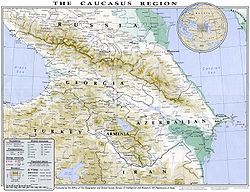
also referred to as Transcaucasia, or The Trans-Caucasus. More specifically, the South Caucasus area spans the southern portion of the Caucasus Mountains
Caucasus Mountains
The Caucasus Mountains is a mountain system in Eurasia between the Black Sea and the Caspian Sea in the Caucasus region .The Caucasus Mountains includes:* the Greater Caucasus Mountain Range and* the Lesser Caucasus Mountains....
and its lowlands, straddles the border between the two continents of Europe
Europe
Europe is, by convention, one of the world's seven continents. Comprising the westernmost peninsula of Eurasia, Europe is generally 'divided' from Asia to its east by the watershed divides of the Ural and Caucasus Mountains, the Ural River, the Caspian and Black Seas, and the waterways connecting...
and Asia
Asia
Asia is the world's largest and most populous continent, located primarily in the eastern and northern hemispheres. It covers 8.7% of the Earth's total surface area and with approximately 3.879 billion people, it hosts 60% of the world's current human population...
, extends from the southern part of the Greater Caucasus
Greater Caucasus
Greater Caucasus , sometimes translated as "Caucasus Major", "Big Caucasus" or "Large Caucasus") is the major mountain range of the Caucasus Mountains....
mountain range of southwestern Russia
Russia
Russia or , officially known as both Russia and the Russian Federation , is a country in northern Eurasia. It is a federal semi-presidential republic, comprising 83 federal subjects...
southerly to the Turkish
Turkey
Turkey , known officially as the Republic of Turkey , is a Eurasian country located in Western Asia and in East Thrace in Southeastern Europe...
and Armenia
Armenia
Armenia , officially the Republic of Armenia , is a landlocked mountainous country in the Caucasus region of Eurasia...
n borders, and from the Black Sea
Black Sea
The Black Sea is bounded by Europe, Anatolia and the Caucasus and is ultimately connected to the Atlantic Ocean via the Mediterranean and the Aegean seas and various straits. The Bosphorus strait connects it to the Sea of Marmara, and the strait of the Dardanelles connects that sea to the Aegean...
to the Caspian Sea
Caspian Sea
The Caspian Sea is the largest enclosed body of water on Earth by area, variously classed as the world's largest lake or a full-fledged sea. The sea has a surface area of and a volume of...
coast of Iran
Iran
Iran , officially the Islamic Republic of Iran , is a country in Southern and Western Asia. The name "Iran" has been in use natively since the Sassanian era and came into use internationally in 1935, before which the country was known to the Western world as Persia...
. The area includes the southern part of the Greater Caucasus Mountain range, the entire Lesser Caucasus Mountain range, the Colchis Lowlands and Kura-Aras Lowland
Kura-Aras Lowland
The Kura-Aras Lowland, Kura-Aras Depression or Kura-Aras Basin is a vast depression in central-southern Azerbaijan defined by the valleys of the Kura River and Aras River. It is situated by the West shore of the Caspian Sea and is part of the Aral-Caspian Depression...
s, the Talysh Mountains
Talysh Mountains
Talysh Mountains is a mountain chain in northwestern Iran, and southeastern Republic of Azerbaijan in the northwest section of the Elburz Mountains, extending southeastward from the Lankaran Lowland in southeast Azerbaijan to the lower part of the Sefid Rud in northwest Iran...
, the Lenkoran Lowlands, Javakheti and the Armenian highlands. The Transcaucasus, or South Caucasus area, is a part of the entire Caucasus geographical region that essentially divides the Eurasia
Eurasia
Eurasia is a continent or supercontinent comprising the traditional continents of Europe and Asia ; covering about 52,990,000 km2 or about 10.6% of the Earth's surface located primarily in the eastern and northern hemispheres...
n transcontinent into two.
All of Armenia
Armenia
Armenia , officially the Republic of Armenia , is a landlocked mountainous country in the Caucasus region of Eurasia...
is in Southern Caucasus; the majority of Georgia
Georgia (country)
Georgia is a sovereign state in the Caucasus region of Eurasia. Located at the crossroads of Western Asia and Eastern Europe, it is bounded to the west by the Black Sea, to the north by Russia, to the southwest by Turkey, to the south by Armenia, and to the southeast by Azerbaijan. The capital of...
and Azerbaijan
Azerbaijan
Azerbaijan , officially the Republic of Azerbaijan is the largest country in the Caucasus region of Eurasia. Located at the crossroads of Western Asia and Eastern Europe, it is bounded by the Caspian Sea to the east, Russia to the north, Georgia to the northwest, Armenia to the west, and Iran to...
, including the exclave of Naxçivan, fall within this area. The countries of the region are producers of oil
Petroleum
Petroleum or crude oil is a naturally occurring, flammable liquid consisting of a complex mixture of hydrocarbons of various molecular weights and other liquid organic compounds, that are found in geologic formations beneath the Earth's surface. Petroleum is recovered mostly through oil drilling...
, manganese ore
Manganese
Manganese is a chemical element, designated by the symbol Mn. It has the atomic number 25. It is found as a free element in nature , and in many minerals...
, tea
Tea
Tea is an aromatic beverage prepared by adding cured leaves of the Camellia sinensis plant to hot water. The term also refers to the plant itself. After water, tea is the most widely consumed beverage in the world...
, citrus fruits, and wine
Wine
Wine is an alcoholic beverage, made of fermented fruit juice, usually from grapes. The natural chemical balance of grapes lets them ferment without the addition of sugars, acids, enzymes, or other nutrients. Grape wine is produced by fermenting crushed grapes using various types of yeast. Yeast...
.
In Western languages, the terms Transcaucasus and Transcaucasia are translations of the Russian
Russian language
Russian is a Slavic language used primarily in Russia, Belarus, Uzbekistan, Kazakhstan, Tajikistan and Kyrgyzstan. It is an unofficial but widely spoken language in Ukraine, Moldova, Latvia, Turkmenistan and Estonia and, to a lesser extent, the other countries that were once constituent republics...
zakavkazie meaning "the area beyond the Caucasus Mountains", i.e., as seen from the Russian capital (analogous to the Roman terms Transalpine and Transpadana). The region remains one of the most complicated in the post-Soviet
Soviet Union
The Soviet Union , officially the Union of Soviet Socialist Republics , was a constitutionally socialist state that existed in Eurasia between 1922 and 1991....
area, and comprises three heavily disputed areas – Abkhazia
Abkhazia
Abkhazia is a disputed political entity on the eastern coast of the Black Sea and the south-western flank of the Caucasus.Abkhazia considers itself an independent state, called the Republic of Abkhazia or Apsny...
and South Ossetia
South Ossetia
South Ossetia or Tskhinvali Region is a disputed region and partly recognized state in the South Caucasus, located in the territory of the South Ossetian Autonomous Oblast within the former Georgian Soviet Socialist Republic....
in Georgia
Georgia (country)
Georgia is a sovereign state in the Caucasus region of Eurasia. Located at the crossroads of Western Asia and Eastern Europe, it is bounded to the west by the Black Sea, to the north by Russia, to the southwest by Turkey, to the south by Armenia, and to the southeast by Azerbaijan. The capital of...
, and Nagorno-Karabakh
Nagorno-Karabakh
Nagorno-Karabakh is a landlocked region in the South Caucasus, lying between Lower Karabakh and Zangezur and covering the southeastern range of the Lesser Caucasus mountains...
in Azerbaijan
Azerbaijan
Azerbaijan , officially the Republic of Azerbaijan is the largest country in the Caucasus region of Eurasia. Located at the crossroads of Western Asia and Eastern Europe, it is bounded by the Caspian Sea to the east, Russia to the north, Georgia to the northwest, Armenia to the west, and Iran to...
. Several wars, including the 2008 South Ossetia war
2008 South Ossetia war
The 2008 South Ossetia War or Russo-Georgian War was an armed conflict in August 2008 between Georgia on one side, and Russia and separatist governments of South Ossetia and Abkhazia on the other....
, Ossetian-Georgian conflict, and the Nagorno-Karabakh war
Nagorno-Karabakh War
The Nagorno-Karabakh War was an armed conflict that took place from February 1988 to May 1994, in the small enclave of Nagorno-Karabakh in southwestern Azerbaijan, between the majority ethnic Armenians of Nagorno-Karabakh backed by the Republic of Armenia, and the Republic of Azerbaijan...
have been waged in this region.
History
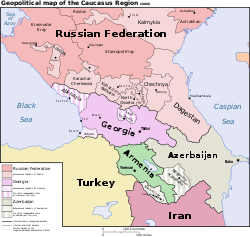
Turkey
Turkey , known officially as the Republic of Turkey , is a Eurasian country located in Western Asia and in East Thrace in Southeastern Europe...
, Iran
Iran
Iran , officially the Islamic Republic of Iran , is a country in Southern and Western Asia. The name "Iran" has been in use natively since the Sassanian era and came into use internationally in 1935, before which the country was known to the Western world as Persia...
and Russia
Russia
Russia or , officially known as both Russia and the Russian Federation , is a country in northern Eurasia. It is a federal semi-presidential republic, comprising 83 federal subjects...
, the region has been an arena for political, military, religious, and cultural rivalries and expansionism for centuries. However, throughout history the Caucasus has usually been incorporated in political entities belonging to the Iranian world, at the beginning of the 13th/19th century Russia took it, along with the Transcaucasus, from the Qajars (1133-1342/1779-1924), severing those historical ties.
Ancient kingdoms of the region included Armenia
Armenia
Armenia , officially the Republic of Armenia , is a landlocked mountainous country in the Caucasus region of Eurasia...
, Albania
Caucasian Albania
Albania is a name for the historical region of the eastern Caucasus, that existed on the territory of present-day republic of...
, and Iberia
Caucasian Iberia
Iberia , also known as Iveria , was a name given by the ancient Greeks and Romans to the ancient Georgian kingdom of Kartli , corresponding roughly to the eastern and southern parts of the present day Georgia...
, among others. These kingdoms were later incorporated into various Iranian empires, including Achaemenid Empire
Achaemenid Empire
The Achaemenid Empire , sometimes known as First Persian Empire and/or Persian Empire, was founded in the 6th century BCE by Cyrus the Great who overthrew the Median confederation...
, Parthian Empire
Parthian Empire
The Parthian Empire , also known as the Arsacid Empire , was a major Iranian political and cultural power in ancient Persia...
, Sassanid Empire
Sassanid Empire
The Sassanid Empire , known to its inhabitants as Ērānshahr and Ērān in Middle Persian and resulting in the New Persian terms Iranshahr and Iran , was the last pre-Islamic Persian Empire, ruled by the Sasanian Dynasty from 224 to 651...
, during which Zoroastrianism
Zoroastrianism
Zoroastrianism is a religion and philosophy based on the teachings of prophet Zoroaster and was formerly among the world's largest religions. It was probably founded some time before the 6th century BCE in Greater Iran.In Zoroastrianism, the Creator Ahura Mazda is all good, and no evil...
followed by Eastern Christianity
Eastern Christianity
Eastern Christianity comprises the Christian traditions and churches that developed in the Balkans, Eastern Europe, Asia Minor, the Middle East, Northeastern Africa, India and parts of the Far East over several centuries of religious antiquity. The term is generally used in Western Christianity to...
became the dominant religions in the region.
In 8th century A.D., most of South Caucasus became part of the Caliphate
Caliphate
The term caliphate, "dominion of a caliph " , refers to the first system of government established in Islam and represented the political unity of the Muslim Ummah...
and Islam
Islam
Islam . The most common are and . : Arabic pronunciation varies regionally. The first vowel ranges from ~~. The second vowel ranges from ~~~...
spread throughout the region. In the middle centuries, kingdom of Georgia dominated the most of South Caucasus. The region was later conquered by the Seljuks, Mongols
Mongols
Mongols ) are a Central-East Asian ethnic group that lives mainly in the countries of Mongolia, China, and Russia. In China, ethnic Mongols can be found mainly in the central north region of China such as Inner Mongolia...
, local Turkic
Turkic peoples
The Turkic peoples are peoples residing in northern, central and western Asia, southern Siberia and northwestern China and parts of eastern Europe. They speak languages belonging to the Turkic language family. They share, to varying degrees, certain cultural traits and historical backgrounds...
dynasties, Safavid dynasty
Safavid dynasty
The Safavid dynasty was one of the most significant ruling dynasties of Iran. They ruled one of the greatest Persian empires since the Muslim conquest of Persia and established the Twelver school of Shi'a Islam as the official religion of their empire, marking one of the most important turning...
.
In the first quarter of 19th century, after two Russo-Persian wars, the region was conquered by Russian Empire
Russian Empire
The Russian Empire was a state that existed from 1721 until the Russian Revolution of 1917. It was the successor to the Tsardom of Russia and the predecessor of the Soviet Union...
.
The region was unified as a single political entity twice – during the Russian Civil War
Russian Civil War
The Russian Civil War was a multi-party war that occurred within the former Russian Empire after the Russian provisional government collapsed to the Soviets, under the domination of the Bolshevik party. Soviet forces first assumed power in Petrograd The Russian Civil War (1917–1923) was a...
(Transcaucasian Democratic Federative Republic
Transcaucasian Democratic Federative Republic
The Transcaucasian Democratic Federative Republic , was a short-lived state composed of the modern-day countries of Armenia, Azerbaijan, and Georgia in the South Caucasus.-...
) from 9 April 1918 to 26 May 1918, and under the Soviet
Soviet Union
The Soviet Union , officially the Union of Soviet Socialist Republics , was a constitutionally socialist state that existed in Eurasia between 1922 and 1991....
rule (Transcaucasian SFSR
Transcaucasian SFSR
The Transcaucasian Socialist Federative Soviet Republic , also known as the Transcaucasian Soviet Federative Socialist Republic, the Transcaucasian SFSR and the TSFSR for short, was a short-lived republic of the Soviet Union, lasting from 1922 to 1936...
) from 12 March 1922 to 5 December 1936.
Transcaucasia, in particular where modern day Georgia and Armenia are located, is one of the native areas of the wine producing vine Vitis vinifera
Vitis vinifera
Vitis vinifera is a species of Vitis, native to the Mediterranean region, central Europe, and southwestern Asia, from Morocco and Portugal north to southern Germany and east to northern Iran....
. Some experts speculate that it may be the birthplace of wine production. Archeological excavation and carbon dating of grape pips from the area have dated back to 7000-5000 BC.
See also
- CaucasusCaucasusThe Caucasus, also Caucas or Caucasia , is a geopolitical region at the border of Europe and Asia, and situated between the Black and the Caspian sea...
- North CaucasusNorth CaucasusThe North Caucasus is the northern part of the Caucasus region between the Black and Caspian Seas and within European Russia. The term is also used as a synonym for the North Caucasus economic region of Russia....
(Ciscaucasia) - Ibero-Caucasian languagesIbero-Caucasian languagesThe term Ibero-Caucasian was proposed by Georgian linguist Arnold Chikobava for the union of the three language families that are specific to the Caucasus area, namely* Kartvelian languages...
- Peoples of the Caucasus