

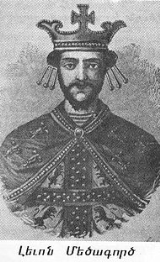
Leo II of Armenia

Encyclopedia
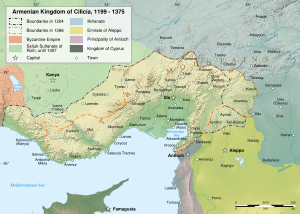
Leo II also Leon II, Levon II or Lewon II (1150 – 2 May 1219) was the tenth lord of Armenian Cilicia or “Lord of the Mountains” (1187–1198/1199), and the first king of Armenian Cilicia (sometimes as Levon I the Magnificent or Lewon I) (1198/1199–1219).
During his reign, Leo succeeded in establishing Cilician Armenia
as a powerful and a unified Christian
state, and his pre-eminence in the political arena cannot be overestimated. He eagerly supplied the armies of the Third Crusade
with provisions, guides, pack animal
s and all manner of aid, besides pledging the cooperation of his army. Under his rule, Armenian
power was at its apogee: his kingdom extended from Isauria
to the Amanus Mountains
(now Nur Mountains in Turkey
).
In 1194–1195, when he was planning to get the title of king
, he instituted a union
of the Armenian church with Rome
. With the signing of the Act of Union, his coronation
proceeded without delay. He was consecrated as king on 6 January 1198 or 1199, in the Church of Holy Wisdom at Tarsus
.
His ascension to the throne of Cilicia as its first Armenian monarch heralded into reality not merely an official end to Cilicia’s shadowy umbilical connection to the Byzantine Empire
, but also a new era of ecclesiastical co-operation with the West. A skilled diplomat and wise politician, Leo established useful alliances with many of the contemporary rulers; he also gained the friendship and support of the Hospitallers and the Teutonic Knights
by granting considerable territories to them.
No doubt, he envisioned annexing the Principality of Antioch
to his kingdom thus reinforcing his authority along much of the northeastern Mediterranean
coastline. He had first put this plan into action in 1194 by seizing the strategic fortress of Baghras after Saladin
, the Sultan of Egypt
and Syria
, had abandoned it. His greatest triumph was achieved at the beginning of 1216 when at the head of his army he occupied Antioch
and installed his grandnephew, Raymond-Roupen as its head. Raymond-Roupen remained in power until Leo’s death.
The transforming of the Armenian court
, following the pattern of the Frankish courts, proceeded at a more rapid pace after Leo came to power. Many of the old names of specific functions or the titles of dignitaries were replaced by Latin
ones and the changes in nomenclature were often accompanied by changes in the character of these offices.
Commerce was greatly developed during the reign of Leo: he granted charters regarding trade and commercial privilege
s to Genoa
, Venice
and Pisa
. These charters
provided their holders with special tax exemption
s in exchange for their merchandising trade. They encouraged the establishment of Italian merchant communities in Tarsus, Adana
and Mamistra, and became a large source of revenue for the growth and development of Cilician Armenia.
, the third son of Leo I, lord of Armenian Cilicia. His mother was Rita, a daughter of Sempad, Lord of Barbaron. Leo’s father, who was on his way to attend a banquet given by the Byzantine
governor of Cilicia
, Andronicus Euphorbenus, was murdered on 7 February 1165. Following their father’s death, Leo and his elder brother Roupen lived with their maternal uncle, Pagouran, lord of the fortress of Barbaron, protecting the Cilician Gates
pass in the Taurus Mountains
.
Their paternal uncle, Mleh I, lord of Armenian Cilicia had made a host of enemies by his cruelties in his country, resulting in his assassination by his own soldiers in the city of Sis
(now Kozan in Turkey) in 1175. The seigneurs of Cilician Armenia elected Leo’s brother, Roupen III to occupy the throne of the principality. In 1183, Hethum III of Lampron, allied with Prince Bohemond III of Antioch, began joint hostilities against Roupen III who sent Leo to surround Hethum’s mountain lair. But Bohemond III, rushing to the aid of Hethum, treacherously made Roupen prisoner.
His brother’s absence gave Leo the opportunity to put his sharp political skills to practice as the interim guardian of the Roupenian House. Roupen’s release required payment of a large ransom, and the submission of Adana and Mamistra as vassalages to Antioch. When Roupen returned from the captivity, he transferred the power to his brother, Leo (1187) and retired to the monastery of Trazarg.
and Saladin, and the more immediate treat of the Turkomans
, led to a rapprochement between Leo and Bohemond III: on his accession Leo sought an alliance with the prince of Antioch and recognized his suzerainty. Large bands of the nomad Turkomans had been crossing the northern borders, advancing almost as far as Sis and laying waste on all sides; the two princes joined to beat off a Turcoman raid in 1187. Leo could muster only a small force, but he attacked them with such energy that he routed the bands, killed their leader, and persuaded the fugitives as far as Sarventikar, inflicting heavy losses on them. Soon afterwards (between 3 February 1188/4 February 1189), Leo married Isabelle, a niece of the Princess Sibylle, the third wife of Bohemond III.
The following year (1188), taking advantage of the troubled condition in the Sultanate of Rûm
that preceded the death of Kilij Arslan II
, Leo turned against the Seljuks. A surprise attack on Bragana was unsuccessful, but Leon returned two months later with a larger army, killed the head of the garrison, seized the fortress and marched into Isauria. Though we find no specific mention of it, Seleucia must have been captured about this time. Proceeding northwards, Leo seized Heraclea, gave it up after payment to him a large sum, and advanced as far as Caesarea.
About the same time he lent a large sum of money to Bohemond III, but the latter showed no haste to repay the loan. When Saladin invaded Antiochene territory, Leo remained carefully neutral.
The Holy Roman Emperor
, Frederick I Barbarossa approached the Armenian territories in June 1190, and Leo sent an embassy with presents, ample supplies, and armed troops. A second embassy, headed by the bishop Nerses of Lampron, arrived too late, after the death of the emperor ( 10 June 1190) and returned to Tarsus with the emperor’s son Frederick
, the bishops, and the German
army.
Nevertheless, Leo participated in the wars of the crusaders: his troops were present at the siege of Acre, and on 11 May 1191 he joined King Richard the Lionheart of England
in the conquest of Cyprus
.
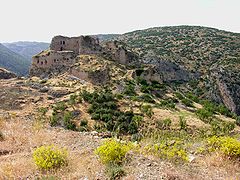 Leo was intent, at the same time, upon insuring the security of his own realm, and some of his actions undertaken for this purpose ran counter the interests or aspirations of his neighbors. In 1191, Saladin dismantled the great fortress of Baghras, which he had captured from the Templars
. Hardly his workmen left before Leo came up and reoccupied the site and rebuilt the fortress. This brought to a head the growing antagonism between Leo and Bohemond III, and the possession of Baghras was to be one of the principal points of contention in the long struggle between Cilicia and Antioch. Bohemond III demanded its return to the Templars and, when Leo refused, complained to Saladin. Saladin himself had objected to Leo’s holding Baghras, which lay on the route from Cilicia to Antioch.
Soon after the death of Saladin, in October 1193, Leo invited Bohemond III to come to Baghras to discuss the whole question. Bohemond III arrived, accompanied by his wife, Sibylla and her son, and accepted Leo’s offer of hospitality within the castle walls. No sooner had he entered than he was taken prisoner by his host, with all his entourage, and was told that he would be released only if he yielded the suzerainty over Antioch to Leo. Leo hoped to gain release from homage to Bohemond III, and to seize Antioch; therefore, Leo took Bohemond’s family and court off to Sis as prisoners.
Bohemond III agreed to surrender Antioch in exchange for his freedom, sending the Marshal Bartholomew Tirel and Richard L’Erminet to turn the city over to Armenian troops under Hethum of Sassoun. When the delegation arrived at Antioch, the barons there were ready to accept Leo as overlord, and allowed Bartholomew Tirel to bring the Armenian soldiers into the city and establish them in the palace.
However, after their initial entry, Antiochene resistance was whipped up by the clergy and the Greeks
. A riot
began in the palace and spread though the city; the Armenians were driven out and prudently retired with Hethum of Sassoun back to Baghras. The citizens of Antioch, under the Latin Patriarch of Antioch
, Aimery of Limoges
, formed a commune
which recognized Bohemond III’s eldest son, Raymond
as lord until his father should be released.
Antioch then asked aid of King Henry I of Jerusalem and Count Bohemond I of Tripoli (the latter was Bohemond III’s younger son). Early next spring, King Henry I sailed to Tripoli
, where young Bohemond joined him, and then went on to Antioch and Sis. Leo, unwilling to face an open war, met him before Sis, ready to negotiate a settlement. Bohemond III renounced his as a suzerain, and in return for this was allowed to go back to Antioch without paying a ransom. Arrangements were also made for the marriage of Raymond of Antioch to Leo’s niece, Alice. However, Raymond soon died and Bohemond III sent Alice back to Leo with her infant son Raymond-Roupen. Leo determined that this great-nephew of his should inherit Antioch on the death of Bohemond III.
 Leo pressed with renewed energy his claims for a royal crown
, seeking the assistance of the two most powerful rulers of the time, the pope
and the German emperor
. He sent to Emperor Henry VI
; but the emperor prevaricated, because he hoped to come soon to the East and he would look into the Armenian Question
then.
So Leo approached Pope Celestine III
; but the pope required submission of the Armenian church to Rome, and this created considerable difficulty; there was marked opposition from the majority of the clergy and the people of Cilicia. The bishops called together by Leo at first refused the papal demands, and are said to have agreed to them only after Leo told them that he would submit merely in word and not in deed.
The Byzantine Emperor, Alexios III Angelos
, hoping to retain some influence in Cilicia, sent Leo a royal crown, which was gracefully received. In 1197 Leo sent an embassy to Constantinople
composed of Bishop Nerses of Lampron and other dignitaries; all of the discussions centered on religious questions, and the sending of the embassy was the last of several fruitless efforts to achieve a union between the two churches.
Meanwhile the Emperor Henry VI also promised a crown to Leo, in return for a recognition of his suzerain rights over Armenia. Although Henry VI never visited the East; but soon after his death, his Chancellor Bishop Conrad of Hildesheim came with the Papal legate
, Archbishop Conrad of Mainz
to Sis. Leo was crowned on 6 January 1198 (or 1199) at Tarsus, in the presence of the Armenian clergy, the Franco-Armenian nobility
of the land, the Greek
archbishop of Tarsus, the Jacobite patriarch, and the caliph
’s ambassadors. While he was crowned by the catholicos, Gregory VI Abirad
, Leo received the other royal insignia from Archbishop Conrad of Mainz. There was great rejoicing among the Armenians, who saw their ancient kingdom restored and renewed in the person of Leo.
In 1198, while az-Zahir, the emir
of Aleppo
detained Leo, Bohemond of Tripoli entered Antioch, summoned the commune, and persuaded it to renounce in his favor its oath to his father. Within three month, however, Leo settled his Moslem troubles, made peace with the military orders, and marched on Antioch. There was no resistance to his army or to its restoration of Bohemond III.
Meanwhile the Templars brought all their influence to bear at Rome; but Leo ignored hints from the Church that he should restore Baghras to them. Leo invited Bohemond III and the Latin Patriarch of Antioch, Peter II of Angoulême to discuss the whole question; but his intransigence drove even the Patriarch over to Bohemond of Tripoli’s side.
In April 1201, Bohemond of Tripoli, informed of his father’s illness, rushed to Antioch, arriving on the day of the funeral. He immediately demanded recognition as rightful heir and Bohemond IV was accepted as prince. But many of the nobility, mindful of their oath and fearful of Bohemond IV’s autocratic tastes, fled to Leo’s court at Sis. Leo heard of the death of Bohemond III late, but then hurried to Antioch with Alice and Raymond-Roupen to claim it for his great-nephew. When he found Bohemond IV already installed, he sent back for reinforcements, while Bohemond IV called for Aleppo. Az-Zahir invaded Cilicia in July 1201, and Leo had to lift his siege of Antioch.
The war was renewed by Leo in 1202. During the following summer King Amalric II of Jerusalem
intervened; accompanied by the papal legate, cardinal Sofred of Saint-Praxedis, the masters of the Hospital and the Temple, and the high barons of the kingdom, he induced Leo to grant a short truce. After Leo had agreed to accept the decision of barons and legate, the barons announced that the question at issue was purely one of feudal law which the legate should have no say. Angered, Leo ended the truce and an on 11 November 1203 entered the city, and asked the patriarch to arrange peace between him and the commune. Bohemond IV who had been forced to leave Antioch to defend Tripoli during the feudal rebellion of Renart of Nephin was at Tripoli at that time, but the commune and the Templars held the citadel in Antioch stoutly, and were able to expel the Armenians. Their appeals to Aleppo were answered when az-Zahir started again into Cilicia. Leo left Antioch in December, when az-Zahir’s army reached the Orontes River
. Thereafter until 1206, when Bohemond IV was able to return to Antioch from Tripoli, Antioch was more or less protected from Leo by the watchfulness of az-Zahir. In the spring of 1206, Az-Zahir sent fresh contingents and assumed their command in person. Victorious at first, Leo had to retreat before the superior forces when the Antiochene armies joined Moslims. An eight-year truce was signed.
Meanwhile, he was reported “injurious information” about his queen; therefore Leo had numerous members of her suite put to death and attacked her personally before imprisoning her in the fortress of Vahka (today Feke in Turkey) where she was poisoned some time later.
Bohemond IV, however, deposed the Latin Patriarch of Antioch, and summoned the titular Greek Patriarch, Symeon II to take his place. The unpopularity of Bohemond IV’s behavior made it possible for Leo to plan a revolt within the city. Led by the Latin Patriarch Peter II and dissatisfied Latin nobles, the city rose, and Bohemond IV took refuge in the citadel. Leo entered with some of his army, just as Bohemond IV felt strong enough to emerge, expel the invaders, and crush the revolt. Leo had held Antioch only a few days.
Pope Innocent III
handed the responsibility of settling the struggle to the Patriarch of Jerusalem
, Albert
who was a friend of Bohemond IV’s allies, the Templars. The Patriarch offended Leo by insisting that the first preliminary to any settlement must be the return of Baghras to the Templars. In 1208 Leo angrily devastated the country round Antioch. But Bohemond’s danger in Antioch in 1208 induced az-Zahir once more to invade Cilicia in 1209. The Seljuk Sultan, Kai-Kushrau I, whom Leo had befriended earlier and received at his court, also made a sudden attack and seized the fort of Pertous. Leo had to agree to return Baghras to the Templars and renounce his claims to Antioch. But Leo’s attempts to keep the fortress of Baghras, despite his promise in the treaty with az-Zahir to return it to the Templars, lead to a war in Cilicia and in the Antiochene plain.
In Cyprus between 28 January 1210/27 January 1211 Leo married Sibylle, the half-sister of King Hugh I of Cyprus
.
In 1211, the master of the Temple
was wounded in an ambush, and Pope Innocent III published the old excommunication
against Leo. Meanwhile, Bohemond IV agreed to accept a new Latin Patriarch in Antioch; Leo therefore forgot his obedience to Rome. He welcomed the Greek Patriarch of Antioch, Symeon II to Cilicia, and he gave much of the Latin church lands there to the Greeks. Leo also sought to tie the Hospitallers closer to him by giving them Seleucia, Norpert (Castrum Novum), and Camardias, thus constituting a march on the western borders of Cilicia and thereby protecting the country from Seljuks. The Teutonic Knights received Amoudain and neighboring castles; and the master of the order may even have resided in Cilicia for a while.
In 1211, King John I of Jerusalem
and Bohemond IV both gave the Templars such effective aid that Leo finally returned Baghras. But the new treaty was abruptly broken the next year with further actions against the Templars. This time the interdict
against Leo was strictly enforced.
Leo was reconciled with Rome in March 1213 after he had promised that he would help in the coming Crusade
. He also won the favor of King John I, who in 1214 married Leo’s daughter Rita
and expected to inherit Armenia.
In Antioch, the population felt deserted by Bohemond IV, who preferred to reside in Tripoli, and Leo’s intrigues rebuilt a strong party in favor of Raymond-Roupen. Bohemond IV was in Tripoli when the plot reached fruition: on the night of 14 February 1216 Leo managed by a successful intrigue, in which the Latin Patriarch, Peter undoubtedly helped, to smuggle toops into Antioch and to occupy the city without a blow.
Raymond-Roupen then paid homage to Patriarch Peter and was consecrated prince of Antioch. In his joy at the successful outcome of the long war, Leo at last gave back Baghras to the Templars and restored the Latin church lands in Cilicia. But he paid for his victory by losing fortresses in the west and across the Taurus Mountains to the Seljuk Prince Kaykaus I
. in 1216. These fortresses were Faustinepolis
, Herakleia and Larende
, were conquered from Seljuks in 1211.
, having fulfilled his Crusader vow, took his troops northward in January, 1218, he proceeded through Cilician Armenia. There King Andrew II arranged a marriage between his son, Andrew and Leo’s daughter, Isabelle.
Shortly afterwards, Raymond-Roupen even quarreled with Leon. In 1219, Antioch sent for its old prince while Raymond Roupen (Raymond-Roupen) first sought refuge in the citadel, only to leave it to the Hospitallers and flee to Cilicia. There he found Leo still unwilling to forgive him, although on his deathbed. Before Leo died, he had named his young daughter Isabel as his rightful heir and had released the barons from the oaths of allegiance to Raymond Roupen.
His body was buried at Sis, but his heart and entrails were buried at the convent of Agner.
# (2) 28 January 1210 – 27 January 1211: Sibylla (1199/1200 – after 1225), a daughter of King Amalric I of Cyprus
and Isabella I of Jerusalem
During his reign, Leo succeeded in establishing Cilician Armenia
Armenian Kingdom of Cilicia
The Armenian Kingdom of Cilicia , also known as the Cilician Armenia, Kingdom of Cilician Armenia or New Armenia, was an independent principality formed during the High Middle Ages by Armenian refugees fleeing the Seljuk invasion of Armenia...
as a powerful and a unified Christian
Christian
A Christian is a person who adheres to Christianity, an Abrahamic, monotheistic religion based on the life and teachings of Jesus of Nazareth as recorded in the Canonical gospels and the letters of the New Testament...
state, and his pre-eminence in the political arena cannot be overestimated. He eagerly supplied the armies of the Third Crusade
Third Crusade
The Third Crusade , also known as the Kings' Crusade, was an attempt by European leaders to reconquer the Holy Land from Saladin...
with provisions, guides, pack animal
Pack animal
A pack animal or beast of burden is a working animal used by humans as means of transporting materials by attaching them so their weight bears on the animal's back; the term may be applied to either an individual animal or a species so employed...
s and all manner of aid, besides pledging the cooperation of his army. Under his rule, Armenian
Armenians
Armenian people or Armenians are a nation and ethnic group native to the Armenian Highland.The largest concentration is in Armenia having a nearly-homogeneous population with 97.9% or 3,145,354 being ethnic Armenian....
power was at its apogee: his kingdom extended from Isauria
Isauria
Isauria , in ancient geography, is a rugged isolated district in the interior of South Asia Minor, of very different extent at different periods, but generally covering what is now the district of Bozkır and its surroundings in the Konya province of Turkey, or the core of the Taurus Mountains. In...
to the Amanus Mountains
Nur Mountains
The Nur Mountains , also known as Gâvur Mountains , the ancient Amanus , is a mountain range in the Hatay Province of south-central Turkey, which runs roughly parallel to the Gulf of İskenderun....
(now Nur Mountains in Turkey
Turkey
Turkey , known officially as the Republic of Turkey , is a Eurasian country located in Western Asia and in East Thrace in Southeastern Europe...
).
In 1194–1195, when he was planning to get the title of king
King
- Centers of population :* King, Ontario, CanadaIn USA:* King, Indiana* King, North Carolina* King, Lincoln County, Wisconsin* King, Waupaca County, Wisconsin* King County, Washington- Moving-image works :Television:...
, he instituted a union
Full communion
In Christian ecclesiology, full communion is a relationship between church organizations or groups that mutually recognize their sharing the essential doctrines....
of the Armenian church with Rome
Pope
The Pope is the Bishop of Rome, a position that makes him the leader of the worldwide Catholic Church . In the Catholic Church, the Pope is regarded as the successor of Saint Peter, the Apostle...
. With the signing of the Act of Union, his coronation
Coronation
A coronation is a ceremony marking the formal investiture of a monarch and/or their consort with regal power, usually involving the placement of a crown upon their head and the presentation of other items of regalia...
proceeded without delay. He was consecrated as king on 6 January 1198 or 1199, in the Church of Holy Wisdom at Tarsus
Tarsus (city)
Tarsus is a historic city in south-central Turkey, 20 km inland from the Mediterranean Sea. It is part of the Adana-Mersin Metropolitan Area, the fourth-largest metropolitan area in Turkey with a population of 2.75 million...
.
His ascension to the throne of Cilicia as its first Armenian monarch heralded into reality not merely an official end to Cilicia’s shadowy umbilical connection to the Byzantine Empire
Byzantine Empire
The Byzantine Empire was the Eastern Roman Empire during the periods of Late Antiquity and the Middle Ages, centred on the capital of Constantinople. Known simply as the Roman Empire or Romania to its inhabitants and neighbours, the Empire was the direct continuation of the Ancient Roman State...
, but also a new era of ecclesiastical co-operation with the West. A skilled diplomat and wise politician, Leo established useful alliances with many of the contemporary rulers; he also gained the friendship and support of the Hospitallers and the Teutonic Knights
Teutonic Knights
The Order of Brothers of the German House of Saint Mary in Jerusalem , commonly the Teutonic Order , is a German medieval military order, in modern times a purely religious Catholic order...
by granting considerable territories to them.
No doubt, he envisioned annexing the Principality of Antioch
Principality of Antioch
The Principality of Antioch, including parts of modern-day Turkey and Syria, was one of the crusader states created during the First Crusade.-Foundation:...
to his kingdom thus reinforcing his authority along much of the northeastern Mediterranean
Mediterranean Sea
The Mediterranean Sea is a sea connected to the Atlantic Ocean surrounded by the Mediterranean region and almost completely enclosed by land: on the north by Anatolia and Europe, on the south by North Africa, and on the east by the Levant...
coastline. He had first put this plan into action in 1194 by seizing the strategic fortress of Baghras after Saladin
Saladin
Ṣalāḥ ad-Dīn Yūsuf ibn Ayyūb , better known in the Western world as Saladin, was an Arabized Kurdish Muslim, who became the first Sultan of Egypt and Syria, and founded the Ayyubid dynasty. He led Muslim and Arab opposition to the Franks and other European Crusaders in the Levant...
, the Sultan of Egypt
Egypt
Egypt , officially the Arab Republic of Egypt, Arabic: , is a country mainly in North Africa, with the Sinai Peninsula forming a land bridge in Southwest Asia. Egypt is thus a transcontinental country, and a major power in Africa, the Mediterranean Basin, the Middle East and the Muslim world...
and Syria
Syria
Syria , officially the Syrian Arab Republic , is a country in Western Asia, bordering Lebanon and the Mediterranean Sea to the West, Turkey to the north, Iraq to the east, Jordan to the south, and Israel to the southwest....
, had abandoned it. His greatest triumph was achieved at the beginning of 1216 when at the head of his army he occupied Antioch
Antioch
Antioch on the Orontes was an ancient city on the eastern side of the Orontes River. It is near the modern city of Antakya, Turkey.Founded near the end of the 4th century BC by Seleucus I Nicator, one of Alexander the Great's generals, Antioch eventually rivaled Alexandria as the chief city of the...
and installed his grandnephew, Raymond-Roupen as its head. Raymond-Roupen remained in power until Leo’s death.
The transforming of the Armenian court
Royal Household
A Royal Household in ancient and medieval monarchies formed the basis for the general government of the country as well as providing for the needs of the sovereign and his relations....
, following the pattern of the Frankish courts, proceeded at a more rapid pace after Leo came to power. Many of the old names of specific functions or the titles of dignitaries were replaced by Latin
Latin
Latin is an Italic language originally spoken in Latium and Ancient Rome. It, along with most European languages, is a descendant of the ancient Proto-Indo-European language. Although it is considered a dead language, a number of scholars and members of the Christian clergy speak it fluently, and...
ones and the changes in nomenclature were often accompanied by changes in the character of these offices.
Commerce was greatly developed during the reign of Leo: he granted charters regarding trade and commercial privilege
Privilege
A privilege is a special entitlement to immunity granted by the state or another authority to a restricted group, either by birth or on a conditional basis. It can be revoked in certain circumstances. In modern democratic states, a privilege is conditional and granted only after birth...
s to Genoa
Republic of Genoa
The Most Serene Republic of Genoa |Ligurian]]: Repúbrica de Zêna) was an independent state from 1005 to 1797 in Liguria on the northwestern Italian coast, as well as Corsica from 1347 to 1768, and numerous other territories throughout the Mediterranean....
, Venice
Republic of Venice
The Republic of Venice or Venetian Republic was a state originating from the city of Venice in Northeastern Italy. It existed for over a millennium, from the late 7th century until 1797. It was formally known as the Most Serene Republic of Venice and is often referred to as La Serenissima, in...
and Pisa
Republic of Pisa
The Republic of Pisa was a de facto independent state centered on the Tuscan city of Pisa during the late tenth and eleventh centuries. It rose to become an economic powerhouse, a commercial center whose merchants dominated Mediterranean and Italian trade for a century before being surpassed and...
. These charters
Charters
Charters is a surname and may refer to :* Ann Charters , American professor of English* Charlie Charters , former English rugby union official and sports marketing executive* Frank Charters, , English cricketer...
provided their holders with special tax exemption
Tax exemption
Various tax systems grant a tax exemption to certain organizations, persons, income, property or other items taxable under the system. Tax exemption may also refer to a personal allowance or specific monetary exemption which may be claimed by an individual to reduce taxable income under some...
s in exchange for their merchandising trade. They encouraged the establishment of Italian merchant communities in Tarsus, Adana
Adana
Adana is a city in southern Turkey and a major agricultural and commercial center. The city is situated on the Seyhan River, 30 kilometres inland from the Mediterranean, in south-central Anatolia...
and Mamistra, and became a large source of revenue for the growth and development of Cilician Armenia.
Early years
He was the younger son of StephenStephen of Armenia
Stephen of Armenia was the Marshal of Armenia, the son of Leo I, Prince of Armenia and Beatrice de Rethel.His father made him Marshal in 1138, due to the invasion of John II Comnenus, and escaped capture by sheltering in Edessa...
, the third son of Leo I, lord of Armenian Cilicia. His mother was Rita, a daughter of Sempad, Lord of Barbaron. Leo’s father, who was on his way to attend a banquet given by the Byzantine
Byzantine Empire
The Byzantine Empire was the Eastern Roman Empire during the periods of Late Antiquity and the Middle Ages, centred on the capital of Constantinople. Known simply as the Roman Empire or Romania to its inhabitants and neighbours, the Empire was the direct continuation of the Ancient Roman State...
governor of Cilicia
Cilicia
In antiquity, Cilicia was the south coastal region of Asia Minor, south of the central Anatolian plateau. It existed as a political entity from Hittite times into the Byzantine empire...
, Andronicus Euphorbenus, was murdered on 7 February 1165. Following their father’s death, Leo and his elder brother Roupen lived with their maternal uncle, Pagouran, lord of the fortress of Barbaron, protecting the Cilician Gates
Cilician Gates
The Cilician Gates or Gülek Pass is a pass through the Taurus Mountains connecting the low plains of Cilicia to the Anatolian Plateau, by way of the narrow gorge of the Gökoluk River. Its highest elevation is about 1000m....
pass in the Taurus Mountains
Taurus Mountains
Taurus Mountains are a mountain complex in southern Turkey, dividing the Mediterranean coastal region of southern Turkey from the central Anatolian Plateau. The system extends along a curve from Lake Eğirdir in the west to the upper reaches of the Euphrates and Tigris rivers in the east...
.
Their paternal uncle, Mleh I, lord of Armenian Cilicia had made a host of enemies by his cruelties in his country, resulting in his assassination by his own soldiers in the city of Sis
Kozan, Adana
Kozan is a city in Adana Province, Turkey, 68 km north of the city of Adana, in the northern section of the Çukurova plain. The city is the capital of Kozan district. The Kilgen Stream, a tributary of the Ceyhan River , flows through Kozan crossing the plain south into the Mediterranean Sea....
(now Kozan in Turkey) in 1175. The seigneurs of Cilician Armenia elected Leo’s brother, Roupen III to occupy the throne of the principality. In 1183, Hethum III of Lampron, allied with Prince Bohemond III of Antioch, began joint hostilities against Roupen III who sent Leo to surround Hethum’s mountain lair. But Bohemond III, rushing to the aid of Hethum, treacherously made Roupen prisoner.
His brother’s absence gave Leo the opportunity to put his sharp political skills to practice as the interim guardian of the Roupenian House. Roupen’s release required payment of a large ransom, and the submission of Adana and Mamistra as vassalages to Antioch. When Roupen returned from the captivity, he transferred the power to his brother, Leo (1187) and retired to the monastery of Trazarg.
Vassal of Antioch
The menace of the recent alliance between the Byzantine Emperor Isaac II AngelosIsaac II Angelos
Isaac II Angelos was Byzantine emperor from 1185 to 1195, and again from 1203 to 1204....
and Saladin, and the more immediate treat of the Turkomans
Oghuz Turks
The Turkomen also known as Oghuz Turks were a historical Turkic tribal confederation in Central Asia during the early medieval Turkic expansion....
, led to a rapprochement between Leo and Bohemond III: on his accession Leo sought an alliance with the prince of Antioch and recognized his suzerainty. Large bands of the nomad Turkomans had been crossing the northern borders, advancing almost as far as Sis and laying waste on all sides; the two princes joined to beat off a Turcoman raid in 1187. Leo could muster only a small force, but he attacked them with such energy that he routed the bands, killed their leader, and persuaded the fugitives as far as Sarventikar, inflicting heavy losses on them. Soon afterwards (between 3 February 1188/4 February 1189), Leo married Isabelle, a niece of the Princess Sibylle, the third wife of Bohemond III.
The following year (1188), taking advantage of the troubled condition in the Sultanate of Rûm
Sultanate of Rûm
The Sultanate of Rum , also known as the Anatolian Seljuk State , was a Turkic state centered in in Anatolia, with capitals first at İznik and then at Konya. Since the court of the sultanate was highly mobile, cities like Kayseri and Sivas also functioned at times as capitals...
that preceded the death of Kilij Arslan II
Kilij Arslan II
Kilij Arslan II was a Seljuk Sultan of Rûm from 1156 until his death in 1192.As Arnold of Lübeck reports in his Chronica Slavorum, he was present at the meeting of Henry the Lion with Kilij-Arslan during the former's pilgrimage to Jerusalem in 1172...
, Leo turned against the Seljuks. A surprise attack on Bragana was unsuccessful, but Leon returned two months later with a larger army, killed the head of the garrison, seized the fortress and marched into Isauria. Though we find no specific mention of it, Seleucia must have been captured about this time. Proceeding northwards, Leo seized Heraclea, gave it up after payment to him a large sum, and advanced as far as Caesarea.
About the same time he lent a large sum of money to Bohemond III, but the latter showed no haste to repay the loan. When Saladin invaded Antiochene territory, Leo remained carefully neutral.
The Holy Roman Emperor
Holy Roman Emperor
The Holy Roman Emperor is a term used by historians to denote a medieval ruler who, as German King, had also received the title of "Emperor of the Romans" from the Pope...
, Frederick I Barbarossa approached the Armenian territories in June 1190, and Leo sent an embassy with presents, ample supplies, and armed troops. A second embassy, headed by the bishop Nerses of Lampron, arrived too late, after the death of the emperor ( 10 June 1190) and returned to Tarsus with the emperor’s son Frederick
Frederick VI, Duke of Swabia
Frederick VI of Hohenstaufen was duke of Swabia from 1170 to his death at the siege of Acre. He was the third son of Frederick I Barbarossa and Beatrice I, Countess of Burgundy and brother of Henry VI, Holy Roman Emperor...
, the bishops, and the German
Germans
The Germans are a Germanic ethnic group native to Central Europe. The English term Germans has referred to the German-speaking population of the Holy Roman Empire since the Late Middle Ages....
army.
Nevertheless, Leo participated in the wars of the crusaders: his troops were present at the siege of Acre, and on 11 May 1191 he joined King Richard the Lionheart of England
Richard I of England
Richard I was King of England from 6 July 1189 until his death. He also ruled as Duke of Normandy, Duke of Aquitaine, Duke of Gascony, Lord of Cyprus, Count of Anjou, Count of Maine, Count of Nantes, and Overlord of Brittany at various times during the same period...
in the conquest of Cyprus
Cyprus
Cyprus , officially the Republic of Cyprus , is a Eurasian island country, member of the European Union, in the Eastern Mediterranean, east of Greece, south of Turkey, west of Syria and north of Egypt. It is the third largest island in the Mediterranean Sea.The earliest known human activity on the...
.
The case of Baghras
Knights Templar
The Poor Fellow-Soldiers of Christ and of the Temple of Solomon , commonly known as the Knights Templar, the Order of the Temple or simply as Templars, were among the most famous of the Western Christian military orders...
. Hardly his workmen left before Leo came up and reoccupied the site and rebuilt the fortress. This brought to a head the growing antagonism between Leo and Bohemond III, and the possession of Baghras was to be one of the principal points of contention in the long struggle between Cilicia and Antioch. Bohemond III demanded its return to the Templars and, when Leo refused, complained to Saladin. Saladin himself had objected to Leo’s holding Baghras, which lay on the route from Cilicia to Antioch.
Soon after the death of Saladin, in October 1193, Leo invited Bohemond III to come to Baghras to discuss the whole question. Bohemond III arrived, accompanied by his wife, Sibylla and her son, and accepted Leo’s offer of hospitality within the castle walls. No sooner had he entered than he was taken prisoner by his host, with all his entourage, and was told that he would be released only if he yielded the suzerainty over Antioch to Leo. Leo hoped to gain release from homage to Bohemond III, and to seize Antioch; therefore, Leo took Bohemond’s family and court off to Sis as prisoners.
Bohemond III agreed to surrender Antioch in exchange for his freedom, sending the Marshal Bartholomew Tirel and Richard L’Erminet to turn the city over to Armenian troops under Hethum of Sassoun. When the delegation arrived at Antioch, the barons there were ready to accept Leo as overlord, and allowed Bartholomew Tirel to bring the Armenian soldiers into the city and establish them in the palace.
However, after their initial entry, Antiochene resistance was whipped up by the clergy and the Greeks
Byzantine Greeks
Byzantine Greeks or Byzantines is a conventional term used by modern historians to refer to the medieval Greek or Hellenised citizens of the Byzantine Empire, centered mainly in Constantinople, the southern Balkans, the Greek islands, Asia Minor , Cyprus and the large urban centres of the Near East...
. A riot
Riot
A riot is a form of civil disorder characterized often by what is thought of as disorganized groups lashing out in a sudden and intense rash of violence against authority, property or people. While individuals may attempt to lead or control a riot, riots are thought to be typically chaotic and...
began in the palace and spread though the city; the Armenians were driven out and prudently retired with Hethum of Sassoun back to Baghras. The citizens of Antioch, under the Latin Patriarch of Antioch
Latin Patriarch of Antioch
The Latin Patriarch of Antioch was an office created in 1098 by Bohemund, founder of the Principality of Antioch, one of the crusader states....
, Aimery of Limoges
Aimery of Limoges
Aimery or Aymery of Limoges , Aimerikos in Greek and Hemri in Armenian, was a Roman Catholic ecclesiarch in Frankish Outremer and the fourth Latin Patriarch of Antioch from c. 1140 until his death. Throughout his lengthy episcopate he was the most powerful figure in the Principality of Antioch...
, formed a commune
Medieval commune
Medieval communes in the European Middle Ages had sworn allegiances of mutual defense among the citizens of a town or city. They took many forms, and varied widely in organization and makeup. Communes are first recorded in the late 11th and early 12th centuries, thereafter becoming a widespread...
which recognized Bohemond III’s eldest son, Raymond
Raymond IV of Tripoli
Raymond IV of Tripoli was the count of Tripoli and prince regent of Antioch . He was the son of Bohemond III of Antioch and Orgueilleuse d'Harenc....
as lord until his father should be released.
Antioch then asked aid of King Henry I of Jerusalem and Count Bohemond I of Tripoli (the latter was Bohemond III’s younger son). Early next spring, King Henry I sailed to Tripoli
Tripoli, Lebanon
Tripoli is the largest city in northern Lebanon and the second-largest city in Lebanon. Situated 85 km north of the capital Beirut, Tripoli is the capital of the North Governorate and the Tripoli District. Geographically located on the east of the Mediterranean, the city's history dates back...
, where young Bohemond joined him, and then went on to Antioch and Sis. Leo, unwilling to face an open war, met him before Sis, ready to negotiate a settlement. Bohemond III renounced his as a suzerain, and in return for this was allowed to go back to Antioch without paying a ransom. Arrangements were also made for the marriage of Raymond of Antioch to Leo’s niece, Alice. However, Raymond soon died and Bohemond III sent Alice back to Leo with her infant son Raymond-Roupen. Leo determined that this great-nephew of his should inherit Antioch on the death of Bohemond III.
Leo’s coronation
Crown (headgear)
A crown is the traditional symbolic form of headgear worn by a monarch or by a deity, for whom the crown traditionally represents power, legitimacy, immortality, righteousness, victory, triumph, resurrection, honour and glory of life after death. In art, the crown may be shown being offered to...
, seeking the assistance of the two most powerful rulers of the time, the pope
Pope
The Pope is the Bishop of Rome, a position that makes him the leader of the worldwide Catholic Church . In the Catholic Church, the Pope is regarded as the successor of Saint Peter, the Apostle...
and the German emperor
Holy Roman Emperor
The Holy Roman Emperor is a term used by historians to denote a medieval ruler who, as German King, had also received the title of "Emperor of the Romans" from the Pope...
. He sent to Emperor Henry VI
Henry VI, Holy Roman Emperor
Henry VI was King of Germany from 1190 to 1197, Holy Roman Emperor from 1191 to 1197 and King of Sicily from 1194 to 1197.-Early years:Born in Nijmegen,...
; but the emperor prevaricated, because he hoped to come soon to the East and he would look into the Armenian Question
Armenian Question
The term "Armenian Question" as used in European history, became common place among diplomatic circles and in the popular press after the Congress of Berlin; that in like Eastern Question, refers to powers of Europe's involvement to the Armenian subjects of the Ottoman Empire beginning with the...
then.
So Leo approached Pope Celestine III
Pope Celestine III
Pope Celestine III , born Giacinto Bobone, was elected Pope on March 21, 1191, and reigned until his death. He was born into the noble Orsini family in Rome, though he was only a cardinal deacon before becoming Pope...
; but the pope required submission of the Armenian church to Rome, and this created considerable difficulty; there was marked opposition from the majority of the clergy and the people of Cilicia. The bishops called together by Leo at first refused the papal demands, and are said to have agreed to them only after Leo told them that he would submit merely in word and not in deed.
The Byzantine Emperor, Alexios III Angelos
Alexios III Angelos
Alexios III Angelos was Byzantine Emperor from 1195 to 1203.- Early life:Alexios III Angelos was the second son of Andronikos Angelos and Euphrosyne Kastamonitissa. Andronicus was himself a son of Theodora Komnene, the youngest daughter of Emperor Alexios I Komnenos and Irene Doukaina. Thus...
, hoping to retain some influence in Cilicia, sent Leo a royal crown, which was gracefully received. In 1197 Leo sent an embassy to Constantinople
Constantinople
Constantinople was the capital of the Roman, Eastern Roman, Byzantine, Latin, and Ottoman Empires. Throughout most of the Middle Ages, Constantinople was Europe's largest and wealthiest city.-Names:...
composed of Bishop Nerses of Lampron and other dignitaries; all of the discussions centered on religious questions, and the sending of the embassy was the last of several fruitless efforts to achieve a union between the two churches.
Meanwhile the Emperor Henry VI also promised a crown to Leo, in return for a recognition of his suzerain rights over Armenia. Although Henry VI never visited the East; but soon after his death, his Chancellor Bishop Conrad of Hildesheim came with the Papal legate
Papal legate
A papal legate – from the Latin, authentic Roman title Legatus – is a personal representative of the pope to foreign nations, or to some part of the Catholic Church. He is empowered on matters of Catholic Faith and for the settlement of ecclesiastical matters....
, Archbishop Conrad of Mainz
Conrad of Wittelsbach
Conrad of Wittelsbach was the Archbishop of Mainz and Archchancellor of Germany from 20 June 1161 to 1165 and again from 1183 to his death. He was also a cardinal of the Roman Catholic Church....
to Sis. Leo was crowned on 6 January 1198 (or 1199) at Tarsus, in the presence of the Armenian clergy, the Franco-Armenian nobility
Nobility
Nobility is a social class which possesses more acknowledged privileges or eminence than members of most other classes in a society, membership therein typically being hereditary. The privileges associated with nobility may constitute substantial advantages over or relative to non-nobles, or may be...
of the land, the Greek
Greek Orthodox Church
The Greek Orthodox Church is the body of several churches within the larger communion of Eastern Orthodox Christianity sharing a common cultural tradition whose liturgy is also traditionally conducted in Koine Greek, the original language of the New Testament...
archbishop of Tarsus, the Jacobite patriarch, and the caliph
Caliph
The Caliph is the head of state in a Caliphate, and the title for the ruler of the Islamic Ummah, an Islamic community ruled by the Shari'ah. It is a transcribed version of the Arabic word which means "successor" or "representative"...
’s ambassadors. While he was crowned by the catholicos, Gregory VI Abirad
Gregory VI of Cilicia
Gregory VI of Cilicia was the Catholicos of the Armenian Church from 1194 to 1203, located in Sis. In 1198, he proclaimed a union between Rome and the Armenian Church.Gregory VI was a nephew of Gregory III of Cilicia and Nerses IV the Gracious...
, Leo received the other royal insignia from Archbishop Conrad of Mainz. There was great rejoicing among the Armenians, who saw their ancient kingdom restored and renewed in the person of Leo.
The Antiochene War of Succession
Archbishop Conrad of Mainz hastened from Sis to Antioch, where he obliged Bohemond III to summon his barons and make them swear to uphold Raymond-Roupen’s succession. The barons had sworn allegiance to Raymond-Roupen, but his succession to Antioch was opposed by Bohemond III’s second son, Count Bohemond of Tripoli, by the Templars, and by the commune, which was hostile to any Armenian interference. Bohemond of Tripoli was determined to secure the succession to Antioch, and at once refused to acknowledge the validity of the oath sworn in favor of his nephew.In 1198, while az-Zahir, the emir
Emir
Emir , meaning "commander", "general", or "prince"; also transliterated as Amir, Aamir or Ameer) is a title of high office, used throughout the Muslim world...
of Aleppo
Aleppo
Aleppo is the largest city in Syria and the capital of Aleppo Governorate, the most populous Syrian governorate. With an official population of 2,301,570 , expanding to over 2.5 million in the metropolitan area, it is also one of the largest cities in the Levant...
detained Leo, Bohemond of Tripoli entered Antioch, summoned the commune, and persuaded it to renounce in his favor its oath to his father. Within three month, however, Leo settled his Moslem troubles, made peace with the military orders, and marched on Antioch. There was no resistance to his army or to its restoration of Bohemond III.
Meanwhile the Templars brought all their influence to bear at Rome; but Leo ignored hints from the Church that he should restore Baghras to them. Leo invited Bohemond III and the Latin Patriarch of Antioch, Peter II of Angoulême to discuss the whole question; but his intransigence drove even the Patriarch over to Bohemond of Tripoli’s side.
In April 1201, Bohemond of Tripoli, informed of his father’s illness, rushed to Antioch, arriving on the day of the funeral. He immediately demanded recognition as rightful heir and Bohemond IV was accepted as prince. But many of the nobility, mindful of their oath and fearful of Bohemond IV’s autocratic tastes, fled to Leo’s court at Sis. Leo heard of the death of Bohemond III late, but then hurried to Antioch with Alice and Raymond-Roupen to claim it for his great-nephew. When he found Bohemond IV already installed, he sent back for reinforcements, while Bohemond IV called for Aleppo. Az-Zahir invaded Cilicia in July 1201, and Leo had to lift his siege of Antioch.
The war was renewed by Leo in 1202. During the following summer King Amalric II of Jerusalem
Amalric II of Jerusalem
Amalric II of Jerusalem or Amalric I of Cyprus, born Amalric of Lusignan , King of Jerusalem 1197–1205, was an older brother of Guy of Lusignan....
intervened; accompanied by the papal legate, cardinal Sofred of Saint-Praxedis, the masters of the Hospital and the Temple, and the high barons of the kingdom, he induced Leo to grant a short truce. After Leo had agreed to accept the decision of barons and legate, the barons announced that the question at issue was purely one of feudal law which the legate should have no say. Angered, Leo ended the truce and an on 11 November 1203 entered the city, and asked the patriarch to arrange peace between him and the commune. Bohemond IV who had been forced to leave Antioch to defend Tripoli during the feudal rebellion of Renart of Nephin was at Tripoli at that time, but the commune and the Templars held the citadel in Antioch stoutly, and were able to expel the Armenians. Their appeals to Aleppo were answered when az-Zahir started again into Cilicia. Leo left Antioch in December, when az-Zahir’s army reached the Orontes River
Orontes River
The Orontes or ‘Āṣī is a river of Lebanon, Syria and Turkey.It was anciently the chief river of the Levant, also called Draco, Typhon and Axius...
. Thereafter until 1206, when Bohemond IV was able to return to Antioch from Tripoli, Antioch was more or less protected from Leo by the watchfulness of az-Zahir. In the spring of 1206, Az-Zahir sent fresh contingents and assumed their command in person. Victorious at first, Leo had to retreat before the superior forces when the Antiochene armies joined Moslims. An eight-year truce was signed.
Meanwhile, he was reported “injurious information” about his queen; therefore Leo had numerous members of her suite put to death and attacked her personally before imprisoning her in the fortress of Vahka (today Feke in Turkey) where she was poisoned some time later.
Bohemond IV, however, deposed the Latin Patriarch of Antioch, and summoned the titular Greek Patriarch, Symeon II to take his place. The unpopularity of Bohemond IV’s behavior made it possible for Leo to plan a revolt within the city. Led by the Latin Patriarch Peter II and dissatisfied Latin nobles, the city rose, and Bohemond IV took refuge in the citadel. Leo entered with some of his army, just as Bohemond IV felt strong enough to emerge, expel the invaders, and crush the revolt. Leo had held Antioch only a few days.
Pope Innocent III
Pope Innocent III
Pope Innocent III was Pope from 8 January 1198 until his death. His birth name was Lotario dei Conti di Segni, sometimes anglicised to Lothar of Segni....
handed the responsibility of settling the struggle to the Patriarch of Jerusalem
Latin Patriarch of Jerusalem
The Latin Patriarch of Jerusalem is the title possessed by the Latin Rite Catholic Archbishop of Jerusalem. The Archdiocese of Jerusalem has jurisdiction for all Latin Rite Catholics in Israel, the Palestinian Territories, Jordan and Cyprus...
, Albert
Albert Avogadro
Saint Albert Avogadro was a canon lawyer who served as Latin Patriarch of Jerusalem from 1204 until his death.Born in Parma, Albert was educated in theology and law and served as Bishop of Bobbio until 1184, when he was appointed Bishop of Vercelli. He served the Papacy as a mediator and diplomat...
who was a friend of Bohemond IV’s allies, the Templars. The Patriarch offended Leo by insisting that the first preliminary to any settlement must be the return of Baghras to the Templars. In 1208 Leo angrily devastated the country round Antioch. But Bohemond’s danger in Antioch in 1208 induced az-Zahir once more to invade Cilicia in 1209. The Seljuk Sultan, Kai-Kushrau I, whom Leo had befriended earlier and received at his court, also made a sudden attack and seized the fort of Pertous. Leo had to agree to return Baghras to the Templars and renounce his claims to Antioch. But Leo’s attempts to keep the fortress of Baghras, despite his promise in the treaty with az-Zahir to return it to the Templars, lead to a war in Cilicia and in the Antiochene plain.
In Cyprus between 28 January 1210/27 January 1211 Leo married Sibylle, the half-sister of King Hugh I of Cyprus
Hugh I of Cyprus
Hugh I of Cyprus succeeded to the throne of Cyprus on April 1, 1205 underage upon the death of his elderly father Amalric of Lusignan, King of Cyprus and Jerusalem...
.
In 1211, the master of the Temple
Grand Masters of the Knights Templar
Each man who held the position of Grand Master of the Knights Templar was the supreme commander of the Poor Fellow-Soldiers of Christ and of the Temple of Solomon , starting with founder Hugues de Payens in 1118. While many Grand Masters chose to hold the position for life, abdication was not unknown...
was wounded in an ambush, and Pope Innocent III published the old excommunication
Excommunication
Excommunication is a religious censure used to deprive, suspend or limit membership in a religious community. The word means putting [someone] out of communion. In some religions, excommunication includes spiritual condemnation of the member or group...
against Leo. Meanwhile, Bohemond IV agreed to accept a new Latin Patriarch in Antioch; Leo therefore forgot his obedience to Rome. He welcomed the Greek Patriarch of Antioch, Symeon II to Cilicia, and he gave much of the Latin church lands there to the Greeks. Leo also sought to tie the Hospitallers closer to him by giving them Seleucia, Norpert (Castrum Novum), and Camardias, thus constituting a march on the western borders of Cilicia and thereby protecting the country from Seljuks. The Teutonic Knights received Amoudain and neighboring castles; and the master of the order may even have resided in Cilicia for a while.
In 1211, King John I of Jerusalem
John of Brienne
John of Brienne was a French nobleman who became King of Jerusalem by marriage, and ruled the Latin Empire of Constantinople as regent.-Life:...
and Bohemond IV both gave the Templars such effective aid that Leo finally returned Baghras. But the new treaty was abruptly broken the next year with further actions against the Templars. This time the interdict
Interdict (Roman Catholic Church)
In Roman Catholic canon law, an interdict is an ecclesiastical censure that excludes from certain rites of the Church individuals or groups, who nonetheless do not cease to be members of the Church.-Distinctions in canon law:...
against Leo was strictly enforced.
Leo was reconciled with Rome in March 1213 after he had promised that he would help in the coming Crusade
Fifth Crusade
The Fifth Crusade was an attempt to reacquire Jerusalem and the rest of the Holy Land by first conquering the powerful Ayyubid state in Egypt....
. He also won the favor of King John I, who in 1214 married Leo’s daughter Rita
Stephanie of Armenia
Stephanie of Armenia , also known as Rita, was the only child of Leo I, King of Armenia by his first wife Isabelle, whose origins are uncertain. She was a member of the Rubenid dynasty.- Early Life and Family :...
and expected to inherit Armenia.
In Antioch, the population felt deserted by Bohemond IV, who preferred to reside in Tripoli, and Leo’s intrigues rebuilt a strong party in favor of Raymond-Roupen. Bohemond IV was in Tripoli when the plot reached fruition: on the night of 14 February 1216 Leo managed by a successful intrigue, in which the Latin Patriarch, Peter undoubtedly helped, to smuggle toops into Antioch and to occupy the city without a blow.
Raymond-Roupen then paid homage to Patriarch Peter and was consecrated prince of Antioch. In his joy at the successful outcome of the long war, Leo at last gave back Baghras to the Templars and restored the Latin church lands in Cilicia. But he paid for his victory by losing fortresses in the west and across the Taurus Mountains to the Seljuk Prince Kaykaus I
Kaykaus I
Kaykaus I or Kayka'us I or Keykavus I was the Sultanate of Rum from 1211 until his death in 1220. He was the eldest son of Kaykhusraw I.-Succession:...
. in 1216. These fortresses were Faustinepolis
Ulukisla
Ulukışla is a town and district of Niğde Province in the Central Anatolia region of Turkey. It covers an area of 1,502 km², and the altitude is 1,427 m...
, Herakleia and Larende
Karaman
Karaman is a town in south central Turkey, located north of the Taurus Mountains, about south of Konya. It is the capital district of the Karaman Province. According to 2000 census, the population of the province is 231 872 of which 132,064 live in the town of Karaman. The district covers an area...
, were conquered from Seljuks in 1211.
Last years
When King Andrew II of HungaryAndrew II of Hungary
Andrew II the Jerosolimitan was King of Hungary and Croatia . He was the younger son of King Béla III of Hungary, who invested him with the government of the Principality of Halych...
, having fulfilled his Crusader vow, took his troops northward in January, 1218, he proceeded through Cilician Armenia. There King Andrew II arranged a marriage between his son, Andrew and Leo’s daughter, Isabelle.
Shortly afterwards, Raymond-Roupen even quarreled with Leon. In 1219, Antioch sent for its old prince while Raymond Roupen (Raymond-Roupen) first sought refuge in the citadel, only to leave it to the Hospitallers and flee to Cilicia. There he found Leo still unwilling to forgive him, although on his deathbed. Before Leo died, he had named his young daughter Isabel as his rightful heir and had released the barons from the oaths of allegiance to Raymond Roupen.
His body was buried at Sis, but his heart and entrails were buried at the convent of Agner.
Marriages and children
# (1) 3 February 1188 – 4 February 1189: Isabelle (? – Vahka, 1205/1206), a daughter of a brother of Sibylle, the wife of Bohemond III of Antioch- RitaStephanie of ArmeniaStephanie of Armenia , also known as Rita, was the only child of Leo I, King of Armenia by his first wife Isabelle, whose origins are uncertain. She was a member of the Rubenid dynasty.- Early Life and Family :...
(Stephanie) (after 1195 – June, 1220), the wife of King John I of JerusalemJohn of BrienneJohn of Brienne was a French nobleman who became King of Jerusalem by marriage, and ruled the Latin Empire of Constantinople as regent.-Life:...
# (2) 28 January 1210 – 27 January 1211: Sibylla (1199/1200 – after 1225), a daughter of King Amalric I of Cyprus
Amalric II of Jerusalem
Amalric II of Jerusalem or Amalric I of Cyprus, born Amalric of Lusignan , King of Jerusalem 1197–1205, was an older brother of Guy of Lusignan....
and Isabella I of Jerusalem
- Queen Isabella I of Cilicia ( 27 January 1216 – 25 January 1217 – Ked, 23 January 1252)
External links
- Greeks, Crusaders and Moslems — Rise of Leon II (Kurkjian's History of Armenia, Chs. 28‑29)
Sources
- Ghazarian, Jacob G: The Armenian Kingdom in Cilicia during the Crusades: The Integration of Cilician Armenians with the Latins (1080–1393); RoutledgeCurzon (Taylor & Francis Group), 2000, Abingdon; ISBN 0-7007-1418-9
- Nersessian, Sirarpie Der: The Kingdom of Cilician Armenia (in: Setton, Kenneth M.Kenneth SettonKenneth Meyer Setton was an American historian and an expert on the history of medieval Europe.- Early life, education and awards :...
: (General Editor) – Wolff, Robert Lee – Hazard, Harry W. (Editors): A History of the Crusades – Volume II: The Later Crusades, 1189–1311; The University of Wisconsin Press, 1969, Madison, Milwaukee and London; ISBN 978-0299048341) - Nickerson Hardwicke, Mary: The Crusader States, 1192–1243 (in: Setton, Kenneth M.: (General Editor) – Wolff, Robert Lee – Hazard, Harry W. (Editors): A History of the Crusades – Volume II: The Later Crusades, 1189–1311; The University of Wisconsin Press, 1969, Madison, Milwaukee and London; ISBN 978-0299048341)
- Runciman, Steven: A History of the Crusades – Volume III.: The Kingdom of Acre and the Later Crusades; Cambridge University Press, 1988, Cambridge; ISBN 0-521-06163-6
- Van Cleve, Thomas C.: The Fifth Crusade (in: Setton, Kenneth M.: (General Editor) – Wolff, Robert Lee – Hazard, Harry W. (Editors): A History of the Crusades – Volume II: The Later Crusades, 1189–1311; The University of Wisconsin Press, 1969, Madison, Milwaukee and London; ISBN 978-0299048341)