


Bagratuni Dynasty

Encyclopedia
| Flag |
|
| Official language Official language An official language is a language that is given a special legal status in a particular country, state, or other jurisdiction. Typically a nation's official language will be the one used in that nation's courts, parliament and administration. However, official status can also be used to give a... |
Armenian Armenian language The Armenian language is an Indo-European language spoken by the Armenian people. It is the official language of the Republic of Armenia as well as in the region of Nagorno-Karabakh. The language is also widely spoken by Armenian communities in the Armenian diaspora... |
| Starting and ending years of the dynasty | 861 861 Year 861 was a common year starting on Wednesday of the Julian calendar.- Europe :* Carloman revolts against his father Louis the German.* Michael III and Bardas invade Bulgaria.... AD-1118 AD |
| Capitals | Dvin Dvin Dvin was a large commercial city and the capital of early medieval Armenia. It was situated north of the previous ancient capital of Armenia, the city of Artaxata, along the banks of the Metsamor River, 35 km to the south of modern Yerevan... , Kars Kars Kars is a city in northeast Turkey and the capital of Kars Province. The population of the city is 73,826 as of 2010.-Etymology:As Chorzene, the town appears in Roman historiography as part of ancient Armenia... , Ani Ani Ani is a ruined and uninhabited medieval Armenian city-site situated in the Turkish province of Kars, near the border with Armenia. It was once the capital of a medieval Armenian kingdom that covered much of present day Armenia and eastern Turkey... (from 961 961 Year 961 was a common year starting on Tuesday of the Julian calendar.- Asia :* Ani becomes the capital of Armenia under the Bagratuni Dynasty.... ) Breakaway branches: Kingdom of Lori Kingdom of Lori Kingdom of Lori alternatively known as the Kingdom of Tashir-Dzoraget or Kingdom of Albania, was an Armenian kingdom formed during the breakup of Bagratuni Armenia. The kingdom encompassed territories of modern-day Armenia, Azerbaijan and Georgia.... -Lori Lori Lori may refer to:*Lori *Lori Province, Armenia*Lori , a nomadic community found in Balochistan region of Pakistan and Iran*Luri language , spoken by the Lur people Lorestān, Iran... ; Principality of Kars Kars Kars is a city in northeast Turkey and the capital of Kars Province. The population of the city is 73,826 as of 2010.-Etymology:As Chorzene, the town appears in Roman historiography as part of ancient Armenia... -Kars Kars Kars is a city in northeast Turkey and the capital of Kars Province. The population of the city is 73,826 as of 2010.-Etymology:As Chorzene, the town appears in Roman historiography as part of ancient Armenia... . |
| Government | Monarchy Monarchy A monarchy is a form of government in which the office of head of state is usually held until death or abdication and is often hereditary and includes a royal house. In some cases, the monarch is elected... |
| Preceding states | Emirate of Armenia Emirate of Armenia The Emirate of Armenia , also called the Principality of Armenia, refers to an aristocratic regime in early medieval Armenia that flourished in the period of interregnum between the seventh and ninth centuries, following the Marzpanate Period when the leading political authority was exercised by a... |
| Succeeding state | Byzantine Empire Byzantine Empire The Byzantine Empire was the Eastern Roman Empire during the periods of Late Antiquity and the Middle Ages, centred on the capital of Constantinople. Known simply as the Roman Empire or Romania to its inhabitants and neighbours, the Empire was the direct continuation of the Ancient Roman State... , Armenian Kingdom of Cilicia Armenian Kingdom of Cilicia The Armenian Kingdom of Cilicia , also known as the Cilician Armenia, Kingdom of Cilician Armenia or New Armenia, was an independent principality formed during the High Middle Ages by Armenian refugees fleeing the Seljuk invasion of Armenia... , Zakarid Armenia Zakarid Armenia The Zakarids or Zakarid Armenia , is used to describe territories of Armenia given to the Zakarid-Mxargrzeli princes as a fief by Tamar, the queen of the Kingdom of Georgia.- History :... |
The Bagratuni, Bagratid or alternatively Pakradouni royal dynasty of Armenia
Armenia
Armenia , officially the Republic of Armenia , is a landlocked mountainous country in the Caucasus region of Eurasia...
was a royal family whose branches formerly ruled many regional polities, including the Armenia
Armenia
Armenia , officially the Republic of Armenia , is a landlocked mountainous country in the Caucasus region of Eurasia...
n lands of Sper
Sper
Sper may refer to:*Sper , ancient Georgian principality*Sper , old region of old Armenia*South Pacific Electric Railway, which operates the Sydney Tramway Museum...
|presently Ispir
Ispir
İspir is a town and district of Erzurum Province in the Eastern Anatolia region of Turkey, on the Çoruh River. The mayor is Osman Çakır . The district has a population of 30260 while the town has a population of 11789.-History:...
in Tayk
Tayk
Tayk was a historical province of the Greater Armenia, one of its 15 ashkars . Tayk consisted of 8 cantons:* Kogh* Berdats por* Partizats por* Tchakatk* Bokha* Vokaghe* Azordats por* Arsiats por....
Province of the Armenian Kingdom, Bagrevand
Bagrevand
Bagrevand was a region of the old Armenia ruled first by Mamikonians and then by the Bagratuni family....
in Ayrarat
Ayrarat
Ayrarat was a province of old Armenia . The main city was Oshakan. It is believed that the name Ayrarat is the Armenian equivalent of the toponym Urartu ....
Province of the Armenian Kingdom, Ani
Ani
Ani is a ruined and uninhabited medieval Armenian city-site situated in the Turkish province of Kars, near the border with Armenia. It was once the capital of a medieval Armenian kingdom that covered much of present day Armenia and eastern Turkey...
in Ayrarat
Ayrarat
Ayrarat was a province of old Armenia . The main city was Oshakan. It is believed that the name Ayrarat is the Armenian equivalent of the toponym Urartu ....
Province of the Armenian Kingdom, Kingdom of Lori
Kingdom of Lori
Kingdom of Lori alternatively known as the Kingdom of Tashir-Dzoraget or Kingdom of Albania, was an Armenian kingdom formed during the breakup of Bagratuni Armenia. The kingdom encompassed territories of modern-day Armenia, Azerbaijan and Georgia....
|Tashir-Dzoraget, Artsakh
Artsakh
Artsakh was the tenth province of the Kingdom of Armenia from 189 BC until 387 AD and afterwards a region of Caucasian Albania from 387 to the 7th century. From the 7th to 9th centuries, it fell under Arab control...
Province of the Armenian Kingdom|presently known as Karabakh
Karabakh
The Karabakh horse , also known as Karabakh, is a mountain-steppe racing and riding horse. It is named after the geographic region where the horse was originally developed, Karabakh in the Southern Caucasus, an area that is de jure part of Azerbaijan but the highland part of which is currently...
or Nagorno-Karabakh
Nagorno-Karabakh
Nagorno-Karabakh is a landlocked region in the South Caucasus, lying between Lower Karabakh and Zangezur and covering the southeastern range of the Lesser Caucasus mountains...
, Syunik
Syunik
Syunik is the southernmost province of Armenia. It borders the Vayots Dzor marz to the north, Azerbaijan's Nakhchivan exclave to the west, Karabakh to the east, and Iran to the south. Its capital is Kapan. Other important cities and towns include Goris, Sisian, Meghri, Agarak, and Dastakert...
Province of the Armenian Kingdom, Vaspurakan
Vaspurakan
Vaspurakan was the first and biggest province of Greater Armenia, which later became an independent kingdom during the Middle Ages, centered around Lake Van...
Province of the Armenian Kingdom, Kars
Kars
Kars is a city in northeast Turkey and the capital of Kars Province. The population of the city is 73,826 as of 2010.-Etymology:As Chorzene, the town appears in Roman historiography as part of ancient Armenia...
|Vanand
Vanand
Vanand is the name used to describe the area of historic Armenia that roughly corresponds to the Kars Province of present-day Turkey. Named after the Armenian family of Vanandi, it was a principality of the Kingdom of Armenia and a later province of the Democratic Republic of Armenia. Its...
, Mamikonian
Mamikonian
Mamikonian, Mamikoneans, or Mamigonian was a noble family which dominated Armenian politics between the 4th and 8th century. They ruled the Armenian regions of Taron, Sasun, Bagrevand and others...
lands of Taron|(historic Armenia) Taron
Taron
Taron may refer to: * Taron , a region of historic Armenia* Taron , an ethnic group in Myanmar* Taron, a genus of gastropods in the family Fasciolariidae...
, Korduq-Tmoriq
Tmoriq
Tmoriq was a region and family of the old Armenia c. 300-800. Was in the south of Armenia....
Province of Armenian Kingdom|also known as Corduene
Corduene
Corduene was an ancient region located in northern Mesopotamia and modern day Kurdish inhabited south east Turkey. It was a province of the Greater Armenia. It was referred to by the Greeks as Karduchia and by both the Greeks and Romans as Corduene...
, Armenian Kingdom of Cilicia
Armenian Kingdom of Cilicia
The Armenian Kingdom of Cilicia , also known as the Cilician Armenia, Kingdom of Cilician Armenia or New Armenia, was an independent principality formed during the High Middle Ages by Armenian refugees fleeing the Seljuk invasion of Armenia...
, and the Bagrationi branch of Kings of Caucasian Iberia|Georgia
Georgia (country)
Georgia is a sovereign state in the Caucasus region of Eurasia. Located at the crossroads of Western Asia and Eastern Europe, it is bounded to the west by the Black Sea, to the north by Russia, to the southwest by Turkey, to the south by Armenia, and to the southeast by Azerbaijan. The capital of...
.
Early history
The Bagratid family first emerged as nakhararNakharar
Nakharar was a hereditary title of the highest order given to houses of the ancient and medieval Armenian nobility.-Nakharar system:Medieval Armenia was divided into large estates, which were the property of an enlarged noble family and were ruled by a member of it, to whom the title of Nahapet...
s, members of the hereditary nobility of Armenia. Their holdings were in the region of Sper
Sper
Sper may refer to:*Sper , ancient Georgian principality*Sper , old region of old Armenia*South Pacific Electric Railway, which operates the Sydney Tramway Museum...
, in the Chorokhi valley. As early as 288-301, the Bagratid prince Smbat
Smbat
Smbat, Sambat, Smpad or Sempad may refer to:*Smbat I , Smbat the Martyr, king of Armenia from 890 to 912*Smbat II, king of Armenia from 977 to 990*Smbat III , king of Armenia from 1020 to 1040...
held the hereditary Armenian titles of Aspet, which means Master of the Horse, and T'agatir, which means Coronant of the King.
According to Prince Cyril Toumanoff
Cyril Toumanoff
Cyril Leo Heraclius, Prince Toumanoff was an United States-based historian and genealogist who mostly specialized in the history and genealogies of medieval Georgia, Armenia, the Byzantine Empire, and Iran...
, the earliest Bagratid prince was chronicled as early as AD 314
314
Year 314 was a common year starting on Friday of the Julian calendar. At the time, it was known as the Year of the Consulship of Rufius and Annianus...
. In the eighth century, a later Bagratid prince (also named Smbat
Smbat
Smbat, Sambat, Smpad or Sempad may refer to:*Smbat I , Smbat the Martyr, king of Armenia from 890 to 912*Smbat II, king of Armenia from 977 to 990*Smbat III , king of Armenia from 1020 to 1040...
) revolted against the Arab
Arab
Arab people, also known as Arabs , are a panethnicity primarily living in the Arab world, which is located in Western Asia and North Africa. They are identified as such on one or more of genealogical, linguistic, or cultural grounds, with tribal affiliations, and intra-tribal relationships playing...
Caliphate
Caliphate
The term caliphate, "dominion of a caliph " , refers to the first system of government established in Islam and represented the political unity of the Muslim Ummah...
. The revolt was defeated, but was successful enough to set the stage for Georgian and Armenian independence.
Certain, generation by generation, history of the family begins only in the 8th century. The later Bagratids also claimed descent from King David of the Hebrew Bible. The claim is given no credence by modern scholarship, but was accepted in its day and lent prestige to the family. Their pretense, however, although without presenting a continuous line between them, was made through one Smbat, reputedly the ancestor of the Bagratids (Bagratuni) of the Caucasus States, "An unusual occurrence is recorded to have taken place during the 4th governor of Judah's (an unnamed Babylonian army-commander) administration, starting in 582 BC when King Hraceay (Hratchea) of Armenia, while visiting the Babylonian emperor, to whose court he had come to pay homage as one of his vassals, for reasons unknown but to himself asked for a certain Jewish captive prince, Sumbat, to return with him to Armenia. He did, and King Hraceay (Hratchea) of Armenia, gave him a pension and an estate at Sper.
Bagratids in Armenia
The Bagratid Princes of Armenia are known as early as 1st century B.C. when they served under the Artaxiad DynastyArtaxiad Dynasty
The Artaxiad Dynasty or Ardaxiad Dynasty ruled the Kingdom of Armenia from 189 BC until their overthrow by the Romans in AD 12. Their realm included Greater Armenia, Sophene and intermittently Lesser Armenia and parts of Mesopotamia...
. Unlike most noble families on Armenia they held only strips of land, as opposed to the Mamikonians, who held a unified land territory. These are the earliest Bagratid princes in Armenia prior to the establishment of the kingdom, as mentioned by the Union of Armenian Noblemen.
Ashot I was the first Bagratid King, the founder of the Royal dynasty. He was recognized as prince of princes by the court at Baghdad
Baghdad
Baghdad is the capital of Iraq, as well as the coterminous Baghdad Governorate. The population of Baghdad in 2011 is approximately 7,216,040...
in 861
861
Year 861 was a common year starting on Wednesday of the Julian calendar.- Europe :* Carloman revolts against his father Louis the German.* Michael III and Bardas invade Bulgaria....
, which provoked war with local Arab emirs. Ashot won the war, and was recognized as King of the Armenians by Baghdad in 885
885
Year 885 was a common year starting on Friday of the Julian calendar.- Europe :* The Vikings besiege Paris.* Godfrith, the Sea King is killed in Lobith...
. Recognition from Constantinople
Constantinople
Constantinople was the capital of the Roman, Eastern Roman, Byzantine, Latin, and Ottoman Empires. Throughout most of the Middle Ages, Constantinople was Europe's largest and wealthiest city.-Names:...
followed in 886
886
Year 886 was a common year starting on Saturday of the Julian calendar.- Europe :...
. In an effort to unify the Armenian nation under one flag, the Bagratids subjugated other Armenian noble families through conquests and fragile marriage alliances. Eventually, some noble families such as the Artsruni
Artsruni
Artsruni was an ancient Armenian noble family that claimed descent from Sennacherib, King of Assyria . Although it mirrors the Bagratuni claim of Davidic descent and the Mamikonian claim of descent from the royal Han Dynasty, it is usually interpreted as a piece of genealogical mythology...
s and the Siunis broke off from the central Bagratid authority. Ashot III the Merciful
Ashot III
Ashot III the Merciful also known as Ashot the Gracious was an Armenian king. He ruled from Armenia's capital city of Ani....
transferred their capital to the city of Ani, now famous for its ruins. They kept power by playing off the competition between the Byzantine Empire
Byzantine Empire
The Byzantine Empire was the Eastern Roman Empire during the periods of Late Antiquity and the Middle Ages, centred on the capital of Constantinople. Known simply as the Roman Empire or Romania to its inhabitants and neighbours, the Empire was the direct continuation of the Ancient Roman State...
and the Arabs.
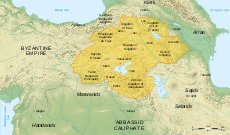
They assumed the Persian-influenced titles of the King of Kings in both Armenia and Georgia. To note, there are inscriptions on some churches of Ani citing Armenian kings as Shahanshahs of the Armenians and Georgians. However, with the start of the 10th century and on, the Bagratunis broke up into different branches, breaking up the unified kingdom in a time when unity was needed in the face of Seljuk and Byzantine pressure. The rule of the Ani branch ended in 1045 with the conquest of Ani by the Byzantines.
The Kars branch held on until 1064. However, the longest to last were the Bagratids of the Armenian region occupied by the principality of Lori (Tashir-Dzoraget) who were the only Armenian Bagratid kings to issue coins. The dynasty of Cilician Armenia is believed to be a branch of the Bagratids, later took the throne of an Armenian Kingdom
Armenian Kingdom of Cilicia
The Armenian Kingdom of Cilicia , also known as the Cilician Armenia, Kingdom of Cilician Armenia or New Armenia, was an independent principality formed during the High Middle Ages by Armenian refugees fleeing the Seljuk invasion of Armenia...
in Cilicia
Cilicia
In antiquity, Cilicia was the south coastal region of Asia Minor, south of the central Anatolian plateau. It existed as a political entity from Hittite times into the Byzantine empire...
. The founder, Roupen I, had an unknown relationship to the exiled king Gagik II
Gagik II
Gagik II of Ani was the last Bagratuni King of Ani from 1042 to 1045.-Historical background:During the reign of John Smbat III, a feudal lord, David, who owned Taik during his battles against the Muslims, gained a large area which stretched all the way to Manzikert...
. He was either a younger family member or kinsman. Ashot, son of Hovhannes (son of Gagik II), was later governor of Ani under the Shaddadid
Shaddadid
The Shaddadids were a Kurdish dynasty who ruled in various parts of Armenia and Arran from 951-1174 AD. They were established in Dvin. Through their long tenure in Armenia, they often intermarried with the Bagratuni royal family of Armenia....
dynasty.
See also
- List of Bagratuni rulers of Armenia
- Zakarid ArmeniaZakarid ArmeniaThe Zakarids or Zakarid Armenia , is used to describe territories of Armenia given to the Zakarid-Mxargrzeli princes as a fief by Tamar, the queen of the Kingdom of Georgia.- History :...
- The city of Dvin
- BagdasarianBagdasarianThe Bagdasarian are a noble family of Nakharars in Armenia and are of hereditary right to Bagrevand with Armenia in the province of Ararat. Variations include Bagawanean, Bagawanian, Bagdasarean....
Genealogy
- Prince Cyrille Toumanoff, Manuel de généalogie et de chronologie pour l'histoire de la Caucasie Chrétienne (Arménie-Géorgie-Albanie). Edizioni Aquila, Roma, 1976. - still remains the only account of the family generally available in the West, although its scientific standard has been criticized as very low.
- The Families of the Nobility of the Russian Empire, Volume III, Moscow, 1996. - contains the latest research available in Russian, compiled by Georgian scientists, some of them Bagratids themselves.
- Armenian Nobility Site
- Robert Bedrosian's History Page
History
- R. H. Hewsen. "Armenia: A Historical Atlas", 2001 ISBN 0-226-33228-4