


1st century

Encyclopedia
Century
A century is one hundred consecutive years. Centuries are numbered ordinally in English and many other languages .-Start and end in the Gregorian Calendar:...
that lasted from 1
1
Year 1 was a common year starting on Saturday or Sunday of the Julian calendar and a common year starting on Saturday of the Proleptic Julian calendar...
to 100
100
Year 100 was a leap year starting on Wednesday of the Julian calendar. At the time, it was known as the Year of the Consulship of Traianus and Frontinus...
according the Julian calendar
Julian calendar
The Julian calendar began in 45 BC as a reform of the Roman calendar by Julius Caesar. It was chosen after consultation with the astronomer Sosigenes of Alexandria and was probably designed to approximate the tropical year .The Julian calendar has a regular year of 365 days divided into 12 months...
. It is considered part of the Classical era, epoch, or historical period
History by period
Whether one can precisely define a time window as 'High Middle Ages' or 'Early Middle Ages' the title evokes an image and expectations in the reader of certain sets of characteristics—the essential essence of such labeling—a communications tool from one mind to another.Nonetheless, periods have a...
.
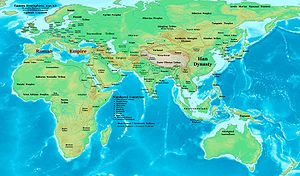
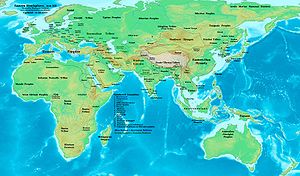
During this period Europe, North Africa and the Near East fell under increasing domination by the Roman Empire
Roman Empire
The Roman Empire was the post-Republican period of the ancient Roman civilization, characterised by an autocratic form of government and large territorial holdings in Europe and around the Mediterranean....
, which continued expanding, most notably conquering Britain
Britannia
Britannia is an ancient term for Great Britain, and also a female personification of the island. The name is Latin, and derives from the Greek form Prettanike or Brettaniai, which originally designated a collection of islands with individual names, including Albion or Great Britain. However, by the...
under the emperor Claudius
Claudius
Claudius , was Roman Emperor from 41 to 54. A member of the Julio-Claudian dynasty, he was the son of Drusus and Antonia Minor. He was born at Lugdunum in Gaul and was the first Roman Emperor to be born outside Italy...
(43
43
Year 43 was a common year starting on Tuesday of the Julian calendar. At the time, it was known as the Year of the Consulship of Caesar and Vitellius...
). The reforms introduced by Augustus
Augustus
Augustus ;23 September 63 BC – 19 August AD 14) is considered the first emperor of the Roman Empire, which he ruled alone from 27 BC until his death in 14 AD.The dates of his rule are contemporary dates; Augustus lived under two calendars, the Roman Republican until 45 BC, and the Julian...
during his long reign stabilized the empire after the turmoil of the previous century's civil wars. Later in the century the Julio-Claudian dynasty
Julio-Claudian Dynasty
The Julio-Claudian dynasty normally refers to the first five Roman Emperors: Augustus, Tiberius, Caligula , Claudius, and Nero, or the family to which they belonged; they ruled the Roman Empire from its formation, in the second half of the 1st century BC, until AD 68, when the last of the line,...
, which had been founded by Augustus
Augustus
Augustus ;23 September 63 BC – 19 August AD 14) is considered the first emperor of the Roman Empire, which he ruled alone from 27 BC until his death in 14 AD.The dates of his rule are contemporary dates; Augustus lived under two calendars, the Roman Republican until 45 BC, and the Julian...
came to an end with the death of Nero
Nero
Nero , was Roman Emperor from 54 to 68, and the last in the Julio-Claudian dynasty. Nero was adopted by his great-uncle Claudius to become his heir and successor, and succeeded to the throne in 54 following Claudius' death....
in 68
68
Year 68 was a leap year starting on Friday of the Julian calendar. At the time, it was known as the Year of the Consulship of Asconius and Thraculus...
. There followed the famous Year of Four Emperors, a brief period of civil war and instability, which was finally brought to an end by Vespasian
Vespasian
Vespasian , was Roman Emperor from 69 AD to 79 AD. Vespasian was the founder of the Flavian dynasty, which ruled the Empire for a quarter century. Vespasian was descended from a family of equestrians, who rose into the senatorial rank under the Emperors of the Julio-Claudian dynasty...
, 9th Roman emperor, and founder of the Flavian dynasty
Flavian dynasty
The Flavian dynasty was a Roman Imperial Dynasty, which ruled the Roman Empire between 69 and 96 AD, encompassing the reigns of Vespasian , and his two sons Titus and Domitian . The Flavians rose to power during the civil war of 69, known as the Year of the Four Emperors...
.
China continued to be dominated by the Han Dynasty
Han Dynasty
The Han Dynasty was the second imperial dynasty of China, preceded by the Qin Dynasty and succeeded by the Three Kingdoms . It was founded by the rebel leader Liu Bang, known posthumously as Emperor Gaozu of Han. It was briefly interrupted by the Xin Dynasty of the former regent Wang Mang...
, despite a 14-year interruption by the Xin dynasty
Xin Dynasty
The Xin Dynasty was a Chinese dynasty which lasted from AD 9 to 23. It followed the Western Han Dynasty and preceded the Eastern Han Dynasty....
under Wang Mang
Wang Mang
Wang Mang , courtesy name Jujun , was a Han Dynasty official who seized the throne from the Liu family and founded the Xin Dynasty , ruling AD 9–23. The Han dynasty was restored after his overthrow and his rule marks the separation between the Western Han Dynasty and Eastern Han Dynasty...
. Han rule was restored in 23
23
Year 23 was a common year starting on Friday of the Julian calendar. At the time, it was known as the Year of the Consulship of Pollio and Vetus...
; Wang Mang's rule represents the watershed between the Western/Former Han and the Eastern/Later Han. The capital was also moved
History of the Han Dynasty
The Han Dynasty , founded by the peasant rebel leader Liu Bang ,From the Shang to the Sui dynasties, Chinese rulers were referred to in later records by their posthumous names, while emperors of the Tang to Yuan dynasties were referred to by their temple names, and emperors of the Ming and Qing...
from Chang'an
Chang'an
Chang'an is an ancient capital of more than ten dynasties in Chinese history, today known as Xi'an. Chang'an literally means "Perpetual Peace" in Classical Chinese. During the short-lived Xin Dynasty, the city was renamed "Constant Peace" ; yet after its fall in AD 23, the old name was restored...
to Luoyang
Luoyang
Luoyang is a prefecture-level city in western Henan province of Central China. It borders the provincial capital of Zhengzhou to the east, Pingdingshan to the southeast, Nanyang to the south, Sanmenxia to the west, Jiyuan to the north, and Jiaozuo to the northeast.Situated on the central plain of...
.
Regional Events and Politics
- Northern EuropeNorthern EuropeNorthern Europe is the northern part or region of Europe. Northern Europe typically refers to the seven countries in the northern part of the European subcontinent which includes Denmark, Estonia, Latvia, Lithuania, Norway, Finland and Sweden...
: - Western EuropeWestern EuropeWestern Europe is a loose term for the collection of countries in the western most region of the European continents, though this definition is context-dependent and carries cultural and political connotations. One definition describes Western Europe as a geographic entity—the region lying in the...
: Controlled by Rome. - Central EuropeCentral EuropeCentral Europe or alternatively Middle Europe is a region of the European continent lying between the variously defined areas of Eastern and Western Europe...
: - Eastern EuropeEastern EuropeEastern Europe is the eastern part of Europe. The term has widely disparate geopolitical, geographical, cultural and socioeconomic readings, which makes it highly context-dependent and even volatile, and there are "almost as many definitions of Eastern Europe as there are scholars of the region"...
: - Southern EuropeSouthern EuropeThe term Southern Europe, at its most general definition, is used to mean "all countries in the south of Europe". However, the concept, at different times, has had different meanings, providing additional political, linguistic and cultural context to the definition in addition to the typical...
: Controlled by Rome. - North AfricaNorth AfricaNorth Africa or Northern Africa is the northernmost region of the African continent, linked by the Sahara to Sub-Saharan Africa. Geopolitically, the United Nations definition of Northern Africa includes eight countries or territories; Algeria, Egypt, Libya, Morocco, South Sudan, Sudan, Tunisia, and...
: Controlled by Rome. - West AfricaWest AfricaWest Africa or Western Africa is the westernmost region of the African continent. Geopolitically, the UN definition of Western Africa includes the following 16 countries and an area of approximately 5 million square km:-Flags of West Africa:...
: Numerous tribal governments. - Central AfricaCentral AfricaCentral Africa is a core region of the African continent which includes Burundi, the Central African Republic, Chad, the Democratic Republic of the Congo, and Rwanda....
: Bantu tribes, collapsing Nok civilization. - East AfricaEast AfricaEast Africa or Eastern Africa is the easterly region of the African continent, variably defined by geography or geopolitics. In the UN scheme of geographic regions, 19 territories constitute Eastern Africa:...
: Meroe, Blemmyes, Axum Empire. - Southern AfricaSouthern AfricaSouthern Africa is the southernmost region of the African continent, variably defined by geography or geopolitics. Within the region are numerous territories, including the Republic of South Africa ; nowadays, the simpler term South Africa is generally reserved for the country in English.-UN...
: Bantu tribes, Khoisan. - Western Asia: Rome, Parthian empires, as well as many smaller tribes.
- Central AsiaCentral AsiaCentral Asia is a core region of the Asian continent from the Caspian Sea in the west, China in the east, Afghanistan in the south, and Russia in the north...
: Sarmatian tribes. - South-central Asia: Kushan empire, Western Satraps, Satavahana, Tibetans.
- Southeast AsiaSoutheast AsiaSoutheast Asia, South-East Asia, South East Asia or Southeastern Asia is a subregion of Asia, consisting of the countries that are geographically south of China, east of India, west of New Guinea and north of Australia. The region lies on the intersection of geological plates, with heavy seismic...
: City states, Khmer, Mon kingdoms, Funan. - East AsiaEast AsiaEast Asia or Eastern Asia is a subregion of Asia that can be defined in either geographical or cultural terms...
: Eastern Han Dynasty of China, Three Kingdoms (Goguryeo, Baekje and Silla) of Korea. - North AmericaNorth AmericaNorth America is a continent wholly within the Northern Hemisphere and almost wholly within the Western Hemisphere. It is also considered a northern subcontinent of the Americas...
: - CaribbeanCaribbeanThe Caribbean is a crescent-shaped group of islands more than 2,000 miles long separating the Gulf of Mexico and the Caribbean Sea, to the west and south, from the Atlantic Ocean, to the east and north...
: - Southern America:
Events
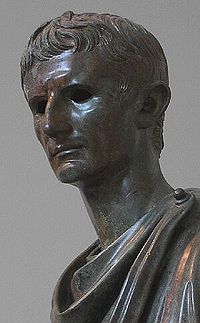
- Early 1st century – Augustus of Primaporta, (perhaps a copy of a bronze statue of ca. 20 BC20 BCYear 20 BC was either a common year starting on Wednesday or Thursday or a leap year starting on Tuesday, Wednesday or Thursday of the Julian calendar and a common year starting on Tuesday of the Proleptic Julian calendar...
), is made. It is now kept in Musei Vaticani, Braccio Nuovo, RomeRomeRome is the capital of Italy and the country's largest and most populated city and comune, with over 2.7 million residents in . The city is located in the central-western portion of the Italian Peninsula, on the Tiber River within the Lazio region of Italy.Rome's history spans two and a half...
. - Early 1st century – Gemma AugusteaGemma AugusteaThe Gemma Augustea is a low-relief cameo engraved gem cut from a double-layered Arabian onyx stone. It is commonly agreed that the gem cutter who created the Gemma Augustea was either Dioscurides or one of his disciples, in the second or third decade of the 1st century AD.- Creation and...
is made. It is now kept at Kunsthistorisches MuseumKunsthistorisches MuseumThe Kunsthistorisches Museum is an art museum in Vienna, Austria. Housed in its festive palatial building on Ringstraße, it is crowned with an octagonal dome...
, ViennaViennaVienna is the capital and largest city of the Republic of Austria and one of the nine states of Austria. Vienna is Austria's primary city, with a population of about 1.723 million , and is by far the largest city in Austria, as well as its cultural, economic, and political centre...
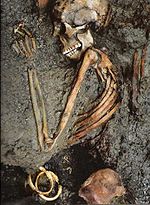
. - Early 1st century – House of the Silver WeddingHouse of the Silver WeddingThe House of the Silver Wedding is the name given to the archaeological remains of a Roman house in Pompeii, buried in the ash from the 79 AD eruption of Mount Vesuvius...
, PompeiiPompeiiThe city of Pompeii is a partially buried Roman town-city near modern Naples in the Italian region of Campania, in the territory of the comune of Pompei. Along with Herculaneum, Pompeii was destroyed and completely buried during a long catastrophic eruption of the volcano Mount Vesuvius spanning...
, is built. Excavated in 1893, the year of the silver wedding anniversary of ItalyItalyItaly , officially the Italian Republic languages]] under the European Charter for Regional or Minority Languages. In each of these, Italy's official name is as follows:;;;;;;;;), is a unitary parliamentary republic in South-Central Europe. To the north it borders France, Switzerland, Austria and...
's King Humbert and his wife, Margherita of SavoyMargherita of SavoyMargherita of Savoy , was the Queen consort of the Kingdom of Italy during the reign of her husband, Umberto I.-Family:...
, who have supported archaeological fieldwork at Pompeii. - Early 1st century - Inner shrine, Ise, MieIse, Mie, formerly called Ujiyamada , is a city located in eastern Mie Prefecture, on the island of Honshū, Japan.Ise is home to Ise Grand Shrine, the most sacred Shintō Shrine in Japan, and is thus a very popular destination for tourists. The city has a long-standing nickname—Shinto —that roughly means...
, Mie PrefectureMie Prefectureis a prefecture of Japan which is part of the Kansai regions on Honshū island. The capital is the city of Tsu.- History :Until the Meiji Restoration, Mie prefecture was known as Ise Province and Iga Province....
, is built. Yayoi periodYayoi periodThe is an Iron Age era in the history of Japan traditionally dated 300 BC to 300 AD. It is named after the neighbourhood of Tokyo where archaeologists first uncovered artifacts and features from that era. Distinguishing characteristics of the Yayoi period include the appearance of new...
. - 11Year 1 was a common year starting on Saturday or Sunday of the Julian calendar and a common year starting on Saturday of the Proleptic Julian calendar...
: LionLionThe lion is one of the four big cats in the genus Panthera, and a member of the family Felidae. With some males exceeding 250 kg in weight, it is the second-largest living cat after the tiger...
s became extinct in Western EuropeWestern EuropeWestern Europe is a loose term for the collection of countries in the western most region of the European continents, though this definition is context-dependent and carries cultural and political connotations. One definition describes Western Europe as a geographic entity—the region lying in the...
. - c. 66Year 6 was a common year starting on Friday of the Julian calendar. At the time, it was known as the Year of the Consulship of Lepidus and Arruntius...
: Census of QuiriniusCensus of QuiriniusThe Census of Quirinius refers to the enrollment of the Roman Provinces of Syria and Iudaea for tax purposes taken in the year 6/7 during the reign of Emperor Augustus , when Publius Sulpicius Quirinius was appointed governor of Syria, after the banishment of Herod Archelaus from the Tetrarchy of... - 88Year 8 was a leap year starting on Sunday of the Julian calendar. At the time, it was known as the Year of the Consulship of Camillus and Quinctilianus...
–2323Year 23 was a common year starting on Friday of the Julian calendar. At the time, it was known as the Year of the Consulship of Pollio and Vetus...
: Wang MangWang MangWang Mang , courtesy name Jujun , was a Han Dynasty official who seized the throne from the Liu family and founded the Xin Dynasty , ruling AD 9–23. The Han dynasty was restored after his overthrow and his rule marks the separation between the Western Han Dynasty and Eastern Han Dynasty...
temporarily overthrew the Han dynastyHan DynastyThe Han Dynasty was the second imperial dynasty of China, preceded by the Qin Dynasty and succeeded by the Three Kingdoms . It was founded by the rebel leader Liu Bang, known posthumously as Emperor Gaozu of Han. It was briefly interrupted by the Xin Dynasty of the former regent Wang Mang...
of ChinaChinaChinese civilization may refer to:* China for more general discussion of the country.* Chinese culture* Greater China, the transnational community of ethnic Chinese.* History of China* Sinosphere, the area historically affected by Chinese culture...
. - 99Year 9 was a common year starting on Tuesday of the Julian calendar. At the time, it was known as the Year of the Consulship of Sabinus and Camerinus...
: Three Roman legions were ambushed and destroyed at Teutoberg Forest by Germans under the leadership of ArminiusArminiusArminius , also known as Armin or Hermann was a chieftain of the Germanic Cherusci who defeated a Roman army in the Battle of the Teutoburg Forest...
. - 1414Year 14 was a common year starting on Monday of the Julian calendar. At the time, it was known as the Year of the Consulship of Pompeius and Appuleius...
: Augustus Caesar, first emperor of Rome, dies. His adopted son, stepson and son-in-law TiberiusTiberiusTiberius , was Roman Emperor from 14 AD to 37 AD. Tiberius was by birth a Claudian, son of Tiberius Claudius Nero and Livia Drusilla. His mother divorced Nero and married Augustus in 39 BC, making him a step-son of Octavian...
is his successor. - 2828Year 28 was a leap year starting on Thursday of the Julian calendar. At the time, it was known as the Year of the Consulship of Silanus and Nerva...
–7575Year 75 was a common year starting on Sunday of the Julian calendar. At the time, it was known as the Year of the Consulship of Augustus and Vespasianus...
: Emperor Ming of HanEmperor Ming of HanEmperor Ming of Han, , was second emperor of the Chinese Eastern Han Dynasty.He was the second son of Emperor Guangwu. It was during Emperor Ming's reign that Buddhism began to spread into China. One night, he is said to have dreamed of a golden man or golden men...
, BuddhismBuddhismBuddhism is a religion and philosophy encompassing a variety of traditions, beliefs and practices, largely based on teachings attributed to Siddhartha Gautama, commonly known as the Buddha . The Buddha lived and taught in the northeastern Indian subcontinent some time between the 6th and 4th...
reaches ChinaChinaChinese civilization may refer to:* China for more general discussion of the country.* Chinese culture* Greater China, the transnational community of ethnic Chinese.* History of China* Sinosphere, the area historically affected by Chinese culture...
. - Humans arrive on Pentecost IslandPentecost IslandPentecost Island is one of the 83 islands that make up the South Pacific nation of Vanuatu. It lies due north of capital Port Vila. Pentecost Island is known as Pentecôte in French and Pentikos in Bislama. The island was known in its native languages by names such as Vanu Aroaroa, although these...
and establish the BunlapBunlapBunlap is a village in the south-east of Pentecost Island in the Pacific archipelago of Vanuatu. It is the most well-known of a number of local kastom villages whose people aspire to retain a traditional lifestyle with minimal Western influences....
tribe, among others. - 2626Year 26 was a common year starting on Tuesday of the Julian calendar. At the time, it was known as the Year of the Consulship of Lentulus and Sabinus...
: According to the BibleBibleThe Bible refers to any one of the collections of the primary religious texts of Judaism and Christianity. There is no common version of the Bible, as the individual books , their contents and their order vary among denominations...
, Jesus begins his ministryChronology of JesusThe chronology of Jesus aims to establish a historical order for some of the events of the life of Jesus in the four canonical gospels. The Christian gospels were primarily written as theological documents rather than historical chronicles and their authors showed little interest in an absolute...
. - 3030Year 30 was a common year starting on Sunday of the Julian calendar. At the time, it was known as the Year of the Consulship of Vinicius and Longinus...
: Death of Jesus on the crossChronology of JesusThe chronology of Jesus aims to establish a historical order for some of the events of the life of Jesus in the four canonical gospels. The Christian gospels were primarily written as theological documents rather than historical chronicles and their authors showed little interest in an absolute...
. Beginning of the Christian ChurchHistory of ChristianityThe history of Christianity concerns the Christian religion, its followers and the Church with its various denominations, from the first century to the present. Christianity was founded in the 1st century by the followers of Jesus of Nazareth who they believed to be the Christ or chosen one of God...
. - 3434Year 34 was a common year starting on Friday of the Julian calendar. At the time, it was known as the Year of the Consulship of Persicus and Vitellius...
: Conversion of Saint Paul. - 4444Year 44 was a leap year starting on Wednesday of the Julian calendar. At the time, it was known as the Year of the Consulship of Crispus and Taurus...
: Death of Herod AgrippaAgrippa IAgrippa I also known as Herod Agrippa or simply Herod , King of the Jews, was the grandson of Herod the Great, and son of Aristobulus IV and Berenice. His original name was Marcus Julius Agrippa, so named in honour of Roman statesman Marcus Vipsanius Agrippa, and he is the king named Herod in the...
. - 4141Year 41 was a common year starting on Sunday of the Julian calendar. At the time, it was known as the Year of the Consulship of Augustus and Saturninus...
–5454Year 54 was a common year starting on Tuesday of the Julian calendar. At the time, it was known as the Year of the Consulship of Lentulus and Marcellus...
: Rachias, an AmbassadorAmbassadorAn ambassador is the highest ranking diplomat who represents a nation and is usually accredited to a foreign sovereign or government, or to an international organization....
sent from Sri LankaSri LankaSri Lanka, officially the Democratic Socialist Republic of Sri Lanka is a country off the southern coast of the Indian subcontinent. Known until 1972 as Ceylon , Sri Lanka is an island surrounded by the Indian Ocean, the Gulf of Mannar and the Palk Strait, and lies in the vicinity of India and the...
to the court of ClaudiusClaudiusClaudius , was Roman Emperor from 41 to 54. A member of the Julio-Claudian dynasty, he was the son of Drusus and Antonia Minor. He was born at Lugdunum in Gaul and was the first Roman Emperor to be born outside Italy...
. - MasoretesMasoretesThe Masoretes were groups of mostly Karaite scribes and scholars working between the 7th and 11th centuries, based primarily in present-day Israel in the cities of Tiberias and Jerusalem, as well as in Iraq...
adds vowel pointings to the text of the TanakhTanakhThe Tanakh is a name used in Judaism for the canon of the Hebrew Bible. The Tanakh is also known as the Masoretic Text or the Miqra. The name is an acronym formed from the initial Hebrew letters of the Masoretic Text's three traditional subdivisions: The Torah , Nevi'im and Ketuvim —hence...
, the Hebrew BibleHebrew BibleThe Hebrew Bible is a term used by biblical scholars outside of Judaism to refer to the Tanakh , a canonical collection of Jewish texts, and the common textual antecedent of the several canonical editions of the Christian Old Testament...
. - Buddhist monks in Sri LankaSri LankaSri Lanka, officially the Democratic Socialist Republic of Sri Lanka is a country off the southern coast of the Indian subcontinent. Known until 1972 as Ceylon , Sri Lanka is an island surrounded by the Indian Ocean, the Gulf of Mannar and the Palk Strait, and lies in the vicinity of India and the...
first write down BuddhaGautama BuddhaSiddhārtha Gautama was a spiritual teacher from the Indian subcontinent, on whose teachings Buddhism was founded. In most Buddhist traditions, he is regarded as the Supreme Buddha Siddhārtha Gautama (Sanskrit: सिद्धार्थ गौतम; Pali: Siddhattha Gotama) was a spiritual teacher from the Indian...
's teachings, creating the PaliPáli- External links :* *...
canon. - The regions of present-day AfghanistanAfghanistanAfghanistan , officially the Islamic Republic of Afghanistan, is a landlocked country located in the centre of Asia, forming South Asia, Central Asia and the Middle East. With a population of about 29 million, it has an area of , making it the 42nd most populous and 41st largest nation in the world...
, PakistanPakistanPakistan , officially the Islamic Republic of Pakistan is a sovereign state in South Asia. It has a coastline along the Arabian Sea and the Gulf of Oman in the south and is bordered by Afghanistan and Iran in the west, India in the east and China in the far northeast. In the north, Tajikistan...
and North IndiaNorth IndiaNorth India, known natively as Uttar Bhārat or Shumālī Hindustān , is a loosely defined region in the northern part of India. The exact meaning of the term varies by usage...
come under the control of the Kushans, a nomadic people forced out of northwest ChinaChinaChinese civilization may refer to:* China for more general discussion of the country.* Chinese culture* Greater China, the transnational community of ethnic Chinese.* History of China* Sinosphere, the area historically affected by Chinese culture...
by the Han DynastyHan DynastyThe Han Dynasty was the second imperial dynasty of China, preceded by the Qin Dynasty and succeeded by the Three Kingdoms . It was founded by the rebel leader Liu Bang, known posthumously as Emperor Gaozu of Han. It was briefly interrupted by the Xin Dynasty of the former regent Wang Mang...
. - TacitusTacitusPublius Cornelius Tacitus was a senator and a historian of the Roman Empire. The surviving portions of his two major works—the Annals and the Histories—examine the reigns of the Roman Emperors Tiberius, Claudius, Nero and those who reigned in the Year of the Four Emperors...
mentions the SuionesSuionesThe Swedes e, "one's own [tribesmen/kinsmen]"; Old English: Sweonas; , Suehans or Sueones) were an ancient North Germanic tribe in Scandinavia...
, who will one day be called the Swedes. - KaundinyaKaundinyaKaundinya also known as Ajnata Kaundinya was a Buddhist bhikkhu in the sangha of Gautama Buddha and the first to become an arahant...
, an IndiaIndiaIndia , officially the Republic of India , is a country in South Asia. It is the seventh-largest country by geographical area, the second-most populous country with over 1.2 billion people, and the most populous democracy in the world...
n BrahminBrahminBrahmin Brahman, Brahma and Brahmin.Brahman, Brahmin and Brahma have different meanings. Brahman refers to the Supreme Self...
marries Soma and establishes the Pre-AngkorAngkorAngkor is a region of Cambodia that served as the seat of the Khmer Empire, which flourished from approximately the 9th to 15th centuries. The word Angkor is derived from the Sanskrit nagara , meaning "city"...
Cambodian KingdomHistory of Cambodia- Prehistory and early history :Carbon 14 dating of a cave at Laang Spean in northwest Cambodia reveals people who made pots were living in Cambodia as early as 4200 BCE . Further archaeological evidence indicates that other parts of the region now called Cambodia were inhabited from around...
of Funan. - The GothsGothsThe Goths were an East Germanic tribe of Scandinavian origin whose two branches, the Visigoths and the Ostrogoths, played an important role in the fall of the Roman Empire and the emergence of Medieval Europe....
settle in northern PolandPolandPoland , officially the Republic of Poland , is a country in Central Europe bordered by Germany to the west; the Czech Republic and Slovakia to the south; Ukraine, Belarus and Lithuania to the east; and the Baltic Sea and Kaliningrad Oblast, a Russian exclave, to the north...
, which they called GothiscandzaGothiscandzaAccording to a tale related by Jordanes, Gothiscandza was the first settlement of the Goths after their migration from Scandinavia during the first half of the 1st century CE....
, and shape the Wielbark culture. - c. 50: ChristianChristianA Christian is a person who adheres to Christianity, an Abrahamic, monotheistic religion based on the life and teachings of Jesus of Nazareth as recorded in the Canonical gospels and the letters of the New Testament...
Council of JerusalemCouncil of JerusalemThe Council of Jerusalem is a name applied by historians and theologians to an Early Christian council that was held in Jerusalem and dated to around the year 50. It is considered by Catholics and Orthodox to be a prototype and forerunner of the later Ecumenical Councils...
. - c. 5252Year 52 was a leap year starting on Saturday of the Julian calendar. At the time, it was known as the Year of the Consulship of Sulla and Otho...
: Arrival of Apostle Thomas to Malabar, India. Beginning of ChristianityChristianityChristianity is a monotheistic religion based on the life and teachings of Jesus as presented in canonical gospels and other New Testament writings...
in IndiaIndiaIndia , officially the Republic of India , is a country in South Asia. It is the seventh-largest country by geographical area, the second-most populous country with over 1.2 billion people, and the most populous democracy in the world...
. - Mid-1st century – Wall niche, from garden in PompeiiPompeiiThe city of Pompeii is a partially buried Roman town-city near modern Naples in the Italian region of Campania, in the territory of the comune of Pompei. Along with Herculaneum, Pompeii was destroyed and completely buried during a long catastrophic eruption of the volcano Mount Vesuvius spanning...
, is made. It is now kept at Fitzwilliam MuseumFitzwilliam MuseumThe Fitzwilliam Museum is the art and antiquities museum of the University of Cambridge, located on Trumpington Street opposite Fitzwilliam Street in central Cambridge, England. It receives around 300,000 visitors annually. Admission is free....
, University of CambridgeUniversity of CambridgeThe University of Cambridge is a public research university located in Cambridge, United Kingdom. It is the second-oldest university in both the United Kingdom and the English-speaking world , and the seventh-oldest globally...
, England. - Mid-1st century – Detail of a wall painting in the House of M. Lucretius Fronto, PompeiiPompeiiThe city of Pompeii is a partially buried Roman town-city near modern Naples in the Italian region of Campania, in the territory of the comune of Pompei. Along with Herculaneum, Pompeii was destroyed and completely buried during a long catastrophic eruption of the volcano Mount Vesuvius spanning...
, is made. - July 19, 64: Great Fire of RomeGreat Fire of RomeThe Great Fire of Rome was an urban fire that occurred beginning July 19, AD 64.-Background:According to Tacitus, the fire spread quickly and burned for six days. Only four of the fourteen districts of Rome escaped the fire; three districts were completely destroyed and the other seven suffered...
, first Roman mass Persecution of ChristiansPersecution of ChristiansPersecution of Christians as a consequence of professing their faith can be traced both historically and in the current era. Early Christians were persecuted for their faith, at the hands of both Jews from whose religion Christianity arose, and the Roman Empire which controlled much of the land...
, earliest significant recognition of Christians in RomeRomeRome is the capital of Italy and the country's largest and most populated city and comune, with over 2.7 million residents in . The city is located in the central-western portion of the Italian Peninsula, on the Tiber River within the Lazio region of Italy.Rome's history spans two and a half...
. - 6666Year 66 was a common year starting on Wednesday of the Julian calendar. At the time, it was known as the Year of the Consulship of Telesinus and Paullinus...
–7373Year 73 was a common year starting on Friday of the Julian calendar. At the time, it was known as the Year of the Consulship of Domitianus and Catullus...
: First Jewish-Roman WarFirst Jewish-Roman WarThe First Jewish–Roman War , sometimes called The Great Revolt , was the first of three major rebellions by the Jews of Judaea Province , against the Roman Empire...
. - August, 7070Year 70 was a common year starting on Monday of the Julian calendar. At the time, it was known as the Year of the Consulship of Augustus and Vespasianus...
: destruction of Herod's Temple in Jerusalem by the Romans under TitusTitusTitus , was Roman Emperor from 79 to 81. A member of the Flavian dynasty, Titus succeeded his father Vespasian upon his death, thus becoming the first Roman Emperor to come to the throne after his own father....
. - August, 7979Year 79 was a common year starting on Friday of the Julian calendar. At the time, it was known as the Year of the Consulship of Augustus and Vespasianus...
: PompeiiPompeiiThe city of Pompeii is a partially buried Roman town-city near modern Naples in the Italian region of Campania, in the territory of the comune of Pompei. Along with Herculaneum, Pompeii was destroyed and completely buried during a long catastrophic eruption of the volcano Mount Vesuvius spanning...
and HerculaneumHerculaneumHerculaneum was an ancient Roman town destroyed by volcanic pyroclastic flows in AD 79, located in the territory of the current commune of Ercolano, in the Italian region of Campania in the shadow of Mt...
destroyed by eruption of Mount VesuviusMount VesuviusMount Vesuvius is a stratovolcano in the Gulf of Naples, Italy, about east of Naples and a short distance from the shore. It is the only volcano on the European mainland to have erupted within the last hundred years, although it is not currently erupting...
. - Jewish Council of JamniaCouncil of JamniaThe Council of Jamnia or Council of Yavne is a hypothetical late 1st-century council at which it is postulated the canon of the Hebrew Bible was finalized....
. - Spread of the Roman EmpireRoman EmpireThe Roman Empire was the post-Republican period of the ancient Roman civilization, characterised by an autocratic form of government and large territorial holdings in Europe and around the Mediterranean....
, reaches largest size under TrajanTrajanTrajan , was Roman Emperor from 98 to 117 AD. Born into a non-patrician family in the province of Hispania Baetica, in Spain Trajan rose to prominence during the reign of emperor Domitian. Serving as a legatus legionis in Hispania Tarraconensis, in Spain, in 89 Trajan supported the emperor against...
. - Arena (colosseum)Arena (colosseum)The Pula Arena is the name of the amphitheatre located in Pula, Croatia. The Arena is the only remaining Roman amphitheatre to have four side towers and with all three Roman architectural orders entirely preserved. It was constructed in 27 BC - 68 AD and is among the six largest surviving Roman...
is constructed, origin of the name ArenaArenaAn arena is an enclosed area, often circular or oval-shaped, designed to showcase theater, musical performances, or sporting events. It is composed of a large open space surrounded on most or all sides by tiered seating for spectators. The key feature of an arena is that the event space is the...
. - Late 1st century—Cityscape, detail of a Second Style wall painting from a bedroom in the House of Publius Fannius Synistor, BoscorealeBoscorealeBoscoreale is a comune and town in the province of Naples, Campania, located in the Parco Nazionale del Vesuvio under the slopes of Mount Vesuvius, known for the fruit and vineyards of Lacryma Christi del Vesuvio...
, is made. It is now at The Metropolitan Museum of ArtMetropolitan Museum of ArtThe Metropolitan Museum of Art is a renowned art museum in New York City. Its permanent collection contains more than two million works, divided into nineteen curatorial departments. The main building, located on the eastern edge of Central Park along Manhattan's Museum Mile, is one of the...
, New YorkNew YorkNew York is a state in the Northeastern region of the United States. It is the nation's third most populous state. New York is bordered by New Jersey and Pennsylvania to the south, and by Connecticut, Massachusetts and Vermont to the east...
. - The painting "Alexander the Great confronts Darius III at the Battle of Issos", detail of mosaic floor decoration from PompeiiPompeiiThe city of Pompeii is a partially buried Roman town-city near modern Naples in the Italian region of Campania, in the territory of the comune of Pompei. Along with Herculaneum, Pompeii was destroyed and completely buried during a long catastrophic eruption of the volcano Mount Vesuvius spanning...
, ItalyItalyItaly , officially the Italian Republic languages]] under the European Charter for Regional or Minority Languages. In each of these, Italy's official name is as follows:;;;;;;;;), is a unitary parliamentary republic in South-Central Europe. To the north it borders France, Switzerland, Austria and...
is made. It is a Roman copy after a Greek painting of c. 310 BC310 BCYear 310 BC was a year of the pre-Julian Roman calendar. At the time, it was known as the Year of the Consulship of Rullianus and Censorinus...
, perhaps by PhiloxenosPhiloxenus of EretriaFor other uses, see PhiloxenusPhiloxenus of Eretria was a painter from Eretria, the disciple of Nicomachus of Thebes, whose speed in painting he imitated and even surpassed, having discovered some new and rapid methods of colouring Nevertheless, Pliny states that there was a picture of his which...
or Helen of Egypt. It is now at Museo Archeologico NazionaleNaples National Archaeological MuseumThe Naples National Archaeological Museum is a museum in Naples, southern Italy, at the northwest corner of the original Greek wall of the city of Neapolis. The museum contains a large collection of Roman artifacts from Pompeii, Stabiae and Herculaneum...
, NaplesNaplesNaples is a city in Southern Italy, situated on the country's west coast by the Gulf of Naples. Lying between two notable volcanic regions, Mount Vesuvius and the Phlegraean Fields, it is the capital of the region of Campania and of the province of Naples...
, ItalyItalyItaly , officially the Italian Republic languages]] under the European Charter for Regional or Minority Languages. In each of these, Italy's official name is as follows:;;;;;;;;), is a unitary parliamentary republic in South-Central Europe. To the north it borders France, Switzerland, Austria and...
. - Late 1st century – Bedroom, from the House of Publius Fannius Synistor, BoscorealeBoscorealeBoscoreale is a comune and town in the province of Naples, Campania, located in the Parco Nazionale del Vesuvio under the slopes of Mount Vesuvius, known for the fruit and vineyards of Lacryma Christi del Vesuvio...
is made. It is reconstructed with later furnishings at The Metropolitan Museum of ArtMetropolitan Museum of ArtThe Metropolitan Museum of Art is a renowned art museum in New York City. Its permanent collection contains more than two million works, divided into nineteen curatorial departments. The main building, located on the eastern edge of Central Park along Manhattan's Museum Mile, is one of the...
, New YorkNew YorkNew York is a state in the Northeastern region of the United States. It is the nation's third most populous state. New York is bordered by New Jersey and Pennsylvania to the south, and by Connecticut, Massachusetts and Vermont to the east...
. - Late 1st century – Seascape, detail of a wall painting from Villa FarnesinaVilla FarnesinaThe Villa Farnesina is a Renaissance suburban villa in the Via della Lungara, in the district of Trastevere in Rome, central Italy.The villa was built for Agostino Chigi, a rich Sienese banker and the treasurer of Pope Julius II. Between 1506–1510, the Sienese artist and pupil of Bramante,...
, RomeRomeRome is the capital of Italy and the country's largest and most populated city and comune, with over 2.7 million residents in . The city is located in the central-western portion of the Italian Peninsula, on the Tiber River within the Lazio region of Italy.Rome's history spans two and a half...
, is made. - Late 1st century – Young Woman Writing, detail of a wall painting, from PompeiiPompeiiThe city of Pompeii is a partially buried Roman town-city near modern Naples in the Italian region of Campania, in the territory of the comune of Pompei. Along with Herculaneum, Pompeii was destroyed and completely buried during a long catastrophic eruption of the volcano Mount Vesuvius spanning...
, is made. It is now kept at Museo Archeologico NazionaleNaples National Archaeological MuseumThe Naples National Archaeological Museum is a museum in Naples, southern Italy, at the northwest corner of the original Greek wall of the city of Neapolis. The museum contains a large collection of Roman artifacts from Pompeii, Stabiae and Herculaneum...
, NaplesNaplesNaples is a city in Southern Italy, situated on the country's west coast by the Gulf of Naples. Lying between two notable volcanic regions, Mount Vesuvius and the Phlegraean Fields, it is the capital of the region of Campania and of the province of Naples...
. - Late 1st century – Mausoleum under Construction, relief from the tomb of the Haterius family, Via LabicanaVia LabicanaThe Via Labicana was an ancient road of Italy, leading east southeast from Rome. It seems possible that the road at first led to Tusculum, that it was then extended to Labici, and later still became a road for through traffic; it may even have superseded the Via Latina as a route to the southeast,...
, RomeRomeRome is the capital of Italy and the country's largest and most populated city and comune, with over 2.7 million residents in . The city is located in the central-western portion of the Italian Peninsula, on the Tiber River within the Lazio region of Italy.Rome's history spans two and a half...
, is made. It is now kept at Musei Vaticani, Museo Gregoriano Profano, ex Lateranese, RomeRomeRome is the capital of Italy and the country's largest and most populated city and comune, with over 2.7 million residents in . The city is located in the central-western portion of the Italian Peninsula, on the Tiber River within the Lazio region of Italy.Rome's history spans two and a half...
. - Late 1st century – Middle-Aged Flavian Woman, is made. It is now kept at Musei Vaticani, Museo Gregoriano Profano, ex Lateranese, RomeRomeRome is the capital of Italy and the country's largest and most populated city and comune, with over 2.7 million residents in . The city is located in the central-western portion of the Italian Peninsula, on the Tiber River within the Lazio region of Italy.Rome's history spans two and a half...
. - c. Late 1st century-early 2nd century – Buddha and Attendants, from Katra Keshavdev, Mathura, Madhya PradeshMadhya PradeshMadhya Pradesh , often called the Heart of India, is a state in central India. Its capital is Bhopal and Indore is the largest city....
, IndiaIndiaIndia , officially the Republic of India , is a country in South Asia. It is the seventh-largest country by geographical area, the second-most populous country with over 1.2 billion people, and the most populous democracy in the world...
, is made. Kushan period. It is now kept at Mathura MuseumMathura MuseumMathura museum is an archaeological museum in Mathura city of Uttar Pradesh state in India. The museum was founded by then collector of the Mathura district, Sir F.S Growse in 1874...
. - 1st-2nd centuries - Tomb model of a house, is made. Eastern Han dynastyHan DynastyThe Han Dynasty was the second imperial dynasty of China, preceded by the Qin Dynasty and succeeded by the Three Kingdoms . It was founded by the rebel leader Liu Bang, known posthumously as Emperor Gaozu of Han. It was briefly interrupted by the Xin Dynasty of the former regent Wang Mang...
. It is now kept at The Nelson-Atkins Museum of ArtNelson-Atkins Museum of ArtThe Nelson-Atkins Museum of Art is an art museum in Kansas City, Missouri, known for its neoclassical architecture and extensive collection of Asian art....
, Kansas CityKansas City, MissouriKansas City, Missouri is the largest city in the U.S. state of Missouri and is the anchor city of the Kansas City Metropolitan Area, the second largest metropolitan area in Missouri. It encompasses in parts of Jackson, Clay, Cass, and Platte counties...
, MissouriMissouriMissouri is a US state located in the Midwestern United States, bordered by Iowa, Illinois, Kentucky, Tennessee, Arkansas, Oklahoma, Kansas and Nebraska. With a 2010 population of 5,988,927, Missouri is the 18th most populous state in the nation and the fifth most populous in the Midwest. It...
.
Significant people
- Apollonius of TyanaApollonius of TyanaApollonius of Tyana was a Greek Neopythagorean philosopher from the town of Tyana in the Roman province of Cappadocia in Asia Minor. Little is certainly known about him...
- AkibaRabbi AkivaAkiva ben Joseph simply known as Rabbi Akiva , was a tanna of the latter part of the 1st century and the beginning of the 2nd century . He was a great authority in the matter of Jewish tradition, and one of the most central and essential contributors to the Mishnah and Midrash Halakha...
- ArminiusArminiusArminius , also known as Armin or Hermann was a chieftain of the Germanic Cherusci who defeated a Roman army in the Battle of the Teutoburg Forest...
- Ban ChaoBan ChaoBan Chao , courtesy name Zhongsheng , was born in Xianyang, Shaanxi, and the younger brother of the famous historian, Ban Gu who, with his father Ban Biao, and sister, Ban Zhao, wrote the famous Hanshu, or 'History of the Former Han Dynasty'....
- Berenice of Cilicia
- BoudicaBoudicaBoudica , also known as Boadicea and known in Welsh as "Buddug" was queen of the British Iceni tribe who led an uprising against the occupying forces of the Roman Empire....
, also known as Boadicea - AugustusAugustusAugustus ;23 September 63 BC – 19 August AD 14) is considered the first emperor of the Roman Empire, which he ruled alone from 27 BC until his death in 14 AD.The dates of his rule are contemporary dates; Augustus lived under two calendars, the Roman Republican until 45 BC, and the Julian...
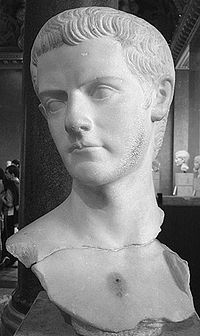
- CaligulaCaligulaCaligula , also known as Gaius, was Roman Emperor from 37 AD to 41 AD. Caligula was a member of the house of rulers conventionally known as the Julio-Claudian dynasty. Caligula's father Germanicus, the nephew and adopted son of Emperor Tiberius, was a very successful general and one of Rome's most...
- ClaudiusClaudiusClaudius , was Roman Emperor from 41 to 54. A member of the Julio-Claudian dynasty, he was the son of Drusus and Antonia Minor. He was born at Lugdunum in Gaul and was the first Roman Emperor to be born outside Italy...
- Clement I of RomePope Clement IStarting in the 3rd and 4th century, tradition has identified him as the Clement that Paul mentioned in Philippians as a fellow laborer in Christ.While in the mid-19th century it was customary to identify him as a freedman of Titus Flavius Clemens, who was consul with his cousin, the Emperor...
- DecebalusDecebalusDecebalus or "The Brave" was a king of Dacia and is famous for fighting three wars and negotiating two interregnums of peace without being eliminated against the Roman Empire under two emperors...
- DomitianDomitianDomitian was Roman Emperor from 81 to 96. Domitian was the third and last emperor of the Flavian dynasty.Domitian's youth and early career were largely spent in the shadow of his brother Titus, who gained military renown during the First Jewish-Roman War...
- Du ShiDu ShiDu Shi was a Chinese governmental Prefect of Nanyang in 31 AD and a mechanical engineer of the Eastern Han Dynasty in ancient China. Du Shi is credited with being the first to apply hydraulic power to operate bellows in metallurgy...
- Elisha ben AbuyahElisha ben AbuyahElisha ben Abuyah was a rabbi and Jewish religious authority born in Jerusalem sometime before 70 CE. After he adopted a worldview considered heretical by his fellow Tannaim and betrayed his people, the rabbis of the Talmud refrained from relating teachings in his name and referred to him as the...
- GalbaGalbaGalba , was Roman Emperor for seven months from 68 to 69. Galba was the governor of Hispania Tarraconensis, and made a bid for the throne during the rebellion of Julius Vindex...
- GermanicusGermanicusGermanicus Julius Caesar , commonly known as Germanicus, was a member of the Julio-Claudian dynasty and a prominent general of the early Roman Empire. He was born in Rome, Italia, and was named either Nero Claudius Drusus after his father or Tiberius Claudius Nero after his uncle...
- Gan YingGan YingGan Ying , was a Chinese military ambassador who was sent on a mission to Rome in 97 CE by the Chinese general Ban Chao.Although Gan Ying never reached Rome, only travelling to as far as the Parthian coast of the Persian Gulf, he is, at least in the historical records, the Chinese who went the...
- Guangwu of HanEmperor Guangwu of HanEmperor Guangwu , born Liu Xiu, was an emperor of the Chinese Han Dynasty, restorer of the dynasty in AD 25 and thus founder of the Later Han or Eastern Han...
- Hero of AlexandriaHero of AlexandriaHero of Alexandria was an ancient Greek mathematician and engineerEnc. Britannica 2007, "Heron of Alexandria" who was active in his native city of Alexandria, Roman Egypt...
- Hillel the ElderHillel the ElderHillel was a famous Jewish religious leader, one of the most important figures in Jewish history. He is associated with the development of the Mishnah and the Talmud...
- Ignatius of AntiochIgnatius of AntiochIgnatius of Antioch was among the Apostolic Fathers, was the third Bishop of Antioch, and was a student of John the Apostle. En route to his martyrdom in Rome, Ignatius wrote a series of letters which have been preserved as an example of very early Christian theology...
- James the JustJames the JustJames , first Bishop of Jerusalem, who died in 62 AD, was an important figure in Early Christianity...
- JesusJesusJesus of Nazareth , commonly referred to as Jesus Christ or simply as Jesus or Christ, is the central figure of Christianity...
of NazarethNazarethNazareth is the largest city in the North District of Israel. Known as "the Arab capital of Israel," the population is made up predominantly of Palestinian Arab citizens of Israel... - John the BaptistJohn the BaptistJohn the Baptist was an itinerant preacher and a major religious figure mentioned in the Canonical gospels. He is described in the Gospel of Luke as a relative of Jesus, who led a movement of baptism at the Jordan River...
- JosephusJosephusTitus Flavius Josephus , also called Joseph ben Matityahu , was a 1st-century Romano-Jewish historian and hagiographer of priestly and royal ancestry who recorded Jewish history, with special emphasis on the 1st century AD and the First Jewish–Roman War, which resulted in the Destruction of...
- Liu XinLiu XinLiu Xin , later changed name to Liu Xiu , courtesy name Zijun , was a Chinese astronomer, historian, and editor during the Xin Dynasty . He was the son of Confucian scholar Liu Xiang and an associate of other prominent thinkers such as the philosopher Huan Tan...
- LiviaLiviaLivia Drusilla, , after her formal adoption into the Julian family in AD 14 also known as Julia Augusta, was a Roman empress as the third wife of the Emperor Augustus and his adviser...
- LivyLivyTitus Livius — known as Livy in English — was a Roman historian who wrote a monumental history of Rome and the Roman people. Ab Urbe Condita Libri, "Chapters from the Foundation of the City," covering the period from the earliest legends of Rome well before the traditional foundation in 753 BC...
- Ma Yuan
- Ming of HanEmperor Ming of HanEmperor Ming of Han, , was second emperor of the Chinese Eastern Han Dynasty.He was the second son of Emperor Guangwu. It was during Emperor Ming's reign that Buddhism began to spread into China. One night, he is said to have dreamed of a golden man or golden men...
- NeroNeroNero , was Roman Emperor from 54 to 68, and the last in the Julio-Claudian dynasty. Nero was adopted by his great-uncle Claudius to become his heir and successor, and succeeded to the throne in 54 following Claudius' death....
- NervaNervaNerva , was Roman Emperor from 96 to 98. Nerva became Emperor at the age of sixty-five, after a lifetime of imperial service under Nero and the rulers of the Flavian dynasty. Under Nero, he was a member of the imperial entourage and played a vital part in exposing the Pisonian conspiracy of 65...
- OthoOthoOtho , was Roman Emperor for three months, from 15 January to 16 April 69. He was the second emperor of the Year of the four emperors.- Birth and lineage :...
- Paul of TarsusPaul of TarsusPaul the Apostle , also known as Saul of Tarsus, is described in the Christian New Testament as one of the most influential early Christian missionaries, with the writings ascribed to him by the church forming a considerable portion of the New Testament...
- PhiloPhiloPhilo , known also as Philo of Alexandria , Philo Judaeus, Philo Judaeus of Alexandria, Yedidia, "Philon", and Philo the Jew, was a Hellenistic Jewish Biblical philosopher born in Alexandria....
- Pliny the ElderPliny the ElderGaius Plinius Secundus , better known as Pliny the Elder, was a Roman author, naturalist, and natural philosopher, as well as naval and army commander of the early Roman Empire, and personal friend of the emperor Vespasian...
- PolycarpPolycarpSaint Polycarp was a 2nd century Christian bishop of Smyrna. According to the Martyrdom of Polycarp, he died a martyr, bound and burned at the stake, then stabbed when the fire failed to touch him...
- Pontius PilatePontius PilatePontius Pilatus , known in the English-speaking world as Pontius Pilate , was the fifth Prefect of the Roman province of Judaea, from AD 26–36. He is best known as the judge at Jesus' trial and the man who authorized the crucifixion of Jesus...
- SejanusSejanusLucius Aelius Seianus , commonly known as Sejanus, was an ambitious soldier, friend and confidant of the Roman Emperor Tiberius...
- Seneca the YoungerSeneca the YoungerLucius Annaeus Seneca was a Roman Stoic philosopher, statesman, dramatist, and in one work humorist, of the Silver Age of Latin literature. He was tutor and later advisor to emperor Nero...
- Simon PeterSaint PeterSaint Peter or Simon Peter was an early Christian leader, who is featured prominently in the New Testament Gospels and the Acts of the Apostles. The son of John or of Jonah and from the village of Bethsaida in the province of Galilee, his brother Andrew was also an apostle...
- StraboStraboStrabo, also written Strabon was a Greek historian, geographer and philosopher.-Life:Strabo was born to an affluent family from Amaseia in Pontus , a city which he said was situated the approximate equivalent of 75 km from the Black Sea...
- Tacitus
- Thomas the ApostleThomas the ApostleThomas the Apostle, also called Doubting Thomas or Didymus was one of the Twelve Apostles of Jesus. He is best known for questioning Jesus' resurrection when first told of it, then proclaiming "My Lord and my God" on seeing Jesus in . He was perhaps the only Apostle who went outside the Roman...
- TiberiusTiberiusTiberius , was Roman Emperor from 14 AD to 37 AD. Tiberius was by birth a Claudian, son of Tiberius Claudius Nero and Livia Drusilla. His mother divorced Nero and married Augustus in 39 BC, making him a step-son of Octavian...
- TitusTitusTitus , was Roman Emperor from 79 to 81. A member of the Flavian dynasty, Titus succeeded his father Vespasian upon his death, thus becoming the first Roman Emperor to come to the throne after his own father....
- TrajanTrajanTrajan , was Roman Emperor from 98 to 117 AD. Born into a non-patrician family in the province of Hispania Baetica, in Spain Trajan rose to prominence during the reign of emperor Domitian. Serving as a legatus legionis in Hispania Tarraconensis, in Spain, in 89 Trajan supported the emperor against...
- VespasianVespasianVespasian , was Roman Emperor from 69 AD to 79 AD. Vespasian was the founder of the Flavian dynasty, which ruled the Empire for a quarter century. Vespasian was descended from a family of equestrians, who rose into the senatorial rank under the Emperors of the Julio-Claudian dynasty...
- VitelliusVitelliusVitellius , was Roman Emperor for eight months, from 16 April to 22 December 69. Vitellius was acclaimed Emperor following the quick succession of the previous emperors Galba and Otho, in a year of civil war known as the Year of the Four Emperors...
- VitruviusVitruviusMarcus Vitruvius Pollio was a Roman writer, architect and engineer, active in the 1st century BC. He is best known as the author of the multi-volume work De Architectura ....
- Wang ChungWang ChongWang Chong , courtesy name Zhongren , was a Chinese philosopher active during the Han Dynasty. He developed a rational, secular, naturalistic and mechanistic account of the world and of human beings and gave a materialistic explanation of the origin of the universe. His main work was the Lùnhéng...
- Wang MangWang MangWang Mang , courtesy name Jujun , was a Han Dynasty official who seized the throne from the Liu family and founded the Xin Dynasty , ruling AD 9–23. The Han dynasty was restored after his overthrow and his rule marks the separation between the Western Han Dynasty and Eastern Han Dynasty...
Inventions, discoveries, introductions
- CodexCodexA codex is a book in the format used for modern books, with multiple quires or gatherings typically bound together and given a cover.Developed by the Romans from wooden writing tablets, its gradual replacement...
, the first form of the modern book, appears in the Roman Empire - Year 7878Year 78 was a common year starting on Thursday of the Julian calendar. At the time, it was known as the Year of the Consulship of Novius and Commodus...
—the beginning of the Saka Era used by South Asian calendars. - BookbindingBookbindingBookbinding is the process of physically assembling a book from a number of folded or unfolded sheets of paper or other material. It usually involves attaching covers to the resulting text-block.-Origins of the book:...
- Various inventions by Hero of AlexandriaHero of AlexandriaHero of Alexandria was an ancient Greek mathematician and engineerEnc. Britannica 2007, "Heron of Alexandria" who was active in his native city of Alexandria, Roman Egypt...
, including the steam turbineSteam turbineA steam turbine is a mechanical device that extracts thermal energy from pressurized steam, and converts it into rotary motion. Its modern manifestation was invented by Sir Charles Parsons in 1884....
(aeolipile), water organWater organThe water organ or hydraulic organ is a type of pipe organ blown by air, where the power source pushing the air is derived by water from a natural source or by a manual pump...
, and various other water-powered machines. - In 3131Year 31 was a common year starting on Monday of the Julian calendar. At the time, it was known as the Year of the Consulship of Augustus and Seianus...
, the Han DynastyHan DynastyThe Han Dynasty was the second imperial dynasty of China, preceded by the Qin Dynasty and succeeded by the Three Kingdoms . It was founded by the rebel leader Liu Bang, known posthumously as Emperor Gaozu of Han. It was briefly interrupted by the Xin Dynasty of the former regent Wang Mang...
Chinese engineer and statesman Du ShiDu ShiDu Shi was a Chinese governmental Prefect of Nanyang in 31 AD and a mechanical engineer of the Eastern Han Dynasty in ancient China. Du Shi is credited with being the first to apply hydraulic power to operate bellows in metallurgy...
(d. 3838Year 38 was a common year starting on Wednesday of the Julian calendar. At the time, it was known as the Year of the Consulship of Iulianus and Asprenas...
) from NanyangNanyang, HenanNanyang is a prefecture-level city in the southwest of Henan province, People's Republic of China. The city with the largest administrative area in Henan, Nanyang borders Xinyang to the southeast, Zhumadian to the east, Pingdingshan to the northeast, Luoyang to the north, Sanmenxia to the...
invented the first-known hydraulic-powered bellowsBellowsA bellows is a device for delivering pressurized air in a controlled quantity to a controlled location.Basically, a bellows is a deformable container which has an outlet nozzle. When the volume of the bellows is decreased, the air escapes through the outlet...
to heat the blast furnaceBlast furnaceA blast furnace is a type of metallurgical furnace used for smelting to produce industrial metals, generally iron.In a blast furnace, fuel and ore and flux are continuously supplied through the top of the furnace, while air is blown into the bottom of the chamber, so that the chemical reactions...
in smelting cast ironCast ironCast iron is derived from pig iron, and while it usually refers to gray iron, it also identifies a large group of ferrous alloys which solidify with a eutectic. The color of a fractured surface can be used to identify an alloy. White cast iron is named after its white surface when fractured, due...
. He used a complex mechanical device that was powered by the rushing current against a waterwheel, a practice that would continue in China. - Although Philo of ByzantiumPhilo of ByzantiumPhilo of Byzantium , also known as Philo Mechanicus, was a Greek engineer and writer on mechanics, who lived during the latter half of the 3rd century BC...
described the saqiya chain pump in the early 2nd century BC, the square-pallet chain pump was innovated in China during this century, mentioned first by the philosopher Wang ChongWang ChongWang Chong , courtesy name Zhongren , was a Chinese philosopher active during the Han Dynasty. He developed a rational, secular, naturalistic and mechanistic account of the world and of human beings and gave a materialistic explanation of the origin of the universe. His main work was the Lùnhéng...
around 80 AD. Wang Chong also accurately described the water cycleWater cycleThe water cycle, also known as the hydrologic cycle or H2O cycle, describes the continuous movement of water on, above and below the surface of the Earth. Water can change states among liquid, vapor, and solid at various places in the water cycle...
in meteorologyMeteorologyMeteorology is the interdisciplinary scientific study of the atmosphere. Studies in the field stretch back millennia, though significant progress in meteorology did not occur until the 18th century. The 19th century saw breakthroughs occur after observing networks developed across several countries...
, and argued against the mainstream 'radiating influence' theory for solar eclipseSolar eclipseAs seen from the Earth, a solar eclipse occurs when the Moon passes between the Sun and the Earth, and the Moon fully or partially blocks the Sun as viewed from a location on Earth. This can happen only during a new moon, when the Sun and the Moon are in conjunction as seen from Earth. At least...
s, the latter of which was accepted by many, including Zhang HengZhang HengZhang Heng was a Chinese astronomer, mathematician, inventor, geographer, cartographer, artist, poet, statesman, and literary scholar from Nanyang, Henan. He lived during the Eastern Han Dynasty of China. He was educated in the capital cities of Luoyang and Chang'an, and began his career as a...
. - The Chinese astronomer Liu XinLiu XinLiu Xin , later changed name to Liu Xiu , courtesy name Zijun , was a Chinese astronomer, historian, and editor during the Xin Dynasty . He was the son of Confucian scholar Liu Xiang and an associate of other prominent thinkers such as the philosopher Huan Tan...
(d. 2323Year 23 was a common year starting on Friday of the Julian calendar. At the time, it was known as the Year of the Consulship of Pollio and Vetus...
) documented 1080 different stars, amongst other achievements. - End of 1st century – codexCodexA codex is a book in the format used for modern books, with multiple quires or gatherings typically bound together and given a cover.Developed by the Romans from wooden writing tablets, its gradual replacement...
replaces the scrollScrollA scroll is a roll of parchment, papyrus, or paper, which has been drawn or written upon.Scroll may also refer to:*Scroll , the decoratively curved end of the pegbox of string instruments such as violins...
.
Christianity
According to the New TestamentNew Testament
The New Testament is the second major division of the Christian biblical canon, the first such division being the much longer Old Testament....
, during the reign of Tiberius
Tiberius
Tiberius , was Roman Emperor from 14 AD to 37 AD. Tiberius was by birth a Claudian, son of Tiberius Claudius Nero and Livia Drusilla. His mother divorced Nero and married Augustus in 39 BC, making him a step-son of Octavian...
, Jesus, a Jewish religious leader from Galilee
Galilee
Galilee , is a large region in northern Israel which overlaps with much of the administrative North District of the country. Traditionally divided into Upper Galilee , Lower Galilee , and Western Galilee , extending from Dan to the north, at the base of Mount Hermon, along Mount Lebanon to the...
, was crucified in Jerusalem
Jerusalem in Christianity
For Christians, Jerusalem's place in the ministry of Jesus and the Apostolic Age gives it great importance, in addition to its place in the Old Testament, the Hebrew Bible.-Jerusalem in the New Testament and early Christianity:...
on the charge of blasphemy
Blasphemy
Blasphemy is irreverence towards religious or holy persons or things. Some countries have laws to punish blasphemy, while others have laws to give recourse to those who are offended by blasphemy...
for claiming to be the Son of God
Son of God
"Son of God" is a phrase which according to most Christian denominations, Trinitarian in belief, refers to the relationship between Jesus and God, specifically as "God the Son"...
. But "God raised him from the dead" three days later, see Resurrection of Jesus
Resurrection of Jesus
The Christian belief in the resurrection of Jesus states that Jesus returned to bodily life on the third day following his death by crucifixion. It is a key element of Christian faith and theology and part of the Nicene Creed: "On the third day he rose again in fulfillment of the Scriptures"...
. Over the next few decades his followers, following the Great Commission
Great Commission
The Great Commission, in Christian tradition, is the instruction of the resurrected Jesus Christ to his disciples, that they spread his teachings to all the nations of the world. It has become a tenet in Christian theology emphasizing missionary work, evangelism, and baptism...
, including the apostle Paul, carried his message throughout the Greek-speaking regions of Asia Minor
Asia Minor
Asia Minor is a geographical location at the westernmost protrusion of Asia, also called Anatolia, and corresponds to the western two thirds of the Asian part of Turkey...
, eventually introducing it to Rome itself. Roman rulers began to persecute
Persecution of Christians
Persecution of Christians as a consequence of professing their faith can be traced both historically and in the current era. Early Christians were persecuted for their faith, at the hands of both Jews from whose religion Christianity arose, and the Roman Empire which controlled much of the land...
the new sect almost immediately (the emperor Nero
Nero
Nero , was Roman Emperor from 54 to 68, and the last in the Julio-Claudian dynasty. Nero was adopted by his great-uncle Claudius to become his heir and successor, and succeeded to the throne in 54 following Claudius' death....
accused the Christians of starting the fires
Great Fire of Rome
The Great Fire of Rome was an urban fire that occurred beginning July 19, AD 64.-Background:According to Tacitus, the fire spread quickly and burned for six days. Only four of the fourteen districts of Rome escaped the fire; three districts were completely destroyed and the other seven suffered...
that destroyed much of Rome in 64 AD), and would continue to do so for centuries, sometimes vigorously, and other times passively. Christian tradition records that all of Christ's apostles except John the Evangelist
John the Evangelist
Saint John the Evangelist is the conventional name for the author of the Gospel of John...
suffered martyrdom.
In the 4th century, Christianity
Christianity
Christianity is a monotheistic religion based on the life and teachings of Jesus as presented in canonical gospels and other New Testament writings...
was eventually taken up by the emperor Constantine
Constantine I
Constantine the Great , also known as Constantine I or Saint Constantine, was Roman Emperor from 306 to 337. Well known for being the first Roman emperor to convert to Christianity, Constantine and co-Emperor Licinius issued the Edict of Milan in 313, which proclaimed religious tolerance of all...
, although one of his successors Julian the Apostate
Julian the Apostate
Julian "the Apostate" , commonly known as Julian, or also Julian the Philosopher, was Roman Emperor from 361 to 363 and a noted philosopher and Greek writer....
renounced it for paganism and again persecuted the Church. However, by the end of the 4th century, Emperor Theodosius I
Theodosius I
Theodosius I , also known as Theodosius the Great, was Roman Emperor from 379 to 395. Theodosius was the last emperor to rule over both the eastern and the western halves of the Roman Empire. During his reign, the Goths secured control of Illyricum after the Gothic War, establishing their homeland...
proclaimed Christianity as the state religion
State religion
A state religion is a religious body or creed officially endorsed by the state...
of the Roman Empire
Roman Empire
The Roman Empire was the post-Republican period of the ancient Roman civilization, characterised by an autocratic form of government and large territorial holdings in Europe and around the Mediterranean....
.