

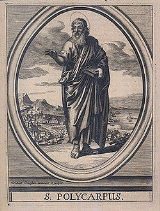
Polycarp

Encyclopedia
Saint Polycarp was a 2nd century Christian
bishop
of Smyrna
. According to the Martyrdom of Polycarp
, he died a martyr
, bound and burned at the stake, then stabbed when the fire failed to touch him. Polycarp is regarded as a saint
in the Roman Catholic
, Eastern Orthodox
, Oriental Orthodox, Anglican, and Lutheran Churches.
It is recorded by Irenaeus
, who heard him speak in his youth, and by Tertullian
, that he had been a disciple of John the Apostle
.
The early tradition that expanded upon the Martyrdom to link Polycarp in competition and contrast with John the Apostle who, though many people had tried to kill him, was not martyred but died of old age after being exiled to the island of Patmos
, is embodied in the Coptic language
fragmentary papyri (the "Harris fragments"), now in the British Library
, dating to the 3rd to 6th centuries. Frederick Weidmann, their editor, interprets the "Harris fragments" as Smyrnan hagiography
addressing Smyrna-Ephesus church rivalries, which "develops the association of Polycarp and John to a degree unwitnessed, so far as we know, either before or since." The fragments echo the Martyrology, and diverge from it.
With Clement of Rome and Ignatius of Antioch
, Polycarp is regarded as one of three chief Apostolic Fathers
. The sole surviving work attributed to his authorship is his Letter to the Philippians
; it is first recorded by Irenaeus of Lyons.
, a mosaic of references to the Greek Scriptures, preserved/produced in Irenaeus' account of Polycarp's life. It, and an account of The Martyrdom of Polycarp that takes the form of a circular letter from the church of Smyrna to the churches of Pontus
, form part of the collection of writings Roman Catholics term "The Apostolic Fathers
" to emphasize their particular closeness to the apostles in Church traditions. Outside of the Book of Acts which contains the death of Saint Stephen
, the Martyrdom is considered one of the earliest genuine accounts of a Christian martyrdom, and is one of the very few genuine accounts from the actual age of the persecutions.
and the passages in Irenaeus
' Adversus Haereses
. Other sources are the epistles of Ignatius, which include one to Polycarp and another to the Smyrnaeans
, and Polycarp's own letter to the Philippians. Other sources, such as the Life of Polycarp or excerpts from Tertullian
and Eusebius of Caesarea
are considered largely unhistorical or based on previous material. In 1999, some third to 6th century Coptic
fragments about Polycarp were also published.
, another "hearer of John" as Irenaeus interprets Papias' testimony, and a correspondent of Ignatius of Antioch
. Ignatius addressed a letter to him, and mentions him in his letters to the Ephesians and to the Magnesians.
Irenaeus claims to have been a pupil of John the Apostle and regarded the memory of Polycarp as a link to the apostolic past. Irenaeus relates how and when he became a Christian, and in his letter to Florinus
stated that he saw and heard Polycarp personally in lower Asia. In particular, he heard the account of Polycarp's discussion with "John the Presbyter
" and with others who had seen Jesus
. Irenaeus also reports that Polycarp was converted to Christianity by apostles, was consecrated a bishop, and communicated with many who had seen Jesus. He repeatedly emphasizes the very great age of Polycarp.
, was Bishop of Rome, in the 150s or 160, Polycarp visited Rome
to discuss the differences that existed between Asia
and Rome "with regard to certain things" and especially about the time of the Easter
festivals. Irenaeus said that on certain things the two bishops speedily came to an understanding, while as to the time of Easter, each adhered to his own custom, without breaking off communion
with the other. Anicetus— the Roman sources offering it as a mark of special honor— allowed Polycarp to celebrate the Eucharist
in his own church. They might have found their customs for observing the Christian Passover differed, Polycarp following the eastern practice of celebrating Passover on the 14th of Nisan, the day of the Jewish Passover
, regardless of what day of the week it fell.
dates it to the reign of Marcus Aurelius, c. 166 – 167. However, a post-Eusebian addition to the Martyrdom of Polycarp dates his death to Saturday, February 23, in the proconsulship of Statius Quadratus — which works out to be 155 or 156. These earlier dates better fit the tradition of his association with Ignatius
and John the Evangelist. However, the addition to the Martyrdom cannot be considered reliable on only its own merits. Lightfoot would argue for the earlier date of Polycarp's death, to which Killen would strongly disagree.
William Cave
wrote, "...the Sabbath or Saturday (for so the word sabbatum is constantly used in the writings of the fathers, when speaking of it as it relates to Christians) was held by them in great veneration, and especially in the Eastern parts honoured with all the public solemnities of religion."
Some feel that the expression, the Great Sabbath refers to the Christian Passover or another annual holy day. If so, then the martyrdom would have had to occur between one and two months later as Nisan 14 (the date that Polycarp observed Passover) cannot come before the end of March in any year. Other Great Sabbaths (if this is referring to what are commonly considered to be Jewish holy days, though observed by many early professors of Christ) come in the Spring, late summer, or Fall. None occur in the winter.
The Great Sabbath may be alluded to in John 7:37. This is called the Last Great Day and is a stand-alone annual holy day immediately following the Feast of Tabernacles. It is, however, disputable whether such biblical references mean a common practice or just onetime events.
, the disciple of Jesus
. He was an elder of an important congregation which was a large contributor to the founding of the Christian Church. He is from an era whose orthodoxy is widely accepted by Orthodox Churches, Oriental Churches, Seventh Day Church of God
groups, Protestants and Catholics alike. And he may have been the one who compiled, edited, and published the New Testament. All of this makes his writings of great interest.
Irenaeus
, who remembered him from his youth, said of him: "a man who was of much greater weight, and a more steadfast witness of truth, than Valentinus, and Marcion, and the rest of the heretics". Polycarp lived in an age after the deaths of the apostles, when a variety of interpretations of the sayings of Jesus were being preached. His role was to authenticate orthodox teachings through his reputed connection with the apostle John: "a high value was attached to the witness Polycarp could give as to the genuine tradition of old apostolic doctrine," Wace commented, "his testimony condemning as offensive novelties the figments of the heretical teachers. Irenaeus states (iii. 3) that on Polycarp's visit to Rome his testimony converted many disciples of Marcion and Valentinus. Surviving accounts of the bravery of this very old man in the face of death by burning at the stake added credence to his words.
Christian
A Christian is a person who adheres to Christianity, an Abrahamic, monotheistic religion based on the life and teachings of Jesus of Nazareth as recorded in the Canonical gospels and the letters of the New Testament...
bishop
Bishop
A bishop is an ordained or consecrated member of the Christian clergy who is generally entrusted with a position of authority and oversight. Within the Catholic Church, Eastern Orthodox, Oriental Orthodox Churches, in the Assyrian Church of the East, in the Independent Catholic Churches, and in the...
of Smyrna
Smyrna
Smyrna was an ancient city located at a central and strategic point on the Aegean coast of Anatolia. Thanks to its advantageous port conditions, its ease of defence and its good inland connections, Smyrna rose to prominence. The ancient city is located at two sites within modern İzmir, Turkey...
. According to the Martyrdom of Polycarp
Martyrdom of Polycarp
The Martyrdom of Polycarp is one of the works of the Apostolic Fathers, and as such is one of the very few eyewitness writings from the actual age of the persecutions. The work details Polycarp's death at the age of 86 years old, at the hands of the Romans, in the 2nd century AD...
, he died a martyr
Martyr
A martyr is somebody who suffers persecution and death for refusing to renounce, or accept, a belief or cause, usually religious.-Meaning:...
, bound and burned at the stake, then stabbed when the fire failed to touch him. Polycarp is regarded as a saint
Saint
A saint is a holy person. In various religions, saints are people who are believed to have exceptional holiness.In Christian usage, "saint" refers to any believer who is "in Christ", and in whom Christ dwells, whether in heaven or in earth...
in the Roman Catholic
Roman Catholic Church
The Catholic Church, also known as the Roman Catholic Church, is the world's largest Christian church, with over a billion members. Led by the Pope, it defines its mission as spreading the gospel of Jesus Christ, administering the sacraments and exercising charity...
, Eastern Orthodox
Eastern Orthodox Church
The Orthodox Church, officially called the Orthodox Catholic Church and commonly referred to as the Eastern Orthodox Church, is the second largest Christian denomination in the world, with an estimated 300 million adherents mainly in the countries of Belarus, Bulgaria, Cyprus, Georgia, Greece,...
, Oriental Orthodox, Anglican, and Lutheran Churches.
It is recorded by Irenaeus
Irenaeus
Saint Irenaeus , was Bishop of Lugdunum in Gaul, then a part of the Roman Empire . He was an early church father and apologist, and his writings were formative in the early development of Christian theology...
, who heard him speak in his youth, and by Tertullian
Tertullian
Quintus Septimius Florens Tertullianus, anglicised as Tertullian , was a prolific early Christian author from Carthage in the Roman province of Africa. He is the first Christian author to produce an extensive corpus of Latin Christian literature. He also was a notable early Christian apologist and...
, that he had been a disciple of John the Apostle
John the Apostle
John the Apostle, John the Apostle, John the Apostle, (Aramaic Yoħanna, (c. 6 - c. 100) was one of the Twelve Apostles of Jesus. He was the son of Zebedee and Salome, and brother of James, another of the Twelve Apostles...
.
The early tradition that expanded upon the Martyrdom to link Polycarp in competition and contrast with John the Apostle who, though many people had tried to kill him, was not martyred but died of old age after being exiled to the island of Patmos
Patmos
Patmos is a small Greek island in the Aegean Sea. One of the northernmost islands of the Dodecanese complex, it has a population of 2,984 and an area of . The highest point is Profitis Ilias, 269 meters above sea level. The Municipality of Patmos, which includes the offshore islands of Arkoi ,...
, is embodied in the Coptic language
Coptic language
Coptic or Coptic Egyptian is the current stage of the Egyptian language, a northern Afro-Asiatic language spoken in Egypt until at least the 17th century. Egyptian began to be written using the Greek alphabet in the 1st century...
fragmentary papyri (the "Harris fragments"), now in the British Library
British Library
The British Library is the national library of the United Kingdom, and is the world's largest library in terms of total number of items. The library is a major research library, holding over 150 million items from every country in the world, in virtually all known languages and in many formats,...
, dating to the 3rd to 6th centuries. Frederick Weidmann, their editor, interprets the "Harris fragments" as Smyrnan hagiography
Hagiography
Hagiography is the study of saints.From the Greek and , it refers literally to writings on the subject of such holy people, and specifically to the biographies of saints and ecclesiastical leaders. The term hagiology, the study of hagiography, is also current in English, though less common...
addressing Smyrna-Ephesus church rivalries, which "develops the association of Polycarp and John to a degree unwitnessed, so far as we know, either before or since." The fragments echo the Martyrology, and diverge from it.
With Clement of Rome and Ignatius of Antioch
Ignatius of Antioch
Ignatius of Antioch was among the Apostolic Fathers, was the third Bishop of Antioch, and was a student of John the Apostle. En route to his martyrdom in Rome, Ignatius wrote a series of letters which have been preserved as an example of very early Christian theology...
, Polycarp is regarded as one of three chief Apostolic Fathers
Apostolic Fathers
The Apostolic Fathers are a small number of Early Christian authors who lived and wrote in the second half of the first century and the first half of the second century. They are acknowledged as leaders in the early church, although their writings were not included in the New Testament...
. The sole surviving work attributed to his authorship is his Letter to the Philippians
Polycarp's letter to the Philippians
The Letter to the Philippians is an epistle composed around 110 to 140 ADby one of the Apostolic Fathers, Polycarp of Smyrna from Antioch, to the early Christian church in Philippi...
; it is first recorded by Irenaeus of Lyons.
Surviving writings and early accounts
The sole surviving work attributed to him is Polycarp's letter to the PhilippiansPolycarp's letter to the Philippians
The Letter to the Philippians is an epistle composed around 110 to 140 ADby one of the Apostolic Fathers, Polycarp of Smyrna from Antioch, to the early Christian church in Philippi...
, a mosaic of references to the Greek Scriptures, preserved/produced in Irenaeus' account of Polycarp's life. It, and an account of The Martyrdom of Polycarp that takes the form of a circular letter from the church of Smyrna to the churches of Pontus
Pontus
Pontus or Pontos is a historical Greek designation for a region on the southern coast of the Black Sea, located in modern-day northeastern Turkey. The name was applied to the coastal region in antiquity by the Greeks who colonized the area, and derived from the Greek name of the Black Sea: Πόντος...
, form part of the collection of writings Roman Catholics term "The Apostolic Fathers
Apostolic Fathers
The Apostolic Fathers are a small number of Early Christian authors who lived and wrote in the second half of the first century and the first half of the second century. They are acknowledged as leaders in the early church, although their writings were not included in the New Testament...
" to emphasize their particular closeness to the apostles in Church traditions. Outside of the Book of Acts which contains the death of Saint Stephen
Saint Stephen
Saint Stephen The Protomartyr , the protomartyr of Christianity, is venerated as a saint in the Roman Catholic, Anglican, Lutheran, Oriental Orthodox and Eastern Orthodox Churches....
, the Martyrdom is considered one of the earliest genuine accounts of a Christian martyrdom, and is one of the very few genuine accounts from the actual age of the persecutions.
Life
There are two chief sources of information concerning the life of Polycarp: the letter of the Smyrnaeans recounting the martyrdom of PolycarpMartyrdom of Polycarp
The Martyrdom of Polycarp is one of the works of the Apostolic Fathers, and as such is one of the very few eyewitness writings from the actual age of the persecutions. The work details Polycarp's death at the age of 86 years old, at the hands of the Romans, in the 2nd century AD...
and the passages in Irenaeus
Irenaeus
Saint Irenaeus , was Bishop of Lugdunum in Gaul, then a part of the Roman Empire . He was an early church father and apologist, and his writings were formative in the early development of Christian theology...
' Adversus Haereses
On the Detection and Overthrow of the So-Called Gnosis
On the Detection and Overthrow of the So-Called Gnosis, today also called On the Detection and Overthrow of Knowledge Falsely So Called , commonly called Against Heresies , is a five-volume work written by St. Irenaeus in the 2nd century...
. Other sources are the epistles of Ignatius, which include one to Polycarp and another to the Smyrnaeans
Letter to the Smyrnaeans
The Letter to the Smyrnaeans was written by Saint Ignatius of Antioch around AD 110 to the Early Christians in Smyrna.It mentions the resurrection of Jesus:...
, and Polycarp's own letter to the Philippians. Other sources, such as the Life of Polycarp or excerpts from Tertullian
Tertullian
Quintus Septimius Florens Tertullianus, anglicised as Tertullian , was a prolific early Christian author from Carthage in the Roman province of Africa. He is the first Christian author to produce an extensive corpus of Latin Christian literature. He also was a notable early Christian apologist and...
and Eusebius of Caesarea
Eusebius of Caesarea
Eusebius of Caesarea also called Eusebius Pamphili, was a Roman historian, exegete and Christian polemicist. He became the Bishop of Caesarea in Palestine about the year 314. Together with Pamphilus, he was a scholar of the Biblical canon...
are considered largely unhistorical or based on previous material. In 1999, some third to 6th century Coptic
Coptic language
Coptic or Coptic Egyptian is the current stage of the Egyptian language, a northern Afro-Asiatic language spoken in Egypt until at least the 17th century. Egyptian began to be written using the Greek alphabet in the 1st century...
fragments about Polycarp were also published.
Papias
According to Irenaeus, Polycarp was a companion of PapiasPapias
Papias was a bishop of the early Church, canonized as a saint. Eusebius of Caesarea calls him "Bishop of Hierapolis" which is 22 km from Laodicea and near Colossae Papias (writing in the first third of the 2nd century) was a bishop of the early Church, canonized as a saint. Eusebius of...
, another "hearer of John" as Irenaeus interprets Papias' testimony, and a correspondent of Ignatius of Antioch
Ignatius of Antioch
Ignatius of Antioch was among the Apostolic Fathers, was the third Bishop of Antioch, and was a student of John the Apostle. En route to his martyrdom in Rome, Ignatius wrote a series of letters which have been preserved as an example of very early Christian theology...
. Ignatius addressed a letter to him, and mentions him in his letters to the Ephesians and to the Magnesians.
Irenaeus claims to have been a pupil of John the Apostle and regarded the memory of Polycarp as a link to the apostolic past. Irenaeus relates how and when he became a Christian, and in his letter to Florinus
Florinus
Florinus can refer to:*Florinus, presbyter at Rome, one of the Fathers of Christian Gnosticism.*Florinus of Remüs, 9th century saint.*Henrik Florinus , Finnish priest, writer and translator....
stated that he saw and heard Polycarp personally in lower Asia. In particular, he heard the account of Polycarp's discussion with "John the Presbyter
John the Presbyter
John the Presbyter is an obscure figure of the early Church who is either distinguished from or identified with the Apostle John, by some also John the Divine. He appears in fragments from the church father Papias of Hierapolis as one of the author's sources and is first unequivocally distinguished...
" and with others who had seen Jesus
Jesus
Jesus of Nazareth , commonly referred to as Jesus Christ or simply as Jesus or Christ, is the central figure of Christianity...
. Irenaeus also reports that Polycarp was converted to Christianity by apostles, was consecrated a bishop, and communicated with many who had seen Jesus. He repeatedly emphasizes the very great age of Polycarp.
Visit to Anicetus
According to Irenaeus, during the time his fellow Syrian, AnicetusPope Anicetus
Pope Saint Anicetus was Pope of the Catholic Church from about 150 to about 167 . His name is Greek for unconquered...
, was Bishop of Rome, in the 150s or 160, Polycarp visited Rome
Rome
Rome is the capital of Italy and the country's largest and most populated city and comune, with over 2.7 million residents in . The city is located in the central-western portion of the Italian Peninsula, on the Tiber River within the Lazio region of Italy.Rome's history spans two and a half...
to discuss the differences that existed between Asia
Asia Minor
Asia Minor is a geographical location at the westernmost protrusion of Asia, also called Anatolia, and corresponds to the western two thirds of the Asian part of Turkey...
and Rome "with regard to certain things" and especially about the time of the Easter
Easter
Easter is the central feast in the Christian liturgical year. According to the Canonical gospels, Jesus rose from the dead on the third day after his crucifixion. His resurrection is celebrated on Easter Day or Easter Sunday...
festivals. Irenaeus said that on certain things the two bishops speedily came to an understanding, while as to the time of Easter, each adhered to his own custom, without breaking off communion
Full communion
In Christian ecclesiology, full communion is a relationship between church organizations or groups that mutually recognize their sharing the essential doctrines....
with the other. Anicetus— the Roman sources offering it as a mark of special honor— allowed Polycarp to celebrate the Eucharist
Eucharist
The Eucharist , also called Holy Communion, the Sacrament of the Altar, the Blessed Sacrament, the Lord's Supper, and other names, is a Christian sacrament or ordinance...
in his own church. They might have found their customs for observing the Christian Passover differed, Polycarp following the eastern practice of celebrating Passover on the 14th of Nisan, the day of the Jewish Passover
Passover
Passover is a Jewish holiday and festival. It commemorates the story of the Exodus, in which the ancient Israelites were freed from slavery in Egypt...
, regardless of what day of the week it fell.
Date of martyrdom
In the Martyrdom, Polycarp is recorded as saying on the day of his death, "Eighty and six years I have served him," which could indicate that he was then eighty-six years old or that he may have lived eighty-six years after his conversion. Polycarp goes on to say, "How then can I blaspheme my King and Saviour? Bring forth what thou wilt." Polycarp was burned at the stake for refusing to burn incense to the Roman Emperor. The date of Polycarp's death is in dispute. EusebiusEusebius of Caesarea
Eusebius of Caesarea also called Eusebius Pamphili, was a Roman historian, exegete and Christian polemicist. He became the Bishop of Caesarea in Palestine about the year 314. Together with Pamphilus, he was a scholar of the Biblical canon...
dates it to the reign of Marcus Aurelius, c. 166 – 167. However, a post-Eusebian addition to the Martyrdom of Polycarp dates his death to Saturday, February 23, in the proconsulship of Statius Quadratus — which works out to be 155 or 156. These earlier dates better fit the tradition of his association with Ignatius
Ignatius of Antioch
Ignatius of Antioch was among the Apostolic Fathers, was the third Bishop of Antioch, and was a student of John the Apostle. En route to his martyrdom in Rome, Ignatius wrote a series of letters which have been preserved as an example of very early Christian theology...
and John the Evangelist. However, the addition to the Martyrdom cannot be considered reliable on only its own merits. Lightfoot would argue for the earlier date of Polycarp's death, to which Killen would strongly disagree.
Great Sabbath
Because the Smyrnaean letter known as the Martyrdom of Polycarp states that Polycarp was taken on the day of the Sabbath and killed on the Great Sabbath, some believe that this is evidence that the Smyrnaeans under Polycarp observed the seventh day Sabbath.William Cave
William Cave
William Cave was an English divine and patristic scholar.-Life:Cave was born at Pickwell, Leicestershire, of which parish his father, John Cave was vicar. He was educated at Oakham School and St. John's College, Cambridge. He took his B.A. degree in 1656, his M.A. in 1660, his D.D. in 1672, and...
wrote, "...the Sabbath or Saturday (for so the word sabbatum is constantly used in the writings of the fathers, when speaking of it as it relates to Christians) was held by them in great veneration, and especially in the Eastern parts honoured with all the public solemnities of religion."
Some feel that the expression, the Great Sabbath refers to the Christian Passover or another annual holy day. If so, then the martyrdom would have had to occur between one and two months later as Nisan 14 (the date that Polycarp observed Passover) cannot come before the end of March in any year. Other Great Sabbaths (if this is referring to what are commonly considered to be Jewish holy days, though observed by many early professors of Christ) come in the Spring, late summer, or Fall. None occur in the winter.
The Great Sabbath may be alluded to in John 7:37. This is called the Last Great Day and is a stand-alone annual holy day immediately following the Feast of Tabernacles. It is, however, disputable whether such biblical references mean a common practice or just onetime events.
Importance
Polycarp occupies an important place in the history of the early Christian Church. He is among the earliest Christians whose writings survive. It is probable that he knew John the ApostleJohn the Apostle
John the Apostle, John the Apostle, John the Apostle, (Aramaic Yoħanna, (c. 6 - c. 100) was one of the Twelve Apostles of Jesus. He was the son of Zebedee and Salome, and brother of James, another of the Twelve Apostles...
, the disciple of Jesus
Jesus
Jesus of Nazareth , commonly referred to as Jesus Christ or simply as Jesus or Christ, is the central figure of Christianity...
. He was an elder of an important congregation which was a large contributor to the founding of the Christian Church. He is from an era whose orthodoxy is widely accepted by Orthodox Churches, Oriental Churches, Seventh Day Church of God
Adventist
Adventism is a Christian movement which began in the 19th century, in the context of the Second Great Awakening revival in the United States. The name refers to belief in the imminent Second Coming of Jesus Christ. It was started by William Miller, whose followers became known as Millerites...
groups, Protestants and Catholics alike. And he may have been the one who compiled, edited, and published the New Testament. All of this makes his writings of great interest.
Irenaeus
Irenaeus
Saint Irenaeus , was Bishop of Lugdunum in Gaul, then a part of the Roman Empire . He was an early church father and apologist, and his writings were formative in the early development of Christian theology...
, who remembered him from his youth, said of him: "a man who was of much greater weight, and a more steadfast witness of truth, than Valentinus, and Marcion, and the rest of the heretics". Polycarp lived in an age after the deaths of the apostles, when a variety of interpretations of the sayings of Jesus were being preached. His role was to authenticate orthodox teachings through his reputed connection with the apostle John: "a high value was attached to the witness Polycarp could give as to the genuine tradition of old apostolic doctrine," Wace commented, "his testimony condemning as offensive novelties the figments of the heretical teachers. Irenaeus states (iii. 3) that on Polycarp's visit to Rome his testimony converted many disciples of Marcion and Valentinus. Surviving accounts of the bravery of this very old man in the face of death by burning at the stake added credence to his words.
External links
- Letter to the Philippians from the Ante-Nicene Fathers
- Early Christian Writings: Polycarp; text and introductions
- Polycarp: The Apostolic Legacy
- Paul N. Tobin, "The Apostolic Succession: Polycarp and Clement": A skeptical assessment of inconsistencies in the tradition
- The Martyrdom of Polycarp: The contemporary account of his death in the letter to the Smyrnaeans.
- Saint Polycarp of Smyrna at Patron Saints Index
- The Golden Legend: Polycarp of Smyrna