

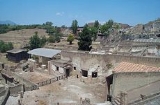
Herculaneum

Encyclopedia
Herculaneum was an ancient Roman
town destroyed by volcanic
pyroclastic flow
s in AD 79, located in the territory of the current commune of Ercolano
, in the Italian region
of Campania
in the shadow of Mt. Vesuvius.
It is most famous for having been lost, along with Pompeii
, Stabiae
and Oplontis
, in the eruption of Mount Vesuvius
though Pompeii is the most famous. Vesuvius started erupting on August 24, AD 79, which buried them in superheated pyroclastic material that has solidified into volcanic tuff
. It also became famous as the source of the first Roman skeletal and physical remains available for study that were located by science, for the Romans
almost universally cremated
their dead. Since the discovery of bones in 1981, some 300 skeletons have been found, most along the sea shorethe town itself having been effectively evacuated. Herculaneum was a smaller town with a wealthier population than Pompeii at the time of the destruction.
 Ancient tradition connected Herculaneum with the name of the Greek hero Herakles
(Hercules
in Latin
and consequently Roman Mythology
), an indication that the city was of Greek origin. In fact, it seems that some forefathers of the Samnite
tribes of the Italian mainland founded the first civilization on the site of Herculaneum at the end of the 6th century BC. Soon after, the town came under Greek control and was used as a trading post because of its proximity to the Gulf of Naples
. The Greeks named the city Ηρακλείου. In the 4th century BC, Herculaneum again came under the domination of the Samnites. The city remained under Samnite control until it became a Roman municipium in 89 BC, when, having participated in the Social War ("war of the allies" against Rome), it was defeated by Titus Didius
, a legate of Sulla
.
After the eruption of Mount Vesuvius in 79 AD, the town of Herculaneum was buried under approximately 20 metres (50–60 feet) of mud and ash. It lay hidden and nearly intact for more than 1600 years until it was accidentally discovered by some workers digging a well in 1709. From there, the excavation process began but is still incomplete. Today, the Italian towns of Ercolano
and Portici
lie on the approximate site of Herculaneum. Until 1969 the town of Ercolano was called Resina, and it changed its name to Ercolano, the Italian modernization of the ancient name in honour of the old city.
The inhabitants worshipped above all Hercules, who was believed to be the founder of both the town and Mount Vesuvius. Other important deities worshipped include Venus
, who was believed to be Hercules' lover, and Apollo
.
Based on the archaeological excavations on the one hand and two letters of Pliny the Younger
to the Roman historian Tacitus
on the other hand, the course of the eruption can be reconstructed.
At around 1 pm on August 24, Vesuvius began spewing volcanic ash and stone thousands of meters into the sky. When it reached the tropopause
(the boundary between the troposphere
and the stratosphere
), the top of the cloud flattened, prompting Pliny to describe it to Tacitus as a Stone Pine
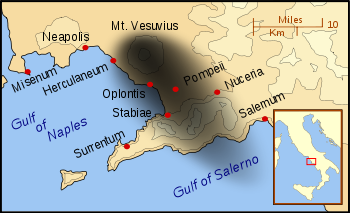
tree. The prevailing winds at the time blew toward the southeast, causing the volcanic material to fall primarily on the city of Pompeii
and the surrounding area. Since Herculaneum lay to the west of Vesuvius, it was only mildly affected by the first phase of the eruption. While roofs in Pompeii collapsed under the weight of falling debris, only a few centimetres of ash fell on Herculaneum, causing little damage but nonetheless prompting many inhabitants to flee.
Because initial excavations revealed only a few skeletons, it was long thought that nearly all of the inhabitants had managed to escape. It wasn't until 1982, when the excavations reached boat houses on the beach area, that this view changed. In the suburban area, archaeologists discovered several hundred skeletons huddled close together on the beach and in 12 boat houses facing the sea. Further excavations in the 1990s confirmed that at least 300 people had taken refuge in those chambers, while the town was almost completely evacuated.
 During the night, the eruptive column which had risen into the stratosphere collapsed down onto Vesuvius and its flanks. The first pyroclastic surge
, formed by a mixture of ash and hot gases, billowed through the evacuated town of Herculaneum at 100 mi/h. At about 1am it reached the beach and the boat houses, where those waiting for rescue were killed instantly by the intense heat, despite being sheltered from the direct impact. The study of the victims' postures and the effects on their skeletons indicate that the emplacement of the first surge caused the instant death of these people as a result of fulminant shock due to a temperature of about 500 °C (932 °F). The intense heat caused explosion of the skulls, fracture of long bones and teeth, and contraction of hands and feet.
A succession of six flows and surges buried the city's buildings from the bottom up, causing them little damage and preserving almost intact structures, objects and victims. The surprisingly good state of preservation of things and victims is due to several factors:
 Excavation began at modern Ercolano
in 1738 by Spanish engineer Rocque Joaquin de Alcubierre
. The elaborate publication of Le Antichità di Ercolano ("The Antiquities of Herculaneum") under the patronage of the King of the Two Sicilies
had an effect on incipient European Neoclassicism
out of all proportion to its limited circulation; in the later 18th century, motifs from Herculaneum began to appear on stylish furnishings from decorative wall-paintings and tripod tables to perfume burners and teacups. However, excavation ceased once the nearby town of Pompeii was discovered, which was significantly easier to excavate due to the reduced amount of debris covering the site (four meters as opposed to Herculaneum's twenty meters). In the twentieth century, excavation once again resumed in the town. However, many public and private buildings, including the forum complex, are yet to be excavated.
, a physical anthropologist from the United States, to oversee the excavation and study the bones of the victims found on the beach and within the first six boat chambers. This research was funded with a grant from the National Geographic Society
.
Until this discovery, there were few Roman skeletal remains available for academic study, as Ancient Romans
regularly practiced cremation
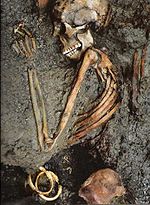
. Excavations in the port area of Herculaneum initially turned up more than 55 skeletons: 30 adult males, 13 adult females and 12 children. The skeletons were found on the seafront, where it is believed they had fled in an attempt to escape the volcanic eruption. This group includes the 'Ring Lady' (image at right), named for the rings on her fingers.
Through the chemical analysis of those remains, Dr. Bisel was able to gain greater insight into the health and nutrition of the Herculaneum population. Quantities of lead were found in some of the skeletons, which led to speculation of lead poisoning. The physical examination of the bones yielded additional information. The presence of scarring on the pelvis, for instance, gave some indication of the number of children a woman had borne.
In 1997-1999, new excavations conducted by Pier Paolo Petrone, a bioanthropologist at the Museum of Anthropology of the University of Naples Federico II
, in collaboration with Giuseppe Mastrolorenzo, volcanologist at the Vesuvius Observatory
, and Mario Pagano, then director at the Herculaneum Site, investigated three left unearthed chambers, within a scientific project finalized to study directly in situ the effects of the eruption on people, structures and things. The results of this research, published by Nature
in 2001, had a wide echo through world press and several scientific documentaries produced by international broadcasters.
Casts of the skeletons were also produced, to replace the original bones after taphonomic study, scientific documentation and excavation. In contrast to Pompeii, where casts resembling the body features of the victims were produced by filling the body imprints in the ash deposit with plaster, the shape of corpses of those killed at Herculaneum could not be preserved, due to the rapid vaporization and replacement of the flesh of the victims by the hot ash (ca. 500°C). A cast of the victims' skeletons unearthed within chamber 10 is on display at the Museum of Anthropology in Naples.
Recent multidisciplinary research on the lethal effects produced by the AD 79 pyroclastic surges in the Vesuvius area definitely showed that at Pompeii and vicinity heat was the main cause of death of people, heretofore supposed to have died by ash suffocation. This study shows that exposure to at least 250°C hot surges even at a distance of 10 kilometres from the vent was sufficient to cause instant death of all residents, even if they were sheltered within buildings.
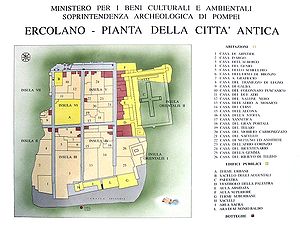
Hence we have Insula II - Insula VII running anti-clockwise from Insula II. To the east are two additional blocks: Orientalis I (oI) and Orientalis II (oII). To the south of Orientalis I (oI) lies one additional group of buildings known as the 'Suburban District' (SD).
Individual buildings having their own entrance number. For example, the House of the Deer is labelled (Ins IV, 3).
and Io
which once adorned a reception room off the large peristyle. The fresco is now sadly lost, but its name lives on. This building must have been one of the finer villas in Herculaneum.
The discovery of the house in the late 1820s was notable because it was the first time a second floor had been unearthed in such detail. The excavation revealed a second floor balcony overlooking Cardo III. Also wooden shelving and cupboards. Sadly with the passing of time, these elements have now been lost.
The atrium is covered, so lacks the usual impluvium. It retains its original flooring of opus tesselatum and opus sectile. Off the atrium is a biclinium richly decorated with frescoes in the fourth style and a large triclinium which originally had a marble floor. A number of other rooms, one of which is the apsed alcove after which the house was named, can be reached via a hall which gets its light from a small courtyard.
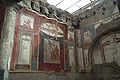 Temple of the augustales
or priests of the Imperial cult
.
" was once identified as the magnificent seafront retreat for Lucius Calpurnius Piso Caesoninus
, Julius Caesar
's father-in-law. However, today it has clearly emerged that the objects thought to be associated with Lucius Calpurnius Piso Caesonius correspond more closely to a greatly standardized assemblage, and cannot indicate, with certainty, the owner of the villa. The villa stretches down towards the sea in four terraces. Piso, a literate man who patronized poets and philosophers, built there a fine library, the only one to survive intact from antiquity. Scrolls
from the villa are stored at the National Library, Naples
. The scrolls are badly carbonized, but a large number have been unrolled, with varying degrees of success. Computer-enhanced multi-spectral imaging, in the infra-red range, helps make the ink legible. There is now a real prospect that it will be possible to read the unopened scrolls using X-rays. The same techniques could be applied to the scrolls waiting to be discovered in the as-yet unexcavated part of the villa, removing the need for potentially damaging the unrolled scrolls.
A team spent a month in summer 2009, making numerous X-ray scans of two of the scrolls that are stored at the French National Academy in Paris
. They hoped that computer processing would convert the scans into digital images showing the interiors of the scrolls and revealing the ancient writing. The main fear, however, was that the Roman writers might have used carbon-based inks, which would be essentially invisible to the scans.
That fear has turned out to be fact.
They now hope that re-scanning the scrolls with more powerful X-ray equipment will reveal the text.
, preservation of the skeletal remains became a high priority. The carbonised remains of organic materials, when exposed to the air, deteriorated over a matter of days, and destroyed many of the remains until a way of preserving them was formed.
Today, tourism and vandalism has damaged many of the areas open to the public, and water damage coming from the modern Ercolano
has undermined many of the foundations of the buildings. Reconstruction efforts have often proved counterproductive. However, in modern times conservation efforts have been more successful. Today excavations have been temporarily discontinued, in order to direct all funding to help save the city.
A large number of artifacts
come from Herculaneum are preserved in the Naples National Archaeological Museum
.
}
}}
Roman Empire
The Roman Empire was the post-Republican period of the ancient Roman civilization, characterised by an autocratic form of government and large territorial holdings in Europe and around the Mediterranean....
town destroyed by volcanic
Volcano
2. Bedrock3. Conduit 4. Base5. Sill6. Dike7. Layers of ash emitted by the volcano8. Flank| 9. Layers of lava emitted by the volcano10. Throat11. Parasitic cone12. Lava flow13. Vent14. Crater15...
pyroclastic flow
Pyroclastic flow
A pyroclastic flow is a fast-moving current of superheated gas and rock , which reaches speeds moving away from a volcano of up to 700 km/h . The flows normally hug the ground and travel downhill, or spread laterally under gravity...
s in AD 79, located in the territory of the current commune of Ercolano
Ercolano
Ercolano is a town and comune in the province of Naples, Campania . It lies at the western foot of Mount Vesuvius, on the Bay of Naples, just southeast of the city of Naples. The medieval town of Resina was built on the volcanic material left by the eruption of Vesuvius that destroyed the ancient...
, in the Italian region
Regions of Italy
The regions of Italy are the first-level administrative divisions of the state, constituting its first NUTS administrative level. There are twenty regions, of which five are constitutionally given a broader amount of autonomy granted by special statutes....
of Campania
Campania
Campania is a region in southern Italy. The region has a population of around 5.8 million people, making it the second-most-populous region of Italy; its total area of 13,590 km² makes it the most densely populated region in the country...
in the shadow of Mt. Vesuvius.
It is most famous for having been lost, along with Pompeii
Pompeii
The city of Pompeii is a partially buried Roman town-city near modern Naples in the Italian region of Campania, in the territory of the comune of Pompei. Along with Herculaneum, Pompeii was destroyed and completely buried during a long catastrophic eruption of the volcano Mount Vesuvius spanning...
, Stabiae
Stabiae
Stabiae was an ancient Roman town, located close to the modern town of Castellammare di Stabia approximately 4.5 km southwest of Pompeii. It was positioned on a 50 m high headland overlooking the Gulf of Naples...
and Oplontis
Oplontis
Oplontis was a town near Pompeii, in the Roman Empire. On August 24, AD 79, the eruption of Mount Vesuvius buried it under a deep layer of ash. It is today the location of the Villa Poppaea, the villa of the wife of Emperor Nero, which was excavated in the mid-20th century and is open to the...
, in the eruption of Mount Vesuvius
Mount Vesuvius
Mount Vesuvius is a stratovolcano in the Gulf of Naples, Italy, about east of Naples and a short distance from the shore. It is the only volcano on the European mainland to have erupted within the last hundred years, although it is not currently erupting...
though Pompeii is the most famous. Vesuvius started erupting on August 24, AD 79, which buried them in superheated pyroclastic material that has solidified into volcanic tuff
Tuff
Tuff is a type of rock consisting of consolidated volcanic ash ejected from vents during a volcanic eruption. Tuff is sometimes called tufa, particularly when used as construction material, although tufa also refers to a quite different rock. Rock that contains greater than 50% tuff is considered...
. It also became famous as the source of the first Roman skeletal and physical remains available for study that were located by science, for the Romans
Roman Empire
The Roman Empire was the post-Republican period of the ancient Roman civilization, characterised by an autocratic form of government and large territorial holdings in Europe and around the Mediterranean....
almost universally cremated
Cremation
Cremation is the process of reducing bodies to basic chemical compounds such as gasses and bone fragments. This is accomplished through high-temperature burning, vaporization and oxidation....
their dead. Since the discovery of bones in 1981, some 300 skeletons have been found, most along the sea shorethe town itself having been effectively evacuated. Herculaneum was a smaller town with a wealthier population than Pompeii at the time of the destruction.
History
Heracles
Heracles ,born Alcaeus or Alcides , was a divine hero in Greek mythology, the son of Zeus and Alcmene, foster son of Amphitryon and great-grandson of Perseus...
(Hercules
Hercules
Hercules is the Roman name for Greek demigod Heracles, son of Zeus , and the mortal Alcmene...
in Latin
Latin
Latin is an Italic language originally spoken in Latium and Ancient Rome. It, along with most European languages, is a descendant of the ancient Proto-Indo-European language. Although it is considered a dead language, a number of scholars and members of the Christian clergy speak it fluently, and...
and consequently Roman Mythology
Roman mythology
Roman mythology is the body of traditional stories pertaining to ancient Rome's legendary origins and religious system, as represented in the literature and visual arts of the Romans...
), an indication that the city was of Greek origin. In fact, it seems that some forefathers of the Samnite
Samnium
Samnium is a Latin exonym for a region of south or south and central Italy in Roman times. The name survives in Italian today, but today's territory comprising it is only a small portion of what it once was. The populations of Samnium were called Samnites by the Romans...
tribes of the Italian mainland founded the first civilization on the site of Herculaneum at the end of the 6th century BC. Soon after, the town came under Greek control and was used as a trading post because of its proximity to the Gulf of Naples
Gulf of Naples
The Gulf of Naples is a c. 15 km wide gulf located in the south western coast of Italy, . It opens to the west into the Mediterranean Sea. It is bordered on the north by the cities of Naples and Pozzuoli, on the east by Mount Vesuvius, and on the south by the Sorrentine Peninsula and the main...
. The Greeks named the city Ηρακλείου. In the 4th century BC, Herculaneum again came under the domination of the Samnites. The city remained under Samnite control until it became a Roman municipium in 89 BC, when, having participated in the Social War ("war of the allies" against Rome), it was defeated by Titus Didius
Titus Didius
Titus Didius was a general and politician of the Roman Republic. He is credited with the restoration of the Villa Publica, and is notorious for his proconsulship in Hispania Citerior ....
, a legate of Sulla
Lucius Cornelius Sulla
Lucius Cornelius Sulla Felix , known commonly as Sulla, was a Roman general and statesman. He had the rare distinction of holding the office of consul twice, as well as that of dictator...
.
After the eruption of Mount Vesuvius in 79 AD, the town of Herculaneum was buried under approximately 20 metres (50–60 feet) of mud and ash. It lay hidden and nearly intact for more than 1600 years until it was accidentally discovered by some workers digging a well in 1709. From there, the excavation process began but is still incomplete. Today, the Italian towns of Ercolano
Ercolano
Ercolano is a town and comune in the province of Naples, Campania . It lies at the western foot of Mount Vesuvius, on the Bay of Naples, just southeast of the city of Naples. The medieval town of Resina was built on the volcanic material left by the eruption of Vesuvius that destroyed the ancient...
and Portici
Portici
Portici is a town and comune of the Province of Naples in the Campania region of southern Italy. It is the site of the Portici Royal Palace.-Geography:...
lie on the approximate site of Herculaneum. Until 1969 the town of Ercolano was called Resina, and it changed its name to Ercolano, the Italian modernization of the ancient name in honour of the old city.
The inhabitants worshipped above all Hercules, who was believed to be the founder of both the town and Mount Vesuvius. Other important deities worshipped include Venus
Venus (mythology)
Venus is a Roman goddess principally associated with love, beauty, sex,sexual seduction and fertility, who played a key role in many Roman religious festivals and myths...
, who was believed to be Hercules' lover, and Apollo
Apollo
Apollo is one of the most important and complex of the Olympian deities in Greek and Roman mythology...
.
The eruption of 79 AD
The catastrophic eruption of Mt. Vesuvius occurred on the afternoon of August 24, 79 AD. Because Vesuvius had been dormant for approximately 800 years, it was no longer even recognized as a volcano.Based on the archaeological excavations on the one hand and two letters of Pliny the Younger
Pliny the Younger
Gaius Plinius Caecilius Secundus, born Gaius Caecilius or Gaius Caecilius Cilo , better known as Pliny the Younger, was a lawyer, author, and magistrate of Ancient Rome. Pliny's uncle, Pliny the Elder, helped raise and educate him...
to the Roman historian Tacitus
Tacitus
Publius Cornelius Tacitus was a senator and a historian of the Roman Empire. The surviving portions of his two major works—the Annals and the Histories—examine the reigns of the Roman Emperors Tiberius, Claudius, Nero and those who reigned in the Year of the Four Emperors...
on the other hand, the course of the eruption can be reconstructed.
At around 1 pm on August 24, Vesuvius began spewing volcanic ash and stone thousands of meters into the sky. When it reached the tropopause
Tropopause
The tropopause is the atmospheric boundary between the troposphere and the stratosphere.-Definition:Going upward from the surface, it is the point where air ceases to cool with height, and becomes almost completely dry...
(the boundary between the troposphere
Troposphere
The troposphere is the lowest portion of Earth's atmosphere. It contains approximately 80% of the atmosphere's mass and 99% of its water vapor and aerosols....
and the stratosphere
Stratosphere
The stratosphere is the second major layer of Earth's atmosphere, just above the troposphere, and below the mesosphere. It is stratified in temperature, with warmer layers higher up and cooler layers farther down. This is in contrast to the troposphere near the Earth's surface, which is cooler...
), the top of the cloud flattened, prompting Pliny to describe it to Tacitus as a Stone Pine
Stone Pine
The Stone Pine , is also called Italian Stone Pine, or Umbrella Pine , and Parasol Pine. It is in the pine family Pinaceae and occasionally listed under the invalid name Pinus sativa. The tree is native to the Mediterranean region...
tree. The prevailing winds at the time blew toward the southeast, causing the volcanic material to fall primarily on the city of Pompeii
Pompeii
The city of Pompeii is a partially buried Roman town-city near modern Naples in the Italian region of Campania, in the territory of the comune of Pompei. Along with Herculaneum, Pompeii was destroyed and completely buried during a long catastrophic eruption of the volcano Mount Vesuvius spanning...
and the surrounding area. Since Herculaneum lay to the west of Vesuvius, it was only mildly affected by the first phase of the eruption. While roofs in Pompeii collapsed under the weight of falling debris, only a few centimetres of ash fell on Herculaneum, causing little damage but nonetheless prompting many inhabitants to flee.
Because initial excavations revealed only a few skeletons, it was long thought that nearly all of the inhabitants had managed to escape. It wasn't until 1982, when the excavations reached boat houses on the beach area, that this view changed. In the suburban area, archaeologists discovered several hundred skeletons huddled close together on the beach and in 12 boat houses facing the sea. Further excavations in the 1990s confirmed that at least 300 people had taken refuge in those chambers, while the town was almost completely evacuated.
Pyroclastic surge
A pyroclastic surge is a fluidized mass of turbulent gas and rock fragments which is ejected during some volcanic eruptions. It is similar to a pyroclastic flow but it has a lower density or contains a much higher proportion of gas to rock ratio, which makes it more turbulent and allows it to rise...
, formed by a mixture of ash and hot gases, billowed through the evacuated town of Herculaneum at 100 mi/h. At about 1am it reached the beach and the boat houses, where those waiting for rescue were killed instantly by the intense heat, despite being sheltered from the direct impact. The study of the victims' postures and the effects on their skeletons indicate that the emplacement of the first surge caused the instant death of these people as a result of fulminant shock due to a temperature of about 500 °C (932 °F). The intense heat caused explosion of the skulls, fracture of long bones and teeth, and contraction of hands and feet.
A succession of six flows and surges buried the city's buildings from the bottom up, causing them little damage and preserving almost intact structures, objects and victims. The surprisingly good state of preservation of things and victims is due to several factors:
- The rapid and complete filling and covering of Herculaneum buildings and the town itself by the ash surges and flows emplacement preserved most of structures from collapse.
- The intense heat of the first pyroclastic surge carbonizedCarbonizationCarbonization or carbonisation is the term for the conversion of an organic substance into carbon or a carbon-containing residue through pyrolysis or destructive distillation. It is often used in organic chemistry with reference to the generation of coal gas and coal tar from raw coal...
the organic materials and extracted the water from them. - The signs of bone carbonization and the preservation of victims' joint connections indicate that most soft body tissues were destroyed by the intense heat and then replaced rapidly by ash. The heat of the ash was sufficient to vaporize most of the organic matter, so the initial violent vaporization caused a sudden drop in ash temperature and the corpses were preserved intact in their original postures.
- The deep (up to 25 meters), dense tuffTuffTuff is a type of rock consisting of consolidated volcanic ash ejected from vents during a volcanic eruption. Tuff is sometimes called tufa, particularly when used as construction material, although tufa also refers to a quite different rock. Rock that contains greater than 50% tuff is considered...
formed an airtight seal over Herculaneum for 1,700 years
Excavation
Ercolano
Ercolano is a town and comune in the province of Naples, Campania . It lies at the western foot of Mount Vesuvius, on the Bay of Naples, just southeast of the city of Naples. The medieval town of Resina was built on the volcanic material left by the eruption of Vesuvius that destroyed the ancient...
in 1738 by Spanish engineer Rocque Joaquin de Alcubierre
Rocque Joaquin de Alcubierre
Rocque Joaquin de Alcubierre was a captain in the Spanish Army, who first excavated the Roman ruins at Pompeii.- Herculaneum and Pompeii:...
. The elaborate publication of Le Antichità di Ercolano ("The Antiquities of Herculaneum") under the patronage of the King of the Two Sicilies
Charles III of Spain
Charles III was the King of Spain and the Spanish Indies from 1759 to 1788. He was the eldest son of Philip V of Spain and his second wife, the Princess Elisabeth Farnese...
had an effect on incipient European Neoclassicism
Neoclassicism
Neoclassicism is the name given to Western movements in the decorative and visual arts, literature, theatre, music, and architecture that draw inspiration from the "classical" art and culture of Ancient Greece or Ancient Rome...
out of all proportion to its limited circulation; in the later 18th century, motifs from Herculaneum began to appear on stylish furnishings from decorative wall-paintings and tripod tables to perfume burners and teacups. However, excavation ceased once the nearby town of Pompeii was discovered, which was significantly easier to excavate due to the reduced amount of debris covering the site (four meters as opposed to Herculaneum's twenty meters). In the twentieth century, excavation once again resumed in the town. However, many public and private buildings, including the forum complex, are yet to be excavated.
Skeletal remains
In 1981, Italian public works employees, under the direction of Dr. Giuseppe Maggi, found bones at the Herculaneum site while digging a drainage trench. Italian officials, at Dr. Maggi's urging, called in Sara C. BiselSara C. Bisel
Dr. Sara C. Bisel was a physical anthropologist and classical archaeologist who played a prominent role in early scientific research at Herculaneum, a Mediterranean coastal town destroyed by the 79 CE eruption of Mount Vesuvius. Her pioneering work in the chemical and physical analysis of...
, a physical anthropologist from the United States, to oversee the excavation and study the bones of the victims found on the beach and within the first six boat chambers. This research was funded with a grant from the National Geographic Society
National Geographic Society
The National Geographic Society , headquartered in Washington, D.C. in the United States, is one of the largest non-profit scientific and educational institutions in the world. Its interests include geography, archaeology and natural science, the promotion of environmental and historical...
.
Until this discovery, there were few Roman skeletal remains available for academic study, as Ancient Romans
Ancient Rome
Ancient Rome was a thriving civilization that grew on the Italian Peninsula as early as the 8th century BC. Located along the Mediterranean Sea and centered on the city of Rome, it expanded to one of the largest empires in the ancient world....
regularly practiced cremation
Cremation
Cremation is the process of reducing bodies to basic chemical compounds such as gasses and bone fragments. This is accomplished through high-temperature burning, vaporization and oxidation....
. Excavations in the port area of Herculaneum initially turned up more than 55 skeletons: 30 adult males, 13 adult females and 12 children. The skeletons were found on the seafront, where it is believed they had fled in an attempt to escape the volcanic eruption. This group includes the 'Ring Lady' (image at right), named for the rings on her fingers.
Through the chemical analysis of those remains, Dr. Bisel was able to gain greater insight into the health and nutrition of the Herculaneum population. Quantities of lead were found in some of the skeletons, which led to speculation of lead poisoning. The physical examination of the bones yielded additional information. The presence of scarring on the pelvis, for instance, gave some indication of the number of children a woman had borne.
In 1997-1999, new excavations conducted by Pier Paolo Petrone, a bioanthropologist at the Museum of Anthropology of the University of Naples Federico II
University of Naples Federico II
The University of Naples Federico II is a university located in Naples, Italy. It was founded in 1224 and is organized into 13 faculties. It is the world's oldest state university and one of the oldest academic institutions in continuous operation...
, in collaboration with Giuseppe Mastrolorenzo, volcanologist at the Vesuvius Observatory
Vesuvius Observatory
The Vesuvius Observatory is the surveillance centre for monitoring the three volcanoes which threaten the Campanian region of Italy: Mount Vesuvius, Campi Flegrei and Ischia. Founded in 1841 on the slopes of Mount Vesuvius , it is the oldest volcanology institute in the world....
, and Mario Pagano, then director at the Herculaneum Site, investigated three left unearthed chambers, within a scientific project finalized to study directly in situ the effects of the eruption on people, structures and things. The results of this research, published by Nature
Nature (journal)
Nature, first published on 4 November 1869, is ranked the world's most cited interdisciplinary scientific journal by the Science Edition of the 2010 Journal Citation Reports...
in 2001, had a wide echo through world press and several scientific documentaries produced by international broadcasters.
Casts of the skeletons were also produced, to replace the original bones after taphonomic study, scientific documentation and excavation. In contrast to Pompeii, where casts resembling the body features of the victims were produced by filling the body imprints in the ash deposit with plaster, the shape of corpses of those killed at Herculaneum could not be preserved, due to the rapid vaporization and replacement of the flesh of the victims by the hot ash (ca. 500°C). A cast of the victims' skeletons unearthed within chamber 10 is on display at the Museum of Anthropology in Naples.
Recent multidisciplinary research on the lethal effects produced by the AD 79 pyroclastic surges in the Vesuvius area definitely showed that at Pompeii and vicinity heat was the main cause of death of people, heretofore supposed to have died by ash suffocation. This study shows that exposure to at least 250°C hot surges even at a distance of 10 kilometres from the vent was sufficient to cause instant death of all residents, even if they were sheltered within buildings.
Specific buildings
To expand this section, translate :it:Scavi archeologici di Ercolano.Open excavation
The buildings at the site are grouped in blocks (insulae), defined by the intersection of the east-west (cardi) and north-south (decumani) streets.Hence we have Insula II - Insula VII running anti-clockwise from Insula II. To the east are two additional blocks: Orientalis I (oI) and Orientalis II (oII). To the south of Orientalis I (oI) lies one additional group of buildings known as the 'Suburban District' (SD).
Individual buildings having their own entrance number. For example, the House of the Deer is labelled (Ins IV, 3).
The House of Aristides (Ins II, 1)
The first building in insula II is the House of Aristides. The entrance opens directly onto the atrium, but the remains of the house is not particularly well preserved due to damage caused by previous excavations. The lower floor was probably used for storage.The House of Argus (Ins II, 2)
The second house in insula II got its name from a fresco of ArgusArgus Panoptes
In Greek mythology, Argus Panoptes or Argos, guardian of the heifer-nymph Io and son of Arestor, was a primordial giant whose epithet "Panoptes", "all-seeing", led to his being described with multiple, often one hundred, eyes. The epithet Panoptes was applied to the Titan of the Sun, Helios, and...
and Io
Io (mythology)
Io was, in Greek mythology, a priestess of Hera in Argos, a nymph who was seduced by Zeus, who changed her into a heifer to escape detection. His wife Hera set ever-watchful Argus Panoptes to guard her, but Hermes was sent to distract the guardian and slay him...
which once adorned a reception room off the large peristyle. The fresco is now sadly lost, but its name lives on. This building must have been one of the finer villas in Herculaneum.
The discovery of the house in the late 1820s was notable because it was the first time a second floor had been unearthed in such detail. The excavation revealed a second floor balcony overlooking Cardo III. Also wooden shelving and cupboards. Sadly with the passing of time, these elements have now been lost.
The House of the Genius (Ins II, 3)
To the north of the House of Argus lies the House of the Genius. It has only been partially excavated but it appears to have been a spacious building. The house derives its name from the statue of a cupid that formed part of a candlestick. In the centre of the peristyle are the remains of a rectangular basin.The House of the Alcove (Ins IV)
The house is actually two buildings joined together. As a consequence of this it is a mixture of plain and simple rooms combined with some highly decorated ones.The atrium is covered, so lacks the usual impluvium. It retains its original flooring of opus tesselatum and opus sectile. Off the atrium is a biclinium richly decorated with frescoes in the fourth style and a large triclinium which originally had a marble floor. A number of other rooms, one of which is the apsed alcove after which the house was named, can be reached via a hall which gets its light from a small courtyard.
College of the Augustales
Sodales Augustales
The Sodales Augustales or Sacerdotes Augustales, or simply Augustales, were an order of Roman priests instituted by Tiberius to attend to the maintenance of the cult of Augustus and the Iulii....
or priests of the Imperial cult
Imperial cult (Ancient Rome)
The Imperial cult of ancient Rome identified emperors and some members of their families with the divinely sanctioned authority of the Roman State...
.
Villa of the Papyri
The most famous of the luxurious villas at Herculaneum is the "Villa of the PapyriVilla of the Papyri
The Villa of the Papyri is a private house in the ancient Roman city of Herculaneum . Situated north-west of the township, the residence sits halfway up the slope of the volcano Vesuvius without other buildings to obstruct the view. The villa suburbana was owned by Julius Caesar's father-in-law,...
" was once identified as the magnificent seafront retreat for Lucius Calpurnius Piso Caesoninus
Lucius Calpurnius Piso Caesoninus
Lucius Calpurnius Piso Caesoninus was a statesman of ancient Rome and the father-in-law of Julius Caesar through his daughter Calpurnia Pisonis...
, Julius Caesar
Julius Caesar
Gaius Julius Caesar was a Roman general and statesman and a distinguished writer of Latin prose. He played a critical role in the gradual transformation of the Roman Republic into the Roman Empire....
's father-in-law. However, today it has clearly emerged that the objects thought to be associated with Lucius Calpurnius Piso Caesonius correspond more closely to a greatly standardized assemblage, and cannot indicate, with certainty, the owner of the villa. The villa stretches down towards the sea in four terraces. Piso, a literate man who patronized poets and philosophers, built there a fine library, the only one to survive intact from antiquity. Scrolls
Herculaneum papyri
The Herculaneum papyri are more than 1,800 papyri found in Herculaneum in the 18th century, carbonized by the eruption of Mount Vesuvius in AD 79. After various methods of manipulation, a method was found to unroll and to read them....
from the villa are stored at the National Library, Naples
Naples National Archaeological Museum
The Naples National Archaeological Museum is a museum in Naples, southern Italy, at the northwest corner of the original Greek wall of the city of Neapolis. The museum contains a large collection of Roman artifacts from Pompeii, Stabiae and Herculaneum...
. The scrolls are badly carbonized, but a large number have been unrolled, with varying degrees of success. Computer-enhanced multi-spectral imaging, in the infra-red range, helps make the ink legible. There is now a real prospect that it will be possible to read the unopened scrolls using X-rays. The same techniques could be applied to the scrolls waiting to be discovered in the as-yet unexcavated part of the villa, removing the need for potentially damaging the unrolled scrolls.
A team spent a month in summer 2009, making numerous X-ray scans of two of the scrolls that are stored at the French National Academy in Paris
French Academy of Sciences
The French Academy of Sciences is a learned society, founded in 1666 by Louis XIV at the suggestion of Jean-Baptiste Colbert, to encourage and protect the spirit of French scientific research...
. They hoped that computer processing would convert the scans into digital images showing the interiors of the scrolls and revealing the ancient writing. The main fear, however, was that the Roman writers might have used carbon-based inks, which would be essentially invisible to the scans.
That fear has turned out to be fact.
They now hope that re-scanning the scrolls with more powerful X-ray equipment will reveal the text.
Issues of conservation
The volcanic water, ash and debris covering Herculaneum, along with the extreme heat, left it in a remarkable state of preservation for over 1600 years. However, once excavations began, exposure to the elements began the slow process of deterioration. This was not helped by the methods of archaeology used earlier in the town's excavation, which generally centered around recovering valuable artifacts rather than ensuring the survival of all artifacts. In the early 1980s and under the direction of Dr. Sara C. BiselSara C. Bisel
Dr. Sara C. Bisel was a physical anthropologist and classical archaeologist who played a prominent role in early scientific research at Herculaneum, a Mediterranean coastal town destroyed by the 79 CE eruption of Mount Vesuvius. Her pioneering work in the chemical and physical analysis of...
, preservation of the skeletal remains became a high priority. The carbonised remains of organic materials, when exposed to the air, deteriorated over a matter of days, and destroyed many of the remains until a way of preserving them was formed.
Today, tourism and vandalism has damaged many of the areas open to the public, and water damage coming from the modern Ercolano
Ercolano
Ercolano is a town and comune in the province of Naples, Campania . It lies at the western foot of Mount Vesuvius, on the Bay of Naples, just southeast of the city of Naples. The medieval town of Resina was built on the volcanic material left by the eruption of Vesuvius that destroyed the ancient...
has undermined many of the foundations of the buildings. Reconstruction efforts have often proved counterproductive. However, in modern times conservation efforts have been more successful. Today excavations have been temporarily discontinued, in order to direct all funding to help save the city.
A large number of artifacts
Artifact (archaeology)
An artifact or artefact is "something made or given shape by man, such as a tool or a work of art, esp an object of archaeological interest"...
come from Herculaneum are preserved in the Naples National Archaeological Museum
Naples National Archaeological Museum
The Naples National Archaeological Museum is a museum in Naples, southern Italy, at the northwest corner of the original Greek wall of the city of Neapolis. The museum contains a large collection of Roman artifacts from Pompeii, Stabiae and Herculaneum...
.
Documentaries
- A 1987 National Geographic special In the Shadow of Vesuvius explored the sites of PompeiiPompeiiThe city of Pompeii is a partially buried Roman town-city near modern Naples in the Italian region of Campania, in the territory of the comune of Pompei. Along with Herculaneum, Pompeii was destroyed and completely buried during a long catastrophic eruption of the volcano Mount Vesuvius spanning...
and Herculaneum, interviewed archaeologists, and examined the events leading up to the eruption of Vesuvius. - A 2002 documentary "Herculaneum. An unlucky escape" - http://www.doclab.it/produzioni.php, based on a research of Pier Paolo Petrone, Giuseppe Mastrolorenzo and Mario Pagano. Co-production of DocLab Rome, Discovery Channel USA, France 3 - Taxi Brousse, Spiegel TV, Mediatred, 52'.
- A 2004 documentary "Pompeii and the 79 AD eruption". TBS Channel Tokyo Broadcasting System, 120’.
- An hour-long drama produced for the BBCBBCThe British Broadcasting Corporation is a British public service broadcaster. Its headquarters is at Broadcasting House in the City of Westminster, London. It is the largest broadcaster in the world, with about 23,000 staff...
entitled Pompeii: The Last DayPompeii: The Last DayPompeii: The Last Day is a 2003 dramatized documentary that tells of the eruption of Mount Vesuvius on 24 August 79 AD. This eruption covered the Roman cities of Pompeii and Herculaneum in ash and pumice, killing all those trapped between the volcano and the sea. The documentary portrayed the...
portrays several characters (with historically attested names, but fictional life-stories) living in Pompeii, Herculaneum and around the Bay of Naples, and their last hours, including a fullerFullingFulling or tucking or walking is a step in woolen clothmaking which involves the cleansing of cloth to eliminate oils, dirt, and other impurities, and making it thicker. The worker who does the job is a fuller, tucker, or walker...
and his wife, two gladiatorGladiatorA gladiator was an armed combatant who entertained audiences in the Roman Republic and Roman Empire in violent confrontations with other gladiators, wild animals, and condemned criminals. Some gladiators were volunteers who risked their legal and social standing and their lives by appearing in the...
s, and Pliny the ElderPliny the ElderGaius Plinius Secundus , better known as Pliny the Elder, was a Roman author, naturalist, and natural philosopher, as well as naval and army commander of the early Roman Empire, and personal friend of the emperor Vespasian...
. It also portrays the facts of the eruption. - Pompeii Live, Channel 5, 28 June 2006, 8pm, live archaeological dig at Pompeii and Herculaneum
- A 2007 documentary "Troja ist überall: Auferstehung am Vesuv", Spiegel TV, 43'29 - http://terra-x.zdf.de/ZDFde/inhalt/3/0,1872,7122307,00.html.
- Secrets of the Dead: Herculaneum Uncovered a PBS show covering the archaeological discoveries at Herculaneum.
- Out of the Ashes: Recovering the Lost Library of Herculaneum is A KBYU-TVKBYU-TVKBYU-TV is a Public Broadcasting Service member public television station serving the U.S. state of Utah. The station broadcasts locally in digital-only on UHF channel 44, which redirects to its former analog channel 11 via PSIP. It is rebroadcast statewide through a network of translators...
documentary that traces the history of the Herculaneum papyri from the time of the eruption, to their discovery in 1752, to modern developments that impact their study.
External links
- The Friends of Herculaneum Society
- The local archaeological authorities
- AD 79: Year of Destruction
- The Philodemus Project will publish Philodemus' works on poetry and on rhetoric.
- Brigham Young University: Herculaneum Scrolls
- Herculaneum by Iain Dickson, 'Melvadius Macrinus Cugerni'
- Romano-Campanian Wall-Painting (English, Italian, Spanish and French introduction)
}
}}