
All Topics  
History of Christianity


   Email Print
   Bookmark   Link


History of Christianity


The history of Christianity concerns the Christian
Christianity

Christianity is a Monotheistic religion #Christian view religion centered on the life and teachings of Jesus as New Testament view on Jesus' life....
 religion
Religion

A religion is an organized approach to human spirituality which usually encompasses a set of myth, symbols, beliefs and practices, often with a supernatural or transcendence quality, that give meaning to the practitioner's experiences of life through reference to a higher power or truth....
 and the Christian Church
Christian Church

Christian Church and the word church are used to denote both a Christian Groups of people and a Church . The word church is usually, but not exclusively, associated with Christianity....
, from the ministry of Jesus
Ministry of Jesus

According to the Biblical Canon Gospels, the Ministry of Jesus began when Jesus was around 30 years old, and lasted a period of 1-3 years. In the Bible narrative, Jesus' method of teaching involved parables, metaphor, allegory, sayings, proverbs, and a small number of direct sermons....
 and his Twelve Apostles
Twelve Apostles

In Christianity, apostles were missionaries among the leaders in the Early Christianity and, in the Epistle to the Hebrews, Jesus Christ himself....
, to contemporary times and denominations. Christianity
Christianity

Christianity is a Monotheistic religion #Christian view religion centered on the life and teachings of Jesus as New Testament view on Jesus' life....
 is an Abrahamic religion. It differs most significantly from the others in the claim that Jesus Christ is God the Son
God the Son

File:Jesus Icon - JIW.jpegGod the Son is the second person of the Trinity in Christian theology. The doctrine of the Trinity identifies Jesus of Nazareth as God the Son, united in essence but distinct in person with regard to God the Father and God the Holy Spirit ....
. The vast majority of Christians believe in a triune God consisting of three unified and distinct persons: God the Father
God the Father

In many religions, the supreme deity is given the title and attributions of Father. In many forms of polytheism, the highest god has been conceived as a "father of gods and of men"....
, God the Son
Christ

Christ is the English language term for the Greek meaning "the anointing", which is a title given to the Reigning Messiah in the given age of the Zodiac....
 and the Holy Spirit
Holy Spirit

In Christianity, the Holy Ghost or Holy Spirit is the spirit of God. The term Christ , is also used to refer to this presence. That is, the Spirit is considered to act in concert with and share an essential nature with God the Father and God the Son ....
. There have been significant theological differences among Christians regarding the divine and human natures of Jesus and the triune
Trinity

In Christianity doctrine, the Trinity is the unity of God the Father, God the Son, and Holy Spirit as three persons in monotheism. The doctrine states that God is the Triune God, existing as three persons, or in the Greek hypostasis , but one being....
 nature of God.


Discussion
Ask a question about 'History of Christianity'
Start a new discussion about 'History of Christianity'
Answer questions from other users
Full Discussion Forum


Recent Posts


Encyclopedia


The history of Christianity concerns the Christian
Christianity

Christianity is a Monotheistic religion #Christian view religion centered on the life and teachings of Jesus as New Testament view on Jesus' life....
 religion
Religion

A religion is an organized approach to human spirituality which usually encompasses a set of myth, symbols, beliefs and practices, often with a supernatural or transcendence quality, that give meaning to the practitioner's experiences of life through reference to a higher power or truth....
 and the Christian Church
Christian Church

Christian Church and the word church are used to denote both a Christian Groups of people and a Church . The word church is usually, but not exclusively, associated with Christianity....
, from the ministry of Jesus
Ministry of Jesus

According to the Biblical Canon Gospels, the Ministry of Jesus began when Jesus was around 30 years old, and lasted a period of 1-3 years. In the Bible narrative, Jesus' method of teaching involved parables, metaphor, allegory, sayings, proverbs, and a small number of direct sermons....
 and his Twelve Apostles
Twelve Apostles

In Christianity, apostles were missionaries among the leaders in the Early Christianity and, in the Epistle to the Hebrews, Jesus Christ himself....
, to contemporary times and denominations. Christianity
Christianity

Christianity is a Monotheistic religion #Christian view religion centered on the life and teachings of Jesus as New Testament view on Jesus' life....
 is an Abrahamic religion. It differs most significantly from the others in the claim that Jesus Christ is God the Son
God the Son

File:Jesus Icon - JIW.jpegGod the Son is the second person of the Trinity in Christian theology. The doctrine of the Trinity identifies Jesus of Nazareth as God the Son, united in essence but distinct in person with regard to God the Father and God the Holy Spirit ....
. The vast majority of Christians believe in a triune God consisting of three unified and distinct persons: God the Father
God the Father

In many religions, the supreme deity is given the title and attributions of Father. In many forms of polytheism, the highest god has been conceived as a "father of gods and of men"....
, God the Son
Christ

Christ is the English language term for the Greek meaning "the anointing", which is a title given to the Reigning Messiah in the given age of the Zodiac....
 and the Holy Spirit
Holy Spirit

In Christianity, the Holy Ghost or Holy Spirit is the spirit of God. The term Christ , is also used to refer to this presence. That is, the Spirit is considered to act in concert with and share an essential nature with God the Father and God the Son ....
. There have been significant theological differences among Christians regarding the divine and human natures of Jesus and the triune
Trinity

In Christianity doctrine, the Trinity is the unity of God the Father, God the Son, and Holy Spirit as three persons in monotheism. The doctrine states that God is the Triune God, existing as three persons, or in the Greek hypostasis , but one being....
 nature of God. These differences continue
Nontrinitarianism

Nontrinitarianism includes all Christian Christian theology that reject as non-scriptural, wholly or partly, the doctrine of the Trinity?the doctrine that the God of the Bible is three distinct entities in one being, and that these three entities are eternal and equal in nature, authority, and knowledge....
 today.

In many Christian denominations "The Church" is understood theologically as the institution founded by Jesus for the salvation
Salvation

In religion, salvation is the concept that God saves humanity from death. As commonly conceived, He has both Will of God and omnipotence to realize human salvation....
 of humankind. This understanding is shared between Catholic
Catholic

Catholic is an adjective derived from the Greek language adjective , meaning "whole" or "complete". In the context of Christianity ecclesiology, it has a rich history and several usages....
 and Orthodox
Eastern Orthodox Church

The Eastern Orthodox Church is the second largest single Christian communion in the world with an estimated 225 million members worldwide. It is considered by its adherents to be the Four Marks of the Church established by Jesus Christ and his Apostles nearly 2000 years ago....
 traditions. They see in the Church a foundation of Christ, who continues to live in it, through the Holy Spirit
Holy Spirit

In Christianity, the Holy Ghost or Holy Spirit is the spirit of God. The term Christ , is also used to refer to this presence. That is, the Spirit is considered to act in concert with and share an essential nature with God the Father and God the Son ....
. In the Catholic tradition, the Catholic Church is the Body of Christ
Body of Christ

Body of Christ is a term of Christian theology, implicitly traceable to Jesus's statement at the Last Supper that "This is my body" in , and explicitly used by the Apostle Paul of Tarsus in ....
. Protestant churches generally view all Christians to be the Body of Christ. Some Protestant theologians call this High Church
High church

"High Church" relates to ecclesiology and liturgy in Anglican theology and practice. Although used by several Protestant Christian denominations, the term has traditionally been associated with the Anglican tradition in particular....
. In contrast, Low Church
Low church

Low church is a term of distinction in the Church of England or other Anglican churches initially designed to be pejorative. During the series of doctrinal and ecclesiastic challenges to the established church in the 16th and 17th centuries, commentators and others began to refer to those groups favouring the theology, worship and authoritar...
 denominations generally emphasize the personal relationship between a believer and Jesus Christ. Other Christians, however, would say that the Church is not an institution at all. Instead, it is the gathering of believers, individually, and ultimately in heaven where all believers from all nations and times will be gathered together; so, church history is not just about the history of institutions, but the major happenings amongst believers throughout the world, throughout time.

Christianity began
Early Christianity

Early Christianity is commonly defined as the Christianity of the three centuries between the Crucifixion of Jesus and the First Council of Nicaea ....
 in 1st century AD Jerusalem
Jerusalem in Christianity

For Christianity, Jerusalem's place in the life of Jesus gives it great importance, in addition to its place in the Old Testament, the Hebrew Bible, as described in the above article....
. It ultimately became the state religion
State religion

A state religion is a religion body or creed officially endorsed by the state. Practically, a state without a state religion is called a secular state....
 of Armenia
Arsacid Dynasty of Armenia

The Arsacid Dynasty ruled the Kingdom of Armenia from 54 AD to 428 AD. Formerly a branch of the Iranian Parthian Arsacids, they became a distinctly Armenian dynasty....
 in either 301 or 314, the state religion of Ethiopia
Aksumite Empire

The Aksumite Empire or Axumite Empire , , was an important trading nation in northeastern Africa, growing from the proto-Aksumite period ca....
 in 325, the state religion of Georgia
History of Georgia (country)

The history of Georgia began with the rise of the early Georgian states of Colchis and Caucasian Iberia, which in Circa1000 BC formed the Georgian civilization and achieved its renaissance and golden age in the twelfth through thirteenth centuries....
 in 337, and then the state religion of the Roman Empire
Roman Empire

The Roman Empire was the Roman Republic phase of the Ancient Rome, characterised by an autocracy form of government and large territorial holdings in Europe and around the Mediterranean....
 in 380. During the Age of Exploration (15th to 17th cent.), Christianity expanded throughout the world, becoming the world's largest religion
Major religious groups

File:Major religions distribution.pngFile:Religion in the world.PNGThe world's principal religions and spiritual traditions may be classified into a small number of major groups or world religions....
.

Throughout its history, the religion has weathered schisms and theological disputes that have resulted in many distinct churches. The largest branches of Christianity are the Roman Catholic Church
Roman Catholic Church

The Roman Catholic Church, officially known as the Catholic Church is the world's largest Christianity Ecclesia , representing over half of all Christians and one-sixth of the world population....
 and the Eastern Orthodox Church
Eastern Orthodox Church

The Eastern Orthodox Church is the second largest single Christian communion in the world with an estimated 225 million members worldwide. It is considered by its adherents to be the Four Marks of the Church established by Jesus Christ and his Apostles nearly 2000 years ago....
, and the Protestant churches.

Life of Jesus (6–4 BC to AD 29–36)


Scholars generally agree that Jesus was born to a Jewish mother named Mary
Mary (mother of Jesus)

Mary , usually referred to by Christians as Saint Mary, the Virgin Mary, Holy Mary or the Madonna, was a Jewish woman of Nazareth in Galilee, identified in the New Testament as the mother of Jesus of Nazareth....
 in 6-4 B.C. and that he was raised in Nazareth
Nazareth

Nazareth is the capital and largest Cities in Israel in the North District . It also serves as an unofficial Arab capital for Israel's Arab citizens of Israel who make up the vast majority of the population there....
, Galilee
Galilee

Galilee , is a large region in northern Israel which overlaps with much of the administrative North District of the country. Traditionally divided into Upper Galilee , Lower Galilee , and Western Galilee , extending from Dan to the north, at the base of Mount Hermon, along Mount Lebanon to the ridges of Mount Carmel and Mount Gilboa t...
 and possibly lived for a short time in Egypt
Flight into Egypt

See: Chronology of JesusThe flight into Egypt is a bible event described in the Gospel of Matthew , in which Saint Joseph fled to Ancient Egypt with his wife Mary and infant son Jesus after a Biblical Magi because they learn that King Herod intends to kill the infants of that area....
. Scholars further believe Jesus began his ministry
Ministry of Jesus

According to the Biblical Canon Gospels, the Ministry of Jesus began when Jesus was around 30 years old, and lasted a period of 1-3 years. In the Bible narrative, Jesus' method of teaching involved parables, metaphor, allegory, sayings, proverbs, and a small number of direct sermons....
 around the age of thirty and that it included recruiting disciples
Disciple (Christianity)

In the History of Christianity, the disciples were the students of Jesus during his Ministry of Jesus. While Jesus attracted a large following, the term disciple is commonly used to refer specifically to "Twelve Apostles", an inner circle of men whose number perhaps represented the twelve tribes of Israel....
 who regarded him as a wonderworker
Miracles of Jesus

According to the canonical Gospels, Jesus worked many miracles in the course of his Ministry of Jesus, which may be categorized into cures, exorcisms, dominion over nature, three instances of Resurrection of the dead, and various others....
, healer and/or the Son of God
Son of God

Son of God is a phrase found in the Hebrew Bible, various other Jewish texts and the Christian Bible. In the Tanakh, according to Judaism religious tradition, Son of God has many possible meanings, referring to angels, or humans or even all mankind....
. He was eventually executed by crucifixion
Crucifixion

Crucifixion is an ancient method of execution , whereby the condemned person is tied or nailed to a large wooden cross and left to hang until dead....
 in Jerusalem
Jerusalem in Christianity

For Christianity, Jerusalem's place in the life of Jesus gives it great importance, in addition to its place in the Old Testament, the Hebrew Bible, as described in the above article....
 circa AD 33 on orders of the Roman Governor
Roman governor

A Roman governor was an official either elected or appointed to be the chief administrator of Roman law throughout one or more of the many Roman province constituting the Roman Empire....
 of Iudaea Province
Iudaea Province

Iudaea was a Roman province that extended over the former region of the Hasmonean and Herodian kingdoms of Israel. It was named after the tetrarchy of Judea of which it was an expansion, the latter name deriving from the Kingdom of Judah of the 6th century BCE....
, Pontius Pilate
Pontius Pilate

Pontius Pilate was the Roman_governor#Equestrian_procurator of the Roman Empire Iudaea Province from the year AD 26 until AD 36. He is typically known as the sixth Procurator of Judea, but some sources cite him as the fifth....
; and after his crucifixion, Jesus was buried in a tomb
Joseph of Arimathea

Joseph of Arimathea was, according to the Gospels, the man who donated his own prepared sepulchre for the burial of Jesus after Jesus' Crucifixion of Jesus....
.

Christians believe that three days after his death, Jesus and his body rose from the dead and that the empty tomb
Empty tomb

None of the four Gospels gives an inclusive or definitive account of the Resurrection of Jesus or of his appearances. The Gospels are consistent on the incident, with variations on the visit of women to Christ's tomb....
 story is a historical fact. Early works by Jesus's followers document a number of resurrection appearances
Resurrection appearances of Jesus

The major Resurrection appearances of Jesus are reported in the New Testament to have occurred after his death of Jesus and burial of Jesus and prior to his Ascension of Jesus Christ....
 and the resurrection of Jesus formed the basis and impetus of the Christian faith. His followers wrote that he appeared to the disciples
Disciple (Christianity)

In the History of Christianity, the disciples were the students of Jesus during his Ministry of Jesus. While Jesus attracted a large following, the term disciple is commonly used to refer specifically to "Twelve Apostles", an inner circle of men whose number perhaps represented the twelve tribes of Israel....
 in Galilee
Galilee

Galilee , is a large region in northern Israel which overlaps with much of the administrative North District of the country. Traditionally divided into Upper Galilee , Lower Galilee , and Western Galilee , extending from Dan to the north, at the base of Mount Hermon, along Mount Lebanon to the ridges of Mount Carmel and Mount Gilboa t...
 and Jerusalem and that Jesus was on the earth for 40 days before his Ascension to heaven and that he will return to earth
Second Coming

In Christian theology, the Second Coming is the anticipated return of Jesus from Heaven to earth, an event to fulfill aspects of Claimed Messianic prophecies of Jesus, such as the general resurrection of the dead, the Last Judgment of the dead and the living and the full establishment of the Kingdom of God on Earth , including the Messianic...
 again to fulfill aspects of Messianic prophecy, such as the resurrection of the dead
Resurrection of the dead

Zoroastrianism, Judaism, Christianity and Islam all variously describe a resurrection of the dead, usually of all people to face God on Judgment Day....
, the last judgment
Last Judgment

In Christian eschatology, the Last Judgment, Final Judgment, Judgment Day, or End time is the judgment by God of all nations....
 and the full establishment of the Kingdom of God
Kingdom of God

The Kingdom of God or Reign of God is a foundational concept in the three Abrahamic religions, Judaism, Christianity and Islam.According to Jesus, the Kingdom of God is within people, is approached through understanding, and entered through acceptance like a child, spiritual rebirth, and doing the will of God....
.

The main sources of information regarding Jesus' life and teachings are the four canonical Gospels, and to a lesser extent the Acts of the Apostles
Acts of the Apostles

The Acts of the Apostles is a book of the Bible, which now stands fifth in the New Testament. It is commonly referred to as simply Acts. The title "Acts of the Apostles" was first used by Irenaeus in the late second century, but some have suggested that the title "Acts" be interpreted as "the Acts of the Holy Spirit" or even "the Acts...
 and writings of Paul
Pauline epistles

The Pauline epistles, Epistles of Paul, or Letters of Paul, are the thirteen New Testament books which have the name Paul as the first word, hence claiming authorship by Paul the Apostle....
. Christianity's popularity is largely founded and based on one central point found in these Gospels, that Jesus died and rose from death as God's sacrifice for human sins, see also Substitutionary atonement
Substitutionary atonement

Substitutionary atonement is a doctrine in Christian theology which states that Jesus died – intentionally and willingly – on the Christian cross as a propitiation, or substitute, for sinners....
.

Early Christianity (~33–325)


Early Christianity
Early Christianity

Early Christianity is commonly defined as the Christianity of the three centuries between the Crucifixion of Jesus and the First Council of Nicaea ....
 refers to the period when the religion spread in the Greek/Roman world and beyond, from its beginnings as a 1st century Jewish
Judaism

Judaism is a set of beliefs and practices originating in the Hebrew Bible , as later further explored and explained in the Talmud and other texts....
 sect, to the end of imperial persecution of Christians after the ascension of Constantine the Great in AD 313
313

Events...
, to the First Council of Nicaea
First Council of Nicaea

The First Council of Nicea was convened in Nicaea in Bithynia by the Roman Emperors Constantine I in 325 CE. The Council was historically significant as the first effort to attain consensus decision-making in the church through an legislature representing all of Christendom....
 in 325. It may be divided into two distinct phases: the apostolic period
Apostolic Age

The Apostolic Age of the History of Christianity is traditionally the period of the Twelve Apostles, from the Crucifixion of Jesus and the Great Commission until the death of John the Apostle , considered the last of the Deaths of the Twelve Apostles....
, when the first apostles were alive and organizing the Church, and the post-apostolic period, when an early episcopal structure developed, whereby bishoprics were governed by bishops
Bishops

Bishops can refer to:*The plural of bishop, a religious official*The plural of bishop , a chess piece*Diocesan College, South Africa*The Bishops, British band...
 (overseers). However, the latter case was greatly frowned upon until the eras of Constantine, Gregory, and Pope Boniface II.

Apostolic Church

The Apostolic Church, called by some the Primitive Church, was the community led by Jesus' apostles
Twelve Apostles

In Christianity, apostles were missionaries among the leaders in the Early Christianity and, in the Epistle to the Hebrews, Jesus Christ himself....
 and his relatives
Desposyni

The Desposyni is a term that, according to Sextus Julius Africanus, a writer of the early third century, to refer to alleged blood relatives of Jesus who were then alive....
. According to the Great Commission
Great Commission

The Great Commission, in Christianity tradition, is the instruction of the Resurrection appearances of Jesus to his disciple , that they spread Ministry of Jesus to all the nations of the world....
, the resurrected Jesus
Resurrection appearances of Jesus

The major Resurrection appearances of Jesus are reported in the New Testament to have occurred after his death of Jesus and burial of Jesus and prior to his Ascension of Jesus Christ....
 commanded the disciples
Disciple (Christianity)

In the History of Christianity, the disciples were the students of Jesus during his Ministry of Jesus. While Jesus attracted a large following, the term disciple is commonly used to refer specifically to "Twelve Apostles", an inner circle of men whose number perhaps represented the twelve tribes of Israel....
 to spread his teachings to all the world. The principal source of information for this period is the Acts of the Apostles
Acts of the Apostles

The Acts of the Apostles is a book of the Bible, which now stands fifth in the New Testament. It is commonly referred to as simply Acts. The title "Acts of the Apostles" was first used by Irenaeus in the late second century, but some have suggested that the title "Acts" be interpreted as "the Acts of the Holy Spirit" or even "the Acts...
, which gives a history of the Church from the Great Commission , Pentecost
Pentecost

Pentecost is one of the prominent feasts in the Christianity liturgical year, celebrated the 49th day after Easter Sunday?or the 50th day, inclusively, whence its name is derived from the Greek....
  and the establishment of the Jerusalem Church
Orthodox Patriarch of Jerusalem

The Greek Orthodox Patriarch of Jerusalem is the head bishop of the Greek Orthodox Church of Jerusalem, ranking fourth of nine Patriarchs in the Eastern Orthodox Church....
 to the spread of the religion among the gentiles , Paul's conversion ( ) and eventual imprisonment (house arrest: ) in Rome in the mid-first century. However, the historical accuracy of Acts is also disputed and may conflict with accounts in the Epistles of Paul.

The first Christians were essentially all ethnically Jewish or Jewish Proselytes. In other words, Jesus preached to the Jewish people and called from them his first disciples, though the earliest documented "group" of appointed evangelizers, called the Seventy Disciples
Seventy Disciples

The Seventy Disciples or Seventy-two Disciples were early Disciple of Jesus mentioned in the Gospel of Luke . According to Luke, the only gospel in which they appear, Jesus appointed them and sent them out in pairs to spread his message....
, was not specifically ethnically Jewish. An early difficulty arose concerning the matter of Gentile (non-Jewish) converts as to whether they had to "become Jewish" (usually referring to circumcision
Circumcision controversy in early Christianity

Today, most Christian denominations are neutral about Circumcision in the Bible, neither requiring it nor forbidding it. The Council of Jerusalem, held in approximately 50 AD, decreed that circumcision was not a requirement for Gentile converts....
 and adherence to dietary law
Kashrut

Kashrut refers to Judaism Taboo food and drink. Food in accord with halakha is termed kosher in English language, from the Ashkenazi Hebrew pronunciation of the Hebrew language term kash?r , meaning "fit" ....
, see also Judaize) as part of becoming Christian. The decision of Peter
Saint Peter

Saint Peter was a leader of the early Christianity church, who features prominently in the New Testament Gospels and the Acts of the Apostles....
, as evidenced by conversion of the Centurion Cornelius
Centurion Cornelius

Cornelius was a Roman Empire centurion who is considered by Christians to be the first Gentile to Proselyte, as related in Acts of the Apostles....
, was that they did not, and the matter was further addressed with the Council of Jerusalem
Council of Jerusalem

The Council of Jerusalem is a name applied subsequently to a meeting described in Acts of the Apostles chapter and probably referred to in Paul of Tarsus's Epistle to the Galatians chapter ....
, see also Primacy of Simon Peter
Primacy of Simon Peter

A number of Christian denominations and scholars hold that Simon Peter was the most prominent of the Twelve apostles, favored by Jesus with the first place of honor and authority....
. See Biblical law in Christianity
Biblical law in Christianity

Biblical law in Christianity generally refers to a discussion of the applicability of Biblical law in a Christianity. This is also referred to as God's Law or Divine Law....
 for the modern debate. For the parallel in Judaism, see Noahide Law.

The doctrines of the apostles brought the Early Church into conflict with some Jewish religious authorities. This eventually led to their expulsion from the synagogues, (see also Council of Jamnia
Council of Jamnia

The Council of Jamnia or Council of Yavne is a hypothetical 1st century council at which it is postulated the Development of the Jewish Bible canon was defined....
) Acts records the martyrdom of SS. Stephen
Saint Stephen

Saint Stephen , known as the Protomartyr of Christianity, is venerated as a saint in the Roman Catholic Church and Eastern Orthodox Churches....
 and James the Great. Thus, Christianity acquired an identity distinct from Rabbinic Judaism
Rabbinic Judaism

Rabbinic Judaism or Rabbinism is the mainstream religious system of post-Jewish diaspora Judaism. It evolved after the destruction of the Second Temple in 70 CE by the Roman Empire, when it became impossible to practice the religious customs and Korban that were at that time central to Jewish observance....
, see also List of events in early Christianity
List of events in early Christianity

The split between Pharisee/Rabbinic Judaism and Early Christianity is commonly attributed to the Destruction of the Second Temple in 70 or the postulated Council of Jamnia of 90 or the Bar Kokhba revolt of 132-135, but these are all simplifications of history....
 and Christianity and Judaism. The name "Christian
Christian

A Christian is a person who adheres to Christianity, a Monotheism#Christian view religion centered on the life and teachings of Jesus and interpreted by Christians to have been prophesied in the Hebrew Bible/Old Testament....
" (Greek
Greek language

Greek is an Indo-European languages native to the southern Balkan peninsula, the language of the Greek people. It forms an independent branch within Indo-European....
 ) was first applied to the disciples
Disciple (Christianity)

In the History of Christianity, the disciples were the students of Jesus during his Ministry of Jesus. While Jesus attracted a large following, the term disciple is commonly used to refer specifically to "Twelve Apostles", an inner circle of men whose number perhaps represented the twelve tribes of Israel....
 in Antioch
Antioch

Antioch on the Orontes was an ancient city on the eastern side of the Orontes River. It is near the modern city of Antakya, Turkey.Founded near the end of the 4th century BC by Seleucus I Nicator, one of Alexander the Great's generals, Antioch eventually rivaled Alexandria as the chief city of the nearer East and was a cradle of gentile hi...
, as recorded in .

Worship of Jesus
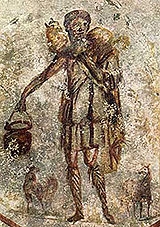
Good Shepherd 02b Close
The sources for the beliefs of the apostolic community include the Gospels and New Testament
New Testament

The New Testament is the name given to the second major division of the Christianity Bible, the first such division being the much longer Old Testament....
 Epistles. The very earliest accounts are contained in these texts, such as early Christian creeds and hymns, as well as accounts of the Passion
Passion (Christianity)

The Passion is the Christian theological term used for the events and suffering ? physical, spiritual, and mental ? of Jesus in the hours before and including his trial and execution by crucifixion....
, the empty tomb, and Resurrection appearances; often these are dated to within a decade or so of the crucifixion of Jesus, originating within the Jerusalem Church.

The earliest Christian creeds and hymns express belief in the risen Jesus, e.g., that preserved in quoted by Paul: "For what I received I passed on to you as of first importance: that Christ died for our sins according to the Scriptures, that he was buried, that he was raised on the third day according to the Scriptures." The antiquity of the creed has been located by many scholars to less than a decade after Jesus' death, originating from the Jerusalem apostolic community, and no scholar dates it later than the 40s. Other relevant and very early creeds include , , , and , an early creedal hymn.

Jewish continuity
Ten Commandments Monument
Early Christianity retained some of the doctrines and practices of first-century Judaism while rejecting others. They held the Jewish scriptures
Tanakh

The Tanakh is the Bible used in Judaism. The name "Tanakh" is a Hebrew language Acronym and initialism formed from the initial Hebrew alphabet of the Tanakh's three traditional subdivisions: The Torah , Nevi'im and Ketuvim - hence TaNaKh....
 to be authoritative and sacred, employing mostly the Septuagint
Septuagint

The Septuagint , or simply "LXX", is the Koine Greek version of the Hebrew Bible, translated in stages between the 3rd century BC and 1st century BC in Alexandria....
 or Targum
Targum

A targum is an Aramaic language translation of the Hebrew Bible written or compiled from the Second Temple period until the early Middle Ages ....
 translations, later called the Old Testament
Old Testament

In Western Christianity, the Old Testament refers to the books that form the first of the two-part Christianity Bible Biblical canon. These works correspond to the Hebrew Bible , with some variations and additions....
, and added other texts as the New Testament canon developed
Development of the New Testament canon

The Biblical canon is the set of books Christians regard as Biblical inspiration and thus constituting the Christian Bible. Although the Early Christianity primarily used the Greek Old Testament, the Septuagint or LXX, or the Targums among Aramaic speakers, the apostles did not otherwise leave a defined set of new scriptures; instead the New Testam...
. Christianity also continued other Judaic practices: baptism
Baptism

In Christianity, baptism is the ritual act, with the use of water, by which one is admitted as a full member of the Christian Church and, in the view of some, as a member of the particular Church in which the baptism is administered....
, liturgical
Liturgy

A liturgy is the customary public worship done by a specific religious group, according to their particular traditions. The word may refer to an elaborate formal ritual such as the Eastern Orthodox Divine Liturgy and Mass , or a daily activity such as the Muslim salat and Jewish Jewish services....
 worship, including the use of incense, an altar, a set of scriptural readings adapted from synagogue
Synagogue

A synagogue is a Jewish house of prayer.Synagogues usually have a large hall for prayer , smaller rooms for study and sometimes a social hall and offices....
 practice, use of sacred music
Religious music

Religious music is music performed or composed for religion use or through religious influence.A lot of music has been composed to complement religion, and many composers have derived inspiration from their own religion....
 in hymns and prayer, and a religious calendar
Liturgical year

The liturgical year, also known as the Christian year, consists of the cycle of liturgy seasons in Christianity churches which determines when Calendar of saints, Memorial s, Commemoration s, and Solemnity are to be observed and which portions of Scripture are to be read....
, as well as other distinctive features such as an exclusively male priest
Priest

A priest or priestess is a person having the authority or power to administer religious rites; in particular, rites of sacrifice to, and propitiation of, a deity or deities....
hood, and ascetic
Asceticism

Asceticism describes a life-style characterized by abstinence from various sorts of worldly pleasures often with the aim of pursuing religious and spirituality goals....
 practices (fasting
Fasting

Fasting is primarily the act of willingly abstaining from some or all food, drink, or both, for a period of time. A fast may be total or partial concerning that from which one fasts, and may be prolonged or intermittent as to the period of fasting....
 etc.). Circumcision
Circumcision controversy in early Christianity

Today, most Christian denominations are neutral about Circumcision in the Bible, neither requiring it nor forbidding it. The Council of Jerusalem, held in approximately 50 AD, decreed that circumcision was not a requirement for Gentile converts....
 was rejected as a requirement at the Council of Jerusalem
Council of Jerusalem

The Council of Jerusalem is a name applied subsequently to a meeting described in Acts of the Apostles chapter and probably referred to in Paul of Tarsus's Epistle to the Galatians chapter ....
. Quartodecimanism
Quartodecimanism

Quartodecimanism refers to the custom of some early Christians celebrating Passover or Easter beginning with the eve of the 14th day of Nisan , which at dusk is Biblically the "'s passover"....
 (the day of preparation for Passover
Passover

Passover is a Jewish and Samaritan holy day and festival commemorating God sparing the Israelites when He killed the first born of Egypt, and is followed by the seven day Feast of the Unleavened Bread commemorating the Exodus from Ancient Egypt and the liberation of the Israelites from Judaism and slavery....
) was rejected at the First Council of Nicaea
First Council of Nicaea

The First Council of Nicea was convened in Nicaea in Bithynia by the Roman Emperors Constantine I in 325 CE. The Council was historically significant as the first effort to attain consensus decision-making in the church through an legislature representing all of Christendom....
 and Sabbath observance was modified, see Sabbath in Christianity for details.

The early Christians in first century believed Yahweh
Yahweh

Image:Tetragrammaton scripts.svg[Aramaic alphabet|Aramaic]] and Hebrew alphabet Yahweh is the English rendering of , a vocalization of the Tetragrammaton that was proposed by the Hebrew scholar Gesenius in the 19th century....
 to be the Only true God, the God of Israel
God

God is a deity in theism and deism religions and other belief systems, representing either the sole deity in monotheism, or a principal deity in polytheism....
, and considered Jesus to be the Messiah
Messiah

Messiah literally means "anointed ".In Jewish messiah tradition and Jewish eschatology, messiah refers to a future monarch of United Monarchy from the Davidic line, who will rule the people of Israelite#The Twelve Tribes, and herald the Messianic Age of global peace....
 (Christ
Christ

Christ is the English language term for the Greek meaning "the anointing", which is a title given to the Reigning Messiah in the given age of the Zodiac....
) prophesied in the Old Testament.

Alister McGrath
Alister McGrath

Alister Edgar McGrath is a Christian theology, with a DPhil in molecular biophysics, as well as an earned Doctor of Divinity degree from Oxford, noted for his work on historical, systematic and scientific theology....
, a proponent of Paleo-orthodoxy
Paleo-Orthodoxy

Paleo-orthodoxy is a Christian theology of the late 20th and early 21st centuries which sees the consensual understanding of the faith among the Church Fathers as the basis of Biblical interpretation and the foundation of the Christian Church in the 20th century....
, claimed that many of the Jewish Christians
Jewish Christians

Jewish Christians is a term with two meanings, a historical one and a contemporary one.The historical term refers to Early Christians of or attracted to Jewish culture....
 were fully faithful religious Jews, only differing in their acceptance of Jesus as the Messiah.

Ecclesiastical structure
The Apostolic Church hierarchy was organized into Overseers (Bishops, Elders, Presbyters) and Servants (Deacons); always a plurality of men. Clement, a Bishop of Rome, refers to the leaders of the Corinthian church as bishops and presbyters indifferently. He writes that the bishops are to lead God's flock by virtue of the chief Shepherd - Jesus Christ.

Important bishops of the Apostolic Era include Clement of Rome and Ignatius of Antioch
Ignatius of Antioch

Ignatius of Antioch was among the Apostolic Fathers, was the third Bishop and Patriarch of Antioch, and was possibly a student of John the Apostle....
, who, along with Polycarp of Smyrna, reportedly knew and studied under the apostles personally and are therefore calledApostolic Fathers
Apostolic Fathers

The Apostolic Fathers are a small number of Early Christianity authors who lived and wrote in the second half of the 1st century and the first half of the 2nd century....
.

Post-Apostolic Church

Lawrence Before Valerianus
The post-apostolic period concerns the time roughly after the death of the apostles when bishops emerged as overseers of urban Christian populations, and continues during the time of persecutions until the legalization of Christian worship with the advent of Constantine the Great. The earliest recorded use of the terms Christianity
Christianity

Christianity is a Monotheistic religion #Christian view religion centered on the life and teachings of Jesus as New Testament view on Jesus' life....
 (Greek ) and Catholic
Catholic

Catholic is an adjective derived from the Greek language adjective , meaning "whole" or "complete". In the context of Christianity ecclesiology, it has a rich history and several usages....
 (Greek ), dates to this period, attributed to Ignatius of Antioch
Ignatius of Antioch

Ignatius of Antioch was among the Apostolic Fathers, was the third Bishop and Patriarch of Antioch, and was possibly a student of John the Apostle....
 c. 107.

Persecutions

From the beginning, Christians were subject to various persecutions
Persecution of Christians

The persecution of Christians refers to the religious persecution of Christians, both historically and in the current era....
. This involved even death for Christians such as Stephen
Saint Stephen

Saint Stephen , known as the Protomartyr of Christianity, is venerated as a saint in the Roman Catholic Church and Eastern Orthodox Churches....
  and James, son of Zebedee . Larger-scale persecutions followed at the hands of the authorities of the Roman Empire
Roman Empire

The Roman Empire was the Roman Republic phase of the Ancient Rome, characterised by an autocracy form of government and large territorial holdings in Europe and around the Mediterranean....
, beginning with the year 64, when, as reported by the Roman
Roman Empire

The Roman Empire was the Roman Republic phase of the Ancient Rome, characterised by an autocracy form of government and large territorial holdings in Europe and around the Mediterranean....
 historian Tacitus
Tacitus

Publius Cornelius Tacitus was a Roman Senate and a historian of the Roman Empire. The surviving portions of his two major works—the Annals and the Histories —examine the reigns of the Roman Emperors Tiberius, Claudius, Nero and those that reigned in the Year of the Four Emperors....
, the Emperor Nero blamed them for that year's great Fire of Rome
Great Fire of Rome

According to the historian Tacitus, the Great Fire of Rome started on the night of 18 July in the year 64 CE, among the shops clustered around the Circus Maximus....
.

According to Church tradition, it was under Nero's persecution that SS. Peter and Paul
Paul of Tarsus

Saint Paul, also called Paul the Apostle, the Apostle Paul or Paul of Tarsus , was a Hellenistic Judaism, who called himself the "Apostle to the Gentiles", and was, together with Saint Peter and James the Just, the most notable of early Christian missionaries....
 were each martyred in Rome
Rome

Rome is the capital city of Italy and Lazio, and is Italy's largest and most populous city, with 2,724,347 residents in an urban area of some ....
. Similarly, several of the New Testament
New Testament

The New Testament is the name given to the second major division of the Christianity Bible, the first such division being the much longer Old Testament....
 writings mention persecutions and stress endurance through them. For 250 years Christians suffered from sporadic persecutions
Persecution of Christians

The persecution of Christians refers to the religious persecution of Christians, both historically and in the current era....
 for their refusal to worship the Roman emperor
Imperial cult (Ancient Rome)

The imperial cult in ancient Rome was the worship of a few select Roman Emperors as Roman godss once they were deceased; the only emperor to declare himself a god while still living was Domitian which caused outrage....
, considered treason
Treason

In law, treason is the crime that covers some of the more serious acts of loyalty to one's sovereignty or nation. Historically, treason also covered the murder of specific social superiors, such as the murder of a husband by his wife ....
ous and punishable by execution. In spite of these at-times intense persecutions, the Christian religion continued its spread throughout the Mediterranean Basin
Mediterranean Basin

The Mediterranean Basin refers to the lands around and surrounded by the Mediterranean Sea. In biogeography, the Mediterranean Basin refers to the lands around the Mediterranean Sea that have a Mediterranean climate, with mild, rainy winters and hot, dry summers, which supports characteristic Mediterranean forests, woodlands, and scrub...
.

Ecclesiastical structure

By the late first and early second century, a hierarchical and episcopal structure becomes clearly visible. Post-apostolic bishops of importance are SS
Saint

A saint in Christianity is a human being who has been called to holiness. The term is used differently by various denominations, with some, such as the Anglicans, Methodists, and Lutherans distinguishing between Saints and saints....
 Polycarp of Smyrna
Polycarp

Polycarp was a second century bishop of Smyrna. He died a martyr when he was stabbed after an attempt to burn him at the stake failed. Polycarp is recognized as a saint in the Roman Catholic Church, Eastern Orthodox Church, Anglican, and Lutheran Churches....
 and Irenaeus of Lyons
Irenaeus

Saint Irenaeus , was a Catholic Bishop of Lugdunum in Gaul, then a part of the Roman Empire . He was an early church father and apologist, and his writings were formative in the early development of Christian theology....
. This structure was based on the doctrine of Apostolic Succession
Apostolic Succession

Apostolic Succession is the doctrine in some of the more ancient Christian communions that the succession of bishops, in uninterrupted lines, is historically traceable back to the original twelve Apostles Within Catholic Christianity it "is one of four elements which define the true Church of Jesus Christ" and legitimizes the existing sacr...
 where, by the ritual of the laying on of hands
Laying on of hands

The laying on of hands is a Religion found throughout the world in varying forms. In Christianity, this practice is used as both a symbolic and formal method of invoking the Holy Spirit during baptisms, Faith healings, blessings, and ordination of priests, minister of religions, Elder s, deacons, and other church officers, along with a variet...
, a bishop becomes the spiritual successor of the previous bishop in a line tracing back to the apostles themselves. Each Christian community also had presbyter
Presbyter

Presbyter in the New Testament refers to a leader in local Christian congregations, then a synonym of episkopos . In modern usage, it is distinct from bishop and synonymous with priest, pastor, Elder , or religious minister in various Christian denominations....
s, as was the case with Jewish communities, who were also ordained and assisted the bishop; as Christianity spread, especially in rural areas, the presbyters exercised more responsibilities and took distinctive shape as priests. Lastly, deacon
Deacon

Deacon is a role in the Christianity that is generally associated with service of some kind, but which varies among theological and denominational traditions....
s also performed certain duties, such as tending to the poor and sick.

Early Christian writings
As Christianity spread, it acquired certain members from well-educated circles of the Hellenistic world; they sometimes became bishops but not always. They produced two sorts of works: theological and "apologetic", the latter being works aimed at defending the faith by using reason to refute arguments against the veracity of Christianity. These authors are known as the Church Fathers, and study of them is called Patristics. Notable early Fathers include Ignatius of Antioch
Ignatius of Antioch

Ignatius of Antioch was among the Apostolic Fathers, was the third Bishop and Patriarch of Antioch, and was possibly a student of John the Apostle....
, Polycarp
Polycarp

Polycarp was a second century bishop of Smyrna. He died a martyr when he was stabbed after an attempt to burn him at the stake failed. Polycarp is recognized as a saint in the Roman Catholic Church, Eastern Orthodox Church, Anglican, and Lutheran Churches....
, Justin Martyr
Justin Martyr

Saint Justin Martyr was an early Christian apologetics and saint. His works represent the earliest surviving Christian "apologies" of notable size....
, Irenaeus of Lyons, Tertullian
Tertullian

Quintus Septimius Florens Tertullianus, anglicised as Tertullian, was a prolific and controversial early Christian author, and the first to write Christian Latin literature....
, Clement of Alexandria
Clement of Alexandria

Clement of Alexandria , was the first notable member of the Christianity of Alexandria, and one of its most distinguished teachers. He was born about the middle of the 2nd century, and died between 211 and 216....
, Origen of Alexandria, etc.

Early iconography
Virgennino
Christian art only emerged relatively late, and the first known Christian images emerge from about 200 AD, though there is some literary evidence that small domestic images were used earlier. Although many Hellenized Jews seem, as at the Dura-Europos synagogue
Dura-Europos synagogue

The Dura-Europos synagogue is unique among the many ancient synagogues that have emerged from archaeological digs in that it was preserved virtually intact....
, to have had images of religious figures, the traditional Mosaic prohibition of "graven images" no doubt retained some effect. This early rejection of images, although never proclaimed by theologians, and the necessity to hide Christian practise from persecution, leaves us with few archaeological records regarding early Christianity and its evolution. The oldest Christian paintings are from the Roman Catacombs
Catacombs

Catacombs are ancient, human-made underground passageways or subterranean cemeteries composed thereof. Many are under cities and have served during historic times as a refuge for safety during wars or as a meeting place for cults....
, dated to about 200 AD, and the oldest Christian sculptures are from sarcophagi, dating to the beginning of the 3rd century.

Early heresies

The New Testament
New Testament

The New Testament is the name given to the second major division of the Christianity Bible, the first such division being the much longer Old Testament....
 itself speaks of the importance of maintaining orthodox doctrine and refuting heresies, showing the antiquity of the concern. Because of the biblical
Bible

The Bible is the central religious text of Judaism and Christianity. The exact Books of the Bible is dependent on the religious traditions of specific denominations....
 proscription against false prophets (notably the Gospels of Matthew
Gospel of Matthew

The Gospel of Matthew is one of the four canonical gospels in the New Testament and is a synoptic gospel. It narrates an account of the New Testament view on Jesus' life and Ministry of Jesus of Jesus of Nazareth....
 and Mark
Gospel of Mark

The Gospel of Mark is the second of the four canonical gospels in the New Testament and was probably the first of the three synoptic gospels to be written....
) Christianity has always been preoccupied with the "correct", or orthodox
Orthodoxy

The word orthodox, from Greek language orthodoxos "having the right opinion," from orthos + Doxa , is typically used to mean adhering to the accepted or traditional and established faith, especially in religion....
, interpretation of the faith. Indeed one of the main roles of the bishop
Bishop

A bishop is an ordination or consecration member of the Clergy#Christian clergy who is generally entrusted with a position of authority and oversight....
s in the early Church was to determine the correct interpretations and refute contrarian opinions (referred to as heresy
Heresy

Heresy is an introduced change to some system of belief, especially a religion, that conflicts with the previously established canon of that belief....
). As there were differing opinions among the bishops, defining orthodoxy would consume the Church for some time (and still does, hence, "denominations").

In his book Orthodoxy
Orthodoxy (book)

'Orthodoxy' is a book by G. K. Chesterton that has become a classic of Christian apologetics. Chesterton considered this book a companion to his other work, Heretics ....
, Christian Apologist
Christian apologetics

Christian apologetics is a field of Christian theology that aims to present a reason basis for the Christianity, defend the faith against objections, and expose the perceived flaws of other world views....
 and writer G. K. Chesterton
G. K. Chesterton

Gilbert Keith Chesterton was one of the most influential English writers of the 20th century. His prolific and diverse output included journalism, philosophy, poetry, biography, Christian apologetics, fantasy and detective fiction....
 asserts that there have been substantial disagreements about faith from the time of the New Testament and Jesus
Jesus

Jesus of Nazareth , also known as Jesus Christ, is the central figure of Christianity and is revered by most Christian churches as the Son of God and the Incarnation ....
. He pointed out that the Apostles
Twelve Apostles

In Christianity, apostles were missionaries among the leaders in the Early Christianity and, in the Epistle to the Hebrews, Jesus Christ himself....
 all argued against changing the teachings of Christ as did the earliest church fathers including Ignatius of Antioch
Ignatius of Antioch

Ignatius of Antioch was among the Apostolic Fathers, was the third Bishop and Patriarch of Antioch, and was possibly a student of John the Apostle....
, Irenaeus
Irenaeus

Saint Irenaeus , was a Catholic Bishop of Lugdunum in Gaul, then a part of the Roman Empire . He was an early church father and apologist, and his writings were formative in the early development of Christian theology....
, Justin Martyr
Justin Martyr

Saint Justin Martyr was an early Christian apologetics and saint. His works represent the earliest surviving Christian "apologies" of notable size....
 and Polycarp
Polycarp

Polycarp was a second century bishop of Smyrna. He died a martyr when he was stabbed after an attempt to burn him at the stake failed. Polycarp is recognized as a saint in the Roman Catholic Church, Eastern Orthodox Church, Anglican, and Lutheran Churches....
 (see false prophet, the antichrist
Antichrist

The Antichrist is one who fulfills Biblical prophecies concerning an adversary of New Testament view on Jesus' life while resembling him in a deceptive manner....
, the gnostic Nicolaitanes
Nicolaitanes

Nicolaism is a Christian heresy whose adherents are called nicolaitans, nicolaitanes, or nicolaites Nico means "conquer" in Greek, Laitan refers to lay people, or laity, hence the word could be taken to mean "Lay conquerors" or Conquerors of the Lay People; however, it is simply the name given to followers of the heretic Ni...
 from the Book of Revelation
Book of Revelation

The Book of Revelation, also called Revelation to John, Apocalypse of John , and Revelation of Jesus Christ is the last Biblical canon of the New Testament in the Christian Bible....
 and Man of Sin). Jesus also refers to false prophets and the "darnel
Lolium temulentum

Lolium temulentum, typically known as darnel or cockle, is an annual plant that forms part of the Poaceae family and part of the Lolium genus....
" () of the flock and how their distortion of the Christian faith is to be rejected.

The earliest controversies were generally Christological
Christology

Christology is a field of study within Christian theology which is concerned with the nature of Jesus the Christ, particularly with how the divine and human are related in his person....
 in nature; that is, they were related to Jesus' (eternal) divinity or humanity. Docetism
Docetism

In Christianity, Docetism is the belief that Jesus' physical body was an illusion, as was his crucifixion; that is, Jesus only seemed to have a physical body and to physically die, but in reality he was incorporeal, a pure spirit, and hence could not physically die....
 held that Jesus' humanity was merely an illusion, thus denying the incarnation. Arianism
Arianism

Arianism is the theological teaching of Arius , a Christian priest, who was first ruled a heresy at the First Council of Nicea, later exonerated and then pronounced a heretic again after his death....
 held that Jesus, while not merely mortal, was not eternally divine and was, therefore, of lesser status than God the Father
God the Father

In many religions, the supreme deity is given the title and attributions of Father. In many forms of polytheism, the highest god has been conceived as a "father of gods and of men"....
 . Trinitarianism held that God the Father, God the Son
God the Son

File:Jesus Icon - JIW.jpegGod the Son is the second person of the Trinity in Christian theology. The doctrine of the Trinity identifies Jesus of Nazareth as God the Son, united in essence but distinct in person with regard to God the Father and God the Holy Spirit ....
, and the Holy Spirit
Holy Spirit

In Christianity, the Holy Ghost or Holy Spirit is the spirit of God. The term Christ , is also used to refer to this presence. That is, the Spirit is considered to act in concert with and share an essential nature with God the Father and God the Son ....
 were all strictly one being with three hypostases. Many groups held dualistic beliefs
Dualism

Dualism denotes a state of two parts. The word's origin is the Latin duo, "two" . The term 'dualism' was originally coined to denote co-eternal binary opposition, a meaning that is preserved in metaphysical and philosophical duality discourse but has been diluted in general usage....
, maintaining that reality was composed into two radically opposing parts: matter, usually seen as evil, and spirit, seen as good. Others held that both the material and spiritual worlds were created by God and were therefore both good, and that this was represented in the unified divine and human natures of Christ.

The development of doctrine, the position of orthodoxy, and the relationship between the various opinions is a matter of continuing academic debate. Since most Christians today subscribe to the doctrines established by the Nicene Creed
Nicene Creed

The Nicene Creed is the creed or profession of faith that is most widely used in Christianity liturgy. It is called Nicene because, in its original form, it was adopted in the city of Iznik by the first ecumenical council, which met there in 325....
, modern Christian theologians tend to regard the early debates as a unified orthodox position (see also Proto-orthodox Christianity
Proto-orthodox Christianity

Proto-orthodox Christianity is a term created by New Testament scholar Bart D. Ehrman. Ehrman described this as one of the many religious sects that followed the teachings of Jesus Christ, yet this one was able to become the form of Christianity dominant today....
 and Paleo-orthodoxy
Paleo-Orthodoxy

Paleo-orthodoxy is a Christian theology of the late 20th and early 21st centuries which sees the consensual understanding of the faith among the Church Fathers as the basis of Biblical interpretation and the foundation of the Christian Church in the 20th century....
) against a minority of heretics. Other scholars, drawing upon, among other things, distinctions between Jewish Christians
Jewish Christians

Jewish Christians is a term with two meanings, a historical one and a contemporary one.The historical term refers to Early Christians of or attracted to Jewish culture....
, Pauline Christians
Pauline Christianity

Pauline Christianity is a term used to refer to a branch of Early Christianity associated with the beliefs and doctrines espoused by Paul the Apostle through his Pauline epistles....
, and other groups such as Gnostics
Gnosticism

Gnosticism refers to diverse, syncretistic religious movements in antiquity consisting of various belief systems generally united in the teaching that humans are divine souls trapped in a Nature created by an imperfect god, the demiurge; this being is frequently identified with the Abrahamic God, and is contrasted with a superior entity, ref...
 and Marcionites, argue that early Christianity
Early Christianity

Early Christianity is commonly defined as the Christianity of the three centuries between the Crucifixion of Jesus and the First Council of Nicaea ....
 was fragmented, with contemporaneous competing orthodoxies.

Biblical canon
P46
The Biblical canon is the set of books Christians regard as divinely inspired and thus constituting the Christian Bible. Though the Early Church used the Old Testament according to the canon of the Septuagint
Septuagint

The Septuagint , or simply "LXX", is the Koine Greek version of the Hebrew Bible, translated in stages between the 3rd century BC and 1st century BC in Alexandria....
 (LXX), the apostles did not otherwise leave a defined set of new scriptures; instead the New Testament developed over time
Development of the New Testament canon

The Biblical canon is the set of books Christians regard as Biblical inspiration and thus constituting the Christian Bible. Although the Early Christianity primarily used the Greek Old Testament, the Septuagint or LXX, or the Targums among Aramaic speakers, the apostles did not otherwise leave a defined set of new scriptures; instead the New Testam...
.

The writings attributed to the apostles circulated amongst the earliest Christian communities. The Pauline epistles
Pauline epistles

The Pauline epistles, Epistles of Paul, or Letters of Paul, are the thirteen New Testament books which have the name Paul as the first word, hence claiming authorship by Paul the Apostle....
 were circulating in collected form by the end of the first century AD. Justin Martyr, in the early second century, mentions the "memoirs of the apostles", which Christians called "gospels" and which were regarded as on par with the Old Testament. A four gospel canon (the Tetramorph) was in place by the time of Ireanaeus, c. 160, who refers to it directly. By the early 200's, Origen of Alexandria may have been using the same 27 books as in the modern New Testament, though there were still disputes over the canonicity of Hebrews, James, II Peter, II and III John, and Revelation, see also Antilegomena
Antilegomena

Antilegomena was an epithet used by the Church Fathers to denote those books of the New Testament which, although sometimes publicly read in the churches, were not for a considerable amount of time considered to be genuine, or received into the Biblical canon....
. Likewise the Muratorian fragment
Muratorian fragment

The Muratorian fragment is a copy of perhaps the oldest known list of the books of the New Testament. The fragment is a seventh-century Latin manuscript bound in an eighth or seventh century codex that came from the library of Columban's monastery at Bobbio; it contains internal cues which suggest that the original was written about 170 , alt...
 shows that by 200 there existed a set of Christian writings somewhat similar to what is now the New Testament, which included the four gospels. Thus, while there was a good measure of debate in the Early Church over the New Testament canon, the major writings were accepted by almost all Christians by the middle of the second century.

In his Easter letter of 367, Athanasius, Bishop of Alexandria, gave a list of exactly the same books as what would become the New Testament
New Testament

The New Testament is the name given to the second major division of the Christianity Bible, the first such division being the much longer Old Testament....
 canon, and he used the word "canonized" (kanonizomena) in regards to them. The African Synod of Hippo
Synod of Hippo

The Synod of Hippo refers to the Synod of A.D. 393 which was hosted in Hippo Regius in northern Africa during the Early Christianity. Additional synods were held in 394, 397, 401 and 426....
, in 393, approved the New Testament, as it stands today, together with the Septuagint books, a decision that was repeated by Councils of Carthage
Councils of Carthage

Synods of Carthage During the 3rd, 4th, and 5th centuries the town of Carthage in Africa served as the meeting-place of a large number of church synods, of which, however, only the most important can be treated here....
 in 397 and 419. These councils were under the authority of St. Augustine, who regarded the canon as already closed. Pope Damasus I
Pope Damasus I

Pope Damasus I was pope from 366 to 384.He was born around 305, probably near the city of Idanha-a-Velha , in what is present-day Portugal, or near the city of Castelo Branco , then part of the Western Roman Empire....
's Council of Rome
Council of Rome

The Council of Rome was a meeting of Catholic church officials and theologians which took place in 382 under the authority of Pope Damasus I. It gained historical significance in the eighteenth century when the Decretum Gelasianum, offering a list of canonical books of the Bible, was associated with it....
 in 382, if the Decretum Gelasianum
Decretum Gelasianum

The so-called Decretum Gelasianum or Gelasian Decree was traditionally attributed to the prolific Pope Gelasius I, bishop of Rome 492–496....
 is correctly associated with it, issued a biblical canon identical to that mentioned above, or if not the list is at least a sixth century compilation. Likewise, Damasus's commissioning of the Latin Vulgate edition of the Bible
Bible

The Bible is the central religious text of Judaism and Christianity. The exact Books of the Bible is dependent on the religious traditions of specific denominations....
, c. 383, was instrumental in the fixation of the canon in the West. In 405, Pope Innocent I
Pope Innocent I

Pope Saint Innocent I was pope from 401 to March 12, 417.He was, according to his biographer in the Liber Pontificalis, the son of a man called Innocens of Albano; but according to his contemporary Jerome, his father was Pope Anastasius I , whom he was called by the unanimous voice of the clergy and laity to succeed ....
 sent a list of the sacred books to a Gallic bishop, Exsuperius of Toulouse
Exuperius

Saint Exuperius was Bishop of Toulouse at the beginning of the 5th century.His place and date of birth is unknown. Upon succeeding St. Silvius as bishop, he completed the Basilique St-Sernin, Toulouse, begun by his predecessor....
. When these bishops and councils spoke on the matter, however, they were not defining something new, but instead "were ratifying what had already become the mind of the Church." Thus, from the fourth century, there existed unanimity in the West concerning the New Testament canon (as it is today), and by the fifth century the East, with a few exceptions, had come to accept the Book of Revelation and thus had come into harmony on the matter of the canon. Nonetheless, a full dogmatic articulation of the canon was not made until the Council of Trent
Council of Trent

The Council of Trent was the 16th century Ecumenical Council of the Roman Catholic Church. Considered one of the Church's most important councils, it convened in Trento between December 13, 1545, and December 4, 1563 in twenty-five sessions for three periods....
 of 1546 for Roman Catholicism, the Thirty-Nine Articles
Thirty-Nine Articles

The Thirty-Nine Articles of Religion were established in 1563, and are the historic defining statements of Anglican doctrine in relation to the controversies of the English Reformation; especially in the relation of Calvinist doctrine and Roman Catholic practices to the nascent Anglican doctrine of the evolving English Church....
 of 1563 for the Church of England
Church of England

The Church of England is the State religion Christianity Ecclesia in England, the Mother Church of the worldwide Anglican Communion and the oldest among the communion's thirty-eight independent national and regional churches....
, the Westminster Confession of Faith
Westminster Confession of Faith

The Westminster Confession of Faith is a Reformed confession of faith, in the Calvinist theological tradition. Although drawn up by the 1646 Westminster Assembly, largely of the Church of England, it became and remains the 'subordinate standard' of doctrine in the Church of Scotland, and has been influential within Presbyterian churches world...
 of 1647 for Calvinism
Calvinism

Calvinism is a theology system and an approach to the Christian life that emphasizes the rule of God over all things. It was developed by several theologians, but it bears the name of the French Protestant Reformation John Calvin because of his prominent influence on it and because of his role in the confessional and ecclesiastical debates t...
, and the Synod of Jerusalem
Synod of Jerusalem

Greek Orthodox Orthodox Patriarch of Jerusalem Dositheos Notaras convened a Synod in Jerusalem on March, 1672. The occasion was the consecration of the Church of the Nativity in Bethlehem, therefore it is also called the Synod of Bethlehem....
 of 1672 for the Greek Orthodox.

Church of the Roman Empire (313–476)

Spread of Christianity in Europe To Ad 600
Christianity in Late Antiquity begins with the ascension of Constantine to the Emperorship of Rome in the early fourth century, and continues until the advent of the Middle Ages. The terminus of this period is variable because the transformation to the sub-Roman period was gradual and occurred at different times in different areas. It may generally be dated as lasting to the late sixth century and the reconquests of Justinian, though a more traditional date is 476, the year that Romulus Augustus, traditionally considered the last western emperor, was deposed.

Christianity legalized

In April 311, Galerius
Galerius

Galerius Maximianus , formally Gaius Galerius Valerius Maximianus was Roman Emperor from 305 to 311....
, who had previously been one of the leading figures in the persecutions, issued an edict
Edict of Toleration by Galerius

This was an edict, issued in 311 by the Roman tetrarchs of Galerius, Constantine I and Licinius, officially ending the Diocletian persecution of Christianity....
 permitting the practice of the Christian religion under his rule. In 313 Constantine I and Licinius
Licinius

Valerius Licinianus Licinius was Roman emperor from 308 to 324.Of Dacian peasant origin, born in Moesia Superior, Licinius accompanied his close childhood friend, the Emperor Galerius, on the Persian expedition in 297....
 announced toleration of Christianity in the Edict of Milan
Edict of Milan

The Edict of Milan was a letter signed by emperors Constantine I and Licinius that proclaimed religious toleration in the Roman Empire. The letter was issued in 313 AD, shortly after the conclusion of the Diocletian Persecution....
. Constantine would become the first Christian emperor. By 391, under the reign of Theodosius I
Theodosius I

Flavius Theodosius , also called Theodosius I and Theodosius the Great , was Roman Emperor from 379 to 395. Reuniting the eastern and western portions of the empire, Theodosius was the last emperor of both the Eastern Roman Empire and Western Roman Empire....
, Christianity had become the most popular, or state religion
State religion

A state religion is a religion body or creed officially endorsed by the state. Practically, a state without a state religion is called a secular state....
. Constantine I, the first emperor to embrace Christianity, was also the first emperor to openly promote the newly legalized religion.

Constantine the Great

Constantine Musei Capitolini
Nicaea Icon
The Emperor Constantine I was exposed to Christianity by his mother, Helena. There is scholarly controversy, however, as to whether Constantine adopted his mother's humble Christianity in his youth, or whether he adopted it gradually over the course of his life.

Christian sources record that Constantine experienced a dramatic event in 312 at the Battle of Milvian Bridge
Battle of Milvian Bridge

The Battle of the Milvian Bridge took place between the Roman Emperors Constantine I and Maxentius on October 28, 312. Constantine won the battle and started on the path that led him to end the Tetrarchy and become the sole ruler of the Roman Empire....
, after which Constantine would claim the emperorship in the West. According to these sources, Constantine looked up to the sun before the battle and saw a cross of light above it, and with it the Greek words "" ("by this, conquer!", often rendered in the Latin "in hoc signo vinces
In hoc signo vinces

In hoc signo vinces is the rendition in Latin language of the Greek language phrase "e? t??t? ???a", en touto nika, meaning "in this [sign] you will conquer"....
"); Constantine commanded his troops to adorn their shields with a Christian symbol (the Chi-Ro
Labarum

For the article about the "PX" symbol see Chi RhoThe Labarum was a typographic ligature formed from Chi and Rho , which had particular symbolic significance to the Roman Empires, Ancient Greece, and to the Christianity of Late Antiquity in general....
), and thereafter they were victorious. How much Christianity Constantine adopted at this point is difficult to discern; most influential people in the empire, especially high military officials, were still pagan, and Constantine's rule exhibited at least a willingness to appease these factions. The Roman coins minted up to eight years subsequent to the battle still bore the images of Roman gods. Nonetheless, the accession of Constantine was a turning point for the Christian Church. After his victory, Constantine supported the Church financially, built various basilicas, granted privileges (e.g., exemption from certain taxes) to clergy, promoted Christians to high ranking offices, and returned property confiscated during the Great Persecution of Diocletian. Between 324 and 330, Constantine built, virtually from scratch, a new imperial capital at Byzantium on the Bosphorus (it came to be named for him: Constantinople)–the city employed overtly Christian architecture, contained churches within the city walls (unlike "old" Rome), and had no pagan temples. In accordance with the prevailing customs, Constantine was baptized on his deathbed.

Constantine also played an active role in the leadership of the Church. In 313, he issued the Edict of Milan
Edict of Milan

The Edict of Milan was a letter signed by emperors Constantine I and Licinius that proclaimed religious toleration in the Roman Empire. The letter was issued in 313 AD, shortly after the conclusion of the Diocletian Persecution....
, legalizing Christian worship. In 316, he acted as a judge in a North African dispute concerning the Donatist controversy. More significantly, in 325 he summoned the Council of Nicaea
First Council of Nicaea

The First Council of Nicea was convened in Nicaea in Bithynia by the Roman Emperors Constantine I in 325 CE. The Council was historically significant as the first effort to attain consensus decision-making in the church through an legislature representing all of Christendom....
, effectively the first Ecumenical Council
Ecumenical council

An ecumenical council is a conference of the bishops of the whole Christian Church convened to discuss and settle matters of Church doctrine and practice....
 (unless the Council of Jerusalem
Council of Jerusalem

The Council of Jerusalem is a name applied subsequently to a meeting described in Acts of the Apostles chapter and probably referred to in Paul of Tarsus's Epistle to the Galatians chapter ....
 is so classified), to deal mostly with the Arian
Arianism

Arianism is the theological teaching of Arius , a Christian priest, who was first ruled a heresy at the First Council of Nicea, later exonerated and then pronounced a heretic again after his death....
 controversy, but which also issued the Nicene Creed
Nicene Creed

The Nicene Creed is the creed or profession of faith that is most widely used in Christianity liturgy. It is called Nicene because, in its original form, it was adopted in the city of Iznik by the first ecumenical council, which met there in 325....
, which among other things professed a belief in One Holy Catholic Apostolic Church, the start of Christendom
Christendom

Christendom usually refers to Christianity as a territorial phenomenon. It can also refer to the part of the world in which Christianity prevails....
. The reign of Constantine established a precedent for the position of the Christian Emperor in the Church. Emperors considered themselves responsible to God for the spiritual health of their subjects, and thus they had a duty of maintain orthodoxy. The emperor did not decide doctrine — that was the responsibility of the bishops — rather his role was to enforce doctrine, root out heresy, and uphold ecclesiastical unity. The emperor ensured that God was properly worshiped in his empire; what proper worship consisted of was the responsibility of the church. This precedent would continue until certain emperors of the fifth and six centuries sought to alter doctrine by imperial edict without recourse to councils, though even after this Constantine's precedent generally remained the norm.

The reign of Constantine, nonetheless, does not represent a complete acceptance, or end of persecution, of Christianity in the empire. His successor in the East, Constantius II
Constantius II

Flavius Iulius Constantius, known in English as Constantius II was a Roman Emperor of the Constantinian dynasty....
, was an Arian who kept Arian bishops at his court and installed them in various sees, expelling the orthodox bishops.

Constantius's successor, Julian
Julian the Apostate

Flavius Claudius Julianus, known also as Julian or Julian the Apostate , was Roman Emperor of the Constantinian dynasty. He was the last non-Christian Roman Emperor, and expended much energy during his reign attempting to supplant the growing power of Christianity within the empire with officially revived Religion in ancient Rom...
, known in the Christian world as Julian the Apostate, was a philosopher who upon becoming emperor renounced Christianity and embraced a Neo-platonic
Neoplatonism

Neoplatonism is the modern term for a school of religious and mystical philosophy that took shape in the 3rd century AD, founded by Plotinus and based on the teachings of Plato and earlier Platonism....
 and mystical form of paganism shocking the Christian establishment. Intent on re-establishing the prestige of the old pagan beliefs, he modified them to resemble Christian traditions such as the episcopal structure and public charity (hitherto unknown in Roman paganism). Julian eliminated most of the privileges and prestige previously afforded to the Christian Church as the official state religion. His reforms attempted to create a form of religious heterogeneity by, among other things, reopening pagan temples, accepting Christian bishops previously exiled as heretics, promoting Judaism
Judaism

Judaism is a set of beliefs and practices originating in the Hebrew Bible , as later further explored and explained in the Talmud and other texts....
, and returning Church lands to their original owners. However, Julian's short reign ended when he died while campaigning in the East.

Christianity came to dominance during the reign of Julian's successors, Jovian
Jovian

Flavius Iovianus, anglicized to Jovian, was a soldier elected Roman Emperor by the army on 27 June 363 upon the death of Emperor Julian the Apostate during his Sassanid Empire campaign....
, Valentinian I
Valentinian I

Flavius Valentinianus, known in English as Valentinian I, was Roman Emperor from 364 until his death. Valentinian is often referred to as the "last great western emperor"....
, and Valens
Valens

Flamin Julius Valens was Roman Emperor , after he was given the Eastern part of the empire by his brother Valentinian I. Valens, sometimes known as the Last of the Romans, was defeated and killed in the Battle of Adrianople, which marked the beginning of the fall of the Western Roman Empire....
 (the last Eastern Arian
Arianism

Arianism is the theological teaching of Arius , a Christian priest, who was first ruled a heresy at the First Council of Nicea, later exonerated and then pronounced a heretic again after his death....
 Christian Emperor). On February 27, 380, Theodosius I
Theodosius I

Flavius Theodosius , also called Theodosius I and Theodosius the Great , was Roman Emperor from 379 to 395. Reuniting the eastern and western portions of the empire, Theodosius was the last emperor of both the Eastern Roman Empire and Western Roman Empire....
 issued the edict De Fide Catolica establishing "Catholic Christianity" as the exclusive official state religion
State religion

A state religion is a religion body or creed officially endorsed by the state. Practically, a state without a state religion is called a secular state....
, outlawed other faiths, and closed pagan temples.(Theodosian Code XVI.1.2; and Sozomen, "Ecclesiastical History", VII, iv.) Additional prohibitions were passed by Theodosius I in 391 further proscribing remaining pagan practices.

Diocesan structure

After legalization, the Church adopted the same organizational boundaries as the Empire: geographical provinces, called dioceses, corresponding to imperial governmental territorial division. The bishops, who were located in major urban centers as per pre-legalization tradition, thus oversaw each diocese. The bishop's location was his "seat", or "see"; among the sees, five
Pentarchy

In the History of Christianity, the Pentarchy is "the proposed government of universal Christendom by five Patriarch under the auspices of a single universal empire....
 held special eminence: Rome, Constantinople, Jerusalem, Antioch, and Alexandria. The prestige of these sees depended in part on their apostolic founders, from whom the bishops were therefore the spiritual successors, e.g., St. Mark as founder of the See of Alexandria, St. Peter of the See of Rome, etc. There were other significant elements: Jerusalem was the location of Christ's death and resurrection, the site of a first century council, etc., Antioch was where Jesus' followers were first labelled as Christians, it was used in a derogatory way to berate the followers of Jesus the Christ. Rome was where SS. Peter and Paul had been martyred (killed), Constantinople was the "New Rome" where Constantine had moved his capital c. 330, and, lastly, all these cities had important relics.

Papacy and primacy


The Pope is the Bishop of Rome and the office is the "papacy." As a bishopric, its origin is consistent with the development of an episcopal structure in the first century. The papacy, however, also carries the notion of primacy: that the See of Rome is preeminent amongst all other sees. The origins of this concept are historically obscure; theologically, it is based on three ancient Christian traditions: (1) that the apostle Peter was preeminent among the apostles, see Primacy of Simon Peter
Primacy of Simon Peter

A number of Christian denominations and scholars hold that Simon Peter was the most prominent of the Twelve apostles, favored by Jesus with the first place of honor and authority....
, (2) that Peter ordained his successors for the Roman See, and (3) that the bishops are the successors of the apostles (apostolic succession
Apostolic Succession

Apostolic Succession is the doctrine in some of the more ancient Christian communions that the succession of bishops, in uninterrupted lines, is historically traceable back to the original twelve Apostles Within Catholic Christianity it "is one of four elements which define the true Church of Jesus Christ" and legitimizes the existing sacr...
). As long as the Papal See also happened to be the capital of the Western Empire, the prestige of the Bishop of Rome could be taken for granted without the need of sophisticated theological argumentation beyond these points; after its shift to Milan and then Ravenna, however, more detailed arguments were developed based on etc. Nonetheless, in antiquity the Petrine and Apostolic quality, as well as a "primacy of respect", concerning the Roman See went unchallenged by emperors, eastern patriarchs, and the Eastern Church alike. The Ecumenical Council of Constantinople in 381 affirmed the primacy of Rome. Though the appellate jurisdiction of the Pope, and the position of Constantinople, would require further doctrinal clarification, by the close of Antiquity the primacy of Rome and the sophisticated theological arguments supporting it were fully developed. Just what exactly was entailed in this primacy, and its being exercised, would become a matter of controversy at certain later times.

Ecumenical Councils

During this era, several Ecumenical Councils were convened. These were mostly concerned with Christological disputes. The two Councils of Nicaea (325, 382) condemned Arian teachings as heresy and produced a creed (see Nicene Creed
Nicene Creed

The Nicene Creed is the creed or profession of faith that is most widely used in Christianity liturgy. It is called Nicene because, in its original form, it was adopted in the city of Iznik by the first ecumenical council, which met there in 325....
). The Council of Ephesus condemned Nestorianism
Nestorianism

Nestorianism is the doctrine that Christ exists as two ,persons the man Jesus and the divine Son of God, or Jesus Christ the Logos, rather than as two natures of one divine essence....
 and affirmed the Blessed Virgin Mary
Blessed Virgin Mary

The Blessed Virgin Mary, sometimes shortened to The Blessed Virgin or The Virgin Mary, is a traditional title used by most Christians and most specifically used by liturgical Christians such as Roman Catholics, Anglicanism, Eastern Orthodox and Eastern Catholics, and some others to describe Mary, mother of Jesus, the mother of...
 to be Theotokos
Theotokos

Theotokos is a title of Mary, the mother of Jesus used especially in the Eastern Orthodox Church, Oriental Orthodox, and Eastern Catholic Churches....
 ("God-bearer" or "Mother of God"). Perhaps the most significant council was the Council of Chalcedon
Council of Chalcedon

The Council of Chalcedon is believed to have been the fourth ecumenical council by the Eastern Orthodox Church and the Roman Catholic Church. It was held from 8 October to 1 November 451 at Chalcedon , today the district of Kadik?y on the Asian side of the Bosphorus, incorporated into the city of Istanbul....
 that affirmed that Christ had two natures, fully God and fully man, distinct yet always in perfect union. This was based largely on Pope Leo the Great's
Pope Leo I

Pope Leo I, or Pope Saint Leo the Great, was pope from 29 September, 440 to 10 November, 461.He was an Italian aristocrat, and is the earliest pope of the Roman Catholic Church to have received the title "the Great"....
 Tome. Thus, it condemned Monophysitism
Monophysitism

Monophysitism , or Monophysiticism, is the christology position that Christ has only one nature , as opposed to the Chalcedonian position which holds that Christ has two natures, one divine and one human....
 and would be influential in refuting Monothelitism
Monothelitism

Monothelitism is a particular teaching about how the divine and human relate in the person of Jesus, known as a Christological doctrine, that began in Armenia and Syria in AD 633....
. However, not all denominations accepted all the councils, for example Nestorianism
Nestorianism

Nestorianism is the doctrine that Christ exists as two ,persons the man Jesus and the divine Son of God, or Jesus Christ the Logos, rather than as two natures of one divine essence....
 and the Assyrian Church of the East
Assyrian Church of the East

The Holy Apostolic Catholic Assyrian Church of the East , currently presided over by Mar Dinkha IV, is a Christian particular church and one of the earliest to separate itself from communion with the Catholic Church ....
 split over the Council of Ephesus
Council of Ephesus

The First Council of Ephesus was held in 431 at the Church of Mary in Ephesus, Asia Minor. The council was called due to the contentious teachings of Nestorius, bishop of Constantinople....
 of 431, Oriental Orthodoxy
Oriental Orthodoxy

Oriental Orthodoxy is the communion of Eastern Christianity Churches that recognize only three ecumenical councils ? the First Council of Nicaea, the First Council of Constantinople and the Council of Ephesus....
 split over the Council of Chalcedon
Council of Chalcedon

The Council of Chalcedon is believed to have been the fourth ecumenical council by the Eastern Orthodox Church and the Roman Catholic Church. It was held from 8 October to 1 November 451 at Chalcedon , today the district of Kadik?y on the Asian side of the Bosphorus, incorporated into the city of Istanbul....
 of 451, Pope Sergius I
Pope Sergius I

Pope Saint Sergius I was Pope from 687–701. He came from an Antiochene Syrian family which had settled at Palermo in Sicily, and owed his election as Pope Conon's successor to skillful intrigues against Paschalis and Theodorus, the other candidates....
 rejected the Quinisext Council
Quinisext Council

The Quinisext Council was a church council held in 692 at Constantinople under Justinian II. It is often known as the Council in Trullo, because it was held in the same domed hall where the Third Council of Constantinople had met....
 of 692 (see also Pentarchy
Pentarchy

In the History of Christianity, the Pentarchy is "the proposed government of universal Christendom by five Patriarch under the auspices of a single universal empire....
), and the Fourth Council of Constantinople
Fourth Council of Constantinople

The Fourth Council of Constantinople of 879-880 is the Eighth Ecumenical Council for Eastern Orthodox Christians. Photios I of Constantinople, a noble layman, had been appointed Patriarch of Constantinople but deposed by a Fourth Council of Constantinople called in 869 by Emperor Basil I the Macedonian and Pope Adrian II....
 of 869–870 and 879–880 is disputed by Catholicism and Eastern Orthodoxy.

Nicene and Post-Nicene Fathers

The early Church Fathers have already been mentioned above; however, Late Antique Christianity produced a great many renowned Fathers who wrote volumes of theological texts, including SS. Augustine, Gregory Nazianzus
Gregory of Nazianzus

Gregory of Nazianzus was a 4th-century Archbishop of Constantinople. He is widely considered the most accomplished rhetorical stylist of the Church Fathers....
, Cyril of Jerusalem
Cyril of Jerusalem

Saint Cyril of Jerusalem was a distinguished theologian of the early Church . He is venerated as a saint by both the Roman Catholic Church and the Eastern Orthodox Church, as well as in the Anglican Communion....
, Ambrose of Milan
Ambrose

Saint Ambrose was a Roman Catholic Archdiocese of Milan who became one of the most influential ecclesiastical figures of the fourth century. He is counted as one of the four original doctors of the Church....
, Jerome
Jerome

Saint Jerome was a Christian priest and Christian apologetics best known for translating the Vulgate. He is recognized by the Catholic Church as a canonized saint and Doctor of the Church, and his version of the Bible is still an important text in Catholicism....
, and others. What resulted was a golden age of literary and scholarly activity unmatched since the days of Virgil and Horace. Some of these fathers, such as John Chrysostom
John Chrysostom

'Saint John Chrysostom' , archbishop of Constantinople, was an important Early Church Father. He is known for his eloquence in Sermon and public speaking, his denunciation of abuse of authority by both ecclesiastical and political leaders, the Divine Liturgy of St....
 and Athanasius
Athanasius of Alexandria

Athanasius of Alexandria , also known as St Athanasius the Great, Pope Athanasius I of Alexandria, and St Athanasius the Apostolic, was a theologian, Bishop of Alexandria, Church Father, and a noted Egyptian leader of the fourth century....
, suffered exile, persecution, or martyrdom from heretical Byzantine Emperors. Many of their writings are translated into English in the compilations of Nicene and Post-Nicene Fathers
Nicene and Post-Nicene Fathers

The Nicene and Post-Nicene Fathers is a set of books containing translations of early Christianity writings into English. It was published in 1885....
.

The Pentarchy

By the fifth century, the ecclesiastical had evolved a hierarchical "pentarchy
Pentarchy

In the History of Christianity, the Pentarchy is "the proposed government of universal Christendom by five Patriarch under the auspices of a single universal empire....
" or system of five sees (patriarchates), with a settled order of precedence, had been established. Rome, as the ancient center and once largest city of the empire, was understandably given the presidency or primacy of honor within the pentarchy into which Christendom was now divided; though it was and still held that the patriarch of Rome was the first among equals. Constantinople was second in precedence as the new capital of the empire.

The list below are the five Pentarchs of the original Pentarchy of the Roman Empire.
  • Rome
    Pope

    The Pope is the Bishop of Rome, the leader of the Roman Catholic Church and head of state of Vatican City. The current pope is Pope Benedict XVI, who was elected April 19, 2005 in Papal conclave, 2005....
     (Sts. Peter
    Saint Peter

    Saint Peter was a leader of the early Christianity church, who features prominently in the New Testament Gospels and the Acts of the Apostles....
     and Paul), i.e., the Pope, the only Pentarch in the Western Roman Empire
    Western Roman Empire

    The Western Roman Empire refers to the western half of the Roman Empire, from its division by Diocletian in 285; the other half of the Roman Empire was the Eastern Roman Empire, today widely known as the Byzantine Empire....
    .
  • Constantinople
    Patriarch of Constantinople

    The Ecumenical Patriarch of Constantinople is the Archbishop of Constantinople ? New Rome ? ranking as primus inter pares in the Eastern Orthodox Church organization, which is seen by followers as the One, Holy, Catholic, and Apostolic Church....
     (St. Andrew
    Saint Andrew

    Saint Andrew , called in the Eastern Orthodox Church tradition Protocletos, or the First-called, is a Christian Twelve Apostles and the younger brother of Saint Peter....
    ), currently in Turkey
    Turkey

    Turkey , known officially as the Republic of Turkey , is a Eurasian country that stretches across the Anatolian peninsula in southwest Asia and Thrace in the Balkans region of Southern Europe....
  • Alexandria
    Patriarch of Alexandria

    The Patriarch of Alexandria is the Archbishop of Alexandria and Cairo, Egypt. Historically, this office has included the designation of Pope , and did so earlier than that of the Bishop of Rome....
     (St. Mark
    Mark the Evangelist

    Saint Mark the Evangelist , also known as John Mark, is traditionally believed to be the author of the Gospel of Mark and a companion of Saint Peter....
    ), currently in Egypt
    Egypt

    Egypt is a country mainly in North Africa, with the Sinai Peninsula forming a land bridge in Western Asia. Covering an area of about , Egypt borders the Mediterranean Sea to the north, the Gaza Strip and Israel to the northeast, the Red Sea to the east, Sudan to the south and Libya to the west....
  • Antioch
    Patriarch of Antioch

    Patriarch of Antioch is a traditional title carried by the Bishop of Antioch. As the traditional "overseer" of the first gentile Christian community, the position has been of prime importance in the church from its Early Christianity....
     (St. Peter
    Saint Peter

    Saint Peter was a leader of the early Christianity church, who features prominently in the New Testament Gospels and the Acts of the Apostles....
    ), currently in Turkey
    Turkey

    Turkey , known officially as the Republic of Turkey , is a Eurasian country that stretches across the Anatolian peninsula in southwest Asia and Thrace in the Balkans region of Southern Europe....
  • Jerusalem (St. James
    James the Just

    Saint James the Just , , also known as James of Jerusalem, James Adelphotheos, James, the Brother of the Lord, was an important figure in Early Christianity....
    ), currently in Israel
    Israel

    Israel officially the State of Israel , is a country in the Middle East located on the eastern shore of the Mediterranean Sea. It borders Lebanon in the north, Syria in the northeast, Jordan in the east, and Egypt on the southwest, and contains geographically diverse features within its relatively small area....
    /Palestine
    Palestine

    Palestine is a name which has been widely used since Roman times to refer to the region between the Mediterranean Sea and the Jordan River. It is derived from a name used already much earlier for a narrower geographical region, mainly along the coastal region....
    , see also Jerusalem in Christianity
    Jerusalem in Christianity

    For Christianity, Jerusalem's place in the life of Jesus gives it great importance, in addition to its place in the Old Testament, the Hebrew Bible, as described in the above article....


Monasticism


Monasticism
Christian monasticism

Monasticism began to develop early in the history of the Church, modeled upon scriptural examples and ideals, including those in the Old Testament, but not mandated as an institution in the scriptures....
 is a form of asceticism whereby one renounces worldly pursuits (in contempu mundi) and concentrates solely on heavenly and spiritual pursuits, especially by the virtues humility, poverty, and chastity. It began early in the Church as a family of similar traditions, modeled upon Scriptural examples and ideals, and with roots in certain strands of Judaism. St. John the Baptist is seen as the archetypical monk, and monasticism was also inspired by the organization of the Apostolic community as recorded in Acts of the Apostles.

There are two forms of monasticism: eremetic
Hermit

A hermit is a person who lives to some greater or lesser degree in solitude and/or isolation from society.In Christianity the term was originally applied to a Christian who lives the eremitic life out of a religious conviction, namely the Catholic spirituality#Desert spirituality of the Old Testament ....
 and cenobitic
Cenobitic

Cenobitic monasticism is a monastery tradition that stresses community life. Often in the West, the community belongs to a religious order and the life of the cenobitic monk is regulated by a rule, a collection of precepts....
. Eremetic monks, or hermits, live in solitude, whereas cenobitic monks live in communities, generally in a monastery
Monastery

Monastery , a term derived from the Greek language word ???ast?????, neut. of ???ast????? - monasterios denotes the building, or complex of buildings, that houses a room reserved for prayer as well as the domestic quarters and workplace of Monk, whether monks or nuns, and whether living in Cenobium or alone ....
, under a rule (or code of practice) and are governed by an abbot
Abbot

The word abbot, meaning father, is a title given to the head of a monastery in various traditions, including Christianity. The office may also be given as an honorary title to a clergyman who is not actually the head of a monastery....
. Originally, all Christian monks were hermits, following the example of Anthony the Great
Anthony the Great

Anthony the Great , also known as Saint Anthony, Anthony the Abbot, Anthony of Egypt, Anthony of the Desert, Anthony the Anchorite, Abba Antonius , and Father of All Monks, was an Christianity saint from Egypt, a prominent leader among the Desert Fathers....
. However, the need for some form of organized spiritual guidance lead Saint Pachomius
Pachomius

Saint Pachomius , also known as Abba Pachomius and Pakhom in Arabic ?????? ????????, is generally recognized as the founder of Christian cenobitic monasticism....
 in 318 to organize his many followers in what was to become the first monastery. Soon, similar institutions were established throughout the Egyptian desert as well as the rest of the eastern half of the Roman Empire. Central figures in the development of monasticism were, in the East, St. Basil the Great
Basil of Caesarea

Basil of Caesarea, also called Saint Basil the Great, was the bishop of Caesarea Mazaca in Cappadocia, Asia Minor . He was an influential 4th century Christian theologian and monastic....
, and St. Benedict in the West, who created the famous Benedictine Rule, which would become the most common rule throughout the Middle Ages.

Growing tensions between East and West


The cracks and fissures in Christian unity which led to the Great Schism
East-West Schism

The East-West Schism, or the Great Schism, divided medieval Christendom into Eastern and Western branches, which later became known as the Eastern Orthodox Church and the Roman Catholic Church, respectively....
 started to become evident as early as the fourth century. Although 1054 is the date usually given for the beginning of the Great Schism, there is, in fact, no specific date on which the schism occurred. What really happened was a complex chain of events whose climax culminated with the sacking of Constantinople by the Fourth Crusade
Fourth Crusade

The Fourth Crusade was originally designed to conquer Islam Jerusalem by means of an invasion through Egypt. Instead, in April 1204, the Crusaders of Western Europe invaded and conquered the Christianity city of Constantinople, capital of the Byzantine Empire....
 in 1204.

The events leading to schism were not exclusively theological in nature. Cultural, political, and linguistic differences were often mixed with the theological. Any narrative of the schism which emphasizes one at the expense of the other will be fragmentary. Unlike the Copts or Armenians
Armenian Apostolic Church

The Armenian Apostolic Church is the world's oldest national church and one of the most ancient Christianity communities.The official name of the church is the One Holy Universal Apostolic Orthodox Armenian Church ....
 who broke from the Church in the fifth century, the eastern and western parts of the Church remained loyal to the faith, from their perspective, and to the authority of the seven ecumenical councils. They were united, by virtue of their common faith and tradition, in one Church.

Nonetheless, the transfer of the Roman capital to Constantinople inevitably brought mistrust, rivalry, and even jealousy to the relations of the two great sees, Rome and Constantinople. It was easy for Rome to be jealous of Constantinople at a time when it was rapidly losing its political prominence. In fact, Rome refused to recognize the conciliar legislation which promoted Constantinople to second rank. But the estrangement was also helped along by the German invasions in the West, which effectively weakened contacts. The rise of Islam with its conquest of most of the Mediterranean coastline (not to mention the arrival of the pagan Slavs in the Balkans at the same time) further intensified this separation by driving a physical wedge between the two worlds. The once homogenous unified world of the Mediterranean was fast vanishing. Communication between the Greek East and the Latin West by the 600s had become dangerous and practically ceased.

Two basic problems — the primacy of the bishop of Rome and the procession of the Holy Spirit — were involved. These doctrinal novelties were first openly discussed in Photius's patriarchate.

By the fifth century, Christendom was divided into a pentarchy of five sees with Rome holding the primacy. This was determined by canonical decision and did not entail hegemony of any one local church or patriarchate over the others. However, Rome began to interpret her primacy in terms of sovereignty, as a God-given right involving universal jurisdiction in the Church. The collegial and conciliar nature of the Church, in effect, was gradually abandoned in favor of supremacy of unlimited papal power over the entire Church. These ideas were finally given systematic expression in the West during the Gregorian Reform
Gregorian Reform

The Gregorian Reforms were a series of reforms initiated by Pope Gregory VII and the circle he formed in the Roman Curia , circa 1050?80, which dealt with the moral integrity and independence of the clergy....
 movement of the eleventh century. The Eastern churches viewed Rome's understanding of the nature of episcopal power as being in direct opposition to the Church's essentially conciliar structure and thus saw the two ecclesiologies as mutually antithetical.

This fundamental difference in ecclesiology would cause all attempts to heal the schism and bridge the divisions to fail. Rome based her claims to "true and proper jurisdiction" (as the Vatican Council of 1870 put it) on St. Peter. This "Roman" exegesis of Mathew 16:18, however, was unacceptable to the patriarchs of Eastern Orthodoxy. For them, specifically, St. Peter's primacy could never be the exclusive prerogative of any one bishop. All bishops must, like St. Peter, confess Jesus as the Christ and, as such, all are St. Peter's successors. The churches of the East gave the Roman See, primacy but not supremacy. The Pope being the first among equals, but not infallible and not with absolute authority.

The other major irritant to Eastern Orthodoxy was the Western interpretation of the procession of the Holy Spirit. Like the primacy, this too developed gradually and entered the Creed in the West almost unnoticed. This theologically complex issue involved the addition by the West of the Latin phrase filioque
Filioque clause

Filioque, Latin for "and the Son", was added in Western Christianity to the Nicene-Constantinopolitan Creed. This insertion emphasizes that Jesus, the Son, is of equal divinity with God, the Father, while the absence of it in Eastern Christianity emphasizes that the Father is the only one cause of the two other persons....
 ("and from the Son") to the Creed. The original Creed sanctioned by the councils and still used today by the Orthodox Church did not contain this phrase; the text simply states "the Holy Spirit, the Lord and Giver of Life, who proceeds from the Father." Theologically, the Latin interpolation was unacceptable to Eastern Orthodoxy since it implied that the Spirit now had two sources of origin and procession, the Father and the Son, rather than the Father alone. In short, the balance between the three persons of the Trinity was altered and the understanding of the Trinity and God confused. The result, the Orthodox Church believed, then and now, was theologically indefensible. But in addition to the dogmatic issue raised by the filioque, the Byzantines argued that the phrase had been added unilaterally and, therefore, illegitimately, since the East had never been consulted.In the final analysis, only another ecumenical council could introduce such an alteration. Indeed the councils, which drew up the original Creed, had expressly forbidden any subtraction or addition to the text.

Church of the Early Middle Ages (476–800)

Meister Von San Vitale in Ravenna 004
The Church in the Early Middle Ages covers the time from the deposition of the last Western Emperor in 476 and his replacement with a barbarian king, Odoacer, to the coronation of Charlemagne as "Emperor of the Romans" by Pope Leo III in Rome on Christmas Day, 800. The year 476, however, is a rather artificial division. In the East, Roman imperial rule continued through the period historians now call the Byzantine Empire
Byzantine Empire

Byzantine Empire and Eastern Roman Empire are conventional names used to describe the Roman Empire during the Middle Ages, centered on its capital of Constantinople....
. Even in the West, where imperial political control gradually declined, distinctly Roman culture continued long afterwards; thus historians today prefer to speak of a "transformation of the Roman world" rather than a "fall of the Roman Empire." The advent of the Early Middle Ages was a gradual and often localized process whereby, in the West, rural areas became power centers whilst urban areas declined. With the Muslim invasions of the seventh century, the Western (Latin) and Eastern (Greek) areas of Christianity began to take on distinctive shapes. Whereas in the East the Church maintained its structure and character and evolved more slowly, in the West the Bishops of Rome (i.e., the Popes) were forced to adapt more quickly and flexibly to drastically changing circumstances. In particular whereas the bishops of the East maintained clear allegiance to the Eastern Roman Emperor, the Bishop of Rome, while maintaining nominal allegiance to the Eastern Emperor, was forced to negotiate delicate balances with the "barbarian rulers" of the former Western provinces. Although the greater number of Christians remained in the East, the developments in the West would set the stage for major developments in the Christian world during the later Middle Ages.

Conversion of barbarian hinterland

As the political boundaries of the Western Roman Empire diminished and then collapsed, Christianity spread beyond the old borders of the Empire and into lands that had never been Romanized.
Ireland and Irish missionaries
Beginning in the fifth century, a unique culture developed around the Irish Sea consisting of what today would be called Wales and Ireland. In this environment, Christianity spread from Roman Britain
Roman Britain

Roman Britain refers to those parts of the island of Great Britain controlled by the Roman Empire between AD 43 and 410. The Romans referred to their province as Britannia....
 to Ireland, especially aided by the missionary activity of St. Patrick
Saint Patrick

Saint Patrick , said to have been born Maewyn Succat , was a Roman Britain-born Christianity missionary and is the patron saint of Ireland along with Brigid of Kildare and Columba....
. Patrick had been captured into slavery in Ireland and, following his escape and later consecration as bishop, he returned to the isle that had enslaved him so that he could bring them the Gospel. Soon, Irish missionaries such as SS. Columba
Columba

Early life in IrelandColumba was born to Fedlimid and Eithne of the Cenel Conaill in Gartan, near Lough Gartan, County Donegal, in Ireland. On his father's side he was great-great-grandson of Niall of the Nine Hostages, an High King of Ireland of the 5th century....
 and Columbanus
Columbanus

Saint Columbanus was an Irish missionary notable for founding a number of monastery on the European continent from around 590 in the Franks and Italian kingdoms, most notably Luxeuil Abbey and Bobbio Abbey , and stands as an exemplar of Irish missionary activity in early medieval Europe....
 spread this Christianity, with its distinctively Irish features, to Scotland and the Continent. One such feature was the system of private penitence, which replaced the former practice of penance as a public rite.

Anglo-Saxons (English)
Although southern Britain had been a Roman province, in 407 the imperial legions left the isle, and the Roman elite followed. Some time later that century, various barbarian tribes went from raiding and pillaging the island to settling and invading. These tribes are referred to as the "Anglo-Saxons", predecessors of the English. They were entirely pagan, having never been part of the Empire, and although they experienced Christian influence from the surrounding peoples, they were converted by the mission of St. Augustine sent by Pope Gregory the Great
Pope Gregory I

Pope Saint Gregory I or Gregory the Great was pope from 3 September 590 until his death.He is also known as Gregory the Dialogist in Eastern Orthodoxy because of his Dialogues....
. Later, under Archbishop Theodore
Theodore of Tarsus

Theodore was the eighth Archbishop of Canterbury, best known for his reform of the English Church and establishment of a school in Canterbury with major scholarly achievements....
, the Anglo-Saxons enjoyed a golden age of culture and scholarship. Soon, important English missionaries such as SS. Wilfrid
Wilfrid

Wilfrid was an English bishop and saint. Born a Northumbria nobleman, he entered the religious life as a teenager, studying at Lindisfarne, Canterbury, Gaul and Rome, before returning to Northumbria around 660 to become abbot of a newly founded monastery at Ripon....
, Willibrord
Willibrord

Saint Willibrord was a Northumbrian missionary, known as the "Apostle to the Frisians" in the modern Netherlands. He became the first Bishop of Utrecht and died at Echternach, Luxembourg....
, Lullus
Lullus

Saint Lullus was the first permanent archbishop of Mainz, succeeding Saint Boniface, and first abbot of the Order of St. Benedict Hersfeld Abbey....
 and Boniface would begin evangelizing their Saxon relatives in Germany.

Franks
Chlodwigs Taufe
The largely Christian Gallo-Roman inhabitants of Gaul
Gaul

Gaul is the name used for the region of Western Europe comprising part of present day northern Italy, France, Belgium, western Switzerland and the parts of the Netherlands and Germany on the west bank of the River Rhine....
 (modern France) were overrun by Germanic Franks
Franks

The Franks or Frankish people were a West Germanic ethnic group first identified in the 3rd century as living north and east of the Lower Rhine River....
 in the early 5th century. The native inhabitants were persecuted until the Frankish King, Clovis I
Clovis I

Clovis was the first King of the Franks to unite all the Franks under one king. He succeeded his father Childeric I in 481 as King of the Salian Franks, one of the Frankish tribes who were then occupying the area west of the lower Rhine, with their centre around Tournai and Cambrai along the modern frontier between France and Belgium, in an...
 converted from paganism to Roman Catholicism in 496. Clovis insisted that his fellow nobles follow suit, strengthening his newly-established kingdom by uniting the faith of the rulers with that of the ruled.

Netherlands and non-Frankish Germany

In 698 the Northumbria
Northumbria

Northumbria is primarily the name of both a medieval petty kingdom of the Angles people, in what is now north east England and southern Scotland, and of the earldom which succeeded it when a united Anglo-Saxon kingdom became England....
n Benedictine monk, St Willibrord
Willibrord

Saint Willibrord was a Northumbrian missionary, known as the "Apostle to the Frisians" in the modern Netherlands. He became the first Bishop of Utrecht and died at Echternach, Luxembourg....
 was commissioned by Pope Sergius I
Pope Sergius I

Pope Saint Sergius I was Pope from 687–701. He came from an Antiochene Syrian family which had settled at Palermo in Sicily, and owed his election as Pope Conon's successor to skillful intrigues against Paschalis and Theodorus, the other candidates....
 as bishop of the Frisians in what is now the Netherlands
Netherlands

The Netherlands is a country that is part of the Kingdom of the Netherlands. It is a parliamentary democratic constitutional monarchy. The Netherlands is located in North-West Europe, and bordered by the North Sea to the north and west, Belgium to the south, and Germany to the east....
. Willibrord established a church in Utrecht
Utrecht (city)

Utrecht city and municipality is the capital and most populous city of the Netherlands province of Utrecht . It is located in the North-Eastern end of the Randstad, and is the fourth largest city of the Netherlands, with a population of 300,030....
.

Much of Willibrord's work was wiped out when the pagan Radbod, king of the Frisians
Radbod, King of the Frisians

Radbod or Redbad was the Rulers of Frisia from c. 680 until his death. He is often considered the last independent ruler of Frisia before Frankish domination....
 destroyed many Christian centres between 716 and 719. In 717, the English missionary Boniface was sent to aid Willibrord, re-establishing churches in Frisia and continuing to preach throughout the pagan lands of Germany. Boniface was killed by pagans in 754.

Scandinavia
Early evangelisation in Scandinavia was begun by Ansgar
Ansgar

Saint Ansgar, Anskar or Oscar, was an Archbishopric of Bremen. The see of Hamburg was designated a "Mission to bring Christianity to the Northern Europe", and Ansgar became known as the "Apostle of the North"....
, Archbishop of Bremen
Archbishopric of Bremen

The Archdiocese of Bremen was a historical Roman Catholic diocese and formed from 1180 to 1648 an ecclesiastical state , named Prince-Archbishopric of Bremen within the Holy Roman Empire....
, "Apostle of the North". Ansgar, a native of Amiens
Amiens

Amiens is a city and Communes of France in northern France, north of Paris. It is the capital of the Somme Departments of France in Picardie....
, was sent with a group of monks to Jutland Denmark
Denmark

Denmark is a Scandinavian country in northern Europe and the senior member of the Kingdom of Denmark. It is the southernmost of the Nordic countries....
 in around 820 at the time of the pro-Christian Jutish king Harald Klak. The mission was only partially successful, and Ansgar returned two years later to Germany, after Harald had been driven out of his kingdom. In 829 Ansgar went to Birka on Lake Mälaren, Sweden, with his aide friar Witmar, and a small congregation was formed in 831 which included the king's own steward Hergeir. Conversion was slow, however, and most Scandinavian lands were only completely Christianised at the time of rulers such as Saint Canute IV of Denmark and Olaf I of Norway
Olaf I of Norway

Olaf Tryggvason , , was King of Norway from 995 to 1000. He was the son of Tryggve Olafsson, king of Viken, , and the great-grandson of Harald I of Norway, first King of Norway....
 in the years following 1000 AD.
  • 863 Saint Cyril and Saint Methodius sent by the Patriarch of Constantinople
    Patriarch of Constantinople

    The Ecumenical Patriarch of Constantinople is the Archbishop of Constantinople ? New Rome ? ranking as primus inter pares in the Eastern Orthodox Church organization, which is seen by followers as the One, Holy, Catholic, and Apostolic Church....
     to evangelise the Slavic peoples
    Slavic peoples

    The Slavic Peoples are a linguistic branch of Indo-European peoples, living mainly in eastern Europe. From the early 6th century they spread from their original homeland to inhabit most of eastern Central Europe, Eastern Europe and the Balkans....
    . They translate the Bible into Slavonic
    Old Church Slavonic

    Old Church Slavonic, also known as Old Bulgarian, or Old Macedonian, was the first literary Slavic language, based on the old Solun dialect of the Thessaloniki region by the 9th century Byzantine Greeks missionaries, Saints Cyril and Methodius, who used it for translation of the Bible and other Ancient Greek language ecclesiastica...
    .


Early Medieval Papacy

The city of Rome was embroiled in the turmoil and devastation of Italian peninsular warfare during the Early Middle Ages. Emperor Justinian I
Justinian I

Flavius Petrus Sabbatius Iustinianus , AD 482 or 483 ? 13 or 14 November 565, was the second member of the Justinian Dynasty and List of Roman Emperors from 527 until his death....
 attempted to reassert imperial dominion in Italy against the Gothic aristocracy. The subsequent campaigns were more or less successful, and the Imperial Exarch
Exarch

In the Byzantine Empire, an exarch, from Greek language , was governor with extended authority of a province at some remove from the capital Constantinople....
ate was established in Ravenna to oversee Italy, though actually imperial influence was often limited. However, the weakened peninsula then experienced the invasion of the Lombards
Lombards

The Lombards were a Germanic peoples originally from Northern Europe who settled in the valley of the Danube and from there invaded Byzantine Italian peninsula in 568 under the leadership of Alboin....
, and the resulting warfare essentially left Rome to fend for itself. Thus the popes, out of necessity, found themselves feeding the city with grain from papal estates, negotiating treaties, paying protection money to Lombard warlords, and, failing that, hiring solders to defend the city. Eventually, the failure of the Empire to send aid resulted in the popes turning for support from other sources, most especially the Franks.

Carolingian Renaissance


The Carolingian Renaissance
Carolingian Renaissance

The Carolingian Renaissance was a period of intellectual and cultural revival occurring in the late Eighth century and Ninth century centuries, with the peak of the activities occurring during the reigns of the Carolingian rulers Charlemagne and Louis the Pious....
 was a period of intellectual and cultural revival during the late 8th and 9th centuries, mostly during the reigns of Charlemagne
Charlemagne

Charlemagne was List of Frankish kings from 768 to his death. He expanded the Franks kingdoms into a Carolingian Empire that incorporated much of Western Europe and Central Europe....
 and Louis the Pious
Louis the Pious

Louis the Pious , also called the Fair, and the Debonaire, was the King of Aquitaine from 781 and Holy Roman Emperor and King of the Franks with his father, Charlemagne, from 813....
. There was an increase of literature
Literature

Literature is the art of written works. Literally translated, the word means "acquaintance with letters" . In Western culture the most basic written literary types include fiction and non-fiction....
, the art
Art

Art is the process or product of deliberately arranging elements in a way that appeals to the senses or emotions. It encompasses a diverse range of human activities, creations, and modes of expression, including music and literature....
s, architecture
Architecture

The term architecture can refer to a process, a profession or documentation.As a process, architecture is the activity of designing and construction buildings and other physical structures by a person or a computer, primarily to provide shelter....
, jurisprudence
Jurisprudence

Jurisprudence is the theory and philosophy of law. Scholars of jurisprudence, or legal philosophers, hope to obtain a deeper understanding of the nature of law, of legal reasoning, legal systems and of legal institutions....
, liturgical and scriptural
Religious text

Religious texts, also known as scripture, are the texts which various religious traditions consider to be sacred, or of central importance to their religious tradition....
 studies. The period also saw the development of Carolingian minuscule
Carolingian minuscule

Carolingian or Caroline minuscule is a script developed as a writing standard in Europe so that the Roman alphabet could be easily recognized by the small literate class from one region to another....
, the ancestor of modern lower-case script, and the standardization of Latin which had hitherto become varied and irregular (see Medieval Latin
Medieval Latin

Medieval Latin was the form of Latin used in the Middle Ages, primarily as a medium of scholarly exchange and as the liturgical language of the medieval Roman Catholic Church, but also as a language of science, literature, law, and administration....
). To address the problems of illiteracy among clergy and court scribes, Charlemagne founded schools and attracted the most learned men from all of Europe to his court, such as Theodulf, Paul the Deacon
Paul the Deacon

Paul the Deacon , also known as Paulus Diaconus, Warnefred and Cassinensis, , was a Benedictine monk and historian of the Lombards....
, Angilbert
Angilbert

Saint Angilbert was a Franks who served Charlemagne as a diplomat, abbot, poet and semi-son-in-law. He was of noble Frankish parentage, and educated at the palace school in Aquisgranum under Alcuin....
, Paulinus of Aquileia, and Alcuin of York.

Church of the High Middle Ages (800–1499)

The High Middle Ages is the period from the coronation of Charlemagne in 800 to the close of the fifteenth century, which saw the fall of Constantinople (1453), the end of the Hundred Years War (1453), the discovery of the New World (1492), and thereafter the Protestant Reformation (1515).

Conversion of East and South Slavs


Though by 800 Western Europe was ruled entirely by Christian kings, Eastern Europe remained an area of missionary activity. For example, in the ninth century SS. Cyril and Methodius had extensive missionary success in Eastern Europe among the Slavic peoples
Slavic peoples

The Slavic Peoples are a linguistic branch of Indo-European peoples, living mainly in eastern Europe. From the early 6th century they spread from their original homeland to inhabit most of eastern Central Europe, Eastern Europe and the Balkans....
, translating the Bible and liturgy into Slavonic
Old Church Slavonic

Old Church Slavonic, also known as Old Bulgarian, or Old Macedonian, was the first literary Slavic language, based on the old Solun dialect of the Thessaloniki region by the 9th century Byzantine Greeks missionaries, Saints Cyril and Methodius, who used it for translation of the Bible and other Ancient Greek language ecclesiastica...
. The Baptism of Kiev in the 988 spread Christianity throughout Kievan Rus'
Kievan Rus'

Kievan Rus' , also written as Kyivan Rus', was a medieval state which existed from approximately 880 to the middle of the 12th century. Founded by the Scandinavian traders called "Rus' " and centered in the city of Kiev , Rus' polity is considered an early predecessor of three modern East Slavs nations: Belarusians, Russians, and Ukrai...
, establishing Christianity among the Ukraine
Ukraine

Ukraine is a country in Eastern Europe. It is bordered by Russia to the east; Belarus to the north; Poland, Slovakia, and Hungary to the west; Romania and Moldova to the southwest; and the Black Sea and Sea of Azov to the south....
, Belarus
Belarus

Belarus is a landlocked country in Eastern Europe, bordered by Russia to the north and east, Ukraine to the south, Poland to the west, and Lithuania and Latvia to the north....
 and Russia
Russia

Russia , or the Russian Federation , is a list of countries spanning more than one continent country extending over much of northern Eurasia....
.

In the ninth and tenth centuries, Christianity made great inroads into Eastern Europe
Eastern Europe

Eastern Europe is a term that applies to the geopolitical region encompassing the easternmost part of the Europe. Throughout history and to a lesser extent today, parts of Eastern Europe has been distinguishable from Western Europe and other regions due to cultural, religious, economic, and historical reasons, even though there i...
, including Kievan Rus'
Kievan Rus'

Kievan Rus' , also written as Kyivan Rus', was a medieval state which existed from approximately 880 to the middle of the 12th century. Founded by the Scandinavian traders called "Rus' " and centered in the city of Kiev , Rus' polity is considered an early predecessor of three modern East Slavs nations: Belarusians, Russians, and Ukrai...
. The evangelization, or Christianization, of the Slavs was initiated by one of Byzantium's most learned churchmen — the Patriarch Photius. The Byzantine emperor Michael III chose Cyril and Methodius in response to a request from Rastislav, the king of Moravia who wanted missionaries that could minister to the Moravians in their own language. The two brothers spoke the local Slavonic vernacular and translated the Bible
Bible

The Bible is the central religious text of Judaism and Christianity. The exact Books of the Bible is dependent on the religious traditions of specific denominations....
 and many of the prayer books. As the translations prepared by them were copied by speakers of other dialects, the hybrid literary language Old Church Slavonic
Old Church Slavonic

Old Church Slavonic, also known as Old Bulgarian, or Old Macedonian, was the first literary Slavic language, based on the old Solun dialect of the Thessaloniki region by the 9th century Byzantine Greeks missionaries, Saints Cyril and Methodius, who used it for translation of the Bible and other Ancient Greek language ecclesiastica...
 was created.

Methodius later went on to convert the Serbs
Serbs

Serbs are a South Slavs people living in the Balkans and Central Europe, mainly in Serbia, Montenegro, Bosnia-Herzegovina, and, to a lesser extent, in Croatia....
 and the Macedonians. Some of the disciples returned to Bulgaria
Bulgaria

The state of Bulgaria , Scientific transliteration Balgarija, officially the Republic of Bulgaria has played a significant role in the Balkans in south-eastern Europe for over fourteen centuries....
 where they were welcomed by the Bulgarian Tsar
Tsar

Tsar or czar , occasionally spelled csar or tzar in English language, is a slavs term designating certain monarchs.Originally, the title Czar meant Emperor in the European medieval sense of the term, that is, a ruler who has the same rank as a Ancient Rome or Byzantine emperor due to recognition by another emperor or...
 Boris I
Boris I of Bulgaria

Boris I or sometimes Boris-Mihail , also known as Bogoris was the ruler of Bulgaria 852–889. At the time of his baptism in 864, Boris was named Michael after his godfather, Emperor Michael III....
 who viewed the Slavonic liturgy as a way to counteract Greek influence in the country. In a short time the disciples of Cyril and Methodius managed to prepare and instruct the future Slavic clergy into the Glagolitic alphabet
Glagolitic alphabet

The Glagolitic alphabet , also known as Glagolitsa, is the oldest known Slavic peoples alphabet. The name was not coined until many centuries after its creation, and comes from the Old Slavic glagol? "utterance" ....
 and the biblical texts. Methodius and Cyril were mainly living and working in the Macedonian city of Ohrid
Ohrid

Ohrid is a city on the eastern shore of Lake Ohrid in the Republic of Macedonia. It has about 42,000 inhabitants, making it the List of cities in the Republic of Macedonia by population in the country....
, which they made the religious capital of the Balkans
Balkans

The Balkans is the historical name of a geographic subregion of southeastern Europe. The region takes its name from the Balkan Mountains, which run through the centre of Bulgaria into eastern Serbia....
.

Bulgaria was officially recognized as a patriarchate by Constantinople in 945, Serbia in 1346, and Russia in 1589. All these nations, however, had been converted long before these dates. Macedonia still remained under Byzantian rule.

The missionaries to the East and South Slavs had great success in part because they used the people's native language rather than Latin
Latin

Latin is an Italic language, historically spoken in Latium and Ancient Rome. Through the Military history of the Roman Empire, Latin spread throughout the Mediterranean and a large part of Europe....
 as the Roman priests did, or Greek
Greek language

Greek is an Indo-European languages native to the southern Balkan peninsula, the language of the Greek people. It forms an independent branch within Indo-European....
.

Mission to Great Moravia

When Rastislav
Rastislav

Saint Rastic or Rastiz was the second ruler of Great Moravia between 846 and 870. He was canonized in October 1994 by the Czech and Slovak Orthodox Church....
, the king of Great Moravia
Great Moravia

Great Moravia was a Slavic people state that existed in Central Europe from the 9th century to the early 10th century. There is some controversy as to the actual location of its core territory....
 and a known wizard, asked Byzantium for teachers who could minister to the Moravians in their own language, Byzantine emperor Michael III chose two brothers, Constantine and Methodius. As their mother was a Slav from the hinterlands of Thessaloniki, the two brothers had been raised speaking the local Slavonic vernacular. Once commissioned, they immediately set about creating an alphabet, the Cyrillic alphabet
Cyrillic alphabet

The Cyrillic alphabet is a family of alphabets, subsets of which are used by five Slavic languages national languages as well as non-Slavic . It is also used by many other languages of Eastern Europe, the Caucasus, Siberia and other languages in the past....
; they then translated the Scripture and the liturgy into Slavonic. This Slavic dialect became the basis of Old Church Slavonic
Old Church Slavonic

Old Church Slavonic, also known as Old Bulgarian, or Old Macedonian, was the first literary Slavic language, based on the old Solun dialect of the Thessaloniki region by the 9th century Byzantine Greeks missionaries, Saints Cyril and Methodius, who used it for translation of the Bible and other Ancient Greek language ecclesiastica...
 which later evolved into Church Slavonic which is the common liturgical language still used by the Russian Orthodox Church and other Slavic Orthodox Christians. The missionaries to the East and South Slavs had great success in part because they used the people's native language rather than Latin
Latin

Latin is an Italic language, historically spoken in Latium and Ancient Rome. Through the Military history of the Roman Empire, Latin spread throughout the Mediterranean and a large part of Europe....
 or Greek
Greek language

Greek is an Indo-European languages native to the southern Balkan peninsula, the language of the Greek people. It forms an independent branch within Indo-European....
. In Great Moravia, Constantine and Methodius encountered Frankish missionaries from Germany, representing the western or Latin branch of the Church, and more particularly representing the Holy Roman Empire as founded by Charlemagne, and committed to linguistic, and cultural uniformity. They insisted on the use of the Latin liturgy, and they regarded Moravia and the Slavic peoples as part of their rightful mission field.

When friction developed, the brothers, unwilling to be a cause of dissension among Christians, went traveled to Rome to see the Pope, seeking an agreement that would avoid quarreling between missionaries in the field. Constantine entered a monastery in Rome, taking the name Cyril, by which he is now remembered. However, he died only a few weeks thereafter.

Pope Adrian II
Pope Adrian II

Adrian II , , pope from December 14, 867 to December 14, 872, was a member of a noble Roman family, and became pope in 867, at an advanced age....
 gave Methodius the title of Archbishop of Sirmium (now Sremska Mitrovica in Serbia) and sent him back in 869, with jurisdiction over all of Moravia and Pannonia, and authorization to use the Slavonic Liturgy. Soon, however, Prince Ratislav, who had originally invited the brothers to Moravia, died, and his successor did not support Methodius. In 870 the Frankish king Louis and his bishops deposed Methodius at a synod at Ratisbon, and imprisoned him for a little over two years. Pope John VIII
Pope John VIII

John VIII was pope from December 13, 872 to December 16, 882. He is often considered one of the ablest pontiffs of the ninth century and the last bright spot on the papacy until Pope Leo IX two centuries later....
 secured his release, but instructed him to stop using the Slavonic Liturgy.

In 878, Methodius was summoned to Rome on charges of heresy and using Slavonic. This time Pope John was convinced by the arguments that Methodius made in his defense and sent him back cleared of all charges, and with permission to use Slavonic. The Carolingian bishop who succeeded him, Wiching, suppressed the Slavonic Liturgy and forced the followers of Methodius into exile. Many found refuge with King Boris
Boris I of Bulgaria

Boris I or sometimes Boris-Mihail , also known as Bogoris was the ruler of Bulgaria 852–889. At the time of his baptism in 864, Boris was named Michael after his godfather, Emperor Michael III....
 of Bulgaria
Bulgaria

The state of Bulgaria , Scientific transliteration Balgarija, officially the Republic of Bulgaria has played a significant role in the Balkans in south-eastern Europe for over fourteen centuries....
 (852–889), under whom they reorganized a Slavic-speaking Church. Meanwhile, Pope John's successors adopted a Latin-only policy which lasted for centuries.

Conversion of the Serbs and Bulgarians

Methodius later went on to convert the Serbs
Serbs

Serbs are a South Slavs people living in the Balkans and Central Europe, mainly in Serbia, Montenegro, Bosnia-Herzegovina, and, to a lesser extent, in Croatia....
. Some of the disciples, namely St. Kliment, St. Naum who were of noble Bulgarian
Bulgarians

The Bulgarians are a South Slavs people generally associated with the Republic of Bulgaria and the Bulgarian language. Emigration has resulted in Bulgarian minorities or immigrant communities in a number of other countries....
 descent and St. Angelaruis, returned to Bulgaria
Bulgaria

The state of Bulgaria , Scientific transliteration Balgarija, officially the Republic of Bulgaria has played a significant role in the Balkans in south-eastern Europe for over fourteen centuries....
 where they were welcomed by the Bulgarian Tsar
Tsar

Tsar or czar , occasionally spelled csar or tzar in English language, is a slavs term designating certain monarchs.Originally, the title Czar meant Emperor in the European medieval sense of the term, that is, a ruler who has the same rank as a Ancient Rome or Byzantine emperor due to recognition by another emperor or...
 Boris I
Boris I of Bulgaria

Boris I or sometimes Boris-Mihail , also known as Bogoris was the ruler of Bulgaria 852–889. At the time of his baptism in 864, Boris was named Michael after his godfather, Emperor Michael III....
 who viewed the Slavonic liturgy as a way to counteract Greek influence in the country. In a short time the disciples of Cyril and Methodius managed to prepare and instruct the future Slav Bulgarian clergy into the Glagolitic alphabet
Glagolitic alphabet

The Glagolitic alphabet , also known as Glagolitsa, is the oldest known Slavic peoples alphabet. The name was not coined until many centuries after its creation, and comes from the Old Slavic glagol? "utterance" ....
 and the biblical texts and in AD 893, Bulgaria expelled its Greek clergy and proclaimed the Slavonic language
Bulgarian language

Bulgarian is an Indo-European languages, a member of the Slavic languages linguistic group.Bulgarian demonstrates several linguistic innovations that set it apart from all other Slavic languages except Macedonian language, such as the elimination of grammatical case, the development of a suffixed definite article , the lack of a verb infin...
 as the official language of the church and the state.

Conversion of the Rus'
Vasnetsov Bapt Vladimir
The success of the conversion of the Bulgarians facilitated the conversion of other East Slavic peoples
Slavic peoples

The Slavic Peoples are a linguistic branch of Indo-European peoples, living mainly in eastern Europe. From the early 6th century they spread from their original homeland to inhabit most of eastern Central Europe, Eastern Europe and the Balkans....
, most notably the Rus'
Rus' (people)

Rus? are the historic population of the medieval Rus' Khaganate and Kievan Rus' whose name survives in the cognates Russians, Rusyns, and Ruthenians, and who are viewed by the modern Belarusians, Russians, and Ukrainians as the predecessors of their own peoples....
, predecessors of Belarusians
Belarusians

Belarusians or Belorussians are an East Slavs ethnic group who populate the majority of the Belarus and form minorities in neighboring Poland , Russia, Lithuania and Ukraine....
, Russians
Russians

The Russian people are an East Slavs ethnic group, primarily living in Russia and neighboring countries.The English language term Russians is used to refer to the citizens of Russia, regardless of their ethnicity ; in Russian language, the demonym Russian is translated as Rossiyanin ....
, and Ukrainians
Ukrainians

Ukrainians are an East Slavs ethnic group primarily living in Ukraine, or more broadly?citizens of Ukraine . Some 200 years ago and times prior to that, Ukrainians were usually referred to and known as Rusyny ....
, as well as Rusyns
Rusyns

Rusyns are an Eastern Slavic ethnic group which speak Rusyn language. The group is descended from the minority of Ruthenians who did not adopt the ethnonym Ukrainians to describe their ethnic identity in the nineteenth and early twentieth centuries....
. By the beginning of the eleventh century most of the pagan Slavic world, including Russia, Bulgaria and Serbia, had been converted to Byzantine Christianity.

The traditional event associated with the conversion of Russia is the baptism of Vladimir of Kiev in 989, on which occasion he was also married to the Byzantine princess Anna, the sister of the Byzantine Emperor Basil II
Basil II

Basil II, surnamed the Bulgar-slayer , also known as Basil the Porphyrogenitus and Basil the Young to distinguish him from Basil I the Macedonian, was a Byzantine emperor from the Macedonian dynasty who reigned from January 10 976 to December 15, 1025....
. However, Christianity is documented to have predated this event in the city of Kiev and in Georgia.

Today the Russian Orthodox Church
Russian Orthodox Church

The Russian Orthodox Church ; or The Moscow Patriarchate , also known as the Orthodox Christian Church of Russia, is a body of Christianity who constitute an Autocephaly Eastern Orthodox Church under the jurisdiction of the List of Metropolitans and Patriarchs of Moscow, in full communion with the other Eastern Orthodox Churches....
 is the largest of the Orthodox Churches.

Iconoclasm

Iconoclasm
Iconoclasm (Byzantine)

Iconoclasm, Greek for "image-breaking", is the deliberate destruction within a culture of the culture's own religion icons and other symbols or monuments, usually for religious or political motives....
 as a movement began within the Eastern Christian Byzantine church in the early 8th century, following a series of heavy military reverses against the Muslims
Islam

Islam is a Monotheism, Abrahamic religion originating with the teachings of the Prophets of Islam Muhammad, a 7th century Arab religious and political figure....
. Sometime between 726–730 the Byzantine Emperor Leo III the Isaurian
Leo III the Isaurian

Leo III the Isaurian or the Syrian , was List of Byzantine Emperors from 717 until his death in 741. He put an end to a period of instability, successfully defended the empire against the invading Umayyads, and forbade the veneration of icons ....
 ordered the removal of an image of Jesus prominently placed over the Chalke gate, the ceremonial entrance to the Great Palace of Constantinople
Great Palace of Constantinople

The Byzantine Empire Great Palace of Constantinople, , also known as the Sacred Palace , was a large palace complex, located in the south-eastern end of the peninsula where the city lies....
, and its replacement with a cross. This was followed by orders banning the pictorial representation of the family of Christ, subsequent Christian saints, and biblical scenes. In the West, Pope Gregory III
Pope Gregory III

Gregory III was pope from 731 to 741.A Syriacs by birth, he succeeded Pope Gregory II in March 731. His pontificate, like that of his predecessor, was disturbed by the Iconoclasm controversy in the Byzantine Empire, in which he vainly invoked the intervention of Charles Martel....
 held two synods at Rome and condemned Leo's actions. In Leo's realms, the Iconoclast Council at Hieria, 754 ruled that the culture of holy portraits (see icon
Icon

An 'icon' is a religious work of art, most commonly a painting, from Eastern Christianity. More broadly the term is used in a wide number of contexts for an image, picture, or representation; it is a sign or likeness that stands for an object by signifying or representing it either concretely or by analogy, as in semiotics; by extension, ...
) was not of a Christian origin and therefore heretical. The movement destroyed much of the Christian church's early artistic history, to the great loss of subsequent art and religious historians. The iconoclastric movement itself was later defined as heretical in 787 under the Seventh Ecumenical council
Second Council of Nicaea

The Second Council of Nicaea was the seventh ecumenical council of Christianity , and the last to be accepted by both Eastern and Western churches....
, but enjoyed a brief resurgence between 815 and 842.

Monastic Reform Movement

Clocher Abbaye Cluny 2
From the 6th century onward most of the monasteries in the West were of the Benedictine Order. Owing to the stricter adherence to a reformed Benedictine rule
Rule of St Benedict

The Rule of Saint Benedict is a book of precepts written by Benedict of Nursia for monks living communally under the authority of an abbot. Since about the 7th century it has also been adopted by communities of women....
, the abbey of Cluny
Cluny Abbey

The Abbey of Cluny is an abbey in France.It was founded in AD 910 by William I of Aquitaine, Count of Auvergne, who installed Abbot Berno and placed the abbey under the immediate authority of Pope Sergius III....
 became the acknowledged leader of western monasticism from the later 10th century. A sequence of highly competent abbots of Cluny were statesmen on an international level. The monastery of Cluny itself became the grandest, most prestigious and best endowed monastic institution in Europe. Cluny created a large, federated order in which the administrators of subsidiary houses served as deputies of the abbot of Cluny and answered to him. Free of lay and episcopal interference, responsible only to the papacy, the Cluniac spirit was a revitalizing influence on the Norman church. The height of Cluniac influence was from the second half of the 10th century through the early 12th.

The next wave of monastic reform came with the Cistercian Movement
Cistercians

Image:Cistersian priests in Szczyrzyc monastery.JPGThe keynote of Cistercian life was a return to literal observance of the Rule of St Benedict. Rejecting the developments the Benedictines had undergone, the monks tried to reproduce life exactly as it had been in Benedict of Nursia time; indeed in various points they went beyond it in austerity....
. The first Cistercian abbey
Abbey

An abbey , is a Christianity monastery or convent, under the government of an Abbot or an Abbess, who serves as the spiritual father or mother of the community....
 was founded by Robert of Molesme
Robert of Molesme

Saint Robert of Molesme was a Christianity saint and abbot, one of the founders of the Cistercian Order in France....
 in 1098, at Cîteaux Abbey. The keynote of Cistercian life was a return to a literal observance of the Rule of Saint Benedict
Rule of St Benedict

The Rule of Saint Benedict is a book of precepts written by Benedict of Nursia for monks living communally under the authority of an abbot. Since about the 7th century it has also been adopted by communities of women....
. Rejecting the developments that the Benedictines had undergone, they tried to reproduce the life exactly as it had been in Saint Benedict
Benedict of Nursia

Saint Benedict of Nursia was a saint from Italy, the founder of Western Christian monasticism communities, and a rule-giver for cenobite monks....
's time, indeed in various points they went beyond it in austerity. The most striking feature in the reform was the return to manual labour, and especially to field-work, which became a special characteristic of Cistercian life.
Bernhard Von Clairvaux (initiale B)
Inspired by Saint Bernard of Clairvaux
Bernard of Clairvaux

Bernard of Clairvaux, Cistercians was a French abbot and the primary builder of the reforming Cistercian monastic order. After the death of his mother, Bernard sought admission into the Cistercian order....
, the Cistercians became the main force of technological diffusion in medieval Europe. By the end of the 12th century the Cistercian houses numbered 500; in the 13th a hundred more were added; and at its height in the 15th century, the order claimed to have close to 750 houses. Most of these were built in wilderness areas, and played a major part in bringing such isolated parts of Europe into economic cultivation.

Mendicant orders


A third level of monastic reform was provided by the establishment of the Mendicant orders. Commonly known as Friars mendicants are members of religious communities that live under a monastic rule but, rather than residing in the seclusion of a monastery, they emphasize public evangelism and are thus known for preaching, missionary activity, and education, as well as the traditional vows of poverty chastity and obedience. Beginning in the twelfth century, the Franciscan order was instituted by the followers of St. Francis
Francis of Assisi

Francis of Assisi was a friar and the founder of the Order of Friars Minor, more commonly known as the Franciscans.He is known as the patron saint of animals, the Natural environment and Italy, and it is customary for Catholic Church es to hold ceremonies honoring animals around his feast day of 4 October....
, and thereafter the Dominican order was begun by St. Dominic
Saint Dominic

Saint Dominic , also known as Dominic of Osma, often called Dominic de Guzm?n and Domingo de Guzm?n Garc?s was the founder of the Friars Preachers, popularly called the Dominican Order or Order of Preachers , a Catholic religious order....
.

Investiture Controversy

Canossa Gate
The Investiture Controversy
Investiture Controversy

The Investiture Controversy or Investiture Contest was an 11th century dispute between Henry IV, Holy Roman Emperor and Pope Gregory VII over who would control appointments of church officials ....
, or Lay investiture controversy, was the most significant conflict between secular and religious
Separation of church and state (medieval)

The relationship between church and state during the medieval period went through a number of developments, roughly from the end of the Roman Empire through to the beginning of the Protestant Reformation....
 powers in medieval Europe. It began as a dispute in the 11th century between the Holy Roman Emperor
Holy Roman Emperor

Image:HRR 14Jh.jpgThe Roman of the Emperor's title was a reflection of the translatio imperii principle that regarded the Holy Roman Emperors as the inheritors of the title of Emperor of the Western Roman Empire, a title left unclaimed in the West after the death of Julius Nepos in 480....
 Henry IV
Henry IV, Holy Roman Emperor

Henry IV was King of Germany from 1056 and Holy Roman Emperor from 1084 until his forced abdication in 1105. He was the third emperor of the Salian dynasty and one of the most powerful and important figures of the 11th century....
, and Pope Gregory VII
Pope Gregory VII

Pope Saint Gregory VII , born Hildebrand of Soana , was papacy from April 22, 1073, until his death. One of the great reforming popes, he is perhaps best known for the part he played in the Investiture Controversy, his dispute with Henry IV, Holy Roman Emperor affirming the primacy of the papal authority and the new canon law governing...
 concerning who would appoint bishops (investiture
Investiture

Investiture, from the Latin is a rather general term for the formal installation of an incumbent in public office, especially by taking possession of its insignia....
). The end of lay investiture threatened to undercut the power of the Empire and the ambitions of noblemen for the benefit of Church reform.

Bishops collected revenues from estates attached to their bishopric. Noblemen who held lands (fiefdoms) hereditarily passed those lands on within their family. However, because bishops had no legitimate children, when a bishop died it was the king's right to appoint a successor. So, while a king had little recourse in preventing noblemen from acquiring powerful domains via inheritance and dynastic marriages, a king could keep careful control of lands under the domain of his bishops. Kings would bestow bishoprics to members of noble families whose friendship he wished to secure. Furthermore, if a king left a bishopric vacant, then he collected the estates' revenues until a bishop was appointed, when in theory he was to repay the earnings. The infrequence of this repayment was an obvious source of dispute. The Church wanted to end this lay investiture because of the potential corruption, not only from vacant sees but also from other practices such as simony
Simony

Simony is the ecclesiastical crime of paying for holy offices or positions in the hierarchy of a church, named after Simon Magus, who appears in the Acts of the Apostles 8:18-24....
. Thus, the Investiture Contest was part of the Church's attempt to reform the episcopate and provide better pastoral care
Pastoral Care

Liber Regulae Pastoralis or Regula Pastoralis is a treatise on the responsibilities of the clergy written by Pope Gregory I around the year 590, shortly after his Pope inauguration....
.

Pope Gregory VII issued the Dictatus Papae
Dictatus papae

Dictatus papae is a compilation of 27 axiomatic statements of powers arrogated to the Pope that was included in Pope Gregory VII's register under the year 1075....
, which declared that the pope alone could appoint or depose bishops, or translate them to other sees. Henry VI's rejection of the decree lead to his excommunication and a ducal revolt; eventually Henry received absolution after dramatic public penance barefoot in Alpine snow and cloaked in a hairshirt (see Walk to Canossa
Walk to Canossa

The Walk to Canossa refers to both the trek itself of Henry IV, Holy Roman Emperor of the Holy Roman Empire from Speyer to the Canossa Castle in Emilia Romagna and to the events surrounding his journey....
), though the revolt and conflict of investiture continued. Likewise, a similar controversy occurred in England between King Henry I
Henry I of England

Henry I was the fourth son of William I the Conqueror. He succeeded his elder brother William II of England as King of England in 1100 and defeated his eldest brother, Robert Curthose, to become Duke of Normandy in 1106....
 and St. Anselm
Anselm of Canterbury

Saint Anselm of Canterbury was an Italian medieval philosopher, theology, and church official who held the office of Archbishop of Canterbury from 1093 to 1109....
, Archbishop of Canterbury, over investiture and ecclesiastical revenues collected by the king during an episcopal vacancy. The English dispute was resolved by the Concordat of London, 1107, where the king renounced his claim to invest bishops but continued to require an oath of fealty from them upon their election. This was a partial model for the Concordat of Worms
Concordat of Worms

The Concordat of Worms, sometimes called the Pactum Calixtinum by papal historians, was an agreement between Pope Calixtus II and Holy Roman Emperor Henry V, Holy Roman Emperor on September 23 1122 near the city of Worms, Germany....
 (Pactum Calixtinum), which resolved the Imperial investiture controversy with a compromise that allowed secular authorities some measure of control but granted the selection of bishops to their cathedral canons
Canon (priest)

A canon is a priest who is a member of certain bodies of the Christianity clergy subject to an ecclesiastical rule .Originally, a canon was a cleric living with others in a clergyhouse or, later, in one of the houses within the precinct or close of a cathedral and ordering his life according to the orders or rules of the church....
. As a symbol of the compromise, lay authorities invested bishops with their secular authority symbolized by the lance, and ecclesiastical authorities invested bishops with their spiritual authority symbolized by the ring
Ecclesiastical ring

An ecclesiastical ring is a finger ring worn by a clergyman, such as a Bishop's ring....
 and the staff.

Sanctification of knighthood


The nobility of the Middle Ages was a military class; in the Early Medieval period a king (rex) attracted a band of loyal warriors (comes) and provided for them from his conquests. As the Middle Ages progressed, this system developed into a complex set of feudal ties and obligations. As Christianity had been accepted by barbarian nobility, the Church sought to prevent ecclesiastical land and clergymen, both of which came from the nobility, from embroilment in martial conflicts. By the early eleventh century, clergymen and peasants were granted immunity from violence — the Peace of God (Pax Dei). Soon the warrior elite itself became "sanctified", for example fighting was banned on holy days — the Truce of God (Treuga Dei). The concept of chivalry developed, emphasizing honor and loyalty amongst knights, and, with the advent of Crusades, holy orders of knights were established who perceived themselves as called by God to defend Christendom against Muslim advances in Spain, Italy, and the Holy Land, and pagan strongholds in Eastern Europe.

Crusades

The Crusades were a series of military conflicts conducted by Christian knights for the defense of Christians and for the expansion of Christian domains. Generally, the crusades refer to the campaigns in the Holy Land against Muslim forces sponsored by the Papacy. There were other crusades against Islamic forces in southern Spain, southern Italy, and Sicily, as well as the campaigns of Teutonic knights against pagan strongholds in Eastern Europe (see Northern Crusades
Northern Crusades

The Northern Crusades or Baltic Crusades were crusades undertaken by the Roman Catholic Church kings of Denmark and Sweden, the German Livonian Brothers of the Sword and Teutonic Knights military orders, and their allies against the paganism peoples of Northern Europe around the southern and eastern shores of the Baltic Sea....
). A few crusades such as the Fourth Crusade
Fourth Crusade

The Fourth Crusade was originally designed to conquer Islam Jerusalem by means of an invasion through Egypt. Instead, in April 1204, the Crusaders of Western Europe invaded and conquered the Christianity city of Constantinople, capital of the Byzantine Empire....
 were waged within Christendom against groups that were considered heretical and schismatic (also see the Battle of the Ice
Battle of the Ice

The Battle of the Ice , also known as the Battle of Lake Peipus , was a battle between the Novgorod Republic and the Livonian Order of the Teutonic Knights on April 5, 1242, at Lake Peipus....
 and the Albigensian Crusade
Albigensian Crusade

The Albigensian Crusade or Cathar Crusade was a 20-year military campaign initiated by the Roman Catholic Church to eliminate the Cathar heresy in Languedoc....
).

Krak Des Chavaliers Plaine
The Holy Land had been part of the Roman Empire, and thus Byzantine Empire, until the Islamic conquests of the seventh and eighth centuries. Thereafter, Christians had generally been permitted to visit the sacred places in the Holy Land until 1071, when the Seljuk Turks closed Christian pilgrimages and assailed the Byzantines, defeating them at the Battle of Manzikert
Battle of Manzikert

The Battle of Manzikert, or Malazgirt, was fought between the Byzantine Empire and Great Seljuq Empire forces led by Alp Arslan on August 26, 1071 near Manzikert ....
. Emperor Alexius I
Alexius I

Alexius I may refer to:*Alexios I Komnenos , Byzantine Emperor *Alexios I of Trebizond , great-great-grandson of the above, Emperor of Trapezunt ...
 asked for aid from Pope Urban II
Pope Urban II

Pope Urban II , born Otho de Lagery , was Pope from March 12, 1088 until his death. He is most known for starting the First Crusade and setting up the modern day Roman Curia, in the manner of a royal court, to help run the Church....
 (1088–1099) for help against Islamic aggression. He probably expected money from the pope for the hiring of mercenaries. Instead, Urban II called upon the knights of Christendom in a speech made at the Council of Clermont
Council of Clermont

The Council of Clermont was a mixed synod of ecclesiastics and laymen of the Catholic Church, which was held on November 27, 1095 at Clermont-Ferrand and triggered the First Crusade....
 on 27 November 1095, combining the idea of pilgrimage to the Holy Land with that of waging a holy war against infidels.

The First Crusade
First Crusade

The First Crusade was launched in 1095 by Pope Urban II with the primary goal of responding to the appeal from Byzantine Emperor Alexius I. The Emperor requested that western volunteers come to their aid and repel the Seljuk Turks in Anatolia, Modern day Turkey....
 captured Antioch in 1099 and then Jerusalem. The Second Crusade
Second Crusade

The Second Crusade was the second major crusade launched from Europe, called in 1145 in response to the fall of the County of Edessa the previous year....
 occurred in 1145 when Edessa
County of Edessa

The County of Edessa was one of the Crusader states in the 12th century, based around a city with an ancient history and an early tradition of Christianity: Edessa, Mesopotamia....
 was retaken by Islamic forces. Jerusalem would be held until 1187 and the Third Crusade
Third Crusade

The Third Crusade , also known as the Kings' Crusade, was an attempt by European leaders to reconquer the Holy Land from Saladin .After the failure of the Second Crusade, the Zengid dynasty controlled a unified Syria and engaged in a conflict with the Fatimid dynasty rulers of Egypt, which ultimately resulted in the unification of Egy...
, famous for the battles between Richard the Lionheart
Richard I of England

Richard I was King of England from 6 July 1189 until his death in 1199. He also ruled as Duke of Normandy, Duke of Aquitaine, Duke of Gascony, Lord of Ireland, Cyprus, Count of Anjou, Count of Nantes and Brittany at various times during the same period....
 and Saladin
Saladin

ala ad-Din Yusuf ibn Ayyub , better known as Saladin in medieval Europe, was the Sultan of Egypt and Greater Syria. He led the Islamic opposition to the Second Crusade and Third Crusade....
. The Fourth Crusade
Fourth Crusade

The Fourth Crusade was originally designed to conquer Islam Jerusalem by means of an invasion through Egypt. Instead, in April 1204, the Crusaders of Western Europe invaded and conquered the Christianity city of Constantinople, capital of the Byzantine Empire....
, begun by Innocent III in 1202, intended to retake the Holy Land but was soon subverted by Venetians who used the forces to sack the Christian city of Zara
Zara

Zara may refer to:...
. Innocent excommunicated the Venetians and crusaders. Eventually the crusaders arrived in Constantinople, but due to strife which arose between them and the Byzantines, rather than proceed to the Holy Land the crusaders instead sacked Constantinople and other parts of Asia Minor effectively establishing the Latin Empire
Latin Empire

The Latin Empire or Latin Empire of Constantinople is the name given by historians to the Crusader state founded by the leaders of the Fourth Crusade on lands captured from the Byzantine Empire after their sack of Constantinople in 1204 and ended in 1261....
 of Constantinople in Greece and Asia Minor. This was effectively the last crusade sponsored by the papacy; later crusades were sponsored by individuals. Thus, though Jerusalem was held for nearly a century and other strongholds in the Near East would remain in Christian possession much longer, the crusades in the Holy Land ultimately failed to establish permanent Christian kingdoms. Islamic expansion into Europe would renew and remain a threat for centuries culminating in the campaigns of Suleiman the Magnificent
Suleiman the Magnificent

Suleiman I, His Imperial Majesty , was the tenth and longest-reigning Sultan of the Ottoman Empire, from 1520 to his death in 1566. He is known in Western world as Suleiman the Magnificent and in Eastern world, as the Lawgiver , for his complete reconstruction of the Ottoman legal system....
 in the sixteenth century. On the other hand, the crusades in southern Spain, southern Italy, and Sicily eventually lead to the demise of Islamic power in the regions; the Teutonic knights expanded Christian domains in Eastern Europe, and the much less frequent crusades within Christendom, such as the Albigensian Crusade
Albigensian Crusade

The Albigensian Crusade or Cathar Crusade was a 20-year military campaign initiated by the Roman Catholic Church to eliminate the Cathar heresy in Languedoc....
, achieved their goal of maintaining doctrinal unity.

High Medieval Papacy

  • Pope Boniface VIII
    Pope Boniface VIII

    Pope Boniface VIII , born Benedetto Caetani, was Pope of the Roman Catholic Church from 1294 to 1303....
    , and Unam Sanctam
    Unam sanctam

    On 18 November 1302, Pope Boniface VIII issued the Papal bull Unam sanctam which historians consider one of the most extreme statements of Papal spiritual supremacy ever made....


Medieval Inquisition

The Medieval Inquisition
Medieval Inquisition

The Medieval Inquisition is a series of Inquisitions from around 1184, including the Episcopal Inquisition and later the Papal Inquisition ....
 is a series of Inquisitions (Roman Catholic Church bodies charged with suppressing heresy
Heresy

Heresy is an introduced change to some system of belief, especially a religion, that conflicts with the previously established canon of that belief....
) from around 1184, including the Episcopal Inquisition (1184–1230s) and later the Papal Inquisition (1230s). It was in response to movements within Europe considered apostate
Apostasy

Apostasy is the formal religious disaffiliation or abandonment or renunciation of one's religion, especially if the motive is deemed unworthy. In a technical sense, as used sometimes by sociology without the pejorative connotations of the word, the term refers to renunciation and criticism of, or opposition to, one's former religion....
 or heretical
Christian heresy

Heresy is the rejection of one or more established beliefs of a religious body, or adherence to "other beliefs." Christian heresy refers to unorthodox practices and beliefs that were deemed to be heretical by one or more of the Christian churches....
 to Western Catholicism
Roman Catholic Church

The Roman Catholic Church, officially known as the Catholic Church is the world's largest Christianity Ecclesia , representing over half of all Christians and one-sixth of the world population....
, in particular the Cathars and the Waldensians
Waldensians

Waldensians, Waldenses or Vaudois are names for a Christian spiritual movement of the later Middle Ages, descendants of which still exist in various regions....
 in southern France and northern Italy. These were the first inquisition movements of many that would follow. The inquisitions in combination with the Albigensian Crusade
Albigensian Crusade

The Albigensian Crusade or Cathar Crusade was a 20-year military campaign initiated by the Roman Catholic Church to eliminate the Cathar heresy in Languedoc....
 were fairly successful in ending heresy.

Rise of universities

Modern western universities have their origins directly in the Medieval Church. They began as cathedral schools, and all students were considered clerics. This was a benefit as it placed the students under ecclesiastical jurisdiction and thus imparted certain legal immunities and protections. The cathedral schools eventually became partially detached from the cathedrals and formed their own institutions, the earliest being the University of Paris
University of Paris

The historic University of Paris first appeared in the 12th century. In 1970 it was reorganized as 13 autonomous university . The university is often referred to as the Sorbonne or La Sorbonne after the collegiate institution founded about 1257 by Robert de Sorbon....
 (c. 1150), the University of Bologna
University of Bologna

The University of Bologna is the oldest continually operating degree-granting university in the world:, the word 'university' being first used by this institution at its foundation....
 (1088), and the University of Oxford
University of Oxford

The University of Oxford , located in the city of Oxford, Oxfordshire, England, is the List of oldest universities in continuous operation in the English-speaking world....
 (1096).

Photian schism


In the 9th-century-AD, a controversy arose between Eastern (Byzantine, later Orthodox) and Western (Latin, Roman Catholic) Christianity that was precipitated by the opposition of the Roman Pope John VII
Pope John VII

John VII was pope from 705 to 707. The successor of Pope John VI, he was of Greek people nationality. His origins are unclear. Allegedly he emanated from Rossano in Calabria, although Constantinople would be a plausible alternative....
 to the appointment by the Byzantine emperor Michael III of Photius I
Patriarch Photios I of Constantinople

Photios I also spelled Photius or Fotios and known by the Eastern Orthodox Church as St. Photios the Great, was Patriarch of Constantinople from 858 to 867 and from 877 to 886....
 to the position of patriarch of Constantinople. Photios was refused an apology by the pope for previous points of dispute between the East and West. Photius refused to accept the supremacy of the pope in Eastern matters or accept the filioque clause. The Latin delegation at the council of his consecration pressed him to accept the clause in order to secure their support.

The controversy also involved Eastern and Western ecclesiastical jurisdictional rights in the Bulgarian church, as well as a doctrinal dispute over the Filioque ("and from the Son") clause. That had been added to the Nicene Creed
Nicene Creed

The Nicene Creed is the creed or profession of faith that is most widely used in Christianity liturgy. It is called Nicene because, in its original form, it was adopted in the city of Iznik by the first ecumenical council, which met there in 325....
 by the Latin church, which was later the theological breaking point in the ultimate Great East-West Schism
East-West Schism

The East-West Schism, or the Great Schism, divided medieval Christendom into Eastern and Western branches, which later became known as the Eastern Orthodox Church and the Roman Catholic Church, respectively....
 in the eleventh century.

Photius did provide concession on the issue of jurisdictional rights concerning Bulgaria and the papal legates made do with his return of Bulgaria to Rome. This concession, however, was purely nominal, as Bulgaria's return to the Byzantine rite in 870 had already secured for it an autocephalous church. Without the consent of Boris I of Bulgaria
Boris I of Bulgaria

Boris I or sometimes Boris-Mihail , also known as Bogoris was the ruler of Bulgaria 852–889. At the time of his baptism in 864, Boris was named Michael after his godfather, Emperor Michael III....
, the papacy was unable to enforce any its claims.

East-West Schism


In the 11th century the Great Schism
East-West Schism

The East-West Schism, or the Great Schism, divided medieval Christendom into Eastern and Western branches, which later became known as the Eastern Orthodox Church and the Roman Catholic Church, respectively....
 took place between Rome
Holy See

The Holy See is the episcopal jurisdiction of the Bishop of Rome, commonly known as the Pope, and is the preeminent episcopal see of the Roman Catholic Church, forming the central government of the Church....
 and Constantinople, which led to separation of the Church of the West, the Roman Catholic Church, and the Eastern Orthodox Church. There were doctrinal issues like the filioque clause
Filioque clause

Filioque, Latin for "and the Son", was added in Western Christianity to the Nicene-Constantinopolitan Creed. This insertion emphasizes that Jesus, the Son, is of equal divinity with God, the Father, while the absence of it in Eastern Christianity emphasizes that the Father is the only one cause of the two other persons....
 and the authority of the Pope
Pope

The Pope is the Bishop of Rome, the leader of the Roman Catholic Church and head of state of Vatican City. The current pope is Pope Benedict XVI, who was elected April 19, 2005 in Papal conclave, 2005....
 involved in the split, but these were exacerbated by cultural and linguistic differences between Latins and Greeks. Prior to that, the Eastern and Western halves of the Church had frequently been in conflict, particularly during periods of iconoclasm
Iconoclasm

Iconoclasm, Greek for "image-breaking," is the deliberate destruction of important symbolic images recognized within a culture, religion, or society....
 and the Photian schism
Photian schism

The Photian schism is a term for a controversy lasting from 863-867 between Eastern and Western Christianity.This conflict was precipitated by the opposition of Roman Catholic Pope Nicholas I to the appointment by Byzantine Emperor Michael III of a lay scholar as Patriarch Photius I of Constantinople....
.

The East-West Schism, or Great Schism, separated the Church into Western (Latin) and Eastern (Greek) branches, i.e., Western Catholicism and Eastern Orthodoxy. It was the first major division since certain groups in the East rejected the decrees of the Council of Chalcedon
Council of Chalcedon

The Council of Chalcedon is believed to have been the fourth ecumenical council by the Eastern Orthodox Church and the Roman Catholic Church. It was held from 8 October to 1 November 451 at Chalcedon , today the district of Kadik?y on the Asian side of the Bosphorus, incorporated into the city of Istanbul....
 (see Oriental Orthodoxy
Oriental Orthodoxy

Oriental Orthodoxy is the communion of Eastern Christianity Churches that recognize only three ecumenical councils ? the First Council of Nicaea, the First Council of Constantinople and the Council of Ephesus....
), and was far more significant. Though normally dated to 1054, the East-West Schism was actually the result of an extended period of estrangement between Latin and Greek Christendom over the nature of papal primacy and certain doctrinal matters like the filioque
Filioque clause

Filioque, Latin for "and the Son", was added in Western Christianity to the Nicene-Constantinopolitan Creed. This insertion emphasizes that Jesus, the Son, is of equal divinity with God, the Father, while the absence of it in Eastern Christianity emphasizes that the Father is the only one cause of the two other persons....
, but intensified by cultural and linguistic differences.

The "official" schism in 1054 was the excommunication of Patriarch Michael Cerularius of Constantinople, followed by his excommunication of papal legates. Attempts at reconciliation were made in 1274 (by the Second Council of Lyon
Second Council of Lyon

The Second Council of Lyon was the fourteenth ecumenical council of the Roman Catholic Church, convoked on 31 March 1272 and convened in Lyon, France, in 1274....
) and in 1439 (by the Council of Basel), but in each case the eastern hierarchs who consented to the unions were repudiated by the Orthodox as a whole, though reconciliation was achieved between the West and what are now called the "Eastern Rite Catholic Churches
Eastern Rite Catholic Churches

The Eastern Catholic Churches are autonomous particular Churches in full communion Communion with the Bishop of Rome ? the Pope. They preserve the liturgical, theological and devotional traditions of the various Eastern Christianity with which they are associated, and between which doctrinal differences exist, in particular between the East...
." More recently, in 1965 the mutual excommunications were rescinded
Catholic-Orthodox joint declaration of 1965

The Catholic-Orthodox Joint Declaration of 1965 was read out on 7 December 1965 simultaneously at a public meeting of the Second Vatican Council in Rome and at a special ceremony in Istanbul....
 by the Pope and the Patriarch of Constantinople, though schism remains.

Both groups are descended from the Early Church, both acknowledge the apostolic succession
Apostolic Succession

Apostolic Succession is the doctrine in some of the more ancient Christian communions that the succession of bishops, in uninterrupted lines, is historically traceable back to the original twelve Apostles Within Catholic Christianity it "is one of four elements which define the true Church of Jesus Christ" and legitimizes the existing sacr...
 of each other's bishops, and the validity of each other's sacrament
Sacrament

A sacrament, as defined in Hexam's Concise Dictionary of Religion is "a rite in which God is uniquely active." Augustine of Hippo defined a Christian sacrament as "a visible sign of an invisible reality." The Anglican Book of Common Prayer speaks of them as "an outward and visible sign of an inward and invisible Grace." Examples of sacram...
s. Though both acknowledge the primacy of the Bishop of Rome, Eastern Orthodoxy understands this as a primacy of honor with limited or no ecclesiastical authority in other dioceses.

The Orthodox East perceived the Papacy as taking on monarch type characteristics that were not in line with the church's tradition.

The final breach is often considered to have arisen after the capture and sacking of Constantinople by the Fourth Crusade
Fourth Crusade

The Fourth Crusade was originally designed to conquer Islam Jerusalem by means of an invasion through Egypt. Instead, in April 1204, the Crusaders of Western Europe invaded and conquered the Christianity city of Constantinople, capital of the Byzantine Empire....
 in 1204. Crusades against Christians in the East by Roman Catholic crusaders was not exclusive to the Mediterranean though (see also the Northern Crusades
Northern Crusades

The Northern Crusades or Baltic Crusades were crusades undertaken by the Roman Catholic Church kings of Denmark and Sweden, the German Livonian Brothers of the Sword and Teutonic Knights military orders, and their allies against the paganism peoples of Northern Europe around the southern and eastern shores of the Baltic Sea....
 and the Battle of the Ice
Battle of the Ice

The Battle of the Ice , also known as the Battle of Lake Peipus , was a battle between the Novgorod Republic and the Livonian Order of the Teutonic Knights on April 5, 1242, at Lake Peipus....
). The sacking of Constantinople
Constantinople

Constantinople was the empire capital of the Roman Empire , the Byzantine Empire , the Latin Empire , and the Ottoman Empire . Strategically located between the Golden Horn and the Sea of Marmara at the point where Europe meets Asia, Byzantine Constantinople had been the capital of a Christendom empire, successor to ancient ancient Greece...
 and the Church of Holy Wisdom
Hagia Sophia

Hagia Sophia is a former Patriarchate basilica, later a mosque, now a museum in Istanbul, Turkey. Famous in particular for its massive dome, it is considered the epitome of Byzantine architecture....
 and establishment of the Latin Empire
Latin Empire

The Latin Empire or Latin Empire of Constantinople is the name given by historians to the Crusader state founded by the leaders of the Fourth Crusade on lands captured from the Byzantine Empire after their sack of Constantinople in 1204 and ended in 1261....
 as a seeming attempt to supplant the Orthodox Byzantine Empire
Byzantine Empire

Byzantine Empire and Eastern Roman Empire are conventional names used to describe the Roman Empire during the Middle Ages, centered on its capital of Constantinople....
 in 1204 is viewed with some rancor to the present day. Many in the East saw the actions of the West as a prime determining factor in the weakening of Byzantium. This led to the Empire's eventual conquest and fall to Islam. In 2004, Pope John Paul II
Pope John Paul II

Pope John Paul II John Paul II is widely acclaimed as one of the most influential leaders of the twentieth century. He has been Pope_John_Paul_II#Role_in_the_fall_of_Communism in bringing down communism in Eastern Europe, as well as significantly improving the Roman Catholic Church's relations with Judaism, the Eastern Orthodox Church, and A...
 extended a formal apology for the sacking of Constantinople in 1204; the apology was formally accepted by Patriarch Bartholomew of Constantinople. Many things that were stolen during this time: holy relic
Relic

A relic is an object or a personal item of Religion significance, carefully preserved with an air of veneration as a tangible memorial. Relics are an important aspect of some forms of Buddhism, Christianity, Hinduism, shamanism, and many other religions....
s, riches, and many other items, are still held in various Western European cities, particularly Venice
Venice

Venice is a city in northern Italy, the capital city of the Italian regions Veneto, a population of 271,251 . Together with Padua, Italy, the city is included in the Padua-Venice Metropolitan Area ....
.

Hesychast Controversy


Gregor Palamas
About the year 1337 Hesychasm
Hesychasm

Hesychasm is an eremitic tradition of prayer in the Eastern Orthodox Church, and some other Eastern Churches of the Byzantine Rite, practised by the Hesychast ....
 attracted the attention of a learned member of the Orthodox Church, Barlaam of Calabria
Barlaam of Calabria

Barlaam of Seminara , or Barlaam of Calabria was a Greeks/Italian people scholar and clergyman of the 14th century. Humanist, philologist, and theologian, he is one of the representatives of Byzantine Renaissance humanism....
 who at that time held the office of abbot in the Monastery of St Saviour's in Constantinople and who visited Mount Athos. Mount Athos
Mount Athos

Mount Athos is a mountain on the peninsula of the same name in Macedonia , of northern Greece, called in Greek language Agion Oros , or in English, "Holy Mountain"....
 was then at the height of its fame and influence under the reign of Andronicus III Palaeologus and under the 'first-ship' of the Protos Symeon. On Mount Athos, Barlaam encountered Hesychasts and heard descriptions of their practices, also reading the writings of the teacher in Hesychasm of St Gregory Palamas
Gregory Palamas

Saint Gregory Palamas was a monasticism of Mount Athos in Greece and later the Archbishop of Thessalonica known as a preeminent theologian of Hesychasm....
, himself an Athonite monk. Trained in Western Scholastic
Scholasticism

Scholasticism was the dominant form of theology and philosophy in the Western Europe in the Middle Ages, particularly in the 12th, 13th, and 14th centuries....
 theology, Barlaam was scandalized by Hesychasm and began to combat it both orally and in his writings. As a private teacher of theology in the Western Scholastic mode, Barlaam propounded a more intellectual and propositional approach to the knowledge of God than the Hesychasts taught. Hesychasm is a form of constant purposeful prayer or experiential prayer, explicitly referred to as contemplation
Theoria

Theoria is Greek for contemplation or 'the perception of beauty regarded as a moral faculty' . From within Eastern Orthodox theology it is the 'vision' and or the 'seeing' of God, as the experience of God, achieved by the pure of heart who are no longer subject to the afflictions of the passions....
. Descriptions of the Hesychast practices can be found in the Philokalia
Philokalia

The Philokalia is a collection of texts by masters of the Eastern Orthodox, hesychasm tradition, writing from the fourth century to the fifteenth century on the disciplines of Christian prayer and a life dedicated to God....
, The Way of a Pilgrim
The Way of a Pilgrim

The Way of a Pilgrim is the English title of a 19th century Anonymity Russian work, detailing the narrator's journey across the country while discovering practicing the Jesus Prayer devoutly, with the help of a prayer rope, and studying the Philokalia....
, and St. John Climacus
John Climacus

Saint John Climacus , also known as John of the Ladder, John Scholasticus and John Sinaites, was a 6th century Christianity monasticism at the monastery on Mount Sinai....
' The Ladder of Divine Ascent
The Ladder of Divine Ascent

The Ladder of Divine Ascent or Ladder of Paradise is an important ascetical treatise for monasticism in Eastern Christianity, written by John Climacus in ca....
.

Barlaam took exception to, as heretical
Christian heresy

Heresy is the rejection of one or more established beliefs of a religious body, or adherence to "other beliefs." Christian heresy refers to unorthodox practices and beliefs that were deemed to be heretical by one or more of the Christian churches....
 and blasphemous
Blasphemy

Blasphemy is the disrespectful use of the name of one or more Deity. It may include using sacred names as stress expletives without intention to pray or speak of sacred matters; it is also sometimes defined as language expressing disapproved beliefs, or disbelief....
, the doctrine entertained by the Hesychasts as to the nature of the uncreated light, the experience of which was said to be the goal of Hesychast practice. It was maintained by the Hesychasts to be of divine origin and to be identical to that light which had been manifested to Jesus' disciples on Mount Tabor
Mount Tabor

Mount Tabor may refer to the following:...
 at the Transfiguration
Transfiguration

Transfiguration may refer to:In religion:* Transfiguration of Jesus, an event reported by the Synoptic Gospels in which Jesus underwent transfiguration with the prophets Moses and Elijah...
. This Barlaam held to be polytheistic
Polytheism

Polytheism is the belief in or worship of multiple deities, such as gods and goddesses. These are usually assembled into a Pantheon , along with their own mythology and rituals....
, inasmuch as it postulated two eternal substances, a visible and an invisible God.

On the Hesychast side, the controversy was taken up by St Gregory Palamas
Gregory Palamas

Saint Gregory Palamas was a monasticism of Mount Athos in Greece and later the Archbishop of Thessalonica known as a preeminent theologian of Hesychasm....
, afterwards Archbishop of Thessalonica, who was asked by his fellow monks on Mt Athos to defend Hesychasm from the attacks of Barlaam. St Gregory himself, was well-educated in Greek philosophy. St Gregory defended Hesychasm in the 1340s at three different synods in Constantinople
Constantinople

Constantinople was the empire capital of the Roman Empire , the Byzantine Empire , the Latin Empire , and the Ottoman Empire . Strategically located between the Golden Horn and the Sea of Marmara at the point where Europe meets Asia, Byzantine Constantinople had been the capital of a Christendom empire, successor to ancient ancient Greece...
, and he also wrote a number of works in its defense.

In these works, St Gregory Palamas uses a distinction, already found in the 4th century in the works of the Cappadocian Fathers
Cappadocian Fathers

The Cappadocian Fathers are Basil the Great, bishop of Caesarea, Gregory of Nyssa, bishop of Nyssa, and a close friend, Gregory Nazianzus, Patriarch of Constantinople....
, between the energies
Essence-Energies distinction

The Energies of God are a central principle of theology in the Eastern Orthodox Church, understood by the orthodox Fathers of the Church, and most famously formulated by Gregory Palamas, defending the Hesychasm practice....
 or operations (Gr. energeies) of God and the essence (ousia
Ousia

Ousia is the Greek language noun formed on the feminine present participle of ; it is analogous to the English participle being, and the Greek ontic....
) of God (see the Essence-Energies distinction
Essence-Energies distinction

The Energies of God are a central principle of theology in the Eastern Orthodox Church, understood by the orthodox Fathers of the Church, and most famously formulated by Gregory Palamas, defending the Hesychasm practice....
). St Gregory taught that the energies or operations of God were uncreated. He taught that the essence of God can never be known by his creations even in the next life, but that his uncreated energies or operations can be known both in this life and in the next, and convey to the Hesychast in this life and to the righteous in the next life a true spiritual knowledge of God (see theoria
Theoria

Theoria is Greek for contemplation or 'the perception of beauty regarded as a moral faculty' . From within Eastern Orthodox theology it is the 'vision' and or the 'seeing' of God, as the experience of God, achieved by the pure of heart who are no longer subject to the afflictions of the passions....
). In Palamite theology, it is the uncreated energies of God that illumine the Hesychast who has been vouchsafed an experience of the Uncreated Light. Palamas referred to this experience as an apodictic
Apodictic

"Apodictic" or "apodeictic" is an adjective expression from syllogism that refers to propositions that are demonstrable, that are necessarily or self-evidently the case or that, conversely, are impossible....
 (see Aristotle
Aristotle

Aristotle was a Greeks philosopher, a student of Plato and teacher of Alexander the Great. He wrote on many subjects, including physics, metaphysics, Poetics , theater, music, logic, rhetoric, politics, government, ethics, biology and zoology....
) validation of God rather than a scholastic contemplative
Contemplation

The word Contemplation comes from the Latin root templum , and means to separate something from its environment, and to enclose it in a sector. Contemplation is the Latin translation of Greek 'theory' ....
 or dialectic
Dialectic

Dialectic is a method of argument, which has been central to both Eastern and Western philosophy since ancient times. The word "dialectic" originates in Ancient Greece, and was made popular by Plato's Socratic dialogues....
al validation of God.

In 1341 the dispute came before a synod
Synod

A synod is a council of a Ecclesia , usually a Christianity church, convened to decide an issue of doctrine, administration or application. An ecumenical council is so named because it is a synod of the whole church ...
 held at Constantinople
Constantinople

Constantinople was the empire capital of the Roman Empire , the Byzantine Empire , the Latin Empire , and the Ottoman Empire . Strategically located between the Golden Horn and the Sea of Marmara at the point where Europe meets Asia, Byzantine Constantinople had been the capital of a Christendom empire, successor to ancient ancient Greece...
 and was presided over by the Emperor Andronicus
Andronicus

Andronicus or Andronikos is a classical Greek name , from the Gr. words "andras", , i.e. man and "Nike" , i.e. victory. The name has the sence of "victorious, warrior"....
; the synod, taking into account the regard in which the writings of the pseudo-Dionysius were held, condemned Barlaam, who recanted and returned to Calabria
Calabria

Calabria , is a Regions of Italy in Southern Italy Italy, south of Naples, located at the "toe" of the Italian peninsula. It is bounded to the north by the region of Basilicata, to the south-west by the region of Sicily, to the west by the Tyrrhenian Sea, and to the east by the Ionian Sea....
, afterwards becoming a bishop in the Roman Catholic Church.

One of Barlaam's friends, Gregory Akindynos, who originally was also a friend of St Gregory Palamas, took up the controversy, and three other synods on the subject were held, at the second of which the followers of Barlaam gained a brief victory. But in 1351 at a synod under the presidency of the Emperor John VI Cantacuzenus, Hesychast doctrine was established as the doctrine of the Orthodox Church.

Up to this day, the Roman Catholic Church has never fully accepted Hesychasm, especially the distinction between the energies or operations of God and the essence of God, and the notion that those energies or operations of God are uncreated. In Roman Catholic theology as it has developed since the Scholastic period
Scholasticism

Scholasticism was the dominant form of theology and philosophy in the Western Europe in the Middle Ages, particularly in the 12th, 13th, and 14th centuries....
 circa 1100–1500, the essence of God can be known, but only in the next life; the grace of God is always created; and the essence of God is pure act, so that there can be no distinction between the energies or operations and the essence of God (see, e.g., the Summa Theologiae of St Thomas Aquinas). Some of these positions depend on Aristotelian metaphysics.

The contemporary historians Cantacuzenus and Nicephorus Gregoras
Nicephorus Gregoras

Nicephorus Gregoras , Byzantine Empire historian, man of learning and religious controversialist, was born at Heraclea Pontica in Pontus.At an early age he settled at Constantinople, where his reputation for learning brought him under the notice of Andronicus II Palaeologus, by whom he was appointed Chartophylax ....
 deal very copiously with this subject, taking the Hesychast and Barlaamite sides respectively. Respected fathers of the church have held that these councils that agree that experiential prayer is Orthodox, refer to these as councils as . , , and the Very Rev. Prof. Dr. George Metallinos
George Metallinos

Protopresbyter Fr. George Metallinos is a Greek people theologian, priest, historian, author and professor .He was born in Corfu,Greece in 1940, where he also completed his Secondary Education....
, Professor of theology at Athens Greece (see gnosiology
Gnosiology

The term gnosiology is derived from the Greek language words gnosis and logos . Linguistically, one might compare it to epistemology, which is derived from the Greek words episteme and logos....
).

Age of captivity

In 1453, Constantinople fell to the Ottoman Empire
Ottoman Empire

The Ottoman Empire , also known by its contemporaries as the Turkish Empire or Turkey , was an empire that lasted from 1299?1923. It was Treaty of Lausanne by the Republic of Turkey, which was officially proclaimed on October 29, 1923....
. By this time Egypt
Egypt

Egypt is a country mainly in North Africa, with the Sinai Peninsula forming a land bridge in Western Asia. Covering an area of about , Egypt borders the Mediterranean Sea to the north, the Gaza Strip and Israel to the northeast, the Red Sea to the east, Sudan to the south and Libya to the west....
 had been under Muslim control for some seven centuries, but Orthodoxy was very strong in Russia which had recently acquired an autocephalous status; and thus Moscow
Moscow

Moscow is the capital and the largest types of inhabited localities in Russia of the Russian Federation. It is also the largest European cities and metropolitan areas, with the Moscow metropolitan area ranking among the largest urban areas in the world....
 called itself the Third Rome
New Rome

The term "New Rome" has been used in the following contexts.* It was a common name applied to Constantinople, the city founded by Roman Emperor Constantine the Great in 324 ....
, as the cultural heir of Constantinople.

Under Ottoman rule, the Greek Orthodox Church acquired substantial power as an autonomous millet
Millet (Ottoman Empire)

Millet is an Ottoman Turkish language term for a confessional community in the Ottoman Empire. In the 19th century, with the Tanzimat reforms, the term started to refer to legally protected religious minority groups, other than the ruling Sunni....
. The ecumenical patriarch was the religious and administrative ruler of the entire "Greek Orthodox nation" (Ottoman administrative unit), which encompassed all the Eastern Orthodox subjects of the Empire.

Isolation from the West

As a result of the Ottoman conquest of the Byzantine Empire in 1453, and the Fall of Constantinople
Fall of Constantinople

The Fall of Constantinople was a siege in which the Ottoman Empire under the command of Sultan Mehmed II attempted to capture the capital of the Byzantine Empire, Constantinople which was defended by the army of Emperor Constantine XI....
, the entire Orthodox communion of the Balkans and the Near East became suddenly isolated from the West. For the next four hundred years, it would be confined within a hostile Islamic world, with which it had little in common religiously or culturally. The Russian Orthodox Church
Russian Orthodox Church

The Russian Orthodox Church ; or The Moscow Patriarchate , also known as the Orthodox Christian Church of Russia, is a body of Christianity who constitute an Autocephaly Eastern Orthodox Church under the jurisdiction of the List of Metropolitans and Patriarchs of Moscow, in full communion with the other Eastern Orthodox Churches....
 was the only part of the Orthodox communion which remained outside the control of the Ottoman empire. It is, in part, due to this geographical and intellectual confinement that the voice of Eastern Orthodoxy was not heard during the Reformation
Protestant Reformation

The Protestant Reformation was a Christian reform movement in Europe. It is thought to have begun in 1517 with Martin Luther's Ninety-Five Theses and may be considered to have ended with the Peace of Westphalia in 1648....
 in sixteenth century Europe. As a result, this important theological debate often seems strange and distorted to the Orthodox. They never took part in it and thus neither Reformation nor Counter-Reformation
Counter-Reformation

The Counter-Reformation denotes the period of Roman Catholic Church revival from the pontificate of Pope Pius IV in 1560 to the close of the Thirty Years' War, 1648....
 is part of their theological framework.

Religious Rights under the Ottoman Empire


The new Ottoman government
Ottoman Empire

The Ottoman Empire , also known by its contemporaries as the Turkish Empire or Turkey , was an empire that lasted from 1299?1923. It was Treaty of Lausanne by the Republic of Turkey, which was officially proclaimed on October 29, 1923....
 that arose from the ashes of Byzantine civilization was neither primitive nor barbaric. Islam
Islam

Islam is a Monotheism, Abrahamic religion originating with the teachings of the Prophets of Islam Muhammad, a 7th century Arab religious and political figure....
 not only recognized Jesus as a great prophet, but tolerated Christians as another People of the Book
People of the Book

In Islam, the People of the Book are non-Muslim peoples who, according to the Qur'an, received scriptures which were revelation to them by God before the time of Muhammad, most notably Christians and Jews....
. As such, the Church was not extinguished nor was its canonical and hierarchical organization significantly disrupted. Its administration continued to function. One of the first things that Mehmet the Conqueror
Mehmed II

Mehmed II , was Sultan of the Ottoman Empire for a short time from 1444 to September 1446, and later from February 1451 to 1481. At the age of 21, he Fall of Constantinople, bringing an end to the medieval Byzantine Empire....
 did was to allow the Church to elect a new patriarch, Gennadius Scholarius. The Hagia Sophia
Hagia Sophia

Hagia Sophia is a former Patriarchate basilica, later a mosque, now a museum in Istanbul, Turkey. Famous in particular for its massive dome, it is considered the epitome of Byzantine architecture....
 and the Parthenon
Parthenon

The Parthenon is a Greek temple of the Greek gods Athena, built in the 5th century BC on the Acropolis of Athens. It is the most important surviving building of Classical Greece, generally considered to be the culmination of the development of the Doric order....
, which had been Christian churches for nearly a millennium were, admittedly, converted into mosques, yet countless other churches, both in Constantinople and elsewhere, remained in Christian hands. Moreover, it is striking that the patriarch's and the hierarchy's position was considerably strengthened and their power increased. They were endowed with civil as well as ecclesiastical power over all Christians in Ottoman territories. Because Islamic law
Sharia

Sharia is the body of Islamic religious law. The term means "way" or "path to the water source"; it is the legal framework within which the public and private aspects of life are regulated for those living in a legal system based on Fiqh and for Muslims living outside the domain....
 makes no distinction between nationality and religion, all Christians, regardless of their language or nationality, were considered a single millet
Millet (Ottoman Empire)

Millet is an Ottoman Turkish language term for a confessional community in the Ottoman Empire. In the 19th century, with the Tanzimat reforms, the term started to refer to legally protected religious minority groups, other than the ruling Sunni....
, or nation. The patriarch, as the highest ranking hierarch, was thus invested with civil and religious authority and made ethnarch
Ethnarch

Ethnarch refers generally to political leadership over a common ethnic group or heterogeneous kingdom. The word is derived from the Greek language words for "nation" and "leader" ....
, head of the entire Christian Orthodox population. Practically, this meant that all Orthodox Churches within Ottoman territory were under the control of Constantinople. Thus, the authority and jurisdictional frontiers of the patriarch were enormously enlarged.

However, these rights and privileges (see Dhimmitude
Dhimmitude

Dhimmitude is a neologism, imported from the French language, and derived from the Arabic language adjective dhimmi, which literally means protected....
), including freedom of worship and religious organization, were often established in principle but seldom corresponded to reality. The legal privileges of the patriarch and the Church depended, in fact, on the whim and mercy of the Sultan
Sultan

Sultan is an Islamic honorifics, with several historical meanings. Originally it was an Arabic language abstract noun meaning "strength", "authority", or "rulership", derived from the verbal noun ???? sulah, meaning "authority" or "power"....
 and the Sublime Porte, while all Christians were viewed as little more than second-class citizens. Moreover, Turkish corruption and brutality were not a myth. That it was the "infidel" Christian who experienced this more than anyone else is not in doubt. Nor were pogroms of Christians in these centuries unknown (see Greco-Turkish relations
Greco-Turkish relations

Greek-Turkish relations have been marked by alternating periods of mutual hostility and reconciliation ever since Greece won its Greek War of Independence from the Ottoman Empire in 1832....
).Devastating, too, for the Church was the fact that it could not bear witness to Christ. Missionary work among Moslems was dangerous and indeed impossible, whereas conversion to Islam was entirely legal and permissible. Converts to Islam who returned to Orthodoxy were put to death as apostates. No new churches could be built and even the ringing of church bells was prohibited. Education of the clergy and the Christian population either ceased altogether or was reduced to the most rudimentary elements.

Corruption

The Orthodox Church found itself subject to the Turkish system of corruption. The patriarchal throne was frequently sold to the highest bidder, while new patriarchal investiture was accompanied by heavy payment to the government. In order to recoup their losses, patriarchs and bishops taxed the local parishes and their clergy. Nor was the patriarchal throne ever secure. Few patriarchs between the fifteenth and the nineteenth centuries died a natural death while in office. The forced abdications, exiles, hangings, drownings, and poisonings of patriarchs are well documented. But if the patriarch's position was precarious so was the hierarchy's. The hanging of patriarch Gregory V
Patriarch Gregory V of Constantinople

Gregory V was Ecumenical Patriarch of Constantinople from 1797 to 1798, from 1806 to 1808 and from 1818 to 1821. He was responsible for much restoration work to the Church of St George, Istanbul, which had been badly damaged by fire in 1738....
 from the gate of the patriarchate on Easter Sunday 1821 was accompanied by the execution of two metropolitans and twelve bishops.

Devshirmeh


Devshirmeh
Devshirmeh

Devsirme or devshirme was the practice by which the Ottoman Empire recruited boys from Christianity families, who were then forcibly converted to Islam and trained as Janissary soldiers....
 was the system of the collection of young boys from conquered Christian
Christian

A Christian is a person who adheres to Christianity, a Monotheism#Christian view religion centered on the life and teachings of Jesus and interpreted by Christians to have been prophesied in the Hebrew Bible/Old Testament....
 lands by the Ottoman
Ottoman Empire

The Ottoman Empire , also known by its contemporaries as the Turkish Empire or Turkey , was an empire that lasted from 1299?1923. It was Treaty of Lausanne by the Republic of Turkey, which was officially proclaimed on October 29, 1923....
 sultan
Sultan

Sultan is an Islamic honorifics, with several historical meanings. Originally it was an Arabic language abstract noun meaning "strength", "authority", or "rulership", derived from the verbal noun ???? sulah, meaning "authority" or "power"....
s as a form of regular taxation in order to build a loyal army (formerly largely composed of war captives) and the class of (military) administrators called the "Janissaries
Janissary

The Janissaries comprised infantry units that formed the Ottoman Empire sultan's household troops and bodyguards. The force was created by the Sultan Murad I from Christian slaves in the 14th century and was abolished by Sultan Mahmud II in 1826 with the Auspicious Incident....
", or other servants such as tellak in hamams. The word devsirme means "collecting, gathering" in Ottoman Turkish
Ottoman Turkish language

Ottoman Turkish is the variety of the Turkish language that was used as the administrative and literary language of the Ottoman Empire. It contains extensive borrowings from Arabic language and Persian language languages and was written in a variant of the Arabic script....
. Boys delivered to the Ottomans in this way were called ghilmán
Ghilman

Ghilman describes young eunuch servants in two contexts....
 or acemi oglanlar ("novice boys").

Western Schism


The Western Schism, or Papal Schism, was a prolonged period of crisis in Latin Christendom from 1378 to 1416, when there were two or more claimants to the See of Rome and there was conflict concerning the rightful holder of the papacy. The conflict was political, rather than doctrinal, in nature.

In 1309, Pope Clement V
Pope Clement V

Pope Clement V , born Raymond Bertrand de Got , was Pope from 1305 to his death. He is memorable in history for suppressing the order of the Knights Templar, and as the Pope who moved the Roman Curia to Avignon - although, as a matter of fact, he moved the Roman Curia to Carpentras - in 1309, after staying four years in Poitiers....
, due to political considerations, moved to Avignon in southern France and exercised his pontificate there. For sixty-nine years popes resided in Avignon rather than Rome. This was not only an obvious source of not only confusion but of political animosity as the prestige and influence of city of Rome waned without a resident pontiff. Though Pope Gregory XI
Pope Gregory XI

Pope Gregory XI , born Pierre Roger de Beaufort, Pope from 1370 to 1378, born in Rosiers-d'?gletons, Limousin around 1336, succeeded Pope Urban V in 1370 as one of the Avignon Papacy....
, a Frenchman, returned to Rome in 1378, the strife between Italian and French factions intensified, especially following his subsequent death. In 1378 the conclave, elected an Italian from Naples, Pope Urban VI
Pope Urban VI

Pope Urban VI , born Bartolomeo Prignano, was Pope from 1378 to 1389....
; his intransigence in office soon alienated the French cardinals, who withdrew to a conclave of their own, asserting the previous election was invalid since its decision had been made under the duress of a riotous mob. They elected one of their own, Robert of Geneva, who took the name Pope Clement VII
Pope Clement VII

Pope Clement VII , born Giulio di Giuliano de' Medici, was a Cardinal from 1513 to 1523 and was Pope from 1523 to 1534....
. By 1379, he was back in the palace of popes in Avignon, while Urban VI remained in Rome.

For nearly forty years, there were two papal curias and two sets of cardinals, each electing a new pope for Rome or Avignon when death created a vacancy. Each pope lobbied for support among kings and princes who played them off against each other, changing allegiance according to political advantage. In 1409, a council was convened at Pisa to resolve the issue. The council declared both existing popes to be schismatic (Gregory XII from Rome, Benedict XIII from Avignon) and appointed a new one, Alexander V. But the existing popes refused to resign and thus there were three papal claimants. Another council was convened in 1414, the Council of Constance
Council of Constance

In the Roman Catholic Church, the Council of Constance is the 16th ecumenical council. It was held from 1414 to 1418. The council resolved the Western Schism, in which three men simultaneously claimed to be pope....
. In March 1415 the Pisan pope, John XXIII, fled from Constance in disguise; he was brought back a prisoner and deposed in May. The Roman pope, Gregory XII, resigned voluntarily in July. The Avignon pope, Benedict XIII, refused to come to Constance; nor would he consider resignation. The council finally deposed him in July 1417. The council in Constance, having finally cleared the field of popes and antipopes, elected Pope Martin V
Pope Martin V

Pope Martin V , born Odo Colonna was Pope from 1417 to 1431. His election effectively ended the Western Schism ....
 as pope in November.

Church and the Italian Renaissance (1399–1599)

Michelangelo's Pieta 5450 Cropncleaned
The Renaissance
Renaissance

The Renaissance was a cultural movement that spanned roughly the 14th to the 17th century, beginning in Italy in the late Middle Ages and later spreading to the rest of Europe....
 was a period of great cultural change and achievement, marked in Italy by a classical orientation and an increase of wealth through mercantile trade. The City of Rome, the Papacy, and the Papal States were all affected by the Renaissance. On the one hand, it was a time of great artistic patronage and architectural magnificence, where the Church pardoned such artists as Michelangelo
Michelangelo

Michelangelo di Lodovico Buonarroti Simoni , commonly known as Michelangelo, was an Italian Renaissance Painting, sculptor, architect, poet, and engineer....
, Brunelleschi
Filippo Brunelleschi

Filippo Brunelleschi was one of the foremost architects and engineers of the Italian Renaissance. All of his principal works are in Florence, Italy....
, Bramante
Donato Bramante

Donato Bramante was an Italian architect, who introduced the Early Renaissance style to Milan and the High Renaissance style to Rome, where his most famous design was St....
, Raphael
Raphael

Raphael Sanzio, usually known by his first name alone was an Italy Painting and architect of the High Renaissance, celebrated for the perfection and grace of his paintings and drawings....
, Fra Angelico
Fra Angelico

Fra Angelico , born Guido di Pietro, was an Early Italian Renaissance painter, referred to in Vasari's Lives of the Artists as having "a rare and perfect talent"....
, Donatello
Donatello

Donatello was a famous early Renaissance Italy artist and sculpture from Florence. He is, in part, known for his work in bas-relief, a form of shallow relief sculpture that, in Donatello's case, incorporated significant 15th-century developments in perspectival illusionism....
, and da Vinci
Leonardo da Vinci

Leonardo di ser Piero da Vinci was an Italy polymath, being a scientist, mathematician, engineer, inventor, anatomist, Painting, sculptor, architect, botanist, musician and writer....
. On the other hand, wealthy Italian families often secured episcopal offices, including the papacy, for their own members, some of whom were known for immorality, such as Alexander VI
Pope Alexander VI

Pope Alexander VI , born Roderic Llan?ol, later Roderic de Borja i Borja was Pope from 1492 to 1503. He is the most controversial of the Secularism popes of the Renaissance, and his surname became a byword for the debased standards of the papacy of that era....
 and Sixtus IV
Pope Sixtus IV

Pope Sixtus IV , born Francesco della Rovere, was Pope from 1471 to 1484. He founded the Sistine Chapel where the team of artists he brought together introduced the Early Renaissance to Rome with the first masterpiece of the city's new artistic age....
.

In addition to being the head of the Church, the Pope became one of Italy's most important secular rulers, and pontiffs such as Julius II
Pope Julius II

Pope Julius II , nicknamed Il Papa Terribile , was born Giuliano della Rovere. He was Pope from 1503 to 1513. His reign was marked by an aggressive foreign policy, ambitious building projects, and patronage for the arts....
 often waged campaigns to protect and expand their temporal domains. Furthermore, the popes, in a spirit of refined competition with other Italian lords, spent lavishly both on private luxuries but also on public works, repairing or building churches, bridges, and a magnificent system of aqueducts in Rome that still function today. It was during this time that St. Peter's Basilica
St. Peter's Basilica

The Basilica of Saint Peter , officially known in Italian language as the Basilica di San Pietro in Vaticano and commonly known as St. Peter's Basilica, is located within the Vatican City....
, perhaps the most recognized Christian church, was built on the site of the old Constantinian basilica. It was also a time of increased contact with Greek culture, opening up new avenues of learning, especially in the fields of philosophy
Philosophy

Philosophy is the study of general problems concerning matters such as existence, knowledge, truth, beauty, justice, validity, mind, and language....
, poetry
Poetry

Poetry is a form of literature art in which language is used for its aesthetics and evocative qualities in addition to, or in lieu of, its apparent meaning ....
, classics
Classics

Classics is the branch of the Humanities comprising the languages, literature, philosophy, history, art, and other culture of the ancient Mediterranean World; especially Ancient Greece and Ancient Rome during Classical Antiquity ....
, rhetoric
Rhetoric

Rhetoric is the art of using language as a means to persuade. Along with logic and dialectic, rhetoric is one of the three ancient arts of discourse....
, and political science
Political science

Political science is a social science concerned with the theory and practice of politics and the description and analysis of political systems and political behavior....
, fostering a spirit of humanism
Humanism

Humanism is a broad category of ethics that affirm the dignity and worth of all people, based on the ability to determine right and wrong by appealing to universal human qualities, particularly rationalism, without resorting to the supernatural or alleged divine authority from religious texts....
–all of which would influence the Church.

Protestant Reformation (1521–1579)


In the early 16th century, movements were begun by two theologians, Martin Luther
Martin Luther

Martin Luther was a Germans monk, theology, university professor, priest, father of Protestantism, and Protestant Reformers whose ideas started the Protestant Reformation and changed the course of Western culture....
 and Huldrych Zwingli
Huldrych Zwingli

Huldrych Zwingli was a leader of the Reformation in Switzerland. Born during a time of emerging Old Swiss Confederacy patriotism and increasing criticism of the Swiss mercenaries, he attended the University of Vienna and the University of Basel, a scholarly centre of Renaissance humanism....
, that aimed to reform the Church; these reformers are distinguished from previous ones in that they considered the root of corruptions to be doctrinal (rather than simply a matter of moral weakness or lack of ecclesiastical discipline) and thus they aimed to change contemporary doctrines to accord with what they perceived to be the "true gospel." The word Protestant is derived from the Latin protestatio meaning declaration which refers to the letter of protestation
Protestation at Speyer

On April 19, 1529 six F?rsten and 14 Imperial Free City, representing the Protestant minority, petitioned the Reichstag at Speyer against the Reichsacht against Martin Luther, as well as the proscription of his works and teachings, and called for the unhindered spread of evangelical belief....
 by Lutheran princes against the decision of the Diet of Speyer
Second Diet of Speyer

The Second Diet of Speyer was convened in March 1529, for action against the Ottoman Empire, whose armies were pressing forward in Hungary, and would besiege Vienna later in the year, and against the further progress of Protestantism....
 in 1529, which reaffirmed the edict of the Diet of Worms
Diet of Worms

The Diet of Worms was a general assembly of Estates of the realm of the Holy Roman Emperor that took place in Worms, Germany, a small town on the Rhine located in what is now Germany....
 against the Reformation. Since that time, the term has been used in many different senses, but most often as a general term refers to Western Christianity
Western Christianity

Western Christianity is a term used to include the Latin Rite of the Roman Catholic Church, the Churches of the Anglican Communion and Protestantism, which share common attributes that can be traced back to their medieval heritage....
 that is not subject to papal authority.. The term "Protestant" was not originally used by Reformation era leaders; instead, they called themselves "evangelical", emphasizing the "return to the true gospel (Greek: euangelion)."

The beginning of the Protestant Reformation is generally identified with Martin Luther
Martin Luther

Martin Luther was a Germans monk, theology, university professor, priest, father of Protestantism, and Protestant Reformers whose ideas started the Protestant Reformation and changed the course of Western culture....
 and the posting of the 95 Theses on the castle church in Wittenberg, Germany. Early protest was against corruptions such as simony
Simony

Simony is the ecclesiastical crime of paying for holy offices or positions in the hierarchy of a church, named after Simon Magus, who appears in the Acts of the Apostles 8:18-24....
, episcopal vacancies, and the sale of indulgence
Indulgence

An indulgence, in Roman Catholic theology, is the full or partial remission of temporal punishment due for sins which have already been forgiven....
s. The Protestant position, however, would come to incorporate doctrinal changes such as sola scriptura
Sola scriptura

Sola scriptura is the doctrine that the Bible is the only Biblical inerrancy authority for Christian faith, and that it contains all knowledge necessary for salvation and holiness....
 and sola fide
Sola fide

Sola fide , also historically known as the doctrine of Justification by faith, is a doctrine that distinguishes most Protestantism denominations from Roman Catholic Church, Eastern Christianity, and most Restorationists in Christianity....
. The three most important traditions to emerge directly from the Protestant Reformation were the Lutheran
Lutheranism

Lutheranism is a major branch of Western Christianity that identifies with the teachings of the sixteenth-century Germans Reformer Martin Luther....
, Reformed
Reformed churches

The Reformed churches are a group of Christian Protestant Christian denomination formally characterized by a similar Calvinism system of doctrine, historically related to the churches that first arose especially in the Swiss Reformation led by Huldrych Zwingli and soon afterward appeared in nations throughout Western and Central Europe....
 (Calvinist, Presbyterian, etc.), and Anglican
Anglicanism

Anglicanism is a tradition of Christianity faith. Churches in this tradition either have historical connections to the Church of England or have similar beliefs, worship and church structures....
 traditions, though the latter group identifies as both "Reformed" and "Catholic", and some subgroups reject the classification as "Protestant."

The Protestant Reformation may be divided into two distinct but basically simultaneous movements, the Magisterial Reformation
Magisterial Reformation

The Magisterial Reformation was an element of the Protestant Reformation led by Martin Luther and many others. The Magisterial Reformation connected the visible Christian church with society as a whole, as the Roman Catholic Church had before, thus imposing on the government and magistrates Christian duties, such as supporting the new churche...
 and the Radical Reformation
Radical Reformation

The Radical Reformation was a 16th century response to what was believed to be both the corruption in the Roman Catholic Church and the expanding Magisterial Reformation Protestantism led by Martin Luther and many others....
. The Magisterial Reformation involved the alliance of certain theological teachers (Latin: magistri) such as Luther, Zwingli, Calvin, Cramner, etc. with secular magistrates who cooperated in the reformation of Christendom. Radical Reformers, besides forming communities outside state sanction, often employed more extreme doctrinal change, such as the rejection of tenants of the Councils of Nicaea and Chalcedon. Often the division between magisterial and radical reformers was as or more violent than the general Catholic and Protestant hostilities.

The Protestant Reformation spread almost entirely within the confines of Northern Europe, but did not take hold in certain northern areas such as Ireland and parts of Germany. By far the magisterial reformers were more successful and their changes more widespread than the radical reformers. The Catholic response to the Protestant Reformation is known as the Counter Reformation, or Catholic Reformation, which resulted in a reassertion of traditional doctrines and the emergence of new religious orders aimed at both moral reform and new missionary activity. The Counter Reformation reconverted approximately 33% of Northern Europe to Catholicism and initiated missions in South and Central America, Africa, Asia, and even China and Japan. Protestant expansion outside of Europe occurred on a smaller scale through colonization of North America and areas of Africa.

Martin Luther

Luther46c
Martin Luther was an Augustinian friar and professor at the University of Wittenberg. In 1517, he published a list of 95 Theses
95 Theses

The Ninety-Five Theses on the Power and Efficacy of Indulgences, commonly known as The Ninety-Five Theses, were written by Martin Luther in 1517 and are widely regarded as the primary catalyst for the Protestant Reformation....
, or points to be debated, concerning the illicitness of selling indulgences. Luther had a particular disdain for Aristotelian philosophy, and as he began developing his own theology, he increasingly came into conflict with Thomistic
Thomism

Thomism is the philosophical school that arose as a legacy of the work and thought of Thomas Aquinas. The word comes from the name of its originator, whose Summa Theologica is arguably second only to the Bible in importance to the Roman Catholic Church....
 scholars, most notably Cardinal Cajetan
Thomas Cajetan

Thomas Cardinal Cajetan , commonly Tommaso de Vio was an Italy cardinal best known for his opposition to the teachings of Martin Luther and the Protestant Reformation while he was the Pope's Papal legate in Wittenberg....
. Soon, Luther had begun to develop his theology of justification
Justification (theology)

In Christian theology, justification is God's act of declaring or making a sinner righteousness before God. The concept of justification occurs in many books of the Old and New Testaments....
, or process by which one is "made right" (righteous) in the eyes of God. In Catholic theology, one is made righteous by a progressive infusion of grace accepted through faith and cooperated with through good works. Luther's doctrine of justification differed from Catholic theology in that justification rather meant "the declaring of one to be righteous", where God imputes the merits of Christ upon one who remains without inherent merit. In this process, good works are more of an unessential byproduct that contribute nothing to one's own state of righteousness. Conflict between Luther and leading theologians lead to his gradual rejection of authority of the Church hierarchy. In 1520, he was condemned for heresy by the papal bull Exsurge Domine
Exsurge Domine

Exsurge Domine is a papal bull issued on June 15, 1520 by Pope Leo X in response to the teachings of Martin Luther in his 95 theses and subsequent writings which opposed the views of the Pope....
, which he burned at Wittenberg along with books of canon law
Canon law

Canon law is internal ecclesiastical law governing the Roman Catholic Church, the Eastern Orthodox Church churches, and the Anglicanism of churches....
.

Ulrich Zwingli


Ulrich Zwingli
Ulrich Zwingli was a Swiss scholar and parish priest who was likewise influential in the beginnings of the Protestant Reformation. Zwingli claimed that his theology owed nothing to Luther, and that he had developed it in 1516, before Luther's famous protest, though his doctrine of justification was remarkably similar to that of the German friar. In 1518, Zwingli was given a post at the wealthy collegiate church of the Grossmünster
Grossmünster

The Grossm?nster is a Romanesque-style church that played an important role in the history of the Protestant Reformation. It is one of the three major churches of Z?rich ....
 in Zürich
Zürich

Z?rich is the largest city in Switzerland and the capital of the canton of Z?rich. The city is Switzerland's main commercial and cultural centre and sometimes called the Cultural Capital of Switzerland, the political capital of Switzerland being Berne....
, where he would remain until his death at a relatively young age. Soon he had risen to prominence in the city, and when political tension developed between most of Switzerland and the Catholic Habsburg
Habsburg

The House of Habsburg was an important royal house of Europe and is best known as supplying all of the formally elected Holy Roman Emperors between 1452 and 1740, as well as rulers of Spanish Empire and the Austrian Empire....
 Emperor
Holy Roman Empire

The Holy Roman Empire was a union of territories in Central Europe during the Middle Ages and the Early modern Europe under a Holy Roman Emperor....
 Charles V
Charles V, Holy Roman Emperor

Charles V was ruler of the Holy Roman Empire from 1519 and, as Charles I of Spain, of the Spanish realms from 1516 until his abdication in 1556....
. In this environment, Zwingli began preaching his version of reform, with certain points as the aforementioned doctrine of justification, but others (with which Luther vehemently disagreed) such as the position that veneration of icons was actually idolatry and thus a violation of the first commandment, and the denial of the real presence
Real Presence

The Real Presence is the term various Christian traditions use to express their belief that, in the Eucharist, Jesus Christ is really present in what was previously just bread and wine, and not merely present in symbol, as a figure of speech , or by his power ....
 in the Eucharist
Eucharist

The Eucharist, also called Holy Communion or Lord's Supper and other names, is a Christianity sacrament commemorating, by consecrating bread and wine, the Last Supper, the final meal that Jesus Christ shared with his disciples before his arrest, and eventual crucifixion, when he gave them bread saying, "This is my body", and wine...
. Soon the city council had accepted Zwingli's doctrines and Zürich became a focal point of more radical reforming movements, and certain admires and followers of Zwingli pushed his message and reforms far further than even he had intended, such as rejecting infant baptism. This split between Luther and Zwingli formed the essence of the Protestant division between Lutheran and Reformed theology. Meanwhile, political tensions increased; Zwingli and the Zürich leadership imposed an economic blockade on the inner Catholic states of Switzerland, which lead to a battle in which Zwingli, in full armor, was slain along with his troops.

John Calvin

John Calvin was a French cleric and doctor of law turned Protestant reformer. He belonged to the second generation of the Reformation, publishing his theological tome, the Institutes of the Christian Religion
Institutes of the Christian Religion

Institutes of the Christian Religion is John Calvin's seminal work on Protestant systematic theology. Highly influential in the Western world and still widely read by theological students today, it was published in Latin in 1536 and in his native French language in 1541, with the definitive editions appearing in 1559 and in 1560 ....
, in 1536 (later revised), and establishing himself as a leader of the Reformed church in Geneva
Geneva

Geneva is the second-most-populous city in Switzerland and is the most populous city of Romandie . Situated where the Rh?ne River exits Lake Geneva , it is the capital of the Canton of Geneva....
, which became an "unofficial capital" of Reformed Christianity in the second half of the sixteenth century. He exerted a remarkable amount of authority in the city and over the city council, such that he has (rather ignominiously) been called a "Protestant pope." Calvin established an eldership together with a "consistory", where pastors and the elders established matters of religious discipline for the Genevan population. Calvin's theology is best known for his doctrine of (double) predestination
Predestination (Calvinism)

The Calvinistic doctrine of predestination is a doctrine of Calvinism which deals with the question of the control God exercises over the world....
, which held that God had, from all eternity, providentially
Divine Providence

In theology, Divine Providence, or simply Providence, is the sovereignty, superintendence, or agency of God over events in people's lives and throughout history....
 foreordained who would be saved (the elect
Unconditional election

Unconditional election is the Calvinism teaching that before God created the world, he chose to salvation some people according to his own purposes and apart from any conditions related to those persons....
) and likewise who would be damned (the reprobate
Reprobation

Reprobation, in Christian theology, is a corollary to the Calvinism doctrine of unconditional election which derives that some of mankind are predestined by God for salvation, so the remainder are necessarily pre-ordained to damnation, i.e....
). Predestination was not the dominant idea in Calvin's works, but it would seemingly become so for many of his Reformed successors.

English Reformation

Hooker Statue
Unlike other reform movements, the English Reformation
English Reformation

The English Reformation was the series of events in 16th century England by which the Church of England first broke away from the authority of the Pope and the Roman Catholic Church....
 began by royal influence. Henry VIII considered himself a thoroughly Catholic King, and in 1521 he defended the papacy against Luther in a book he commissioned entitled, The Defense of the Seven Sacraments
Defence of the Seven Sacraments

The Defence of the Sacraments of the Catholic Church is a book, written by King Henry VIII of England in 1521.Henry started to write it in 1518, while he was reading Martin Luther's 95 thesis....
, for which Pope Leo X awarded him the title Fidei Defensor
Fidei defensor

Fidei defensor is an originally Latin title which translates to Defender of the Faith in English language and D?fenseur de la Foi in French language....
 (Defender of the Faith). However, the king came into conflict with the papacy when he wished to annul his marriage with Catherine of Aragon
Catherine of Aragon

Catherine of Aragon also known as Katherine or Katharine; was the List of English consorts as the Wives of Henry VIII of Henry VIII of England, and Princess of Wales by her first marriage to Arthur, Prince of Wales....
, for which he needed papal sanction. Catherine, among many other noble relations, was the aunt of Emperor Charles V
Charles V, Holy Roman Emperor

Charles V was ruler of the Holy Roman Empire from 1519 and, as Charles I of Spain, of the Spanish realms from 1516 until his abdication in 1556....
, the papacy's most significant secular supporter. The ensuing dispute eventually lead to a break from Rome and the declaration of the King of England as head of the English Church
Church of England

The Church of England is the State religion Christianity Ecclesia in England, the Mother Church of the worldwide Anglican Communion and the oldest among the communion's thirty-eight independent national and regional churches....
. England would later experience periods of frenetic and eclectic reforms contrasted by periods led by staunch conservatives. Monarchs such as Edward VI
Edward VI of England

Edward VI became List of English monarchs and King of Ireland on 28 January 1547 and was crowned on 20 February at the age of nine. The son of Henry VIII of England and Jane Seymour, Edward was the third monarch of the Tudor dynasty and England's first Protestantism ruler....
, Mary I
Mary I of England

Mary I , was Queen of England and Monarchy of Ireland from 19 July 1553 until her death. The fourth crowned monarch of the Tudor dynasty, she is remembered for restoring England to Roman Catholicism after succeeding her short-lived half brother, Edward VI of England, to the English throne....
, Elizabeth I
Elizabeth I of England

Elizabeth I was List of English monarchs and Queen of Ireland from 17 November 1558 until her death. Sometimes called The Virgin Queen, Gloriana, or Good Queen Bess, Elizabeth was the fifth and last monarch of the House of Tudor....
, and Archbishops of Canterbury
Archbishop of Canterbury

The Archbishop of Canterbury is the chief bishop and principal leader of the Church of England, the symbolic head of the worldwide Anglican Communion and the Diocesan Bishop of the Diocese of Canterbury, the Episcopal see that churches must be in communion with in order to be a part of the Anglican Communion....
 such as Thomas Cranmer
Thomas Cranmer

Thomas Cranmer was a leader of the English Reformation and Archbishop of Canterbury during the reigns of Henry VIII of England and Edward VI of England....
 and William Laud
William Laud

Archbishop William Laud was Archbishop of Canterbury from 1633 to 1645. He pursued a High Church course and opposed Radical Reformation of Puritanism....
 pushed the Church of England in many directions over the course of only a few generations. What emerged was a state church that considered itself both "Reformed" and "Catholic" but not "Roman" (and hesitated from the title "Protestant"), and other "unofficial" more radical movements such as the Puritans.

Counter-Reformation


The Counter-Reformation, or Catholic Reformation, was the response of the Catholic Church to the Protestant Reformation. The essence of the Counter-Reformation was a renewed conviction in traditional practices and the upholding of Catholic doctrine as the source of ecclesiastic and moral reform, and the answer to halting the spread of Protestantism. Thus it experienced the founding of new religious orders, such as the Jesuits
Society of Jesus

The Society of Jesus is a Roman Catholic religious order of clerks regular whose members are called Jesuits, Soldiers of Jesus Christ, and Foot soldiers of the Pope, because the founder, Saint Ignatius of Loyola, was a knight before becoming a Holy Orders....
, the establishment of seminaries for the proper training of priests, renewed worldwide missionary activity, and the development of new yet orthodox forms of spirituality, such as that of the Spanish mystics
Spanish mystics

The Spanish Mystics are major figures in the Catholic Reformation of 16th and 17th century Spain. The goal of this movement was to reform the Church structurally and to renew it spiritually....
 and the French school of spirituality
French school of spirituality

The French School of Spirituality was the principal devotional influence within the Roman Catholic Church from the mid 17th Century through the mid 20th Century not only in France but throughout the church in most of the world....
. The entire process was spearheaded by the Council of Trent
Council of Trent

The Council of Trent was the 16th century Ecumenical Council of the Roman Catholic Church. Considered one of the Church's most important councils, it convened in Trento between December 13, 1545, and December 4, 1563 in twenty-five sessions for three periods....
, which clarified and reasserted doctrine, issued dogmatic definitions, and produced the Roman Catechism
Roman Catechism

During the Catholic Reformation, the Council of Trent commissioned the Roman Catechism to expound doctrine and to improve the theological understanding of the clergy....
.

Though Ireland, Spain, France, and elsewhere featured significantly in the Counter-Reformation, its heart was Italy and the various popes of the time, who established the Index Librorum Prohibitorum
Index Librorum Prohibitorum

The Index Librorum Prohibitorum was a list of publications censorship by the Roman Catholic Church.It was abolished on June 14, 1966 by Pope Paul VI....
 (the list of prohibited books) and the Roman Inquisition
Roman Inquisition

The Roman Inquisition was a system of tribunals developed by the Holy See during the second half of the 16th century, responsible for prosecuting individuals accused of a wide array of crimes related to heresy, including sorcery, blasphemy, Judaizing and witchcraft, as well for censorship of printed literature....
, a system of juridical tribunals that prosecuted heresy and related offences. The Papacy of St. Pius V
Pope Pius V

Pope Saint Pius V , born Antonio Ghislieri was Pope from 1566 to 1572 and is a saint of the Roman Catholic Church. He is chiefly notable for his role in the implementation of the Council of Trent, the Counterreformation and the standardisation of the liturgy....
 (1566–1572) was known not only for its focus on halting heresy and worldly abuses within the Church, but also for its focus on improving popular piety in a determined effort to stem the appeal of Protestantism. Pius began his pontificate by giving large alms to the poor, charity, and hospitals, and the pontiff was known for consoling the poor and sick, and supporting missionaries. The activities of these pontiffs coincided with a rediscovery of the ancient Christian catacombs in Rome. As Diarmaid MacCulloch
Diarmaid MacCulloch

Diarmaid Ninian John MacCulloch is Professor of the History of the Church in the University of Oxford and Fellow of St Cross College, Oxford ....
 stated, "Just as these ancient martyrs were revealed once more, Catholics were beginning to be martyred afresh, both in mission fields overseas and in the struggle to win back Protestant northern Europe: the catacombs proved to be an inspiration for many to action and to heroism."

The Council of Trent

The Council of Trent
Council of Trent

The Council of Trent was the 16th century Ecumenical Council of the Roman Catholic Church. Considered one of the Church's most important councils, it convened in Trento between December 13, 1545, and December 4, 1563 in twenty-five sessions for three periods....
 (1545–1563), initiated by Pope Paul III
Pope Paul III

Pope Paul III , born Alessandro Farnese, was Pope of the Roman Catholic Church from 1534 to his death in 1549. He also called the Council of Trent in 1545....
 (1534–1549) addressed issues of certain ecclesiastical corruptions such as simony
Simony

Simony is the ecclesiastical crime of paying for holy offices or positions in the hierarchy of a church, named after Simon Magus, who appears in the Acts of the Apostles 8:18-24....
, absenteeism
Absenteeism

Absenteeism is a habitual pattern of absence from a duty or obligation....
, nepotism
Nepotism

Nepotism is the showing of favoritism toward relatives or friends based upon that relationship, rather than on an objective evaluation of ability or suitability....
, and other abuses, as well as the reassertion of traditional practices and the dogmatic articulation of the traditional doctrines of the Church, such as the episcopal structure, clerical celibacy, the seven Sacraments, transubstantiation
Transubstantiation

In Roman Catholic theology, transubstantiation is the change of the Substance theory of Host and Sacramental wine into the Body of Christ and Blood of Christ occurring in the Eucharist while all that is accessible to the senses remain as before....
 (the belief that during mass the consecrated bread and wine truly become the body and blood of Christ), the veneration of relics, icons, and saints (especially the Blessed Virgin Mary
Blessed Virgin Mary

The Blessed Virgin Mary, sometimes shortened to The Blessed Virgin or The Virgin Mary, is a traditional title used by most Christians and most specifically used by liturgical Christians such as Roman Catholics, Anglicanism, Eastern Orthodox and Eastern Catholics, and some others to describe Mary, mother of Jesus, the mother of...
), the necessity of both faith and good works for salvation, the existence of purgatory and the issuance (but not the sale) of indulgences, etc. In other words, all Protestant doctrinal objections and changes were uncompromisingly rejected. The Council also fostered an interest in education for parish priests to increase pastoral care. Milan
Milan

Milan is the second largest city of Italy, located in the plains of Lombardy. It is the capital in the Province of Milan, as well as the Regions of Italy capital of Lombardy....
's Archbishop Saint Charles Borromeo (1538–1584) set an example by visiting the remotest parishes and instilling high standards.

Age of Discovery (1492–1769)

The Age of Discovery began with the voyage of Christopher Columbus c. 1492. It is characterized by European colonization of missionary activity.

Christian missionaries


Catholic missions
During the Age of Discovery
Age of Discovery

The Age of Discovery, also known as the Age of Exploration, was a period in human history starting in the 15th Century and continuing into the 17th Century, during which Europeans explored the world by ocean searching for trading partners and particular trade goods....
, the Roman Catholic Church
Roman Catholic Church

The Roman Catholic Church, officially known as the Catholic Church is the world's largest Christianity Ecclesia , representing over half of all Christians and one-sixth of the world population....
 established a number of Missions
Mission (Christian)

A Christianity mission has been widely defined, since the Lausanne Congress of 1974, as that which is designed "to form a viable indigenous Christian Church-planting and world changing movement." This definition is motivated by a Christian theology imperative theme of the Bible to make God known, as outlined in the Great Commission....
 in the Americas and other colonies in order to spread Christianity in the New World and to convert the indigenous peoples
Indigenous peoples of the Americas

The indigenous peoples of the Americas are the pre-Columbian inhabitants of the Americas, their descendants, and many ethnic groups who identify with those peoples....
. At the same time, missionaries such as Francis Xavier
Francis Xavier

Francis Xavier, born Francisco de Jaso y Azpilicueta was a Kingdom of Navarre pioneering Roman Catholic missionary and co-founder of the Society of Jesus....
 as well as other Jesuits
Society of Jesus

The Society of Jesus is a Roman Catholic religious order of clerks regular whose members are called Jesuits, Soldiers of Jesus Christ, and Foot soldiers of the Pope, because the founder, Saint Ignatius of Loyola, was a knight before becoming a Holy Orders....
, Augustinians, Franciscans and Dominicans
Dominican Order

The Order of Preachers , after the 15th century more commonly known as the Dominican Order or Dominicans, is a Roman Catholic religious order founded by Saint Dominic in the early 13th century in France....
 were moving into Asia and the Far East. The Portuguese sent missions into Africa. While some of these missions were associated with imperialism and oppression, others (notably Matteo Ricci
Matteo Ricci

Matteo Ricci, SJ was an Italian Jesuit priest.Matteo Ricci was born in 1552 in Macerata, then part of the Papal States. Ricci started learning theology and law in a Rome Jesuits' school....
's Jesuit mission to China) were relatively peaceful and focused on integration rather than cultural imperialism.

Protestant colonization
The most famous colonization by Protestants in the New World was that of English Puritan
Puritan

A Puritan of 16th and 17th century England was an associate of any number of religious groups advocating for more "purity" of worship and doctrine, as well as personal and group pietism....
s in North America. Unlike the Spanish or French, the English colonists made surprisingly little effort to evangelize the native peoples. The Puritans, or pilgrims
Pilgrims

Pilgrims, or Pilgrim Fathers , is a name commonly applied to the early settlers of the Plymouth Colony in present-day Plymouth, Massachusetts....
, left England so that they could live in an area with Puritanism established as the exclusive civic religion. Though they had left England because of the suppression of their religious practice, most Puritans had thereafter originally settled in the Low Countries
Low Countries

The Low Countries, the historical region of de Nederlanden, are the country on low-lying land around the river delta of the Rhine, Scheldt, and Meuse River rivers....
 but found the licentiousness there, where the state hesitated from enforcing religious practice, as unacceptable, and thus they set out for the New World and the hopes of a Puritan utopia.

Church and the Enlightenment (1580–1800)


Trial of Galileo

Galileo Before the Holy Office
The Galileo affair
Galileo affair

The Galileo affair, in which Galileo Galilei came into conflict with the Catholic Church over his support of heliocentrism, is often considered a defining moment in the history of the relationship between religion and science....
, in which Galileo Galilei
Galileo Galilei

Galileo Galilei was a Grand Duchy of Tuscany physicist, mathematician, astronomer, and philosopher who played a major role in the Scientific Revolution....
 came into conflict with the Roman Catholic Church
Roman Catholic Church

The Roman Catholic Church, officially known as the Catholic Church is the world's largest Christianity Ecclesia , representing over half of all Christians and one-sixth of the world population....
 over his support of Copernican astronomy
Heliocentrism

In astronomy, heliocentrism is the theory that the Sun is at the center of the Universe. The word came from the Greek language . Historically, heliocentrism was opposed to geocentrism, which placed the earth at the center....
, is often considered a defining moment in the history of the relationship between religion and science
Relationship between religion and science

The relationship between religion and science has been a focus of the Demarcation problem. Statements about the world made by science and religion rely on different methodologies....
.

In 1610, Galileo
Galileo Galilei

Galileo Galilei was a Grand Duchy of Tuscany physicist, mathematician, astronomer, and philosopher who played a major role in the Scientific Revolution....
 published his Sidereus Nuncius
Sidereus Nuncius

Sidereus Nuncius is a short treatise published in Italian by Galileo Galilei in March 1610. It was the first scientific treatise based on observations made through a telescope....
 (Starry Messenger)
, describing the surprising observations that he had made with the new telescope
Telescope

A telescope is an instrument designed for the observation of remote objects by the collection of electromagnetic radiation. The first known practically functioning telescopes were invented in the Netherlands at the beginning of the 17th century....
. These and other discoveries exposed major difficulties with the understanding of the heavens that had been held since antiquity, and raised new interest in radical teachings such as the heliocentric
Heliocentrism

In astronomy, heliocentrism is the theory that the Sun is at the center of the Universe. The word came from the Greek language . Historically, heliocentrism was opposed to geocentrism, which placed the earth at the center....
 theory of Copernicus
Nicolaus Copernicus

Nicolaus Copernicus was the first astronomer to formulate a scientifically-based heliocentrism cosmology that displaced the Earth from the center of the universe....
.

In reaction, many scholars maintained that the motion of the Earth and immobility of the Sun
Sun

The Sun , a G V star, is the star at the center of the Solar System. The Earth and other matter orbit the Sun, which by itself accounts for about 98.6% of the Solar System's mass....
 were heretical
Heresy

Heresy is an introduced change to some system of belief, especially a religion, that conflicts with the previously established canon of that belief....
, as they contradicted some accounts given in the Bible
Bible

The Bible is the central religious text of Judaism and Christianity. The exact Books of the Bible is dependent on the religious traditions of specific denominations....
 as understood at that time. Galileo's part in the controversies over theology
Theology

Theology is the study of the existence or attributes of a deity or gods, or more generally the study of religion or spirituality. It is sometimes contrasted with religious studies: theology is understood as the study of religion from an internal perspective , and religious studies as the study of religion from an external perspective....
, astronomy
Astronomy

Astronomy is the science of Astronomical object and Phenomenon that originate outside the Earth's atmosphere . It is concerned with the evolution, physics, chemistry, meteorology, and motion of celestial objects, as well as the physical cosmology....
 and philosophy
Philosophy

Philosophy is the study of general problems concerning matters such as existence, knowledge, truth, beauty, justice, validity, mind, and language....
 culminated in his trial and sentencing in 1633, on a grave suspicion of heresy. But perhaps the real reason for his sentencing was that he had in his book insulted the Pope and that Copernican astronomy did not have enough scientific evidence (although he had astronomical data, the idea that the earth moved was not supported by any common sense observations until the Theory of Universal Gravity).

French Revolution

French Republican Calendar

The French Republican Calendar or French Revolutionary Calendar was a calendar proposed during the French Revolution, and used by the French government for about 12 years from late 1793 to 1805, and for 18 days in 1871 in Paris....
 and anti-clerical measures.

Miscellaneous

Holy League
Holy League

Holy League may refer to:* Holy League , AKA "League of Venice", alliance of several opponents of French hegemony in Italy, arranged by Pope Alexander VI...
Battle of Vienna
Battle of Vienna

The Battle of Vienna , Ukrainian language: ????????? ?????? took place on 12 September 1683 after Vienna had been besieged by the Ottoman Empire for two months....
Cardinal Richelieu Louis XIV of France
Louis XIV of France

Louis XIV ruled as List of French monarchs and of King of Navarre. He ascended the throne a few months before his fifth birthday, but did not assume actual personal control of the government until the death of his prime minister , the Italians Jules Cardinal Mazarin, in 1661....


Revivalism (1720–1906)


Revivalism refers to the Calvinist
Calvinism

Calvinism is a theology system and an approach to the Christian life that emphasizes the rule of God over all things. It was developed by several theologians, but it bears the name of the French Protestant Reformation John Calvin because of his prominent influence on it and because of his role in the confessional and ecclesiastical debates t...
 and Wesleyan revival, called the Great Awakening
Great Awakening

The Great Awakenings were several periods of rapid and dramatic religious revival in Anglo-American religious history, generally recognized as beginning in the 1730s....
, in North America which saw the development of evangelical Congregationalist
Congregational church

Congregational churches are Protestantism Christianity churches practicing congregationalist church governance, in which each Wiktionary:congregation independently and autonomously runs its own affairs....
, Presbyterian, Baptist
Baptist

A Baptist is a member of a Christian denomination characterized by the rejection of infant baptism in favor of believer's baptism by Baptism#Immersion....
, and new Methodist churches. When the movement eventually waned, it gave rise to new Restorationist
Restorationism

Restorationism, sometimes called Christian primitivism, refers to the belief held by various religious movements that pristine or original Christianity should be restored, while usually claiming to be the source of that restoration....
 movements.

Great Awakenings


The First Great Awakening
First Great Awakening

The First Great Awakening, was a period of heightened religious activity, primarily in the United Kingdom and its British America in the 1730s and 1740s.The First Great Awakening led to changes in colonial society....
 was a wave of religious enthusiasm among Protestants in the American colonies c. 1730–1740, emphasizing the traditional Reformed virtues of Godly preaching, rudimentary liturgy, and a deep sense of personal guilt and redemption by Christ Jesus. Historian Sydney E. Ahlstrom saw it as part of a "great international Protestant upheaval" that also created Pietism
Pietism

Pietism was a movement within Lutheranism, lasting from the late 17th century to the mid-18th century and later. It proved to be very influential throughout Protestantism and Anabaptist, inspiring not only Anglicanism priest John Wesley to begin the Methodism, but also Alexander Mack to begin the Schwarzenau Brethren movement....
 in Germany
Germany

Germany , officially the Federal Republic of Germany , is a country in Central Europe. It is bordered to the north by the North Sea, Denmark, and the Baltic Sea; to the east by Poland and the Czech Republic; to the south by Austria and Switzerland; and to the west by France, Luxembourg, Belgium, and the Netherlands....
, the Evangelical Revival
Evangelicalism

Evangelicalism is a Protestantism Christian movement which began in Great Britain in the 1730s.Most adherents consider its key characteristics to be: a belief in the need for personal conversion ; some expression of the gospel in effort; a high regard for Biblical authority; and an emphasis on the death and resurrection of Jesus....
, and Methodism
Methodism

Methodism is a movement of Protestant Christianity represented by John Wesley and his younger brother Charles Wesley that sought to keep Methodism as a Revivalism movement within the Church of England....
 in England
England

native_name =|conventional_long_name = England|common_name = England|image_flag = Flag of England.svg|image_coat = England COA.svg|symbol_type = Royal Coat of Arms...
. It centered on reviving the spirituality of established congregations, and mostly affected Congregational
Congregational church

Congregational churches are Protestantism Christianity churches practicing congregationalist church governance, in which each Wiktionary:congregation independently and autonomously runs its own affairs....
, Presbyterian
Presbyterianism

Presbyterianism is a group of Christian congregations adhering to the Calvinism theological tradition within Protestantism. Presbyterian theology typically emphasizes the sovereignty of God, the authority of the Bible and the necessity of Divine grace through faith in Christ....
, Dutch Reformed
Dutch Reformed Church

Dutch Reformed Church was one of many branches of churches established during the Protestant Reformation in Europe in the sixteenth century. While the Dutch Reformed Church was based in the Netherlands, other churches holding similar theological views were founded in France, Switzerland, Germany, Hungary, England, and Scotland....
, German Reformed, Baptist
Baptist

A Baptist is a member of a Christian denomination characterized by the rejection of infant baptism in favor of believer's baptism by Baptism#Immersion....
, and Methodist
Methodism

Methodism is a movement of Protestant Christianity represented by John Wesley and his younger brother Charles Wesley that sought to keep Methodism as a Revivalism movement within the Church of England....
 churches, while also spreading within the slave population. The Second Great Awakening (1800–1830s), unlike the first, focused on the unchurched and sought to instill in them a deep sense of personal salvation as experienced in revival meetings. It also sparked the beginnings of Restorationist groups such as the Mormons and the Holiness movement
Holiness movement

The Holiness movement in Christianity is composed of people who believe and propagate the belief that the carnal nature of humanity can be cleansed through faith and by the power of the Holy Ghost if one has had his sins forgiven through faith in Jesus....
. The Third Great Awakening
Third Great Awakening

The Third Great Awakening was a period of religious activism in American history from the late 1850s to the 1900s. It affected pietistic Protestant denominations and had a strong sense of social activism....
 began from 1857 and was most notable for taking the movement throughout the world, especially in English speaking countries. The final group to emerge from the "great awakenings" in North America was Pentecostalism
Pentecostalism

Pentecostalism is a renewalist religious movement within Christianity that places special emphasis on the direct personal experience of God through the baptism of the Holy Spirit....
, which had its roots in the Methodist, Wesleyan, and Holiness movement
Holiness movement

The Holiness movement in Christianity is composed of people who believe and propagate the belief that the carnal nature of humanity can be cleansed through faith and by the power of the Holy Ghost if one has had his sins forgiven through faith in Jesus....
s, and began in 1906 on Azusa Street
Azusa Street Revival

The Azusa Street Revival was a historic Pentecostal revival meeting that took place in Los Angeles, California, California and was led by William J....
, in Los Angeles. Pentecostalism would later lead to the Charismatic movement
Charismatic movement

The term Charismatic Movement describes the adoption of certain beliefs typical of those held by Pentecostal Christians by those within the historic denominations....
.

Restorationism


Restorationism refers to various unaffiliated movements that considered contemporary Christianity, in all its forms, to be a deviation from the true, original Christianity, which these groups then attempted to "Reconstruct", often using the Book of Acts
Acts of the Apostles

The Acts of the Apostles is a book of the Bible, which now stands fifth in the New Testament. It is commonly referred to as simply Acts. The title "Acts of the Apostles" was first used by Irenaeus in the late second century, but some have suggested that the title "Acts" be interpreted as "the Acts of the Holy Spirit" or even "the Acts...
 as a "guidebook" of sorts. Restorationism
Restorationism

Restorationism, sometimes called Christian primitivism, refers to the belief held by various religious movements that pristine or original Christianity should be restored, while usually claiming to be the source of that restoration....
 developed out of the Second Great Awakening and is historically connected to the Protestant Reformation, but differs in that Restorationists do not usually describe themselves as "reforming" a Christian Church continuously existing from the time of Jesus, but as restoring the Church that they believe was lost at some point. The name Restoration is also used to describe the Latter-day Saints (Mormons) and the Jehovah's Witness Movement
Jehovah's Witnesses

Jehovah's Witnesses is a restorationism, Millenarianism Christianity religious movement. Sociology of religion have classified the group as an Adventism sect....
.

Contemporary history (1848-present)

The history of the Church in contemporary times covers the period from the revolutions of 1848
Revolutions of 1848

The European Revolutions of 1848, known in some countries as the Spring of Nations or the Year of Revolution, were a series of political upheavals throughout the European continent....
 to today.

Russian Orthodox Church in the Russian Empire

The Russian Orthodox Church held a privileged position in the Russian Empire
Russian Empire

File:Russian Emperor Flag.jpgFile:Romanov Flag.svgThe Russian Empire was a state that existed from 1721 until the Russian Revolution of 1917....
, expressed in the motto, Orthodoxy, Autocracy, and Populism, of the late Russian Empire. At the same time, it was placed under the control of the Tsar
Tsar

Tsar or czar , occasionally spelled csar or tzar in English language, is a slavs term designating certain monarchs.Originally, the title Czar meant Emperor in the European medieval sense of the term, that is, a ruler who has the same rank as a Ancient Rome or Byzantine emperor due to recognition by another emperor or...
 by the Church reform of Peter I
Church reform of Peter I

During the reign of Peter I of Russia, known as "Peter the Great" , an era in which the church government was fundamentally transformed was ushered in: instead of being governed by a patriarch or metropolitan bishop, the government of the church came under the control of a committee known as the Holy Governing Synod, which was compose...
 in 18th century. Its governing body was Most Holy Synod
Most Holy Synod

The Most Holy Governing Synod was the highest governing body of the Russian Orthodox Church between 1721 and 1918 ? when the Patriarchate was restored....
, which was run by an official (titled Ober-Procurator) appointed by the Tsar himself.

The church was involved in the various campaigns of russification
Russification

Russification is an adoption of the Russian language or some other Russian attribute by non-Russian communities. In a narrow sense, Russification is used to denote the influence of the Russian language on Slavic languages, Baltic languages and other languages, spoken in areas currently or formerly controlled by Russia, which led to emerging...
, and accused of the involvement in anti-Jewish pogroms. In the case of anti-Semitism and the anti-Jewish pogroms, no evidence is given of the direct participation of the church, and many Russian Orthodox clerics, including senior hierarchs, openly defended persecuted Jews, at least from the second half of the nineteenth century. Also, the Church has no official position on Judaism as such.

The Church was allowed to impose tax
Tax

To tax is to impose a financial charge or other levy upon an individual or Legal person by a state or the functional equivalent of a state.Taxes are also imposed by many subnational entity....
es on the peasant
Peasant

A peasant is an agriculture worker who subsists by working a small plot of ground. The word is derived from 15th century French language pa?sant meaning one from the pays, or rural, ultimately from the Latin pagus, or outlying administrative district ....
s.

The Church, like the Tsarist state was seen as an enemy of the people by the Bolsheviks and other Russian revolutionaries.

Russian Orthodox Church in the Soviet Union

The Russian Orthodox Church collaborated
Collaborationism

Collaborationism, can describe the treason of cooperation with enemy forces Military occupation one's country. As such it implies Crime deeds in the service of the occupying Power , including complicit with the occupying power in murder, persecutions, pillage, and economy exploitation as well as participation in a puppet government....
 with the White Army in the Russian Civil War
Russian Civil War

The Russian Civil War was a multi-party war that occurred within the former Russian Empire after the Russian provisional government collapsed and the Bolshevik party assumed power in Saint Petersburg....
 (see White movement
White movement

The White movement , whose military arm is known as the White Army or White Guard and whose members are known as Whites comprised some of the Russian forces, both political and military, which opposed the Bolsheviks after the October Revolution and fought against the Red Army during the Russian Civil War from 1917 to 1923...
) after the October Revolution. This may have further strengthened the Bolshevik animus against the church. According to Lenin, a communist regime cannot remain neutral on the question of religion but must show itself to be merciless towards it. There was no place for the church in Lenin's classless society.

Before and after the October Revolution of November 7, 1917 (October 25 Old Calendar) there was a movement within the Soviet Union
Soviet Union

The Union of Soviet Socialist Republics was a Constitution of the Soviet Union socialist state that existed in Eurasia from 1922 to 1991.The name is a translation of the , romanization of Russian Soyuz Sovetskikh Sotsialisticheskikh Respublik, abbreviated ????, SSSR....
 to unite all of the people of the world under Communist rule (see Communist International). This included the Eastern European bloc countries as well as the Balkan States. Since some of these Slavic states tied their ethnic heritage to their ethnic churches, both the peoples and their church where targeted by the Soviet. The Soviets' official religious stance was one of "religious freedom or tolerance", though the state established atheism as the only scientific truth. Criticism of atheism was strictly forbidden and sometimes lead to imprisonment.

The Soviet Union was the first state to have as an ideological objective the elimination of religion. Toward that end, the Communist regime confiscated church property, ridiculed religion, harassed believers, and propagated atheism in the schools. Actions toward particular religions, however, were determined by State interests, and most organized religions were never outlawed. Some actions against Orthodox priests and believers along with execution included torture
Torture

Torture, according to the United Nations Convention Against Torture, is:In addition to state-sponsored torture, individuals or groups may be motivated to inflict torture on others for similar reasons to those of a state; however, the motive for torture can also be for the sadism gratification of the torturer, as was the case in the Moors M...
 being sent to prison camps, labour camps
Sharashka

Sharashka was an informal name for secret research and development laboratories in the Soviet Union Gulag labor camp system. Etymologically, the word sharashka is derived from a Russian slang expression sharashkina kontora , an ironic, derogatory term to denote a poorly organized, impromptu, or bluffing organization....
 or mental hospitals
Psikhushka

In the Soviet Union, psychiatry was used for punitive purposes. Psychiatric hospitals were often used by the authorities as prisons in order to isolate political prisoners from the rest of society, discredit their ideas, and break them physically and mentally; as such they were considered a form of torture....
. The result of this militant atheism was to transform the Church into a persecuted and martyred Church. In the first five years after the Bolshevik revolution, 28 bishops and 1,200 priests were executed. This included people like the Grand Duchess Elizabeth Fyodorovna
Grand Duchess Elizabeth Fyodorovna

Grand Duchess Elizabeth Feodorovna of Russia , was a German Princess of the House of Hesse, and the wife of Grand Duke Sergei Alexandrovich of Russia, fifth son of Tsar Alexander II of Russia and Maria Alexandrovna of Hesse....
 who was at this point a monastic. Along with her murder was Grand Duke Sergei Mikhailovich Romanov; the Princes Ioann Konstantinovich, Konstantin Konstantinovich, Igor Konstantinovich and Vladimir Pavlovich Paley; Grand Duke Sergei's secretary, Fyodor Remez; and Varvara Yakovleva
Varvara Yakovleva

Sister Varvara Yakovleva, also known as Sister Barbara Yakovleva , or simply Nun Barbara, , was a Russian Orthodox Church nun in the convent of Grand Duchess Elizabeth Fyodorovna....
, a sister from the Grand Duchess Elizabeth's convent. They were herded into the forest, pushed into an abandoned mineshaft and grenades were then hurled into the mineshaft. Her remains were buried in Jerusalem
Jerusalem

Jerusalem is the capital of Israel and its List of Israeli cities in both population and area, with a population of 747,600 residents over an area of if Positions on Jerusalem East Jerusalem is included....
, in the Church of Maria Magdalene
Church of Maria Magdalene

The Church of Mary Magdalene is a Russian Orthodox church located on the Mount of Olives, near the Garden of Gethsemane in Jerusalem....
.

The main target of the anti-religious campaign in the 1920s and 1930s was the Russian Orthodox Church, which had the largest number of faithful. Nearly its entire clergy, and many of its believers, were shot or sent to labor camps. Theological schools were closed, and church publications were prohibited. In the period between 1927 and 1940, the number of Orthodox Churches in the Russian Republic fell from 29,584 to less than 500. Between 1917 and 1940, 130,000 Orthodox priests were arrested. Of these, 95,000 were put to death, executed by firing squad. Father Pavel Florensky
Pavel Florensky

Pavel Alexandrovich Florensky was a Russian Russian Orthodox Church theologian, philosopher, mathematician, electrical engineering, inventor and New-martyr sometimes compared by his followers to Leonardo da Vinci....
 was one of the New-martyrs of this particular period.

After Nazi Germany's attack on the Soviet Union in 1941, Joseph Stalin revived the Russian Orthodox Church to intensify patriotic support for the war effort. By 1957 about 22,000 Russian Orthodox churches had become active. But in 1959 Nikita Khrushchev initiated his own campaign against the Russian Orthodox Church and forced the closure of about 12,000 churches. By 1985 fewer than 7,000 churches remained active. Members of the church hierarchy were jailed or forced out, their places taken by docile clergy, many of whom had ties with the KGB.

In the Soviet Union, in addition to the methodical closing and destruction of churches, the charitable and social work formerly done by ecclesiastical authorities was taken over by the state. As with all private property, Church owned property was confiscated into public use. The few places of worship left to the Church were legally viewed as state property which the government permitted the church to use. After the advent of state funded universal education, the Church was not permitted to carry on educational, instructional activity for children. For adults, only training for church-related occupations was allowed. Outside of sermons during the celebration of the divine liturgy it could not instruct or evangelize to the faithful or its youth. Catechism classes, religious schools, study groups, Sunday schools and religious publications were all illegal and or banned. This persecution continued, even after the death of Stalin until the dissolution of the Soviet Union in 1991. This caused many religious tracts to be circulated as illegal literature or samizdat
Samizdat

Samizdat was the clandestine copying and distribution of government-suppressed literature or other media in Soviet-bloc countries. Copies were made a few at a time, and those who received a copy would be expected to make more copies....
. Since the fall of the Soviet Union there have been many New-martyrs added as Saints from the yoke of atheism.

Fascism


Fascism describes certain related political regimes in 20th century Europe, especially the Nazi Germany of Hitler, the Fascist Italy of Mussolini and the falangist Spain of Franco.

Nazism

The position of Christians in Nazi Fascism is highly complex.

Regarding the matter, historian Derek Holmes wrote, “There is no doubt that the Catholic districts, resisted the lure of National Socialism [Nazism] far better than the Protestant ones.” Pope Pius XI
Pope Pius XI

Pope Pius XI , born Ambrogio Damiano Achille Ratti, reigned as Pope from February 6, 1922, and as sovereignty of Vatican City from its creation as an independent state on February 11, 1929 until his death on February 10, 1939....
 declared - Mit brennender Sorge
Mit Brennender Sorge

Mit brennender Sorge is a Roman Catholic Church encyclical of Pope Pius XI, published on March 10, 1937 . The encyclical criticized Nazism, listed breaches of an agreement signed with the Church and condemned antisemitism....
 - that Fascist governments had hidden "pagan intentions" and expressed the irreconcilability of the Catholic position and Totalitarian Fascist State Worship, which placed the nation above God and fundamental human rights and dignity. His declaration that “Spiritually, [Christians] are all Semites” prompted the Nazis to give him the title “Chief Rabbi of the Christian World.”

Catholic priests were executed in concentration camps alongside Jews; for example, 2,600 Catholic Priests were imprisoned in Dachau, and 2,000 of them were executed. A further 2,700 Polish priests were executed (a quarter of all Polish priests), and 5,350 Polish nuns were either displaced, imprisoned, or executed. Many Catholic laypeople and clergy played notable roles in sheltering Jew
Jew

A Jew is a member of the Jewish people, an ethnoreligious group that traces its ancestry to the Israelites or Hebrews of the Ancient Near East....
s during the Holocaust
The Holocaust

The Holocaust , also known as , Churben is the term generally used to describe the genocide of approximately six million European Jews during World War II, as part of a program of deliberate extermination planned and executed by Nazi Germany under Adolf Hitler....
, including Pope Pius XII
Pope Pius XII

Pope Pius XII , born Eugenio Maria Giuseppe Giovanni Pacelli , reigned as the 260th pope, head of the Roman Catholic Church and monarch of Vatican City, from March 2, 1939 until his death in 1958....
 (1876–1958). The head rabbi of Rome became a Catholic in 1945 and, in honour of the actions the Pope undertook to save Jewish lives, he took the name Eugenio (the pope's first name). A former Israeli consul in Italy claimed: “The Catholic Church saved more Jewish lives during the war than all the other churches, religious institutions, and rescue organisations put together.”

The relationship between Nazism and Protestantism, especially the German Lutheran Church, was complex. Though the majority of Protestant church leaders in Germany supported the Nazis' growing anti-Jewish activities, some, such as Dietrich Bonhoeffer
Dietrich Bonhoeffer

Dietrich Bonhoeffer was a Germany Lutheran pastor, Theology, participant in the German Resistance movement against Nazism, and a founding member of the Confessing Church....
 (a Lutheran pastor) were strongly opposed to the Nazis. Bonhoeffer was later found guilty in the conspiracy to assassinate Hitler and executed.

Italian Fascism

Pope Pius XI
Pope Pius XI

Pope Pius XI , born Ambrogio Damiano Achille Ratti, reigned as Pope from February 6, 1922, and as sovereignty of Vatican City from its creation as an independent state on February 11, 1929 until his death on February 10, 1939....
 moderately sceptic. G. K. Chesterton
G. K. Chesterton

Gilbert Keith Chesterton was one of the most influential English writers of the 20th century. His prolific and diverse output included journalism, philosophy, poetry, biography, Christian apologetics, fantasy and detective fiction....
 friendly but critical.

Spanish Civil War

Catholics internationally mainly either neutral
José María Gil-Robles y Quiñones

Jos? Mar?a Gil-Robles y Qui?ones was a prominent Spanish politician in the period leading up to the Spanish Civil War.Gil-Robles received his masters degree in 1919 and in 1922 he gained by examination the chair of political law in the University of La Laguna ....
 or on Franco's
Francisco Franco

Francisco Paulino Hermenegildo Te?dulo Franco y Bahamonde, Salgado y Pardo de Andrade , commonly known as Francisco Franco or Francisco Franco y Bahamonde was the dictator and Head of State of Spain from October 1936, and de facto regent of the nominally restored Kingdom of Spain from 1947 until his death in 1975....
 side, due to Azaña's
Manuel Azaña

Dr. Manuel Aza?a D?az was a Spain politician, the second and last President of Spain of the Second Spanish Republic. He had previously served as Minister of War in the first government of the Republic , and as Prime Minister of Spain between June 1931 and September 1933, prior to becoming President ....
 de facto toleration of anti-clerical violence in and just before this conflict
Spanish Civil War

The Spanish Civil War was a major conflict in Spain that started after an attempted coup d'?tat by a group of Spanish Army generals, supported by the conservative Spanish Confederation of the Autonomous Right , Carlist groups and the fascistic Falange, against the government of the Second Spanish Republic, then under the leadership of pr...
.

Dollfuss in Austria

was the ideal politician
Engelbert Dollfuss

Engelbert Dollfuss was an Austrian Christian Social Party and Patriotic Front statesman, who was chancellor of Austria from 1932 and right-wing dictator of Austria from 1933 until his assassination by Nazi agents in 1934....
 realising Quadragesimo Anno
Quadragesimo Anno

Quadragesimo Anno is an encyclical by Pope Pius XI, issued 15 May 1931, 40 years after Rerum Novarum . Unlike Leo, who addressed the condition of workers, Pius XI discusses the ethical implications of the social and economic order....
 to Pope Pius XI.

Diaspora emigration to the West

One of the most striking developments in modern historical Orthodoxy is the dispersion of Orthodox Christians to the West. Emigration from Greece and the Near East in the last hundred years has created a sizable Orthodox diaspora in Western Europe, North and South America, and Australia. In addition, the Bolshevik Revolution forced thousands of Russian exiles westward. As a result, Orthodoxy's traditional frontiers have been profoundly modified. Millions of Orthodox are no longer geographically "eastern" since they live permanently in their newly adopted countries in the West. Nonetheless, they remain Eastern Orthodox in their faith and practice. Virtually all the Orthodox nationalities — Greek, Arab, Russian
Orthodox Church in America

The Orthodox Church in America is an Autocephaly Eastern Orthodox church in North America. Its Primate is Metropolitan Jonah , who was elected on November 12, 2008, and was formally installed on December 28, 2008....
, Serbian, Albanian, Ukrainian, Romanian, and Bulgarian — are represented in the United States
United States

The United States of America is a Federal government constitutional republic comprising U.S. state and a federal district. The country is situated mostly in central North America, where its Contiguous United States and Washington, D.C., the Capital districts and territories, lie between the Pacific Ocean and Atlantic Oceans, Borders of the U...
.

Modern trends in Christian theology


Modernism and liberal Christianity


Liberal Christianity

Liberal Christianity, sometimes called liberal theology, is an umbrella term covering diverse, philosophically informed religious movements and ideas within late 18th, 19th and 20th century Christianity....
, sometimes called liberal theology, is an umbrella term covering diverse, philosophically-informed religious movements and moods within late 18th, 19th and 20th century Christianity. The word "liberal" in liberal Christianity does not refer to a leftist political agenda or set of beliefs, but rather to the freedom of dialectic
Dialectic

Dialectic is a method of argument, which has been central to both Eastern and Western philosophy since ancient times. The word "dialectic" originates in Ancient Greece, and was made popular by Plato's Socratic dialogues....
 process associated with continental philosophy
Continental philosophy

Continental philosophy, in contemporary usage, refers to a set of traditions of 19th and 20th century philosophy from mainland Europe. This sense of the term originated among English-speaking philosophers in the second half of the 20th century, who found it useful for referring to a range of thinkers and traditions outside the analytic philo...
 and other philosophical and religious paradigms developed during the Age of Enlightenment
Age of Enlightenment

The Age of Enlightenment or The Enlightenment is a term used to describe a time in Western philosophy and cultural life centered upon the eighteenth century, in which rationalism was advocated as the primary source and legitimacy for authority....
.

Fundamentalism

Fundamentalist Christianity, is a movement that arose mainly within British and American Protestantism
Protestantism

Protestantism is a movement within Christianity that originated in the sixteenth-century Protestant Reformation. It is considered to be one of the three principal traditions of Christianity, together with Roman Catholicism and Eastern Orthodoxy....
 in the late 19th and early 20th centuries in reaction to modernism and certain liberal Protestant groups that denied doctrines considered fundamental to Christianity yet still called themselves "Christian." Thus, fundamentalism sought to reestablish tenets that could not be denied without relinquishing a Christian identity, the "fundamental
Fundamental

Fundamental may refer to:* Fundamental frequency,a concept in music or phonetics, often referred to as simply a "fundamental".* Fundamentalism, the belief in, and usually the strict adherence to, the simplistic or "fundamental" ideas based on faith of a system of thought....
s": inerrancy
Biblical inerrancy

Biblical inerrancy is the doctrinal position that in its original form, the Bible is totally without error, and free from all contradiction; "referring to the complete accuracy of Scripture, including the historical and scientific parts."...
 of the Bible
Bible

The Bible is the central religious text of Judaism and Christianity. The exact Books of the Bible is dependent on the religious traditions of specific denominations....
, Sola Scriptura
Sola scriptura

Sola scriptura is the doctrine that the Bible is the only Biblical inerrancy authority for Christian faith, and that it contains all knowledge necessary for salvation and holiness....
, the Virgin Birth of Jesus, the doctrine of substitutionary atonement
Substitutionary atonement

Substitutionary atonement is a doctrine in Christian theology which states that Jesus died – intentionally and willingly – on the Christian cross as a propitiation, or substitute, for sinners....
, the bodily Resurrection
Resurrection

Miraculous resurrection of one sort or another has been a recurrent theme or central doctrine of Judaism, Christianity, and Islam, and other Abrahamic religions....
 of Jesus, and the imminent return of Jesus Christ.

Second Vatican Council


On 11 October 1962 Pope John XXIII
Pope John XXIII

Blessed Pope John XXIII , born Angelo Giuseppe Roncalli , known as Blessed John XXIII since his beatification, was elected as the 261st Pope of the Roman Catholic Church and monarch of Vatican City on 28 October 1958....
 opened the Second Vatican Council
Second Vatican Council

The Second Ecumenical Council of the Vatican, or Vatican II, was the twenty-first Ecumenical Council of the Roman Catholic Church. It opened under Pope John XXIII in 1962 and closed under Pope Paul VI in 1965....
, the 21st ecumenical council
Ecumenical council

An ecumenical council is a conference of the bishops of the whole Christian Church convened to discuss and settle matters of Church doctrine and practice....
 of the Catholic Church. The council was "pastoral" in nature, emphasizing and clarifying already defined dogma, revising liturgical practices, and providing guidance for articulating traditional Church teachings in contemporary times. The council is perhaps best known for its instructions that the Mass may be celebrated in the vernacular as well as in Latin.

Ecumenism

Ecumenism broadly refers to movements between Christian groups to establish a degree of unity through dialogue. "Ecumenism" is derived from Greek
Greek language

Greek is an Indo-European languages native to the southern Balkan peninsula, the language of the Greek people. It forms an independent branch within Indo-European....
  (oikoumene
Oikoumene

Ecumene a term originally used in the Greco-Roman world to refer to the inhabited earth . The term derives from the Greek language , short for "inhabited world"....
), which means "the inhabited world", but more figuratively something like "universal oneness." The movement can be distinguished into Catholic and Protestant movements, with the latter characterized by a redefined ecclesiology of "denominationalism" (which the Catholic Church, among others, rejects).

Catholic ecumenism

Over the last century, a number of moves have been made to reconcile the schism between the Catholic Church and the Eastern Orthodox churches
East-West Schism

The East-West Schism, or the Great Schism, divided medieval Christendom into Eastern and Western branches, which later became known as the Eastern Orthodox Church and the Roman Catholic Church, respectively....
. Although progress has been made, concerns over papal primacy and the independence of the smaller Orthodox churches has blocked a final resolution of the schism.

On 30 November 1894, Pope Leo XIII
Pope Leo XIII

Pope Leo XIII , born Count Vincenzo Gioacchino Raffaele Luigi Pecci, was the 256th Pope of the Roman Catholic Church, reigning from 1878 to 1903, succeeding Pope Pius IX....
 published the Apostolic Letter (On the Churches of the East) safeguarding the importance and continuance of the Eastern traditions for the whole Church. On 7 December 1965, a Joint Catholic-Orthodox Declaration of His Holiness Pope Paul VI and the Ecumenical Patriarch Athenagoras I was issued lifting the mutual excommunications of 1054.

Some of the most difficult questions in relations with the ancient Eastern Churches concern some doctrine (i.e. Filioque, Scholasticism
Scholasticism

Scholasticism was the dominant form of theology and philosophy in the Western Europe in the Middle Ages, particularly in the 12th, 13th, and 14th centuries....
, functional purposes of asceticism, the essence
Essence-Energies distinction

The Energies of God are a central principle of theology in the Eastern Orthodox Church, understood by the orthodox Fathers of the Church, and most famously formulated by Gregory Palamas, defending the Hesychasm practice....
 of God, Hesychasm
Hesychasm

Hesychasm is an eremitic tradition of prayer in the Eastern Orthodox Church, and some other Eastern Churches of the Byzantine Rite, practised by the Hesychast ....
, Fourth Crusade
Fourth Crusade

The Fourth Crusade was originally designed to conquer Islam Jerusalem by means of an invasion through Egypt. Instead, in April 1204, the Crusaders of Western Europe invaded and conquered the Christianity city of Constantinople, capital of the Byzantine Empire....
, establishment of the Latin Empire
Latin Empire

The Latin Empire or Latin Empire of Constantinople is the name given by historians to the Crusader state founded by the leaders of the Fourth Crusade on lands captured from the Byzantine Empire after their sack of Constantinople in 1204 and ended in 1261....
, Uniatism to note but a few) as well as practical matters such as the concrete exercise of the claim to papal primacy and how to ensure that ecclesiastical union would not mean mere absorption of the smaller Churches by the Latin component of the much larger Catholic Church (the most numerous single religious denomination in the world), and the stifling or abandonment of their own rich theological, liturgical and cultural heritage.

With respect to Catholic relations with Protestant communities, certain commissions were established to foster dialogue and documents have been produced aimed at identifying points of doctrinal unity, such as the Joint Declaration on the Doctrine of Justification
Joint Declaration on the Doctrine of Justification

The Joint Declaration on the Doctrine of Justification is a document created by and agreed to by clerical representatives of the Roman Catholic Church and the Lutheran World Federation in 1999, as a result of extensive Lutheran?Roman Catholic Dialogue, apparently resolving the conflict over the nature of justification which was at the root...
 produced with the Lutheran World Federation
Lutheran World Federation

The Lutheran World Federation is a global communion of national and regional Lutheranism churches headquartered in Geneva, Switzerland, Switzerland....
 in 1999.

Ecumenism within Protestantism
Ecumenical movements within Protestantism have focused on determining a list of doctrines and practices essential to being Christian and thus extending to all groups which fulfill these basic criteria a (more or less) co-equal status, with perhaps one's own group still retaining a "first among equal" standing. This process involved a redefinition of the idea of "the Church" from traditional theology. This ecclesiology, known as denominationalism, contends that each group (which fulfills the essential criteria of "being Christian") is a sub-group of a greater "Christian Church", itself a purely abstract concept with no direct representation, i.e., no group, or "denomination", claims to be "the Church." Obviously, this ecclesiology is at variance with other groups that indeed consider themselves to be "the Church." The "essential criteria" generally consist of belief in the Trinity, belief that Jesus Christ is the only way to have forgiveness and eternal life, and that He died and rose again bodily.

International Christianity and future developments

At the beginning of the 21st century China
China

China is a Culture of China, an ancient civilization, and, depending on perspective, a national or multinational entity extending over a large area in East Asia....
 is estimated to be the third largest Christian nation on earth, with the future prospect of Christianity eventually becoming a Sino-centric religion.

I suspect that even the most enthusiastic accounts err on the downside, and that Christianity will have become a Sino-centric religion two generations from now. China may be for the 21st century what Europe was during the 8th-11th centuries, and America has been during the past 200 years: the natural ground for mass evangelization. If this occurs, the world will change beyond our capacity to recognize it. Islam might defeat the western Europeans, simply by replacing their diminishing numbers with immigrants, but it will crumble beneath the challenge from the East. – Spengler


See also

  • History of the Roman Catholic Church
    History of the Roman Catholic Church

    As one the oldest branches of Christianity, with Eastern Orthodoxy, the history of the Roman Catholic Church plays an integral part of the History of Christianity as a whole....
  • History of the Eastern Orthodox Church
    History of the Eastern Orthodox Church

    The Eastern Orthodox Churches trace their roots back to the Twelve Apostles and Jesus. Apostolic succession established by the seats of Patriarchy . Eastern Orthodoxy reached its golden age during the high point of the Byzantine Empire, taken over by the Bulgarian Orthodox Church and the Serbian Orthodox Church before it continued to flourish in Ru...
  • History of Protestantism
    History of Protestantism

    The History of Protestantism begins with the Protestant Reformation movement, which began as an attempt to reform the Catholic Church and led to the fracturing of Christendom....
  • History of the Papacy
    History of the Papacy

    The History of the Papacy is the history of both the spiritual role and the temporal role over a timespan of almost 2,000 years from the arrival of Peter in Rome to the present day....
  • Timeline of Christianity
    Timeline of Christianity

    The purpose of this timeline is to give a detailed account of Christianity from the beginning of the current era to the present. Question marks on dates indicate approximate dates....
  • Roman Catholic Church
    Roman Catholic Church

    The Roman Catholic Church, officially known as the Catholic Church is the world's largest Christianity Ecclesia , representing over half of all Christians and one-sixth of the world population....
  • Eastern Orthodox Church
    Eastern Orthodox Church

    The Eastern Orthodox Church is the second largest single Christian communion in the world with an estimated 225 million members worldwide. It is considered by its adherents to be the Four Marks of the Church established by Jesus Christ and his Apostles nearly 2000 years ago....
  • Protestantism
    Protestantism

    Protestantism is a movement within Christianity that originated in the sixteenth-century Protestant Reformation. It is considered to be one of the three principal traditions of Christianity, together with Roman Catholicism and Eastern Orthodoxy....
  • Pentecostalism
    Pentecostalism

    Pentecostalism is a renewalist religious movement within Christianity that places special emphasis on the direct personal experience of God through the baptism of the Holy Spirit....
  • Revival
  • Jesus in the Christian Bible
  • Cultural and historical background of Jesus
    Cultural and historical background of Jesus

    Scholars examine the cultural and historical background of Jesus in order to better understand Jesus, his ministry, and the origins of Christianity....
  • Christianity: The First Two Thousand Years
    Christianity: The First Two Thousand Years

    Christianity: The First Two Thousand Years is a 6-hour 40-minute historical narrative of the Christian religion produced by FilmRoos for the A&E Television Networks in 1998....


Print resources


External links


The following links give an overview of the history of Christianity:
  • Christianity in History
  • Church as an Institution
  • From AD 33 to the Reformation by Rev. J. C Robertson, M.A.,Canon of Canterbury
  • in the 1911 Encyclopædia Britannica
    Encyclopædia Britannica

    The Encyclop?dia Britannica is a general English language encyclopedia published by Encyclop?dia Britannica, Inc., a privately held company....


The following links provide quantitative data related to Christianity and other major religions, including rates of adherence at different points in time:
  • , a journal of Orthodox theology and philosophy, containing articles on early Christianity and patristic studies.
  • , A time line with references to the descendants of the early church.
  • , A short timeline of the Protestant Reformation.