
All Topics  
Steam turbine

 
Steam Turbine

   Email Print
   Bookmark   Link


Steam turbine


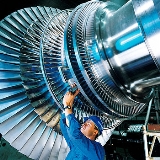
A steam turbine is a mechanical device that extracts thermal energy
Thermal energy

Thermal energy is a form of energy that manifests itself as an increase of temperature. It is also the sum of sensible heat and latent heat....
 from pressurized steam
Steam

In physical chemistry, and in engineering, steam refers to vaporized water. It is a pure, completely invisible gaseous phase . At standard temperature and pressure, pure steam occupies about 1,600 times the volume of an equal mass of liquid water....
, and converts it into rotary motion. Its modern manifestation was invented by Charles Parsons
Charles Algernon Parsons

Sir Charles Algernon Parsons, O.M. was a British engineer, best known for his invention of the steam turbine. He worked as an engineer on dynamo and turbine design, and power generation, with great influence on the naval and electrical engineering fields....
 in 1884.

It has almost completely replaced the reciprocating
Reciprocating engine

A reciprocating engine, also often known as a piston engine, is a heat engine that uses one or more Reciprocating motion pistons to convert pressure into a Circular motion....
 piston steam engine
Steam engine

File:Steam-powered fire engine.jpgA steam engine is a heat engine that performs mechanical work using steam as its working fluid.Steam engines have a long history, going back at least 2000 years....
 (invented by Thomas Newcomen
Thomas Newcomen

Thomas Newcomen was an ironmonger by trade and a Baptist lay preacher by calling. He was born in Dartmouth, England, Devon, England, near a part of the country noted for its tin Minings....
 and greatly improved by James Watt
James Watt

James Watt was a Scottish inventor and mechanical engineer whose improvements to the steam engine were fundamental to the changes brought by the Industrial Revolution in both the Kingdom of Great Britain and the world....
) primarily because of its greater thermal efficiency and higher power-to-weight ratio
Power-to-weight ratio

Power-to-weight ratio is a calculation commonly applied to engines and mobile power sources to enable the comparison of one unit or design to another....
.


Discussion
Ask a question about 'Steam turbine'
Start a new discussion about 'Steam turbine'
Answer questions from other users
Full Discussion Forum


Recent Posts


Encyclopedia


Dampfturbine Laeufer01
A steam turbine is a mechanical device that extracts thermal energy
Thermal energy

Thermal energy is a form of energy that manifests itself as an increase of temperature. It is also the sum of sensible heat and latent heat....
 from pressurized steam
Steam

In physical chemistry, and in engineering, steam refers to vaporized water. It is a pure, completely invisible gaseous phase . At standard temperature and pressure, pure steam occupies about 1,600 times the volume of an equal mass of liquid water....
, and converts it into rotary motion. Its modern manifestation was invented by Charles Parsons
Charles Algernon Parsons

Sir Charles Algernon Parsons, O.M. was a British engineer, best known for his invention of the steam turbine. He worked as an engineer on dynamo and turbine design, and power generation, with great influence on the naval and electrical engineering fields....
 in 1884.

It has almost completely replaced the reciprocating
Reciprocating engine

A reciprocating engine, also often known as a piston engine, is a heat engine that uses one or more Reciprocating motion pistons to convert pressure into a Circular motion....
 piston steam engine
Steam engine

File:Steam-powered fire engine.jpgA steam engine is a heat engine that performs mechanical work using steam as its working fluid.Steam engines have a long history, going back at least 2000 years....
 (invented by Thomas Newcomen
Thomas Newcomen

Thomas Newcomen was an ironmonger by trade and a Baptist lay preacher by calling. He was born in Dartmouth, England, Devon, England, near a part of the country noted for its tin Minings....
 and greatly improved by James Watt
James Watt

James Watt was a Scottish inventor and mechanical engineer whose improvements to the steam engine were fundamental to the changes brought by the Industrial Revolution in both the Kingdom of Great Britain and the world....
) primarily because of its greater thermal efficiency and higher power-to-weight ratio
Power-to-weight ratio

Power-to-weight ratio is a calculation commonly applied to engines and mobile power sources to enable the comparison of one unit or design to another....
. Because the turbine generates rotary motion, it is particularly suited to be used to drive an electrical generator – about 80% of all electricity generation in the world is by use of steam turbines. The steam turbine is a form of heat engine
Heat engine

A heat engine is a physical or theoretical device that converts thermal energy to mechanical output. The mechanical output is called Mechanical work, and the thermal energy input is called heat....
 that derives much of its improvement in thermodynamic efficiency through the use of multiple stages in the expansion of the steam, which results in a closer approach to the ideal reversible process
Reversible process (thermodynamics)

In thermodynamics, a reversible process, or reversible cycle if the process is cyclic, is a process that can be "reversed" by means of infinitesimal changes in some property of the system without loss or dissipation of energy....
.

History

The first device that may be classified as a reaction steam turbine was little more than a toy, the classic Aeolipile
Aeolipile

An aeolipile , a rocket engine style jet engine invented in the first century by Hero of Alexandria, is considered to be the first recorded steam engine or reaction steam turbine....
, described in the 1st century by Hero of Alexandria
Hero of Alexandria

Hero of Alexandria . was an ancient Greek mathematics who was a resident of a Roman province ; he was also an engineer who was active in his hometown of Alexandria....
 in Roman Egypt. A thousand years later, the first impact steam turbine with practical applications was invented in 1551 by Taqi al-Din
Taqi al-Din

Taqi al-Din Muhammad ibn Ma'ruf al-Shami al-Asadi was a major Ottoman Turks or Arab Muslim polymath: a Islamic science, Islamic astronomy and Islamic astrology, Timeline of Muslim scientists and engineers and Inventions in the Muslim world, clockmaker and watchmaker, Islamic physics and Islamic mathematics, Muslim Agricultural Revolution, I...
 in Ottoman Egypt, who described it as a prime mover for rotating a spit. Similar smoke jack
Smoke jack

A smoke-jack is a Jack which gets its energy from a column of rising air or smoke. It is typically used to turn a Rotisserie in a cooking fire....
s were later described by John Wilkins
John Wilkins

John Wilkins was an Anglican ministry and author. He was founder and first secretary of the Royal Society in 1660 and Bishop of Chester from 1668 until his death....
 in 1648 and Samuel Pepys
Samuel Pepys

Samuel Pepys, Fellow of the Royal Society was an English people Navy Board and Member of Parliament, who is now most famous for his diary. Although Pepys had no maritime experience, he rose by patronage, hard work and his talent for administration, to be the Chief Secretary to the Admiralty under James II of England....
 in 1660. Another steam turbine device was created by Italian Giovanni Branca
Giovanni Branca

Giovanni Branca was an Italy engineer and architect, chiefly remembered today for what some commentators have taken to be an early steam engine....
 in 1629.

The modern steam turbine was invented in 1884 by the Englishman Charles A. Parsons, whose first model was connected to a dynamo
Dynamo

Dynamo or Dinamo may refer to:...
 that generated 7.5 kW of electricity. His patent was licensed and the turbine scaled-up shortly after by an American, George Westinghouse
George Westinghouse

George Westinghouse, Jr was an United States of America entrepreneur and engineer who invented the railroad air brake and was a pioneer of the electrical industry....
. A number of other variations of turbines have been developed that work effectively with steam. The de Laval turbine (invented by Gustaf de Laval
Gustaf de Laval

Karl Gustaf Patrik de Laval was a Sweden engineer and inventor who made important contributions to the design of steam turbines and dairy machinery....
) accelerated the steam to full speed before running it against a turbine blade. This was good, because the turbine is simpler, less expensive and does not need to be pressure-proof. It can operate with any pressure of steam. It is also, however, considerably less efficient. The Parson's turbine also turned out to be relatively easy to scale-up. Within Parson's lifetime the generating capacity of a unit was scaled-up by about 10,000 times.
Wirnik Turbiny Parowej Orp Wicher

Types

Steam turbines are made in a variety of sizes ranging from small 1 hp (0.75 kW) units (rare) used as mechanical drives for pumps, compressors and other shaft driven equipment, to 2,000,000 hp (1,500,000 kW) turbines used to generate electricity. There are several classifications for modern steam turbines.

Steam Supply and Exhaust Conditions

These types include condensing, noncondensing, reheat, extraction and induction.

Noncondensing or backpressure turbines are most widely used for process steam applications. The exhaust pressure is controlled by a regulating valve to suit the needs of the process steam pressure. These are commonly found at refineries, district heating units, pulp and paper plants, and desalination
Desalination

Desalination, desalinization, or desalinisation refers to any of several processes that remove excess sodium chloride and other minerals from water....
 facilities where large amounts of low pressure process steam are available.

Condensing turbines are most commonly found in electrical power plants. These turbines exhaust steam in a partially condensed state, typically of a quality
Steam quality

Steam quality is the proportion of saturation steam in a saturated water/steam mixture. A steam quality of 0 indicates 100% water while a steam quality of 1 indicates 100% steam....
 near 90%, at a pressure well below atmospheric to a condenser.

Reheat turbines are also used almost exclusively in electrical power plants. In a reheat turbine, steam flow exits from a high pressure section of the turbine and is returned to the boiler where additional superheat is added. The steam then goes back into an intermediate pressure section of the turbine and continues its expansion.

Extracting type turbines are common in all applications. In an extracting type turbine, steam is released from various stages of the turbine, and used for industrial process needs or sent to boiler feedwater heater
Feedwater heater

A feedwater heater is a power plant component used to pre-heat water delivered to a steam generating boiler. Preheating the feedwater reduces the irreversibilities involved in steam generation and therefore improves the thermodynamic efficiency of the system....
s to improve overall cycle efficiency. Extraction flows may be controlled with a valve, or left uncontrolled. Induction turbines introduce low pressure steam at an intermediate stage to produce additional power.

Casing or Shaft Arrangements

These arrangements include single casing, tandem compound and cross compound turbines. Single casing units are the most basic style where a single casing and shaft are coupled to a generator. Tandem compound are used where two or more casings are directly coupled together to drive a single generator. A cross compound turbine arrangement features two or more shafts not in line driving two or more generators that often operate at different speeds. A cross compound turbine is typically used for many large applications.

Principle of Operation and Design

An ideal steam turbine is considered to be an isentropic process
Isentropic process

In thermodynamics, an isentropic process or isoentropic process is one during which the entropy of the system remains constant. It can be proved that any Reversible process adiabatic process is an isentropic process....
, or constant entropy process, in which the entropy of the steam entering the turbine is equal to the entropy of the steam leaving the turbine. No steam turbine is truly “isentropic”, however, with typical isentropic efficiencies ranging from 20%-90% based on the application of the turbine. The interior of a turbine comprises several sets of blades, or “buckets” as they are more commonly referred to. One set of stationary blades is connected to the casing and one set of rotating blades is connected to the shaft. The sets intermesh with certain minimum clearances, with the size and configuration of sets varying to efficiently exploit the expansion of steam at each stage.

Turbine Efficiency

Turbines Impulse V Reaction
To maximize turbine efficiency, the steam is expanded, generating work, in a number of stages. These stages are characterized by how the energy is extracted from them and are known as impulse or reaction turbines. Most modern steam turbines are a combination of the reaction and impulse design. Typically, higher pressure sections are impulse type and lower pressure stages are reaction type.

Impulse Turbines
An impulse turbine has fixed nozzles that orient the steam flow into high speed jets. These jets contain significant kinetic energy, which the rotor blades, shaped like buckets, convert into shaft rotation as the steam jet changes direction. A pressure drop occurs across only the stationary blades, with a net increase in steam velocity across the stage.

As the steam flows through the nozzle its pressure falls from steam chest pressure to condenser pressure (or atmosphere pressure). Due to this relatively higher ratio of expansion of steam in the nozzle the steam leaves the nozzle with a very high velocity. The steam leaving the moving blades is a large portion of the maximum velocity of the steam when leaving the nozzle. The loss of energy due to this higher exit velocity is commonly called the "carry over velocity" or "leaving loss".

Reaction Turbines
In the reaction turbine, the rotor blades themselves are arranged to form convergent nozzles. This type of turbine makes use of the reaction force produced as the steam accelerates through the nozzles formed by the rotor. Steam is directed onto the rotor by the fixed vanes of the stator. It leaves the stator as a jet that fills the entire circumference of the rotor. The steam then changes direction and increases its speed relative to the speed of the blades. A pressure drop occurs across both the stator and the rotor, with steam accelerating through the stator and decelerating through the rotor, with no net change in steam velocity across the stage but with a decrease in both pressure and temperature, reflecting the work performed in the driving of the rotor.

Operation and Maintenance

When warming up a steam turbine for use, the main steam stop valves (after the boiler) have a bypass line to allow superheated steam to slowly bypass the valve and proceed to heat up the lines in the system along with the steam turbine. Also a turning gear is engaged when there is no steam to the turbine to slowly rotate the turbine to ensure even heating to prevent uneven expansion. After first rotating the turbine by the turning gear, allowing time for the rotor to assume a straight plane (no bowing), then the turning gear is disengaged and steam is admitted to the turbine, first to the astern blades then to the ahead blades slowly rotating the turbine at 10 to 15 RPM to slowly warm the turbine.

Problems with turbines are now rare and maintenance requirements are relatively small. Any imbalance of the rotor can lead to vibration, which in extreme cases can lead to a blade letting go and punching straight through the casing. It is, however, essential that the turbine be turned with dry steam. If water gets into the steam and is blasted onto the blades (moisture carryover) rapid impingement and erosion of the blades can occur, possibly leading to imbalance and catastrophic failure. Also, water entering the blades will likely result in the destruction of the thrust bearing for the turbine shaft. To prevent this, along with controls and baffles in the boilers to ensure high quality steam, condensate drains are installed in the steam piping leading to the turbine.

Speed regulation

The control of a turbine with a governor is essential, as turbines need to be run up slowly, to prevent damage while some applications (such as the generation of alternating current electricity) require precise speed control. Uncontrolled acceleration of the turbine rotor can lead to an overspeed trip, which causes the nozzle valves that control the flow of steam to the turbine to close. If this fails then the turbine may continue accelerating until it breaks apart, often spectacularly. Turbines are expensive to make, requiring precision manufacture and special quality materials.

Direct drive

Electrical power stations
Electricity generation

Electricity generation is the process of converting non-electrical energy to electricity. For electric utility, it is the first process in the delivery of electricity to consumers....
 use large steam turbines driving electric generators to produce most (about 80%) of the world's electricity. Most of these centralised stations are of two types: fossil fuel power plant
Fossil fuel power plant

A fossil-fuel power plant is a power stations that burns fossil fuels such as coal, natural gas or petroleum to produce electricity.Fossil-fuel power plants are designed on a large scale for continuous operation....
s and nuclear power plants. The turbines used for electric power generation are most often directly coupled to their generators. As the generators must rotate at constant synchronous speeds according to the frequency of the electric power system, the most common speeds are 3000 r/min for 50 Hz systems, and 3600 r/min for 60 Hz systems. In installations with high steam output, as may be found in nuclear power stations, the generator sets may be arranged to operate at half these speeds, but with four-pole generators.

Speed reduction

Turbinia At Speed
Another use of steam turbines is in ships; their small size, low maintenance, light weight, and low vibration are compelling advantages. (Steam turbine locomotive
Steam turbine locomotive

A steam turbine locomotive is a steam locomotive which transmits steam power to the wheels via a steam turbine. Numerous attempts at this type of locomotive were made, mostly without success....
s were also tested, but with limited success.) A steam turbine is only efficient when operating in the thousands of RPM range while application of the power in propulsion applications may be only in the hundreds of RPM and so requiring that expensive and precise reduction gears must be used, although several ships, such as Turbinia
Turbinia

Turbinia was the first steam turbine powered steamship. Built as an experimental vessel in 1894, and easily the fastest ship in the world at that time, Turbinia was demonstrated dramatically at the Spithead Navy Review in 1897 and set the standard for the next generation of steamships, the majority of which were turbine powered....
, had direct drive from the steam turbine to the propeller shafts. This purchase cost is offset by much lower fuel and maintenance requirements and the small size of a turbine when compared to a reciprocating engine having an equivalent power, except for diesel engines which are capable of higher efficiencies. Steam turbine efficiencies have yet to break 50% yet diesel engines routinely exceed 50%, especially in marine applications.

Further Reading


External link

by Hubert E. Collins