Tanakh

Encyclopedia
The Tanakh is a name used in Judaism
for the canon
of the Hebrew Bible
. The Tanakh is also known as the Masoretic Text
or the Miqra. The name is an acronym
formed from the initial Hebrew letters
of the Masoretic Text's three traditional subdivisions: The Torah
("Teaching", also known as the Five Books of Moses), Nevi'im
("Prophets") and Ketuvim
("Writings")—hence TaNaKh. The name "Miqra" (מקרא), meaning "that which is read", is an alternative Hebrew term for the Tanakh. The books of the Tanakh (Hebrew Bible) were relayed with an accompanying oral tradition passed on by each generation, called the Oral Torah
.
According to the Talmud
, much of the contents of the Tanakh were compiled by the "Men of the Great Assembly" by 450 BCE, and have since remained unchanged. Modern scholars believe that the process of canonization of the Tanakh became finalized between 200 BCE and 200 CE, see Development of the Jewish canon for details.
The Hebrew text was originally an abjad
: consonant
s written with some applied vowel letters ("matres lectionis
"). During the early Middle Ages
scholars known as the Masoretes
created a single formalized system of vocalization. This was chiefly done by Aaron ben Moses ben Asher
, in the Tiberias school, based on the oral tradition for reading the Tanakh, hence the name Tiberian vocalization
. It also included some of Ben Naftali and Babylonian innovations. Despite the comparatively late process of codification, some traditional sources and some Orthodox Jews believe the pronunciation and cantillation
derive from the revelation at Sinai
, since it is impossible to read the original text without pronunciations and cantillation pauses. The combination of a text (מקרא mikra), pronunciation (ניקוד niqqud) and cantillation (טעמים te`amim) enable the reader to understand both the simple meaning, as well as the nuances in sentence flow of the text.
period and in Rabbinic literature
. During that period, however, "Tanakh" was not used. Instead, the proper title was Mikra (מקרא, meaning "reading" or "that which is read") because the biblical texts were read publicly. Mikra continues to be used in Hebrew to this day, alongside Tanakh, to refer to the Jewish scriptures. In modern spoken Hebrew
both are used interchangeably.
(Bava Basra 14b-15a, Rashi to Megillah 3a, 14a), much of the contents of the Tanakh was compiled by the Men of the Great Assembly (Anshei K'nesset HaGedolah), a task completed in 450 BCE, and have remained unchanged since that date. Evidence suggests that the process of canonization
occurred between 200 BCE and 200 CE. A popular position is that the Torah
was canonized circa 400 BCE, the Prophets circa 200 BCE, and the Writings
circa 100 CE, perhaps at a hypothetical Council of Jamnia
. This position, however, is increasingly criticised by modern scholars. Some scholars argue that the Jewish canon was fixed by the Hasmonean
dynasty (140-37 BCE). Today, there is no scholarly consensus as to when the Jewish canon was set.
Formal closure of the canon has often been ascribed to Rabbinic Judaism
after the destruction of the Second Temple
in 70 CE. Heinrich Graetz
proposed in 1871 that it was concluded at a Council of Jamnia (or Yavne
in Hebrew), some time in the period 70–90 CE. However, Rabbinical writings seem to indicate that certain books were disputed as accepted canon (such as Ecclesiastes, Song of Songs and Esther, see also Antilegomena
), but it may not necessarily be the case. The implication of the Talmud
indicates that the books themselves were already accepted canon, but may have been misunderstood on philosophical or ecclesiastical grounds. The Talmud eliminates this misunderstanding.
The twenty-four books are also mentioned in the Midrash Koheleth
12:12.
A slightly different accounting can be found in the book Against Apion
, by the 1st-century Jewish historian Josephus
, who describes 22 sacred books. Some scholars have suggested that he considered Ruth
part of Judges
, and Lamentations
part of Jeremiah
; as the Christian translator Jerome
recorded in the 4th century CE. Other scholars suggest that at the time Josephus wrote, such books as Esther
and Ecclesiastes were not yet considered canonical.
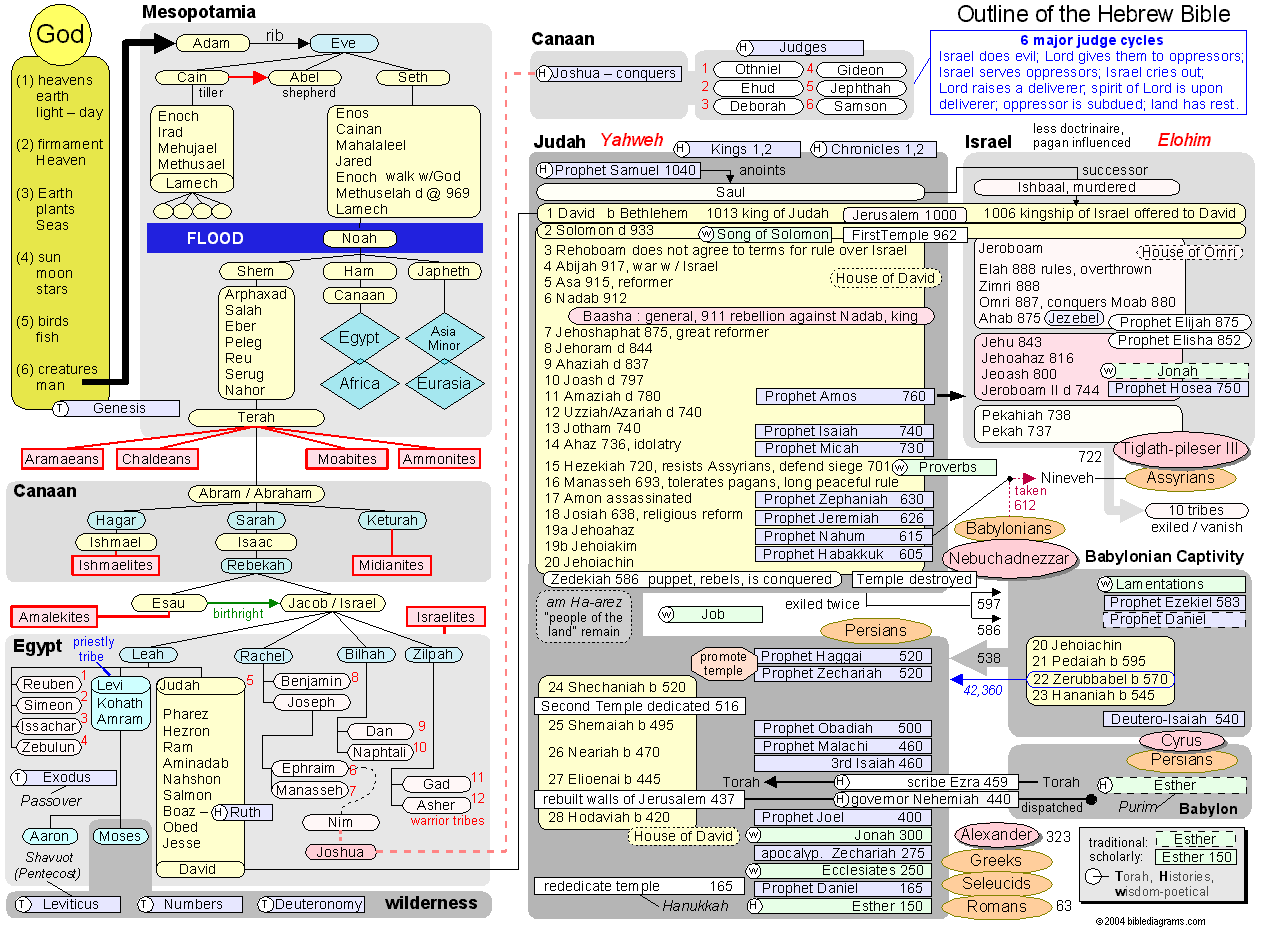
 According to Jewish tradition, the Tanakh consists of twenty-four books. The Tanakh counts as one book each Samuel, Kings, Chronicles and Ezra-Nehemiah
and counts Trei Asar (תרי עשר, the Twelve Prophets; literally "twelve") as a single book.
In Hebrew, the five books of the Torah are identified by the first prominent word
in each book. The English names are derived from the Greek names given to the books in the Septuagint, which are based on the thematic content of each of the books, as follows:
until the Babylonian captivity
of Judah (the "period of prophecy"). However, they exclude Chronicles
, which covers the same period, as well as Ruth. The Nevi'im are often divided into the Earlier Prophets (נביאים ראשונים), which are generally historical in nature, and the Later Prophets (נביאים אחרונים), which contain more exhortational prophecies.
Although most versions of the Old Testament
count the number of books as totaling twenty-one, counting the books of Samuel and Kings
as two books each, and the "Twelve Prophets" (or the minor prophets) as 12 books, Jewish tradition does not:
title "Hagiographa" and consists of eleven books. These encompass all the remaining books, and include the Five Megillot (Five Scrolls). They are sometimes also divided into such categories as Sifrei Emet (ספרי אמת, literally "Books of Truth") of Psalms
, Proverbs
and Job
(the Hebrew names of these three books form the Hebrew word for "truth" as an acrostic
, and all three books have unique cantillation marks), the "wisdom books" of Job
, Ecclesiastes
, and Proverbs
, the "poetry books" of Psalms
, Lamentations
and Song of Songs
, and the "historical books" of Ezra-Nehemiah
and Chronicles
.
Although most versions of the Old Testament
count the number of books as totaling thirteen, counting Ezra
and Nehemiah
as two books and I and II Chronicles as two, Jewish Tradition again does not.
The adoption of the Christian chapter divisions by Jews began in the late Middle Ages in Spain
, partially in the context of forced clerical debates which took place against a background of harsh persecution and of the Spanish Inquisition
(the debates required a common system for citing biblical texts). From the standpoint of the Jewish textual tradition, the chapter divisions are not only a foreign feature with no basis in the mesorah
, but are also open to severe criticism of three kinds:
Nevertheless, because they proved useful for citations, they are often included in most Hebrew editions of the biblical books. For more information on the origin of these divisions, see chapters and verses of the Bible
. Jews don't necessarily reference the specific verse in a chapter (older editions of the Talmud
cite only chapter numbers), and some works cite the sectional divisions in the Torah.
The chapter and verse numbers were often indicated very prominently in older editions, to the extent that they overshadowed the traditional Jewish masoretic
divisions. However, in many Jewish editions of the Tanakh published over the past forty years, there has been a major trend towards minimizing the impact and prominence of the chapter and verse numbers on the printed page. Most editions accomplish this by removing them from the text itself and relegating them to the margins of the page. The main text in these editions is unbroken and uninterrupted at the beginning of chapters (which are noted only in the margin). The lack of chapter breaks within the text in these editions also serves to reinforce the visual impact created by the spaces and "paragraph" breaks on the page, which indicate the traditional Jewish parashah divisions. Some versions have even introduced a new chapter system .
These modern Jewish editions present Samuel, Kings, and Chronicles (as well as Ezra) as single books in their title pages, and make no indication inside the main text of their division into two parts (though it is noted in the upper and side margins). In such editions, the second books of Samuel, Kings and Chronicles follow the respective first books on the very same page, with no special break at all in the flow of the text. In the case of Kings, in which no parashah division appears at this point, the text of II Kings continues that of I Kings on the very same line of text.
Jewish (Hebrew) editions have a different pattern regarding Chronicles
(I Chronicles) chapters 5 and 6. In I Chronicles (in Christian sources) chapter 5 ends at verse 41. Chronicles (Jewish editions of Chronicles) 5:27-41 is equivalent to First Chronicles 6: 1-15 in most English translations. In Jewish (Hebrew) editions 6:1 is equivalent to 6:16 and therefore the chapter ends at Chronicles 6:66 instead of the First Chronicles 6:81 (English translations) and at 7:1 both Hebrew and English versions set off from the same starting point once more. This difference offsets other more contextual differences. The Jewish Tanakh is the same as the Christian Hebrew Old Testament and is based on careful copying of Hebrew and Aramaic manuscripts over centuries. Jewish and Christian translations often differ. For example, some Christians translate the word almah (עלמה) as "virgin," while Jews tend to the translation "young maiden". Christian views are based on exegesis of the Isaiah passage and Matthew's interpretation, which also agrees with the ancient Jewish Septuagint translation, , which according to some New Testament Scholars, can mean "a marriageable maiden" or "virgin."
The Leningrad Codex also served as the basis for two important Jewish editions of the Hebrew Bible (Tanakh):
Secular practitioners of Biblical Studies do not have a faith commitment to the texts they study. In fact, Biblical criticism contradicts commitment to the idea that the Bible was written by prophets inspired by God. Indeed, this practice, when applied to the Torah, is considered heresy by the entire Orthodox Jewish community. As such, much modern day Bible commentary written by non-Orthodox authors is considered forbidden by rabbis teaching in Orthodox yeshivas.
Some classical rabbinic commentators, such as Abraham Ibn Ezra, Gersonides, and Maimonides, used many elements of contemporary biblical criticism, including their then-current knowledge of history, science, and philology. Their use of historical and scientific analysis of the Bible was considered kosher by historic Judaism due to the author's faith commitment to the idea that God revealed the Torah to Moses on Mount Sinai.
The Modern Orthodox Jewish community allows for a wider array of biblical criticism to be used for biblical books outside of the Torah, and a few Orthodox commentaries now incorporate many of the techniques previously found in the academic world, e.g. the Da'at Miqra
series.
Non-Orthodox Jews, including those affiliated with Conservative Judaism and Reform Judaism, accept both traditional and secular approaches to Bible studies. See the article on Revelation
for details of how members of these groups understand this concept.
The article on Jewish commentaries on the Bible
discusses Jewish Tanakh commentaries from the Targums to classical rabbinic literature
, the midrash
literature, the classical medieval commentators, and modern day commentaries.
Judaism
Judaism ) is the "religion, philosophy, and way of life" of the Jewish people...
for the canon
Biblical canon
A biblical canon, or canon of scripture, is a list of books considered to be authoritative as scripture by a particular religious community. The term itself was first coined by Christians, but the idea is found in Jewish sources. The internal wording of the text can also be specified, for example...
of the Hebrew Bible
Hebrew Bible
The Hebrew Bible is a term used by biblical scholars outside of Judaism to refer to the Tanakh , a canonical collection of Jewish texts, and the common textual antecedent of the several canonical editions of the Christian Old Testament...
. The Tanakh is also known as the Masoretic Text
Masoretic Text
The Masoretic Text is the authoritative Hebrew text of the Jewish Bible and is regarded as Judaism's official version of the Tanakh. While the Masoretic Text defines the books of the Jewish canon, it also defines the precise letter-text of these biblical books, with their vocalization and...
or the Miqra. The name is an acronym
Acronym and initialism
Acronyms and initialisms are abbreviations formed from the initial components in a phrase or a word. These components may be individual letters or parts of words . There is no universal agreement on the precise definition of the various terms , nor on written usage...
formed from the initial Hebrew letters
Hebrew alphabet
The Hebrew alphabet , known variously by scholars as the Jewish script, square script, block script, or more historically, the Assyrian script, is used in the writing of the Hebrew language, as well as other Jewish languages, most notably Yiddish, Ladino, and Judeo-Arabic. There have been two...
of the Masoretic Text's three traditional subdivisions: The Torah
Torah
Torah- A scroll containing the first five books of the BibleThe Torah , is name given by Jews to the first five books of the bible—Genesis , Exodus , Leviticus , Numbers and Deuteronomy Torah- A scroll containing the first five books of the BibleThe Torah , is name given by Jews to the first five...
("Teaching", also known as the Five Books of Moses), Nevi'im
Nevi'im
Nevi'im is the second of the three major sections in the Hebrew Bible, the Tanakh. It falls between the Torah and Ketuvim .Nevi'im is traditionally divided into two parts:...
("Prophets") and Ketuvim
Ketuvim
Ketuvim or Kəṯûḇîm in actual Biblical Hebrew is the third and final section of the Tanak , after Torah and Nevi'im . In English translations of the Hebrew Bible, this section is usually entitled "Writings" or "Hagiographa"...
("Writings")—hence TaNaKh. The name "Miqra" (מקרא), meaning "that which is read", is an alternative Hebrew term for the Tanakh. The books of the Tanakh (Hebrew Bible) were relayed with an accompanying oral tradition passed on by each generation, called the Oral Torah
Oral Torah
The Oral Torah comprises the legal and interpretative traditions that, according to tradition, were transmitted orally from Mount Sinai, and were not written in the Torah...
.
According to the Talmud
Talmud
The Talmud is a central text of mainstream Judaism. It takes the form of a record of rabbinic discussions pertaining to Jewish law, ethics, philosophy, customs and history....
, much of the contents of the Tanakh were compiled by the "Men of the Great Assembly" by 450 BCE, and have since remained unchanged. Modern scholars believe that the process of canonization of the Tanakh became finalized between 200 BCE and 200 CE, see Development of the Jewish canon for details.
The Hebrew text was originally an abjad
Abjad
An abjad is a type of writing system in which each symbol always or usually stands for a consonant; the reader must supply the appropriate vowel....
: consonant
Consonant
In articulatory phonetics, a consonant is a speech sound that is articulated with complete or partial closure of the vocal tract. Examples are , pronounced with the lips; , pronounced with the front of the tongue; , pronounced with the back of the tongue; , pronounced in the throat; and ,...
s written with some applied vowel letters ("matres lectionis
Mater lectionis
In the spelling of Hebrew and some other Semitic languages, matres lectionis , refers to the use of certain consonants to indicate a vowel. The letters that do this in Hebrew are aleph, he, waw and yod...
"). During the early Middle Ages
Middle Ages
The Middle Ages is a periodization of European history from the 5th century to the 15th century. The Middle Ages follows the fall of the Western Roman Empire in 476 and precedes the Early Modern Era. It is the middle period of a three-period division of Western history: Classic, Medieval and Modern...
scholars known as the Masoretes
Masoretes
The Masoretes were groups of mostly Karaite scribes and scholars working between the 7th and 11th centuries, based primarily in present-day Israel in the cities of Tiberias and Jerusalem, as well as in Iraq...
created a single formalized system of vocalization. This was chiefly done by Aaron ben Moses ben Asher
Aaron ben Moses ben Asher
Aaron ben Moses ben Asher was a Jewish scribe who refined the Tiberian system for writing down vowel sounds in Hebrew, which is still in use today, and serves as the basis for grammatical analysis...
, in the Tiberias school, based on the oral tradition for reading the Tanakh, hence the name Tiberian vocalization
Tiberian vocalization
The Tiberian vocalization is a system of diacritics devised by the Masoretes to add to the consonantal Masoretic text of the Hebrew Bible; this system soon became used to vocalize other texts as well...
. It also included some of Ben Naftali and Babylonian innovations. Despite the comparatively late process of codification, some traditional sources and some Orthodox Jews believe the pronunciation and cantillation
Cantillation
Cantillation is the ritual chanting of readings from the Hebrew Bible in synagogue services. The chants are written and notated in accordance with the special signs or marks printed in the Masoretic text of the Hebrew Bible to complement the letters and vowel points...
derive from the revelation at Sinai
Biblical Mount Sinai
The Biblical Mount Sinai is the mountain at which the Book of Exodus states that the Ten Commandments were given to Moses by God...
, since it is impossible to read the original text without pronunciations and cantillation pauses. The combination of a text (מקרא mikra), pronunciation (ניקוד niqqud) and cantillation (טעמים te`amim) enable the reader to understand both the simple meaning, as well as the nuances in sentence flow of the text.
Terminology
The three-part division reflected in the acronym "Tanakh" is well attested to in documents from the Second TempleSecond Temple
The Jewish Second Temple was an important shrine which stood on the Temple Mount in Jerusalem between 516 BCE and 70 CE. It replaced the First Temple which was destroyed in 586 BCE, when the Jewish nation was exiled to Babylon...
period and in Rabbinic literature
Rabbinic literature
Rabbinic literature, in its broadest sense, can mean the entire spectrum of rabbinic writings throughout Jewish history. However, the term often refers specifically to literature from the Talmudic era, as opposed to medieval and modern rabbinic writing, and thus corresponds with the Hebrew term...
. During that period, however, "Tanakh" was not used. Instead, the proper title was Mikra (מקרא, meaning "reading" or "that which is read") because the biblical texts were read publicly. Mikra continues to be used in Hebrew to this day, alongside Tanakh, to refer to the Jewish scriptures. In modern spoken Hebrew
Hebrew language
Hebrew is a Semitic language of the Afroasiatic language family. Culturally, is it considered by Jews and other religious groups as the language of the Jewish people, though other Jewish languages had originated among diaspora Jews, and the Hebrew language is also used by non-Jewish groups, such...
both are used interchangeably.
Codification of the books of Tanakh
According to the TalmudTalmud
The Talmud is a central text of mainstream Judaism. It takes the form of a record of rabbinic discussions pertaining to Jewish law, ethics, philosophy, customs and history....
(Bava Basra 14b-15a, Rashi to Megillah 3a, 14a), much of the contents of the Tanakh was compiled by the Men of the Great Assembly (Anshei K'nesset HaGedolah), a task completed in 450 BCE, and have remained unchanged since that date. Evidence suggests that the process of canonization
Biblical canon
A biblical canon, or canon of scripture, is a list of books considered to be authoritative as scripture by a particular religious community. The term itself was first coined by Christians, but the idea is found in Jewish sources. The internal wording of the text can also be specified, for example...
occurred between 200 BCE and 200 CE. A popular position is that the Torah
Torah
Torah- A scroll containing the first five books of the BibleThe Torah , is name given by Jews to the first five books of the bible—Genesis , Exodus , Leviticus , Numbers and Deuteronomy Torah- A scroll containing the first five books of the BibleThe Torah , is name given by Jews to the first five...
was canonized circa 400 BCE, the Prophets circa 200 BCE, and the Writings
Ketuvim
Ketuvim or Kəṯûḇîm in actual Biblical Hebrew is the third and final section of the Tanak , after Torah and Nevi'im . In English translations of the Hebrew Bible, this section is usually entitled "Writings" or "Hagiographa"...
circa 100 CE, perhaps at a hypothetical Council of Jamnia
Council of Jamnia
The Council of Jamnia or Council of Yavne is a hypothetical late 1st-century council at which it is postulated the canon of the Hebrew Bible was finalized....
. This position, however, is increasingly criticised by modern scholars. Some scholars argue that the Jewish canon was fixed by the Hasmonean
Hasmonean
The Hasmonean dynasty , was the ruling dynasty of Judea and surrounding regions during classical antiquity. Between c. 140 and c. 116 BCE, the dynasty ruled semi-autonomously from the Seleucids in the region of Judea...
dynasty (140-37 BCE). Today, there is no scholarly consensus as to when the Jewish canon was set.
Formal closure of the canon has often been ascribed to Rabbinic Judaism
Rabbinic Judaism
Rabbinic Judaism or Rabbinism has been the mainstream form of Judaism since the 6th century CE, after the codification of the Talmud...
after the destruction of the Second Temple
Siege of Jerusalem (70)
The Siege of Jerusalem in the year 70 AD was the decisive event of the First Jewish-Roman War. The Roman army, led by the future Emperor Titus, with Tiberius Julius Alexander as his second-in-command, besieged and conquered the city of Jerusalem, which had been occupied by its Jewish defenders in...
in 70 CE. Heinrich Graetz
Heinrich Graetz
Heinrich Graetz was amongst the first historians to write a comprehensive history of the Jewish people from a Jewish perspective....
proposed in 1871 that it was concluded at a Council of Jamnia (or Yavne
Yavne
Yavne is a city in the Central District of Israel. According to the Israel Central Bureau of Statistics , at the end of 2009 the city had a population of 33,000.-History:...
in Hebrew), some time in the period 70–90 CE. However, Rabbinical writings seem to indicate that certain books were disputed as accepted canon (such as Ecclesiastes, Song of Songs and Esther, see also Antilegomena
Antilegomena
Antilegomena, a direct transliteration from the Greek , refers to written texts whose authenticity or value is disputed.Eusebius in his Church History written c. 325 used the term for those Christian scriptures that were "disputed" or literally those works which were "spoken against" in Early...
), but it may not necessarily be the case. The implication of the Talmud
Talmud
The Talmud is a central text of mainstream Judaism. It takes the form of a record of rabbinic discussions pertaining to Jewish law, ethics, philosophy, customs and history....
indicates that the books themselves were already accepted canon, but may have been misunderstood on philosophical or ecclesiastical grounds. The Talmud eliminates this misunderstanding.
The twenty-four books are also mentioned in the Midrash Koheleth
Ecclesiastes Rabbah
Ecclesiastes Rabbah or Kohelet Rabbah is an haggadic commentary on Ecclesiastes, included in the collection of the Midrash Rabbot. It follows the Biblical book verse by verse, only a few verses remaining without comment. In the list of the old sedarim for the Bible four sedarim are assigned to...
12:12.
A slightly different accounting can be found in the book Against Apion
Against Apion
Against Apion was a polemical work written by Flavius Josephus as a defense of Judaism as a classical religion and philosophy, stressing its antiquity against what he perceived as more recent traditions of the Greeks.-Text:Against Apion 1:8 also defines which books he viewed as being in the Jewish...
, by the 1st-century Jewish historian Josephus
Josephus
Titus Flavius Josephus , also called Joseph ben Matityahu , was a 1st-century Romano-Jewish historian and hagiographer of priestly and royal ancestry who recorded Jewish history, with special emphasis on the 1st century AD and the First Jewish–Roman War, which resulted in the Destruction of...
, who describes 22 sacred books. Some scholars have suggested that he considered Ruth
Book of Ruth
The Book of Ruth is one of the books of the Hebrew Bible, Tanakh, or Old Testament. In the Jewish canon the Book of Ruth is included in the third division, or the Writings . In the Christian canon the Book of Ruth is placed between Judges and 1 Samuel...
part of Judges
Book of Judges
The Book of Judges is the seventh book of the Hebrew bible and the Christian Old Testament. Its title describes its contents: it contains the history of Biblical judges, divinely inspired prophets whose direct knowledge of Yahweh allows them to act as decision-makers for the Israelites, as...
, and Lamentations
Book of Lamentations
The Book of Lamentations ) is a poetic book of the Hebrew Bible composed by the Jewish prophet Jeremiah. It mourns the destruction of Jerusalem and the Holy Temple in the 6th Century BCE....
part of Jeremiah
Book of Jeremiah
The Book of Jeremiah is the second of the Latter Prophets in the Hebrew Bible, following the book of Isaiah and preceding Ezekiel and the Book of the Twelve....
; as the Christian translator Jerome
Jerome
Saint Jerome was a Roman Christian priest, confessor, theologian and historian, and who became a Doctor of the Church. He was the son of Eusebius, of the city of Stridon, which was on the border of Dalmatia and Pannonia...
recorded in the 4th century CE. Other scholars suggest that at the time Josephus wrote, such books as Esther
Book of Esther
The Book of Esther is a book in the Ketuvim , the third section of the Jewish Tanakh and is part of the Christian Old Testament. The Book of Esther or the Megillah is the basis for the Jewish celebration of Purim...
and Ecclesiastes were not yet considered canonical.
Books of the Tanakh
Ezra-Nehemiah
Ezra-Nehemiah is the combined biblical books of Ezra and Nehemiah - the two were originally one, but were divided by Christians in the 3rd century CE, and in Jewish circles in the 15th century...
and counts Trei Asar (תרי עשר, the Twelve Prophets; literally "twelve") as a single book.
Torah
The Torah (תּוֹרָה, literally "teaching") consists of five books, commonly referred to as the "Five Books of Moses". Printed versions of the Torah are often called Chamisha Chumshei Torah (חמישה חומשי תורה, literally the "five five-sections of the Torah"), and informally a Chumash.In Hebrew, the five books of the Torah are identified by the first prominent word
Incipit
Incipit is a Latin word meaning "it begins". The incipit of a text, such as a poem, song, or book, is the first few words of its opening line. In music, it can also refer to the opening notes of a composition. Before the development of titles, texts were often referred to by their incipits...
in each book. The English names are derived from the Greek names given to the books in the Septuagint, which are based on the thematic content of each of the books, as follows:
- 1. (בראשית / Bereshit) - Genesis
- 2. (שמות / Shemot) - Exodus
- 3. (ויקרא / Vayikra) - LeviticusLeviticusThe Book of Leviticus is the third book of the Hebrew Bible, and the third of five books of the Torah ....
- 4. (במדבר / Bamidbar) - NumbersBook of NumbersThe Book of Numbers is the fourth book of the Hebrew Bible, and the fourth of five books of the Jewish Torah/Pentateuch....
- 5. (דברים / Devarim) - DeuteronomyDeuteronomyThe Book of Deuteronomy is the fifth book of the Hebrew Bible, and of the Jewish Torah/Pentateuch...
Nevi'im
Nevi'im (נְבִיאִים, "Prophets") consists of eight books. This division includes the books which, as a whole, cover the chronological era from the entrance of the Israelites into the LandLand of Israel
The Land of Israel is the Biblical name for the territory roughly corresponding to the area encompassed by the Southern Levant, also known as Canaan and Palestine, Promised Land and Holy Land. The belief that the area is a God-given homeland of the Jewish people is based on the narrative of the...
until the Babylonian captivity
Babylonian captivity
The Babylonian captivity was the period in Jewish history during which the Jews of the ancient Kingdom of Judah were captives in Babylon—conventionally 587–538 BCE....
of Judah (the "period of prophecy"). However, they exclude Chronicles
Books of Chronicles
The Books of Chronicles are part of the Hebrew Bible. In the Masoretic Text, it appears as the first or last book of the Ketuvim . Chronicles largely parallels the Davidic narratives in the Books of Samuel and the Books of Kings...
, which covers the same period, as well as Ruth. The Nevi'im are often divided into the Earlier Prophets (נביאים ראשונים), which are generally historical in nature, and the Later Prophets (נביאים אחרונים), which contain more exhortational prophecies.
Although most versions of the Old Testament
Old Testament
The Old Testament, of which Christians hold different views, is a Christian term for the religious writings of ancient Israel held sacred and inspired by Christians which overlaps with the 24-book canon of the Masoretic Text of Judaism...
count the number of books as totaling twenty-one, counting the books of Samuel and Kings
Books of Kings
The Book of Kings presents a narrative history of ancient Israel and Judah from the death of David to the release of his successor Jehoiachin from imprisonment in Babylon, a period of some 400 years...
as two books each, and the "Twelve Prophets" (or the minor prophets) as 12 books, Jewish tradition does not:
- 6. (יהושע / Y'hoshua) - JoshuaBook of JoshuaThe Book of Joshua is the sixth book in the Hebrew Bible and of the Old Testament. Its 24 chapters tell of the entry of the Israelites into Canaan, their conquest and division of the land under the leadership of Joshua, and of serving God in the land....
- 7. (שופטים / Shophtim) - JudgesBook of JudgesThe Book of Judges is the seventh book of the Hebrew bible and the Christian Old Testament. Its title describes its contents: it contains the history of Biblical judges, divinely inspired prophets whose direct knowledge of Yahweh allows them to act as decision-makers for the Israelites, as...
- 8. (שמואל / Sh'muel) - SamuelBooks of SamuelThe Books of Samuel in the Jewish bible are part of the Former Prophets, , a theological history of the Israelites affirming and explaining the Torah under the guidance of the prophets.Samuel begins by telling how the prophet Samuel is chosen by...
(I & II) - 9. (מלכים / M'lakhim) - KingsBooks of KingsThe Book of Kings presents a narrative history of ancient Israel and Judah from the death of David to the release of his successor Jehoiachin from imprisonment in Babylon, a period of some 400 years...
(I & II) - 10. (ישעיה / Y'shayahu) - IsaiahBook of IsaiahThe Book of Isaiah is the first of the Latter Prophets in the Hebrew Bible, preceding the books of Ezekiel, Jeremiah and the Book of the Twelve...
- 11. (ירמיה / Yir'mi'yahu) - JeremiahBook of JeremiahThe Book of Jeremiah is the second of the Latter Prophets in the Hebrew Bible, following the book of Isaiah and preceding Ezekiel and the Book of the Twelve....
- 12. (יחזקאל / Y'khezqel) - EzekielBook of EzekielThe Book of Ezekiel is the third of the Latter Prophets in the Hebrew Bible, following the books of Isaiah and Jeremiah and preceding the Book of the Twelve....
- 13. The Twelve Prophets (תרי עשר)
- a. (הושע / Hoshea) - HoseaBook of HoseaThe Book of Hosea is one of the books of the Hebrew Bible. It stands first in order among what are known as the twelve Minor Prophets.-Background and Content:...
- b. (יואל / Yo'el) - JoelBook of JoelThe Book of Joel is part of the Hebrew Bible. Joel is part of a group of twelve prophetic books known as the Minor Prophets or simply as The Twelve; the distinction 'minor' indicates the short length of the text in relation to the larger prophetic texts known as the "Major Prophets".-Content:After...
- c. (עמוס / Amos) - AmosBook of AmosThe Book of Amos is a prophetic book of the Hebrew Bible, one of the Twelve Minor Prophets. Amos, an older contemporary of Hosea and Isaiah, was active c. 750 BCE during the reign of Jeroboam II, making the Book of Amos the first biblical prophetic book written. Amos lived in the kingdom of Judah...
- d. (עובדיה / Ovadyah) - ObadiahBook of ObadiahThe canonical Book of Obadiah is an oracle concerning the divine judgment of Edom and the restoration of Israel. The text consists of a single chapter, divided into 21 verses, making it the shortest book in the Hebrew Bible....
- e. (יונה / Yonah) - JonahBook of JonahThe Book of Jonah is a book in the Hebrew Bible. It tells the story of a Hebrew prophet named Jonah ben Amittai who is sent by God to prophesy the destruction of Nineveh but tries to escape the divine mission...
- f. (מיכה / Mikhah) - MicahBook of MicahThe Book of Micah is one of fifteen prophetic books in the Hebrew bible/Old Testament, and the sixth of the twelve minor prophets. It records the sayings of Mikayahu, meaning "Who is like Yahweh?", an 8th century prophet from the village of Moresheth in Judah...
- g. (נחום / Nakhum) - NahumBook of NahumThe book of Nahum is the seventh book of the 12 minor prophets of the Hebrew Bible. It is attributed to the prophet Nahum, and was probably written in Jerusalem in the 8th century BC.-Background:...
- h. (חבקוק /Havakuk) - HabakkukBook of HabakkukThe Book of Habakkuk is the eighth book of the 12 minor prophets of the Hebrew Bible. It is attributed to the prophet Habakkuk, and was probably composed in the late 7th century BC. A copy of chapters 1 and 2 is included in the Habakkuk Commentary, found among the Dead Sea Scrolls.Chapters 1-2...
- i. (צפניה / Ts'phanyah) - ZephaniahBook of ZephaniahThe superscription of the Book of Zephaniah attributes its authorship to “Zephaniah son of Cushi son of Gedaliah son of Amariah son of Hezekiah, in the days of King Josiah son of Amon of Judah” . All that is known of Zephaniah comes from the text. The superscription of the book is lengthier than...
- j. (חגי / Khagai) - HaggaiBook of HaggaiThe Book of Haggai is a book of the Hebrew Bible or Tanak, and has its place as the antepenultimate of the Minor Prophets or the "Book of the Twelve." It is a short book, consisting of only two chapters. The historical setting dates around 520 BCE before the Temple has been rebuilt...
- k. (זכריה / Z'kharyah) - ZechariahBook of ZechariahThe Book of Zechariah is the penultimate book of the twelve minor prophets in the Hebrew and Christian Bible, attributed to the prophet Zechariah.-Historical context:...
- l. (מלאכי / Mal'akhi) - MalachiBook of MalachiMalachi is a book of the Hebrew Bible, the last of the twelve minor prophets and the final book of the Neviim...
- a. (הושע / Hoshea) - Hosea
Ketuvim
Ketuvim (כְּתוּבִים, "Writings") are sometimes also known by the GreekGreek language
Greek is an independent branch of the Indo-European family of languages. Native to the southern Balkans, it has the longest documented history of any Indo-European language, spanning 34 centuries of written records. Its writing system has been the Greek alphabet for the majority of its history;...
title "Hagiographa" and consists of eleven books. These encompass all the remaining books, and include the Five Megillot (Five Scrolls). They are sometimes also divided into such categories as Sifrei Emet (ספרי אמת, literally "Books of Truth") of Psalms
Psalms
The Book of Psalms , commonly referred to simply as Psalms, is a book of the Hebrew Bible and the Christian Bible...
, Proverbs
Book of Proverbs
The Book of Proverbs , commonly referred to simply as Proverbs, is a book of the Hebrew Bible.The original Hebrew title of the book of Proverbs is "Míshlê Shlomoh" . When translated into Greek and Latin, the title took on different forms. In the Greek Septuagint the title became "paroimai paroimiae"...
and Job
Book of Job
The Book of Job , commonly referred to simply as Job, is one of the books of the Hebrew Bible. It relates the story of Job, his trials at the hands of Satan, his discussions with friends on the origins and nature of his suffering, his challenge to God, and finally a response from God. The book is a...
(the Hebrew names of these three books form the Hebrew word for "truth" as an acrostic
Acrostic
An acrostic is a poem or other form of writing in which the first letter, syllable or word of each line, paragraph or other recurring feature in the text spells out a word or a message. As a form of constrained writing, an acrostic can be used as a mnemonic device to aid memory retrieval. A famous...
, and all three books have unique cantillation marks), the "wisdom books" of Job
Book of Job
The Book of Job , commonly referred to simply as Job, is one of the books of the Hebrew Bible. It relates the story of Job, his trials at the hands of Satan, his discussions with friends on the origins and nature of his suffering, his challenge to God, and finally a response from God. The book is a...
, Ecclesiastes
Ecclesiastes
The Book of Ecclesiastes, called , is a book of the Hebrew Bible. The English name derives from the Greek translation of the Hebrew title.The main speaker in the book, identified by the name or title Qoheleth , introduces himself as "son of David, king in Jerusalem." The work consists of personal...
, and Proverbs
Book of Proverbs
The Book of Proverbs , commonly referred to simply as Proverbs, is a book of the Hebrew Bible.The original Hebrew title of the book of Proverbs is "Míshlê Shlomoh" . When translated into Greek and Latin, the title took on different forms. In the Greek Septuagint the title became "paroimai paroimiae"...
, the "poetry books" of Psalms
Psalms
The Book of Psalms , commonly referred to simply as Psalms, is a book of the Hebrew Bible and the Christian Bible...
, Lamentations
Book of Lamentations
The Book of Lamentations ) is a poetic book of the Hebrew Bible composed by the Jewish prophet Jeremiah. It mourns the destruction of Jerusalem and the Holy Temple in the 6th Century BCE....
and Song of Songs
Song of songs
Song of Songs, also known as the Song of Solomon, is a book of the Hebrew Bible or Old Testament. It may also refer to:In music:* Song of songs , the debut album by David and the Giants* A generic term for medleysPlays...
, and the "historical books" of Ezra-Nehemiah
Ezra-Nehemiah
Ezra-Nehemiah is the combined biblical books of Ezra and Nehemiah - the two were originally one, but were divided by Christians in the 3rd century CE, and in Jewish circles in the 15th century...
and Chronicles
Books of Chronicles
The Books of Chronicles are part of the Hebrew Bible. In the Masoretic Text, it appears as the first or last book of the Ketuvim . Chronicles largely parallels the Davidic narratives in the Books of Samuel and the Books of Kings...
.
Although most versions of the Old Testament
Old Testament
The Old Testament, of which Christians hold different views, is a Christian term for the religious writings of ancient Israel held sacred and inspired by Christians which overlaps with the 24-book canon of the Masoretic Text of Judaism...
count the number of books as totaling thirteen, counting Ezra
Ezra
Ezra , also called Ezra the Scribe and Ezra the Priest in the Book of Ezra. According to the Hebrew Bible he returned from the Babylonian exile and reintroduced the Torah in Jerusalem...
and Nehemiah
Nehemiah
Nehemiah ]]," Standard Hebrew Nəḥemya, Tiberian Hebrew Nəḥemyāh) is the central figure of the Book of Nehemiah, which describes his work rebuilding Jerusalem and purifying the Jewish community. He was the son of Hachaliah, Nehemiah ]]," Standard Hebrew Nəḥemya, Tiberian Hebrew Nəḥemyāh) is the...
as two books and I and II Chronicles as two, Jewish Tradition again does not.
| Section Title | Common Order | Leningrad Codex Leningrad Codex The Leningrad Codex is the oldest complete manuscript of the Hebrew Bible in Hebrew, using the masoretic text and Tiberian vocalization. It is dated AD 1008 according to its colophon... | BHS Order |
|---|---|---|---|
| The "Sifrei Emet," "Books of Truth" | 14. (תהלים / Tehillim) - Psalms Psalms The Book of Psalms , commonly referred to simply as Psalms, is a book of the Hebrew Bible and the Christian Bible... 15. (משלי / Mishlei) - Proverbs Book of Proverbs The Book of Proverbs , commonly referred to simply as Proverbs, is a book of the Hebrew Bible.The original Hebrew title of the book of Proverbs is "Míshlê Shlomoh" . When translated into Greek and Latin, the title took on different forms. In the Greek Septuagint the title became "paroimai paroimiae"... 16. (איוב / Iyov) - Job Book of Job The Book of Job , commonly referred to simply as Job, is one of the books of the Hebrew Bible. It relates the story of Job, his trials at the hands of Satan, his discussions with friends on the origins and nature of his suffering, his challenge to God, and finally a response from God. The book is a... |
14. Chronicles Books of Chronicles The Books of Chronicles are part of the Hebrew Bible. In the Masoretic Text, it appears as the first or last book of the Ketuvim . Chronicles largely parallels the Davidic narratives in the Books of Samuel and the Books of Kings... (I & II) [דברי הימים / Divrei Hayamim](Not part of Emet) 15. Psalms Psalms The Book of Psalms , commonly referred to simply as Psalms, is a book of the Hebrew Bible and the Christian Bible... [תהלים / Tehilim] 16. Job Book of Job The Book of Job , commonly referred to simply as Job, is one of the books of the Hebrew Bible. It relates the story of Job, his trials at the hands of Satan, his discussions with friends on the origins and nature of his suffering, his challenge to God, and finally a response from God. The book is a... [איוב / Iyov] 17. Proverbs Book of Proverbs The Book of Proverbs , commonly referred to simply as Proverbs, is a book of the Hebrew Bible.The original Hebrew title of the book of Proverbs is "Míshlê Shlomoh" . When translated into Greek and Latin, the title took on different forms. In the Greek Septuagint the title became "paroimai paroimiae"... [משלי / Mishlei] |
14. Psalms Psalms The Book of Psalms , commonly referred to simply as Psalms, is a book of the Hebrew Bible and the Christian Bible... [תהלים / Tehilim] 15. Job Book of Job The Book of Job , commonly referred to simply as Job, is one of the books of the Hebrew Bible. It relates the story of Job, his trials at the hands of Satan, his discussions with friends on the origins and nature of his suffering, his challenge to God, and finally a response from God. The book is a... [איוב / Iyov] 16. Proverbs Book of Proverbs The Book of Proverbs , commonly referred to simply as Proverbs, is a book of the Hebrew Bible.The original Hebrew title of the book of Proverbs is "Míshlê Shlomoh" . When translated into Greek and Latin, the title took on different forms. In the Greek Septuagint the title became "paroimai paroimiae"... [משלי / Mishlei] |
| The "Five Megillot" or "Five Scrolls" | 17. (שיר השירים / Shir Hashirim) - Song of Songs Song of songs Song of Songs, also known as the Song of Solomon, is a book of the Hebrew Bible or Old Testament. It may also refer to:In music:* Song of songs , the debut album by David and the Giants* A generic term for medleysPlays... 18. (רות / Rut) - Ruth Book of Ruth The Book of Ruth is one of the books of the Hebrew Bible, Tanakh, or Old Testament. In the Jewish canon the Book of Ruth is included in the third division, or the Writings . In the Christian canon the Book of Ruth is placed between Judges and 1 Samuel... 19. (איכה / Eikhah) - Lamentations Book of Lamentations The Book of Lamentations ) is a poetic book of the Hebrew Bible composed by the Jewish prophet Jeremiah. It mourns the destruction of Jerusalem and the Holy Temple in the 6th Century BCE.... 20. (קהלת / Kohelet) - Ecclesiastes Ecclesiastes The Book of Ecclesiastes, called , is a book of the Hebrew Bible. The English name derives from the Greek translation of the Hebrew title.The main speaker in the book, identified by the name or title Qoheleth , introduces himself as "son of David, king in Jerusalem." The work consists of personal... 21. (אסתר / Esther) - Esther Book of Esther The Book of Esther is a book in the Ketuvim , the third section of the Jewish Tanakh and is part of the Christian Old Testament. The Book of Esther or the Megillah is the basis for the Jewish celebration of Purim... |
18. Ruth Book of Ruth The Book of Ruth is one of the books of the Hebrew Bible, Tanakh, or Old Testament. In the Jewish canon the Book of Ruth is included in the third division, or the Writings . In the Christian canon the Book of Ruth is placed between Judges and 1 Samuel... [רות / Rut]19. Song of Songs Song of songs Song of Songs, also known as the Song of Solomon, is a book of the Hebrew Bible or Old Testament. It may also refer to:In music:* Song of songs , the debut album by David and the Giants* A generic term for medleysPlays... [שיר השירים / Shir Hashirim]20. Ecclesiastes Ecclesiastes The Book of Ecclesiastes, called , is a book of the Hebrew Bible. The English name derives from the Greek translation of the Hebrew title.The main speaker in the book, identified by the name or title Qoheleth , introduces himself as "son of David, king in Jerusalem." The work consists of personal... [קהלת / Kohelet]21. Lamentations Book of Lamentations The Book of Lamentations ) is a poetic book of the Hebrew Bible composed by the Jewish prophet Jeremiah. It mourns the destruction of Jerusalem and the Holy Temple in the 6th Century BCE.... [איכה / Eikhah]22. Esther Book of Esther The Book of Esther is a book in the Ketuvim , the third section of the Jewish Tanakh and is part of the Christian Old Testament. The Book of Esther or the Megillah is the basis for the Jewish celebration of Purim... [אסתר / Esther] |
17. Ruth Book of Ruth The Book of Ruth is one of the books of the Hebrew Bible, Tanakh, or Old Testament. In the Jewish canon the Book of Ruth is included in the third division, or the Writings . In the Christian canon the Book of Ruth is placed between Judges and 1 Samuel... [רות / Rut]18. Song of Songs Song of songs Song of Songs, also known as the Song of Solomon, is a book of the Hebrew Bible or Old Testament. It may also refer to:In music:* Song of songs , the debut album by David and the Giants* A generic term for medleysPlays... [שיר השירים / Shir Hashirim]19. Ecclesiastes Ecclesiastes The Book of Ecclesiastes, called , is a book of the Hebrew Bible. The English name derives from the Greek translation of the Hebrew title.The main speaker in the book, identified by the name or title Qoheleth , introduces himself as "son of David, king in Jerusalem." The work consists of personal... [קהלת / Kohelet]20. Lamentations Book of Lamentations The Book of Lamentations ) is a poetic book of the Hebrew Bible composed by the Jewish prophet Jeremiah. It mourns the destruction of Jerusalem and the Holy Temple in the 6th Century BCE.... [איכה / Eikhah]21. Esther Book of Esther The Book of Esther is a book in the Ketuvim , the third section of the Jewish Tanakh and is part of the Christian Old Testament. The Book of Esther or the Megillah is the basis for the Jewish celebration of Purim... [אסתר / Esther] |
| The rest of the "Writings" | 22. (דניאל / Dani'el) - Daniel Book of Daniel The Book of Daniel is a book in the Hebrew Bible. The book tells of how Daniel, and his Judean companions, were inducted into Babylon during Jewish exile, and how their positions elevated in the court of Nebuchadnezzar. The court tales span events that occur during the reigns of Nebuchadnezzar,... 23. (עזרא ונחמיה / Ezra v'Nechemia) - Ezra Book of Ezra The Book of Ezra is a book of the Hebrew Bible. Originally combined with the Book of Nehemiah in a single book of Ezra-Nehemiah, the two became separated in the early centuries of the Christian era... -Nehemiah Book of Nehemiah The Book of Nehemiah is a book of the Hebrew Bible. Told largely in the form of a first-person memoir, it concerns the rebuilding of the walls of Jerusalem by Nehemiah, a Jew who is a high official at the Persian court, and the dedication of the city and its people to God's laws... 24. (דברי הימים / Divrei Hayamim) - Chronicles Books of Chronicles The Books of Chronicles are part of the Hebrew Bible. In the Masoretic Text, it appears as the first or last book of the Ketuvim . Chronicles largely parallels the Davidic narratives in the Books of Samuel and the Books of Kings... (I & II) |
23. Daniel Book of Daniel The Book of Daniel is a book in the Hebrew Bible. The book tells of how Daniel, and his Judean companions, were inducted into Babylon during Jewish exile, and how their positions elevated in the court of Nebuchadnezzar. The court tales span events that occur during the reigns of Nebuchadnezzar,... [דניאל / Dani'el]24. Ezra Ezra Ezra , also called Ezra the Scribe and Ezra the Priest in the Book of Ezra. According to the Hebrew Bible he returned from the Babylonian exile and reintroduced the Torah in Jerusalem... -Nehemiah Nehemiah Nehemiah ]]," Standard Hebrew Nəḥemya, Tiberian Hebrew Nəḥemyāh) is the central figure of the Book of Nehemiah, which describes his work rebuilding Jerusalem and purifying the Jewish community. He was the son of Hachaliah, Nehemiah ]]," Standard Hebrew Nəḥemya, Tiberian Hebrew Nəḥemyāh) is the... [עזרא ונחמיה / Ezra ve-Nehemiah] |
22. Daniel Book of Daniel The Book of Daniel is a book in the Hebrew Bible. The book tells of how Daniel, and his Judean companions, were inducted into Babylon during Jewish exile, and how their positions elevated in the court of Nebuchadnezzar. The court tales span events that occur during the reigns of Nebuchadnezzar,... [דניאל / Dani'el]23. Ezra Ezra Ezra , also called Ezra the Scribe and Ezra the Priest in the Book of Ezra. According to the Hebrew Bible he returned from the Babylonian exile and reintroduced the Torah in Jerusalem... -Nehemiah Nehemiah Nehemiah ]]," Standard Hebrew Nəḥemya, Tiberian Hebrew Nəḥemyāh) is the central figure of the Book of Nehemiah, which describes his work rebuilding Jerusalem and purifying the Jewish community. He was the son of Hachaliah, Nehemiah ]]," Standard Hebrew Nəḥemya, Tiberian Hebrew Nəḥemyāh) is the... [עזרא ונחמיה / Ezra ve-Nehemiah]24. Chronicles Books of Chronicles The Books of Chronicles are part of the Hebrew Bible. In the Masoretic Text, it appears as the first or last book of the Ketuvim . Chronicles largely parallels the Davidic narratives in the Books of Samuel and the Books of Kings... (I & II) [דברי הימים / Divrei Hayamim] |
Chapters and verse numbers, book divisions
The chapter divisions and verse numbers have no significance in the Jewish tradition. Nevertheless, they are noted in all modern editions of the Tanakh so that verses may be located and cited. The division of Samuel, Kings, and Chronicles into parts I and II is also indicated on each page of those books in order to prevent confusion about whether a chapter number is from part I or II, since the chapter numbering for these books follows their partition in the Christian textual tradition.The adoption of the Christian chapter divisions by Jews began in the late Middle Ages in Spain
Spain
Spain , officially the Kingdom of Spain languages]] under the European Charter for Regional or Minority Languages. In each of these, Spain's official name is as follows:;;;;;;), is a country and member state of the European Union located in southwestern Europe on the Iberian Peninsula...
, partially in the context of forced clerical debates which took place against a background of harsh persecution and of the Spanish Inquisition
Spanish Inquisition
The Tribunal of the Holy Office of the Inquisition , commonly known as the Spanish Inquisition , was a tribunal established in 1480 by Catholic Monarchs Ferdinand II of Aragon and Isabella I of Castile. It was intended to maintain Catholic orthodoxy in their kingdoms, and to replace the Medieval...
(the debates required a common system for citing biblical texts). From the standpoint of the Jewish textual tradition, the chapter divisions are not only a foreign feature with no basis in the mesorah
Masoretic Text
The Masoretic Text is the authoritative Hebrew text of the Jewish Bible and is regarded as Judaism's official version of the Tanakh. While the Masoretic Text defines the books of the Jewish canon, it also defines the precise letter-text of these biblical books, with their vocalization and...
, but are also open to severe criticism of three kinds:
- The chapter divisions often reflect Christian exegesisExegesisExegesis is a critical explanation or interpretation of a text, especially a religious text. Traditionally the term was used primarily for exegesis of the Bible; however, in contemporary usage it has broadened to mean a critical explanation of any text, and the term "Biblical exegesis" is used...
of the Bible. - Even when they do not imply Christian exegesis, the chapters often divide the biblical text at numerous points that may be deemed inappropriate for literary or other reasons.
- They ignore the accepted closed and open space division which are based on the mesorah
Nevertheless, because they proved useful for citations, they are often included in most Hebrew editions of the biblical books. For more information on the origin of these divisions, see chapters and verses of the Bible
Chapters and verses of the Bible
The Bible is a compilation of many shorter books written at different times and later assembled into the Biblical canon. All but the shortest of these books have been divided into chapters, generally a page or so in length, since the early 13th century. Since the mid-16th century, each chapter has...
. Jews don't necessarily reference the specific verse in a chapter (older editions of the Talmud
Talmud
The Talmud is a central text of mainstream Judaism. It takes the form of a record of rabbinic discussions pertaining to Jewish law, ethics, philosophy, customs and history....
cite only chapter numbers), and some works cite the sectional divisions in the Torah.
The chapter and verse numbers were often indicated very prominently in older editions, to the extent that they overshadowed the traditional Jewish masoretic
Masoretic Text
The Masoretic Text is the authoritative Hebrew text of the Jewish Bible and is regarded as Judaism's official version of the Tanakh. While the Masoretic Text defines the books of the Jewish canon, it also defines the precise letter-text of these biblical books, with their vocalization and...
divisions. However, in many Jewish editions of the Tanakh published over the past forty years, there has been a major trend towards minimizing the impact and prominence of the chapter and verse numbers on the printed page. Most editions accomplish this by removing them from the text itself and relegating them to the margins of the page. The main text in these editions is unbroken and uninterrupted at the beginning of chapters (which are noted only in the margin). The lack of chapter breaks within the text in these editions also serves to reinforce the visual impact created by the spaces and "paragraph" breaks on the page, which indicate the traditional Jewish parashah divisions. Some versions have even introduced a new chapter system .
These modern Jewish editions present Samuel, Kings, and Chronicles (as well as Ezra) as single books in their title pages, and make no indication inside the main text of their division into two parts (though it is noted in the upper and side margins). In such editions, the second books of Samuel, Kings and Chronicles follow the respective first books on the very same page, with no special break at all in the flow of the text. In the case of Kings, in which no parashah division appears at this point, the text of II Kings continues that of I Kings on the very same line of text.
Jewish (Hebrew) editions have a different pattern regarding Chronicles
Books of Chronicles
The Books of Chronicles are part of the Hebrew Bible. In the Masoretic Text, it appears as the first or last book of the Ketuvim . Chronicles largely parallels the Davidic narratives in the Books of Samuel and the Books of Kings...
(I Chronicles) chapters 5 and 6. In I Chronicles (in Christian sources) chapter 5 ends at verse 41. Chronicles (Jewish editions of Chronicles) 5:27-41 is equivalent to First Chronicles 6: 1-15 in most English translations. In Jewish (Hebrew) editions 6:1 is equivalent to 6:16 and therefore the chapter ends at Chronicles 6:66 instead of the First Chronicles 6:81 (English translations) and at 7:1 both Hebrew and English versions set off from the same starting point once more. This difference offsets other more contextual differences. The Jewish Tanakh is the same as the Christian Hebrew Old Testament and is based on careful copying of Hebrew and Aramaic manuscripts over centuries. Jewish and Christian translations often differ. For example, some Christians translate the word almah (עלמה) as "virgin," while Jews tend to the translation "young maiden". Christian views are based on exegesis of the Isaiah passage and Matthew's interpretation, which also agrees with the ancient Jewish Septuagint translation, , which according to some New Testament Scholars, can mean "a marriageable maiden" or "virgin."
Editions
- The first ever printed Hebrew Chumash simply had Biblical text with RashiRashiShlomo Yitzhaki , or in Latin Salomon Isaacides, and today generally known by the acronym Rashi , was a medieval French rabbi famed as the author of a comprehensive commentary on the Talmud, as well as a comprehensive commentary on the Tanakh...
on the page, and since then many editions have appeared. - The first Masoretic Mikraot GedolotMikraot GedolotThe Mikraot Gedolot "Great Scriptures," often called the "Rabbinic Bible" in English, is anedition of Tanakh that generally includes four distinct elements:...
was printed in 1524-1525 in VeniceVeniceVenice is a city in northern Italy which is renowned for the beauty of its setting, its architecture and its artworks. It is the capital of the Veneto region...
, edited by Daniel BombergDaniel BombergDaniel Bomberg was an early printer of Hebrew language books. A Christian, born in Antwerp, he was primarily active in Venice between 1516 and 1549....
. - The Soncino edition was printed in 1527 in VeniceVeniceVenice is a city in northern Italy which is renowned for the beauty of its setting, its architecture and its artworks. It is the capital of the Veneto region...
. - Many editions of Mikraot Gedolot have been made since then.
- Rudolf KittelRudolf KittelRudolf Kittel was a German Old Testament scholar.Kittel studied at Tübingen University. He became Professor of Old Testament at Breslau and Leipzig...
's Biblia HebraicaBiblia HebraicaBiblia Hebraica is a Latin phrase meaning Hebrew Bible. It is traditionally used as a title for printed editions of the Tanakh ....
appeared in 1906 and was reprinted in 1913. - The Leningrad CodexLeningrad CodexThe Leningrad Codex is the oldest complete manuscript of the Hebrew Bible in Hebrew, using the masoretic text and Tiberian vocalization. It is dated AD 1008 according to its colophon...
was edited under Paul E. KahlePaul E. KahlePaul Ernst Kahle was a German orientalist and scholar.He was born in East Prussia and studied orientalism and theology in Marburg. He attained his doctorate in 1898. He was a Lutheran pastor. He studied semitic philology in Cairo between 1908 and 1918...
as the Biblia HebraicaBiblia HebraicaBiblia Hebraica is a Latin phrase meaning Hebrew Bible. It is traditionally used as a title for printed editions of the Tanakh ....
(BHK), published in Stuttgart, in 1937. The codex was also used for Biblia Hebraica StuttgartensiaBiblia Hebraica StuttgartensiaThe Biblia Hebraica Stuttgartensia, or ', is an edition of the Masoretic Text of the Hebrew Bible as preserved in the Leningrad Codex, and supplemented by masoretic and text-critical notes...
(BHS) in 1977, and will be used for Biblia Hebraica QuintaBiblia Hebraica QuintaThe Biblia Hebraica Quinta is the fifth edition of the Biblia Hebraica and when complete will supersede the fourth edition, the Biblia Hebraica Stuttgartensia...
(BHQ).
The Leningrad Codex lists a different order for the books of the Ketuvim.
The Leningrad Codex also served as the basis for two important Jewish editions of the Hebrew Bible (Tanakh):
- Aharon Dotan's edition, which was reprinted with a concise commentary and distributed to soldiers in mass quantities as the official Tanakh of the Israel Defense ForcesIsrael Defense ForcesThe Israel Defense Forces , commonly known in Israel by the Hebrew acronym Tzahal , are the military forces of the State of Israel. They consist of the ground forces, air force and navy. It is the sole military wing of the Israeli security forces, and has no civilian jurisdiction within Israel...
throughout the 1990s. This has recently been updated as the Codex Leningradensis. - The Koren Tanakh (Bible) was the first edition in nearly 500 years to be designed, edited, printed, and bound by Jews. It was published by Koren Publishers JerusalemKoren Publishers JerusalemKoren Publishers Jerusalem is an Israeli publisher of Jewish religious texts. It was established in 1961 by Eliyahu Koren, with the aim of publishing the first Hebrew Bible designed, edited, printed, and bound by Jews in nearly 500 years...
, under the direction of renowned typographer Eliyahu Koren, using his specially designed Koren Bible TypeKoren TypeKoren Type refers to two Hebrew fonts, Koren Bible Type and Hebrew Book Type created by Israeli typographer and graphic designer Elyahu Koren. Koren created Koren Bible Type for the specific purpose of printing The Koren Bible, published by Koren Publishers Jerusalem in 1962...
, (Jerusalem, 1962). - Mesorah Publications מקראות גדלות, (Jerusalem, 1996)
- The JPS Hebrew-English TanakhNew Jewish Publication Society of America VersionThe JPS TANAKH, published in 1985, is a modern Jewish translation of Hebrew Scripture into English.This translation emerged from the collaborative efforts of an interdenominational team of Jewish scholars and rabbis working together over a thirty-year period...
(Philadelphia, 1999) - The Aleppo CodexAleppo CodexThe Aleppo Codex is a medieval bound manuscript of the Hebrew Bible. The codex was written in the 10th century A.D.The codex has long been considered to be the most authoritative document in the masorah , the tradition by which the Hebrew Scriptures have been preserved from generation to generation...
was edited by Mordechai BreuerMordechai BreuerMordechai Breuer was an Orthodox rabbi. He was one of the world's leading experts on Tanakh , and especially of the text of the Aleppo Codex....
in 1977-1982, the first edition to include a reconstruction of the letters, vowels, and cantillation marks in the missing parts of the Aleppo Codex, in 1996-8 re-edited with inclusion of new information on the parashah divisions. - Jerusalem Crown: The Bible of the Hebrew University of Jerusalem, 2000. Edited according to the method of Mordechai BreuerMordechai BreuerMordechai Breuer was an Orthodox rabbi. He was one of the world's leading experts on Tanakh , and especially of the text of the Aleppo Codex....
under the supervision of Yosef Ofer, with additional proofreading and refinements since the Horev edition. - Jerusalem Simanim Institute, Feldheim Publishers, 2004 (published in one-volume and three-volume editions).
- Hebrew University Bible ProjectHebrew University Bible ProjectThe Hebrew University Bible Project is a project to create the first edition of the Hebrew Bible that reproduces the text of the Aleppo Codex and includes a thorough critical apparatus....
(so far on Isaiah, Jeremiah, Ezekiel) includes four apparatuses, as well as the masoretic notes of the Aleppo Codex. - Mikraot Gedolot Haketer, Bar-Ilan UniversityBar-Ilan UniversityBar-Ilan University is a university in Ramat Gan of the Tel Aviv District, Israel.Established in 1955, Bar Ilan is now Israel's second-largest academic institution. It has nearly 26,800 students and 1,350 faculty members...
(1992–present). A multi-volume critical edition of the Mikraot GedolotMikraot GedolotThe Mikraot Gedolot "Great Scriptures," often called the "Rabbinic Bible" in English, is anedition of Tanakh that generally includes four distinct elements:...
, ten volumes published to date including Genesis (2 vols.), Exodus (one of a two vols so far), Joshua & Judges (1 vol.), Samuel, Kings, Isaiah, Ezekiel, Psalms (2 vols.). Includes the masoretic notes of the Aleppo Codex and a new commentary on them. Differs from the Breuer reconstruction and presentation for some masoretic details.
Translations
- The Holy Scriptures According to the Masoretic Text: A New Translation with the aid of Previous Versions & with the Constant Consultation of Jewish AuthoritiesJewish Publication Society of America VersionThe Jewish Publication Society of America Version of the Tanakh was the first Bible translation published by the Jewish Publication Society of America and the first translation of the Tanakh into English by a committee of Jews...
was published in 1917 by the Jewish Publication Society. It was replaced by their Tanakh in 1985 - Tanakh, Jewish Publication Society, 1985, ISBN 0-8276-0252-9
- Tanach: The Stone Edition, Hebrew with English translation, Mesorah Publications, 1996, ISBN 0-89906-269-5, named after benefactor Irving I. StoneIrving I. StoneIrving I. Stone was an American philanthropist, businessman, and founder-chairman of American Greetings, which was founded by his father Jacob Sapirstein....
.
Jewish commentaries on the Bible
There are two major approaches towards study of, and commentary on, the Tanakh. In the Jewish community, the classical approach is religious study of the Bible, where it is assumed that the Bible has a divine origin. Another approach is to study the Bible as a human creation; in this approach, Biblical studies can be considered as a sub-field of religious studies.Secular practitioners of Biblical Studies do not have a faith commitment to the texts they study. In fact, Biblical criticism contradicts commitment to the idea that the Bible was written by prophets inspired by God. Indeed, this practice, when applied to the Torah, is considered heresy by the entire Orthodox Jewish community. As such, much modern day Bible commentary written by non-Orthodox authors is considered forbidden by rabbis teaching in Orthodox yeshivas.
Some classical rabbinic commentators, such as Abraham Ibn Ezra, Gersonides, and Maimonides, used many elements of contemporary biblical criticism, including their then-current knowledge of history, science, and philology. Their use of historical and scientific analysis of the Bible was considered kosher by historic Judaism due to the author's faith commitment to the idea that God revealed the Torah to Moses on Mount Sinai.
The Modern Orthodox Jewish community allows for a wider array of biblical criticism to be used for biblical books outside of the Torah, and a few Orthodox commentaries now incorporate many of the techniques previously found in the academic world, e.g. the Da'at Miqra
Da'at Miqra
The Da’at Miqra is a series of volumes of Hebrew-language biblical commentary published by the Jerusalem-based Rav Kook Institute and constitutes a cornerstone of contemporary Israeli Orthodox bible scholarship...
series.
Non-Orthodox Jews, including those affiliated with Conservative Judaism and Reform Judaism, accept both traditional and secular approaches to Bible studies. See the article on Revelation
Revelation
In religion and theology, revelation is the revealing or disclosing, through active or passive communication with a supernatural or a divine entity...
for details of how members of these groups understand this concept.
The article on Jewish commentaries on the Bible
Jewish commentaries on the Bible
This article describes the first printing of the Hebrew Bible with major Jewish commentaries, notes concerning translations into Aramaic and English, lists some universally accepted Jewish commentaries with notes on their method of approach and lists modern translations into English with notes.-...
discusses Jewish Tanakh commentaries from the Targums to classical rabbinic literature
Rabbinic literature
Rabbinic literature, in its broadest sense, can mean the entire spectrum of rabbinic writings throughout Jewish history. However, the term often refers specifically to literature from the Talmudic era, as opposed to medieval and modern rabbinic writing, and thus corresponds with the Hebrew term...
, the midrash
Midrash
The Hebrew term Midrash is a homiletic method of biblical exegesis. The term also refers to the whole compilation of homiletic teachings on the Bible....
literature, the classical medieval commentators, and modern day commentaries.
See also
- 613 mitzvot613 mitzvotThe 613 commandments is a numbering of the statements and principles of law, ethics, and spiritual practice contained in the Torah or Five Books of Moses...
, formal list of Jewish 613 commandments- TorahTorahTorah- A scroll containing the first five books of the BibleThe Torah , is name given by Jews to the first five books of the bible—Genesis , Exodus , Leviticus , Numbers and Deuteronomy Torah- A scroll containing the first five books of the BibleThe Torah , is name given by Jews to the first five...
- Torah
- BibleBibleThe Bible refers to any one of the collections of the primary religious texts of Judaism and Christianity. There is no common version of the Bible, as the individual books , their contents and their order vary among denominations...
- Biblical canonBiblical canonA biblical canon, or canon of scripture, is a list of books considered to be authoritative as scripture by a particular religious community. The term itself was first coined by Christians, but the idea is found in Jewish sources. The internal wording of the text can also be specified, for example...
- Books of the BibleBooks of the BibleThe Books of the Bible are listed differently in the canons of Judaism and the Catholic, Protestant, Greek Orthodox, Slavonic Orthodox, Georgian, Armenian Apostolic, Syriac and Ethiopian churches, although there is substantial overlap. A table comparing the canons of some of these traditions...
- CanonsBiblical canonA biblical canon, or canon of scripture, is a list of books considered to be authoritative as scripture by a particular religious community. The term itself was first coined by Christians, but the idea is found in Jewish sources. The internal wording of the text can also be specified, for example...
- CatholicRoman Catholic ChurchThe Catholic Church, also known as the Roman Catholic Church, is the world's largest Christian church, with over a billion members. Led by the Pope, it defines its mission as spreading the gospel of Jesus Christ, administering the sacraments and exercising charity...
- OrthodoxEastern Orthodox ChurchThe Orthodox Church, officially called the Orthodox Catholic Church and commonly referred to as the Eastern Orthodox Church, is the second largest Christian denomination in the world, with an estimated 300 million adherents mainly in the countries of Belarus, Bulgaria, Cyprus, Georgia, Greece,...
- JewishJudaismJudaism ) is the "religion, philosophy, and way of life" of the Jewish people...
- ProtestantProtestantismProtestantism is one of the three major groupings within Christianity. It is a movement that began in Germany in the early 16th century as a reaction against medieval Roman Catholic doctrines and practices, especially in regards to salvation, justification, and ecclesiology.The doctrines of the...
- Canons
- Jewish English Bible translationsJewish English Bible translationsJewish English Bible translations are English translations of the Tanakh according to the masoretic text, in the traditional division and order of Torah, Nevi'im, and Ketuvim...
- JPS Tanakh
- List of burial places of biblical figures
- Mikraot GedolotMikraot GedolotThe Mikraot Gedolot "Great Scriptures," often called the "Rabbinic Bible" in English, is anedition of Tanakh that generally includes four distinct elements:...
- Non-canonical books referenced in the BibleNon-canonical books referenced in the BibleThe non-canonical books in this article include Biblical apocrypha and Deuterocanonical books , Pseudepigrapha, writings from Hellenistic and other non-Biblical cultures, and lost works of known or unknown status...
- Rabbinic literatureRabbinic literatureRabbinic literature, in its broadest sense, can mean the entire spectrum of rabbinic writings throughout Jewish history. However, the term often refers specifically to literature from the Talmudic era, as opposed to medieval and modern rabbinic writing, and thus corresponds with the Hebrew term...
- RashiRashiShlomo Yitzhaki , or in Latin Salomon Isaacides, and today generally known by the acronym Rashi , was a medieval French rabbi famed as the author of a comprehensive commentary on the Talmud, as well as a comprehensive commentary on the Tanakh...
- Samaritan PentateuchSamaritan PentateuchThe Samaritan Pentateuch, sometimes called Samaritan Torah, , is a version of the Hebrew language Pentateuch, the first five books of the Bible, used by the Samaritans....
- Septuagint
- Table of books of Judeo-Christian Scripture
- Tanakh at QumranTanakh at QumranThe Tanakh is the Hebrew Bible and Qumran is an archaeological site near the Dead Sea. More than two hundred portions of the Tanakh have been found near Qumran, forming part of the Dead Sea Scrolls. The scrolls were found in a series of caves, which have since been numbered, and these numbers used...
External links
- iTanakh.org An extensive list of links and resources pertaining to the study of the Tanakh
Online texts
- Download the complete Tanakh in Hebrew with translation and transliteration Lev Software
- Mikraot GedolotMikraot GedolotThe Mikraot Gedolot "Great Scriptures," often called the "Rabbinic Bible" in English, is anedition of Tanakh that generally includes four distinct elements:...
(Rabbinic Bible) at Wikisource in English (sample) and Hebrew (sample) - TanakhML (Biblia Hebraica StuttgartensiaBiblia Hebraica StuttgartensiaThe Biblia Hebraica Stuttgartensia, or ', is an edition of the Masoretic Text of the Hebrew Bible as preserved in the Leningrad Codex, and supplemented by masoretic and text-critical notes...
and King James Version) - Unicode/XML Westminster Leningrad Codex – A free transcription of the electronic source maintained by the Westminster Hebrew Institute. (Leningrad CodexLeningrad CodexThe Leningrad Codex is the oldest complete manuscript of the Hebrew Bible in Hebrew, using the masoretic text and Tiberian vocalization. It is dated AD 1008 according to its colophon...
) - Mechon Mamre – The Hebrew text of the Tanakh based on the Aleppo codexAleppo CodexThe Aleppo Codex is a medieval bound manuscript of the Hebrew Bible. The codex was written in the 10th century A.D.The codex has long been considered to be the most authoritative document in the masorah , the tradition by which the Hebrew Scriptures have been preserved from generation to generation...
and other Tiberian manuscripts close to it, edited according to the system of Rabbi Mordechai BreuerMordechai BreuerMordechai Breuer was an Orthodox rabbi. He was one of the world's leading experts on Tanakh , and especially of the text of the Aleppo Codex....
. Hebrew text comes in four convenient versions (including one with cantillationCantillationCantillation is the ritual chanting of readings from the Hebrew Bible in synagogue services. The chants are written and notated in accordance with the special signs or marks printed in the Masoretic text of the Hebrew Bible to complement the letters and vowel points...
marks) and may be downloaded. The JPSJewish Publication Society of AmericaThe Jewish Publication Society , originally known as the Jewish Publication Society of America, is the oldest nonprofit, nondenominational publisher of Jewish works in English...
1917 English translation is included as well (including a parallel translation). The link to the parallel Hebrew and English version is http://www.mechon-mamre.org/p/pt/pt0.htm - Tanach on Demand – Custom PDF versions of any section of the Bible in Hebrew.
- Evolutionary Tanakh – Parallel Leningrad text and English translation with an introduction which sets the books in their historical context. The edition comes in two versions: browsable html and downloadable eBook.
Reading guides
- A Guide to Reading Nevi'im and Ketuvim – Detailed Hebrew outlines of the biblical books based on the natural flow of the text (rather than the chapter divisionsChapters and verses of the BibleThe Bible is a compilation of many shorter books written at different times and later assembled into the Biblical canon. All but the shortest of these books have been divided into chapters, generally a page or so in length, since the early 13th century. Since the mid-16th century, each chapter has...
). The outlines include a daily study-cycle, and the explanatory material is in English. - A detailed chart of the major figures and events in the Tanakh
- Judaica Press Translation (online translation of Tanakh and RashiRashiShlomo Yitzhaki , or in Latin Salomon Isaacides, and today generally known by the acronym Rashi , was a medieval French rabbi famed as the author of a comprehensive commentary on the Talmud, as well as a comprehensive commentary on the Tanakh...
's entire commentary)