

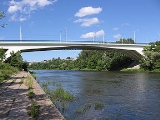
Neris

Encyclopedia

Neris is a river rising in Belarus
Belarus
Belarus , officially the Republic of Belarus, is a landlocked country in Eastern Europe, bordered clockwise by Russia to the northeast, Ukraine to the south, Poland to the west, and Lithuania and Latvia to the northwest. Its capital is Minsk; other major cities include Brest, Grodno , Gomel ,...
, flowing through Vilnius
Vilnius
Vilnius is the capital of Lithuania, and its largest city, with a population of 560,190 as of 2010. It is the seat of the Vilnius city municipality and of the Vilnius district municipality. It is also the capital of Vilnius County...
(Lithuania
Lithuania
Lithuania , officially the Republic of Lithuania is a country in Northern Europe, the biggest of the three Baltic states. It is situated along the southeastern shore of the Baltic Sea, whereby to the west lie Sweden and Denmark...
) and becoming a tributary of the Neman River
Neman River
Neman or Niemen or Nemunas, is a major Eastern European river rising in Belarus and flowing through Lithuania before draining into the Curonian Lagoon and then into the Baltic Sea at Klaipėda. It is the northern border between Lithuania and Russia's Kaliningrad Oblast in its lower reaches...
(Nemunas) at Kaunas
Kaunas
Kaunas is the second-largest city in Lithuania and has historically been a leading centre of Lithuanian economic, academic, and cultural life. Kaunas was the biggest city and the center of a powiat in Trakai Voivodeship of the Grand Duchy of Lithuania since 1413. During Russian Empire occupation...
(Lithuania). Its length is 510 km.
275 km of the river runs through Belarus, where it is called Viliya, and 235 km runs through Lithuania, where it is called Neris.
The Neris connects two old Lithuanian capitals - Kernavė
Kernave
Kernavė was a medieval capital of the Grand Duchy of Lithuania and today is a tourist attraction and an archeological site . It is located in the Širvintos district municipality located in southeast Lithuania...
and Vilnius
Vilnius
Vilnius is the capital of Lithuania, and its largest city, with a population of 560,190 as of 2010. It is the seat of the Vilnius city municipality and of the Vilnius district municipality. It is also the capital of Vilnius County...
. Along its banks are burial places of the pagan Lithuanians
Lithuanian mythology
Lithuanian mythology is an example of Baltic mythology, developed by Lithuanians throughout the centuries.-History of scholarship:Surviving information about Baltic paganism in general is very sketchy and incomplete. As with most ancient Indo-European cultures Lithuanian mythology is an example of...
. 25 km from Vilnius are the old burial mounds of Karmazinai
Karmazinai
Karmazinai is a village in Vilnius district municipality, Lithuania. It is situated on the right bank of Neris River, by forest, part of the Neris Regional Park. There is an ancient burial mound and hill fort about 0.8km northwest of the village....
. There also are many mythological stones, and a sacred oak
Oak
An oak is a tree or shrub in the genus Quercus , of which about 600 species exist. "Oak" may also appear in the names of species in related genera, notably Lithocarpus...
.
Dual naming
The issue of the dual naming of the river as Neris by the Lithuanians and Viliya (formerly Velja, meaning "big, great" in Slavic) by the Slavs is complex. Even in VilniusVilnius
Vilnius is the capital of Lithuania, and its largest city, with a population of 560,190 as of 2010. It is the seat of the Vilnius city municipality and of the Vilnius district municipality. It is also the capital of Vilnius County...
, there are toponyms including both names, e. g. Neris remains in the riverside names of Paneriai
Paneriai
Paneriai is a neighborhood of Vilnius, situated about 10 kilometres away from the city center. It is the largest elderate in the Vilnius city municipality. It is located on low forested hills, on the Vilnius-Warsaw road...
and Paneriškės while Velja is a part of the name Valakampiai, which means "an angle of Velja" in Lithuanian.
Although it has been suggested that Neris is the primeval name of the river, while name Viliya is of a secondary extraction, the dual naming most probably emerged from the confluence of rivers Neris (now known as Narach River, leaving Lake Narach) and Velja, in the historical Slavic/Baltic borderland, each ethnos choosing their own name for the river starting at the confluence. It is moreover evidenced by the fact that the name Neris was never used to name the river Velja up to this confluence. Therefore it has been proposed that the Narach River had in fact been considered the upper reaches of Neris by the Balts in ancient times.
Etymology of "Neris"
The name Neris is of BalticBaltic languages
The Baltic languages are a group of related languages belonging to the Balto-Slavic branch of the Indo-European language family and spoken mainly in areas extending east and southeast of the Baltic Sea in Northern Europe...
origin, a cognate
Cognate
In linguistics, cognates are words that have a common etymological origin. This learned term derives from the Latin cognatus . Cognates within the same language are called doublets. Strictly speaking, loanwords from another language are usually not meant by the term, e.g...
of the Lithuanian nerti generally meaning "to dive, swim downstream" as well as "to net, crochet
Crochet
Crochet is a process of creating fabric from yarn, thread, or other material strands using a crochet hook. The word is derived from the French word "crochet", meaning hook. Hooks can be made of materials such as metals, woods or plastic and are commercially manufactured as well as produced by...
". It is likely that the name had a more general meaning of "flow" or particularly "swift and swirling flow" in early times.
Etymologically, the name is one of a class of hydronym
Hydronym
A hydronym is a proper name of a body of water. Hydronymy is the study of hydronyms and of how bodies of water receive their names and how they are transmitted through history...
s, widespread in the modern and prehistoric Baltic ranges; e. g. Lithuanian Narotis, Narasa (rivers), Narutis (lake), Old Prussian Narus
Narew
The Narew River , in western Belarus and north-eastern Poland, is a left tributary of the Vistula river...
, Nara
Nara River
Nara River is a river in the Moscow Oblast and Kaluga Oblast in Russia. It is a left tributary of the Oka River. The length of the river is 158 kilometres. The area of its basin is 2030 km². The Nara River freezes up in November-December and stays under the ice until April. The cities of...
near Moscow
Moscow
Moscow is the capital, the most populous city, and the most populous federal subject of Russia. The city is a major political, economic, cultural, scientific, religious, financial, educational, and transportation centre of Russia and the continent...
. These are related to Lithuanian narus, "deep", and nerti, "to dive".
More remote connections are obscure, although the root is believed to be Indo-European
Proto-Indo-European language
The Proto-Indo-European language is the reconstructed common ancestor of the Indo-European languages, spoken by the Proto-Indo-Europeans...
. There are a number of possibilities:
- PokornyJulius PokornyJulius Pokorny was an Austrian linguist and scholar of the Celtic languages, particularly Irish, and a supporter of Irish nationalism. He held academic posts in Austrian and German universities.-Life:...
's 2nd *ner-, "under" (Indogermanisches etymologisches WörterbuchIndogermanisches Etymologisches WörterbuchThe Indogermanisches etymologisches Wörterbuch was published in 1959 by the Austrian-German comparative linguist and Celtic languages expert Julius Pokorny...
, pp765–766); - Derksen's *nerH-, o-grade *norH- (Slavic Inherited Lexicon);
- A relation to the Greek god NereusNereusIn Greek mythology, Nereus was the eldest son of Pontus and Gaia , a Titan who with Doris fathered the Nereids, with whom Nereus lived in the Aegean Sea. In the Iliad the Old Man of the Sea is the father of Nereids, though Nereus is not directly named...
, which may be from *snau-, "to give milk to", in the sense of "flow" (Partridge, Origins (1983)).
Basin within Belarus
The river is called Viliya in Belarus. There is the Belarus largest Vileyka Reservoir by Vilia, up off the VileykaVileyka
Vileyka – town in Republic of Belarus, the capital of the Vileyka Raion in the Minsk Voblast. It is located on the river Viliya, 100 km to northwest from Minsk. First documental record: 16 November 1460....
city.
Tributaries
- VilniaVilnia RiverVilnia is a river in Lithuania. Its source is near the village of Vindžiūnai, 5 km south of Šumskas, at the Lithuanian-Belarusian border. The Vilnia is 79.6 km long and its basin covers 624 sq. km...
- Vokė
- Bražuolė
- Dūkšta
- MusėMuseThe Muses in Greek mythology, poetry, and literature, are the goddesses who inspire the creation of literature and the arts. They were considered the source of the knowledge, related orally for centuries in the ancient culture, that was contained in poetic lyrics and myths...
- Laukysta
- Lomena
- LokysLokys RiverLokys is a rivulet in Jonava district municipality, Lithuania, a tributary of Neris.In 2005, a new wild nature adventure park "Lokės pėda" was established in the valley of Lokys, by the Lokėneliai village....
- Šešuva
- Saidė