

KGB

Encyclopedia
The KGB was the commonly used acronym for the (Komitet gosudarstvennoy bezopasnosti or Committee for State Security). It was the national security agency of the Soviet Union
from 1954 until 1991, and was the premier internal security
, intelligence
, and secret police
organization during that time.
The State Security Agency of the Republic of Belarus currently uses the Russian name KGB. While most of the KGB archives remain classified, two on-line documentary sources are available.
. At best, the compromised spy either returned to the Soviet Union or was declared persona non grata
and expelled by the government of the target country. The illegal resident spied, unprotected by diplomatic immunity, and worked independently of Soviet diplomatic and trade missions, (cf. the non-official cover
CIA agent). In its early history, the KGB valued illegal spies more than legal spies, because illegal spies infiltrated their targets with greater ease. The KGB residency executed four types of espionage: (i) political, (ii) economic, (iii) military-strategic, and (iv) disinformation
, effected with "active measures" (PR Line), counter-intelligence
and security (KR Line), and scientific–technological intelligence (X Line); quotidian duties included SIGINT (RP Line) and illegal support (N Line).
At first, using the romantic and intellectual allure of "The First Worker–Peasant State" (1917), "The Fight Against Fascism
" (1936–39), and the "Anti-Nazi Great Patriotic War" (1941–45) the Soviets recruited many idealistic, high-level Westerners as ideological agents, but the Russo–German Molotov-Ribbentrop Pact
(1939) and the suppressed Hungarian Uprising (1956) and Prague Spring
(1968) drastically limited ideological recruitment.
The KGB classified its spies as agents (intelligence providers) and controllers (intelligence relayers). The false-identity or legend assumed by a USSR-born illegal spy was elaborate, using the life of either a "live double" (participant to the fabrication) or a "dead double" (whose identity is tailored to the spy). The agent then substantiated his or her legend by living it in a foreign country, before emigrating to the target country, thus the sending of US-bound illegal residents via the Soviet embassy in Ottawa
, Canada
. Tradecraft included stealing and photographing documents, code-names, contacts, targets, and dead letter boxes
, and working as a "friend of the cause" or agents provocateur
, who would infiltrate the target group to sow dissension, influence policy, and arrange kidnappings and assassination
s.
was established to defend the October Revolution
and the nascent Bolshevik
state from its enemies—principally the monarchist White Army
. To ensure the Bolshevik regime's survival, the Cheka suppressed counter-revolutionary activity with domestic terror and international deception. The scope of foreign intelligence operations prompted Lenin to authorise the Cheka's creation of the INO (Innostranyi Otdel – Foreign-intelligence Department)—the precursor to the First Chief Directorate
(FCD) of the KGB. In 1922, Lenin's regime re-named the Cheka as the State Political Directorate
(OGPU).
The OGPU expanded Soviet espionage nationally and internationally, and provided Stalin with head personal bodyguard: Nikolai Vlasik
. The vagaries of Stalin's paranoia
influenced the OGPU's performance and direction in the 1930s, i.e. Trotskyist
conspiracies. Acting as his own analyst, Stalin unwisely subordinated intelligence analysis to intelligence collection. Eventually, reports pandered to his conspiracy fantasies. The middle history of the KGB culminates in the Great Purge
(1936–1938) killings of civil, military, and government people deemed politically unreliable. Among those executed were NKVD
chairmen Genrikh Yagoda
(1938) and Nikolai Yezhov
(1940); later, Lavrentiy Beria
(1953) followed suit. Ironically, Yezhov denounced Yagoda for executing the Great Terror, which from 1937 to 1938 is called Yezhovshchina, the especially cruel "Yezhov era".
In 1941, under Chairman Lavrentiy Beria
, the OGPU became the NKGB (People's Commissariat for State Security, integral to the NKVD) and recovered from the Great Purge of the thirties. Yet, the NKGB unwisely continued pandering to Stalin's conspiracy fantasies—whilst simultaneously achieving its deepest penetrations of the West. Next, Foreign Minister Vyacheslav Molotov
centralised the intelligence agencies, re-organising the NKGB as the KI (Komitet Informatsii – Committee of Information), composed (1947–51) of the MGB (Ministry for State Security
) and the GRU (Foreign military Intelligence Directorate
). In practice making an ambassador head of the MGB and GRU legal residencies in his embassy; intelligence operations are under political control; the KI ended when Molotov incurred Stalin's disfavor.
Despite its political end, the KI's contribution to Soviet Intelligence was reliant upon illegal residents- spies able to establish a more secure base of operations in the target country.
Moreover, expecting to succeed Joseph Stalin
as leader of the USSR, the ambitious head of the MVD (Ministry of Internal Affairs), Lavrentiy Beria
merged the MGB and the MVD on Stalin's death in 1953. Anticipating a coup d'etat
, the Presidium
swiftly eliminated Beria with treasonous charges of "criminal anti-Party and anti-state activities" and executed him. In the event, the MGB was renamed KGB and detached from the MVD.
Mindful of ambitious spy chiefs—and after deposing Premier Nikita Khrushchev
—Secretary Leonid Brezhnev
and the CPSU knew to manage the next over-ambitious KGB Chairman, Aleksandr Shelepin (1958–61), who facilitated Brezhnev's palace coup d'état against Khrushchev in 1964—despite Shelepin not then being in KGB. With political reassignments, Shelepin protégé Vladimir Semichastny
(1961–67) was sacked as KGB Chairman, and Shelepin, himself, was demoted from chairman of the Committee of Party and State Control to Trade Union Council chairman.
In the 1980s, the glasnost
liberalisation of Soviet society provoked KGB Chairman Vladimir Kryuchkov
(1988–91) to lead the August 1991 Soviet coup d'état attempt to depose President Mikhail Gorbachev. The thwarted coup d'état ended the KGB on 6 November 1991. The KGB's successors are the secret police agency FSB (Federal Security Service of the Russian Federation) and the espionage agency SVR (Foreign Intelligence Service).
and Alger Hiss
, who became State Department diplomats in 1936. The NKVD's first US operation was establishing the legal residency of Boris Bazarov
and the illegal residency of Iskhak Akhmerov
in 1934. Throughout, the Communist Party USA
(CPUSA) and its Gen.-Sec'y Earl Browder
, helped NKVD recruit Americans, working in government, business, and industry.
Other important, high-level ideological agents were the diplomats Laurence Duggan
and Michael Whitney Straight
in the State Department, the statistician Harry Dexter White
in the Treasury Department
, the economist Lauchlin Currie
(an FDR advisor), and the "Silvermaster Group", headed by statistician Greg Silvermaster, in the Farm Security Administration and the Board of Economic Warfare. Moreover, when Whittaker Chambers
, formerly Alger Hiss's courier, approached the Roosevelt Government—to identify the Soviet spies Duggan, White, and others—he was ignored. Hence, during the Second World War (1939–45)—at the Teheran (1943), Yalta
(1945), and Potsdam
(1945) conferences—Big Three Ally Joseph Stalin of the USSR, was better-informed about the war affairs of his US and UK allies, than they about his.
Soviet espionage succeeded most in collecting scientific and technologic intelligence about advances in jet propulsion
, radar
, and encryption
, which impressed Moscow, but stealing atomic secrets was the capstone of NKVD espionage against Anglo–American science and technology. To wit, British Manhattan Project
team physicist Klaus Fuchs
(GRU 1941) was the main agent of the Rosenberg
spy ring. In 1944, the New York City residency infiltrated the top secret Los Alamos National Laboratory
in New Mexico, by recruiting Theodore Hall
, a nineteen-year-old Harvard physicist.
, and the destruction of the CPUSA hampered recruitment. The last major illegal resident, Rudolf Abel ("Willie" Vilyam Fisher
), was betrayed by his assistant, Reino Häyhänen
, in 1957.
Recruitment then emphasised mercenary agents, an approach especially successful in scientific and technical espionage—because private industry practiced lax internal security, unlike the US Government. In late 1967, the notable KGB success was the walk-in recruitment of US Navy Chief Warrant Officer
John Anthony Walker
who individually and via the Walker Spy Ring
for eighteen years enabled Soviet Intelligence to decipher some one million US Navy messages, and track the US Navy.
In the late Cold War, the KGB was lucky with intelligence coups with the cases of the mercenary walk-in recruits, FBI counterspy
Robert Hanssen
(1979–2001) and CIA Soviet Division officer Aldrich Ames
(1985).
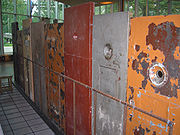 It was Cold War policy for the KGB of the Soviet Union and the secret services of the satellite-states to extensively monitor public and private opinion, internal subversion, and possible revolutionary plots in the Soviet Bloc. In supporting those Communist governments, the KGB was instrumental in crushing the Hungarian Revolution of 1956, and the Prague Spring
of "Socialism with a Human Face," in 1968 Czechoslovakia.
During the Hungarian revolt, KGB chairman Ivan Serov
, personally supervised the post-invasion "normalization" of the country. In consequence, KGB monitored the satellite-state populations for occurrences of "harmful attitudes" and "hostile acts;" yet, stopping the Prague Spring, deposing a nationalist Communist government, was its greatest achievement.
 The KGB prepared the Red Army's route by infiltrating to Czechoslovakia
many illegal residents disguised as Western tourists. They were to gain the trust of and spy upon the most outspoken proponents of Alexander Dubček
's new government. They were to plant subversive evidence, justifying the USSR's invasion, that right-wing groups—aided by Western intelligence agencies—were going to depose the Communist government of Czechoslovakia. Finally, the KGB prepared hardline, pro-USSR members of the Communist Party of Czechoslovakia
(CPC), such as Alois Indra and Vasil Biľak
, to assume power after the Red Army's invasion. The courage of the betrayed Prague Spring leaders did not escape KGB notice; the defector Oleg Gordievsky
later remarked, "It was that dreadful event, that awful day, which determined the course of my own life" (The Sword and the Shield, p. 261).
The KGB's Czech success in the 1960s was matched with the failed suppression of the Solidarity labour movement in 1980s Poland. The KGB had forecast political instability consequent to the election of Archbishop of Kraków Karol Wojtyla
, as the first Polish Pope, John Paul II, whom they had categorised as "subversive," because of his anti-Communist sermons against the one-party PUWP régime. Despite its accurate forecast of crisis, the Polish United Workers' Party
(PUWP) hindered the KGB's destroying the nascent Solidarity-backed political movement, fearing explosive civil violence if they imposed the KGB-recommended martial law. Aided by their Polish counterpart, the Służba Bezpieczeństwa (SB), the KGB successfully infiltrated spies to Solidarity and the Catholic Church, and in Operation X co-ordinated the declaration of martial law
with Gen. Wojciech Jaruzelski
and the Polish Communist Party; however, the vacillating, conciliatory Polish approach blunted KGB effectiveness—and Solidarity then fatally weakened the Communist Polish government in 1989.
, who said all dissent threatened the Soviet state—including anti-Communist religious movements. Most arrested dissidents were sentenced to indefinite terms in Gulag
-administered forced labour camps—where their dissension lacked the strength it might have had in public. Moreover, Yale University archive documents record that suppressing "ideological subversion" was the principal preoccupation of Yuri Andropov and Vitali Fedorchuk when each was KGB Chairman.
After denouncing Stalinism
in his secret speech On the Personality Cult and its Consequences
(1956), Nikita Khrushchev
lessened suppression of "ideological subversion". Resultantly, critical literature re-emerged, notably the novel One Day in the Life of Ivan Denisovich
(1962), by Aleksandr Solzhenitsyn; however, after Khrushchev's deposition in 1964, Leonid Brezhnev reverted the State and KGB to actively harsh suppression—routine house searches to seize documents and the continual monitoring of dissidents. To wit, in 1965, such a search-and-seizure operation yielded Solzhenitsyn (code-name PAUK, "spider") manuscripts of "slanderous fabrications", and the subversion trial of the novelists Andrei Sinyavsky
and Yuli Daniel
; Sinyavsky (alias "Abram Tertz"), and Daniel (alias "Nikolai Arzhak"), were captured after a Moscow literary-world informant
told KGB when to find them at home.
After suppressing the Prague Spring, KGB Chairman Andropov established the Fifth Directorate to monitor dissension and eliminate dissenters. He was especially concerned with the Aleksandr Solzhenitsyn
and Andrei Sakharov
, "Public Enemy Number One". Andropov failed to expel Solzhenitsyn before 1974; but did internally-exile Sakharov to Gorky city [Nizhny Novgorod] in 1980. KGB failed to prevent Sakharov's collecting his Nobel Peace Prize
in 1975, but did prevent Yuri Orlov collecting his Nobel Prize in 1978; Chairman Andropov supervised both operations.
KGB dissident-group infiltration featured agents provocateur pretending "sympathy to the cause", smear campaign
s against prominent dissidents, and show trial
s; once imprisoned, the dissident endured KGB interrogators and sympathetic informant-cell mates. In the event, Mikhail Gorbachev
's glasnost
policies lessened persecution of dissidents; he was effecting some of the policy changes they had been demanding since the 1970s.

In the 1960s, acting upon the information of KGB defector Anatoliy Golitsyn
, the CIA counter-intelligence chief, James Jesus Angleton
, believed KGB had moles
in two key places—the counter-intelligence section of CIA and the FBI's counter-intelligence department—through whom they would know of, and control, US counter-espionage to protect the moles and hamper the detection and capture of other Communist spies. Moreover, KGB counter-intelligence vetted foreign intelligence sources, so that the moles might "officially" approve an anti-CIA double agent
as trustworthy. In retrospect, the captures of the moles Aldrich Ames
and Robert Hanssen
, proved Angleton—ignored as over-cautious—was correct, despite costing him his job at CIA, which he left in 1975.
The highest-ranking Communist intelligence officer to defect, Lt. Gen. Ion Mihai Pacepa
, said the Romanian Communist party leader Nicolae Ceauşescu
told him about the "ten international leaders the Kremlin killed, or tried to kill": Laszlo Rajk
and Imre Nagy
of Hungary; Lucretiu Patrascanu
and Gheorghiu-Dej of Romania; Rudolf Slansky
, the head of Czechoslovakia, and chief diplomat Jan Masaryk
; Mohammad Reza Pahlavi
, the Shah of Iran; Palmiro Togliatti
of Italy; US President John F. Kennedy
; and Mao Zedong
of China via Lin Biao
; and noted that "among the leaders of Moscow's satellite intelligence services, there was unanimous agreement that the KGB had been involved in the assassination of President Kennedy."
In the mid-1970s, the KGB tried to secretly buy three banks in northern California to gain access to high-technology secrets. Their efforts, however, were thwarted by the CIA. The banks were Peninsula National Bank in Burlingame, the First National Bank of Fresno, and the Tahoe National Bank in South Lake Tahoe. These banks had made numerous loans to advanced technology companies and had many of their officers and directors as clients. The KGB used the Moscow Narodny Bank Limited
to finance the acquisition, and an intermediary, Singaporean businessman Amos Dawe, as the frontman.
comprised a chairman, deputy chairmen, directorate chiefs, and republican KGB chairmen.
Soviet Union
The Soviet Union , officially the Union of Soviet Socialist Republics , was a constitutionally socialist state that existed in Eurasia between 1922 and 1991....
from 1954 until 1991, and was the premier internal security
Security agency
A security agency is a governmental organization which conducts intelligence activities for the internal security of a nation. They are the domestic cousins of foreign intelligence agencies...
, intelligence
Intelligence agency
An intelligence agency is a governmental agency that is devoted to information gathering for purposes of national security and defence. Means of information gathering may include espionage, communication interception, cryptanalysis, cooperation with other institutions, and evaluation of public...
, and secret police
Secret police
Secret police are a police agency which operates in secrecy and beyond the law to protect the political power of an individual dictator or an authoritarian political regime....
organization during that time.
The State Security Agency of the Republic of Belarus currently uses the Russian name KGB. While most of the KGB archives remain classified, two on-line documentary sources are available.
Mode of operation
A 1983 Time magazine article reported that the KGB was the world's most effective information-gathering organization. It operated legal and illegal espionage residencies in target countries where a legal resident gathered intelligence while based at the Soviet Embassy or Consulate, and, if caught, was protected from prosecution by diplomatic immunityDiplomatic immunity
Diplomatic immunity is a form of legal immunity and a policy held between governments that ensures that diplomats are given safe passage and are considered not susceptible to lawsuit or prosecution under the host country's laws...
. At best, the compromised spy either returned to the Soviet Union or was declared persona non grata
Persona non grata
Persona non grata , literally meaning "an unwelcome person", is a legal term used in diplomacy that indicates a proscription against a person entering the country...
and expelled by the government of the target country. The illegal resident spied, unprotected by diplomatic immunity, and worked independently of Soviet diplomatic and trade missions, (cf. the non-official cover
Non-official cover
Non-official cover is a term used in espionage, particularly by national intelligence services, for agents or operatives who assume covert roles in organizations without ties to the government for which they work. Such agents or operatives are typically abbreviated in espionage lingo as a NOC...
CIA agent). In its early history, the KGB valued illegal spies more than legal spies, because illegal spies infiltrated their targets with greater ease. The KGB residency executed four types of espionage: (i) political, (ii) economic, (iii) military-strategic, and (iv) disinformation
Disinformation
Disinformation is intentionally false or inaccurate information that is spread deliberately. For this reason, it is synonymous with and sometimes called black propaganda. It is an act of deception and false statements to convince someone of untruth...
, effected with "active measures" (PR Line), counter-intelligence
Counter-intelligence
Counterintelligence or counter-intelligence refers to efforts made by intelligence organizations to prevent hostile or enemy intelligence organizations from successfully gathering and collecting intelligence against them. National intelligence programs, and, by extension, the overall defenses of...
and security (KR Line), and scientific–technological intelligence (X Line); quotidian duties included SIGINT (RP Line) and illegal support (N Line).
At first, using the romantic and intellectual allure of "The First Worker–Peasant State" (1917), "The Fight Against Fascism
Spanish Civil War
The Spanish Civil WarAlso known as The Crusade among Nationalists, the Fourth Carlist War among Carlists, and The Rebellion or Uprising among Republicans. was a major conflict fought in Spain from 17 July 1936 to 1 April 1939...
" (1936–39), and the "Anti-Nazi Great Patriotic War" (1941–45) the Soviets recruited many idealistic, high-level Westerners as ideological agents, but the Russo–German Molotov-Ribbentrop Pact
Molotov-Ribbentrop Pact
The Molotov–Ribbentrop Pact, named after the Soviet foreign minister Vyacheslav Molotov and the German foreign minister Joachim von Ribbentrop, was an agreement officially titled the Treaty of Non-Aggression between Germany and the Soviet Union and signed in Moscow in the late hours of 23 August 1939...
(1939) and the suppressed Hungarian Uprising (1956) and Prague Spring
Prague Spring
The Prague Spring was a period of political liberalization in Czechoslovakia during the era of its domination by the Soviet Union after World War II...
(1968) drastically limited ideological recruitment.
The KGB classified its spies as agents (intelligence providers) and controllers (intelligence relayers). The false-identity or legend assumed by a USSR-born illegal spy was elaborate, using the life of either a "live double" (participant to the fabrication) or a "dead double" (whose identity is tailored to the spy). The agent then substantiated his or her legend by living it in a foreign country, before emigrating to the target country, thus the sending of US-bound illegal residents via the Soviet embassy in Ottawa
Embassy of Russia in Ottawa
The Embassy of Russia in Canada is the Russian embassy in Ottawa, Ontario, Canada, It is located at 285 Charlotte, at the eastern terminus of Laurier Avenue. To the south it looks out on Strathcona Park while to the east it looks out on the Rideau River...
, Canada
Canada
Canada is a North American country consisting of ten provinces and three territories. Located in the northern part of the continent, it extends from the Atlantic Ocean in the east to the Pacific Ocean in the west, and northward into the Arctic Ocean...
. Tradecraft included stealing and photographing documents, code-names, contacts, targets, and dead letter boxes
Dead drop
A dead drop or dead letter box is a method of espionage tradecraft used to pass items between two individuals by using a secret location and thus does not require them to meet directly. Using a dead drop permits a Case Officer and his Agent to exchange objects and information while maintaining...
, and working as a "friend of the cause" or agents provocateur
Agent provocateur
Traditionally, an agent provocateur is a person employed by the police or other entity to act undercover to entice or provoke another person to commit an illegal act...
, who would infiltrate the target group to sow dissension, influence policy, and arrange kidnappings and assassination
Assassination
To carry out an assassination is "to murder by a sudden and/or secret attack, often for political reasons." Alternatively, assassination may be defined as "the act of deliberately killing someone, especially a public figure, usually for hire or for political reasons."An assassination may be...
s.
History
The ChekaCheka
Cheka was the first of a succession of Soviet state security organizations. It was created by a decree issued on December 20, 1917, by Vladimir Lenin and subsequently led by aristocrat-turned-communist Felix Dzerzhinsky...
was established to defend the October Revolution
October Revolution
The October Revolution , also known as the Great October Socialist Revolution , Red October, the October Uprising or the Bolshevik Revolution, was a political revolution and a part of the Russian Revolution of 1917...
and the nascent Bolshevik
Bolshevik
The Bolsheviks, originally also Bolshevists , derived from bol'shinstvo, "majority") were a faction of the Marxist Russian Social Democratic Labour Party which split apart from the Menshevik faction at the Second Party Congress in 1903....
state from its enemies—principally the monarchist White Army
White movement
The White movement and its military arm the White Army - known as the White Guard or the Whites - was a loose confederation of Anti-Communist forces.The movement comprised one of the politico-military Russian forces who fought...
. To ensure the Bolshevik regime's survival, the Cheka suppressed counter-revolutionary activity with domestic terror and international deception. The scope of foreign intelligence operations prompted Lenin to authorise the Cheka's creation of the INO (Innostranyi Otdel – Foreign-intelligence Department)—the precursor to the First Chief Directorate
First Chief Directorate
The First Chief Directorate , of the Committee for State Security , was the organization responsible for foreign operations and intelligence collection activities by the training and management of the covert agents, intelligence collection management, and the collection of political, scientific and...
(FCD) of the KGB. In 1922, Lenin's regime re-named the Cheka as the State Political Directorate
State Political Directorate
The State Political Directorate was the secret police of the Russian Soviet Federative Socialist Republic and the Soviet Union from 1922 until 1934...
(OGPU).
The OGPU expanded Soviet espionage nationally and internationally, and provided Stalin with head personal bodyguard: Nikolai Vlasik
Nikolai Vlasik
Nikolai Vlasik was a Soviet security official and General, best known as a head of Joseph Stalin's personal security from 1931 to 1952....
. The vagaries of Stalin's paranoia
Paranoia
Paranoia [] is a thought process believed to be heavily influenced by anxiety or fear, often to the point of irrationality and delusion. Paranoid thinking typically includes persecutory beliefs, or beliefs of conspiracy concerning a perceived threat towards oneself...
influenced the OGPU's performance and direction in the 1930s, i.e. Trotskyist
Trotskyism
Trotskyism is the theory of Marxism as advocated by Leon Trotsky. Trotsky considered himself an orthodox Marxist and Bolshevik-Leninist, arguing for the establishment of a vanguard party of the working-class...
conspiracies. Acting as his own analyst, Stalin unwisely subordinated intelligence analysis to intelligence collection. Eventually, reports pandered to his conspiracy fantasies. The middle history of the KGB culminates in the Great Purge
Great Purge
The Great Purge was a series of campaigns of political repression and persecution in the Soviet Union orchestrated by Joseph Stalin from 1936 to 1938...
(1936–1938) killings of civil, military, and government people deemed politically unreliable. Among those executed were NKVD
NKVD
The People's Commissariat for Internal Affairs was the public and secret police organization of the Soviet Union that directly executed the rule of power of the Soviets, including political repression, during the era of Joseph Stalin....
chairmen Genrikh Yagoda
Genrikh Yagoda
Genrikh Grigoryevich Yagoda , born Enokh Gershevich Ieguda , was a Soviet state security official who served as director of the NKVD, the Soviet Union's Stalin-era security and intelligence agency, from 1934 to 1936...
(1938) and Nikolai Yezhov
Nikolai Yezhov
Nikolai Ivanovich Yezhov or Ezhov was a senior figure in the NKVD under Joseph Stalin during the period of the Great Purge. His reign is sometimes known as the "Yezhovshchina" , "the Yezhov era", a term that began to be used during the de-Stalinization campaign of the 1950s...
(1940); later, Lavrentiy Beria
Lavrentiy Beria
Lavrentiy Pavlovich Beria was a Georgian Soviet politician and state security administrator, chief of the Soviet security and secret police apparatus under Joseph Stalin during World War II, and Deputy Premier in the postwar years ....
(1953) followed suit. Ironically, Yezhov denounced Yagoda for executing the Great Terror, which from 1937 to 1938 is called Yezhovshchina, the especially cruel "Yezhov era".
In 1941, under Chairman Lavrentiy Beria
Lavrentiy Beria
Lavrentiy Pavlovich Beria was a Georgian Soviet politician and state security administrator, chief of the Soviet security and secret police apparatus under Joseph Stalin during World War II, and Deputy Premier in the postwar years ....
, the OGPU became the NKGB (People's Commissariat for State Security, integral to the NKVD) and recovered from the Great Purge of the thirties. Yet, the NKGB unwisely continued pandering to Stalin's conspiracy fantasies—whilst simultaneously achieving its deepest penetrations of the West. Next, Foreign Minister Vyacheslav Molotov
Vyacheslav Molotov
Vyacheslav Mikhailovich Molotov was a Soviet politician and diplomat, an Old Bolshevik and a leading figure in the Soviet government from the 1920s, when he rose to power as a protégé of Joseph Stalin, to 1957, when he was dismissed from the Presidium of the Central Committee by Nikita Khrushchev...
centralised the intelligence agencies, re-organising the NKGB as the KI (Komitet Informatsii – Committee of Information), composed (1947–51) of the MGB (Ministry for State Security
Ministry for State Security (USSR)
The Ministry of State Security was the name of Soviet secret police from 1946 to 1953.-Origins of the MGB:The MGB was just one of many incarnations of the Soviet State Security apparatus. Since the revolution, the Bolsheviks relied on a strong political police or security force to support and...
) and the GRU (Foreign military Intelligence Directorate
GRU
GRU or Glavnoye Razvedyvatel'noye Upravleniye is the foreign military intelligence directorate of the General Staff of the Armed Forces of the Russian Federation...
). In practice making an ambassador head of the MGB and GRU legal residencies in his embassy; intelligence operations are under political control; the KI ended when Molotov incurred Stalin's disfavor.
Despite its political end, the KI's contribution to Soviet Intelligence was reliant upon illegal residents- spies able to establish a more secure base of operations in the target country.
Moreover, expecting to succeed Joseph Stalin
Joseph Stalin
Joseph Vissarionovich Stalin was the Premier of the Soviet Union from 6 May 1941 to 5 March 1953. He was among the Bolshevik revolutionaries who brought about the October Revolution and had held the position of first General Secretary of the Communist Party of the Soviet Union's Central Committee...
as leader of the USSR, the ambitious head of the MVD (Ministry of Internal Affairs), Lavrentiy Beria
Lavrentiy Beria
Lavrentiy Pavlovich Beria was a Georgian Soviet politician and state security administrator, chief of the Soviet security and secret police apparatus under Joseph Stalin during World War II, and Deputy Premier in the postwar years ....
merged the MGB and the MVD on Stalin's death in 1953. Anticipating a coup d'etat
Coup d'état
A coup d'état state, literally: strike/blow of state)—also known as a coup, putsch, and overthrow—is the sudden, extrajudicial deposition of a government, usually by a small group of the existing state establishment—typically the military—to replace the deposed government with another body; either...
, the Presidium
Presidium of the Supreme Soviet
The Presidium of the Supreme Soviet was a Soviet governmental institution – a permanent body of the Supreme Soviets . This body was of the all-Union level , as well as in all Soviet republics and autonomous republics...
swiftly eliminated Beria with treasonous charges of "criminal anti-Party and anti-state activities" and executed him. In the event, the MGB was renamed KGB and detached from the MVD.
Mindful of ambitious spy chiefs—and after deposing Premier Nikita Khrushchev
Nikita Khrushchev
Nikita Sergeyevich Khrushchev led the Soviet Union during part of the Cold War. He served as First Secretary of the Communist Party of the Soviet Union from 1953 to 1964, and as Chairman of the Council of Ministers, or Premier, from 1958 to 1964...
—Secretary Leonid Brezhnev
Leonid Brezhnev
Leonid Ilyich Brezhnev – 10 November 1982) was the General Secretary of the Central Committee of the Communist Party of the Soviet Union , presiding over the country from 1964 until his death in 1982. His eighteen-year term as General Secretary was second only to that of Joseph Stalin in...
and the CPSU knew to manage the next over-ambitious KGB Chairman, Aleksandr Shelepin (1958–61), who facilitated Brezhnev's palace coup d'état against Khrushchev in 1964—despite Shelepin not then being in KGB. With political reassignments, Shelepin protégé Vladimir Semichastny
Vladimir Semichastny
Vladimir Yefimovich Semichastny was the head of the KGB from November 1961 to April 1967....
(1961–67) was sacked as KGB Chairman, and Shelepin, himself, was demoted from chairman of the Committee of Party and State Control to Trade Union Council chairman.
In the 1980s, the glasnost
Glasnost
Glasnost was the policy of maximal publicity, openness, and transparency in the activities of all government institutions in the Soviet Union, together with freedom of information, introduced by Mikhail Gorbachev in the second half of the 1980s...
liberalisation of Soviet society provoked KGB Chairman Vladimir Kryuchkov
Vladimir Kryuchkov
Vladimir Alexandrovich Kryuchkov was a former Soviet politician and Communist Party member, having been in the organization from 1944 until he was dismissed in 1991...
(1988–91) to lead the August 1991 Soviet coup d'état attempt to depose President Mikhail Gorbachev. The thwarted coup d'état ended the KGB on 6 November 1991. The KGB's successors are the secret police agency FSB (Federal Security Service of the Russian Federation) and the espionage agency SVR (Foreign Intelligence Service).
The world war interregnum
The GRU (military intelligence) recruited the ideological agents Julian WadleighJulian Wadleigh
Henry Julian Wadleigh , was an American economist and the United States Department of State official in the 1930s and 1940s. He was a key witness in the Alger Hiss trials.-Biography:...
and Alger Hiss
Alger Hiss
Alger Hiss was an American lawyer, government official, author, and lecturer. He was involved in the establishment of the United Nations both as a U.S. State Department and U.N. official...
, who became State Department diplomats in 1936. The NKVD's first US operation was establishing the legal residency of Boris Bazarov
Boris Bazarov
Boris Bazarov was a Soviet secret police officer who served as the chief illegal rezident in New York City from 1935 until 1937.-Early years:...
and the illegal residency of Iskhak Akhmerov
Iskhak Akhmerov
Iskhak Abdulovich Akhmerov was a Soviet spy of Tatar ethnicity who joined the Bolshevik Party in 1919. Akhmerov attended the Communist University of Toilers of the East and the First State University, where he graduated from the School of International Relations in 1930...
in 1934. Throughout, the Communist Party USA
Communist Party USA
The Communist Party USA is a Marxist political party in the United States, established in 1919. It has a long, complex history that is closely related to the histories of similar communist parties worldwide and the U.S. labor movement....
(CPUSA) and its Gen.-Sec'y Earl Browder
Earl Browder
Earl Russell Browder was an American communist and General Secretary of the Communist Party USA from 1934 to 1945. He was expelled from the party in 1946.- Early years :...
, helped NKVD recruit Americans, working in government, business, and industry.
Other important, high-level ideological agents were the diplomats Laurence Duggan
Laurence Duggan
Laurence Duggan , was head of the South American desk at the United States Department of State during World War II. In 1948, Duggan fell to his death from the window of his office in New York, ten days after being questioned by the Federal Bureau of Investigation about whether he had had contacts...
and Michael Whitney Straight
Michael Whitney Straight
Michael Whitney Straight, was an American magazine publisher, novelist, patron of the arts, a member of the prominent Whitney family, and a confessed spy for the KGB.-Biography:...
in the State Department, the statistician Harry Dexter White
Harry Dexter White
Harry Dexter White was an American economist, and senior U.S. Treasury department official, participating in the Bretton Woods conference...
in the Treasury Department
United States Department of the Treasury
The Department of the Treasury is an executive department and the treasury of the United States federal government. It was established by an Act of Congress in 1789 to manage government revenue...
, the economist Lauchlin Currie
Lauchlin Currie
Lauchlin Bernard Currie was a Canadian-born U.S.economist from New Dublin, Nova Scotia, Canada, and allegedly an agent of espionage for the Soviet Union....
(an FDR advisor), and the "Silvermaster Group", headed by statistician Greg Silvermaster, in the Farm Security Administration and the Board of Economic Warfare. Moreover, when Whittaker Chambers
Whittaker Chambers
Whittaker Chambers was born Jay Vivian Chambers and also known as David Whittaker Chambers , was an American writer and editor. After being a Communist Party USA member and Soviet spy, he later renounced communism and became an outspoken opponent later testifying in the perjury and espionage trial...
, formerly Alger Hiss's courier, approached the Roosevelt Government—to identify the Soviet spies Duggan, White, and others—he was ignored. Hence, during the Second World War (1939–45)—at the Teheran (1943), Yalta
Yalta Conference
The Yalta Conference, sometimes called the Crimea Conference and codenamed the Argonaut Conference, held February 4–11, 1945, was the wartime meeting of the heads of government of the United States, the United Kingdom, and the Soviet Union, represented by President Franklin D...
(1945), and Potsdam
Potsdam Conference
The Potsdam Conference was held at Cecilienhof, the home of Crown Prince Wilhelm Hohenzollern, in Potsdam, occupied Germany, from 16 July to 2 August 1945. Participants were the Soviet Union, the United Kingdom, and the United States...
(1945) conferences—Big Three Ally Joseph Stalin of the USSR, was better-informed about the war affairs of his US and UK allies, than they about his.
Soviet espionage succeeded most in collecting scientific and technologic intelligence about advances in jet propulsion
Jet engine
A jet engine is a reaction engine that discharges a fast moving jet to generate thrust by jet propulsion and in accordance with Newton's laws of motion. This broad definition of jet engines includes turbojets, turbofans, rockets, ramjets, pulse jets...
, radar
Radar
Radar is an object-detection system which uses radio waves to determine the range, altitude, direction, or speed of objects. It can be used to detect aircraft, ships, spacecraft, guided missiles, motor vehicles, weather formations, and terrain. The radar dish or antenna transmits pulses of radio...
, and encryption
Encryption
In cryptography, encryption is the process of transforming information using an algorithm to make it unreadable to anyone except those possessing special knowledge, usually referred to as a key. The result of the process is encrypted information...
, which impressed Moscow, but stealing atomic secrets was the capstone of NKVD espionage against Anglo–American science and technology. To wit, British Manhattan Project
Manhattan Project
The Manhattan Project was a research and development program, led by the United States with participation from the United Kingdom and Canada, that produced the first atomic bomb during World War II. From 1942 to 1946, the project was under the direction of Major General Leslie Groves of the US Army...
team physicist Klaus Fuchs
Klaus Fuchs
Klaus Emil Julius Fuchs was a German theoretical physicist and atomic spy who in 1950 was convicted of supplying information from the American, British and Canadian atomic bomb research to the USSR during and shortly after World War II...
(GRU 1941) was the main agent of the Rosenberg
Julius and Ethel Rosenberg
Ethel Greenglass Rosenberg and Julius Rosenberg were American communists who were convicted and executed in 1953 for conspiracy to commit espionage during a time of war. The charges related to their passing information about the atomic bomb to the Soviet Union...
spy ring. In 1944, the New York City residency infiltrated the top secret Los Alamos National Laboratory
Los Alamos National Laboratory
Los Alamos National Laboratory is a United States Department of Energy national laboratory, managed and operated by Los Alamos National Security , located in Los Alamos, New Mexico...
in New Mexico, by recruiting Theodore Hall
Theodore Hall
Theodore Alvin Hall was an American physicist and an atomic spy for the Soviet Union, who, during his work on US efforts to develop the first atomic bomb during World War II , gave a detailed description of the "Fat Man" plutonium bomb, and of processes for purifying plutonium, to Soviet...
, a nineteen-year-old Harvard physicist.
During the Cold War
The KGB failed to rebuild most of its US illegal resident networks. The aftermath of the Second Red Scare (1947–57), McCarthyismMcCarthyism
McCarthyism is the practice of making accusations of disloyalty, subversion, or treason without proper regard for evidence. The term has its origins in the period in the United States known as the Second Red Scare, lasting roughly from the late 1940s to the late 1950s and characterized by...
, and the destruction of the CPUSA hampered recruitment. The last major illegal resident, Rudolf Abel ("Willie" Vilyam Fisher
Vilyam Genrikhovich Fisher
Vilyam Genrikhovich Fisher was a noted Soviet intelligence officer...
), was betrayed by his assistant, Reino Häyhänen
Reino Häyhänen
Reino Häyhänen, was an ethnic Finn Soviet Lieutenant Colonel who defected to the United States.-Birth and education:...
, in 1957.
Recruitment then emphasised mercenary agents, an approach especially successful in scientific and technical espionage—because private industry practiced lax internal security, unlike the US Government. In late 1967, the notable KGB success was the walk-in recruitment of US Navy Chief Warrant Officer
Chief Warrant Officer
Chief warrant officer is a military rank used by the Canadian Forces and the Israel Defence Forces.-Canada:In the Canadian Forces, a chief warrant officer or CWO is the most senior non-commissioned member rank in the Canadian Army and the Royal Canadian Air Force...
John Anthony Walker
John Anthony Walker
John Anthony Walker, Jr. is a former United States Navy Chief Warrant Officer and communications specialist convicted of spying for the Soviet Union from 1968 to 1985, at the height of the Cold War...
who individually and via the Walker Spy Ring
John Anthony Walker
John Anthony Walker, Jr. is a former United States Navy Chief Warrant Officer and communications specialist convicted of spying for the Soviet Union from 1968 to 1985, at the height of the Cold War...
for eighteen years enabled Soviet Intelligence to decipher some one million US Navy messages, and track the US Navy.
In the late Cold War, the KGB was lucky with intelligence coups with the cases of the mercenary walk-in recruits, FBI counterspy
Counterspy
CounterSpy is a proprietary spyware removal program for Microsoft Windows software developed by Sunbelt Software.-Features:CounterSpy scans a PC for spyware, examining files on the hard drive, objects in memory, the Windows registry and cookies and it has a capability called DNR that, according to...
Robert Hanssen
Robert Hanssen
Robert Philip Hanssen is a former American FBI agent who spied for Soviet and Russian intelligence services against the United States for 22 years from 1979 to 2001...
(1979–2001) and CIA Soviet Division officer Aldrich Ames
Aldrich Ames
Aldrich Hazen Ames is a former Central Intelligence Agency counter-intelligence officer and analyst, who, in 1994, was convicted of spying for the Soviet Union and Russia...
(1985).
KGB in the Soviet Bloc
Prague Spring
The Prague Spring was a period of political liberalization in Czechoslovakia during the era of its domination by the Soviet Union after World War II...
of "Socialism with a Human Face," in 1968 Czechoslovakia.
During the Hungarian revolt, KGB chairman Ivan Serov
Ivan Serov
State Security General Ivan Aleksandrovich Serov was a prominent leader of Soviet security and intelligence agencies, head of the KGB between March 1954 and December 1958, as well as head of the GRU between 1958 and 1963. He was Deputy Commissar of the NKVD under Lavrentiy Beria, and was to play a...
, personally supervised the post-invasion "normalization" of the country. In consequence, KGB monitored the satellite-state populations for occurrences of "harmful attitudes" and "hostile acts;" yet, stopping the Prague Spring, deposing a nationalist Communist government, was its greatest achievement.
Czechoslovakia
Czechoslovakia or Czecho-Slovakia was a sovereign state in Central Europe which existed from October 1918, when it declared its independence from the Austro-Hungarian Empire, until 1992...
many illegal residents disguised as Western tourists. They were to gain the trust of and spy upon the most outspoken proponents of Alexander Dubček
Alexander Dubcek
Alexander Dubček , also known as Dikita, was a Slovak politician and briefly leader of Czechoslovakia , famous for his attempt to reform the communist regime during the Prague Spring...
's new government. They were to plant subversive evidence, justifying the USSR's invasion, that right-wing groups—aided by Western intelligence agencies—were going to depose the Communist government of Czechoslovakia. Finally, the KGB prepared hardline, pro-USSR members of the Communist Party of Czechoslovakia
Communist Party of Czechoslovakia
The Communist Party of Czechoslovakia, in Czech and in Slovak: Komunistická strana Československa was a Communist and Marxist-Leninist political party in Czechoslovakia that existed between 1921 and 1992....
(CPC), such as Alois Indra and Vasil Biľak
Vasil Bilak
RSDr. Vasiľ Biľak is a former Slovak Communist leader of Rusyn origin.Vasiľ Biľak was originally a tailor...
, to assume power after the Red Army's invasion. The courage of the betrayed Prague Spring leaders did not escape KGB notice; the defector Oleg Gordievsky
Oleg Gordievsky
Oleg Antonovich Gordievsky , CMG , is a former Colonel of the KGB and KGB Resident-designate and bureau chief in London, who was a secret agent of the British Secret Intelligence Service from 1974 to 1985.-Early career:Oleg Gordievsky attended the Moscow State Institute of International...
later remarked, "It was that dreadful event, that awful day, which determined the course of my own life" (The Sword and the Shield, p. 261).
The KGB's Czech success in the 1960s was matched with the failed suppression of the Solidarity labour movement in 1980s Poland. The KGB had forecast political instability consequent to the election of Archbishop of Kraków Karol Wojtyla
Pope John Paul II
Blessed Pope John Paul II , born Karol Józef Wojtyła , reigned as Pope of the Catholic Church and Sovereign of Vatican City from 16 October 1978 until his death on 2 April 2005, at of age. His was the second-longest documented pontificate, which lasted ; only Pope Pius IX ...
, as the first Polish Pope, John Paul II, whom they had categorised as "subversive," because of his anti-Communist sermons against the one-party PUWP régime. Despite its accurate forecast of crisis, the Polish United Workers' Party
Polish United Workers' Party
The Polish United Workers' Party was the Communist party which governed the People's Republic of Poland from 1948 to 1989. Ideologically it was based on the theories of Marxism-Leninism.- The Party's Program and Goals :...
(PUWP) hindered the KGB's destroying the nascent Solidarity-backed political movement, fearing explosive civil violence if they imposed the KGB-recommended martial law. Aided by their Polish counterpart, the Służba Bezpieczeństwa (SB), the KGB successfully infiltrated spies to Solidarity and the Catholic Church, and in Operation X co-ordinated the declaration of martial law
Martial law in Poland
Martial law in Poland refers to the period of time from December 13, 1981 to July 22, 1983, when the authoritarian government of the People's Republic of Poland drastically restricted normal life by introducing martial law in an attempt to crush political opposition to it. Thousands of opposition...
with Gen. Wojciech Jaruzelski
Wojciech Jaruzelski
Wojciech Witold Jaruzelski is a retired Polish military officer and Communist politician. He was the last Communist leader of Poland from 1981 to 1989, Prime Minister from 1981 to 1985 and the country's head of state from 1985 to 1990. He was also the last commander-in-chief of the Polish People's...
and the Polish Communist Party; however, the vacillating, conciliatory Polish approach blunted KGB effectiveness—and Solidarity then fatally weakened the Communist Polish government in 1989.
Suppressing ideological subversion
During the Cold War, the KGB actively suppressed "ideological subversion"—unorthodox political and religious ideas and the espousing dissidents. In 1967, the suppression increased under new KGB Chairman Yuri AndropovYuri Andropov
Yuri Vladimirovich Andropov was a Soviet politician and the General Secretary of the Communist Party of the Soviet Union from 12 November 1982 until his death fifteen months later.-Early life:...
, who said all dissent threatened the Soviet state—including anti-Communist religious movements. Most arrested dissidents were sentenced to indefinite terms in Gulag
Gulag
The Gulag was the government agency that administered the main Soviet forced labor camp systems. While the camps housed a wide range of convicts, from petty criminals to political prisoners, large numbers were convicted by simplified procedures, such as NKVD troikas and other instruments of...
-administered forced labour camps—where their dissension lacked the strength it might have had in public. Moreover, Yale University archive documents record that suppressing "ideological subversion" was the principal preoccupation of Yuri Andropov and Vitali Fedorchuk when each was KGB Chairman.
After denouncing Stalinism
Stalinism
Stalinism refers to the ideology that Joseph Stalin conceived and implemented in the Soviet Union, and is generally considered a branch of Marxist–Leninist ideology but considered by some historians to be a significant deviation from this philosophy...
in his secret speech On the Personality Cult and its Consequences
On the Personality Cult and its Consequences
On the Personality Cult and its Consequences was a report, critical of Joseph Stalin, made to the Twentieth Party Congress on February 25, 1956 by Soviet leader Nikita Khrushchev. It is more commonly known as the Secret Speech or the Khrushchev Report...
(1956), Nikita Khrushchev
Nikita Khrushchev
Nikita Sergeyevich Khrushchev led the Soviet Union during part of the Cold War. He served as First Secretary of the Communist Party of the Soviet Union from 1953 to 1964, and as Chairman of the Council of Ministers, or Premier, from 1958 to 1964...
lessened suppression of "ideological subversion". Resultantly, critical literature re-emerged, notably the novel One Day in the Life of Ivan Denisovich
One Day in the Life of Ivan Denisovich
One Day in the Life of Ivan Denisovich is a novel written by Aleksandr Solzhenitsyn, first published in November 1962 in the Soviet literary magazine Novy Mir . The story is set in a Soviet labor camp in the 1950s, and describes a single day of an ordinary prisoner, Ivan Denisovich Shukhov...
(1962), by Aleksandr Solzhenitsyn; however, after Khrushchev's deposition in 1964, Leonid Brezhnev reverted the State and KGB to actively harsh suppression—routine house searches to seize documents and the continual monitoring of dissidents. To wit, in 1965, such a search-and-seizure operation yielded Solzhenitsyn (code-name PAUK, "spider") manuscripts of "slanderous fabrications", and the subversion trial of the novelists Andrei Sinyavsky
Andrei Sinyavsky
Andrei Donatovich Sinyavsky was a Russian writer, dissident, political prisoner, emigrant, Professor of Sorbonne University, magazine founder and publisher...
and Yuli Daniel
Yuli Daniel
Yuli Markovich Daniel was a Soviet dissident writer, poet, translator and political prisoner.He frequently wrote under the pseudonyms Nikolay Arzhak and Yu. Petrov .-Early life and World War II:...
; Sinyavsky (alias "Abram Tertz"), and Daniel (alias "Nikolai Arzhak"), were captured after a Moscow literary-world informant
Informant
An informant is a person who provides privileged information about a person or organization to an agency. The term is usually used within the law enforcement world, where they are officially known as confidential or criminal informants , and can often refer pejoratively to the supply of information...
told KGB when to find them at home.
After suppressing the Prague Spring, KGB Chairman Andropov established the Fifth Directorate to monitor dissension and eliminate dissenters. He was especially concerned with the Aleksandr Solzhenitsyn
Aleksandr Solzhenitsyn
Aleksandr Isayevich Solzhenitsyn was aRussian and Soviet novelist, dramatist, and historian. Through his often-suppressed writings, he helped to raise global awareness of the Gulag, the Soviet Union's forced labor camp system – particularly in The Gulag Archipelago and One Day in the Life of...
and Andrei Sakharov
Andrei Sakharov
Andrei Dmitrievich Sakharov was a Soviet nuclear physicist, dissident and human rights activist. He earned renown as the designer of the Soviet Union's Third Idea, a codename for Soviet development of thermonuclear weapons. Sakharov was an advocate of civil liberties and civil reforms in the...
, "Public Enemy Number One". Andropov failed to expel Solzhenitsyn before 1974; but did internally-exile Sakharov to Gorky city [Nizhny Novgorod] in 1980. KGB failed to prevent Sakharov's collecting his Nobel Peace Prize
Nobel Peace Prize
The Nobel Peace Prize is one of the five Nobel Prizes bequeathed by the Swedish industrialist and inventor Alfred Nobel.-Background:According to Nobel's will, the Peace Prize shall be awarded to the person who...
in 1975, but did prevent Yuri Orlov collecting his Nobel Prize in 1978; Chairman Andropov supervised both operations.
KGB dissident-group infiltration featured agents provocateur pretending "sympathy to the cause", smear campaign
Smear campaign
A smear campaign, smear tactic or simply smear is a metaphor for activity that can harm an individual or group's reputation by conflation with a stigmatized group...
s against prominent dissidents, and show trial
Show trial
The term show trial is a pejorative description of a type of highly public trial in which there is a strong connotation that the judicial authorities have already determined the guilt of the defendant. The actual trial has as its only goal to present the accusation and the verdict to the public as...
s; once imprisoned, the dissident endured KGB interrogators and sympathetic informant-cell mates. In the event, Mikhail Gorbachev
Mikhail Gorbachev
Mikhail Sergeyevich Gorbachev is a former Soviet statesman, having served as General Secretary of the Communist Party of the Soviet Union from 1985 until 1991, and as the last head of state of the USSR, having served from 1988 until its dissolution in 1991...
's glasnost
Glasnost
Glasnost was the policy of maximal publicity, openness, and transparency in the activities of all government institutions in the Soviet Union, together with freedom of information, introduced by Mikhail Gorbachev in the second half of the 1980s...
policies lessened persecution of dissidents; he was effecting some of the policy changes they had been demanding since the 1970s.
Notable operations
- With the Trust OperationTrust OperationOperation Trust was a counterintelligence operation of the State Political Directorate of the Soviet Union. The operation, which ran from 1921-1926, set up a fake anti-Bolshevik underground organization, "Monarchist Union of Central Russia", MUCR , in order to help the OGPU identify real...
, the OGPU successfully deceived some leaders of the right-wing, counter-revolutionary White GuardsWhite movementThe White movement and its military arm the White Army - known as the White Guard or the Whites - was a loose confederation of Anti-Communist forces.The movement comprised one of the politico-military Russian forces who fought...
back to the USSR for execution. - NKVD infiltrated and destroyed Trotskyist groups; in 1940, the Spanish agent Ramón MercaderRamón MercaderJaime Ramón Mercader del Río Hernández was a Spanish communist who became famous as the murderer of Russian Communist ideologist Leon Trotsky in 1940, in Mexico...
assassinated Leon TrotskyLeon TrotskyLeon Trotsky , born Lev Davidovich Bronshtein, was a Russian Marxist revolutionary and theorist, Soviet politician, and the founder and first leader of the Red Army....
in Mexico City. - KGB favoured active measuresActive measuresActive Measures were a form of political warfare conducted by the Soviet security services to influence the course of world events, "in addition to collecting intelligence and producing politically correct assessment of it". Active measures ranged "from media manipulations to special actions...
(e.g. disinformationDisinformationDisinformation is intentionally false or inaccurate information that is spread deliberately. For this reason, it is synonymous with and sometimes called black propaganda. It is an act of deception and false statements to convince someone of untruth...
), in discrediting the USSR's enemies. - For war-time, KGB had ready sabotageSabotageSabotage is a deliberate action aimed at weakening another entity through subversion, obstruction, disruption, or destruction. In a workplace setting, sabotage is the conscious withdrawal of efficiency generally directed at causing some change in workplace conditions. One who engages in sabotage is...
operations arms caches in target countries.
In the 1960s, acting upon the information of KGB defector Anatoliy Golitsyn
Anatoliy Golitsyn
Anatoliy Mikhaylovich Golitsyn CBE is a Soviet KGB defector and author of two books about the long-term deception strategy of the KGB leadership. He was born in Piryatin, Ukrainian SSR...
, the CIA counter-intelligence chief, James Jesus Angleton
James Jesus Angleton
James Jesus Angleton was chief of the Central Intelligence Agency's counterintelligence staff from 1954 to 1975...
, believed KGB had moles
Mole (espionage)
A mole is a spy who works for an enemy nation, but whose loyalty ostensibly lies with his own nation's government. In some usage, a mole differs from a defector in that a mole is a spy before gaining access to classified information, while a defector becomes a spy only after gaining access...
in two key places—the counter-intelligence section of CIA and the FBI's counter-intelligence department—through whom they would know of, and control, US counter-espionage to protect the moles and hamper the detection and capture of other Communist spies. Moreover, KGB counter-intelligence vetted foreign intelligence sources, so that the moles might "officially" approve an anti-CIA double agent
Double agent
A double agent, commonly abbreviated referral of double secret agent, is a counterintelligence term used to designate an employee of a secret service or organization, whose primary aim is to spy on the target organization, but who in fact is a member of that same target organization oneself. They...
as trustworthy. In retrospect, the captures of the moles Aldrich Ames
Aldrich Ames
Aldrich Hazen Ames is a former Central Intelligence Agency counter-intelligence officer and analyst, who, in 1994, was convicted of spying for the Soviet Union and Russia...
and Robert Hanssen
Robert Hanssen
Robert Philip Hanssen is a former American FBI agent who spied for Soviet and Russian intelligence services against the United States for 22 years from 1979 to 2001...
, proved Angleton—ignored as over-cautious—was correct, despite costing him his job at CIA, which he left in 1975.
The highest-ranking Communist intelligence officer to defect, Lt. Gen. Ion Mihai Pacepa
Ion Mihai Pacepa
Ion Mihai Pacepa is the highest-ranking intelligence official ever to have defected from the former Eastern Bloc. He is now a United States citizen, a writer, and a columnist....
, said the Romanian Communist party leader Nicolae Ceauşescu
Nicolae Ceausescu
Nicolae Ceaușescu was a Romanian Communist politician. He was General Secretary of the Romanian Communist Party from 1965 to 1989, and as such was the country's second and last Communist leader...
told him about the "ten international leaders the Kremlin killed, or tried to kill": Laszlo Rajk
László Rajk
László Rajk was a Hungarian Communist; politician, former Minister of Interior and former Minister of Foreign Affairs...
and Imre Nagy
Imre Nagy
Imre Nagy was a Hungarian communist politician who was appointed Chairman of the Council of Ministers of the People's Republic of Hungary on two occasions...
of Hungary; Lucretiu Patrascanu
Lucretiu Patrascanu
Lucreţiu Pătrăşcanu was a Romanian communist politician and leading member of the Communist Party of Romania , also noted for his activities as a lawyer, sociologist and economist. For a while, he was a professor at Bucharest University...
and Gheorghiu-Dej of Romania; Rudolf Slansky
Rudolf Slánský
Rudolf Slánský was a Czech Communist politician. Holding the post of the party's General Secretary after World War II, he was one of the leading creators and organizers of Communist rule in Czechoslovakia...
, the head of Czechoslovakia, and chief diplomat Jan Masaryk
Jan Masaryk
Jan Garrigue Masaryk was a Czech diplomat and politician and Foreign Minister of Czechoslovakia from 1940 to 1948.- Early life :...
; Mohammad Reza Pahlavi
Mohammad Reza Pahlavi
Mohammad Rezā Shāh Pahlavi, Shah of Iran, Shah of Persia , ruled Iran from 16 September 1941 until his overthrow by the Iranian Revolution on 11 February 1979...
, the Shah of Iran; Palmiro Togliatti
Palmiro Togliatti
Palmiro Togliatti was an Italian politician and leader of the Italian Communist Party from 1927 until his death.-Early life:...
of Italy; US President John F. Kennedy
John F. Kennedy
John Fitzgerald "Jack" Kennedy , often referred to by his initials JFK, was the 35th President of the United States, serving from 1961 until his assassination in 1963....
; and Mao Zedong
Mao Zedong
Mao Zedong, also transliterated as Mao Tse-tung , and commonly referred to as Chairman Mao , was a Chinese Communist revolutionary, guerrilla warfare strategist, Marxist political philosopher, and leader of the Chinese Revolution...
of China via Lin Biao
Lin Biao
Lin Biao was a major Chinese Communist military leader who was pivotal in the communist victory in the Chinese Civil War, especially in Northeastern China...
; and noted that "among the leaders of Moscow's satellite intelligence services, there was unanimous agreement that the KGB had been involved in the assassination of President Kennedy."
In the mid-1970s, the KGB tried to secretly buy three banks in northern California to gain access to high-technology secrets. Their efforts, however, were thwarted by the CIA. The banks were Peninsula National Bank in Burlingame, the First National Bank of Fresno, and the Tahoe National Bank in South Lake Tahoe. These banks had made numerous loans to advanced technology companies and had many of their officers and directors as clients. The KGB used the Moscow Narodny Bank Limited
Moscow Narodny Bank Limited
Moscow Narodny Bank Limited; Moscow Narodny Bank Ltd; MNBMoscow Narodny Bank Limited, London was created as an independent bank in 1919 on the basis of the London branch of the Moscow Narodny Bank, operating in London since 1915....
to finance the acquisition, and an intermediary, Singaporean businessman Amos Dawe, as the frontman.
Senior staff
The Chairman of the KGB, First Deputy Chairmen (1–2), Deputy Chairmen (4–6). Its policy CollegiumCollegium (ministry)
The collegia were government departments in Imperial Russia, established in 1717 by Peter the Great...
comprised a chairman, deputy chairmen, directorate chiefs, and republican KGB chairmen.
The directorates
- First Chief DirectorateFirst Chief DirectorateThe First Chief Directorate , of the Committee for State Security , was the organization responsible for foreign operations and intelligence collection activities by the training and management of the covert agents, intelligence collection management, and the collection of political, scientific and...
(Foreign Operations) – foreign espionage. - Second Chief Directorate – counter-intelligence, internal political control.
- Third Chief Directorate (Armed Forces) – military counter-intelligence and armed forces political surveillance.
- Fourth Directorate (Transportation security)
- Fifth Chief Directorate – censorship and internal security against artistic, political, and religious dissension; renamed "Directorate Z", protecting the Constitutional order, in 1989.
- Sixth Directorate (Economic Counter-intelligence, industrial security)
- Seventh Directorate (Surveillance) – of Soviet nationals and foreigners.
- Eighth Chief Directorate – monitored-managed national, foreign, and overseas communications, cryptologic equipment, and research and development.
- Ninth Directorate (Guards and KGB Protection Service) 40,000-man uniformed bodyguard for the CPSU leaders and families, guarded critical government installations (nuclear weapons, etc.), operated the Moscow VIP subwayMoscow Metro 2Metro-2 in Moscow, Russia, is the informal name for a purported secret underground metro system which parallels the public Moscow Metro. The system was supposedly built, or at least started, during the time of Joseph Stalin and was codenamed D-6 by the KGB...
, and secure Government–Party telephony. Pres. Yeltsin transformed it to the Federal Protective ServiceFederal Protective Service (Russia)In the Russian Federation, the Federal Protective Service is a federal government agency concerned with the tasks related to the protection of several, mandated by the relevant law, high-ranking state officials, including the President of Russia, as well as certain federal properties...
(FPS). - Fifteenth Directorate (Security of Government Installations)
- Sixteenth Directorate (SIGINT and communications interception) operated the national and government telephone and telegraph systems.
- Border Guards DirectorateUSSR Border TroopsSoviet Border Troops, were the militarized border guard of the Soviet Union, subordinated to its subsequently reorganized state security agency: first to Cheka/OGPU, then to NKVD/MGB and, finally, to KGB...
responsible for the USSR's border troops. - Operations and Technology Directorate – research laboratories for recording devices and Laboratory 12 for poisons and drugs.
Other units
- KGB Personnel Department
- Secretariat of the KGB
- KGB Technical Support Staff
- KGB Finance Department
- KGB Archives
- KGB Irregulars
- Administration Department of the KGB, and
- The CPSUCommunist Party of the Soviet UnionThe Communist Party of the Soviet Union was the only legal, ruling political party in the Soviet Union and one of the largest communist organizations in the world...
Committee. - KGB SpetsnazSpetsnazSpetsnaz, Specnaz tr: Voyska specialnogo naznacheniya; ) is an umbrella term for any special forces in Russian, literally "force of special purpose"...
(special operationsSpecial operationsSpecial operations are military operations that are considered "special" .Special operations are typically performed independently or in conjunction with conventional military operations. The primary goal is to achieve a political or military objective where a conventional force requirement does...
) units such as: - The Alpha GroupAlpha GroupThe Alpha Group , is an elite component of Russia's Spetsnaz as well as the dedicated counter-terrorism unit of the Federal Security Service...
- The VympelVympelVympel , also known as KGB Directorate "B" ,Vega Group or Spetsgruppa V, Group B is a Russian special forces unit....
, etc. - Kremlin Guard ForceKremlin RegimentKremlin Regiment is a unique military regiment, a part of Russian Federal Protective Service with the status of a special unit. The regiment ensures the security of the Kremlin and its treasures and guards the highest state officials...
for the PresidiumPresidium of the Supreme SovietThe Presidium of the Supreme Soviet was a Soviet governmental institution – a permanent body of the Supreme Soviets . This body was of the all-Union level , as well as in all Soviet republics and autonomous republics...
, et al., then became the FPS.
History of the KGB
| Organization | Chairman | Dates |
|---|---|---|
| Cheka–GPU–OGPU | Felix Edmundovich Dzerzhinsky Felix Edmundovich Dzerzhinsky Felix Edmundovich Dzerzhinsky was a Communist revolutionary, famous as the first director of the Bolshevik secret police, the Cheka, known later by many names during the history of the Soviet Union... |
1917–26 |
| OGPU | Vyacheslav Rudolfovich Menzhinsky | 1926–34 |
| NKVD | Genrikh Grigoryevich Yagoda | 1934–36 |
| Nikolai Ivanovich Yezhov | 1936–38 | |
| Lavrenti Pavlovich Beria | 1938–41 | |
| NKGB | Vsevolod Nikolayevich Merkulov Vsevolod Nikolayevich Merkulov Vsevolod Nikolayevich Merkulov , was the head of NKGB from February to July 1941, and again from April 1943 to March 1946. He was a member of the so-called "Georgian mafia" of Lavrenti Beria, head of the NKVD.In 1913, Merkulov graduated from the Tiflis Gymnasium with the gold medal and became a... |
1941 (Feb–Jul) |
| NKVD | Lavrenti Pavlovich Beria Lavrentiy Beria Lavrentiy Pavlovich Beria was a Georgian Soviet politician and state security administrator, chief of the Soviet security and secret police apparatus under Joseph Stalin during World War II, and Deputy Premier in the postwar years .... |
1941–43 |
| NKGB–MGB | Vsevolod Nikolayevich Merkulov Vsevolod Nikolayevich Merkulov Vsevolod Nikolayevich Merkulov , was the head of NKGB from February to July 1941, and again from April 1943 to March 1946. He was a member of the so-called "Georgian mafia" of Lavrenti Beria, head of the NKVD.In 1913, Merkulov graduated from the Tiflis Gymnasium with the gold medal and became a... |
1943–46 |
| MGB | Viktor Semyonovich Abakumov Viktor Abakumov Viktor Semyonovich Abakumov , was a high level Soviet security organs official, from 1943 to 1946 the head of SMERSH in the USSR People's Commissariat of Defense, and from 1946 to 1951 Minister of State Security or MGB . Abakumov was a notoriously brutal official who was known to torture prisoners... |
1946–51 |
| Semyon Denisovich Ignatyev Semyon Ignatyev Semyon Denisovich Ignatiev, also spelled Ignatyev was a Soviet politician.Ignatiev, the son of a peasant,an engineer, joined the Communist Party in 1926. For most of his career, he was a discreet regional apparatchik, serving as Party Secretary in Buryat ASSR, Bashkir ASSR, Byelorussian SSR and... |
1951–53 | |
| Lavrenti Pavlovich Beria Lavrentiy Beria Lavrentiy Pavlovich Beria was a Georgian Soviet politician and state security administrator, chief of the Soviet security and secret police apparatus under Joseph Stalin during World War II, and Deputy Premier in the postwar years .... |
1953 (Mar–Jun) | |
| Sergei Nikiforovich Kruglov | 1953–54 | |
| KGB | Ivan Aleksandrovich Serov Ivan Serov State Security General Ivan Aleksandrovich Serov was a prominent leader of Soviet security and intelligence agencies, head of the KGB between March 1954 and December 1958, as well as head of the GRU between 1958 and 1963. He was Deputy Commissar of the NKVD under Lavrentiy Beria, and was to play a... |
1954–58 |
| Aleksandr Nikolayevich Shelepin | 1958–61 | |
| Vladimir Yefimovich Semichastny | 1961–67 | |
| Yuri Vladimirovich Andropov Yuri Andropov Yuri Vladimirovich Andropov was a Soviet politician and the General Secretary of the Communist Party of the Soviet Union from 12 November 1982 until his death fifteen months later.-Early life:... |
1967–82 | |
| Vitali Vasilyevich Fedorchuk | 1982 (May–Dec) | |
| Viktor Mikhailovich Chebrikov Viktor Chebrikov Viktor Mikhailovich Chebrikov ) was a Soviet Union public official and security administrator and head of the KGB from December 1982 to October 1988.... |
1982–88 | |
| Vladimir Aleksandrovich Kryuchkov Vladimir Kryuchkov Vladimir Alexandrovich Kryuchkov was a former Soviet politician and Communist Party member, having been in the organization from 1944 until he was dismissed in 1991... |
1988–91 | |
| Vadim Viktorovich Bakatin Vadim Bakatin Vadim Viktorovich Bakatin was a Soviet politician who served as the last chairman of the KGB in 1991. He is the last surviving former chairman of this organization... |
1991 (Aug–Nov) |
See also
- Active measuresActive measuresActive Measures were a form of political warfare conducted by the Soviet security services to influence the course of world events, "in addition to collecting intelligence and producing politically correct assessment of it". Active measures ranged "from media manipulations to special actions...
- Chronology of Soviet secret police agenciesChronology of Soviet secret police agenciesThere was a succession of Soviet secret police agencies over time. The first secret police after the Russian Revolution, created by Vladimir Lenin's decree on December 20, 1917, was called "Cheka"...
- CIACentral Intelligence AgencyThe Central Intelligence Agency is a civilian intelligence agency of the United States government. It is an executive agency and reports directly to the Director of National Intelligence, responsible for providing national security intelligence assessment to senior United States policymakers...
- Eastern Bloc politicsEastern Bloc politicsEastern Bloc politics followed the Red Army's occupation of much of eastern Europe at the end of World War II and the Soviet Union's installation of Soviet-controlled communist governments in the Eastern Bloc through a process of bloc politics and repression...
- FBIFederal Bureau of InvestigationThe Federal Bureau of Investigation is an agency of the United States Department of Justice that serves as both a federal criminal investigative body and an internal intelligence agency . The FBI has investigative jurisdiction over violations of more than 200 categories of federal crime...
- Federal Agency of Government Communications and InformationFAPSIFAPSI or Federal Agency of Government Communications and Information was a Russian government agency, which was responsible for signal intelligence and security of governmental communications...
- Federal Protective ServiceFederal Protective Service (Russia)In the Russian Federation, the Federal Protective Service is a federal government agency concerned with the tasks related to the protection of several, mandated by the relevant law, high-ranking state officials, including the President of Russia, as well as certain federal properties...
- Federal Security Service
- Foreign Intelligence ServiceForeign Intelligence Service (Russia)The Russian Foreign Intelligence Service is Russia's primary external intelligence agency. The SVR is the successor of the First Chief Directorate of the KGB since December 1991...
- History of Soviet espionageHistory of Soviet espionageComing to power as a clandestine organization, having been schooled in the secret police tactics of the Czarist Okhrana the new Soviet government of the Soviet Union tended to overestimate the degree to which the other European powers of the day, especially the United Kingdom, were plotting its...
- Index of Soviet Union-related articles
- ISI
- KGB victim memorialsKGB victim memorialsMemorials to victims of the KGB have been set up in several countries that were formerly occupied by the Soviet Union, often in former KGB prisons, to document the repressions of the Soviet secret police and to commemorate its victims...
- Ministry of Internal Affairs
- Mitrokhin ArchiveMitrokhin ArchiveThe Mitrokhin Archive is a collection of notes made secretly by KGB Major Vasili Mitrokhin during his thirty years as a KGB archivist in the foreign intelligence service and the First Chief Directorate...
- Numbers stationNumbers stationA numbers station is a shortwave radio station of uncertain origin. In the 1950s, Time magazine reported that the numbers stations first appeared shortly after World War II and were using a format that had been used to send weather data during that war.Numbers stations generally broadcast...
- Presidential Security ServicePresidential Security ServicePresidential Security Service , or PSS for short, is a South Korean close protection agency. Based on the United States Secret Service, the South Korean PSS is an independent agency responsible for the protection of the President of South Korea and the Blue House.The unit is currently being...
- RAWResearch and Analysis WingThe Research and Analysis Wing is India's external intelligence agency. It was formed in September 1968 after the poor performance of the Intelligence Bureau in the Sino-Indian war of 1962 and the India-Pakistani war of 1965 convinced the then government of India that a specialized, independent...
- Sanzo NosakaSanzo Nosakawas the co-founder of the Japanese Communist Party in 1922. He co-founded the party in 1922 but was much later expelled from it after being indicted on charges of being an informant for the Soviets...
- SMERSHSMERSHSMERSH was the counter-intelligence agency in the Red Army formed in late 1942 or even earlier, but officially founded on April 14, 1943. The name SMERSH was coined by Joseph Stalin...
- Venona
- World Peace CouncilWorld Peace CouncilThe World Peace Council is an international organization that advocates universal disarmament, sovereignty and independence and peaceful co-existence, and campaigns against imperialism, weapons of mass destruction and all forms of discrimination...
Further reading
- Yevgenia AlbatsYevgenia AlbatsDr. Yevgenia Markovna Albats is a Russian investigative journalist, political scientist, writer and radio host. As of year 2011, she workes as a chief editor of The New Times magazine.-Early life and education:...
and Catherine A. Fitzpatrick, The State Within a State: The KGB and Its Hold on Russia — Past, Present, and Future Farrar Straus Giroux (1994) ISBN 0-374-52738-5. - John Barron, KGB: The Secret Works of Soviet Secret Agents Bantam Books (1981) ISBN 0-553-23275-4
- Vadim J. Birstein. The Perversion Of Knowledge: The True Story of Soviet Science. Westview Press (2004) ISBN 0-8133-4280-5
- John Dziak Chekisty: A History of the KGB, Lexington Books (1988) ISBN 978-0-669-10258-1 Бережков, Василий Иванович (2004). Руководители Ленинградского управления КГБ : 1954-1991. Санкт-Петербург: Выбор, 2004. ISBN 5-93518-035-9
- Кротков, Юрий (1973). «КГБ в действии». Published in «Новый журнал» №111, 1973 (in Russian)
External links
- For Cold War KGB activity in the US, see Alexander Vassiliev's Notebooks from the Cold War International History Project (CWIHP)
- KGB Information Center, Federation of American Scientists
- Viktor M. Chebrikov et al., eds. Istoriya sovetskikh organov gosudarstvennoi bezopasnosti ("History of the Soviet Organs of State Security"). (1977), www.fas.harvard.edu Slaves of KGB. 20th Century. The religion of betrayal, by Yuri ShchekochikhinYuri ShchekochikhinYuri Petrovich Shchekochikhin was a Russian investigative journalist, writer, and liberal lawmaker of Russian parliament. Shchekochikhin made his name writing about and campaigning against the influence of organized crime and corruption...