


Ryanair

Encyclopedia
Ryanair is an Irish
low-cost airline. Its head office is at Dublin Airport
and its primary operational bases at Dublin Airport and London Stansted Airport
.
Ryanair operates 300 Boeing 737-800
aircraft on over 1,100 routes across Europe and Morocco from 46 bases. The airline has been characterised by rapid expansion, a result of the deregulation
of the aviation industry
in Europe in 1997 and the success of its low-cost business model.
to London into one of Europe's largest carriers. After the rapidly growing airline was taken public in 1997, the money raised was used to expand the airline into a pan-European carrier. Revenue
s have risen from €231 million in 1998, to €1843 million in 2003 and €3013 million in 2010. Similarly net profits have increased from €48 million to €339 million over the same period.
(after whom the company is named), founder of Guinness Peat Aviation
and father of Cathal Ryan and Declan. The airline began with a 14-seat Embraer Bandeirante
turboprop
aircraft, flying between Waterford
and Gatwick Airport with the aim of breaking the duopoly
on London-Republic of Ireland flights at that time, held by British Airways
and Aer Lingus
.
In 1986, the company added a second route – flying Dublin–Luton International Airport
in direct competition with the Aer Lingus
/ British Airways
duopoly for the first time. Under partial EU deregulation, airlines could begin new international intra-EU services, as long as at least one of the two governments gave approval (the so-called "double-disapproval" regime). The Irish government at the time refused its approval, in order to protect Aer Lingus, but Britain, under Margaret Thatcher
's pro-free-market Conservative
government, approved the service. With two routes and two planes, the fledgling airline carried 82,000 passengers in one year. Passenger numbers continued to increase, but the airline generally ran at a loss and, by 1991, was in need of restructuring. Michael O'Leary
was charged with the task of making the airline profitable. O'Leary quickly decided that the key to low fares was to implement quick turn-around times for aircraft, "no frills" and no business class, as well as operating a single model of aircraft. In 1987, a Short Sunderland
was operated by Ryanair.
O'Leary returned from a visit to Southwest Airlines
convinced that Ryanair could make huge inroads into the European air market, at that time dominated by national carriers, which were subsidised to various degrees by their parent countries. He competed with the major airlines by providing a "no-frills", low-cost service. Flights were scheduled into regional airports, which offered lower landing and handling charges than larger established international airports. O'Leary as Chief Executive took part in a publicity stunt
, where he helped out with baggage handling on Ryanair flights at Dublin airport. By 1995, after the consistent pursuit of its low-cost business model, Ryanair celebrated its 10th birthday by carrying 2.25 million passengers.
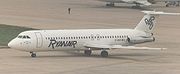 In 1992, the European Union's (EU)
deregulation of the air industry in Europe gave carriers from one EU country the right to operate scheduled services between other EU states and represented a major opportunity for Ryanair. After a successful flotation on the Dublin Stock Exchange
and the NASDAQ Stock exchanges
, the airline launched services to Stockholm
, Oslo (Sandefjord Airport, Torp, 110 km south of Oslo), Paris-Beauvais and Charleroi
near Brussels
. In 1998, flush with new capital, the airline placed a massive US$2 billion
order for 45 new Boeing 737-800 series aircraft.
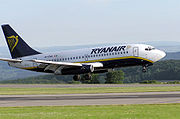
Ryanair launched a new base of operation in Charleroi Airport in 2001 The airport was relabelled as "Brussels South", even though it is 30 miles distant from the Belgian capital. Later that year, the airline ordered 155 new Boeing 737-800 series aircraft from Boeing
at what was believed to be a substantial discount, (taking full advantage of the downturn in airplane orders after the slump in air travel following the September 2001 aircraft attacks in the United States) to be delivered over eight years from 2002 to 2010. Approximately 100 of these aircraft had been delivered by the end of 2005, although there were slight delays in late 2005 caused by production disruptions arising from a Boeing machinists' strike.


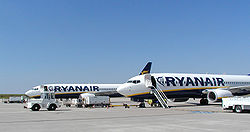 In 2003, Ryanair announced the order of a further 100 new Boeing 737-800 series aircraft.
In April 2003, Ryanair acquired its ailing competitor Buzz
from KLM. By the end of 2003, the airline flew 127 routes, of which 60 had opened in the previous 12 months.
By mid 2004 the airline was operating from a total of 11 bases across Europe.
During 2004, Michael O'Leary warned of a "bloodbath" during the winter from which only two or three low-cost airlines would emerge, the expectation being that these would be Ryanair and EasyJet
. A modest loss of €3.3 million in the second quarter of 2004 was the airline's first recorded loss for 15 years. However, the airline recovered posting profits soon after. The enlargement of the European Union
on 1 May 2004 opened the way to more new routes as Ryanair and other budget airlines tapped the markets of the EU accession countries.
In February 2005, Ryanair announced an order for a further 70 Boeing 737-800 aircraft, along with an option
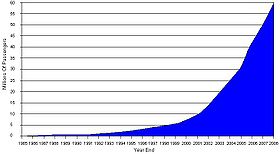
for a further 70. This was expected at the time to allow Ryanair to increase passenger numbers from the 34 million expected in 2005 to 70 million in 2011. Some of these aircraft would be deployed at Ryanair's 12 European bases, others to 10 new bases the company intended to establish over the next seven years.
In June 2006, the company announced that in the quarter ending 30 June 2006, its average yields were 13% higher than the same quarter of the previous year and its passenger numbers were up by 25% to 10.7 million, although year-on-year comparison was difficult, because of the movement of Easter from first quarter 2005 to second quarter 2006. Net profits (€115.7 m) increased by 80% over the same quarter in 2005. Management indicated that the level of growth may not be sustained for the remainder of that year, despite adding 27 new aircraft and opening new routes.
Ryanair's passenger numbers have grown by up to 25% a year for most of the last decade. Carrying under 700,000 annually in its early years, passenger figures grew to 21.4 million in 2003. The rapid addition of new routes and new bases has enabled this growth in passenger numbers and made Ryanair among the largest carriers on European routes. In August 2004, the airline carried 20% more passengers within Europe than British Airways.
Ryanair posted record half-year profits of €329 million for the six months ending 30 September 2006. Over the same period, passenger traffic grew by more than a fifth to 22.1 million passengers and revenues rose by a third to €1.256 billion.
broadcast a documentary as part of its Dispatches
series, "Ryanair caught napping". The documentary criticised Ryanair's training policies, security procedures and aircraft hygiene, and highlighted poor staff morale. Ryanair denied the allegations and claimed that promotional materials, in particular a photograph of a stewardess sleeping, had been faked by Dispatches.
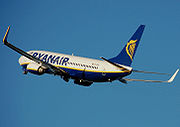 On 5 October 2006, Ryanair launched a €1.48 billion (£1bn; $1.9bn) bid to buy fellow Irish carrier Aer Lingus
. Ryanair CEO Michael O'Leary said the move was a "unique opportunity" to form an Irish airline. The "new" airline would carry over 50 million passengers a year.
Aer Lingus floated on the Irish Stock Exchange
on 2 October 2006, following a decision by the Irish government to sell more than 50% of its 85.1% share in the company. Workers retained a 15% stake. The shares began trading at €2.20 each, valuing the firm at €1.13bn. Ryanair said it had bought a 16% stake in Aer Lingus and was offering €2.80 per share for remaining shares. On the same day, Aer Lingus rejected Ryanair's takeover bid, saying the bid was contradictory. With a total of 47% of Aer Lingus in the hands of the Irish Government, the employee share ownership trust and other entities that publicly rejected the bid and a further 4% in the hands of the Bank of Ireland
and AIB
, who were considered highly unlikely to sell, the takeover bid was effectively dead. The Ryanair website described the attempted takeover as, "In October...we make an all cash offer for the small regional airline, Aer Lingus".
In January, following a BBC
investigation, Ryanair conceded that a claim it had cut its CO2
emissions by half in recent years was "an error".
In the meantime, Ryanair continued to expand and establish new European bases.
In May, Ryanair launched BING. This application brings daily fare specials to the user's computer.
On 18 July, the British Advertising Standards Authority (ASA)
ordered Ryanair not to repeat a claim that airline industry "accounts for just 2% of carbon dioxide emissions". The ASA ruled it breached rules on truthfulness by not explaining the figure was based on global, rather than UK emissions (which are 5.5% of the total) and exclude incoming flight figures.
In August, the company announced it would start charging passengers to check-in at the airport, therefore reversing its policy of paying for online check-in. It says that by cutting airport check-in it reduces overhead costs.
 Ryanair's CEO, Michael O'Leary, stated in April 2007 that Ryanair planned to launch a new long-haul airline around 2009. The new airline would be separate from Ryanair and operate under a different branding. It would offer both low cost with fares starting at €10.00 and a business class service which would be much more expensive, intended to rival airlines like Virgin Atlantic
. The new airline would operate from Ryanair's existing bases in Europe, to approximately six new bases in the United States. The new American bases will not be main bases such as New York's JFK airport, but smaller airports located outside major cities. It is planned that the new airline will eventually operate a fleet of 40 to 50 new Airbus A350XWB
or Boeing 787 Dreamliner aircraft. Since the Boeing 787 is sold out of production until at least 2012, and the Airbus A350 XWB will not enter service until 2013, this would contribute a delay to the airline's launch. It was not stated if other aircraft would be operated in the interim. O'Leary indicated that he intends to purchase the aircraft, when market prices for new aircraft recede, according to demand. It is said that the name of the new airline will be RyanAtlantic and will sell tickets through the Ryanair website under an alliance agreement.
In February 2010, O'Leary said the launch would be delayed until 2014, at the earliest, because of the shortage of suitable, cheap aircraft.
 On 31 August 2008 the Sunday Times
reported Ryanair was saving money by pressuring pilots to limit their discretionary fuel reserves. The discretionary reserves are in addition to the legal requirement for 5% extra fuel to be carried as a contingency, plus adequate fuel reserves to divert to an alternative airport, plus enough fuel to hold for 30 minutes at the destination airport. Ryanair has already suffered one incident in the past three years due to a low fuel situation. This move was popular at all airlines because of the high cost of fuel in the summer of 2008. Carrying lower reserves allows the plane to get better mileage than when it is overloaded with the excess weight of unused fuel.
In October, Ryanair withdrew operations from a base in Europe for the first time. Ryanair was unable to reach agreement with the local authorities in Valencia, Spain, thus terminating many of its Valencia services after a year of operation, though some routes still remain open. It is estimated the closure cost 750 jobs. Ryanair has since reintroduced its Valencia base, doubling its previous capacity.
In November, Ryanair announced they were planning to offer United States bound flights for around 10 euros by the end of 2009. Such a move would still need to be negotiated and the relevant permissions obtained.
619mil; US$950mil). The offer was a 28% premium on the value of Aer Lingus stock, during the preceding 30 days. Ryanair said, "Aer Lingus, as a small, stand alone, regional airline, has been marginalised and bypassed, as most other EU flag carriers consolidate." The two airlines would operate separately. Ryanair stated they would double the Aer Lingus short haul fleet from 33 to 66 and create 1,000 new jobs. The Aer Lingus Board rejected the offer and advised its shareholder
s to take no action. On 22 January 2009, Ryanair walked away from the Aer Lingus takeover bid after it was rejected by the Irish Government on the grounds it undervalued the airline and would harm competition. However, Ryanair retained a stake in Aer Lingus; in October 2010, competition regulators in the UK opened an enquiry; there are concerns that Ryanair's stake may lead to a reduction in competition.
by the start of 2010. Michael O'Leary, Ryanair's chief executive said passengers will be able to leave their luggage at a bag drop, but everything else will be done online. This became reality in October 2009.
On 28 March 2010, Ryanair announced that the on-board mobile phone service would be temporarily unavailable. Michael O'Leary explained that the contract with OnAir (who provided Ryanair the service) had been terminated after a 13 month proving period. As a result, Ryanair have invited other in-flight communications providers to tender for access to Ryanair's in-flight phone service.
As of February 2010, Ryanair had an average fare of €32. Ryanair stood by that fact that its average fare was less than half of competitor EasyJet's of €66, and therefore called the rival carrier a "high fares" airline.
In April 2010, after a week of flight disruption
in Europe caused by the eruption of a volcano
in Iceland, Ryanair decided to end refusals to comply with EU regulations which stated they were obliged to reimburse stranded passengers. The company had initially indicated it would only refund the price of unused tickets, but eventually agreed to comply with European Union legislation. However Italian authorities fined Ryanair €3,000,000 for failing to help passengers after cancelling their flights. In a company statement released on 22 April 2010, Ryanair described the regulations as 'unfair'.
On 29 April 2010, Ryanair announced the cancellations of all of its routes from Budapest Ferihegy Airport, after talks about decreasing taxes with the airports management failed. Ryanair stated it would have opened 25 new routes from the Hungarian capital, if the taxes had been decreased. As Ferihegy Airport is the only one serving Budapest
, the airline is not able to operate from an alternative low cost airport in the surroundings.
In June 2010, Ryanair called for a scrapping of the Irish Government's tourist tax and implied that it was destroying Irish tourism. Ryanair announced being back in the black with a €319m profit. and announced it would be cutting its winter schedule in UK by 16%, blaming the level of UK taxes on air tickets.
In June 2010, an Irish High Court judge said he has been driven to conclude "the truth and Ryanair are uncomfortable bedfellows" in light of Ryanair's conduct in challenging proposed new charges at Dublin airport for the five years up to 2014.
In August 2010, Ryanair held a press conference in Plovdiv
and announced its first ever Bulgarian destination connecting Plovdiv with London Stansted. The service is planned to start in November 2010 with two flights weekly.
On the 31 August Ryanair announced that they would be withdrawing all their routes from their smallest base, Belfast City. Chief executive Michael O'Leary said: "While we recognise the right of the government and people of Northern Ireland to subject this small runway extension to an extended planning process, these repeated delays, the reference to a public inquiry, and now the further delay to the public inquiry for spurious noise reasons, shows a lack of willingness on the part of the local authorities to grow and develop traffic, routes, tourism and jobs in Northern Ireland.
"In these circumstances, sadly, we have better alternative airports elsewhere in the UK and Europe, all of whom are willing and able to provide us with the runway infrastructure and low-cost facilities we need in order to operate our lowest fare flights immediately, safely and profitably."
In September 2010, it was announced that Ryanair would be reducing flights from Shannon by 21% to 6 destinations due to rises in airport fees. Ryanair has also announced that starts routes from Larnaca to Brussels South-Charleroi and Girona by the end of the year.
On 23 September 2010 Ryanair announced via its website that it was reducing its thrice daily service from Kerry to Dublin, to a single rotation citing increased charges at Dublin Airport and Air Traffic Control levies. Ryanair alleged the Irish government had not increased the PSO subsidy in compensation. It now refuses the subsidy.
On 30 September 2010 Ryanair announced that it will start flights from Tallinn to 7 destinations in December 2010: Skavsta (near Stockholm), Weeze, Rygge (near Oslo), Dublin, Milano-Bergamo, Edinburgh and Luton.
On 21 February 2011 Ryanair announced that it will start flights from Vilnius to 5 destinations in May 2011: Barcelona-Girona, Dublin, London-Stansted, Milan-Bergamo, Rome-Ciampino.
In March 2011, Ryanair opened a new maintenance hangar at Glasgow Prestwick International Airport. Making the Prestwick facilities Ryanair's biggest fleet maintenance base, performing all aircraft checks with the exception of D checks.The new hangar boosts capacity of the established maintenance facilities at the airport from two aircraft, to five. That same month, Ryanair is in breach of European Union rules by not offering an online complaints service to customers, according to the European Commissions European E-commerce Directive, any company selling goods online must offer customers the opportunity to complain via email. Ryanair currently has no email contact listed on its website instead requiring disgruntled customers to contact them by fax, letter or premium rate telephone number for urgent inquiries.
On 23 May 2011, Ryanair announced plans to temporarily cut capacity by grounding 80 aircraft in the winter schedules between November 2011 and April 2012 due to the high cost of fuel and continuing weak economic conditions. However, the airline will take delivery of 25 new aircraft over the coming months, but will not put them into service until April 2012.
On 14 July 2011, it was reported that Ryanair were looking to secure 40 - 50 new aircraft for transatlantic flights. .
, that is income from sources other than ticket fares. In 2009 ancillary revenue was at €598 million, compared to a total revenue of €2,942 million.
Ryanair has been described by the consumer magazine, Holiday Which?, as being the "worst offender" for charging for optional extras. As part of the low-cost business model the airline charges fees, these can be related to alternative services like using airport check-in facilities instead of the online service fee and using non-preferred methods of payment. It also charges for extra services like checked in luggage and it offers food and drinks for purchase as part of a buy on board
programme. Ryanair argues that it charges for a large number of optional extras in order to allow those passengers who do not require baggage, priority boarding or other premium services to travel for the lowest possible price by giving customers the flexibility to choose what they pay for.
In 2009, Ryanair abolished airport check-in and replaced it with a fast bag drop for those passengers checking in bags. The option of checking in at the airport for €10 has been discontinued, and all passengers are required to check-in online and print their own boarding pass. Passengers arriving at the airport without a pre-printed online check-in will have to pay €40 for their boarding pass to be re-issued. Ryanair has also replaced the free online check-in with a €6 online check-in fee which is charged per person, per flight. Although this fee is waived on "Free", "€1" and "€5" promotional fares, it has been criticised as being a non-optional extra charge which should be included in the headline fare.
.
Other proposed measures to reduce frills further have included eliminating two toilets to add six more seats, redesigning the aircraft to allow standing passengers, suggested that passengers should pay to use the toilets, charging extra for overweight passengers, and asking passengers to carry their checked-in luggage to the plane.
In common with other no-frills airlines, Ryanair is a strictly point-to-point carrier and does not offer connecting flights. Passengers who purchase an onward flight from their destination, intending to make a connection, are held responsible for making it to the airport on time for each flight. Ryanair does not compensate passengers who miss their flights because they arrive too late at the airport, nor does it provide replacement tickets free of charge. If a passenger misses their flight, then it is the passenger's responsibility to buy a new ticket at their own expense. This rule applies regardless of the passenger's chosen method of transport to the airport (including another Ryanair flight).
 Ryanair has been criticised for many aspects of its customer service. The Economist
wrote that Ryanair's "cavalier treatment of passengers" had given Ryanair "a deserved reputation for nastiness" and that the airline "has become a byword for appalling customer service ... and jeering rudeness towards anyone or anything that gets in its way".
In 2002, the High Court in Dublin awarded Jane O'Keefe €67,500 damages and her costs after Ryanair reneged on a free travel prize she was awarded for being the airline's 1 millionth passenger.
The airline has come under heavy criticism in the past for its poor treatment of disabled passengers. In 2002, it refused to provide wheelchair
s for disabled passengers at London Stansted Airport, greatly angering disabled rights groups. The airline argued that this provision was the responsibility of the airport authority, stating that wheelchairs were provided by 80 of the 84 Ryanair destination airports, at that time. A court ruling in 2004 judged that the responsibility should be shared by the airline and the airport owners; Ryanair responded by adding a surcharge of £0.50 to all its flight prices. On 30 March 2011, it announced that from 4 April it would add a surcharge of €2 to its flights to cover the costs arising from compliance with EC Regulation 261/2004, which requires it to pay for meals and accommodation for passengers on delayed and cancelled flights.
Ryanair does not offer customers the possibility of contacting them by email or webform
, only through a premium rate phone line, by fax or by post. An early day motion
in the British Parliament put forward in 2006 criticised Ryanair for this reason and called on the company to provide customers with a means to contact the company by email.
(ASA) and occasionally court action being taken against the airline.
Another Ryanair tactic is to make deliberately controversial statements to gain media attention. An example of this was the live BBC News interview on 27 February 2009 when Michael O'Leary, observing that it was "a quiet news day", commented that Ryanair was considering charging passengers £1 to use the toilet on their flights. The story subsequently made headlines in the media for several days and drew attention to Ryanair's announcement that it was removing check-in desks from airports and replacing them with online check-in. Eight days later O'Leary eventually admitted that it was a publicity stunt saying "It is not likely to happen, but it makes for interesting and very cheap PR". The concept of Ryanair charging for even this most essential of customer services was foreseen by the spoof news website "The Mardale Times" some five months previously, in their article "Ryanair announce new 'Pay-Per-Poo' service".
Ryanair often use their advertising to make direct comparisons and attack their competitors. One of their advertisements used a picture of the Manneken Pis
, a famous Belgian statue of a urinating child, with the words: "Pissed off with Sabena
's high fares? Low fares have arrived in Belgium." Sabena sued and the court ruled that the advertisements were misleading and offensive. Ryanair was ordered to discontinue the advertisements immediately or face fines. Ryanair was also obliged to publish an apology and publish the court decision on their website. Ryanair used the apologies for further advertising, primarily for further price comparisons.
Another deliberately provocative ad campaign headlined "Expensive Bastards!" compared Ryanair with British Airways
. As with Sabena, British Airways disagreed with the accompanying price comparisons and brought legal action against Ryanair. However, in this case the High Court sided with Ryanair and threw BA's case out ordering BA to make a payment towards Ryanair's court costs. The judge ruled "The complaint amounts to this: that Ryanair exaggerated in suggesting BA is five times more expensive because BA is only three times more expensive. Accordingly, in my view, the use was honest comparative advertising. I suspect the real reason that BA do not like it is precisely because it is true."
In 2007 Ryanair used an advertisement for its new Belfast
route which showed Sinn Féin
's Martin McGuinness
(an ex-commander in the Provisional IRA) standing alongside Gerry Adams
with a speech bubble which said "Ryanair fares are so low even the British Army flew home". Ulster Unionists reacted angrily to the advertisement, while the Advertising Standards Authority said it did not believe the ad would cause widespread offence.
Innuendo often features in Ryanair advertisements with one ad featuring a model dressed as a schoolgirl, accompanied by the words "Hottest back to school fares". Ryanair ran the advertisement in two Scottish and one UK-wide newspaper. After receiving 13 complaints, the advertisement was widely reported by national newspapers, generating more free publicity for the airline. The Advertising Standards Authority (ASA) instructed them to withdraw the advert in the United Kingdom, saying that it "appeared to link teenage girls with sexually provocative behaviour and was irresponsible and likely to cause serious or widespread offence". Ryanair said that they would "not be withdrawing this ad" and would "not provide the ASA with any of the undertakings they seek", on the basis that they found it absurd that "a picture of a fully clothed model is now claimed to cause 'serious or widespread offence', when many of the UK's leading daily newspapers regularly run pictures of topless or partially dressed females without causing any serious or widespread offence".
Another incident where it is speculated that Ryanair has used controversial statements for free publicity occurred in November of 2011. The airline has proposed the introduction of pay-per-view porn on its flights, CEO Michael O’Leary revealed to UK newspaper The Sun. O'Leary likened the service to those commonly provided in hotels, saying "Hotels around the world have it, so why wouldn’t we?”.
, on the grounds that the claim was misleading, due to required travel times to the airports mentioned. Ryanair stood by its claims, noting that their flight is shorter than the train trip and that travel time is also required to reach Eurostar's stations.
In April 2008, Ryanair faced a probe by the UK Office of Fair Trading
, after a string of complaints about its adverts. It was found to have breached advertising rules seven times in two years. ASA's director general Christopher Graham commented that formal referrals to the OFT were rare, the last occurring in 2005. He added that the ASA "would prefer to work with advertisers within the self-regulatory system rather than call in a statutory body, but Ryanair's approach has left us with no option." Ryanair countered with the claim that the ASA had "demonstrated a repeated lack of independence, impartiality and fairness".
In July 2009, Ryanair took a number of steps to "increase the clarity and transparency of its website and other advertising" after reaching an agreement with the OFT. The airline's website now includes a statement that "Fares don't include optional fees/charges" and they now include a table of fees to make fare comparisons easier.
In July 2010 Ryanair once again found itself in controversy regarding alleged misleading advertising. Ryanair circulated advertisements in two newspapers offering £10 one-way fares to European destinations. Following a complaint from rival carrier EasyJet, the ASA ruled the offer was "likely to mislead". Ryanair made no comment on the claim but did hit back at EasyJet, claiming they cared about details in this regard but did not themselves print their on-time statistics. EasyJet denied this.
In April 2011 Ryanair advertised 'a place in the sun destinations' but the advert was banned when it was found that some of the destination experienced sunshine for as little as 3 hours a day and temperatures between 0C and 14C.
Ryanair no longer replies to complaints from the ASA or its Irish equivalent, the ASAI.
 Ryanair now has a number of low-cost
competitors. In 2004, approximately 60 new low-cost airlines were formed. Although traditionally a full-service airline, Aer Lingus moved to a low-fares strategy from 2002, leading to a much more intense competition with Ryanair on Irish routes.
Airlines which attempt to compete directly with Ryanair are treated competitively, with Ryanair being accused by some of reducing fares to significantly undercut their competitors. In response to MyTravelLite, who started to compete with Ryanair on the Birmingham to Dublin route in 2003, Ryanair set up competing flights on some of MyTravelLite's routes until they pulled out. Go
was another airline which attempted to offer services from Ryanair's base at Dublin to Glasgow and Edinburgh in Scotland. A fierce battle ensued, which ended with Go withdrawing its service from Dublin.
In September 2004, Ryanair's biggest competitor, EasyJet, announced routes to the Republic of Ireland for the first time, beginning with the Cork to London Gatwick route. Until then, EasyJet had never competed directly with Ryanair on its home ground. EasyJet announced in July 2006, that it was withdrawing its Gatwick-Cork, Gatwick-Shannon and Gatwick-Knock services; within two weeks, Ryanair also announced it would withdraw its own service on the Gatwick-Knock and Luton-Shannon routes.
Ryanair has asked the high court to investigate why it has been refused permission to fly from Knock
to Dublin.
This route was won by CityJet, which was unable to operate the service. The runner up, Aer Arann
, was then allowed to start flights, a move Ryanair criticises on the basis that not initiating an additional tender process was unlawful.
DFDS Seaways
cited competition from low-cost air services, especially Ryanair, which now flies to Glasgow Prestwick Airport and London Stansted Airport from Gothenburg City Airport
, as the reason for scrapping the Newcastle
–Gothenburg
ferry service in October 2006. It was the only dedicated passenger ferry service between Sweden and the United Kingdom, and had been running under various operators since the 19th century.
 When Ryanair negotiates with its airports, it demands very low landing and handling fees, as well as financial assistance with marketing and promotional campaigns. In subsequent contract renewal negotiations, the airline has been reported to play airports against each other, threatening to withdraw services and deploy the aircraft elsewhere, if the airport does not make further concessions. According to Michael O’Leary's biography "A Life in Full Flight", Ryanair's growing popularity and also growing bargaining power, with both airports and airplane manufacturers, has resulted in the airline being less concerned about a market research/demographics approach to route selection to one based more on experimentation. This means they are more likely to fly their low cost planes between the lowest cost airports in anticipation that their presence alone on that route will be sufficient to create a demand which previously may not have existed, either in whole or in part.
In April 2006, a failure to reach agreement on a new commercial contract resulted in Ryanair announcing that it would withdraw service on the Dublin–Cardiff route at short notice. The airport management rebutted Ryanair's assertion that airport charges were unreasonably high, claiming that the Cardiff charges were already below Ryanair's average and claimed that Ryanair had recently adopted the same negotiating approach with Cork Airport and London Stansted Airports. Ryanair was recently reported to have adopted 'harsh' negotiating with Shannon Airport
and is closing 75% of its operations there from April 2010. Ryanair was forced to give up its Rome Ciampino–Alghero
route, after the route was allocated to Air One
, as a public service obligation
(PSO) route. The European Commission
is investigating the actions of the Italian Government in assigning PSO routes and thus restricting competition.
(approximately 70 daily departures), Brussels-Charleroi (between 45 and 50 daily departures) and Alicante
(approximately 40 daily departures). Pescara airport is currently the airline's smallest base with approximately five daily departures from the airport. Some non-base airports have more daily departures than some of the base airports. Bratislava, Kraków, Gatwick, Palma de Mallorca
and Paris-Beauvais are all non-base airports but have more daily departures than Ryanair's bases at Brindisi
, Pescara and Shannon
. Some of these non-base airports also serve more destinations than some of the airline's larger bases like Barcelona-Reus
, Bremen
and Bristol
.
Ryanair flies in a point to point model rather than the more traditional airline hub and spoke model where the passengers have to change aircraft in transit at a major airport. Ryanair prefers to fly to smaller or secondary airports usually outside of major cities to help the company cut costs and benefit from lower landing fees. For example Ryanair does not fly to the main Düsseldorf airport, it instead flies to Weeze, 70 km from Düsseldorf. Secondary airports are not always far from the city it serves and in fact can be closer than the city's major airport; this is the case at Belfast
, Gothenburg
and Rome. Ryanair does still serve a number of major airports including Barcelona, Berlin Schönefeld, Dublin, Edinburgh
, London-Gatwick, Manchester Airport and Porto although the majority of these cities do not have a secondary airport that Ryanair can use.
Ryanair has 44 European bases. Despite Ryanair's being an Irish airline, and having a significant presence there, it also has a significant presence in France, Germany, Italy, Poland, Spain, the United Kingdom as well as many other European countries (although the airline has no bases in France and Poland). The United Kingdom is its biggest market, containing the airline's largest base and nine others, as well as a total of seven other non-base airports. Its three largest British bases in order of size are London-Stansted, Liverpool and East Midlands airports.
Ryanair's largest competitor is EasyJet, which unlike Ryanair has a focus on larger or primary airports and also heavily targets business passengers. Ryanair in more recent years has focused on sun destinations such as the Canary Islands
and Greece. EasyJet often criticises Ryanair for its choice of airports and Ryanair often refers to EasyJet as a high fares airline.
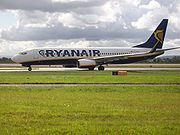
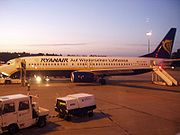
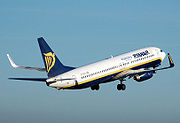 Ryanair claims to operate the newest, greenest and quietest fleet of aircraft in Europe. As of 13 July 2011, the average age of the Ryanair fleet is 3.6 years.
Ryanair's fleet reached 200 aircraft for the first time on 5 September 2009. The airline is expanding rapidly and will operate a fleet of 292 aircraft by 2012 with options for a further 10 aircraft to be delivered during that time. All aircraft in the Ryanair fleet have been retrofit
ted with performance enhancing winglets and the more recent deliveries have them fitted as standard.
and Airbus
about an order, which could include up to 200 aircraft. Even though Ryanair had dealt with Boeing aircraft up to this point, Michael O'Leary said he would buy Airbus planes if they offered a better deal. However, Airbus Chief Commercial Officer John Leahy denied in February 2009 that any negotiations were taking place: "We are not in discussions with Ryanair about aircraft. [...] We don't have plans to enter a sales campaign with Ryanair, which would be very expensive and very time-consuming."
In November 2009, Ryanair announced that negotiations with Boeing had proceeded poorly and that Ryanair was thinking of stopping negotiations, now put at 200 aircraft for delivery between 2013–2016, and simply returning cash to shareholders. Furthermore, if negotiations have not been completed by the end of 2009, Ryanair will start a series of deferrals and cancellations of existing orders, and "end" its relationship with Boeing. Boeing's competitor Airbus was mentioned again as an alternative vendor for Ryanair, but both Michael O'Leary and Airbus CCO John Leahy dismissed this, with Leahy stating "With what I know of the pricing levels they have in mind, I think I can say this is one order that Boeing should win"
In December 2009, Ryanair announced that negotiations with Boeing had indeed failed. Plans were to take all 112 aircraft already on order at that point, with the last deliveries occurring in 2012, for a total fleet of 300. Ryanair confirmed that an agreement had been met on price, but they had failed to agree on conditions, as Ryanair had wanted to carry forward certain conditions from their previous contract. As of late 2009, Ryanair plans to return cash to shareholders after 2012, and has no plans, it states, to reopen negotiations with Boeing or any other air-framer.
In January 2011 it was reported that Ryanair is speaking with Comac
of China and United Aircraft Corporation
of Russia, saying that these alternative manufactures could be a viable option for Ryanair. Possible candidates may include Comac C919
and Irkut MS-21.
Republic of Ireland
Ireland , described as the Republic of Ireland , is a sovereign state in Europe occupying approximately five-sixths of the island of the same name. Its capital is Dublin. Ireland, which had a population of 4.58 million in 2011, is a constitutional republic governed as a parliamentary democracy,...
low-cost airline. Its head office is at Dublin Airport
Dublin Airport
Dublin Airport, , is operated by the Dublin Airport Authority. Located in Collinstown, in the Fingal part of County Dublin, 18.4 million passengers passed through the airport in 2010, making it the busiest airport in the Republic of Ireland, followed by Cork and Shannon...
and its primary operational bases at Dublin Airport and London Stansted Airport
London Stansted Airport
-Cargo:-Statistics:-Infrastructure:-Terminal and satellite buildings:Stansted is the newest passenger airport of all the main London airports. The terminal is an oblong glass building, and is separated in to three areas: Check-in concourse, arrivals and departures...
.
Ryanair operates 300 Boeing 737-800
Boeing 737 Next Generation
The Boeing 737 Next Generation, commonly abbreviated as Boeing 737NG, is the name given to the -600/-700/-800/-900 series of the Boeing 737 after the introduction of the -300/-400/-500 Classic series. They are short- to medium-range, narrow-body jet airliners...
aircraft on over 1,100 routes across Europe and Morocco from 46 bases. The airline has been characterised by rapid expansion, a result of the deregulation
Deregulation
Deregulation is the removal or simplification of government rules and regulations that constrain the operation of market forces.Deregulation is the removal or simplification of government rules and regulations that constrain the operation of market forces.Deregulation is the removal or...
of the aviation industry
Aviation
Aviation is the design, development, production, operation, and use of aircraft, especially heavier-than-air aircraft. Aviation is derived from avis, the Latin word for bird.-History:...
in Europe in 1997 and the success of its low-cost business model.
History
Ryanair has grown since its establishment in 1985 from a small airline flying a short hop from WaterfordWaterford
Waterford is a city in the South-East Region of Ireland. It is the oldest city in the country and fifth largest by population. Waterford City Council is the local government authority for the city and its immediate hinterland...
to London into one of Europe's largest carriers. After the rapidly growing airline was taken public in 1997, the money raised was used to expand the airline into a pan-European carrier. Revenue
Revenue
In business, revenue is income that a company receives from its normal business activities, usually from the sale of goods and services to customers. In many countries, such as the United Kingdom, revenue is referred to as turnover....
s have risen from €231 million in 1998, to €1843 million in 2003 and €3013 million in 2010. Similarly net profits have increased from €48 million to €339 million over the same period.
Early years
Ryanair was founded in 1985 by Christopher Ryan, Liam Lonergan (owner of Irish travel agent Club Travel) and Irish businessman Tony RyanTony Ryan
Thomas Anthony "Tony" Ryan was an Irish multi-millionaire, philanthropist and businessman.He was a founder of Guinness Peat Aviation as well as co-founder of Ryanair with Christy Ryan and Liam Lonergan...
(after whom the company is named), founder of Guinness Peat Aviation
Guinness Peat Aviation
Guinness Peat Aviation was a Commercial Aircraft Sales and Leasing company set up in 1975 by Aer Lingus, the Guinness Peat Group and Tony Ryan, then an Aer Lingus executive.-History:...
and father of Cathal Ryan and Declan. The airline began with a 14-seat Embraer Bandeirante
Embraer EMB 110 Bandeirante
The Embraer EMB 110 Bandeirante is a general purpose 15-21 passenger twin-turboprop light transport aircraft suitable for military and civil duties...
turboprop
Turboprop
A turboprop engine is a type of turbine engine which drives an aircraft propeller using a reduction gear.The gas turbine is designed specifically for this application, with almost all of its output being used to drive the propeller...
aircraft, flying between Waterford
Waterford
Waterford is a city in the South-East Region of Ireland. It is the oldest city in the country and fifth largest by population. Waterford City Council is the local government authority for the city and its immediate hinterland...
and Gatwick Airport with the aim of breaking the duopoly
Duopoly
A true duopoly is a specific type of oligopoly where only two producers exist in one market. In reality, this definition is generally used where only two firms have dominant control over a market...
on London-Republic of Ireland flights at that time, held by British Airways
British Airways
British Airways is the flag carrier airline of the United Kingdom, based in Waterside, near its main hub at London Heathrow Airport. British Airways is the largest airline in the UK based on fleet size, international flights and international destinations...
and Aer Lingus
Aer Lingus
Aer Lingus Group Plc is the flag carrier of Ireland. It operates a fleet of Airbus aircraft serving Europe and North America. It is Ireland's oldest extant airline, and its second largest after low-cost rival Ryanair...
.
In 1986, the company added a second route – flying Dublin–Luton International Airport
London Luton Airport
London Luton Airport is an international airport located east of the town centre in the Borough of Luton in Bedfordshire, England and is north of Central London. The airport is from Junction 10a of the M1 motorway...
in direct competition with the Aer Lingus
Aer Lingus
Aer Lingus Group Plc is the flag carrier of Ireland. It operates a fleet of Airbus aircraft serving Europe and North America. It is Ireland's oldest extant airline, and its second largest after low-cost rival Ryanair...
/ British Airways
British Airways
British Airways is the flag carrier airline of the United Kingdom, based in Waterside, near its main hub at London Heathrow Airport. British Airways is the largest airline in the UK based on fleet size, international flights and international destinations...
duopoly for the first time. Under partial EU deregulation, airlines could begin new international intra-EU services, as long as at least one of the two governments gave approval (the so-called "double-disapproval" regime). The Irish government at the time refused its approval, in order to protect Aer Lingus, but Britain, under Margaret Thatcher
Margaret Thatcher
Margaret Hilda Thatcher, Baroness Thatcher, was Prime Minister of the United Kingdom from 1979 to 1990...
's pro-free-market Conservative
Conservative Party (UK)
The Conservative Party, formally the Conservative and Unionist Party, is a centre-right political party in the United Kingdom that adheres to the philosophies of conservatism and British unionism. It is the largest political party in the UK, and is currently the largest single party in the House...
government, approved the service. With two routes and two planes, the fledgling airline carried 82,000 passengers in one year. Passenger numbers continued to increase, but the airline generally ran at a loss and, by 1991, was in need of restructuring. Michael O'Leary
Michael O'Leary (Ryanair)
Michael O'Leary is an Irish businessman and the Chief Executive Officer of the Irish airline Ryanair. He is one of Ireland's wealthiest businessmen.-Early life:...
was charged with the task of making the airline profitable. O'Leary quickly decided that the key to low fares was to implement quick turn-around times for aircraft, "no frills" and no business class, as well as operating a single model of aircraft. In 1987, a Short Sunderland
Short Sunderland
The Short S.25 Sunderland was a British flying boat patrol bomber developed for the Royal Air Force by Short Brothers. It took its service name from the town and port of Sunderland in northeast England....
was operated by Ryanair.
O'Leary returned from a visit to Southwest Airlines
Southwest Airlines
Southwest Airlines Co. is an American low-cost airline based in Dallas, Texas. Southwest is the largest airline in the United States, based upon domestic passengers carried,...
convinced that Ryanair could make huge inroads into the European air market, at that time dominated by national carriers, which were subsidised to various degrees by their parent countries. He competed with the major airlines by providing a "no-frills", low-cost service. Flights were scheduled into regional airports, which offered lower landing and handling charges than larger established international airports. O'Leary as Chief Executive took part in a publicity stunt
Publicity stunt
A publicity stunt is a planned event designed to attract the public's attention to the event's organizers or their cause. Publicity stunts can be professionally organized or set up by amateurs...
, where he helped out with baggage handling on Ryanair flights at Dublin airport. By 1995, after the consistent pursuit of its low-cost business model, Ryanair celebrated its 10th birthday by carrying 2.25 million passengers.
1992–1999
European Union
The European Union is an economic and political union of 27 independent member states which are located primarily in Europe. The EU traces its origins from the European Coal and Steel Community and the European Economic Community , formed by six countries in 1958...
deregulation of the air industry in Europe gave carriers from one EU country the right to operate scheduled services between other EU states and represented a major opportunity for Ryanair. After a successful flotation on the Dublin Stock Exchange
Irish Stock Exchange
-History:The Irish Stock Exchange is Ireland's only stock exchange and has been in existence since 1793. It is an Irish private company limited by guarantee. It was first recognised by legislation in 1799 when the Irish Parliament passed the Stock Exchange Act...
and the NASDAQ Stock exchanges
NASDAQ
The NASDAQ Stock Market, also known as the NASDAQ, is an American stock exchange. "NASDAQ" originally stood for "National Association of Securities Dealers Automated Quotations". It is the second-largest stock exchange by market capitalization in the world, after the New York Stock Exchange. As of...
, the airline launched services to Stockholm
Stockholm
Stockholm is the capital and the largest city of Sweden and constitutes the most populated urban area in Scandinavia. Stockholm is the most populous city in Sweden, with a population of 851,155 in the municipality , 1.37 million in the urban area , and around 2.1 million in the metropolitan area...
, Oslo (Sandefjord Airport, Torp, 110 km south of Oslo), Paris-Beauvais and Charleroi
Charleroi
Charleroi is a city and a municipality of Wallonia, located in the province of Hainaut, Belgium. , the total population of Charleroi was 201,593. The metropolitan area, including the outer commuter zone, covers an area of and had a total population of 522,522 as of 1 January 2008, ranking it as...
near Brussels
Brussels
Brussels , officially the Brussels Region or Brussels-Capital Region , is the capital of Belgium and the de facto capital of the European Union...
. In 1998, flush with new capital, the airline placed a massive US$2 billion
1000000000 (number)
1,000,000,000 is the natural number following 999,999,999 and preceding 1,000,000,001.In scientific notation, it is written as 109....
order for 45 new Boeing 737-800 series aircraft.
2000–2006
The airline launched its website in 2000, with online booking initially said to be a small and unimportant part of the software supporting the site. Increasingly the online booking contributed to the aim of cutting flight prices by selling direct to passengers and excluding the costs imposed by travel agents. Within a year the website was handling three-quarters of all bookings. Today it is only possible to book seats via the website or via the "Ryanair direct" call-centre. No other possibilities are officially offered.Ryanair launched a new base of operation in Charleroi Airport in 2001 The airport was relabelled as "Brussels South", even though it is 30 miles distant from the Belgian capital. Later that year, the airline ordered 155 new Boeing 737-800 series aircraft from Boeing
Boeing
The Boeing Company is an American multinational aerospace and defense corporation, founded in 1916 by William E. Boeing in Seattle, Washington. Boeing has expanded over the years, merging with McDonnell Douglas in 1997. Boeing Corporate headquarters has been in Chicago, Illinois since 2001...
at what was believed to be a substantial discount, (taking full advantage of the downturn in airplane orders after the slump in air travel following the September 2001 aircraft attacks in the United States) to be delivered over eight years from 2002 to 2010. Approximately 100 of these aircraft had been delivered by the end of 2005, although there were slight delays in late 2005 caused by production disruptions arising from a Boeing machinists' strike.
In April 2003, Ryanair acquired its ailing competitor Buzz
Buzz (airline)
Buzz was a British low-cost airline operating services within Europe. It operated from 2000 until 2004 as a subsidiary of KLM and then Ryanair.- History :The airline was established in 1999 and started operations on January 4, 2000...
from KLM. By the end of 2003, the airline flew 127 routes, of which 60 had opened in the previous 12 months.
By mid 2004 the airline was operating from a total of 11 bases across Europe.
During 2004, Michael O'Leary warned of a "bloodbath" during the winter from which only two or three low-cost airlines would emerge, the expectation being that these would be Ryanair and EasyJet
EasyJet
EasyJet Airline Company Limited is a British airline headquartered at London Luton Airport. It carries more passengers than any other United Kingdom-based airline, operating domestic and international scheduled services on 500 routes between 118 European, North African, and West Asian airports...
. A modest loss of €3.3 million in the second quarter of 2004 was the airline's first recorded loss for 15 years. However, the airline recovered posting profits soon after. The enlargement of the European Union
Enlargement of the European Union
The Enlargement of the European Union is the process of expanding the European Union through the accession of new member states. This process began with the Inner Six, who founded the European Coal and Steel Community in 1952...
on 1 May 2004 opened the way to more new routes as Ryanair and other budget airlines tapped the markets of the EU accession countries.
In February 2005, Ryanair announced an order for a further 70 Boeing 737-800 aircraft, along with an option
Option (aircraft purchasing)
An option, when purchasing aircraft, allows an airline to purchase additional aircraft in the future at an agreed price and date.When placing orders for new aircraft, airlines commonly obtain options from the aircraft manufacturer, for example Airbus or Boeing...
for a further 70. This was expected at the time to allow Ryanair to increase passenger numbers from the 34 million expected in 2005 to 70 million in 2011. Some of these aircraft would be deployed at Ryanair's 12 European bases, others to 10 new bases the company intended to establish over the next seven years.
In June 2006, the company announced that in the quarter ending 30 June 2006, its average yields were 13% higher than the same quarter of the previous year and its passenger numbers were up by 25% to 10.7 million, although year-on-year comparison was difficult, because of the movement of Easter from first quarter 2005 to second quarter 2006. Net profits (€115.7 m) increased by 80% over the same quarter in 2005. Management indicated that the level of growth may not be sustained for the remainder of that year, despite adding 27 new aircraft and opening new routes.
Ryanair's passenger numbers have grown by up to 25% a year for most of the last decade. Carrying under 700,000 annually in its early years, passenger figures grew to 21.4 million in 2003. The rapid addition of new routes and new bases has enabled this growth in passenger numbers and made Ryanair among the largest carriers on European routes. In August 2004, the airline carried 20% more passengers within Europe than British Airways.
Ryanair posted record half-year profits of €329 million for the six months ending 30 September 2006. Over the same period, passenger traffic grew by more than a fifth to 22.1 million passengers and revenues rose by a third to €1.256 billion.
Dispatches programme
On 13 February 2006, Britain's Channel 4Channel 4
Channel 4 is a British public-service television broadcaster which began working on 2 November 1982. Although largely commercially self-funded, it is ultimately publicly owned; originally a subsidiary of the Independent Broadcasting Authority , the station is now owned and operated by the Channel...
broadcast a documentary as part of its Dispatches
Dispatches (TV series)
Dispatches is the British television current affairs documentary series on Channel 4, first transmitted in 1987. The programme covers issues about British society, politics, health, religion, international current affairs and the environment, usually featuring a mole in an organisation.-Awards:*...
series, "Ryanair caught napping". The documentary criticised Ryanair's training policies, security procedures and aircraft hygiene, and highlighted poor staff morale. Ryanair denied the allegations and claimed that promotional materials, in particular a photograph of a stewardess sleeping, had been faked by Dispatches.
Aer Lingus takeover bid
Aer Lingus
Aer Lingus Group Plc is the flag carrier of Ireland. It operates a fleet of Airbus aircraft serving Europe and North America. It is Ireland's oldest extant airline, and its second largest after low-cost rival Ryanair...
. Ryanair CEO Michael O'Leary said the move was a "unique opportunity" to form an Irish airline. The "new" airline would carry over 50 million passengers a year.
Aer Lingus floated on the Irish Stock Exchange
Irish Stock Exchange
-History:The Irish Stock Exchange is Ireland's only stock exchange and has been in existence since 1793. It is an Irish private company limited by guarantee. It was first recognised by legislation in 1799 when the Irish Parliament passed the Stock Exchange Act...
on 2 October 2006, following a decision by the Irish government to sell more than 50% of its 85.1% share in the company. Workers retained a 15% stake. The shares began trading at €2.20 each, valuing the firm at €1.13bn. Ryanair said it had bought a 16% stake in Aer Lingus and was offering €2.80 per share for remaining shares. On the same day, Aer Lingus rejected Ryanair's takeover bid, saying the bid was contradictory. With a total of 47% of Aer Lingus in the hands of the Irish Government, the employee share ownership trust and other entities that publicly rejected the bid and a further 4% in the hands of the Bank of Ireland
Bank of Ireland
The Bank of Ireland is a commercial bank operation in Ireland, which is one of the 'Big Four' in both parts of the island.Historically the premier banking organisation in Ireland, the Bank occupies a unique position in Irish banking history...
and AIB
Allied Irish Banks
Allied Irish Banks p.l.c. is a major commercial bank based in Ireland.AIB is one of the so called "big four" commercial banks in the state. The bank has one of the largest branch networks in Ireland; only Bank of Ireland fully rivals it. AIB offers a full range of personal and corporate banking...
, who were considered highly unlikely to sell, the takeover bid was effectively dead. The Ryanair website described the attempted takeover as, "In October...we make an all cash offer for the small regional airline, Aer Lingus".
2007
Fourth quarter 2006 profits far exceeded analyst expectations and over the period from October 2006 to February 2007, the stock rose by some 50%. The press suggested that Ryanair was now selling on its 737-800s at higher prices than the cost of acquisition from Boeing. They also noted that average fares keep increasing.In January, following a BBC
BBC
The British Broadcasting Corporation is a British public service broadcaster. Its headquarters is at Broadcasting House in the City of Westminster, London. It is the largest broadcaster in the world, with about 23,000 staff...
investigation, Ryanair conceded that a claim it had cut its CO2
Carbon dioxide
Carbon dioxide is a naturally occurring chemical compound composed of two oxygen atoms covalently bonded to a single carbon atom...
emissions by half in recent years was "an error".
In the meantime, Ryanair continued to expand and establish new European bases.
In May, Ryanair launched BING. This application brings daily fare specials to the user's computer.
On 18 July, the British Advertising Standards Authority (ASA)
Advertising Standards Authority (United Kingdom)
The Advertising Standards Authority is the self-regulatory organisation of the advertising industry in the United Kingdom. The ASA is a non-statutory organisation and so cannot interpret or enforce legislation. However, its code of advertising practice broadly reflects legislation in many instances...
ordered Ryanair not to repeat a claim that airline industry "accounts for just 2% of carbon dioxide emissions". The ASA ruled it breached rules on truthfulness by not explaining the figure was based on global, rather than UK emissions (which are 5.5% of the total) and exclude incoming flight figures.
In August, the company announced it would start charging passengers to check-in at the airport, therefore reversing its policy of paying for online check-in. It says that by cutting airport check-in it reduces overhead costs.
RyanAtlantic
Virgin Atlantic Airways
Virgin Atlantic Airways Limited is a British airline owned by Sir Richard Branson's Virgin Group and Singapore Airlines...
. The new airline would operate from Ryanair's existing bases in Europe, to approximately six new bases in the United States. The new American bases will not be main bases such as New York's JFK airport, but smaller airports located outside major cities. It is planned that the new airline will eventually operate a fleet of 40 to 50 new Airbus A350XWB
Airbus A350
The Airbus A350 is a family of long-range, wide-body jet airliners under development by European aircraft manufacturer Airbus.A consortium originally comprising European aerospace companies from the UK, France, Spain and West Germany, Airbus is now fully owned by EADS and since 2001 has been known...
or Boeing 787 Dreamliner aircraft. Since the Boeing 787 is sold out of production until at least 2012, and the Airbus A350 XWB will not enter service until 2013, this would contribute a delay to the airline's launch. It was not stated if other aircraft would be operated in the interim. O'Leary indicated that he intends to purchase the aircraft, when market prices for new aircraft recede, according to demand. It is said that the name of the new airline will be RyanAtlantic and will sell tickets through the Ryanair website under an alliance agreement.
In February 2010, O'Leary said the launch would be delayed until 2014, at the earliest, because of the shortage of suitable, cheap aircraft.
2008
The Sunday Times
The Sunday Times is a British Sunday newspaper.The Sunday Times may also refer to:*The Sunday Times *The Sunday Times *The Sunday Times *The Sunday Times...
reported Ryanair was saving money by pressuring pilots to limit their discretionary fuel reserves. The discretionary reserves are in addition to the legal requirement for 5% extra fuel to be carried as a contingency, plus adequate fuel reserves to divert to an alternative airport, plus enough fuel to hold for 30 minutes at the destination airport. Ryanair has already suffered one incident in the past three years due to a low fuel situation. This move was popular at all airlines because of the high cost of fuel in the summer of 2008. Carrying lower reserves allows the plane to get better mileage than when it is overloaded with the excess weight of unused fuel.
In October, Ryanair withdrew operations from a base in Europe for the first time. Ryanair was unable to reach agreement with the local authorities in Valencia, Spain, thus terminating many of its Valencia services after a year of operation, though some routes still remain open. It is estimated the closure cost 750 jobs. Ryanair has since reintroduced its Valencia base, doubling its previous capacity.
In November, Ryanair announced they were planning to offer United States bound flights for around 10 euros by the end of 2009. Such a move would still need to be negotiated and the relevant permissions obtained.
Second Aer Lingus Takeover Bid
On 1 December 2008, Ryanair launched a second takeover bid of fellow Irish airline, Aer Lingus. Offering an all-cash offer of €748 million (£Pound sterling
The pound sterling , commonly called the pound, is the official currency of the United Kingdom, its Crown Dependencies and the British Overseas Territories of South Georgia and the South Sandwich Islands, British Antarctic Territory and Tristan da Cunha. It is subdivided into 100 pence...
619mil; US$950mil). The offer was a 28% premium on the value of Aer Lingus stock, during the preceding 30 days. Ryanair said, "Aer Lingus, as a small, stand alone, regional airline, has been marginalised and bypassed, as most other EU flag carriers consolidate." The two airlines would operate separately. Ryanair stated they would double the Aer Lingus short haul fleet from 33 to 66 and create 1,000 new jobs. The Aer Lingus Board rejected the offer and advised its shareholder
Shareholder
A shareholder or stockholder is an individual or institution that legally owns one or more shares of stock in a public or private corporation. Shareholders own the stock, but not the corporation itself ....
s to take no action. On 22 January 2009, Ryanair walked away from the Aer Lingus takeover bid after it was rejected by the Irish Government on the grounds it undervalued the airline and would harm competition. However, Ryanair retained a stake in Aer Lingus; in October 2010, competition regulators in the UK opened an enquiry; there are concerns that Ryanair's stake may lead to a reduction in competition.
2009
On 21 February 2009, Ryanair confirmed they were planning to close all check-in desksAirport check-in
Airport check-in uses service counters found at commercial airports handling commercial air travel. The check-in is normally handled by an airline itself or a handling agent working on behalf of an airline...
by the start of 2010. Michael O'Leary, Ryanair's chief executive said passengers will be able to leave their luggage at a bag drop, but everything else will be done online. This became reality in October 2009.
2010
In February 2010, Michael O'Leary threatened that if London Stansted did not give Ryanair any more low-priced landing fees, the airline would move many of its routes from Stansted to London Gatwick (which provided lower landing offers to the airline) and open a base there, or even pull out entirely from Stansted.On 28 March 2010, Ryanair announced that the on-board mobile phone service would be temporarily unavailable. Michael O'Leary explained that the contract with OnAir (who provided Ryanair the service) had been terminated after a 13 month proving period. As a result, Ryanair have invited other in-flight communications providers to tender for access to Ryanair's in-flight phone service.
As of February 2010, Ryanair had an average fare of €32. Ryanair stood by that fact that its average fare was less than half of competitor EasyJet's of €66, and therefore called the rival carrier a "high fares" airline.
In April 2010, after a week of flight disruption
Air travel disruption after the 2010 Eyjafjallajökull eruption
In response to concerns that volcanic ash ejected during the 2010 eruptions of Eyjafjallajökull in Iceland would damage aircraft engines, the controlled airspace of many European countries was closed to instrument flight rules traffic, resulting in the largest air-traffic shut-down since World War II...
in Europe caused by the eruption of a volcano
2010 eruptions of Eyjafjallajökull
The 2010 eruptions of Eyjafjallajökull were volcanic events at Eyjafjöll in Iceland which, although relatively small for volcanic eruptions, caused enormous disruption to air travel across western and northern Europe over an initial period of six days in April 2010. Additional localised disruption...
in Iceland, Ryanair decided to end refusals to comply with EU regulations which stated they were obliged to reimburse stranded passengers. The company had initially indicated it would only refund the price of unused tickets, but eventually agreed to comply with European Union legislation. However Italian authorities fined Ryanair €3,000,000 for failing to help passengers after cancelling their flights. In a company statement released on 22 April 2010, Ryanair described the regulations as 'unfair'.
On 29 April 2010, Ryanair announced the cancellations of all of its routes from Budapest Ferihegy Airport, after talks about decreasing taxes with the airports management failed. Ryanair stated it would have opened 25 new routes from the Hungarian capital, if the taxes had been decreased. As Ferihegy Airport is the only one serving Budapest
Budapest
Budapest is the capital of Hungary. As the largest city of Hungary, it is the country's principal political, cultural, commercial, industrial, and transportation centre. In 2011, Budapest had 1,733,685 inhabitants, down from its 1989 peak of 2,113,645 due to suburbanization. The Budapest Commuter...
, the airline is not able to operate from an alternative low cost airport in the surroundings.
In June 2010, Ryanair called for a scrapping of the Irish Government's tourist tax and implied that it was destroying Irish tourism. Ryanair announced being back in the black with a €319m profit. and announced it would be cutting its winter schedule in UK by 16%, blaming the level of UK taxes on air tickets.
In June 2010, an Irish High Court judge said he has been driven to conclude "the truth and Ryanair are uncomfortable bedfellows" in light of Ryanair's conduct in challenging proposed new charges at Dublin airport for the five years up to 2014.
In August 2010, Ryanair held a press conference in Plovdiv
Plovdiv
Plovdiv is the second-largest city in Bulgaria after Sofia with a population of 338,153 inhabitants according to Census 2011. Plovdiv's history spans some 6,000 years, with traces of a Neolithic settlement dating to roughly 4000 BC; it is one of the oldest cities in Europe...
and announced its first ever Bulgarian destination connecting Plovdiv with London Stansted. The service is planned to start in November 2010 with two flights weekly.
On the 31 August Ryanair announced that they would be withdrawing all their routes from their smallest base, Belfast City. Chief executive Michael O'Leary said: "While we recognise the right of the government and people of Northern Ireland to subject this small runway extension to an extended planning process, these repeated delays, the reference to a public inquiry, and now the further delay to the public inquiry for spurious noise reasons, shows a lack of willingness on the part of the local authorities to grow and develop traffic, routes, tourism and jobs in Northern Ireland.
"In these circumstances, sadly, we have better alternative airports elsewhere in the UK and Europe, all of whom are willing and able to provide us with the runway infrastructure and low-cost facilities we need in order to operate our lowest fare flights immediately, safely and profitably."
In September 2010, it was announced that Ryanair would be reducing flights from Shannon by 21% to 6 destinations due to rises in airport fees. Ryanair has also announced that starts routes from Larnaca to Brussels South-Charleroi and Girona by the end of the year.
On 23 September 2010 Ryanair announced via its website that it was reducing its thrice daily service from Kerry to Dublin, to a single rotation citing increased charges at Dublin Airport and Air Traffic Control levies. Ryanair alleged the Irish government had not increased the PSO subsidy in compensation. It now refuses the subsidy.
On 30 September 2010 Ryanair announced that it will start flights from Tallinn to 7 destinations in December 2010: Skavsta (near Stockholm), Weeze, Rygge (near Oslo), Dublin, Milano-Bergamo, Edinburgh and Luton.
2011
On 4 January 2011, Ryanair announced that its 2010 traffic grew by 10% from 65 million to over 72 million passengers.On 21 February 2011 Ryanair announced that it will start flights from Vilnius to 5 destinations in May 2011: Barcelona-Girona, Dublin, London-Stansted, Milan-Bergamo, Rome-Ciampino.
In March 2011, Ryanair opened a new maintenance hangar at Glasgow Prestwick International Airport. Making the Prestwick facilities Ryanair's biggest fleet maintenance base, performing all aircraft checks with the exception of D checks.The new hangar boosts capacity of the established maintenance facilities at the airport from two aircraft, to five. That same month, Ryanair is in breach of European Union rules by not offering an online complaints service to customers, according to the European Commissions European E-commerce Directive, any company selling goods online must offer customers the opportunity to complain via email. Ryanair currently has no email contact listed on its website instead requiring disgruntled customers to contact them by fax, letter or premium rate telephone number for urgent inquiries.
On 23 May 2011, Ryanair announced plans to temporarily cut capacity by grounding 80 aircraft in the winter schedules between November 2011 and April 2012 due to the high cost of fuel and continuing weak economic conditions. However, the airline will take delivery of 25 new aircraft over the coming months, but will not put them into service until April 2012.
On 14 July 2011, it was reported that Ryanair were looking to secure 40 - 50 new aircraft for transatlantic flights. .
Business model
Employment relations
In the early years, when Ryanair had a total of 450 employees who each had shares in the company, there was an agreement that staff would not join a union on the basis that they would have influence on how the company was run. However, there were some early attempts to unionise Ryanair due to Michael O'Leary, board of directors, requesting that pilots take pay cuts and accept changes in their working conditions. Many of Ryanair's pilots were dissatisfied with the new moves and were represented by the Irish Airline Pilots Association. Ryanair's response was to outsource employees from other European countries. Though in later years, CEO Michael O'Leary, took a more hands on approach and could be seen working with other staff members on the front line loading bags and checking passengers.Ancillary revenue and in-flight service
Twenty percent of Ryanair's revenue is generated from ancillary revenueAncillary revenue
Ancillary revenue refers to airline revenue from non-ticket sources, such as baggage fees and on-board food and services, and has become an important financial component for low-cost carriers in Europe, the United States and other global regions...
, that is income from sources other than ticket fares. In 2009 ancillary revenue was at €598 million, compared to a total revenue of €2,942 million.
Ryanair has been described by the consumer magazine, Holiday Which?, as being the "worst offender" for charging for optional extras. As part of the low-cost business model the airline charges fees, these can be related to alternative services like using airport check-in facilities instead of the online service fee and using non-preferred methods of payment. It also charges for extra services like checked in luggage and it offers food and drinks for purchase as part of a buy on board
Buy on board
In commercial flight, buy on board is a system where food or beverages are paid for on board; often food or beverages are not included in the ticket price for certain fare classes....
programme. Ryanair argues that it charges for a large number of optional extras in order to allow those passengers who do not require baggage, priority boarding or other premium services to travel for the lowest possible price by giving customers the flexibility to choose what they pay for.
In 2009, Ryanair abolished airport check-in and replaced it with a fast bag drop for those passengers checking in bags. The option of checking in at the airport for €10 has been discontinued, and all passengers are required to check-in online and print their own boarding pass. Passengers arriving at the airport without a pre-printed online check-in will have to pay €40 for their boarding pass to be re-issued. Ryanair has also replaced the free online check-in with a €6 online check-in fee which is charged per person, per flight. Although this fee is waived on "Free", "€1" and "€5" promotional fares, it has been criticised as being a non-optional extra charge which should be included in the headline fare.
No-frills
New Ryanair aircraft have been delivered with non-reclining synthetic leather seats, no seat-back pockets, safety cards stuck on the back of the seats, and life jackets stowed overhead rather than under the seat. This allows the airline to save on aircraft costs and enables faster cleaning and safety checks during the short turnaround times. It was reported in various media that Ryanair wanted to order their aircraft without window shades; however, the new aircraft do have them as it is required by the regulations of the Irish Aviation AuthorityIrish Aviation Authority
The Irish Aviation Authority is a commercial semi state company employing approximately 700 people at six locations around Ireland. The IAA has two main functions; the provision of air traffic management & related services in Irish controlled airspace and the safety regulation of the civil...
.
Other proposed measures to reduce frills further have included eliminating two toilets to add six more seats, redesigning the aircraft to allow standing passengers, suggested that passengers should pay to use the toilets, charging extra for overweight passengers, and asking passengers to carry their checked-in luggage to the plane.
In common with other no-frills airlines, Ryanair is a strictly point-to-point carrier and does not offer connecting flights. Passengers who purchase an onward flight from their destination, intending to make a connection, are held responsible for making it to the airport on time for each flight. Ryanair does not compensate passengers who miss their flights because they arrive too late at the airport, nor does it provide replacement tickets free of charge. If a passenger misses their flight, then it is the passenger's responsibility to buy a new ticket at their own expense. This rule applies regardless of the passenger's chosen method of transport to the airport (including another Ryanair flight).
Customer service
The Economist
The Economist is an English-language weekly news and international affairs publication owned by The Economist Newspaper Ltd. and edited in offices in the City of Westminster, London, England. Continuous publication began under founder James Wilson in September 1843...
wrote that Ryanair's "cavalier treatment of passengers" had given Ryanair "a deserved reputation for nastiness" and that the airline "has become a byword for appalling customer service ... and jeering rudeness towards anyone or anything that gets in its way".
In 2002, the High Court in Dublin awarded Jane O'Keefe €67,500 damages and her costs after Ryanair reneged on a free travel prize she was awarded for being the airline's 1 millionth passenger.
The airline has come under heavy criticism in the past for its poor treatment of disabled passengers. In 2002, it refused to provide wheelchair
Wheelchair
A wheelchair is a chair with wheels, designed to be a replacement for walking. The device comes in variations where it is propelled by motors or by the seated occupant turning the rear wheels by hand. Often there are handles behind the seat for someone else to do the pushing...
s for disabled passengers at London Stansted Airport, greatly angering disabled rights groups. The airline argued that this provision was the responsibility of the airport authority, stating that wheelchairs were provided by 80 of the 84 Ryanair destination airports, at that time. A court ruling in 2004 judged that the responsibility should be shared by the airline and the airport owners; Ryanair responded by adding a surcharge of £0.50 to all its flight prices. On 30 March 2011, it announced that from 4 April it would add a surcharge of €2 to its flights to cover the costs arising from compliance with EC Regulation 261/2004, which requires it to pay for meals and accommodation for passengers on delayed and cancelled flights.
Ryanair does not offer customers the possibility of contacting them by email or webform
Form (web)
A webform on a web page allows a user to enter data that is sent to a server for processing. Webforms resemble paper or database forms because internet users fill out the forms using checkboxes, radio buttons, or text fields...
, only through a premium rate phone line, by fax or by post. An early day motion
Early day motion
An Early Day Motion , in the Westminster system, is a motion, expressed as a single sentence, tabled by Members of Parliament for debate "on an early day" . Controversial EDMs are not signed by Government Ministers, PPS or the Speaker of the House of Commons and very few are debated on the floor...
in the British Parliament put forward in 2006 criticised Ryanair for this reason and called on the company to provide customers with a means to contact the company by email.
Controversial advertising
Ryanair's advertising and the antics of Michael O'Leary, such as causing deliberate court controversy in order to generate free publicity for the airline, have led to a number of complaints to the Advertising Standards AuthorityAdvertising Standards Authority (United Kingdom)
The Advertising Standards Authority is the self-regulatory organisation of the advertising industry in the United Kingdom. The ASA is a non-statutory organisation and so cannot interpret or enforce legislation. However, its code of advertising practice broadly reflects legislation in many instances...
(ASA) and occasionally court action being taken against the airline.
Another Ryanair tactic is to make deliberately controversial statements to gain media attention. An example of this was the live BBC News interview on 27 February 2009 when Michael O'Leary, observing that it was "a quiet news day", commented that Ryanair was considering charging passengers £1 to use the toilet on their flights. The story subsequently made headlines in the media for several days and drew attention to Ryanair's announcement that it was removing check-in desks from airports and replacing them with online check-in. Eight days later O'Leary eventually admitted that it was a publicity stunt saying "It is not likely to happen, but it makes for interesting and very cheap PR". The concept of Ryanair charging for even this most essential of customer services was foreseen by the spoof news website "The Mardale Times" some five months previously, in their article "Ryanair announce new 'Pay-Per-Poo' service".
Ryanair often use their advertising to make direct comparisons and attack their competitors. One of their advertisements used a picture of the Manneken Pis
Manneken Pis
, is a famous Brussels landmark. It is a small bronze fountain sculpture depicting a naked little boy urinating into the fountain's basin. It was designed by Jerome Duquesnoy and put in place in 1618 or 1619...
, a famous Belgian statue of a urinating child, with the words: "Pissed off with Sabena
Sabena
SABENA was the national airline of Belgium from 1923 to 2001, with its base at Brussels National Airport. After its bankruptcy in 2001, the newly formed SN Brussels Airlines took over part of SABENA's assets in February 2002, which then became Brussels Airlines...
's high fares? Low fares have arrived in Belgium." Sabena sued and the court ruled that the advertisements were misleading and offensive. Ryanair was ordered to discontinue the advertisements immediately or face fines. Ryanair was also obliged to publish an apology and publish the court decision on their website. Ryanair used the apologies for further advertising, primarily for further price comparisons.
Another deliberately provocative ad campaign headlined "Expensive Bastards!" compared Ryanair with British Airways
British Airways
British Airways is the flag carrier airline of the United Kingdom, based in Waterside, near its main hub at London Heathrow Airport. British Airways is the largest airline in the UK based on fleet size, international flights and international destinations...
. As with Sabena, British Airways disagreed with the accompanying price comparisons and brought legal action against Ryanair. However, in this case the High Court sided with Ryanair and threw BA's case out ordering BA to make a payment towards Ryanair's court costs. The judge ruled "The complaint amounts to this: that Ryanair exaggerated in suggesting BA is five times more expensive because BA is only three times more expensive. Accordingly, in my view, the use was honest comparative advertising. I suspect the real reason that BA do not like it is precisely because it is true."
In 2007 Ryanair used an advertisement for its new Belfast
Belfast
Belfast is the capital of and largest city in Northern Ireland. By population, it is the 14th biggest city in the United Kingdom and second biggest on the island of Ireland . It is the seat of the devolved government and legislative Northern Ireland Assembly...
route which showed Sinn Féin
Sinn Féin
Sinn Féin is a left wing, Irish republican political party in Ireland. The name is Irish for "ourselves" or "we ourselves", although it is frequently mistranslated as "ourselves alone". Originating in the Sinn Féin organisation founded in 1905 by Arthur Griffith, it took its current form in 1970...
's Martin McGuinness
Martin McGuinness
James Martin Pacelli McGuinness is an Irish Sinn Féin politician and the current deputy First Minister of Northern Ireland. McGuinness was also the Sinn Féin candidate for the Irish presidential election, 2011. He was born in Derry, Northern Ireland....
(an ex-commander in the Provisional IRA) standing alongside Gerry Adams
Gerry Adams
Gerry Adams is an Irish republican politician and Teachta Dála for the constituency of Louth. From 1983 to 1992 and from 1997 to 2011, he was an abstentionist Westminster Member of Parliament for Belfast West. He is the president of Sinn Féin, the second largest political party in Northern...
with a speech bubble which said "Ryanair fares are so low even the British Army flew home". Ulster Unionists reacted angrily to the advertisement, while the Advertising Standards Authority said it did not believe the ad would cause widespread offence.
Innuendo often features in Ryanair advertisements with one ad featuring a model dressed as a schoolgirl, accompanied by the words "Hottest back to school fares". Ryanair ran the advertisement in two Scottish and one UK-wide newspaper. After receiving 13 complaints, the advertisement was widely reported by national newspapers, generating more free publicity for the airline. The Advertising Standards Authority (ASA) instructed them to withdraw the advert in the United Kingdom, saying that it "appeared to link teenage girls with sexually provocative behaviour and was irresponsible and likely to cause serious or widespread offence". Ryanair said that they would "not be withdrawing this ad" and would "not provide the ASA with any of the undertakings they seek", on the basis that they found it absurd that "a picture of a fully clothed model is now claimed to cause 'serious or widespread offence', when many of the UK's leading daily newspapers regularly run pictures of topless or partially dressed females without causing any serious or widespread offence".
Another incident where it is speculated that Ryanair has used controversial statements for free publicity occurred in November of 2011. The airline has proposed the introduction of pay-per-view porn on its flights, CEO Michael O’Leary revealed to UK newspaper The Sun. O'Leary likened the service to those commonly provided in hotels, saying "Hotels around the world have it, so why wouldn’t we?”.
Allegations of misleading advertising
Ryanair was ordered by the ASA to stop claiming that its flights from London to Brussels are faster than the rail connection EurostarEurostar
Eurostar is a high-speed railway service connecting London with Paris and Brussels. All its trains traverse the Channel Tunnel between England and France, owned and operated separately by Eurotunnel....
, on the grounds that the claim was misleading, due to required travel times to the airports mentioned. Ryanair stood by its claims, noting that their flight is shorter than the train trip and that travel time is also required to reach Eurostar's stations.
In April 2008, Ryanair faced a probe by the UK Office of Fair Trading
Office of Fair Trading
The Office of Fair Trading is a not-for-profit and non-ministerial government department of the United Kingdom, established by the Fair Trading Act 1973, which enforces both consumer protection and competition law, acting as the UK's economic regulator...
, after a string of complaints about its adverts. It was found to have breached advertising rules seven times in two years. ASA's director general Christopher Graham commented that formal referrals to the OFT were rare, the last occurring in 2005. He added that the ASA "would prefer to work with advertisers within the self-regulatory system rather than call in a statutory body, but Ryanair's approach has left us with no option." Ryanair countered with the claim that the ASA had "demonstrated a repeated lack of independence, impartiality and fairness".
In July 2009, Ryanair took a number of steps to "increase the clarity and transparency of its website and other advertising" after reaching an agreement with the OFT. The airline's website now includes a statement that "Fares don't include optional fees/charges" and they now include a table of fees to make fare comparisons easier.
In July 2010 Ryanair once again found itself in controversy regarding alleged misleading advertising. Ryanair circulated advertisements in two newspapers offering £10 one-way fares to European destinations. Following a complaint from rival carrier EasyJet, the ASA ruled the offer was "likely to mislead". Ryanair made no comment on the claim but did hit back at EasyJet, claiming they cared about details in this regard but did not themselves print their on-time statistics. EasyJet denied this.
In April 2011 Ryanair advertised 'a place in the sun destinations' but the advert was banned when it was found that some of the destination experienced sunshine for as little as 3 hours a day and temperatures between 0C and 14C.
Ryanair no longer replies to complaints from the ASA or its Irish equivalent, the ASAI.
Competitors
Low-cost carrier
A low-cost carrier or low-cost airline is an airline that generally has lower fares and fewer comforts...
competitors. In 2004, approximately 60 new low-cost airlines were formed. Although traditionally a full-service airline, Aer Lingus moved to a low-fares strategy from 2002, leading to a much more intense competition with Ryanair on Irish routes.
Airlines which attempt to compete directly with Ryanair are treated competitively, with Ryanair being accused by some of reducing fares to significantly undercut their competitors. In response to MyTravelLite, who started to compete with Ryanair on the Birmingham to Dublin route in 2003, Ryanair set up competing flights on some of MyTravelLite's routes until they pulled out. Go
Go Fly
Go Fly was the name of an award-winning British airline. It was purchased by EasyJet.-History:Bob Ayling, ex-chief of British Airways, approached EasyJet's founder, Stelios Haji-Ioannou, to ask whether he could visit claiming that he was fascinated by how the Greek entrepreneur had made the budget...
was another airline which attempted to offer services from Ryanair's base at Dublin to Glasgow and Edinburgh in Scotland. A fierce battle ensued, which ended with Go withdrawing its service from Dublin.
In September 2004, Ryanair's biggest competitor, EasyJet, announced routes to the Republic of Ireland for the first time, beginning with the Cork to London Gatwick route. Until then, EasyJet had never competed directly with Ryanair on its home ground. EasyJet announced in July 2006, that it was withdrawing its Gatwick-Cork, Gatwick-Shannon and Gatwick-Knock services; within two weeks, Ryanair also announced it would withdraw its own service on the Gatwick-Knock and Luton-Shannon routes.
Ryanair has asked the high court to investigate why it has been refused permission to fly from Knock
Ireland West Airport Knock
-Ground transport:BusBus Éireann currently provide services from the Airport on the Derry-Sligo-Galway and Galway-Sligo-Derry Route 64, Ireland West Airport Knock - Castlebar - Westport - Achill Island route 440, Dublin - Athlone - Ireland West Airport Knock - Westport route 21, and connects with...
to Dublin.
This route was won by CityJet, which was unable to operate the service. The runner up, Aer Arann
Aer Arann
Aer Arann is a regional airline based in Dublin, Ireland. Aer Arann operates scheduled services from Ireland and the Isle of Man to destinations in Ireland, the United Kingdom, and France, with a fleet of 18 aircraft. Aer Arann has expanded from a single aircraft to Ireland's third largest airline...
, was then allowed to start flights, a move Ryanair criticises on the basis that not initiating an additional tender process was unlawful.
DFDS Seaways
DFDS
DFDS is a Danish shipping company. It is one of the world's largest ferry operators. The companies name is an acronym of Det Forenede Dampskibs-Selskab DFDS is a Danish shipping company. It is one of the world's largest ferry operators. The companies name is an acronym of Det Forenede...
cited competition from low-cost air services, especially Ryanair, which now flies to Glasgow Prestwick Airport and London Stansted Airport from Gothenburg City Airport
Gothenburg City Airport
Gothenburg City Airport or Göteborg City Airport , formerly known as Säve Flygplats, is Gothenburg's second international airport, located north-west from the centre of Gothenburg on the island of Hisingen, Bohuslän, Sweden. It is located within the borders of Gothenburg Municipality, hence its...
, as the reason for scrapping the Newcastle
Newcastle upon Tyne
Newcastle upon Tyne is a city and metropolitan borough of Tyne and Wear, in North East England. Historically a part of Northumberland, it is situated on the north bank of the River Tyne...
–Gothenburg
Gothenburg
Gothenburg is the second-largest city in Sweden and the fifth-largest in the Nordic countries. Situated on the west coast of Sweden, the city proper has a population of 519,399, with 549,839 in the urban area and total of 937,015 inhabitants in the metropolitan area...
ferry service in October 2006. It was the only dedicated passenger ferry service between Sweden and the United Kingdom, and had been running under various operators since the 19th century.
Choosing destinations
In April 2006, a failure to reach agreement on a new commercial contract resulted in Ryanair announcing that it would withdraw service on the Dublin–Cardiff route at short notice. The airport management rebutted Ryanair's assertion that airport charges were unreasonably high, claiming that the Cardiff charges were already below Ryanair's average and claimed that Ryanair had recently adopted the same negotiating approach with Cork Airport and London Stansted Airports. Ryanair was recently reported to have adopted 'harsh' negotiating with Shannon Airport
Shannon Airport
Shannon Airport, is one of the Republic of Ireland's three primary airports along with Dublin and Cork. In 2010 around 1,750,000 passengers passed through the airport, making it the third busiest airport in the Republic of Ireland after Dublin and Cork, and the fifth busiest airport on the island...
and is closing 75% of its operations there from April 2010. Ryanair was forced to give up its Rome Ciampino–Alghero
Alghero
Alghero , is a town of about 44,000 inhabitants in Italy. It lies in the province of Sassari in northwestern Sardinia, next to the sea.-History:The area of today's Alghero has been settled since pre-historic times...
route, after the route was allocated to Air One
Air One
Air One "Smart Carrier" is Alitalia's LCC subsidiary based in Milan Malpensa Airport and headquartered in Fiumicino, Italy. Before the merger with Alitalia, Air One was a competitor, the second largest airline in Italy, with a high-frequency scheduled network to 36 destinations in Italy, Europe and...
, as a public service obligation
Public Service Obligation
In transport, public service obligation or PSO is an arrangement in which a governing body or other authority offers an auction for subsidies, permit the winning company a monopoly to operate a specified service of public transport for a specified period of time for the given subsidy...
(PSO) route. The European Commission
European Commission
The European Commission is the executive body of the European Union. The body is responsible for proposing legislation, implementing decisions, upholding the Union's treaties and the general day-to-day running of the Union....
is investigating the actions of the Italian Government in assigning PSO routes and thus restricting competition.
Destinations
Ryanair's five largest bases in order of size are London-Stansted (more than 120 daily departures), Dublin (more than 70 daily departures), Milan-BergamoOrio al Serio Airport
Caravaggio Airport Bergamo Orio al Serio aka Bergamo-Orio al Serio Airport is an airport located in Orio al Serio, southeast of Bergamo, Italy. It is popular with low-cost airlines offering flights to Milan, 45 km away from the airport...
(approximately 70 daily departures), Brussels-Charleroi (between 45 and 50 daily departures) and Alicante
Alicante Airport
Alicante Airport , , originally named El Altet, is the sixth busiest airport in Spain, and the main airport for the Province of Alicante and the Region of Murcia. The airport is situated southwest of Alicante and east of Elche in the municipality of Elche on Mediterranean coast. Up to eighty...
(approximately 40 daily departures). Pescara airport is currently the airline's smallest base with approximately five daily departures from the airport. Some non-base airports have more daily departures than some of the base airports. Bratislava, Kraków, Gatwick, Palma de Mallorca
Palma de Mallorca Airport
Palma de Mallorca Airport is an airport located east of Palma, Majorca, adjacent to the village of Can Pastilla. Also known as Son Sant Joan Airport or Aeroport de Son Sant Joan, it is the third largest airport in Spain, after Madrid's Barajas Airport and Barcelona Airport...
and Paris-Beauvais are all non-base airports but have more daily departures than Ryanair's bases at Brindisi
Brindisi Airport
Papola Casale Airport , also known as Aeroporto del Salento, is an airport near Brindisi in southern Italy.-Airlines and destinations:-External links:**...
, Pescara and Shannon
Shannon Airport
Shannon Airport, is one of the Republic of Ireland's three primary airports along with Dublin and Cork. In 2010 around 1,750,000 passengers passed through the airport, making it the third busiest airport in the Republic of Ireland after Dublin and Cork, and the fifth busiest airport on the island...
. Some of these non-base airports also serve more destinations than some of the airline's larger bases like Barcelona-Reus
Reus Airport
-Incidents and accidents:* On 20 July 1970, a Condor Boeing 737-100 which was approaching Reus Airport, collided with a privately owned Piper Cherokee light aircraft near Tarragona, Spain. The Piper subsequently crashed, resulting in the death of the three persons on board...
, Bremen
Bremen Airport
Bremen Airport or Flughafen Bremen serves the German city of Bremen and is located south of the city. There were 2.4 million passengers in 2008.-History:The beginnings of the airport date back to the early 20th century...
and Bristol
Bristol Airport
Bristol Airport may refer to:* Bristol Airport, serving Bristol, England, United Kingdom ** Bristol Airport , a docu-soap based on events at Bristol Airport...
.
Ryanair flies in a point to point model rather than the more traditional airline hub and spoke model where the passengers have to change aircraft in transit at a major airport. Ryanair prefers to fly to smaller or secondary airports usually outside of major cities to help the company cut costs and benefit from lower landing fees. For example Ryanair does not fly to the main Düsseldorf airport, it instead flies to Weeze, 70 km from Düsseldorf. Secondary airports are not always far from the city it serves and in fact can be closer than the city's major airport; this is the case at Belfast
Belfast
Belfast is the capital of and largest city in Northern Ireland. By population, it is the 14th biggest city in the United Kingdom and second biggest on the island of Ireland . It is the seat of the devolved government and legislative Northern Ireland Assembly...
, Gothenburg
Gothenburg
Gothenburg is the second-largest city in Sweden and the fifth-largest in the Nordic countries. Situated on the west coast of Sweden, the city proper has a population of 519,399, with 549,839 in the urban area and total of 937,015 inhabitants in the metropolitan area...
and Rome. Ryanair does still serve a number of major airports including Barcelona, Berlin Schönefeld, Dublin, Edinburgh
Edinburgh Airport
Edinburgh Airport is located at Turnhouse in the City of Edinburgh, Scotland, and was the busiest airport in Scotland in 2010, handling just under 8.6 million passengers in that year. It was also the sixth busiest airport in the UK by passengers and the fifth busiest by aircraft movements...
, London-Gatwick, Manchester Airport and Porto although the majority of these cities do not have a secondary airport that Ryanair can use.
Ryanair has 44 European bases. Despite Ryanair's being an Irish airline, and having a significant presence there, it also has a significant presence in France, Germany, Italy, Poland, Spain, the United Kingdom as well as many other European countries (although the airline has no bases in France and Poland). The United Kingdom is its biggest market, containing the airline's largest base and nine others, as well as a total of seven other non-base airports. Its three largest British bases in order of size are London-Stansted, Liverpool and East Midlands airports.
Ryanair's largest competitor is EasyJet, which unlike Ryanair has a focus on larger or primary airports and also heavily targets business passengers. Ryanair in more recent years has focused on sun destinations such as the Canary Islands
Canary Islands
The Canary Islands , also known as the Canaries , is a Spanish archipelago located just off the northwest coast of mainland Africa, 100 km west of the border between Morocco and the Western Sahara. The Canaries are a Spanish autonomous community and an outermost region of the European Union...
and Greece. EasyJet often criticises Ryanair for its choice of airports and Ryanair often refers to EasyJet as a high fares airline.
Fleet
Ryanair's fleet reached 200 aircraft for the first time on 5 September 2009. The airline is expanding rapidly and will operate a fleet of 292 aircraft by 2012 with options for a further 10 aircraft to be delivered during that time. All aircraft in the Ryanair fleet have been retrofit
Retrofit
Retrofitting refers to the addition of new technology or features to older systems.* power plant retrofit, improving power plant efficiency / increasing output / reducing emissions...
ted with performance enhancing winglets and the more recent deliveries have them fitted as standard.
| Aircraft | In Fleet | Orders | Options | Passengers (Economy) |
|---|---|---|---|---|
| Boeing 737-800 Boeing 737 Next Generation The Boeing 737 Next Generation, commonly abbreviated as Boeing 737NG, is the name given to the -600/-700/-800/-900 series of the Boeing 737 after the introduction of the -300/-400/-500 Classic series. They are short- to medium-range, narrow-body jet airliners... |
275 | Future order by either Boeing Boeing The Boeing Company is an American multinational aerospace and defense corporation, founded in 1916 by William E. Boeing in Seattle, Washington. Boeing has expanded over the years, merging with McDonnell Douglas in 1997. Boeing Corporate headquarters has been in Chicago, Illinois since 2001... , Airbus Airbus Airbus SAS is an aircraft manufacturing subsidiary of EADS, a European aerospace company. Based in Blagnac, France, surburb of Toulouse, and with significant activity across Europe, the company produces around half of the world's jet airliners.... or Comac COMAC COMAC may refer to:* Commercial Aircraft Corporation of China* Comac , a Belgian socialist student movement * Chinese Overseas Movement of Advanced Culture* Coordinate Modal Assurance Criterion... |
0 | 189 |
Future purchases
In 2009, Ryanair announced that they were in talks with BoeingBoeing
The Boeing Company is an American multinational aerospace and defense corporation, founded in 1916 by William E. Boeing in Seattle, Washington. Boeing has expanded over the years, merging with McDonnell Douglas in 1997. Boeing Corporate headquarters has been in Chicago, Illinois since 2001...
and Airbus
Airbus
Airbus SAS is an aircraft manufacturing subsidiary of EADS, a European aerospace company. Based in Blagnac, France, surburb of Toulouse, and with significant activity across Europe, the company produces around half of the world's jet airliners....
about an order, which could include up to 200 aircraft. Even though Ryanair had dealt with Boeing aircraft up to this point, Michael O'Leary said he would buy Airbus planes if they offered a better deal. However, Airbus Chief Commercial Officer John Leahy denied in February 2009 that any negotiations were taking place: "We are not in discussions with Ryanair about aircraft. [...] We don't have plans to enter a sales campaign with Ryanair, which would be very expensive and very time-consuming."
In November 2009, Ryanair announced that negotiations with Boeing had proceeded poorly and that Ryanair was thinking of stopping negotiations, now put at 200 aircraft for delivery between 2013–2016, and simply returning cash to shareholders. Furthermore, if negotiations have not been completed by the end of 2009, Ryanair will start a series of deferrals and cancellations of existing orders, and "end" its relationship with Boeing. Boeing's competitor Airbus was mentioned again as an alternative vendor for Ryanair, but both Michael O'Leary and Airbus CCO John Leahy dismissed this, with Leahy stating "With what I know of the pricing levels they have in mind, I think I can say this is one order that Boeing should win"
In December 2009, Ryanair announced that negotiations with Boeing had indeed failed. Plans were to take all 112 aircraft already on order at that point, with the last deliveries occurring in 2012, for a total fleet of 300. Ryanair confirmed that an agreement had been met on price, but they had failed to agree on conditions, as Ryanair had wanted to carry forward certain conditions from their previous contract. As of late 2009, Ryanair plans to return cash to shareholders after 2012, and has no plans, it states, to reopen negotiations with Boeing or any other air-framer.
In January 2011 it was reported that Ryanair is speaking with Comac
COMAC
COMAC may refer to:* Commercial Aircraft Corporation of China* Comac , a Belgian socialist student movement * Chinese Overseas Movement of Advanced Culture* Coordinate Modal Assurance Criterion...
of China and United Aircraft Corporation
United Aircraft Corporation
United Aircraft Corporation may refer to one of the following:* United Aircraft Corporation, formerly United Aircraft and Transport Corporation; now known as United Technologies Corporation....
of Russia, saying that these alternative manufactures could be a viable option for Ryanair. Possible candidates may include Comac C919
Comac C919
The Comac C919 is a planned family of 168-190 seat narrow-body airliners to be built by the Commercial Aircraft Corporation of China ....
and Irkut MS-21.
Past fleet
Ryanair has operated the following types of aircraft:| Aircraft | Introduced | Retired |
|---|---|---|
| Embraer EMB 110 Bandeirante Embraer EMB 110 Bandeirante The Embraer EMB 110 Bandeirante is a general purpose 15-21 passenger twin-turboprop light transport aircraft suitable for military and civil duties... |
1985 | 1989 |
| Hawker Siddeley HS 748 | 1986 | 1989 |
| BAC One-Eleven BAC One-Eleven The British Aircraft Corporation One-Eleven, also known as the BAC-111, BAC-1-11 or BAC 1-11, was a British short-range jet airliner of the 1960s and 1970s... |
1987 | 1994 |
| ATR 42 ATR 42 -Civil operators:The largest operators of the ATR-42 are FedEx Express, Airlinair, TRIP Linhas Aéreas,and Mexico City-based Aeromar respectively. Number of aircraft as of 2010:Some 70 other airlines operate smaller numbers of the type.... |
1989 | 1991 |
| Boeing 737-200 Boeing 737 The Boeing 737 is a short- to medium-range, twin-engine narrow-body jet airliner. Originally developed as a shorter, lower-cost twin-engine airliner derived from Boeing's 707 and 727, the 737 has developed into a family of nine passenger models with a capacity of 85 to 215 passengers... |
1994 | 2005 |
Accidents and incidents
- On 27 February 2002, Ryanair Flight RYR296 (Boeing 737-800, EI-CSA), from Dublin to London Stansted, was evacuated shortly after landing in Stansted, because airport personnel believed that one of the engines was on fire. The UK Air Accidents Investigation BranchAir Accidents Investigation BranchThe Air Accidents Investigation Branch investigates air accidents in the United Kingdom. It is a branch of the Department for Transport and is based on the grounds of Farnborough Airport near Aldershot, Rushmoor, Hampshire.-History:...
concluded that the release of oil from a broken engine bearing into the path of hot gas had caused the smoke and that there were no signs of fire damage. The investigation also found that although the aircraft was fully evacuated within 90 seconds, some members of the cabin crew struggled to open the emergency doors and had to be assisted by off-duty cabin crew travelling as passengers. Some passengers attempted to evacuate onto the right wing of the aircraft, before being turned back by firefighters. The investigation found that during training, cabin crew were informed that in an emergency, the doors are more difficult to open due to the need to activate the evacuation slides, but the majority of trainees never experienced the pressure needed. The investigation also made several recommendations to the Civil Aviation Authority, on how to better handle similar incidents in the future.
- On 10 November 2008, Ryanair Flight RYR4102Ryanair Flight 4102Ryanair Flight 4102 was a flight operated by a Boeing 737-8AS, registered EI-DYG, from Frankfurt-Hahn Airport, Germany, to Rome Ciampino Airport, Italy, that, on 10 November 2008 suffered multiple bird strikes...
, from Hahn Airport, suffered undercarriage damage in an emergency landing at Rome Ciampino Airport, after experiencing multiple bird strikeBird strikeA bird strike—sometimes called birdstrike, avian ingestion , bird hit, or BASH —is a collision between an airborne animal and a man-made vehicle, especially aircraft...
s, which damaged both engines on approach. The registration number of the aircraft involved was EI-DYG. There were 6 crew members and 166 passengers on board. Two crew members and eight passengers were taken to hospital with minor injuries. The port undercarriage of the Boeing 737-800Boeing 737 Next GenerationThe Boeing 737 Next Generation, commonly abbreviated as Boeing 737NG, is the name given to the -600/-700/-800/-900 series of the Boeing 737 after the introduction of the -300/-400/-500 Classic series. They are short- to medium-range, narrow-body jet airliners...
collapsed, leaving the aircraft stranded on the runway and closing the airport for over 35 hours. As well as damage to the engines and undercarriage, the rear fuselage was also damaged by contact with the runway. Ryanair thanked the crew of Flight 4102 and praised their skill and professionalism, at a dinner held in FrankfurtFrankfurtFrankfurt am Main , commonly known simply as Frankfurt, is the largest city in the German state of Hesse and the fifth-largest city in Germany, with a 2010 population of 688,249. The urban area had an estimated population of 2,300,000 in 2010...
. The aircraft involved was damaged beyond repair and has since been scrapped.
See also
- List of airlines
- List of companies of Ireland
- List of low-cost airlines