


Kaunas Ghetto

Encyclopedia
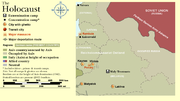
Ghetto
A ghetto is a section of a city predominantly occupied by a group who live there, especially because of social, economic, or legal issues.The term was originally used in Venice to describe the area where Jews were compelled to live. The term now refers to an overcrowded urban area often associated...
established by Nazi Germany
Nazi Germany
Nazi Germany , also known as the Third Reich , but officially called German Reich from 1933 to 1943 and Greater German Reich from 26 June 1943 onward, is the name commonly used to refer to the state of Germany from 1933 to 1945, when it was a totalitarian dictatorship ruled by...
to hold the Lithuanian Jews
Lithuanian Jews
Lithuanian Jews or Litvaks are Jews with roots in the Grand Duchy of Lithuania:...
of Kaunas
Kaunas
Kaunas is the second-largest city in Lithuania and has historically been a leading centre of Lithuanian economic, academic, and cultural life. Kaunas was the biggest city and the center of a powiat in Trakai Voivodeship of the Grand Duchy of Lithuania since 1413. During Russian Empire occupation...
during the Holocaust
The Holocaust
The Holocaust , also known as the Shoah , was the genocide of approximately six million European Jews and millions of others during World War II, a programme of systematic state-sponsored murder by Nazi...
. At its peak, the Ghetto held 40,000 people, most of whom were later sent to concentration and extermination camps, or were shot at the Ninth Fort
Ninth Fort
The Ninth Fort is a stronghold in the northern part of Šilainiai elderate, Kaunas, Lithuania. It is a part of the Kaunas Fortress, which was constructed in the late 19th century. During the occupation of Kaunas and the rest of Lithuania by the Soviet Union, the fort was used as a prison and...
. About 500 Jews escaped from work details and directly from the Ghetto, and joined Soviet partisan forces in the distant forests of southeast Lithuania and Belarus.
Establishment
The Nazis established a civilian administration under SA Major General Hans Kramer to replace military rule in place from the invasion of Lithuania on June 22, 1941. The Lithuanian Provisional Government was officially disbanded by the Nazis after only a few weeks, but not before approval for the establishment of a ghetto under the supervision of Lithuanian military commandant of Kaunas Jurgis Bobelis, extensive laws enacted against Jews and the provision of auxiliary policeTautinio Darbo Apsaugos Batalionas
Tautinio Darbo Apsaugos Batalionas was organized by the Provisional Government of Lithuania in 1941 as basis for future independent Lithuanian Army, but Nazi authorities soon reorganized the battalion into auxiliary police...
to assist the Nazis in the genocide. Between July and August 15, 1941, the Germans concentrated Jews who survived the initial pogroms
Kaunas pogrom
The Kaunas pogrom was a massacre of Jewish people living in Kaunas, Lithuania that took place in from June 25 to June 29, 1941 – the first days of the Operation Barbarossa and of Nazi occupation of Lithuania. The most infamous incident occurred in the Lietūkis garrage, where several Jews were...
, some 29,000 people, in a ghetto established in Vilijampolė
Vilijampole
Vilijampolė is an elderate in the city of Kaunas, Lithuania, located on the right bank of the Neris River and the Nemunas River, near their confluence. The elderate covers 1,720 hectares and houses about 32,000 people....
(Slabodka). It was an area of small primitive houses and no running water which had been cleared of its mainly Jewish population in pogroms by Lithuanian activists beginning on June 24.
Organization
The ghetto had two parts, called the "small" and "large" ghetto, separated by Paneriai Street and connected by a small wooden bridge over the street. Each ghetto was enclosed by barbed wireBarbed wire
Barbed wire, also known as barb wire , is a type of fencing wire constructed with sharp edges or points arranged at intervals along the strand. It is used to construct inexpensive fences and is used atop walls surrounding secured property...
and closely guarded. Both were overcrowded, with each person allocated less than ten square feet of living space. The Germans continually reduced the ghetto's size, forcing Jews to relocate several times. The Germans and Lithuanians destroyed the small ghetto on October 4, 1941, and killed almost all of its inhabitants at the Ninth Fort. Later that same month, on October 29, 1941, the Germans staged what became known as the "Great Action
Kaunas massacre of October 29, 1941
Kaunas massacre of October 29, 1941 also known as the Great Action was the largest mass murder of Lithuanian Jews.By the order of SS-Standartenführer Karl Jäger and SS-Rottenführer Helmut Rauca, the Sonderkommando under the leadership of SS-Obersturmführer Joachim Hamann, and 8 to 10 men from...
." In a single day, they shot around 10,000 Jews at the Ninth Fort.
The ghetto in Kovno provided forced labor for the German military. Jews were employed primarily as forced laborers at various sites outside the ghetto, especially in the construction of a military airbase in Aleksotas
Aleksotas
Aleksotas is an elderate in the southern section of the city of Kaunas, Lithuania, bordering the left bank of the Neman River . Its population in 2006 was 21,694....
. The Jewish council (Aeltestenrat; Council of Elders), headed by Dr. Elkhanan Elkes, also created workshops inside the ghetto for those women, children, and elderly who could not participate in the labor brigades. Eventually, these workshops employed almost 6,500 people. The council hoped the Germans would not kill Jews who were producing for the army.
The Underground School
As an act of defiance an underground school was conducted in the Kovno Ghetto when such education was banned in 1942. A remarkable photo of one of the classes of that school features in the US Holocaust publication,"The Hidden History of the Kovno Ghetto". Identification of the teacher visible in that photo is given in a website that deals with the hidden school. However almost all of the children in the Ghetto, approximately 2,500, were removed in the Kinder Aktion of 27-28 March 1944.
Smuggling Babies out of the Ghetto
From 1942 births were not permitted in the ghetto and pregnant women faced death. However a number of babies of ages from about 9 months to 15 months were smuggled out of the Kovno Ghetto to willing Lithuanian foster mothers.Final days
In the autumn of 1943, the SS assumed control of the ghetto and converted it into the Kovno concentration camp. The Jewish council's role was drastically curtailed. The Nazis dispersed more than 3,500 Jews to subcamps where strict discipline governed all aspects of daily life. On October 26, 1943, the SS deported more than 2,700 people from the main camp. The SS sent those deemed fit to work to Vaivara concentration camp in EstoniaEstonia
Estonia , officially the Republic of Estonia , is a state in the Baltic region of Northern Europe. It is bordered to the north by the Gulf of Finland, to the west by the Baltic Sea, to the south by Latvia , and to the east by Lake Peipsi and the Russian Federation . Across the Baltic Sea lies...
, and deported surviving children and the elderly to Auschwitz.
On July 8, 1944, the Germans evacuated the camp, deporting most of the remaining Jews to the Dachau concentration camp in Germany or to the Stutthof camp
Stutthof concentration camp
Stutthof was the first Nazi concentration camp built outside of 1937 German borders.Completed on September 2, 1939, it was located in a secluded, wet, and wooded area west of the small town of Sztutowo . The town is located in the former territory of the Free City of Danzig, 34 km east of...
, near Danzig, on the Baltic
Baltic Sea
The Baltic Sea is a brackish mediterranean sea located in Northern Europe, from 53°N to 66°N latitude and from 20°E to 26°E longitude. It is bounded by the Scandinavian Peninsula, the mainland of Europe, and the Danish islands. It drains into the Kattegat by way of the Øresund, the Great Belt and...
coast. Three weeks before the Soviet army arrived in Kovno, the Germans razed the ghetto to the ground with grenades and dynamite. As many as 2,000 people burned to death or were shot while trying to escape the burning ghetto. The Red Army
Red Army
The Workers' and Peasants' Red Army started out as the Soviet Union's revolutionary communist combat groups during the Russian Civil War of 1918-1922. It grew into the national army of the Soviet Union. By the 1930s the Red Army was among the largest armies in history.The "Red Army" name refers to...
liberated Kovno on August 1, 1944. Of Kovno's few Jewish survivors, 500 had survived in forests or in a single bunker which had escaped detection during the final liquidation; the Germans evacuated an additional 2,500 to concentration camps in Germany.
Resistance
Throughout the years of hardship and horror, the Jewish community in Kovno documented its story in secret archives, diaries, drawings and photographs. Many of these artifacts lay buried in the ground when the ghetto was destroyed. Discovered after the war, these few written remnants of a once thriving community provide evidence of the Jewish community's defiance, oppression, resistance, and death. George KadishGeorge Kadish
George Kadish, born Zvi Kadushin , was a Lithuanian Jewish photographer who documented life in the Kovno Ghetto during the Holocaust, the period of the Nazi German genocide against Jews....
(Hirsh Kadushin), for example, secretly photographed the trials of daily life within the ghetto with a hidden camera through the buttonhole of his overcoat.
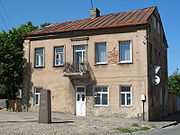
Soviet partisans
The Soviet partisans were members of a resistance movement which fought a guerrilla war against the Axis occupation of the Soviet Union during World War II....
in the forests around Kovno.
In 1943, the General Jewish Fighting Organization (Yidishe Algemeyne Kamfs Organizatsye) was established, uniting the major resistance groups in the ghetto. Under this organization's direction, some 300 ghetto fighters escaped from the Kovno ghetto to join Jewish partisan groups
Jewish partisans
Jewish partisans were fighters in irregular military groups participating in the Jewish resistance movement against Nazi Germany and its collaborators during World War II....
. About 70 died in action.
The Jewish council in Kovno actively supported the ghetto underground. Moreover, a number of the ghetto's Jewish police participated in resistance activities. The Germans executed 34 members of the Jewish police for refusing to reveal specially constructed hiding places used by Jews in the ghetto.
Notable people
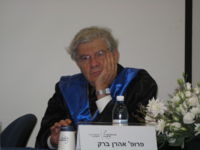
- Aharon BarakAharon BarakAharon Barak is a Professor of Law at the Interdisciplinary Center in Herzliya and a lecturer in law at the Hebrew University of Jerusalem, the Yale Law School, and the University of Toronto Faculty of Law....
(originally, Brick), professor of law at Hebrew University of JerusalemHebrew University of JerusalemThe Hebrew University of Jerusalem ; ; abbreviated HUJI) is Israel's second-oldest university, after the Technion – Israel Institute of Technology. The Hebrew University has three campuses in Jerusalem and one in Rehovot. The world's largest Jewish studies library is located on its Edmond J...
and former President of the Supreme Court of Israel, spent three years in the Kovno ghetto
Sources
- This article incorporates text from the United States Holocaust Memorial MuseumUnited States Holocaust Memorial MuseumThe United States Holocaust Memorial Museum is the United States' official memorial to the Holocaust. Adjacent to the National Mall in Washington, D.C., the USHMM provides for the documentation, study, and interpretation of Holocaust history...
, and has been released under the GFDL. - Mishell, William W. Kaddish for Kovno: Life and Death in a Lithuanian Ghetto, 1941-1945 (Chicago, Chicago Review Press: 1988) ISBN: 1556520336, an irreplaceable primary source by a Jewish native of Kovno and survivor of the Kovno ghetto.
- United States Holocaust Memorial Museum "Hidden History of the Kovno Ghetto", (Boston, Little, Brown, and Co. :1997) Editor Dennis B. Klein. ISBN 0-8212-2457-3, contains a wealth of visual material based on buried records that survived the liquidation of the Ghetto in July 1944.
See also
- List of Nazi concentration camps
- Adrian von RentelnAdrian von RentelnTheodor Adrian von Renteln was an activist and politician in Nazi Germany...
- Erich EhrlingerErich EhrlingerErich Ehrlinger was a member of the Nazi SS who, as commander of Special Detachment 1b, was responsible for mass murder in the Baltic states and Belarus.He was also the commander of the Security Police and the...
External links
- United States Holocaust Memorial Museum Kovno
- Kovno Ghetto Web Page By Jose Gutstein