

Standard gauge

Encyclopedia
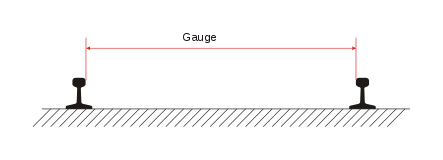
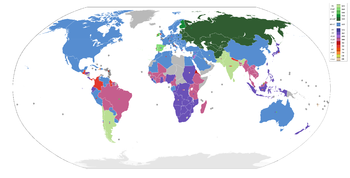
The standard gauge is a widely-used track gauge . Approximately 60% of the world's existing railway lines are built to this gauge (see the list of countries that use the standard gauge). The distance between the inside edges of the rails of standard gauge track is .
History
| ft in | mm |
|---|---|
| 5' 6" | 1676 |
| 5' 5.85" | 1668 |
| 5' 3" | 1600 |
| 5' | 1524 |
| 4' 11.85" | 1520 |
| 4' 8.5" | 1435 |
| 4' 6" | 1372 |
| 3' 6" | 1067 |
| 3' 5.35" | 1050 |
| 3' 3.37" | 1000 |
| 3' 4.1" | 950 |
| 3' | 914 |
| 2' 6" | 762 |
| 2' 5.55" | 750 |
| 2' | 610 |
| 1' 11.6" | 600 |
As railways developed and expanded one of the key issues to be decided was that of the track gauge (the distance, or width, between the inner sides of the rails) that should be used. The eventual result was the adoption throughout a large part of the world of a "standard gauge" of allowing inter-connectivity and the inter-operability of train
Train
A train is a connected series of vehicles for rail transport that move along a track to transport cargo or passengers from one place to another place. The track usually consists of two rails, but might also be a monorail or maglev guideway.Propulsion for the train is provided by a separate...
s.
In England
England
England is a country that is part of the United Kingdom. It shares land borders with Scotland to the north and Wales to the west; the Irish Sea is to the north west, the Celtic Sea to the south west, with the North Sea to the east and the English Channel to the south separating it from continental...
some early lines in colliery (coal mining
Coal mining
The goal of coal mining is to obtain coal from the ground. Coal is valued for its energy content, and since the 1880s has been widely used to generate electricity. Steel and cement industries use coal as a fuel for extraction of iron from iron ore and for cement production. In the United States,...
) areas in the northeast of the country were built to a gauge of ; and in Scotland
Scotland
Scotland is a country that is part of the United Kingdom. Occupying the northern third of the island of Great Britain, it shares a border with England to the south and is bounded by the North Sea to the east, the Atlantic Ocean to the north and west, and the North Channel and Irish Sea to the...
some early lines were (Scotch gauge
Scotch gauge
Scotch gauge was the name given to a track gauge, that was adopted by early 19th century railways mainly in the Lanarkshire area of Scotland. It differed from the gauge of that was used on some early lines in England; and from the standard gauge of...
). By 1846, in both countries, these lines were widened to standard gauge. Parts of the United States
United States
The United States of America is a federal constitutional republic comprising fifty states and a federal district...
rail system, mainly in the northeast, adopted the same gauge because some early trains were purchased from Britain. However, until well into the second half of the 19th century Britain and the USA had several different track gauges. The American gauges converged over time as the advantages of equipment interchange became more and more apparent; notably, the South's broad gauge
Broad gauge
Broad-gauge railways use a track gauge greater than the standard gauge of .- List :For list see: List of broad gauges, by gauge and country- History :...
system was converted to be compatible with standard gauge over two days, beginning May 31, 1886.http://southern.railfan.net/ties/1966/66-8/gauge.html See Rail gauge in North America
Rail gauge in North America
The vast majority of North American railroads are standard gauge. Exceptions include some streetcar, subway and rapid transit systems and some narrow gauge lines particularly in the West, e.g. the isolated White Pass and Yukon Route system, and the former Newfoundland Railway.As well as the usual...
.
Origins
A popular legend, which has been around since at least 1937, traces the origin of the gauge even further back than the coalfields of northern England, pointing to the evidence of rutted roads marked by chariotChariot
The chariot is a type of horse carriage used in both peace and war as the chief vehicle of many ancient peoples. Ox carts, proto-chariots, were built by the Proto-Indo-Europeans and also built in Mesopotamia as early as 3000 BC. The original horse chariot was a fast, light, open, two wheeled...
wheels dating from the Roman Empire
Roman Empire
The Roman Empire was the post-Republican period of the ancient Roman civilization, characterised by an autocratic form of government and large territorial holdings in Europe and around the Mediterranean....
. Snopes categorized this legend as false but commented that "...it is perhaps more fairly labeled as 'True, but for trivial and unremarkable reasons.'" The historical tendency to place the wheels of horse-drawn vehicles approximately 5 feet (1,524 mm) apart probably derives from the width needed to fit a carthorse in between the shafts. In addition, while road-traveling vehicles are typically measured from the outermost portions of the wheel rims (and there is some evidence that the first railroads were measured in this way as well), it became apparent that for vehicles travelling on rails, it was better to have the wheel
Wheel
A wheel is a device that allows heavy objects to be moved easily through rotating on an axle through its center, facilitating movement or transportation while supporting a load, or performing labor in machines. Common examples found in transport applications. A wheel, together with an axle,...
flange
Flange
A flange is an external or internal ridge, or rim , for strength, as the flange of an iron beam such as an I-beam or a T-beam; or for attachment to another object, as the flange on the end of a pipe, steam cylinder, etc., or on the lens mount of a camera; or for a flange of a rail car or tram wheel...
s located inside the rails, and thus the distance measured on the inside of the wheels (and, by extension, the inside faces of the rail heads
Rail profile
The rail profile is the cross sectional shape of a railway rail, perpendicular to the length of the rail.In all but very early cast iron rails, a rail is hot rolled steel of a specific cross sectional profile designed for use as the fundamental component of railway track.Unlike some other uses of...
) was the important one.
There was no standard gauge for horse railways, but there were rough groupings: in the north of England none were less than . Wylam
Wylam
Wylam is a small village about west of Newcastle upon Tyne. It is located in the county of Northumberland.It is famous for the being the birthplace of George Stephenson, one of the early rail pioneers. George Stephenson's Birthplace is his cottage that can be found on the north bank of the...
colliery's system, built before 1763, was ; as was John Blenkinsop
John Blenkinsop
John Blenkinsop was an English mining engineer and an inventor of steam locomotives, who designed the first practical railway locomotive....
's Middleton Railway
Middleton Railway
The Middleton Railway is the world's oldest continuously working railway. It was founded in 1758 and is now a heritage railway run by volunteers from The Middleton Railway Trust Ltd...
, the old plateway was relaid to so that Blenkinsop's engine could be used. Others were Beamish
Beamish
Beamish can refer to:Places:*Beamish, County Durham, a village in England**Beamish Museum near Beamish*Beamish and Crawford a brewery in Cork, Ireland that produces the brand Beamish Stout.People:...
or (Bigges Main and Kenton and Coxlodge).
The English railway pioneer George Stephenson
George Stephenson
George Stephenson was an English civil engineer and mechanical engineer who built the first public railway line in the world to use steam locomotives...
spent much of his early engineering career working for the coal mines of County Durham
County Durham
County Durham is a ceremonial county and unitary district in north east England. The county town is Durham. The largest settlement in the ceremonial county is the town of Darlington...
. He favoured for wagonways in Northumberland
Northumberland
Northumberland is the northernmost ceremonial county and a unitary district in North East England. For Eurostat purposes Northumberland is a NUTS 3 region and is one of three boroughs or unitary districts that comprise the "Northumberland and Tyne and Wear" NUTS 2 region...
and Durham
Durham
Durham is a city in north east England. It is within the County Durham local government district, and is the county town of the larger ceremonial county...
and used it on his Killingworth
Killingworth
Killingworth, formerly Killingworth Township, is a town north of Newcastle Upon Tyne, in North Tyneside, United Kingdom.Built as a planned town in the 1960s, most of Killingworth's residents commute to Newcastle, or the city's surrounding area. However, Killingworth itself has a sizeable...
line. The Hetton and Springwell wagonways also used the gauge.
Stephenson's Stockton and Darlington railway
Stockton and Darlington Railway
The Stockton and Darlington Railway , which opened in 1825, was the world's first publicly subscribed passenger railway. It was 26 miles long, and was built in north-eastern England between Witton Park and Stockton-on-Tees via Darlington, and connected to several collieries near Shildon...
(S&DR) was built primarily to transport coal from several mines near Shildon
Shildon
Shildon is a town in County Durham, in England. It is situated 2 miles to the south east of Bishop Auckland and 11 miles north of Darlington. It is 13 miles away from Durham, 23 miles from Sunderland and 23 miles from Newcastle-upon-Tyne...
to the port at Stockton-on-Tees
Stockton-on-Tees
Stockton-on-Tees is a market town in north east England. It is the major settlement in the unitary authority and borough of Stockton-on-Tees. For ceremonial purposes, the borough is split between County Durham and North Yorkshire as it also incorporates a number of smaller towns including...
. The S&DR's initial track gauge of was set to accommodate the existing gauge of hundreds of horse-drawn chaldron wagons that were already in use on the wagonway
Wagonway
Wagonways consisted of the horses, equipment and tracks used for hauling wagons, which preceded steam powered railways. The terms "plateway", "tramway" and in someplaces, "dramway" are also found.- Early developments :...
s in the mines. It was built and used at this gauge for fifteen years before being changed
Gauge conversion
In rail transport, gauge conversion is the process of converting a railway from one rail gauge to another, through the alteration of the railway tracks...
to gauge.
Other chariot and ox-cart citations
- (If buried chariots are found, what are their gauges? )
- 0400BC (1947) MaltaMaltaMalta , officially known as the Republic of Malta , is a Southern European country consisting of an archipelago situated in the centre of the Mediterranean, south of Sicily, east of Tunisia and north of Libya, with Gibraltar to the west and Alexandria to the east.Malta covers just over in...
OxcartOxcartOxcart or ox cart can mean:*Bullock cart, a cart pulled by oxen*CIA codename for the program to produce the Lockheed A-12 spyplaneSee also:*Ox-Cart Library*Ox-Cart Man*Red River ox cart...
s - 0300BC
- 0000 (1947)
- 1828 (1937)
- 1923 Pharoah's tomb
- 1952
- 2011 Oct 13
The beginnings of the 4 ft 8½ in gauge
George Stephenson used the gauge (with a belated extra 0.5 in (12.7 mm) of free movement to reduce binding on curves) for the Liverpool and Manchester RailwayLiverpool and Manchester Railway
The Liverpool and Manchester Railway was the world's first inter-city passenger railway in which all the trains were timetabled and were hauled for most of the distance solely by steam locomotives. The line opened on 15 September 1830 and ran between the cities of Liverpool and Manchester in North...
, authorised in 1826 and opened 30 September 1830. The success of this project led to George Stephenson and his son Robert
Robert Stephenson
Robert Stephenson FRS was an English civil engineer. He was the only son of George Stephenson, the famed locomotive builder and railway engineer; many of the achievements popularly credited to his father were actually the joint efforts of father and son.-Early life :He was born on the 16th of...
being employed to engineer several other larger railway projects. However, the Chester and Birkenhead Railway
Chester and Birkenhead Railway
The Chester and Birkenhead Railway ran from Birkenhead to Chester. It opened on 23 September 1838. On the 22 July 1847 it merged with the Birkenhead, Lancaster and Cheshire Junction Railway to become the Birkenhead Railway.-Currently Working:...
, authorised on 12 July 1837, was ; the Eastern Counties Railway
Eastern Counties Railway
The Eastern Counties Railway was an early English railway company incorporated in 1836. It was intended to link London with Ipswich via Colchester, and then on to Norwich and Yarmouth. Construction began in late March 1837 on the first nine miles, at the London end of the line.Construction was...
, authorised on 4 July 1836, was ; London and Blackwall Railway
London and Blackwall Railway
Originally called the Commercial Railway, the London and Blackwall Railway was a railway line in east London, England. It ran from the Minories to Blackwall via Stepney, with a branch line to the Isle of Dogs, thus connecting central London to many of London's docks in the 19th and 20th centuries...
, authorised on 28 July 1836, was ; the London and Brighton Railway
London and Brighton Railway
The London and Brighton Railway was a railway company in England which was incorporated in 1837 and survived until 1846. Its railway runs from a junction with the London & Croydon Railway at Norwood - which gives it access from London Bridge, just south of the River Thames in central London...
, authorised on 15 July 1837, was ; the Manchester and Birmingham Railway
Manchester and Birmingham Railway
The Manchester and Birmingham Railway was built between Manchester and Crewe and opened in stages from 1840. Between Crewe and Birmingham, trains were worked by the Grand Junction Railway...
, authorised on 30 June 1837, was ; the Manchester and Leeds Railway
Manchester and Leeds Railway
The Manchester and Leeds Railway was a railway company in the United Kingdom which opened in 1839, connecting Manchester with Leeds via the North Midland Railway which it joined at Normanton....
, authorised on 4 July 1836, was and the Northern and Eastern Railway
Northern and Eastern Railway
The Northern & Eastern Railway operated one of the two main lines which eventually became the Great Eastern Railway: the other being the Eastern Counties Railway....
, authorised on 4 July 1836, was . The railways were intended to take gauge vehicles and allow a (second) running tolerance.
The influence of the Stephensons appears to be the main reason that the gauge became the standard, and its use became more widespread than any other gauge. .
During the "gauge war" with the Great Western Railway
Great Western Railway
The Great Western Railway was a British railway company that linked London with the south-west and west of England and most of Wales. It was founded in 1833, received its enabling Act of Parliament in 1835 and ran its first trains in 1838...
, standard gauge was called narrow gauge.
The Royal Commission
In 1845, in the United Kingdom of Great Britain and IrelandUnited Kingdom of Great Britain and Ireland
The United Kingdom of Great Britain and Ireland was the formal name of the United Kingdom during the period when what is now the Republic of Ireland formed a part of it....
, a Royal Commission
Royal Commission
In Commonwealth realms and other monarchies a Royal Commission is a major ad-hoc formal public inquiry into a defined issue. They have been held in various countries such as the United Kingdom, Australia, Canada, New Zealand, and Saudi Arabia...
reported in favour of a standard gauge. In Great Britain
Great Britain
Great Britain or Britain is an island situated to the northwest of Continental Europe. It is the ninth largest island in the world, and the largest European island, as well as the largest of the British Isles...
, Stephenson's gauge was chosen as the standard gauge on the grounds that lines already built to this gauge were eight times longer than that of the rival gauge, adopted principally by the Great Western Railway. The subsequent Gauge Act
Railway Regulation (Gauge) Act 1846
The Railway Regulation Act 1846 introduced mandated standard gauges of for Great Britain, and for Ireland. This signalled the end for Brunel's broad gauge network.-See also:* The GWR "gauge war"* Rail gauge in Ireland* Standard gauge...
ruled that new passenger-carrying railways in Great Britain should be built to a standard gauge of ; and those in Ireland
Ireland
Ireland is an island to the northwest of continental Europe. It is the third-largest island in Europe and the twentieth-largest island on Earth...
to a standard gauge of . It allowed the broad gauge companies in Great Britain to continue repairing their tracks and expanding their networks within the Limits of Deviation and the exceptions defined in the Act. After an intervening period of mixed-gauge
Dual gauge
A dual-gauge or mixed-gauge railway has railway track that allows trains of different gauges to use the same track. Generally, a dual-gauge railway consists of three rails, rather than the standard two rails. The two outer rails give the wider gauge, while one of the outer rails and the inner rail...
operation (tracks were laid with three running-rails), the Great Western Railway finally converted its entire network to standard gauge in 1892.
Pioneer lines
John WhittonJohn Whitton
John Whitton was appointed Engineer-in-Charge for the New South Wales Railways, Australia, in January 1867. Over the next 32 years he completed 2811 miles of railway around NSW and Victoria...
, the longest serving engineer of the New South Wales Railways, was always being pressured to cut costs on new construction, by using horses or by using a narrower gauge
Narrow gauge
A narrow gauge railway is a railway that has a track gauge narrower than the of standard gauge railways. Most existing narrow gauge railways have gauges of between and .- Overview :...
. He resisted as much as possible so as to avoid any wasteful breaks-of-gauge
Break-of-gauge
With railways, a break-of-gauge occurs where a line of one gauge meets a line of a different gauge. Trains and rolling stock cannot run through without some form of conversion between gauges, and freight and passengers must otherwise be transloaded...
, but did eventually introduce so-called pioneer lines for more remote and lightly trafficked areas to reduce costs. These lines eliminated extravagances like fencing, used half-round sleepers, light rails and replaced metal ballast with earth or ash. Only light locomotives were allowed. Speeds and axleloads and train loads were thus limited.
Pioneer rolling stock would have light and thus weak drawgear and couplings
Coupling (railway)
A coupling is a mechanism for connecting rolling stock in a train. The design of the coupler is standard, and is almost as important as the railway gauge, since flexibility and convenience are maximised if all rolling stock can be coupled together.The equipment that connects the couplings to the...
limited the length and weight of trains, forcing these waggons at best to be marshalled at the rear of trains containing ordinary strength drawgear and couplings.
Only if traffic increased would these lines be upgraded to normal standards of construction. Indeed as the country was developed, many lines including those not of the pioneer type have seen their rail weights increase to allow heavier axleload, heavier engines and heavier and faster trains, all of which can be done progressively and incrementally without any need to change the gauge.
Road Vehicles
Several states in the United States had laws requiring that road vehicles have a consistent gauge. This would allow the vehicles to follow ruts in the road all the better. These gauges were roughly similar to the railway standard gauge.See also
- Broad gaugeBroad gaugeBroad-gauge railways use a track gauge greater than the standard gauge of .- List :For list see: List of broad gauges, by gauge and country- History :...
- Iberian gaugeIberian gaugeIberian gauge is the name given to the track gauge most extensively used by the railways of Spain and Portugal: namely ....
- Indian gaugeIndian gaugeIndian gauge is a track gauge commonly used in India, Pakistan, Bangladesh, Sri Lanka, Argentina and Chile. It is also the gauge that is used on BART , in northern California.- Scotland :...
- Irish gaugeIrish gaugeIrish gauge railways use a track gauge of . It is used in* Ireland * Australia where it is also known as Victorian Broad Gauge* Brazil where it is also known as Bitola larga no Brasil....
- Russian gaugeRussian gaugeIn railway terminology, Russian gauge refers to railway track with a gauge between 1,520 mm and . In a narrow sense as defined by Russian Railways it refers to gauge....
- Iberian gauge
- Dual gaugeDual gaugeA dual-gauge or mixed-gauge railway has railway track that allows trains of different gauges to use the same track. Generally, a dual-gauge railway consists of three rails, rather than the standard two rails. The two outer rails give the wider gauge, while one of the outer rails and the inner rail...
- List of rail gauges
- Narrow gauge railway
- Rail gaugeRail gaugeTrack gauge or rail gauge is the distance between the inner sides of the heads of the two load bearing rails that make up a single railway line. Sixty percent of the world's railways use a standard gauge of . Wider gauges are called broad gauge; smaller gauges, narrow gauge. Break-of-gauge refers...
- Rail transport by countryRail transport by countryThis page provides an index of articles on Rail transport by country.Other indexes available include:*List of railway companies by country*List of countries by rail transport network size*Rail usage statistics by country...
- Scotch gaugeScotch gaugeScotch gauge was the name given to a track gauge, that was adopted by early 19th century railways mainly in the Lanarkshire area of Scotland. It differed from the gauge of that was used on some early lines in England; and from the standard gauge of...
- Standard Gauge (toy trains)Standard Gauge (toy trains)Standard Gauge, also known as Wide Gauge, was an early model railway and toy train rail gauge, introduced in the United States in 1906 by Lionel Corporation. As it was a toy standard, rather than a scale modeling standard, the actual scale of Standard Gauge locomotives and rolling stock varied...