

Trolleybus

Encyclopedia
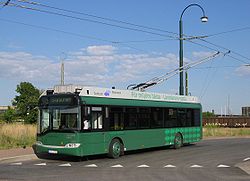
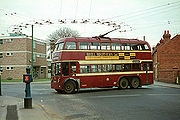
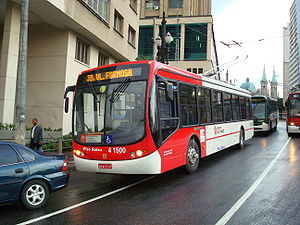
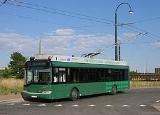
A trolleybus is an electric bus
Electric bus
An electric bus is a bus powered by electricity.There are two main electric bus categories:* Non-autonomous electric buses:**The trolleybus is a type of electric bus powered by two overhead electric wires, with electricity being drawn from one wire and returned via the other wire, using two...
that draws its electricity
Electricity
Electricity is a general term encompassing a variety of phenomena resulting from the presence and flow of electric charge. These include many easily recognizable phenomena, such as lightning, static electricity, and the flow of electrical current in an electrical wire...
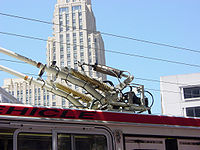
from overhead wires (generally suspended from roadside posts) using spring-loaded trolley pole
Trolley pole
A trolley pole is a tapered cylindrical pole of wood or metal, used to transfer electricity from a "live" overhead wire to the control and propulsion equipment of a tram or trolley bus. The use of overhead wire in a system of current collection is reputed to be the 1880 invention of Frank J....
s. Two wires and poles are required to complete the electrical circuit. This differs from a tram or streetcar
Tram
A tram is a passenger rail vehicle which runs on tracks along public urban streets and also sometimes on separate rights of way. It may also run between cities and/or towns , and/or partially grade separated even in the cities...
, which normally uses the track as the return part of the electrical path and therefore needs only one wire and one pole (or pantograph
Pantograph (rail)
A pantograph for rail lines is a hinged electric-rod device that collects electric current from overhead lines for electric trains or trams. The pantograph typically connects to a one-wire line, with the track acting as the ground wire...
). They also are distinct from other kinds of electric bus
Electric bus
An electric bus is a bus powered by electricity.There are two main electric bus categories:* Non-autonomous electric buses:**The trolleybus is a type of electric bus powered by two overhead electric wires, with electricity being drawn from one wire and returned via the other wire, using two...
es, which usually rely on batteries.
Currently, around 315 trolleybus systems are in operation, in cities and towns in 45 countries. Altogether, more than 800 trolleybus systems have existed, but not more than about 405 concurrently.
Background
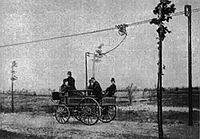
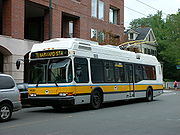

Ernst Werner von Siemens
Ernst Werner Siemens, von Siemens since 1888, was a German inventor and industrialist. Siemens' name has been adopted as the SI unit of electrical conductance, the siemens...
ran his "Elektromote
Elektromote
The Electromote was the world's first vehicle run like a trolleybus, which was first presented to the public on April 29, 1882, by its inventor Dr. Ernst Werner von Siemens in Halensee, a suburb of Berlin, Germany. The Elektromote operated from April 29 to June 13, 1882, on a 540 m ...
" in a Berlin suburb. This experimental demonstration continued until 13 June 1882, after which there were few developments in Europe, although separate experiments were conducted in the USA. In 1899, another vehicle which could run either on or off rails was demonstrated in Berlin. The next development was when Lombard Gérin operated an experimental line at the Paris Exhibition of 1900 after four years of trials, connecting the Exhibition with the Porte de Vincennes. Max Schiemann took the biggest step when on 10 July 1901 the world's first passenger-carrying trolleybus operated at Bielatal (Biela Valley, near Dresden
Dresden
Dresden is the capital city of the Free State of Saxony in Germany. It is situated in a valley on the River Elbe, near the Czech border. The Dresden conurbation is part of the Saxon Triangle metropolitan area....
), in Germany. Schiemann built and operated the Bielatal system
Biela Valley Trolleybus
The Biela Valley Trolleybus was a trolleybus service in the German state of Saxony. The facility opened on 10 July 1901 and had closed again by September 1904. It was one of the first trolleybus operations in the world...
, and is credited with developing the under-running trolley current collection system, with two horizontally parallel overhead wires and rigid trolleypoles spring-loaded to hold them up to the wires. Although this system operated only until 1904, Schiemann had developed what is now the standard trolleybus current collection system. In the early days there were a few other methods of current collection. The Cédès-Stoll system was operated near Dresden between 1902 and 1904, and in Vienna
Vienna
Vienna is the capital and largest city of the Republic of Austria and one of the nine states of Austria. Vienna is Austria's primary city, with a population of about 1.723 million , and is by far the largest city in Austria, as well as its cultural, economic, and political centre...
. The Lloyd-Köhler or Bremen system was tried out in Bremen, and the Filovia was demonstrated near Milan
Milan
Milan is the second-largest city in Italy and the capital city of the region of Lombardy and of the province of Milan. The city proper has a population of about 1.3 million, while its urban area, roughly coinciding with its administrative province and the bordering Province of Monza and Brianza ,...
.
Leeds
Leeds
Leeds is a city and metropolitan borough in West Yorkshire, England. In 2001 Leeds' main urban subdivision had a population of 443,247, while the entire city has a population of 798,800 , making it the 30th-most populous city in the European Union.Leeds is the cultural, financial and commercial...
and Bradford
Bradford
Bradford lies at the heart of the City of Bradford, a metropolitan borough of West Yorkshire, in Northern England. It is situated in the foothills of the Pennines, west of Leeds, and northwest of Wakefield. Bradford became a municipal borough in 1847, and received its charter as a city in 1897...
became the first cities to put trolleybuses into service in Great Britain on 20 June 1911. Bradford was also the last to operate trolleybuses in the UK, the system closing on 26 March 1972. The last rear-entrance trolleybus in Britain was also in Bradford and is now owned by the Bradford Trolleybus Association. Birmingham
Birmingham
Birmingham is a city and metropolitan borough in the West Midlands of England. It is the most populous British city outside the capital London, with a population of 1,036,900 , and lies at the heart of the West Midlands conurbation, the second most populous urban area in the United Kingdom with a...
was the first to replace a tram route with trolleybuses, while Wolverhampton
Wolverhampton
Wolverhampton is a city and metropolitan borough in the West Midlands, England. For Eurostat purposes Walsall and Wolverhampton is a NUTS 3 region and is one of five boroughs or unitary districts that comprise the "West Midlands" NUTS 2 region...
, under the direction of Charles Owen Silvers, became world-famous for its trolleybus designs. There were 50 trolleybus systems in the UK, London's being the largest. By the time trolleybuses arrived in Britain in 1911, the Schiemann system was well established and was the most common, although the Cédès-Stoll system was tried in West Ham (in 1912) and in Keighley
Keighley
Keighley is a town and civil parish within the metropolitan borough of the City of Bradford in West Yorkshire, England. It is situated northwest of Bradford and is at the confluence of the River Aire and the River Worth...
(in 1913).
In the U.S.A., some cities, led by the Brooklyn-Manhattan Transit Corporation
Brooklyn-Manhattan Transit Corporation
The Brooklyn–Manhattan Transit Corporation was an urban transit holding company, based in Brooklyn, New York City, United States, and incorporated in 1923. The system was sold to the city in 1940 and today, together with the IND subway system, form the B Division of the New York City Subway...
(BMT—New York), subscribed to the all-four
All-four
All-four is an urban public transport scheme first enunciated by the Brooklyn-Manhattan Transit Corporation in the 1930s in which different transportation technologies are chosen and implemented in an integrated system.-Modes:...
concept of using buses, trolleybuses, tram
Tram
A tram is a passenger rail vehicle which runs on tracks along public urban streets and also sometimes on separate rights of way. It may also run between cities and/or towns , and/or partially grade separated even in the cities...
s (in US called streetcars or trolleys) and rapid transit
Rapid transit
A rapid transit, underground, subway, elevated railway, metro or metropolitan railway system is an electric passenger railway in an urban area with a high capacity and frequency, and grade separation from other traffic. Rapid transit systems are typically located either in underground tunnels or on...
subway and/or elevated lines (metros), as appropriate, for routes ranging from the lightly used to the heaviest trunk line. Buses and trolleybuses in particular were seen as entry systems that could later be upgraded to rail as appropriate. In a similar fashion, many cities in Britain originally viewed trolleybus routes as extensions to tram (streetcar) routes where the cost of constructing or restoring track could not be justified at the time, though this attitude changed markedly (to viewing them as outright replacements for tram routes) in the years after 1918. Although the BMT in Brooklyn
Brooklyn
Brooklyn is the most populous of New York City's five boroughs, with nearly 2.6 million residents, and the second-largest in area. Since 1896, Brooklyn has had the same boundaries as Kings County, which is now the most populous county in New York State and the second-most densely populated...
built only one trolleybus line, other cities, notably San Francisco (California), and Philadelphia (Pennsylvania), built larger systems and apparently still maintain an "all-four" approach to the current day.
Some trolleybus lines in the United States (and in Britain, as noted above) came into existence when a trolley or tram route did not have sufficient ridership to warrant track maintenance or reconstruction. In a similar manner, a proposed tram scheme in Leeds, United Kingdom, was changed to a trolleybus scheme to cut costs.
Trolleybuses are uncommon today in North America, but they remain common in many European countries as well as Russia and China, generally occupying a position in usage between street railways (trams) and diesel buses. Worldwide, around 315 cities or metropolitan areas are served by trolleybuses today. (Further detail under Use and preservation, below.)
Design
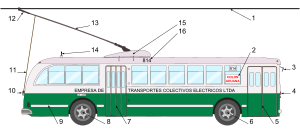 |
|
Advantages
Electric motor
An electric motor converts electrical energy into mechanical energy.Most electric motors operate through the interaction of magnetic fields and current-carrying conductors to generate force...
s are more effective than diesel engine
Diesel engine
A diesel engine is an internal combustion engine that uses the heat of compression to initiate ignition to burn the fuel, which is injected into the combustion chamber...
s in providing torque
Torque
Torque, moment or moment of force , is the tendency of a force to rotate an object about an axis, fulcrum, or pivot. Just as a force is a push or a pull, a torque can be thought of as a twist....
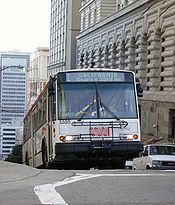
at start-up, an advantage for climbing steep hills. Unlike combustion engines, electric motors draw power from a central plant and can be overloaded for short periods without damage. San Francisco and Seattle, both hilly American cities, use trolleybuses partly for this reason, another being improved air quality. Given their acceleration and braking performance, trolleybuses can outperform diesel buses on flat stretches as well.
Trolleybuses' rubber
Rubber
Natural rubber, also called India rubber or caoutchouc, is an elastomer that was originally derived from latex, a milky colloid produced by some plants. The plants would be ‘tapped’, that is, an incision made into the bark of the tree and the sticky, milk colored latex sap collected and refined...
tyre
Tire
A tire or tyre is a ring-shaped covering that fits around a wheel rim to protect it and enable better vehicle performance by providing a flexible cushion that absorbs shock while keeping the wheel in close contact with the ground...
s have better adhesion
Adhesion
Adhesion is any attraction process between dissimilar molecular species that can potentially bring them in close contact. By contrast, cohesion takes place between similar molecules....
than trams' steel wheels on steel rails, giving them better hill-climbing capability and braking. Unlike rail vehicles (where side tracks are not available), an out-of-service vehicle can be moved to the side of the road and its trolley poles lowered, allowing other trolleybuses to pass. Additionally, because they are not confined to tracks, trolleybuses can pull over to the curb as a diesel bus does, eliminating boarding islands in the middle of the street.
Like other electric vehicle
Electric vehicle
An electric vehicle , also referred to as an electric drive vehicle, uses one or more electric motors or traction motors for propulsion...
s, trolleybuses are more environmentally friendly in the city than fossil-fuel
Fossil fuel
Fossil fuels are fuels formed by natural processes such as anaerobic decomposition of buried dead organisms. The age of the organisms and their resulting fossil fuels is typically millions of years, and sometimes exceeds 650 million years...
or hydrocarbon
Hydrocarbon
In organic chemistry, a hydrocarbon is an organic compound consisting entirely of hydrogen and carbon. Hydrocarbons from which one hydrogen atom has been removed are functional groups, called hydrocarbyls....
-based vehicles (petrol/gasoline
Gasoline
Gasoline , or petrol , is a toxic, translucent, petroleum-derived liquid that is primarily used as a fuel in internal combustion engines. It consists mostly of organic compounds obtained by the fractional distillation of petroleum, enhanced with a variety of additives. Some gasolines also contain...
, diesel, alcohol
Alcohol
In chemistry, an alcohol is an organic compound in which the hydroxy functional group is bound to a carbon atom. In particular, this carbon center should be saturated, having single bonds to three other atoms....
, etc.). Although the power is not free, having to be produced at centralised power plants with attendant transmission losses, it is produced more efficiently. Further, it is not bound to a specific fuel source and is more amenable to pollution control as a point source
Point source (pollution)
A point source of pollution is a single identifiable localized source of air, water, thermal, noise or light pollution. A point source has negligible extent, distinguishing it from other pollution source geometries. The sources are called point sources because in mathematical modeling, they can be...
supply than are individual vehicles with their own engines exhausting noxious gases and particulates at street level. Moreover, some cities, like Calgary, Alberta, run their light rail
Light rail
Light rail or light rail transit is a form of urban rail public transportation that generally has a lower capacity and lower speed than heavy rail and metro systems, but higher capacity and higher speed than traditional street-running tram systems...
networks using wind energy, which is effectively emission-free once the turbines are built and installed. Other cities, Vancouver, B.C.
Vancouver
Vancouver is a coastal seaport city on the mainland of British Columbia, Canada. It is the hub of Greater Vancouver, which, with over 2.3 million residents, is the third most populous metropolitan area in the country,...
, for instance, use hydroelectricity. A further advantage of trolleybuses is that they can generate electricity from kinetic energy
Kinetic energy
The kinetic energy of an object is the energy which it possesses due to its motion.It is defined as the work needed to accelerate a body of a given mass from rest to its stated velocity. Having gained this energy during its acceleration, the body maintains this kinetic energy unless its speed changes...
while braking, a process known as regenerative braking.
Unlike trams or gasoline and diesel buses, trolleybuses are almost silent, lacking the noise of an engine or of wheels on rails. Such noise as there is tends to emanate from auxiliary systems such as power steering pumps and air conditioning. Early trolleybuses without these systems were even quieter and, in the UK at least, were often referred to as the "Silent Service". The quietness did have its disadvantages though, with some pedestrians falling victim to what was also known as the "Silent Death" (in Britain) or "Whispering Death" (in Australia).
Trolleybuses are especially favoured where electricity is abundant and cheap. Examples are the extensive systems in Vancouver, Canada and Seattle, USA, both of which draw hydroelectric power from the Columbia River
Columbia River
The Columbia River is the largest river in the Pacific Northwest region of North America. The river rises in the Rocky Mountains of British Columbia, Canada, flows northwest and then south into the U.S. state of Washington, then turns west to form most of the border between Washington and the state...
and other Pacific river systems. San Francisco operates its system using hydro power from the city-owned Hetch Hetchy
Hetch Hetchy Reservoir
Hetch Hetchy Reservoir is a reservoir in Yosemite National Park, about northeast from the city of Merced, California. The reservoir has a capacity of and is formed by the concrete gravity O'Shaughnessy Dam in Hetch Hetchy Valley on the Tuolumne River...
generating plant.
Trolleybuses are used extensively in large European cities, such as Athens
Athens
Athens , is the capital and largest city of Greece. Athens dominates the Attica region and is one of the world's oldest cities, as its recorded history spans around 3,400 years. Classical Athens was a powerful city-state...
, Belgrade
Belgrade
Belgrade is the capital and largest city of Serbia. It is located at the confluence of the Sava and Danube rivers, where the Pannonian Plain meets the Balkans. According to official results of Census 2011, the city has a population of 1,639,121. It is one of the 15 largest cities in Europe...
, Bratislava
Bratislava
Bratislava is the capital of Slovakia and, with a population of about 431,000, also the country's largest city. Bratislava is in southwestern Slovakia on both banks of the Danube River. Bordering Austria and Hungary, it is the only national capital that borders two independent countries.Bratislava...
, Bucharest
Bucharest
Bucharest is the capital municipality, cultural, industrial, and financial centre of Romania. It is the largest city in Romania, located in the southeast of the country, at , and lies on the banks of the Dâmbovița River....
, Budapest
Budapest
Budapest is the capital of Hungary. As the largest city of Hungary, it is the country's principal political, cultural, commercial, industrial, and transportation centre. In 2011, Budapest had 1,733,685 inhabitants, down from its 1989 peak of 2,113,645 due to suburbanization. The Budapest Commuter...
, Kiev
Kiev
Kiev or Kyiv is the capital and the largest city of Ukraine, located in the north central part of the country on the Dnieper River. The population as of the 2001 census was 2,611,300. However, higher numbers have been cited in the press....
, Lyon
Lyon
Lyon , is a city in east-central France in the Rhône-Alpes region, situated between Paris and Marseille. Lyon is located at from Paris, from Marseille, from Geneva, from Turin, and from Barcelona. The residents of the city are called Lyonnais....
, Milan
Milan
Milan is the second-largest city in Italy and the capital city of the region of Lombardy and of the province of Milan. The city proper has a population of about 1.3 million, while its urban area, roughly coinciding with its administrative province and the bordering Province of Monza and Brianza ,...
, Minsk
Minsk
- Ecological situation :The ecological situation is monitored by Republican Center of Radioactive and Environmental Control .During 2003–2008 the overall weight of contaminants increased from 186,000 to 247,400 tons. The change of gas as industrial fuel to mazut for financial reasons has worsened...
, Moscow
Moscow
Moscow is the capital, the most populous city, and the most populous federal subject of Russia. The city is a major political, economic, cultural, scientific, religious, financial, educational, and transportation centre of Russia and the continent...
, Riga
Riga
Riga is the capital and largest city of Latvia. With 702,891 inhabitants Riga is the largest city of the Baltic states, one of the largest cities in Northern Europe and home to more than one third of Latvia's population. The city is an important seaport and a major industrial, commercial,...
, Saint Petersburg
Saint Petersburg
Saint Petersburg is a city and a federal subject of Russia located on the Neva River at the head of the Gulf of Finland on the Baltic Sea...
, Sofia
Sofia
Sofia is the capital and largest city of Bulgaria and the 12th largest city in the European Union with a population of 1.27 million people. It is located in western Bulgaria, at the foot of Mount Vitosha and approximately at the centre of the Balkan Peninsula.Prehistoric settlements were excavated...
, Varna
Varna
Varna is the largest city and seaside resort on the Bulgarian Black Sea Coast and third-largest in Bulgaria after Sofia and Plovdiv, with a population of 334,870 inhabitants according to Census 2011...
and Zurich
Zürich
Zurich is the largest city in Switzerland and the capital of the canton of Zurich. It is located in central Switzerland at the northwestern tip of Lake Zurich...
, as well as smaller ones such as Arnhem
Arnhem trolleybus
The Arnhem trolleybus system is the trolleybus system in the city of Arnhem. It is unique in the Netherlands as the only operating of the type in the country.- External links :...
, Bergen
Bergen
Bergen is the second largest city in Norway with a population of as of , . Bergen is the administrative centre of Hordaland county. Greater Bergen or Bergen Metropolitan Area as defined by Statistics Norway, has a population of as of , ....
, Brest (Belarus), Cluj-Napoca
Cluj-Napoca
Cluj-Napoca , commonly known as Cluj, is the fourth most populous city in Romania and the seat of Cluj County in the northwestern part of the country. Geographically, it is roughly equidistant from Bucharest , Budapest and Belgrade...
, Coimbra
Coimbra
Coimbra is a city in the municipality of Coimbra in Portugal. Although it served as the nation's capital during the High Middle Ages, it is better-known for its university, the University of Coimbra, which is one of the oldest in Europe and the oldest academic institution in the...
, Gdynia
Gdynia
Gdynia is a city in the Pomeranian Voivodeship of Poland and an important seaport of Gdańsk Bay on the south coast of the Baltic Sea.Located in Kashubia in Eastern Pomerania, Gdynia is part of a conurbation with the spa town of Sopot, the city of Gdańsk and suburban communities, which together...
, Kaunas
Kaunas
Kaunas is the second-largest city in Lithuania and has historically been a leading centre of Lithuanian economic, academic, and cultural life. Kaunas was the biggest city and the center of a powiat in Trakai Voivodeship of the Grand Duchy of Lithuania since 1413. During Russian Empire occupation...
, Lausanne
Lausanne
Lausanne is a city in Romandy, the French-speaking part of Switzerland, and is the capital of the canton of Vaud. The seat of the district of Lausanne, the city is situated on the shores of Lake Geneva . It faces the French town of Évian-les-Bains, with the Jura mountains to its north-west...
, Limoges
Limoges
Limoges |Limousin]] dialect of Occitan) is a city and commune, the capital of the Haute-Vienne department and the administrative capital of the Limousin région in west-central France....
, Luzern, Parma
Parma
Parma is a city in the Italian region of Emilia-Romagna famous for its ham, its cheese, its architecture and the fine countryside around it. This is the home of the University of Parma, one of the oldest universities in the world....
, Piatra Neamţ
Piatra Neamt
Piatra Neamț , , ; is the capital city of Neamţ County, in the historical region of Moldavia, eastern Romania. Because of its privileged location in the Eastern Carpathian mountains, it is considered one of the most picturesque cities in Romania...
, Plzeň, Prešov
Prešov
Prešov Historically, the city has been known in German as Eperies , Eperjes in Hungarian, Fragopolis in Latin, Preszów in Polish, Peryeshis in Romany, Пряшев in Russian and Пряшів in Rusyn and Ukrainian.-Characteristics:The city is a showcase of Baroque, Rococo and Gothic...
, Salzburg
Salzburg
-Population development:In 1935, the population significantly increased when Salzburg absorbed adjacent municipalities. After World War II, numerous refugees found a new home in the city. New residential space was created for American soldiers of the postwar Occupation, and could be used for...
, Solingen
Solingen
Solingen is a city in North Rhine-Westphalia, Germany. It is located on the northern edge of the region called Bergisches Land, south of the Ruhr area, and with a 2009 population of 161,366 is the second largest city in the Bergisches Land...
, Szeged
Szeged
' is the third largest city of Hungary, the largest city and regional centre of the Southern Great Plain and the county town of Csongrád county. The University of Szeged is one of the most distinguished universities in Hungary....
, Tallinn
Tallinn
Tallinn is the capital and largest city of Estonia. It occupies an area of with a population of 414,940. It is situated on the northern coast of the country, on the banks of the Gulf of Finland, south of Helsinki, east of Stockholm and west of Saint Petersburg. Tallinn's Old Town is in the list...
and Yalta
Yalta
Yalta is a city in Crimea, southern Ukraine, on the north coast of the Black Sea.The city is located on the site of an ancient Greek colony, said to have been founded by Greek sailors who were looking for a safe shore on which to land. It is situated on a deep bay facing south towards the Black...
. Realising the advantages of these zero-emission vehicles, some cities have started to expand their systems again, while others, such as Lecce
Lecce
Lecce is a historic city of 95,200 inhabitants in southern Italy, the capital of the province of Lecce, the second province in the region by population, as well as one of the most important cities of Puglia...
and Leeds
Leeds
Leeds is a city and metropolitan borough in West Yorkshire, England. In 2001 Leeds' main urban subdivision had a population of 443,247, while the entire city has a population of 798,800 , making it the 30th-most populous city in the European Union.Leeds is the cultural, financial and commercial...
, plan to introduce new trolleybus systems.
In Cambridge, Massachusetts
Cambridge, Massachusetts
Cambridge is a city in Middlesex County, Massachusetts, United States, in the Greater Boston area. It was named in honor of the University of Cambridge in England, an important center of the Puritan theology embraced by the town's founders. Cambridge is home to two of the world's most prominent...
, the trolleybus system has survived because Harvard Station
Harvard (MBTA station)
Harvard is a station on the Red Line of the MBTA subway system in Cambridge, Massachusetts. The third-busiest MBTA subway station, Harvard saw 21,868 entries each weekday in 2010, with only Downtown Crossing and South Station being busier...
, where several bus lines terminate, is in a tunnel that was once used by trams. Although diesel buses do use the tunnel, there are limitations due to exhaust fumes. Also the trolleybuses continue to have popular support.

Disadvantages
Re-routings, temporary or permanent, are not usually readily available outside of "downtown" areas where the buses may be re-routed via adjacent business area streets where other trolleybus routes operate. This problem was highlighted in Vancouver in July 2008, when an explosion closed several roads in the city's downtown core. Because of the closure, trolleys were forced to detour several kilometers off their route in order to stay on the wires, leaving major portions of their routes unserved and service well off schedule.Some trolleybus systems have been criticised for aesthetic reasons, with city residents complaining that the jumble of overhead wires
Overhead lines
Overhead lines or overhead wires are used to transmit electrical energy to trams, trolleybuses or trains at a distance from the energy supply point...
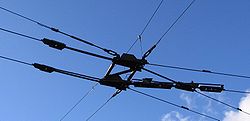
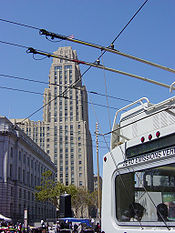
was unsightly. Intersections often have a "webbed ceiling" appearance, due to multiple crossing and converging sets of trolley wires.
Dewirements — when the trolley pole
Trolley pole
A trolley pole is a tapered cylindrical pole of wood or metal, used to transfer electricity from a "live" overhead wire to the control and propulsion equipment of a tram or trolley bus. The use of overhead wire in a system of current collection is reputed to be the 1880 invention of Frank J....
s come off of the wires — sometimes occur, especially in areas subject to heavy snow. After a dewirement, trolleybuses not equipped with an auxiliary power unit
Auxiliary power unit
An auxiliary power unit is a device on a vehicle that provides energy for functions other than propulsion. They are commonly found on large aircraft, as well as some large land vehicles.-Function:...
(APU) are stranded without power. However, dewirements are relatively rare in modern systems with well-maintained overhead wires, hangers, fittings and "contact shoes". Trolleybuses are equipped with special insulated pole ropes which drivers use to reconnect the trolley poles with the overhead wires in case of dewirement. When approaching switches, trolleybuses usually must decelerate in order to avoid dewiring, and this deceleration can potentially add slightly to traffic congestion.
Trolleybuses cannot overtake one another in regular service unless two separate sets of wires with a switch are provided or the vehicles are equipped with off-wire capability, but the latter is an increasingly common feature of new trolleybuses.
Recent power developments
With the introduction of hybrid designs, trolleybuses are no longer tied to overhead wires. Since the 1980s, trolleybus systems in MuniSan Francisco Municipal Railway
The San Francisco Municipal Railway is the public transit system for the city and county of San Francisco, California. In 2006, it served with an operating budget of about $700 million...
in San Francisco, TransLink
TransLink (Vancouver)
TransLink is the organization responsible for the regional transportation network of Metro Vancouver in British Columbia, Canada, including public transport and major roads and bridges...
in Vancouver, and in Beijing
Beijing
Beijing , also known as Peking , is the capital of the People's Republic of China and one of the most populous cities in the world, with a population of 19,612,368 as of 2010. The city is the country's political, cultural, and educational center, and home to the headquarters for most of China's...
, among others, have bought trolleybuses equipped with batteries to allow them to operate fairly long distances away from the wires. Supercapacitor
Supercapacitor
An electric double-layer capacitor , also known as supercapacitor, supercondenser, electrochemical double layer capacitor, or ultracapacitor, is an electrochemical capacitor with relatively high energy density. Their energy density is typically hundreds of times greater than conventional...
s can be also used to move buses short distances.
Trolleybuses can optionally be equipped either with limited off-wire capability—a small diesel engine or battery pack—for auxiliary or emergency use only, or full dual-mode capability
Dual-mode bus
A dual-mode bus is a bus that can run independently on power from two different sources, typically electricity from overhead lines or batteries, alternated with conventional fossil fuel ....
. A simple auxiliary power unit can allow a trolleybus to get around a route blockage or can reduce the amount (or complexity) of overhead wiring needed at operating garages (depots). This capability has become increasingly common in newer trolleybuses, particularly in North America and Western Europe, where the vast majority of new trolleybuses delivered since the 1990s are fitted with at least limited off-wire capability. These have gradually replaced older trolleybuses which lacked such capability. In Philadelphia, new trolleybuses (known there as "trackless trolleys") that were placed in service by SEPTA in 2008 are equipped with small hybrid
Hybrid electric vehicle
A hybrid electric vehicle is a type of hybrid vehicle and electric vehicle which combines a conventional internal combustion engine propulsion system with an electric propulsion system. The presence of the electric powertrain is intended to achieve either better fuel economy than a conventional...
diesel-electric power units for operating short distances off-wire, instead of using a conventional diesel drive train or battery-only system for their off-wire movement.
King County Metro in Seattle, Washington and MBTA
Massachusetts Bay Transportation Authority
The Massachusetts Bay Transportation Authority, often referred to as the MBTA or simply The T, is the public operator of most bus, subway, commuter rail and ferry systems in the greater Boston, Massachusetts, area. Officially a "body politic and corporate, and a political subdivision" of the...
in Boston
Boston
Boston is the capital of and largest city in Massachusetts, and is one of the oldest cities in the United States. The largest city in New England, Boston is regarded as the unofficial "Capital of New England" for its economic and cultural impact on the entire New England region. The city proper had...
use or have used dual-mode bus
Dual-mode bus
A dual-mode bus is a bus that can run independently on power from two different sources, typically electricity from overhead lines or batteries, alternated with conventional fossil fuel ....
es that run on electric power from overhead wires on a fixed right-of-way and on diesel
Diesel engine
A diesel engine is an internal combustion engine that uses the heat of compression to initiate ignition to burn the fuel, which is injected into the combustion chamber...
power on city streets. Metro used special-order articulated Breda
Società Italiana Ernesto Breda
Società Italiana Ernesto Breda, more usually referred to simply as Breda was an Italian mechanical manufacturing company founded by Ernesto Breda in Milan in 1886. The firm originally manufactured locomotives and other railway machinery, but later branched out into armaments and aircraft. In 1962,...
buses with the center axle driven electrically and the rear (third) axle driven by a conventional power pack, with electricity used for clean operation in the downtown transit tunnel. They were introduced in 1990 and retired in 2005, replaced by cleaner hybrid buses, although 59 of 236 had their diesel propulsion equipment removed and continue (as of 2010) in trolley bus service on non-tunnel routes. MBTA uses dual-mode buses on its new (2004-opened) Silver Line (Waterfront)
Silver Line (MBTA)
The Silver Line is the only bus rapid transit line currently operated by the Massachusetts Bay Transportation Authority . It operates in two sections; the first runs from Dudley Square in Roxbury to downtown Boston, Massachusetts and South Station, mostly via Washington Street, with buses...
.
Other considerations
With increasing diesel fuel costs and problems caused by particulate matter and NOx emissions in cities, trolleybuses may be seen as the best option, either as the primary transit mode or as a supplement to rapid transit and commuter rail networks.It has been suggested that trolleybuses will become obsolete in a future hydrogen economy
Hydrogen economy
The hydrogen economy is a proposed system of delivering energy using hydrogen. The term hydrogen economy was coined by John Bockris during a talk he gave in 1970 at General Motors Technical Center....
, but direct electric transmission is at least twice as efficient as the alternative, viz. conversion of energy into hydrogen
Hydrogen
Hydrogen is the chemical element with atomic number 1. It is represented by the symbol H. With an average atomic weight of , hydrogen is the lightest and most abundant chemical element, constituting roughly 75% of the Universe's chemical elemental mass. Stars in the main sequence are mainly...
, transportation and storage of the hydrogen and its conversion back into electricity by fuel cell
Fuel cell
A fuel cell is a device that converts the chemical energy from a fuel into electricity through a chemical reaction with oxygen or another oxidizing agent. Hydrogen is the most common fuel, but hydrocarbons such as natural gas and alcohols like methanol are sometimes used...
s.
Being electric, trolleybuses are very much quieter than diesel- or petrol-engined vehicles. While this is mainly seen as a benefit, it does also make it easier for unobservant pedestrians and other motorists to miss hearing a trolleybus when crossing a street and risk being struck.
Trolleybuses can share overhead wires and other electrical infrastructure (such as substations) with tramways. This can result in cost savings when trolleybuses are added to a transport system that already has trams, though this refers only to potential savings over the cost of installing and operating trolleybuses alone.
Trolleybus wire switch
Trolleybus wire switches (referred to as "frogs" in some countries) are used where a trolleybus line branches into two or where two lines join. A switch may be either in a "straight through" or "turnout" position; it normally remains in the "straight through" position unless it has been triggered, and reverts to it after a few seconds or after the pole shoe passes through and strikes a release lever. (In Boston, the resting or "default" position is the "leftmost" position.) Triggering is typically accomplished by a pair of contacts, one on each wire close to and before the switch assembly, which power a pair of electromagnets, one in each frog.Multiple branches may be handled by installing more than one switch assembly. For example, to provide straight-through, left-turn or right-turn branches at an intersection, one switch is installed some distance from the intersection to choose the wires over the left-turn lane, and another switch is mounted closer to or in the intersection to choose between straight through and a right turn. (This would be the arrangement in countries such as the US, where traffic directionality is right-handed; in left-handed traffic countries such as Britain and New Zealand, the first switch (before the intersection) would be used to access the right-turn lanes, and the second switch (usually in the intersection) would be for the left-turn.)
Three common types of switches exist: Power-on/Power-off (the picture of a switch above is of this type), Selectric, and Fahslabend.
A Power-on/Power-off switch is triggered if the trolleybus is drawing considerable power from the overhead wires, usually by accelerating, at the moment the poles pass over the contacts. (The contacts are lined up on the wires in this case.) If the trolleybus "coasts" through the switch, the switch will not activate. Some trolleybuses, such as those in Philadelphia and Vancouver, have a manual "power-coast" toggle switch that turns the power on or off. This allows a switch to be triggered in situations that would otherwise be impossible, such as activating a switch while braking or accelerating through a switch without activating it. One variation of the toggle switch will simulate accelerating by causing a larger power draw (through a resistance grid) but will not simulate coasting and prevent activation of the switch by cutting the power.
A Selectric (trademark of Ohio Brass Co., maker of trolley wire fittings and equipment and trolley poles) switch has a similar design, but the contacts on the wires are skewed, often at a 45-degree angle, rather than being lined up. This skew means that a trolleybus going straight through will not trigger the switch, but a trolleybus making a turn will have its poles match the contacts in a matching skew (with one pole shoe ahead of the other), which will trigger the switch regardless of power draw (accelerating versus coasting).
For a Fahslabend switch, the trolleybus's turn indicator (or a separate driver-controlled switch) causes a coded radio signal to be sent from a transmitter, often attached to a trolley pole. The receiver is attached to the switch and causes it to trigger if the correct code is received. This has the advantage that the driver does not need to be accelerating the bus (as with a Power-on/Power-off switch) or trying to make a sharp turn (as with a Selectric switch).
Trailing switches (where two sets of wires merge) do not require action by the operator. The frog runners are pushed into the desired position by the trolley shoe, or the frog is shaped so the shoe is guided onto the exit wire without any moving parts.
Current
- Astra Bus (Romania)
- BelkommunmashBelkommunmashBelkommunmash is Belarusian manufacturer of public electrotransport. The enterprise was founded on basis of the repair tram-trolleybus factory which was opened in 1974. Today it is the leading industrial enterprise in Belarus in the field of manufacture and major overhaul of a rolling stock of...
- VDL Berkhof
- BogdanBogdan groupBogdan Corporation or Bohdan Corporation is an Ukrainian automobile-manufacturing group including several car- and bus-makers of the country...
- Bashkir Trolleybus Plant (BTZ), UfaUfa-Demographics:Nationally, dominated by Russian , Bashkirs and Tatars . In addition, numerous are Ukrainians , Chuvash , Mari , Belarusians , Mordovians , Armenian , Germans , Jews , Azeris .-Government and administration:Local...
- BredaMenarinibusIT (owned by FinmeccanicaFinmeccanicaFinmeccanica S.p.A. is an Italian conglomerate. Finmeccanica is the second largest industrial group and the largest of the hi-tech industrial groups based in Italy. It works in the fields of defence, aerospace, security, automation, transport and energy...
) - Busscar (Brazil)BusscarBusscar Ônibus S.A. is a Brazilian bus manufacturer that builds coaches, trolleybuses, charter and tour buses. The company is based in Joinville in the south of Brazil, where it has industrial premises that cover 1,000,000 m2, including a building of 84,000 m2.-History:The business has its origins...
- CAIO InduscarPT (Brazil)
- DesignLine (New Zealand)
- Electrotrans-Service
- Eletra Industrial Ltda (Brazil)
- ELBOELBOELBO , is a Greek vehicle manufacturer based in Thessaloniki...
(Greece) - Fiat Group
- IvecoIvecoIveco, an acronym for Industrial Vehicle Corporation, originally an alliance of European commercial vehicle manufacturers such as Fiat , Unic and Magirus. Iveco is now an Italian truck, bus, and diesel engine manufacturer, based in Turin...
- IrisbusIrisbusIrisbus is a bus manufacturer which was formed through the merger of the bus and coach divisions of Fiat Industrial, Iveco and Renault in January 1999 and Ikarus Bus in late 1999...
(with electrical equipment by Škoda WorksŠkoda WorksŠkoda Works was the largest industrial enterprise in Austro-Hungary and later in Czechoslovakia, one of its successor states. It was also one of the largest industrial conglomerates in Europe in the 20th century...
)
- Irisbus
- Iveco
- HessCarrosserie HessCarrosserie Hess AG is a bus, trolleybus and commercial vehicle manufacturer based in Bellach , Switzerland. Its products can be found operating across the globe, including the United States and Canada.-History:...
- LiAZ
- LuAZLuAZLuAZ is a Ukrainian automobile manufacturer located in the city of Lutsk.-History:The original product of this relatively small plant is the "LuAZ"-branded off-road vehicle, sturdy and simple, but outdated...
- LAZLviv Bus FactoryThe Lviv Automobile Factory, , mostly known under its obsolete name L’vivs’ky Avtobusnyi Zavod is a bus manufacturing company in Lviv, Ukraine...
- Mercedes-BenzMercedes-BenzMercedes-Benz is a German manufacturer of automobiles, buses, coaches, and trucks. Mercedes-Benz is a division of its parent company, Daimler AG...
- MAZMinsk Automobile PlantMinsk Automobile Plant is a state-run automotive manufacturer association in Belarus, one of the largest in Eastern and Central Europe.-History:...
- New Flyer IndustriesNew Flyer IndustriesNew Flyer Industries Inc. is a bus manufacturer in North America, headquartered in Winnipeg, Manitoba, Canada. It also has factories in Crookston and St. Cloud, Minnesota, USA.-History:...
or Flyer Industries - PTMZ
- Škoda TransportationŠkoda WorksŠkoda Works was the largest industrial enterprise in Austro-Hungary and later in Czechoslovakia, one of its successor states. It was also one of the largest industrial conglomerates in Europe in the 20th century...
- Solaris Bus & CoachSolaris Bus & CoachSolaris Bus & Coach S.A. is a bus, coach and trolleybus manufacturer based in Bolechowo-Osiedle and Środa Wielkopolska, near Poznań, Poland.It is a family-owned business, with Krzysztof Olszewski as president and his wife Solange as chairman...
(with electrical equipment by GanzGanzThe Ganz electric works in Budapest is probably best known for the manufacture of tramcars, but was also a pioneer in the application of three-phase alternating current to electric railways. Ganz also made / makes: ships , bridge steel structures , high voltage equipment...
(owned by ŠkodaŠkoda WorksŠkoda Works was the largest industrial enterprise in Austro-Hungary and later in Czechoslovakia, one of its successor states. It was also one of the largest industrial conglomerates in Europe in the 20th century...
) and DP Ostrava) - SOR LibchavyCS, PL (with electrical equipment by ŠkodaŠkoda WorksŠkoda Works was the largest industrial enterprise in Austro-Hungary and later in Czechoslovakia, one of its successor states. It was also one of the largest industrial conglomerates in Europe in the 20th century...
) - Sunwin
- TransAlfa
- Trolza, major producer in Russia
- Van HoolVan HoolVan Hool NV is a Belgian coachbuilder and manufacturer of buses, coaches, trolleybuses, and trailers.The company was founded in 1947 by Bernard van Hool in Koningshooikt, nearby Lier, Belgium. In the early years, the company introduced serial production and exported their products all over Europe...
- Viseon BusViseon BusViseon Bus GmbH is a German bus, trolleybus and coach manufacturer, based in Pilsting, Bavaria, Germany. It was established in July 2008, and in April 2009 it took over the former bus and coach production facility of MAN Nutzfahrzeuge AG in Pilsting and a workforce of about 200 employees...
(formerly Neoplan's trolleybus production) - VolvoVolvoAB Volvo is a Swedish builder of commercial vehicles, including trucks, buses and construction equipment. Volvo also supplies marine and industrial drive systems, aerospace components and financial services...
- Volgograd transport & mashinery plant
- YuMZYuzhmashThe A.M. Makarov Yuzhny Machine-Building Plant, or PA Yuzhmash is a Ukrainian manufacturer of space rockets, agricultural equipment, buses, trolley buses and trams, wind turbines, and satellites...
- DnipropetrovskDnipropetrovskDnipropetrovsk or Dnepropetrovsk formerly Yekaterinoslav is Ukraine's third largest city with one million inhabitants. It is located southeast of Ukraine's capital Kiev on the Dnieper River, in the south-central region of the country...
, Ukraine - Youngman
- ZIU (Uritsky) – see Trolza
Defunct or no longer making trolleybuses

- Alfa RomeoAlfa RomeoAlfa Romeo Automobiles S.p.A. is an Italian manufacturer of cars. Founded as A.L.F.A. on June 24, 1910, in Milan, the company has been involved in car racing since 1911, and has a reputation for building expensive sports cars...
, Italy - AM GeneralAM GeneralAM General is an American heavy vehicle manufacturer based in South Bend, Indiana. It is best known for the civilian Hummer and the military Humvee, that is assembled in Mishawaka, Indiana...
, USA - AnsaldoBreda and predecessors Ansaldo Trasporti and Breda Costruzioni Ferroviarie (but a related company, BredaMenarinibus, is still making trolleybuses), Italy
- Aviant Aircraft FactoryAviant“Antonov” production aircraft plant was established by decision of the War Industry Council on September 9, 1920 under the name of "State Aircraft Plant 12" . It consisted of small uncoordinated workshops and until the war was located on Garmatna Street.The plant performed overhaul of foreign...
, KievKievKiev or Kyiv is the capital and the largest city of Ukraine, located in the north central part of the country on the Dnieper River. The population as of the 2001 census was 2,611,300. However, higher numbers have been cited in the press....
, Ukraine - Associated Equipment Company, UK
- BernaBernaBerna was a Swiss manufacturer of buses, trolleybuses and trucks, which later also specialized in surface metallurgical treatments and components. Until the 1960s it was primarily a vehicle manufacturer, but between 1965 and 1978 vehicle manufacturing was phased out and replaced with other products...
, Switzerland - British United Traction, UK
- ChavdarChavdar (company)Chavdar is a trademark and name of a Bulgarian coachbuilding company in Botevgrad. Founded by Racho Dzhambov, the company that would later become "Chavdar" produced around 200 buses between 1927 and 1947; on chassis' from Ford Motor Company, Mercedes-Benz, and Dodge. In 1948 the state took...
, Bulgaria - Crossley MotorsCrossley MotorsCrossley Motors was a British motor vehicle manufacturer based in Manchester, England. They produced approximately 19,000 high quality cars from 1904 until 1938, 5,500 buses from 1926 until 1958 and 21,000 goods and military vehicles from 1914 to 1945.Crossley Brothers, originally...
, UK - Daimler Motor CompanyDaimler Motor CompanyThe Daimler Motor Company Limited was an independent British motor vehicle manufacturer founded in London by H J Lawson in 1896, which set up its manufacturing base in Coventry. The right to the use of the name Daimler had been purchased simultaneously from Gottlieb Daimler and Daimler Motoren...
, UK - Dennis Specialist VehiclesDennis Specialist VehiclesDennis Specialist Vehicles is a major British coachbuilder and manufacturer of specialised commercial vehicles based in Guildford, England...
, UK - Electric Transit, Inc.Electric Transit, Inc.Electric Transit, Inc. was a joint venture between the Škoda group in the Czech Republic and AAI Corporation in the United States which made trolleybuses for the Dayton and San Francisco trolleybus systems, constructing a total of 330 trolleybuses. ETI was formed in 1994, and ownership was divided...
, USA-based joint venture - FiatFiatFIAT, an acronym for Fabbrica Italiana Automobili Torino , is an Italian automobile manufacturer, engine manufacturer, financial, and industrial group based in Turin in the Italian region of Piedmont. Fiat was founded in 1899 by a group of investors including Giovanni Agnelli...
(subsidiary IrisbusIrisbusIrisbus is a bus manufacturer which was formed through the merger of the bus and coach divisions of Fiat Industrial, Iveco and Renault in January 1999 and Ikarus Bus in late 1999...
is still manufacturing trolleybuses), Italy - FBWFranz Brozincevic WetzikonFranz Brozincevic & Cie was a Swiss maker of trucks and buses, active between 1922 and 1985 and based in Wetzikon.FBW gained an excellent reputation for the top-level engineering and the long-lasting life of its products, never producing series but instead making individually tailored vehicles...
, Switzerland - Gräf & StiftGräf & StiftGräf & Stift was an Austrian manufacturer of automobiles, trucks, buses and trolleybuses, from 1902 until 2001, latterly as a subsidiary of MAN. Founded in 1902 by the brothers Franz, Heinrich and Karl Gräf, and the investor, Wilhelm Stift...
, Austria - Guy MotorsGuy MotorsGuy Motors was a British company based in Fallings Park, Wolverhampton that made cars, lorries, buses, and trolleybuses.-History:Guy Motors Ltd was founded in 1914 by Sydney Guy who had been the Works Manager of nearby Sunbeam. A factory was built on the site at Fallings Park, Wolverhampton...
, UK - Henschel. Germany
- Hispano-SuizaHispano-SuizaHispano-Suiza was a Spanish automotive and engineering firm, best known for its luxury cars and aviation engines in the pre-World War II period of the twentieth century. In 1923, its French subsidiary became a semi-autonomous partnership with the parent company and is now part of the French SAFRAN...
, Spain - IkarusIkarus BusIkarus is a bus manufacturer based in Budapest, Hungary. It was established in 1895 as Uhri Imre Kovács- és Kocsigyártó Üzeme .-History:...
, Hungary - J.G. Brill, USA
- JelczJelczJelcz is a Polish brand of trucks, buses and trolley buses produced by Zakłady Samochodowe Jelcz SA , a division of Jelczańskie Zakłady Samochodowe or . Currently Zakłady Samochodowe Jelcz SA is closed....
, Poland - LanciaLanciaLancia Automobiles S.p.A. is an Italian automobile manufacturer founded in 1906 by Vincenzo Lancia and which became part of the Fiat Group in 1969. The company has a long history of producing distinctive cars and also has a strong rally heritage. Some modern Lancias are seen as presenting a more...
, Italy - Leyland Motors, UK
- MafersaMafersaMafersa S.A. was a Brazilian manufacturer of passenger rail cars, buses and trolleybuses, and related components. It was founded in 1944 and was located in the city of São Paulo. At the end of 1997 it became a subsidiary of Alstom....
, Brazil - Marmon-HerringtonMarmon-HerringtonThe Marmon-Herrington Company, Inc. is an American-based manufacturer of axles and transfer cases for trucks and other vehicles. Earlier, the company built military vehicles and some tanks during World War II, and until the late 1950s or early 1960s was a manufacturer of trucks and trolley buses...
, USA - Menarini, Italy – acquired by Breda in 1989, forming BredaMenarinibus
- MASA (Mexicana de Autobuses SA) - now part of VolvoVolvoAB Volvo is a Swedish builder of commercial vehicles, including trucks, buses and construction equipment. Volvo also supplies marine and industrial drive systems, aerospace components and financial services...
, Mexico - NAW, Switzerland
- NeoplanNeoplanNEOPLAN Bus GmbH is a German automotive company that manufactures buses, trolleybuses and coaches. NEOPLAN is now a subsidiary of NEOMAN Bus GmbH, which itself is a part of MAN SE.-Foundations:...
, Germany (see Viseon BusViseon BusViseon Bus GmbH is a German bus, trolleybus and coach manufacturer, based in Pilsting, Bavaria, Germany. It was established in July 2008, and in April 2009 it took over the former bus and coach production facility of MAN Nutzfahrzeuge AG in Pilsting and a workforce of about 200 employees...
, above) - Neoplan USANeoplan USANeoplan USA was a major transit bus manufacturing company based in Denver, Colorado, which was entirely separate from the German corporation, Neoplan, licensing its designs from the German company of the same name. The company was founded in 1981 and folded in 2006. It was originally a subsidiary...
- PegasoPegasoPegaso was a Spanish make of trucks, omnibuses, tractors, armored vehicles, and, for a while, sports cars. The parent company, Enasa, was created in 1946 and based in the old Hispano-Suiza factory, under the direction of the renowned automotive engineer Wifredo Ricart...
, Spain - PragaPraga HostivarPraga is a manufacturing company based in Prague. In 2006, it was purchased by International Truck Alliance.- History :Praga was founded in 1907 to build motor cars. as a venture between Frantisek Ringhoffer and the First Czech-Moravian Machine Factory. Ringhoffer only stayed for one year and in...
, Czech Republic - Pullman-StandardPullman CompanyThe Pullman Palace Car Company, founded by George Pullman, manufactured railroad cars in the mid-to-late 19th century through the early decades of the 20th century, during the boom of railroads in the United States. Pullman developed the sleeping car which carried his name into the 1980s...
, USA - Richard Garrett & SonsRichard Garrett & SonsRichard Garrett & Sons was a manufacturer of agricultural machinery, steam engines and trolleybuses. Their factory was Leiston Works, in Leiston, Suffolk, United Kingdom.The company was active under its original ownership between 1778 and 1932....
, UK - RocarRocarRocar was a van, bus and trolleybus manufacturer based in Bucharest, Romania.The company was created in 1951, and the first production lines were made for rolling-stock equipment and agricultural machines....
, Romania - SaurerSaurerAdolph Saurer AG was a Arbon, Switzerland , based manufacturer of trucks and buses, under the Saurer and Berna brand names, and active between 1903 and 1982....
, Switzerland - Salvador CaetanoSalvador CaetanoGrupo Salvador Caetano, SGPS, SA is a Portuguese holding based in Vila Nova de Gaia, Portugal that controls some enterprises on vehicle assembly, components and distribution business....
, Portugal - St. Louis Car CompanySt. Louis Car CompanyThe St. Louis Car Company was a major United States manufacturer of railroad passenger cars, streetcars, trolleybuses and locomotives that existed from 1887–1973, based in St. Louis, Missouri.-History:...
, USA - SocimiSocimiSocietà Costruzioni Industriali Milano, better known as Socimi, was an Italian manufacturing company based in Milan. It was a manufacturer of trams, metro trains; traction motors for these and for trolleybuses; and bodies for motorbuses and trolleybuses...
, Italy - Sunbeam, UK
- Tatra, Czech Republic
- Tushino Mechanical Plant, Russia
- Twin CoachTwin CoachTwin Coach was an American vehicle manufacturing company from 1927 to 1955, based in Kent, Ohio, and a maker of marine engines and airplane parts until the 1960s. It was formed by brothers Frank and William Fageol when they left the Fageol Motor Company in 1927. They established the company in...
, USA - Vétra,FR France
- Yaroslavl motor plant, Russia
List of low-floor trolleybuses
- BelkommunmashBelkommunmashBelkommunmash is Belarusian manufacturer of public electrotransport. The enterprise was founded on basis of the repair tram-trolleybus factory which was opened in 1974. Today it is the leading industrial enterprise in Belarus in the field of manufacture and major overhaul of a rolling stock of...
: AKSM (or BKM)- 221, 321, 333, 420 - BogdanBogdan groupBogdan Corporation or Bohdan Corporation is an Ukrainian automobile-manufacturing group including several car- and bus-makers of the country...
: T601, T701, T801, T901 - BusscarBusscarBusscar Ônibus S.A. is a Brazilian bus manufacturer that builds coaches, trolleybuses, charter and tour buses. The company is based in Joinville in the south of Brazil, where it has industrial premises that cover 1,000,000 m2, including a building of 84,000 m2.-History:The business has its origins...
: Urbanuss Pluss - DesignLine
- HessCarrosserie HessCarrosserie Hess AG is a bus, trolleybus and commercial vehicle manufacturer based in Bellach , Switzerland. Its products can be found operating across the globe, including the United States and Canada.-History:...
(or Carrosserie Hess)- Eurotrolley 3
- Swisstrolley 3
- lighTram 3Hess lighTram 3The Hess lighTram3 is a 24.7m long double-articulated trolleybus with a capacity of around 192 passengers. It is manufactured by Carrosserie Hess, a bus, trolleybus and commercial vehicle manufacturer based in Bellach , Switzerland. It is in use in several cities in Switzerland including Zurich and...
- IkarusIkarus BusIkarus is a bus manufacturer based in Budapest, Hungary. It was established in 1895 as Uhri Imre Kovács- és Kocsigyártó Üzeme .-History:...
: 411T, 412T, 435T - IrisbusIrisbusIrisbus is a bus manufacturer which was formed through the merger of the bus and coach divisions of Fiat Industrial, Iveco and Renault in January 1999 and Ikarus Bus in late 1999...
: Civis, Cristalis - LAZLviv Bus FactoryThe Lviv Automobile Factory, , mostly known under its obsolete name L’vivs’ky Avtobusnyi Zavod is a bus manufacturing company in Lviv, Ukraine...
- ElectroLAZ: 12, 20
- MAN/Kiepe NG
- MAZMinsk Automobile PlantMinsk Automobile Plant is a state-run automotive manufacturer association in Belarus, one of the largest in Eastern and Central Europe.-History:...
: 103T, 203TMAZ-203MAZ-203 is a low-floor city bus. It is a representative of second generation of MAZ city buses, being a successor of MAZ-103. It has been built since 2006, there are over 100 models built already. MAZ 203 work in Poland, Ukraine, Russia and Romania... - NeoplanNeoplanNEOPLAN Bus GmbH is a German automotive company that manufactures buses, trolleybuses and coaches. NEOPLAN is now a subsidiary of NEOMAN Bus GmbH, which itself is a part of MAN SE.-Foundations:...
- N6014/6108/6110/6114/6121
- Electroliner: N6216/N6221/N6321
- New Flyer IndustriesNew Flyer IndustriesNew Flyer Industries Inc. is a bus manufacturer in North America, headquartered in Winnipeg, Manitoba, Canada. It also has factories in Crookston and St. Cloud, Minnesota, USA.-History:...
: E40LFR, E60LFR - SolarisSolaris Bus & CoachSolaris Bus & Coach S.A. is a bus, coach and trolleybus manufacturer based in Bolechowo-Osiedle and Środa Wielkopolska, near Poznań, Poland.It is a family-owned business, with Krzysztof Olszewski as president and his wife Solange as chairman...
- Trollino: 12, 15, 18
- ŠkodaŠkoda WorksŠkoda Works was the largest industrial enterprise in Austro-Hungary and later in Czechoslovakia, one of its successor states. It was also one of the largest industrial conglomerates in Europe in the 20th century...
: 21Tr, 22Tr, 24Tr, 25Tr, 26Tr, 27Tr, 28Tr, 30Tr, 31Tr - TrolZa: Megapolis
- Van HoolVan HoolVan Hool NV is a Belgian coachbuilder and manufacturer of buses, coaches, trolleybuses, and trailers.The company was founded in 1947 by Bernard van Hool in Koningshooikt, nearby Lier, Belgium. In the early years, the company introduced serial production and exported their products all over Europe...
: A330T, AG300T - JelczJelczJelcz is a Polish brand of trucks, buses and trolley buses produced by Zakłady Samochodowe Jelcz SA , a division of Jelczańskie Zakłady Samochodowe or . Currently Zakłady Samochodowe Jelcz SA is closed....
Double-decker trolleybuses
Since the end of 1997, no double-decker trolleybuses have been in service anywhere in the world, but in the past several manufacturers made such vehicles. Most builders of double-deck trolleybuses were in the United Kingdom, but there were a few, usually solitary, instances of such trolleybuses being built in other countries, including in Germany by HenschelHenschel & Son
Henschel & Son was a German company, situated in Kassel, best known during the 20th century as a maker of transportation equipment, including locomotives, trucks, buses and trolleybuses, and armoured fighting vehicles and weapons....
(for Hamburg); in Italy by Lancia
Lancia
Lancia Automobiles S.p.A. is an Italian automobile manufacturer founded in 1906 by Vincenzo Lancia and which became part of the Fiat Group in 1969. The company has a long history of producing distinctive cars and also has a strong rally heritage. Some modern Lancias are seen as presenting a more...
(for Porto, Portugal); in Russia by the Yaroslavl motor plant (for Moscow) and in Spain by Maquitrans (for Barcelona). British manufacturers of double-deck trolleybuses included AEC, BUT, Crossley, Guy, Leyland, Karrier, Sunbeam and others.
In 2001, Citybus (Hong Kong)
Citybus (Hong Kong)
Citybus Limited is one of the three major bus operators in Hong Kong. It provides both franchised and non-franchised bus service. The franchised route network serves mainly Hong Kong Island, cross-harbour routes , Ocean Park, North Lantau and Hong Kong International Airport...
converted a Dennis Dragon
Dennis Dragon
The Dennis Dragon is a 3-axle double decker bus built by Dennis of the United Kingdom in the 1980s and 1990s....
(#701) into a double-decker
Double-decker bus
A double-decker bus is a bus that has two storeys or 'decks'. Global usage of this type of bus is more common in outer touring than in its intra-urban transportion role. Double-decker buses are also commonly found in certain parts of Europe, Asia, and former British colonies and protectorates...
trolleybus, and it was tested on a 300-metre track in Wong Chuk Hang in that year. Hong Kong decided not to build a trolleybus system, and the testing of this prototype did not lead to any further production of vehicles.
Use and preservation
There are currently around 315 cities or metropolitan areas where trolleybuses are operated, and more than 500 additional trolleybus systems have existed in the past. For complete lists of trolleybus systems by location, with dates of opening and (where applicable) closure, see List of trolleybus systems and the related lists indexed there.The following are summary notes about current and past trolleybus operation in some countries.
Africa
No trolleybus systems currently exist in any African country, but in the past, trolleybuses provided service in several South AfricaSouth Africa
The Republic of South Africa is a country in southern Africa. Located at the southern tip of Africa, it is divided into nine provinces, with of coastline on the Atlantic and Indian oceans...
n cities, as well as two cities in Algeria
Algeria
Algeria , officially the People's Democratic Republic of Algeria , also formally referred to as the Democratic and Popular Republic of Algeria, is a country in the Maghreb region of Northwest Africa with Algiers as its capital.In terms of land area, it is the largest country in Africa and the Arab...
, three in Morocco
Morocco
Morocco , officially the Kingdom of Morocco , is a country located in North Africa. It has a population of more than 32 million and an area of 710,850 km², and also primarily administers the disputed region of the Western Sahara...
, one in Tunisia
Tunisia
Tunisia , officially the Tunisian RepublicThe long name of Tunisia in other languages used in the country is: , is the northernmost country in Africa. It is a Maghreb country and is bordered by Algeria to the west, Libya to the southeast, and the Mediterranean Sea to the north and east. Its area...
and one in Egypt
Egypt
Egypt , officially the Arab Republic of Egypt, Arabic: , is a country mainly in North Africa, with the Sinai Peninsula forming a land bridge in Southwest Asia. Egypt is thus a transcontinental country, and a major power in Africa, the Mediterranean Basin, the Middle East and the Muslim world...
. The last city on the continent to be served by trolleybuses was Johannesburg
Johannesburg
Johannesburg also known as Jozi, Jo'burg or Egoli, is the largest city in South Africa, by population. Johannesburg is the provincial capital of Gauteng, the wealthiest province in South Africa, having the largest economy of any metropolitan region in Sub-Saharan Africa...
, whose trolleybus system closed in 1986. See List of trolleybus systems#Africa for specific information.
Armenia
24 trolleybus lines run in YerevanYerevan
Yerevan is the capital and largest city of Armenia and one of the world's oldest continuously-inhabited cities. Situated along the Hrazdan River, Yerevan is the administrative, cultural, and industrial center of the country...
, Armenia
Armenia
Armenia , officially the Republic of Armenia , is a landlocked mountainous country in the Caucasus region of Eurasia...
. The trolleybuses have been operating in the streets of Yerevan since 1949.
Australia
Australia has no remaining trolleybus systems, but such systems existed in AdelaideAdelaide
Adelaide is the capital city of South Australia and the fifth-largest city in Australia. Adelaide has an estimated population of more than 1.2 million...
, Brisbane
Brisbane
Brisbane is the capital and most populous city in the Australian state of Queensland and the third most populous city in Australia. Brisbane's metropolitan area has a population of over 2 million, and the South East Queensland urban conurbation, centred around Brisbane, encompasses a population of...
, Hobart
Hobart
Hobart is the state capital and most populous city of the Australian island state of Tasmania. Founded in 1804 as a penal colony,Hobart is Australia's second oldest capital city after Sydney. In 2009, the city had a greater area population of approximately 212,019. A resident of Hobart is known as...
, Launceston
Launceston, Tasmania
Launceston is a city in the north of the state of Tasmania, Australia at the junction of the North Esk and South Esk rivers where they become the Tamar River. Launceston is the second largest city in Tasmania after the state capital Hobart...
, Perth
Perth, Western Australia
Perth is the capital and largest city of the Australian state of Western Australia and the fourth most populous city in Australia. The Perth metropolitan area has an estimated population of almost 1,700,000....
and Sydney
Sydney
Sydney is the most populous city in Australia and the state capital of New South Wales. Sydney is located on Australia's south-east coast of the Tasman Sea. As of June 2010, the greater metropolitan area had an approximate population of 4.6 million people...
. Trolleybuses are preserved in the Brisbane Tramway Museum
Brisbane Tramway Museum
Brisbane Tramway Museum is a transport museum which preserves and displays trams and trolley-buses, most of which operated in Brisbane, Queensland, Australia. The museum also has a collection of vehicles and other equipment used in maintaining Brisbane's electric street transport system which...
, Sydney Tramway Museum
Sydney Tramway Museum
The Sydney Tramway Museum is an operating tramway museum, located in Loftus in the southern suburbs of Sydney, Australia. Sydney Tramway Museum is the trading name of the South Pacific Electric Railway ....
, Powerhouse Museum
Powerhouse Museum
The Powerhouse Museum is the major branch of the Museum of Applied Arts and Sciences in Sydney, the other being the historic Sydney Observatory...
(Sydney), the Australian Electric Transport Museum at Adelaide (South Australia
South Australia
South Australia is a state of Australia in the southern central part of the country. It covers some of the most arid parts of the continent; with a total land area of , it is the fourth largest of Australia's six states and two territories.South Australia shares borders with all of the mainland...
), the Perth Electric Tramway Society Museum and the Bus Preservation Society of Western Australia, and at the Tasmanian Transport Museum in Hobart. Some of these historic trolleybuses are in operating condition, but there are no wired roadways on which to operate them.
China
- See also: List of trolleybus systems and Transportation in China
Trolleybuses have provided regular public transport service in 27 different cities in China at one time or another. Currently, the number is 10, and they include Beijing
Beijing
Beijing , also known as Peking , is the capital of the People's Republic of China and one of the most populous cities in the world, with a population of 19,612,368 as of 2010. The city is the country's political, cultural, and educational center, and home to the headquarters for most of China's...
, Guangzhou
Guangzhou
Guangzhou , known historically as Canton or Kwangchow, is the capital and largest city of the Guangdong province in the People's Republic of China. Located in southern China on the Pearl River, about north-northwest of Hong Kong, Guangzhou is a key national transportation hub and trading port...
, Shanghai
Shanghai
Shanghai is the largest city by population in China and the largest city proper in the world. It is one of the four province-level municipalities in the People's Republic of China, with a total population of over 23 million as of 2010...
, Wuhan
Wuhan
Wuhan is the capital of Hubei province, People's Republic of China, and is the most populous city in Central China. It lies at the east of the Jianghan Plain, and the intersection of the middle reaches of the Yangtze and Han rivers...
, Qingdao
Qingdao
' also known in the West by its postal map spelling Tsingtao, is a major city with a population of over 8.715 million in eastern Shandong province, Eastern China. Its built up area, made of 7 urban districts plus Jimo city, is home to about 4,346,000 inhabitants in 2010.It borders Yantai to the...
and Jinan
Jinan
Jinan is the capital of Shandong province in Eastern China. The area of present-day Jinan has played an important role in the history of the region from the earliest beginnings of civilisation and has evolved into a major national administrative, economic, and transportation hub...
, among other locations. Shanghai's system
Trolleybuses in Shanghai
The Shanghai trolleybus system serves the city of Shanghai, in the People's Republic of China. Of more than 300 trolleybus systems in operation worldwide , the Shanghai system is the oldest...
is the oldest trolleybus system in the world, having been in operation since November 1914. Beijing's trolleybus system, the most extensive in China, is served by trolleybuses that can run for considerable distances on battery power. In Shanghai, new battery-only buses have been ordered to replace certain trolleybus routes. These buses charge at terminals and stops and operate from the electric power stored in supercapacitors. China also has a few very small trolleybus systems located away from urban areas, at coal mine
Coal mining
The goal of coal mining is to obtain coal from the ground. Coal is valued for its energy content, and since the 1880s has been widely used to generate electricity. Steel and cement industries use coal as a fuel for extraction of iron from iron ore and for cement production. In the United States,...
s, with trolleybuses used for transporting of workers between the mines and the workers' housing areas. One such line is at the Wuyang Coal Mine, located near Changzhi
Changzhi
Changzhi is a prefecture-level city in Shanxi Province, People's Republic of China. It lies between the city of Huozhou in Shanxi and the city of Hebi in Henan....
, in Shanxi province
Shanxi
' is a province in Northern China. Its one-character abbreviation is "晋" , after the state of Jin that existed here during the Spring and Autumn Period....
, which opened in 1985 and, as of 2010, had a fleet of 10 articulated trolleybuses.
India
A small trolleybus system operated in DelhiDelhi
Delhi , officially National Capital Territory of Delhi , is the largest metropolis by area and the second-largest by population in India, next to Mumbai. It is the eighth largest metropolis in the world by population with 16,753,265 inhabitants in the Territory at the 2011 Census...
from 1935 until about 1962. The Brihanmumbai Electric Supply and Transport
Brihanmumbai Electric Supply and Transport
The BEST ) is Mumbai's public transport service and electricity provider....
of Mumbai
Mumbai
Mumbai , formerly known as Bombay in English, is the capital of the Indian state of Maharashtra. It is the most populous city in India, and the fourth most populous city in the world, with a total metropolitan area population of approximately 20.5 million...
operated trolleybuses from 1962 to 1971.
Iran
The only trolleybus system in Iran opened in 1992 in the capital, TehranTehran
Tehran , sometimes spelled Teheran, is the capital of Iran and Tehran Province. With an estimated population of 8,429,807; it is also Iran's largest urban area and city, one of the largest cities in Western Asia, and is the world's 19th largest city.In the 20th century, Tehran was subject to...
, with a fleet of 65 articulated
Articulated bus
An articulated bus is an articulated vehicle used in public transportation. It is usually a single-deck design, and comprises two rigid sections linked by a pivoting joint...
vehicles serving a single transport corridor, mostly in reserved lanes. In 2005, the size of the system was relatively unchanged. Five routes were in operation, of which two were limited-stop
Limited-stop
In public transport, a limited-stop bus, tram or train service is a service that operates along the same route as a local bus service, but omits certain stops in order to offer a faster trip between the places served. The term is normally used on routes with a mixture of fast and slow services...
services, all starting at Meydan-e-Emam-Hoseyn (Imam Hossein Square
Imam Hossein Square
Imam Hossein Square is a square in eastern central Tehran, Iran.-Transportation:* Enqelab Street* Damavand Street* 17 Shahrivar Street* Mazandaran Street* Trolleybus routes 1, 2, 3, 4 and 5* Tehran BRT Line Imam Hossein Square Station...
) and Imam Hossein station
Imam Hossein Metro Station
Imam Hossein Metro Station is a station in Tehran Metro Line 2. It is located in Imam Hossein Square the junctions of Ayatollah Madani Avenue and Enghelab Street. It is between Shahid Madani Metro Station and Darvaze Shemiran Metro Station. This Station is 23 meters under the ground and it has...
of Tehran Metro
Tehran Metro
The Tehran Metro is a rapid transit system serving Tehran, the capital of Iran. The system consists of 4 operational lines, with construction having begun on a further two lines in 2007....
Line 2.
Japan
Trolleybuses are in use on two unusual mountain lines, the Tateyama Tunnel TrolleybusTateyama Tunnel Trolleybus
The , officially the , is Japanese trolleybus line in Tateyama, Toyama, operated by the Tateyama Kurobe Kankō Company. The line is entirely underground , including both termini. It is one of the only two trolleybus lines in Japan. The line is a part of Tateyama Kurobe Alpine Route, together with...
line and the Kanden Tunnel Trolleybus
Kanden Tunnel Trolleybus
The is a Japanese trolleybus line between Ōgisawa Station, Ōmachi and Kurobe Dam Station, Tateyama. The line does not have any official name. The 6.1-km line runs almost entirely in a tunnel, except for about 300 metres at Ogisawa station and the approach to it. Opened in 1964, it is one of only...
line, both of which are mostly or entirely in tunnel and serve mainly tourists and hikers in a scenic area. These are now the country's only trolleybus lines, but seven Japanese cities had trolleybus systems in the past. In Japan, this transport system is regarded as a railway so that Act on Rail Tracks/Railway Business Act are applied. The drivers are required to get a licence of Railroad engineer
Railroad engineer
A railroad engineer, locomotive engineer, train operator, train driver or engine driver is a person who drives a train on a railroad...
as well as Driver's license
Driver's license
A driver's license/licence , or driving licence is an official document which states that a person may operate a motorized vehicle, such as a motorcycle, car, truck or a bus, on a public roadway. Most U.S...
.
Mongolia
The capital city, UlaanbaatarUlaanbaatar
Ulan Bator or Ulaanbaatar is the capital and largest city of Mongolia. An independent municipality, the city is not part of any province, and its population as of 2008 is over one million....
, has several trolleybus-operating private companies. The trolleybus system
Trolleybuses in Ulan Bator
The Ulan Bator trolleybus system forms part of the public transport network in Ulan Bator, the capital city of Mongolia. It is Mongolia's only trolleybus system.-History:...
was introduced to Mongolia by the Soviet Union during the industrialization period of the city.
Nepal
Chinese-built trolleybuses operated on a route from Kathmandu to BhaktapurBhaktapur
Bhaktapur , also Bhadgaon or Khwopa is an ancient Newar town in the east corner of the Kathmandu Valley, Nepal. It is located in Bhaktapur District in the Bagmati Zone...
between 1975 and 2001. A limited trolleybus service was restarted in 2003, and there were plans to expand it, but they did not come to fruition. Trolleybus operation was suspended again in November 2008, and in 2009 that cessation was made permanent. See Trolleybuses in Kathmandu
Trolleybuses in Kathmandu
The Kathmandu trolleybus system once served Kathmandu, the capital city of the then Kingdom of Nepal. It was the only trolleybus system ever to be constructed in that country....
.
New Zealand

Wellington
Wellington is the capital city and third most populous urban area of New Zealand, although it is likely to have surpassed Christchurch due to the exodus following the Canterbury Earthquake. It is at the southwestern tip of the North Island, between Cook Strait and the Rimutaka Range...
has the only public trolleybus system in Australasia
Australasia
Australasia is a region of Oceania comprising Australia, New Zealand, the island of New Guinea, and neighbouring islands in the Pacific Ocean. The term was coined by Charles de Brosses in Histoire des navigations aux terres australes...
. GO Wellington operates 61 Designline
Designline
DesignLine Corporation is a bus, coach, and trolleybus manufacturer founded in Ashburton, New Zealand in 1985. Initially it was a manufacturer of tour coaches, later it diversified into city buses in the early 1990s, and then to hybrid city buses in the late 1990s...
trolleybuses on nine suburban routes south, east and west of the city centre.
In Foxton
Foxton, New Zealand
Foxton is a town in the Manawatu-Wanganui region of New Zealand. The 2006 census population was 2715.It is located on the lower west coast of the North Island, in the Horowhenua district, 30 kilometres southwest of Palmerston North and 15 kilometres north of Levin. The town is located close to the...
and at Ferrymead Heritage Park
Ferrymead Heritage Park
Ferrymead Heritage Park is a museum in Christchurch, New Zealand, housing a number of groups with historical themes, the most frequent of which is transport. Formerly known as Ferrymead Historic Park, it was founded in the mid-1960s by a number of groups, local government bodies and other...
in Christchurch
Christchurch
Christchurch is the largest city in the South Island of New Zealand, and the country's second-largest urban area after Auckland. It lies one third of the way down the South Island's east coast, just north of Banks Peninsula which itself, since 2006, lies within the formal limits of...
preserved trolleybuses operate. The Ferrymead system has trolleybuses from every New Zealand city that operated trolleybuses: Auckland, New Plymouth, Wellington, Christchurch and Dunedin.
North Korea
Trolleybuses have operated in Pyongyang
Pyongyang
Pyongyang is the capital of the Democratic People's Republic of Korea, commonly known as North Korea, and the largest city in the country. Pyongyang is located on the Taedong River and, according to preliminary results from the 2008 population census, has a population of 3,255,388. The city was...
since 1962, with a large fleet serving several routes. Due to the closed nature of North Korea, the existence of trolleybus networks in other North Korean cities was generally unknown outside the country for many years, but it is now known that around 12 to 15 other cities also possess trolleybus systems, among them Chongjin
Chongjin
Ch'ŏngjin is the capital of North Korea's North Hamgyŏng Province and the country's third largest city. From 1960 to 1967 and again from 1977 to 1985, Ch'ŏngjin was administered separately from North Hamgyŏng as a Directly Governed City...
and Nampho. A few other places have private, very small (in some cases only one or two vehicles) systems for transporting workers from a housing area to a nearby coal mine or other industrial site—or at least did at some time within recent years. Trolleybuses include both imported and locally made vehicles. Imported buses are from Europe and copied versions from China. There are a few local manufacturers of trolleybuses.
Turkey
In the Asian part of Turkey, trolleybuses have operated in Ankara and Izmir; see Turkey listing in Europe section, below, for details.Austria
The largest trolleybus system in Austria is in SalzburgSalzburg
-Population development:In 1935, the population significantly increased when Salzburg absorbed adjacent municipalities. After World War II, numerous refugees found a new home in the city. New residential space was created for American soldiers of the postwar Occupation, and could be used for...
, with nine routes and 80 trolleybuses, operating from 0600 to midnight. The system was introduced in 1940 and has been expanded during recent years. Linz
Linz
Linz is the third-largest city of Austria and capital of the state of Upper Austria . It is located in the north centre of Austria, approximately south of the Czech border, on both sides of the river Danube. The population of the city is , and that of the Greater Linz conurbation is about...
has four routes and 19 vehicles; after years of uncertainty the continued existence of the system is guaranteed by the operator. The trolleybuses in Innsbruck
Innsbruck
- Main sights :- Buildings :*Golden Roof*Kaiserliche Hofburg *Hofkirche with the cenotaph of Maximilian I, Holy Roman Emperor*Altes Landhaus...
went out of service in 2007 because of an expected expansion of the light rail
Light rail
Light rail or light rail transit is a form of urban rail public transportation that generally has a lower capacity and lower speed than heavy rail and metro systems, but higher capacity and higher speed than traditional street-running tram systems...
system. A trolleybus system with two routes existed in Kapfenberg
Kapfenberg
Kapfenberg is a city in Styria, Austria, near Bruck an der Mur. The town's landmark is Burg Oberkapfenberg. Main employer in the city of Kapfenberg was and still is the steel manufacturer Böhler....
until 2002. The towns of Klagenfurt
Klagenfurt
-Name:Carinthia's eminent linguists Primus Lessiak and Eberhard Kranzmayer assumed that the city's name, which literally translates as "ford of lament" or "ford of complaints", had something to do with the superstitious thought that fateful fairies or demons tend to live around treacherous waters...
and Graz
Graz
The more recent population figures do not give the whole picture as only people with principal residence status are counted and people with secondary residence status are not. Most of the people with secondary residence status in Graz are students...
closed their trolleybus systems in the 1960s.
Belarus
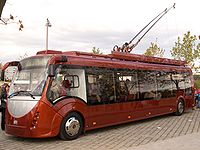
The trolleybus system in Minsk
Minsk
- Ecological situation :The ecological situation is monitored by Republican Center of Radioactive and Environmental Control .During 2003–2008 the overall weight of contaminants increased from 186,000 to 247,400 tons. The change of gas as industrial fuel to mazut for financial reasons has worsened...
(since 1952) is the second-largest in the world. Trolleybuses also work in Brest, Vitebsk
Vitebsk
Vitebsk, also known as Viciebsk or Vitsyebsk , is a city in Belarus, near the border with Russia. The capital of the Vitebsk Oblast, in 2004 it had 342,381 inhabitants, making it the country's fourth largest city...
, Gomel, Grodno, Mogilev
Mogilev
Mogilev is a city in eastern Belarus, about 76 km from the border with Russia's Smolensk Oblast and 105 km from the border with Russia's Bryansk Oblast. It has more than 367,788 inhabitants...
and Babruysk
Babruysk
Babruysk or Bobruysk is a city in the Mahilyow Voblast of Belarus on the Berezina river. It is a large city in Belarus with a population of approximately 227,000 people . The name Babruysk probably originates from the Belarusian word babyor , many of which used to inhabit the Berezina...
(since 1978).
Belgium
No trolleybus systems remain in operation in Belgium, but in the past, trolleybuses provided a portion of the local transport service in Antwerp, BrusselsBrussels
Brussels , officially the Brussels Region or Brussels-Capital Region , is the capital of Belgium and the de facto capital of the European Union...
, Liège
Liège
Liège is a major city and municipality of Belgium located in the province of Liège, of which it is the economic capital, in Wallonia, the French-speaking region of Belgium....
and Ghent
Ghent
Ghent is a city and a municipality located in the Flemish region of Belgium. It is the capital and biggest city of the East Flanders province. The city started as a settlement at the confluence of the Rivers Scheldt and Lys and in the Middle Ages became one of the largest and richest cities of...
. The last system, that of Ghent, which ceased operation in June 2009, had opened much later than all of the other Belgian trolleybus systems, in 1989. Government funds to build the Ghent system were provided, in part, for the purpose of improving the prospects for the export of Belgian-built trolleybuses, and the Ghent system's fleet was made up entirely of trolleybuses built by Van Hool
Van Hool
Van Hool NV is a Belgian coachbuilder and manufacturer of buses, coaches, trolleybuses, and trailers.The company was founded in 1947 by Bernard van Hool in Koningshooikt, nearby Lier, Belgium. In the early years, the company introduced serial production and exported their products all over Europe...
, a Belgian company. The Brussels system comprised only a single route (the 54), in contrast to that city's large tram
Brussels trams
The Brussels tram system is one of the ten largest in the world, carrying some 75.6 million passengers in 2009. Its development demonstrates many of the quandaries that face local public transport planners...
system. Liège had two independent trolleybus systems. One of them, a small system connecting Liège to the suburb of Seraing
Seraing
Seraing is a Walloon municipality of Belgium in Province of Liege. The municipality of Seraing includes the old communes of Boncelles, Jemeppe-sur-Meuse, and Ougrée. With Liège, Herstal, Saint-Nicolas, Ans, and Flémalle it forms the greater Liège agglomeration...
, operated the world's only double-ended (bi-directional) trolleybuses; the vehicles were eventually rebuilt to conventional (single-ended) configuration. One of those unique vehicles, restored to double-ended configuration, is preserved at the Musée des Transports en commun du Pays de Liège. Trolleybuses from the other Liège system and from Brussels and Ghent are preserved at various museums, including 1932-built Liège 425 at the Sandtoft museum
The Trolleybus Museum at Sandtoft
The Trolleybus Museum at Sandtoft is a transport museum which specialises in the preservation of trolleybuses. It is located by the village of Sandtoft, near Belton on the Isle of Axholme in the English county of Lincolnshire.-Description:...
, in England.
Bosnia and Herzegovina
Trolleybuses are in use only in the capital city, SarajevoSarajevo
Sarajevo |Bosnia]], surrounded by the Dinaric Alps and situated along the Miljacka River in the heart of Southeastern Europe and the Balkans....
. Operation and maintenance is done by GRAS (City transportation). There are seven routes (101-107).
Bulgaria
Trolleybus networks operate in SofiaSofia
Sofia is the capital and largest city of Bulgaria and the 12th largest city in the European Union with a population of 1.27 million people. It is located in western Bulgaria, at the foot of Mount Vitosha and approximately at the centre of the Balkan Peninsula.Prehistoric settlements were excavated...
(since 1941), Plovdiv
Plovdiv
Plovdiv is the second-largest city in Bulgaria after Sofia with a population of 338,153 inhabitants according to Census 2011. Plovdiv's history spans some 6,000 years, with traces of a Neolithic settlement dating to roughly 4000 BC; it is one of the oldest cities in Europe...
(1955), Pleven
Pleven
Pleven is the seventh most populous city in Bulgaria. Located in the northern part of the country, it is the administrative centre of Pleven Province, as well as of the subordinate Pleven municipality...
(1985), Varna
Varna
Varna is the largest city and seaside resort on the Bulgarian Black Sea Coast and third-largest in Bulgaria after Sofia and Plovdiv, with a population of 334,870 inhabitants according to Census 2011...
(1986), Kazanlak (1987), Stara Zagora
Stara Zagora
Stara Zagora is the sixth largest city in Bulgaria, and a nationally important economic center. Located in Southern Bulgaria, it is the administrative capital of the homonymous Stara Zagora Province...
(1988), Ruse (1988), Sliven
Sliven
Sliven is the eighth-largest city in Bulgaria and the administrative and industrial centre of Sliven Province and municipality. It is a relatively large town with 89,848 inhabitants, as of February 2011....
(1988), Vratsa
Vratsa
Vratsa is a city in northwestern Bulgaria, at the foothills of the Balkan Mountains. It is the administrative centre of the homonymous Vratsa Province. As of February 2011, the town has a population of 60,482 inhabitants....
(1988), Dobrich
Dobrich
Dobrich is a town in northeastern Bulgaria, the administrative centre of Dobrich Province. With 91,030 inhabitants, as of February 2011, Dobrich is the ninth most populated town in Bulgaria, being the centre of the historical region of Southern Dobruja...
(1988), Pernik
Pernik
Pernik is a city in western Bulgaria with a population of 81,052 . It is the main city of Pernik Province and lies on both banks of the Struma River in the Pernik Valley between the Viskyar, Vitosha and Golo Bardo mountains.Originally the site of a Thracian fortress founded in the 4th century BC,...
(1989), Gabrovo
Gabrovo
Gabrovo is a city in central northern Bulgaria, the administrative centre of Gabrovo Province. It is situated at the foot of the central Balkan Mountains, in the valley of the Yantra River, and is known as an international capital of humour and satire , as well as noted for its Bulgarian National...
(1990), Haskovo
Haskovo
Haskovo , is a city, an administrative centre of the homonymous Haskovo Province in southern Bulgaria, not far from the borders with Greece and Turkey. As of February 2011, it has a population of 74,843 inhabitants....
(1990), Veliko Tarnovo
Veliko Tarnovo
Veliko Tarnovo is a city in north central Bulgaria and the administrative centre of Veliko Tarnovo Province. Often referred to as the "City of the Tsars", Veliko Tarnovo is located on the Yantra River and is famous as the historical capital of the Second Bulgarian Empire, attracting many tourists...
(1990), Burgas
Burgas
-History:During the rule of the Ancient Romans, near Burgas, Debeltum was established as a military colony for veterans by Vespasian. In the Middle Ages, a small fortress called Pyrgos was erected where Burgas is today and was most probably used as a watchtower...
(1991) and Pazardzhik
Pazardzhik
Pazardzhik is a city situated along the banks of the Maritsa river, Southern Bulgaria. It is the capital of Pazardzhik Province and centre for the homonymous Pazardzhik Municipality...
(1993). The most developed system in terms of density is in Pleven, with 14 trolleybus routes, totalling 75 kilometres (46.6 mi), and one bus route. The largest system is in Sofia: 105 kilometres (65.2 mi). Now the Kazanlak system is not in operation. In the late 80s the towns of Dimitrovgrad
Dimitrovgrad, Bulgaria
Dimitrovgrad is a town in Haskovo Province, South-central Bulgaria, located close to the province capital - Haskovo. It is a newly founded settlement, built in the end of the 1940s. and named after the communist leader Georgi Dimitrov. The town is the administrative centre of the homonymous...
and Gorna Oryahovitsa
Gorna Oryahovitsa
Gorna Oryahovitsa is a town in northern Bulgaria, situated in Veliko Tarnovo Province, not far from the city of Veliko Tarnovo. It is the administrative centre of the homonymous Gorna Oryahovitsa Municipality...
started to build networks, but due to financial problems the projects were suspended. Also that is the reason for closing Kazanlak's system.
Czech Republic
The Czech Republic has 13 trolleybus systems, in towns both large and small, and in the past trolleybuses also operated in three other cities. See List of trolleybus systems for details.There also was a line between Ostrov nad Ohří
Ostrov (Karlovy Vary District)
Ostrov , is a town in the Carlsbad Region, Czech Republic. It is located at a foothill of the Ore Mountains about 10 km northeast of Karlovy Vary and has a population of 16,999 ....
and Jáchymov
Jáchymov
For other places called Joachimsthal, see Joachimsthal Jáchymov . compl: "Sant Joachim's Sthal" is a spa town in north-west Bohemia in the Czech Republic belonging to the Karlovy Vary Region. It is situated at an altitude of 733 m above sea level in the eponymous St...
, taking advantage of steep gradients between these towns, used only for testing trolleybuses made at the Škoda
Škoda Works
Škoda Works was the largest industrial enterprise in Austro-Hungary and later in Czechoslovakia, one of its successor states. It was also one of the largest industrial conglomerates in Europe in the 20th century...
factory in Ostrov. The line was dismantled in 2004, following the cessation of production.
Denmark
Trolleybuses were introduced in GentofteGentofte
Gentofte Kommune is a municipality in the Capital Region of Denmark on the east coast of the island of Zealand in eastern Denmark. The municipality covers an area of , and has a total population of 68,913...
(a suburb of Copenhagen
Copenhagen
Copenhagen is the capital and largest city of Denmark, with an urban population of 1,199,224 and a metropolitan population of 1,930,260 . With the completion of the transnational Øresund Bridge in 2000, Copenhagen has become the centre of the increasingly integrating Øresund Region...
) with one line in 1927 - operated by the regional power company, NESA. The network was gradually expanded to connect to the suburbs of Lyngby and Søborg
Gladsaxe
Gladsaxe Kommune is a municipality near Copenhagen in Region Hovedstaden on the island of Zealand in eastern Denmark. The municipality covers an area of 25 km², and has a total population of 62,562...
also. From 1938 to 1963 trolleybuses were operating on the route on Lyngbyvej to Nørreport Station (in downtown Copenhagen). From 1953 onward NESA operated 4 trolleybus lines. In 1963 the two lines to Nørreport Station were converted to operate with diesel buses. NESA replaced the last trolleybus with diesel buses in 1971.
The city of Odense
Odense
The city of Odense is the third largest city in Denmark.Odense City has a population of 167,615 and is the main city of the island of Funen...
also got a trolleybus line in 1939. In 1959 this line was converted to operate with diesel buses.
Estonia
Tallinn
Tallinn is the capital and largest city of Estonia. It occupies an area of with a population of 414,940. It is situated on the northern coast of the country, on the banks of the Gulf of Finland, south of Helsinki, east of Stockholm and west of Saint Petersburg. Tallinn's Old Town is in the list...
. The first trolleybus route opened on 6 July 1965. There were nine routes, but one closed on 31 March 2000 - the overhead wires remain in place. There has been talk about a tenth line but this has never been brought to reality.
Old Skoda 14Tr and 15Tr trolleybuses are being replaced with newer low-floor Solaris/Ganz T12 and T18 articulated
Articulated bus
An articulated bus is an articulated vehicle used in public transportation. It is usually a single-deck design, and comprises two rigid sections linked by a pivoting joint...
models.
Finland
TampereTampere
Tampere is a city in southern Finland. It is the most populous inland city in any of the Nordic countries. The city has a population of , growing to approximately 300,000 people in the conurbation and over 340,000 in the metropolitan area. Tampere is the third most-populous municipality in...
and Helsinki
Helsinki
Helsinki is the capital and largest city in Finland. It is in the region of Uusimaa, located in southern Finland, on the shore of the Gulf of Finland, an arm of the Baltic Sea. The population of the city of Helsinki is , making it by far the most populous municipality in Finland. Helsinki is...
have had trolleybus systems in the past. In Tampere, trolleybus operations began in 1948 and ended in 1976. At the system's maximum extent seven trolleybus lines operated. Two trolleybuses have been preserved, in the collection of Tampereen kaupungin liikennelaitos. In Helsinki a single trolleybus line was operated, 1949–1974. An attempt to restore trolleybus operation in Helsinki was made in the late 1970s and resulted in the acquisition of a prototype trolleybus which was used between 1979 and 1985. Three Helsinki trolleybuses have been preserved. Of these, number 605 is on display at the Helsinki Tram Museum. Helsinki is considering restoring trolleybus services.
France
Trolleybuses are used in LimogesLimoges
Limoges |Limousin]] dialect of Occitan) is a city and commune, the capital of the Haute-Vienne department and the administrative capital of the Limousin région in west-central France....
, Lyon
Lyon
Lyon , is a city in east-central France in the Rhône-Alpes region, situated between Paris and Marseille. Lyon is located at from Paris, from Marseille, from Geneva, from Turin, and from Barcelona. The residents of the city are called Lyonnais....
, Nancy and Saint-Étienne
Saint-Étienne
Saint-Étienne is a city in eastern central France. It is located in the Massif Central, southwest of Lyon in the Rhône-Alpes region, along the trunk road that connects Toulouse with Lyon...
, which have expanded their use. Preserved trolleybuses are at the Musée des Transports (AMTUIR) in Colombes.
Germany
Trolleybuses operate in EberswaldeEberswalde
Eberswalde is a major town and the administrative seat of the district Barnim in the German Federal State of Brandenburg, about 50 km northeast of Berlin. Population 42144 , geographical location . The town is often called Waldstadt , because of the large forests around it, including the...
(near Berlin), Esslingen (near Stuttgart) and Solingen
Solingen
Solingen is a city in North Rhine-Westphalia, Germany. It is located on the northern edge of the region called Bergisches Land, south of the Ruhr area, and with a 2009 population of 161,366 is the second largest city in the Bergisches Land...
(near Düsseldorf). There were over 60 trolleybus systems in the late 1950s, many having replaced under-used tram services.
Greece
22 Trolleybus lines in the Athens metropolitan area serve AthensAthens
Athens , is the capital and largest city of Greece. Athens dominates the Attica region and is one of the world's oldest cities, as its recorded history spans around 3,400 years. Classical Athens was a powerful city-state...
, Piraeus
Piraeus
Piraeus is a city in the region of Attica, Greece. Piraeus is located within the Athens Urban Area, 12 km southwest from its city center , and lies along the east coast of the Saronic Gulf....
and other municipalities. The trolleybus network, which is operated by ILPAP
ILPAP
I.L.P.A.P. was a public Greek company, part of the general Athens Mass Transit System, responsible for the operation of the trolleybuses network...
, is one of the largest in Europe, with more than 360 trolleybuses. The entire fleet was replaced with new Neoplan
Neoplan
NEOPLAN Bus GmbH is a German automotive company that manufactures buses, trolleybuses and coaches. NEOPLAN is now a subsidiary of NEOMAN Bus GmbH, which itself is a part of MAN SE.-Foundations:...
and Van Hool
Van Hool
Van Hool NV is a Belgian coachbuilder and manufacturer of buses, coaches, trolleybuses, and trailers.The company was founded in 1947 by Bernard van Hool in Koningshooikt, nearby Lier, Belgium. In the early years, the company introduced serial production and exported their products all over Europe...
low-floor trolleybuses from 1999 to 2004.
Hungary
Trolleybuses are used in BudapestBudapest
Budapest is the capital of Hungary. As the largest city of Hungary, it is the country's principal political, cultural, commercial, industrial, and transportation centre. In 2011, Budapest had 1,733,685 inhabitants, down from its 1989 peak of 2,113,645 due to suburbanization. The Budapest Commuter...
, Szeged
Szeged
' is the third largest city of Hungary, the largest city and regional centre of the Southern Great Plain and the county town of Csongrád county. The University of Szeged is one of the most distinguished universities in Hungary....
and Debrecen
Debrecen
Debrecen , is the second largest city in Hungary after Budapest. Debrecen is the regional centre of the Northern Great Plain region and the seat of Hajdú-Bihar county.- Name :...
. In Budapest
Budapest
Budapest is the capital of Hungary. As the largest city of Hungary, it is the country's principal political, cultural, commercial, industrial, and transportation centre. In 2011, Budapest had 1,733,685 inhabitants, down from its 1989 peak of 2,113,645 due to suburbanization. The Budapest Commuter...
the fleet is operated by Budapesti Közlekedési Vállalat Zrt
BKV
BKV is the unified public transport company of Budapest, established in 1968...
.
Italy
Trolleybuses are in use in AnconaAncona
Ancona is a city and a seaport in the Marche region, in central Italy, with a population of 101,909 . Ancona is the capital of the province of Ancona and of the region....
, Bologna
Bologna
Bologna is the capital city of Emilia-Romagna, in the Po Valley of Northern Italy. The city lies between the Po River and the Apennine Mountains, more specifically, between the Reno River and the Savena River. Bologna is a lively and cosmopolitan Italian college city, with spectacular history,...
, Cagliari
Cagliari
Cagliari is the capital of the island of Sardinia, a region of Italy. Cagliari's Sardinian name Casteddu literally means castle. It has about 156,000 inhabitants, or about 480,000 including the outlying townships : Elmas, Assemini, Capoterra, Selargius, Sestu, Monserrato, Quartucciu, Quartu...
, Chieti
Chieti
Chieti is a city and comune in Central Italy, 200 km northeast of Rome. It is the capital of the Province of Chieti in the Abruzzo region...
, Genoa
Genoa
Genoa |Ligurian]] Zena ; Latin and, archaically, English Genua) is a city and an important seaport in northern Italy, the capital of the Province of Genoa and of the region of Liguria....
, La Spezia
La Spezia
La Spezia , at the head of the Gulf of La Spezia in the Liguria region of northern Italy, is the capital city of the province of La Spezia. Located between Genoa and Pisa on the Ligurian Sea, it is one of the main Italian military and commercial harbours and hosts one of Italy's biggest military...
, Milan
Milan
Milan is the second-largest city in Italy and the capital city of the region of Lombardy and of the province of Milan. The city proper has a population of about 1.3 million, while its urban area, roughly coinciding with its administrative province and the bordering Province of Monza and Brianza ,...
, Modena
Modena
Modena is a city and comune on the south side of the Po Valley, in the Province of Modena in the Emilia-Romagna region of Italy....
, Naples
Naples
Naples is a city in Southern Italy, situated on the country's west coast by the Gulf of Naples. Lying between two notable volcanic regions, Mount Vesuvius and the Phlegraean Fields, it is the capital of the region of Campania and of the province of Naples...
, Parma
Parma
Parma is a city in the Italian region of Emilia-Romagna famous for its ham, its cheese, its architecture and the fine countryside around it. This is the home of the University of Parma, one of the oldest universities in the world....
, Rimini
Rimini
Rimini is a medium-sized city of 142,579 inhabitants in the Emilia-Romagna region of Italy, and capital city of the Province of Rimini. It is located on the Adriatic Sea, on the coast between the rivers Marecchia and Ausa...
, Rome
Rome
Rome is the capital of Italy and the country's largest and most populated city and comune, with over 2.7 million residents in . The city is located in the central-western portion of the Italian Peninsula, on the Tiber River within the Lazio region of Italy.Rome's history spans two and a half...
and San Remo
Sanremo
Sanremo or San Remo is a city with about 57,000 inhabitants on the Mediterranean coast of western Liguria in north-western Italy. Founded in Roman times, the city is best known as a tourist destination on the Italian Riviera. It hosts numerous cultural events, such as the Sanremo Music Festival...
. The largest systems are in Milan (about 150 vehicles, serving four routes) and Naples (100 vehicles, eight routes), the latter being divided between two separate transport authorities (ANM
ANM (Naples)
Azienda Napoletana Mobilità SpA , more commonly known simply as ANM, is a municipally controlled public company that is the primary provider of surface public transportation in the city of Naples, Italy, and also provides a portion of the surface transit service in surrounding municipalities...
and CTP). Work is under way to reopen a system in Bari
Bari
Bari is the capital city of the province of Bari and of the Apulia region, on the Adriatic Sea, in Italy. It is the second most important economic centre of mainland Southern Italy after Naples, and is well known as a port and university city, as well as the city of Saint Nicholas...
that closed in 1987. New systems are under construction in Avellino
Avellino
Avellino is a town and comune, capital of the province of Avellino in the Campania region of southern Italy. It is situated in a plain surrounded by mountains 42 km north-east of Naples and is an important hub on the road from Salerno to Benevento.-History:Before the Roman conquest, the...
, Lecce
Lecce
Lecce is a historic city of 95,200 inhabitants in southern Italy, the capital of the province of Lecce, the second province in the region by population, as well as one of the most important cities of Puglia...
and Pescara
Pescara
Pescara is the capital city of the Province of Pescara, in the Abruzzo region of Italy. As of January 1, 2007 it was the most populated city within Abruzzo at 123,059 residents, 400,000 with the surrounding metropolitan area...
, and are planned in Verona
Verona
Verona ; German Bern, Dietrichsbern or Welschbern) is a city in the Veneto, northern Italy, with approx. 265,000 inhabitants and one of the seven chef-lieus of the region. It is the second largest city municipality in the region and the third of North-Eastern Italy. The metropolitan area of Verona...
and Vicenza
Vicenza
Vicenza , a city in north-eastern Italy, is the capital of the eponymous province in the Veneto region, at the northern base of the Monte Berico, straddling the Bacchiglione...
.
Latvia
Trolleybuses have been used in RigaRiga
Riga is the capital and largest city of Latvia. With 702,891 inhabitants Riga is the largest city of the Baltic states, one of the largest cities in Northern Europe and home to more than one third of Latvia's population. The city is an important seaport and a major industrial, commercial,...
since 1947. Currently there are 354 trolleybuses operated on 19 routes by Rīgas Satiksme
Rigas Satiksme
Rīgas Satiksme is a limited liability company of Riga municipality which operates public transport and vehicle hire in the Latvian capital Riga and its surrounding areas. The organisation's principal activities involve the operation of the city's 476 buses, 354 trolleybuses and 267 trams. It is...
.
Lithuania
Trolleybuses have been used in VilniusVilnius
Vilnius is the capital of Lithuania, and its largest city, with a population of 560,190 as of 2010. It is the seat of the Vilnius city municipality and of the Vilnius district municipality. It is also the capital of Vilnius County...
since 1956 (21 routes) and Kaunas
Kaunas
Kaunas is the second-largest city in Lithuania and has historically been a leading centre of Lithuanian economic, academic, and cultural life. Kaunas was the biggest city and the center of a powiat in Trakai Voivodeship of the Grand Duchy of Lithuania since 1413. During Russian Empire occupation...
(16 routes) since 1965.
Moldova
Trolleybuses are used in ChişinăuChisinau
Chișinău is the capital and largest municipality of Moldova. It is also its main industrial and commercial centre and is located in the middle of the country, on the river Bîc...
(1949), Bălţi
Balti
Balti can refer to:* Balti language, a language spoken in Baltistan in Pakistan and Ladakh in Kashmir* Balti people, Muslims of Ladakhi/Tibetan origin from Baltistan in Pakistan and Ladakh in Kashmir...
(1972), Tighina
Bender, Moldova
Bender or Bendery, also known as Tighina is a city within the internationally recognized borders of Moldova under de facto control of the unrecognized Transnistria Republic since 1992...
(1993) and Tiraspol
Tiraspol
Tiraspol is the second largest city in Moldova and is the capital and administrative centre of the unrecognized Pridnestrovian Moldavian Republic . The city is located on the eastern bank of the Dniester River...
(1967). Trolleybuses are the most used transport in Chişinău
Chisinau
Chișinău is the capital and largest municipality of Moldova. It is also its main industrial and commercial centre and is located in the middle of the country, on the river Bîc...
Netherlands
Trolleybuses have been in use in Arnhem since 1949. Past trolleybus systems were located in Groningen (1927–65) and Nijmegen (1952–69).Norway
In BergenBergen
Bergen is the second largest city in Norway with a population of as of , . Bergen is the administrative centre of Hordaland county. Greater Bergen or Bergen Metropolitan Area as defined by Statistics Norway, has a population of as of , ....
, Norway, trolleybuses have been in use since 1950.
In 1909, Drammen had the first trolleybus system in Scandinavia, running until 1967, and trolleybuses also served Oslo
Oslo
Oslo is a municipality, as well as the capital and most populous city in Norway. As a municipality , it was established on 1 January 1838. Founded around 1048 by King Harald III of Norway, the city was largely destroyed by fire in 1624. The city was moved under the reign of Denmark–Norway's King...
and Stavanger
Stavanger
Stavanger is a city and municipality in the county of Rogaland, Norway.Stavanger municipality has a population of 126,469. There are 197,852 people living in the Stavanger conurbation, making Stavanger the fourth largest city, but the third largest urban area, in Norway...
from the 1940s until the 1960s.
Poland
Three cities operate trolleybuses: LublinLublin
Lublin is the ninth largest city in Poland. It is the capital of Lublin Voivodeship with a population of 350,392 . Lublin is also the largest Polish city east of the Vistula river...
, Tychy
Tychy
Tychy is a city in Silesia, Poland, approximately south of Katowice. Situated on the southern edge of the Upper Silesian industrial district, the city borders Katowice to the north, Mikołów to the west, Bieruń to the east and Kobiór to the south...
and Gdynia
Gdynia
Gdynia is a city in the Pomeranian Voivodeship of Poland and an important seaport of Gdańsk Bay on the south coast of the Baltic Sea.Located in Kashubia in Eastern Pomerania, Gdynia is part of a conurbation with the spa town of Sopot, the city of Gdańsk and suburban communities, which together...
. Several other Polish cities had trolleybus systems in the past; see List of trolleybus systems.
Portugal
Trolleybuses are currently operated only in CoimbraCoimbra
Coimbra is a city in the municipality of Coimbra in Portugal. Although it served as the nation's capital during the High Middle Ages, it is better-known for its university, the University of Coimbra, which is one of the oldest in Europe and the oldest academic institution in the...
, where the system is managed by a municipal authority, SMTUC. Construction of a new trolleybus system in Amadora
Amadora
Amadora is a city and a municipality in Portugal, in the northwest of the Lisbon Metropolitan Area. The city and municipality population is 175,872 in eleven freguesias . With an area of 23.77 km², it is the most densely populated municipality of Portugal...
, a suburb of Lisbon
Lisbon
Lisbon is the capital city and largest city of Portugal with a population of 545,245 within its administrative limits on a land area of . The urban area of Lisbon extends beyond the administrative city limits with a population of 3 million on an area of , making it the 9th most populous urban...
, is planned. Two other cities used trolleybuses in the past: Braga
Braga
Braga , a city in the Braga Municipality in northwestern Portugal, is the capital of the Braga District, the oldest archdiocese and the third major city of the country. Braga is the oldest Portuguese city and one of the oldest Christian cities in the World...
was served by trolleybuses from 1963 to 1979. In Porto
Porto
Porto , also known as Oporto in English, is the second largest city in Portugal and one of the major urban areas in the Iberian Peninsula. Its administrative limits include a population of 237,559 inhabitants distributed within 15 civil parishes...
, Sociedade de Transportes Colectivos do Porto operated several trolleybus routes from 1959 to 1997 and has preserved some of its historic vehicles. Unusually, the Porto fleet included double-deck
Double-decker bus
A double-decker bus is a bus that has two storeys or 'decks'. Global usage of this type of bus is more common in outer touring than in its intra-urban transportion role. Double-decker buses are also commonly found in certain parts of Europe, Asia, and former British colonies and protectorates...
trolleybuses.
Romania
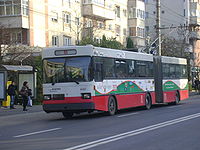
Bucharest
Bucharest is the capital municipality, cultural, industrial, and financial centre of Romania. It is the largest city in Romania, located in the southeast of the country, at , and lies on the banks of the Dâmbovița River....
(1949), where around 300 vehicles were serving 19 routes as of early 2009, the larger trolleybuses systems opened in 1959: Brașov
Brasov
Brașov is a city in Romania and the capital of Brașov County.According to the last Romanian census, from 2002, there were 284,596 people living within the city of Brașov, making it the 8th most populated city in Romania....
(shrunk considerably in the 2000s), Cluj
Cluj-Napoca
Cluj-Napoca , commonly known as Cluj, is the fourth most populous city in Romania and the seat of Cluj County in the northwestern part of the country. Geographically, it is roughly equidistant from Bucharest , Budapest and Belgrade...
(1959), Constanta
Constanta
Constanța is the oldest extant city in Romania, founded around 600 BC. The city is located in the Dobruja region of Romania, on the Black Sea coast. It is the capital of Constanța County and the largest city in the region....
(1959; shrunk considerably in the 2000s; closed 2010). An exception is Timişoara
Timisoara
Timișoara is the capital city of Timiș County, in western Romania. One of the largest Romanian cities, with an estimated population of 311,586 inhabitants , and considered the informal capital city of the historical region of Banat, Timișoara is the main social, economic and cultural center in the...
(1942) built with Italian equipment and vehicles. Most smaller systems were opened through a government program in the 1980s and 1990s, though only about half survive: Sibiu
Sibiu
Sibiu is a city in Transylvania, Romania with a population of 154,548. Located some 282 km north-west of Bucharest, the city straddles the Cibin River, a tributary of the river Olt...
(1983; closed 2009), Iaşi
Iasi
Iași is the second most populous city and a municipality in Romania. Located in the historical Moldavia region, Iași has traditionally been one of the leading centres of Romanian social, cultural, academic and artistic life...
(1985; closed 2006), Suceava
Suceava
Suceava is the Suceava County seat in Bukovina, Moldavia region, in north-eastern Romania. The city was the capital of the Principality of Moldavia from 1388 to 1565.-History:...
(1987; closed 2006), Brăila
Braila
Brăila is a city in Muntenia, eastern Romania, a port on the Danube and the capital of Brăila County, in the close vicinity of Galaţi.According to the 2002 Romanian census there were 216,292 people living within the city of Brăila, making it the 10th most populous city in Romania.-History:A...
(1989; closed 1999), Galaţi
Galati
Galați is a city and municipality in Romania, the capital of Galați County. Located in the historical region of Moldavia, in the close vicinity of Brăila, Galați is the largest port and sea port on the Danube River and the second largest Romanian port....
(1989), Mediaş
Medias
Mediaș is the second largest city in Sibiu County, Transylvania, Romania.-Geographic location:Mediaș is located in the middle basin of Târnava Mare River, at 39 km from Sighișoara and 41 km from Blaj. The health resort Bazna, officially recognized for the first time in 1302, is...
(1989), Satu Mare (1994; closed 2005), Vaslui
Vaslui
Vaslui , a city in eastern Romania, is the seat of Vaslui County, in the historical region of Moldavia.The city administers five villages: Bahnari, Brodoc, Moara Grecilor, Rediu and Viişoara.-History:...
(1994), Piatra Neamţ
Piatra Neamt
Piatra Neamț , , ; is the capital city of Neamţ County, in the historical region of Moldavia, eastern Romania. Because of its privileged location in the Eastern Carpathian mountains, it is considered one of the most picturesque cities in Romania...
(1995), Târgu Jiu
Târgu Jiu
Târgu Jiu is the capital of Gorj County, Oltenia, Romania. It is situated on the Southern Sub-Carpathians, on the banks of the river Jiu. Eight villages are administered by the city: Bârseşti, Drăgoeni, Iezureni, Polata, Preajba Mare, Româneşti, Slobozia and Ursaţi.-History:The city takes its name...
(1995), Târgovişte
Târgoviste
Târgoviște is a city in the Dâmbovița county of Romania. It is situated on the right bank of the Ialomiţa River. , it had an estimated population of 89,000. One village, Priseaca, is administered by the city.-Name:...
(1995; closed 2005), Baia Mare
Baia Mare
Baia Mare is a municipality in northwestern Romania and the capital of Maramureş County. The city is situated about 600 kilometres from Bucharest, the capital of Romania, 70 kilometres from the border with Hungary and 50 kilometres from the border with Ukraine...
(1996), Slatina
Slatina, Romania
Slatina is the capital city of Olt county, Romania, on the river Olt.The city administers one village, Cireaşov.-History:The town of Slatina was first mentioned on January 20, 1368 in an official document issued by Vladislav I Vlaicu, Prince of Wallachia. The document stated that merchants from...
(1996; closed 2005), Ploieşti
Ploiesti
Ploiești is the county seat of Prahova County and lies in the historical region of Wallachia in Romania. The city is located north of Bucharest....
(1997). A "DAC 117 E
Rocar DAC
Rocar DAC was a series of buses and trolleybuses produced by the Autobuzul company of Bucharest, Romania, between 1979 and 2000...
" (1987) is preserved by the TRANSIRA Association.
Russia
- See also: List of trolleybus systems in Russia and Trolleybus in former Soviet Union countries
Trolleybus systems operate in 87 cities, including the largest network in the world, in Moscow. In Moscow, preserved vintage trolleybuses are available to the public only at transport-dedicated exhibitions and at parades on celebration days. In Saint Petersburg
Saint Petersburg
Saint Petersburg is a city and a federal subject of Russia located on the Neva River at the head of the Gulf of Finland on the Baltic Sea...
and Nizhny Novgorod
Nizhny Novgorod
Nizhny Novgorod , colloquially shortened to Nizhny, is, with the population of 1,250,615, the fifth largest city in Russia, ranking after Moscow, St. Petersburg, Novosibirsk, and Yekaterinburg...
museum trolleybuses may be hired for city excursions and parties.
Serbia
There are eight trolleybus routes in BelgradeBelgrade
Belgrade is the capital and largest city of Serbia. It is located at the confluence of the Sava and Danube rivers, where the Pannonian Plain meets the Balkans. According to official results of Census 2011, the city has a population of 1,639,121. It is one of the 15 largest cities in Europe...
. Three of them are variations of the original line established shortly after World War II with Russian-made vehicles, with the same terminus in the heart of old downtown
Downtown
Downtown is a term primarily used in North America by English speakers to refer to a city's core or central business district ....
next to the Kalemegdan
Kalemegdan
Belgrade Fortress , represent old citadel and Kalemegdan Park on the confluence of the River Sava and Danube, in an urban area of modern Belgrade, the capital of Serbia. It is located in Belgrade's municipality of Stari Grad...
fortress. Another is a completely independent line built perpendicular to the other three in the early 1980s. The fleet had 154 operable trolleybuses as of December 2005.
Slovakia
The first trolleybus system connected Poprad with Starý Smokovec from 1904 to 1906. The second trolleybus system was built in 1909 in BratislavaBratislava
Bratislava is the capital of Slovakia and, with a population of about 431,000, also the country's largest city. Bratislava is in southwestern Slovakia on both banks of the Danube River. Bordering Austria and Hungary, it is the only national capital that borders two independent countries.Bratislava...
, but served only until 1915. The route led to the hilly recreational area of Železná studienka and the trolleybuses' motors were fed by a four-wheel bogie running on top of the wires and connected to the vehicle by a cable. Trolleybuses in Bratislava were reintroduced in 1943, with standard trolley poles. In 1962 trolleybuses were introduced in Prešov
Prešov
Prešov Historically, the city has been known in German as Eperies , Eperjes in Hungarian, Fragopolis in Latin, Preszów in Polish, Peryeshis in Romany, Пряшев in Russian and Пряшів in Rusyn and Ukrainian.-Characteristics:The city is a showcase of Baroque, Rococo and Gothic...
. Banská Bystrica
Banská Bystrica
Banská Bystrica is a key city in central Slovakia located on the Hron River in a long and wide valley encircled by the mountain chains of the Low Tatras, the Veľká Fatra, and the Kremnica Mountains. With 81,281 inhabitants, Banská Bystrica is the sixth most populous municipality in Slovakia...
introduced trolleybuses in 1989, Košice
Košice
Košice is a city in eastern Slovakia. It is situated on the river Hornád at the eastern reaches of the Slovak Ore Mountains, near the border with Hungary...
in 1993 and Žilina
Žilina
Žilina is a city in north-western Slovakia, around from the capital Bratislava, close to both the Czech and Polish borders. It is the fourth largest city of Slovakia with a population of approximately 85,000, an important industrial center, the largest city on the Váh river, and the seat of a...
in 1994. All trolleybuses were made by Škoda
Škoda Works
Škoda Works was the largest industrial enterprise in Austro-Hungary and later in Czechoslovakia, one of its successor states. It was also one of the largest industrial conglomerates in Europe in the 20th century...
.
Slovenia
The first trolleybus line in the BalkansBalkans
The Balkans is a geopolitical and cultural region of southeastern Europe...
opened to the public on 24 October 1909 in the coastal town of Piran
Piran
Piran is a city and municipality in southwestern Slovenia on the Gulf of Piran on the Adriatic Sea. It is one of the three major towns of Slovenian Istria. The city resembles a large open-air museum, with medieval architecture and a rich cultural heritage. Narrow streets and compact houses give...
, then part of Austria-Hungary
Austria-Hungary
Austria-Hungary , more formally known as the Kingdoms and Lands Represented in the Imperial Council and the Lands of the Holy Hungarian Crown of Saint Stephen, was a constitutional monarchic union between the crowns of the Austrian Empire and the Kingdom of Hungary in...
. It ran from the Tartini Square
Tartini Square
The Tartini Square is the largest and main square in the town of Piran, Slovenia. It was named after a famous violinist and composer Giuseppe Tartini, of whom a mounument was made in 1896.-History:...
, the central square of the town, along the coast and the shipyard to Portorož
Portorož
- External links :**...
and Lucija
Lucija, Piran
Lucija is a settlement in the Piran Municipality in the Littoral region of Slovenia. With a population close to 5,800, it is the largest settlement in Slovenia that is not a municipality in its own right.-External links:*...
. The town authorities bought five trolleybuses manufactured by the Austrian company Daimler-Motoren-Gesellschaft. In 1912, it was replaced by a tram
Tram
A tram is a passenger rail vehicle which runs on tracks along public urban streets and also sometimes on separate rights of way. It may also run between cities and/or towns , and/or partially grade separated even in the cities...
on the same route. From 1951 until 1971, trolleybuses served Ljubljana
Ljubljana
Ljubljana is the capital of Slovenia and its largest city. It is the centre of the City Municipality of Ljubljana. It is located in the centre of the country in the Ljubljana Basin, and is a mid-sized city of some 270,000 inhabitants...
, the capital of the then Socialist Republic of Slovenia
Socialist Republic of Slovenia
The Socialist Republic of Slovenia was a socialist state that was a constituent country of the Socialist Federal Republic of Yugoslavia from 1943 until 1990...
, till 1958 alongside the tram. There were five trolleybus lines in Ljubljana.
Spain
Trolleybuses are currently in use only in Castellón de la PlanaCastellón de la Plana
Castellón de la Plana or Castelló de la Plana is the capital city of the province of Castelló, in the Valencian Community, Spain, in the east of the Iberian Peninsula, on the Costa del Azahar by the Mediterranean Sea...
, where a new system opened on 25 June 2008; trolleybuses had previously served the town from 1963 to 1969. The Irisbus Civis vehicles are optically guided and are capable of switching to diesel power
Dual-mode bus
A dual-mode bus is a bus that can run independently on power from two different sources, typically electricity from overhead lines or batteries, alternated with conventional fossil fuel ....
for turning in front of the Parque Ribalto.
Earlier, at least 12 trolleybus systems existed in Spain; see list. While most were urban systems, there were also some interurban lines, including a 33-km route from A Coruña
A Coruña
A Coruña or La Coruña is a city and municipality of Galicia, Spain. It is the second-largest city in the autonomous community and seventeenth overall in the country...
to Carballo and a 12-km route from Tarragona
Tarragona
Tarragona is a city located in the south of Catalonia on the north-east of Spain, by the Mediterranean. It is the capital of the Spanish province of the same name and the capital of the Catalan comarca Tarragonès. In the medieval and modern times it was the capital of the Vegueria of Tarragona...
to Reus. Until the opening of the second Castellón system, in 2008, the last Spanish system to operate had been the one in Pontevedra
Pontevedra
Pontevedra is a city in the north-west of the Iberian Peninsula. It is the capital of both the comarca and province of Pontevedra, in Galicia . It is also the capital of its own municipality which is, in fact, often considered as an extension of the actual city...
, which closed in 1989. In the 1960s and 1970s, more than 100 secondhand London double-deck trolleybuses operated on various Spanish systems.
Sweden
In LandskronaLandskrona
Landskrona is a locality and the seat of Landskrona Municipality, Skåne County, Sweden with 28,670 inhabitants in 2005.-History:The city of Landskrona was founded at the location of Scania's best natural harbour, as a means of King Eric of Pomerania's anti-Hanseatic policy, intended to compete...
, a single trolleybus route connects the railway station with the city centre and the wharf area. The system opened in 2003 and employs four trolleybuses, making it one of the world's smallest systems. Forty years earlier trolleybus systems existed in Gothenburg
Gothenburg
Gothenburg is the second-largest city in Sweden and the fifth-largest in the Nordic countries. Situated on the west coast of Sweden, the city proper has a population of 519,399, with 549,839 in the urban area and total of 937,015 inhabitants in the metropolitan area...
and Stockholm
Stockholm
Stockholm is the capital and the largest city of Sweden and constitutes the most populated urban area in Scandinavia. Stockholm is the most populous city in Sweden, with a population of 851,155 in the municipality , 1.37 million in the urban area , and around 2.1 million in the metropolitan area...
, the latter a large system with 12 routes.
Switzerland
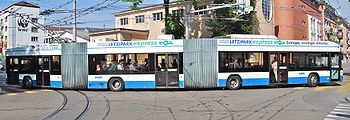
Trolleybuses are in use in cities including Lausanne
Lausanne
Lausanne is a city in Romandy, the French-speaking part of Switzerland, and is the capital of the canton of Vaud. The seat of the district of Lausanne, the city is situated on the shores of Lake Geneva . It faces the French town of Évian-les-Bains, with the Jura mountains to its north-west...
(10 lines), Lucerne
Lucerne
Lucerne is a city in north-central Switzerland, in the German-speaking portion of that country. Lucerne is the capital of the Canton of Lucerne and the capital of the district of the same name. With a population of about 76,200 people, Lucerne is the most populous city in Central Switzerland, and...
(7 lines), Geneva
Geneva
Geneva In the national languages of Switzerland the city is known as Genf , Ginevra and Genevra is the second-most-populous city in Switzerland and is the most populous city of Romandie, the French-speaking part of Switzerland...
(6 lines), Zürich
Zürich
Zurich is the largest city in Switzerland and the capital of the canton of Zurich. It is located in central Switzerland at the northwestern tip of Lake Zurich...
(6 lines), Bern (5 lines), St. Gallen
St. Gallen
St. Gallen is the capital of the canton of St. Gallen in Switzerland. It evolved from the hermitage of Saint Gall, founded in the 7th century. Today, it is a large urban agglomeration and represents the center of eastern Switzerland. The town mainly relies on the service sector for its economic...
(4 lines), Neuchâtel (4 lines), Winterthur
Winterthur
Winterthur is a city in the canton of Zurich in northern Switzerland. It has the country's sixth largest population with an estimate of more than 100,000 people. In the local dialect and by its inhabitants, it is usually abbreviated to Winti...
(4 lines), Fribourg
Fribourg
Fribourg is the capital of the Swiss canton of Fribourg and the district of Sarine. It is located on both sides of the river Saane/Sarine, on the Swiss plateau, and is an important economic, administrative and educational center on the cultural border between German and French Switzerland...
(3 lines), La Chaux-de-Fonds
La Chaux-de-Fonds
La Chaux-de-Fonds is a Swiss city of the district of La Chaux-de-Fonds in the canton of Neuchâtel. It is located in the Jura mountains at an altitude of 1000 m, a few kilometres from the French border. After Geneva and Lausanne, it is the third largest city of Romandie, the French-speaking part of...
(3 lines), Biel (2 lines), Schaffhausen
Schaffhausen
Schaffhausen is a city in northern Switzerland and the capital of the canton of the same name; it has an estimated population of 34,587 ....
(1 line), Vevey
Vevey
Vevey is a town in Switzerland in the canton Vaud, on the north shore of Lake Geneva, near Lausanne.It was the seat of the district of the same name until 2006, and is now part of the Riviera-Pays-d'Enhaut District...
–Montreux
Montreux
Montreux is a municipality in the district of Riviera-Pays-d'Enhaut in the canton of Vaud in Switzerland.It is located on Lake Geneva at the foot of the Alps and has a population, , of and nearly 90,000 in the agglomeration.- History :...
(1 line).
The last trolleybus ran in Lugano
Lugano
Lugano is a city of inhabitants in the city proper and a total of over 145,000 people in the agglomeration/city region, in the south of Switzerland, in the Italian-speaking canton of Ticino, which borders Italy...
in June 2001 and in Basel
Basel
Basel or Basle In the national languages of Switzerland the city is also known as Bâle , Basilea and Basilea is Switzerland's third most populous city with about 166,000 inhabitants. Located where the Swiss, French and German borders meet, Basel also has suburbs in France and Germany...
, where they have been replaced by gas powered buses, on 30 June 2008. These are the only urban networks that have been closed in Switzerland.
In Lausanne, the Association RétroBus has preserved several vintage trolleybuses, the oldest example being a 1932 FBW
Franz Brozincevic Wetzikon
Franz Brozincevic & Cie was a Swiss maker of trucks and buses, active between 1922 and 1985 and based in Wetzikon.FBW gained an excellent reputation for the top-level engineering and the long-lasting life of its products, never producing series but instead making individually tailored vehicles...
, and operates them periodically on public excursions, especially on summer weekends.
Turkey
Trolleybuses have operated in three cities: AnkaraAnkara
Ankara is the capital of Turkey and the country's second largest city after Istanbul. The city has a mean elevation of , and as of 2010 the metropolitan area in the entire Ankara Province had a population of 4.4 million....
, Istanbul
Istanbul
Istanbul , historically known as Byzantium and Constantinople , is the largest city of Turkey. Istanbul metropolitan province had 13.26 million people living in it as of December, 2010, which is 18% of Turkey's population and the 3rd largest metropolitan area in Europe after London and...
and Izmir
Izmir
Izmir is a large metropolis in the western extremity of Anatolia. The metropolitan area in the entire Izmir Province had a population of 3.35 million as of 2010, making the city third most populous in Turkey...
. Turkey's first trolleybus line began operating in 1947 in the capital, Ankara. On 1 June 1947, 10 Brill trolleybuses, joined in 1948 by 10 FBW
Franz Brozincevic Wetzikon
Franz Brozincevic & Cie was a Swiss maker of trucks and buses, active between 1922 and 1985 and based in Wetzikon.FBW gained an excellent reputation for the top-level engineering and the long-lasting life of its products, never producing series but instead making individually tailored vehicles...
vehicles, started running between the Ulus and Bakanliklar districts. In 1952 13 more trolleybuses were bought from MAN. The system closed in 1986. In the financial and cultural capital, Istanbul, the first trolleybuses were introduced in the early 1960s. The first line was the Topkapi-Eminönü line and was constructed by the Italian Ansaldo San Giorgia company. The total length of trolleybus line was 45 km, and there were 100 buses in operation at the system's peak. However, due to frequent power losses it was decided to close the system, and the last trolleybus ran in 1984.
Ukraine
Trolleybus systems run in more than 25 cities, including the interurban CrimeaCrimea
Crimea , or the Autonomous Republic of Crimea , is a sub-national unit, an autonomous republic, of Ukraine. It is located on the northern coast of the Black Sea, occupying a peninsula of the same name...
n network connecting Simferopol
Simferopol
-Russian Empire and Civil War:The city was renamed Simferopol in 1784 after the annexation of the Crimean Khanate to the Russian Empire by Catherine II of Russia. The name Simferopol is derived from the Greek, Συμφερόπολις , translated as "the city of usefulness." In 1802, Simferopol became the...
with Alushta
Alushta
Alushta is a resort town in Crimea, Ukraine, founded in the 6th century by Emperor Justinian. It is situated on the Black Sea on the road from Gurzuf to Sudak, as well as on the Crimean Trolleybus line....
and Yalta
Yalta
Yalta is a city in Crimea, southern Ukraine, on the north coast of the Black Sea.The city is located on the site of an ancient Greek colony, said to have been founded by Greek sailors who were looking for a safe shore on which to land. It is situated on a deep bay facing south towards the Black...
on the coast. The Crimean trolleybus
Crimean Trolleybus
Crimean Trolleybus Line in Crimea, Ukraine is currently the longest trolleybus line in the world. It is long, and runs between the autonomous republic's capital, Simferopol, and the coastal city of Yalta on the Black Sea....
network includes the longest trolleybus route in the world, the 86-km (54 mi.) route from Yalta to Simferopol.
United Kingdom

No trolleybus systems are in operation but a new Leeds trolleybus
Leeds Trolleybus
A Leeds trolleybus system served the city of Leeds, West Yorkshire, England between 1911 and 1928, and a very different new system for Leeds, known as the New Generation Transport - NGT project, is currently proposed....
system is planned and the project was given preliminary government approval and funding in March 2010. In the past, more than 50 systems existed and a large number of trolleybuses have been preserved at British museum
Museum
A museum is an institution that cares for a collection of artifacts and other objects of scientific, artistic, cultural, or historical importance and makes them available for public viewing through exhibits that may be permanent or temporary. Most large museums are located in major cities...
s. The world's largest collection of preserved trolleybuses is at The Trolleybus Museum at Sandtoft
The Trolleybus Museum at Sandtoft
The Trolleybus Museum at Sandtoft is a transport museum which specialises in the preservation of trolleybuses. It is located by the village of Sandtoft, near Belton on the Isle of Axholme in the English county of Lincolnshire.-Description:...
in England. Examples are also preserved at the East Anglia Transport Museum
East Anglia Transport Museum
The East Anglia Transport Museum is an open air transport museum, with numerous historic public transport vehicles . It is located in Carlton Colville a suburb of Lowestoft, Suffolk...
and the Black Country Living Museum
Black Country Living Museum
The Black Country Living Museum is an open-air museum of rebuilt historic buildings, located in Dudley in the West Midlands of England. The museum occupies a urban heritage park in the shadow of Dudley Castle in the centre of the Black Country conurbation...
in England. The Bradford Trolleybus Association is restoring Bradford trolleybus 758, the last rear-entrance trolleybus in Britain, which is kept at Sandtoft
The Trolleybus Museum at Sandtoft
The Trolleybus Museum at Sandtoft is a transport museum which specialises in the preservation of trolleybuses. It is located by the village of Sandtoft, near Belton on the Isle of Axholme in the English county of Lincolnshire.-Description:...
. The last trolleybuses in Britain ran in Bradford in 1972.
Canada
EdmontonEdmonton
Edmonton is the capital of the Canadian province of Alberta and is the province's second-largest city. Edmonton is located on the North Saskatchewan River and is the centre of the Edmonton Capital Region, which is surrounded by the central region of the province.The city and its census...
was the most recent city to abandon its trolleybus network, ending service in May 2009, despite opposition from local citizens. Vancouver is currently the only Canadian city operating trolleybuses, with several other cities considering new trolleybus networks, including Laval
Laval
-Places:* Laval, Quebec, a city and an administrative region coextensive with the city in southern Quebec, Canada, part of the Montreal area** Îles Laval, an archipelago within the limits of the above city** Laval - riding in Canada...
and Montréal
Montreal
Montreal is a city in Canada. It is the largest city in the province of Quebec, the second-largest city in Canada and the seventh largest in North America...
.
TransLink operates a fleet of 262 vehicles in Vancouver
Vancouver
Vancouver is a coastal seaport city on the mainland of British Columbia, Canada. It is the hub of Greater Vancouver, which, with over 2.3 million residents, is the third most populous metropolitan area in the country,...
, locally known as "trolleys"
Trolleybuses in Vancouver
The Vancouver trolleybus system forms part of the public transport network serving Metro Vancouver, in the province of British Columbia, Canada....
. The city's aging trolley fleet was replaced in 2006–2009 with new low-floor models built in Canada by New Flyer, including 74 articulated
Articulated bus
An articulated bus is an articulated vehicle used in public transportation. It is usually a single-deck design, and comprises two rigid sections linked by a pivoting joint...
units. The trolleys are valued in the Vancouver transit network for their "greener" energy usage and emissions (relying on hydro-electric power), quieter operation over diesels and the high-torque electric motors are well-suited to hilly areas of the city.
In Laval, Quebec
Laval, Quebec
Laval is a Canadian city and a region in southwestern Quebec. It is the largest suburb of Montreal, the third largest municipality in the province of Quebec, and the 14th largest city in Canada with a population of 368,709 in 2006...
(within the Greater Montreal area), the transit system operator, Société de transport de Laval
Société de transport de Laval
Société de transport de Laval is the public transit system in the city of Laval, Quebec, Canada. It was founded in June 1971 as the Commission de transport de la Ville de Laval ...
(STL), launched a study in spring 2009 into the possible construction of a new, four-route trolleybus system. Funded jointly by STL and Hydro-Québec
Hydro-Québec
Hydro-Québec is a government-owned public utility established in 1944 by the Government of Quebec. Based in Montreal, the company is in charge of the generation, transmission and distribution of electricity across Quebec....
, the study was completed in 2010. In discussing the Laval study, some provincial officials indicated they would like to see transport agencies in other major Québec cities also consider installing trolleybus networks. At the end of the study, the Laval transit authority decided to experiment with rechargeable battery-powered buses first, before making a decision on whether to proceed with trolleybuses. Among the points noted in the study's findings were that installing a trolleybus system would require a significant initial capital investment in infrastructure, but that trolleybuses are a technology that is known to be able to operate reliably in harsh winter temperatures, whereas it is uncertain whether other types of electric buses would be able to do so, and testing of this is now planned.
A new trolleybus system is also proposed for the city of Montréal
Montreal
Montreal is a city in Canada. It is the largest city in the province of Quebec, the second-largest city in Canada and the seventh largest in North America...
proper, by STM
Société de transport de Montréal
The Société de transport de Montréal is a public transport agency that operates transit bus, and rapid transit services in Montreal, Quebec, Canada...
. Montreal was previously served by trolleybuses from 1937 until 1966.
Several other Canadian cities have operated trolleybus systems in the past. In Hamilton, where they were referred to as "trolley coaches", they were used from 1951 until the end of 1992. Toronto initially had an experimental fleet of four trolleybuses from 1922 through 1927, but later maintained a fleet of about 150 vehicles from 1947 through 1992. Another 40 trolleybuses leased from Edmonton continued operation in Toronto until the lease expired, in July 1993, and the buses were returned to Edmonton a few months later. Most of Canada's other trolleybus systems were abandoned during the 1960s and 1970s; the last two to disappear at that time (Saskatoon and Calgary) closed down in 1974 and 1975, respectively.
The Transit Museum Society
Transit Museum Society
The Transit Museum Society is dedicated to the restoration and preservation of old and decommissioned transit vehicles in Vancouver and the adjoining areas. Based out of Coast Mountain Bus Company's Surrey Transit Centre , TRAMS has a fleet of twelve operational vehicles, and at least six vehicles...
, in Vancouver
Vancouver
Vancouver is a coastal seaport city on the mainland of British Columbia, Canada. It is the hub of Greater Vancouver, which, with over 2.3 million residents, is the third most populous metropolitan area in the country,...
, has preserved at least five trolleybuses retired from service on that city's trolleybus system, and some are maintained in running condition for occasional operation on the system, in cooperation with the transit agency TransLink.
Mexico
Servicio de Transportes Eléctricos (STE)Servicio de Transportes Eléctricos
Servicio de Transportes Eléctricos del Distrito Federal is a public transport agency responsible for the operation of all trolleybus and light rail services in Mexico City. As its name implies, its routes use only electrically powered vehicles...
of Mexico City
Mexico City
Mexico City is the Federal District , capital of Mexico and seat of the federal powers of the Mexican Union. It is a federal entity within Mexico which is not part of any one of the 31 Mexican states but belongs to the federation as a whole...
is one of the largest systems in North America. In the 1960s and 1970s STE acquired trolleybuses withdrawn from service in many Canadian and U.S. cities, including Montreal, Winnipeg, Cleveland, Dallas, Indianapolis, Johnstown, Little Rock, Los Angeles, Milwaukee, New Orleans, Shreveport and San Francisco, and placed them in service in Mexico City, following these later with a similar acquisition of 37 Flyer
New Flyer Industries
New Flyer Industries Inc. is a bus manufacturer in North America, headquartered in Winnipeg, Manitoba, Canada. It also has factories in Crookston and St. Cloud, Minnesota, USA.-History:...
s from Edmonton in 1987. Since 1981 more than 700 trolleybuses have been purchased from Mexicana de Autobuses S.A. (MASA)
MASA (company)
Mexicana de Autobuses, S.A., or MASA, was a major bus and coach manufacturer located in Mexico. Formed in 1959, it was owned by the Mexican government until being privatized in 1988...
, fitted with electrical equipment by various suppliers (including Hitachi, Toshiba, Kiepe and Mitsubishi) for batches of vehicles ordered at different times. The size of the fleet in 2008 was around 400.
Guadalajara
Guadalajara
Guadalajara may refer to:In Mexico:*Guadalajara, Jalisco, the capital of the state of Jalisco and second largest city in Mexico**Guadalajara Metropolitan Area*University of Guadalajara, a public university in Guadalajara, Jalisco...
opened a trolleybus system in 1976 using ex-Chicago trolleybuses dating from 1951-52. The last of these were withdrawn in January 1993, and since then the service has been provided by MASA trolleybuses, most of which had been acquired new in 1982-85.
United States
Since the opening of the first system, a relatively short-lived one opened in 1910 in Los Angeles, more than 60 cities in the United States have been served by trolleybuses, in some instances by two or more independent systems operated by different private companies.Trolleybus systems are currently in operation in five U.S. metropolitan areas:
- BostonBostonBoston is the capital of and largest city in Massachusetts, and is one of the oldest cities in the United States. The largest city in New England, Boston is regarded as the unofficial "Capital of New England" for its economic and cultural impact on the entire New England region. The city proper had...
, Massachusetts: Massachusetts Bay Transportation AuthorityMassachusetts Bay Transportation AuthorityThe Massachusetts Bay Transportation Authority, often referred to as the MBTA or simply The T, is the public operator of most bus, subway, commuter rail and ferry systems in the greater Boston, Massachusetts, area. Officially a "body politic and corporate, and a political subdivision" of the...
's Silver Line WaterfrontSilver Line (MBTA)The Silver Line is the only bus rapid transit line currently operated by the Massachusetts Bay Transportation Authority . It operates in two sections; the first runs from Dudley Square in Roxbury to downtown Boston, Massachusetts and South Station, mostly via Washington Street, with buses...
service- Cambridge, MassachusettsCambridge, MassachusettsCambridge is a city in Middlesex County, Massachusetts, United States, in the Greater Boston area. It was named in honor of the University of Cambridge in England, an important center of the Puritan theology embraced by the town's founders. Cambridge is home to two of the world's most prominent...
: Massachusetts Bay Transportation Authority; see Boston-area trackless trolleysBoston-area trackless trolleysThere are currently four trolleybus routes in the Boston, Massachusetts area, all run by the Massachusetts Bay Transportation Authority in the Harvard Square area, and all former streetcar lines...
- Cambridge, Massachusetts
- Philadelphia, Pennsylvania: SEPTA; see Trolleybuses in PhiladelphiaTrolleybuses in PhiladelphiaThe Philadelphia trolleybus system, or trackless trolley system as it is known by its operator, forms part of the public transportation network serving Philadelphia, in the state of Pennsylvania, United States. It opened on October 14, 1923, and is now is the second-longest-lived trolleybus...
- San Francisco, California: San Francisco MuniSan Francisco Municipal RailwayThe San Francisco Municipal Railway is the public transit system for the city and county of San Francisco, California. In 2006, it served with an operating budget of about $700 million...
- Seattle, Washington: King County Metro
- Dayton, OhioDayton, OhioDayton is the 6th largest city in the U.S. state of Ohio and the county seat of Montgomery County, the fifth most populous county in the state. The population was 141,527 at the 2010 census. The Dayton Metropolitan Statistical Area had a population of 841,502 in the 2010 census...
: Greater Dayton Regional Transit AuthorityGreater Dayton Regional Transit AuthorityThe Greater Dayton Regional Transit Authority, formerly known as the Miami Valley RTA, is a public transit agency that generally serves the greater Dayton, Ohio area. The GDRTA serves communities within Montgomery County and parts of Greene County, Ohio, USA. There are 29 routes...
; see Trolleybuses in DaytonTrolleybuses in DaytonThe Dayton trolleybus system forms part of the public transportation network serving Dayton, in the state of Ohio, United States. Opened on April 23, 1933, it presently comprises seven lines, and is operated by the Greater Dayton Regional Transit Authority, with a fleet of 54...
Preservation
- The Illinois Railway MuseumIllinois Railway MuseumThe Illinois Railway Museum is the largest railroad museum in the United States and is located in Union, Illinois, northwest of Chicago...
in Union maintains an historical collection of 20 trolleybuses from ChicagoChicagoChicago is the largest city in the US state of Illinois. With nearly 2.7 million residents, it is the most populous city in the Midwestern United States and the third most populous in the US, after New York City and Los Angeles...
, DaytonDayton, OhioDayton is the 6th largest city in the U.S. state of Ohio and the county seat of Montgomery County, the fifth most populous county in the state. The population was 141,527 at the 2010 census. The Dayton Metropolitan Statistical Area had a population of 841,502 in the 2010 census...
, Cleveland, Des MoinesDes Moines, IowaDes Moines is the capital and the most populous city in the US state of Iowa. It is also the county seat of Polk County. A small portion of the city extends into Warren County. It was incorporated on September 22, 1851, as Fort Des Moines which was shortened to "Des Moines" in 1857...
, Vancouver, Toronto, Seattle, San Francisco, Edmonton and Milwaukee. Several of the preserved coaches are operable and periodically provide rides for visitors over the museum's 0.6-mile (1 km) demonstration line, such service usually being scheduled on the first Saturday of June, July, September and October each year. - There are 18 historic trolleybuses in the collection of the Seashore Trolley MuseumSeashore Trolley MuseumThe Seashore Trolley Museum, located in Kennebunkport, Maine, United States, is the world's oldest and largest museum of mass transit vehicles....
in Kennebunkport, MaineKennebunkport, MaineKennebunkport is a town in York County, Maine, United States. The population was 3,720 at the 2000 census. It is part of the Portland–South Portland–Biddeford metropolitan statistical area....
. Some are only on display or stored, but seven are in operating condition, and the museum has an approximately quarter-mile trolleybus line, on which operation takes place on about two or three weekends each year. - In Seattle, transit authority King County Metro has preserved several historic trolleybuses and diesel buses that used to serve the city, and adds more to its collection as additional types are withdrawn from use on the Metro transit system. Volunteers from a group of current and retired employees of the agency, the Metro Employees Historic Vehicle Association (MEHVA), formed in 1981, restore and maintain the vehicles and operate them on public excursions a few times each year. As of 2009, the historic-vehicle fleet includes six trolleybuses, of which one is also a dual-mode busDual-mode busA dual-mode bus is a bus that can run independently on power from two different sources, typically electricity from overhead lines or batteries, alternated with conventional fossil fuel ....
. - San Francisco MuniSan Francisco Municipal RailwayThe San Francisco Municipal Railway is the public transit system for the city and county of San Francisco, California. In 2006, it served with an operating budget of about $700 million...
has a collection of seven historic trolleybuses, including three FlyerNew Flyer IndustriesNew Flyer Industries Inc. is a bus manufacturer in North America, headquartered in Winnipeg, Manitoba, Canada. It also has factories in Crookston and St. Cloud, Minnesota, USA.-History:...
E800s of mid-1970s vintage, in operating condition, and four older vehicles which are not in running condition. - A number of other museums in the United States have trolleybuses on static display only.
South America
Argentina
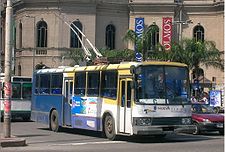
Mendoza Province
The Province of Mendoza is a province of Argentina, located in the western central part of the country in the Cuyo region. It borders to the north with San Juan, the south with La Pampa and Neuquén, the east with San Luis, and to the west with the republic of Chile; the international limit is...
, Argentina, had the first trolleybus operation in Latin America and one of the first in the world. South American Railless Traction Co., organized in London in 1912, planned to cover the continent with trolleybus lines and built an experimental route in Mendoza in 1913. (It was the only line that it built).
In 1952 the Argentine government imported 700 new trolleybuses from Germany (350 Mercedes-Benz
Mercedes-Benz buses
Mercedes-Benz has been making buses since 1895 in Mannheim in Germany. Since 1995, the brand of Mercedes-Benz buses and coaches is under the umbrella of EvoBus GmbH, belonging 100 % to the Daimler AG.-Heritage:...
, 175 Henschel
Henschel & Son
Henschel & Son was a German company, situated in Kassel, best known during the 20th century as a maker of transportation equipment, including locomotives, trucks, buses and trolleybuses, and armoured fighting vehicles and weapons....
and 175 from Maschinenfabrik
Maschinenfabrik Esslingen
Maschinenfabrik Esslingen , was a German engineering firm that manufactured locomotives, tramways, railway wagons, roll-blocks, technical equipment for the railways, , bridges, steel structures, pumps and boilers.-Founding:...
Augsburg Nürnberg). Most of the vehicles ran in the capital, Buenos Aires
Buenos Aires
Buenos Aires is the capital and largest city of Argentina, and the second-largest metropolitan area in South America, after São Paulo. It is located on the western shore of the estuary of the Río de la Plata, on the southeastern coast of the South American continent...
, but about 110 were sent to provincial cities: Bahía Blanca
Bahía Blanca
Bahía Blanca is a city located in the south-west of the province of Buenos Aires, Argentina, by the Atlantic Ocean, and seat of government of Bahía Blanca Partido. It has a population of 274,509 inhabitants according to the...
, La Plata
La Plata
La Plata is the capital city of the Province of Buenos Aires, Argentina, and of La Plata partido. According to the , the city proper has a population of 574,369 and its metropolitan area has 694,253 inhabitants....
, Tucumán, Mar del Plata
Mar del Plata
Mar del Plata is an Argentine city located on the coast of the Atlantic Ocean, south of Buenos Aires. Mar del Plata is the second largest city of Buenos Aires Province. The name "Mar del Plata" had apparently the sense of "sea of the Río de la Plata region" or "adjoining sea to the Río de la Plata"...
and Rosario.
Trolleybuses are currently in use in Mendoza
Mendoza, Argentina
Mendoza is the capital city of Mendoza Province, in Argentina. It is located in the northern-central part of the province, in a region of foothills and high plains, on the eastern side of the Andes. As of the , Mendoza's population was 110,993...
, Rosario and Córdoba
Córdoba, Argentina
Córdoba is a city located near the geographical center of Argentina, in the foothills of the Sierras Chicas on the Suquía River, about northwest of Buenos Aires. It is the capital of Córdoba Province. Córdoba is the second-largest city in Argentina after the federal capital Buenos Aires, with...
.
Brazil

Santos (São Paulo)
-Sister cities: Shimonoseki, Japan Nagasaki, Japan Funchal, Portugal Trieste, Italy Coimbra, Portugal Ansião, Portugal Arouca, Portugal Ushuaia, Argentina Havana, Cuba Taizhou. China Ningbo. China Constanţa, Romania Ulsan, South Korea Colón, Panama* Cadiz, Spain...
. In São Paulo (city), there are two separate trolleybus systems, operated or regulated by two different public agencies: SPTrans
SPTrans
The São Paulo Transporte is the name adopted on March 8, 1995 by the municipal local government which aims to manage the public transport system with buses in São Paulo...
, in the central and eastern areas, and EMTU
Empresa Metropolitana de Transportes Urbanos de São Paulo
The Empresa Metropolitana de Transportes Urbanos de São Paulo, or EMTU, is a company owned by the Secretaria de Estado dos Transportes Metropolitanos...
, in the southeastern suburbs and the cities of Santo André, São Bernardo do Campo
São Bernardo do Campo
São Bernardo do Campo is a municipality in the state of São Paulo, in southern Metropolitan São Paulo and São Paulo microregion. The municipality's total area is 408.45 km ² and a population estimated at 1 July 2009, according to the IBGE, was 810,979 inhabitants, which results in a population...
, Mauá and Diadema
Diadema, São Paulo
Diadema is a city in São Paulo state, Brazil. The distance from the capital is 17 km . The city has an area of 30.65 square kilometres and a population of 357,064, and is accessed by a transit called EMTU .- History :Since its beginning, Diadema occupation process had one fundamental...
. The trolleybus system of SPTrans (formerly CMTC), which opened in 1949, is the oldest surviving trolleybus system in Latin America and also the largest system in South America. In the past, trolleybus systems existed in eleven other Brazilian cities; see list.
Two trolleybuses are preserved and exhibited at the SPTrans (São Paulo Transportation Authority) Museum at Gaetano Ferrola. Another five trolleybuses built by CMTC (SPTrans' predecessor, until 1995) and Villares between 1958 and 1965 are awaiting restoration in the SPTrans garage at Santa Rita. A trolleybus built in the United States by ACF-Brill in 1948 was restored in 1999 and operates during special celebrations, such as the city's 454th anniversary celebration on 25 January 2008.
Chile
ValparaísoValparaíso
Valparaíso is a city and commune of Chile, center of its third largest conurbation and one of the country's most important seaports and an increasing cultural center in the Southwest Pacific hemisphere. The city is the capital of the Valparaíso Province and the Valparaíso Region...
, one of the largest cities of Chile, has the only trolleybus service currently, and it is managed by a private company, Trolebuses de Chile S.A. (formerly Empresa de Transportes Colectivos Eléctricos). The single route is numbered 802 in the regional transport scheme and is about 5 km in length. The fleet is a distinctive mix of old American, Swiss and Chinese vehicles. The most famous vehicles are the Pullman-Standard
Pullman Company
The Pullman Palace Car Company, founded by George Pullman, manufactured railroad cars in the mid-to-late 19th century through the early decades of the 20th century, during the boom of railroads in the United States. Pullman developed the sleeping car which carried his name into the 1980s...
s, built in 1946-52, which are the oldest trolleybuses still in service anywhere in the world. They were declared national monuments in 2003. The company has faced fierce competition from bus operators, and has come close to bankruptcy a few times, but many Valparaíso inhabitants feel an emotional link to the service, and vigorously defend the trolleybuses. During one such crisis in May 2007, even the country's president, Michelle Bachelet
Michelle Bachelet
Verónica Michelle Bachelet Jeria is a Social Democrat politician who was President of Chile from 11 March 2006 to 11 March 2010. She was the first woman president of her country...
, expressed support for keeping the historic system running. In October 2007, the Chilean government's National Monuments Council
National Monuments Council
The National Monuments Council is a Chilean government agency dedicated to the preservation and upkeep of special natural and cultural sites in Chile. The National Monuments Council was created in 1925 by law Nº 17.288.-External links:*...
extended the national monument status to include also the system's operations infrastructure (overhead wires, support poles and substations).
Trolleybuses operated in Santiago from 1947–1978 and 1991–1994.
Colombia
Trolleybuses systems were operated in MedellínMedellín
Medellín , officially the Municipio de Medellín or Municipality of Medellín, is the second largest city in Colombia. It is in the Aburrá Valley, one of the more northerly of the Andes in South America. It has a population of 2.3 million...
from 1929 to 1951 and in Bogotá
Bogotá
Bogotá, Distrito Capital , from 1991 to 2000 called Santa Fé de Bogotá, is the capital, and largest city, of Colombia. It is also designated by the national constitution as the capital of the department of Cundinamarca, even though the city of Bogotá now comprises an independent Capital district...
(where the service was managed by the local government) from 1948 until 1991. Russian-built ZIU and Romanian-built DAC
Rocar DAC
Rocar DAC was a series of buses and trolleybuses produced by the Autobuzul company of Bucharest, Romania, between 1979 and 2000...
trolleybuses comprised the entire fleet in the system's last several years of operation.
Ecuador
A distinctive and heavily used trolleybus system opened in QuitoQuito
San Francisco de Quito, most often called Quito , is the capital city of Ecuador in northwestern South America. It is located in north-central Ecuador in the Guayllabamba river basin, on the eastern slopes of Pichincha, an active stratovolcano in the Andes mountains...
in stages in 1995-96. The single-corridor Quito trolleybus system, named "El Trole", is a high-capacity design, featuring dedicated trolleybus-only lanes over almost its entire length and with boarding taking place exclusively at high-platform stations, through all three vehicle doorways simultaneously, akin to modern-day light-rail transit
Light rail
Light rail or light rail transit is a form of urban rail public transportation that generally has a lower capacity and lower speed than heavy rail and metro systems, but higher capacity and higher speed than traditional street-running tram systems...
systems. The initial fleet of 54 articulated
Articulated bus
An articulated bus is an articulated vehicle used in public transportation. It is usually a single-deck design, and comprises two rigid sections linked by a pivoting joint...
trolleybuses was expanded to 113 vehicles in 1999-2000. The headway
Headway
Headway is a measurement of the distance/time between vehicles in a transit system. The precise definition varies depending on the application, but it is most commonly measured as the distance from the tip of one vehicle to the tip of the next one behind it, expressed as the time it will take for...
is as short as 90 seconds in peak periods, and average daily patronage exceeds 250,000 passengers. Extensions to the route were opened in 2000 and 2008, and it is now 18.7 kilometres (11.6 mi) in length. Five different overlapping trolleybus services are operated along the corridor. The system inspired the design of a new trolleybus system in Mérida, Venezuela, the first stage of which opened in 2007.
Peru
A small trolleybus system operated in LimaLima
Lima is the capital and the largest city of Peru. It is located in the valleys of the Chillón, Rímac and Lurín rivers, in the central part of the country, on a desert coast overlooking the Pacific Ocean. Together with the seaport of Callao, it forms a contiguous urban area known as the Lima...
from 1928 to 1931, using just six vehicles on a single 3.3-km route. The six trolleybuses were rebuilt as tram
Tram
A tram is a passenger rail vehicle which runs on tracks along public urban streets and also sometimes on separate rights of way. It may also run between cities and/or towns , and/or partially grade separated even in the cities...
s in 1931, the only known instance of trolleybuses' being converted into trams.
Uruguay
Trolleybuses served the capital, MontevideoMontevideo
Montevideo is the largest city, the capital, and the chief port of Uruguay. The settlement was established in 1726 by Bruno Mauricio de Zabala, as a strategic move amidst a Spanish-Portuguese dispute over the platine region, and as a counter to the Portuguese colony at Colonia del Sacramento...
, from 1951 until 1992. The fleet originally included 18 British-built BUT vehicles, but Italian-built Alfa Romeo
Alfa Romeo
Alfa Romeo Automobiles S.p.A. is an Italian manufacturer of cars. Founded as A.L.F.A. on June 24, 1910, in Milan, the company has been involved in car racing since 1911, and has a reputation for building expensive sports cars...
or Fiat
Fiat
FIAT, an acronym for Fabbrica Italiana Automobili Torino , is an Italian automobile manufacturer, engine manufacturer, financial, and industrial group based in Turin in the Italian region of Piedmont. Fiat was founded in 1899 by a group of investors including Giovanni Agnelli...
trolleybuses were later acquired in much larger numbers and comprised the entire fleet for the system's last several years.
Venezuela
A trolleybus system opened in MéridaMérida, Mérida
Santiago de los Caballeros de Mérida, Venezuela, is the capital of the municipality of Libertador and the state of Mérida, and is one of the principal cities of the Venezuelan Andes...
in June 2007. Like the 1995-opened Quito trolleybus system, the new Mérida system is a Bus Rapid Transit
Bus rapid transit
Bus rapid transit is a term applied to a variety of public transportation systems using buses to provide faster, more efficient service than an ordinary bus line. Often this is achieved by making improvements to existing infrastructure, vehicles and scheduling...
(BRT) system, using dedicated trolleybus-only lanes over the entire length of the route, with signals giving priority
Traffic signal preemption
Traffic signal preemption is a type of system that allows the normal operation of traffic lights to be preempted, often to assist emergency vehicles...
over other traffic, and with all boarding and alighting taking place at enclosed "stations". A fleet of 45 articulated
Articulated bus
An articulated bus is an articulated vehicle used in public transportation. It is usually a single-deck design, and comprises two rigid sections linked by a pivoting joint...
trolleybuses built in Spain by Mercedes-Benz
Mercedes-Benz buses
Mercedes-Benz has been making buses since 1895 in Mannheim in Germany. Since 1995, the brand of Mercedes-Benz buses and coaches is under the umbrella of EvoBus GmbH, belonging 100 % to the Daimler AG.-Heritage:...
and Hispano Carrocera
Hispano Carrocera
Tata Hispano Motors Carrocera , based in Zaragoza, Aragon, Spain, is one of the largest manufacturers of bus and coach cabins in Europe. It is a fully owned subsidiary of India's Tata Motors. Tata Motors acquired control of the company in 2005, after purchasing a 21% stake in the company...
provides the service. A similar new trolleybus BRT system is under construction in Barquisimeto
Barquisimeto
Barquisimeto is the capital city of the State of Lara located in west central Venezuela, halfway between Caracas and Maracaibo on the Turbio River.-Overview:...
, and for this system 80 articulated trolleybuses have been purchased from Neoplan
Neoplan
NEOPLAN Bus GmbH is a German automotive company that manufactures buses, trolleybuses and coaches. NEOPLAN is now a subsidiary of NEOMAN Bus GmbH, which itself is a part of MAN SE.-Foundations:...
, in Germany. Many years earlier, a small trolleybus system (using only 11 vehicles) operated in Caracas
Caracas
Caracas , officially Santiago de León de Caracas, is the capital and largest city of Venezuela; natives or residents are known as Caraquenians in English . It is located in the northern part of the country, following the contours of the narrow Caracas Valley on the Venezuelan coastal mountain range...
from 1937 until about 1949.
See also
- Bombardier Guided Light TransitBombardier Guided Light TransitGuided Light Transit is a public transport system manufactured by Bombardier Transportation and used in the French cities of Nancy and Caen....
- Dual-mode transit
- Electric busElectric busAn electric bus is a bus powered by electricity.There are two main electric bus categories:* Non-autonomous electric buses:**The trolleybus is a type of electric bus powered by two overhead electric wires, with electricity being drawn from one wire and returned via the other wire, using two...
- GyrobusGyrobusA Gyrobus is an electric bus that uses flywheel energy storage, not overhead wires like a trolleybus. The name comes from the Greek language term for flywheel, gyros....
- List of trolleybus systems
- Low-floor busLow-floor busA low-floor bus is a bus that has no steps between one or more entrances and part or all of the passenger cabin. Being low floor improves the accessibility of the bus for the public, particularly the elderly or infirm, or those with push chairs, and increasingly, those in wheelchairs.In the modern...
- Tourist trolleyTourist trolleyA tourist trolley, also called a road trolley, is a rubber-tired bus , which is made to resemble an old-style streetcar or tram....
- TranslohrTranslohrTranslohr is a guided bus system manufactured by Lohr Industrie of France. It is used in Clermont-Ferrand, Tianjin, Padua and in the mainland Mestre district of Venice in Italy. Translohr runs on rubber tires and is guided by a single central rail....
- TrolleytruckTrolleytruckFor the alternative name for a sack truck , see Hand truckA trolleytruck is a trolleybus-like vehicle used for carrying cargo instead of passengers. A trolleytruck is usually a type of electric truck powered by two overhead wires, from which it draws electricity using two trolley poles or two...
- List of buses
Books
- Murray, Alan (2000). World Trolleybus Encyclopaedia. Trolleybooks (UK). ISBN 0-904235-18-1
- Sebree, MacMac SebreeGeorge McClellan Sebree III , better known as Mac Sebree, was an American journalist, writer and publisher whose area of expertise was urban mass transit, particularly urban rail transit. He was also a businessman, being owner and president of the publishing company, Interurban Press, from 1975...
; and Ward, Paul (1973). Transit's Stepchild, The Trolley Coach (Interurbans Special 58). Los Angeles: InterurbansInterurban PressInterurban Press was a small, privately owned American publishing company, specializing in books about streetcars, other forms of rail transit and railroads in North America, from 1943 until 1993. It was based in the Los Angeles area, and specifically in Glendale, California after 1976...
. LCCN 73-84356 - Sebree, Mac; and Ward, Paul (1974). The Trolley Coach in North America (Interurbans Special 59). Los Angeles: Interurbans. LCCN 74-20367
- Porter, Harry; and Worris, Stanley F.X. (1979). Trolleybus Bulletin No. 109: Databook II. North American Trackless Trolley Association (defunct)
- Dunbar, Charles S. (1967). Buses, Trolleys & Trams. Paul Hamlyn Ltd. (UK) [republished 2004 with ISBN 0-7537-0970-8 or 9780753709702]
Periodicals
- Trolleybus Magazine (ISSN 0266-7452). National Trolleybus Association (UK), bi-monthly
- Trackless, Bradford Trolleybus Association, quarterly
- Trolleybus, British Trolleybus Society (UK), monthly
External links
- TrolleyMotion - an international action group to promote modern trolleybus systems (+ database of systems in the world)
- British Trolleybuses
- Trolleybuses in Latin America
- North American trolleybus pictures
- All-time list of North American trolleybus systems, accessed 30 January 2004
- Bibliography of the electric trolleybus (Richard DeArmond)
- The Electric Trolleybus Web Site
- Trolleybuses in Europe Trolleybus cities of Russia