


Militsiya

Encyclopedia
Militsiya or militia is used as an official name of the civilian police
in several former communist states, despite its original military
connotation (see militia
). The term was used in the Soviet Union
, the Eastern Bloc
and the Warsaw Pact
countries, as well as in the non-aligned SFR Yugoslavia, although it is still commonly used in the individual former Soviet republics and Eastern Europe.
s intended to associate their new law enforcement authority with the self-organization of the people and to distinguish it from the czarist police. The militsiya was reaffirmed on October 28 (November 10, according to the new style dating
), 1917 under the official name of the Workers' and Peasants' Militsiya, in further contrast to what the Bolsheviks called the "bourgeois class protecting" police
. Eventually, it was replaced by the Ministry of Internal Affairs (Russian: МВД, MVD; Ukrainian: МВС, MVS; Belorussian: МУС, MUS), which is now the official full name for the militsiya forces in the respective countries. Its regional branches are officially called Departments of Internal Affairs—city department of internal affairs, raion
department of internal affairs, oblast
department of internal affairs, etc. The Russian term for a raion department is OVD (ОВД; Отдел/Отделение внутренних дел), for region department is UVD (УВД; Управление внутренних дел) or, sometimes, GUVD (ГУВД; Главное управление внутренних дел), same for national republics is MVD, (МВД; Министерство внутренних дел).
Functionally, Ministries of Internal Affairs are mostly police agencies. Their functions and organization differ significantly from similarly named departments in Western countries, which are usually civil executive
bodies headed by politicians and responsible for many other tasks as well as the supervision of law enforcement. The Soviet and successor MVDs have usually been headed by a militsiya general
and predominantly consist of service personnel, with civilian employees only filling auxiliary posts. Although such ministers are members of their respective countries' cabinet
, they usually do not report to the prime minister
and parliament
, but only to the president
. Local militsiya departments are subordinated to their regional departments, having little accountability before local authorities.
Internal affairs
units within the militsiya itself are usually called "internal security" departments.
The official names of particular militsiya bodies and services in post-Soviet countries are usually very complicated, hence the use of the short term militsiya. Law
s usually refer to police just as militsiya.
The short term for a police officer (regardless of gender) is militsioner (Russian: милиционер, Ukrainian: мiлiцiонер). Slang
terms for militsioner include ment (plural: менты, menty) and musor (plural: мусора, musora). Although the latter word is offensive (it literally means "trash" or "garbage"), it originated from an acronym for the Moscow Criminal Investigations Department (МУС, short for Московский уголовный сыск) in Imperial Russia. Ment is a closely equivalent to the English slang term "cop" and has derived from the Lwów dialect
.
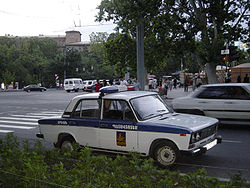
 The organizational structure, methods and traditions of the militsiya differ significantly from those of western police. Militsiya as an organization consists of many functional departments, such as the GIBDD
, a traffic police
. Organized crime
detectives form highly independent squads inside regional militsiya. Some units may have the distinctive names (like OMON
in Russia) which are more specific than militsiya or militsioner.
Militsiya personnel ranks mostly follow those of the Army - from private
(Rus: ryadovoy), which is the lowest rank, to colonel general
- with only these exceptions: there are no ranks of Army General
and Marshal
. Detective
s (Russian: operativnik short for operativniy rabotnik) hold a rank of lieutenant
at least and could be promoted to major
or the lieutenant colonel
. The militsiya of an oblast
(or other equivalent subnational entity) is usually headed by a general. The rank name is suffixed with of militsiya (e.g. major of militsiya for a major
). Militsiya personnel carry firearm
s, but are not permitted to carry their weapons when they are off duty.
Unlike in some other countries' police agencies, militsioners are not assigned permanent partners, but work alone or within larger groups. Neither street patrols nor detectives are allowed to drive police vehicles themselves, so a specialist driver (either a serviceman or a civil employee) is assigned to each car and is also in charge of its maintenance. GIBDD
(the traffic militsiya) is the only exception: its members drive their own (or even own private) cars and are specially trained in risk-driving.
One unique feature of militsiya policing approach is the system of territorial patronage over citizens. The cities, as well as the rural settlements are divided into uchastoks with a special uchastkovyi militsioner ("quarter policeman"), assigned to each. The main duty of uchastkovyi is to maintain close relations with the residents of his quarter and gather information among them. In particular, uchastkovyi should personally know each and every ex-convict, substance abuser, young hooligan etc. in given uchastok, and visit them regularly for preemptive influence. Uchastkovyi is also responsible for tackling minor offences like family violence, loud noise, residential area parking etc. Uchastkovyi is also the main, and actually the real, militsiya force in remote areas and small settlements where permanent police departments are not created. Uchastkovyi militsioners possess separate small offices within their quarters and maintain citizens admittance in definite weekdays.
This system slightly resembles the U.S. system of sheriff
s but shows some notable differences. Uchastkovyi is neither a chief police officer in a given community nor a universal one (not combining detective, incarceration or special tactics tasks).
The system of uchastkovyis dates back to imperial times
when uriadniks were conducting lowest-level policing in rural areas. In Soviet Union, uchastkovyis were also responsible for such tasks as maintaining propiska
limitations and overseeing former political prisoners, which were subject to daily registration at the local MVD office.
Although women constitute a significant proportion of militsiya staff, they are usually not permitted to fill positions that carry risks (such as patrolman, guard, SWAT), but are allowed to carry firearms for self-defense. Instead, they are widely represented among investigators, juvenile crime inspectors, clerks, etc. However, limited attempts are being made to appoint women as traffic officers or operativniks.
soldiers from the Internal Troops
for regular urban policing. The Internal Troops are the gendarmerie
-like military force who can be assigned to carry out simple public security tasks like patrolling while being accompanied by professional militsioners, or cordoning large crowds at sport events, concerts, and protests. These soldiers possess no firearms on their policing duties, however they do have cold weapons; when called to perform riot control
duties, they are typically armed with riot batons
. The soldiers typically wear standard grey militsiya uniforms, however they are authorizrd to wear a green military uniform and will sometimes even wear armor vests and protective helmets on their policing duties.
While not on law enforcement duty, soldiers reside in barracks and maintain standard military training. ODON is a famous Internal Troops unit which is frequently used for policing Moscow
; its soldiers can be spotted by a shoulder patch which features a white panther
; other Internal troops units in the Moscow region use a shoulder patch with a white falcon.
of the NKVD
had no personal ranks, much akin to the Red Army
, Red Navy, and OGPU, and used position-ranks. When personal ranks were reintroduced in the military in 1935, the Militsiya created a curious rank system that was a blend of standard military ranks such as Sergeant, Lieutenant, Capitan and Major, and old positional ranks like 'squad leader', 'inspector', and 'director', some with several grades like 'senior' or 'junior'. The collar rank insignia was completely original and not based on military insignia.
This system was largely reused by the GUGB in their special rank structure introduced in 1935, although with new rank insignia and Commissar
-style ranks for top officers.
New insignia were issued to GUGB in 1937 and to Militsiya in 1939. It was now based on collar rank patches of the Red Army and Internal Troops. Confusingly, the special NKVD rank system was left intact, so for example Captain of Militsiya/State Security was assigned the three-box insignia of an army Colonel (in the Red Army, this patch was reassigned to Lieutenant Colonel in September 1939, but the NKVD did not alter their insignia) and Major of Militsiya/State Security was mapped to one-romb insignia of Kombrig (a brigade commander) (which was abolished for commanding officers of the Red Army in May 1940). This created a great deal of inconsistency and tension between army and NKVD/NKGB officers.
The NKVD rank system was streamlined in 1943 when imperial-style shoulder boards replaced the collar insignia patches. The ranks now copied those of the Soviet Army, with the exception of top officers starting with 'Senior Major' who were renamed Commissar
of Militsiya 3rd, 2nd, and 1st rank, although they still wore army-style Major General, Lieutenant General and Colonel General shoulder boards.
The GUGB/NKGB maintained their commissar ranks until 1945, and switched to equivalent General ranks after that. Militsiya retained commissar ranks until 1973.
Some MVD officers had distinct ranks of General of the Internal Service of 1st, 2nd and 3rd rank; they were replaced with Major General, Lieutenant General and Colonel General in 1970s.
Ranks of militsiya are considered special ranks, not to be confused with military (all-forces) ranks, which are used by the internal troops of MVD. All militsiya ranks have the words "of militsiya" at the end, which are part of the rank name and not a descriptive addition.
|- bgcolor="#CCCCCC"
!
! colspan="1" | Private Staff
! colspan="6" | Junior Supervising Staff
|- align="center" bgcolor="#efefef"
| Shoulder insignia
for every day uniform
|
|
|
|
|
|
|
|- align="center" valign="center"
|- align="center" bgcolor="#efefef"
| Rank
| Private
of militsiya
| Junior sergeant
of militsiya
| Sergeant
of militsiya
| Senior sergeant
of militsiya
| Starshina
of militsiya
| Praporshchik
of militsiya
| Senior praporshchik
of militsiya
|- align="center" bgcolor="#efefef"
{| width="100%" style="border:1px solid #8888aa; background-color:#FFFFFF; padding:5px; font-size:95%; margin: 0px 12px 12px 0px;"
|- bgcolor="#CCCCCC"
|}
{| width="100%" style="border:1px solid #8888aa; background-color:#FFFFFF; padding:5px; font-size:95%; margin: 0px 12px 12px 0px;"
|- bgcolor="#CCCCCC"
!
! colspan="4" | Medium Supervising Staff
! colspan="3" | Senior Supervising Staff
! colspan="4" | Supreme Supervising Staff
|- align="center" bgcolor="#efefef"
| Shoulder insignia
for every day uniform
|
|
|
|
|
|
|
|
|
|
|- align="center" valign="center"
|- align="center" bgcolor="#efefef"
| Rank
|Junior lieutenant
of militsiya
|Lieutenant
of militsiya
|Senior lieutenant
of militsiya
|Captain
of militsiya
|Major
of militsiya
|Lieutenant colonel
of militsiya
|Colonel
of militsiya
|Major General
of militsiya
|Lieutenant General
of militsiya
|Colonel General
of militsiya
|- align="center" bgcolor="#efefef"
|- bgcolor="#CCCCCC"
|}
have also included:
These non-police services should be distinguished from the militsiya itself, except passport and registration service, which structures are often included into OVD and sometimes considered as one of the important militsiya services. Their members have always used different generic names and specific ranks (e.g. Major of the Internal Service, rather than Major of Militsiya).
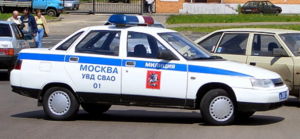 The Russian MVD was recreated as the MVD of the Russian SFSR in 1990, following the restoration of the republican Council of Ministers
and Supreme Soviet
, and remained when Russia gained independence from the Soviet Union
. It currently controls the Militsiya, the State Road Inspection Service (GAI
), and the Internal Troops
. Since the disbanding of the Tax Police, it also investigates economic crimes.
The long-time additional duties of the Imperial MVD and NKVD
, such as the Firefighting Service and Prisons Service, were recently moved to the Ministry of Emergency Situations and the Ministry of Justice respectively. The last reorganization abolished Main Directorates inherited from the NKVD
in favour of Departments. The current minister of internal affairs in Russia is Rashid Nurgaliyev
.
Throughout the first half of the 1990s, the Russian militsiya functioned with minimal funding, equipment, and support from the legal system. The inadequacy of the force became particularly apparent during the wave of organized crime
that began sweeping Russia after the beginning of perestroika
. Many highly qualified individuals moved from the militsiya into better-paying jobs in the field of private security, which has expanded to meet the demands of companies needing protection, while others joined the organized crime itself. Frequent taking of bribes among the remaining members of the militsiya has damaged the force's public credibility. Numerous revelations of participation by militsiya personnel in murders, prostitution
rings, information peddling, and tolerance of criminal acts have created a general public perception that all militsioners are at least taking bribes. Bribery of officers to avoid penalty
for traffic violations and petty crimes is a routine and expected occurrence, as well as torture
s and abusing of suspect
s in the custody. Up to 50-80% of suspects were reportedly tortured and beaten in order to extract a "confession."
In a 1995 poll of the public, only 5% of respondents expressed confidence in the ability of the militsiya to deal with crime in their city. Human rights
organizations have accused the Moscow
militsiya of racism in singling out non-Slavic individuals (especially immigrants from Russia's Caucasus
republics), physical attacks, unjustified detention, and other rights violations. In 1995 Minister of Internal Affairs Anatoliy Kulikov conducted a high-profile "Clean Hands Campaign" to purge the MVD of corrupt elements. In its first year, this limited operation caught several highly placed MVD officials collecting bribes, indicating a high level of corruption throughout the agency. According to experts, the main causes of corruption are insufficient funding to train and equip personnel and pay them adequate wages, poor work discipline, lack of accountability, and fear of reprisals from organized criminals.
 According to the country law, the militsiya ranks in Russia are classified as a "special ranks of the law-enforcement service" or "special ranks". Such a ranks are in general equal to the Russian military ranks. There are 3 types of the "special ranks":
- militsiya ranks (for Ministry of internal affairs (MVD) personnel working in the general-purpose militsiya service),
- justice ranks (equal to militsya but suffixed with "of justice") - for personnel of the MVD investigatory agency departments,
- internal service ranks (suffixed with "of internal service" - in general such personnel wear the Russian military uniform) - for the personnel of MVD, Ministry of Emergency Situations and civil defence, Peneciary service on the service of: fire guard, migration service, administrative function and other.
In some cases the personnel with the special ranks could be promoted into the military rank
. For example if the officer of militsiya is removing to the Internal Troops
. Another case: if it is necessary to promote the officer into the higher rank which is absent in militsiya ranks or in ranks of other special service.
The Day of Russian Militsiya is held on November 10. The results of a poll conducted on November 10, 2005, published by Izvestia
, show that 72% of people are afraid of militsiya because the militiamen are thought to often take illegal actions against innocent people. Another 2005 poll showed that 41% of the Russian population fears the militsiya more than organized crime (56% in Moscow).
In August 2010, President Dmitry Medvedev
introduced new legislation to reform and centralize the funding of the militsiya, as well as to officially change the militsiya's name to "Police" (the term which was used in the Russian Empire
). The change was performed on 1 March 2011.
and Belarusian governments. In the latter, in addition to the Militsiya, law enforcement is also the responsibility of other agencies such as the Presidential Guard
and the State Security Committee (KGB), all under the authority of the country's Ministry of Internal Affairs.
The term was also used in countries friendly to the Soviet Union such as Bulgaria
and the Federal Republic of Yugoslavia, although throughout the 1990s, the Yugoslav milicija was slowly phased out and replaced by policija (police). For example, in 2000, a standard Serbian police uniform may have either displayed the word Milicija (Милиција) or Policija (Полиција). Bulgaria changed the name of its law enforcement body to Policija in 1991. In Romania
the term was Miliţia or Miliţie, but after the communist regime fell, it was replaced by Poliţia
or Poliţie.
Police
The police is a personification of the state designated to put in practice the enforced law, protect property and reduce civil disorder in civilian matters. Their powers include the legitimized use of force...
in several former communist states, despite its original military
Military terminology
Military terminology refers to the terms and language of military organizations and personnel as belonging to a discrete category, as distinguishable by their usage in military doctrine, as they serve to depoliticise, dehumanise, or otherwise abstract discussion about its operations from an actual...
connotation (see militia
Militia
The term militia is commonly used today to refer to a military force composed of ordinary citizens to provide defense, emergency law enforcement, or paramilitary service, in times of emergency without being paid a regular salary or committed to a fixed term of service. It is a polyseme with...
). The term was used in the Soviet Union
Soviet Union
The Soviet Union , officially the Union of Soviet Socialist Republics , was a constitutionally socialist state that existed in Eurasia between 1922 and 1991....
, the Eastern Bloc
Eastern bloc
The term Eastern Bloc or Communist Bloc refers to the former communist states of Eastern and Central Europe, generally the Soviet Union and the countries of the Warsaw Pact...
and the Warsaw Pact
Warsaw Pact
The Warsaw Treaty Organization of Friendship, Cooperation, and Mutual Assistance , or more commonly referred to as the Warsaw Pact, was a mutual defense treaty subscribed to by eight communist states in Eastern Europe...
countries, as well as in the non-aligned SFR Yugoslavia, although it is still commonly used in the individual former Soviet republics and Eastern Europe.
Name and status
The name originates from a Provisional Government decree dated April 17, 1917, and from early Soviet history, when both the Provisional Government and the BolshevikBolshevik
The Bolsheviks, originally also Bolshevists , derived from bol'shinstvo, "majority") were a faction of the Marxist Russian Social Democratic Labour Party which split apart from the Menshevik faction at the Second Party Congress in 1903....
s intended to associate their new law enforcement authority with the self-organization of the people and to distinguish it from the czarist police. The militsiya was reaffirmed on October 28 (November 10, according to the new style dating
Old Style and New Style dates
Old Style and New Style are used in English language historical studies either to indicate that the start of the Julian year has been adjusted to start on 1 January even though documents written at the time use a different start of year ; or to indicate that a date conforms to the Julian...
), 1917 under the official name of the Workers' and Peasants' Militsiya, in further contrast to what the Bolsheviks called the "bourgeois class protecting" police
Police
The police is a personification of the state designated to put in practice the enforced law, protect property and reduce civil disorder in civilian matters. Their powers include the legitimized use of force...
. Eventually, it was replaced by the Ministry of Internal Affairs (Russian: МВД, MVD; Ukrainian: МВС, MVS; Belorussian: МУС, MUS), which is now the official full name for the militsiya forces in the respective countries. Its regional branches are officially called Departments of Internal Affairs—city department of internal affairs, raion
Raion
A raion is a type of administrative unit of several post-Soviet countries. The term, which is from French rayon 'honeycomb, department,' describes both a type of a subnational entity and a division of a city, and is commonly translated in English as "district"...
department of internal affairs, oblast
Oblast
Oblast is a type of administrative division in Slavic countries, including some countries of the former Soviet Union. The word "oblast" is a loanword in English, but it is nevertheless often translated as "area", "zone", "province", or "region"...
department of internal affairs, etc. The Russian term for a raion department is OVD (ОВД; Отдел/Отделение внутренних дел), for region department is UVD (УВД; Управление внутренних дел) or, sometimes, GUVD (ГУВД; Главное управление внутренних дел), same for national republics is MVD, (МВД; Министерство внутренних дел).
Functionally, Ministries of Internal Affairs are mostly police agencies. Their functions and organization differ significantly from similarly named departments in Western countries, which are usually civil executive
Executive (government)
Executive branch of Government is the part of government that has sole authority and responsibility for the daily administration of the state bureaucracy. The division of power into separate branches of government is central to the idea of the separation of powers.In many countries, the term...
bodies headed by politicians and responsible for many other tasks as well as the supervision of law enforcement. The Soviet and successor MVDs have usually been headed by a militsiya general
General
A general officer is an officer of high military rank, usually in the army, and in some nations, the air force. The term is widely used by many nations of the world, and when a country uses a different term, there is an equivalent title given....
and predominantly consist of service personnel, with civilian employees only filling auxiliary posts. Although such ministers are members of their respective countries' cabinet
Cabinet (government)
A Cabinet is a body of high ranking government officials, typically representing the executive branch. It can also sometimes be referred to as the Council of Ministers, an Executive Council, or an Executive Committee.- Overview :...
, they usually do not report to the prime minister
Prime minister
A prime minister is the most senior minister of cabinet in the executive branch of government in a parliamentary system. In many systems, the prime minister selects and may dismiss other members of the cabinet, and allocates posts to members within the government. In most systems, the prime...
and parliament
Parliament
A parliament is a legislature, especially in those countries whose system of government is based on the Westminster system modeled after that of the United Kingdom. The name is derived from the French , the action of parler : a parlement is a discussion. The term came to mean a meeting at which...
, but only to the president
President
A president is a leader of an organization, company, trade union, university, or country.Etymologically, a president is one who presides, who sits in leadership...
. Local militsiya departments are subordinated to their regional departments, having little accountability before local authorities.
Internal affairs
Internal affairs (law enforcement)
The internal affairs division of a law enforcement agency investigates incidents and plausible suspicions of lawbreaking and professional misconduct attributed to officers on the force...
units within the militsiya itself are usually called "internal security" departments.
The official names of particular militsiya bodies and services in post-Soviet countries are usually very complicated, hence the use of the short term militsiya. Law
Law
Law is a system of rules and guidelines which are enforced through social institutions to govern behavior, wherever possible. It shapes politics, economics and society in numerous ways and serves as a social mediator of relations between people. Contract law regulates everything from buying a bus...
s usually refer to police just as militsiya.
The short term for a police officer (regardless of gender) is militsioner (Russian: милиционер, Ukrainian: мiлiцiонер). Slang
Slang
Slang is the use of informal words and expressions that are not considered standard in the speaker's language or dialect but are considered more acceptable when used socially. Slang is often to be found in areas of the lexicon that refer to things considered taboo...
terms for militsioner include ment (plural: менты, menty) and musor (plural: мусора, musora). Although the latter word is offensive (it literally means "trash" or "garbage"), it originated from an acronym for the Moscow Criminal Investigations Department (МУС, short for Московский уголовный сыск) in Imperial Russia. Ment is a closely equivalent to the English slang term "cop" and has derived from the Lwów dialect
Lwów dialect
The Lwów dialect is a local variety of the Polish language characteristic of the inhabitants of the city of Lviv , now in Ukraine. Based on the substratum of the Malopolonia dialect, it was heavily influenced by borrowings from other languages spoken in Central Europe, notably German and Yiddish,...
.
General overview
GAI
GAI , short for State Automobile Inspectorate , are the Russian traffic police. They are responsible for the regulation of traffic, investigating traffic accidents, and manning the stop lights. GAI officers are called "GAI inspectors" in Russia...
, a traffic police
Traffic police
Traffic police or Traffic cops may refer to:*Police controlling traffic, see rules of the road*Traffic Cops, a BBC real-life documentary*Highway patrol*Road Policing Unit*Traffic Guard*Sri Lankan Traffic Police*Municipal police...
. Organized crime
Organized crime
Organized crime or criminal organizations are transnational, national, or local groupings of highly centralized enterprises run by criminals for the purpose of engaging in illegal activity, most commonly for monetary profit. Some criminal organizations, such as terrorist organizations, are...
detectives form highly independent squads inside regional militsiya. Some units may have the distinctive names (like OMON
OMON
OMOH is a generic name for the system of special units of militsiya within the Russian and earlier the Soviet MVD...
in Russia) which are more specific than militsiya or militsioner.
Militsiya personnel ranks mostly follow those of the Army - from private
Private (rank)
A Private is a soldier of the lowest military rank .In modern military parlance, 'Private' is shortened to 'Pte' in the United Kingdom and other Commonwealth countries and to 'Pvt.' in the United States.Notably both Sir Fitzroy MacLean and Enoch Powell are examples of, rare, rapid career...
(Rus: ryadovoy), which is the lowest rank, to colonel general
Colonel General
Colonel General is a senior rank of General. North Korea and Russia are two countries which have used the rank extensively throughout their histories...
- with only these exceptions: there are no ranks of Army General
Army General
For the army rank of General, as opposed to the specific rank of Army General, see General officer.Army General is a title used in many countries to denote the rank of General nominally commanding an army in the field...
and Marshal
Marshal
Marshal , is a word used in several official titles of various branches of society. The word is an ancient loan word from Old French, cf...
. Detective
Detective
A detective is an investigator, either a member of a police agency or a private person. The latter may be known as private investigators or "private eyes"...
s (Russian: operativnik short for operativniy rabotnik) hold a rank of lieutenant
Lieutenant
A lieutenant is a junior commissioned officer in many nations' armed forces. Typically, the rank of lieutenant in naval usage, while still a junior officer rank, is senior to the army rank...
at least and could be promoted to major
Major
Major is a rank of commissioned officer, with corresponding ranks existing in almost every military in the world.When used unhyphenated, in conjunction with no other indicator of rank, the term refers to the rank just senior to that of an Army captain and just below the rank of lieutenant colonel. ...
or the lieutenant colonel
Lieutenant colonel
Lieutenant colonel is a rank of commissioned officer in the armies and most marine forces and some air forces of the world, typically ranking above a major and below a colonel. The rank of lieutenant colonel is often shortened to simply "colonel" in conversation and in unofficial correspondence...
. The militsiya of an oblast
Oblast
Oblast is a type of administrative division in Slavic countries, including some countries of the former Soviet Union. The word "oblast" is a loanword in English, but it is nevertheless often translated as "area", "zone", "province", or "region"...
(or other equivalent subnational entity) is usually headed by a general. The rank name is suffixed with of militsiya (e.g. major of militsiya for a major
Major
Major is a rank of commissioned officer, with corresponding ranks existing in almost every military in the world.When used unhyphenated, in conjunction with no other indicator of rank, the term refers to the rank just senior to that of an Army captain and just below the rank of lieutenant colonel. ...
). Militsiya personnel carry firearm
Firearm
A firearm is a weapon that launches one, or many, projectile at high velocity through confined burning of a propellant. This subsonic burning process is technically known as deflagration, as opposed to supersonic combustion known as a detonation. In older firearms, the propellant was typically...
s, but are not permitted to carry their weapons when they are off duty.
Unlike in some other countries' police agencies, militsioners are not assigned permanent partners, but work alone or within larger groups. Neither street patrols nor detectives are allowed to drive police vehicles themselves, so a specialist driver (either a serviceman or a civil employee) is assigned to each car and is also in charge of its maintenance. GIBDD
GAI
GAI , short for State Automobile Inspectorate , are the Russian traffic police. They are responsible for the regulation of traffic, investigating traffic accidents, and manning the stop lights. GAI officers are called "GAI inspectors" in Russia...
(the traffic militsiya) is the only exception: its members drive their own (or even own private) cars and are specially trained in risk-driving.
One unique feature of militsiya policing approach is the system of territorial patronage over citizens. The cities, as well as the rural settlements are divided into uchastoks with a special uchastkovyi militsioner ("quarter policeman"), assigned to each. The main duty of uchastkovyi is to maintain close relations with the residents of his quarter and gather information among them. In particular, uchastkovyi should personally know each and every ex-convict, substance abuser, young hooligan etc. in given uchastok, and visit them regularly for preemptive influence. Uchastkovyi is also responsible for tackling minor offences like family violence, loud noise, residential area parking etc. Uchastkovyi is also the main, and actually the real, militsiya force in remote areas and small settlements where permanent police departments are not created. Uchastkovyi militsioners possess separate small offices within their quarters and maintain citizens admittance in definite weekdays.
This system slightly resembles the U.S. system of sheriff
Sheriff
A sheriff is in principle a legal official with responsibility for a county. In practice, the specific combination of legal, political, and ceremonial duties of a sheriff varies greatly from country to country....
s but shows some notable differences. Uchastkovyi is neither a chief police officer in a given community nor a universal one (not combining detective, incarceration or special tactics tasks).
The system of uchastkovyis dates back to imperial times
Russian Empire
The Russian Empire was a state that existed from 1721 until the Russian Revolution of 1917. It was the successor to the Tsardom of Russia and the predecessor of the Soviet Union...
when uriadniks were conducting lowest-level policing in rural areas. In Soviet Union, uchastkovyis were also responsible for such tasks as maintaining propiska
Propiska
Propiska was both a residence permit and migration recording tool in the Russian Empire before 1917 and from 1930s in the Soviet Union. It was documented in local police registers and certified with a stamp in internal passports....
limitations and overseeing former political prisoners, which were subject to daily registration at the local MVD office.
Although women constitute a significant proportion of militsiya staff, they are usually not permitted to fill positions that carry risks (such as patrolman, guard, SWAT), but are allowed to carry firearms for self-defense. Instead, they are widely represented among investigators, juvenile crime inspectors, clerks, etc. However, limited attempts are being made to appoint women as traffic officers or operativniks.
Conscripted police
Another unique militsiya feature is the use of conscriptedConscription
Conscription is the compulsory enlistment of people in some sort of national service, most often military service. Conscription dates back to antiquity and continues in some countries to the present day under various names...
soldiers from the Internal Troops
Internal Troops
The Internal Troops, full name Internal Troops of the Ministry for Internal Affairs ; alternatively translated as "Interior " is a paramilitary gendarmerie-like force in the now-defunct Soviet Union and its successor countries, particularly, in Russia, Ukraine, Georgia and Azerbaijan...
for regular urban policing. The Internal Troops are the gendarmerie
Gendarmerie
A gendarmerie or gendarmery is a military force charged with police duties among civilian populations. Members of such a force are typically called "gendarmes". The Shorter Oxford English Dictionary describes a gendarme as "a soldier who is employed on police duties" and a "gendarmery, -erie" as...
-like military force who can be assigned to carry out simple public security tasks like patrolling while being accompanied by professional militsioners, or cordoning large crowds at sport events, concerts, and protests. These soldiers possess no firearms on their policing duties, however they do have cold weapons; when called to perform riot control
Riot control
Riot control refers to the measures used by police, military, or other security forces to control, disperse, and arrest civilians who are involved in a riot, demonstration, or protest. Law enforcement officers or soldiers have long used non-lethal weapons such as batons and whips to disperse crowds...
duties, they are typically armed with riot batons
Baton (law enforcement)
A truncheon or baton is essentially a club of less than arm's length made of wood, plastic, or metal...
. The soldiers typically wear standard grey militsiya uniforms, however they are authorizrd to wear a green military uniform and will sometimes even wear armor vests and protective helmets on their policing duties.
While not on law enforcement duty, soldiers reside in barracks and maintain standard military training. ODON is a famous Internal Troops unit which is frequently used for policing Moscow
Moscow
Moscow is the capital, the most populous city, and the most populous federal subject of Russia. The city is a major political, economic, cultural, scientific, religious, financial, educational, and transportation centre of Russia and the continent...
; its soldiers can be spotted by a shoulder patch which features a white panther
Leopard
The leopard , Panthera pardus, is a member of the Felidae family and the smallest of the four "big cats" in the genus Panthera, the other three being the tiger, lion, and jaguar. The leopard was once distributed across eastern and southern Asia and Africa, from Siberia to South Africa, but its...
; other Internal troops units in the Moscow region use a shoulder patch with a white falcon.
Rank insignia
Until late 1936, the People's Militsiya and Internal TroopsInternal Troops
The Internal Troops, full name Internal Troops of the Ministry for Internal Affairs ; alternatively translated as "Interior " is a paramilitary gendarmerie-like force in the now-defunct Soviet Union and its successor countries, particularly, in Russia, Ukraine, Georgia and Azerbaijan...
of the NKVD
NKVD
The People's Commissariat for Internal Affairs was the public and secret police organization of the Soviet Union that directly executed the rule of power of the Soviets, including political repression, during the era of Joseph Stalin....
had no personal ranks, much akin to the Red Army
Red Army
The Workers' and Peasants' Red Army started out as the Soviet Union's revolutionary communist combat groups during the Russian Civil War of 1918-1922. It grew into the national army of the Soviet Union. By the 1930s the Red Army was among the largest armies in history.The "Red Army" name refers to...
, Red Navy, and OGPU, and used position-ranks. When personal ranks were reintroduced in the military in 1935, the Militsiya created a curious rank system that was a blend of standard military ranks such as Sergeant, Lieutenant, Capitan and Major, and old positional ranks like 'squad leader', 'inspector', and 'director', some with several grades like 'senior' or 'junior'. The collar rank insignia was completely original and not based on military insignia.
This system was largely reused by the GUGB in their special rank structure introduced in 1935, although with new rank insignia and Commissar
Commissar
Commissar is the English transliteration of an official title used in Russia from the time of Peter the Great.The title was used during the Provisional Government for regional heads of administration, but it is mostly associated with a number of Cheka and military functions in Bolshevik and Soviet...
-style ranks for top officers.
New insignia were issued to GUGB in 1937 and to Militsiya in 1939. It was now based on collar rank patches of the Red Army and Internal Troops. Confusingly, the special NKVD rank system was left intact, so for example Captain of Militsiya/State Security was assigned the three-box insignia of an army Colonel (in the Red Army, this patch was reassigned to Lieutenant Colonel in September 1939, but the NKVD did not alter their insignia) and Major of Militsiya/State Security was mapped to one-romb insignia of Kombrig (a brigade commander) (which was abolished for commanding officers of the Red Army in May 1940). This created a great deal of inconsistency and tension between army and NKVD/NKGB officers.
The NKVD rank system was streamlined in 1943 when imperial-style shoulder boards replaced the collar insignia patches. The ranks now copied those of the Soviet Army, with the exception of top officers starting with 'Senior Major' who were renamed Commissar
Commissar
Commissar is the English transliteration of an official title used in Russia from the time of Peter the Great.The title was used during the Provisional Government for regional heads of administration, but it is mostly associated with a number of Cheka and military functions in Bolshevik and Soviet...
of Militsiya 3rd, 2nd, and 1st rank, although they still wore army-style Major General, Lieutenant General and Colonel General shoulder boards.
The GUGB/NKGB maintained their commissar ranks until 1945, and switched to equivalent General ranks after that. Militsiya retained commissar ranks until 1973.
Some MVD officers had distinct ranks of General of the Internal Service of 1st, 2nd and 3rd rank; they were replaced with Major General, Lieutenant General and Colonel General in 1970s.
Ranks of militsiya are considered special ranks, not to be confused with military (all-forces) ranks, which are used by the internal troops of MVD. All militsiya ranks have the words "of militsiya" at the end, which are part of the rank name and not a descriptive addition.
Table of ranks and insignia of former Russian militsiya
{| width="100%" style="border:1px solid #8888aa; background-color:#FFFFFF; padding:5px; font-size:95%; margin: 0px 12px 12px 0px;"|- bgcolor="#CCCCCC"
!
! colspan="1" | Private Staff
! colspan="6" | Junior Supervising Staff
|- align="center" bgcolor="#efefef"
| Shoulder insignia
for every day uniform
|
|
|
|
|
|
|
|- align="center" valign="center"
|- align="center" bgcolor="#efefef"
| Rank
| Private
of militsiya
| Junior sergeant
of militsiya
| Sergeant
of militsiya
| Senior sergeant
of militsiya
| Starshina
of militsiya
| Praporshchik
Praporshchik
Praporshchik is a rank in the Russian military.-Imperial Russia:Praporshchik was originally a name of a junior commissioned officer rank in the military of the Russian Empire equivalent to ensign...
of militsiya
| Senior praporshchik
of militsiya
|- align="center" bgcolor="#efefef"
{| width="100%" style="border:1px solid #8888aa; background-color:#FFFFFF; padding:5px; font-size:95%; margin: 0px 12px 12px 0px;"
|- bgcolor="#CCCCCC"
|}
{| width="100%" style="border:1px solid #8888aa; background-color:#FFFFFF; padding:5px; font-size:95%; margin: 0px 12px 12px 0px;"
|- bgcolor="#CCCCCC"
!
! colspan="4" | Medium Supervising Staff
! colspan="3" | Senior Supervising Staff
! colspan="4" | Supreme Supervising Staff
|- align="center" bgcolor="#efefef"
| Shoulder insignia
for every day uniform
|
|
|
|
|
|
|
|
|
|
|- align="center" valign="center"
|- align="center" bgcolor="#efefef"
| Rank
|Junior lieutenant
of militsiya
|Lieutenant
of militsiya
|Senior lieutenant
of militsiya
|Captain
of militsiya
|Major
of militsiya
|Lieutenant colonel
of militsiya
|Colonel
of militsiya
|Major General
of militsiya
|Lieutenant General
of militsiya
|Colonel General
of militsiya
|- align="center" bgcolor="#efefef"
|- bgcolor="#CCCCCC"
|}
Non-police services of the MVD
The Soviet and some post-Soviet Ministries of Internal AffairsRussian Ministry of Internal Affairs
The Ministerstvo Vnutrennikh Del is the interior ministry of Russia. Its predecessor was founded in 1802 by Alexander I in Imperial Russia...
have also included:
- militarizedMilitaryA military is an organization authorized by its greater society to use lethal force, usually including use of weapons, in defending its country by combating actual or perceived threats. The military may have additional functions of use to its greater society, such as advancing a political agenda e.g...
forces ( "Internal TroopsInternal TroopsThe Internal Troops, full name Internal Troops of the Ministry for Internal Affairs ; alternatively translated as "Interior " is a paramilitary gendarmerie-like force in the now-defunct Soviet Union and its successor countries, particularly, in Russia, Ukraine, Georgia and Azerbaijan...
); - department of prisonPrisonA prison is a place in which people are physically confined and, usually, deprived of a range of personal freedoms. Imprisonment or incarceration is a legal penalty that may be imposed by the state for the commission of a crime...
s (i.e. GULAGGulagThe Gulag was the government agency that administered the main Soviet forced labor camp systems. While the camps housed a wide range of convicts, from petty criminals to political prisoners, large numbers were convicted by simplified procedures, such as NKVD troikas and other instruments of...
and its successor bodies), if not merged with other ministries or agencies; - firefightingFirefighterFirefighters are rescuers extensively trained primarily to put out hazardous fires that threaten civilian populations and property, to rescue people from car incidents, collapsed and burning buildings and other such situations...
service, if not merged with Emergency Ministry; - passportPassportA passport is a document, issued by a national government, which certifies, for the purpose of international travel, the identity and nationality of its holder. The elements of identity are name, date of birth, sex, and place of birth....
and registration service, if not merged with Migration service.
These non-police services should be distinguished from the militsiya itself, except passport and registration service, which structures are often included into OVD and sometimes considered as one of the important militsiya services. Their members have always used different generic names and specific ranks (e.g. Major of the Internal Service, rather than Major of Militsiya).
Militsiya in the Russian Federation
Russian Council of Ministers
The Russian Council of Ministers is an executive governmental body that brings together the principal officers of the Executive Branch of the Russian government.- Committee of Ministers :...
and Supreme Soviet
Supreme Soviet of Russia
The Supreme Soviet of the Russian SFSR , later Supreme Soviet of the Russian Federation was the supreme government institution of the Russian SFSR in 1938–1990; in 1990–1993 it was a permanent parliament, elected by the Congress of People's Deputies of the Russian Federation.The Supreme Soviet of...
, and remained when Russia gained independence from the Soviet Union
Soviet Union
The Soviet Union , officially the Union of Soviet Socialist Republics , was a constitutionally socialist state that existed in Eurasia between 1922 and 1991....
. It currently controls the Militsiya, the State Road Inspection Service (GAI
GAI
GAI , short for State Automobile Inspectorate , are the Russian traffic police. They are responsible for the regulation of traffic, investigating traffic accidents, and manning the stop lights. GAI officers are called "GAI inspectors" in Russia...
), and the Internal Troops
Internal Troops
The Internal Troops, full name Internal Troops of the Ministry for Internal Affairs ; alternatively translated as "Interior " is a paramilitary gendarmerie-like force in the now-defunct Soviet Union and its successor countries, particularly, in Russia, Ukraine, Georgia and Azerbaijan...
. Since the disbanding of the Tax Police, it also investigates economic crimes.
The long-time additional duties of the Imperial MVD and NKVD
NKVD
The People's Commissariat for Internal Affairs was the public and secret police organization of the Soviet Union that directly executed the rule of power of the Soviets, including political repression, during the era of Joseph Stalin....
, such as the Firefighting Service and Prisons Service, were recently moved to the Ministry of Emergency Situations and the Ministry of Justice respectively. The last reorganization abolished Main Directorates inherited from the NKVD
NKVD
The People's Commissariat for Internal Affairs was the public and secret police organization of the Soviet Union that directly executed the rule of power of the Soviets, including political repression, during the era of Joseph Stalin....
in favour of Departments. The current minister of internal affairs in Russia is Rashid Nurgaliyev
Rashid Nurgaliyev
Rashid Gumarovich Nurgaliyev is a Russian general and politician of the Tatars descent. Since 2002, he has been the minister of the Internal Affairs of Russia.-Early years:...
.
Throughout the first half of the 1990s, the Russian militsiya functioned with minimal funding, equipment, and support from the legal system. The inadequacy of the force became particularly apparent during the wave of organized crime
Organized crime
Organized crime or criminal organizations are transnational, national, or local groupings of highly centralized enterprises run by criminals for the purpose of engaging in illegal activity, most commonly for monetary profit. Some criminal organizations, such as terrorist organizations, are...
that began sweeping Russia after the beginning of perestroika
Perestroika
Perestroika was a political movement within the Communist Party of the Soviet Union during 1980s, widely associated with the Soviet leader Mikhail Gorbachev...
. Many highly qualified individuals moved from the militsiya into better-paying jobs in the field of private security, which has expanded to meet the demands of companies needing protection, while others joined the organized crime itself. Frequent taking of bribes among the remaining members of the militsiya has damaged the force's public credibility. Numerous revelations of participation by militsiya personnel in murders, prostitution
Prostitution
Prostitution is the act or practice of providing sexual services to another person in return for payment. The person who receives payment for sexual services is called a prostitute and the person who receives such services is known by a multitude of terms, including a "john". Prostitution is one of...
rings, information peddling, and tolerance of criminal acts have created a general public perception that all militsioners are at least taking bribes. Bribery of officers to avoid penalty
Sentence (law)
In law, a sentence forms the final explicit act of a judge-ruled process, and also the symbolic principal act connected to his function. The sentence can generally involve a decree of imprisonment, a fine and/or other punishments against a defendant convicted of a crime...
for traffic violations and petty crimes is a routine and expected occurrence, as well as torture
Torture
Torture is the act of inflicting severe pain as a means of punishment, revenge, forcing information or a confession, or simply as an act of cruelty. Throughout history, torture has often been used as a method of political re-education, interrogation, punishment, and coercion...
s and abusing of suspect
Suspect
In the parlance of criminal justice, a suspect is a known person suspected of committing a crime.Police and reporters often incorrectly use the word suspect when referring to the...
s in the custody. Up to 50-80% of suspects were reportedly tortured and beaten in order to extract a "confession."
In a 1995 poll of the public, only 5% of respondents expressed confidence in the ability of the militsiya to deal with crime in their city. Human rights
Human rights
Human rights are "commonly understood as inalienable fundamental rights to which a person is inherently entitled simply because she or he is a human being." Human rights are thus conceived as universal and egalitarian . These rights may exist as natural rights or as legal rights, in both national...
organizations have accused the Moscow
Moscow
Moscow is the capital, the most populous city, and the most populous federal subject of Russia. The city is a major political, economic, cultural, scientific, religious, financial, educational, and transportation centre of Russia and the continent...
militsiya of racism in singling out non-Slavic individuals (especially immigrants from Russia's Caucasus
Caucasus
The Caucasus, also Caucas or Caucasia , is a geopolitical region at the border of Europe and Asia, and situated between the Black and the Caspian sea...
republics), physical attacks, unjustified detention, and other rights violations. In 1995 Minister of Internal Affairs Anatoliy Kulikov conducted a high-profile "Clean Hands Campaign" to purge the MVD of corrupt elements. In its first year, this limited operation caught several highly placed MVD officials collecting bribes, indicating a high level of corruption throughout the agency. According to experts, the main causes of corruption are insufficient funding to train and equip personnel and pay them adequate wages, poor work discipline, lack of accountability, and fear of reprisals from organized criminals.
- militsiya ranks (for Ministry of internal affairs (MVD) personnel working in the general-purpose militsiya service),
- justice ranks (equal to militsya but suffixed with "of justice") - for personnel of the MVD investigatory agency departments,
- internal service ranks (suffixed with "of internal service" - in general such personnel wear the Russian military uniform) - for the personnel of MVD, Ministry of Emergency Situations and civil defence, Peneciary service on the service of: fire guard, migration service, administrative function and other.
In some cases the personnel with the special ranks could be promoted into the military rank
Military rank
Military rank is a system of hierarchical relationships in armed forces or civil institutions organized along military lines. Usually, uniforms denote the bearer's rank by particular insignia affixed to the uniforms...
. For example if the officer of militsiya is removing to the Internal Troops
Internal Troops
The Internal Troops, full name Internal Troops of the Ministry for Internal Affairs ; alternatively translated as "Interior " is a paramilitary gendarmerie-like force in the now-defunct Soviet Union and its successor countries, particularly, in Russia, Ukraine, Georgia and Azerbaijan...
. Another case: if it is necessary to promote the officer into the higher rank which is absent in militsiya ranks or in ranks of other special service.
The Day of Russian Militsiya is held on November 10. The results of a poll conducted on November 10, 2005, published by Izvestia
Izvestia
Izvestia is a long-running high-circulation daily newspaper in Russia. The word "izvestiya" in Russian means "delivered messages", derived from the verb izveshchat . In the context of newspapers it is usually translated as "news" or "reports".-Origin:The newspaper began as the News of the...
, show that 72% of people are afraid of militsiya because the militiamen are thought to often take illegal actions against innocent people. Another 2005 poll showed that 41% of the Russian population fears the militsiya more than organized crime (56% in Moscow).
In August 2010, President Dmitry Medvedev
Dmitry Medvedev
Dmitry Anatolyevich Medvedev is the third President of the Russian Federation.Born to a family of academics, Medvedev graduated from the Law Department of Leningrad State University in 1987. He defended his dissertation in 1990 and worked as a docent at his alma mater, now renamed to Saint...
introduced new legislation to reform and centralize the funding of the militsiya, as well as to officially change the militsiya's name to "Police" (the term which was used in the Russian Empire
Russian Empire
The Russian Empire was a state that existed from 1721 until the Russian Revolution of 1917. It was the successor to the Tsardom of Russia and the predecessor of the Soviet Union...
). The change was performed on 1 March 2011.
Other countries
The term Militsiya is used in the countries of the former Soviet Union, as well as those of the former Eastern Bloc. Its usage, for example, is maintained by the UkrainianMinistry of Internal Affairs of Ukraine
The Ministry of Internal Affairs of Ukraine is the main body in the system of central bodies of exeecutive power that provides formation and realization of the state policy in the sphere of protection the rights and liberties of citizens, unlawful acts against the interest of society and state,...
and Belarusian governments. In the latter, in addition to the Militsiya, law enforcement is also the responsibility of other agencies such as the Presidential Guard
Presidential Guard (Belarus)
The Belarusian Presidential Guard or officially the Presidential Security Service is a law-enforcement body that was designed to protect the President of Belarus and other high ranking officials and officers.However, the United States State Department stated that the Presidential Guard is a secret...
and the State Security Committee (KGB), all under the authority of the country's Ministry of Internal Affairs.
The term was also used in countries friendly to the Soviet Union such as Bulgaria
Bulgaria
Bulgaria , officially the Republic of Bulgaria , is a parliamentary democracy within a unitary constitutional republic in Southeast Europe. The country borders Romania to the north, Serbia and Macedonia to the west, Greece and Turkey to the south, as well as the Black Sea to the east...
and the Federal Republic of Yugoslavia, although throughout the 1990s, the Yugoslav milicija was slowly phased out and replaced by policija (police). For example, in 2000, a standard Serbian police uniform may have either displayed the word Milicija (Милиција) or Policija (Полиција). Bulgaria changed the name of its law enforcement body to Policija in 1991. In Romania
Romania
Romania is a country located at the crossroads of Central and Southeastern Europe, on the Lower Danube, within and outside the Carpathian arch, bordering on the Black Sea...
the term was Miliţia or Miliţie, but after the communist regime fell, it was replaced by Poliţia
Romanian Police
The Romanian Police is the national police force and main civil law enforcement agency in Romania. It is subordinated to the Ministry of Interior and Administrative Reform.-Duties:The Romanian Police are responsible for:...
or Poliţie.
See also
- Voluntary People's DruzhinaVoluntary People's DruzhinaVoluntary People's Druzhina variously translated as Voluntary People’s Guard, People’s Volunteer Squads, People's Volunteer Militia, etc. were voluntary detachments for maintaining public order in the Soviet Union similar to the Neighborhood Watch...
- ODON of the Internal TroopsInternal TroopsThe Internal Troops, full name Internal Troops of the Ministry for Internal Affairs ; alternatively translated as "Interior " is a paramilitary gendarmerie-like force in the now-defunct Soviet Union and its successor countries, particularly, in Russia, Ukraine, Georgia and Azerbaijan...
- OMONOMONOMOH is a generic name for the system of special units of militsiya within the Russian and earlier the Soviet MVD...
- Milicja ObywatelskaMilicja ObywatelskaMilicja Obywatelska was a state police institution in the People's Republic of Poland. It was created in 1944 by Soviet-sponsored PKWN, effectively replacing the pre-war police force. In 1990 it was transformed back into Policja....
, police in People's Republic of PolandPeople's Republic of PolandThe People's Republic of Poland was the official name of Poland from 1952 to 1990. Although the Soviet Union took control of the country immediately after the liberation from Nazi Germany in 1944, the name of the state was not changed until eight years later...
, with similar name
Further reading
- Shelley, Louise I. Policing Soviet Society: The Evolution of State Control. London: Routledge, 1996.