


University

Encyclopedia
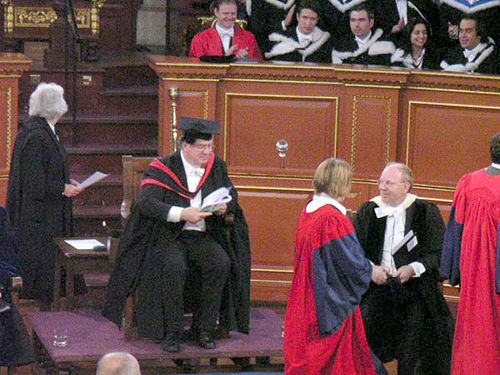
Higher education
Higher, post-secondary, tertiary, or third level education refers to the stage of learning that occurs at universities, academies, colleges, seminaries, and institutes of technology...
and research
Research
Research can be defined as the scientific search for knowledge, or as any systematic investigation, to establish novel facts, solve new or existing problems, prove new ideas, or develop new theories, usually using a scientific method...
, which grants academic degree
Academic degree
An academic degree is a position and title within a college or university that is usually awarded in recognition of the recipient having either satisfactorily completed a prescribed course of study or having conducted a scholarly endeavour deemed worthy of his or her admission to the degree...
s in a variety of subjects. A university is an organisation that provides both undergraduate education
Undergraduate education
Undergraduate education is an education level taken prior to gaining a first degree . Hence, in many subjects in many educational systems, undergraduate education is post-secondary education up to the level of a bachelor's degree, such as in the United States, where a university entry level is...
and postgraduate education
Postgraduate education
Postgraduate education involves learning and studying for degrees or other qualifications for which a first or Bachelor's degree generally is required, and is normally considered to be part of higher education...
. The word university is derived from the Latin
Latin
Latin is an Italic language originally spoken in Latium and Ancient Rome. It, along with most European languages, is a descendant of the ancient Proto-Indo-European language. Although it is considered a dead language, a number of scholars and members of the Christian clergy speak it fluently, and...
universitas magistrorum et scholarium, which roughly means "community of teachers and scholars
Academia
Academia is the community of students and scholars engaged in higher education and research.-Etymology:The word comes from the akademeia in ancient Greece. Outside the city walls of Athens, the gymnasium was made famous by Plato as a center of learning...
."
History
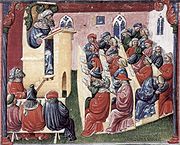
Definition
The original LatinLatin
Latin is an Italic language originally spoken in Latium and Ancient Rome. It, along with most European languages, is a descendant of the ancient Proto-Indo-European language. Although it is considered a dead language, a number of scholars and members of the Christian clergy speak it fluently, and...
word "universitas" was used at the time of emergence of urban town life and medieval guild
Guild
A guild is an association of craftsmen in a particular trade. The earliest types of guild were formed as confraternities of workers. They were organized in a manner something between a trade union, a cartel, and a secret society...
s, to describe specialised "associations of students and teachers with collective legal rights usually guaranteed by charters issued by princes, prelates, or the towns in which they were located." The original Latin word referred to degree-granting institutions of learning in Western Europe
Western Europe
Western Europe is a loose term for the collection of countries in the western most region of the European continents, though this definition is context-dependent and carries cultural and political connotations. One definition describes Western Europe as a geographic entity—the region lying in the...
, where this form of legal organisation was prevalent, and from where the institution spread around the world. For non-related educational institutions of antiquity which did not stand in the tradition of the university and to which the term is only loosely and retrospectively applied, see ancient higher-learning institutions
Ancient higher-learning institutions
Ancient higher-learning institutions which give learning an institutional framework date back to ancient times and can be found in many cultures. These ancient centres were typically institutions of philosophical education and religious instruction...
.
Academic freedom
An important idea in the definition of a university is the notion of academic freedomAcademic freedom
Academic freedom is the belief that the freedom of inquiry by students and faculty members is essential to the mission of the academy, and that scholars should have freedom to teach or communicate ideas or facts without being targeted for repression, job loss, or imprisonment.Academic freedom is a...
. The first documentary evidence of this comes from early in the life of the first university. The University of Bologna
University of Bologna
The Alma Mater Studiorum - University of Bologna is the oldest continually operating university in the world, the word 'universitas' being first used by this institution at its foundation. The true date of its founding is uncertain, but believed by most accounts to have been 1088...
adopted an academic charter, the Constitutio Habit
Authentica habita
The Authentica Habita was a document written in 1155 by the Emperor Frederick I Barbarossa. In it, he set out for the first time some of the rules, rights and privileges of Universities...
a, in 1158 or 1155, which guaranteed the right of a traveling scholar to unhindered passage in the interests of education. Today this is claimed as the origin of "academic freedom". This is now widely recognised internationally - on 18 September 1988 430 university rectors signed the Magna Charta Universitatum, marking the 900th anniversary of Bologna's foundation. The number of universities signing the Magna Charta Universitatum continues to grow, drawing from all parts of the world.
Medieval universities
Prior to their formal establishment, many medieval universities were run for hundreds of years as ChristianChristianity
Christianity is a monotheistic religion based on the life and teachings of Jesus as presented in canonical gospels and other New Testament writings...
cathedral school
Cathedral school
Cathedral schools began in the Early Middle Ages as centers of advanced education, some of them ultimately evolving into medieval universities. Throughout the Middle Ages and beyond, they were complemented by the monastic schools...
s or monastic school
Monastic school
Monastic schools were, along with cathedral schools, the most important institutions of higher learning in the Latin West from the early Middle Ages until the 12th century. Since Cassiodorus's educational program, the standard curriculum incorporated religious studies, the Trivium, and the...
s (Scholae monasticae), in which monk
Monk
A monk is a person who practices religious asceticism, living either alone or with any number of monks, while always maintaining some degree of physical separation from those not sharing the same purpose...
s and nun
Nun
A nun is a woman who has taken vows committing her to live a spiritual life. She may be an ascetic who voluntarily chooses to leave mainstream society and live her life in prayer and contemplation in a monastery or convent...
s taught classes; evidence of these immediate forerunners of the later university at many places dates back to the 6th century AD. The earliest universities were developed under the aegis of the Latin Church
Latin Church
The Latin Church is the largest particular church within the Catholic Church. It is a particular church not on the level of the local particular churches known as dioceses or eparchies, but on the level of autonomous ritual churches, of which there are 23, the remaining 22 of which are Eastern...
, usually from cathedral schools or by papal bull
Papal bull
A Papal bull is a particular type of letters patent or charter issued by a Pope of the Catholic Church. It is named after the bulla that was appended to the end in order to authenticate it....
as studia generalia
Studium Generale
Studium generale is the old customary name for a Medieval university.- Definition :There is no clear official definition of what constituted a Studium generale...
(n.b. The development of cathedral schools into universities actually appears to be quite rare, with the University of Paris being an exception — see Leff, Paris and Oxford Universities), later they were also founded by Kings (University of Naples Federico II
University of Naples Federico II
The University of Naples Federico II is a university located in Naples, Italy. It was founded in 1224 and is organized into 13 faculties. It is the world's oldest state university and one of the oldest academic institutions in continuous operation...
, Charles University in Prague
Charles University in Prague
Charles University in Prague is the oldest and largest university in the Czech Republic. Founded in 1348, it was the first university in Central Europe and is also considered the earliest German university...
, Jagiellonian University in Kraków
Jagiellonian University
The Jagiellonian University was established in 1364 by Casimir III the Great in Kazimierz . It is the oldest university in Poland, the second oldest university in Central Europe and one of the oldest universities in the world....
) or municipal administrations (University of Cologne
University of Cologne
The University of Cologne is one of the oldest universities in Europe and, with over 44,000 students, one of the largest universities in Germany. The university is part of the Deutsche Forschungsgemeinschaft, an association of Germany's leading research universities...
, University of Erfurt
University of Erfurt
The University of Erfurt is a public university located in Erfurt, Germany. Originally founded in 1379, the university was closed in 1816 for the next 177 years...
). In the early medieval period
Early Middle Ages
The Early Middle Ages was the period of European history lasting from the 5th century to approximately 1000. The Early Middle Ages followed the decline of the Western Roman Empire and preceded the High Middle Ages...
, most new universities were founded from pre-existing schools, usually when these schools were deemed to have become primarily sites of higher education. Many historians state that universities and cathedral schools were a continuation of the interest in learning promoted by monasteries.
The first universities with formally established guilds in Europe were the University of Bologna
University of Bologna
The Alma Mater Studiorum - University of Bologna is the oldest continually operating university in the world, the word 'universitas' being first used by this institution at its foundation. The true date of its founding is uncertain, but believed by most accounts to have been 1088...
(1088), the University of Paris
University of Paris
The University of Paris was a university located in Paris, France and one of the earliest to be established in Europe. It was founded in the mid 12th century, and officially recognized as a university probably between 1160 and 1250...
(c. 1150, later associated with the Sorbonne
Sorbonne
The Sorbonne is an edifice of the Latin Quarter, in Paris, France, which has been the historical house of the former University of Paris...
), the University of Oxford
University of Oxford
The University of Oxford is a university located in Oxford, United Kingdom. It is the second-oldest surviving university in the world and the oldest in the English-speaking world. Although its exact date of foundation is unclear, there is evidence of teaching as far back as 1096...
(1167), the University of Palencia
University of Palencia
The University of Palencia was founded by Alfonso VIII at the request of Bishop Tello Téllez de Meneses and was the first university of Spain. It was the model upon which was patterned the University of Salamanca....
(1208), the University of Cambridge
University of Cambridge
The University of Cambridge is a public research university located in Cambridge, United Kingdom. It is the second-oldest university in both the United Kingdom and the English-speaking world , and the seventh-oldest globally...
(1209), the University of Salamanca
University of Salamanca
The University of Salamanca is a Spanish higher education institution, located in the town of Salamanca, west of Madrid. It was founded in 1134 and given the Royal charter of foundation by King Alfonso IX in 1218. It is the oldest founded university in Spain and the third oldest European...
(1218), the University of Montpellier
University of Montpellier
The University of Montpellier was a French university in Montpellier in the Languedoc-Roussillon région of the south of France. Its present-day successor universities are the University of Montpellier 1, Montpellier 2 University and Paul Valéry University, Montpellier III.-History:The university...
(1220), the University of Padua
University of Padua
The University of Padua is a premier Italian university located in the city of Padua, Italy. The University of Padua was founded in 1222 as a school of law and was one of the most prominent universities in early modern Europe. It is among the earliest universities of the world and the second...
(1222), the University of Naples Federico II
University of Naples Federico II
The University of Naples Federico II is a university located in Naples, Italy. It was founded in 1224 and is organized into 13 faculties. It is the world's oldest state university and one of the oldest academic institutions in continuous operation...
(1224), the University of Toulouse
University of Toulouse
The Université de Toulouse is a consortium of French universities, grandes écoles and other institutions of higher education and research, named after one of the earliest universities established in Europe in 1229, and including the successor universities to that earlier university...
(1229)., the University of Siena
University of Siena
The University of Siena in Siena, Tuscany is one of the oldest and first publicly funded universities in Italy. Originally called Studium Senese, the University of Siena was founded in 1240. The University has around 20,000 students, nearly half of Siena's total population of around 54,000...
(1240).
The University of Bologna began as a law school teaching the ius gentium
Jus gentium
Ius gentium, Latin for "law of nations", was originally the part of Roman law that the Roman Empire applied to its dealings with foreigners, especially provincial subjects...
or Roman law of peoples which was in demand across Europe for those defending the right of incipient nations against empire and church. Bologna’s special claim to Alma Mater Studiorum is based on its autonomy, its awarding of degrees, and other structural arrangements, making it the oldest continuously operating institution independent of kings, emperors or any kind of direct religious authority.
The conventional date of 1088, or 1087 according to some, records when a certain Irnerius
Irnerius
Irnerius , sometimes referred to as lucerna juris , was an Italian jurist, and founder of the School of Glossators and thus of the tradition of Medieval Roman Law....
commences teaching Emperor Justinian’s 6th century codification of Roman law, the Corpus Iuris Civilis, recently discovered at Pisa. Lay students arrived in the city from many lands entering into a contract to gain this knowledge, organising themselves into ‘Learning Nations’ of Hungarians, Greeks, North Africans, Arabs, Franks, Germans, Iberians etc. The students “had all the power … and dominated the masters”.
In Europe, young men proceeded to university when they had completed their study of the trivium–the preparatory arts of grammar
Grammar
In linguistics, grammar is the set of structural rules that govern the composition of clauses, phrases, and words in any given natural language. The term refers also to the study of such rules, and this field includes morphology, syntax, and phonology, often complemented by phonetics, semantics,...
, rhetoric
Rhetoric
Rhetoric is the art of discourse, an art that aims to improve the facility of speakers or writers who attempt to inform, persuade, or motivate particular audiences in specific situations. As a subject of formal study and a productive civic practice, rhetoric has played a central role in the Western...
and dialectic
Dialectic
Dialectic is a method of argument for resolving disagreement that has been central to Indic and European philosophy since antiquity. The word dialectic originated in Ancient Greece, and was made popular by Plato in the Socratic dialogues...
or logic
Logic
In philosophy, Logic is the formal systematic study of the principles of valid inference and correct reasoning. Logic is used in most intellectual activities, but is studied primarily in the disciplines of philosophy, mathematics, semantics, and computer science...
–and the quadrivium
Quadrivium
The quadrivium comprised the four subjects, or arts, taught in medieval universities, after teaching the trivium. The word is Latin, meaning "the four ways" , and its use for the 4 subjects has been attributed to Boethius or Cassiodorus in the 6th century...
: arithmetic
Arithmetic
Arithmetic or arithmetics is the oldest and most elementary branch of mathematics, used by almost everyone, for tasks ranging from simple day-to-day counting to advanced science and business calculations. It involves the study of quantity, especially as the result of combining numbers...
, geometry
Geometry
Geometry arose as the field of knowledge dealing with spatial relationships. Geometry was one of the two fields of pre-modern mathematics, the other being the study of numbers ....
, music
Music
Music is an art form whose medium is sound and silence. Its common elements are pitch , rhythm , dynamics, and the sonic qualities of timbre and texture...
, and astronomy
Astronomy
Astronomy is a natural science that deals with the study of celestial objects and phenomena that originate outside the atmosphere of Earth...
. (See Degrees of the University of Oxford for the history of how the trivium and quadrivium developed in relation to degrees, especially in anglophone
English-speaking world
The English-speaking world consists of those countries or regions that use the English language to one degree or another. For more information, please see:Lists:* List of countries by English-speaking population...
universities).
Universities became popular all over Europe, as rulers and city governments began to create them to satisfy a European thirst for knowledge, and the belief that society would benefit from the scholarly expertise generated from these institutions. Princes and leaders of city governments perceived the potential benefit of having a scholarly expertise develop with the ability to address difficult problems and achieve desired ends. The emergence of humanism was essential to this understanding of the possible utility of universities as well as the revival of interest in knowledge gained from ancient Greek texts.
The rediscovery of Aristotle
Aristotle
Aristotle was a Greek philosopher and polymath, a student of Plato and teacher of Alexander the Great. His writings cover many subjects, including physics, metaphysics, poetry, theater, music, logic, rhetoric, linguistics, politics, government, ethics, biology, and zoology...
's works - more than 3000 pages of it would eventually be translated - fuelled a spirit of inquiry into natural processes that had already begun to emerge in the 12th century. Some scholars believe that these works represented one of the most important document discoveries in Western intellectual history. Richard Dales, for instance, calls the discovery of Aristotle's works “a turning point in the history of Western thought." After Aristotle re-emerged, a community of scholars, primarily communicating in Latin, accelerated the process and practice of attempting to reconcile the thoughts of Greek antiquity, and especially ideas related to understanding the natural world, with those of the church. The efforts of this “scholasticism
Scholasticism
Scholasticism is a method of critical thought which dominated teaching by the academics of medieval universities in Europe from about 1100–1500, and a program of employing that method in articulating and defending orthodoxy in an increasingly pluralistic context...
” were focused on applying Aristotelian logic and thoughts about natural processes to biblical passages and attempting to prove the viability of those passages through reason. This became the primary mission of lecturers, and the expectation of students.
The university culture developed differently in northern Europe than it did in the south, although the northern (primarily Germany, France and Great Britain) and southern universities (primarily Italy) did have many elements in common. Latin was the language of the university, used for all texts, lectures, disputation
Disputation
In the scholastic system of education of the Middle Ages, disputations offered a formalized method of debate designed to uncover and establish truths in theology and in sciences...
s and examinations. Professors lectured on the books of Aristotle for logic, natural philosophy
Natural philosophy
Natural philosophy or the philosophy of nature , is a term applied to the study of nature and the physical universe that was dominant before the development of modern science...
, and metaphysics
Metaphysics
Metaphysics is a branch of philosophy concerned with explaining the fundamental nature of being and the world, although the term is not easily defined. Traditionally, metaphysics attempts to answer two basic questions in the broadest possible terms:...
; while Hippocrates
Hippocrates
Hippocrates of Cos or Hippokrates of Kos was an ancient Greek physician of the Age of Pericles , and is considered one of the most outstanding figures in the history of medicine...
, Galen
Galen
Aelius Galenus or Claudius Galenus , better known as Galen of Pergamon , was a prominent Roman physician, surgeon and philosopher...
, and Avicenna
Avicenna
Abū ʿAlī al-Ḥusayn ibn ʿAbd Allāh ibn Sīnā , commonly known as Ibn Sīnā or by his Latinized name Avicenna, was a Persian polymath, who wrote almost 450 treatises on a wide range of subjects, of which around 240 have survived...
were used for medicine. Outside of these commonalities, great differences separated north and south, primarily in subject matter. Italian universities focused on law and medicine, while the northern universities focused on the arts and theology. There were distinct differences in the quality of instruction in these areas which were congruent with their focus, so scholars would travel north or south based on their interests and means. There was also a difference in the types of degrees awarded at these universities. English, French and German universities usually awarded bachelor's degrees, with the exception of degrees in theology, for which the doctorate was more common. Italian universities awarded primarily doctorates. The distinction can be attributed to the intent of the degree holder after graduation – in the north the focus tended to be on acquiring teaching positions, while in the south students often went on to professional positions. The structure of Northern Universities tended to be modeled after the system of faculty governance developed at the University of Paris. Southern universities tended to be patterned after the student-controlled model begun at the University of Bologna.
Although the university is widely regarded as "the European institution par excellence" in terms of its origins and characteristics, some scholars have argued that early medieval universities were influenced by the religious Madrasah
Madrasah
Madrasah is the Arabic word for any type of educational institution, whether secular or religious...
schools in Al-Andalus
Al-Andalus
Al-Andalus was the Arabic name given to a nation and territorial region also commonly referred to as Moorish Iberia. The name describes parts of the Iberian Peninsula and Septimania governed by Muslims , at various times in the period between 711 and 1492, although the territorial boundaries...
, the Emirate of Sicily
Emirate of Sicily
The Emirate of Sicily was an Islamic state on the island of Sicily , which existed from 965 to 1072.-First Arab invasions of Sicily:...
, and the Middle East (during the Crusades
Crusades
The Crusades were a series of religious wars, blessed by the Pope and the Catholic Church with the main goal of restoring Christian access to the holy places in and near Jerusalem...
). Other scholars oppose this view and argue that there is no actual evidence of the transmission of Arab scholarly methods discernible in medieval universities.
Early Modern universities
During the Early Modern periodEarly modern period
In history, the early modern period of modern history follows the late Middle Ages. Although the chronological limits of the period are open to debate, the timeframe spans the period after the late portion of the Middle Ages through the beginning of the Age of Revolutions...
(approximately late 1400s to 1800), the universities of Europe would see a tremendous amount of growth, productivity and innovative research. At the end of the Middle Ages, about 400 years after the first university was founded, there were twenty-nine universities spread throughout Europe. In the 15th century, twenty-eight new ones were created, with another eighteen added between 1500 and 1625. This pace continued until by the end of the 18th century there were approximately 143 universities in Europe and Eastern Europe, with the highest concentrations in the German Empire (34), Italian countries (26), France (25), and Spain (23) – this was close to a 500% increase over the number of universities toward the end of the Middle Ages. This number does not include the numerous universities that disappeared, or institutions that merged with other universities during this time. It should be noted that the identification of a university was not necessarily obvious during the Early Modern period, as the term is applied to a burgeoning number of institutions. In fact, the term “university” was not always used to designate a higher education institution. In Mediterranean countries, the term studium generale
Studium Generale
Studium generale is the old customary name for a Medieval university.- Definition :There is no clear official definition of what constituted a Studium generale...
was still often used, while “Academy” was common in Northern European countries.
The propagation of universities was not necessarily a steady progression, as the seventeenth century was rife with events that adversely effected university expansion. Many wars, and especially the Thirty Years' War
Thirty Years' War
The Thirty Years' War was fought primarily in what is now Germany, and at various points involved most countries in Europe. It was one of the most destructive conflicts in European history....
, disrupted the university landscape throughout Europe at different times. War, plague, famine, regicide
Regicide
The broad definition of regicide is the deliberate killing of a monarch, or the person responsible for the killing of a monarch. In a narrower sense, in the British tradition, it refers to the judicial execution of a king after a trial...
, and changes in religious power and structure often adversely affected the societies that provided support for universities. Internal strife within the universities themselves, such as student brawling and absentee professors, acted to destabilize these institutions as well. Universities were also reluctant to give up older curricula, and the continued reliance on the works of Aristotle defied contemporary advancements in science and the arts. This era was also affected by the rise of the nation-state
Nation-state
The nation state is a state that self-identifies as deriving its political legitimacy from serving as a sovereign entity for a nation as a sovereign territorial unit. The state is a political and geopolitical entity; the nation is a cultural and/or ethnic entity...
. As universities increasingly came under state control, or formed under the auspices of the state, the faculty governance model (begun by the University of Paris) became more and more prominent. Although the older student-controlled universities still existed, they slowly started to move toward this structural organization. Control of universities still tended to be independent, although university leadership was increasingly appointed by the state.
Although the structural model provided by the University of Paris, where student members are controlled by faculty “masters,” provided a standard for universities, the application of this model took at least three different forms. There were universities that had a system of faculties whose teaching was centralized around a very specific curriculum; this model tended to train specialists. There was a collegiate or tutorial model based on the system at University of Oxford
University of Oxford
The University of Oxford is a university located in Oxford, United Kingdom. It is the second-oldest surviving university in the world and the oldest in the English-speaking world. Although its exact date of foundation is unclear, there is evidence of teaching as far back as 1096...
where teaching and organization was decentralized and knowledge was more of a generalist nature. There were also universities that combined these models, using the collegiate model but having a centralized organization.
Early Modern universities initially continued the curriculum and research of the Middle Ages: natural philosophy
Natural philosophy
Natural philosophy or the philosophy of nature , is a term applied to the study of nature and the physical universe that was dominant before the development of modern science...
, logic, medicine, theology, mathematics, astronomy (and astrology), law, grammar and rhetoric
Rhetoric
Rhetoric is the art of discourse, an art that aims to improve the facility of speakers or writers who attempt to inform, persuade, or motivate particular audiences in specific situations. As a subject of formal study and a productive civic practice, rhetoric has played a central role in the Western...
. Aristotle was prevalent throughout the curriculum, while medicine also depended on Galen and Arabic scholarship. The importance of humanism for changing this state-of-affairs cannot be underestimated. Once humanist professors joined the university faculty, they began to transform the study of grammar and rhetoric through the studia humanitatis. Humanist professors focused on the ability of students to write and speak with distinction, to translate and interpret classical texts, and to live honorable lives. Other scholars within the university were affected by the humanist approaches to learning and their linguistic expertise in relation to ancient texts, as well as the ideology that advocated the ultimate importance of those texts. Professors of medicine such as Niccolò Leoniceno
Niccolò Leoniceno
Niccolò Leoniceno , also known as Nicolo Leoniceno, Nicolaus Leoninus, Nicolaus Leonicenus of Vicenza, Nicolaus Leonicenus Vicentinus, Nicolo Lonigo, Nicolò da Lonigo da Vincenza, was an Italian physician and humanist....
, Thomas Linacre
Thomas Linacre
Thomas Linacre was a humanist scholar and physician, after whom Linacre College, Oxford and Linacre House The King's School, Canterbury are named....
and William Cop were often trained in and taught from a humanist perspective as well as translated important ancient medical texts. The critical mindset imparted by humanism was imperative for changes in universities and scholarship. For instance, Andreas Vesalius was educated in a humanist fashion before producing a translation of Galen, whose ideas he verified through his own dissections. In law, Andreas Alciatus infused the Corpus Juris
Corpus Juris
The legal term Corpus Juris means "body of law".It was originally used by the Romans for several of their collections of all the laws in a certain field; see Corpus Juris Civilis....
with a humanist perspective, while Jacques Cujas
Jacques Cujas
Jacques Cujas was a French legal expert. He was prominent among the legal humanists or mos gallicus school, which sought to abandon the work of the medieval Commentators and concentrate on ascertaining the correct text and social context of the original works of Roman law.He was born at...
humanist writings were paramount to his reputation as a jurist. Philipp Melanchthon
Philipp Melanchthon
Philipp Melanchthon , born Philipp Schwartzerdt, was a German reformer, collaborator with Martin Luther, the first systematic theologian of the Protestant Reformation, intellectual leader of the Lutheran Reformation, and an influential designer of educational systems...
cited the works of Erasmus as a highly influential guide for connecting theology back to original texts, which was important for the reform at Protestant universities. Galileo Galilei
Galileo Galilei
Galileo Galilei , was an Italian physicist, mathematician, astronomer, and philosopher who played a major role in the Scientific Revolution. His achievements include improvements to the telescope and consequent astronomical observations and support for Copernicanism...
, who taught at the Universities of Pisa
University of Pisa
The University of Pisa , located in Pisa, Tuscany, is one of the oldest universities in Italy. It was formally founded on September 3, 1343 by an edict of Pope Clement VI, although there had been lectures on law in Pisa since the 11th century...
and Padua
University of Padua
The University of Padua is a premier Italian university located in the city of Padua, Italy. The University of Padua was founded in 1222 as a school of law and was one of the most prominent universities in early modern Europe. It is among the earliest universities of the world and the second...
, and Martin Luther
Martin Luther
Martin Luther was a German priest, professor of theology and iconic figure of the Protestant Reformation. He strongly disputed the claim that freedom from God's punishment for sin could be purchased with money. He confronted indulgence salesman Johann Tetzel with his Ninety-Five Theses in 1517...
, who taught at the University of Wittenberg (as did Melanchthon), also had humanist training. The task of the humanists was to slowly permeate the university; to increase the humanist presence in professorships and chairs, syllabi and textbooks so that published works would demonstrate the humanistic ideal of science and scholarship.
Although the initial focus of the humanist scholars in the university was the discovery, exposition and insertion of ancient texts and languages into the university, and the ideas of those texts into society generally, their influence was ultimately quite progressive. The emergence of classical texts brought new ideas and lead to a more creative university climate (as the notable list of scholars above attests to). A focus on knowledge coming from self, from the human, has a direct implication for new forms of scholarship and instruction, and was the foundation for what is commonly known as the humanities. This disposition toward knowledge manifested in not simply the translation and propagation of ancient texts, but also their adaptation and expansion. For instance, Vesalius was imperative for advocating the use of Galen, but he also invigorated this text with experimentation, disagreements and further research. The propagation of these texts, especially within the universities, was greatly aided by the emergence of the printing press and the beginning of the use of the vernacular, which allowed for the printing of relatively large texts at reasonable prices.
Examining the influence of humanism on scholars in medicine, mathematics, astronomy and physics may suggest that humanism and universities were a strong impetus for the scientific revolution. Although the connection between humanism and the scientific discovery may very well have begun within the confines of the university, the connection has been commonly perceived as having been severed by the changing nature of science during the scientific revolution. Historians such as Richard Westfall have argued that the overt traditionalism of universities inhibited attempts to re-conceptualize nature and knowledge and caused an indelible tension between universities and scientists. This resistance to changes in science may have been a significant factor in driving many scientists away from the university and toward private benefactors, usually in princely courts, and associations with newly forming scientific societies.
Other historians find incongruity in the proposition that the very place where the vast number of the scholars that influenced the scientific revolution received their education should also be the place that inhibits their research and the advancement of science. In fact, more than 80% of the European scientists between 1450-1650 included in the Dictionary of Scientific Biography were university trained, of which approximately 45% held university posts. It was the case that the academic foundations remaining from the Middle Ages were stable, and they did provide for an environment that fostered considerable growth and development. There was considerable reluctance on the part of universities to relinquish the symmetry and comprehensiveness provided by the Aristotelian system, which was effective as a coherent system for understanding and interpreting the world. However, university professors still utilized some autonomy, at least in the sciences, to choose epistemological foundations and methods. For instance, Melanchthon and his disciples at University of Wittenberg were instrumental for integrating Copernican mathematical constructs into astronomical debate and instruction. Another example was the short-lived but fairly rapid adoption of Cartesian epistemology and methodology in European universities, and the debates surrounding that adoption, which led to more mechanistic approaches to scientific problems as well as demonstrated an openness to change. There are many examples which belie the commonly perceived intransigence of universities. Although universities may have been slow to accept new sciences and methodologies as they emerged, when they did accept new ideas it helped to convey legitimacy and respectability, and supported the scientific changes through providing a stable environment for instruction and material resources.
Regardless of the way the tension between universities, individual scientists, and the scientific revolution itself is perceived, there was a discernible impact on the way that university education was constructed. Aristotelian epistemology provided a coherent framework not simply for knowledge and knowledge construction, but also for the training of scholars within the higher education setting. The creation of new scientific constructs during the scientific revolution, and the epistemological challenges that were inherent within this creation, initiated the idea of both the autonomy of science and the hierarchy of the disciplines. Instead of entering higher education to become a “general scholar” immersed in becoming proficient in the entire curriculum, there emerged a type of scholar that put science first and viewed it as a vocation in itself. The divergence between those focused on science and those still entrenched in the idea of a general scholar exacerbated the epistemological tensions that were already beginning to emerge.
The epistemological tensions between scientists and universities were also heightened by the economic realities of research during this time, as individual scientists, associations and universities were vying for limited resources. There was also competition from the formation of new colleges funded by private benefactors and designed to provide free education to the public, or established by local governments to provide a knowledge hungry populace with an alternative to traditional universities. Even when universities supported new scientific endeavors, and the university provided foundational training and authority for the research and conclusions, they could not compete with the resources available through private benefactors.
By the end of the early modern period, the structure and orientation of higher education had changed in ways that are eminently recognizable for the modern context. Aristotle was no longer a force providing the epistemological and methodological focus for universities and a more mechanistic orientation was emerging. The hierarchical place of theological knowledge had for the most part been displaced and the humanities had become a fixture, and a new openness was beginning to take hold in the construction and dissemination of knowledge that were to become imperative for the formation of the modern state.
Modern universities
Academic journal
An academic journal is a peer-reviewed periodical in which scholarship relating to a particular academic discipline is published. Academic journals serve as forums for the introduction and presentation for scrutiny of new research, and the critique of existing research...
and by the 19th century, the German and the French university models had arisen. The German, or Humboldtian model, was conceived by Wilhelm von Humboldt
Wilhelm von Humboldt
Friedrich Wilhelm Christian Karl Ferdinand Freiherr von Humboldt was a German philosopher, government functionary, diplomat, and founder of Humboldt Universität. He is especially remembered as a linguist who made important contributions to the philosophy of language and to the theory and practice...
and based on Friedrich Schleiermacher’s liberal ideas pertaining to the importance of freedom
Academic freedom
Academic freedom is the belief that the freedom of inquiry by students and faculty members is essential to the mission of the academy, and that scholars should have freedom to teach or communicate ideas or facts without being targeted for repression, job loss, or imprisonment.Academic freedom is a...
, seminar
Seminar
Seminar is, generally, a form of academic instruction, either at an academic institution or offered by a commercial or professional organization. It has the function of bringing together small groups for recurring meetings, focusing each time on some particular subject, in which everyone present is...
s, and laboratories
Laboratory
A laboratory is a facility that provides controlled conditions in which scientific research, experiments, and measurement may be performed. The title of laboratory is also used for certain other facilities where the processes or equipment used are similar to those in scientific laboratories...
in universities. The French university model involved strict discipline and control over every aspect of the university.
Until the 19th century, religion
Religion
Religion is a collection of cultural systems, belief systems, and worldviews that establishes symbols that relate humanity to spirituality and, sometimes, to moral values. Many religions have narratives, symbols, traditions and sacred histories that are intended to give meaning to life or to...
played a significant role in university curriculum; however, the role of religion in research universities decreased in the 19th century, and by the end of the 19th century, the German university model had spread around the world. Universities concentrated on science in the 19th and 20th centuries and became increasingly accessible to the masses. In Britain, the move from Industrial Revolution
Industrial Revolution
The Industrial Revolution was a period from the 18th to the 19th century where major changes in agriculture, manufacturing, mining, transportation, and technology had a profound effect on the social, economic and cultural conditions of the times...
to modernity
Modernity
Modernity typically refers to a post-traditional, post-medieval historical period, one marked by the move from feudalism toward capitalism, industrialization, secularization, rationalization, the nation-state and its constituent institutions and forms of surveillance...
saw the arrival of new civic universities with an emphasis on science
Science
Science is a systematic enterprise that builds and organizes knowledge in the form of testable explanations and predictions about the universe...
and engineering
Engineering
Engineering is the discipline, art, skill and profession of acquiring and applying scientific, mathematical, economic, social, and practical knowledge, in order to design and build structures, machines, devices, systems, materials and processes that safely realize improvements to the lives of...
, a movement initiated in 1960 by Sir Keith Murray (chairman of the University Grants Committee) and Sir Samuel Curran
Samuel Curran
Sir Samuel Crowe Curran , FRS, FRSE, was a physicist and the first Principal and Vice-Chancellor of the University of Strathclyde - the first of the new technical universities in Britain....
, with the formation of the University of Strathclyde
University of Strathclyde
The University of Strathclyde , Glasgow, Scotland, is Glasgow's second university by age, founded in 1796, and receiving its Royal Charter in 1964 as the UK's first technological university...
. The British also established universities worldwide, and higher education
Higher education
Higher, post-secondary, tertiary, or third level education refers to the stage of learning that occurs at universities, academies, colleges, seminaries, and institutes of technology...
became available to the masses not only in Europe. In a general sense, the basic structure and aims of universities have remained constant over the years.
In 1963, the Robbins Report
Robbins Report
The Robbins Report was commissioned by the British government and published in 1963. The Committee met from 1961 to 1963...
on universities in the United Kingdom
United Kingdom
The United Kingdom of Great Britain and Northern IrelandIn the United Kingdom and Dependencies, other languages have been officially recognised as legitimate autochthonous languages under the European Charter for Regional or Minority Languages...
concluded that such institutions should have four main "objectives essential to any properly balanced system: instruction in skills; the promotion of the general powers of the mind so as to produce not mere specialists but rather cultivated men and women; to maintain research in balance with teaching, since teaching should not be separated from the advancement of learning and the search for truth; and to transmit a common culture and common standards of citizenship."
National universities
A national universityNational university
A national university is generally a university created or run by a government, but which at the same time operates autonomously without direct oversight or control by the state. Some national universities are closely associated with national cultural or political aspirations...
is generally a university created or run by a national state but at the same time represent a state autonomic institutions which functions as a completely independent body inside of the same state. Some national universities are closely associated with national cultural or political aspirations, for instance the National University of Ireland
National University of Ireland
The National University of Ireland , , is a federal university system of constituent universities, previously called constituent colleges, and recognised colleges set up under the Irish Universities Act, 1908, and significantly amended by the Universities Act, 1997.The constituent universities are...
in the early days of Irish independence
Irish Free State
The Irish Free State was the state established as a Dominion on 6 December 1922 under the Anglo-Irish Treaty, signed by the British government and Irish representatives exactly twelve months beforehand...
collected a large amount of information on the Irish language
Irish language
Irish , also known as Irish Gaelic, is a Goidelic language of the Indo-European language family, originating in Ireland and historically spoken by the Irish people. Irish is now spoken as a first language by a minority of Irish people, as well as being a second language of a larger proportion of...
and Irish culture. Reforms in Argentina were the result of the University Revolution
University Revolution
The University Revolution or Argentine university reform of 1918 was a general modernization of the universities, especially tending towards democratization, brought about by student activism. The events started in Córdoba and spread to the rest of Argentina, and then through much of Latin America...
of 1918 and its posterior reforms by incorporating values that sought for a more equal and laic higher education system.
Intergovernmental universities
Universities created by bilateral or multilateral treaty between states are intergovernmental. Such as Academy of European LawAcademy of European Law
The Academy of European Law is an international centre for training and debate for lawyers...
offering training in European law to lawyers, judges, barristers, solicitors, in-house counsel and academics. EUCLID (Pôle Universitaire Euclide, Euclid University) is chartered as a university and umbrella organization dedicated to sustainable development in signatory countries and United Nations University
United Nations University
The United Nations University is an academic arm of the United Nations established in 1973, which serves purposes and principles of the Charter of the United Nations. The UNU undertakes research into the pressing global problems of human survival, development and welfare that are the concern of...
efforts to resolve the pressing global problems that are the concern of the United Nations, its Peoples and Member States.
Organization
Chancellor (education)
A chancellor or vice-chancellor is the chief executive of a university. Other titles are sometimes used, such as president or rector....
, or rector
Rector
The word rector has a number of different meanings; it is widely used to refer to an academic, religious or political administrator...
; at least one vice president, vice-chancellor, or vice-rector; and deans of various divisions. Universities are generally divided into a number of academic departments, schools or faculties. Public university
Public university
A public university is a university that is predominantly funded by public means through a national or subnational government, as opposed to private universities. A national university may or may not be considered a public university, depending on regions...
systems are ruled over by government-run higher education boards. They review financial requests and budget proposals and then allocate funds for each university in the system. They also approve new programs of instruction and cancel or make changes in existing programs. In addition, they plan for the further coordinated growth and development of the various institutions of higher education in the state or country. However, many public universities in the world have a considerable degree of financial, research and pedagogical
Pedagogy
Pedagogy is the study of being a teacher or the process of teaching. The term generally refers to strategies of instruction, or a style of instruction....
autonomy. Private universities
Private university
Private universities are universities not operated by governments, although many receive public subsidies, especially in the form of tax breaks and public student loans and grants. Depending on their location, private universities may be subject to government regulation. Private universities are...
are privately funded and generally have a broader independence from state policies. However, they may have less independence from business corporations depending on the source of their finances.
Universities around the world
The funding and organization of universities varies widely between different countries around the world. In some countries universities are predominantly funded by the state, while in others funding may come from donors or from fees which students attending the university must pay. In some countries the vast majority of students attend university in their local town, while in other countries universities attract students from all over the world, and may provide university accommodation for their students.Classification

Massachusetts
The Commonwealth of Massachusetts is a state in the New England region of the northeastern United States of America. It is bordered by Rhode Island and Connecticut to the south, New York to the west, and Vermont and New Hampshire to the north; at its east lies the Atlantic Ocean. As of the 2010...
, will only grant a school "university status" if it grants at least two doctoral degrees. In the United Kingdom, the Privy Council
Privy Council of the United Kingdom
Her Majesty's Most Honourable Privy Council, usually known simply as the Privy Council, is a formal body of advisers to the Sovereign in the United Kingdom...
is responsible for approving the use of the word "university" in the title of an institution, under the terms of the Further and Higher Education Act 1992
Further and Higher Education Act 1992
The Further and Higher Education Acts 1992 made changes in the funding and administration of further education and higher education within the United Kingdom. The most visible result was to allow thirty-five polytechnics to become universities. In addition the Act created bodies to fund higher...
. In India, a new tag deemed universities was created a few years ago, by the cabinet minister Arjun Singh
Arjun Singh
Arjun Singh was an Indian politician from the Indian National Congress party. He was the Union Minister of Human Resource Development in the Manmohan Singh cabinet from 2004 to 2009....
during his tenure as the Minister for Human Resource Development. Through this provision many universities sprung up in India, which are commercial in nature and have been established just to exploit the demand of higher education.
Colloquial usage
Colloquially, the term university may be used to describe a phase in one's life: "When I was at university..." (in the United States and Ireland, college is often used instead: "When I was in college..."; see the college article for further discussion). In Australia, New Zealand, the United Kingdom, the Netherlands and the German-speaking countries university is often contracted to uni. In New Zealand and in South Africa it is sometimes called "varsity" (although this has become uncommon in New Zealand in recent years), which was also common usage in the UK in the 19th century.Cost
Many students look to get 'student grants' to cover the cost of university. The cost may rise for students, as a result of decreased funding given to universities.Religious and political control of universities
In some countries, in some political systems, universities are controlled by political or religious authorities who forbid certain fields of study or impose certain other fields. Sometimes national or racial limitations exist in the students that can be admitted, the faculty and staff that can be employed, and the research that can be conducted (e.g. in Nazi GermanyUniversity education in Nazi Germany
-The Nazification of German universities:April 8, 1933 - a memorandum to Nazi Student Organizations proposed that culturally destructive books from public, state and university libraries be collected and burned. The Deutsche Studentenschaft started its anti-Semitic action...
).