
All Topics  
Skunk

 
Skunk

   Email Print
   Bookmark   Link


Skunk


Skunks are mammal
Mammal

Mammals are a class of vertebrate animals whose name is derived from their distinctive feature, mammary glands, with which they feed their young....
s best known for their ability to excrete a strong, foul-smelling odor. General appearance ranges from species to species from black and white to brown or cream colored. They belong to the family
Family (biology)

In biological classification, family is a taxonomic rank. Exact details of formal nomenclature depend on the Nomenclature Codes which applies....
 Mephitidae and to the order
Order (biology)

In Biological classification used in biology, the order is a taxonomic rank between class and family . The superorder is a rank between class and order....
 Carnivora
Carnivora

The diverse Order Carnivora includes over 260 species of eutheria mammals. Its members are formally referred to as carnivorans, while the word "carnivore" can refer to any meat-eating animal....
. There are 11 species of skunks, which are divided into four genera
Genus

A genus is a low-level taxonomic rank used in the classification of living and fossil organisms. The taxonomic ranks are domain , kingdom , phylum, class , order , family , genus, and species....
: Mephitis
Mephitis (genus)

The genus Mephitis has two species:*Striped Skunk *Hooded Skunk ...
 (hooded and striped skunks, two species), Spilogale (spotted skunks, two species), Mydaus
Mydaus

Mydaus is a genus of Old World Carnivora comprising two species of stink badger. There are two species - the Palawan Stink Badger , and the Sunda Stink Badger or Teledu ....
 (stink badgers, two species), and Conepatus (hog-nosed skunk
Hog-nosed skunk

The hog-nosed skunks belong to the genus Conepatus and are members of the family Mephitidae . They are native to the Americas....
s, five species).


Discussion
Ask a question about 'Skunk'
Start a new discussion about 'Skunk'
Answer questions from other users
Full Discussion Forum


Recent Posts


Encyclopedia


Skunks are mammal
Mammal

Mammals are a class of vertebrate animals whose name is derived from their distinctive feature, mammary glands, with which they feed their young....
s best known for their ability to excrete a strong, foul-smelling odor. General appearance ranges from species to species from black and white to brown or cream colored. They belong to the family
Family (biology)

In biological classification, family is a taxonomic rank. Exact details of formal nomenclature depend on the Nomenclature Codes which applies....
 Mephitidae and to the order
Order (biology)

In Biological classification used in biology, the order is a taxonomic rank between class and family . The superorder is a rank between class and order....
 Carnivora
Carnivora

The diverse Order Carnivora includes over 260 species of eutheria mammals. Its members are formally referred to as carnivorans, while the word "carnivore" can refer to any meat-eating animal....
. There are 11 species of skunks, which are divided into four genera
Genus

A genus is a low-level taxonomic rank used in the classification of living and fossil organisms. The taxonomic ranks are domain , kingdom , phylum, class , order , family , genus, and species....
: Mephitis
Mephitis (genus)

The genus Mephitis has two species:*Striped Skunk *Hooded Skunk ...
 (hooded and striped skunks, two species), Spilogale (spotted skunks, two species), Mydaus
Mydaus

Mydaus is a genus of Old World Carnivora comprising two species of stink badger. There are two species - the Palawan Stink Badger , and the Sunda Stink Badger or Teledu ....
 (stink badgers, two species), and Conepatus (hog-nosed skunk
Hog-nosed skunk

The hog-nosed skunks belong to the genus Conepatus and are members of the family Mephitidae . They are native to the Americas....
s, five species). The two skunk species in the Mydaus genus inhabit Indonesia
Indonesia

The Republic of Indonesia , is a transcontinental country in Southeast Asia and Oceania. Comprising Islands of Indonesia, it is the world's largest Archipelago state....
 and the Philippines
Philippines

The Philippines, officially known as the Republic of the Philippines, is a country in Southeast Asia with Manila as its capital city. It comprises 7,107 islands in the western Pacific Ocean....
; all other skunks inhabit the Americas from Canada
Canada

Canada is a country occupying most of northern North America, extending from the Atlantic Ocean in the east to the Pacific Ocean in the west and northward into the Arctic Ocean....
 to central South America
South America

South America is the southern continent of the Americas, situated entirely in the Western Hemisphere and mostly in the Southern Hemisphere, with a relatively small portion in the Northern Hemisphere....
.

Skunks were formerly classified as a subfamily within the family Mustelidae
Mustelidae

Mustelidae or Mustelids , commonly referred to as the weasel family, is a family of carnivora mammals. The Mustelidae is a diverse family and the largest in the order Carnivora, at least partly because it has in the past been a catch-all category for many early or poorly differentiated taxa....
, which includes weasel
Weasel

Weasels are mammals in the genus Mustela of the Mustelidae family .Originally, the name "weasel" was applied to one species of the genus, the European form of the Least Weasel ....
s, otter
Otter

Otters are semi-aquatic fish-eating mammals. The otter Rank Lutrinae forms part of the Family Mustelidae, which also includes weasels, polecats, badgers, as well as others....
s, badger
Badger

Badger is the common name for a specific group of carnivora mammals, which belong to the family Mustelidae, which also includes weasels, otters, ferrets, wolverines, and relatives....
s, and relatives. However, recent genetic
Genetics

Genetics , a discipline of biology, is the science of heredity and Genetic variation in living organisms. The fact that living things inherit traits from their parents has been used since prehistoric times to improve crop plants and animals through selective breeding....
 evidence suggests that the skunks are not as closely related to the mustelids as previously thought, and are now classified in their own family. Some taxonomists dispute this claim, and continue to group skunks in family Mustelidae.

Physical description

Skunk species vary in size from about 15.6 to 37 inches (40 to 70 cm) and in weight from about 1.1 pounds (0.5 kg) (the spotted skunks) to 18 pounds (8.2 kg) (the hog-nosed skunk
Hog-nosed skunk

The hog-nosed skunks belong to the genus Conepatus and are members of the family Mephitidae . They are native to the Americas....
s). They have a moderately elongated body with reasonably short, well-muscled legs, and long front claw
Claw

A claw is a curved, pointed appendage, found at the end of a toe or finger in most mammals, birds, and some reptiles. Somewhat similar fine hooked structures are found in arthropods such as beetles and spiders, at the end of the leg or Arthropod leg for gripping a surface as the creature walks....
s for digging.

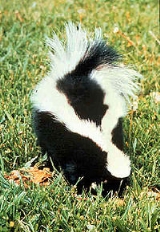
Although the most common fur color is black and white, some skunks are brown or gray, and a few are cream-colored. All skunks are striped, even from birth. They may have a single thick stripe across back and tail, two thinner stripes, or a series of white spots and broken stripes (in the case of the spotted skunk). Some also have stripes on their legs.

Diet

Skunks are omnivorous, eating both plant and animal material and changing their diet as the seasons change. They eat insect
Insect

Insects are the biggest class of arthropods and the only ones with wings. They are the most diverse group of animals on the planet. They are most diverse at the equator and their diversity declines toward the poles....
s and larva
Larva

A larva is a young form of animal with indirect developmental biology, going through or undergoing metamorphosis .The larva can look completely different from the adult form, for example, a caterpillar differs from a butterfly....
e, earthworm
Earthworm

Earthworm is the common name for the largest members of Oligochaeta in the phylum Annelida. The earthworm is the most known worm in America, and other countries....
s, small rodent
Rodent

Rodentia is an Order of mammals also known as rodents, characterised by two continuously growing Incisors#The_Rodent_incisor in the upper and lower jaws which must be kept short by gnawing....
s, lizard
Lizard

Lizards are a large and widespread group of squamate reptiles, with nearly 5,000 species, ranging across all continents except Antarctica as well as most oceanic island chains....
s, salamander
Salamander

Salamander is a common name of approximately 500 species of amphibians. They are typically characterized by slender bodies, short noses, and long tails....
s, frog
Frog

Frogs are amphibians in the order Anura , formerly referred to as Salientia . The name frog derives from Old English language frogga, , cognate with Sanskrit plava , probably deriving from Proto-Indo-European language praw = "to jump"....
s, snake
Snake

Snakes are elongate legless carnivore reptiles of the suborder Serpentes that can be distinguished from legless lizards by their lack of eyelids and external ears....
s, bird
Bird

Birds are wing, Bipedalismal, endothermic , vertebrate animals that lay egg . There are around 10,000 living species, making them the most numerous tetrapod vertebrates....
s, mole
Mole (animal)

Moles are the majority of the members of the mammal family Talpidae in the order Soricomorpha. Although most moles burrow, some species are aquatic or semi-aquatic....
s, and eggs
Egg (biology)

In most birds and reptiles, an egg is the zygote, resulting from fertilization of the ovum. To enable incubation the egg is usually kept within a favourable temperature range as it nourishes and protects the growing embryo....
. They also commonly eat berries, root
Root

In vascular plants, the root is the organ of a plant body that typically lies below the surface of the soil. This is not always the case, however, since a root can also be aerial root or aerating ....
s, leaves
Leaves

Leaves are an Iceland five-piece alternative rock band who formed in 2001. They came to prominence in 2002 with their debut album, Breathe, drawing comparisons to groups such as Coldplay and Doves....
, grass
Grass

Grass is the common word that generally describes monocotyledonous green plants. The family Poaceae are the "true grasses" and include most plants grown as grains, for pasture, and for lawns ....
es, fungi, and nut
Nut (fruit)

Nut is a general term for the large, dry, oily seed or fruit of some plant. While a wide variety of dried seeds and fruits are called nuts, only a certain number of them are considered by biologists to be true nuts....
s.

In settled areas, skunks also seek human garbage. Less often, skunks may be found acting as scavenger
Scavenger

Scavenging, or necrophagy, is a carnivorous feeding behaviour in which a predator consumes corpses or carrion that were not killed to be eaten by the predator or others of its species....
s, eating bird
Bird

Birds are wing, Bipedalismal, endothermic , vertebrate animals that lay egg . There are around 10,000 living species, making them the most numerous tetrapod vertebrates....
 and rodent
Rodent

Rodentia is an Order of mammals also known as rodents, characterised by two continuously growing Incisors#The_Rodent_incisor in the upper and lower jaws which must be kept short by gnawing....
 carcasses left by cat
Cat

The cat , also known as the Domestication cat or house cat to distinguish it from other Felinae and Felidae, is a small predationy carnivore species of crepuscular mammal that is valued by humans for its companionship and its ability to hunt vermin, snakes, scorpions, and other unwanted household pests....
s or other animals. Pet owners, particularly those of cats, may experience a skunk finding its way into a garage or basement where pet food is kept. Skunks commonly dig holes in lawns in search of grubs and worms.

Skunks are one of the primary predators of the honeybee, relying on their thick fur to protect them from stings. The skunk scratches at the front of the beehive
Beehive

Beehive may refer to:Bee-keeping* Beehive is a structure in which bees live and raise their young. It includes both natural and man-made hives; the latter includes traditional designs such as skeps and gums and modern designs such as:...
 and eats the guard bees that come out to investigate. Mother skunks are known to teach this to their young.

Behavior

Skunks are crepuscular
Crepuscular

Crepuscular is a term used to describe some animals that are primarily active during twilight, that is at dawn and at dusk. The word is derived from the Latin word crepusculum, meaning "twilight"....
, and are solitary
Solitary

Solitary may refer to:* shortened form of solitary confinement in jail* Solitary , an episode of the TV series Lost* Solitary , a reality show made by FOX...
 animals when not breeding, though in the colder parts of their range
Range (biology)

In biology, the range or distribution of a species is the geographical area within which that species can be found. Within that range, dispersion is variation in local density....
 they may gather in communal dens for warmth. During the day they shelter in burrows that they dig with their powerful front claws, or in other man-made or natural hollows as the opportunity arises. Both genders occupy overlapping home ranges through the greater part of the year; typically 2 to 4 km2 for females, up to 20 km2 for males.

Skunks do not hibernate in the winter. However, they do remain generally inactive and feed rarely. They often overwinter in a huddle of one male and multiple (as many as twelve) females. The same winter den is often repeatedly used.

Although they have excellent senses of smell and hearing—vital attributes in a crepuscular omnivore—they have poor vision. They cannot see objects more than about 3 metres away with any clarity, which makes them vulnerable to road traffic
Traffic

Traffic on roads may consist of pedestrians, ridden or herded animals, vehicles, streetcars and other conveyances, either singly or together, while using the public way for purposes of travel....
. Roughly half of all skunk deaths are caused by humans, as roadkill
Roadkill

Roadkill is an animal or animals that have been struck and killed by motor vehicles. Mammals are the animals most likely to be recorded as roadkill....
, or as a result of shooting and poison
Poison

In the context of biology, poisons are Chemical substance that can cause disturbances to organisms, usually by chemical reaction or other activity on the molecular scale, when a sufficient quantity is absorbed by an organism....
ing. They are short-lived animals: fewer than 10% survive for longer than three years.

Reproduction

Skunks typically mate in early spring and are a polygynous species, meaning that males usually mate with more than one female. Before giving birth (usually in May), the female will excavate a den to house her litter of four to seven kits. They are placental, with a gestation period of about 66 days.

When born, skunk kits are blind, deaf, and covered in a soft layer of fur. About three weeks after birth, their eyes open. The kits are weaned about two months after birth, but generally stay with their mother until they are ready to mate, at about one year of age.

The mother is very protective of her kits, and will often spray at any sign of danger. The male plays no part in raising the young and may even kill them.

Anal scent glands

The notorious feature of skunks is their anal scent glands, which they can use as a defensive weapon. They are similar to, though much more developed than, the glands found in species of the Mustelidae
Mustelidae

Mustelidae or Mustelids , commonly referred to as the weasel family, is a family of carnivora mammals. The Mustelidae is a diverse family and the largest in the order Carnivora, at least partly because it has in the past been a catch-all category for many early or poorly differentiated taxa....
 family. Skunks have two glands, one on either side of the anus, that produce a mixture of sulfur
Sulfur

Sulfur or sulphur is the chemical element that has the atomic number 16. It is denoted with the symbol S. It is an abundant Valence non-metal....
-containing chemicals (methyl and butyl
Butyl

In organic chemistry, butyl is a four-carbon alkyl radical with chemical formula -C4H9 . It is derived from either of the two isomers of the alkane called butane....
 thiol
Thiol

In organic chemistry, a thiol is a compound that contains the functional group composed of a sulfur atom and a hydrogen atom . Being the sulfur analogue of an alcohol group , this functional group is referred to either as a thiol group or a sulfhydryl group....
s (mercaptans)) that have a highly offensive smell that can be described as a combination of the odors of rotten eggs
Egg (food)

An egg is a round or oval body laid by the female of many animals, consisting of an ovum surrounded by layers of membranes and an outer casing, which acts to nourish and protect a developing embryo and its nutrient reserves....
, garlic
Garlic

Allium sativum L., commonly known as garlic, is a species in the onion family Alliaceae. Its close relatives include the onion, shallot, leek, and chive....
  and burnt rubber
Rubber

Natural rubber is an elastomer?an Elasticity_ hydrocarbon polymer?that was originally derived from a milky colloidal suspension, or latex , found in the sap of some plants....
. The odor of the fluid is strong enough to ward off bears and other potential attackers, and can be difficult to remove from clothing. Muscles located next to the scent glands allow them to spray with high accuracy as far as 2 to 5 meters (7 to 15 ft). The smell aside, the spray can cause irritation and even temporary blindness, and is sufficiently powerful to be detected by even an insensitive human nose anywhere up to a mile downwind. Their chemical defense, though unusual, is effective, as illustrated by this extract from Charles Darwin
Charles Darwin

Charles Robert Darwin Royal Society was an English people natural history who realised and presented compelling evidence that all species of life have evolution over time from common descent, through the process he called natural selection....
's Voyage of the Beagle
The Voyage of the Beagle

The Voyage of the Beagle is a title commonly given to the book written by Charles Darwin published in 1839 as his Journal and Remarks, which brought him considerable fame and respect....
:

We saw also a couple of Zorrillos, or skunks—odious animals, which are far from uncommon. In general appearance the Zorrillo resembles a polecat, but it is rather larger, and much thicker in proportion. Conscious of its power, it roams by day about the open plain, and fears neither dog nor man. If a dog is urged to the attack, its courage is instantly checked by a few drops of the fetid oil, which brings on violent sickness and running at the nose. Whatever is once polluted by it, is for ever useless. Azara says the smell can be perceived at a league distant; more than once, when entering the harbour of Monte Video, the wind being off shore, we have perceived the odour on board the Beagle. Certain it is, that every animal most willingly makes room for the Zorrillo.


Skunks are reluctant to use their smelly weapon, as they carry just enough of the chemical for five or six uses—about 15 cc—and require some ten days to produce another supply. Their bold black and white coloring however serves to make the skunk's appearance memorable. Where practical, it is to a skunk's advantage simply to warn a threatening creature off without expending scent: the black and white warning color aside, threatened skunks will go through an elaborate routine of hisses, foot stamping, and tail-high threat postures before resorting to the spray. Interestingly, skunks will not spray other skunks (with the exception of males in the mating season); though they fight over den space in autumn, they do so with tooth and claw.

The singular musk-spraying ability of the skunk has not escaped the attention of biologists: the names of the family and the most common genus (Mephitidae, Mephitis) mean "stench", and Spilogale putorius means "stinking spotted weasel". The word skunk is a corruption of an Abenaki name for them, segongw or segonku, which means "one who squirts" in the Algonquian dialect.

Most predatory animals of the Americas, such as wolves, fox
Fox

A fox is an animal belonging to any one of about 27 species of small to medium-sized Canidae, characterized by possessing a long, narrow snout, and a bushy tail, or brush....
es and badgers, seldom attack skunks—presumably out of fear of being sprayed. The exception is the great horned owl
Great Horned Owl

The Great Horned Owl, Bubo virginianus, is a large Typical owl native to the Americas. It is an adaptable bird with a vast range and is the most widely distributed true owl in the Americas....
, the animal's only serious predator, which, like most bird
Bird

Birds are wing, Bipedalismal, endothermic , vertebrate animals that lay egg . There are around 10,000 living species, making them the most numerous tetrapod vertebrates....
s, has a poor-to-nonexistent sense of smell.

Skunk spray is composed mainly of low molecular weight thiol compounds, namely (E)-2-butene-1-thiol, 3-methyl-1-butanethiol, and 2-quinolinemethanethiol, as well as acetate
Acetate

An acetate, or ethanoate, is either a salt or ester of acetic acid.In chemistry, the abbreviation Ac refers to the acetyl group. The anion and the functional group may be written as -OAc and AcO-, or OAc respectively....
 thioesters of each of these. These compounds are detectable at concentrations of about 2 parts per million.

Bites


The Centers for Disease Control and Prevention
Centers for Disease Control and Prevention

The Centers for Disease Control and Prevention is an agency of the United States United States Department of Health and Human Services based in Atlanta, Georgia, United States adjacent to the campus of Emory University and northeast of downtown Atlanta....
 recorded 1,494 cases of rabies
Rabies

Rabies is a virus zoonotic neurotropic virus disease that causes acute encephalitis in mammals. It is most commonly caused by a bite from an infected animal, but occasionally by other forms of contact....
 in skunks in the United States for the year 2006—about 21.5% of reported cases in all species. Skunks trail raccoons as vectors of rabies, although this varies regionally (raccoons dominate along the Atlantic coast and eastern Gulf of Mexico, skunks throughout the Midwest and down to the western Gulf, and in California). Despite this prevalence, all recorded cases of human rabies from 1990–2002 are attributed by the CDC to dogs or bats.

Domestication

Domesticated skunks
Pet skunk

A pet skunk is a skunk kept by humans for companionship and enjoyment. Although capable of living indoors with humans similarly to dogs or cats, pet skunks are relatively rare, partly due to restrictive laws and the complexity of their care....
 can legally be kept as pet
PET

The term pet typically refers to a pet.PET may also refer to:...
s in the UK. However, the has made it illegal to remove their scent glands (it is considered to be a cosmetic operation), thus making them impractical as pets. Owners have been known to dump skunks in the wild when they discover that vets will no longer perform the operation to remove their scent glands.

The keeping of skunks as pets is legal only in certain U.S. states. Mephitis mephitis, the striped skunk species, is the most social skunk and the one most commonly domesticated. When the skunk is kept as a pet, the scent gland is removed. Typical life spans for domesticated skunks are considerably longer than for wild skunks, often reaching 10 years, though it is not unusual for a well-cared for skunk to live well past 20 years.

One problem with U.S. skunks kept as pets is the lack of genetic diversity. The few breeders of skunks use the same genetic stock (as none are allowed to be taken from the wild) that was available many decades ago, when skunks were bred for the fur trade rather than the pet trade. Undescended testicles, epileptic seizures, and other problems are often found with the domestic stock. European settlers in America reported that certain Native Americans
Native Americans in the United States

Native Americans in the United States are the Indigenous peoples of the Americas from the regions of North America now encompassed by the continental United States United States, including parts of Alaska and the island state of Hawaii....
 kept skunks as pets. The Pilgrims
Pilgrims

Pilgrims, or Pilgrim Fathers , is a name commonly applied to the early settlers of the Plymouth Colony in present-day Plymouth, Massachusetts....
 are also said to have kept skunks as pets.

Classification

  • Order Carnivora
    • Family Canidae
      Canidae

      Canidae is the family of the dogs; a member of this family is called a canid. They include wolf, foxes, coyotes, and jackals. The Canidae family is divided into the "true dogs" of the tribe Canini and the "foxes" of the tribe Vulpini....
      : dogs, 35 species
    • Family Ursidae: bears, 8 species
    • Family Procyonidae
      Procyonidae

      Procyonidae is a New World family of the order Carnivora. It includes the Procyon s, coatis, kinkajous, olingos, Ring-tailed_Cats and cacomistles....
      : raccoons, 15 species
    • Family Ailuridae
      Ailuridae

      Ailuridae is a family in the mammal order Carnivora. The family includes the Red Panda and its extinct relatives....
      : red panda, 1 species
    • Family Mustelidae
      Mustelidae

      Mustelidae or Mustelids , commonly referred to as the weasel family, is a family of carnivora mammals. The Mustelidae is a diverse family and the largest in the order Carnivora, at least partly because it has in the past been a catch-all category for many early or poorly differentiated taxa....
      : weasels and allies, 55 species
    • Family Mephitidae
      • Striped Skunk
        Striped Skunk

        The Striped Skunk, Mephitis mephitis, is an omnivorous mammal of the skunk family Mephitidae. Found over most of the North American continent north of Mexico, it is one of the best-known mammals in Canada and the United States....
        , Mephitis mephitis
      • Hooded Skunk
        Hooded Skunk

        The hooded skunk, Mephitis macroura, is similar to the Striped Skunk, but can be distinguished by its longer tail and longer, softer coat of fur....
        , Mephitis macroura
      • Southern Spotted Skunk, Spilogale angustifrons
      • Western Spotted Skunk
        Western Spotted Skunk

        The Western Spotted Skunk is a spotted skunk found throughout the western United States, northern Mexico, and southwestern British Columbia. The Western Spotted Skunk is smaller than the striped skunk....
        , Spilogale gracilis
        • Channel Islands Spotted Skunk
          Channel Islands Spotted Skunk

          The Channel Islands spotted skunk, Santa Rosa Island spotted skunk, or island spotted skunk is a subspecies of North American skunk about which little is known....
          , Spilogale gracilis amphiala
      • Eastern Spotted Skunk
        Eastern Spotted Skunk

        The Eastern Spotted Skunk is a small, relatively slender skunk found throughout the eastern United States.This small skunk is more weasel-like in body shape than the more familiar Striped Skunk....
        , Spilogale putorius
      • Pygmy Spotted Skunk
        Pygmy Spotted Skunk

        The Pygmy Spotted Skunk is a species of mammal in the Mephitidae family. It is Endemism to Mexico.References...
        , Spilogale pygmaea
      • Western Hog-nosed Skunk
        Western Hog-nosed Skunk

        Recent work has concluded that the western hog-nosed skunk or common hog-nosed skunk is the same species as the American Hog-nosed Skunk, and that Conepatus leuconotus is the correct name of the merged populations....
        , Conepatus mesoleucus
      • Eastern Hog-nosed Skunk, Conepatus leuconotus
      • Striped Hog-nosed Skunk
        Striped Hog-nosed Skunk

        The Striped Hog-nosed Skunk, Conepatus semistriatus, is a skunk species from Central America and South America. It lives in a wide range of habitats including dry forest scrub and occasionally, in rainforest....
        , Conepatus semistriatus
      • Andes skunk
        Molina's Hog-nosed Skunk

        Molina's Hog-nosed Skunk, Conepatus chinga, is a skunk species from South America. It is found in Argentina, Bolivia, Brazil, Chile, Peru and Uruguay....
        , Conepatus chinga
      • Patagonian Skunk, Conepatus humboldtii
      • Indonesian or Javan Stink Badger
        Javan Stink Badger

        The Sunda Stink Badger is a mammal endemic to Java . There is strong DNA evidence that the genus Mydaus is not a member of the badger family at all, but are in fact Old World relatives of the skunks....
         (Teledu), Mydaus javanensis (sometimes included in Mustelidae
        Mustelidae

        Mustelidae or Mustelids , commonly referred to as the weasel family, is a family of carnivora mammals. The Mustelidae is a diverse family and the largest in the order Carnivora, at least partly because it has in the past been a catch-all category for many early or poorly differentiated taxa....
        )
      • Palawan Stink Badger
        Palawan Stink Badger

        The Palawan stink badger is a small skunk that lives on the Philippine Islands of Palawan and Busuanga. They live primarily in the grasslands and in cultivated areas on these islands....
        , Mydaus marchei (sometimes included in Mustelidae
        Mustelidae

        Mustelidae or Mustelids , commonly referred to as the weasel family, is a family of carnivora mammals. The Mustelidae is a diverse family and the largest in the order Carnivora, at least partly because it has in the past been a catch-all category for many early or poorly differentiated taxa....
        )
    • Family Felidae
      Felidae

      Felidae is the family of the cats; a member of this family is called a felid. Felids are the most strictly Carnivore of the sixteen mammal families in the order Carnivora....
      : cats, 37 species
    • Family Viverridae: civets and genets, 35 species
    • Family Herpestidae: Mongooses, 35 species
    • Family Hyaenidae: hyenas, 4 species


See also

  • Skunk oil
    Skunk oil

    Skunk oil is an oil that is obtained from the two lateral glands that run the length of a skunks back. Skunks store fats in these glands for use during hibernation or semi-hibernation in warmer climes....


External links