

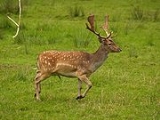
Fallow Deer

Encyclopedia
The Fallow Deer is a ruminant
mammal
belonging to the family Cervidae. This common species is native to western Eurasia
, but has been introduced
widely elsewhere. It often includes the rarer Persian Fallow Deer
as a subspecies
(D. d. mesopotamica), while others treat it as an entirely different species (D. mesopotamica).
The male is known as a buck, the female is a doe, and the young a fawn. Adult bucks are 140–160 cm long and 85–95 cm shoulder height, and 50–80 kg in weight; does are 130–150 cm long and 75–85 cm shoulder height, and 25–45 kg in weight. Fawns are born in spring at about 30 cm and weigh around 4.5 kg. The life span is around 12–16 years.
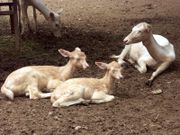
The species has great variations in the colour of their coats, with four main variants, "common", "menil", "melanistic" and "white" - a genuine colour variety, not albinistic
. The white is the lightest colored, almost white; common and menil are darker, and melanistic is very dark, sometimes even black (easily confused with the Sika Deer
).
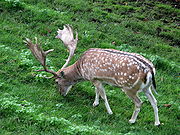
Common: Chestnut coat with white mottles that are most pronounced in summer with a much darker, unspotted coat in the winter. Light-colored area around the tail, edged with black. Tail is light with a black stripe.
Menil: Spots more distinct than common in summer and no black around the rump patch or on the tail. In winter, spots still clear on a darker brown coat.
Menalistic/Black: All year black shading to greyish-brown. No light-colored tail patch or spots.
White (not albino): Fawns cream-colored, adults become pure white, especially in winter. Dark eyes and nose, no spots.
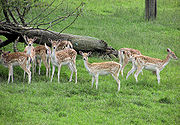
Most herds consist of the common coat variation, yet it is not rare to see animals of the menil coat variation. The Melanistic variation is rarer and white very much rarer still.
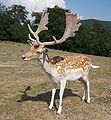
Only bucks have antlers, which are broad and shovel-shaped (palmate) from 3 years. In the first two years the antler is a single spike. They are grazing animals; their preferred habitat is mixed woodland and open grassland. During the rut bucks will spread out and females move between them, at this time of year fallow deer are relatively ungrouped compared to the rest of the year when they try to stay together in groups of up to 150.
Agile and fast in case of danger, fallow deer can run up to a maximum speed of 28 mph (45 km/h) over short distances (being naturally less muscular than other cervids such as roe deer, they are not as fast). Fallow deer can also make jumps up to 1.75 metres high and up to 5 metres in length.
 The Fallow Deer is a Eurasia
n deer that was a native to most of Europe during the last Interglacial. In the Holocene
, the distribution was restricted to the Middle East
and possibly also parts of the Mediterranean region, while further southeast in western Asia was the home of the Persian Fallow Deer
, that is bigger and has larger antlers. In the Levant
, Fallow Deer were an important source of meat in the Palaeolithic Kebaran
-culture (17000-10000 BC), as is shown by animal bones from sites in northern Israel, but the numbers decreased in the following epi-Palaeolithic Natufian culture
(10000-8500 BC), perhaps because of increased aridity and the decrease of wooded areas.
by the Romans. Until recently it was thought that the Normans
introduced them to Great Britain and to Ireland for hunting in the royal forest
s. However recent finds at Fishbourne Roman Palace
show that Fallow Deer were introduced into southern England in the 1st century AD. It is not known whether these escaped to form a feral colony, or whether they died out and were reintroduced by the Normans.
Fallow deer are now widespread on the UK mainland and are present in most of England and Wales below a line drawn from the Wash to the Mersey. There have been long standing populations in the New Forest
and the Forest of Dean
and many of the other populations originated from park escapees. They are not quite so widespread in the northern parts of England but are present in most lowland areas and also in parts of Scotland, principally in the Tay valley and around Loch Lomond. According to the British Deer Society distribution survey 2007 they have enjoyed an increase in range
since the previous survey in 2000 although the increase in range is not as spectacular as for some of the other deer species.
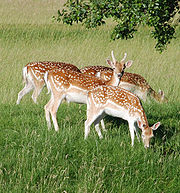 A significant number of the fallow in the Forest of Dean
and in Epping Forest
are of the black variety. One particularly interesting population is that based in the Mortimer Forest
on the England/Wales border where a significant part of the population have long hair with distinct ear tufts and longer body hair.
population of Fallow Deer has been found to average smaller than those of central and northern Europe, though they are similarly coloured. In 2005 the Rhodian Fallow Deer was found to be genetically distinct from all other populations and to be of urgent conservation concern. At the entrance to the harbour of Rhodes city, statues of a Fallow Deer buck and doe now grace the location where the Colossus of Rhodes
once stood.
In more recent times, Fallow Deer have been introduced in parts of the United States. In some areas of central Georgia
, wild Fallow Deer, not having any natural enemies, have increased to numbers that cause serious damage to young trees. Fallow Deer have also been introduced in Texas
, along with many other exotic deer species, where they are often hunted on large game ranches.
There is a herd of white fallow deer located near Argonne National Laboratories in central Illinois.
A small herd of fifteen mostly white fallow deer resides at the Belle Isle Nature Zoo on Belle Isle in Detroit, Michigan.
Preserve in Öland
, Sweden where Karl X Gustav erected a drystone wall some four kilometres long to enclose a royal fallow deer herd in the mid 17th century; the herd still exists as of 2006.
Another is Phoenix Park
in Ireland where a herd of 400-450 fallow deer descend from the original herd introduced in the 1660s.
The Fallow Deer is easily tamed and is often kept semi-domesticated in parks today.
, gazelle
s, and antelope
s, lies at the root of the modern scientific name, and the German Damhirsch, French daim, Dutch damhert, and Italian daino. In Croatian and Serbian, the name for the fallow deer is jelen lopatar ("shovel deer"), due to the form of its antlers. The Hebrew name of the fallow deer, yachmur (יחמור), comes from the Aramaic language
, where chamra (חמרא) means "red" or "brown".
 In the well-known 16th century English folk ballad "The Three Ravens
", the term "fallow doe" is used metaphorically, as meaning "a young woman".
Ruminant
A ruminant is a mammal of the order Artiodactyla that digests plant-based food by initially softening it within the animal's first compartment of the stomach, principally through bacterial actions, then regurgitating the semi-digested mass, now known as cud, and chewing it again...
mammal
Mammal
Mammals are members of a class of air-breathing vertebrate animals characterised by the possession of endothermy, hair, three middle ear bones, and mammary glands functional in mothers with young...
belonging to the family Cervidae. This common species is native to western Eurasia
Eurasia
Eurasia is a continent or supercontinent comprising the traditional continents of Europe and Asia ; covering about 52,990,000 km2 or about 10.6% of the Earth's surface located primarily in the eastern and northern hemispheres...
, but has been introduced
Introduced species
An introduced species — or neozoon, alien, exotic, non-indigenous, or non-native species, or simply an introduction, is a species living outside its indigenous or native distributional range, and has arrived in an ecosystem or plant community by human activity, either deliberate or accidental...
widely elsewhere. It often includes the rarer Persian Fallow Deer
Persian fallow deer
The Persian Fallow Deer is a rare ruminant mammal belonging to the family Cervidae. Its taxonomic status is disputed, with some maintaining it as a subspecies of the Fallow Deer, while other treat it as a separate species, Dama mesopotamica.-Description:Persian fallow deer are bigger than Fallow...
as a subspecies
Subspecies
Subspecies in biological classification, is either a taxonomic rank subordinate to species, ora taxonomic unit in that rank . A subspecies cannot be recognized in isolation: a species will either be recognized as having no subspecies at all or two or more, never just one...
(D. d. mesopotamica), while others treat it as an entirely different species (D. mesopotamica).
The male is known as a buck, the female is a doe, and the young a fawn. Adult bucks are 140–160 cm long and 85–95 cm shoulder height, and 50–80 kg in weight; does are 130–150 cm long and 75–85 cm shoulder height, and 25–45 kg in weight. Fawns are born in spring at about 30 cm and weigh around 4.5 kg. The life span is around 12–16 years.
The species has great variations in the colour of their coats, with four main variants, "common", "menil", "melanistic" and "white" - a genuine colour variety, not albinistic
Albinism
Albinism is a congenital disorder characterized by the complete or partial absence of pigment in the skin, hair and eyes due to absence or defect of an enzyme involved in the production of melanin...
. The white is the lightest colored, almost white; common and menil are darker, and melanistic is very dark, sometimes even black (easily confused with the Sika Deer
Sika Deer
The Sika Deer, Cervus nippon, also known as the Spotted Deer or the Japanese Deer, is a species of deer native to much of East Asia and introduced to various other parts of the world...
).
Common: Chestnut coat with white mottles that are most pronounced in summer with a much darker, unspotted coat in the winter. Light-colored area around the tail, edged with black. Tail is light with a black stripe.
Menil: Spots more distinct than common in summer and no black around the rump patch or on the tail. In winter, spots still clear on a darker brown coat.
Menalistic/Black: All year black shading to greyish-brown. No light-colored tail patch or spots.
White (not albino): Fawns cream-colored, adults become pure white, especially in winter. Dark eyes and nose, no spots.
Most herds consist of the common coat variation, yet it is not rare to see animals of the menil coat variation. The Melanistic variation is rarer and white very much rarer still.
Only bucks have antlers, which are broad and shovel-shaped (palmate) from 3 years. In the first two years the antler is a single spike. They are grazing animals; their preferred habitat is mixed woodland and open grassland. During the rut bucks will spread out and females move between them, at this time of year fallow deer are relatively ungrouped compared to the rest of the year when they try to stay together in groups of up to 150.
Agile and fast in case of danger, fallow deer can run up to a maximum speed of 28 mph (45 km/h) over short distances (being naturally less muscular than other cervids such as roe deer, they are not as fast). Fallow deer can also make jumps up to 1.75 metres high and up to 5 metres in length.
Distribution and history
Eurasia
Eurasia is a continent or supercontinent comprising the traditional continents of Europe and Asia ; covering about 52,990,000 km2 or about 10.6% of the Earth's surface located primarily in the eastern and northern hemispheres...
n deer that was a native to most of Europe during the last Interglacial. In the Holocene
Holocene
The Holocene is a geological epoch which began at the end of the Pleistocene and continues to the present. The Holocene is part of the Quaternary period. Its name comes from the Greek words and , meaning "entirely recent"...
, the distribution was restricted to the Middle East
Middle East
The Middle East is a region that encompasses Western Asia and Northern Africa. It is often used as a synonym for Near East, in opposition to Far East...
and possibly also parts of the Mediterranean region, while further southeast in western Asia was the home of the Persian Fallow Deer
Persian fallow deer
The Persian Fallow Deer is a rare ruminant mammal belonging to the family Cervidae. Its taxonomic status is disputed, with some maintaining it as a subspecies of the Fallow Deer, while other treat it as a separate species, Dama mesopotamica.-Description:Persian fallow deer are bigger than Fallow...
, that is bigger and has larger antlers. In the Levant
Levant
The Levant or ) is the geographic region and culture zone of the "eastern Mediterranean littoral between Anatolia and Egypt" . The Levant includes most of modern Lebanon, Syria, Jordan, Israel, the Palestinian territories, and sometimes parts of Turkey and Iraq, and corresponds roughly to the...
, Fallow Deer were an important source of meat in the Palaeolithic Kebaran
Kebaran
The Kebaran or Kebarian culture was an archaeological culture in the eastern Mediterranean area , named after its type site, Kebara Cave south of Haifa...
-culture (17000-10000 BC), as is shown by animal bones from sites in northern Israel, but the numbers decreased in the following epi-Palaeolithic Natufian culture
Natufian culture
The Natufian culture was a Mesolithic culture that existed from 12,500 to 9,500 BC in the Levant, a region in the Eastern Mediterranean. It was unusual in that it was sedentary, or semi-sedentary, before the introduction of agriculture...
(10000-8500 BC), perhaps because of increased aridity and the decrease of wooded areas.
Britain and Ireland
The Fallow Deer was spread across central EuropeCentral Europe
Central Europe or alternatively Middle Europe is a region of the European continent lying between the variously defined areas of Eastern and Western Europe...
by the Romans. Until recently it was thought that the Normans
Normans
The Normans were the people who gave their name to Normandy, a region in northern France. They were descended from Norse Viking conquerors of the territory and the native population of Frankish and Gallo-Roman stock...
introduced them to Great Britain and to Ireland for hunting in the royal forest
Royal forest
A royal forest is an area of land with different meanings in England, Wales and Scotland; the term forest does not mean forest as it is understood today, as an area of densely wooded land...
s. However recent finds at Fishbourne Roman Palace
Fishbourne Roman Palace
Fishbourne Roman Palace is in the village of Fishbourne in West Sussex. The large palace was built in the 1st century AD, around thirty years after the Roman conquest of Britain on the site of a Roman army supply base established at the Claudian invasion in 43 AD. The rectangular palace surrounded...
show that Fallow Deer were introduced into southern England in the 1st century AD. It is not known whether these escaped to form a feral colony, or whether they died out and were reintroduced by the Normans.
Fallow deer are now widespread on the UK mainland and are present in most of England and Wales below a line drawn from the Wash to the Mersey. There have been long standing populations in the New Forest
New Forest
The New Forest is an area of southern England which includes the largest remaining tracts of unenclosed pasture land, heathland and forest in the heavily-populated south east of England. It covers south-west Hampshire and extends into south-east Wiltshire....
and the Forest of Dean
Forest of Dean
The Forest of Dean is a geographical, historical and cultural region in the western part of the county of Gloucestershire, England. The forest is a roughly triangular plateau bounded by the River Wye to the west and north, the River Severn to the south, and the City of Gloucester to the east.The...
and many of the other populations originated from park escapees. They are not quite so widespread in the northern parts of England but are present in most lowland areas and also in parts of Scotland, principally in the Tay valley and around Loch Lomond. According to the British Deer Society distribution survey 2007 they have enjoyed an increase in range
Range (biology)
In biology, the range or distribution of a species is the geographical area within which that species can be found. Within that range, dispersion is variation in local density.The term is often qualified:...
since the previous survey in 2000 although the increase in range is not as spectacular as for some of the other deer species.
Forest of Dean
The Forest of Dean is a geographical, historical and cultural region in the western part of the county of Gloucestershire, England. The forest is a roughly triangular plateau bounded by the River Wye to the west and north, the River Severn to the south, and the City of Gloucester to the east.The...
and in Epping Forest
Epping Forest
Epping Forest is an area of ancient woodland in south-east England, straddling the border between north-east Greater London and Essex. It is a former royal forest, and is managed by the City of London Corporation....
are of the black variety. One particularly interesting population is that based in the Mortimer Forest
Mortimer Forest
Mortimer Forest is a forest on the Shropshire/Herefordshire border in England, near the town of Ludlow.-History:Mortimer Forest was an ancient hunting forest, like similar areas including Bircher Common...
on the England/Wales border where a significant part of the population have long hair with distinct ear tufts and longer body hair.
Rhodes island
The RhodianRhodes
Rhodes is an island in Greece, located in the eastern Aegean Sea. It is the largest of the Dodecanese islands in terms of both land area and population, with a population of 117,007, and also the island group's historical capital. Administratively the island forms a separate municipality within...
population of Fallow Deer has been found to average smaller than those of central and northern Europe, though they are similarly coloured. In 2005 the Rhodian Fallow Deer was found to be genetically distinct from all other populations and to be of urgent conservation concern. At the entrance to the harbour of Rhodes city, statues of a Fallow Deer buck and doe now grace the location where the Colossus of Rhodes
Colossus of Rhodes
The Colossus of Rhodes was a statue of the Greek Titan Helios, erected in the city of Rhodes on the Greek island of Rhodes by Chares of Lindos between 292 and 280 BC. It is considered one of the Seven Wonders of the Ancient World. It was constructed to celebrate Rhodes' victory over the ruler of...
once stood.
United States
The species Odocoeleus virginianus was once classified as Dama virginianus; they were given a separate genus in the 19th century.In more recent times, Fallow Deer have been introduced in parts of the United States. In some areas of central Georgia
Georgia (U.S. state)
Georgia is a state located in the southeastern United States. It was established in 1732, the last of the original Thirteen Colonies. The state is named after King George II of Great Britain. Georgia was the fourth state to ratify the United States Constitution, on January 2, 1788...
, wild Fallow Deer, not having any natural enemies, have increased to numbers that cause serious damage to young trees. Fallow Deer have also been introduced in Texas
Texas
Texas is the second largest U.S. state by both area and population, and the largest state by area in the contiguous United States.The name, based on the Caddo word "Tejas" meaning "friends" or "allies", was applied by the Spanish to the Caddo themselves and to the region of their settlement in...
, along with many other exotic deer species, where they are often hunted on large game ranches.
There is a herd of white fallow deer located near Argonne National Laboratories in central Illinois.
A small herd of fifteen mostly white fallow deer resides at the Belle Isle Nature Zoo on Belle Isle in Detroit, Michigan.
Historical herds
One noted historical herd of fallow deer is located in the OttenbyOttenby
Ottenby is a nature reserve at the southern tip of the island of Öland in Sweden. Ottenby was previously a royal game reserve stocked with fallow deer, and King Charles X Gustav of Sweden built a drystone wall to confine the native deer...
Preserve in Öland
Öland
' is the second largest Swedish island and the smallest of the traditional provinces of Sweden. Öland has an area of 1,342 km² and is located in the Baltic Sea just off the coast of Småland. The island has 25,000 inhabitants, but during Swedish Midsummer it is visited by up to 500,000 people...
, Sweden where Karl X Gustav erected a drystone wall some four kilometres long to enclose a royal fallow deer herd in the mid 17th century; the herd still exists as of 2006.
Another is Phoenix Park
Phoenix Park
Phoenix Park is an urban park in Dublin, Ireland, lying 2–4 km west of the city centre, north of the River Liffey. Its 16 km perimeter wall encloses , one of the largest walled city parks in Europe. It includes large areas of grassland and tree-lined avenues, and since the seventeenth...
in Ireland where a herd of 400-450 fallow deer descend from the original herd introduced in the 1660s.
The Fallow Deer is easily tamed and is often kept semi-domesticated in parks today.
Name
The Latin word dāma or damma, used for roe deerRoe Deer
The European Roe Deer , also known as the Western Roe Deer, chevreuil or just Roe Deer, is a Eurasian species of deer. It is relatively small, reddish and grey-brown, and well-adapted to cold environments. Roe Deer are widespread in Western Europe, from the Mediterranean to Scandinavia, and from...
, gazelle
Gazelle
A gazelle is any of many antelope species in the genus Gazella, or formerly considered to belong to it. Six species are included in two genera, Eudorcas and Nanger, which were formerly considered subgenera...
s, and antelope
Antelope
Antelope is a term referring to many even-toed ungulate species indigenous to various regions in Africa and Eurasia. Antelopes comprise a miscellaneous group within the family Bovidae, encompassing those old-world species that are neither cattle, sheep, buffalo, bison, nor goats...
s, lies at the root of the modern scientific name, and the German Damhirsch, French daim, Dutch damhert, and Italian daino. In Croatian and Serbian, the name for the fallow deer is jelen lopatar ("shovel deer"), due to the form of its antlers. The Hebrew name of the fallow deer, yachmur (יחמור), comes from the Aramaic language
Aramaic language
Aramaic is a group of languages belonging to the Afroasiatic language phylum. The name of the language is based on the name of Aram, an ancient region in central Syria. Within this family, Aramaic belongs to the Semitic family, and more specifically, is a part of the Northwest Semitic subfamily,...
, where chamra (חמרא) means "red" or "brown".
Metaphorical meaning
The Three Ravens
"The Three Ravens" is an English folk ballad, printed in the song book Melismata compiled by Thomas Ravenscroft and published in 1611, but it is perhaps older than that. More recent versions were recorded right up through the 19th century. Francis James Child recorded several versions in his...
", the term "fallow doe" is used metaphorically, as meaning "a young woman".
- Down there comes a fallow Doe,
- As great with young as she might goe,
Further reading
- FAO ANIMAL PRODUCTION AND HEALTH PAPER 27. (1982). Deer farming guidelines on practical aspects. ISBN 92-5-101137-0. Retrieved on 4 January 2008.
- Clutton-Brock, J. (1978). A Natural History of Domesticated Animals. London, British MuseumBritish MuseumThe British Museum is a museum of human history and culture in London. Its collections, which number more than seven million objects, are amongst the largest and most comprehensive in the world and originate from all continents, illustrating and documenting the story of human culture from its...
. - Lyneborg, L. (1971). Mammals [of Europe]. ISBN 0-7137-0548-5.
- Level 1 DSC Training Manual. http://www.eskdalewildlife.com/training.html
- Urdang, Laurence. The Random House Dictionary of the English Language. 1969; Laurence Urdang, Editor in Chief, Random House.