
All Topics  
Zebra Finch

 
Zebra Finch

   Email Print
   Bookmark   Link


Zebra Finch


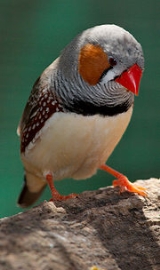
The Zebra Finch, Taeniopygia guttata is the most common and familiar estrildid finch
Estrildid finch

The estrildid finches are small passerine birds of the Old World tropics and Australasia. They can be classified as the family Estrildidae , or previously as a sub-group within the family Passeridae, which also includes the true sparrows....
 of Central Australia
Central Australia

Central Australia/Alice Springs Region is one of the five regions in the Northern Territory. The term Central Australia is used to describe an area centred on Alice Springs, Northern Territory in Australia....
 and ranges over most of the continent, avoiding only the cool moist south and the tropical far north. It also can be found in Indonesia
Indonesia

The Republic of Indonesia , is a transcontinental country in Southeast Asia and Oceania. Comprising Islands of Indonesia, it is the world's largest Archipelago state....
 (native), Timor-Leste (native), Puerto Rico
Puerto Rico

Puerto Rico , officially the Commonwealth of Puerto Rico , is a Autonomy Territories of the United States of the United States located in the northeastern Caribbean, east of the Dominican Republic and west of the Virgin Islands....
 (introduced), Portugal
Portugal

Portugal , officially the Portuguese Republic , is a country on the Iberian Peninsula. Located in southwestern Europe, Portugal is the westernmost country of mainland Europe and is bordered by the Atlantic Ocean to the west and south and by Spain to the north and east....
 (introduced) & U.S.
United States

The United States of America is a Federal government constitutional republic comprising U.S. state and a federal district. The country is situated mostly in central North America, where its Contiguous United States and Washington, D.C., the Capital districts and territories, lie between the Pacific Ocean and Atlantic Oceans, Borders of the U...
 (introduced). Zebra Finches inhabit open steppes with scattered bushes and trees, but have adapted to human disturbances, taking advantage of human-made watering holes and large patches of deforested land.


Discussion
Ask a question about 'Zebra Finch'
Start a new discussion about 'Zebra Finch'
Answer questions from other users
Full Discussion Forum


Encyclopedia


The Zebra Finch, Taeniopygia guttata is the most common and familiar estrildid finch
Estrildid finch

The estrildid finches are small passerine birds of the Old World tropics and Australasia. They can be classified as the family Estrildidae , or previously as a sub-group within the family Passeridae, which also includes the true sparrows....
 of Central Australia
Central Australia

Central Australia/Alice Springs Region is one of the five regions in the Northern Territory. The term Central Australia is used to describe an area centred on Alice Springs, Northern Territory in Australia....
 and ranges over most of the continent, avoiding only the cool moist south and the tropical far north. It also can be found in Indonesia
Indonesia

The Republic of Indonesia , is a transcontinental country in Southeast Asia and Oceania. Comprising Islands of Indonesia, it is the world's largest Archipelago state....
 (native), Timor-Leste (native), Puerto Rico
Puerto Rico

Puerto Rico , officially the Commonwealth of Puerto Rico , is a Autonomy Territories of the United States of the United States located in the northeastern Caribbean, east of the Dominican Republic and west of the Virgin Islands....
 (introduced), Portugal
Portugal

Portugal , officially the Portuguese Republic , is a country on the Iberian Peninsula. Located in southwestern Europe, Portugal is the westernmost country of mainland Europe and is bordered by the Atlantic Ocean to the west and south and by Spain to the north and east....
 (introduced) & U.S.
United States

The United States of America is a Federal government constitutional republic comprising U.S. state and a federal district. The country is situated mostly in central North America, where its Contiguous United States and Washington, D.C., the Capital districts and territories, lie between the Pacific Ocean and Atlantic Oceans, Borders of the U...
 (introduced). Zebra Finches inhabit open steppes with scattered bushes and trees, but have adapted to human disturbances, taking advantage of human-made watering holes and large patches of deforested land. Zebra Finches – including many human-bred
Animal fancy

Animal fancy is a hobby involving the appreciation, promotion, and/or breeding of pet or domestic animals.Fancy may include pet and exotic pet ownership, showing, trialling and other competitions, selective breeding and judging....
 variants to the species – are widely kept by genetic researchers
Geneticist

A geneticist is a scientist who studies genetics, the science of heredity and genetic variation of organisms. A geneticist can be employed as a researcher or lecturer....
, breeding hobbyists
Aviculture

File:Budgerigars and Cockatiel.jpgAviculture is the practice of keeping and often breeding birds and the culture that forms around it. Aviculture is generally focused not just on the raising and breeding of birds, but also on preserving avian habitat, and public awareness campaigns....
 and pet
PET

The term pet typically refers to a pet.PET may also refer to:...
 owners. The life expectancy of a Zebra Finch is highly variable on account of genetic and environmental factors. The Zebra Finch may reach up to 5 years in its natural environment, averaging 5 to 10 years in captivity with a maximum of 12 to 15 years.

Subspecies

There are two sub-species:
  • Taeniopygia guttata guttata, the Timor Zebra Finch, extends from Lombok
    Lombok

    Lombok is an island in West Nusa Tenggara province, Indonesia. It is part of the chain of the Lesser Sunda Islands, with the Lombok Strait separating it from Bali to the west and the Alas Strait between it and Sumbawa to the east....
     in the Lesser Sunda Islands
    Lesser Sunda Islands

    The Nusa Tenggara , or Lesser Sunda Islands, are a group of islands in the middle-south part of Maritime Southeast Asia. Together with the Greater Sunda Islands to the west they make up the Sunda Islands....
     or Nusa Tenggara in Indonesia
    Indonesia

    The Republic of Indonesia , is a transcontinental country in Southeast Asia and Oceania. Comprising Islands of Indonesia, it is the world's largest Archipelago state....
     to Sermata in addition to coastal areas around the continent of Australia.
  • Taeniopygia guttata castanotis is found over the wide range of continental Australia.


The Australian race is sometimes split as Chestnut-eared Finch (Gould
John Gould

John Gould was an England ornithologist. The Gould League in Australia was named after him. His identification of the birds now nicknamed "Darwin's finches" was pivotal in the inception of Darwin's theory of evolution by natural selection, though they are barely mentioned in Charles Darwin's book, On the Origin of Species....
, 1837), Taeniopygia castanotis.

The morphological
Morphology (biology)

The term morphology in biology refers to form, structure and configuration of an organism. This includes aspects of the outward appearance as well as the form and structure of the internal parts like bones and organs....
 differences between the sub-species include differences in size. Taeniopygia guttata guttata is smaller than Taeniopygia guttata castanotis. In addition, the T.g. guttata males do not have the fine barring found on the throat and upper breast of T.g. castanotis as well as having small breast bands.

The Zebra Finch breeds after substantial rains in its native habitat, which can occur at any time of the year. Birds in captivity are ready to breed year-round. Wild birds are adaptable and varied in their nesting habits, with nests being found in cavities, scrub, low trees, bushes, on the ground, in termite hills, rabbit burrows, nests of other birds, and in the cracks, crevices, and ledges of human structures. Outside of the breeding time, brood nests are constructed for sleeping in.

Song and other vocalizations


Zebra Finches are loud and boisterous singers. Their call can be a loud "beep", "meep", "oi!" or "a-ha!", sounding something like a toy trumpet or the buttons on a phone being pushed. Their song is a few small beeps, leading up to a rhythmic song of varying complexity in males. Each male's song is different, although birds of the same bloodline will exhibit similarities, and all finches will overlay their own uniqueness onto a common rhythmic framework. Fathers pass on their songs to their sons with little variation. Songs may change during puberty, but afterwards they are locked in for the life of the bird. Scientific research at Japan's RIKEN
RIKEN

is a large natural sciences research institute in Japan. Founded in 1917, it now has approximately 3000 scientists on seven campuses across Japan, the main one in Wako, Saitama, just outside Tokyo....
 institute has suggested that singing to females is an emotionally rewarding experience for male Zebra Finches.

Male Zebra Finches begin to sing at puberty while females lack a singing ability. This is due to a developmental difference, where in the embryo, the male Zebra Finch produces estrogen, which is transformed into a testosterone-like hormone in the brain, which in turn leads to the nervous development of a song system. Their song begins as a few disjointed sounds, but as they experiment and match what they sing to the memory of the father's song, it rapidly matures into a full-fledged song. During these formative times, they will incorporate sounds from their surroundings into their song, also using the songs of other nearly males for inspiration.

Male finches use their song, in part, as a mating call. The mating act is usually accompanied by a high pitched whining sound. They will also exhibit a hissing sound when they are protecting their territory.

Because Zebra Finch males learn their songs, they are often used as avian model organisms to investigate the neural bases of learning, memory, and sensorimotor integration. The Zebra Finch genome was the second bird genome to be sequenced, in 2008, after chicken
Chicken

The chicken is a Domestication fowl. Recent evidence suggests that domestication of the chicken was under way in Vietnam over 10,000 years ago....
. Their popularity as model organisms is also related to their prolific breeding, an adaptation to their usually dry environment. This ability also makes them popular as pet songbirds.

Diet


Zebra Finches, being weaverbirds, are primarily seed eating birds, as their beak
Beak

The beak, bill or rostrum is an external anatomical structure of birds which, in addition to eating, is used for Personal grooming#In animals, manipulating objects, killing prey, probing for food, Courtship#Courtship in the animal kingdom and feeding their young....
s are adapted for dehusking small seeds
SEEDS

SEEDS is a voluntary organisation registered under the Societies Act of India.SEEDS was formed in 1994 as an informal group of students and pedagogues of the School of Planning and Architecture, New Delhi, whose common interests brought them together and made them carry human habitat environment related exercises beyond set academic target...
. They prefer millet, but will eat many other kinds of fruit seeds as well. While they prefer seed, Zebra Finches will also eat fruit
Fruit

The term fruit has different meanings dependent on context, and the term is not synonymous in food preparation and biology. In botany, which is the scientific study of plants, fruits are the ripened Ovary of flowering plants....
s, vegetable
Vegetable

The term "vegetable" generally means the Eating parts of plants. The definition of the word is traditional rather than scientific, however, and therefore the usage of the word is somewhat arbitrary and subjective, as it is determined by individual cultural customs of food selection and food preparation....
s, egg
Egg (food)

An egg is a round or oval body laid by the female of many animals, consisting of an ovum surrounded by layers of membranes and an outer casing, which acts to nourish and protect a developing embryo and its nutrient reserves....
 food, and live food, enjoying a meal of mealworm
Mealworm

Mealworms are the larva form of the mealworm beetle, Tenebrio molitor, a species of darkling beetle. Like all holometabolism insects, they go through four life-stages: egg , larva, pupa, and imago....
s and other small insects. They are particularly fond of spray millet, and one or two of these small birds will eat a spray millet stalk within a few days. Zebra Finches are messy and voracious eaters, typically dropping seed everywhere. This behavior spreads seed around, helping plants to reproduce.

Zebra Finch breeding

Zfinch
A pair of finches show signs of wanting to nest by sudden bursts of gathering behaviors. They will pull strings or plant leaves that they can reach. If they have nothing at all to gather, they will use feathers and bits of seed husks. Any item they can use to build a nest will be deposited in a corner of the cage floor, or in their food dish. When these behaviors are noticed a mating pair should be provided with a sturdy wicker nest about the size of a large apple or orange. This nest should always be placed in the highest possible corner of the cage, opposite the food dish but near the normal night perch. Nesting finches will abandon a perch if it is across the cage with the male showing that he prefers to sit at top the nest while the female lays. During the nest building, however, both will spend the night cuddling inside the nest.

When they accept the nest shell and begin using it each night, they should be provided with an ample supply of very soft bits of string and leaves. They prefer items that are only a couple of inches long and will use nearly any type and color of soft material. The nest shell will be packed with everything they can reach for at least a week before laying begins. The egg clutch (amount of young in eggs) ranges from 3-12 eggs per egg laying period.

Males and females are very similar in size, but are easily distinguished from one another as the males usually have bright orange cheek feathers, a red beak (as opposed to the orange beak of a female), and generally more striking black and white patterns. The beak is sometimes the only way to tell the gender of a Zebra Finch, as sometimes the orange cheek coloring is faded or nonexistent. Offspring from a similarly colored nesting pair may sometimes vary from the parents coloration, with nestlings from plain grey to completely white. These variations are usually due to mixed breeding between finch types somewhere down the family line especially in pet store birds. However, the orange cheeks are a stubborn indication that a young Zebra Finch is indeed a male and the cheeks begin to appear when the young are about two months old. Young Zebra Finches will also have a black beak, with the coloring coming in at puberty.

A nesting pair of parents may produce as many as 2 to 12 eggs over a few days of active laying. The chicks will hatch according to the laying time of each egg. It is common to have one or two eggs remaining unhatched as the parents begin the task of feeding the nestlings. Nests should be left completely alone after the egg laying begins, and until the young begin to venture out on their own. The time from laying until a fledgling adventures outside will vary with each clutch, but generally good eggs will hatch within 14 to 16 days of laying and young will begin to venture out within about three or four weeks of hatching, and will look full grown in about three months. Breeding age is eight or more months. Zebra Finch are usually excellent parents and will readily take turns sitting on the nest and bringing food to the young.

Do not remove the nest from the cage until all the young adventure out freely and join the parents in perching for the night. But owners should not leave the nest for more than a very few weeks after the family moves out, as the mother finch will begin to nest for a new clutch very quickly. While the female is laying, only her mate will be allowed in the nest. Allowing the pair to start a new family while the first clutch is still in the cage will overly stress all the birds in the family. The father bird will not allow any other birds near the nest while eggs are being laid, so the fussing and shoving will be noisy and tiring for all the birds.

Taming


Zebra Finches prefer to be left to their own devices. It is, however, possible to hand-tame a Zebra Finch. In order to do so successfully the finch should be very young, and it should not be provided with a mate. Some zebra finches have remained loving and tame despite being provided a mate later in life.

External links

  • on the Internet Bird Collection