
All Topics  
Asian Elephant

 
Asian Elephant

   Email Print
   Bookmark   Link


Asian Elephant


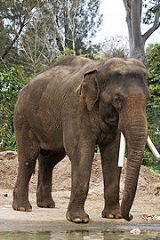
The Asian or Asiatic Elephant (Elephas maximus), sometimes known by the name of one of its subspecies – the Indian Elephant
Indian Elephant

The Indian Elephant, Elephas maximus indicus, is one of four subspecies of the Asian Elephant, the largest population of which is found in India....
, is one of the three living species
Species

In biology, a species is one of the basic units of biological classification and a taxonomic rank. A species is often defined as a group of organisms capable of interbreeding and producing fertile offspring....
 of elephant
Elephant

Elephants are large land mammals of the order Proboscidea and the family Elephantidae. There are three living species: the African Bush Elephant, the African Forest Elephant and the Asian Elephant ....
, and the only living species of the genus Elephas
Elephas

Elephas is one of two surviving genus in the Order of elephants, Proboscidea.The genus has one surviving species, the Asian elephant , but several Extinction species have been identified as belonging to the genus, including Elephas recki, Elephas antiquus, and the dwarf elephants Elephas falconeri and Elephas cypriotes....
. It is the largest living land animal in Asia
Asia

Asia is the world's largest and most populous continent. It covers 8.6% of the Earth's total surface area and, with over 4 billion people, it contains more than 60% of the world's current human population....
. The species is found primarily in Bangladesh
Bangladesh

, officially the People's Republic of Bangladesh is a country in South Asia. It is bordered by India on all sides except for a small border with Burma to the far southeast and by the Bay of Bengal to the south....
, India
India

India, officially the Republic of India , is a country in South Asia. It is the List of countries and outlying territories by total area country by geographical area, the List of countries by population country, and the most populous liberal democracy in the world....
, Sri Lanka
Sri Lanka

Sri Lanka, officially the Democratic Socialist Republic of Sri Lanka is an island country in South Asia, located about off the southern coast of India....
, Indochina
Indochina

Indochina, or the Indochinese Peninsula, is a subregion in Southeast Asia. It lies roughly east of India, south of China.The word has French origins, Indochine, and was adopted when French colonizers in Vietnam began expanding their territory to bordering countries....
 and parts of Nepal
Nepal

Nepal , officially the Federal Democratic Republic of Nepal, is a landlocked country in South Asia and is the world's youngest republic. It is bordered to the north by the People's Republic of China, and to the south, east, and west by India....
 and Indonesia
Indonesia

The Republic of Indonesia , is a transcontinental country in Southeast Asia and Oceania. Comprising Islands of Indonesia, it is the world's largest Archipelago state....
 and Thailand
Thailand

The Kingdom of Thailand is an independent country that lies in the heart of Southeast Asia. It is bordered to the north by Laos and Myanmar, to the east by Laos and Cambodia, to the south by the Gulf of Thailand and Malaysia, and to the west by the Andaman Sea and Myanmar....
. It is considered endangered
Endangered species

An endangered species is a population of an organism which is at risk of becoming extinct because it is either few in numbers, or threatened by changing environmental or predation parameters....
, with between 41,410 and 52,345 left in the wild.

This animal is widely domesticated
Domestication

Domestication or taming refers to the process whereby a population of living things becomes accustomed to a controlled environment by other plants or animals through a process of Selective breeding....
, and has been used in forestry
Forestry

Forestry is the art and science of managing forests, tree plantations, and related natural resources. Silviculture, a related science, involves the growing and tending of trees and forests....
 in South
South Asia

South Asia, also known as Southern Asia, is the southern region of the Asian continent, which comprises the sub-Himalayan countries and, for some authorities , also includes the adjoining countries on the west and the east....
 and Southeast Asia
Southeast Asia

Southeast Asia or Southeastern Asia is a subregion of Asia, consisting of the countries that are geographically south of China, east of India and north of Australia....
 for centuries and also in ceremonial
Ceremony

A ceremony is an activity, infused with ritual significance, performed on a special occasion....
 purposes.


Discussion
Ask a question about 'Asian Elephant'
Start a new discussion about 'Asian Elephant'
Answer questions from other users
Full Discussion Forum


Encyclopedia


The Asian or Asiatic Elephant (Elephas maximus), sometimes known by the name of one of its subspecies – the Indian Elephant
Indian Elephant

The Indian Elephant, Elephas maximus indicus, is one of four subspecies of the Asian Elephant, the largest population of which is found in India....
, is one of the three living species
Species

In biology, a species is one of the basic units of biological classification and a taxonomic rank. A species is often defined as a group of organisms capable of interbreeding and producing fertile offspring....
 of elephant
Elephant

Elephants are large land mammals of the order Proboscidea and the family Elephantidae. There are three living species: the African Bush Elephant, the African Forest Elephant and the Asian Elephant ....
, and the only living species of the genus Elephas
Elephas

Elephas is one of two surviving genus in the Order of elephants, Proboscidea.The genus has one surviving species, the Asian elephant , but several Extinction species have been identified as belonging to the genus, including Elephas recki, Elephas antiquus, and the dwarf elephants Elephas falconeri and Elephas cypriotes....
. It is the largest living land animal in Asia
Asia

Asia is the world's largest and most populous continent. It covers 8.6% of the Earth's total surface area and, with over 4 billion people, it contains more than 60% of the world's current human population....
. The species is found primarily in Bangladesh
Bangladesh

, officially the People's Republic of Bangladesh is a country in South Asia. It is bordered by India on all sides except for a small border with Burma to the far southeast and by the Bay of Bengal to the south....
, India
India

India, officially the Republic of India , is a country in South Asia. It is the List of countries and outlying territories by total area country by geographical area, the List of countries by population country, and the most populous liberal democracy in the world....
, Sri Lanka
Sri Lanka

Sri Lanka, officially the Democratic Socialist Republic of Sri Lanka is an island country in South Asia, located about off the southern coast of India....
, Indochina
Indochina

Indochina, or the Indochinese Peninsula, is a subregion in Southeast Asia. It lies roughly east of India, south of China.The word has French origins, Indochine, and was adopted when French colonizers in Vietnam began expanding their territory to bordering countries....
 and parts of Nepal
Nepal

Nepal , officially the Federal Democratic Republic of Nepal, is a landlocked country in South Asia and is the world's youngest republic. It is bordered to the north by the People's Republic of China, and to the south, east, and west by India....
 and Indonesia
Indonesia

The Republic of Indonesia , is a transcontinental country in Southeast Asia and Oceania. Comprising Islands of Indonesia, it is the world's largest Archipelago state....
 and Thailand
Thailand

The Kingdom of Thailand is an independent country that lies in the heart of Southeast Asia. It is bordered to the north by Laos and Myanmar, to the east by Laos and Cambodia, to the south by the Gulf of Thailand and Malaysia, and to the west by the Andaman Sea and Myanmar....
. It is considered endangered
Endangered species

An endangered species is a population of an organism which is at risk of becoming extinct because it is either few in numbers, or threatened by changing environmental or predation parameters....
, with between 41,410 and 52,345 left in the wild.

This animal is widely domesticated
Domestication

Domestication or taming refers to the process whereby a population of living things becomes accustomed to a controlled environment by other plants or animals through a process of Selective breeding....
, and has been used in forestry
Forestry

Forestry is the art and science of managing forests, tree plantations, and related natural resources. Silviculture, a related science, involves the growing and tending of trees and forests....
 in South
South Asia

South Asia, also known as Southern Asia, is the southern region of the Asian continent, which comprises the sub-Himalayan countries and, for some authorities , also includes the adjoining countries on the west and the east....
 and Southeast Asia
Southeast Asia

Southeast Asia or Southeastern Asia is a subregion of Asia, consisting of the countries that are geographically south of China, east of India and north of Australia....
 for centuries and also in ceremonial
Ceremony

A ceremony is an activity, infused with ritual significance, performed on a special occasion....
 purposes. Historical sources indicate that they were sometimes used during the harvest season primarily for milling. Wild elephants attract tourist
Tourism

Tourism is travel for recreational or leisure purposes. The World Tourism Organization defines tourists as people who "travel to and stay in places outside their usual environment for not more than one consecutive year for leisure, business and other purposes not related to the exercise of an activity remunerated from...
 money to the areas where they can most readily be seen, but damage crops
Crop (agriculture)

A crop is the annual or season's yield of any plant that is grown in significant quantities to be harvested as food, as livestock fodder, or for any other economic purpose....
, and may enter villages to raid gardens.

Description

The Asian elephant is smaller than its African relatives; the easiest way to distinguish the two is that the Asian elephant has smaller ear
Ear

The ear is the sense organ that detects sounds. The vertebrate ear shows a common biology from fish to humans, with variations in structure according to order and species....
s. The Asian Elephant tends to grow to around two to four meters (7–12 feet) in height and 3,000–5,000 kilograms (6,500–11,000 pounds
Pound (mass)

The pound or pound-mass is a Units of measurement of massused in the Imperial unit, United States customary units and other systems of measurement....
) in weight.

The Asian Elephant has other differences from its African relatives, including a more arched back than the African, one semi-prehensile "finger" at the tip of its trunk as opposed to two, four nails on each hind foot instead of three, and 19 pairs of ribs instead of 21. Also, unlike the African elephant, the female Asian Elephant usually lacks tusk
Tusk

Tusks are unusually long teeth, usually but not always in pairs, that protrude well beyond the mouth of certain mammal species. They are most commonly canine tooth, as with warthogs, boar , and walruses, or, in the case of elephants and narwhals, elongated incisors....
s; if tusks — in that case called "tushes" — are present, they are barely visible, and only seen when the female opens her mouth. The enamel plates
Tooth enamel

Tooth enamel is the hardest and most highly mineralized substance of the body, and with dentin, cementum, and Pulp is one of the four major tissues which make up the tooth in vertebrates....
 of the molars are greater in number and closer together in Asian elephants. Some males may also lack tusks; these individuals are called "makhnas".

Size

The sizes of elephants in the wild have been exaggerated in the past. However, record elephants may have measured as high as at the shoulder. Height is often estimated using the rule of thumb
Rule of thumb

A rule of thumb is a principle with broad application that is not intended to be strictly accurate or reliable for every situation. It is an easily learned and easily applied procedure for approximately calculating or recalling some value, or for making some determination....
 of twice the forefoot circumference.

A record tusk described by George P. Sanderson measured five feet along the curve, with a girth of sixteen inches (406 mm) at the point of emergence from the jaw, the weight being one hundred and four and one-half pounds. This was from an elephant killed by Sir V. Brooke and measured eight feet in length, and nearly seventeen inches in circumference, and weighed ninety pounds. This tusk's weight is, however, exceeded by [the weight of] a shorter tusk of about six feet in length which weighed one hundred pounds. The heaviest wild male recorded was shot by the Maharajah of Susang in the Garo Hills of Assam
Assam

Assam ) is a North-East India state of India with its capital at Dispur, in the outskirts of the city Guwahati. Located south of the eastern Himalayas, Assam comprises the Brahmaputra and the Barak River river valleys and the Karbi Anglong District and the North Cachar Hills with an area of 30,285 square miles ....
, India
India

India, officially the Republic of India , is a country in South Asia. It is the List of countries and outlying territories by total area country by geographical area, the List of countries by population country, and the most populous liberal democracy in the world....
 in 1924, and was 8 tonnes (8.8 short tons), 3.35 m (11.1 ft) tall and 8.06 m (26.6 ft) long.

Behaviour


In the wild, elephant herds follow well-defined seasonal migration routes. These are made around the monsoon
Monsoon

A monsoon is a seasonal prevailing wind that lasts for several months. The term was first used in English in India, Bangladesh, Pakistan, and neighboring countries to refer to the big seasonal winds blowing from the Indian Ocean and Arabian Sea in the southwest bringing heavy rainfall to the region....
 seasons, often between the wet and dry zones, and it is the task of the eldest elephant to remember and follow the traditional migration routes. When human farms are founded along these old routes there is often considerable damage done to crops, and it is common for elephants to be killed in the ensuing conflicts. The adult Asian Elephant has no natural predators, but young elephants may fall prey to tiger
Tiger

The tiger is a member of the Felidae family; the largest of the four "big cats" in the genus Panthera. Native to much of eastern and southern Asia, the tiger is an apex predator and an Carnivore#Obligate carnivores....
s. Elephants life span
Life span

Life span refers to the typical length of time that any particular organism can be expected to live. It may also refer to:*Life expectancy, the average lifespan expected of a group...
s have been exaggerated in the past and live on average for 60 years in the wild and 80 in captivity. They eat 10% of their body weight each day, which for adults is between 170-200 kilograms of food per day. They need 80–200 litres of water a day, and use more for bathing. They sometimes scrape the soil for minerals.

Elephants use infrasound
Infrasound

Infrasound is sound that is lower in frequency than 20 cycles per second, the normal limit of human hearing. Hearing becomes gradually less sensitive as frequency decreases, so for humans to perceive infrasound, the sound pressure must be sufficiently high....
 to communicate; this was first noted by the Indian naturalist M. Krishnan and later studied by Katherine Payne.

Male behavior

Bull elephants are usually solitary, and fight over females during the breeding season
Breeding season

The breeding season is the most suitable season, usually with favorable conditions and abundant food and water, for breeding in the wild among some wild animals and birds ....
. Younger bulls may form small groups. Males reach sexual maturity during their 15th year, after which they annually enter "musth
Musth

Musth is a periodic condition in bull elephants, characterized by highly aggressive behavior, and less notably, by copious discharge of a thick tar-like secretion called temporin from the temporal bone ducts on the sides of the head....
". This is a period where the testosterone
Testosterone

Testosterone is a steroid hormone from the androgen group. In mammals, testosterone is primarily secreted in the testis of males and the ovaries of females, although small amounts are also secreted by the adrenal glands....
 level is high (up to 60 times greater) and they become extremely aggressive. Secretions containing pheromones occur during this period, from the temporal glands on the forehead.

Female behavior

Female elephants live in small groups. They have a matriarchal society, and the group is led by the oldest female. The herd consists of relatives. An individual reaches sexual maturity
Sexual maturity

Sexual maturity is the age or stage when an organism can sexual reproduction. It is sometimes considered synonymous with adulthood, though the two are distinct....
 at 9-15 years of age. The gestation period
Gestation period

I.H The gestation period in a viviparous animal is the length of its gestation. In humans this is 266 days , but varies for other animals.Gestation period is measured from fertilisation to birth....
 is 18–22 months, and the female gives birth to one calf
Calf

File:New Forest calf.jpgA calf is the young of various species of mammal. The term is most commonly used to refer to the young of cattle. The young of bison, camels, dolphins, elephants, giraffes, hippopotamuses, moose, rhinoceroses, whales, seals and yaks are also called calves....
, or occasionally twin
Twin

Twins are two offspring resulting from the same pregnancy, usually childbirth in close succession. They can be the same or different sex. Twins can either be monozygotic or dizygotic ....
s. The calf is fully developed by the 19th month but stays in the womb
Uterus

The uterus is a major female hormone-responsive reproductive sex organ of most mammals, including humans. It is within the uterus that the fetus develops during gestation....
 to grow so that it can reach its mother to feed. At birth, the calf weighs about 100 kg (220 lb), and is suckled
Lactation

Lactation describes the secretion of milk from the mammary glands, the process of providing that milk to the young, and the period of time that a mother lactates to feed her young....
 for up to 2–3 years. Females stay on with the herd, but mature males are chased away.

Females produce sex pheromones; a principal component thereof, (Z)-7-dodecen-1-yl acetate, has also been found to be a sex pheromone in numerous species of insects.

Danger

At most seasons of the year the Indian elephant is a timid animal, much more ready to flee from a foe than to make an attack. Solitary rogues are, however, frequently an exception to this rule, and sometimes make unprovoked attacks on passers-by. Rogue elephant sometimes take up a position near a road, and make it impassable to travellers. Females with calves are at all times dangerous to approach. Contrary to what is stated to be the case with the African species, when an Indian elephant makes a charge, it does so with its trunk tightly curled up, and it makes its attack by trampling its victim with its feet or knees, or, if a male, by pinning it to the ground with its tusks. During musth the male elephant is highly dangerous, not only to human beings, but to its fellow animals. At the first indications of this, domestic elephants are secured tightly to prevent any mishaps; xylazine
Xylazine

Xylazine is a medication that is used for sedation, anesthesia, muscle relaxation, and analgesia in animals such as horses, cattle and other large mammals....
 is also used.
Borneo Elephant Plos Biology
While elephant charges are often displays of aggression that do not go beyond threats, some elephants, such as rogues, may actually attack.
In regard to movement on land, Mr. Sanderson
George P. Sanderson

George Peress Sanderson was born in India in 1848, the son of Rev. Daniel Sanderson, who was a Methodist missionary in India from 1842 to 1867. George Sanderson was sent home for schooling to his father?s family in Cockermouth, Cumbria....
 says that "the only pace of the elephant is the walk, capable of being increased to a fast shuffle of about fifteen miles (24 km) an hour for very short distances. It can neither trot, canter, nor gallop. It does not move with the legs on the same side together, but nearly so. A very good runner might keep out of an elephant's way on a smooth piece of turf, but on the ground in which they are generally met with, any attempt to escape by flight, unless supplemented by concealment, would be unavailing."


When an elephant does charge, it requires all the coolness and presence of mind of the sportsman to avoid a catastrophe- "A grander animated object," writes Mr. Sanderson, "than a wild elephant in full charge can hardly be imagined. The cocked ears and broad forehead present an immense frontage; the head is held high, with the trunk curled between the tusks, to be uncoiled in the moment of attack; the massive fore-legs come down with the force and regularity of ponderous machinery; and the whole figure is rapidly foreshortened, and appears to double in size with each advancing stride. The trunk being curled and unable to emit any sound, the attack is made in silence, after the usual premonitory shriek, which adds to its impressiveness. The usual pictorial representations of the Indian elephant charging with upraised trunk are accordingly quite incorrect."


Captivity

Elephants have been captured from the wild and tamed for use by humans. Their ability to work under instruction makes them particularly useful for carrying heavy objects. They have been used particularly for timber-carrying in jungle areas. Other than their work use, they have been used in war, in ceremonies, and for carriage. They have been used for their ability to travel over difficult terrain by hunters, for whom they served as mobile hunting platforms. The same purpose is met in safaris in modern times.

The first historical record of domestication of Asian elephants was in Harappan times. Ultimately the elephant went on to become a siege engine, a mount in war, a status symbol, a work animal, and an elevated platform for hunting during historical times in South Asia
South Asia

South Asia, also known as Southern Asia, is the southern region of the Asian continent, which comprises the sub-Himalayan countries and, for some authorities , also includes the adjoining countries on the west and the east....
.

The elephant plays an important part in the culture of the subcontinent and beyond, featuring prominently in Jataka
Jataka

The Jataka Tales also known in other languages refer to a voluminous body of folklore-like literature native to India concerning the previous births of the Gotama Buddha....
 tales and the Panchatantra
Panchatantra

The Panchatantra or Tantrakhyayika also known in other cultures as Kalileh o Demneh or Anvar-e Soheyli or Kalilag and Damnag or Kalilah wa Dimnah or Kalila and Dimna or The Fables of Bidpai or The Morall Philosophie of Doni was originally a canon...
. It plays a major role in Hinduism
Hinduism

'Hinduism' is the predominant religion of the Indian subcontinent. Hinduism is often referred to as , a Sanskrit phrase meaning "the eternal dharma", by its practitioners....
: the god Ganesha
Ganesha

Ganesha , also spelled Ganesa or Ganesh and also known as Ganapati, Vinayaka, and Pillaiyar, is one of the best-known and most widely worshipped Hindu deities in the Hinduism Pantheon ....
's head is that of an elephant, and the "blessings" of a temple elephant are highly valued. Elephants have been used in processions in Kerala
Kerala

Kerala is a Indian Union States and territories of India located in the southwestern part of India. With an Arabian Sea coastline on the west, it is bordered on the north by Karnataka and by Tamil Nadu on the south and east....
 where the animals are adorned with festive outfits. They were also used by almost all armies in India as war elephant
War elephant

A war elephant is an elephant trained and guided by humans for combat. Their main use was in charge s, to trample the enemy and/or break their ranks....
s, terrifying opponents unused to the massive beast.

Subspecies

Elephas maximus is the only surviving species in the Elephas
Elephas

Elephas is one of two surviving genus in the Order of elephants, Proboscidea.The genus has one surviving species, the Asian elephant , but several Extinction species have been identified as belonging to the genus, including Elephas recki, Elephas antiquus, and the dwarf elephants Elephas falconeri and Elephas cypriotes....
 genus, although several extinct fossil species of Elephas are known.

There are four living subspecies of the Asian elephant:

  • Indian Elephant
    Indian Elephant

    The Indian Elephant, Elephas maximus indicus, is one of four subspecies of the Asian Elephant, the largest population of which is found in India....
     (E. m. indicus)
  • Sri Lankan Elephant
    Sri Lankan Elephant

    The Sri Lankan Elephant is the nominate subspecies of the Asian Elephant and is the largest of the subspecies although smaller than the two species of African elephants....
     (E. m. maximus)
  • Sumatran Elephant
    Sumatran Elephant

    The Sumatran Elephant is a subspecies of the Asian Elephant. As the name suggests, the elephant is only found in Sumatra. The Sumatran Elephant is smaller than the Indian subspecies and is extremely endangered species....
     (E. m. sumatrensis)
  • Borneo Elephant
    Borneo Elephant

    The Borneo Elephant, also called the Borneo Pygmy Elephant, is a subspecies of the Asian Elephant and found in north Borneo ....
     (E. m. borneensis)
The population in Vietnam
Vietnam

Vietnam , officially the Socialist Republic of Vietnam , is the easternmost country on the Indochina Peninsula in Southeast Asia. It is bordered by People's Republic of China to the north, Laos to the northwest, Cambodia to the southwest, and the South China Sea to the east....
 and Laos
Laos

Laos , officially the Lao People's Democratic Republic, is a landlocked country in southeast Asia, bordered by Burma and People's Republic of China to the northwest, Vietnam to the east, Cambodia to the south, and Thailand to the west....
 is undergoing tests to determine if it is a fifth subspecies. This research is considered vital as there are less than 1300 wild Asian elephants remaining in Laos
Laos

Laos , officially the Lao People's Democratic Republic, is a landlocked country in southeast Asia, bordered by Burma and People's Republic of China to the northwest, Vietnam to the east, Cambodia to the south, and Thailand to the west....
.

E. m. indicus survives in separate ranges in southern India, the Himalayan foothills, and northwest India; it is also found in southern China
China

China is a Culture of China, an ancient civilization, and, depending on perspective, a national or multinational entity extending over a large area in East Asia....
, Burma, Thailand
Thailand

The Kingdom of Thailand is an independent country that lies in the heart of Southeast Asia. It is bordered to the north by Laos and Myanmar, to the east by Laos and Cambodia, to the south by the Gulf of Thailand and Malaysia, and to the west by the Andaman Sea and Myanmar....
, Cambodia
Cambodia

The Kingdom of Cambodia is a country in South East Asia with a population of over 13 million people. The kingdom's capital and largest city is Phnom Penh....
 and the Malaysia
Malaysia

Malaysia is a federation that consists of States of Malaysia in Southeast Asia with a total landmass of . The capital city is Kuala Lumpur, while Putrajaya is the seat of the federal government....
n peninsula. Most males of this subspecies have tusks.
E. m. maximus is only found in Sri Lanka
Sri Lanka

Sri Lanka, officially the Democratic Socialist Republic of Sri Lanka is an island country in South Asia, located about off the southern coast of India....
. It has a larger skull relative to body size, and commonly has a decolourised area of skin on the forehead and the front of the upper trunk. It is rare to find even males with tusks. Males can reach a height of 3.5 metres at the shoulder.
E. m. sumatrensis is only found in Sumatra
Sumatra

Sumatra is an island in western Indonesia, westernmost of the Sunda Islands. It is the largest island entirely in Indonesia , and the list of islands by area in the world ....
, Indonesia
Indonesia

The Republic of Indonesia , is a transcontinental country in Southeast Asia and Oceania. Comprising Islands of Indonesia, it is the world's largest Archipelago state....
. It is the second smallest subspecies, between 1.7 to 2.6 metres at the shoulder. It is sometimes called the pocket elephant because of its size.
E. m. borneensis is found in north Borneo
Borneo

Borneo is the List of islands by area and is located at the centre of Maritime Southeast Asia. Administratively, this island is divided between Indonesia, Malaysia and Brunei....
 (east Sabah and extreme north Kalimantan). It is smaller than all the other subspecies. It has larger ears, a longer tail, and straighter tusks. Genetic tests found that its ancestors separated from the mainland population about 300,000 years ago.

In addition, two extinct subspecies are considered by some authorities to have existed:
  • The Chinese population is sometimes separated as E. m. rubridens (pink-tusked elephant); it disappeared after the 14th century BC.
  • The Syrian Elephant
    Syrian Elephant

    The Syrian elephant is said to have been the westernmost subspecies of the Asian Elephant in ancient times. Syrian elephants were among the largest elephants in historic times, measuring or more at the shoulder....
     (E. m. asurus), the westernmost and the largest subspecies of the Asian Elephant, went extinct around 100 BC. This latter population, along with other Indian elephants, were considered the best war elephant
    War elephant

    A war elephant is an elephant trained and guided by humans for combat. Their main use was in charge s, to trample the enemy and/or break their ranks....
    s in antiquity, and found superior to the smallish North African Elephant
    North African Elephant

    The North African Elephant was a possible subspecies of the African Bush Elephant , or possibly a separate elephant species, that existed in North Africa until becoming extinct in Ancient Ancient Rome....
     (Loxodonta africana pharaonensis) used by the armies of Carthage
    Carthage

    Carthage refers both to an ancient city in present-day Tunisia, and a modern-day suburb of Tunis. The civilization that developed within the city's sphere of influence is referred to as Punic or Carthaginian....
    .


See also

  • Batyr
    Batyr

    Batyr was an Asian Elephant claimed to be able to use a large amount of meaningful human Speech communication.Living in a zoo in Kazakhstan, Batyr was widely published as having a vocabulary of more than 20 phrases....
    , an Asian Elephant who could imitate human speech
  • Elephants in Kerala culture
  • Elefantasia
    Elefantasia

    ElefantAsia is a non-profit organisation dedicated towards the protection of the Asian elephant, Elephas maximus. This organisation operates in Laos PDR where today there are only 1500 Asian elephants remaining, 560 of these domesticated and working with their mahouts....
     for information on Asian elephants in Laos
    Laos

    Laos , officially the Lao People's Democratic Republic, is a landlocked country in southeast Asia, bordered by Burma and People's Republic of China to the northwest, Vietnam to the east, Cambodia to the south, and Thailand to the west....
  • National Elephant Institute
    National Elephant Institute

    The National Elephant Institute was founded as the Thai Elephant Conservation Center . Subsequently in January 2002, in order to enlarge the scope of Conservation ecology efforts and address the issues facing Thailand's elephants, it was proposed that the TECC be renamed the National Elephant Institute....
     in Thailand
    Thailand

    The Kingdom of Thailand is an independent country that lies in the heart of Southeast Asia. It is bordered to the north by Laos and Myanmar, to the east by Laos and Cambodia, to the south by the Gulf of Thailand and Malaysia, and to the west by the Andaman Sea and Myanmar....


External links