
All Topics  
Banteng


   Email Print
   Bookmark   Link


Banteng


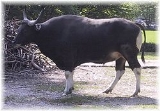
The Banteng, Bos javanicus is an oxOx

Oxen are cattle trained as draft animals....
 that is found in Burma, ThailandThailand

The Kingdom of Thailand is a country in Southeast Asia, bordering Laos and Cambodia to the east, the Gulf of Thailand and Ma...
, CambodiaCambodia

The Kingdom of Cambodia is a country in Southeast Asia with a population of more than 13 million....
, LaosLaos

Laos, officially the Lao People's Democratic Republic, is a landlocked socialist republic communist state in southeast...
, VietnamVietnam

Vietnam, officially the Socialist Republic of Vietnam, is a country in Southeast Asia....
, BorneoBorneo

Borneo is the third largest island in the world....
, Java, and BaliBali

Bali is an Indonesian island located at , one of the Lesser Sunda Islands, and one of the country's 33 provinces....
. Some Banteng were introduced to Northern AustraliaNorthern Territory

The Northern Territory is a federal territory of Australia....
 during British colonization in 1849 where they are doing extremely well having grown in number spurred by the trophy huntingTrophy hunting

Trophy hunting is the selective seeking of wild game....
 incentive.
Banteng have been domesticated in several places in Southeast AsiaSoutheast Asia

Southeast Asia or Southeastern Asia is a subregion of Asia, consisting of the countries that are geographically east o...
, and there are around 1.5 million domestic Banteng, which are called Bali cattle. These animals are used as a working beast, and for their meat. Domestic and wild Banteng can mate and offspring are often fertileFertile

Fertile may be used in the following context:...
. Domesticated bantengs have been introduced in 1849 to northern Australia and form a feral population there.

Distribution

As of February 2005, the Banteng population of the Cobourg PeninsulaCobourg Peninsula

The Cobourg Peninsula is located 350 km east of Darwin in the Northern Territory, Australia....
 is 10,000 head, making the population in the Northern TerritoryNorthern Territory

The Northern Territory is a federal territory of Australia....
 the largest herd in the world. Before the study by Charles Darwin UniversityCharles Darwin University

otto="Change your World"|established=2004|...
 it was believed that only 5,000 pure-strain Banteng survived worldwide. In their native range the largest herd numbers less than 500 head.

Behaviour

Banteng live in sparse forest where they feed on grasses, bamboo, fruit, leaves and young branches. The Banteng is generally active both at night and day time but in places where humans are common they adopt a nocturnal schedule. Banteng tend to gather in herds of two to thirty members.

Subspecies

  • Java Banteng (B. j. javanicus): JavaJava

    style="margin-left: inherit; font-size: medium;" | Java...
    ; Males are black, females buff.
  • Borneo Banteng (B. j. lowi): BorneoBorneo

    Borneo is the third largest island in the world....
    ; Smaller then Java Banteng and the horns are steeper, bulls are chocolate-brown.
  • Burma Banteng (B. j. birmanicus): Burma, ThailandThailand

    The Kingdom of Thailand is a country in Southeast Asia, bordering Laos and Cambodia to the east, the Gulf of Thailand and Ma...
    , CambodiaCambodia

    The Kingdom of Cambodia is a country in Southeast Asia with a population of more than 13 million....
    , VietnamVietnam

    Vietnam, officially the Socialist Republic of Vietnam, is a country in Southeast Asia....
    ; Males and females are usually buff, but in CambodiaCambodia

    The Kingdom of Cambodia is a country in Southeast Asia with a population of more than 13 million....
     are 20 % of the bulls blackish, and on the Malayan Peninsula in Thailand are even most of the bulls black. These subspecies is classified as Critically Endangered by the IUCN.

Cloning

The Banteng is the second endangered species to be successfully clonedCloning

Cloning is the process of recreating an identical copy of an original organism or thing....
, and the first to survive for more than a week (the first was a GaurGaur

The Gaur is a large, dark-coated ox of the hilly areas of South Asia and Southeast Asia, which may be found wild or domestic...
 that died two days after being born). Scientists at Advanced Cell TechnologyAdvanced Cell Technology

Advanced Cell Technology , a biotechnology company formed in 1994, is involved with therapeutic cloning and the cloning of animals...
 in Worcester, MA, USA extracted DNADNA

Deoxyribonucleic acid is a nucleic acid that contains the genetic instructions for the biological development of a cellu...
 from Banteng cells kept in the San Diego ZooSan Diego Zoo

The world-famous San Diego Zoo in Balboa Park, San Diego, California is one of the largest, most progressive zoos in the wor...
's "Frozen ZooEx-situ conservation

Ex-situ conservation means literally, "off-site conservation"....
" facility, and transferred it into eggs from domestic cattle, a process called somatic cell nuclear transferSomatic cell nuclear transfer

In genetics, somatic cell nuclear transfer is a technique for cloning....
. 30 embryos were created, sent to Trans Ova Genetics, which implanted the fertilized eggs in domestic cattle. Two were carried to term and delivered by caesarian section. The first was born on April 1, 2003, and the second two days later. The second was euthanizedAnimal euthanasia

Euthanasia is the practice of killing in a painless or minimally painful way for merciful reasons, usually to end suffering...
, but the first survived and, as of September 2006, remains in good health at the San Diego Zoo.

The Banteng in Australia

Overview of Australian Presence:

The domesticated form of the banteng was first introduced to Australia in 1849 with the establishment of a British military outpost on the Cobourg Peninsula called Port Essington. In all 20 animals were taken to the Western Arnhem Land, a part of current day Northern Territory, as a source of meat. Only a year after the outpost’s establishment, poor conditions such as crop failure and tropical disease lead to its abandonment. With the departure of British troops, the banteng were released from their grazing pastures and allowed to form a feral population. By the 1960’s, researchers realized that a population of about 1500 individuals had developed in the tropical forests of the Cobourg Peninsula.

Since their introduction in 1849, the population has not strayed far from its initial point of domesticated life; all currently live within the Garig Gunak Barlu National ParkGarig Gunak Barlu National Park

Garig Gunak Barlu is a national park in the Northern Territory, 216 km northeast of Darwin....
. As of 2007, the initial population had grown from only 20 in 1849 to 8,000-10,000 and is used exclusively for sport hunting and aboriginal subsistence hunters.

Physiology and Reproduction in Australian Banteng Populations

The Banteng of the Cobourg PeninsulaCobourg Peninsula Summary

The Cobourg Peninsula is located 350 km east of Darwin in the Northern Territory, Australia....
 have developed slightly different life processes than their domesticated counterparts. Growth over lifetime is sexually dimorphic; males grow faster and are larger than females. Furthermore, females reach maximum body mass in three to four years, while males take five to six. Sexual maturity occurs three to four years, and two to four years in males and females respectively. Fecundity also declines in older females. Breeding is seasonal, with maximum mating occurring during the months of October and November, and most births take place in the winter months of June to August. Calf mortality is high in the first six months of life, and declines quickly thereafter with increasing body size. When compared to domestic populations, it was found that increased food in captive conditions allowed respectively higher fecundity, earlier maturation, and lower juvenile mortality.

Australian Environmental Impact:

Despite being an non-native species, the feral australian banteng, has adapted to positively interact with native avian populations. Studies have shown that mutual relationships have developed involving the removal of ectoparasites residing on the bovid body by the Torresian crowTorresian Crow

The Torresian Crow, also occasionally called the Australian Crow, is about the same size as the Eurasian Carrion Crow ...
 (Corvus orru). This is especially notable because it is the first-known relationship of such a kind, which only needed 150 years to develop, where a native bird relies on a non-native wild mammal.

Within the Garig Gunak Barlu National ParkGarig Gunak Barlu National Park

Garig Gunak Barlu is a national park in the Northern Territory, 216 km northeast of Darwin....
, where practically all Banteng reside, there has been limited damage due to overgrazing. They are primarily found within the monsoon forests, but cause little damage, especially when compared to feral pigs. Within the forest, densities were found to be around 70 per square kilometer, and have remained near their initial introduction point 140 years ago because of the possibility that their habitat is a uniquely suitable mosaic of grassland and monsoon forest. Another likely reason for their limit dispersal is the presence of fences along the southern end of the peninsula installed to manage movement of other feral species like the water buffalo. Interaction with the habitat is also unclear in another aspect involving monsoonal forest succession into grasslands. Within the Garig Gunak Barlu National Park researchers noticed that monsoonal seedling were encroaching into previously well established grasslands. It is thought that the grazing by banteng limits potential fuel for grassland fires to take back monsoonal forest and spreads monsoonal seeds, but was still unclear after the study.

Conservation Value of Australian banteng population for Bos javnicus

Since Australian banteng are considered an invasive non-native species, some environmental scientists believe that a complete removal of the limited population will allow previously occupied habitat to regress back to its pre-1849 state and allow native species to return. However, this thought of return to pristine conditions is not clearly favorable because of the socio-economic niche it has formed, as well as playing an integral role in helping to recover endangered wild individuals in Asia.

Small populations in northern Australian are heavily relied on as a source of income for sport hunting as well as aboriginal peoples. Studies revealed that as much as AU$200,000 can be made annually on hunting without damaging populace stability.

The current population of banteng in Australia has become the center of debate due to the endangered status it has achieved in its native Asia. Wild bantengs are incredibly rare in Asia due to loss of suitable habitat, even though they are regularly used in domestic agricultural settings by as grazers. But these domestic bantengs of South East Asia have varying degrees of introgression from other domesticated BosBos

Bos is the genus of wild and domestic cattle or oxen....
species. The Australian bantengs are derived from the domesticated form and not from the rare wild form. However, genetic studies have revealed that the Australian bantengs are identical to the Asian Bos javanicus and are therefore not crossed with other species, what places the Australian population in a different conservation category relative to its domesticated conspecific in South East Asia.

Since a small founder event occurred with only approximately 20 previously domesticated individuals, a genetic bottlenecking has inevitably occurred, causing all current individuals in Australia to be genetically similar and lacking genetic diversity due to generational inbreeding. This was proven using microsatellites, 12 in all, were used to determine that their inbreeding coefficient was high, F=0.58. These findings were comparatively much higher than the endangered artiodactyl populations in Southeast Asia. Despite the limited genetic pool of this population, conservationists are hopeful that preservation of at risk populations can transpire. Some have proposed a deliberate introduction of the endangered populations to the stable but non-native Australian variety will enable viable conservation, even though it is not entirely known how it will affect Northern territory grazing ranges.

External links


  • from
  • ARKive -
  • from CDU HomepageCharles Darwin University

    otto="Change your World"|established=2004|...


>