

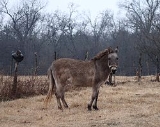
Hinny

Encyclopedia
- The word hinny is also a term of endearment used in North East EnglandNorth East EnglandNorth East England is one of the nine official regions of England. It covers Northumberland, County Durham, Tyne and Wear, and Teesside . The only cities in the region are Durham, Newcastle upon Tyne and Sunderland...
, equivalent to honey; see GeordieGeordieGeordie is a regional nickname for a person from the Tyneside region of the north east of England, or the name of the English-language dialect spoken by its inhabitants...
and MackemMackemMackem is a term that refers to the accent, dialect and people of the Wearside area, or more specifically Sunderland, a city in North East England. Spelling variations include "Mak'em", "Makem", and "Maccam".- Origin :...
.
A hinny is a domestic
Domestication
Domestication or taming is the process whereby a population of animals or plants, through a process of selection, becomes accustomed to human provision and control. In the Convention on Biological Diversity a domesticated species is defined as a 'species in which the evolutionary process has been...
equine hybrid that is the offspring of a male horse
Horse
The horse is one of two extant subspecies of Equus ferus, or the wild horse. It is a single-hooved mammal belonging to the taxonomic family Equidae. The horse has evolved over the past 45 to 55 million years from a small multi-toed creature into the large, single-toed animal of today...
and a female donkey
Donkey
The donkey or ass, Equus africanus asinus, is a domesticated member of the Equidae or horse family. The wild ancestor of the donkey is the African Wild Ass, E...
(called a jenny
Jenny (donkey)
A jenny is the term used to describe a female ass or donkey. Occasionally, a female mule is referred to as a jenny, but more often, the term "molly," "mare" or "mule mare" is used. In western Canada, the term "jennet" is sometimes used instead of "jenny," though the term Jennet usually refers to a...
). It is similar to the more common mule
Mule
A mule is the offspring of a male donkey and a female horse. Horses and donkeys are different species, with different numbers of chromosomes. Of the two F1 hybrids between these two species, a mule is easier to obtain than a hinny...
, which is the product of a female horse and a male donkey.
In Ireland the word jennet is used for a hinny.
Physical description
Hinnies are on average slightly smaller than mulesMule
A mule is the offspring of a male donkey and a female horse. Horses and donkeys are different species, with different numbers of chromosomes. Of the two F1 hybrids between these two species, a mule is easier to obtain than a hinny...
. There is much speculation about the size variances between the two types of hybrids. Some fanciers feel this size difference is merely physiological
Physiology
Physiology is the science of the function of living systems. This includes how organisms, organ systems, organs, cells, and bio-molecules carry out the chemical or physical functions that exist in a living system. The highest honor awarded in physiology is the Nobel Prize in Physiology or...
, due to the smaller size of the donkey
Donkey
The donkey or ass, Equus africanus asinus, is a domesticated member of the Equidae or horse family. The wild ancestor of the donkey is the African Wild Ass, E...
dam, as compared with a much larger mare
Mare (horse)
A mare is an adult female horse or other equine.In most cases, a mare is a female horse over the age of three, and a filly is a female horse age three and younger. However, in Thoroughbred horse racing, a mare is defined as a female horse more than four years old; in harness racing a mare is a...
. Others claim it is genetic, but the view of the American Donkey and Mule Society is, "The genetic inheritance of the hinny is exactly the same as the mule."
Thus, hinnies are smaller because donkeys are, for the most part, smaller than horses, and growth potential of equine offspring is influenced by the size of the dam's womb. However, like mules, hinnies do come in many sizes. This is because donkeys come in many sizes, from miniatures, as small as 24 inches (610 mm) at the withers
Withers
The withers is the ridge between the shoulder blades of a four-legged animal. In many species it is the tallest point of the body, and in horses and dogs it is the standard place to measure the animal's height .-Horses:The withers in horses are formed by the dorsal spinal processes of roughly the...
, to Mammoth
American Mammoth Jack
The American Mammoth Donkey, commonly known as the Mammoth Jack, or American Mammoth Jack is a descendant of multiple breeds of donkey imported to the United States. Breeds that influenced the Mammoth Jack include the Maltese donkey, Poitou donkey , Andalusian donkey, Majorcan donkey, and...
jacks and jennies that may be over at the withers. Thus, a hinny is restricted to being about the size of the largest breed of donkey. Mules, however, have a female horse as a parent, so they can be as large as the size of the tallest breed of horse. There are some very large mules, mostly from work horse breeds such as the Belgian
Belgian (horse)
The Belgian Draft horse or Belgian, also known as Belgian Heavy Horse, Brabançon, or Brabant, is a draft horse breed from the Brabant region of modern Belgium, where it is called the or Flemish: . It is one of the strongest of the heavy breeds...
.
Other than size, there are some minor differences that occur frequently between mules and hinnies. The head of a hinny resembles that of a horse, more so than mule heads. Hinnies often have shorter ears, although they are still longer than those of horses, and more horse-like manes and tails than mules. Certain traits, such as the popular gait
Horse gait
Horse gaits are the various ways in which a horse can move, either naturally or as a result of specialized training by humans.-Classification:...
that some horses and donkeys possess, seem to pass more readily through the male parent. Therefore, many people have tried to produce gaited hybrids by using gaited male horses with female donkeys, in hopes of creating gaited hinnies.
Fertility, sterility, and rarity
Hinnies are difficult to obtain because of the differences in the number of chromosomeChromosome
A chromosome is an organized structure of DNA and protein found in cells. It is a single piece of coiled DNA containing many genes, regulatory elements and other nucleotide sequences. Chromosomes also contain DNA-bound proteins, which serve to package the DNA and control its functions.Chromosomes...
s of the horse and the donkey
Donkey
The donkey or ass, Equus africanus asinus, is a domesticated member of the Equidae or horse family. The wild ancestor of the donkey is the African Wild Ass, E...
. A donkey has 62 chromosomes, whereas a horse has 64. Hinnies, being hybrids of those two species
Species
In biology, a species is one of the basic units of biological classification and a taxonomic rank. A species is often defined as a group of organisms capable of interbreeding and producing fertile offspring. While in many cases this definition is adequate, more precise or differing measures are...
, have 63 chromosomes and are sterile. The uneven number of chromosomes results in an incomplete reproductive system
Reproductive system
The reproductive system or genital system is a system of organs within an organism which work together for the purpose of reproduction. Many non-living substances such as fluids, hormones, and pheromones are also important accessories to the reproductive system. Unlike most organ systems, the sexes...
. According to the ADMS, "The equine hybrid is easier to obtain when the lower chromosome count, the donkey, is in the male. Therefore breeding for hinnies is more hit-and-miss than breeding for mules."
Male hinnies and mule
Mule
A mule is the offspring of a male donkey and a female horse. Horses and donkeys are different species, with different numbers of chromosomes. Of the two F1 hybrids between these two species, a mule is easier to obtain than a hinny...
s are usually castrated to help control their behavior by eliminating their interest in females. The male hinny or mule can and will mate, but the emission is not fertile
Fertility
Fertility is the natural capability of producing offsprings. As a measure, "fertility rate" is the number of children born per couple, person or population. Fertility differs from fecundity, which is defined as the potential for reproduction...
. There are no recorded cases of fertile male hinnies or male mules.
Female hinnies and mules are not customarily spayed, and may or may not go through estrus. Female mules have been known to produce offspring when mated to a horse or donkey, though this is extremely uncommon. Since 1527 there have been more than sixty documented cases of foals born to female mules around the world. In contrast, according to the ADMS, there is only one known case of a female hinny doing so.
In China
China
Chinese civilization may refer to:* China for more general discussion of the country.* Chinese culture* Greater China, the transnational community of ethnic Chinese.* History of China* Sinosphere, the area historically affected by Chinese culture...
in 1981, a hinny mare proved fertile with a donkey stallion. When the Chinese hinny was bred to a donkey jack, she produced "Dragon Foal," who resembled a donkey with mule-like features. Dragon Foal's chromosomes and DNA
DNA
Deoxyribonucleic acid is a nucleic acid that contains the genetic instructions used in the development and functioning of all known living organisms . The DNA segments that carry this genetic information are called genes, but other DNA sequences have structural purposes, or are involved in...
tests confirmed that she was a previously undocumented combination - That is, she was not the expected gene combination of 'donkey-donkey' (from her donkey father) / 'donkey-donkey' (If her hinny mother were to have passed on her maternal donkey genes). Instead, Dragon Foal's gene pair combination was donkey-donkey/donkey-horse. Her hinny mother passed along a combination of maternal and paternal genes.
In Morocco
Morocco
Morocco , officially the Kingdom of Morocco , is a country located in North Africa. It has a population of more than 32 million and an area of 710,850 km², and also primarily administers the disputed region of the Western Sahara...
in 2003, a mule mare bred to a donkey stallion produced a male foal that was 75% donkey and 25% horse. DNA testing revealed the Moroccan foal is a mixed karyotype
Karyotype
A karyotype is the number and appearance of chromosomes in the nucleus of an eukaryotic cell. The term is also used for the complete set of chromosomes in a species, or an individual organism.p28...
hybrid like the Chinese hinny offspring, Dragon Foal. This means that, unlike regular hinnies, whose 63 chromosomes consist of 31 pairs that are horse-donkey with one left over, the Morocco colt has about 23 pairs of chromosomes that are donkey-donkey, eight pairs that are horse-donkey, and one left over. Because of the mix of gene pairs in the Moroccan foal, it's unknown whether Dragon Foal's genetic oddity is due to her mother being a hinny rather than a mule, or if there is some other factor that applies equally to Dragon Foal in China and the 2003 colt in Morocco.
There are other reasons for the rarity of hinnies. Female donkeys, jennies
Jenny (donkey)
A jenny is the term used to describe a female ass or donkey. Occasionally, a female mule is referred to as a jenny, but more often, the term "molly," "mare" or "mule mare" is used. In western Canada, the term "jennet" is sometimes used instead of "jenny," though the term Jennet usually refers to a...
, and male horses, stallions
Stallion (horse)
A stallion is a male horse that has not been gelded .Stallions will follow the conformation and phenotype of their breed, but within that standard, the presence of hormones such as testosterone may give stallions a thicker, "cresty" neck, as well as a somewhat more muscular physique as compared to...
, are choosier about their mates than horse mares and donkey jacks. Thus, the two parties involved may not care to mate. Even if they do cooperate, female donkeys are less likely to conceive when bred to a horse than horse mares are when bred to a donkey. Breeding
Horse breeding
Horse breeding is reproduction in horses, and particularly the human-directed process of selective breeding of animals, particularly purebred horses of a given breed. Planned matings can be used to produce specifically desired characteristics in domesticated horses...
large hinnies is an even bigger challenge, as it requires stock from a jenny of Mammoth donkey (Baudet de Poitou
Baudet de Poitou
The Baudet de Poitou is a breed of donkey originating in the Poitou region of France. One of the most distinctive donkey breeds, it is also among the rarest and least-known...
or American Mammoth Jack
American Mammoth Jack
The American Mammoth Donkey, commonly known as the Mammoth Jack, or American Mammoth Jack is a descendant of multiple breeds of donkey imported to the United States. Breeds that influenced the Mammoth Jack include the Maltese donkey, Poitou donkey , Andalusian donkey, Majorcan donkey, and...
. Mammoth donkey stock is becoming increasingly rare and has been declared an endangered domestic breed. Fanciers are unlikely to devote a Mammoth jenny's valuable breeding time to producing sterile hinny hybrids when Mammoth females are in high demand to produce fertile pure-bred Mammoth foals.