
All Topics  
Red Deer

 
Red Deer

   Email Print
   Bookmark   Link


Red Deer


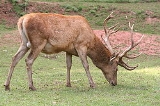
The Red Deer (Cervus elaphus) is one of the largest deer
Deer

Deer are the ruminant mammals forming the family Cervidae . A number of broadly similar animals from related families within the order even-toed ungulate are often also called deer....
 species. The Red Deer inhabits most of Europe, the Caucasus Mountains
Caucasus Mountains

The Caucasus Mountains is a Mountain range in Eurasia between the Black Sea and the Caspian Sea sea in the Caucasus region.The Caucasus Mountains are made up of two separate mountain systems:...
 region, Asia Minor and parts of western and central Asia. It also inhabits the Atlas Mountains
Atlas Mountains

The Atlas Mountains are a mountain range across a northern stretch of Africa extending about 2,400 km through Morocco, Algeria, and Tunisia. The highest peak is Jbel Toubkal, with an elevation of in southwestern Morocco....
 region between Morocco
Morocco

Morocco , officially the Kingdom of Morocco , is a country located in North Africa with a population of nearly 34 million and an area just under 447,000 km2....
 and Tunisia
Tunisia

Tunisia , officially the Tunisian Republic , is a country located in North Africa. It is bordered by Algeria to the west and Libya to the southeast....
 in northwestern Africa, being the only species of deer to inhabit Africa. Red Deer have been introduced to other areas including Australia
Australia

Australia, officially the Commonwealth of Australia, is a country in the southern hemisphere comprising the Australia of the world's smallest continent, the major island of Tasmania, and numerous list of islands of Australia in the Indian Ocean and Pacific Oceans....
, New Zealand
New Zealand

New Zealand is an island country in the south-western Pacific Ocean comprising two main landmasses , and numerous Islands of New Zealand, most notably Stewart Island/Rakiura and the Chatham Islands....
 and Argentina
Argentina

Argentina, officially the Argentine Republic , is a country in South America, constituted as a federation of 23 provinces and an autonomous city....
. In many parts of the world the meat (venison
Venison

Venison is the culinary name for meat from the family Cervidae. Deer meat, whether hunting or farmed, is termed venison....
) from Red Deer is widely used as a food source.

Red Deer are ruminant
Ruminant

Physiologically, a ruminant is a mammal of the order Artiodactyla that digests plant-based food by initially softening it within the animal's first stomach, known as the rumen, then regurgitating the semi-digested mass, now known as cud, and chewing it again....
s, characterized by an even number of toes, and a four-chambered stomach.


Discussion
Ask a question about 'Red Deer'
Start a new discussion about 'Red Deer'
Answer questions from other users
Full Discussion Forum


Encyclopedia


The Red Deer (Cervus elaphus) is one of the largest deer
Deer

Deer are the ruminant mammals forming the family Cervidae . A number of broadly similar animals from related families within the order even-toed ungulate are often also called deer....
 species. The Red Deer inhabits most of Europe, the Caucasus Mountains
Caucasus Mountains

The Caucasus Mountains is a Mountain range in Eurasia between the Black Sea and the Caspian Sea sea in the Caucasus region.The Caucasus Mountains are made up of two separate mountain systems:...
 region, Asia Minor and parts of western and central Asia. It also inhabits the Atlas Mountains
Atlas Mountains

The Atlas Mountains are a mountain range across a northern stretch of Africa extending about 2,400 km through Morocco, Algeria, and Tunisia. The highest peak is Jbel Toubkal, with an elevation of in southwestern Morocco....
 region between Morocco
Morocco

Morocco , officially the Kingdom of Morocco , is a country located in North Africa with a population of nearly 34 million and an area just under 447,000 km2....
 and Tunisia
Tunisia

Tunisia , officially the Tunisian Republic , is a country located in North Africa. It is bordered by Algeria to the west and Libya to the southeast....
 in northwestern Africa, being the only species of deer to inhabit Africa. Red Deer have been introduced to other areas including Australia
Australia

Australia, officially the Commonwealth of Australia, is a country in the southern hemisphere comprising the Australia of the world's smallest continent, the major island of Tasmania, and numerous list of islands of Australia in the Indian Ocean and Pacific Oceans....
, New Zealand
New Zealand

New Zealand is an island country in the south-western Pacific Ocean comprising two main landmasses , and numerous Islands of New Zealand, most notably Stewart Island/Rakiura and the Chatham Islands....
 and Argentina
Argentina

Argentina, officially the Argentine Republic , is a country in South America, constituted as a federation of 23 provinces and an autonomous city....
. In many parts of the world the meat (venison
Venison

Venison is the culinary name for meat from the family Cervidae. Deer meat, whether hunting or farmed, is termed venison....
) from Red Deer is widely used as a food source.

Red Deer are ruminant
Ruminant

Physiologically, a ruminant is a mammal of the order Artiodactyla that digests plant-based food by initially softening it within the animal's first stomach, known as the rumen, then regurgitating the semi-digested mass, now known as cud, and chewing it again....
s, characterized by an even number of toes, and a four-chambered stomach. Recent DNA
DNA

Deoxyribonucleic acid is a nucleic acid that contains the genetics instructions used in the development and functioning of all known living organisms and some viruses....
 evidence indicates that the Red Deer (Cervus elaphus) and the East Asian and North American Elk
Elk

Elk may refer to:* Various species of deer:** European Elk , also known as Moose** North American Elk , also known as Wapiti** Indian Elk , also known as sambar ...
 (Wapiti) (Cervus canadensis) represent two distinct species. They also hint at an additional primordial subgroup of Central Asian Red Deer
Central Asian Red Deer

The Central Asian Red Deer is a primordial group of Red deer subspecies, which live primarily in Asia east of the Caspian Sea and south of Mongolia....
. The ancestor of all Red Deer probably originated in Central Asia and likely resembled Sika Deer
Sika Deer

The Sika Deer is a member of the deer family Cervidae that inhabits much of East Asia. It is found in mixed deciduous forests to the north, and mixed subtropical deciduous and evergreen forests to the south....
.

Although at one time Red Deer were rare in some areas, they were never close to extinction. Reintroduction and conservation
Habitat conservation

To conserve habitat areas for wild conservation reliant species and prevent their extinction or reduction in range is a priority of a great many groups that cannot be easily characterized in terms of any one ideology....
 efforts, especially in the United Kingdom
United Kingdom

The United Kingdom of Great Britain and Northern Ireland, commonly known as the United Kingdom , the UK or Britain,is a sovereign state located off the northwestern coast of continental Europe....
, have resulted in an increase of Red Deer populations, while other areas, such as North Africa
North Africa

North Africa or Northern Africa is the northernmost region of the African continent, separated by the Sahara from Sub-Saharan Africa.Geopolitically, the United Nations subregion of Northern Africa includes the following seven countries or territories:...
, have continued to show a population decline.

Description


The Red Deer is one of the largest deer species. It is a ruminant, eating its food in two stages and having an even number of toes on each hoof, similar to camel
Camel

Camels are even-toed ungulates within the genus Camelus. The dromedary, one-humped or Arabian camel has a single hump and is well known for its healthy low fat milk, and the Bactrian camel has two humps....
s, goat
Goat

The domestic goat is a subspecies of goat domesticated from the wild goat of southwest Asia and Eastern Europe. The goat is a member of the Bovidae family and is closely related to the sheep: both are in the goat-antelope subfamily Caprinae....
s and cattle
Cattle

Cattle, colloquially referred to as cows, are domestication ungulates, a member of the subfamily Bovinae of the family Bovidae. They are raised as livestock for meat , dairy products , leather and as draft animals ....
. European Red Deer have a longer relative tail length compared to their Asian and North American relatives. There are subtle differences in appearance between the various subspecies of Red Deer primarily in size and antlers with the smallest being the Corsican Red Deer found on the islands of Corsica
Corsica

Corsica is the Mediterranean islands#By area in the Mediterranean Sea . It is located west of Italy, southeast of the France mainland, and north of the island of Sardinia....
 and Sardinia
Sardinia

Sardinia is the Mediterranean islands#By area island in the Mediterranean Sea . The area of Sardinia is . The island is surrounded by the France island of Corsica, the Italian Peninsula, Tunisia and the Balearic Islands....
 and the largest being the Caspian red deer (or maral) of Asia Minor and the Caucasus Region to the west of the Caspian Sea
Caspian Sea

The Caspian Sea is the largest enclosed body of water on Earth by area, variously classed as the List of lakes by area or a full-fledged sea. It has a surface area of 371,000 square kilometers and a volume of 78,200 cubic kilometers ....
. The deer of Central and Western Europe vary greatly in size with some of the largest deer found in the Carpathian Mountains
Carpathian Mountains

The Carpathian Mountains or Carpathians are a range of mountains forming an arc of roughly 1,500 km across Central Europe and Eastern Europe, making them the largest mountain range in Europe....
 in Central Europe. West European Red Deer historically, grew to large size given ample food supply (including peoples' crops), and descendants of introduced populations living in New Zealand
New Zealand

New Zealand is an island country in the south-western Pacific Ocean comprising two main landmasses , and numerous Islands of New Zealand, most notably Stewart Island/Rakiura and the Chatham Islands....
 and Argentina
Argentina

Argentina, officially the Argentine Republic , is a country in South America, constituted as a federation of 23 provinces and an autonomous city....
 have grown quite large in size and antlers. Large Red Deer stags, like the Caspian Red Deer or those of the Carpathian Mountains may rival the Wapiti
Wapiti

Wapiti may refer to:...
 in size. Note that the large size is applied to male deer only. Female Red Deer are much smaller.

Generally, the male (stag or hart
Deer

Deer are the ruminant mammals forming the family Cervidae . A number of broadly similar animals from related families within the order even-toed ungulate are often also called deer....
) Red Deer is typically 175–230 cm (69-91 in) long and weighs 160–240 kg (350–530 lbs); the female is 160–210 cm (63–83 in) and weighs 120–170 kg (264–374 lbs). The tail adds another 12-19 cm (5-7.5 in) and shoulder height is about 105-120 cm (41-48 in). Size varies in different subspecies with the largest, the huge but small-antlered deer of the Carpathian Mountains (C. e. elaphus), weighing up to 500 kg (1,100 lbs). At the other end of the scale, the Corsican Red Deer (C. e. corsicanus) weighs about 80-100 kg (176-220 lbs), although Red Deer introduced to other parts of the world can weigh as little as 53 kg (117 lbs). European Red Deer tend to be reddish-brown in their summer coats. All Red Deer subspecies are between 2.1 and 2.4 metres (7 to 8 ft) in length from nose to tail. The males of many subspecies also grow a short neck mane ("mane" of hair around their necks) during the autumn. The male deer of the British Isles
British Isles

The British Isles are a group of islands off the northwest coast of continental Europe that include Great Britain and Ireland, and numerous smaller islands....
 and Norway
Norway

Norway , officially the Kingdom of Norway, is a constitutional monarchy in Northern Europe that occupies the western portion of the Scandinavian Peninsula....
 tend to have the thickest and most noticeable neck manes, relative to the other subspecies. Male Caspian Red Deer (Cervus elaphus maral) and Spanish Red Deer (Cervus elaphus hispanicus) do not carry neck manes. Male deer of all subspecies, however, tend to have stronger and thicker neck muscles than female deer, which may give them an appearance of having neck manes. Red Deer hinds (females) do not have neck manes. The European Red Deer is adapted to a woodland environment.

Only the stags have antler
Antler

Antlers are the usually large and complex horn -like appendages of most deer species, mostly worn by males in true horns. Each antler grows from an attachment point on the skull called a pedicle....
s which start growing in the spring and are shed each year, usually at the end of winter. Antlers are made of bone which can grow at a rate of 2.5 centimetres (1 in) a day. A soft covering known as velvet helps to protect newly forming antlers in the spring. European red deer antlers are distinctive in being rather straight and rugose, with the fourth and fifth tines forming a "crown" or "cup" in larger males. Any tines in excess of the fourth and fifth tine will grow radially from the "cup". "Cups" are generally absent in the antlers of smaller red deer such as Corsican Red Deer. West European Red Deer antlers feature bez (second) tines that are either absent or smaller than the brow tine. However, bez tines occur frequently in Norwegian Red Deer. Antlers of Caspian Red Deer carry large bez (second) tines and form less-developed "cups" than West European red deer. A stag can (exceptionally) have smooth antlers, and is then known as a switch. Similarly, a stag that doesn't grow antlers is a hummel. The antlers are testosterone
Testosterone

Testosterone is a steroid hormone from the androgen group. In mammals, testosterone is primarily secreted in the testis of males and the ovaries of females, although small amounts are also secreted by the adrenal glands....
 driven and as the stag's testosterone levels drop in the autumn, the velvet is shed and the antlers stop growing.

During the autumn, all Red Deer subspecies grow a thicker coat of hair which helps to insulate them during the winter. Autumn is also when some of the stags grow their neck manes. It is in the autumn/winter coat that distinguishes most subspecies. The Caspian Red Deer's winter coat is greyer and has a larger and more distinguished light rump-patch (similar to Wapitis and some Central Asian Red Deer) compared to the West European Red Deer which is more of a greyish-brown coat with a darker yellowish rump patch in the winter. By the time summer begins, the heavy winter coat has been shed; the animals are known to rub against trees and other objects to help remove hair from their bodies. Red Deer have different colouration based on the seasons and types of habitats, with grey or lighter colouration prevalent in the winter and a more reddish and darker coat in the summer. Most European Red Deer wear a reddish-brown summer coat, and some individuals may have a few spots on the backs of their summer coats.

Distribution and habitat

Red Deer
Cervus
Cervus

Cervus is a genus of deer consisting of the following species:* Central Asian Red Deer - Central Asian Red Deer* Cervus albirostris - Thorold's Deer or White-lipped Deer...
 genus
Genus

A genus is a low-level taxonomic rank used in the classification of living and fossil organisms. The taxonomic ranks are domain , kingdom , phylum, class , order , family , genus, and species....
 ancestors of Red Deer first appear in fossil records 12 million years ago during the Pliocene
Pliocene

The Pliocene epoch is the period in the geologic timescale that extends from 5.332 million to 1.806 million years before present.The Pliocene is the second epoch of the Neogene period in the Cenozoic era....
 in Eurasia
Eurasia

Eurasia is a large landmass covering about 53,990,000 km? or about 10.6% of the Earth's surface . Often considered a single continent, Eurasia comprises the traditional continents of Europe and Asia, concepts which date back to classical antiquity and the borders for which are somewhat arbitrary....
. An extinct species, known as the Irish Elk
Irish Elk

The Irish Elk or Giant Deer, Megaloceros giganteus was a species of Megaloceros and one of the largest deer that ever lived....
 (Megaloceros) was not related to the red deer but to the fallow deer
Fallow Deer

The Fallow Deer is a ruminant mammal belonging to the family Cervidae.The male is a buck, the female is a doe, and the young a fawn. Bucks are 140-160 cm long and 90-100 cm shoulder height, and 60-85 kg in weight; does are 130-150 cm long and 75-85 cm shoulder height, and 30-50 kg in weight....
, was the largest member of the deer family known from the fossil record.

The European Red Deer is one of the largest game animals
Hunting

Hunting is the practice of pursuing living animals for food, recreation, or trade. In present-day use, the term refers to lawful hunting, as distinguished from poaching, which is the killing, trapping or capture of the hunted species contrary to law....
 found in Southwestern Asia (Asia Minor and Caucasus Regions), North Africa and Europe. In Europe, The Red Deer is the largest non-domesticated mammal still existing in some countries such as the United Kingdom
United Kingdom

The United Kingdom of Great Britain and Northern Ireland, commonly known as the United Kingdom , the UK or Britain,is a sovereign state located off the northwestern coast of continental Europe....
 and Ireland
Ireland

Ireland is the List of islands by area in Europe, and the twentieth-largest island in the world. It lies to the north-west of continental Europe and is surrounded by hundreds of islands and islet....
. A deer known as the "Barbary Stag" which resembles the West European Red Deer, is the only member of the deer family that is represented in Africa, with population centred in the northwestern region of the continent in the Atlas Mountains
Atlas Mountains

The Atlas Mountains are a mountain range across a northern stretch of Africa extending about 2,400 km through Morocco, Algeria, and Tunisia. The highest peak is Jbel Toubkal, with an elevation of in southwestern Morocco....
. As of the mid 1990s, Morocco
Morocco

Morocco , officially the Kingdom of Morocco , is a country located in North Africa with a population of nearly 34 million and an area just under 447,000 km2....
, Tunisia
Tunisia

Tunisia , officially the Tunisian Republic , is a country located in North Africa. It is bordered by Algeria to the west and Libya to the southeast....
 and Algeria
Algeria

Algeria , officially the People's Democratic Republic of Algeria, is a country located in North Africa. It is the largest country of the Mediterranean sea, second largest in the Arab World, and the second largest on the African continent and the eleventh-largest country in the world in terms of land area....
 were the only African countries known to have Red Deer.

In New Zealand, and to a much lesser degree in Australia
Australia

Australia, officially the Commonwealth of Australia, is a country in the southern hemisphere comprising the Australia of the world's smallest continent, the major island of Tasmania, and numerous list of islands of Australia in the Indian Ocean and Pacific Oceans....
, there is only a couple of small herds left of the original deer brought over for attempted breeding. Most Red deer in Australia are on hunting preserves. Introduced Red Deer have adapted well and are widely hunted in New Zealand. Red Deer populations in Africa and southern Europe are generally declining. In Argentina, where the Red Deer has had a potential adverse impact on native animal species, the International Union for Conservation of Nature and Natural Resources has labelled the animal as one of the world's 100 worst invaders.

Migration

Red Deer in Europe generally spend their winters in lower altitudes and more wooded terrain. During the summer, they migrate to higher elevations where food supplies are greater for the calving season.

Taxonomy

Biologists have until recently stated that Red Deer and Wapiti (or Elk) are the same species forming a continuous distribution throughout temperate Eurasia and North America, based on fertile hybrids that have been produced under captive conditions. Animal behaviour is generally different in captivity than in the wild, and the assumption that the same results would happen in the wild as in captivity is not necessarily the best test methodology to determine speciation
Speciation

Speciation is the evolutionary process by which new biological species arise. The biologist Orator F. Cook seems to have been the first to coin the term 'speciation' for the splitting of lineages or 'cladogenesis,' as opposed to 'anagenesis' or 'phyletic evolution' occurring within lineages....
.

Recent DNA studies conducted on hundreds of samples from Red Deer and Elk subspecies concluded that no more than 9 distinct subspecies of Red Deer exist and that they should be considered to be two separate species. The Wapiti or Elk from Northern and Eastern Asia and North America and the Red Deer from Europe, western Asia and North Africa represent two distinct species. Surprisingly the Elk is more closely related in DNA to the Sika Deer
Sika Deer

The Sika Deer is a member of the deer family Cervidae that inhabits much of East Asia. It is found in mixed deciduous forests to the north, and mixed subtropical deciduous and evergreen forests to the south....
 and to Thorold's deer
Thorold's Deer

Thorold's deer has the scientific classification Cervus albirostris. It is also known as the white-lipped deer , for the white patches around its muzzle....
 than to the Red Deer.

Subspecies

Additionally there are some central asiatic subspecies
Central Asian Red Deer

The Central Asian Red Deer is a primordial group of Red deer subspecies, which live primarily in Asia east of the Caspian Sea and south of Mongolia....
 (Tarim group, including Bactrian deer
Bactrian deer

The Bactrian deer , also called the Bukhara deer, Bokhara deer or Bactrian wapiti, is a lowland subspecies of Red Deer that is native to central Asia....
 and Yarkand deer
Yarkand deer

The Yarkand deer is a subspecies of Red Deer that is native to central Asia. It is similar in ecology to the Bactrian deer in occupying lowland riparian corridors surrounded by deserts....
), which are geographically isolated from Wapitis and western Red Deer by the Takla Makan and the Pamir Mountains
Pamir Mountains

The Pamir Mountains are a mountain range in Central Asia formed by the junction or knot of the Tian Shan, Karakoram, Kunlun Mountains, and Hindu Kush ranges....
. They represent a primordial subgroup, which is genetically more related to the Red Deer than to the Wapitis. It remains unclear which clade
Clade

A clade is a term used in modern alpha taxonomy, the scientific classification of living and fossil organisms, to describe a monophyletic group, defined as a group consisting of a single common ancestor and all its descendants.The term "monophyletic group" is used in this article in the conventional sense of "an a...
 the Kashmir stag
Kashmir stag

The Kashmir stag , also called hangul, is a subspecies of Red Deer native to northern Pakistan and India, especially in Jammu and Kashmir where it is the State Animal of Kashmir....
 belongs in, though it, in terms of zoogeography
Zoogeography

Zoogeography is the branch of the science of biogeography that is concerned with the geographic distribution of animal species and their attributes....
, is most likely to belong in the central Asian group.

The International Union for Conservation of Nature and Natural Resources originally listed nine subspecies of Red Deer (Cervus elaphus): three as endangered
Endangered species

An endangered species is a population of an organism which is at risk of becoming extinct because it is either few in numbers, or threatened by changing environmental or predation parameters....
, one as vulnerable
Vulnerable species

A vulnerable species is a species which is likely to become Endangered species unless the circumstances threatening its survival and reproduction improve....
, one as near threatened
Near Threatened

Near Threatened is a conservation status assigned to species or lower taxa that may be considered threatened species with extinction in the near future, although it does not currently qualify for the threatened status....
, and four without enough data to give a category ("Data Deficient"). The species as a whole, however, is listed as least concern
Least Concern

Least Concern is an World Conservation Union category assigned to extant species or lower taxa which have been evaluated but do not qualify for any other category....
.. However, this was based on the classification of Red Deer as one species (Cervus elaphus) that included Wapitis.

Listed below are the subspecies of Red Deer (Cervus elaphus) including the primordial subgroup from central Asia.

Name Subspecies Status Historical range
Western European Red Deer Cervus elaphus elaphus Western Europe
Eastern European Red deer Cervus elaphus hippelaphus Eastern Europe, Balkan
Maral Cervus elaphus maral Asia Minor, Crimea, Caucasus Region and northwestern Iran
Barbary stag
Barbary stag

The Barbary stag , or Atlas deer is a subspecies of red deer that is native to North Africa....
 
Cervus elaphus barbarusLower risk (Near threatened) Morocco, Tunisia and Algeria
Corsican Red Deer
Corsican Red Deer

The Corsican Red Deer is a subspecies of Red Deer. It gets its name from the island of Corsica, but ironically it became extinct in Corsica at around 1970, and is now endemic to the island of Sardinia....
 
Cervus elaphus corsicanus Endangered (D) Corsica, Sardinia
Sardinia

Sardinia is the Mediterranean islands#By area island in the Mediterranean Sea . The area of Sardinia is . The island is surrounded by the France island of Corsica, the Italian Peninsula, Tunisia and the Balearic Islands....
; probably introduced in historical times and identical with Barbary stag
Kashmir stag
Kashmir stag

The Kashmir stag , also called hangul, is a subspecies of Red Deer native to northern Pakistan and India, especially in Jammu and Kashmir where it is the State Animal of Kashmir....
 
Cervus elaphus hanglu Endangered (D) Kashmir
Bactrian deer
Bactrian deer

The Bactrian deer , also called the Bukhara deer, Bokhara deer or Bactrian wapiti, is a lowland subspecies of Red Deer that is native to central Asia....
 
Cervus elaphus bactrianus Vulnerable (D1) Afghanistan, Kazakhstan, Turkmenistan, Usbekistan and Tadschikistan
Yarkand deer
Yarkand deer

The Yarkand deer is a subspecies of Red Deer that is native to central Asia. It is similar in ecology to the Bactrian deer in occupying lowland riparian corridors surrounded by deserts....
 
Cervus elaphus yarkandensis Endangered (A1a) Xinjiang


Behaviour

Mature Red Deer (Cervus elaphus) usually stay in single-sex groups for most of the year. During the mating ritual, called the rut
Rut (mammalian reproduction)

The Rut is the period of time when antlered ungulates mate. Ungulates include deer, sheep, elk, moose, caribou, ibex, goats, pronghorn and Asian and African antelope....
, mature stags compete for the attentions of the hinds and will then try to defend hinds that they attract. Rival stags challenge opponents by belling and walking in parallel. This allows combatants to assess each other's antlers, body size and fighting prowess. If neither stag backs down a clash of antlers can occur, and stags sometimes sustain serious injuries.

Dominant stags follow groups of hinds during the rut, from August into early winter. The stags may have as many as 20 hinds to keep from other less attractive males. Only mature stags hold harems (groups of hinds) and breeding success peaks at about 8 years of age. Stags 2-4 years old rarely hold harems and spend most of the rut on the periphery of larger harems, as do stags over 11 years old. Young and old stags that do acquire a harem hold it later in the breeding season than those stags in their prime. Harem holding stags rarely feed and lose up to 20% of their body weight. Stags that enter the rut in poor condition are less likely to make it through to the peak conception period.

Male European Red Deer have a distinctive "roar" during the rut, which is an adaptation to forested environments, as opposed to male Wapiti (or American Elk) which "bugle" during the rut in adaptation to open environments. The male deer roars to keep his harem of females together. The females are initially attracted to those males that both roar most often and have the loudest roar call. Males also use the roar call when competing with other males for females during the rut, and along with other forms of posturing and antler fights, is a method used by the males to establish dominance. Roaring is most common during the early dawn and late evening, which is also when the crepuscular deer are most active in general.

Breeding, gestation and lifespan

Red Deer mating patterns usually involve a dozen or more mating
Mating

In biology, mating is the pairing of same-sex, opposite-sex or hermaphrodite organisms for copulation and, in social animals, also to raise their offspring....
 attempts before the first successful one. There may be several more matings before the stag will seek out another mate in his harem. Females in their second autumn can produce one and very rarely two offspring per year. The gestation
Gestation

Gestation is the carrying of an embryo or fetus inside a female viviparous animal. Mammals during mammalian pregnancy can have one or more gestations at the same time ....
 period is 240 and 262 days and the offspring weigh between 15 and 16 kilograms (33 to 35 lb). After two weeks, calves are able to join the herd and are fully weaned after two months. Female offspring outnumber male offspring more than two to one and all Red Deer calves are born spotted, as is common with many deer species, and lose their spots by the end of summer. However, as in many species of Old World Deer, some adults do retain a few spots on the backs of their summer coats. The offspring will remain with their mothers for almost one full year, leaving around the time that the next season offspring are produced. The gestation period is the same for all subspecies.

Red Deer live up to over 20 years in captivity and average 10 to 13 years in the wild, though some subspecies that have less predation pressure average 15 years.

Protection from predators

Male Red Deer retain their antlers for more than half the year and are less gregarious and less likely to group with other males when they have antlers. The antlers provide self-defence as does a strong front-leg kicking action which is performed by both sexes when attacked. Once the antlers are shed, stags tend to form bachelor groups which allow them to cooperatively work together. Herds tend to have one or more members watching for potential danger while the remaining members eat and rest.

After the rut, females form large herds of up to 50 individuals. The newborn calves are kept close to the hinds by a series of vocalizations between the two, and larger nurseries have an ongoing and constant chatter during the daytime hours. When approached by predators, the largest and most robust females may make a stand, using their front legs to kick at their attackers. Guttural grunts and posturing is used with all but the most determined of predators with great effectiveness. Aside from humans and domestic dogs, the Wolf
Gray Wolf

The grey wolf or gray wolf , also known as the timber wolf or simply wolf, is the largest wild member of the Canidae family. It is an ice age survivor originating during the Late Pleistocene around 300,000 years ago....
 is probably the most dangerous predator that most European Red Deer encounter. Occasionally, the Brown bear
Brown Bear

The Brown Bear is a large bear distributed across much of northern Eurasia and North America. It weighs 100 to 700 kg and its larger populations such as the Kodiak bear match the Polar bear as the largest extant land predator....
 will predate on European Red Deer as well. Eurasian Lynx
Eurasian Lynx

The Eurasian lynx is a medium-sized Felidae native to European and Siberian forests, where it is one of the predators. The Eurasian lynx is the biggest of the lynxes, ranging in length from 80 to 130 cm and standing about 70 cm at the shoulder....
 and wild boar
Boar

The wild boar , or colloquially simply called the boar, is an omnivorous, wikt:gregarious mammal of the family Suidae. It is native across much of Central Europe, the Mediterranean Basin and much of Asia as far south as Indonesia, and has been introduced elsewhere....
s sometimes prey on the calves. The leopard
Leopard

The leopard is a member of the Felidae biological family and the smallest of the four "Panthera" in the genus Panthera; the other three are the tiger, lion and jaguar....
 in Asia Minor (now extinct) probably preyed on East European Red Deer. Both leopards and lion
Lion

The lion is a member of the family Felidae and one of four big cats in the genus Panthera. With exceptionally large males exceeding 250 kg in weight, it is the second-largest living cat after the tiger....
s, which are now extinct in the Atlas Mountains, probably once preyed on European Red Deer.

Red Deer in folklore

Red Deer are widely depicted in cave art
Cave painting

Cave paintings are paintings on cave walls and ceilings, and the term is used especially for those dating to prehistoric times. The earliest known European cave paintings date to 32,000 years ago....
 and are found throughout European caves, with some of the artwork dating from as early as 40,000 years ago, during the Upper Paleolithic
Upper Paleolithic

The Upper Paleolithic is the third and last subdivision of the Paleolithic or Old Stone Age as it is understood in Europe, Africa and Asia. Very broadly it dates to between 40,000 and 9th millennium BC years ago, roughly coinciding with the appearance of "high" culture and before the advent of agriculture....
. Siberia
Siberia

Siberia , is the name given to the vast region constituting almost all of North Asia and for the most part currently serving as the massive central and eastern portion of the Russian Federation, having served in the same capacity previously for the Soviet Union from its beginning, and the Russian Empire beginning in the 16th century....
n cave art from the Neolithic
Neolithic

The Neolithic period was a period in the development of human technology, beginning about 9500 Before the Christian Era in the Middle East that is traditionally considered the last part of the Stone Age....
 of 7,000 years ago has abundant depictions of Red Deer, including what can be described as spiritual artwork, indicating the importance of this mammal to the peoples of that region (Note: these animals were most likely Wapiti
Wapiti

Wapiti may refer to:...
 (Cervus canadensis) in Siberia, not Red Deer). Red deer are also often depicted on Pictish stones (c.550-850 AD), from the early medieval period in Scotland, usually as prey animals for human or animal predators.

Red Deer products

Red Deer are held in captivity for a variety of reasons. The meat of the deer, called venison, is not generally harvested for human consumption on a large scale, though speciality restaurants seasonally offer venison which is widely considered to be both flavourful and nutritious. Venison is higher in protein
Protein

Proteins are organic compounds made of amino acids arranged in a linear chain and joined together by peptide bonds between the carboxyl and amino groups of adjacent amino acid Residue ....
 and lower in fat
Fat

Fats consist of a wide group of compounds that are generally soluble in organic solvents and largely insoluble in water. Chemistry, fats are generally ester of glycerol and fatty acids....
 than either beef
Beef

Beef is the culinary name for meat from bovines, especially domestic cattle . Beef is one of the principal meats used in the cuisine of Australia, European cuisine and the Americas, and is also important in Africa, East Asia, and Southeast Asia....
 or chicken
Chicken

The chicken is a Domestication fowl. Recent evidence suggests that domestication of the chicken was under way in Vietnam over 10,000 years ago....
. In some countries in central Asia, elk is still hunted as a primary source of meat.

The red deer can produce 10 to 11 kilograms (22 to 25 lb) of antler velvet annually. On ranches in New Zealand
New Zealand

New Zealand is an island country in the south-western Pacific Ocean comprising two main landmasses , and numerous Islands of New Zealand, most notably Stewart Island/Rakiura and the Chatham Islands....
, China
China

China is a Culture of China, an ancient civilization, and, depending on perspective, a national or multinational entity extending over a large area in East Asia....
, Siberia
Siberia

Siberia , is the name given to the vast region constituting almost all of North Asia and for the most part currently serving as the massive central and eastern portion of the Russian Federation, having served in the same capacity previously for the Soviet Union from its beginning, and the Russian Empire beginning in the 16th century....
, and elsewhere this velvet is collected and sold to markets in East Asia, where it is used for holistic medicine
Holistic health

Holistic health is a philosophy of medical care that views physical and mental and spiritual aspects of life as closely interconnected and equally important approaches to treatment....
s, with South Korea
South Korea

South Korea, officially the Republic of Korea , ), often referred to as Korea and the "names of Korea#Revival of the names", is a Semi-presidential system republic in East Asia, located in the southern half of the Korean Peninsula....
 being the primary consumer. In Russia
Russia

Russia , or the Russian Federation , is a list of countries spanning more than one continent country extending over much of northern Eurasia....
, a medication produced from antler velvet is sold under the brand name Pantokrin (; ). The antlers themselves are also believed by East Asians to have medicinal purposes and is often ground up and used in small quantities.

Related deer species such as Central Asian Red Deer, Wapitis, Thorold's Deer
Thorold's Deer

Thorold's deer has the scientific classification Cervus albirostris. It is also known as the white-lipped deer , for the white patches around its muzzle....
, and Sika Deer
Sika Deer

The Sika Deer is a member of the deer family Cervidae that inhabits much of East Asia. It is found in mixed deciduous forests to the north, and mixed subtropical deciduous and evergreen forests to the south....
 have been historically been raised on deer farms in Central and Eastern Asia by Han Chinese
Han Chinese

Han Chinese are an ethnic group native to China and, by most modern definitions, the largest single ethnic group in the Earth.Han Chinese constitute about 92 percent of the population of the People's Republic of China , 98 percent of the population of the Republic of China , 75 percent of the population of Singapore, and about 19 percent...
, Turkic peoples
Turkic peoples

The Turkic peoples are Eurasian peoples residing in northern, central and western Eurasia, and who mostly speak languages belonging to the Turkic languages....
, Tungusic peoples
Tungusic peoples

The term Tungusic peoples is used to describe peoples speaking a Tungusic languages....
, Mongolians, and Koreans. In modern times, Western countries such as New Zealand and United States have taken to farming European Red Deer for similar purposes.

Deer antlers are also highly sought after worldwide for decorative purposes and have been used for artwork, furniture and other novelty items.

External links


Status: 200 OK Content-type: text/html Internal Error

Error in /topics/Red_Deer

The following internal error has occurred:
[MySQL][ODBC 3.51 Driver]Can't connect to MySQL server on 'localhost' (10048) Error Number = -2147467259