
All Topics  
Zebra

 
Zebra

   Email Print
   Bookmark   Link


Zebra


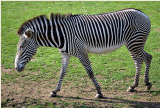
Zebras are African equids best known for their distinctive white and black stripes. Their stripes come in different patterns unique to each individual. They are generally social animals and can be seen in small harems to large herds. Zebras are generally 2.3 m (8ft) long, stand 1.25-1.5 m (4-5ft) at the shoulder, and weigh around 300 kg (660 lbs), although some can grow to more than 410 kg (900 lbs).


Discussion
Ask a question about 'Zebra'
Start a new discussion about 'Zebra'
Answer questions from other users
Full Discussion Forum


Encyclopedia


Zebras are African equids best known for their distinctive white and black stripes. Their stripes come in different patterns unique to each individual. They are generally social animals and can be seen in small harems to large herds. Zebras are generally 2.3 m (8ft) long, stand 1.25-1.5 m (4-5ft) at the shoulder, and weigh around 300 kg (660 lbs), although some can grow to more than 410 kg (900 lbs). In addition to their stripes, zebras have erect, mohawk
Mohawk hairstyle

File:Mohawk 1951.jpgThe Mohawk is a hairstyle which consists of shaving both sides of the head, leaving a strip of noticeably longer hair. Mohawks became common in punk subculture and Rivethead subculture in the early 1980s and were then adopted by various other groups, becoming more diverse in style....
-like manes. Unlike their closest relatives, horse
Horse

The horse is a hoofed mammal, a subspecies of one of seven extant species of the family Equidae. The horse has evolution of the horse over the past 45 to 55 million years from a small multi-toed creature into the large, odd-toed ungulate animal of today....
s and donkey
Donkey

The 'donkey' or 'ass', Equus africanus asinus, is a Domestication member of the Equidae or horse family, and an Odd-toed ungulates. The wild ancestor of the donkey is the Wild Ass, E....
s, zebras have never been truly domesticated.

There are three species of zebra: the Plains Zebra
Plains Zebra

The Plains zebra , also known as the Common zebra or the Burchell's zebra, is the most common and geographically widespread form of zebra....
, Grevy's Zebra
Grevy's Zebra

Gr?vy's zebra , sometimes known as the Imperial zebra, is the largest species of zebra. It is found in the wild in Kenya and Ethiopia. Compared to other zebras, it is tall, has large ears, and its stripes are narrower....
 and the Mountain Zebra
Mountain Zebra

The Mountain Zebra is a threatened species of zebra native to south-western Angola, Namibia and South Africa. It has two subspecies, the Cape Mountain Zebra and Hartmann's Mountain Zebra , though it has been suggested these should be considered separate species....
. The Plains zebra and the Mountain Zebra belong to the subgenus Hippotigris, but Grevy's zebra is the sole species of subgenus Dolichohippus. The latter resembles an ass
Asinus

The subgenus Asinus encompasses four species and several subspecies of equidae characterized by long ears, a lean, straight-backed build, a scant tail and reputed to have considerable toughness and endurance....
 while the former two are more horse-like. Nevertheless, DNA and molecular data show that zebras do indeed have monophyletic origins. All three belong to the genus Equus along with other equids. In certain regions of Kenya, Plains zebras and Grevy's zebras coexist.

The unique stripes and behaviors of zebras make these among the most familiar animals to people. They can be found in a variety of habitats, such as grasslands, savannas, woodlands, thorny scrublands, mountains and coastal hills. However, various anthropogenic factors have severely impacted zebra populations, in particular hunting for skins and habitat destruction. Grevy's zebra and the Mountain zebra are endangered. While Plains zebras are much more plentiful, one subspecies, the quagga, went extinct in the late nineteenth century.

The name "zebra" comes from the Old Portuguese word zevra which means "wild ass
Wild ass

Wild ass can refer to:*African Wild Ass*Kiang *Onager *Yukon Wild Ass...
". The pronunciation is internationally, or in North America.

Taxonomy and evolution

Zebras were the second lineage to diverge from the earliest proto-horses, after the asses, around 4 million years ago. Grevy's zebra is believed to have been the first zebra species to emerge. Fossils of an ancient equid were discovered in the Hagerman Fossil Beds National Monument
Hagerman Fossil Beds National Monument

Hagerman Fossil Beds National Monument near Hagerman, Idaho, contains the largest concentration of Hagerman Horse fossils in North America. The 4,351-acre Monument is internationally significant because it protects the world's richest known fossil deposits from a time period called the late Pliocene epoch, 3.5 million years ago....
 in Hagerman, Idaho
Hagerman, Idaho

Hagerman is a city in Gooding County, Idaho, Idaho, United States. The population was 768 at the United States Census, 2000....
. It was named the Hagerman horse
Hagerman Horse

The Hagerman horse , also called the Hagerman zebra or the American zebra, was a North American species of Equidae from the Pliocene and the Pleistocene....
 with a scientific name of Equus simplicidens. It is believed to have been similar to the Grevy's zebra. The animals had stocky zebra-like bodies and short, narrow, donkey-like skulls. Grevy's zebra also has a donkey-like skull. The Hagerman horse is also called the American zebra or Hagerman zebra.

Classification

There are three extant species
Species

In biology, a species is one of the basic units of biological classification and a taxonomic rank. A species is often defined as a group of organisms capable of interbreeding and producing fertile offspring....
. Collectively, two of the species have 8 subspecies
Subspecies

In biology, subspecies is the taxonomic rank immediately subordinate to a species. A subspecies is a taxonomic group which is less distinct than the Common descent or species from which it originates....
 (7 extant). Zebra populations are diverse, and the relationships between and the taxonomic
Taxonomy

Taxonomy is the practice and science of classification. The word comes from the Greek language ', taxis and ', nomos .Taxonomies, or taxonomic schemes, are composed of taxonomic units known as taxa , or kinds of things that are arranged frequently in a hierarchical structure....
 status of several of the subspecies are not well known.

zebra in captivity]]
  • Genus: Equus
    Equus

    Equus may refer to:*Equus , a genus of animals including horses, donkeys, zebras and onagers* Equus , a play by Peter Shaffer* Equus , a film adaptation of the Peter Shaffer play...
    • Subgenus: Hippotigris
      • Plains Zebra
        Plains Zebra

        The Plains zebra , also known as the Common zebra or the Burchell's zebra, is the most common and geographically widespread form of zebra....
        , Equus quagga
        • Quagga
          Quagga

          The quagga is an List of extinct animals subspecies of the Plains zebra, which was once found in great numbers in South Africa's Cape Province and the southern part of the Orange Free State....
          , Equus quagga quagga (extinct
          Extinction

          In biology and ecology, extinction is the death of every member of a species or group of taxon. The moment of extinction is generally considered to be the death of the last individual of that species ....
          )
        • Burchell's Zebra
          Burchell's Zebra

          The Burchell's zebra is a southern subspecies of the Plains Zebra....
          , Equus quagga burchellii (includes Damara Zebra)
        • Grant's Zebra
          Grant's Zebra

          The Grant's Zebra is the smallest of six subspecies of the Plains Zebra....
          , Equus quagga boehmi
        • Selous' zebra, Equus quagga borensis
        • Chapman's Zebra, Equus quagga chapmani
        • Crawshay's Zebra, Equus quagga crawshayi
      • Mountain Zebra
        Mountain Zebra

        The Mountain Zebra is a threatened species of zebra native to south-western Angola, Namibia and South Africa. It has two subspecies, the Cape Mountain Zebra and Hartmann's Mountain Zebra , though it has been suggested these should be considered separate species....
        , Equus zebra
        • Cape Mountain Zebra
          Cape Mountain Zebra

          Cape mountain zebra, Equus zebra zebra, is a subspecies of the Mountain zebra found in the Western Cape and Eastern Cape in South Africa. They mainly eat grass but if little food is left they will eat bushes....
          , Equus zebra zebra
        • Hartmann's Mountain Zebra
          Hartmann's Mountain Zebra

          Hartmann's mountain zebra, Equus zebra hartmannae, is a subspecies of the mountain zebra found in far south-western Angola and western Namibia....
          , Equus zebra hartmannae
    • Subgenus: Dolichohippus
      • Grevy's Zebra
        Grevy's Zebra

        Gr?vy's zebra , sometimes known as the Imperial zebra, is the largest species of zebra. It is found in the wild in Kenya and Ethiopia. Compared to other zebras, it is tall, has large ears, and its stripes are narrower....
        ,
        Equus grevyi


The Plains Zebra
Plains Zebra

The Plains zebra , also known as the Common zebra or the Burchell's zebra, is the most common and geographically widespread form of zebra....
 (
Equus quagga, formerly Equus burchelli) is the most common, and has or had about twelve subspecies distributed across much of southern and eastern Africa. It, or particular subspecies of it, have also been known as the Common Zebra, the Dauw, Burchell's Zebra
Burchell's Zebra

The Burchell's zebra is a southern subspecies of the Plains Zebra....
 (actually the subspecies
Equus quagga burchellii), Chapman's Zebra, Wahlberg's Zebra, Selous
Frederick Selous

Frederick Courteney Selous Distinguished Service Order was a United Kingdom List of explorers, British Army, hunter, and conservationist, famous for his exploits in south and east of Africa....
' Zebra, Grant's Zebra, Boehm's Zebra and the Quagga
Quagga

The quagga is an List of extinct animals subspecies of the Plains zebra, which was once found in great numbers in South Africa's Cape Province and the southern part of the Orange Free State....
 (another extinct
Extinction

In biology and ecology, extinction is the death of every member of a species or group of taxon. The moment of extinction is generally considered to be the death of the last individual of that species ....
 subspecies,
Equus quagga quagga).

The Mountain Zebra
Mountain Zebra

The Mountain Zebra is a threatened species of zebra native to south-western Angola, Namibia and South Africa. It has two subspecies, the Cape Mountain Zebra and Hartmann's Mountain Zebra , though it has been suggested these should be considered separate species....
 (
Equus zebra) of southwest Africa tends to have a sleek coat with a white belly and narrower stripes than the Plains Zebra. It has two subspecies and is classified as vulnerable.

Grevy's Zebra
Grevy's Zebra

Gr?vy's zebra , sometimes known as the Imperial zebra, is the largest species of zebra. It is found in the wild in Kenya and Ethiopia. Compared to other zebras, it is tall, has large ears, and its stripes are narrower....
 (
Equus grevyi) is the largest type, with a long, narrow head making it appear rather mule
Mule

In its common modern meaning, a mule is the offspring of a male donkey and a female horse.Mules are classified as an F1 hybrid.The term "mule" was formerly applied to the infertile offspring of any two creatures of different species....
-like. It is an inhabitant of the semi-arid grassland
Grassland

Grasslands are areas where the vegetation is dominated by grasses and other herbaceous plants . However, sedge and rush families can also be found....
s of Ethiopia
Ethiopia

Ethiopia , officially the Federal Democratic Republic of Ethiopia, is a landlocked country situated in the Horn of Africa. Ethiopia is bordered by Eritrea to the north, Sudan to the west, Kenya to the south, Somalia to the east and Djibouti to the northeast....
 and northern Kenya
Kenya

The Republic of Kenya is a country in East Africa. It is bordered by Ethiopia to the north, Somalia to the northeast, Tanzania to the south, Uganda to the west, and Sudan to the northwest, with the Indian Ocean running along the southeast border....
. Grevy's Zebra is the rarest species of zebra around today, and is classified as endangered.

Although zebra species may have overlapping ranges, they do not interbreed. This held true even when the Quagga and Burchell's race of Plains Zebra shared the same area. In captivity, Plains Zebras have been crossed with Mountain zebras. The hybrid foals lacked a dewlap
Dewlap

A dewlap is a flap of skin that hangs beneath the lower jaw of tetrapods, that is, amphibians, reptiles, birds, mammals and their relatives....
 and resembled the Plains Zebra apart from their larger ears and their hindquarters pattern. Attempts to breed a Grevy's zebra stallion to Mountain Zebra mares resulted in a high rate of miscarriage. In captivity, crosses between zebras and other (non-zebra) equines have produced several distinct hybrids, including the zebroid
Zebroid

A zebroid is the offspring of any cross between a zebra and any other equine: essentially, a zebra Hybrid . In most cases, the sire is a zebra stallion....
, zeedonk
Zeedonk

A zonkey is a crossbreed between a zebra and a donkey. The generic name for crosses between zebras and horses or asses is zebroid or zebra mule....
, zony
Zony

A zony is the offspring of a zebra stallion and a pony mare. Medium size pony mares are preferred in order to produce riding zonies, but zebras have been crossed with smaller pony breeds such as the Shetland resulting in so-called "Zetlands"....
, and zorse
Zorse

A zorse or zebrula is a zebroid, specifically the offspring of a zebra stallion and a horse mare . The rarer reverse pairing is sometimes called a horbra....
.

Physical attributes


Stripes

Zebras are black or dark animals with white stripes and their bellies have a large white blotch for camouflage purposes. Some zebras have brown "shadow stripes" in between the white and black coloring.

Zebras are described as black with white stripes rather than the reverse for the following three reasons:
  1. White equids would not survive well in the African plains or forests.
  2. The quagga, an extinct Plains zebra subspecies, had the zebra striping pattern in the front of the animal, but had a dark rump.
  3. When the region between the pigmented bands becomes too wide, secondary stripes emerge, as if suppression was weakening.


The fact that some zebras have pure white bellies and legs is not very strong evidence for a white background, since many animals of different colors have white or light colored bellies and legs.
Zebra2
The stripes are typically vertical on the head, neck, forequarters, and main body, with horizontal stripes at the rear and on the legs of the animal. The "zebra crossing
Zebra crossing

A zebra crossing is a type of pedestrian crossing used in many places around the world. The crossing is characterised by longitudinal stripes on the road, parallel to the flow of the traffic, alternately a light colour and a dark one ....
" is named after the zebra's black and white stripes.

Some zoologists
Zoology

Zoology is the branch of biology concerned with the study of animals. The most common pronunciation of "zoology" is ; however, an alternative pronunciation is ....
 believe that the stripes act as a camouflage
Camouflage

Camouflage is a method of cryptic or concealing coloration that allows an otherwise visible organism or object to remain invisibility through deception....
 mechanism. This is accomplished in several ways. First, the vertical
Vertical

vetical means up and downAn object is in a vertical position when it is aligned in an "up-down" direction, roughly speaking perpendicular to the horizon or horizontal plane....
 striping helps the zebra hide in grass. While seeming absurd at first glance considering that grass is neither white nor black, it is supposed to be effective against the zebra's main predator, the lion
Lion

The lion is a member of the family Felidae and one of four big cats in the genus Panthera. With exceptionally large males exceeding 250 kg in weight, it is the second-largest living cat after the tiger....
, which is color blind. Theoretically a zebra standing still in tall grass may not be noticed at all by a lion. Additionally, since zebras are herd animals, the stripes may help to confuse predators - a number of zebras standing or moving close together may appear as one large animal, making it more difficult for the lion to pick out any single zebra to attack. A herd of zebras scattering to avoid a predator will also represent to that predator a confused mass of vertical stripes travelling in multiple directions making it difficult for the predator to track an individual visually as it separates from its herdmates, although biologists have never observed lions appearing confused by zebra stripes.

Stripes are also believed to play a role in sexual attractions, with slight variations of the pattern allowing the animals to distinguish between individuals.

A more recent theory, supported by experiment, posits that the disruptive colouration is also an effective means of confusing the visual system of the blood-sucking tsetse fly
Tsetse fly

Tsetse are large biting flies from Africa which live by feeding on the blood of vertebrate animals. Tsetse include all the species in the genus Glossina, which are generally placed in their own family, Glossinidae....
. Alternative theories include that the stripes coincide with fat patterning beneath the skin, serving as a thermoregulatory mechanism for the zebra, and that wounds sustained disrupt the striping pattern to clearly indicate the fitness of the animal to potential mates.

Gaits

Like horses, zebras walk, trot, canter and gallop. They are generally slower than horses but their great stamina helps them outpace predators. When chased, a zebra will zig-zag from side to side making it more difficult for the predator. When cornered the zebra will rear up and kick or bite its attacker.

Senses

Zebras have excellent eyesight. It is believed that they can see in color. Like most ungulates the zebra has its eyes on the sides of its head, giving it a wide field of view. Zebras also have night vision
Night vision

Night vision is the ability to see in a dark environment. Whether by biological or technological means, night vision is made possible by a combination of two approaches: sufficient spectral range, and sufficient intensity range....
, although not as advanced as that of most of their predators, but their hearing compensates.

Zebras have great hearing, and tend to have larger, rounder ears than horses. Like horses and other ungulates, zebra can turn their ears in almost any direction. In addition to eyesight and hearing, zebras have an acute sense of smell and taste.

Ecology and behavior


Harems

Like most members of the horse family, zebras are highly sociable. Their social structure, however, depends on the species. Mountain zebras and Plains zebras live in groups, known as 'harems', consisting of one stallion with up to six mares and their foals. Bachelor males either live alone or with groups of other bachelors until they are old enough to challenge a breeding stallion. When attacked by packs of hyenas or wild dogs, a zebra group will huddle together with the foals in the middle while the stallion tries to ward them off.

Unlike the other zebra species, Grevy's zebras do not have permanent social bonds. A group of these zebras rarely stays together for more than a few months. The foals stay with their mother, while the adult male lives alone. However like the other two zebra species, bachelor male zebras will organize in groups.

Like horses, zebras sleep standing up and only sleep when neighbors are around to warn them of predators.

Communication

Zebras communicate with each other with high pitched barks and whinnying. Grevy's zebras make mule-like brays. A zebra’s ears signify its mood. When a zebra is in a calm, tense or friendly mood, its ears stand erect. When it is frightened, its ears are pushed forward. When angry, the ears are pulled backward. When surveying an area for predators, zebras will stand in an alert posture; with ears erect, head held high, and staring. When tense they will also snort. When a predator is spotted or sensed, a zebra will bark (or bray) loudly.

Food and foraging

Zebras are very adaptable grazers. They feed mainly on grasses but will also eat shrubs, herbs, twigs, leaves and bark. Their well adapted digestive system allows them to subsist on diets of lower nutritional quality than that necessary for herbivores.

Reproduction

Like most animal species, female zebras mature earlier than the males and a mare may have her first foal by the age of three. Males are not able to breed until the age of five or six. Mares may give birth to one foal every twelve months. She nurses the foal for up to a year. Like horses, zebras are able to stand, walk and suckle shortly after they're born. A zebra foal is brown and white instead of black and white at birth.

Plains and Mountain zebra foals are protected by their mother as well as the head stallion and the other mares in their group. Grevy’s zebra foals have only their mother as a regular protector since, as noted above, Grevy's zebra groups often disband after a few months.

Human interactions


Domestication

Attempts have been made to train zebras for riding since they have better resistance than horses to African diseases. However most of these attempts failed, due to the zebra's more unpredictable nature and tendency to panic under stress. For this reason, zebra-mules or zebroid
Zebroid

A zebroid is the offspring of any cross between a zebra and any other equine: essentially, a zebra Hybrid . In most cases, the sire is a zebra stallion....
s (crosses between any species of zebra and a horse, pony, donkey or ass) are preferred over pure-bred zebras.

In England, the zoological collector Lord Rothschild
Walter Rothschild, 2nd Baron Rothschild

Lionel Walter Rothschild, 2nd Baron Rothschild , a scion of the Mayer Amschel Rothschild family family, was a United Kingdom banker, politician and zoologist....
 frequently used zebras to draw a carriage. In 1907, Rosendo Ribeiro, the first doctor in Nairobi, Kenya, used a riding zebra for house-calls. In the mid 1800s Governor George Grey
George Grey

George Grey may refer to:*Sir George Grey, 2nd Baronet , British politician*George Grey, 2nd Earl of Kent*George Grey , Governor of Cape Colony, South Australia and New Zealand...
 imported zebras to New Zealand
New Zealand

New Zealand is an island country in the south-western Pacific Ocean comprising two main landmasses , and numerous Islands of New Zealand, most notably Stewart Island/Rakiura and the Chatham Islands....
 from his previous posting in South Africa
South Africa

The Republic of South Africa, also known by Official names of South Africa, is a country located at the southern tip of the continent of Africa....
, and used them to pull his carriage on his privately owned Kawau Island
Kawau Island

Kawau Island is an island in the Hauraki Gulf, close to the north-eastern coast of the North Island of New Zealand. It lies 2 km off the coast of the North Auckland Peninsula, just south of Tawharanui Peninsula, and shelters Kawau Bay to the north-east of Warkworth, New Zealand....
.

Zebra Tame Jumping
Captain Horace Hayes, in "Points of the Horse" (circa 1893) compared the usefulness of different zebra species. In 1891, Hayes broke a mature, intact Mountain Zebra stallion to ride in two days time, and the animal was quiet enough for his wife to ride and be photographed upon. He found the Burchell's zebra easy to break in and considered it ideal for domestication, as it was immune to the bite of the tsetse fly
Tsetse fly

Tsetse are large biting flies from Africa which live by feeding on the blood of vertebrate animals. Tsetse include all the species in the genus Glossina, which are generally placed in their own family, Glossinidae....
. He considered the quagga well-suited to domestication due to being easy to train to saddle and harness.

Conservation

Modern man has had great impact on the zebra population. Zebras were, and still are, hunted mainly for their skins. The Cape mountain zebra was hunted to near extinction with less than 100 individuals by the 1930s. However the population has increased to about 700 due to conservation efforts. Both Mountain zebra subspecies are currently protected in national parks but are still endangered.

The Grevy's zebra is also endangered. Hunting and competition from livestock have greatly decreased their population. Because of the population's small size, environmental hazards, such as drought, are capable of easily affecting the entire species. Plains zebras are much more numerous and have a healthy population. Nevertheless they too are threatened by hunting and habitat change from farming. One subspecies, the quagga, is now extinct.

Cultural depictions

Zebras have been the subject of African folk tales which tell how they got their stripes. According to a Bushmen
Bushmen

The Bushmen, San, Sho, Basarwa, Kung, or Khwe are indigenous people of southern Africa that spans most areas of South Africa, Zimbabwe, Lesotho, Mozambique, Swaziland, Botswana, Namibia, and Angola....
 folk tale of Namibia
Namibia

Namibia, officially the Republic of Namibia, is a country in southern Africa on the Atlantic Ocean coast. It shares borders with Angola and Zambia to the north, Botswana to the east, and South Africa to the south....
, the zebra was once all white but got its black stripes after a fight with a baboon
Baboon

Baboons are African Old World monkeys belonging to the genus Papio, part of the subfamily Cercopithecinae. There are five species, which are some of the largest non-hominid members of the primate order; only the Mandrill and the Drill are larger....
 over a waterhole. After kicking the baboon so hard the zebra lost his balance and tripped over a fire and the fire sticks left scorches mark all over this white coat. In the film
Fantasia
Fantasia (film)

Fantasia is a 1940 in film List of animated feature-length films produced by Walt Disney, and is the third film in the List of Disney theatrical animated features#official canon....
, two centaur
Centaur

In Greek mythology, the centaurs are a race of creatures composed of part human and part horse. In early Attica Pottery of ancient Greece, they are depicted with the torso of a human joined at the waist to the horse's withers, where the horse's neck would be....
s are depicted being half human and half zebra, instead of the typical half human and half horse.

Zebra are a popular subject in art. The fourth Mughal
Mughal Empire

The Mughal Empire was a Muslim imperial power of the Indian subcontinent which began in 1526, ruled most of the Indian Subcontinent by the late 17th and early 18th centuries, and ended in the mid-19th century....
 emperor Jahangir
Jahangir

Nur-ud-din Salim Jahangir Born as Prince Muhammad Salim, he was the third and eldest surviving son of Mughal Empire Emperor Akbar. Akbar's twin sons, Hasan and Hussain, died in infancy....
 (r.1605-24), commissioned a painting of the zebra, which was completed by Ustad Mansur
Ustad Mansur

Ustad Mansur was a seventeenth century Mughal painting Painting and court artist of Jehangir who specialised in depicting plants and animals....
. Zebra stripes are also a popular style for furniture, carpets and fashion.

When in movies and cartoons zebras are most often miscellaneous characters but have had some starring roles, notably in
Madagascar
Madagascar (film)

Madagascar is the title of three films:*Madagascar , a 1994 Cuban film*Madagascar , a 3D animated film*...
and Racing Stripes
Racing Stripes

Racing Stripes is a 2005 in film adventure/comedy film, film director by Frederik Du Chau. It is similar in the style to the 1995 movie Babe , in that the protagonist is a talking animal who lives on a farm and succeeds at an activity not expected of his species....
. Zebras are also serve as mascots and symbols for products and corporations, notably Zebra Technologies
Zebra Technologies

Zebra Technologies is a manufacturer of thermal Barcode label and receipt printers, RFID smart label printer/encoders, and card printers, based in Vernon_Hills....
 and Fruit Stripe
Fruit Stripe

Fruit Stripe is an artificially and naturally flavored fruit chewing gum known for its strong but fleeting flavor. It is packaged in zebra-striped wrappers, and every stick now comes with one or more temporary tattoos....
 gum. Zebras are featured on the coat of arms of Botswana
Coat of arms of Botswana

File:Coat of arms of Botswana.pngThe Coat of Arms of Botswana was adopted on January 25, 1966. The centre shield is supported by two zebras. The shape of the shield is that of traditional shields found in East Africa....
.

See also

  • Tijuana Zebra
    Tijuana Zebra

    A Tijuana Zebra is a donkey that has been painted with stripes so that it looks like a zebra....


External links

  • - and explains the different number of stripes for each type of Zebra.