

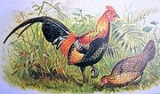
Red Junglefowl

Encyclopedia
The Red Junglefowl is a tropical member of the Pheasant
family. They are thought to be ancestors of the domestic chicken
with some hybridisation with the Grey Junglefowl
. The Red Junglefowl was first raised in captivity at least several thousand years ago in Asia
, and the domesticated form has been used all around the world as a very productive food source for both meat and eggs. Some breeds have been specifically developed to produce these.
and down into Malaysia, The Philippines and Indonesia
. Junglefowl are established on several of the Hawaiian Islands
, but these are feral descendents of domestic chicken
s. They can also be found on Christmas Island
and the Marianas.
Each of these various regions had its own subspecies. Some examples include:
and female
birds show very strong sexual dimorphism
. Males are much larger; they have large red fleshy wattle
s and comb
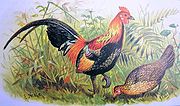
on the head and long, bright gold and bronze feathers forming a "shawl" or "cape" over the back of the bird from the neck to the lower back. The tail is composed of long, arching feathers that initially look black but shimmer with blue, purple and green in good light. The female's plumage
is typical of this family of birds in being cryptic and having evolved
for camouflage
as she alone looks after the eggs and chicks. She also has no fleshy wattles or comb on the head.
During their mating season, the male birds announce their presence with the well known "cock-a-doodle-doo" call or crowing. This serves both to attract potential mates and to make other male birds in the area aware of the risk of fighting a breeding competitor. The lower leg just behind and above the foot has a long spur with just this function. Their call structure is complex and they have distinctive alarm calls for aerial and ground predators to which others react appropriately.
Behaviour, not morphology, is the best predictor of paternity. Specifically, behaviours related to dominance and to signalling are critical, and the single best predictor is the rate at which males produce anti-predator alarm calls. This suggests that male alarm calling is a form of mate investment, increasing the survival of his chicks.
They are omnivorous and feed on insects, seeds and fruits including those that are cultivated such as those of the oil palm.
Flight in these birds is almost purely confined to reaching their roosting areas at sunset in trees or any other high and relatively safe places free from ground predators, and for escape from immediate danger through the day.
(Gallus lafayetii), Grey Junglefowl
(Gallus sonneratii), and the Green Junglefowl
(Gallus varius) — do not produce fertile hybrids with the Red Junglefowl, suggesting that it is the sole ancestor of the domestic chicken. However, recent research has revealed the absence of the yellow skin gene in the wild Red Junglefowl found in domestic birds, which suggests hybridisation with the Grey Junglefowl during the domestication of the species. A culturally significant hybrid between the Red Junglefowl and the Green Junglefowl
in Indonesia is known as the Bekisar
.
because of genetic pollution
which is occurring at the edge of forests where domesticated free ranging chickens are commonly kept in bordering villages and towns.
Pheasant
Pheasants refer to some members of the Phasianinae subfamily of Phasianidae in the order Galliformes.Pheasants are characterised by strong sexual dimorphism, males being highly ornate with bright colours and adornments such as wattles and long tails. Males are usually larger than females and have...
family. They are thought to be ancestors of the domestic chicken
Chicken
The chicken is a domesticated fowl, a subspecies of the Red Junglefowl. As one of the most common and widespread domestic animals, and with a population of more than 24 billion in 2003, there are more chickens in the world than any other species of bird...
with some hybridisation with the Grey Junglefowl
Grey Junglefowl
The Grey Junglefowl , also known as Sonnerat's Junglefowl, is a wild relative of domestic fowl that is endemic to India. This species is found mainly in peninsular India and where it overlaps with the distribution of the Red Junglefowl, it is known to form hybrids...
. The Red Junglefowl was first raised in captivity at least several thousand years ago in Asia
Asia
Asia is the world's largest and most populous continent, located primarily in the eastern and northern hemispheres. It covers 8.7% of the Earth's total surface area and with approximately 3.879 billion people, it hosts 60% of the world's current human population...
, and the domesticated form has been used all around the world as a very productive food source for both meat and eggs. Some breeds have been specifically developed to produce these.
Range
The range of the true species stretches from northeast India (where the pure species has almost certainly been diluted with cross breeding from domestic breeds) eastwards across southern ChinaChina
Chinese civilization may refer to:* China for more general discussion of the country.* Chinese culture* Greater China, the transnational community of ethnic Chinese.* History of China* Sinosphere, the area historically affected by Chinese culture...
and down into Malaysia, The Philippines and Indonesia
Indonesia
Indonesia , officially the Republic of Indonesia , is a country in Southeast Asia and Oceania. Indonesia is an archipelago comprising approximately 13,000 islands. It has 33 provinces with over 238 million people, and is the world's fourth most populous country. Indonesia is a republic, with an...
. Junglefowl are established on several of the Hawaiian Islands
Hawaiian Islands
The Hawaiian Islands are an archipelago of eight major islands, several atolls, numerous smaller islets, and undersea seamounts in the North Pacific Ocean, extending some 1,500 miles from the island of Hawaii in the south to northernmost Kure Atoll...
, but these are feral descendents of domestic chicken
Chicken
The chicken is a domesticated fowl, a subspecies of the Red Junglefowl. As one of the most common and widespread domestic animals, and with a population of more than 24 billion in 2003, there are more chickens in the world than any other species of bird...
s. They can also be found on Christmas Island
Christmas Island
The Territory of Christmas Island is a territory of Australia in the Indian Ocean. It is located northwest of the Western Australian city of Perth, south of the Indonesian capital, Jakarta, and ENE of the Cocos Islands....
and the Marianas.
Each of these various regions had its own subspecies. Some examples include:
- G. g. gallus IndochinaIndochinaThe Indochinese peninsula, is a region in Southeast Asia. It lies roughly southwest of China, and east of India. The name has its origins in the French, Indochine, as a combination of the names of "China" and "India", and was adopted when French colonizers in Vietnam began expanding their territory...
- G. g. bankiva Java
- G. g. jabouillei VietnamVietnamVietnam – sometimes spelled Viet Nam , officially the Socialist Republic of Vietnam – is the easternmost country on the Indochina Peninsula in Southeast Asia. It is bordered by China to the north, Laos to the northwest, Cambodia to the southwest, and the South China Sea –...
- G. g. murghi IndiaIndiaIndia , officially the Republic of India , is a country in South Asia. It is the seventh-largest country by geographical area, the second-most populous country with over 1.2 billion people, and the most populous democracy in the world...
- G. g. spadiceus Burma
- G. g. domesticus (ChickenChickenThe chicken is a domesticated fowl, a subspecies of the Red Junglefowl. As one of the most common and widespread domestic animals, and with a population of more than 24 billion in 2003, there are more chickens in the world than any other species of bird...
)
Sexual dimorphism
MaleMale
Male refers to the biological sex of an organism, or part of an organism, which produces small mobile gametes, called spermatozoa. Each spermatozoon can fuse with a larger female gamete or ovum, in the process of fertilization...
and female
Female
Female is the sex of an organism, or a part of an organism, which produces non-mobile ova .- Defining characteristics :The ova are defined as the larger gametes in a heterogamous reproduction system, while the smaller, usually motile gamete, the spermatozoon, is produced by the male...
birds show very strong sexual dimorphism
Sexual dimorphism
Sexual dimorphism is a phenotypic difference between males and females of the same species. Examples of such differences include differences in morphology, ornamentation, and behavior.-Examples:-Ornamentation / coloration:...
. Males are much larger; they have large red fleshy wattle
Wattle (anatomy)
A wattle is a fleshy dewlap or caruncle hanging from various parts of the head or neck in several groups of birds, goats and other animals. In some birds the caruncle is erectile tissue.The wattle is frequently an organ of sexual dimorphism...
s and comb
Comb (anatomy)
Anatomically, a comb is a fleshy growth, caruncle, or crest on the top of the head of gallinaceous birds, most notably turkeys, pheasants, and domestic chickens...
on the head and long, bright gold and bronze feathers forming a "shawl" or "cape" over the back of the bird from the neck to the lower back. The tail is composed of long, arching feathers that initially look black but shimmer with blue, purple and green in good light. The female's plumage
Plumage
Plumage refers both to the layer of feathers that cover a bird and the pattern, colour, and arrangement of those feathers. The pattern and colours of plumage vary between species and subspecies and can also vary between different age classes, sexes, and season. Within species there can also be a...
is typical of this family of birds in being cryptic and having evolved
Evolution
Evolution is any change across successive generations in the heritable characteristics of biological populations. Evolutionary processes give rise to diversity at every level of biological organisation, including species, individual organisms and molecules such as DNA and proteins.Life on Earth...
for camouflage
Camouflage
Camouflage is a method of concealment that allows an otherwise visible animal, military vehicle, or other object to remain unnoticed, by blending with its environment. Examples include a leopard's spotted coat, the battledress of a modern soldier and a leaf-mimic butterfly...
as she alone looks after the eggs and chicks. She also has no fleshy wattles or comb on the head.
During their mating season, the male birds announce their presence with the well known "cock-a-doodle-doo" call or crowing. This serves both to attract potential mates and to make other male birds in the area aware of the risk of fighting a breeding competitor. The lower leg just behind and above the foot has a long spur with just this function. Their call structure is complex and they have distinctive alarm calls for aerial and ground predators to which others react appropriately.
Behavior
Males make a food-related display called 'tidbitting', performed upon finding food in the presence of a female. The display is composed of coaxing, cluck-like calls and eye-catching bobbing and twitching motions of the head and neck. During the performance, the male repeatedly picks up and drops the food item with his beak. The display usually ends when the hen takes the food item either from the ground or directly from the male’s beak and is associated with copulations and more offspring.Behaviour, not morphology, is the best predictor of paternity. Specifically, behaviours related to dominance and to signalling are critical, and the single best predictor is the rate at which males produce anti-predator alarm calls. This suggests that male alarm calling is a form of mate investment, increasing the survival of his chicks.
They are omnivorous and feed on insects, seeds and fruits including those that are cultivated such as those of the oil palm.
Flight in these birds is almost purely confined to reaching their roosting areas at sunset in trees or any other high and relatively safe places free from ground predators, and for escape from immediate danger through the day.
Hybridisation
The other three members of the genus — Sri Lanka JunglefowlSri Lanka Junglefowl
The Sri Lankan Junglefowl , also known during the colonial era as the Ceylon Junglefowl, is a member of the pheasant family which is endemic to Sri Lanka, where it is the national bird. It is closely related to the Red Junglefowl , the wild junglefowl from which the chicken was domesticated...
(Gallus lafayetii), Grey Junglefowl
Grey Junglefowl
The Grey Junglefowl , also known as Sonnerat's Junglefowl, is a wild relative of domestic fowl that is endemic to India. This species is found mainly in peninsular India and where it overlaps with the distribution of the Red Junglefowl, it is known to form hybrids...
(Gallus sonneratii), and the Green Junglefowl
Green Junglefowl
The Green Junglefowl, Gallus varius also known as Javan Junglefowl, Forktail or Green Javanese Junglefowl is a medium-sized, up to 75 cm long, bird in the pheasant family Phasianidae...
(Gallus varius) — do not produce fertile hybrids with the Red Junglefowl, suggesting that it is the sole ancestor of the domestic chicken. However, recent research has revealed the absence of the yellow skin gene in the wild Red Junglefowl found in domestic birds, which suggests hybridisation with the Grey Junglefowl during the domestication of the species. A culturally significant hybrid between the Red Junglefowl and the Green Junglefowl
Green Junglefowl
The Green Junglefowl, Gallus varius also known as Javan Junglefowl, Forktail or Green Javanese Junglefowl is a medium-sized, up to 75 cm long, bird in the pheasant family Phasianidae...
in Indonesia is known as the Bekisar
Bekisar
The Bekisar, or Ayam Bekisar, is the first generation hybrid offspring of the Green Junglefowl and domesticated Red Junglefowl from Java...
.
Genetic pollution and threat of extinction
Purebred Red Junglefowl are thought to be facing a serious threat of extinctionExtinction
In biology and ecology, extinction is the end of an organism or of a group of organisms , normally a species. The moment of extinction is generally considered to be the death of the last individual of the species, although the capacity to breed and recover may have been lost before this point...
because of genetic pollution
Genetic pollution
Genetic pollution is a controversial term for uncontrolled gene flow into wild populations. This gene flow is undesirable according to some environmentalists and conservationists, including groups such as Greenpeace, TRAFFIC, and GeneWatch UK.-Usage:...
which is occurring at the edge of forests where domesticated free ranging chickens are commonly kept in bordering villages and towns.