
Encyclopedia
Tuberculosis is an infectious disease caused by the
bacterium Mycobacterium tuberculosis is the bacterium [i] that causes most cases of tuberculosis [i]. ...
, which most commonly affects the
lungs but can also affect the
central nervous system ,
lymphatic system,
circulatory system , genitourinary system,
bones and joints.
Tuberculosis is one of the deadliest and most common major infectious diseases today. In 2004, the prevalence of active TB disease was 14.6 million people with an incidence of 8.9 million people and
mortality of 1.7 million people mostly in
developing countries. However,
developing countries are not the only places with tuberculosis. There is a rising number of people in the developed world who contract tuberculosis because they have compromised immune systems, typically as a result of immunosuppressive drugs, substance abuse, or
HIV/AIDS. These people are at particular risk of tuberculosis infection and active tuberculosis disease.
Most of those infected have asymptomatic latent TB infection . There is a 10% lifetime chance that LTBI will progress to TB disease which, if left untreated, will kill more than 50% of its victims. TB is one of the top four infectious killing diseases in the world: TB kills 1.7 million, and
malaria kills 2-3 million[footnote needed].
HIV/AIDS, the neglect of TB control programs, and immigration have caused a resurgence of tuberculosis. Multidrug-resistant strains of TB and Extensively Drug-Resistant Tuberculosis are emerging. The
World Health Organization declared TB a global health emergency in 1993, and the proposed a Global Plan to Stop Tuberculosis which aims to save an additional 14 million lives between 2006 and 2015.
Other names for the disease
The bacterium
The cause of tuberculosis,
Mycobacterium tuberculosis is the bacterium [i] that causes most cases of tuberculosis [i]. ...
, is a slow-growing aerobic
bacterium that divides every 16 to 20 hours. This is extremely slow compared to other bacteria , which tend to have division times measured in minutes . MTB is not classified as either
Gram-positive or Gram-negative because it does not have the chemical characteristics of either. If a Gram stain is performed, it stains very weakly Gram-positive or not at all . It is a small rod-like
bacillus which can withstand weak disinfectants and can survive in a
dry state for weeks but, spontaneously, can only grow within a host organism .
MTB is identified microscopically by its staining characteristics: it retains certain stains after being treated with acidic solution, and is thus classified as an "
acid-fast bacillus" or
AFB. In the most common staining technique, the
Ziehl-Neelsen stain, AFB are stained a bright red which stands out clearly against a blue background. Acid-fast bacilli can also be visualized by fluorescent microscopy, and by an
auramine-rhodamine stain.
The
M. tuberculosis complex includes 3 other
mycobacteria which can cause tuberculosis:
M. bovis,
M. africanum and
M. microti. The first two are very rare causes of disease and the last one does not cause human disease.
- Nontuberculous mycobacteria are other mycobacteria which may cause pulmonary disease resembling TB, lymphadenitis, skin disease, or disseminated disease. These include Mycobacterium avium, M. kansasii, and others.
The disease
Epidemiology
About one-third of the world population have latent TB infection; in 2004, around 14.6 million people have active TB disease with 9 million new cases. The annual incidence rate varies enormously, from 356 per 100,000 in
Africa to 41 per 100,000 in the
Americas.
Transmission
TB is spread by aerosol droplets expelled by people with active TB disease of the lungs when they cough, sneeze, speak, or spit. Each droplet is 5 µm in diameter and contains 1 to 3
bacilli. Close contacts are at highest risk of becoming infected . A person with untreated, active tuberculosis can infect an estimated 20 other people per year. Others at risk include foreign-born from areas where TB is common, immunocompromised patients , residents and employees of high-risk congregate settings, health care workers who serve high-risk clients, medically underserved, low-income populations, high-risk racial or ethnic minority populations, children exposed to adults in high-risk categories, and people who inject illicit drugs.
Transmission can only occur from people with active TB disease .
The probability of transmission depends upon infectiousness of the person with TB , environment of exposure, duration of exposure, and virulence of the organism.
The chain of transmission can be stopped by isolating patients with active disease and starting effective anti-tuberculous therapy.
Pathogenesis
Most of those infected have asymptomatic latent TB infection . There is a 10% lifetime chance that LTBI will progress to TB disease. If untreated, the death rate for active TB disease is more than 50%.
TB infection begins when MTB bacilli reach the
pulmonary alveoli, where the mycobacteria replicate at an exponential rate and infect alveolar macrophages. The primary site of infection in the lungs is called the
Ghon focus. Bacteria are picked up by dendritic cells, which can transport the bacilli to local
lymph nodes, and then through the bloodstream to the more distant tissues and organs where TB disease could potentially develop: lung apices, peripheral lymph nodes, kidneys, brain, and bone.
Tuberculosis is classified as one of the granulomatous inflammatory conditions.
Macrophages,
T lymphocytes,
B lymphocytes and fibroblasts are among the cells that aggregate to form a
granuloma, with lymphocytes surrounding infected macrophages. The granuloma functions not only to prevent dissemination of the mycobacteria, but also provides a local environment for communication of cells of the immune system. Within the granuloma, T lymphocytes secrete a cytokine such as
interferon gamma, which activates macrophages to destroy the bacteria with which they are infected, making them better able to fight infection. T lymphocytes can also directly kill infected cells.
Importantly, bacteria are not eliminated with the granuloma, but can become dormant, resulting in a latent infection. Latent infection can only be diagnosed in a non-immunized person by a tuberculin skin test, which yields a delayed hypersensitivity type response to purified protein derivatives of
M. tuberculosis. Those immunized for TB or with past-cleared infection will respond with parallel delayed hypersensitivity to those currently in a state of infection and thus must be used with caution, particularly with regard to persons from countries where TB immunization is common.
Another feature of the
granulomas of human tuberculosis is the development of cell death, also called necrosis, in the center of tubercles. To the naked eye this has the texture of soft white cheese and was termed caseous necrosis.
If TB bacteria gain entry to the blood stream from an area of tissue damage they spread through the body and set up myriad foci of infection, all appearing as tiny white tubercles in the tissues. This is called miliary tuberculosis and has a high rate of fatality.
In many patients the infection waxes and wanes. Tissue destruction and necrosis are balanced by healing and fibrosis. Affected tissue is replaced by scarring and cavities filled with cheese-like white necrotic material. During active disease, some of these cavities are in continuity with the air passages bronchi. This material may therefore be coughed up. It contains living bacteria and can pass on infection.
Treatment with appropriate antibiotics kills bacteria and allows healing to take place. Affected areas are eventually replaced by scar tissue.
Progression
In those people in whom TB bacilli overcome the immune system defenses and begin to multiply, there is progression from TB infection to TB disease. This may occur soon after infection or many years after infection . The risk of reactivation increases with immune compromise, such as that caused by infection with HIV. In patients co-infected with M. tuberculosis and HIV, the risk of reactivation increases to 10% per year, while in immune competent individuals, the risk is between 5 and 10% in a lifetime.
About five percent of infected persons will develop TB disease in the first two years, and another five percent will develop disease later in life. In other words, about 10% of infected persons with normal immune systems will develop TB disease in their lifetime.
Some medical conditions increase the risk of progression to TB disease. In
HIV infected persons with TB infection, the risk increases to 10% each year instead of 10% over a lifetime. Other such conditions include drug injection , substance abuse, recent TB infection or history of inadequately treated TB, chest X-ray suggestive of previous TB , diabetes mellitus, silicosis, prolonged corticosteroid therapy and other immunosuppressive therapy, head and neck cancers, hematologic and reticuloendothelial diseases , end-stage renal disease, intestinal bypass or gastrectomy, chronic malabsorption syndromes, or low body weight .
Some drugs, including rheumatoid arthritis drugs that work by blocking
tumor necrosis factor-alpha , raise the risk of causing a latent infection to become active due to the importance of this cytokine in the immune defense against TB.
Symptoms
TB most commonly affects the lungs , where it is called pulmonary TB. Symptoms may include a productive, prolonged cough of more than three weeks duration, chest pain, and
hemoptysis. Systemic symptoms include fever, chills, night sweats, appetite loss, weight loss, and easy fatigability. The term consumption arose because sufferers appeared as if they were "consumed" from within by the disease. People from Asian and African descent may have lymph node TB more often than Caucasians. Lymph node TB is not contagious.
Extrapulmonary sites include the pleura, central nervous system , lymphatic system , genitourinary system, and bones and joints . An especially serious form is
disseminated, or
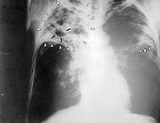
miliary TB, so named because the lung lesions so-formed resemble millet seeds on x-ray. These are more common in immunosuppressed persons and in young children. Pulmonary TB may co-exist with extrapulmonary TB.
Drug resistance
Drug-resistant tuberculosis is transmitted in the same way as regular TB. Primary resistance is said to occur in persons who are infected with a resistant strain of TB. A patient with fully-susceptible TB develops secondary resistance during TB therapy because of inadequate treatment, i.e. not taking the prescribed regimen appropriately, or using low quality medication.
Drug-resistant TB is an important public health issue in many developing countries, as treatment of drug-resistant TB requires the use of more expensive drugs and treatment is longer.
Multidrug-resistant TB is defined as resistance to the two most effective first line TB drugs: rifampicin and isoniazid .
Extensively drug-resistant TB is defined as MDR-TB what is also resistant to three or more of the six classes of second-line drugs. which is based on a genetically modified vaccinia virus.
Because of the limitations of current vaccines, researchers and policymakers are promoting new economic models of vaccine development including prizes, tax incentives and advance market commitments.
Animals
Tuberculosis can be carried by many mammals. Domesticated species, such as cats and dogs, are generally free of tuberculosis, but wild animals may be carriers. As a result, many places have regulations restricting the ownership of
novelty pets, possibly including such partially domesticated species as
pet skunks; for example, the
American state of
California forbids the ownership of pet
gerbils. The strictness of such restrictions generally depends on the public health policies adopted for fighting tuberculosis.
An effort to eradicate bovine tuberculosis from the cattle and deer herds of
New Zealand is underway. It has been found that herd infection is more likely in areas where infected vector species such as Australian
brush-tailed possums come into contact with
domestic livestock at farm/bush borders. Controlling the vectors through possum eradication and monitoring the level of disease in livestock herds through regular surveillance are seen as a "two-pronged" approach to ridding New Zealand of the disease.
In both the
Republic of Ireland and
Northern Ireland,
badgers have been identified as a vector species for the transmission of bovine tuberculosis. As a result, the government in both regions has mounted an active campaign of eradication of the species in an effort to reduce the incidence of the disease. Badgers have been culled primarily by snaring and gassing. It remains a contentious issue, with proponents and opponents of the scheme citing their own studies to support their position.
History
Tuberculosis has been present in humans since
antiquity. The origins of the disease are in the first domestication of cattle . Skeletal remains show prehistoric humans had TB, and tubercular decay has been found in the spines of
Egyptian
mummies from 3000-2400 BCE. There were references to TB in
India around 2000 BCE, and indications of lung scarring identical to that of modern-day TB sufferers in preserved bodies suggests that TB was present in
The Americas from about 2000 BCE.
Phthisis is a Greek term for consumption. Around 460 BCE,
Hippocrates identified phthisis as the most widespread disease of the times which was almost always fatal.
During the Industrial Revolution, tuberculosis was more commonly thought of as
vampirism. When one member of a family died from it, the other members that were infected would lose their health slowly. People believed that the cause of this was the original victim draining the life from the other family members. To cure this, people would dig up the body of what they thought was the vampire, open the chest and burn the heart, sometimes with the rest of the body. Furthermore, people who had TB exhibited symptoms similar to what people considered to be vampire traits. People with TB often had symptoms such as red, swollen eyes , pale skin and coughing blood . This may be how much of the common mythology of the vampire originated.
Although it was established that the pulmonary form was associated with 'tubercles' by Dr Richard Morton in 1689, due to the variety of its symptoms, TB was not identified as a single disease until the 1820s and was not named 'tuberculosis' until 1839 by J. L. Schönlein. During the years 1838-1845, Dr. John Croghan, the owner of
Mammoth Cave, brought a number of tuberculosis sufferers into the cave in the hope of curing the disease with the constant temperature and purity of the cave air. The first TB sanatorium opened in 1859 in
Poland, with another opening in the
United States in 1885.
The bacillus causing tuberculosis,
Mycobacterium tuberculosis, was identified and described on March 24, 1882 by
Robert Koch. He received the Nobel Prize in physiology or medicine in 1905 for this discovery. Koch did not believe that bovine and human tuberculosis were similar, which held back the recognition of infected milk as a source of infection. Later, this source was eliminated by the pasteurization process. Koch announced a
glycerine extract of the tubercle bacilli as a "remedy" for tuberculosis in 1890, calling it 'tuberculin'. It was not effective, but was later adapted by von Pirquet in a test for pre-symptomatic tuberculosis.
The first genuine success in immunizing against tuberculosis developed from attenuated bovine-strain tuberculosis by
Albert Calmette and
Camille Guerin in 1906. It was called 'BCG' . The BCG vaccine was first used on humans on July 18, 1921 in
France. It wasn't until after
World War II that BCG received widespread acceptance in the
USA,
Great Britain, and
Germany.
Tuberculosis caused the most widespread public concern in the 19th and early 20th centuries as the endemic disease of the urban poor. In 1815, one in four deaths in England was of consumption; by 1918 one in six deaths in France were still caused by TB. After the establishment in the 1880s that the disease was contagious, TB was made a notifiable disease in Britain; there were campaigns to stop spitting in public places, and the infected poor were "encouraged" to enter sanatoria that rather resembled prisons. Whatever the purported benefits of the fresh air and labor in the sanatoria, 75% of those who entered were dead within five years .
The promotion of
Christmas Seals was started in 1904 in Denmark as a way to raise money for tuberculosis programs. It expanded to the United States and Canada in 1907-08 to help the National Tuberculosis Association .
In the United States, concern about the spread of tuberculosis played a role in the movement to prohibit public spitting except into
spittoons.
In Europe, deaths from TB fell from 500 out of 100,000 in 1850 to 50 out of 100,000 by 1950. Improvements in public health were reducing tuberculosis even before the arrival of antibiotics, although the disease's significance was still such that when the
Medical Research Council was formed in Britain in 1913 its first project was tuberculosis.
It was not until 1946 with the development of the antibiotic
streptomycin that treatment rather than prevention became a possibility. Prior to then only surgical intervention was possible as supposed treatment , including the
pneumothorax technique: collapsing an infected lung to "rest" it and allow lesions to heal, which was an accomplished technique but was of little benefit and was discontinued after 1946.
Hopes that the disease could be completely eliminated have been dashed since the rise of drug-resistant strains in the 1980s. For example, Tuberculosis cases in Britain, numbering around 50,000 in 1955, had fallen to around 5,500 in 1987, but in 2000 there were over 7,000 confirmed cases. Due to the elimination of public health facilities in New York in the 1970s, there was a resurgence in the 1980s [citation needed]. The number of those failing to complete their course of drugs was very high. NY had to cope with more than 20,000 "unnecessary" TB-patients with many multidrug-resistant strains . The resurgence of tuberculosis resulted in the declaration of a global health emergency by the World Health Organization in 1993.
Incidence
According to the World Health Organization , nearly 2 billion people, one-third of the world's population, have tuberculosis. Tuberculosis currently causes approximately 1.7 million deaths per year worldwide.
In the
United Kingdom, the rate of tuberculosis in
London is 40 per 100,000 - three times the national average of 13 per 100,000, according to the Public Health Laboratory Service and WHO. The highest rates in
Western Europe are in
Portugal and
Spain . These rates compare with 113 per 100,000 in
China and 64 per 100,000 in
Brazil. Tuberculosis is the world's greatest infectious killer of women of reproductive age and the leading cause of death among people with
HIV/
AIDS. Globally more than 23 000 people develop active TB and almost 5 000 die from the disease every day. . The highly urbanized region centered in
Porto, northern
Portugal, is placed among the
European Union's largest metropolitan areas having the highest rates of tuberculosis positive cases - 53 per 100,000 .
Tuberculosis in art, literature, history and film
Historical people
Due to the high prevalence of tuberculosis in the pre-antibiotic era, many historically prominent people developed or died from the condition, often in the prime of their productive period.
Theology:- Saint Maria Faustina Kowalska, the Roman Catholic nun and mystic from Poland, is the patron saint of mercy, and the Apostle of The Divine Mercy. She suffered greatly from tuberculosis and succumbed to it on October 5, 1938. She was canonized by the Church on April 30, 2000.
- David Brainerd only lived 29 years. His diary has been published and reflects his reliance upon God's faithfulness amidst his battle with consumption. Brainerd's diary has proven historically very influential, particularly to the modern Christian missionary movement. He was a close friend of Theologian and Pastor Jonathan Edwards in New England.
- The Catholic Church canonized Saint Therese of the Child Jesus in 1925, who died of tuberculosis.
- Cardinal Richelieu of France died of tuberculosis in 1642
Music:- Frédéric Chopin died of consumption in 1849 at age 39. Historical records indicate episodes of hemoptysis during performances.
- Legendary father of country music, Jimmie Rodgers sang the woes of having tuberculosis in the song T.B. Blues . Rodgers ultimately died of the disease days after a New York city recording session.
- Luigi Boccherini, Italian cellist and composer, died in 1805 of pulmonary tuberculosis.
- Tom Jones, the Welsh singing legend, spent about a year recovering from TB in his parents basement around the age of 12.
- Cat Stevens contracted tuberculosis. After several months in the hospital and a year of convalescence, Stevens returned to recording.
- Van Morrison's "T.B. Sheets", from the album of the same name, is a 9-minute song to a lover dying of the disease.
Mathematics:Literature and poetry:- English Romantic poet John Keats and some of his family were taken by tuberculosis.
- The Brontë family of writers, poets and painters was particularly struck by TB, with Anne
...
,
Branwell, and
Emily all dying of it within 2 years of each other.
Charlotte's death in 1855 was stated as due to TB at the time, although there is some controversy over this today.
- In A Moveable Feast, Ernest Hemingway recounts meeting Ernest Walsh, an Irish poet suffering from TB. "... I looked at him and his marked-for-death look and I thought, you con man conning me with your con."
- Neo-romantic Scottish essayist, novelist and poet Robert Louis Stevenson is thought to have suffered from tuberculosis during much of his life. He spent the winter of 1887–1888 recuperating from a presumed bout of tuberculosis at Dr. E.L. Trudeau's world-renowned Adirondack Cottage Sanatarium in Saranac Lake, New York.
- The 20th century French writer, playwright, activist, and existentialist philosopher, Albert Camus also suffered from TB during his life time, although he died in a car accident.
- Edward Bellamy , a fiction writer who was made famous from his book "Looking Backward", died from tuberculosis.
- Franz Kafka , a German-language novelist who was made famous from his novel , died from tuberculosis.
- Masaoka Shiki
...
, a Japanese poet famous for revitalizing the haiku, died after a long struggle with tuberculosis.
- George Orwell , British author of 1984, Animal Farm and Homage to Catalonia suffered from the diease in bouts from the early 1930s until his death from the illness.
- Dashiell Hammett , American author and creator of the "hard boiled" detective novel , contracted tuberculosis during WWI.
- Fyodor Dostoyevsky , author of Crime and Punishment and The Brothers Karamazov lost his first wife, Marya Dimitryevna, to consumption.
- Charles Bukowski , American author and poet contracted TB in 1988; he recovered, losing 60 pounds.
- Sir Arthur Conan Doyle , lost his first wife, Louisa Hawkins, to tuberculosis in 1906.
- Poet Elizabeth Barrett Browning died of tuberculosis in 1861
- American Author Jessamyn West contracted TB in 1932, and recovered.
Military:- Okita Soji , a young and famous captain of the Shinsengumi, was rumored to have discovered his disease when he coughed blood and fainted during the Ikedaya Affair. He died of it in his mid-20's, on July 19th , 1868.
Painters:- Edvard Munch , The famous painter who painted , lost two members of his family, his mother, and his beloved sister both to tuberculosis. The loss of his sister was immortalized in the painting "The Sick Child."
Others:Gunslinger, also
gunfighter, is a name given to men in the American Old West [i] who had gain ...
John "Doc" Holliday suffered from tuberculosis until his death in 1887.
- Arline Greenbaum, the first wife of famed physicist Richard Feynman died from tuberculosis while he was working on the Manhattan Project.
- Juliet Hulme, a girl who helped her friend, Pauline Parker, murder Pauline's mother Honore Parker in Christchurch, New Zealand suffered from tuberculosis.
- Tulasa Thapa, a kidnapped Nepali girl, died of tuberculosis in 1995.
- Celebrated British actress of stage and screen Vivien Leigh died from complications of tuberculosis.
- It has been said that King Tutankhamen, Pharoah of Egypt, had TB, but there is debate as to whether it was the cause of his death.
- Simon Bolivar, the man who many South American countries consider their liberator, died in 1830 of TB.
Portrayals
It has been speculated that the real-life ubiquity of illness and death due to tuberculosis affected the portrayal of these issues in European art and literature as well as history. The pale, "haunted" appearance of tuberculosis sufferers was fashionable at times, and has been seen as an influence on the works of
Edgar Allan Poe who lost loved ones to this disease. In recent years, this aesthetic has been revived by the "
Goth subculture". In 1680
John Bunyan referred to TB as "the captain of all these men of death".
Opera and theatre:- Mimi, the heroine of Puccini's opera, La bohème suffers from tuberculosis . Violetta Valéry, heroine of Verdi's La Traviata, also dies of the disease .
- The character of Jody in the play Hollywood Arms suffers from TB.
Novels:- In Dan Simmons' novel The Fall of Hyperion , an artificially recreated John Keats suffers and dies from tuberculosis; several chapters in the book describe his agony and personal thoughts during his final days.
- In "", the entire city of Halcyon is infected with Tuberculosis or "Phthisis", and through that disease that Yawgmoth says he shall cure is how he gains power. The disease infects also the great Genius Glacian.
- The Life and Death of Mr. Badman by John Bunyan - "Yet the captain of all these men of death that came against him to take him away, was the consumption, for it was that that brought him down to the grave."
- The protagonist's mother in "Angela's Ashes" by Frank McCourt dies of the consumption.
- Tuberculosis is portrayed at least twice in the Sherlock Holmes stories by Sir Arthur Conan Doyle, himself a medical doctor. In 'The Final Problem', Dr. Watson gets a message saying that a lady was in 'the final stages of consumption'. In the story 'The Missing Three-Quarter', Godfrey Staunton's young wife dies of 'consumption of the most villianed kind'. 'Consumption' was a common name for 'tuberculosis' in the 19th and early 20th centuries.
- Tuberculosis patients were frequent characters in 19th century Russian literature, and even inspired a character type; the consumptive nihilist, examples of which include Bazarov from Ivan Turgenev's Fathers and Sons, Katerina Ivanovna from Fyodor Dostoevsky's Crime and Punishment, Kirillov from Dostoevsky's Demons , and Ippolit and Marie from Dostoevsky's The Idiot.
- In the novel The Constant Gardener by John Le Carré, as well as in the movie adaptation directed by Fernando Meirelles, the plot largely revolves around TB drugs beings tested on unwitting subjects in Africa, and dire predictions about a global pandemic of a drug-resistant form of the disease appear repeatedly.
- In Sylvia Plath's novel The Bell Jar, the protagonist Esther's boyfriend Buddy Willard suffers from tuberculosis, much to her liking.
- Celestine, the heroine of Octave Mirbeau's Diary of a Chambermaid, attempts to contract tuberculosis from her dying lover, Monsieur Georges.
- In Nicholas Nickleby, by Charles Dickens, Nickleby's faithful companion Smike is beset by tuberculosis.
- Extensively, in The Magic Mountain is a long novel [i] by Thomas Mann [i], first published in November 1924. ...
, by Thomas Mann, where a three week visit to a sanitarium turns into a seven year sabbatical and additionally in the novelle "Tristan" which is set in an alpine sanatorium. - In Hocus Pocus by Kurt Vonnegut, the protagonist contracts TB later in his lifetime.
- In the Swedish novel "Körkarlen" by Selma Lagerlöf, the protagonist David Holm is sick with TB, and so are his younger brother Bernard and his friend Sister Edith.
- In the Australian novel Seven Little Australians, Judy becomes consumptive after walking from the Blue Mountains