


Mink

Encyclopedia
There are two living species referred to as "mink": the European Mink
and the American Mink
. The extinct Sea Mink
is related to the American Mink, but was much larger. All three species are dark-colored, semi-aquatic
, carnivorous mammal
s of the family Mustelidae
, which also includes the weasel
s and the otter
s and ferret
s. The American Mink is larger and more adaptable than the European Mink. It is sometimes possible to distinguish between the European and American mink; a European Mink always has a large white patch on its upper lip, while the American species sometimes does not. Thus, any mink without such a patch can be identified with certainty as an American Mink, but an individual with a patch cannot be certainly identified without looking at the skeleton. Taxonomically, both American and European Minks used to be placed in the same genus
Mustela ("Weasel
s"), but most recently the American Mink has been re-classified as belonging to its own genus Neovison.
The American Mink's fur has been highly prized for its use in clothing
, with hunting
giving way to farming
. Its treatment has also been a focus of animal rights
and animal welfare
activism
. American Mink have found their way into the wild in Europe
(including Great Britain
) and South America
, after being released from mink farms by animal rights activists or otherwise escaping from captivity.
American Mink are believed by some to have contributed to the decline of the less hardy European Mink through competition (though not through hybridization—native European mink are in fact closer to polecats than to their North American cousins). Trapping is used to control or eliminate feral
American Mink populations.
Mink oil
is used in some medical products and cosmetics, as well as to treat, preserve and waterproof leather.
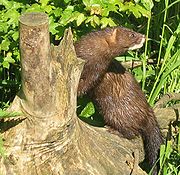
European mink
The European mink , also known as the Russian mink, is a semi-aquatic species of Mustelid native to Europe. It is listed by the IUCN as Endangered due to an ongoing reduction in numbers, having been calculated as being more than 50% over the past three generations...
and the American Mink
American Mink
The American mink is a semi-aquatic species of Mustelid native to North America, though human intervention has expanded its range to many parts of Europe and South America. Because of this, it is classed as Least Concern by the IUCN. Since the extinction of the sea mink, the American mink is the...
. The extinct Sea Mink
Sea Mink
The Sea Mink, Neovison macrodon, is an extinct North American member of the family Mustelidae. It is the only mustelid, and one of only two terrestrial mammal species in the order Carnivora, to become extinct in historic times . The body of the sea mink was significantly longer than that of the...
is related to the American Mink, but was much larger. All three species are dark-colored, semi-aquatic
Aquatic animal
An aquatic animal is an animal, either vertebrate or invertebrate, which lives in water for most or all of its life. It may breathe air or extract its oxygen from that dissolved in water through specialised organs called gills, or directly through its skin. Natural environments and the animals that...
, carnivorous mammal
Mammal
Mammals are members of a class of air-breathing vertebrate animals characterised by the possession of endothermy, hair, three middle ear bones, and mammary glands functional in mothers with young...
s of the family Mustelidae
Mustelidae
Mustelidae , commonly referred to as the weasel family, are a family of carnivorous mammals. Mustelids are diverse and the largest family in the order Carnivora, at least partly because in the past it has been a catch-all category for many early or poorly differentiated taxa...
, which also includes the weasel
Weasel
Weasels are mammals forming the genus Mustela of the Mustelidae family. They are small, active predators, long and slender with short legs....
s and the otter
Otter
The Otters are twelve species of semi-aquatic mammals which feed on fish and shellfish, and also other invertebrates, amphibians, birds and small mammals....
s and ferret
Ferret
The ferret is a domesticated mammal of the type Mustela putorius furo. Ferrets are sexually dimorphic predators with males being substantially larger than females. They typically have brown, black, white, or mixed fur...
s. The American Mink is larger and more adaptable than the European Mink. It is sometimes possible to distinguish between the European and American mink; a European Mink always has a large white patch on its upper lip, while the American species sometimes does not. Thus, any mink without such a patch can be identified with certainty as an American Mink, but an individual with a patch cannot be certainly identified without looking at the skeleton. Taxonomically, both American and European Minks used to be placed in the same genus
Genus
In biology, a genus is a low-level taxonomic rank used in the biological classification of living and fossil organisms, which is an example of definition by genus and differentia...
Mustela ("Weasel
Weasel
Weasels are mammals forming the genus Mustela of the Mustelidae family. They are small, active predators, long and slender with short legs....
s"), but most recently the American Mink has been re-classified as belonging to its own genus Neovison.
The American Mink's fur has been highly prized for its use in clothing
Clothing
Clothing refers to any covering for the human body that is worn. The wearing of clothing is exclusively a human characteristic and is a feature of nearly all human societies...
, with hunting
Hunting
Hunting is the practice of pursuing any living thing, usually wildlife, for food, recreation, or trade. In present-day use, the term refers to lawful hunting, as distinguished from poaching, which is the killing, trapping or capture of the hunted species contrary to applicable law...
giving way to farming
Fur farming
Fur farming is the practice of breeding or raising certain types of animals for their fur.Fur used from wild caught animals is not farmed, and is instead known as 'free range fur' because the animals have lived their lives free and natural in the wild....
. Its treatment has also been a focus of animal rights
Animal rights
Animal rights, also known as animal liberation, is the idea that the most basic interests of non-human animals should be afforded the same consideration as the similar interests of human beings...
and animal welfare
Animal welfare
Animal welfare is the physical and psychological well-being of animals.The term animal welfare can also mean human concern for animal welfare or a position in a debate on animal ethics and animal rights...
activism
Activism
Activism consists of intentional efforts to bring about social, political, economic, or environmental change. Activism can take a wide range of forms from writing letters to newspapers or politicians, political campaigning, economic activism such as boycotts or preferentially patronizing...
. American Mink have found their way into the wild in Europe
Europe
Europe is, by convention, one of the world's seven continents. Comprising the westernmost peninsula of Eurasia, Europe is generally 'divided' from Asia to its east by the watershed divides of the Ural and Caucasus Mountains, the Ural River, the Caspian and Black Seas, and the waterways connecting...
(including Great Britain
Great Britain
Great Britain or Britain is an island situated to the northwest of Continental Europe. It is the ninth largest island in the world, and the largest European island, as well as the largest of the British Isles...
) and South America
South America
South America is a continent situated in the Western Hemisphere, mostly in the Southern Hemisphere, with a relatively small portion in the Northern Hemisphere. The continent is also considered a subcontinent of the Americas. It is bordered on the west by the Pacific Ocean and on the north and east...
, after being released from mink farms by animal rights activists or otherwise escaping from captivity.
American Mink are believed by some to have contributed to the decline of the less hardy European Mink through competition (though not through hybridization—native European mink are in fact closer to polecats than to their North American cousins). Trapping is used to control or eliminate feral
Feral
A feral organism is one that has changed from being domesticated to being wild or untamed. In the case of plants it is a movement from cultivated to uncultivated or controlled to volunteer. The introduction of feral animals or plants to their non-native regions, like any introduced species, may...
American Mink populations.
Mink oil
Mink oil
Mink oil is made from mink fat and originates from China. The fat that is made into this oil is stored just beneath the skin. Removed from pelts destined for the fur industry, the fat is rendered into mink oil....
is used in some medical products and cosmetics, as well as to treat, preserve and waterproof leather.
Species
- American MinkAmerican MinkThe American mink is a semi-aquatic species of Mustelid native to North America, though human intervention has expanded its range to many parts of Europe and South America. Because of this, it is classed as Least Concern by the IUCN. Since the extinction of the sea mink, the American mink is the...
Neovison vison - European MinkEuropean minkThe European mink , also known as the Russian mink, is a semi-aquatic species of Mustelid native to Europe. It is listed by the IUCN as Endangered due to an ongoing reduction in numbers, having been calculated as being more than 50% over the past three generations...
Mustela lutreola - Sea MinkSea MinkThe Sea Mink, Neovison macrodon, is an extinct North American member of the family Mustelidae. It is the only mustelid, and one of only two terrestrial mammal species in the order Carnivora, to become extinct in historic times . The body of the sea mink was significantly longer than that of the...
Neovison macrodon (extinct)