


Pearl

Encyclopedia
A pearl is a hard object produced within the soft tissue (specifically the mantle
) of a living shelled mollusk. Just like the shell of a mollusk, a pearl is made up of calcium carbonate
in minute crystalline form, which has been deposited in concentric layers. The ideal pearl is perfectly round and smooth, but many other shapes of pearls (baroque pearl
s) occur. The finest quality natural pearls have been highly valued as gemstone
s and objects of beauty
for many centuries, and because of this, the word pearl has become a metaphor
for something very rare, fine, admirable, and valuable.
The most valuable pearls occur spontaneously in the wild, but they are extremely rare. These wild pearls are referred to as natural pearls. Cultured or farmed pearls from pearl oyster
s and freshwater mussels make up the majority of those that are currently sold. Imitation or fake pearls are also widely sold in inexpensive jewelry, but the quality of their iridescence is usually very poor, and generally speaking, artificial pearls are easily distinguished from genuine pearls. Pearls have been harvested and cultivated primarily for use in jewelry, but in the past they were also stitched onto lavish clothing. Pearls have also been crushed and used in cosmetics, medicines, and in paint formulations.
Whether wild or cultured, gem quality pearls are almost always nacre
ous and iridescent, as is the interior of the shell that produces them. However, almost all species of shelled mollusks are capable of producing pearls (formerly referred to as "calcareous concretions" by some sources) of lesser shine or less spherical shape. Although these may also be legitimately referred to as "pearls" by gemological labs and also under U.S. Federal Trade Commission
rules, and are formed in the same way, most of them have no value, except as curiosities.
perle, originally from the Latin
diminutive of perna leg, ham, leg-of-mutton shaped bivalve.
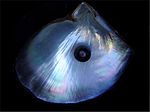 Almost any shelled mollusk can, by natural processes, produce some kind of "pearl" when an irritating microscopic object becomes trapped within the mollusk's mantle folds, but the great majority of these "pearls" are not valued as gemstones. Nacreous pearls, the best-known and most commercially-significant pearls, are primarily produced by two groups of molluscan bivalves or clam
s. A nacreous pearl is made from layers of nacre
, by the same living process as is used in the secretion of the mother of pearl which lines the shell.
A "natural pearl" or "wild pearl" is one that forms without any human intervention at all, in the wild, and is very rare. Many hundreds of pearl oysters or pearl mussels have to be gathered and opened, and thus killed, in order to find even one wild pearl, and for many centuries that was the only way pearls were obtained. This was the main reason why pearls fetched such extraordinary prices in the past. A cultured pearl
is formed in a pearl farm, using human intervention as well as natural processes.
One family of nacreous pearl bivalves – the pearl oyster
– lives in the sea, while the other – a very different group of bivalves – lives in freshwater; these are the river mussel
s such as the freshwater pearl mussel
. Saltwater pearls can grow in several species of marine
pearl oyster
s in the family
Pteriidae
. Freshwater pearls grow within certain (but by no means all) species of freshwater mussels in the order Unionida, the families Unionidae
and Margaritiferidae
.
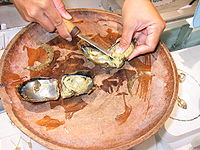
of pearls depends upon the reflection
, refraction
, and diffraction
of light from the translucent layers. The thinner and more numerous the layers in the pearl, the finer the luster. The iridescence
that pearls display is caused by the overlapping of successive layers, which breaks up light falling on the surface. In addition, pearls (especially cultured freshwater pearls) can be dyed yellow, green, blue, brown, pink, purple, or black. The very best pearls have a metallic mirror-like lustre.
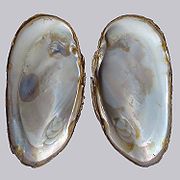 Freshwater and saltwater pearls may sometimes look quite similar, but they come from different sources.
Freshwater pearls form in various species of freshwater mussels, family Unionidae
, which live in lakes, rivers, ponds and other bodies of fresh water. These freshwater pearl mussel
s occur not only in hotter climates, but also in colder more temperate areas such as Scotland
(where they are totally protected under law). However, most freshwater cultured pearl
s sold today come from China.
Saltwater pearls grow within pearl oysters, family Pteriidae
, which live in oceans. Saltwater pearl oyster
s are usually cultivated in protected lagoon
s or volcanic atolls.
The mantle of the mollusk deposits layers of calcium carbonate
(CaCO3) in the form of the mineral
aragonite
or a mixture of aragonite and calcite (polymorphs with the same chemical formula, but different crystal structures) held together by an organic horn-like compound called conchiolin
. The combination of aragonite and conchiolin is called nacre
, which makes up mother-of-pearl. The commonly held belief that a grain of sand acts as the irritant is in fact rarely the case. Typical stimuli include organic material, parasites, or even damage that displaces mantle tissue to another part of the mollusk's body. These small particles or organisms gain entry when the shell valves are open for feeding or respiration. In cultured pearls, the irritant is typically an introduced piece of the mantle epithelium, together or without a spherical bead (beaded or beadless cultured pearls).
Typically, the build-up of a natural pearl consists of a brown central zone formed by columnar calcium carbonate (usually calcite, sometimes columnar aragonite) and a yellowish to white outer zone consisting of nacre (tabular aragonite). In a pearl cross-section such as the diagram, these two different materials can be seen. The presence of columnar calcium carbonate rich in organic material indicates juvenile mantle tissue that formed during the early stage of pearl development. Displaced living cells with a well-defined task may continue to perform their function in their new location, often resulting in a cyst
. Such displacement may occur via an injury. The fragile rim of the shell is exposed and is prone to damage and injury. Crabs, other predators and parasites such as worm larvae may produce traumatic attacks and cause injuries in which some external mantle tissue cells are disconnected from their layer. Embedded in the conjunctive tissue of the mantle, these cells may survive and form a small pocket in which they continue to secrete their natural product: calcium carbonate. The pocket is called a pearl sack, and grows with time by cell division; in this way the pearl grows also. The juvenile mantle tissue cells, according to their stage of growth, produce columnar calcium carbonate, which is secreted from the inner surface of the pearl sack. With ongoing time the external mantle cells of the pearl sack proceed to the formation of tabular aragonite. When the transition to nacre secretion occurs, the brown pebble becomes covered with a nacreous coating. As this process progresses, the shell itself grows, and the pearl sack seems to travel into the shell. However, it actually stays in its original relative position within the mantle tissue. After a couple of years, a pearl will have formed and the shell might be found by a lucky pearl fisher.
Cultured pearls (beadless or beaded) and imitation pearls can be distinguished from natural pearls by X-ray examination. Nucleated cultured pearls are often 'pre-formed' as they tend to follow the shape of the implanted shell bead nucleus. Once the pre-formed beads are inserted into the oyster, it secretes a few layers of nacre around the outside surface of the implant before it is removed after six months or more.
When a cultured pearl with bead is X-rayed, it reveals a different structure to that of a natural pearl. A beaded cultured pearl shows a solid center with no concentric growth rings, whereas a natural pearl shows a series of concentric growth rings. A beadless cultured pearl (whether of freshwater or saltwater origin) may show growth rings, but also a complex central cavity, witness of the first precipitation of the young pearl sac.
in order to examine the center of a pearl. With an x-ray it is possible to see the growth rings of the pearl, where the layers of calcium carbonate are separated by thin layers of conchiolin. The differentiation of natural pearls from non-beaded cultured pearls can be very difficult without the use of this x-ray technique.
Natural and cultured pearl
s can be distinguished from imitation pearls using a microscope
. Another method of testing for imitations is to rub two pearls against each other. Imitation pearls are completely smooth, but natural and cultured pearls are composed of nacre platelets, making both feel slightly gritty.
Single, natural pearls are often sold as a collector's item, or set as centerpieces in unique jewelry. Very few matched strands of natural pearls exist, and those that do often sell for hundreds of thousands of dollars. (In 1917, jeweler Pierre Cartier
purchased the Fifth Avenue mansion that is now the New York Cartier store in exchange for a matched, double strand of natural pearls that he had been collecting for years; valued at the time at $1 million USD.)
The Great Depression
effectively slashed the value of the natural pearl, but there is no doubt that it had been some time coming. The introduction and advance of the cultured pearl hit the pearl industry hard; it had pearl dealers publicly disputing over the authenticity of these new cultured pearls, and left many consumers uneasy and confused about the much lower prices. Essentially, it damaged the image of both natural and cultured pearls alike. By the 1950s, an era of every woman being able to own her own pearl necklace had begun, and natural pearls were reduced to a small, exclusive niche in the pearl industry.
. Australia also has one of the world's last remaining fleets of pearl diving ships. Australian pearl divers dive for south sea pearl oysters to be used in the cultured south sea pearl industry. The catch of pearl oysters is similar to the numbers of oysters taken during the natural pearl days. Hence significant numbers of natural pearls are still found in the Australian Indian Ocean waters from wild oysters. X-Ray examination is required to positively verify natural pearls found today.
 Keshi pearls
, although they often occur by chance, are not considered natural pearls. They are a byproduct of the culturing process, and hence do not happen without human intervention. These pearls are quite small: typically a few millimeters in size. Keshi pearls are produced by many different types of marine mollusks and freshwater mussels in China. Today many "keshi" pearls are actually intentional, with post-harvest shells returned to the water to regenerate a pearl in the existing pearl sac.
The Tahitian pearl, frequently referred to as Black Tahitian Pearls, are highly valued because of their rarity; the culturing process for them dictates a smaller volume output and they can never be mass produced because, in common with most sea pearls, the oyster can only be nucleated with one pearl at a time, while freshwater mussels are capable of multiple pearl implants. Before the days of cultured pearls, black pearls were rare and highly valued for the simple reason that white pearl oysters rarely produced naturally black pearls, and black pearl oysters rarely produced any natural pearls at all.
 Since the development of pearl culture technology, the black pearl oyster found in Tahiti and many other Pacific Island areas has been extensively used for producing cultured pearls. The rarity of the black cultured pearl is now a "comparative" issue. The black cultured pearl is rare when compared to Chinese freshwater cultured pearls, and Japanese and Chinese akoya cultured pearls, and is more valuable than these pearls. However, it is more abundant than the South Sea pearl, which is more valuable than the black cultured pearl. This is simply because the black pearl oyster Pinctada margaritifera is far more abundant than the elusive, rare, and larger south sea pearl oyster Pinctada maxima, which cannot be found in lagoons, but which must be dived for in a rare number of deep ocean habitats or grown in hatcheries.
In fact Black pearls are very rarely black: they are usually shades of green,purple, aubergine, blue, grey, silver or peacock (a mix of several shades, like a peacock's feather)
Black cultured pearls from the black pearl oyster – Pinctada margaritifera – are not South Sea pearls, although they are often mistakenly described as black South Sea pearls. In the absence of an official definition for the pearl from the black oyster, these pearls are usually referred to as "black Tahitian pearls".
The correct definition of a South Sea pearl – as described by CIBJO and GIA – is a pearl produced by the Pinctada maxima pearl oyster. South Sea pearls are the color of their host Pinctada maxima oyster – and can be white, silver, pink, gold, cream, and any combination of these basic colors, including overtones of the various colors of the rainbow displayed in the pearl nacre of the oyster shell itself.
South Sea Pearls are produced in various parts of the world. White ones tend to come from the Broome area of Australia while golden ones are from the Philippines. Pearls are also produced in the Cook Islands and one farm in the Sea of Cortez, Mexico, from Concha Nácar the rainbow lipped oyster; these pearls fluoresce red under ultraviolet
light.
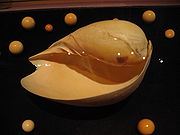 Biologically speaking, under the right set of circumstances, almost any shelled mollusk can produce some kind of pearl, however, most of these molluscan pearls have no luster or iridescence
. The great majority of mollusk species produce pearls which are not attractive, and are sometimes not even very durable, such that they usually have no value at all, except perhaps to a scientist, a collector, or as a curiosity. These objects used to be referred to as "calcareous concretions" by some gemologists, even though a malacologist would still consider them to be pearls. Valueless pearls of this type are sometimes found in edible mussel
s, edible oyster
s, escargot snails, and so on. The GIA and CIBJO now simply use the term 'pearl' (or, where appropriate, the more descriptive term 'non-nacreous pearl') when referring to such items and, under Federal Trade Commission rules, various mollusc pearls may be referred to as 'pearls', without qualification.
A few species produce pearls that can be of interest as gemstones. These species include the bailer shell Melo, the giant clam
Tridacna, various scallop
species, Pen shells Pinna
, and the Haliotis iris
species of abalone. Abalone, or Pāua
are Mabe
pearls unique to New Zealand
waters and are commonly referred to as 'Blue Pearls'. They are admired for their incredible luster and naturally bright vibrant colors that are often compared to Opal
. Another example is the conch pearl (sometimes referred to simply as the 'pink pearl'), which is found very rarely growing between the mantle and the shell of the queen conch
or pink conch, Strombus gigas
, a large sea snail or marine gastropod from the Caribbean Sea
. These pearls, which are often pink in color, are a by-product of the conch fishing industry, and the best of them display a shimmering optical effect related to chatoyance known as 'flame structure'.
Somewhat similar gastropod pearls, this time more orange in hue, are (again very rarely) found in the horse conch Pleuroploca gigantea
.
The largest pearl known was found in the Philippines
in 1934 and is known as the Pearl of Lao Tzu
. It is a naturally-occurring, non-nacreous, calcareous concretion (pearl) from a giant clam
. Because it did not grow in a pearl oyster it is not pearly; instead the surface is glossy like porcelain. Other pearls from giant clams are known to exist, but this is a particularly large one, weighing 14 lb (6.4 kg).
, in areas like the Persian Gulf, the Red Sea, and in the Gulf of Mannar
. Starting in the Han Dynasty
(206 BC–220 AD), the Chinese
hunted extensively for seawater pearls in the South China Sea
. In the 14th-century Arabian Sea
, the traveller Ibn Battuta
provided the earliest known description of pearl diving by means of attaching a cord to the diver's waist.
When Spanish conquistadors arrived in the Western Hemisphere, they discovered that around the islands of Cubagua
and Margarita
, some 200 km north of the Venezuelan coast, was an extensive pearl bed (a bed of pearl oysters). One discovered and named pearl, La Peregrina pearl
, was offered to the Spanish queen. According to Garcilasso de la Vega, who says that he saw La Peregrina at Seville in 1507, (Garcilasso, "Historie des Incas, Rois du Perou," Amsterdam, 1704, Vol. II, P. 352.) this was found at Panama in 1560 by a slave worker who was rewarded with his liberty, and his owner with the office of alcalde of Panama.
Margarita pearls are extremely difficult to find today and are known for their unique yellowish color. The most famous Margarita necklace that any one can see today is the one that then Venezuelan President Romulo Betancourt
gave to Jacqueline Kennedy when she and her husband, President John F. Kennedy
paid an official visit to Venezuela.
Before the beginning of the 20th century, pearl hunting
was the most common way of harvesting pearls. Divers manually pulled oysters from ocean floors and river bottoms and checked them individually for pearls. Not all mussels and oysters produce pearls. In a haul of three tons, only three or four oysters will produce perfect pearls.
who passed the information along to Tatsuhei Mise and Tokichi Nishikawa from Japan
.
The second category includes the non-beaded freshwater cultured pearls, like the Biwa or Chinese pearls. As they grow in the mantle, where on each wing up to 25 grafts can be implanted, these pearls are much more frequent and saturate the market completely. An impressive improvement in quality has taken place in the last ten years when the former rice grain-shaped pebbles are compared with the near round pearls of today. In the last two years large near perfect round bead nucleated pearls up to 15mm in diameter have been produced with metallic lustre.
The nucleus bead in a beaded cultured pearl is generally a polished sphere made from freshwater mussel
shell. Along with a small piece of mantle tissue from another mollusk (donor shell) to serve as a catalyst for the pearl sac, it is surgically implanted into the gonad (reproductive organ) of a saltwater mollusk. In freshwater perliculture, only the piece of tissue is used in most cases, and is inserted into the fleshy mantle of the host mussel. South Sea and Tahitian pearl oysters, also known as Pinctada maxima and Pinctada margaritifera, which survive the subsequent surgery to remove the finished pearl, are often implanted with a new, larger beads as part of the same procedure and then returned to the water for another 2–3 years of growth.
 Despite the common misperception, Mikimoto did not discover the process of pearl culture. The accepted process of pearl culture was developed by the British Biologist William Saville-Kent in Australia and brought to Japan by Tokichi Nishikawa and Tatsuhei Mise. Nishikawa was granted the patent in 1916, and married the daughter of Mikimoto. Mikimoto was able to use Nishikawa's technology. After the patent was granted in 1916, the technology was immediately commercially applied to akoya pearl oysters in Japan in 1916. Mise's brother was the first to produce a commercial crop of pearls in the akoya oyster. Mitsubishi's Baron Iwasaki immediately applied the technology to the south sea pearl oyster in 1917 in the Philippines, and later in Buton, and Palau. Mitsubishi was the first to produce a cultured south sea pearl – although it was not until 1928 that the first small commercial crop of pearls was successfully produced.
The original Japanese cultured pearls, known as akoya pearls, are produced by a species of small pearl oyster, Pinctada fucata martensii, which is no bigger than 6 to 8 cm in size, hence akoya pearls larger than 10 mm in diameter are extremely rare and highly priced. Today, a hybrid mollusk is used in both Japan and China in the production of akoya pearls.
In the past couple of decades, cultured pearls have been produced using larger oysters in the south Pacific
and Indian Ocean
. The largest pearl oyster is the Pinctada maxima, which is roughly the size of a dinner plate. South Sea pearls are characterized by their large size and warm luster. Sizes up to 14 mm in diameter are not uncommon. South Sea pearls are primarily produced in Australia
, Indonesia
and the Philippines.
Mitsubishi commenced pearl culture with the south sea pearl oyster in 1916, as soon as the technology patent was commercialized. By 1931 this project was showing signs of success, but was upset by the death of Tatsuhei Mise. Although the project was recommenced after Tatsuhei's death, the project was discontinued at the beginning of WWII before significant productions of pearls were achieved.
After WWII, new south sea pearl projects were commenced in the early 1950s in Burma and Kuri Bay
and Port Essington in Australia. Japanese companies were involved in all projects using technicians from the original Mitsubishi south sea pre-war projects.
. This lake, the largest and most ancient in Japan, lies near the city of Kyoto
. The extensive and successful use of the Biwa Pearl Mussel is reflected in the name Biwa pearls, a phrase which was at one time nearly synonymous with freshwater pearls in general. Since the time of peak production in 1971, when Biwa pearl farmers produced six tons of cultured pearls, pollution has caused the virtual extinction of the industry. Japanese pearl farmers recently cultured a hybrid pearl mussel – a cross between Biwa Pearl Mussels and a closely related species from China, Hyriopsis cumingi, in Lake Kasumigaura
. This industry has also nearly ceased production, due to pollution.
Japanese pearl producers also invested in producing cultured pearls with freshwater mussel
s in the region of Shanghai, China
. China has since become the world's largest producer of freshwater pearls, producing more than 1,500 metric tons per year (in addition to metric measurements, Japanese units of measurement
such as the kan and momme are sometimes encountered in the pearl industry).
Led by pearl pioneer John Latendresse
and his wife Chessy, the United States began farming cultured freshwater pearls in the mid 1960s. National Geographic magazine introduced the American cultured pearl as a commercial product in their August 1985 issue. The Tennessee pearl farm has emerged as a tourist destination in recent years, but commercial production of freshwater pearls has ceased.
In the United States, during the 19th and 20th centuries, through trade with Japan in silk cloth the momme became a unit indicating the quality of silk cloth.
Though millimeter size range is typically the first factor in determining a cultured pearl necklace's value, the momme weight of pearl necklace will allow the buyer to quickly determine if the necklace is properly proportioned. This is especially true when comparing the larger south sea and Tahitian pearl necklaces.
All factors being equal, however, the larger the pearl the more valuable it is. Large, perfectly round pearls are rare and highly valued. Teardrop-shaped pearls are often used in pendants.
Drop and pear shaped pearls are sometimes referred to as teardrop pearls and are most often seen in earrings, pendants, or as a center pearl in a necklace. Baroque pearls have a different appeal; they are often highly irregular with unique and interesting shapes. They are also commonly seen in necklaces. Circled pearls are characterized by concentric ridges, or rings, around the body of the pearl.
In general, cultured pearls are less valuable than natural pearls, whereas imitation pearls almost have no value. One way that jewelers can determine whether a pearl is cultured or natural is to have a gem lab perform an x-ray of the pearl. If the x-ray reveals a nucleus, the pearl is likely a bead-nucleated saltwater pearl. If no nucleus is present, but irregular and small dark inner spots indicating a cavity are visible, combined with concentric rings of organic substance, the pearl is likely a cultured freshwater. Cultured freshwater pearls can often be confused for natural pearls which present as homogeneous pictures which continuously darken toward the surface of the pearl. Natural pearls will often show larger cavities where organic matter has dried out and decomposed.
Some imitation pearls are simply made of mother-of-pearl, coral
or conch
shell, while others are made from glass and are coated with a solution containing fish scales called essence d'Orient. Although imitation pearls look the part, they do not have the same weight or smoothness as real pearls, and their luster will also dim greatly.
Necklaces can also be classified as uniform, or graduated. In a uniform strand of pearls, all pearls are classified as the same size, but actually fall in a range. A uniform strand of akoya pearls, for example, will measure within 0.5 mm. So a strand will never be 7 mm, but will be 6.5–7 mm. Freshwater pearls, Tahitian pearls, and South Sea pearls all measure to a full millimeter when considered uniform.
A graduated strand of pearls most often has at least 3 mm of differentiation from the ends to the center of the necklace. Popularized in the United States
during the 1950s by the GIs bringing strands of cultured akoya pearls home from Japan
, a 3.5 momme
, 3 mm to 7 mm graduated strand was much more affordable than a uniform strand because most of the pearls were small.
tradition describes the sacred Nine Pearls
which were first documented in the Garuda Purana
, one of the books of the Hindu mythology. Ayurveda contains references to pearl powder as a stimulant of digestion and to treat mental ailments. According to Marco Polo, the kings of Malabar wore a necklace of 104 rubies and pearls which was given from one generation of kings to the next. The reason was that every king had to say 104 prayers every morning and every evening. At least until the beginning of the 20th century it was a Hindu custom to present a completely new, undrilled pearl and pierce it during the wedding ceremony.
The Pearl or Mukta in Sanskrit
is also associated with many Hindu deities. The most famous being the Koustubha which Lord Vishnu wears on his chest. Apart from religious connotations, stories and folklore abound of pearls occurring in snakes, the Naaga Mani, and elephants, the Gaja Mukta.
, the word Yahalom in the verse Exodus 28:18 means "pearl" and was the stone on the Hoshen
representing the tribe of Zebulun
. This is generally disputed among scholars, particularly since the word in question in most manuscripts is actually Yasepheh - the word from which jasper
derives; scholars think that refers to green jasper (the rarest and most prized form in early times) rather than red jasper (the most common form). Yahalom is usually translated by the Septuagint as an "onyx
", but sometimes as "beryl
" or as "jasper"; onyx only started being mined after the Septuagint was written, so the Septuagint's term "onyx" probably does not mean onyx – onyx is originally an Assyrian
word meaning ring, and so could refer to anything used for making rings. Yahalom is similar to a Hebrew word meaning hit hard, so some people think that it means diamond. The variation in possibilities of meaning for this sixth stone in the Hoshen is reflected in different translations of the Bible – the King James Version translates the sixth stone as diamond
, the New International Version
translates it as emerald
, and the Vulgate
translates it as jaspis – meaning jasper. There is a wide range of views among traditional sources about which tribe the stone refers to.
New Testament
parable
, Jesus
compared the Kingdom of Heaven
to a "pearl of great price"
in Matthew 13: 45-46. "Again, the kingdom of heaven is like unto a merchant man, seeking goodly (fine) pearls: Who, when he had found one pearl of great price, went and sold all that he had, and bought it."
The language of symbolism was in common use around the time of Jesus Christ; most people were familiar with the symbolic meanings. The circle is a symbol of God because it has no beginning and no end. The circle or pearl was considered to represent Love, Knowledge (the combination of equal amounts of Love and Knowledge is a symbol of Wisdom, the 2 circles intertwined (owl eyes) is symbolic of Wisdom. Some other pearls are Truth, and Faith.
The twelve gates of the New Jerusalem are reportedly each made of a single pearl in Revelation
21:21, that is, the Pearly Gates
. "And the twelve gates were twelve pearls; every gate was of one pearl: and the streets of the city were pure gold, as if transparent glass."
Holy things are compared to pearls in Matthew 7:6. "Do not give dogs what is holy, and do not throw your pearls before pigs, lest they trample them underfoot and turn to attack you."
Pearls are also found in numerous references showing the wickedness and pride of a people, as in Revelation
18:16. "And saying, Alas, alas, that great city, that was clothed in fine linen, in purple and scarlet, and decked with gold, and precious stones, and pearls!"
often mentions that dwellers of paradise will be adorned with pearls:
22:23 God will admit those who believe and work righteous deeds, to Gardens beneath which rivers flow: they shall be adorned therein with bracelets of gold and pearls; and their garments there will be of silk.
35:33 Gardens of Eternity will they enter: therein will they be adorned with bracelets of gold and pearls; and their garments there will be of silk.
The handsome young boys in paradise are similarly depicted:
52:24 Round about them will serve, [devoted] to them, youths [handsome] as pearls well-guarded.
.
The Pearl of Great Price is a book of scripture in The Church of Jesus Christ of Latter-day Saints.
Mantle (mollusc)
The mantle is a significant part of the anatomy of molluscs: it is the dorsal body wall which covers the visceral mass and usually protrudes in the form of flaps well beyond the visceral mass itself.In many, but by no means all, species of molluscs, the epidermis of the mantle secretes...
) of a living shelled mollusk. Just like the shell of a mollusk, a pearl is made up of calcium carbonate
Calcium carbonate
Calcium carbonate is a chemical compound with the formula CaCO3. It is a common substance found in rocks in all parts of the world, and is the main component of shells of marine organisms, snails, coal balls, pearls, and eggshells. Calcium carbonate is the active ingredient in agricultural lime,...
in minute crystalline form, which has been deposited in concentric layers. The ideal pearl is perfectly round and smooth, but many other shapes of pearls (baroque pearl
Baroque pearl
Baroque pearls are simply pearls that have an irregular shape. Cultured freshwater pearls are most commonly baroque, because freshwater pearls are mantle-tissue nucleated instead of bead nucleated...
s) occur. The finest quality natural pearls have been highly valued as gemstone
Gemstone
A gemstone or gem is a piece of mineral, which, in cut and polished form, is used to make jewelry or other adornments...
s and objects of beauty
Beauty
Beauty is a characteristic of a person, animal, place, object, or idea that provides a perceptual experience of pleasure, meaning, or satisfaction. Beauty is studied as part of aesthetics, sociology, social psychology, and culture...
for many centuries, and because of this, the word pearl has become a metaphor
Metaphor
A metaphor is a literary figure of speech that uses an image, story or tangible thing to represent a less tangible thing or some intangible quality or idea; e.g., "Her eyes were glistening jewels." Metaphor may also be used for any rhetorical figures of speech that achieve their effects via...
for something very rare, fine, admirable, and valuable.
The most valuable pearls occur spontaneously in the wild, but they are extremely rare. These wild pearls are referred to as natural pearls. Cultured or farmed pearls from pearl oyster
Pearl oyster
Pearl oysters are saltwater clams, marine bivalve molluscs of the genus Pinctada in the family Pteriidae. They have a strong inner shell layer composed of nacre, also known as "mother of pearl"....
s and freshwater mussels make up the majority of those that are currently sold. Imitation or fake pearls are also widely sold in inexpensive jewelry, but the quality of their iridescence is usually very poor, and generally speaking, artificial pearls are easily distinguished from genuine pearls. Pearls have been harvested and cultivated primarily for use in jewelry, but in the past they were also stitched onto lavish clothing. Pearls have also been crushed and used in cosmetics, medicines, and in paint formulations.
Whether wild or cultured, gem quality pearls are almost always nacre
Nacre
Nacre , also known as mother of pearl, is an organic-inorganic composite material produced by some mollusks as an inner shell layer; it is also what makes up pearls. It is very strong, resilient, and iridescent....
ous and iridescent, as is the interior of the shell that produces them. However, almost all species of shelled mollusks are capable of producing pearls (formerly referred to as "calcareous concretions" by some sources) of lesser shine or less spherical shape. Although these may also be legitimately referred to as "pearls" by gemological labs and also under U.S. Federal Trade Commission
Federal Trade Commission
The Federal Trade Commission is an independent agency of the United States government, established in 1914 by the Federal Trade Commission Act...
rules, and are formed in the same way, most of them have no value, except as curiosities.
Evolutionary significance
Pearls are commonly viewed by scientists as a by-product of an adaptive immune system-like function.Etymology
The English word pearl comes from the FrenchFrench language
French is a Romance language spoken as a first language in France, the Romandy region in Switzerland, Wallonia and Brussels in Belgium, Monaco, the regions of Quebec and Acadia in Canada, and by various communities elsewhere. Second-language speakers of French are distributed throughout many parts...
perle, originally from the Latin
Latin
Latin is an Italic language originally spoken in Latium and Ancient Rome. It, along with most European languages, is a descendant of the ancient Proto-Indo-European language. Although it is considered a dead language, a number of scholars and members of the Christian clergy speak it fluently, and...
diminutive of perna leg, ham, leg-of-mutton shaped bivalve.
Definition
Clam
The word "clam" can be applied to freshwater mussels, and other freshwater bivalves, as well as marine bivalves.In the United States, "clam" can be used in several different ways: one, as a general term covering all bivalve molluscs...
s. A nacreous pearl is made from layers of nacre
Nacre
Nacre , also known as mother of pearl, is an organic-inorganic composite material produced by some mollusks as an inner shell layer; it is also what makes up pearls. It is very strong, resilient, and iridescent....
, by the same living process as is used in the secretion of the mother of pearl which lines the shell.
A "natural pearl" or "wild pearl" is one that forms without any human intervention at all, in the wild, and is very rare. Many hundreds of pearl oysters or pearl mussels have to be gathered and opened, and thus killed, in order to find even one wild pearl, and for many centuries that was the only way pearls were obtained. This was the main reason why pearls fetched such extraordinary prices in the past. A cultured pearl
Cultured pearl
A cultured pearl is a pearl created by a pearl farmer under controlled conditions.-Development of a pearl:A pearl is formed when the mantle tissue is injured by a parasite, an attack of a fish or another event that damages the external fragile rim of the shell of a molluc shell bivalve or gastropod...
is formed in a pearl farm, using human intervention as well as natural processes.
One family of nacreous pearl bivalves – the pearl oyster
Pearl oyster
Pearl oysters are saltwater clams, marine bivalve molluscs of the genus Pinctada in the family Pteriidae. They have a strong inner shell layer composed of nacre, also known as "mother of pearl"....
– lives in the sea, while the other – a very different group of bivalves – lives in freshwater; these are the river mussel
Mussel
The common name mussel is used for members of several families of clams or bivalvia mollusca, from saltwater and freshwater habitats. These groups have in common a shell whose outline is elongated and asymmetrical compared with other edible clams, which are often more or less rounded or oval.The...
s such as the freshwater pearl mussel
Freshwater pearl mussel
The freshwater pearl mussel, scientific name Margaritifera margaritifera, is an endangered species of freshwater mussel, an aquatic bivalve mollusc in the family Margaritiferidae....
. Saltwater pearls can grow in several species of marine
Marine (ocean)
Marine is an umbrella term. As an adjective it is usually applicable to things relating to the sea or ocean, such as marine biology, marine ecology and marine geology...
pearl oyster
Oyster
The word oyster is used as a common name for a number of distinct groups of bivalve molluscs which live in marine or brackish habitats. The valves are highly calcified....
s in the family
Family (biology)
In biological classification, family is* a taxonomic rank. Other well-known ranks are life, domain, kingdom, phylum, class, order, genus, and species, with family fitting between order and genus. As for the other well-known ranks, there is the option of an immediately lower rank, indicated by the...
Pteriidae
Pteriidae
Pteriidae is a family of medium-sized to large saltwater clams. They are pearl oysters, marine bivalve mollusks in the order Pterioida.Some of the species in this family are important economically as the source of saltwater pearls....
. Freshwater pearls grow within certain (but by no means all) species of freshwater mussels in the order Unionida, the families Unionidae
Unionidae
Unionidae is a family of freshwater mussels, the largest in the order Unionoida, the bivalve mollusks sometimes known as river mussels, naiads, or simply as unionids.The range of distribution for this family is world-wide...
and Margaritiferidae
Margaritiferidae
Margaritiferidae is a family of medium-sized freshwater mussels, aquatic bivalve mollusks in the order Unionoida. They are known as freshwater pearl mussels, because they are capable of producing pearls.-Genera within the family Margaritiferidae:...
.
Physical properties
The unique lusterLustre (mineralogy)
Lustre is a description of the way light interacts with the surface of a crystal, rock, or mineral. The word lustre traces its origins back to the Latin word lux, meaning "light", and generally implies radiance, gloss, or brilliance....
of pearls depends upon the reflection
Reflection (physics)
Reflection is the change in direction of a wavefront at an interface between two differentmedia so that the wavefront returns into the medium from which it originated. Common examples include the reflection of light, sound and water waves...
, refraction
Refraction
Refraction is the change in direction of a wave due to a change in its speed. It is essentially a surface phenomenon . The phenomenon is mainly in governance to the law of conservation of energy. The proper explanation would be that due to change of medium, the phase velocity of the wave is changed...
, and diffraction
Diffraction
Diffraction refers to various phenomena which occur when a wave encounters an obstacle. Italian scientist Francesco Maria Grimaldi coined the word "diffraction" and was the first to record accurate observations of the phenomenon in 1665...
of light from the translucent layers. The thinner and more numerous the layers in the pearl, the finer the luster. The iridescence
Iridescence
Iridescence is generally known as the property of certain surfaces which appear to change color as the angle of view or the angle of illumination changes...
that pearls display is caused by the overlapping of successive layers, which breaks up light falling on the surface. In addition, pearls (especially cultured freshwater pearls) can be dyed yellow, green, blue, brown, pink, purple, or black. The very best pearls have a metallic mirror-like lustre.
Freshwater and saltwater pearls
Freshwater pearls form in various species of freshwater mussels, family Unionidae
Unionidae
Unionidae is a family of freshwater mussels, the largest in the order Unionoida, the bivalve mollusks sometimes known as river mussels, naiads, or simply as unionids.The range of distribution for this family is world-wide...
, which live in lakes, rivers, ponds and other bodies of fresh water. These freshwater pearl mussel
Freshwater pearl mussel
The freshwater pearl mussel, scientific name Margaritifera margaritifera, is an endangered species of freshwater mussel, an aquatic bivalve mollusc in the family Margaritiferidae....
s occur not only in hotter climates, but also in colder more temperate areas such as Scotland
Scotland
Scotland is a country that is part of the United Kingdom. Occupying the northern third of the island of Great Britain, it shares a border with England to the south and is bounded by the North Sea to the east, the Atlantic Ocean to the north and west, and the North Channel and Irish Sea to the...
(where they are totally protected under law). However, most freshwater cultured pearl
Cultured pearl
A cultured pearl is a pearl created by a pearl farmer under controlled conditions.-Development of a pearl:A pearl is formed when the mantle tissue is injured by a parasite, an attack of a fish or another event that damages the external fragile rim of the shell of a molluc shell bivalve or gastropod...
s sold today come from China.
Saltwater pearls grow within pearl oysters, family Pteriidae
Pteriidae
Pteriidae is a family of medium-sized to large saltwater clams. They are pearl oysters, marine bivalve mollusks in the order Pterioida.Some of the species in this family are important economically as the source of saltwater pearls....
, which live in oceans. Saltwater pearl oyster
Pearl oyster
Pearl oysters are saltwater clams, marine bivalve molluscs of the genus Pinctada in the family Pteriidae. They have a strong inner shell layer composed of nacre, also known as "mother of pearl"....
s are usually cultivated in protected lagoon
Lagoon
A lagoon is a body of shallow sea water or brackish water separated from the sea by some form of barrier. The EU's habitat directive defines lagoons as "expanses of shallow coastal salt water, of varying salinity or water volume, wholly or partially separated from the sea by sand banks or shingle,...
s or volcanic atolls.
Creation of a pearl
The difference between wild and cultured pearls focuses on whether the pearl was created spontaneously by nature – without human intervention – or with human aid. Pearls are formed inside the shell of certain mollusks as a defense mechanism against a potentially threatening irritant such as a parasite inside its shell, or an attack from outside, injuring the mantle tissue. The mollusk creates a pearl sac to seal off the irritation.The mantle of the mollusk deposits layers of calcium carbonate
Calcium carbonate
Calcium carbonate is a chemical compound with the formula CaCO3. It is a common substance found in rocks in all parts of the world, and is the main component of shells of marine organisms, snails, coal balls, pearls, and eggshells. Calcium carbonate is the active ingredient in agricultural lime,...
(CaCO3) in the form of the mineral
Mineral
A mineral is a naturally occurring solid chemical substance formed through biogeochemical processes, having characteristic chemical composition, highly ordered atomic structure, and specific physical properties. By comparison, a rock is an aggregate of minerals and/or mineraloids and does not...
aragonite
Aragonite
Aragonite is a carbonate mineral, one of the two common, naturally occurring, crystal forms of calcium carbonate, CaCO3...
or a mixture of aragonite and calcite (polymorphs with the same chemical formula, but different crystal structures) held together by an organic horn-like compound called conchiolin
Conchiolin
Conchiolin and perlucin are complex proteins which are secreted by a mollusc's outer epithelium ....
. The combination of aragonite and conchiolin is called nacre
Nacre
Nacre , also known as mother of pearl, is an organic-inorganic composite material produced by some mollusks as an inner shell layer; it is also what makes up pearls. It is very strong, resilient, and iridescent....
, which makes up mother-of-pearl. The commonly held belief that a grain of sand acts as the irritant is in fact rarely the case. Typical stimuli include organic material, parasites, or even damage that displaces mantle tissue to another part of the mollusk's body. These small particles or organisms gain entry when the shell valves are open for feeding or respiration. In cultured pearls, the irritant is typically an introduced piece of the mantle epithelium, together or without a spherical bead (beaded or beadless cultured pearls).
Natural pearls
Natural pearls are nearly 100% calcium carbonate and conchiolin. It is thought that natural pearls form under a set of accidental conditions when a microscopic intruder or parasite enters a bivalve mollusk, and settles inside the shell. The mollusk, being irritated by the intruder, forms a pearl sac of external mantle tissue cells and secretes the calcium carbonate and conchiolin to cover the irritant. This secretion process is repeated many times, thus producing a pearl. Natural pearls come in many shapes, with perfectly round ones being comparatively rare.Typically, the build-up of a natural pearl consists of a brown central zone formed by columnar calcium carbonate (usually calcite, sometimes columnar aragonite) and a yellowish to white outer zone consisting of nacre (tabular aragonite). In a pearl cross-section such as the diagram, these two different materials can be seen. The presence of columnar calcium carbonate rich in organic material indicates juvenile mantle tissue that formed during the early stage of pearl development. Displaced living cells with a well-defined task may continue to perform their function in their new location, often resulting in a cyst
Cyst
A cyst is a closed sac, having a distinct membrane and division on the nearby tissue. It may contain air, fluids, or semi-solid material. A collection of pus is called an abscess, not a cyst. Once formed, a cyst could go away on its own or may have to be removed through surgery.- Locations :* Acne...
. Such displacement may occur via an injury. The fragile rim of the shell is exposed and is prone to damage and injury. Crabs, other predators and parasites such as worm larvae may produce traumatic attacks and cause injuries in which some external mantle tissue cells are disconnected from their layer. Embedded in the conjunctive tissue of the mantle, these cells may survive and form a small pocket in which they continue to secrete their natural product: calcium carbonate. The pocket is called a pearl sack, and grows with time by cell division; in this way the pearl grows also. The juvenile mantle tissue cells, according to their stage of growth, produce columnar calcium carbonate, which is secreted from the inner surface of the pearl sack. With ongoing time the external mantle cells of the pearl sack proceed to the formation of tabular aragonite. When the transition to nacre secretion occurs, the brown pebble becomes covered with a nacreous coating. As this process progresses, the shell itself grows, and the pearl sack seems to travel into the shell. However, it actually stays in its original relative position within the mantle tissue. After a couple of years, a pearl will have formed and the shell might be found by a lucky pearl fisher.
Cultured pearls
Cultured pearls are the response of the shell to a tissue implant. A tiny piece of mantle tissue from a donor shell is transplanted into a recipient shell. This graft will form a pearl sac and the tissue will precipitate calcium carbonate into this pocket. There are a number of options for producing cultured pearls: use freshwater or seawater shells, transplant the graft into the mantle or into the gonad, add a spherical bead or do it non-beaded. The majority of saltwater cultured pearls are grown with beads. The trade name of the cultured pearls are Akoya, white or golden South sea, and black Tahitian. The majority of beadless cultured pearls are mantle-grown in freshwater shells in China, known as freshwater cultured pearls.Cultured pearls (beadless or beaded) and imitation pearls can be distinguished from natural pearls by X-ray examination. Nucleated cultured pearls are often 'pre-formed' as they tend to follow the shape of the implanted shell bead nucleus. Once the pre-formed beads are inserted into the oyster, it secretes a few layers of nacre around the outside surface of the implant before it is removed after six months or more.
When a cultured pearl with bead is X-rayed, it reveals a different structure to that of a natural pearl. A beaded cultured pearl shows a solid center with no concentric growth rings, whereas a natural pearl shows a series of concentric growth rings. A beadless cultured pearl (whether of freshwater or saltwater origin) may show growth rings, but also a complex central cavity, witness of the first precipitation of the young pearl sac.
Gemological identification
A well equipped gem testing laboratory is able to distinguish natural pearls from cultured pearls by using a gemological x-rayX-ray
X-radiation is a form of electromagnetic radiation. X-rays have a wavelength in the range of 0.01 to 10 nanometers, corresponding to frequencies in the range 30 petahertz to 30 exahertz and energies in the range 120 eV to 120 keV. They are shorter in wavelength than UV rays and longer than gamma...
in order to examine the center of a pearl. With an x-ray it is possible to see the growth rings of the pearl, where the layers of calcium carbonate are separated by thin layers of conchiolin. The differentiation of natural pearls from non-beaded cultured pearls can be very difficult without the use of this x-ray technique.
Natural and cultured pearl
Cultured pearl
A cultured pearl is a pearl created by a pearl farmer under controlled conditions.-Development of a pearl:A pearl is formed when the mantle tissue is injured by a parasite, an attack of a fish or another event that damages the external fragile rim of the shell of a molluc shell bivalve or gastropod...
s can be distinguished from imitation pearls using a microscope
Microscope
A microscope is an instrument used to see objects that are too small for the naked eye. The science of investigating small objects using such an instrument is called microscopy...
. Another method of testing for imitations is to rub two pearls against each other. Imitation pearls are completely smooth, but natural and cultured pearls are composed of nacre platelets, making both feel slightly gritty.
Value of a natural pearl
Quality natural pearls are very rare jewels. The actual value of a natural pearl is determined in the same way as it would be for other "precious" gems. The valuation factors include size, shape, color, quality of surface, orient and luster.Single, natural pearls are often sold as a collector's item, or set as centerpieces in unique jewelry. Very few matched strands of natural pearls exist, and those that do often sell for hundreds of thousands of dollars. (In 1917, jeweler Pierre Cartier
Pierre Cartier (jeweler)
Pierre Camille Cartier was a French jeweler. He was one of three sons of Alfred Cartier and the brother of Jaques Cartier and Louis Cartier...
purchased the Fifth Avenue mansion that is now the New York Cartier store in exchange for a matched, double strand of natural pearls that he had been collecting for years; valued at the time at $1 million USD.)
The Great Depression
Great Depression
The Great Depression was a severe worldwide economic depression in the decade preceding World War II. The timing of the Great Depression varied across nations, but in most countries it started in about 1929 and lasted until the late 1930s or early 1940s...
effectively slashed the value of the natural pearl, but there is no doubt that it had been some time coming. The introduction and advance of the cultured pearl hit the pearl industry hard; it had pearl dealers publicly disputing over the authenticity of these new cultured pearls, and left many consumers uneasy and confused about the much lower prices. Essentially, it damaged the image of both natural and cultured pearls alike. By the 1950s, an era of every woman being able to own her own pearl necklace had begun, and natural pearls were reduced to a small, exclusive niche in the pearl industry.
Origin of a natural pearl
Previously, natural pearls were found in many parts of the world. Present day natural pearling is confined mostly to seas off BahrainBahrain
' , officially the Kingdom of Bahrain , is a small island state near the western shores of the Persian Gulf. It is ruled by the Al Khalifa royal family. The population in 2010 stood at 1,214,705, including 235,108 non-nationals. Formerly an emirate, Bahrain was declared a kingdom in 2002.Bahrain is...
. Australia also has one of the world's last remaining fleets of pearl diving ships. Australian pearl divers dive for south sea pearl oysters to be used in the cultured south sea pearl industry. The catch of pearl oysters is similar to the numbers of oysters taken during the natural pearl days. Hence significant numbers of natural pearls are still found in the Australian Indian Ocean waters from wild oysters. X-Ray examination is required to positively verify natural pearls found today.
Types of cultured pearls
Keshi pearls
Keshi pearls are small non-nucleated pearls typically formed as by-products of pearl cultivation. A Japanese word also meaning “poppy”, it is used in Japanese for all pearls that grew without a nucleus. Originally, keshi pearls referred to those pearls formed when a bead nucleus was rejected...
, although they often occur by chance, are not considered natural pearls. They are a byproduct of the culturing process, and hence do not happen without human intervention. These pearls are quite small: typically a few millimeters in size. Keshi pearls are produced by many different types of marine mollusks and freshwater mussels in China. Today many "keshi" pearls are actually intentional, with post-harvest shells returned to the water to regenerate a pearl in the existing pearl sac.
The Tahitian pearl, frequently referred to as Black Tahitian Pearls, are highly valued because of their rarity; the culturing process for them dictates a smaller volume output and they can never be mass produced because, in common with most sea pearls, the oyster can only be nucleated with one pearl at a time, while freshwater mussels are capable of multiple pearl implants. Before the days of cultured pearls, black pearls were rare and highly valued for the simple reason that white pearl oysters rarely produced naturally black pearls, and black pearl oysters rarely produced any natural pearls at all.
In fact Black pearls are very rarely black: they are usually shades of green,purple, aubergine, blue, grey, silver or peacock (a mix of several shades, like a peacock's feather)
Black cultured pearls from the black pearl oyster – Pinctada margaritifera – are not South Sea pearls, although they are often mistakenly described as black South Sea pearls. In the absence of an official definition for the pearl from the black oyster, these pearls are usually referred to as "black Tahitian pearls".
The correct definition of a South Sea pearl – as described by CIBJO and GIA – is a pearl produced by the Pinctada maxima pearl oyster. South Sea pearls are the color of their host Pinctada maxima oyster – and can be white, silver, pink, gold, cream, and any combination of these basic colors, including overtones of the various colors of the rainbow displayed in the pearl nacre of the oyster shell itself.
South Sea Pearls are produced in various parts of the world. White ones tend to come from the Broome area of Australia while golden ones are from the Philippines. Pearls are also produced in the Cook Islands and one farm in the Sea of Cortez, Mexico, from Concha Nácar the rainbow lipped oyster; these pearls fluoresce red under ultraviolet
Ultraviolet
Ultraviolet light is electromagnetic radiation with a wavelength shorter than that of visible light, but longer than X-rays, in the range 10 nm to 400 nm, and energies from 3 eV to 124 eV...
light.
Pearls from other species
Iridescence
Iridescence is generally known as the property of certain surfaces which appear to change color as the angle of view or the angle of illumination changes...
. The great majority of mollusk species produce pearls which are not attractive, and are sometimes not even very durable, such that they usually have no value at all, except perhaps to a scientist, a collector, or as a curiosity. These objects used to be referred to as "calcareous concretions" by some gemologists, even though a malacologist would still consider them to be pearls. Valueless pearls of this type are sometimes found in edible mussel
Mussel
The common name mussel is used for members of several families of clams or bivalvia mollusca, from saltwater and freshwater habitats. These groups have in common a shell whose outline is elongated and asymmetrical compared with other edible clams, which are often more or less rounded or oval.The...
s, edible oyster
Oyster
The word oyster is used as a common name for a number of distinct groups of bivalve molluscs which live in marine or brackish habitats. The valves are highly calcified....
s, escargot snails, and so on. The GIA and CIBJO now simply use the term 'pearl' (or, where appropriate, the more descriptive term 'non-nacreous pearl') when referring to such items and, under Federal Trade Commission rules, various mollusc pearls may be referred to as 'pearls', without qualification.
A few species produce pearls that can be of interest as gemstones. These species include the bailer shell Melo, the giant clam
Giant clam
The giant clam, Tridacna gigas , is the largest living bivalve mollusc. T. gigas is one of the most endangered clam species. It was mentioned as early as 1825 in scientific reports...
Tridacna, various scallop
Scallop
A scallop is a marine bivalve mollusk of the family Pectinidae. Scallops are a cosmopolitan family, found in all of the world's oceans. Many scallops are highly prized as a food source...
species, Pen shells Pinna
Pinna (genus)
Pinna is a genus of pen shells. It is a cosmopolitan genus of bivalve molluscs characterized by elongated, wedge-shaped shells which most commonly stand point-first in the sea bottom in which they live, anchored by a net of byssus threads....
, and the Haliotis iris
Haliotis iris
Haliotis iris, common name paua or blackfoot paua, is a species of edible sea snail, a marine gastropod mollusk in the family Haliotidae, the abalones. It is endemic to New Zealand.- Description :...
species of abalone. Abalone, or Pāua
Paua
Pāua is the Māori name given to three species of large edible sea snails, marine gastropod molluscs which belong to the family Haliotidae , known in the United States and Australia as abalone, and in the United Kingdom as ormer shells.-Species:There are three species of New Zealand pāua:New...
are Mabe
Mabe
Mabe may refer to:*Mabe, Cornwall, a village and civil parish in west Cornwall, United Kingdom*Mabe, Nepal*Mabe Mexico, a global company which designs, produces, and distributes appliances to more than 70 countries around the world...
pearls unique to New Zealand
New Zealand
New Zealand is an island country in the south-western Pacific Ocean comprising two main landmasses and numerous smaller islands. The country is situated some east of Australia across the Tasman Sea, and roughly south of the Pacific island nations of New Caledonia, Fiji, and Tonga...
waters and are commonly referred to as 'Blue Pearls'. They are admired for their incredible luster and naturally bright vibrant colors that are often compared to Opal
Opal
Opal is an amorphous form of silica related to quartz, a mineraloid form, not a mineral. 3% to 21% of the total weight is water, but the content is usually between 6% to 10%. It is deposited at a relatively low temperature and may occur in the fissures of almost any kind of rock, being most...
. Another example is the conch pearl (sometimes referred to simply as the 'pink pearl'), which is found very rarely growing between the mantle and the shell of the queen conch
Conch
A conch is a common name which is applied to a number of different species of medium-sized to large sea snails or their shells, generally those which are large and have a high spire and a siphonal canal....
or pink conch, Strombus gigas
Strombus gigas
Lobatus gigas, commonly known as the queen conch, is a species of large edible sea snail, a marine gastropod mollusk in the family of true conchs, the Strombidae...
, a large sea snail or marine gastropod from the Caribbean Sea
Caribbean Sea
The Caribbean Sea is a sea of the Atlantic Ocean located in the tropics of the Western hemisphere. It is bounded by Mexico and Central America to the west and southwest, to the north by the Greater Antilles, and to the east by the Lesser Antilles....
. These pearls, which are often pink in color, are a by-product of the conch fishing industry, and the best of them display a shimmering optical effect related to chatoyance known as 'flame structure'.
Somewhat similar gastropod pearls, this time more orange in hue, are (again very rarely) found in the horse conch Pleuroploca gigantea
Pleuroploca gigantea
Pleuroploca gigantea, common name the Florida horse conch, is a species of extremely large predatory subtropical and tropical sea snail, a marine gastropod mollusk in the family Fasciolariidae, the spindle snails, tulip snails and their allies....
.
The largest pearl known was found in the Philippines
Philippines
The Philippines , officially known as the Republic of the Philippines , is a country in Southeast Asia in the western Pacific Ocean. To its north across the Luzon Strait lies Taiwan. West across the South China Sea sits Vietnam...
in 1934 and is known as the Pearl of Lao Tzu
Pearl of Lao Tzu
The Pearl of Lao Tzu is the largest known pearl in the world. It is not a gem-quality pearl, but is instead what is known as a "clam pearl" or "Tridacna pearl" from a giant clam. It measures 24 centimeters in diameter and weighs 6.4 kilograms...
. It is a naturally-occurring, non-nacreous, calcareous concretion (pearl) from a giant clam
Giant clam
The giant clam, Tridacna gigas , is the largest living bivalve mollusc. T. gigas is one of the most endangered clam species. It was mentioned as early as 1825 in scientific reports...
. Because it did not grow in a pearl oyster it is not pearly; instead the surface is glossy like porcelain. Other pearls from giant clams are known to exist, but this is a particularly large one, weighing 14 lb (6.4 kg).
Pearl hunting
For thousands of years, most seawater pearls were retrieved by divers working in the Indian OceanIndian Ocean
The Indian Ocean is the third largest of the world's oceanic divisions, covering approximately 20% of the water on the Earth's surface. It is bounded on the north by the Indian Subcontinent and Arabian Peninsula ; on the west by eastern Africa; on the east by Indochina, the Sunda Islands, and...
, in areas like the Persian Gulf, the Red Sea, and in the Gulf of Mannar
Gulf of Mannar
The Gulf of Mannar is a large shallow bay forming part of the Laccadive Sea in the Indian Ocean. It lies between the southeastern tip of India and the west coast of Sri Lanka. A chain of low islands and reefs known as Adam's Bridge, also called Ramsethu, which includes Mannar Island, separates the...
. Starting in the Han Dynasty
Han Dynasty
The Han Dynasty was the second imperial dynasty of China, preceded by the Qin Dynasty and succeeded by the Three Kingdoms . It was founded by the rebel leader Liu Bang, known posthumously as Emperor Gaozu of Han. It was briefly interrupted by the Xin Dynasty of the former regent Wang Mang...
(206 BC–220 AD), the Chinese
China
Chinese civilization may refer to:* China for more general discussion of the country.* Chinese culture* Greater China, the transnational community of ethnic Chinese.* History of China* Sinosphere, the area historically affected by Chinese culture...
hunted extensively for seawater pearls in the South China Sea
South China Sea
The South China Sea is a marginal sea that is part of the Pacific Ocean, encompassing an area from the Singapore and Malacca Straits to the Strait of Taiwan of around...
. In the 14th-century Arabian Sea
Arabian Sea
The Arabian Sea is a region of the Indian Ocean bounded on the east by India, on the north by Pakistan and Iran, on the west by the Arabian Peninsula, on the south, approximately, by a line between Cape Guardafui in northeastern Somalia and Kanyakumari in India...
, the traveller Ibn Battuta
Ibn Battuta
Abu Abdullah Muhammad Ibn Battuta , or simply Ibn Battuta, also known as Shams ad–Din , was a Muslim Moroccan Berber explorer, known for his extensive travels published in the Rihla...
provided the earliest known description of pearl diving by means of attaching a cord to the diver's waist.
When Spanish conquistadors arrived in the Western Hemisphere, they discovered that around the islands of Cubagua
Cubagua
Cubagua or Isla de Cubagua is the smallest and least populated of the three islands constituting the Venezuelan state of Nueva Esparta, after Isla Margarita and Coche. It is located 16 km north of Araya Peninsula, the closest mainland area....
and Margarita
Isla Margarita
Margarita Island is the largest island of the state of Nueva Esparta in Venezuela, situated in the Caribbean Sea, off the northeastern coast of the country. The state also contains two other smaller islands: Coche and Cubagua. The capital city of Nueva Esparta is La Asunción, located in a river...
, some 200 km north of the Venezuelan coast, was an extensive pearl bed (a bed of pearl oysters). One discovered and named pearl, La Peregrina pearl
La Peregrina pearl
La Peregrina is one of the most famous pearls in the world. Its history spans almost 500 years, and it has passed from the African slave who found it at Pearl Islands in the Gulf of Panama, to European kings and queens. Most recently, the pearl belonged to Elizabeth Taylor.-Origin of name:La...
, was offered to the Spanish queen. According to Garcilasso de la Vega, who says that he saw La Peregrina at Seville in 1507, (Garcilasso, "Historie des Incas, Rois du Perou," Amsterdam, 1704, Vol. II, P. 352.) this was found at Panama in 1560 by a slave worker who was rewarded with his liberty, and his owner with the office of alcalde of Panama.
Margarita pearls are extremely difficult to find today and are known for their unique yellowish color. The most famous Margarita necklace that any one can see today is the one that then Venezuelan President Romulo Betancourt
Rómulo Betancourt
Rómulo Ernesto Betancourt Bello , known as "The Father of Venezuelan Democracy", was President of Venezuela from 1945 to 1948 and again from 1959 to 1964, as well as leader of Accion Democratica, Venezuela's dominant political party in the 20th century...
gave to Jacqueline Kennedy when she and her husband, President John F. Kennedy
John F. Kennedy
John Fitzgerald "Jack" Kennedy , often referred to by his initials JFK, was the 35th President of the United States, serving from 1961 until his assassination in 1963....
paid an official visit to Venezuela.
Before the beginning of the 20th century, pearl hunting
Pearl hunting
Pearl hunting or pearl diving refers to a largely obsolete method of retrieving pearls from pearl oysters, freshwater pearl mussels and, on rare occasions, other nacre-producing molluscs, such as abalone.-History:...
was the most common way of harvesting pearls. Divers manually pulled oysters from ocean floors and river bottoms and checked them individually for pearls. Not all mussels and oysters produce pearls. In a haul of three tons, only three or four oysters will produce perfect pearls.
Development of pearl farming
Today, the cultured pearls on the market can be divided into two categories. The first category covers the beaded cultured pearls, including Akoya, South Sea and Tahiti. These pearls are gonad grown, and usually one pearl is grown at a time. This limits the number of pearls at a harvest period. The pearls are usually harvested after one year for akoya, 2–4 years for Tahitian and South Sea, and 2–7 years for freshwater. This perliculture process was first developed by the British biologist William Saville-KentWilliam Saville-Kent
William Saville-Kent was an English marine biologist.Born in Sidmouth, Devon, his childhood was marred by the death of his mother, the murder of his half-brother and conviction of his sister Constance to twenty years in prison...
who passed the information along to Tatsuhei Mise and Tokichi Nishikawa from Japan
Japan
Japan is an island nation in East Asia. Located in the Pacific Ocean, it lies to the east of the Sea of Japan, China, North Korea, South Korea and Russia, stretching from the Sea of Okhotsk in the north to the East China Sea and Taiwan in the south...
.
The second category includes the non-beaded freshwater cultured pearls, like the Biwa or Chinese pearls. As they grow in the mantle, where on each wing up to 25 grafts can be implanted, these pearls are much more frequent and saturate the market completely. An impressive improvement in quality has taken place in the last ten years when the former rice grain-shaped pebbles are compared with the near round pearls of today. In the last two years large near perfect round bead nucleated pearls up to 15mm in diameter have been produced with metallic lustre.
The nucleus bead in a beaded cultured pearl is generally a polished sphere made from freshwater mussel
Mussel
The common name mussel is used for members of several families of clams or bivalvia mollusca, from saltwater and freshwater habitats. These groups have in common a shell whose outline is elongated and asymmetrical compared with other edible clams, which are often more or less rounded or oval.The...
shell. Along with a small piece of mantle tissue from another mollusk (donor shell) to serve as a catalyst for the pearl sac, it is surgically implanted into the gonad (reproductive organ) of a saltwater mollusk. In freshwater perliculture, only the piece of tissue is used in most cases, and is inserted into the fleshy mantle of the host mussel. South Sea and Tahitian pearl oysters, also known as Pinctada maxima and Pinctada margaritifera, which survive the subsequent surgery to remove the finished pearl, are often implanted with a new, larger beads as part of the same procedure and then returned to the water for another 2–3 years of growth.
The original Japanese cultured pearls, known as akoya pearls, are produced by a species of small pearl oyster, Pinctada fucata martensii, which is no bigger than 6 to 8 cm in size, hence akoya pearls larger than 10 mm in diameter are extremely rare and highly priced. Today, a hybrid mollusk is used in both Japan and China in the production of akoya pearls.
Recent pearl production
In 2010, China overtook Japan in akoya pearl production. Japan has all but ceased its production of akoya pearls smaller than 8 mm. Japan maintains its status as a pearl processing center, however, and imports the majority of Chinese akoya pearl production. These pearls are then processed (often simply matched and sorted), relabeled as product of Japan, and exported.In the past couple of decades, cultured pearls have been produced using larger oysters in the south Pacific
Pacific Ocean
The Pacific Ocean is the largest of the Earth's oceanic divisions. It extends from the Arctic in the north to the Southern Ocean in the south, bounded by Asia and Australia in the west, and the Americas in the east.At 165.2 million square kilometres in area, this largest division of the World...
and Indian Ocean
Indian Ocean
The Indian Ocean is the third largest of the world's oceanic divisions, covering approximately 20% of the water on the Earth's surface. It is bounded on the north by the Indian Subcontinent and Arabian Peninsula ; on the west by eastern Africa; on the east by Indochina, the Sunda Islands, and...
. The largest pearl oyster is the Pinctada maxima, which is roughly the size of a dinner plate. South Sea pearls are characterized by their large size and warm luster. Sizes up to 14 mm in diameter are not uncommon. South Sea pearls are primarily produced in Australia
Australia
Australia , officially the Commonwealth of Australia, is a country in the Southern Hemisphere comprising the mainland of the Australian continent, the island of Tasmania, and numerous smaller islands in the Indian and Pacific Oceans. It is the world's sixth-largest country by total area...
, Indonesia
Indonesia
Indonesia , officially the Republic of Indonesia , is a country in Southeast Asia and Oceania. Indonesia is an archipelago comprising approximately 13,000 islands. It has 33 provinces with over 238 million people, and is the world's fourth most populous country. Indonesia is a republic, with an...
and the Philippines.
Mitsubishi commenced pearl culture with the south sea pearl oyster in 1916, as soon as the technology patent was commercialized. By 1931 this project was showing signs of success, but was upset by the death of Tatsuhei Mise. Although the project was recommenced after Tatsuhei's death, the project was discontinued at the beginning of WWII before significant productions of pearls were achieved.
After WWII, new south sea pearl projects were commenced in the early 1950s in Burma and Kuri Bay
Kuri Bay
Kuri Bay is a remote coastal bay in the far north of Western Australia in the Kimberley region, about north of Broome. The closest main town is Derby that is located southwest from the bay. The bay opens directly into the Indian Ocean and the Augustus Island is located just off-shore from the bay...
and Port Essington in Australia. Japanese companies were involved in all projects using technicians from the original Mitsubishi south sea pre-war projects.
Freshwater pearl farming
In 1914, pearl farmers began growing cultured freshwater pearls using the pearl mussels native to Lake BiwaLake Biwa
is the largest freshwater lake in Japan, located in Shiga Prefecture , northeast of the former capital city of Kyoto. Because of its proximity to the ancient capital, references to Lake Biwa appear frequently in Japanese literature, particularly in poetry and in historical accounts of battles.-...
. This lake, the largest and most ancient in Japan, lies near the city of Kyoto
Kyoto
is a city in the central part of the island of Honshū, Japan. It has a population close to 1.5 million. Formerly the imperial capital of Japan, it is now the capital of Kyoto Prefecture, as well as a major part of the Osaka-Kobe-Kyoto metropolitan area.-History:...
. The extensive and successful use of the Biwa Pearl Mussel is reflected in the name Biwa pearls, a phrase which was at one time nearly synonymous with freshwater pearls in general. Since the time of peak production in 1971, when Biwa pearl farmers produced six tons of cultured pearls, pollution has caused the virtual extinction of the industry. Japanese pearl farmers recently cultured a hybrid pearl mussel – a cross between Biwa Pearl Mussels and a closely related species from China, Hyriopsis cumingi, in Lake Kasumigaura
Lake Kasumigaura
is the second-largest lake in Japan, located 60 km to the north-east of Tōkyō. Lake Kasumigaura is actually the name given to a group of contiguous lakes, which includes the main lake, Nishiura , and two smaller lakes, Kitaura is the second-largest lake in Japan, located 60 km to the...
. This industry has also nearly ceased production, due to pollution.
Japanese pearl producers also invested in producing cultured pearls with freshwater mussel
Mussel
The common name mussel is used for members of several families of clams or bivalvia mollusca, from saltwater and freshwater habitats. These groups have in common a shell whose outline is elongated and asymmetrical compared with other edible clams, which are often more or less rounded or oval.The...
s in the region of Shanghai, China
China
Chinese civilization may refer to:* China for more general discussion of the country.* Chinese culture* Greater China, the transnational community of ethnic Chinese.* History of China* Sinosphere, the area historically affected by Chinese culture...
. China has since become the world's largest producer of freshwater pearls, producing more than 1,500 metric tons per year (in addition to metric measurements, Japanese units of measurement
Japanese units of measurement
' is the traditional Japanese system of measurement. The name shakkanhō originates from the name of two of the units, the shaku, a unit of length, and the kan, a mass measurement.The system is Chinese in origin...
such as the kan and momme are sometimes encountered in the pearl industry).
Led by pearl pioneer John Latendresse
John Latendresse
John Robert Latendresse is known for being the "father of American cultured freshwater pearls" - USGS. He left home at 13, and lying about his age, joined the U.S. Marines at 15yo serving 38 months in the south pacific during World War II...
and his wife Chessy, the United States began farming cultured freshwater pearls in the mid 1960s. National Geographic magazine introduced the American cultured pearl as a commercial product in their August 1985 issue. The Tennessee pearl farm has emerged as a tourist destination in recent years, but commercial production of freshwater pearls has ceased.
Momme Weight
For many cultured pearl dealers and wholesalers, the preferred weight measure used for loose pearls and pearl strands is momme. Momme is a weight measure used by the Japanese for centuries. Today, momme weight is still the standard unit of measure used by most pearl dealers to communicate with pearl producers and wholesalers. One momme corresponds to 1/1000 kan. Reluctant to give up tradition, in 1891, the Japanese government formalized the kan measure as being exactly 1 kan = 3.75 kilograms or 8.28 pounds. Hence, 1 momme = 3.75 grams or 3750 milligrams.In the United States, during the 19th and 20th centuries, through trade with Japan in silk cloth the momme became a unit indicating the quality of silk cloth.
Though millimeter size range is typically the first factor in determining a cultured pearl necklace's value, the momme weight of pearl necklace will allow the buyer to quickly determine if the necklace is properly proportioned. This is especially true when comparing the larger south sea and Tahitian pearl necklaces.
Pearls in jewelry
The value of the pearls in jewelry is determined by a combination of the luster, color, size, lack of surface flaw and symmetry that are appropriate for the type of pearl under consideration. Among those attributes, luster is the most important differentiator of pearl quality according to jewelers.All factors being equal, however, the larger the pearl the more valuable it is. Large, perfectly round pearls are rare and highly valued. Teardrop-shaped pearls are often used in pendants.
Shapes
Pearls come in eight basic shapes: round, semi-round, button, drop, pear, oval, baroque, and circled. Perfectly round pearls are the rarest and most valuable shape. Semi-rounds are also used in necklaces or in pieces where the shape of the pearl can be disguised to look like it is a perfectly round pearl. Button pearls are like a slightly flattened round pearl and can also make a necklace, but are more often used in single pendants or earrings where the back half of the pearl is covered, making it look like a larger, rounder pearl.Drop and pear shaped pearls are sometimes referred to as teardrop pearls and are most often seen in earrings, pendants, or as a center pearl in a necklace. Baroque pearls have a different appeal; they are often highly irregular with unique and interesting shapes. They are also commonly seen in necklaces. Circled pearls are characterized by concentric ridges, or rings, around the body of the pearl.
In general, cultured pearls are less valuable than natural pearls, whereas imitation pearls almost have no value. One way that jewelers can determine whether a pearl is cultured or natural is to have a gem lab perform an x-ray of the pearl. If the x-ray reveals a nucleus, the pearl is likely a bead-nucleated saltwater pearl. If no nucleus is present, but irregular and small dark inner spots indicating a cavity are visible, combined with concentric rings of organic substance, the pearl is likely a cultured freshwater. Cultured freshwater pearls can often be confused for natural pearls which present as homogeneous pictures which continuously darken toward the surface of the pearl. Natural pearls will often show larger cavities where organic matter has dried out and decomposed.
Some imitation pearls are simply made of mother-of-pearl, coral
Coral
Corals are marine animals in class Anthozoa of phylum Cnidaria typically living in compact colonies of many identical individual "polyps". The group includes the important reef builders that inhabit tropical oceans and secrete calcium carbonate to form a hard skeleton.A coral "head" is a colony of...
or conch
Conch
A conch is a common name which is applied to a number of different species of medium-sized to large sea snails or their shells, generally those which are large and have a high spire and a siphonal canal....
shell, while others are made from glass and are coated with a solution containing fish scales called essence d'Orient. Although imitation pearls look the part, they do not have the same weight or smoothness as real pearls, and their luster will also dim greatly.
Lengths of pearl necklaces
There is a special vocabulary used to describe the length of pearl necklaces. While most other necklaces are simply referred to by their physical measurement, pearl necklaces are named by how low they hang when worn around the neck. A collar, measuring 10 to 13 inches or 25 to 33 cm in length, sits directly against the throat and does not hang down the neck at all; collars are often made up of multiple strands of pearls. Pearl chokers, measuring 14 to 16 inches or 35 to 41 cm in length, nestle just at the base of the neck. A strand called a princess length, measuring 17 to 19 inches or 43 to 48 cm in length, comes down to or just below the collarbone. A matinee length, measuring 20 to 24 inches or 50 to 60 cm in length, falls just above the breasts. An opera length, measuring 28 to 35 inches or 70 to 90 cm in length, will be long enough to reach the breastbone or sternum of the wearer; and longer still, a pearl rope, measuring more than 45 inches or 115 cm in length, is any length that falls down farther than an opera.Necklaces can also be classified as uniform, or graduated. In a uniform strand of pearls, all pearls are classified as the same size, but actually fall in a range. A uniform strand of akoya pearls, for example, will measure within 0.5 mm. So a strand will never be 7 mm, but will be 6.5–7 mm. Freshwater pearls, Tahitian pearls, and South Sea pearls all measure to a full millimeter when considered uniform.
A graduated strand of pearls most often has at least 3 mm of differentiation from the ends to the center of the necklace. Popularized in the United States
United States
The United States of America is a federal constitutional republic comprising fifty states and a federal district...
during the 1950s by the GIs bringing strands of cultured akoya pearls home from Japan
Japan
Japan is an island nation in East Asia. Located in the Pacific Ocean, it lies to the east of the Sea of Japan, China, North Korea, South Korea and Russia, stretching from the Sea of Okhotsk in the north to the East China Sea and Taiwan in the south...
, a 3.5 momme
Japanese units of measurement
' is the traditional Japanese system of measurement. The name shakkanhō originates from the name of two of the units, the shaku, a unit of length, and the kan, a mass measurement.The system is Chinese in origin...
, 3 mm to 7 mm graduated strand was much more affordable than a uniform strand because most of the pearls were small.
Colors of pearl jewelry
Earrings and necklaces can also be classified on the grade of the color of the pearl. While white, and more recently black, saltwater pearls are by far the most popular, other color tints can be found on pearls from the oceans. Pink, blue, champagne, green, black and even purple saltwater pearls can be encountered, but to collect enough of these rare colors to form a complete string of the same size and same shade can take years.Hindu scriptures
The HinduHindu
Hindu refers to an identity associated with the philosophical, religious and cultural systems that are indigenous to the Indian subcontinent. As used in the Constitution of India, the word "Hindu" is also attributed to all persons professing any Indian religion...
tradition describes the sacred Nine Pearls
Nine Pearls
The Nine Pearls, sometimes known as the Nava Moti, are a group of sacred gemstones described in the Vedic text known as the Garuda Purana.The nine are enumerated as the Oyster Pearl, Conch Pearl, Cobra Pearl, Boar Pearl, Elephant Pearl, Bamboo Pearl, Whale Pearl, Fish Pearl, and Cloud Pearl...
which were first documented in the Garuda Purana
Garuda Purana
Garuda Purana is one of the Puranas which are part of the Hindu body of texts known as smriti. It is a Vaishnava Purana and its first part contains a dialog between Vishnu and Garuda, the King of Birds...
, one of the books of the Hindu mythology. Ayurveda contains references to pearl powder as a stimulant of digestion and to treat mental ailments. According to Marco Polo, the kings of Malabar wore a necklace of 104 rubies and pearls which was given from one generation of kings to the next. The reason was that every king had to say 104 prayers every morning and every evening. At least until the beginning of the 20th century it was a Hindu custom to present a completely new, undrilled pearl and pierce it during the wedding ceremony.
The Pearl or Mukta in Sanskrit
Sanskrit
Sanskrit , is a historical Indo-Aryan language and the primary liturgical language of Hinduism, Jainism and Buddhism.Buddhism: besides Pali, see Buddhist Hybrid Sanskrit Today, it is listed as one of the 22 scheduled languages of India and is an official language of the state of Uttarakhand...
is also associated with many Hindu deities. The most famous being the Koustubha which Lord Vishnu wears on his chest. Apart from religious connotations, stories and folklore abound of pearls occurring in snakes, the Naaga Mani, and elephants, the Gaja Mukta.
Hebrew scriptures
According to Rebbenu BachyaBahya ben Asher
Bahye ben Asher ibn Halawa also known as Rabbeinu Behaye was a rabbi and scholar of Judaism. He was a commentator on the Hebrew Bible and is noted for introducing Kabbalah into study of the Torah.He is considered by Jewish scholars to be one of the most distinguished of the Biblical exegetes of...
, the word Yahalom in the verse Exodus 28:18 means "pearl" and was the stone on the Hoshen
Hoshen
The priestly breastplate was a sacred breastplate worn by the High Priest for the Israelites, according to the Book of Exodus...
representing the tribe of Zebulun
Zebulun
Zebulun was, according to the Books of Genesis and Numbers, the sixth son of Jacob and Leah, and the founder of the Israelite Tribe of Zebulun...
. This is generally disputed among scholars, particularly since the word in question in most manuscripts is actually Yasepheh - the word from which jasper
Jasper
Jasper, a form of chalcedony, is an opaque, impure variety of silica, usually red, yellow, brown or green in color; and rarely blue. This mineral breaks with a smooth surface, and is used for ornamentation or as a gemstone. It can be highly polished and is used for vases, seals, and at one time for...
derives; scholars think that refers to green jasper (the rarest and most prized form in early times) rather than red jasper (the most common form). Yahalom is usually translated by the Septuagint as an "onyx
Onyx
Onyx is a banded variety of chalcedony. The colors of its bands range from white to almost every color . Commonly, specimens of onyx contain bands of black and/or white.-Etymology:...
", but sometimes as "beryl
Beryl
The mineral beryl is a beryllium aluminium cyclosilicate with the chemical formula Be3Al26. The hexagonal crystals of beryl may be very small or range to several meters in size. Terminated crystals are relatively rare...
" or as "jasper"; onyx only started being mined after the Septuagint was written, so the Septuagint's term "onyx" probably does not mean onyx – onyx is originally an Assyrian
Akkadian language
Akkadian is an extinct Semitic language that was spoken in ancient Mesopotamia. The earliest attested Semitic language, it used the cuneiform writing system derived ultimately from ancient Sumerian, an unrelated language isolate...
word meaning ring, and so could refer to anything used for making rings. Yahalom is similar to a Hebrew word meaning hit hard, so some people think that it means diamond. The variation in possibilities of meaning for this sixth stone in the Hoshen is reflected in different translations of the Bible – the King James Version translates the sixth stone as diamond
Diamond
In mineralogy, diamond is an allotrope of carbon, where the carbon atoms are arranged in a variation of the face-centered cubic crystal structure called a diamond lattice. Diamond is less stable than graphite, but the conversion rate from diamond to graphite is negligible at ambient conditions...
, the New International Version
New International Version
The New International Version is an English translation of the Christian Bible. Published by Zondervan in the United States and by Hodder & Stoughton in the UK, it has become one of the most popular modern translations in history.-History:...
translates it as emerald
Emerald
Emerald is a variety of the mineral beryl colored green by trace amounts of chromium and sometimes vanadium. Beryl has a hardness of 7.5–8 on the 10 point Mohs scale of mineral hardness...
, and the Vulgate
Vulgate
The Vulgate is a late 4th-century Latin translation of the Bible. It was largely the work of St. Jerome, who was commissioned by Pope Damasus I in 382 to make a revision of the old Latin translations...
translates it as jaspis – meaning jasper. There is a wide range of views among traditional sources about which tribe the stone refers to.
New Testament scriptures
In a ChristianChristianity
Christianity is a monotheistic religion based on the life and teachings of Jesus as presented in canonical gospels and other New Testament writings...
New Testament
New Testament
The New Testament is the second major division of the Christian biblical canon, the first such division being the much longer Old Testament....
parable
Parable
A parable is a succinct story, in prose or verse, which illustrates one or more instructive principles, or lessons, or a normative principle. It differs from a fable in that fables use animals, plants, inanimate objects, and forces of nature as characters, while parables generally feature human...
, Jesus
Jesus
Jesus of Nazareth , commonly referred to as Jesus Christ or simply as Jesus or Christ, is the central figure of Christianity...
compared the Kingdom of Heaven
Kingdom of God
The Kingdom of God or Kingdom of Heaven is a foundational concept in the Abrahamic religions: Judaism, Christianity and Islam.The term "Kingdom of God" is found in all four canonical gospels and in the Pauline epistles...
to a "pearl of great price"
Parable of the Pearl
The Parable of the Pearl is a parable of Jesus. It appears in only one of the Canonical gospels of the New Testament...
in Matthew 13: 45-46. "Again, the kingdom of heaven is like unto a merchant man, seeking goodly (fine) pearls: Who, when he had found one pearl of great price, went and sold all that he had, and bought it."
The language of symbolism was in common use around the time of Jesus Christ; most people were familiar with the symbolic meanings. The circle is a symbol of God because it has no beginning and no end. The circle or pearl was considered to represent Love, Knowledge (the combination of equal amounts of Love and Knowledge is a symbol of Wisdom, the 2 circles intertwined (owl eyes) is symbolic of Wisdom. Some other pearls are Truth, and Faith.
The twelve gates of the New Jerusalem are reportedly each made of a single pearl in Revelation
Book of Revelation
The Book of Revelation is the final book of the New Testament. The title came into usage from the first word of the book in Koine Greek: apokalupsis, meaning "unveiling" or "revelation"...
21:21, that is, the Pearly Gates
Pearly gates
The pearly gates is an informal name for the gateway to Heaven according to some Christian denominations. It is inspired by the description of the New Jerusalem in Book of...
. "And the twelve gates were twelve pearls; every gate was of one pearl: and the streets of the city were pure gold, as if transparent glass."
Holy things are compared to pearls in Matthew 7:6. "Do not give dogs what is holy, and do not throw your pearls before pigs, lest they trample them underfoot and turn to attack you."
Pearls are also found in numerous references showing the wickedness and pride of a people, as in Revelation
Revelation
In religion and theology, revelation is the revealing or disclosing, through active or passive communication with a supernatural or a divine entity...
18:16. "And saying, Alas, alas, that great city, that was clothed in fine linen, in purple and scarlet, and decked with gold, and precious stones, and pearls!"
Islamic scriptures
The Qur'anQur'an
The Quran , also transliterated Qur'an, Koran, Alcoran, Qur’ān, Coran, Kuran, and al-Qur’ān, is the central religious text of Islam, which Muslims consider the verbatim word of God . It is regarded widely as the finest piece of literature in the Arabic language...
often mentions that dwellers of paradise will be adorned with pearls:
22:23 God will admit those who believe and work righteous deeds, to Gardens beneath which rivers flow: they shall be adorned therein with bracelets of gold and pearls; and their garments there will be of silk.
35:33 Gardens of Eternity will they enter: therein will they be adorned with bracelets of gold and pearls; and their garments there will be of silk.
The handsome young boys in paradise are similarly depicted:
52:24 Round about them will serve, [devoted] to them, youths [handsome] as pearls well-guarded.
Other scriptures
The metaphor of a pearl appears in the longer Hymn of the Pearl, a poem respected for its high literary quality, and use of layered theological metaphor, found within one of the texts of GnosticismGnosticism
Gnosticism is a scholarly term for a set of religious beliefs and spiritual practices common to early Christianity, Hellenistic Judaism, Greco-Roman mystery religions, Zoroastrianism , and Neoplatonism.A common characteristic of some of these groups was the teaching that the realisation of Gnosis...
.
The Pearl of Great Price is a book of scripture in The Church of Jesus Christ of Latter-day Saints.
See also
- AmmoliteAmmoliteAmmolite is a rare and valuable opal-like organic gemstone found primarily along the eastern slopes of the Rocky Mountains of North America. It is made of the fossilized shells of ammonites, which in turn are composed primarily of aragonite, the same mineral that makes up nacreous pearls...
– another organic gemstone formed primarily of fossil aragonite mollusk shells - Broome, Western AustraliaBroome, Western AustraliaBroome is a pearling and tourist town in the Kimberley region of Western Australia, north of Perth. The year round population is approximately 14,436, growing to more than 45,000 per month during the tourist season...
, a pearling town - Cave pearlCave pearlA cave pearl is a type of speleothem, a concretion of calcium salts which forms in limestone caves. They may be any shape but are formed of concentric layers, reaching up to in diameter. Most are smaller than wide. They can be found singly or grouped...
- Les pêcheurs de perlesLes pêcheurs de perlesLes pêcheurs de perles is an opera in three acts by the French composer Georges Bizet, to a libretto by Eugène Cormon and Michel Carré. It was first performed on 30 September 1863 at the Théâtre Lyrique in Paris, and was given 18 performances in its initial run...
The Pearl Fishers an opera by Georges BizetGeorges BizetGeorges Bizet formally Alexandre César Léopold Bizet, was a French composer, mainly of operas. In a career cut short by his early death, he achieved few successes before his final work, Carmen, became one of the most popular and frequently performed works in the entire opera repertory.During a... - AmberAmberAmber is fossilized tree resin , which has been appreciated for its color and natural beauty since Neolithic times. Amber is used as an ingredient in perfumes, as a healing agent in folk medicine, and as jewelry. There are five classes of amber, defined on the basis of their chemical constituents...
- Precious coral
External links
- The History of Pearls. PBS Pearl History Special.
- Recover the major pearl produce country by aquaculture in UAE (Japanese page with English narration)
- The Chinese fresh-water pearl industry Excerpts from Tears of Mermaids: The Secret Story of Pearls by Stephen G. Bloom
- The history of Tahitian pearls in French Polynesia.