

Teosinte

Encyclopedia
Zea is a genus of grasses in the family Poaceae
. Several species are commonly known as teosintes and are found in Mexico
, Guatemala
, and Nicaragua
.
There are five recognized species in the genus: Zea diploperennis, Zea perennis, Zea luxurians, Zea nicaraguensis, and Zea mays. The last species is further divided into four subspecies: huehuetenangensis, mexicana, parviglumis, and mays. The first three subspecies are teosintes; the last is maize
, or corn, the only domesticated taxon
in the genus Zea. The species are grouped into two sections, sect. Luxuriantes, with the first four species, and sect. Zea with Zea mays. The former section is typified by dark-staining knobs made up of heterochromatin
that are terminal on most chromosome
arms, while most subspecies of sect. Zea may have 0 to 3 knobs between each chromosome end and the centromere
and very few terminal knobs (except Z. m. huehuetenangensis which has many large terminal knobs). The two perennials are thought to be one species by some.
and perennial
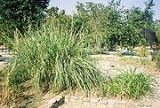
teosinte species. Zea diploperennis and Z. perennis are perennial, while all other taxa are annual. All species are diploid (n=10) with the exception of Z. perennis, which is tetraploid (n=20). The different species and subspecies of teosinte can be readily distinguished based on morphological, cytogenetic, protein, and DNA differences and on geographic origin, although the two perennials are sympatric and very similar. What many consider to be the most puzzling teosinte is Z. m. huehuetenangensis which combines a morphology rather like Z. m. parviglumis with many terminal chromosome knobs and an isozyme position between the two sections. Considered to be phenotypically the most distinctive, as well as the most threatened, teosinte is Z. nicaraguensis. This teosinte thrives in flooded conditions along 200 meters of a coastal estuarine river in northwest Nicaragua.
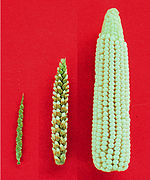
Teosintes strongly resembles maize in many ways, notably their tassel (male inflorescence) morphology. Teosintes are distinguished from maize most obviously by their numerous branches each bearing bunches of distinctive, small female inflorescences. These spikes mature to form a two-ranked 'ear' of five to ten triangular or trapezoidal, black or brown disarticulating segments, each with one seed. Each seed is enclosed by a very hard fruitcase, consisting of a cupule or depression in the rachis and a tough lower glume. This protects them from the digestive processes of ruminants that forage on teosinte and aid in seed distribution through their droppings. Teosinte seed exhibits some resistance to germination but will quickly germinate if treated with a dilute solution of hydrogen peroxide.
 Teosintes are critical components of maize evolution
, but opinions vary about which taxa were involved. According to the most widely-held evolutionary model, the crop was derived directly from Z. m. parviglumis by selection of key mutations ; up to 12% of its genetic material came from Z. m. mexicana through introgression
. Another model proposes that a tiny-eared wild maize was domesticated, and after being spread from east-central Mexico, this cultigen hybridized with Z. luxurians or Z. diploperennis resulting in a great explosion of maize genetic diversity, ear and kernel forms, and capacity to adapt to new habitats, as well as increased yields. A third model suggests that the early maize resulted from a cross between Z. diploperennis and a species of Tripsacum
; support for this is minimal. A fourth model posits that teosinte resulted from hybridization between an early wild form of Z. m. mays
and Tripsacum.
All but the Nicaraguan species of teosinte may grow in or very near corn fields, providing opportunities for introgression between teosinte and maize. First- and later-generation hybrids are often found in the fields, but the rate of gene exchange is quite low. Some populations of Z. m. mexicana display Vavilovian mimicry
within cultivated maize fields, having evolved a maize-like form as a result of the farmers' selective weeding pressure. In some areas of Mexico
, teosintes are regarded by maize farmers as a noxious weed, while in a few areas farmers regard it as a beneficial companion plant, and encourage its introgression into their maize.
e (caterpillar
s) of some Lepidoptera
species including (in the Americas) the Fall Armyworm
(Spodoptera frugiperda) the Corn Earworm
(Helicoverpa zea), and the stem borers Diatraea
and Chilo
; in the Old World, it is attacked by the Double-striped Pug
, the cutworm
s Heart and Club
and Heart and Dart
, the Hypercompe indecisa
, the Rustic Shoulder-knot
, the Setaceous Hebrew Character
and Turnip Moth
s, and the European Corn Borer
(Ostrinia nubilalis), among many others.
Virtually all populations of teosinte are either threatened or endangered: Zea diploperennis exists in an area of only a few square miles; Zea nicaraguensis survives as approx. 6000 plants in an area 200 x 150 meters. The Mexican and Nicaraguan governments have taken action in recent years to protect wild teosinte populations, using both in-situ and ex-situ conservation methods. There is currently a large amount of scientific interest in conferring beneficial teosinte traits, such as insect resistance, perennialism and flood tolerance, to cultivated maize lines, although this is very difficult due to linked deleterious teosinte traits.
Poaceae
The Poaceae is a large and nearly ubiquitous family of flowering plants. Members of this family are commonly called grasses, although the term "grass" is also applied to plants that are not in the Poaceae lineage, including the rushes and sedges...
. Several species are commonly known as teosintes and are found in Mexico
Mexico
The United Mexican States , commonly known as Mexico , is a federal constitutional republic in North America. It is bordered on the north by the United States; on the south and west by the Pacific Ocean; on the southeast by Guatemala, Belize, and the Caribbean Sea; and on the east by the Gulf of...
, Guatemala
Guatemala
Guatemala is a country in Central America bordered by Mexico to the north and west, the Pacific Ocean to the southwest, Belize to the northeast, the Caribbean to the east, and Honduras and El Salvador to the southeast...
, and Nicaragua
Nicaragua
Nicaragua is the largest country in the Central American American isthmus, bordered by Honduras to the north and Costa Rica to the south. The country is situated between 11 and 14 degrees north of the Equator in the Northern Hemisphere, which places it entirely within the tropics. The Pacific Ocean...
.
There are five recognized species in the genus: Zea diploperennis, Zea perennis, Zea luxurians, Zea nicaraguensis, and Zea mays. The last species is further divided into four subspecies: huehuetenangensis, mexicana, parviglumis, and mays. The first three subspecies are teosintes; the last is maize
Maize
Maize known in many English-speaking countries as corn or mielie/mealie, is a grain domesticated by indigenous peoples in Mesoamerica in prehistoric times. The leafy stalk produces ears which contain seeds called kernels. Though technically a grain, maize kernels are used in cooking as a vegetable...
, or corn, the only domesticated taxon
Taxon
|thumb|270px|[[African elephants]] form a widely-accepted taxon, the [[genus]] LoxodontaA taxon is a group of organisms, which a taxonomist adjudges to be a unit. Usually a taxon is given a name and a rank, although neither is a requirement...
in the genus Zea. The species are grouped into two sections, sect. Luxuriantes, with the first four species, and sect. Zea with Zea mays. The former section is typified by dark-staining knobs made up of heterochromatin
Heterochromatin
Heterochromatin is a tightly packed form of DNA, which comes in different varieties. These varieties lie on a continuum between the two extremes of constitutive and facultative heterochromatin...
that are terminal on most chromosome
Chromosome
A chromosome is an organized structure of DNA and protein found in cells. It is a single piece of coiled DNA containing many genes, regulatory elements and other nucleotide sequences. Chromosomes also contain DNA-bound proteins, which serve to package the DNA and control its functions.Chromosomes...
arms, while most subspecies of sect. Zea may have 0 to 3 knobs between each chromosome end and the centromere
Centromere
A centromere is a region of DNA typically found near the middle of a chromosome where two identical sister chromatids come closest in contact. It is involved in cell division as the point of mitotic spindle attachment...
and very few terminal knobs (except Z. m. huehuetenangensis which has many large terminal knobs). The two perennials are thought to be one species by some.
Description
There are both annualAnnual plant
An annual plant is a plant that usually germinates, flowers, and dies in a year or season. True annuals will only live longer than a year if they are prevented from setting seed...
and perennial
Perennial plant
A perennial plant or simply perennial is a plant that lives for more than two years. The term is often used to differentiate a plant from shorter lived annuals and biennials. The term is sometimes misused by commercial gardeners or horticulturalists to describe only herbaceous perennials...
teosinte species. Zea diploperennis and Z. perennis are perennial, while all other taxa are annual. All species are diploid (n=10) with the exception of Z. perennis, which is tetraploid (n=20). The different species and subspecies of teosinte can be readily distinguished based on morphological, cytogenetic, protein, and DNA differences and on geographic origin, although the two perennials are sympatric and very similar. What many consider to be the most puzzling teosinte is Z. m. huehuetenangensis which combines a morphology rather like Z. m. parviglumis with many terminal chromosome knobs and an isozyme position between the two sections. Considered to be phenotypically the most distinctive, as well as the most threatened, teosinte is Z. nicaraguensis. This teosinte thrives in flooded conditions along 200 meters of a coastal estuarine river in northwest Nicaragua.
Teosintes strongly resembles maize in many ways, notably their tassel (male inflorescence) morphology. Teosintes are distinguished from maize most obviously by their numerous branches each bearing bunches of distinctive, small female inflorescences. These spikes mature to form a two-ranked 'ear' of five to ten triangular or trapezoidal, black or brown disarticulating segments, each with one seed. Each seed is enclosed by a very hard fruitcase, consisting of a cupule or depression in the rachis and a tough lower glume. This protects them from the digestive processes of ruminants that forage on teosinte and aid in seed distribution through their droppings. Teosinte seed exhibits some resistance to germination but will quickly germinate if treated with a dilute solution of hydrogen peroxide.
Origin of maize and interaction with teosintes
Artificial selection
Artificial selection describes intentional breeding for certain traits, or combination of traits. The term was utilized by Charles Darwin in contrast to natural selection, in which the differential reproduction of organisms with certain traits is attributed to improved survival or reproductive...
, but opinions vary about which taxa were involved. According to the most widely-held evolutionary model, the crop was derived directly from Z. m. parviglumis by selection of key mutations ; up to 12% of its genetic material came from Z. m. mexicana through introgression
Introgression
Introgression, also known as introgressive hybridization, in genetics is the movement of a gene from one species into the gene pool of another by the repeated backcrossing of an interspecific hybrid with one of its parent species...
. Another model proposes that a tiny-eared wild maize was domesticated, and after being spread from east-central Mexico, this cultigen hybridized with Z. luxurians or Z. diploperennis resulting in a great explosion of maize genetic diversity, ear and kernel forms, and capacity to adapt to new habitats, as well as increased yields. A third model suggests that the early maize resulted from a cross between Z. diploperennis and a species of Tripsacum
Tripsacum
Tripsacum is a genus of grass in the Poaceae family.Species include:* T. andersonii* T. australe* T. cundinamarce* T. dactyloides* T. fasciculatum * T. floridanum...
; support for this is minimal. A fourth model posits that teosinte resulted from hybridization between an early wild form of Z. m. mays
Maize
Maize known in many English-speaking countries as corn or mielie/mealie, is a grain domesticated by indigenous peoples in Mesoamerica in prehistoric times. The leafy stalk produces ears which contain seeds called kernels. Though technically a grain, maize kernels are used in cooking as a vegetable...
and Tripsacum.
All but the Nicaraguan species of teosinte may grow in or very near corn fields, providing opportunities for introgression between teosinte and maize. First- and later-generation hybrids are often found in the fields, but the rate of gene exchange is quite low. Some populations of Z. m. mexicana display Vavilovian mimicry
Vavilovian mimicry
Vavilovian mimicry is a form of mimicry in plants where a weed comes to share one or more characteristics with a domesticated plant through generations of artificial selection. It is named after Nikolai Vavilov, a prominent Russian plant geneticist who identified the centres of origin of...
within cultivated maize fields, having evolved a maize-like form as a result of the farmers' selective weeding pressure. In some areas of Mexico
Mexico
The United Mexican States , commonly known as Mexico , is a federal constitutional republic in North America. It is bordered on the north by the United States; on the south and west by the Pacific Ocean; on the southeast by Guatemala, Belize, and the Caribbean Sea; and on the east by the Gulf of...
, teosintes are regarded by maize farmers as a noxious weed, while in a few areas farmers regard it as a beneficial companion plant, and encourage its introgression into their maize.
Ecology
Zea species are used as food plants by the larvaLarva
A larva is a distinct juvenile form many animals undergo before metamorphosis into adults. Animals with indirect development such as insects, amphibians, or cnidarians typically have a larval phase of their life cycle...
e (caterpillar
Caterpillar
Caterpillars are the larval form of members of the order Lepidoptera . They are mostly herbivorous in food habit, although some species are insectivorous. Caterpillars are voracious feeders and many of them are considered to be pests in agriculture...
s) of some Lepidoptera
Lepidoptera
Lepidoptera is a large order of insects that includes moths and butterflies . It is one of the most widespread and widely recognizable insect orders in the world, encompassing moths and the three superfamilies of butterflies, skipper butterflies, and moth-butterflies...
species including (in the Americas) the Fall Armyworm
Army worm
The Fall Armyworm is part of the order of Lepidoptera and is the caterpillar life stage of a moth. It is regarded as a pest and can wreak havoc with crops if left to multiply. Its name is derived from its feeding habits...
(Spodoptera frugiperda) the Corn Earworm
Helicoverpa zea
The larva of the moth Helicoverpa zea is a major agricultural pest. It can feed on many different plants during the larval stage. Accordingly, the species has been given many different common names. When the larva consumes cotton, it is known as the cotton bollworm...
(Helicoverpa zea), and the stem borers Diatraea
Diatraea
Diatraea is a genus of moths of the Crambidae family.-Species:*Diatraea albicrinella Box, 1931*Diatraea amazonica Box, 1931*Diatraea amnemonella Dyar, 1911*Diatraea andina Box, 1951*Diatraea angustella Dyar, 1911...
and Chilo
Chilo (moth)
Chilo is a genus of moths of the Crambidae family.-Species:* Chilo agamemnon Bleszynski, 1962* Chilo aleniella * Chilo argyrogramma Hampson, 1919* Chilo argyropasta * Chilo auricilius Dudgeon, 1905...
; in the Old World, it is attacked by the Double-striped Pug
Double-striped Pug
The Double-striped Pug is a moth of the family Geometridae. It is a widespread and common species, being found throughout the Palearctic region, the Near East and North Africa....
, the cutworm
Cutworm
Cutworms are not worms, biologically speaking, but caterpillars; they are moth larvae that hide under litter or soil during the day, coming out in the dark to feed on plants...
s Heart and Club
Heart and Club
The Heart and Club is a moth of the family Noctuidae. It is distributed throughout Europe.The common name of this species refers to the supposed shapes of the bold dark stigmata on the usually pale forewings. In this species all the stigmata have a rounded shape, contrasting with the elongated...
and Heart and Dart
Heart and Dart
The Heart and Dart is a moth of the family Noctuidae. A familiar moth to many, it is considered one of the most common of the European region....
, the Hypercompe indecisa
Hypercompe
Hypercompe is a genus of moths of the family Arctiidae. There are over 80 species found throughout the Americas. Several species were formerly separated in Ecpantheria which is now regarded as a junior synonym. They are typically large moths with white forewings heavily spotted with black, and...
, the Rustic Shoulder-knot
Rustic Shoulder-knot
The Rustic Shoulder-knot is a moth of the family Noctuidae. It is distributed throughout Europe and is also found in North America....
, the Setaceous Hebrew Character
Setaceous Hebrew Character
The Setaceous Hebrew Character is a moth of the family Noctuidae. It is found in the Palearctic ecozone. It is a common species throughout Europe. It is also found in North America, from coast to coast across Canada and the northern United States to western Alaska. It occurs in the Rocky Mountains...
and Turnip Moth
Turnip Moth
The Turnip Moth is a moth of the family Noctuidae. It is a common European species, but it is also found in Asia and Africa, very likely having been spread by the international trade in nursery stock...
s, and the European Corn Borer
European Corn Borer
The European corn borer , also known as the European high-flyer, is a pest of grain, particularly maize. The insect is native to Europe, originally infesting varieties of millet, including broom corn. The European corn borer was first reported in North America in 1917 in Massachusetts, but was...
(Ostrinia nubilalis), among many others.
Virtually all populations of teosinte are either threatened or endangered: Zea diploperennis exists in an area of only a few square miles; Zea nicaraguensis survives as approx. 6000 plants in an area 200 x 150 meters. The Mexican and Nicaraguan governments have taken action in recent years to protect wild teosinte populations, using both in-situ and ex-situ conservation methods. There is currently a large amount of scientific interest in conferring beneficial teosinte traits, such as insect resistance, perennialism and flood tolerance, to cultivated maize lines, although this is very difficult due to linked deleterious teosinte traits.
Species
- Zea diploperennis H.H.Iltis et al.
- Zea luxurians (Durieu & Asch.) R.M.Bird
- Zea mays L.
- Zea mays huehuetenangensis (H.H.Iltis & Doebley) Doebley
- Zea mays maysMaizeMaize known in many English-speaking countries as corn or mielie/mealie, is a grain domesticated by indigenous peoples in Mesoamerica in prehistoric times. The leafy stalk produces ears which contain seeds called kernels. Though technically a grain, maize kernels are used in cooking as a vegetable...
– Maize, Corn - Zea mays mexicana (Schrad.) H.H.Iltis
- Zea mays parviglumis H.H.Iltis & Doebley
- Zea nicaraguensis H.H.Iltis & B.F.Benz
- Zea perennis (Hitchc.) Reeves & Mangelsd.
External links
- Crop Wild Relatives Gap Analysis Portal reliable information source on where and what to conserve ex-situ, regarding Zea genepool
- Tracking the Ancestry of Corn Back 9,000 Years