


European Rabbit

Encyclopedia
The European Rabbit or Common Rabbit (Oryctolagus cuniculus) is a species of rabbit
native to south west Europe (Spain and Portugal) and north west Africa (Morocco and Algeria). It has been widely introduced elsewhere often with devastating effects on local biodiversity
. However, its decline in its native range (caused by the diseases myxomatosis
and rabbit calicivirus as well as over-hunting and habitat loss) has caused the decline of its highly dependent predators, the Iberian Lynx
and the Spanish Imperial Eagle
. It is known as an invasive species
for the fact it has been introduced to countries on all continents with the exception of Antarctica and Sub-saharan Africa, and caused many problems within the environment and ecosystems as well. Australia has the most problems with European Rabbits, due to the lack of natural predators there.
The European Rabbit is well-known for digging networks of burrow
s, called warrens, where it spends most of its time when not feeding. Unlike the related hare
s (Lepus), rabbits are altricial
, the young being born blind and furless, in a fur-lined nest in the warren, and they are totally dependent upon their mother. Much of the modern research into wild rabbit behaviour was carried out in the 1960s by two research centres. One was the naturalist Ronald Lockley
who maintained a number of large enclosures for wild rabbit colonies, with observation facilities, in Orielton in Pembrokeshire
. Apart from publishing a number of scientific papers, he popularised his finding in a book The Private Life of the Rabbit., which is credited by Richard Adams
as having played a key role in his gaining "a knowledge of rabbits and their ways" that was espoused in the novel Watership Down
. The other group was the Commonwealth Scientific and Industrial Research Organisation
(CSIRO) in Australia
where Mykytowycz & Myers performed numerous studies of the social behaviour of wild rabbits. Since the onset of myxomatosis
and the decline of the significance of the rabbit as an agricultural pest, few large scale studies have been performed and many aspects of rabbit behaviour are still poorly understood.
ranging from 34–45 cm (13-18 inches) in length, and is approximately 1.3-2.2 kg (3-5 lb
) in weight. As a lagomorph, it has four sharp incisor
s (two on top, two on bottom) that grow continuously throughout its life, and two peg teeth on the top behind the incisors, dissimilar to those of rodent
s (which have only 2 each, top and bottom). Rabbits have long ears, large hind legs, and short, fluffy tails. Rabbits move by hopping, using their long and powerful hind legs. To facilitate quick movement, a rabbit's hind feet have a thick padding of fur to dampen the shock of rapid hopping. Their toes are long, and are webbed to keep from spreading apart as the animal jumps.
animals, living in medium-sized colonies known as warrens. Rabbits are largely crepuscular
, being most active around dawn and dusk
, although they are not infrequently seen active during the day. During the day, rabbits prefer to reside in vegetated patches which they use for protection from predators. At night, they move into open prairie to feed. Rabbit populations seem to be greatest in ecotone
habitats and less in scrublands or grasslands. Rabbits are essentially mixed-feeders, both grazing
and browsing, but grass is their primary food source. They nevertheless have a diverse diet of grasses, leaves, buds, tree bark, and roots. They will also eat lettuce, cabbage, root vegetables, and grains. Birds of prey are the primary predators of rabbits in scrublands. Rabbits in grasslands are preyed on by carnivores
. Ecotone rabbits are preyed on by both.
The rabbit mating system
is rather complex. Dominant males exhibit polygyny
, whereas lower-status individuals (males and females) often form monogamous
breeding relationships. Rabbits signal when they are ready to copulate by marking inanimate objects while giving off odoriferous substances though their chin gland, a process known as "chinning". Dominance hierarchies
exist in parallel for both males and females. Social rank is based on the amount of group aggression. The dominant buck has greater mobility and more aggression than the dominant doe. This is likely because males have to fight each other for the females. The social hierarchy of males is also determined by a number of other factors, such as the size patrol area, the number of females that visit his area, resting time near females, the number of shelters he visits, and the distance he travels daily.
Rabbits can be extremely aggressive
in the wild, and competition between males can often lead to severe injury and death. Although hostile displays are used, and males often squirt urine
on challengers as a form of territorial marking, the most common response to a challenge is immediate attack. Rabbits use their powerful back legs as weapons, kicking at an opponent's underside, as well as biting and scratching with the front paws.
s, they have carved out a strong ecological niche through their rate of impregnation, due to the fact that female rabbits ovulate at the time of copulation. One striking example of rapid rabbit reproduction took place in Australia, where the 24 rabbits first introduced in 1859 had multiplied in number to over 600 million over the course of less than a century.
The gestation cycle for a rabbit averages 31 days, although it can vary anywhere between 29 and 35 days. Litter sizes generally range between two to twelve rabbits. The young are born in a nesting burrow dug by the female, which she returns to once a day for four weeks in order for them to suckle. The rabbit's reproductive abilities were the inspiration for the phrase "breeding like rabbits". They can reproduce from 3–4 months of age. They can produce 4-7 litters of offspring per year, a mature female can be pregnant continuously for 6–8 months. One single pair of mature rabbits are able to produce 30-40 offspring per year. Kittens are born in a nest in an isolated part of the warren. The female build, prepare and defend the nest. A doe will mark the nest with urine and fecal dropping to detract others from invading the site. Does take care of the kittens without help from the bucks. However, bucks show considerable investment in the welfare of young, although much of this aspect of rabbit behavior is poorly understood. It is possible that the males may be trying to enhance their social status by being surrounded by friendly individuals.
Humans' relationship with the European (sometimes called true) rabbit was first recorded by the Phoenicians earlier than 1000 BC, when they termed the Iberian Peninsula
i-shaphan-ím (literally, the land of the hyraxes). This phrase closely resembles related modern Hebrew
: i (אי) meaning island and shafan (שפן) meaning hyrax, plural shfaním (שפנים). Phoenicians called the local rabbits hyraxes because hyraxes resemble rabbits in some ways, and were probably more common than rabbits in their native land (the Levant
) at the time. Hyraxes, like rabbits, are not rodents. According to one theory, Romans converted the phrase i-shaphan-ím, with influence by Greek Spania, to its Latin form, Hispania
, which evolved into the modern Spanish word España, English Spain, and such other variations of modern languages. The precise meaning of shafan remains unclear, but the balance of opinion appears to indicate that the hyrax is indeed the intended meaning.
The European Rabbit is the only species of rabbit to be domesticated. All pet breeds of rabbits, such as dwarf lops and angoras, are of this species. However, rabbits and humans interact in many different ways beyond domestication
. Rabbits are an example of an animal
that is treated as food, pet, and pest by members of the same culture. Urbanized European Rabbits descended from pets have become pest problems in some cities. For instance, one of the northernmost populations of the species is now hosted by Helsinki
, Finland
, with an estimated 2500 animals at the end of 2006 and 5000 in autumn, 2007. Finland's native lagomorphs are the European Hare
and the Mountain Hare
. In Iceland there are also populations both in Reykjavik and in the Vestmann islands.
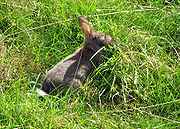
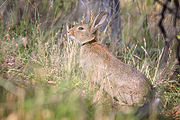 The European Rabbit has been introduced as an exotic species into a number of environments, with baleful results to vegetation and local wildlife. Locations include England
, where they were introduced, perhaps from France, at first to coastal islands at the end of the twelfth century, then more generally in England in the course of the 13th century; (as of November 2004 there were about 40 million European Rabbits in the British Isles
), Laysan Island (1903) and Lisianski Island
in the Hawaiian Islands
; Macquarie Island
; Smith Island
, San Juan Island
(around 1900) later spreading to the other San Juan Islands; Australia
and New Zealand
.
Twenty-four European Rabbits were introduced to Australia
in 1859 by estate owner Thomas Austin
in Victoria
. They soon spread throughout the country due to the lack of natural predators, widespread farming producing an ideal habitat, and mild Australian winters allowing them to breed year-round. Australia's equivalent to the rabbit, the Bilby
, was quickly pushed out by the rabbits. The bilbies are endangered, but are now making a comeback due to government protection. Between 1901 and 1907, Australia built an immense "rabbit-proof fence
" to halt the westward expansion of the introduced rabbit population. The European Rabbit can not only jump very high, but also burrow underground, making fencing especially futile. During the 1950s experiments with introduction of a virus, Myxomatosis cuniiculi provided some relief in Australia but not in New Zealand where the insect vectors necessary for spread of the disease were not present. Myxomatosis can also infect pet rabbits of the same species. Today's remaining wild rabbits in Australia are largely immune to Myxomatosis. The rabbit haemorrhagic disease virus which causes the rabbit haemorrhagic disease
has been cleared as a safe form of biological control agent against the European Rabbit in Australia
as well.
. It was first widely kept in ancient Rome
and was refined into a wider variety of breeds during the Middle Ages
.
Domesticated rabbits have mostly been bred to be much larger than wild rabbits, though selective breeding
has produced a wide range of breeds which are kept as pets and food animals across the world. They have as much colour variation among themselves as other household pets. Their fur is prized for its softness, and even today Angora rabbits are raised for their long soft fur, which is often spun into yarn. Other breeds are raised for the fur industry, particularly the Rex, which has a smooth velvet like coat and comes in a wide variety of colours and sizes.
In the middle-size breeds, the teeth grow approximately 125 mm (5 in) per year for the upper incisors and about 200 mm (8 in) per year for the lower incisors. The teeth abrade away against one another, giving the teeth a constantly sharp edge.
Rabbit
Rabbits are small mammals in the family Leporidae of the order Lagomorpha, found in several parts of the world...
native to south west Europe (Spain and Portugal) and north west Africa (Morocco and Algeria). It has been widely introduced elsewhere often with devastating effects on local biodiversity
Biodiversity
Biodiversity is the degree of variation of life forms within a given ecosystem, biome, or an entire planet. Biodiversity is a measure of the health of ecosystems. Biodiversity is in part a function of climate. In terrestrial habitats, tropical regions are typically rich whereas polar regions...
. However, its decline in its native range (caused by the diseases myxomatosis
Myxomatosis
Myxomatosis is a disease that affects rabbits and is caused by the Myxoma virus. It was first observed in Uruguay in laboratory rabbits in the late 19th century. It was introduced into Australia in 1950 in an attempt to control the rabbit population...
and rabbit calicivirus as well as over-hunting and habitat loss) has caused the decline of its highly dependent predators, the Iberian Lynx
Iberian Lynx
The Iberian lynx, Lynx pardinus, is a critically endangered species native to the Iberian Peninsula in Southern Europe. It is one of the most endangered cat species in the world. According to the conservation group SOS Lynx, if this species died out, it would be one of the few feline extinctions...
and the Spanish Imperial Eagle
Spanish Imperial Eagle
The Spanish Imperial Eagle, Iberian Imperial Eagle or Adalbert's Eagle is a threatened species of eagle that only occurs in central and south-west Spain, adjacent areas of Portugal and possibly northern Morocco, although the latter is disputed...
. It is known as an invasive species
Invasive species
"Invasive species", or invasive exotics, is a nomenclature term and categorization phrase used for flora and fauna, and for specific restoration-preservation processes in native habitats, with several definitions....
for the fact it has been introduced to countries on all continents with the exception of Antarctica and Sub-saharan Africa, and caused many problems within the environment and ecosystems as well. Australia has the most problems with European Rabbits, due to the lack of natural predators there.
The European Rabbit is well-known for digging networks of burrow
Burrow
A burrow is a hole or tunnel dug into the ground by an animal to create a space suitable for habitation, temporary refuge, or as a byproduct of locomotion. Burrows provide a form of shelter against predation and exposure to the elements, so the burrowing way of life is quite popular among the...
s, called warrens, where it spends most of its time when not feeding. Unlike the related hare
Hare
Hares and jackrabbits are leporids belonging to the genus Lepus. Hares less than one year old are called leverets. Four species commonly known as types of hare are classified outside of Lepus: the hispid hare , and three species known as red rock hares .Hares are very fast-moving...
s (Lepus), rabbits are altricial
Altricial
Altricial, meaning "requiring nourishment", refers to a pattern of growth and development in organisms which are incapable of moving around on their own soon after hatching or being born...
, the young being born blind and furless, in a fur-lined nest in the warren, and they are totally dependent upon their mother. Much of the modern research into wild rabbit behaviour was carried out in the 1960s by two research centres. One was the naturalist Ronald Lockley
Ronald Lockley
Ronald Mathias Lockley was a Welsh naturalist and author who spent much of his later life in New Zealand. He wrote over fifty books, including The Private Life of the Rabbit , which played an important role in the plot development of Richard Adams' famous book Watership Down...
who maintained a number of large enclosures for wild rabbit colonies, with observation facilities, in Orielton in Pembrokeshire
Pembrokeshire
Pembrokeshire is a county in the south west of Wales. It borders Carmarthenshire to the east and Ceredigion to the north east. The county town is Haverfordwest where Pembrokeshire County Council is headquartered....
. Apart from publishing a number of scientific papers, he popularised his finding in a book The Private Life of the Rabbit., which is credited by Richard Adams
Richard Adams
Richard Adams was a non-conforming English Presbyterian divine, known as author of sermons and other theological writings.-Life:...
as having played a key role in his gaining "a knowledge of rabbits and their ways" that was espoused in the novel Watership Down
Watership Down
Watership Down is a classic heroic fantasy novel, written by English author Richard Adams, about a small group of rabbits. Although the animals in the story live in their natural environment, they are anthropomorphised, possessing their own culture, language , proverbs, poetry, and mythology...
. The other group was the Commonwealth Scientific and Industrial Research Organisation
Commonwealth Scientific and Industrial Research Organisation
The Commonwealth Scientific and Industrial Research Organisation is the national government body for scientific research in Australia...
(CSIRO) in Australia
Australia
Australia , officially the Commonwealth of Australia, is a country in the Southern Hemisphere comprising the mainland of the Australian continent, the island of Tasmania, and numerous smaller islands in the Indian and Pacific Oceans. It is the world's sixth-largest country by total area...
where Mykytowycz & Myers performed numerous studies of the social behaviour of wild rabbits. Since the onset of myxomatosis
Myxomatosis
Myxomatosis is a disease that affects rabbits and is caused by the Myxoma virus. It was first observed in Uruguay in laboratory rabbits in the late 19th century. It was introduced into Australia in 1950 in an attempt to control the rabbit population...
and the decline of the significance of the rabbit as an agricultural pest, few large scale studies have been performed and many aspects of rabbit behaviour are still poorly understood.
Terminology
Rabbits are known by many names. Young rabbits are known by the names bunny, kit, or kitten. A male rabbit is called a buck, and a female rabbit is called a doe. A group of rabbits is known as a colony or a nest. Colloquially, a rabbit may be referred to as a "coney" or a "bunny", though the former is archaic.Physical description
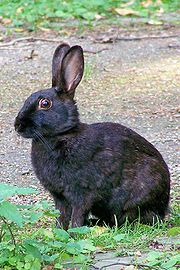
The European Rabbit is a small, grey-brown (or sometimes black) mammalMammal
Mammals are members of a class of air-breathing vertebrate animals characterised by the possession of endothermy, hair, three middle ear bones, and mammary glands functional in mothers with young...
ranging from 34–45 cm (13-18 inches) in length, and is approximately 1.3-2.2 kg (3-5 lb
Pound (mass)
The pound or pound-mass is a unit of mass used in the Imperial, United States customary and other systems of measurement...
) in weight. As a lagomorph, it has four sharp incisor
Incisor
Incisors are the first kind of tooth in heterodont mammals. They are located in the premaxilla above and mandible below.-Function:...
s (two on top, two on bottom) that grow continuously throughout its life, and two peg teeth on the top behind the incisors, dissimilar to those of rodent
Rodent
Rodentia is an order of mammals also known as rodents, characterised by two continuously growing incisors in the upper and lower jaws which must be kept short by gnawing....
s (which have only 2 each, top and bottom). Rabbits have long ears, large hind legs, and short, fluffy tails. Rabbits move by hopping, using their long and powerful hind legs. To facilitate quick movement, a rabbit's hind feet have a thick padding of fur to dampen the shock of rapid hopping. Their toes are long, and are webbed to keep from spreading apart as the animal jumps.
Habitat
Rabbits are gregarious, socialSocial
The term social refers to a characteristic of living organisms...
animals, living in medium-sized colonies known as warrens. Rabbits are largely crepuscular
Crepuscular
Crepuscular animals are those that are active primarily during twilight, that is during dawn and dusk. The word is derived from the Latin word crepusculum, meaning "twilight." Crepuscular is, thus, in contrast with diurnal and nocturnal behavior. Crepuscular animals may also be active on a bright...
, being most active around dawn and dusk
Dusk
Dusk is the beginning of darkness in the evening, and occurs after twilight, when the sky generally remains bright and blue. Civil dusk is when the earth has rotated enough that the center of the sun is at 6° below the local horizon...
, although they are not infrequently seen active during the day. During the day, rabbits prefer to reside in vegetated patches which they use for protection from predators. At night, they move into open prairie to feed. Rabbit populations seem to be greatest in ecotone
Ecotone
An ecotone is a transition area between two biomes but different patches of the landscape, such as forest and grassland. It may be narrow or wide, and it may be local or regional...
habitats and less in scrublands or grasslands. Rabbits are essentially mixed-feeders, both grazing
Grazing
Grazing generally describes a type of feeding, in which a herbivore feeds on plants , and also on other multicellular autotrophs...
and browsing, but grass is their primary food source. They nevertheless have a diverse diet of grasses, leaves, buds, tree bark, and roots. They will also eat lettuce, cabbage, root vegetables, and grains. Birds of prey are the primary predators of rabbits in scrublands. Rabbits in grasslands are preyed on by carnivores
Carnivora
The diverse order Carnivora |Latin]] carō "flesh", + vorāre "to devour") includes over 260 species of placental mammals. Its members are formally referred to as carnivorans, while the word "carnivore" can refer to any meat-eating animal...
. Ecotone rabbits are preyed on by both.
Social organization
Rabbits live in warrens that contain 2-10 other individuals living in smaller groups to ensure greater breeding success. Territoriality and aggression contribute greatly to the rabbits maturation process and help ensure survival of the population. Mature male and females are better at fighting off predators. Females tend to be more territorial than males although the areas that are most frequented by females are not defended. Rabbit mark their territories with dung hills. They expel soft mucus-covered pellets that are then reingested. They also expel larger pellets that are covered with secretion from the anal gland. A rabbit’s success in repelling strangers depends on the potency of the pellets. When young rabbits leave their natal warrens, they settle either in pre-existing territories, unoccupied established territories or become transients. Females tend to move into neighboring territories while males tend to move even farther. Overall, males disperse more than females.The rabbit mating system
Mating system
A mating system is a way in which a group is structured in relation to sexual behaviour. The precise meaning depends upon the context. With respect to higher animals, it specifies which males mate with which females, under which circumstances; recognised animal mating systems include monogamy,...
is rather complex. Dominant males exhibit polygyny
Polygyny
Polygyny is a form of marriage in which a man has two or more wives at the same time. In countries where the practice is illegal, the man is referred to as a bigamist or a polygamist...
, whereas lower-status individuals (males and females) often form monogamous
Monogamy
Monogamy /Gr. μονός+γάμος - one+marriage/ a form of marriage in which an individual has only one spouse at any one time. In current usage monogamy often refers to having one sexual partner irrespective of marriage or reproduction...
breeding relationships. Rabbits signal when they are ready to copulate by marking inanimate objects while giving off odoriferous substances though their chin gland, a process known as "chinning". Dominance hierarchies
Dominance hierarchy
A dominance hierarchy is the organization of individuals in a group that occurs when competition for resources leads to aggression...
exist in parallel for both males and females. Social rank is based on the amount of group aggression. The dominant buck has greater mobility and more aggression than the dominant doe. This is likely because males have to fight each other for the females. The social hierarchy of males is also determined by a number of other factors, such as the size patrol area, the number of females that visit his area, resting time near females, the number of shelters he visits, and the distance he travels daily.
Rabbits can be extremely aggressive
Aggressive
“Aggressive” is a New York-based Grammy award-winning music video and commercial directing team of Alex Topaller and Daniel Shapiro.Aggressive has been described by Movie Creation Mag as “having a fascination with the wonderful, in the likes of the surrealist Rafal Olbinski” and “tenacious about...
in the wild, and competition between males can often lead to severe injury and death. Although hostile displays are used, and males often squirt urine
Urine
Urine is a typically sterile liquid by-product of the body that is secreted by the kidneys through a process called urination and excreted through the urethra. Cellular metabolism generates numerous by-products, many rich in nitrogen, that require elimination from the bloodstream...
on challengers as a form of territorial marking, the most common response to a challenge is immediate attack. Rabbits use their powerful back legs as weapons, kicking at an opponent's underside, as well as biting and scratching with the front paws.
Reproduction
Rabbits are famed for their reproductive capabilities. Although certainly not the strongest, fastest, or smartest of the mammalMammal
Mammals are members of a class of air-breathing vertebrate animals characterised by the possession of endothermy, hair, three middle ear bones, and mammary glands functional in mothers with young...
s, they have carved out a strong ecological niche through their rate of impregnation, due to the fact that female rabbits ovulate at the time of copulation. One striking example of rapid rabbit reproduction took place in Australia, where the 24 rabbits first introduced in 1859 had multiplied in number to over 600 million over the course of less than a century.
The gestation cycle for a rabbit averages 31 days, although it can vary anywhere between 29 and 35 days. Litter sizes generally range between two to twelve rabbits. The young are born in a nesting burrow dug by the female, which she returns to once a day for four weeks in order for them to suckle. The rabbit's reproductive abilities were the inspiration for the phrase "breeding like rabbits". They can reproduce from 3–4 months of age. They can produce 4-7 litters of offspring per year, a mature female can be pregnant continuously for 6–8 months. One single pair of mature rabbits are able to produce 30-40 offspring per year. Kittens are born in a nest in an isolated part of the warren. The female build, prepare and defend the nest. A doe will mark the nest with urine and fecal dropping to detract others from invading the site. Does take care of the kittens without help from the bucks. However, bucks show considerable investment in the welfare of young, although much of this aspect of rabbit behavior is poorly understood. It is possible that the males may be trying to enhance their social status by being surrounded by friendly individuals.
Humans' relationship with rabbits
Recent research has shown that all European Rabbits carry common genetic markers and descend from one of two maternal lines. These lines originated approximately between 6.5 million and 12,000 years ago when glaciers isolated two herds; one on the Iberian Peninsula and the other in Mediterranean France. It can be surmised that man began hunting rabbit as a food source, but further research needs to occur. Little substantial evidence of man's relationship with the European rabbits is documented until the medieval period.Humans' relationship with the European (sometimes called true) rabbit was first recorded by the Phoenicians earlier than 1000 BC, when they termed the Iberian Peninsula
Iberian Peninsula
The Iberian Peninsula , sometimes called Iberia, is located in the extreme southwest of Europe and includes the modern-day sovereign states of Spain, Portugal and Andorra, as well as the British Overseas Territory of Gibraltar...
i-shaphan-ím (literally, the land of the hyraxes). This phrase closely resembles related modern Hebrew
Modern Hebrew
Modern Hebrew , also known as Israeli Hebrew or Modern Israeli Hebrew, is the language spoken in Israel and in some Jewish communities worldwide, from the early 20th century to the present....
: i (אי) meaning island and shafan (שפן) meaning hyrax, plural shfaním (שפנים). Phoenicians called the local rabbits hyraxes because hyraxes resemble rabbits in some ways, and were probably more common than rabbits in their native land (the Levant
Levant
The Levant or ) is the geographic region and culture zone of the "eastern Mediterranean littoral between Anatolia and Egypt" . The Levant includes most of modern Lebanon, Syria, Jordan, Israel, the Palestinian territories, and sometimes parts of Turkey and Iraq, and corresponds roughly to the...
) at the time. Hyraxes, like rabbits, are not rodents. According to one theory, Romans converted the phrase i-shaphan-ím, with influence by Greek Spania, to its Latin form, Hispania
Hispania
Another theory holds that the name derives from Ezpanna, the Basque word for "border" or "edge", thus meaning the farthest area or place. Isidore of Sevilla considered Hispania derived from Hispalis....
, which evolved into the modern Spanish word España, English Spain, and such other variations of modern languages. The precise meaning of shafan remains unclear, but the balance of opinion appears to indicate that the hyrax is indeed the intended meaning.
The European Rabbit is the only species of rabbit to be domesticated. All pet breeds of rabbits, such as dwarf lops and angoras, are of this species. However, rabbits and humans interact in many different ways beyond domestication
Domestication
Domestication or taming is the process whereby a population of animals or plants, through a process of selection, becomes accustomed to human provision and control. In the Convention on Biological Diversity a domesticated species is defined as a 'species in which the evolutionary process has been...
. Rabbits are an example of an animal
Animal
Animals are a major group of multicellular, eukaryotic organisms of the kingdom Animalia or Metazoa. Their body plan eventually becomes fixed as they develop, although some undergo a process of metamorphosis later on in their life. Most animals are motile, meaning they can move spontaneously and...
that is treated as food, pet, and pest by members of the same culture. Urbanized European Rabbits descended from pets have become pest problems in some cities. For instance, one of the northernmost populations of the species is now hosted by Helsinki
Helsinki
Helsinki is the capital and largest city in Finland. It is in the region of Uusimaa, located in southern Finland, on the shore of the Gulf of Finland, an arm of the Baltic Sea. The population of the city of Helsinki is , making it by far the most populous municipality in Finland. Helsinki is...
, Finland
Finland
Finland , officially the Republic of Finland, is a Nordic country situated in the Fennoscandian region of Northern Europe. It is bordered by Sweden in the west, Norway in the north and Russia in the east, while Estonia lies to its south across the Gulf of Finland.Around 5.4 million people reside...
, with an estimated 2500 animals at the end of 2006 and 5000 in autumn, 2007. Finland's native lagomorphs are the European Hare
European Hare
The European hare , also known as the brown hare, Eastern Jackrabbit and Eastern prairie hare, is a species of hare native to northern, central, and western Europe and western Asia. It is a mammal adapted to temperate open country. It is related to the similarly appearing rabbit, which is in the...
and the Mountain Hare
Mountain Hare
The Mountain Hare , also known as Blue Hare, Tundra Hare, Variable Hare, White Hare, Alpine Hare and Irish Hare, is a hare, which is largely adapted to polar and mountainous habitats. It is distributed from Fennoscandia to eastern Siberia; in addition there are isolated populations in the Alps,...
. In Iceland there are also populations both in Reykjavik and in the Vestmann islands.
As an exotic pest
England
England is a country that is part of the United Kingdom. It shares land borders with Scotland to the north and Wales to the west; the Irish Sea is to the north west, the Celtic Sea to the south west, with the North Sea to the east and the English Channel to the south separating it from continental...
, where they were introduced, perhaps from France, at first to coastal islands at the end of the twelfth century, then more generally in England in the course of the 13th century; (as of November 2004 there were about 40 million European Rabbits in the British Isles
British Isles
The British Isles are a group of islands off the northwest coast of continental Europe that include the islands of Great Britain and Ireland and over six thousand smaller isles. There are two sovereign states located on the islands: the United Kingdom of Great Britain and Northern Ireland and...
), Laysan Island (1903) and Lisianski Island
Lisianski Island
Lisianski Island is one of the Northwestern Hawaiian Islands, with a land area of and a maximum elevation of above sea level. Honolulu is away, to the southeast. Linked to Lisianski are the extensive Neva Shoals...
in the Hawaiian Islands
Hawaiian Islands
The Hawaiian Islands are an archipelago of eight major islands, several atolls, numerous smaller islets, and undersea seamounts in the North Pacific Ocean, extending some 1,500 miles from the island of Hawaii in the south to northernmost Kure Atoll...
; Macquarie Island
Macquarie Island
Macquarie Island lies in the southwest corner of the Pacific Ocean, about half-way between New Zealand and Antarctica, at 54°30S, 158°57E. Politically, it has formed part of the Australian state of Tasmania since 1900 and became a Tasmanian State Reserve in 1978. In 1997 it became a world heritage...
; Smith Island
Smith Island (Washington)
Smith Island is an island located in the eastern Strait of Juan de Fuca, Washington, about mid-way between Admiralty Inlet and Lopez Island. It is connected to the smaller Minor Island, to its east, by a low spit that is covered at high tide. The low, grassy islands have a few trees and are an...
, San Juan Island
San Juan Island
San Juan Island is the second-largest and most populous of the San Juan Islands in northwestern Washington, United States. It has a land area of 142.59 km² and a population of 6,822 as of the 2000 census....
(around 1900) later spreading to the other San Juan Islands; Australia
Australia
Australia , officially the Commonwealth of Australia, is a country in the Southern Hemisphere comprising the mainland of the Australian continent, the island of Tasmania, and numerous smaller islands in the Indian and Pacific Oceans. It is the world's sixth-largest country by total area...
and New Zealand
New Zealand
New Zealand is an island country in the south-western Pacific Ocean comprising two main landmasses and numerous smaller islands. The country is situated some east of Australia across the Tasman Sea, and roughly south of the Pacific island nations of New Caledonia, Fiji, and Tonga...
.
Twenty-four European Rabbits were introduced to Australia
Rabbits in Australia
In Australia, rabbits are a serious mammalian pest and are an invasive species. Annually, European rabbits cause millions of dollars of damage to crops.-Effects on Australia's ecology:...
in 1859 by estate owner Thomas Austin
Thomas Austin
Thomas Austin was an English settler in Australia who is generally credited with the introduction of rabbits into Australia in 1859.- Personal life :...
in Victoria
Victoria (Australia)
Victoria is the second most populous state in Australia. Geographically the smallest mainland state, Victoria is bordered by New South Wales, South Australia, and Tasmania on Boundary Islet to the north, west and south respectively....
. They soon spread throughout the country due to the lack of natural predators, widespread farming producing an ideal habitat, and mild Australian winters allowing them to breed year-round. Australia's equivalent to the rabbit, the Bilby
Bilby
Bilbies are desert-dwelling marsupial omnivores; they are members of the order Peramelemorphia. Before European colonisation of Australia, there were two species. One became extinct in the 1950s; the other survives but remains endangered....
, was quickly pushed out by the rabbits. The bilbies are endangered, but are now making a comeback due to government protection. Between 1901 and 1907, Australia built an immense "rabbit-proof fence
Rabbit-proof fence
The State Barrier Fence of Western Australia, formerly known as the No. 1 Rabbit-proof Fence, the State Vermin Fence and the Emu Fence, is a pest-exclusion fence constructed between 1901 and 1907 to keep rabbits and other agricultural pests, from the east, out of Western Australian pastoral...
" to halt the westward expansion of the introduced rabbit population. The European Rabbit can not only jump very high, but also burrow underground, making fencing especially futile. During the 1950s experiments with introduction of a virus, Myxomatosis cuniiculi provided some relief in Australia but not in New Zealand where the insect vectors necessary for spread of the disease were not present. Myxomatosis can also infect pet rabbits of the same species. Today's remaining wild rabbits in Australia are largely immune to Myxomatosis. The rabbit haemorrhagic disease virus which causes the rabbit haemorrhagic disease
Rabbit haemorrhagic disease
Rabbit haemorrhagic disease , also known as rabbit calicivirus disease or viral haemorrhagic disease , is a highly infectious and often fatal disease that affects wild and domestic rabbits of the species Oryctolagus cuniculus...
has been cleared as a safe form of biological control agent against the European Rabbit in Australia
Australia
Australia , officially the Commonwealth of Australia, is a country in the Southern Hemisphere comprising the mainland of the Australian continent, the island of Tasmania, and numerous smaller islands in the Indian and Pacific Oceans. It is the world's sixth-largest country by total area...
as well.
Domesticated rabbits
The only rabbit to be widely domesticated is the European Rabbit. This rabbit has been extensively domesticated for food or as a petPet
A pet is a household animal kept for companionship and a person's enjoyment, as opposed to wild animals or to livestock, laboratory animals, working animals or sport animals, which are kept for economic or productive reasons. The most popular pets are noted for their loyal or playful...
. It was first widely kept in ancient Rome
Ancient Rome
Ancient Rome was a thriving civilization that grew on the Italian Peninsula as early as the 8th century BC. Located along the Mediterranean Sea and centered on the city of Rome, it expanded to one of the largest empires in the ancient world....
and was refined into a wider variety of breeds during the Middle Ages
Middle Ages
The Middle Ages is a periodization of European history from the 5th century to the 15th century. The Middle Ages follows the fall of the Western Roman Empire in 476 and precedes the Early Modern Era. It is the middle period of a three-period division of Western history: Classic, Medieval and Modern...
.
Domesticated rabbits have mostly been bred to be much larger than wild rabbits, though selective breeding
Selective breeding
Selective breeding is the process of breeding plants and animals for particular genetic traits. Typically, strains that are selectively bred are domesticated, and the breeding is sometimes done by a professional breeder. Bred animals are known as breeds, while bred plants are known as varieties,...
has produced a wide range of breeds which are kept as pets and food animals across the world. They have as much colour variation among themselves as other household pets. Their fur is prized for its softness, and even today Angora rabbits are raised for their long soft fur, which is often spun into yarn. Other breeds are raised for the fur industry, particularly the Rex, which has a smooth velvet like coat and comes in a wide variety of colours and sizes.
In the middle-size breeds, the teeth grow approximately 125 mm (5 in) per year for the upper incisors and about 200 mm (8 in) per year for the lower incisors. The teeth abrade away against one another, giving the teeth a constantly sharp edge.
Status
Portuguese National Authorities (ICNB) have classified the rabbit as Near Threatened in Portugal, whilst Spanish authorities recently re-classified the rabbit as Vulnerable in Spain. In 2008, the European Rabbit was re-classified by the World Conservation Union (IUCN) as "Near Threatened" in its native range due to the extent of recent declinesSee also
- Warren (domestic)Warren (domestic)A domestic warren is an artificial, enclosed establishment of animal husbandry dedicated to the raising of rabbits for meat and fur. It evolved from the Anglo-Norman concept of free warren, which had been, essentially, the equivalent of a hunting license for a given woodland.-Architecture of the...
, man-made warrens used for the commercial breeding and raising of European rabbits for fur and meat from the medieval period onwards - Rabbits in AustraliaRabbits in AustraliaIn Australia, rabbits are a serious mammalian pest and are an invasive species. Annually, European rabbits cause millions of dollars of damage to crops.-Effects on Australia's ecology:...
, information on the European rabbit's status as a pest in Australia - Rabbit show jumpingRabbit show jumpingRabbit show jumping is a competition in which trained domestic rabbits leap over appropriately sized obstacles. The activity began in the late 1970s in Sweden . It was popularized in the United Kingdom following an appearance on the TV show That's Life!...
, a sport involving domestic European rabbits - House Rabbit SocietyHouse Rabbit SocietyThe House Rabbit Society is a non-profit organization based in Richmond, California that rescues and adopts rabbits and educates the community on how to properly care for them. HRS tries to promote responsible rabbit ownership, including the spaying and neutering of all pet rabbits, and proper...
, a non-profit organization dedicated to domesticated European rabbit care, education, information, and advocacy - List of rabbit breeds
- American Rabbit Breeders' AssociationAmerican Rabbit Breeders' AssociationThe American Rabbit Breeders Association is a national club for domestic rabbit and cavy breeders. The ARBA is headquartered in Bloomington, Illinois in the United States...