


Domestication of the horse

Encyclopedia
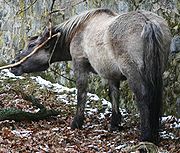
Horse
The horse is one of two extant subspecies of Equus ferus, or the wild horse. It is a single-hooved mammal belonging to the taxonomic family Equidae. The horse has evolved over the past 45 to 55 million years from a small multi-toed creature into the large, single-toed animal of today...
s appeared in Paleolithic
Paleolithic
The Paleolithic Age, Era or Period, is a prehistoric period of human history distinguished by the development of the most primitive stone tools discovered , and covers roughly 99% of human technological prehistory...
cave art as early as 30,000 BCE, these were truly wild horses and were probably hunted for meat
Meat
Meat is animal flesh that is used as food. Most often, this means the skeletal muscle and associated fat and other tissues, but it may also describe other edible tissues such as organs and offal...
. How and when horses became domesticated
Domestication
Domestication or taming is the process whereby a population of animals or plants, through a process of selection, becomes accustomed to human provision and control. In the Convention on Biological Diversity a domesticated species is defined as a 'species in which the evolutionary process has been...
is disputed. The clearest evidence of early use of the horse as a means of transport
Transport
Transport or transportation is the movement of people, cattle, animals and goods from one location to another. Modes of transport include air, rail, road, water, cable, pipeline, and space. The field can be divided into infrastructure, vehicles, and operations...
is from chariot
Chariot
The chariot is a type of horse carriage used in both peace and war as the chief vehicle of many ancient peoples. Ox carts, proto-chariots, were built by the Proto-Indo-Europeans and also built in Mesopotamia as early as 3000 BC. The original horse chariot was a fast, light, open, two wheeled...
burials dated c. 2000 BCE. However, an increasing amount of evidence supports the hypothesis that horses were domesticated in the Eurasian Steppe
Eurasian Steppe
The Eurasian Steppe is the vast steppe ecoregion of Eurasia in the Temperate grasslands, savannas, and shrublands Biome. It stretches from Hungary to Mongolia...
s (Dereivka
Dereivka
Dereivka is an archaeological site located in the village of the same name in Kirovohrad Oblast, Ukraine, on the right bank of the Dneiper. The site dates to ca. 4500—3500 BC and is associated with the Sredny Stog culture....
centered in Ukraine
Ukraine
Ukraine is a country in Eastern Europe. It has an area of 603,628 km², making it the second largest contiguous country on the European continent, after Russia...
) approximately 4000-3500 BCE. Recent discoveries on Botai culture
Botai culture
Botai Culture is termed Eneolithic . It was named by settlement Botai in Aqmola Province of Kazakhstan. The Botai culture has two other large sites: Krasnyi Yar, and Vasilkovka....
suggest that Botai culture settlements in the Akmola Province
Akmola Province
Akmola Province is a centrally located province of Kazakhstan. Its capital is Kokshetau. The capital of the whole country, Astana, is enclosed in the province, but is politically separate from Akmola Province. The province's population is 748,300; Kokshetau's is 124,000. The area is 146,200...
of Kazakhstan
Kazakhstan
Kazakhstan , officially the Republic of Kazakhstan, is a transcontinental country in Central Asia and Eastern Europe. Ranked as the ninth largest country in the world, it is also the world's largest landlocked country; its territory of is greater than Western Europe...
are the location of the earliest domestication of the horse.
The date of the domestication of the horse depends to some degree upon the definition of "domestication." Some zoologists define "domestication" as human control over breeding, which can be detected in ancient skeletal samples by changes in the size and variability of ancient horse populations. Other researchers look at broader evidence, including skeletal and dental evidence of working activity; weapons, art, and spiritual artifacts; and lifestyle patterns of human cultures. There is also evidence that horses were kept as meat animals prior to being trained as working animal
Working animal
A working animal is an animal, usually domesticated, that is kept by humans and trained to perform tasks. They may be close members of the family, such as guide or service dogs, or they may be animals trained strictly to perform a job, such as logging elephants. They may also be used for milk, a...
s.
Attempts to date domestication by genetic study or analysis of physical remains rests on the assumption that there was a separation of the genotypes of domesticated and the wild populations. Such a separation appears to have taken place, but dates based on such methods can only produce an estimate of the latest possible date for domestication without excluding the possibility of an unknown period of earlier gene-flow between wild and domestic populations (which will occur naturally as long as the domesticated population is kept within the habitat of the wild population). Further, all modern horse populations retain the ability to revert to a feral state
Feral
A feral organism is one that has changed from being domesticated to being wild or untamed. In the case of plants it is a movement from cultivated to uncultivated or controlled to volunteer. The introduction of feral animals or plants to their non-native regions, like any introduced species, may...
, and all feral horse
Feral horse
A feral horse is a free-roaming horse of domesticated ancestry. As such, a feral horse is not a wild animal in the sense of an animal without domesticated ancestors. However, some populations of feral horses are managed as wildlife, and these horses often are popularly called "wild" horses...
s are of domestic types; that is, they descend from ancestors that escaped from captivity.
Whether one adopts the narrower zoological definition of domestication or the broader cultural definition that rests on an array of zoological and archaeological evidence affects the time frame chosen for domestication of the horse. The date of 4000 BCE is based on evidence that includes the appearance of dental pathologies associated with bitting, changes in butchering practices, changes in human economies and settlement patterns, the depiction of horses as symbols of power in artifact
Artifact (archaeology)
An artifact or artefact is "something made or given shape by man, such as a tool or a work of art, esp an object of archaeological interest"...
s, and the appearance of horse bones in human graves. On the other hand, measurable changes in size and increases in variability associated with domestication occurred later, about 2500-2000 BCE, as seen in horse remains found at the site of Csepel-Haros in Hungary
Hungary
Hungary , officially the Republic of Hungary , is a landlocked country in Central Europe. It is situated in the Carpathian Basin and is bordered by Slovakia to the north, Ukraine and Romania to the east, Serbia and Croatia to the south, Slovenia to the southwest and Austria to the west. The...
, a settlement of the Bell Beaker culture
Beaker culture
The Bell-Beaker culture , ca. 2400 – 1800 BC, is the term for a widely scattered cultural phenomenon of prehistoric western Europe starting in the late Neolithic or Chalcolithic running into the early Bronze Age...
.
Regardless of the specific date of domestication, use of horses spread rapidly across Eurasia for transportation, agricultural work
Draft horse
A draft horse , draught horse or dray horse , less often called a work horse or heavy horse, is a large horse bred for hard, heavy tasks such as ploughing and farm labour...
and warfare
Horses in warfare
The first use of horses in warfare occurred over 5,000 years ago. The earliest evidence of horses ridden in warfare dates from Eurasia between 4000 and 3000 BC. A Sumerian illustration of warfare from 2500 BC depicts some type of equine pulling wagons...
. Horses and mule
Mule
A mule is the offspring of a male donkey and a female horse. Horses and donkeys are different species, with different numbers of chromosomes. Of the two F1 hybrids between these two species, a mule is easier to obtain than a hinny...
s in agriculture used a breastplate
Breastplate
A breastplate is a device worn over the torso to protect it from injury, as an item of religious significance, or as an item of status. A breastplate is sometimes worn by mythological beings as a distinctive item of clothing.- Armour :...
type harness or a yoke
Yoke
A yoke is a wooden beam, normally used between a pair of oxen or other animals to enable them to pull together on a load when working in pairs, as oxen usually do; some yokes are fitted to individual animals. There are several types of yoke, used in different cultures, and for different types of oxen...
more suitable for ox
Ox
An ox , also known as a bullock in Australia, New Zealand and India, is a bovine trained as a draft animal. Oxen are commonly castrated adult male cattle; castration makes the animals more tractable...
en, which was not as efficient at utilizing the full strength of the animals as the later-invented padded horse collar
Horse collar
A horse collar is a part of a horse harness device used to distribute load around a horse's neck and shoulders when pulling a wagon or plow. The collar often supports and pads a pair of curved metal or wood pieces, called hames, to which the traces of the harness are attached...
that arose several millennia later in western Europe.
Predecessors to the domestic horse
A 2005 study analyzed the mitochondrial DNAMitochondrial DNA
Mitochondrial DNA is the DNA located in organelles called mitochondria, structures within eukaryotic cells that convert the chemical energy from food into a form that cells can use, adenosine triphosphate...
(mtDNA) of a worldwide range of equids
Equidae
Equidae is the taxonomic family of horses and related animals, including the extant horses, donkeys, and zebras, and many other species known only from fossils. All extant species are in the genus Equus...
, from 53,000 year old fossils to contemporary horses. Their analysis placed all equids into a single clade
Clade
A clade is a group consisting of a species and all its descendants. In the terms of biological systematics, a clade is a single "branch" on the "tree of life". The idea that such a "natural group" of organisms should be grouped together and given a taxonomic name is central to biological...
, or group with a single common ancestor, consisting of three genetically divergent
Genetic divergence
Genetic divergence is the process in which two or more populations of an ancestral species accumulate independent genetic changes through time, often after the populations have become reproductively isolated for some period of time...
species: Hippidion
Hippidion
Hippidion was a Welsh pony-sized horse that lived in South America during the Pleistocene epoch, between two million and 10,000 years ago....
, the New World stilt-legged horse, and the true horse. The true horse, which ranged from western Europe to eastern Beringia, included prehistoric horses and the Przewalski's Horse
Przewalski's Horse
Przewalski's Horse or Dzungarian Horse, is a rare and endangered subspecies of wild horse native to the steppes of central Asia, specifically China and Mongolia.At one time extinct in the wild, it has been reintroduced to its native habitat in Mongolia at the Khustain Nuruu...
, as well as what is now the modern domestic horse, belonged to a single Holarctic
Holarctic
The Holarctic ecozone refers to the habitats found throughout the northern continents of the world as a whole. This region is divided into the Palearctic, consisting of Northern Africa and all of Eurasia, with the exception of Southeast Asia and the Indian subcontinent, and the Nearctic,...
species. A more detailed analysis of the true horses grouped them into two major clades. One of these clades, which seemed to have been restricted to North America, is now extinct. The other clade was broadly distributed from North America to central Europe, north and south of Pleistocene
Pleistocene
The Pleistocene is the epoch from 2,588,000 to 11,700 years BP that spans the world's recent period of repeated glaciations. The name pleistocene is derived from the Greek and ....
ice sheets. It became extinct in Beringia around 14,200 years ago, and in the rest of the Americas around 10,000 years ago. This clade survived in Eurasia, however, and it is from these horses which all domestic horses appear to have descended. These horses showed little phylogeographic
Phylogeography
Phylogeography is the study of the historical processes that may be responsible for the contemporary geographic distributions of individuals. This is accomplished by considering the geographic distribution of individuals in light of the patterns associated with a gene genealogy.This term was...
structure, probably reflecting their high degree of mobility and adaptability.
Therefore, the domestic horse
Horse
The horse is one of two extant subspecies of Equus ferus, or the wild horse. It is a single-hooved mammal belonging to the taxonomic family Equidae. The horse has evolved over the past 45 to 55 million years from a small multi-toed creature into the large, single-toed animal of today...
today is classified as Equus ferus caballus. No genetic originals of native wild horses currently exist, other than the never-domesticated Przewalski's Horse
Przewalski's Horse
Przewalski's Horse or Dzungarian Horse, is a rare and endangered subspecies of wild horse native to the steppes of central Asia, specifically China and Mongolia.At one time extinct in the wild, it has been reintroduced to its native habitat in Mongolia at the Khustain Nuruu...
. The Przewalski has 66 chromosome
Chromosome
A chromosome is an organized structure of DNA and protein found in cells. It is a single piece of coiled DNA containing many genes, regulatory elements and other nucleotide sequences. Chromosomes also contain DNA-bound proteins, which serve to package the DNA and control its functions.Chromosomes...
s, however, as opposed to 64 among modern domesticated horses, and their Mitochondrial DNA
Mitochondrial DNA
Mitochondrial DNA is the DNA located in organelles called mitochondria, structures within eukaryotic cells that convert the chemical energy from food into a form that cells can use, adenosine triphosphate...
(mtDNA) forms a distinct cluster. Genetic evidence suggests that modern Przewalski's horses are descended from a distinct regional gene pool in the eastern part of the Eurasian steppes, not from the same genetic group that gave rise to modern domesticated horses. Nevertheless, evidence such as the cave painting
Cave painting
Cave paintings are paintings on cave walls and ceilings, and the term is used especially for those dating to prehistoric times. The earliest European cave paintings date to the Aurignacian, some 32,000 years ago. The purpose of the paleolithic cave paintings is not known...
s of Lascaux
Lascaux
Lascaux is the setting of a complex of caves in southwestern France famous for its Paleolithic cave paintings. The original caves are located near the village of Montignac, in the department of Dordogne. They contain some of the best-known Upper Paleolithic art. These paintings are estimated to be...
suggests that the ancient wild horses that some researchers now label the "Tarpan subtype" probably resembled Przewalski horses in their general appearance: big heads, dun coloration
Dun gene
The dun gene is a dilution gene that affects both red and black pigments in the coat color of a horse. The dun gene has the ability to affect the appearance of all black, bay, or chestnut -based horses to some degree by lightening the base body coat and suppressing the underlying base color to the...
, thick necks, stiff upright manes
Mane (horse)
The mane is the hair that grows from the top of the neck of a horse or other equine, reaching from the poll to the withers, and includes the forelock or foretop. It is thicker and coarser than the rest of the horse's coat, and naturally grows to roughly cover the neck...
, and relatively short, stout legs.
The horses of the Ice Age
Ice age
An ice age or, more precisely, glacial age, is a generic geological period of long-term reduction in the temperature of the Earth's surface and atmosphere, resulting in the presence or expansion of continental ice sheets, polar ice sheets and alpine glaciers...
were hunted for meat in Europe and across the Eurasian steppes and in North America by early modern humans. Numerous kill sites exist and many cave painting
Cave painting
Cave paintings are paintings on cave walls and ceilings, and the term is used especially for those dating to prehistoric times. The earliest European cave paintings date to the Aurignacian, some 32,000 years ago. The purpose of the paleolithic cave paintings is not known...
s in Europe
Europe
Europe is, by convention, one of the world's seven continents. Comprising the westernmost peninsula of Eurasia, Europe is generally 'divided' from Asia to its east by the watershed divides of the Ural and Caucasus Mountains, the Ural River, the Caspian and Black Seas, and the waterways connecting...
indicate what they looked like. Many of these Ice Age subspecies died out during the rapid climate changes associated with the end of the last Ice Age or were hunted out by humans, particularly in North America
North America
North America is a continent wholly within the Northern Hemisphere and almost wholly within the Western Hemisphere. It is also considered a northern subcontinent of the Americas...
, where the horse became completely extinct.
Classification based on body types and conformation, absent the availability of DNA
DNA
Deoxyribonucleic acid is a nucleic acid that contains the genetic instructions used in the development and functioning of all known living organisms . The DNA segments that carry this genetic information are called genes, but other DNA sequences have structural purposes, or are involved in...
for research, once suggested that that there were roughly four basic wild prototypes, thought to have developed with adaptations to their environment prior to domestication. There were competing theories, some argued that the four prototypes were separate species or subspecies, while others suggested that the prototypes were physically different manifestations of the same species. However, more recent study indicates that there was only one wild species and all different body types were entirely a result of selective breeding
Selective breeding
Selective breeding is the process of breeding plants and animals for particular genetic traits. Typically, strains that are selectively bred are domesticated, and the breeding is sometimes done by a professional breeder. Bred animals are known as breeds, while bred plants are known as varieties,...
or landrace
Landrace
A landrace is a local variety of a domesticated animal or plant species which has developed largely by natural processes, by adaptation to the natural and cultural environment in which it lives. It differs from a formal breed which has been bred deliberately to conform to a particular standard...
adaptation after domestication. Either way, the most common theories of prototypes from which all modern breeds are thought to have developed suggests than in addition to the so-called Tarpan subtype, there were the following base prototypes:
- The "Warmblood subspecies" or "Forest HorseHistory of horse domestication theoriesThe history of horse domestication has been subject to much debate, with various competing theories over time about how domestication of the horse occurred. The main point of contention was whether the domestication of the horse occurred once in a single domestication event, or that the horse was...
" (once proposed as Equus ferus silvaticus, also called the Diluvial Horse), which evolved into a later variety sometimes called Equus ferus germanicus. This prototype may have contributed to the development of the warmbloodWarmbloodWarmbloods are a group of middle-weight horse types and breeds, primarily originating in Europe, registered with organizations that are characterized by open studbook policy, studbook selection, and the aim of breeding for equestrian sport...
horses of northern EuropeEuropeEurope is, by convention, one of the world's seven continents. Comprising the westernmost peninsula of Eurasia, Europe is generally 'divided' from Asia to its east by the watershed divides of the Ural and Caucasus Mountains, the Ural River, the Caspian and Black Seas, and the waterways connecting...
, as well as older "heavy horses" such as the Ardennais. - The "Draft" subspecies, a small, sturdy, heavyset animal with a heavy hair coat, arising in northern Europe, adapted to cold, damp climates, somewhat resembling today's draft horseDraft horseA draft horse , draught horse or dray horse , less often called a work horse or heavy horse, is a large horse bred for hard, heavy tasks such as ploughing and farm labour...
and even the Shetland ponyShetland ponyThe Shetland pony is a breed of pony originating in the Shetland Isles. Shetlands range in size from a minimum height of approximately 28 inches to an official maximum height of 42 inches at the withers. Shetland ponies have heavy coats, short legs and are considered quite intelligent...
. - The "OrientalOriental horseThe term oriental horse refers to the ancient breeds of horses developed in the Middle East, such as the Arabian, Akhal-Teke, Barb, and the now-extinct Turkoman horse. They tend to be thin-skinned, long-legged, slim in build and more physically refined than other types, but with great endurance...
" subspecies, (once proposed as Equus agilis) a taller, slim, refined and agile animal arising in western AsiaAsiaAsia is the world's largest and most populous continent, located primarily in the eastern and northern hemispheres. It covers 8.7% of the Earth's total surface area and with approximately 3.879 billion people, it hosts 60% of the world's current human population...
, adapted to hot, dry climates, thought to be the progenitor of the modern Arabian horseArabian horseThe Arabian or Arab horse is a breed of horse that originated on the Arabian Peninsula. With a distinctive head shape and high tail carriage, the Arabian is one of the most easily recognizable horse breeds in the world. It is also one of the oldest breeds, with archaeological evidence of horses...
and Akhal-TekeAkhal-TekeThe Akhal-Teke is a horse breed from Turkmenistan, where they are a national emblem. They are noted for their speed and for endurance on long marches. These "golden-horses" are adapted to severe climatic conditions and are thought to be one of the oldest surviving horse breeds...
.
Only two never-domesticated "wild" groups survived into historic times, Przewalski's horse (Equus ferus przewalski), and the Tarpan
Tarpan
Tarpan is an extinct subspecies of wild horse. The last individual of this subspecies died in captivity in Russia in 1909....
(Equus ferus ferus). The Tarpan became extinct in the late 19th century and Przewalski's horse is endangered; it became extinct in the wild during the 1960s, but was re-introduced in the late 1980s to two preserves in Mongolia. Although researchers such as Marija Gimbutas
Marija Gimbutas
Marija Gimbutas , was a Lithuanian-American archeologist known for her research into the Neolithic and Bronze Age cultures of "Old Europe", a term she introduced. Her works published between 1946 and 1971 introduced new views by combining traditional spadework with linguistics and mythological...
theorized that the horses of the Chalcolithic period were Przewalski's, more recent genetic studies indicate that Przewalski's horse is not an ancestor to modern domesticated horses. Other subspecies of Equus ferus, appear to have existed and could have been the stock from which domesticated horses are descended.
Even though horse domestication was widespread in a short period of time, it is still possible that domestication began with a single culture, which passed on techniques and breeding stock. It is possible that the two "wild" subspecies remained when all other groups of once-"wild" horses died out because all others had been, perhaps, more suitable for taming by humans and the selective breeding
Selective breeding
Selective breeding is the process of breeding plants and animals for particular genetic traits. Typically, strains that are selectively bred are domesticated, and the breeding is sometimes done by a professional breeder. Bred animals are known as breeds, while bred plants are known as varieties,...
that gave rise to the modern domestic horse.
Archaeological evidence

3) archaeological
Archaeology
Archaeology, or archeology , is the study of human society, primarily through the recovery and analysis of the material culture and environmental data that they have left behind, which includes artifacts, architecture, biofacts and cultural landscapes...
sites containing artifacts, images, or evidence of changes in human behavior connected with horses.
Archaeological evidence includes horse remains interred in human graves; changes in the ages and sexes of the horses killed by humans; the appearance of horse corral
Corral
Corral is a town, commune and sea port in Los Ríos Region, Chile. It is located south of Corral Bay. Corral is best known for the forts of Corral Bay, a system of defensive batteries and forts made to protect Valdivia during colonial times. Corral was the headquarters of the system...
s; equipment such as bits
Bit (horse)
A bit is a type of horse tack used in equestrian activities, usually made of metal or a synthetic material, and is placed in the mouth of a horse or other equid and assists a rider in communicating with the animal. It rests on the bars of the mouth in an interdental region where there are no teeth...
or other types of horse tack
Horse tack
Tack is a term used to describe any of the various equipment and accessories worn by horses in the course of their use as domesticated animals. Saddles, stirrups, bridles, halters, reins, bits, harnesses, martingales, and breastplates are all forms of horse tack...
; horses themselves interred with equipment intended for use by horses, such as chariot
Chariot
The chariot is a type of horse carriage used in both peace and war as the chief vehicle of many ancient peoples. Ox carts, proto-chariots, were built by the Proto-Indo-Europeans and also built in Mesopotamia as early as 3000 BC. The original horse chariot was a fast, light, open, two wheeled...
s; and depictions of horses used for riding
Equestrianism
Equestrianism more often known as riding, horseback riding or horse riding refers to the skill of riding, driving, or vaulting with horses...
, driving
Chariot
The chariot is a type of horse carriage used in both peace and war as the chief vehicle of many ancient peoples. Ox carts, proto-chariots, were built by the Proto-Indo-Europeans and also built in Mesopotamia as early as 3000 BC. The original horse chariot was a fast, light, open, two wheeled...
, draught work
Working animal
A working animal is an animal, usually domesticated, that is kept by humans and trained to perform tasks. They may be close members of the family, such as guide or service dogs, or they may be animals trained strictly to perform a job, such as logging elephants. They may also be used for milk, a...
, or symbols of human power.
Few of these categories, taken alone, provide irrefutable evidence of domestication, but combined add up to a persuasive argument.
Horses interred with chariots
The least ancient, but most persuasive evidence of domestication comes from sites where horse leg bones and skulls, probably originally attached to hides, were interred with the remains of chariots in at least 16 graves of the SintashtaSintashta
Sintashta is an archaeological site in Chelyabinsk Oblast, Russia. It is the remains of a fortified settlement dating to the Bronze Age, c. 2800–1600 BC, and is the type site of the Sintashta culture...
and Petrovka
Petrovka settlement
The Petrovka fortified settlement, namesake of the 2nd millennium BC Sintashta-Petrovka culture lies at the Ishim River, near the modern village of Petrovka, Kazakhstan ....
cultures. These were located in the steppes southeast of the Ural Mountains
Ural Mountains
The Ural Mountains , or simply the Urals, are a mountain range that runs approximately from north to south through western Russia, from the coast of the Arctic Ocean to the Ural River and northwestern Kazakhstan. Their eastern side is usually considered the natural boundary between Europe and Asia...
, between the upper Ural
Ural River
The Ural or Jayıq/Zhayyq , known as Yaik before 1775, is a river flowing through Russia and Kazakhstan. It arises in the southern Ural Mountains and ends at the Caspian Sea. Its total length is 1,511 mi making it the third longest river in Europe after the Volga and the Danube...
and upper Tobol River
Tobol River
Tobol is a river in Kurgan and Tyumen Oblasts in Russia and Kazakhstan, left tributary of the Irtysh. The length of the Tobol River is 1591 km. The area of its drainage basin is 426,000 km². Average discharge at mouth is 805 m³/s. The lower reaches of the river freeze up in late October -...
s, a region today divided between southern Russia
Russia
Russia or , officially known as both Russia and the Russian Federation , is a country in northern Eurasia. It is a federal semi-presidential republic, comprising 83 federal subjects...
and northern Kazakhstan
Kazakhstan
Kazakhstan , officially the Republic of Kazakhstan, is a transcontinental country in Central Asia and Eastern Europe. Ranked as the ninth largest country in the world, it is also the world's largest landlocked country; its territory of is greater than Western Europe...
. Petrovka was a little later than and probably grew out of Sintashta, and the two complexes together spanned about 2100-1700 BCE in calibrated or true years calibration methods
Radiocarbon dating
Radiocarbon dating is a radiometric dating method that uses the naturally occurring radioisotope carbon-14 to estimate the age of carbon-bearing materials up to about 58,000 to 62,000 years. Raw, i.e. uncalibrated, radiocarbon ages are usually reported in radiocarbon years "Before Present" ,...
. A few of these graves contained the remains of as many as eight sacrificed horses placed in, above, and beside the grave.
In all of the dated chariot graves, the heads and hooves of a pair of horses were placed in a grave that once contained a chariot. Evidence of chariots in these graves was inferred from the impressions of two spoked wheels set in grave floors 1.2-1.6m apart; in most cases the rest of the vehicle left no trace. In addition a pair of disk-shaped antler "cheekpieces," an ancient predecessor to a modern bit shank or bit ring
Bit ring
The bit ring is the ring on the side of a horse's bit, particularly on a snaffle bit. It is used as a point of attachment for the cheekpieces of the bridle and for the reins. It also has an effect on the action of the bit...
, were placed in pairs beside each horse head-and-hoof sacrifice. The inner faces of the disks had protruding prongs or studs that would have pressed against the horse’s lips when the rein
Rein
Reins are items of horse tack, used to direct a horse or other animal used for riding or driving. Reins can be made of leather, nylon, metal, or other materials, and attach to a bridle via either its bit or its noseband.-Use for riding:...
s were pulled on the opposite side. Studded cheekpieces were a new and fairly severe kind of control device that appeared simultaneously with chariots.
All of the dated chariot graves contained wheel impressions, horse bones, weapons (arrow and javelin points, axes, daggers, or stone mace-heads), human skeletal remains, and cheekpieces. Because they were buried in teams of two with chariots and studded cheekpieces, the evidence is extremely persuasive that these steppe horses of 2100-1700 BCE were domesticated. Shortly after the period of these burials, the expansion of the domestic horse throughout Europe was little short of explosive. In the space of possibly 500 years, there is evidence of horse-drawn chariot
Chariot
The chariot is a type of horse carriage used in both peace and war as the chief vehicle of many ancient peoples. Ox carts, proto-chariots, were built by the Proto-Indo-Europeans and also built in Mesopotamia as early as 3000 BC. The original horse chariot was a fast, light, open, two wheeled...
s in Greece, Egypt, and Mesopotamia. By another 500 years, the horse-drawn chariot had spread to China.
Skeletal indicators of domestication
Some researchers do not consider an animal to be "domesticated" until it exhibits physical changes consistent with selective breedingSelective breeding
Selective breeding is the process of breeding plants and animals for particular genetic traits. Typically, strains that are selectively bred are domesticated, and the breeding is sometimes done by a professional breeder. Bred animals are known as breeds, while bred plants are known as varieties,...
, or at least having been born and raised entirely in captivity. Until that point, they classify captive animals as merely "tamed." Those who hold to this theory of domestication point to a change in skeletal measurements was detected among horse bones
Skeletal system of the horse
The skeletal system of the horse has three major functions in the body. It protects vital organs, provides framework, and supports soft parts of the body. Horses typically have 205 bones...
recovered from middens dated about 2500 BCE in eastern Hungary
Hungary
Hungary , officially the Republic of Hungary , is a landlocked country in Central Europe. It is situated in the Carpathian Basin and is bordered by Slovakia to the north, Ukraine and Romania to the east, Serbia and Croatia to the south, Slovenia to the southwest and Austria to the west. The...
in Bell-Beaker
Beaker culture
The Bell-Beaker culture , ca. 2400 – 1800 BC, is the term for a widely scattered cultural phenomenon of prehistoric western Europe starting in the late Neolithic or Chalcolithic running into the early Bronze Age...
sites, and in later Bronze Age
Bronze Age
The Bronze Age is a period characterized by the use of copper and its alloy bronze as the chief hard materials in the manufacture of some implements and weapons. Chronologically, it stands between the Stone Age and Iron Age...
sites in the Russia
Russia
Russia or , officially known as both Russia and the Russian Federation , is a country in northern Eurasia. It is a federal semi-presidential republic, comprising 83 federal subjects...
n steppes, Spain
Spain
Spain , officially the Kingdom of Spain languages]] under the European Charter for Regional or Minority Languages. In each of these, Spain's official name is as follows:;;;;;;), is a country and member state of the European Union located in southwestern Europe on the Iberian Peninsula...
, and eastern Europe
Eastern Europe
Eastern Europe is the eastern part of Europe. The term has widely disparate geopolitical, geographical, cultural and socioeconomic readings, which makes it highly context-dependent and even volatile, and there are "almost as many definitions of Eastern Europe as there are scholars of the region"...
. Horse bones from these contexts exhibited an increase in variability, thought to reflect the survival under human care of both larger and smaller individuals than appeared in the wild; and a decrease in average size, thought to reflect penning and restriction in diet. Horse populations that showed this combination of skeletal changes probably were domesticated. Most evidence suggests that horses were increasingly controlled by humans after about 2500 BCE. However, more recently there have been skeletal remains found at a site in Kazakhstan
Kazakhstan
Kazakhstan , officially the Republic of Kazakhstan, is a transcontinental country in Central Asia and Eastern Europe. Ranked as the ninth largest country in the world, it is also the world's largest landlocked country; its territory of is greater than Western Europe...
which display the smaller, more slender limbs characteristic of corralled animals, dated to 3500 BCE.
Botai culture
Some of the most intriguing evidence of early domestication comes from the Botai cultureBotai culture
Botai Culture is termed Eneolithic . It was named by settlement Botai in Aqmola Province of Kazakhstan. The Botai culture has two other large sites: Krasnyi Yar, and Vasilkovka....
, found in northern Kazakhstan
Kazakhstan
Kazakhstan , officially the Republic of Kazakhstan, is a transcontinental country in Central Asia and Eastern Europe. Ranked as the ninth largest country in the world, it is also the world's largest landlocked country; its territory of is greater than Western Europe...
. The Botai culture was a culture of forager
Foraging
- Definitions and significance of foraging behavior :Foraging is the act of searching for and exploiting food resources. It affects an animal's fitness because it plays an important role in an animal's ability to survive and reproduce...
s who seem to have adopted horseback riding
Equestrianism
Equestrianism more often known as riding, horseback riding or horse riding refers to the skill of riding, driving, or vaulting with horses...
in order to hunt the abundant wild horses of northern Kazakhstan between 3500-3000 BCE. Botai sites had no cattle
Cattle
Cattle are the most common type of large domesticated ungulates. They are a prominent modern member of the subfamily Bovinae, are the most widespread species of the genus Bos, and are most commonly classified collectively as Bos primigenius...
or sheep bones; the only domesticated
Domestication
Domestication or taming is the process whereby a population of animals or plants, through a process of selection, becomes accustomed to human provision and control. In the Convention on Biological Diversity a domesticated species is defined as a 'species in which the evolutionary process has been...
animals, in addition to horses, were dog
Dog
The domestic dog is a domesticated form of the gray wolf, a member of the Canidae family of the order Carnivora. The term is used for both feral and pet varieties. The dog may have been the first animal to be domesticated, and has been the most widely kept working, hunting, and companion animal in...
s. Botai settlements in this period contained between 50-150 pit houses. Garbage deposits contained tens to hundreds of thousands of discarded animal bones, 65% to 99% of which had come from horses. Also, there has been evidence found of horse milking at these sites, with horse milk fats soaked into pottery shards dating to 3500 BCE. Earlier hunter-gatherer
Hunter-gatherer
A hunter-gatherer or forage society is one in which most or all food is obtained from wild plants and animals, in contrast to agricultural societies which rely mainly on domesticated species. Hunting and gathering was the ancestral subsistence mode of Homo, and all modern humans were...
s who lived in the same region had not hunted wild horses with such success, and lived for millennia in smaller, more shifting settlements, often containing less than 200 wild animal bones.
Entire herds of horses were slaughtered by the Botai hunters, apparently in hunting drives. The adoption of horseback riding might explain the appearance of specialized horse-hunting techniques and larger, more permanent settlements. Domesticated horses could have been adopted from neighboring herding societies in the steppes west of the Ural Mountains, where the Khvalynsk
Khvalynsk
Khvalynsk is a river port town in Saratov Oblast, Russia, located by the Volga River. Population: 16,000 .It was founded in 1556 as a Russian outpost on the Sosnovy Island on the Volga. In 1606, the whole settlement was relocated to the spot of today's Khvalynsk and came to be known as Sosnovy...
culture had herds of cattle and sheep, and perhaps had domesticated horses, as early as 4800 BCE.
Other researchers have argued that all of the Botai horses were wild, and that the horse-hunters of Botai hunted wild horses on foot. As evidence, they note that Zoologists have found no skeletal changes in the Botai horses that indicate domestication. And because they were hunted for food, the majority of the horse remains found in Botai-culture settlements indeed probably were wild. On the other hand, any domesticated riding horses were probably the same size as their wild cousins and cannot now be distinguished by bone measurements. They also note that the age structure of the horses slaughtered at Botai represents a natural demographic profile for hunted animals, not the pattern expected if they were domesticated and selected for slaughter. However, these arguments were published prior to the discovery of a corral at Krasnyi Yar and mats of horse-dung at two other Botai sites.
Bit wear
The presence of bit wear suggest that a horse was ridden or driven, and the earliest of such evidence from a site in Kazakhstan dates to 3500 BCE. Because horses can be ridden and controlled without bits by using a nosebandNoseband
A noseband is the part of a horse's bridle that encircles the nose and jaw of the horse. In English riding, where the noseband is separately attached to its own headstall or crownpiece, held independently of the bit, it is often called a cavesson or caveson noseband...
or a hackamore
Hackamore
A hackamore is a type of animal headgear which does not have a bit. Instead, it has a special type of noseband that works on pressure points on the face, nose, and chin...
, and such tools are used even today, the absence of bit wear on horse teeth
Horse teeth
Horses' teeth are often used to estimate the animal's age, hence the sayings "long in the tooth", "straight from the horse's mouth" and "Don't look a gift horse in the mouth".- Types of teeth :At five years of age a horse has between 36 and 44 teeth...
is not conclusive evidence against domestication, but such materials do not produce significant physiological changes nor are they apt to be preserved for millennia.
The regular use of a bit
Bit (horse)
A bit is a type of horse tack used in equestrian activities, usually made of metal or a synthetic material, and is placed in the mouth of a horse or other equid and assists a rider in communicating with the animal. It rests on the bars of the mouth in an interdental region where there are no teeth...
to control a horse can create wear facets or bevels on the anterior corners of the lower second premolars. The corners of the horse's mouth normally keep the bit on the "bars" of the mouth, an interdental space where there are no teeth, forward of the premolars. The bit must be manipulated by a human or the horse must move it with its tongue for it to touch the teeth. Wear can be caused by the bit abrading the front corners of the premolars if the horse grasps and releases the bit between its teeth
Horse teeth
Horses' teeth are often used to estimate the animal's age, hence the sayings "long in the tooth", "straight from the horse's mouth" and "Don't look a gift horse in the mouth".- Types of teeth :At five years of age a horse has between 36 and 44 teeth...
; other wear can be created by the bit striking the vertical front edge of the lower premolars, due to very strong pressure from a human handler.
Modern experiments showed that even organic bits of rope or leather can create significant wear facets, and also showed that facets 3 mm deep or more do not appear on the premolars of wild horse
Wild Horse
The wild horse is a species of the genus Equus, which includes as subspecies the domesticated horse as well as the undomesticated Tarpan and Przewalski's Horse. The Tarpan became extinct in the 19th century, and Przewalski's Horse was saved from the brink of extinction and reintroduced...
s. However, other researchers disputed both conclusions.
Wear facets of 3 mm or more also were found on seven horse premolars in two sites of the Botai
Botai culture
Botai Culture is termed Eneolithic . It was named by settlement Botai in Aqmola Province of Kazakhstan. The Botai culture has two other large sites: Krasnyi Yar, and Vasilkovka....
, Botai and Kozhai 1, dated about 3500-3000 BCE. The Botai culture premolars are the earliest reported multiple examples of this dental pathology in any archaeological site, and preceded any skeletal change indicators by 1000 years. While wear facets more than 3 mm deep were discovered on the lower second premolars of a single stallion
Stallion
A Stallion is a male horse.Stallion may also refer to:* Stallion , an American pop rock group* Stallion , a figure in the Gobot toyline* Stallion , a character in the console role-playing game series...
from Dereivka
Dereivka
Dereivka is an archaeological site located in the village of the same name in Kirovohrad Oblast, Ukraine, on the right bank of the Dneiper. The site dates to ca. 4500—3500 BC and is associated with the Sredny Stog culture....
in Ukraine
Ukraine
Ukraine is a country in Eastern Europe. It has an area of 603,628 km², making it the second largest contiguous country on the European continent, after Russia...
, an Eneolithic settlement dated about 4000 BCE, dental material from one of the worn teeth later produced a radiocarbon date of 700-200 BCE, indicating that this stallion was actually deposited in a pit dug into the older Eneolithic site during the Iron Age
Iron Age
The Iron Age is the archaeological period generally occurring after the Bronze Age, marked by the prevalent use of iron. The early period of the age is characterized by the widespread use of iron or steel. The adoption of such material coincided with other changes in society, including differing...
.
Dung and corrals
Soil scientists working with Sandra Olsen of the Carnegie Museum of Natural HistoryCarnegie Museum of Natural History
Carnegie Museum of Natural History, located at 4400 Forbes Avenue in the Oakland neighborhood of Pittsburgh, Pennsylvania, USA, was founded by the Pittsburgh-based industrialist Andrew Carnegie in 1896...
at the Chalcolithic (also called Eneolithic, or "Copper Age") settlements of Botai and Krasnyi Yar in northern Kazakhstan found layers of horse dung
Manure
Manure is organic matter used as organic fertilizer in agriculture. Manures contribute to the fertility of the soil by adding organic matter and nutrients, such as nitrogen, that are trapped by bacteria in the soil...
, discarded in unused house pits in both settlements. The collection and disposal of horse dung suggests that horses were confined in corral
Corral
Corral is a town, commune and sea port in Los Ríos Region, Chile. It is located south of Corral Bay. Corral is best known for the forts of Corral Bay, a system of defensive batteries and forts made to protect Valdivia during colonial times. Corral was the headquarters of the system...
s or stable
Stable
A stable is a building in which livestock, especially horses, are kept. It most commonly means a building that is divided into separate stalls for individual animals...
s. An actual corral, dated to 3000-3500 BCE was identified at Krasnyi Yar by a pattern of post holes for a circular fence
Agricultural fencing
In agriculture, fences are used to keep animals in or out of an area. They can be made from a wide variety of materials, depending on terrain, location and animals to be confined...
, with the soil
Soil
Soil is a natural body consisting of layers of mineral constituents of variable thicknesses, which differ from the parent materials in their morphological, physical, chemical, and mineralogical characteristics...
s inside the fence yielding ten times more phosphorus
Phosphorus
Phosphorus is the chemical element that has the symbol P and atomic number 15. A multivalent nonmetal of the nitrogen group, phosphorus as a mineral is almost always present in its maximally oxidized state, as inorganic phosphate rocks...
than the soils outside. The phosphorus could represent the remains of manure.
Geographic expansion
The appearance of horse remains in human settlements in regions where they had not previously been present is another indicator of domestication. Although images of horses appear as early as the Upper PaleolithicUpper Paleolithic
The Upper Paleolithic is the third and last subdivision of the Paleolithic or Old Stone Age as it is understood in Europe, Africa and Asia. Very broadly it dates to between 40,000 and 10,000 years ago, roughly coinciding with the appearance of behavioral modernity and before the advent of...
period in places such as the caves of Lascaux
Lascaux
Lascaux is the setting of a complex of caves in southwestern France famous for its Paleolithic cave paintings. The original caves are located near the village of Montignac, in the department of Dordogne. They contain some of the best-known Upper Paleolithic art. These paintings are estimated to be...
, France, suggesting that wild horse
Wild Horse
The wild horse is a species of the genus Equus, which includes as subspecies the domesticated horse as well as the undomesticated Tarpan and Przewalski's Horse. The Tarpan became extinct in the 19th century, and Przewalski's Horse was saved from the brink of extinction and reintroduced...
s lived in regions outside of Eurasia prior to domestication and may have even been hunted by early humans, concentration of remains suggests animals being deliberately captured and contained, an indicator of domestication, at least for food, if not necessarily use as a working animal.
Around 3500-3000 BCE horse bones began to appear more frequently in archaeological sites beyond their center of distribution in the Eurasian steppes and were seen in central Europe
Europe
Europe is, by convention, one of the world's seven continents. Comprising the westernmost peninsula of Eurasia, Europe is generally 'divided' from Asia to its east by the watershed divides of the Ural and Caucasus Mountains, the Ural River, the Caspian and Black Seas, and the waterways connecting...
, the middle and lower Danube
Danube
The Danube is a river in the Central Europe and the Europe's second longest river after the Volga. It is classified as an international waterway....
valley, and the North Caucasus
Caucasus
The Caucasus, also Caucas or Caucasia , is a geopolitical region at the border of Europe and Asia, and situated between the Black and the Caspian sea...
and Transcaucasia
South Caucasus
The South Caucasus is a geopolitical region located on the border of Eastern Europe and Southwest Asia also referred to as Transcaucasia, or The Trans-Caucasus...
. Evidence of horses in these areas had been rare before, and as numbers increased, larger animals also began to appear in horse remains. This expansion in range was contemporary with the Botai culture, where there are indications that horses were corralled and ridden. This does not necessarily mean that horses were first domesticated in the steppes, but the horse-hunters of the steppes certainly pursued wild horses more than in any other region. This geographic expansion is interpreted by many zoologists as an early phase in the spread of domesticated horses.
European wild horses were hunted for up to 10% of the animal bones in a handful of Mesolithic
Mesolithic
The Mesolithic is an archaeological concept used to refer to certain groups of archaeological cultures defined as falling between the Paleolithic and the Neolithic....
and Neolithic
Neolithic
The Neolithic Age, Era, or Period, or New Stone Age, was a period in the development of human technology, beginning about 9500 BC in some parts of the Middle East, and later in other parts of the world. It is traditionally considered as the last part of the Stone Age...
settlements scattered across Spain
Spain
Spain , officially the Kingdom of Spain languages]] under the European Charter for Regional or Minority Languages. In each of these, Spain's official name is as follows:;;;;;;), is a country and member state of the European Union located in southwestern Europe on the Iberian Peninsula...
, France
France
The French Republic , The French Republic , The French Republic , (commonly known as France , is a unitary semi-presidential republic in Western Europe with several overseas territories and islands located on other continents and in the Indian, Pacific, and Atlantic oceans. Metropolitan France...
, and the marshlands of northern Germany
Germany
Germany , officially the Federal Republic of Germany , is a federal parliamentary republic in Europe. The country consists of 16 states while the capital and largest city is Berlin. Germany covers an area of 357,021 km2 and has a largely temperate seasonal climate...
, but in many other parts of Europe, including Greece
Greece
Greece , officially the Hellenic Republic , and historically Hellas or the Republic of Greece in English, is a country in southeastern Europe....
, the Balkans
Balkans
The Balkans is a geopolitical and cultural region of southeastern Europe...
, the British Isles
British Isles
The British Isles are a group of islands off the northwest coast of continental Europe that include the islands of Great Britain and Ireland and over six thousand smaller isles. There are two sovereign states located on the islands: the United Kingdom of Great Britain and Northern Ireland and...
, and much of central Europe, horse bones do not occur or occur very rarely in Mesolithic, Neolithic or Chalcolithic sites. In contrast, wild horse bones regularly exceeded 40% of the identified animal bones in Mesolithic and Neolithic camps in the Eurasian steppes, west of the Ural Mountains.
Horse bones were rare or absent in Neolithic
Neolithic
The Neolithic Age, Era, or Period, or New Stone Age, was a period in the development of human technology, beginning about 9500 BC in some parts of the Middle East, and later in other parts of the world. It is traditionally considered as the last part of the Stone Age...
and Chalcolithic kitchen garbage in western Turkey
Turkey
Turkey , known officially as the Republic of Turkey , is a Eurasian country located in Western Asia and in East Thrace in Southeastern Europe...
, Mesopotamia
Mesopotamia
Mesopotamia is a toponym for the area of the Tigris–Euphrates river system, largely corresponding to modern-day Iraq, northeastern Syria, southeastern Turkey and southwestern Iran.Widely considered to be the cradle of civilization, Bronze Age Mesopotamia included Sumer and the...
, most of Iran
Iran
Iran , officially the Islamic Republic of Iran , is a country in Southern and Western Asia. The name "Iran" has been in use natively since the Sassanian era and came into use internationally in 1935, before which the country was known to the Western world as Persia...
, South and Central Asia
Asia
Asia is the world's largest and most populous continent, located primarily in the eastern and northern hemispheres. It covers 8.7% of the Earth's total surface area and with approximately 3.879 billion people, it hosts 60% of the world's current human population...
, and much of Europe. While horse bones have been identified in Neolithic sites in central Turkey, all equids together totaled less than 3% of the animal bones. Within this three percent, horses were less than 10%, with 90% or more of the equids represented by onager
Onager
The Onager is a large member of the genus Equus of the family Equidae native to the deserts of Syria, Iran, Pakistan, India, Israel and Tibet...
s (Equus hemionus) or another ass-like equid that later became extinct, Equus Hydruntinus. Onagers were the most common native wild equids of the Near East. They were hunted in Syria
Syria
Syria , officially the Syrian Arab Republic , is a country in Western Asia, bordering Lebanon and the Mediterranean Sea to the West, Turkey to the north, Iraq to the east, Jordan to the south, and Israel to the southwest....
, Anatolia
Anatolia
Anatolia is a geographic and historical term denoting the westernmost protrusion of Asia, comprising the majority of the Republic of Turkey...
, Mesopotamia
Mesopotamia
Mesopotamia is a toponym for the area of the Tigris–Euphrates river system, largely corresponding to modern-day Iraq, northeastern Syria, southeastern Turkey and southwestern Iran.Widely considered to be the cradle of civilization, Bronze Age Mesopotamia included Sumer and the...
, Iran
Iran
Iran , officially the Islamic Republic of Iran , is a country in Southern and Western Asia. The name "Iran" has been in use natively since the Sassanian era and came into use internationally in 1935, before which the country was known to the Western world as Persia...
, and Central Asia; and domesticated asses (Equus asinus) were imported into Mesopotamia, probably from Egypt
Egypt
Egypt , officially the Arab Republic of Egypt, Arabic: , is a country mainly in North Africa, with the Sinai Peninsula forming a land bridge in Southwest Asia. Egypt is thus a transcontinental country, and a major power in Africa, the Mediterranean Basin, the Middle East and the Muslim world...
, but wild horses apparently did not live there.
Other evidence of geographic expansion
Later, images of horses, identified by their short ears, flowing manes, and tails that bushed out at the dock, began to appear in artistic media in Mesopotamia during the Akkadian period, 2300-2100 BCE. The word for "horse", literally translated as ass of the mountains, first appeared in SumerSumer
Sumer was a civilization and historical region in southern Mesopotamia, modern Iraq during the Chalcolithic and Early Bronze Age....
ian documents during the Third Dynasty of Ur
Ur
Ur was an important city-state in ancient Sumer located at the site of modern Tell el-Muqayyar in Iraq's Dhi Qar Governorate...
, about 2100-2000 BCE. The kings of the Third Dynasty of Ur apparently fed horses to lions for royal entertainment, perhaps indicating that horses were still regarded as more exotic than useful, but King Shulgi, about 2050 BCE, compared himself to “a horse of the highway that swishes its tail”, and one image from his reign showed a man apparently riding a horse at full gallop. Horses were imported into Mesopotamia and the lowland Near East in larger numbers after 2000 BCE in connection with the beginning of chariot warfare
Chariot tactics
The first depictions of four-wheeled wagons pulled by semi-domesticated onagers and other available animals come from the Sumerians.Against infantry the fast chariots used tactics of wearing down the enemy by missile fire, deploying heavy troops and running down enemies.The next step was towards...
.
A further expansion, into the lowland Near East
Near East
The Near East is a geographical term that covers different countries for geographers, archeologists, and historians, on the one hand, and for political scientists, economists, and journalists, on the other...
and northwestern China
China
Chinese civilization may refer to:* China for more general discussion of the country.* Chinese culture* Greater China, the transnational community of ethnic Chinese.* History of China* Sinosphere, the area historically affected by Chinese culture...
, also happened around 2000 BCE, again apparently in conjunction with the chariot. Although ‘’Equus’’ bones of uncertain species are found in some Late Neolithic sites in China dated before 2000 BCE, ‘’Equus caballus’’ or ‘’Equus ferus’’ bones first appeared in multiple sites and in significant numbers in sites of the Qijia
Qijia culture
The Qijia culture was an early Bronze Age culture distributed around the upper Yellow River region of western Gansu and eastern Qinghai, China, it is regarded as one of the earliest bronze cultures. Johan Gunnar Andersson discovered the initial site at Qijiaping in 1923...
and Siba cultures, 2000-1600 BCE, in Gansu
Gansu
' is a province located in the northwest of the People's Republic of China.It lies between the Tibetan and Huangtu plateaus, and borders Mongolia, Inner Mongolia, and Ningxia to the north, Xinjiang and Qinghai to the west, Sichuan to the south, and Shaanxi to the east...
and the northwestern provinces of China. The Qijia culture was in contact with cultures of the Eurasian steppes, as shown through similarities between Qijia and Late Bronze Age
Bronze Age
The Bronze Age is a period characterized by the use of copper and its alloy bronze as the chief hard materials in the manufacture of some implements and weapons. Chronologically, it stands between the Stone Age and Iron Age...
steppe metallurgy
Metallurgy
Metallurgy is a domain of materials science that studies the physical and chemical behavior of metallic elements, their intermetallic compounds, and their mixtures, which are called alloys. It is also the technology of metals: the way in which science is applied to their practical use...
, so it was probably through these contacts that domesticated horses first became frequent in northwestern China.
Horses images as symbols of power
About 4200-4000 BCE, more than 500 years before the geographic expansion evidenced by the presence of horse bones, new kinds of graves, named after a grave at SuvorovoPrimorsky Krai
Primorsky Krai , informally known as Primorye , is a federal subject of Russia . Primorsky means "maritime" in Russian, hence the region is sometimes referred to as Maritime Province or Maritime Territory. Its administrative center is in the city of Vladivostok...
, appeared north of the Danube
Danube
The Danube is a river in the Central Europe and the Europe's second longest river after the Volga. It is classified as an international waterway....
delta in the coastal steppes of Ukraine near Izmail
Izmail
Izmail is a historic town near the Danube river in the Odessa Oblast of south-western Ukraine. Serving as the administrative center of the Izmail Raion , the city itself is also designated as a separate raion within the oblast....
. Suvorovo graves were similar to and probably derived from earlier funeral traditions in the steppes around the Dnieper River
Dnieper River
The Dnieper River is one of the major rivers of Europe that flows from Russia, through Belarus and Ukraine, to the Black Sea.The total length is and has a drainage basin of .The river is noted for its dams and hydroelectric stations...
. Some Suvorovo graves contained polished stone mace-heads shaped like horse heads and horse tooth beads. Earlier steppe graves also had contained polished stone mace-heads, some of them carved in the shape of animal heads. Settlements in the steppes contemporary with Suvorovo, such as Sredni Stog II and Dereivka
Dereivka
Dereivka is an archaeological site located in the village of the same name in Kirovohrad Oblast, Ukraine, on the right bank of the Dneiper. The site dates to ca. 4500—3500 BC and is associated with the Sredny Stog culture....
on the Dnieper River, contained 12%-52% horse bones.
When Suvorovo graves appeared in the Danube delta grasslands, horse-head maces also appeared in some of the indigenous farming towns of the Tripolye and Gumelnitsa
Hamangia culture
The Hamangia culture is a Late Neolithic archaeological culture of Dobruja between the Danube and the Black Sea and Muntenia and in the south. It is named after the site of Baia-Hamangia, discovered in 1952 along Lake Golovita....
cultures in present-day Romania
Romania
Romania is a country located at the crossroads of Central and Southeastern Europe, on the Lower Danube, within and outside the Carpathian arch, bordering on the Black Sea...
and Moldova
Moldova
Moldova , officially the Republic of Moldova is a landlocked state in Eastern Europe, located between Romania to the West and Ukraine to the North, East and South. It declared itself an independent state with the same boundaries as the preceding Moldavian Soviet Socialist Republic in 1991, as part...
, near the Suvorovo graves. These agricultural cultures had not previously used polished-stone maces, and horse bones were rare or absent in their settlement sites. Probably their horse-head maces came from the Suvorovo immigrants. The Suvorovo people in turn acquired many copper ornaments from the Tripolye and Gumelnitsa towns. After this episode of contact and trade, but still during the period 4200-4000 BCE, about 600 agricultural towns in the Balkans and the lower Danube valley, some of which had been occupied for 2000 years, were abandoned. Copper mining ceased in the Balkan copper mines, and the cultural traditions associated with the agricultural towns were terminated in the Balkans and the lower Danube valley. This collapse of "Old Europe" has been attributed to the immigration of mounted Indo-European warriors. The collapse could have been caused by intensified warfare, for which there is some evidence; and warfare could have been worsened by mounted raiding; and the horse-head maces have been interpreted as indicating the introduction of domesticated horses and riding just before the collapse.
However, mounted raiding is just one possible explanation for this complex event. Environmental deterioration, ecological degradation from millennia of farming, and the exhaustion of easily mined oxide copper ores also are cited as causal factors.
Artifacts
Perforated antler objects discovered at Dereivka and other sites contemporary with Suvorovo have been identified as cheekpieces or ‘’psalia’’ for horse bitsBit (horse)
A bit is a type of horse tack used in equestrian activities, usually made of metal or a synthetic material, and is placed in the mouth of a horse or other equid and assists a rider in communicating with the animal. It rests on the bars of the mouth in an interdental region where there are no teeth...
.. This identification is no longer widely accepted, as the objects in question have not been found associated with horse bones, and could have had a variety of other functions. However, through studies of microscopic wear, it has been extablished that many of the bone tools at Botai were used to smooth rawhide thongs, and rawhide thongs might have been used to manufacture of rawhide cords and ropes, useful for horse tack
Horse tack
Tack is a term used to describe any of the various equipment and accessories worn by horses in the course of their use as domesticated animals. Saddles, stirrups, bridles, halters, reins, bits, harnesses, martingales, and breastplates are all forms of horse tack...
. Similar bone thong-smoothers are known from many other steppe settlements, but it cannot be known how the thongs were used. The oldest artifacts clearly identified as horse tack—bits, bridle
Bridle
A bridle is a piece of equipment used to direct a horse. As defined in the Oxford English Dictionary, the "bridle" includes both the headstall that holds a bit that goes in the mouth of a horse, and the reins that are attached to the bit....
s, cheekpieces, or any other kind of horse gear—are the antler disk-shaped cheekpieces associated with the invention of the chariot, at the Sintashta-Petrovka sites.
Horses interred in human graves
The oldest possible archaeological indicator of a changed relationship between horses and humans is the appearance about 4800-4400 BCE of horse bones and carved images of horses in Chalcolithic graves of the early Khvalynsk cultureKhvalynsk culture
The Khvalynsk culture was an Eneolithic culture of the first half of the 5th millennium BC, discovered at Khvalynsk on the Volga in Saratov Oblast, Russia. The culture also is termed the Middle Eneolithic or Developed Eneolithic or Proto-kurgan...
and the Samara culture
Samara culture
The Samara culture was an eneolithic culture of the early 5th millennium BC at the Samara bend region of the middle Volga, discovered during archaeological excavations in 1973 near the village of Syezzheye in Russia...
in the middle Volga
Volga River
The Volga is the largest river in Europe in terms of length, discharge, and watershed. It flows through central Russia, and is widely viewed as the national river of Russia. Out of the twenty largest cities of Russia, eleven, including the capital Moscow, are situated in the Volga's drainage...
region of Russia. At the Khvalynsk cemetery near the town of Khvalynsk
Khvalynsk
Khvalynsk is a river port town in Saratov Oblast, Russia, located by the Volga River. Population: 16,000 .It was founded in 1556 as a Russian outpost on the Sosnovy Island on the Volga. In 1606, the whole settlement was relocated to the spot of today's Khvalynsk and came to be known as Sosnovy...
, 158 graves of this period were excavated. Of these, 26 graves contained parts of sacrificed domestic animals, and additional sacrifices occurred in ritual deposits on the original ground surface above the graves. Ten graves contained parts of lower horse legs; two of these also contained the bones of domesticated cattle and sheep. At least 52 domesticated sheep or goat
Goat
The domestic goat is a subspecies of goat domesticated from the wild goat of southwest Asia and Eastern Europe. The goat is a member of the Bovidae family and is closely related to the sheep as both are in the goat-antelope subfamily Caprinae. There are over three hundred distinct breeds of...
s, 23 domesticated cattle, and 11 horses were sacrificed at Khvalynsk. The inclusion of horses with cattle and sheep and the exclusion of obviously wild animals together suggest that horses were categorized symbolically with domesticated animals.
At S’yezzhe, a contemporary cemetery of the Samara culture, parts of two horses were placed above a group of human graves. The pair of horses here was represented by the head and hooves, probably originally attached to hides. The same ritual—using the hide with the head and lower leg bones as a symbol for the whole animal—was used for many domesticated cattle and sheep sacrifices at Khvalynsk. Horse images carved from bone were placed in the above-ground ochre deposit at S’yezzhe and occurred at several other sites of the same period in the middle and lower Volga region. Together these archaeological clues suggest that horses had a symbolic importance in the Khvalynsk and Samara cultures that they had lacked earlier, and that they were associated with humans, domesticated cattle, and domesticated sheep. Thus, the earliest phase in the domestication of the horse might have begun during the period 4800-4400 BCE.
Genetic evidence
The domestication of stallions and mares can be analyzed separately by looking at those portions of the DNA that are passed on exclusively along the maternal (mitochondrial DNAMitochondrial DNA
Mitochondrial DNA is the DNA located in organelles called mitochondria, structures within eukaryotic cells that convert the chemical energy from food into a form that cells can use, adenosine triphosphate...
or mtDNA) or paternal line (Y-chromosome or Y-DNA). DNA studies indicate that there may have been multiple domestication events for mares, as the number of female lines required to account for the genetic diversity of the modern horse suggests a minimum of 77 different ancestral mare
Mare
Female horses are called mares.Mare is the Latin word for "sea".The word may also refer to:-People:* Ahmed Marzooq, also known as Mare, a footballer and Secretary General of Maldives Olympic Committee* Mare Winningham, American actress and singer...
s, divided into 17 distinct lineages. On the other hand, genetic evidence with regard to the domestication of stallions points at a single domestication event for a limited number of stallions combined with repeated restocking of wild females into the domesticated herds.
Genes located on the Y-chromosome are inherited only from sire to its male offspring and these lines show a very reduced degree of genetic variation (aka genetic homogeneity) in modern domestic horses than expected based on the overall genetic variation in the remaining genetic material. This indicates that a relatively few stallions were domesticated, and that it is unlikely that many male offspring originating from unions between wild stallions and domestic mares were included in early domesticated breeding stock.
Genes located in the mitochondrial DNA are passed on along the maternal line from the mother to her offspring. Multiple analyses of the mitochondrial DNA obtained from modern horses as well as from horse bones and tooth from archaeological and palaeological finds consistency shows an increased genetic diversity in the mitochondrial DNA compared to the remaining DNA, showing that a large number of mares has been included into the breeding stock of the domesticated horse. Variation in the mitochondrial DNA is used to determine so-called haplogroup
Haplogroup
In the study of molecular evolution, a haplogroup is a group of similar haplotypes that share a common ancestor having the same single nucleotide polymorphism mutation in both haplotypes. Because a haplogroup consists of similar haplotypes, this is what makes it possible to predict a haplogroup...
s. A haplogroup is a group of closely related haplotype
Haplotype
A haplotype in genetics is a combination of alleles at adjacent locations on the chromosome that are transmitted together...
s that share the same common ancestor. In horses, seven main haplogroups are recognized (A-G), each with several subgroups. Several haplogroups are unequal distributed around the world, indicating the addition of local wild mares to the domesticated stock. One of these haplotypes (Lusitano group C) is exclusively found on in Iberian Peninsula
Iberian Peninsula
The Iberian Peninsula , sometimes called Iberia, is located in the extreme southwest of Europe and includes the modern-day sovereign states of Spain, Portugal and Andorra, as well as the British Overseas Territory of Gibraltar...
, leading to a hypothesis that the Iberian peninsula or North Africa was an independent origin for domestication of the horse. However, until there is additional analysis of nuclear DNA and a better understanding of the genetic structure of the earliest domestic herds, this question cannot be answered.
Methods of domestication
EquidaeEquidae
Equidae is the taxonomic family of horses and related animals, including the extant horses, donkeys, and zebras, and many other species known only from fossils. All extant species are in the genus Equus...
died out in the Western Hemisphere
Western Hemisphere
The Western Hemisphere or western hemisphere is mainly used as a geographical term for the half of the Earth that lies west of the Prime Meridian and east of the Antimeridian , the other half being called the Eastern Hemisphere.In this sense, the western hemisphere consists of the western portions...
at the end of the last Ice Age
Ice age
An ice age or, more precisely, glacial age, is a generic geological period of long-term reduction in the temperature of the Earth's surface and atmosphere, resulting in the presence or expansion of continental ice sheets, polar ice sheets and alpine glaciers...
. A question raised is why and how horses avoided this fate on the Eurasian continent. It has been theorized that domestication saved the species. While the environmental conditions for equine survival in Europe were somewhat more favorable in Eurasia than in the Americas, the same stressors that led to extinction for the Mammoth
Mammoth
A mammoth is any species of the extinct genus Mammuthus. These proboscideans are members of Elephantidae, the family of elephants and mammoths, and close relatives of modern elephants. They were often equipped with long curved tusks and, in northern species, a covering of long hair...
did have an impact on horses. Thus, some time after 8000 BCE, the approximate date of extinction in the Americas, humans in Eurasia may have begun to keep horses as a livestock
Livestock
Livestock refers to one or more domesticated animals raised in an agricultural setting to produce commodities such as food, fiber and labor. The term "livestock" as used in this article does not include poultry or farmed fish; however the inclusion of these, especially poultry, within the meaning...
food source, and by keeping them in captivity, may have helped to preserve the species. Horses also fit the six core criteria for livestock domestication, and thus, it could be argued, "chose" to live in close proximity to humans.
One model of horse domestication starts with individual foal
Foal
A foal is an equine, particularly a horse, that is one year old or younger. More specific terms are colt for a male foal and filly for a female foal, but these terms are used until the horse is age three or four. When the foal is nursing from its dam , it may also be called a suckling...
s being kept as pets while the adult horses were slaughtered for meat. Foals are relatively small and easy to handle. Horses behave
Horse behavior
Horse behavior is best understood from the perspective that horses are prey animals with a well-developed fight-or-flight instinct. Their first response to a threat is to flee, although they are known to stand their ground and defend themselves or their offspring in cases where flight is...
as herd animals and need companionship to thrive. Both historic and modern data shows that foals can and will bond to humans and other domestic animals to meet their social needs. Thus domestication may have started with young horses being repeatedly made into pets over time, preceding the great discovery that these pets could be ridden or otherwise put to work.
However, there is a dispute over what domesticated means. One theory suggests that domestication must include physiological changes associated with being selectively bred
Selective breeding
Selective breeding is the process of breeding plants and animals for particular genetic traits. Typically, strains that are selectively bred are domesticated, and the breeding is sometimes done by a professional breeder. Bred animals are known as breeds, while bred plants are known as varieties,...
in captivity, and not merely "tamed." It has been noted that traditional peoples worldwide (both hunter-gatherers and horticulturists) routinely tame individuals from wild species, typically by hand-rearing infants whose parents have been killed, and these animals are not necessarily "domesticated."
On the other hand, some researchers look to examples from historical times in order to hypothesize how domestication occurred. For example, while Native American cultures captured and rode horses from the 16th century on, most tribes did not exert significant control over their breeding, thus their horses developed a genotype
Genotype
The genotype is the genetic makeup of a cell, an organism, or an individual usually with reference to a specific character under consideration...
and phenotype
Phenotype
A phenotype is an organism's observable characteristics or traits: such as its morphology, development, biochemical or physiological properties, behavior, and products of behavior...
adapted to the uses and climatological conditions in which they were kept, making them more of a landrace
Landrace
A landrace is a local variety of a domesticated animal or plant species which has developed largely by natural processes, by adaptation to the natural and cultural environment in which it lives. It differs from a formal breed which has been bred deliberately to conform to a particular standard...
than a planned breed as defined by modern standards, but nonetheless "domesticated."
Driving versus riding
A difficult question is if domesticated horses were first ridden or driven. While the most unequivocal evidence shows horses first being used to pull chariots in warfare, there is strong, though indirect, evidence for riding occurring first, particularly by the Botai. Bit wear may correlate to riding, though, as the modern hackamore demonstrates, horses can be ridden without a bit by using rope and other evanescent materials to make equipment that fastens around the nose. So the absence of unequivocal evidence of early riding in the record does not settle the question.Thus, on one hand, logic suggests that horses would have been ridden long before they were driven. But it is also far more difficult to gather evidence of this, as the materials required for riding—simple hackamore
Hackamore
A hackamore is a type of animal headgear which does not have a bit. Instead, it has a special type of noseband that works on pressure points on the face, nose, and chin...
s or blankets—would not survive as artifacts, and other than tooth wear from a bit
Bit (horse)
A bit is a type of horse tack used in equestrian activities, usually made of metal or a synthetic material, and is placed in the mouth of a horse or other equid and assists a rider in communicating with the animal. It rests on the bars of the mouth in an interdental region where there are no teeth...
, the skeletal changes in an animal that was ridden would not necessarily be particularly noticeable. Direct evidence of horses being driven is much stronger.
On the other hand, others argue that evidence of bit wear does not necessarily correlate to riding. Some theorists speculate that a horse could have been controlled from the ground by placing a bit in the mouth, connected to a lead rope, and leading the animal while pulling a primitive wagon or plow. Since oxen were usually relegated to this duty in Mesopotamia, it is possible that early plows might have been attempted with the horse, and a bit may indeed have been significant as part of agrarian development rather than as warfare technology.
Horses in ancient warfare
While riding may have been practiced during the 4th and 3rd millennia BCE, and the disappearance of "Old European" settlements may be related to attacks by horseback-mounted warriors, the clearest impact by horses on ancient warfareAncient warfare
Ancient warfare is war as conducted from the beginnings of recorded history to the end of the ancient period. In Europe and the Near East, the end of antiquity is often equated with the fall of Rome in 476, and the wars of the Eastern Roman Empire Byzantium in its South Western Asian and North...
was by pulling chariot
Chariot
The chariot is a type of horse carriage used in both peace and war as the chief vehicle of many ancient peoples. Ox carts, proto-chariots, were built by the Proto-Indo-Europeans and also built in Mesopotamia as early as 3000 BC. The original horse chariot was a fast, light, open, two wheeled...
s, introduced c. 2000 BCE.
Horses in the Bronze Age
Bronze Age
The Bronze Age is a period characterized by the use of copper and its alloy bronze as the chief hard materials in the manufacture of some implements and weapons. Chronologically, it stands between the Stone Age and Iron Age...
were relatively small by modern standards, which led some theorists to believe the ancient horses were too small to be ridden and so must have been driven. Herodotus' description of the Sigynnae
Sigynnae
The Sigynnae were an obscure people of antiquity. They are variously located by ancient authors.According to Herodotus , they dwelt beyond the Danube, and their frontiers extended almost as far as the Eneti on the Adriatic. Their horses were small and flat-nosed with shaggy long hair, five fingers...
, a steppe people who bred horses too small to ride but extremely efficient at drawing chariots, illustrates this stage. However, as horses remained generally smaller than modern equines well into the Middle Ages
Middle Ages
The Middle Ages is a periodization of European history from the 5th century to the 15th century. The Middle Ages follows the fall of the Western Roman Empire in 476 and precedes the Early Modern Era. It is the middle period of a three-period division of Western history: Classic, Medieval and Modern...
, this theory is highly questionable.
The Iron Age
Iron Age
The Iron Age is the archaeological period generally occurring after the Bronze Age, marked by the prevalent use of iron. The early period of the age is characterized by the widespread use of iron or steel. The adoption of such material coincided with other changes in society, including differing...
in Mesopotamia saw the rise of mounted cavalry
Cavalry
Cavalry or horsemen were soldiers or warriors who fought mounted on horseback. Cavalry were historically the third oldest and the most mobile of the combat arms...
as a tool of war, as evidenced by the notable successes of mounted archer tactics used by various invading equestrian nomads such as the Parthians. Over time, the chariot gradually become obsolete.
The horse of the Iron Age was still relatively small, perhaps 12.2 to 14.2 hands
Hand (unit)
The hand is a non-SI unit of measurement of length, now used only for the measurement of the height of horses in some English-speaking countries, including Australia, Canada, the UK and the USA. With origins in ancient Egypt, it was originally based on the breadth of a human hand...
high (1.27 to 1.47 meters, measured at the withers
Withers
The withers is the ridge between the shoulder blades of a four-legged animal. In many species it is the tallest point of the body, and in horses and dogs it is the standard place to measure the animal's height .-Horses:The withers in horses are formed by the dorsal spinal processes of roughly the...
.) This was shorter overall average height than modern riding horses, which range from 14.2 to 17.2 hh (1.47 to 1.78 meters). However, small horses were used successfully as light cavalry for many centuries. For example, Fell ponies
Fell pony
The Fell Pony is a versatile, working breed of mountain and moorland pony originating in the north of England in Cumberland and Westmorland and Northumberland. It was originally bred on the fell farms of northwest England, and is used as a riding and driving pony...
, believed to be descended from Roman cavalry horses, are comfortably able to carry fully grown adults (although with rather limited ground clearance) at an average height of 13.2 hands (1.37 m). Likewise, the Arabian horse
Arabian horse
The Arabian or Arab horse is a breed of horse that originated on the Arabian Peninsula. With a distinctive head shape and high tail carriage, the Arabian is one of the most easily recognizable horse breeds in the world. It is also one of the oldest breeds, with archaeological evidence of horses...
is noted for a short back and dense bone, and the successes of the Muslim
Muslim
A Muslim, also spelled Moslem, is an adherent of Islam, a monotheistic, Abrahamic religion based on the Quran, which Muslims consider the verbatim word of God as revealed to prophet Muhammad. "Muslim" is the Arabic term for "submitter" .Muslims believe that God is one and incomparable...
s against the heavy mounted knight
Knight
A knight was a member of a class of lower nobility in the High Middle Ages.By the Late Middle Ages, the rank had become associated with the ideals of chivalry, a code of conduct for the perfect courtly Christian warrior....
s of Europe demonstrated that a 14.2 hand horse (1.47 m) can easily carry a full-grown human adult into battle.
Mounted warriors such as the Scythians, Huns
Huns
The Huns were a group of nomadic people who, appearing from east of the Volga River, migrated into Europe c. AD 370 and established the vast Hunnic Empire there. Since de Guignes linked them with the Xiongnu, who had been northern neighbours of China 300 years prior to the emergence of the Huns,...
and Vandals
Vandals
The Vandals were an East Germanic tribe that entered the late Roman Empire during the 5th century. The Vandals under king Genseric entered Africa in 429 and by 439 established a kingdom which included the Roman Africa province, besides the islands of Sicily, Corsica, Sardinia and the Balearics....
of late Roman antiquity, the Mongols
Mongols
Mongols ) are a Central-East Asian ethnic group that lives mainly in the countries of Mongolia, China, and Russia. In China, ethnic Mongols can be found mainly in the central north region of China such as Inner Mongolia...
who invaded eastern Europe in the 7th century through 14th centuries CE, the Muslim
Muslim
A Muslim, also spelled Moslem, is an adherent of Islam, a monotheistic, Abrahamic religion based on the Quran, which Muslims consider the verbatim word of God as revealed to prophet Muhammad. "Muslim" is the Arabic term for "submitter" .Muslims believe that God is one and incomparable...
warriors of the 8th through 14th centuries CE, and the American Indian
Indigenous peoples of the Americas
The indigenous peoples of the Americas are the pre-Columbian inhabitants of North and South America, their descendants and other ethnic groups who are identified with those peoples. Indigenous peoples are known in Canada as Aboriginal peoples, and in the United States as Native Americans...
s in the 16th through 19th centuries each demonstrated effective forms of light cavalry.