
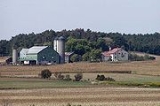
A
farm is an area of land, or, for
aquacultureAquaculture, also known as aquafarming, is the farming of aquatic organisms such as fish, crustaceans, molluscs and aquatic plants. Aquaculture involves cultivating freshwater and saltwater populations under controlled conditions, and can be contrasted with commercial fishing, which is the...
,
lakeA lake is a body of relatively still fresh or salt water of considerable size, localized in a basin, that is surrounded by land. Lakes are inland and not part of the ocean and therefore are distinct from lagoons, and are larger and deeper than ponds. Lakes can be contrasted with rivers or streams,...
,
riverA river is a natural watercourse, usually freshwater, flowing towards an ocean, a lake, a sea, or another river. In a few cases, a river simply flows into the ground or dries up completely before reaching another body of water. Small rivers may also be called by several other names, including...
or
seaA sea generally refers to a large body of salt water, but the term is used in other contexts as well. Most commonly, it means a large expanse of saline water connected with an ocean, and is commonly used as a synonym for ocean...
, including various structures, devoted primarily to the practice of producing and managing
foodFood is any substance consumed to provide nutritional support for the body. It is usually of plant or animal origin, and contains essential nutrients, such as carbohydrates, fats, proteins, vitamins, or minerals...
(
produceProduce is a generalized term for a group of farm-produced goods and, not limited to fruits and vegetables . More specifically, the term "produce" often implies that the products are fresh and generally in the same state as where they were harvested. In supermarkets the term is also used to refer...
,
grainGRAIN is a small international non-profit organisation that works to support small farmers and social movements in their struggles for community-controlled and biodiversity-based food systems. Our support takes the form of independent research and analysis, networking at local, regional and...
s, or
livestockLivestock refers to one or more domesticated animals raised in an agricultural setting to produce commodities such as food, fiber and labor. The term "livestock" as used in this article does not include poultry or farmed fish; however the inclusion of these, especially poultry, within the meaning...
), fibres and, increasingly,
fuelFuel is any material that stores energy that can later be extracted to perform mechanical work in a controlled manner. Most fuels used by humans undergo combustion, a redox reaction in which a combustible substance releases energy after it ignites and reacts with the oxygen in the air...
. It is the basic production facility in
food productionAgriculture is the cultivation of animals, plants, fungi and other life forms for food, fiber, and other products used to sustain life. Agriculture was the key implement in the rise of sedentary human civilization, whereby farming of domesticated species created food surpluses that nurtured the...
. Farms may be owned and operated by a single individual, family, community, corporation or a company. A farm can be a holding of any size from a fraction of a
hectareThe hectare is a metric unit of area defined as 10,000 square metres , and primarily used in the measurement of land. In 1795, when the metric system was introduced, the are was defined as being 100 square metres and the hectare was thus 100 ares or 1/100 km2...
to several thousand hectares.
Etymology
There are two unrelated etymologies for the term "farm:"
Latin
The word in the sense of an agricultural land-holding derives from the verb "to farm" a revenue source, whether taxes, customs, rents of a group of manors or simply to hold an individual manor by the
feudal land tenureUnder the English feudal system several different forms of land tenure existed, each effectively a contract with differing rights and duties attached thereto. Such tenures could be either free-hold, signifying that they were hereditable or perpetual, or non-free where the tenancy terminated on the...
of "fee farm". The word is from the mediaeval Latin noun firma, also the source of the French word ferme, meaning a fixed agreement, contract, from the classical Latin adjective firmus-a-um meaning strong, stout, firm. As in the mediaeval age virtually all manors were engaged in the business of agriculture, which was their principal revenue source, so to hold a manor by the tenure of "fee farm" became synonymous with the practice of agriculture itself.
Old English
An alternative etymology states the word farm comes from Old English feorm, farm ("provision, stores of food, supplies, possessions; provisions supplied to the king or a lord by a tenant or vassal; rent, feast, benefit, assylum"), from Proto-Germanic *firmō, *firχumō ("means of living, subsistence"), from
Proto-Indo-EuropeanThe Proto-Indo-European language is the reconstructed common ancestor of the Indo-European languages, spoken by the Proto-Indo-Europeans...
*perk
wu- ("life, strength, force"). It is related to other Old English words such as feormehām ("farm"), feormere ("purveyor, grocer"), feormian ("to provision, sustain"), and feorh ("life, spirit").
Farming
The term
farming covers a wide spectrum of agricultural production work. At one end of this spectrum is the
subsistence farmerSubsistence agriculture is self-sufficiency farming in which the farmers focus on growing enough food to feed their families. The typical subsistence farm has a range of crops and animals needed by the family to eat and clothe themselves during the year. Planting decisions are made with an eye...
, who farms a small area with limited resource inputs, and produces only enough
foodFood is any substance consumed to provide nutritional support for the body. It is usually of plant or animal origin, and contains essential nutrients, such as carbohydrates, fats, proteins, vitamins, or minerals...
to meet the needs of his family. At the other end is commercial intensive agriculture, including
industrial agricultureIndustrial farming is a form of modern farming that refers to the industrialized production of livestock, poultry, fish, and crops. The methods of industrial agriculture are technoscientific, economic, and political...
. Such farming involves large fields and/or numbers of animals, large resource inputs (
pesticidePesticides are substances or mixture of substances intended for preventing, destroying, repelling or mitigating any pest.A pesticide may be a chemical unicycle, biological agent , antimicrobial, disinfectant or device used against any pest...
s,
fertilizerFertilizer is any organic or inorganic material of natural or synthetic origin that is added to a soil to supply one or more plant nutrients essential to the growth of plants. A recent assessment found that about 40 to 60% of crop yields are attributable to commercial fertilizer use...
s, etc.), and a high level of
mechanizationMechanized agriculture is the process of using agricultural machinery to mechanize the work of agriculture, massively increasing farm output and farm worker productivity...
. These operations generally attempt to maximize financial income from
grainGRAIN is a small international non-profit organisation that works to support small farmers and social movements in their struggles for community-controlled and biodiversity-based food systems. Our support takes the form of independent research and analysis, networking at local, regional and...
,
produceProduce is a generalized term for a group of farm-produced goods and, not limited to fruits and vegetables . More specifically, the term "produce" often implies that the products are fresh and generally in the same state as where they were harvested. In supermarkets the term is also used to refer...
, or
livestockLivestock refers to one or more domesticated animals raised in an agricultural setting to produce commodities such as food, fiber and labor. The term "livestock" as used in this article does not include poultry or farmed fish; however the inclusion of these, especially poultry, within the meaning...
.
Traditionally, the goal of farming was to work collectively as a community to grow and harvest crops that could be grown in mass such as
wheatWheat is a cereal grain, originally from the Levant region of the Near East, but now cultivated worldwide. In 2007 world production of wheat was 607 million tons, making it the third most-produced cereal after maize and rice...
,
maizeMaize known in many English-speaking countries as corn or mielie/mealie, is a grain domesticated by indigenous peoples in Mesoamerica in prehistoric times. The leafy stalk produces ears which contain seeds called kernels. Though technically a grain, maize kernels are used in cooking as a vegetable...
, squash, and other cash crops. Centuries later these same farmers took charge of livestock, and began growing food exclusively for the feeding of livestock as well as for the community. With the growth of
civilizationCivilization is a sometimes controversial term that has been used in several related ways. Primarily, the term has been used to refer to the material and instrumental side of human cultures that are complex in terms of technology, science, and division of labor. Such civilizations are generally...
the farmer's focus changed from basic survival to that of financial gain. In smaller towns on the outset of civilization the farmer did retain the need to grow their own food, but the financially minded farmer was largely spreading. With the
RenaissanceThe Renaissance was a cultural movement that spanned roughly the 14th to the 17th century, beginning in Italy in the Late Middle Ages and later spreading to the rest of Europe. The term is also used more loosely to refer to the historical era, but since the changes of the Renaissance were not...
came the plantation, a farm primarily worked by others primarily for the gain of the plantation's owner. Then came a new age of
industryIndustry refers to the production of an economic good or service within an economy.-Industrial sectors:There are four key industrial economic sectors: the primary sector, largely raw material extraction industries such as mining and farming; the secondary sector, involving refining, construction,...
where the farm could be staffed by fewer people and big machines. This meant a complete revolution for farming.
Types of farms
A business producing tree fruits or nuts is called an
orchardAn orchard is an intentional planting of trees or shrubs that is maintained for food production. Orchards comprise fruit or nut-producing trees which are grown for commercial production. Orchards are also sometimes a feature of large gardens, where they serve an aesthetic as well as a productive...
; a
vineyardA vineyard is a plantation of grape-bearing vines, grown mainly for winemaking, but also raisins, table grapes and non-alcoholic grape juice...
produces grapes. The
stableA stable is a building in which livestock, especially horses, are kept. It most commonly means a building that is divided into separate stalls for individual animals...
is used for operations principally involved in the training of horses. Stud and commercial farms breed and produce other animals and livestock. A farm that is primarily used for the production of milk and dairy is a dairy farm. A
market gardenA market garden is the relatively small-scale production of fruits, vegetables and flowers as cash crops, frequently sold directly to consumers and restaurants. It is distinguishable from other types of farming by the diversity of crops grown on a small area of land, typically, from under one acre ...
or truck farm is a farm that grows vegetables, but little or no grain. Additional specialty farms include
fish farmsFish farming is the principal form of aquaculture, while other methods may fall under mariculture. Fish farming involves raising fish commercially in tanks or enclosures, usually for food. A facility that releases young fish into the wild for recreational fishing or to supplement a species'...
, which raise fish in captivity as a food source, and tree farms, which grow trees for sale for transplant, lumber, or decorative use. A
plantationA plantation is a long artificially established forest, farm or estate, where crops are grown for sale, often in distant markets rather than for local on-site consumption...
is usually a large farm or estate, on which
cottonCotton is a soft, fluffy staple fiber that grows in a boll, or protective capsule, around the seeds of cotton plants of the genus Gossypium. The fiber is almost pure cellulose. The botanical purpose of cotton fiber is to aid in seed dispersal....
,
tobaccoTobacco is an agricultural product processed from the leaves of plants in the genus Nicotiana. It can be consumed, used as a pesticide and, in the form of nicotine tartrate, used in some medicines...
,
coffeeCoffee is a brewed beverage with a dark,init brooo acidic flavor prepared from the roasted seeds of the coffee plant, colloquially called coffee beans. The beans are found in coffee cherries, which grow on trees cultivated in over 70 countries, primarily in equatorial Latin America, Southeast Asia,...
or sugar cane, are cultivated, often by resident laborers.
Types of farming
- Collective farming
Collective farming and communal farming are types of agricultural production in which the holdings of several farmers are run as a joint enterprise...
- Factory farming
Factory farming is a term referring to the process of raising livestock in confinement at high stocking density, where a farm operates as a factory — a practice typical in industrial farming by agribusinesses. The main products of this industry are meat, milk and eggs for human consumption...
- Intensive farming
Intensive farming or intensive agriculture is an agricultural production system characterized by the high inputs of capital, labour, or heavy usage of technologies such as pesticides and chemical fertilizers relative to land area....
- Protected culture farming
- Organic farming
Organic farming is the form of agriculture that relies on techniques such as crop rotation, green manure, compost and biological pest control to maintain soil productivity and control pests on a farm...
- Vertical farming
Vertical farming is a concept that argues that it is economically and environmentally viable to cultivate plant or animal life within skyscrapers, or on vertically inclined surfaces...
- Fell farming
Fell farming is the farming of fells, i.e. areas of uncultivated high ground used as common grazing. It is a term commonly used in Northern England, especially in the Lake District and the Pennine Dales...
Dairy farms
Dairy farmingDairy farming is a class of agricultural, or an animal husbandry, enterprise, for long-term production of milk, usually from dairy cows but also from goats and sheep, which may be either processed on-site or transported to a dairy factory for processing and eventual retail sale.Most dairy farms...
is a class of
agricultureAgriculture is the cultivation of animals, plants, fungi and other life forms for food, fiber, and other products used to sustain life. Agriculture was the key implement in the rise of sedentary human civilization, whereby farming of domesticated species created food surpluses that nurtured the...
, where female
cattleCattle are the most common type of large domesticated ungulates. They are a prominent modern member of the subfamily Bovinae, are the most widespread species of the genus Bos, and are most commonly classified collectively as Bos primigenius...
, goats, or other
mammalMammals are members of a class of air-breathing vertebrate animals characterised by the possession of endothermy, hair, three middle ear bones, and mammary glands functional in mothers with young...
s are raised for their
milkMilk is a white liquid produced by the mammary glands of mammals. It is the primary source of nutrition for young mammals before they are able to digest other types of food. Early-lactation milk contains colostrum, which carries the mother's antibodies to the baby and can reduce the risk of many...
, which may be either processed on-site or transported to a
dairyA dairy is a business enterprise established for the harvesting of animal milk—mostly from cows or goats, but also from buffalo, sheep, horses or camels —for human consumption. A dairy is typically located on a dedicated dairy farm or section of a multi-purpose farm that is concerned...
for processing and eventual retail sale.
In most
WesternThe Western world, also known as the West and the Occident , is a term referring to the countries of Western Europe , the countries of the Americas, as well all countries of Northern and Central Europe, Australia and New Zealand...
countries, a centralized
dairyA dairy is a business enterprise established for the harvesting of animal milk—mostly from cows or goats, but also from buffalo, sheep, horses or camels —for human consumption. A dairy is typically located on a dedicated dairy farm or section of a multi-purpose farm that is concerned...
facility processes milk and dairy products, such as
creamCream is a dairy product that is composed of the higher-butterfat layer skimmed from the top of milk before homogenization. In un-homogenized milk, over time, the lighter fat rises to the top. In the industrial production of cream this process is accelerated by using centrifuges called "separators"...
,
butterButter is a dairy product made by churning fresh or fermented cream or milk. It is generally used as a spread and a condiment, as well as in cooking applications, such as baking, sauce making, and pan frying...
, and
cheeseCheese is a generic term for a diverse group of milk-based food products. Cheese is produced throughout the world in wide-ranging flavors, textures, and forms....
. In the United States, these dairies are usually local companies, while in the
southern hemisphereThe Southern Hemisphere is the part of Earth that lies south of the equator. The word hemisphere literally means 'half ball' or "half sphere"...
facilities may be run by very large nationwide or trans-national corporations (such as
FonterraFonterra Co-operative Group Limited is a New Zealand multinational dairy co-operative owned by almost 10,500 New Zealand farmers. The company is responsible for approximately 30% of the world's dairy exports and with revenue exceeding NZ$19.87 billion, is New Zealand's largest company.- History :In...
).
Dairy farms generally sell the male calves borne by their mothers for
vealVeal is the meat of young cattle , as opposed to meat from older cattle. Though veal can be produced from a calf of either sex and any breed, most veal comes from male calves of dairy cattle breeds...
meatMeat is animal flesh that is used as food. Most often, this means the skeletal muscle and associated fat and other tissues, but it may also describe other edible tissues such as organs and offal...
, as dairy breeds are not normally satisfactory for commercial
beefBeef is the culinary name for meat from bovines, especially domestic cattle. Beef can be harvested from cows, bulls, heifers or steers. It is one of the principal meats used in the cuisine of the Middle East , Australia, Argentina, Brazil, Europe and the United States, and is also important in...
production. Many dairy farms also grow their own feed, typically including
cornMaize known in many English-speaking countries as corn or mielie/mealie, is a grain domesticated by indigenous peoples in Mesoamerica in prehistoric times. The leafy stalk produces ears which contain seeds called kernels. Though technically a grain, maize kernels are used in cooking as a vegetable...
,
alfalfaAlfalfa is a flowering plant in the pea family Fabaceae cultivated as an important forage crop in the US, Canada, Argentina, France, Australia, the Middle East, South Africa, and many other countries. It is known as lucerne in the UK, France, Australia, South Africa and New Zealand, and known as...
, and
hayHay is grass, legumes or other herbaceous plants that have been cut, dried, and stored for use as animal fodder, particularly for grazing livestock such as cattle, horses, goats, and sheep. Hay is also fed to pets such as rabbits and guinea pigs...
. This is fed directly to the cows, or stored as
silageSilage is fermented, high-moisture fodder that can be fed to ruminants or used as a biofuel feedstock for anaerobic digesters. It is fermented and stored in a process called ensiling or silaging, and is usually made from grass crops, including corn , sorghum or other cereals, using the entire...
for use during the winter season. Additional dietary supplements are added to the feed to improve milk production.
Poultry farms
Poultry farms are devoted to raising
chickenThe chicken is a domesticated fowl, a subspecies of the Red Junglefowl. As one of the most common and widespread domestic animals, and with a population of more than 24 billion in 2003, there are more chickens in the world than any other species of bird...
s, turkeys,
duckDuck is the common name for a large number of species in the Anatidae family of birds, which also includes swans and geese. The ducks are divided among several subfamilies in the Anatidae family; they do not represent a monophyletic group but a form taxon, since swans and geese are not considered...
s, and other
fowlFowl is a word for birds in general but usually refers to birds belonging to one of two biological orders, namely the gamefowl or landfowl and the waterfowl...
, generally for meat or eggs.
Prison farms
Prison farmA prison farm is a large correctional facility where penal labor convicts are put to economical use in a 'farm' , usually for manual labour, largely in open air, such as in agriculture, logging, quarrying, etc...
s are farms which serve as prisons for persons sentenced to hard labor by a court. On prison farms inmates run the important tasks of a farm, producing crops.
Ownership
Farm control and ownership has traditionally been a key indicator of status and power, especially in agrarian societies. The distribution of farm ownership has historically been closely linked to
form of governmentA form of government, or form of state governance, refers to the set of political institutions by which a government of a state is organized. Synonyms include "regime type" and "system of government".-Empirical and conceptual problems:...
. Medieval
feudalismFeudalism was a set of legal and military customs in medieval Europe that flourished between the 9th and 15th centuries, which, broadly defined, was a system for ordering society around relationships derived from the holding of land in exchange for service or labour.Although derived from the...
was essentially a system that centralized control of farmland, control of farm labor and political power, while the early American
democracyDemocracy is generally defined as a form of government in which all adult citizens have an equal say in the decisions that affect their lives. Ideally, this includes equal participation in the proposal, development and passage of legislation into law...
, in which land ownership was a prerequisite for voting rights, was built on relatively easy paths to individual farm ownership. However, the gradual
modernizationIn the social sciences, modernization or modernisation refers to a model of an evolutionary transition from a 'pre-modern' or 'traditional' to a 'modern' society. The teleology of modernization is described in social evolutionism theories, existing as a template that has been generally followed by...
and
mechanizationMechanization or mechanisation is providing human operators with machinery that assists them with the muscular requirements of work or displaces muscular work. In some fields, mechanization includes the use of hand tools...
of farming, which greatly increases both the efficiency and capital requirements of farming, has led to increasingly large farms. This has usually been accompanied by the decoupling of political power from farm ownership.
Forms of ownership
In some societies (especially socialist and communist),
collective farmingCollective farming and communal farming are types of agricultural production in which the holdings of several farmers are run as a joint enterprise...
is the norm, with either government ownership of the land or common ownership by a local group. Especially in societies without widespread industrialized farming, tenant farming and
sharecroppingSharecropping is a system of agriculture in which a landowner allows a tenant to use the land in return for a share of the crop produced on the land . This should not be confused with a crop fixed rent contract, in which a landowner allows a tenant to use the land in return for a fixed amount of...
are common; farmers either pay landowners for the right to use farmland or give up a portion of the crops.
Australia
Farming is a significant economic sector in Australia. A farm is an area of land used for primary production which will include buildings.
Where most of the income is from some other employment, and the farm is really an expanded residence, the term
hobby farmA hobby farm is a smallholding or small farm that is maintained without expectation of being a primary source of income. Some are merely to provide some recreational land, and perhaps a few horses for the family's children...
is common. This will allow sufficient size for recreational use but be very unlikely to produce sufficient income to be self-sustaining. Hobby farms are commonly around 5 acres (20,234.3 m²) but may be much larger depending upon land prices (which vary regionally).
Often very small farms used for intensive primary production are referred to by the specialization they are being used for, such as a dairy rather than a dairy farm, a piggery, a market garden, etc. This also applies to feedlots, which are specifically developed to a single purpose and are often not able to be used for more general purpose (mixed) farming practices.
In remote areas farms can become quite large. As with estates in England, there is no defined size or method of operation at which a large farm becomes a
stationStation is the term for a large Australian landholding used for livestock production. It corresponds to the North American term ranch or South American estancia...
.
Regardless of size, the term station is only used for farms where the main activity is grazing. Some cotton farms in north-western
New South WalesNew South Wales is a state of :Australia, located in the east of the country. It is bordered by Queensland, Victoria and South Australia to the north, south and west respectively. To the east, the state is bordered by the Tasman Sea, which forms part of the Pacific Ocean. New South Wales...
or south-western
QueenslandQueensland is a state of Australia, occupying the north-eastern section of the mainland continent. It is bordered by the Northern Territory, South Australia and New South Wales to the west, south-west and south respectively. To the east, Queensland is bordered by the Coral Sea and Pacific Ocean...
have been formed by combining previous sheep stations once sufficient water has become available to allow cotton to be grown.
Europe
In the UK, farm as an agricultural unit, always denotes the area of
pasturePasture is land used for grazing. Pasture lands in the narrow sense are enclosed tracts of farmland, grazed by domesticated livestock, such as horses, cattle, sheep or swine. The vegetation of tended pasture, forage, consists mainly of grasses, with an interspersion of legumes and other forbs...
and other
fieldsIn agriculture, the word field refers generally to an area of land enclosed or otherwise and used for agricultural purposes such as:* Cultivating crops* Usage as a paddock or, generally, an enclosure of livestock...
together with its farmhouse, farmyard and outbuildings. Very large farms, or groups of farms under the same ownership, may be called an estate. Conversely, a small farm surrounding the owner's dwelling is called a
smallholdingA smallholding is a farm of small size.In third world countries, smallholdings are usually farms supporting a single family with a mixture of cash crops and subsistence farming. As a country becomes more affluent and farming practices become more efficient, smallholdings may persist as a legacy of...
and is generally focused on
self-sufficiencySelf-sufficiency refers to the state of not requiring any outside aid, support, or interaction, for survival; it is therefore a type of personal or collective autonomy...
with only the surplus being sold.
North America
The land and buildings of a farm are called the "farmstead."
Enterprises where livestock are raised on
rangelandRangelands are vast natural landscapes in the form of grasslands, shrublands, woodlands, wetlands, and deserts. Types of rangelands include tallgrass and shortgrass prairies, desert grasslands and shrublands, woodlands, savannas, chaparrals, steppes, and tundras...
are called
ranchA ranch is an area of landscape, including various structures, given primarily to the practice of ranching, the practice of raising grazing livestock such as cattle or sheep for meat or wool. The word most often applies to livestock-raising operations in the western United States and Canada, though...
es. Where
livestockLivestock refers to one or more domesticated animals raised in an agricultural setting to produce commodities such as food, fiber and labor. The term "livestock" as used in this article does not include poultry or farmed fish; however the inclusion of these, especially poultry, within the meaning...
are raised in confinement on feed produced elsewhere, the term
feedlotA feedlot or feedyard is a type of animal feeding operation which is used in factory farming for finishing livestock, notably beef cattle, but also swine, horses, sheep, turkeys, chickens or ducks, prior to slaughter. Large beef feedlots are called Concentrated Animal Feeding Operations . They...
is usually used.
In 1910 there were 6,406,000 farms and 10,174,000 family workers; In 2000 there were only 2,172,000 farms and 2,062,300 family workers.
In the United States, eighty-one percent of all farmworkers are migrant workers, and seventy-one percent are foreign-born. Eighty percent of farmworkers are men, with the average age being 31. Additionally, farmworkers earn less than $75,000 per year, making an average hourly rate of less than $27.00. On average, farmworker families earn $10,000 per year, which is significantly below the 2005 U.S. poverty level of $19,874 for a family of four.
In 2007, corn acres are expected to increase by 15% because of the high demand for ethanol, both in and outside of the U.S. Producers are expecting to plant 90.5 million acres (366,000 km²) of corn, making it the largest corn crop since 1944.
Farm buildings
Farms require buildings to facilitate the action of farming the material at hand. Such buildings can include a farm house (for the farmers), a grain
siloA silo is a structure for storing bulk materials. Silos are used in agriculture to store grain or fermented feed known as silage. Silos are more commonly used for bulk storage of grain, coal, cement, carbon black, woodchips, food products and sawdust. Three types of silos are in widespread use...
(for storing grain), and a
barnA barn is an agricultural building used for storage and as a covered workplace. It may sometimes be used to house livestock or to store farming vehicles and equipment...
(for the storing of certain animals.)
Farm equipment
- Tractor
A tractor is a vehicle specifically designed to deliver a high tractive effort at slow speeds, for the purposes of hauling a trailer or machinery used in agriculture or construction...
- Plough
The plough or plow is a tool used in farming for initial cultivation of soil in preparation for sowing seed or planting. It has been a basic instrument for most of recorded history, and represents one of the major advances in agriculture...
- Harrow
In agriculture, a harrow is an implement for breaking up and smoothing out the surface of the soil. In this way it is distinct in its effect from the plough, which is used for deeper tillage. Harrowing is often carried out on fields to follow the rough finish left by ploughing operations...
- Combine harvester
The combine harvester, or simply combine, is a machine that harvests grain crops. The name derives from the fact that it combines three separate operations, reaping, threshing, and winnowing, into a single process. Among the crops harvested with a combine are wheat, oats, rye, barley, corn ,...
- Mower
A mower is a machine for cutting grass or other plants that grow on the ground. Usually mowing is distinguished from reaping, which uses similar implements, but is the traditional term for harvesting grain crops, e.g...
- Baler
A baler is a piece of farm machinery used to compress a cut and raked crop into compact bales that are easy to handle, transport and store...
- Pickup truck
A pickup truck is a light motor vehicle with an open-top rear cargo area .-Definition:...
See also
- Agroecology
Agroecology is the application of ecological principles to the production of food, fuel, fiber, and pharmaceuticals. The term encompasses a broad range of approaches, and is considered "a science, a movement, [and] a practice."...
- Electrical energy efficiency on United States farms
Electrical energy efficiency on United States farms covers the use of electricity on farms and the methods and incentives for improving the efficiency of that use.U.S...
- Factory farming
Factory farming is a term referring to the process of raising livestock in confinement at high stocking density, where a farm operates as a factory — a practice typical in industrial farming by agribusinesses. The main products of this industry are meat, milk and eggs for human consumption...
- Farmette
A farmette is a small residential farm run by an owner who earns income from a source other than the farm. It is sometimes known as a yokelet or a farmlet.Farmette owners are typically city workers who want to own rural land without operating a full farm...
- Gentleman's farm
A gentleman's farm is an extremely small or non-operative farm. They are generally small acreages that are not used to produce large amounts of food, grain, or livestock for major markets. Gentleman's farms are also used as hobby farms, for horse rearing, or as bed and breakfast establishments...
- Museum of Scottish Country Life
- Ranch
A ranch is an area of landscape, including various structures, given primarily to the practice of ranching, the practice of raising grazing livestock such as cattle or sheep for meat or wool. The word most often applies to livestock-raising operations in the western United States and Canada, though...
- Rural economics
Rural economics is the study of rural economies, including:* farm and non-farm industry.* economic growth, development, and change * size and spatial distribution of production and household units and interregional trade* land use...
- Rural flight
Rural flight is a term used to describe the migratory patterns of peoples from rural areas into urban areas.In modern times, it often occurs in a region following the industrialization of agriculture when fewer people are needed to bring the same amount of agricultural output to market and related...
- Rural
Rural areas or the country or countryside are areas that are not urbanized, though when large areas are described, country towns and smaller cities will be included. They have a low population density, and typically much of the land is devoted to agriculture...
- Semi trucks
- Smallholding
A smallholding is a farm of small size.In third world countries, smallholdings are usually farms supporting a single family with a mixture of cash crops and subsistence farming. As a country becomes more affluent and farming practices become more efficient, smallholdings may persist as a legacy of...
External links