
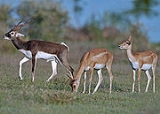
Antelope is a term referring to many
even-toed ungulateThe even-toed ungulates are ungulates whose weight is borne about equally by the third and fourth toes, rather than mostly or entirely by the third as in odd-toed ungulates such as horses....
species indigenous to various regions in
AfricaAfrica is the world's second largest and second most populous continent, after Asia. At about 30.2 million km² including adjacent islands, it covers 6% of the Earth's total surface area and 20.4% of the total land area...
and
EurasiaEurasia is a continent or supercontinent comprising the traditional continents of Europe and Asia ; covering about 52,990,000 km2 or about 10.6% of the Earth's surface located primarily in the eastern and northern hemispheres...
. Antelopes comprise a miscellaneous group within the family
BovidA bovid is any of almost 140 species of cloven-hoofed ruminant mammal at least the males of which bear characteristic unbranching horns covered in a permanent sheath of keratin....
ae, encompassing those
old-worldThe Old World consists of those parts of the world known to classical antiquity and the European Middle Ages. It is used in the context of, and contrast with, the "New World" ....
species that are neither cattle, sheep, buffalo, bison, nor goats. A group of antelope is called a
herdHerd refers to a social grouping of certain animals of the same species, either wild or domestic, and also to the form of collective animal behavior associated with this or as a verb, to herd, to its control by another species such as humans or dogs.The term herd is generally applied to mammals,...
.
Distinctions from confusingly similar even-toed ungulates
No antelope species are native to the
AmericasThe Americas, or America , are lands in the Western hemisphere, also known as the New World. In English, the plural form the Americas is often used to refer to the landmasses of North America and South America with their associated islands and regions, while the singular form America is primarily...
,
AustralasiaAustralasia is a region of Oceania comprising Australia, New Zealand, the island of New Guinea, and neighbouring islands in the Pacific Ocean. The term was coined by Charles de Brosses in Histoire des navigations aux terres australes...
, or
Antarctica. The
PronghornThe pronghorn is a species of artiodactyl mammal endemic to interior western and central North America. Though not an antelope, it is often known colloquially in North America as the prong buck, pronghorn antelope, or simply antelope, as it closely resembles the true antelopes of the Old World and...
of North America, though sometimes known colloquially as Pronghorn Antelope, is not a member of the family
BovidA bovid is any of almost 140 species of cloven-hoofed ruminant mammal at least the males of which bear characteristic unbranching horns covered in a permanent sheath of keratin....
ae, but the family Antilocapridae and accordingly is not a true antelope. Among their most obvious differences, pronghorns have branching horns, of which they shed the outer horny sheaths annually, in which they in turn differ from
deerDeer are the ruminant mammals forming the family Cervidae. Species in the Cervidae family include white-tailed deer, elk, moose, red deer, reindeer, fallow deer, roe deer and chital. Male deer of all species and female reindeer grow and shed new antlers each year...
. The horns of pronghorns and the antlers of deer contrast in two ways with the horns of true antelopes; firstly, although true antelopes have
hornsA horn is a pointed projection of the skin on the head of various animals, consisting of a covering of horn surrounding a core of living bone. True horns are found mainly among the ruminant artiodactyls, in the families Antilocapridae and Bovidae...
of various shapes according to species, whether straight, curved, helical, or otherwise, and although their horns have cores of living bone, their horns always are unbranched. Secondly, the antelope horn never is shed, either wholly as in the antlers of
deerDeer are the ruminant mammals forming the family Cervidae. Species in the Cervidae family include white-tailed deer, elk, moose, red deer, reindeer, fallow deer, roe deer and chital. Male deer of all species and female reindeer grow and shed new antlers each year...
, nor in part, as in the pronghorn.
Apart from not shedding their horns, antelope, and bovids in general, differ from deer in several other ways. Probably the most obvious is that their horns are perennial living bone covered with strong, thick layers of dead
hornKeratin refers to a family of fibrous structural proteins. Keratin is the key of structural material making up the outer layer of human skin. It is also the key structural component of hair and nails...
tissueTissue is a cellular organizational level intermediate between cells and a complete organism. A tissue is an ensemble of cells, not necessarily identical, but from the same origin, that together carry out a specific function. These are called tissues because of their identical functioning...
, whereas
antlerAntlers are the usually large, branching bony appendages on the heads of most deer species.-Etymology:Antler originally meant the lowest tine, the "brow tine"...
s, in those deer that have them, are covered with living skin ("velvet") only while growing. The velvet then is shed and the bony tissue, after it has matured, dies and is shed at the end of the season.
Etymology
The English word "antelope" first appears in 1417 and is derived from the
Old FrenchOld French was the Romance dialect continuum spoken in territories that span roughly the northern half of modern France and parts of modern Belgium and Switzerland from the 9th century to the 14th century...
antelop, itself derived from
Medieval LatinMedieval Latin was the form of Latin used in the Middle Ages, primarily as a medium of scholarly exchange and as the liturgical language of the medieval Roman Catholic Church, but also as a language of science, literature, law, and administration. Despite the clerical origin of many of its authors,...
ant(h)alopus, which in turn comes from the Byzantine Greek word
anthólops, first attested in
Eustathius of AntiochEustathius of Antioch, sometimes surnamed the Great, was a bishop and patriarch of Antioch in the 4th century.He was a native of Side in Pamphylia. About 320 he was bishop of Beroea, and he became patriarch of Antioch shortly before the Council of Nicaea in 325...
(c.336), according to whom it was a fabulous animal "haunting the banks of the Euphrates, very savage, hard to catch and having long saw-like horns capable of cutting down trees". It perhaps derives from Greek
anthos (flower) and
ops (eye), perhaps meaning "beautiful eye" or alluding to the animals long eyelashes; however this may be a later folk etymology. The word
talopus and
calopus, from Latin, came to be used in
heraldryHeraldry is the profession, study, or art of creating, granting, and blazoning arms and ruling on questions of rank or protocol, as exercised by an officer of arms. Heraldry comes from Anglo-Norman herald, from the Germanic compound harja-waldaz, "army commander"...
. In 1607 it was first used for living,
cervineDeer are the ruminant mammals forming the family Cervidae. Species in the Cervidae family include white-tailed deer, elk, moose, red deer, reindeer, fallow deer, roe deer and chital. Male deer of all species and female reindeer grow and shed new antlers each year...
animals.
Species
There are 91 species, most of which are native to Africa, in about 30 genera. The classification of tribes or subfamilies within
BovidA bovid is any of almost 140 species of cloven-hoofed ruminant mammal at least the males of which bear characteristic unbranching horns covered in a permanent sheath of keratin....
ae is still a matter of debate, with several alternative systems proposed.
Antelope are not a cladistic or taxonomically defined group. The term is used loosely to describe all members of the family Bovidae which do not fall under the category of sheep,
cattleCattle are the most common type of large domesticated ungulates. They are a prominent modern member of the subfamily Bovinae, are the most widespread species of the genus Bos, and are most commonly classified collectively as Bos primigenius...
, or
goatThe domestic goat is a subspecies of goat domesticated from the wild goat of southwest Asia and Eastern Europe. The goat is a member of the Bovidae family and is closely related to the sheep as both are in the goat-antelope subfamily Caprinae. There are over three hundred distinct breeds of...
. Usually all species of the
AlcelaphinaeThe subfamily Alcelaphinae contains Wildebeest, Hartebeest, Bonteboks and several similar species. All in all it contains 10 species in 4 genera, although Beatragus is sometimes considered a subgenus of Damaliscus, and Sigmoceros for the Lichtenstein's Hartebeest.* Family Bovidae** Subfamily...
,
AntilopinaeAntilopinae is a subfamily of Bovidae. The gazelles, blackbucks, springboks, gerenuks, dibatags and Central Asian gazelles are often referred to as "True Antelopes" and are usually the sole representatives of the Antilopinae...
, Hippotraginae,
ReduncinaeThe subfamily Reduncinae is composed 8 species of antelope all of which dwell in marshes, floodplains or other well-watered areas, including the waterbucks and reedbucks...
, Cephalophinae, many
BovinaeThe biological subfamily Bovinae includes a diverse group of 10 genera of medium to large sized ungulates, including domestic cattle, the bison, African buffalo, the water buffalo, the yak, and the four-horned and spiral-horned antelopes...
, the
Grey RhebokThe Grey Rhebok or Grey Rhebuck is a species of antelope endemic to South Africa, Zimbabwe, Lesotho and Swaziland....
, and the
impalaAn impala is a medium-sized African antelope. The name impala comes from the Zulu language meaning "gazelle"...
are called antelopes.
Distribution and habitat
Most species of antelope are native to Africa, but some occur in Asia. The
Arabian PeninsulaThe Arabian Peninsula is a land mass situated north-east of Africa. Also known as Arabia or the Arabian subcontinent, it is the world's largest peninsula and covers 3,237,500 km2...
is home to the
Arabian OryxThe Arabian Oryx or White Oryx is a medium sized antelope with a distinct shoulder hump, long straight horns, and a tufted tail. It is a bovid, and the smallest member of Oryx genus, native to desert and steppe areas of the Arabian peninsula...
and
Dorcas GazelleThe Dorcas Gazelle , also known as the Ariel Gazelle, is a small and common gazelle. The Dorcas Gazelle stands approximately 55-65 cm . Dorcas gazelle have a head and body length of 90-110 cm and a weight of 15-20 kg...
. India is home to the
NilgaiThe nilgai , sometimes called nilgau, is an antelope, and is one of the most commonly seen wild animals of central and northern India and eastern Pakistan; it is also present in parts of southern Nepal. The mature males appear ox-like and are also known as blue bulls...
,
ChinkaraThe Chinkara is a species of gazelle found in south Asia.-Habitat and Distribution:It lives in grasslands and desert areas in India, Bangladesh and parts of Iran and Pakistan...
, and
BlackbuckBlackbuck is a species of antelope native to the Indian subcontinent. Their range decreased sharply during the 20th century. Since 2003, the IUCN lists the species as near threatened....
, while Russia and Central Asia have the
Four-horned AntelopeThe Four-horned Antelope , or Chousingha, is a small antelope found in open forest in India and Nepal. It is the only species currently classified in the genus Tetracerus.-Description:...
,
Tibetan antelopeThe Tibetan antelope or chiru is a medium-sized bovid which is about in height at the shoulder. It is the sole species in the genus Pantholops and is placed in its own subfamily, Pantholopinae...
, and
Saiga AntelopeThe saiga is a Critically Endangered antelope which originally inhabited a vast area of the Eurasian steppe zone from the foothills of the Carpathians and Caucasus into Dzungaria and Mongolia. They also lived in North America during the Pleistocene...
.
Many species of antelope have been imported to other parts of the world, especially the United States, for exotic game hunting. Due to the spectacular leaping and evasive skills of some species, individuals may escape.
TexasTexas is the second largest U.S. state by both area and population, and the largest state by area in the contiguous United States.The name, based on the Caddo word "Tejas" meaning "friends" or "allies", was applied by the Spanish to the Caddo themselves and to the region of their settlement in...
in particular has high numbers of gaming ranches, as well as habitat and climate that are very hospitable to African and Asian plains antelope species. As such, wild populations of Blackbuck Antelope,
GemsbokThe gemsbok or gemsbuck is a large antelope in the Oryx genus. It is native to the arid regions of southern Africa, but formerly some authorities included the East African Oryx as a subspecies...
, and
NilgaiThe nilgai , sometimes called nilgau, is an antelope, and is one of the most commonly seen wild animals of central and northern India and eastern Pakistan; it is also present in parts of southern Nepal. The mature males appear ox-like and are also known as blue bulls...
exist in Texas, though they are not native to the area.
Antelope exist in a wide range of habitats. Numerically, most exist in the African savannahs. However, there are many species of more secluded forest antelope, as well as the extreme-cold living Saiga, desert adapted
Arabian OryxThe Arabian Oryx or White Oryx is a medium sized antelope with a distinct shoulder hump, long straight horns, and a tufted tail. It is a bovid, and the smallest member of Oryx genus, native to desert and steppe areas of the Arabian peninsula...
, the rocky kopje-living
klipspringerThe Klipspringer, Oreotragus oreotragus, is a small species of African antelope.-Name:The word klipspringer literally means "rock jumper" in Afrikaans/Dutch...
, and semi-aquatic
sitatungaThe situtunga or marshbuck is a swamp-dwelling antelope found throughout Central Africa, centering on the Democratic Republic of the Congo, Cameroon and parts of Southern Sudan as well as in Ghana, Botswana, Zambia, Gabon, Tanzania, Uganda and Kenya.-Description:Situtunga stand about one and a...
.
Species of forest, woodland, or bush tend to be sedentary, but many of the plains species undertake huge migrations. These migrations enable grass-eating species to follow the rains and therefore their food supply. The
gnusThe wildebeest , also called the gnu is an antelope of the genus Connochaetes. It is a hooved mammal...
and
gazelleA gazelle is any of many antelope species in the genus Gazella, or formerly considered to belong to it. Six species are included in two genera, Eudorcas and Nanger, which were formerly considered subgenera...
s of
East AfricaEast Africa or Eastern Africa is the easterly region of the African continent, variably defined by geography or geopolitics. In the UN scheme of geographic regions, 19 territories constitute Eastern Africa:...
perform some of the most impressive mass migratory circuits of all mammals.
Morphology
All bovids have even-toed hooves, horizontal pupils, ruminating guts, and (in at least the males) bony horns. These basic characteristics, however, mask huge differences in appearance between antelopes, cattle, goats, and sheep, and among the antelopes themselves. For example, a male
Common ElandThe common eland , also known as the southern eland or eland antelope, is a savannah and plains antelope found in East and Southern Africa. It is the largest antelope in the African continent...
can measure 178 centimetres (70.1 in) at the shoulder and weigh almost 950 kilograms (2,094.4 lb), whereas an adult
Royal AntelopeThe Royal Antelope is a West African antelope, only 25–30 cm high at the shoulder and weighing only 3.2–3.6 kg — it is the smallest of all antelopes. Their calves are small enough to fit into the average person's open hand...
may stand only 24 centimetres (9.4 in) at the shoulder and weigh a mere 1.5 kilograms (3.3 lb).
Not surprisingly for animals with long, slender yet powerful legs, many antelopes have long strides and can run fast. Some (e.g.
KlipspringerThe Klipspringer, Oreotragus oreotragus, is a small species of African antelope.-Name:The word klipspringer literally means "rock jumper" in Afrikaans/Dutch...
) are also adapted to climbing in rock kopjes. Both
DibatagThe dibatag , or Clarke's gazelle, is an antelope found in the sandy grasslands of Ethiopia and Somalia. Not a true gazelle, it is similarly marked, with a long, furry black tail which is raised in flight...
s and
GerenukThe Gerenuk , also known as the Waller's Gazelle, is a long-necked species of antelope found in dry bushy scrub and steppe in East Africa, from Somalia and eastern Ethiopia through northern and eastern Kenya to northeastern Tanzania...
s habitually stand on their two hind legs to reach
acaciaAcacia is a genus of shrubs and trees belonging to the subfamily Mimosoideae of the family Fabaceae, first described in Africa by the Swedish botanist Carl Linnaeus in 1773. Many non-Australian species tend to be thorny, whereas the majority of Australian acacias are not...
and other tree foliage. Different antelope have different body types which can affect movement. Duikers are short, bush-dwelling antelope that can pick through dense foliage and dive into the shadows rapidly. Gazelles and Springbok are known for their speed and leaping abilities. Even larger antelope, such as
NilgaiThe nilgai , sometimes called nilgau, is an antelope, and is one of the most commonly seen wild animals of central and northern India and eastern Pakistan; it is also present in parts of southern Nepal. The mature males appear ox-like and are also known as blue bulls...
,
ElandsTaurotragus, commonly called Eland, is a genus of antelopes of the African savannah, containing two species: the Common Eland and the Giant Eland...
, and
KuduThe kudus are two species of antelope of the genus Tragelaphus:*Lesser Kudu, Tragelaphus imberbis*Greater Kudu, Tragelaphus strepsiceros- Etymology :...
s, are capable of jumping 8 feet (2.4 m) or greater, although their running speed is restricted by their greater mass.
Antelopes have a wide variety of coverings, through most have a dense coat of short fur. In most species, the coat (pelage) is some variation of a brown colour (or several shades of brown); often with white or pale under-bodies. Exceptions include the zebra-marked
Zebra DuikerThe Zebra Duiker is a small antelope found in Ivory Coast, Guinea, Sierra Leone and Liberia.Zebra Duikers have gold or red-brown coats with distinctive zebra-like stripes, dark markings on their upper legs and russet faces. They grow to 90 centimetres in length, 45 centimetres in height and weigh...
; the grey, black, and white
Jentink's DuikerJentink's Duiker, Cephalophus jentinki, also known as Gidi-Gidi in Krio and Kaikulowulei in Mende, is a forest-dwelling duiker found in the southern parts of Liberia, south-western Côte d'Ivoire, and scattered enclaves in Sierra Leone...
; and the Black Lechwe. Most of the "spiral-horned" antelopes have pale vertical stripes on their backs. Many desert and sub-desert species are particularly pale, some almost silvery or whitish (e.g.
Arabian OryxThe Arabian Oryx or White Oryx is a medium sized antelope with a distinct shoulder hump, long straight horns, and a tufted tail. It is a bovid, and the smallest member of Oryx genus, native to desert and steppe areas of the Arabian peninsula...
); the Beisa and Southern Oryxes have gray and black pelage with vivid black-and-white faces. Common features of various
gazelleA gazelle is any of many antelope species in the genus Gazella, or formerly considered to belong to it. Six species are included in two genera, Eudorcas and Nanger, which were formerly considered subgenera...
s are a white rump, which flashes a warning to others when they run from danger, and a dark stripe mid-body (the latter feature is also shared by the Springbok and
BeiraThe Beira is a small antelope that inhabits arid regions of Somalia, Djibouti, and eastern Ethiopia.The Beira stands high at the shoulder and weighs between . It has a coarse, red-grey coat with a yellow-red face. It has long, ears and the males of the species have short, straight horns...
). The
SpringbokSpringbok can have the following meanings:* Springbok , a small antelope inhabiting southern and western Africa.* South Africa national rugby union team, known as the Springboks....
also has a pouch of white brushlike hairs running along its back, which opens up when the animal senses danger, causing the dorsal hairs to stand on end.
Antelopes are
ruminantA ruminant is a mammal of the order Artiodactyla that digests plant-based food by initially softening it within the animal's first compartment of the stomach, principally through bacterial actions, then regurgitating the semi-digested mass, now known as cud, and chewing it again...
s, and thus have well-developed molar teeth, which grind
cudCud is a portion of food that returns from a ruminant's stomach in the mouth to be chewed for the second time. More accurately, it is a bolus of semi-degraded food regurgitated from the reticulorumen of a ruminant. Cud is produced during the physical digestive process of rumination, or "chewing the...
(food balls stored in the stomach) into a pulp for further digestion. They have no upper incisors, but rather a hard upper gum pad, against which their lower incisors bite to tear grass stems and leaves.
Like many other
herbivoreHerbivores are organisms that are anatomically and physiologically adapted to eat plant-based foods. Herbivory is a form of consumption in which an organism principally eats autotrophs such as plants, algae and photosynthesizing bacteria. More generally, organisms that feed on autotrophs in...
s, antelopes rely on keen senses to avoid predators. Their eyes are placed on the sides of their heads, giving them a broad radius of vision with minimal binocular vision. The fact that most species have their pupils elongated horizontally also helps in this respect. Acute senses of smell and hearing, give antelope the ability to perceive danger at night out in the open (when predators are often on the prowl). These same senses play an important role in contact between individuals of the same species: markings on head, ears, legs, and rumps are used in such communication—many species "flash" such markings, as well as their tails; vocal communications include loud barks, whistles, "moos" and trumpeting; many species also use scent marking to define their territories or simply to maintain contact with their relatives and neighbors.
Many antelope are sexually dimorphic. In most species, both sexes have horns, but those of males tend to be larger. There is a tendency for males to be larger than the females; however, exceptions in which the females tend to be heavier than the males include the Bush Duiker, Dwarf Antelope, Cape Grysbok, and
OribiOribi are graceful slender-legged, long-necked small antelope found in grassland almost throughout Sub-Saharan Africa.-Description:...
, all rather small species. A number of species have hornless females (e.g.
SitatungaThe situtunga or marshbuck is a swamp-dwelling antelope found throughout Central Africa, centering on the Democratic Republic of the Congo, Cameroon and parts of Southern Sudan as well as in Ghana, Botswana, Zambia, Gabon, Tanzania, Uganda and Kenya.-Description:Situtunga stand about one and a...
, Red Lechwe, and
SuniSuni is a very small species of antelope. It occurs in south-east Africa in dense underbrush.Suni are around 12-17 inches high at the shoulder and weigh 10-12 pounds . They are usually reddish brown, darker on their back than their sides and legs. The belly, chin, throat and insides of legs are...
). In some species, the males and females have different coloured pelage (e.g.
BlackbuckBlackbuck is a species of antelope native to the Indian subcontinent. Their range decreased sharply during the 20th century. Since 2003, the IUCN lists the species as near threatened....
and
NyalaThe Nyala is a Southern African antelope. It is a spiral-horned dense-forest antelope that is uncomfortable in open spaces and is most often seen at water holes. Nyalas live alone or in small family groups of up to 10 individuals.The male stands up to 110 cm , the female is up to 90 cm ...
).
The size and shape of antelope horns varies immensely. Those of the
duikerA duiker is any of about 21 small to medium-sized antelope species from the subfamily Cephalophinae native to Sub-Saharan Africa.Duikers are shy and elusive creatures with a fondness for dense cover; most are forest dwellers and even the species living in more open areas are quick to disappear...
s and
dwarf antelopesThe Tribe Neotragini comprises the dwarf antelopes of Africa:* Dorcatragus** Beira Dorcatragus megalotis* Madoqua** Günther's Dik-dik Modoqua guntheri** Kirk's Dik-dik Madoqua kirkii** Silver Dik-dik Madoqua piacentinii...
tend to be simple "spikes", but differ in the angle to the head from backward curved and backward pointing (e.g.
Yellow-backed DuikerThe Yellow-backed Duiker , is an antelope found in central and western Africa. They have the widest range of any duiker in the genus Cephalophus....
) to straight and upright (e.g.
SteenbokThe Steenbok, Raphicerus campestris, is a common small antelope of southern and eastern Africa. It is sometimes known as the Steinbuck or Steinbok.- Description :...
). Other groups have twisted (e.g.
Common ElandThe common eland , also known as the southern eland or eland antelope, is a savannah and plains antelope found in East and Southern Africa. It is the largest antelope in the African continent...
), spiral (e.g.
Greater KuduThe Greater Kudu is a woodland antelope found throughout eastern and southern Africa. Despite occupying such widespread territory, they are sparsely populated in most areas, due to a declining habitat, deforestation and hunting....
), "recurved" (e.g. the
reedbuckReedbuck is a common name for African antelopes from the genus Redunca. These species are:* Southern Reedbuck, Redunca arundinum* Mountain Reedbuck, Redunca fulvorufula* Bohor Reedbuck, Redunca redunca...
s), lyrate (e.g.
impalaAn impala is a medium-sized African antelope. The name impala comes from the Zulu language meaning "gazelle"...
), or long, curved (e.g. the
oryxOryx is one of four large antelope species of the genus Oryx. Three of the species are native to arid parts of Africa, with a fourth native to the Arabian Peninsula. Their pelage is pale with contrasing dark markings in the face and on the legs, and their long horns are almost straight...
es) horns. Horns are not shed and their bony core is covered with a thick, persistent sheath of
horny materialKeratin refers to a family of fibrous structural proteins. Keratin is the key of structural material making up the outer layer of human skin. It is also the key structural component of hair and nails...
, both of which features distinguish them from antlers.
Horns are efficient weapons and tend to be better developed in those species where males fight over females (large herd antelope) than in solitary or lekking species. With male-male competition for mates, horns are clashed in combat. It is much more common for males to use their horns against each other than against another species. The boss of the horns is typically arranged in such a way that two antelope striking at each other's horns cannot crack each other's skulls, making a fight via horn more ritualized than dangerous. Many species have ridges in their horns for at least 2/3 the length of their horns, but these ridges are not a direct indicator of age.
Mating strategies
Antelope are often classified by their reproductive behavior.
Small antelope, such as
dik-dikA dik-dik, pronounced "dĭk’ dĭk", is a small antelope in the Genus Madoqua that lives in the bushes of eastern and southern Africa. Dik-diks stand 30–40 cm at the shoulder, are 50–70 cm long, weigh 3–6 kg and can live for up to 10 years...
s, tend to be monogamous. They live in a forest environment with patchy resources, and a male is unable to monopolize more than one female due to this sparse distribution. Larger forest species often form very small herds of 2–4 females and 1 male.
Some species such as
lechweThe Lechwe, or Southern Lechwe, is an antelope found in Botswana, Zambia, south-eastern Democratic Republic of the Congo, north-eastern Namibia, and eastern Angola, especially in the Okavango Delta, Kafue Flats and Bangweulu Swamps....
pursue a lek breeding system. In this, the males gather on a lekking ground and compete for a small territory, while the females appraise males and choose one with which to mate.
Large grazing antelope, such as
impalaAn impala is a medium-sized African antelope. The name impala comes from the Zulu language meaning "gazelle"...
or
wildebeestThe wildebeest , also called the gnu is an antelope of the genus Connochaetes. It is a hooved mammal...
form large herds made up of many females and a single breeding male, which excludes all other males, often by combat.
Defense
Antelope pursue a number of defense strategies, often dictated by their morphology.
Large antelope that gather in large herds, such as
wildebeestThe wildebeest , also called the gnu is an antelope of the genus Connochaetes. It is a hooved mammal...
rely on numbers and running speed for protection. In some species, adults will circle around the offspring, protecting them from predators when threatened. Many forest antelope rely on
crypticIn ecology, crypsis is the ability of an organism to avoid observation or detection by other organisms. It may be either a predation strategy or an antipredator adaptation, and methods include camouflage, nocturnality, subterranean lifestyle, transparency, and mimicry...
coloring and good hearing to avoid predators. Forest antelope often have very large ears and a dark or striped coloration. Small antelope, especially
duikerA duiker is any of about 21 small to medium-sized antelope species from the subfamily Cephalophinae native to Sub-Saharan Africa.Duikers are shy and elusive creatures with a fondness for dense cover; most are forest dwellers and even the species living in more open areas are quick to disappear...
s, evade predation by jumping into dense bush where the predator cannot pursue. Springboks use a behavior known as
stottingStotting is a gait of quadrupeds, particularly gazelles , involving jumping high into the air by lifting all four feet off the ground simultaneously. This may occur during pursuit by a predator...
to confuse predators.
Open grassland species have nowhere to hide from predators so they tend to be fast runners. They are
agile* Agility is a physical trait of an animal or person, and a component of physical fitness. It is the ability to change the body's position and direction with speed and precision.Agility may also refer to:In Sport:...
and have good
enduranceEndurance is the ability for a human or animal to exert itself and remain active for a long period of time, as well as its ability to resist, withstand, recover from, and have immunity to trauma, wounds, or fatigue. In humans, it is usually used in aerobic or anaerobic exercise...
—these are advantages when pursued by sprint-dependent predators like
cheetahThe cheetah is a large-sized feline inhabiting most of Africa and parts of the Middle East. The cheetah is the only extant member of the genus Acinonyx, most notable for modifications in the species' paws...
, which are the fastest of land animals but tire quickly. Reaction distances vary with predator species and predator behaviour. For example, gazelles may not flee from a
lionThe lion is one of the four big cats in the genus Panthera, and a member of the family Felidae. With some males exceeding 250 kg in weight, it is the second-largest living cat after the tiger...
until it is closer than 200 m (650 ft)—lions hunt as a pride or by surprise, usually by stalking, one that can be seen clearly is unlikely to attack. However, sprint-dependent cheetahs will cause gazelles to flee at a range of over 800 m (0.5 mile).
Status
About 25 species are rated by the IUCN as endangered, such as the
Dama GazelleThe Dama Gazelle is a species of gazelle. It lives in Africa in the Sahara desert and migrates south in search of food during the dry season. Their habitat includes open steppes, bushy, grassy steppes, semi-desert, and deserts, while their diet includes grasses, leaves, shoots, fruit, and...
and
Mountain NyalaThe Mountain Nyala found in Oromia, Ethiopia as gadumsa, is an antelope found in high altitude woodland in a small part of central Ethiopia...
. A number of subspecies are also endangered, including the
Giant Sable AntelopeThe Giant Sable Antelope, Hippotragus niger variani, also known in Portuguese as the Palanca Negra Gigante, is a large, rare subspecies of Sable Antelope native and endemic to the region between Cuango and Luando Rivers in Angola....
and mhorr gazelle. The main causes for concern for these species are habitat loss, competition with cattle for grazing, and trophy hunting.
The chiru or
Tibetan antelopeThe Tibetan antelope or chiru is a medium-sized bovid which is about in height at the shoulder. It is the sole species in the genus Pantholops and is placed in its own subfamily, Pantholopinae...
is hunted for its pelt, which is used in making shahtoosh, an incredibly fine material used in shawls. The fur can only be removed from dead animals, and each animal yields very little of the downy fur, so multiple antelope must be killed to make a single shawl. This unsustainable demand has led to enormous declines in the chiru population.
The
Saiga AntelopeThe saiga is a Critically Endangered antelope which originally inhabited a vast area of the Eurasian steppe zone from the foothills of the Carpathians and Caucasus into Dzungaria and Mongolia. They also lived in North America during the Pleistocene...
is hunted for its horns, which are considered an
aphrodisiacAn aphrodisiac is a substance that increases sexual desire. The name comes from Aphrodite, the Greek goddess of sexuality and love. Throughout history, many foods, drinks, and behaviors have had a reputation for making sex more attainable and/or pleasurable...
by some cultures. Only the males carry the horns, and have been heavily hunted to the point where some herds contain up to 800 females and a single male. The species has shown a steep decline and is critically endangered.
Lifespan
It is difficult to determine how long antelope live in the wild. With the preference of predators towards old and infirm individuals which can no longer sustain peak speeds, few wild prey-animals live as long as their biological potential. In captivity,
wildebeestThe wildebeest , also called the gnu is an antelope of the genus Connochaetes. It is a hooved mammal...
have lived beyond 20 years old, and impalas have reached their late teens. In the wild, few individuals of prey species live to old age, as the old and weak are easier prey for predators; antelopes are no exception to this rule.
Culture
The antelope's horn is prized for medicinal and magical powers in many places. The horn of the male Saiga in Eastern practice is ground as an aphrodisiac, for which it has been hunted nearly to extinction. In the
CongoThe Republic of the Congo , sometimes known locally as Congo-Brazzaville, is a state in Central Africa. It is bordered by Gabon, Cameroon, the Central African Republic, the Democratic Republic of the Congo , the Angolan exclave province of Cabinda, and the Gulf of Guinea.The region was dominated by...
, it is thought to confine spirits. Christian iconography sometimes uses the antelope's two horns as a symbol of the two spiritual weapons that Christians possess: the
Old TestamentThe Old Testament, of which Christians hold different views, is a Christian term for the religious writings of ancient Israel held sacred and inspired by Christians which overlaps with the 24-book canon of the Masoretic Text of Judaism...
and the
New TestamentThe New Testament is the second major division of the Christian biblical canon, the first such division being the much longer Old Testament....
. Their ability to run swiftly has also led to their association with the
windWind is the flow of gases on a large scale. On Earth, wind consists of the bulk movement of air. In outer space, solar wind is the movement of gases or charged particles from the sun through space, while planetary wind is the outgassing of light chemical elements from a planet's atmosphere into space...
, such as in the
Rig Veda, as the steeds of the
MarutsIn Hinduism the Marutas , also known as the Marutagana and sometimes identified with Rudras, are storm deities and sons of Rudra and Diti and attendants of Indra. The number of Maruts varies from two to sixty . They are very violent and aggressive, described as armed with golden weapons i.e...
and the wind god
VayuVāyu is a primary Hindu deity, the Lord of the winds, the father of Bhima and the spiritual father of Lord Hanuman...
.
Domestication
Domestication of animals requires certain traits in the animal which antelope do not typically display. Most species are difficult to contain in any density, due to territoriality of males or in the case of
oryxOryx is one of four large antelope species of the genus Oryx. Three of the species are native to arid parts of Africa, with a fourth native to the Arabian Peninsula. Their pelage is pale with contrasing dark markings in the face and on the legs, and their long horns are almost straight...
es (which have a relatively hierarchical social structure), an aggressive disposition that can easily kill a human. Because many have extremely good jumping abilities, providing adequate fencing is a challenge. Also, antelope will consistently display a fear response to perceived predators, such as humans, making them very difficult to herd or handle. Although antelopes have a diet and rapid growth rate highly suitable for
domesticationDomestication or taming is the process whereby a population of animals or plants, through a process of selection, becomes accustomed to human provision and control. In the Convention on Biological Diversity a domesticated species is defined as a 'species in which the evolutionary process has been...
, this tendency to
panicPanic is a sudden sensation of fear which is so strong as to dominate or prevent reason and logical thinking, replacing it with overwhelming feelings of anxiety and frantic agitation consistent with an animalistic fight-or-flight reaction...
and their non-hierarchical social structure explains why farm-raised antelope is uncommon. Ancient Egyptians kept herds of gazelles for meat, and occasionally pets. It is unknown whether they were truly domesticated, but it seems unlikely as no domesticated gazelles exist today.
However, humans have had success taming certain species, such as the
elandsTaurotragus, commonly called Eland, is a genus of antelopes of the African savannah, containing two species: the Common Eland and the Giant Eland...
. These antelope sometimes jump over each other's backs when alarmed, but this incongruous talent seems to be exploited only by wild members of the species; tame elands do not take advantage of it and can be enclosed within a very low fence. Their meat, milk, and hides are all of excellent quality, and experimental eland husbandry has been going on for some years in both Ukraine and Zimbabwe. In both locations the animal has proved wholly amenable to domestication. For further information, see animal domestication.
Hybrid antelope
A wide variety of antelope hybrids have been recorded in zoos, game parks, and wildlife ranches. This is due to either a lack of more appropriate mates in enclosures shared with other species or a misidentification of species. The ease of hybridization shows how closely related some antelope species are. With few exceptions, most hybrid antelope occur only in captivity.
Most hybrids occur between species within the same genus. All reported examples occur within the same sub-family. As with most mammal hybrids, the less closely related the parents, the more likely that the offspring will be sterile.
External links