

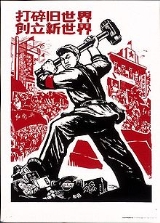
Cultural Revolution

Encyclopedia
The Great Proletarian Cultural Revolution, commonly known as the Cultural Revolution , was a socio-political movement that took place in the People's Republic of China
from 1966 through 1976. Set into motion by Mao Zedong
, then Chairman of the Communist Party of China
, its stated goal was to enforce socialism
in the country by removing capitalist
, tradition
al and cultural
elements from Chinese society, and to impose Maoist orthodoxy within the Party. The revolution marked the return of Mao Zedong to a position of absolute power after the failed Great Leap Forward
. The movement paralyzed the country politically and significantly impacted the country economically and socially.
The Revolution was launched in May 1966. Mao alleged that bourgeois elements were entering the government and society at large, aiming to restore capitalism. He insisted that these "revisionist
s" be removed through violent class struggle
. China's youth then responded to Mao's appeal by forming Red Guard
groups around the country. The movement then spread into the military, urban workers, and the Communist Party leadership itself. It resulted in widespread factional struggles in all walks of life. In the top leadership, it led to a mass purge of senior officials who were accused of deviating from the socialist path, most notably Liu Shaoqi
and Deng Xiaoping
. During the same period Mao's personality cult grew to immense proportions.
Millions of people were persecuted in the violent factional struggles that ensued across the country, and suffered a wide range of abuses including torture, rape, imprisonment, sustained harassment, and seizure of property. A large segment of the population was forcibly displaced, most notably the transfer of urban youth to rural regions during the Down to the Countryside Movement
. Historical relics and artifacts were destroyed. Cultural and religious sites were ransacked.
Mao officially declared the Cultural Revolution to have ended in 1969, but its active phase lasted until the death of Lin Biao
in 1971. The political instability between 1971 and the arrest of the Gang of Four
in 1976 is now also widely regarded as part of the Revolution. After Mao's death in 1976, reformers led by Deng Xiaoping
gained prominence. Most of the Maoist reforms associated with the Cultural Revolution were abandoned by 1978. The Cultural Revolution has been treated officially as a negative phenomenon ever since.
, Mao called for "grassroots socialism" in order to accelerate his plans for turning China into a modern industrialized state. In this spirit, Mao launched the Great Leap Forward
, established People's Commune
s in the countryside, and began the mass mobilization
of the people. Many communities were assigned production of a single commodity—steel. Mao vowed to increase agricultural production to twice 1957 levels.
The Great Leap was an economic failure. Uneducated farmers attempted to produce steel on a massive scale, partially relying on backyard furnace
s to achieve the production targets set by local cadres. The steel produced was low quality and largely useless. The Great Leap reduced harvest sizes and led to a decline in the production of most goods except substandard pig iron
and steel. Furthermore, local authorities frequently exaggerated production numbers, hiding and intensifying the problem for several years. In the meantime, chaos in the collectives, bad weather, and exports of food necessary to secure hard currency resulted in the Great Chinese Famine. Food was in desperate shortage, and production fell dramatically. The famine caused the deaths of millions of people, particularly in poorer inland regions.
The Great Leap's failure reduced Mao's prestige within the Party. Forced to take major responsibility, in 1959, Mao resigned as the State Chairman
, China's head of state, and was succeeded by Liu Shaoqi
. In July, senior Party leaders convened
at the scenic Mount Lu to discuss policy. At the conference, Marshal Peng Dehuai
, the Minister of Defence, criticized Great-Leap policies in a private letter to Mao, writing that it was plagued by mismanagement and cautioning against elevating political dogma over the laws of economics. Despite the moderate tone of Peng's letter, Mao took it as a personal attack against his leadership. Following the Conference, Mao had Peng removed from his posts, and accused him of being a 'right-opportunist'. Peng was replaced by Lin Biao
, another revolutionary army general who became a more staunch Mao supporter later in his career. While the Lushan Conference
served as a death knell for Peng, Mao's most vocal critic, it led to a shift of power to moderates led by Liu Shaoqi and Deng Xiaoping, who took effective control of the economy following 1959.
By the early 1960s, many of the Great Leap's economic policies were reversed by initiatives spearheaded by Liu, Deng, and Zhou Enlai
. This moderate group of pragmatists were unenthusiastic about Mao's utopian visions. Owing to his loss of esteem within the party, Mao developed a decadent and eccentric lifestyle. By 1962, while Zhou, Liu and Deng managed affairs of state and the economy, Mao had effectively withdrawn himself from economic decision-making, and focused much of his time on further contemplating his contributions to Marxist-Leninist social theory, including the idea of "continuous revolution." This theory's ultimate aim was to set the stage for Mao to restore his brand of Communism and his personal prestige within the Party.
were the two largest Communist states in the world. Whilst they had initially been mutually supportive, issues arose following the ascendancy of Nikita Khrushchev
to power in the Soviet Union after the death of Joseph Stalin
. In 1956, Khrushchev denounced both Stalin and his policies and subsequently set about implementing post-Stalinist economic reforms. Mao and many members of the Chinese Communist Party were opposed to these changes, believing that it would have negative repercussions for the worldwide Marxist movement, among whom Stalin was still viewed as a hero. Mao also believed that Khrushchev was not adhering to Marxism-Leninism
, but was instead a revisionist
, altering his policies from basic Marxist concepts, something Mao feared would allow capitalists
to eventually regain control of the country. Relations between the two governments subsequently soured
, with the Soviets for instance refusing to support China's case for joining the United Nations
and going back on their pledge to supply China with a nuclear weapon
.
Mao went on to publicly denounce revisionism in April 1960. Without pointing fingers at the Soviet Union, Mao criticized their ideological ally, the League of Communists of Yugoslavia
, whilst the Soviets returned the favour by proxy via criticizing the Party of Labour of Albania, a Chinese ally. In 1963, the Communist Party began to openly denounce the Soviet Union, publishing a series of nine polemics against their Marxist revisionism, with one of them being titled On Khrushchev's Phoney Communism and Historical Lessons for the World, where Mao charged that Khrushchev was not only revisionist but also presented a real danger for capitalist restoration. Khrushchev's own downfall from an internal coup d'état in 1964 also contributed to Mao's own fears of political vulnerability, particularly because of his dwindling prestige amongst his colleagues following the Great Leap forward.
In late 1959, historian and Beijing Deputy Mayor Wu Han
published a historical drama entitled Hai Rui Dismissed from Office
. In the play, an honest civil servant, Hai Rui
, is dismissed by a corrupt emperor. While Mao initially praised the play, in February 1965 he secretly commissioned his wife Jiang Qing
and Shanghai propagandist Yao Wenyuan
to publish an article criticizing it. Yao boldly alleged that Hai Rui was really an allegory attacking Mao; that is, Mao was the corrupt emperor and Peng Dehuai
was the honest civil servant.
Beijing Mayor Peng Zhen
, a powerful official and Wu Han's direct superior, spearheaded a committee to refute Yao's claims. Yao's article was initially syndicated by several municipal dailies. Peng Zhen, aware that he would be implicated if it were established that Wu wrote an "anti-Mao" play, forbid Yao's article from being published on the nationally distributed People's Daily
. In November, Premier Zhou Enlai urged Peng Zhen to publish the article nationally to avoid contradicting Mao's wishes. Peng Zhen refused, instructing newspapers under his control to focus exclusively on "academic discussion," not politics. While the 'literary battle' against Peng raged, Mao fired Yang Shangkun
, director of the Party's General Office, an organ that controlled internal communications, installing in his stead staunch loyalist Wang Dongxing
, head of Mao's security detail. Yang was accused of "bugging Mao's office" among a series of other unsubstantiated charges.
Yang's dismissal likely emboldened Mao's allies to move against their factional rivals. In December, Defence Minister and Mao loyalist Lin Biao
accused General Luo Ruiqing
, the chief of staff of the People's Liberation Army, of being anti-Mao, alleging that Luo put too much emphasis on military training rather than Maoist "political discussion." In December, Mao called an enlarged Politburo meeting to discuss the charges against Luo. While the Politburo initially received the charges with skepticism, Mao pushed for an investigation into Luo's conduct, after which Luo was denounced, dismissed, and forced to deliver a self-criticism
. Stress from the events led Luo to attempt suicide. Luo's removal solidified Lin's leadership in the PLA, securing the military command's loyalty to Mao.
Having ousted Luo and Yang, Mao reverted his attention to Peng Zhen. On February 12, 1966, Peng Zhen's committee, the "Five Man Group
", issued a report known as the February Outline . The Outline, sanctioned by the Party centre, defined Hai Rui as healthy "academic discussion," and aimed to formally distance Peng Zhen from any political implications. However, Jiang Qing and Yao Wenyuan continued their denunciation of Wu Han and Peng Zhen. Meanwhile, Mao targeted Propaganda Department director Lu Dingyi
, an ally of Peng Zhen who had occasionally made skeptical remarks about Mao Zedong Thought. Lu's removal would give Maoists unrestricted access to the Press. Mao delivered his final blow to Peng Zhen by proxy through hardline supporters Kang Sheng
and Chen Boda
in May. At an enlarged Politburo session in Beijing, Kang and Chen accused Peng Zhen of opposing Mao, labeled the February Outline "evidence of Peng Zhen's revisionism", and grouped him with three other disgraced officials as part of the "Peng-Luo-Lu-Yang Anti-Party Clique." The decisions were made with the support of Zhou Enlai and Liu Shaoqi; Zhou called it a "great victory for Mao Zedong Thought." On May 16, the Politburo formalized the decisions by releasing a party-wide notification, condemning Peng Zhen and his "anti-party allies" in the strongest terms, disbanding his "Five Man Group", and replacing it with the Maoist Cultural Revolution Group
(CRG).
issued six Central Documents regarding the dismissal of Peng, Luo, Lu and Yang in which they declared that the "Great Cultural Revolution" had been launched. One of these documents, titled Zhongfa 267, contained a notification that had been prepared under Mao's personal supervision, in which the writers condemned Peng's "errors" of revisionist thinking. In one passage at the end of the notification, it stated that:
This text, which became known as the May 16 Notification, was then put to the vote amongst the members of the Politburo on whether it should be officially adopted, and "was approved unanimously by a show of hands, without any alterations whatever to the text." Initially it was given the second-highest level of classification then in use, meaning that only those Communist Party members of rank 17 and above could gain access to it. It would be publicly printed in the People's Daily newspaper a year later, on 17 May 1967, where it was claimed that it had "sounded the Great Proletarian Cultural Revolutionary bugle to advance". However, upon its initial release, there was some confusion as to what the May 16 Notification actually meant amongst Party members.
, wrote a big-character poster
and taped it onto a public bulletin. Nie attacked the university party administration and cadres from Beijing party authorities as "black anti-Party gangsters," implying that there were forces at work in government and at the university who wished to betray the progress of the revolution. Several days later, Mao ordered Nie's message to be broadcast nationwide and called it "the first Marxist big-character poster in China." On May 29, at the High School attached to Tsinghua University
, the first organization of Red Guards
was formed with the aim of punishing and neutralising both intellectuals and Mao's political enemies.
On June 1, 1966, the People's Daily
launched an attack on "reactionary" forces in the intellectual community. Subsequently, various university presidents and other prominent intellectuals were purged. On July 28, 1966, Red Guard representatives wrote to Mao, stating that mass purges and all such related social and political phenomena were justified and correct. Mao responded with his full support with his own big-character poster entitled Bombard the Headquarters
. Mao wrote that despite having undergone a Communist revolution, China's political hierarchy was still dominated by "bourgeoisie" elitist elements, capitalists, and revisionists, and that these counter-revolutionary elements were indeed still present at the top ranks of the party leadership itself. This was, in effect, an open call-to-arms against Liu Shaoqi, Deng Xiaoping, and their allies.
The Decision took the already existing student movement and elevated it to the level of a nationwide mass campaign, calling on not only students but also "the masses of the workers, peasants, soldiers, revolutionary intellectuals, and revolutionary cadres" to carry out the task of "transforming the superstructure" by writing big-character posters and holding "great debates." China, Mao felt, needed a "Cultural Revolution" to put socialism back on track.
The freedoms granted in the 16 Points were later written into the PRC constitution as "the four great rights (四大自由, Sì Dà Zìyóu)" of "great democracy (大民主, Dàmínzhǔ)": the right to speak out freely, to air one's views fully, to write big-character posters, and to hold great debates (大鸣dàmíng、大放dàfàng、大字报dàzìbào、大辩论dàbiànlùn - the first two are basically synonyms). (In other contexts the second was sometimes replaced by 大串联dàchuànlián - the right to "link up," meaning for students to cut class and travel across the country to meet other young activists and propagate Mao Zedong Thought.)
Those who had anything other than a Communist background were challenged and often charged for corruption and sent to prison. These freedoms were supplemented by the right to strike, although this right was severely attenuated by the Army's entrance onto the stage of civilian mass politics in February 1967. All of these rights were deleted from the constitution after Deng's government suppressed the Democracy Wall
movement in 1979.
On August 18, 1966, millions of Red Guards from all over the country gathered in Beijing for a peek at the Chairman. On top of the Tiananmen, Mao and Lin Biao made frequent appearances to approximately 11 million Red Guards, receiving cheers each time. Mao praised their actions in the recent campaigns to develop socialism and democracy.
Marxist-Leninist ideology was opposed to religion, and people were told to become atheists from the early days of the PRC's existence. During the Destruction of Four Olds
campaign, religious affairs of all types were discouraged by Red Guards, and practitioners persecuted. Temples, churches, mosques, monasteries, and cemeteries were closed down and sometimes converted to other uses, looted, and destroyed. Marxist propaganda depicted Buddhism as superstition, and religion was looked upon as a means of hostile foreign infiltration, as well as an instrument of the 'ruling class'. Chinese Marxists declared 'the death of God', and considered religion a defilement of the Chinese communist vision. Clergy were arrested and sent to camps; many Tibetan Buddhists were forced to participate in the destruction of their monasteries at gunpoint.
For two years, until July 1968 (and in some places for much longer), student activists such as the Red Guards expanded their areas of authority, and accelerated their efforts at socialist reconstruction. They began by passing out leaflets explaining their actions to develop and strengthen socialism, and posting the names of suspected "counter-revolutionaries" on bulletin boards. They assembled in large groups, held "great debates," and wrote educational plays. They held public meetings to criticize and solicit self-criticisms from suspected "counter-revolutionaries."
This was one of many quotations in the Little Red Book that the Red Guards would later follow as a guide, provided by Mao. It was the mechanism that led the Red Guards to commit to their objective as the future for China. These quotes directly from Mao led to other actions by the Red Guards in the views of other Maoist leaders. Although the 16 Points and other pronouncements of the central Maoist leaders forbade "physical struggle (武斗, wǔdòu)" in favor of "verbal struggle" (文斗, wéndòu), these struggle session
s often led to physical violence. Initially verbal struggles among activist groups became even more violent, especially when activists began to seize weapons from the Army in 1967. The central Maoist leaders limited their intervention in activist violence to verbal criticism, sometimes even appearing to encourage "physical struggle," and only after the PLA began to intervene in 1969 did authorities begin to suppress the mass movement.
During the Cultural Revolution, all politicians who had any history of being anything other than dogmatically Maoist were almost immediately purged. Liu Shaoqi
, once the most powerful man in China after Mao, was sent to a detention camp, where he later died in 1969. Deng Xiaoping was himself sent away for a period of re-education three times, and was eventually sent to work in an engine factory until he was brought back years later by Zhou Enlai. Many of those accused were not lucky enough to survive their persecution, and were only rehabilitated posthumously, after Deng succeeded Hua Guofeng
as the paramount leader of China.
The work of the Red Guards was praised by Mao Zedong. On August 22, 1966, Mao issued a public notice, which stopped "all police intervention in Red Guard tactics and actions." Those in the police force who dared to defy this notice were labeled "counter-revolutionaries." Mao himself showed no scruples about the taking of human life during the Cultural Revolution, and went so far as to suggest that the sign of a true revolutionary was his desire to kill:
Public security in China deteriorated rapidly as a result of central officials lifting restraints on violent behavior. Said Xie Fuzhi
, national police chief:
The police relayed Xie's remarks to the Red Guards and they acted accordingly. In the course of about two weeks, the violence left some one hundred teachers, school officials, and educated cadres dead in Beijing's western district alone. The number injured was "too large to be calculated."
The most gruesome aspects of the campaign ended up being the numerous incidents of torture and killing, and the suicides that were the final option of many who suffered beatings and humiliation. In August and September 1966, there were 1,772 people murdered in Beijing alone. In Shanghai there were 704 suicides and 534 deaths related to the Cultural Revolution in September. In Wuhan there were 62 suicides and 32 murders during September.
On September 5, 1966, another notice was issued, encouraging all Red Guards to come to Beijing over a stretch of time. All fees, including accommodation and transportation, were to be paid by the government. On October 10, 1966, Mao's ally, General Lin Biao, publicly criticized Liu and Deng as "capitalist roader
s" and "threats". Later, Peng Dehuai
was brought to Beijing to be publicly displayed and ridiculed.
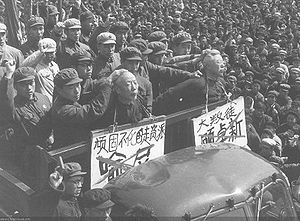 On January 3, 1967, Lin Biao
and Jiang Qing
employed local media and cadres to generate the so-called "January Storm", in which many prominent Shanghai municipal government leaders were heavily criticized and purged. This paved the way for Wang Hongwen
to take charge of the city as leader of its Municipal Revolutionary Committee. The Municipal government was thus abolished. In Beijing, Liu Shaoqi and Deng Xiaoping were once again the targets of criticism, but others also pointed at the wrongdoings of the Vice Premier, Tao Zhu
. Separate political struggles ensued among central government officials and local party cadres, who seized the Cultural Revolution as an opportunity to accuse rivals of "counter-revolutionary activity."
On January 8, Mao praised these actions through the party-run People's Daily, urging all local government leaders to rise in self-criticism, or the criticism and purging of others suspected of "counterrevolutionary activity". This led to massive power struggles which took the form of purge after purge among local governments, many of which stopped functioning altogether. Involvement in some sort of "revolutionary" activity was the only way to avoid being purged, but it was no guarantee.
In February, Jiang Qing and Lin Biao, with support from Mao, insisted that the "class struggles" be extended to the military. Many prominent generals of the People's Liberation Army
who were instrumental in the founding of the PRC voiced their concern and opposition to the Cultural Revolution, calling it a "mistake". Former Foreign Minister Chen Yi, angered at a Politburo meeting, said factionalism was going to completely destroy the military, and in turn the party.
Other generals, including Nie Rongzhen
and Xu Xiangqian
also expressed their discontent. They were subsequently denounced on national media, controlled by Zhang Chunqiao and Yao Wenyuan, as the "February Counter-current forces" . They were all eventually purged. At the same time, many large and prominent Red Guard organizations rose in protest against other Red Guard organizations who ran dissimilar revolutionary messages, further complicating the situation and exacerbating the chaos.
This led to a notice to stop all unhealthy activity within the Red Guards from Jiang Qing. On April 6, 1967, Liu Shaoqi was openly and widely denounced by a Zhongnanhai faction whose members included Jiang Qing and Kang Sheng, and ultimately, Mao himself. This was followed by a protest and mass demonstrations, most notably in Wuhan on July 20, where Jiang openly denounced any "counter-revolutionary activity"; she later personally flew to Wuhan to criticize Chen Zaidao
, the general in charge of the Wuhan area.
On July 22, Jiang Qing directed the Red Guards to replace the People's Liberation Army if necessary, and thereby to render the existing forces powerless. After the initial praise by Jiang Qing, the Red Guards began to steal and loot from barracks and other army buildings. This activity, which could not be stopped by army generals, continued until the autumn of 1968.
resisted Mao's supporters and the Red Guards with violent force. In Qinghai
, a military officer toppled his commander and exterminated 200 Maoists, 100,000 people against Mao and several PLA troops smashed a Red Guard Newspaper station to pieces and an attempted assassination was plotted against the Sichuan military district deputy commander.
. In any case, their purpose had been largely fulfilled, and Mao had largely consolidated his political power.
In early October, Mao began a campaign to purge officials disloyal to him. They were sent to the countryside to work in labor camps. In the same month, at the 12th Plenum of the 8th Party Congress, Liu Shaoqi was "forever expelled from the Party", and Lin Biao was made the Party's Vice-Chairman, Mao's "comrade-in-arms" and "designated successor", his status and fame in the country was second only to Mao.
In December 1968, Mao began the "Down to the Countryside Movement
". During this movement, which lasted for the next decade, young intellectuals living in cities were ordered to go to the countryside. The term "intellectuals" was actually used in the broadest sense to refer to recently graduated middle school students. In the late 1970s, these "young intellectuals" were finally allowed to return to their home cities. This movement was in part a means of moving Red Guards from the cities to the countryside, where they would cause less social disruption.
Lin delivered the keynote address at the Congress, a document drafted by hardliner leftists Yao Wenyuan
and Zhang Chunqiao
. The report levied criticism on Liu Shaoqi and other "counter-revolutionaries", and drew extensively from quotations in the Little Red Book
. The Congress passed the new Party constitution, which re-introduced Mao Zedong Thought as an official guiding ideology of the party and officially designated Lin as Mao's successor. Lastly, the Congress elected a new Politburo with Mao Zedong, Lin Biao, Chen Boda, Zhou Enlai, and Kang Sheng being the five new members of the Politburo Standing Committee
. Lin, Chen, and Kang were all beneficiaries of the Cultural Revolution. Zhou Enlai was demoted in rank.
, which had been abolished by Mao after Liu Shaoqi's dismissal. They hoped that by allowing Lin to ease into a constitutionally sanctioned role, whether President or Vice-President, Lin's succession would be entrenched and institutionalized. The consensus on the Politburo was that Mao should assume the office with Lin becoming Vice-President; but Mao had explicitly voiced his opposition to the recreation of the position and his assuming it.
On August 23, 1970, the Second Plenum of the CCP's Ninth Congress was held in Lushan
. Chen Boda
, now aligned with the Lin camp, was the first to speak. Chen praised Mao using flowery language, but to Mao's ire called again for the restoration of the position of State President. Moreover, Chen attacked Zhang Chunqiao
, a staunch Maoist, over whether or not a line glorifying Mao should be inserted into the Party constitution. Mao was deeply critical of Chen's speeches and removed him from the Politburo Standing Committee. This marked the beginning of a series of criticism sessions across the nation for people who used "deceit" for gains, who were called "Liu Shaoqi's representatives for Marxism
and political liars."
In addition to the purge of Chen Boda, Mao also asked Lin's principal generals to write a self-criticism on their political positions as a warning to Lin. Mao's doubts about Lin's loyalty gave Mao the determination to remove Lin from power. Mao started to take strong actions against the state's second man, but these efforts went slowly and were noticed by Lin.
, and other high-ranking military conspirators formed a coup apparatus in Shanghai aimed solely at ousting Mao from power by the use of force, and dubbed the plan Outline for Project 571, which sounds similar to "Military Uprising" in Mandarin. It is disputed whether Lin Biao was involved in this process. While official sources maintain that Lin planned and executed of the alleged coup attempt, scholars such as Jin Qiu portray Lin as a rather passive character, who was in some ways manipulated by members of his family and his supporters. Jin contests that Lin Biao was never personally involved in drafting the Outline.
The Outline revealed that Lin Liguo's plan consisted mainly of aerial bombardments and the widespread use of the Air Force. Were the plan to succeed, his father could successfully arrest all of his political rivals and gain the supreme power that he wanted. Assassination attempts were alleged to have been made against Mao in Shanghai, from September 8 to September 10, 1971. It was learned that before these attacks upon Mao there was initial knowledge of Lin's activities among the local police, who stated that Lin Biao had been coordinating a political plot, and that Lin's loyal backers were receiving special training in the military. One internal report alleged that Lin had planned to bomb a bridge that Mao was to cross to reach Beijing (Mao avoided this bridge because intelligence reports caused him to change routes). In those nervous days, guards were placed every 10–20 meters on the railway tracks of Mao's route, facing outwards from the train, to prevent attempts at assassination.
According to the official version of the events, on September 13, 1971, Lin Biao, his wife Ye Qun
, his son Lin Liguo, and members of his staff attempted to fly to the Soviet Union
. En route, Lin's plane crashed in Mongolia
, killing all on board. On the same day, the Politburo met in an emergency session to discuss matters pertaining to Lin Biao. Only on September 30 was Lin's death confirmed in Beijing, which led to the cancellation of the National Day
celebration events the following day. The Central Committee under Mao's direction kept information largely under wraps, and news of Lin's death was only released to the public two months following the incident. Many of Lin's supporters sought refuge in Hong Kong; those who remained on the mainland were purged. The event caught the party leadership completely off guard. For several months following the incident, the party information apparatus attempted to find a "correct way" to frame the incident for public consumption. Scholars have identified some gaps in the official version of the events.
The exact cause of the plane crash remains a mystery. It is widely believed that Lin's plane ran out of fuel or that there was a sudden engine failure. There was also speculation that the plane was shot down. It could also have been that Soviet forces caused the plane to crash. After investigating the wreckage, Soviet authorities later took possession of the bodies of those on board. There was no confirmation on the identity of the bodies.
, was transferred to work in Beijing for the Central Government, and was elevated to become the Communist Party's Vice-Chairman in the following year, seemingly groomed for succession. Jiang Qing's position and undisputed leadership status over the radical camp was solidified following the death of Lin Biao. While Jiang Qing was at the forefront of carrying out Mao's policies in the earlier stages of the Cultural Revolution, it was clear by 1972 that she had political ambitions of her own. She allied herself with propaganda specialists Zhang Chunqiao
and Yao Wenyuan
, and the politically favoured Wang Hongwen
, and formed a political clique later dubbed as the "Gang of Four
".
The Gang identified Zhou Enlai as the main political threat in post-Mao era succession. In late 1973, to weaken Zhou's political position and to distance themselves from Lin's apparent betrayal, the "Criticize Lin, Criticize Confucius" campaign began under Jiang Qing's leadership. Its stated goals were to eradicate China of neo-Confucianist thinking and denounce Lin Biao's actions as traitorous and regressive. Reminiscent of the first years of the Cultural Revolution, the political battle was carried out through historical allegory
, and although Zhou Enlai's name was never mentioned during this campaign, the Premier's historical namesake, the Duke of Zhou
, was a frequent target. The public had become weary of protracted political campaigns that seemed to have no practical value, and did not participate enthusiastically. The campaign failed to achieve its goals.
With much of the moderate faction purged, and factional struggles continuing in the country's factories, railways, and local government, the country's economy had fallen into disarray. In October 1974, to prevent further deterioration of production in the country, Mao approved Deng Xiaoping to be transferred back to work in Beijing as Executive Vice-Premier, directing "day-to-day government affairs" while Zhou Enlai was in hospital receiving cancer treatment. Meanwhile Mao issued a series of rebukes on the Gang of Four, criticizing their ability to manage the economy. Deng's return set the scene for a protracted factional struggle between the radical Gang of Four and moderates led by Zhou and Deng.
At the time, Jiang Qing's clique held effective control of the media and China's propaganda network and were antagonistic towards Zhou Enlai and Deng Xiaoping, who held much control of government organs. On some decisions, Mao sought to mitigate the Gang's influence, but on others, he acquiesced to their demands. The Gang of Four's heavy hand in political and media control, however, did not prevent Deng from reinstating progressive economic policies. Deng held a clear stance against Party factionalism, and his policies were aimed at promoting unity as the first step to reimplementing effective production. Much like the post-Great Leap restructuring led by Liu Shaoqi, Deng streamlined the railway system, steel production, and other key areas of the economy. By late 1975, however, Mao saw that Deng's economic restructuring might negate the legacy of the Cultural Revolution, and launched a campaign to oppose "rehabilitating the case for the rightists", alluding to Deng as the country's foremost "rightist". Mao directed Deng to write self-criticisms in November 1975, a move lauded by the Gang of Four.
. On January 15 Deng Xiaoping delivered Zhou's official eulogy in a funeral attended by all of China's most senior leaders with the notable exception of Mao himself, who did not attend due to his spite for Zhou, and because Mao believed that his attendance would be viewed as an admission that the Cultural Revolution was a mistake (a view held privately by Zhou). Mao's absence was officially explained as being due to illness, although Mao was not too ill to receive the president of Sao Tome and Principe
two weeks earlier, or Richard Nixon
several months before. Curiously, after Zhou's death, Mao neither selected a member of the Gang of Four nor Deng Xiaoping to become Premier, instead choosing the relatively unknown Hua Guofeng
.
The Gang of Four grew apprehensive that spontaneous, large-scale popular support for Zhou could turn the political tide against them. They acted through the media to impose as set of restrictions known as the "five nos": no wearing black armbands, no mourning wreaths, no mourning halls, no memorial activities, and no handing out photos of Zhou. Years of resentment over the Cultural Revolution, the public persecution of Deng Xiaoping (who was strongly associated with Zhou in public perception), and the prohibition against publicly mourning Zhou became associated with each other shortly after Zhou's death, leading to popular discontent against Mao and his apparent successors (notably Hua Guofeng
and the Gang of Four).
Official attempts to enforce the "five nos" included removing public memorials and tearing down posters commemorating Zhou's achievements. On March 25, 1976, a leading Shanghai newspaper, Wenhui bao, published an article stating that Zhou was "the capitalist roader inside the Party [who] wanted to help the unrepentant capitalist roader [Deng] regain his power". This and other propaganda efforts to attack Zhou's image only strengthened the public's attachment to Zhou's memory. Between March and April 1976, a forged document circulated in Nanjing
that claimed itself to be Zhou Enlai's last will. It attacked Jiang Qing
and praised Deng Xiaoping, and was met with increased propaganda efforts by the government.
, in which Chinese traditionally pay homage to their deceased ancestors, thousands of people gathered around the Monument to the People's Heroes
in Tiananmen Square
to commemorate Zhou Enlai. On this occasion, the people of Beijing honored Zhou by laying wreaths, banners, poems, placards, and flowers at the foot of the Monument. The most obvious purpose of this memorial was to eulogize Zhou, but Jiang Qing, Zhang Chunqiao
, and Yao Wenyuan
were also attacked for their actions against the Premier. A small number of slogans left at Tiananmen even attacked Mao himself, and his Cultural Revolution.
Up to two million people may have visited Tiananmen Square on April 4. First-hand observations of the events on April 4 report that all levels of society, from the poorest peasants to high-ranking PLA officers and the children of high-ranking cadres, were represented in the activities. Those who participated were motivated by a mixture of anger over the treatment of Zhou, revolt against Maoist policies, apprehension for China's future, and defiance of those who would seek to punish the public for commemorating Zhou's memory. The events did not appear to have coordinated leadership and was a reflection of public sentiment.
On the morning of April 5, crowds were angered to discover that their memorial items for Zhou had been removed overnight. Attempts to suppress the mourners led to a violent riot. Police cars were set on fire and a crowd of over 100,000 people forced its way into several government buildings surrounding the square. By 6:00 pm, most of the crowd had dispersed, but a small group remained until security forces entered Tiananmen Square to arrest them. Many of those arrested were later sentenced to prison work camps. Similar incidents occurred in Zhengzhou
, Kunming
, Taiyuan
, Changchun
, Shanghai
, Wuhan
, and Guangzhou
. Jiang Qing and her allies pinned Deng as the incident's 'mastermind', and issued reports on official media to that effect. Deng Xiaoping was formally stripped of all positions "inside and outside the Party" on April 7. This marked Deng's second purge in ten years.
Before dying, Mao had allegedly scribbled a message on a piece of paper stating "With you in charge, I'm at ease", to Hua Guofeng. This legitimized Hua as the Party's new Chairman. Before this event, Hua had been widely considered to be lacking in political skill and ambitions, and seemingly posed no serious threat to the Gang of Four in the race for succession. However, the Gang's radical ideas also clashed with some influential elders and a large segment of party reformers. With army backing and the support of prominent generals like Ye Jianying
, on October 10 the Special Unit 8341 had all members of the Gang of Four arrested in a bloodless coup. Historically, this marked the end of the Cultural Revolution era.
, namely, "Whatever policy originated from Chairman Mao, we must continue to support," and "Whatever directions were given to us from Chairman Mao, we must continue to follow." Like Deng, Hua wanted to reverse the damage of the Cultural Revolution; but unlike Deng, who wanted to propose new economic models for China, Hua intended to move the Chinese economic and political system towards Soviet-style planning of the early 1950s.
It became increasingly clear to Hua that, without Deng Xiaoping, it was difficult to continue daily affairs of state. On October 10, Deng Xiaoping personally wrote a letter to Hua asking to be transferred back to state and party affairs; party elders also called for Deng's return. With increasing pressure from all sides, Hua decided to bring Deng back into state affairs, first naming him Vice-Premier in July 1977, and later promoting him to various other positions, effectively catapulting Deng to China's second-most powerful figure. In August, the Party's Eleventh Congress was held in Beijing, officially naming (in ranking order) Hua Guofeng, Ye Jianying
, Deng Xiaoping, Li Xiannian
, and Wang Dongxing
as new members of the Politburo Standing Committee.
In May 1978, Deng seized the opportunity to elevate his protégé Hu Yaobang to power. Hu published an article on Guangming Daily
, making clever use of Mao's quotations while lauding Deng's ideas. Following this article, Hua began to shift his tone in support of Deng. On July 1, Deng publicized Mao's self-criticism report of 1962 regarding the failure of the Great Leap Forward. With an expanding power base, in September 1978, Deng began openly attacking Hua Guofeng's "Two Whatevers".
On December 18, 1978, the pivotal Third Plenum of the Eleventh CCP Congress was held. During the congress Deng remarked famously that "a liberation of thoughts" was in order and the Party and country needed to "seek truth from facts
". The Plenum officially marked the beginning of the economic reform era. Hua Guofeng engaged in self-criticism, calling his "Two Whatevers" a mistake. Wang Dongxing
, a trusted ally of Mao, was also criticized. At the Plenum, the Party's verdict on the Tiananmen Incident
was reversed, later leading to the rehabilitation of those arrested for their participation in the Incident. Disgraced former leader Liu Shaoqi was allowed a belated state funeral.
At the Fifth Plenum of the Eleventh CCP Congress, held in 1980, Peng Zhen, He Long and many others who had been purged during the Cultural Revolution were also politically rehabilitated. Hu Yaobang was named General-Secretary, and Zhao Ziyang
, another Deng protégé, was introduced into the Central Committee. In September, Hua Guofeng resigned, and Zhao was named the new Premier. Deng remained the Chairman of the Central Military Commission
, but formal power was transferred to a new generation of pragmatic reformers, who reversed Mao-era policies almost in their entirety.
had been printed.
The ten years of the Cultural Revolution brought China's education system to a virtual halt. The university entrance exams were cancelled after 1966, and were not restored until 1977 under Deng Xiaoping. Many intellectual
s were sent to rural labour camps, and many of those who survived left China shortly after the revolution ended. Many survivors and observers suggest that almost anyone with skills over that of the average person was made the target of political "struggle" in some way. According to most Western observers as well as followers of Deng Xiaoping, this led to almost an entire generation of inadequately educated individuals. The impact of the Cultural Revolution on popular education varied among regions, and formal measurements of literacy did not resume until the 1980s. Some counties in Zhanjiang
had illiteracy rates as high as 41% some 20 years after the revolution. The leaders of China at the time denied any illiteracy problems from the start. This effect was amplified by the elimination of qualified teachers—many of the districts were forced to rely upon chosen students to re-educate the next generation.
As the bureaucracy in the Ministry of Health was marginalized, a large number of health personnel were deployed to the countryside. Some farmers were given informal medical training, and health-care centers were established in rural communities. This process led to a marked improvement in the health and the life expectancy of the general population.
Mao Zedong Thought
became the central operative guide to all things in China. The authority of the Red Guards surpassed that of the army, local police authorities, and the law in general. Chinese traditional arts and ideas were ignored and publicly attacked, with praise for Mao being practiced in their place. People were encouraged to criticize cultural institutions and to question their parents and teachers, which had been strictly forbidden in traditional Chinese culture. The persecution of traditional Chinese cultural institutions was emphasized even more during the Anti-Lin Biao, Anti-Confucius Campaign. Slogans such as "Parents may love me, but not as much as Chairman Mao" were common.
The Cultural Revolution also brought to the forefront numerous internal power struggles within the Communist party, many of which had little to do with the larger battles between Party leaders, but resulted instead from local factionalism and petty rivalries that were usually unrelated to the "revolution" itself. Because of the chaotic political environment, local governments lacked organization and stability, if they existed at all. Members of different factions often fought on the streets, and political assassinations, particularly in predominantly rural provinces, were common. The masses spontaneously involved themselves in factions, and took part in open warfare against other factions. The ideology that drove these factions was vague and sometimes nonexistent, with the struggle for local authority being the only motivation for mass involvement.
, in which educated youths living in the urban areas were sent to live and work in agrarian areas, in order that they might better understand the role of manual agrarian labour in Chinese society. In the initial stages of this policy, most of the youth who took part in it volunteered, although later on the government resorted to forcing many of them to move.
In the post-Mao period, many of those forcibly moved attacked the policy as a violation of their human rights
. Historian Mobo Gao went as far to criticise such attitudes, suggesting that "from the perspectives of the rural residents, the educated youth had a good life. They did not have to work as hard as the local farmers and they had state and family subsidies. They would frequently go back home to visit their parents in the cities, and they had money to spend and wore fashionable clothes." Gao also claimed that during the Revolution, Mao sent his daughter, Li Na
, to work on a farm in Jiangxi
.
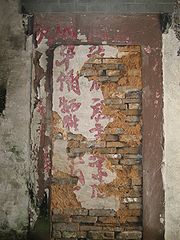 According to Shaorong Huang, the fact that the Cultural Revolution had such massive effects on Chinese society is the result of extensive use of political slogans. In Huang's view, rhetoric played a central role in rallying both the Party leadership and people at large during the Cultural Revolution. For example, the slogan "to rebel is justified" (造反有理, zàofǎn yǒulǐ) became a unitary theme.
Huang asserts that political slogans were ubiquitous in every aspect of people's lives, being printed onto ordinary items such as bus tickets, cigarette packets, and mirror tables. Workers were supposed to "grasp revolution and promote productions", while peasants were supposed to raise more pigs because "more pigs means more manure, and more manure means more grain." Even a casual remark by Mao, "Sweet potato tastes good; I like it" became a slogan everywhere in the countryside.
Political slogans of the time had three sources: Mao, official Party media such as People's Daily
, and the Red Guards. Mao often offered vague, yet powerful directives that led to the factionalization of the Red Guards
. These directives could be interpreted to suit personal interests, in turn aiding factions' goals in being most loyal to Mao Zedong
. Red Guard slogans were the most violent in nature, such as "Strike the enemy down on the floor and step on him with a foot", "Long live the red terror!" and "Those who are against Chairman Mao will have their dog skulls smashed into pieces".
Sinologists Lowell Dittmer and Chen Ruoxi point out that the Chinese language had historically been defined by subtlety, delicacy, moderation, and honesty, as well as the "cultivation of a refined and elegant literary style." This changed during the Cultural Revolution. Since Mao wanted an army of bellicose people in his crusade, rhetoric at the time was reduced to militant and violent vocabulary. These slogans were a powerful and effective method of "thought reform", mobilizing millions of people in a concerted attack upon the subjective world, "while at the same time reforming their objective world."
Dittmer and Chen argue that the emphasis on politics made language a very effective form of propaganda, but "also transformed it into a jargon of stereotypes—pompous, repetitive, and boring." To distance itself from the era, Deng Xiaoping's government cut back heavily on the use of political slogans. The practice of sloganeering saw a mild resurgence in the late 1990s under Jiang Zemin
.
, with the intention of producing new and innovative art that reflected the benefits of a socialist society. As a part of this, many artists whose work was deemed to be bourgeoise or anti-socialist were persecuted and prevented from working.
At the same time, other art forms flourished in the People's Republic during the Revolution. One of the most notable examples of this was the Peking opera, which saw "some amazing achievements in those years" under the leadership of such figures as Yu Huiyong. One of China's most important playwrights and directors of the late twentieth century, Zhang Guangtian, has argued that during the Cultural Revolution, the innovations that were encouraged in the Peking Opera - which primarily involved "the formalism and style of simplification and concision" - led it into one of its greatest periods.
intensified during this period, because religion was seen as being opposed to Marxist-Leninist and Maoist thinking.
Although being undertaken by some of the Revolution's enthusiastic followers, the destruction of historical relics was never formally sanctioned by the Communist Party, whose official policy was instead to protect such items. Indeed, on 14 May 1967, the CCP central committee issued a document entitled Several suggestions for the protection of cultural relics and books during the Cultural Revolution. Archaeological
excavation and preservation also continued successfully in this period, and several major discoveries, such as that of the Terracotta Army
and the Mawangdui tombs occurred during the Revolution, and were duly protected from any potential damage. The most prominent symbol of academic research in archaeology, the journal Kaogu, did not publish during the Cultural Revolution.
The status of traditional Chinese culture within China was also severely damaged as a result of the Cultural Revolution. Many traditional customs, such as fortune telling, paper art, feng shui
consultations, wearing traditional Chinese dresses for weddings, the use of the traditional Chinese calendar, scholarship in classical Chinese literature and the practice of referring to the Chinese New Year
as the "New Year" rather than the "Spring Festival" have been weakened in mainland China.
 Millions of people in China were violently persecuted during the Cultural Revolution. Those identified as spies, "running dogs", "revisionists", or coming from a suspect class (including those related to former landlords or rich peasants) were subject to beating, imprisonment, rape, torture, sustained and systematic harassment and abuse, seizure of property, denial of medical attention, and erasure of social identity. At least hundreds of thousands of people were murdered, starved, or worked to death. Millions more were forcibly displaced. Young people from the cities were forcibly moved to the countryside, where they were forced to abandon all forms of standard education in place of the propaganda
teachings of the Communist Party of China.
Estimates of the death toll, including both civilians and Red Guards, from various sources are about 500,000 between 1966 and 1969. Some people were not able to stand the torture and, losing hope for the future, committed suicide. One of the most famous cases of attempted suicide due to political persecution involved Deng Xiaoping's son, Deng Pufang
, who jumped (or was thrown) from a four-story building after being "interrogated" by Red Guards. Instead of dying, he became a paraplegic. In the trial of the so-called Gang of Four, a Chinese court stated that 729,511 people had been persecuted, of which 34,800 were said to have died.
According to Mao: The Unknown Story
, an estimated 100,000 people died in one of the worst factional struggles in Guangxi
in January–April 1968, before Premier Zhou sent the PLA to intervene. In 1993, erotic fiction author Zheng Yi wrote the controversial book Scarlet Memorial: Tales Of Cannibalism In Modern China
, alleging "systematic killing and cannibalization
of individuals in the name of political revolution and 'class struggle
'" among the Zhuang people in Wuxuan County
, Guangxi, during that period. The book was roundly criticized in China for its reliance on unpublished interviews and for its negative portrayal of a Chinese ethnic minority, although senior party historians have corroborated some allegations of cannibalism. Sinologist Gang Yue has questioned how "systematic" the cannibalism could have been, given the inherent factionalism of the Cultural Revolution. MacFarquhar and Schoenhals also dispute that it was communism that compelled the Zhuang in this area towards cannibalism, noting that similar incidents occurred under pressure from the Kuomintang secret police in the republican period
.
The true figure of those who were persecuted or died during the Cultural Revolution may never be known, since many deaths went unreported or were actively covered up by the police or local authorities. The state of Chinese demographics at the time was very poor, and the PRC has been hesitant to allow formal research into the period. In their book Mao's Last Revolution (2006), the Sinologists Roderick MacFarquhar
and Michael Schoenhals assert that in rural China alone some 36 million people were persecuted, of whom between 750,000 and 1.5 million were killed, with roughly the same number permanently injured. In Mao: The Unknown Story
, Jung Chang
and Jon Halliday
claim that as many as 3 million people died in the violence of the Cultural Revolution. Sociologist Daniel Chirot claims that around 100 million people suffered and at least one million people, and perhaps as many as 20 million, died in the Cultural Revolution.
, over 6,000 monasteries were destroyed, often with the complicity of local ethnic Tibetan Red Guards. In Inner Mongolia
, some 790,000 people were persecuted. Of these, 22,900 were beaten to death and 120,000 were maimed, during a ruthless witchhunt to find members of the alleged separatist New Inner Mongolian People's Revolutionary Party. In Xinjiang
, copies of the Qu'ran and other books of the Uyghur people
were apparently burned. Muslim imams were reportedly paraded around with paint splashed on their bodies. In the ethnic Korean areas of northeast China, language schools were destroyed. In Yunnan
Province, the palace of the Dai people
's king was torched, and an infamous massacre of Hui
Muslim people at the hands of the People's Liberation Army
in Yunnan, known as the "Shadian incident
", reportedly claimed over 1,600 lives in 1975.
Concessions given to minorities were abolished as part of the Red Guards' attack on the “Four Olds
”: old customs, old culture, old habits, and old ideas. Communes
were established in the Tibetan Autonomous Region (Tibet had previously been exempt from China's period of land reform) and reimposed in other minority areas. Despite official persecution, some local leaders and minority ethnic practices survived in remote regions.
The overall failure of the Red Guards' and radical assimilationists' goals was largely due to two factors. It was felt that pushing minority groups too hard would compromise China's border defences. This was especially important as minorities make up a large percentage of the population that live along China's borders. In the late 1960s China experienced a period of strained relations with a number of its neighbours, notably with the Soviet Union
and India
. Many of the Cultural Revolution's goals in minority areas were simply too unreasonable to be implemented. The return to pluralism, and therefore the end of the worst of the affects of the Cultural Revolution to ethnic minorities in China, coincides closely with Lin Biao's removal from power.

and Jiang Qing
," who caused its worst excesses. The Resolution affirmed that the Cultural Revolution "brought serious disaster and turmoil to the Communist Party and the Chinese people."
The official view aimed to separate Mao's actions during the Cultural Revolution from his "heroic" revolutionary activities during the Chinese Civil War
and the Second Sino-Japanese War
. It also separates Mao's personal mistakes from the correctness of the theory that he created, which remains an official guiding ideology in the Party. Deng Xiaoping famously summed this up with the phrase "Mao was 70% good, 30% bad." In rhetoric, Deng affirmed that Maoist ideology was responsible for the revolutionary success of the Communist Party, but abandoned it in practice to favour "Socialism with Chinese characteristics", essentially a totally anti-Maoist embrace of state-directed market economics.
In Mainland China, the official Party view now serves as the dominant framework for Chinese historiography
of the time period; alternative views (see below) are discouraged. Following the Cultural Revolution, a new genre of literature known as "scar literature
" (shangen wenxue) emerged, being encouraged by the post-Mao government. Largely written by educated youths such as Liu Xinhua, Zhang Xianliang
, and Liu Xinwu
, scar literature depicted the Revolution from a negative viewpoint, using their own perspectives and experiences as a basis.
After the suppression of the Tiananmen Square Protests of 1989
, both liberals and conservatives within the Party accused each other of excesses that they claimed were reminiscent of the Cultural Revolution. Li Peng
, who promoted the use of military force, cited that the student movement had taken inspiration from the grassroots populism of the Cultural Revolution, and that if it is left unchecked, would eventually lead to a similar degree of mass chaos. Zhao Ziyang
, who was sympathetic to the protestors, later accused his political opponents of illegally removing him from office by using "Cultural Revolution-style" tactics, including "reversing black and white, exaggerating personal offenses, taking quotes out of context, issuing slander and lies... innundating the newpapers with critical articles making me out to be an enemy, and casual disregard for my personal freedoms."
, who benefited most from its policies. Since Deng's ascendancy to power, the government has arrested and imprisoned figures who have taken a strongly pro-Cultural Revolution stance. For instance, in 1985, a young worker at a shoe factory put up a poster on the wall of a factory in Xianyang
, Shaanxi
, which declared that "The Cultural Revolution was Good" and led to achievements such as "the building of the Nanjing Yangtze River Bridge
, the creation of hybrid rice crops and the rise of people's consciousness." The factory worker was eventually sentenced to ten years in prison, where he died soon after "without any apparent cause."
One of the student leaders of the Tiananmen Square protests of 1989
, Shen Tong
, author of Almost a Revolution, has a positive view of some aspects of the Cultural Revolution. According to Shen, the trigger for the famous Tiananmen hunger-strikes of 1989 was a big-character poster (dazibao), a form of public political discussion that gained prominence during the Cultural Revolution. Shen remarked that the congregation of students from across the country to Beijing on trains and the hospitality they received from residents was reminiscent of the experiences of Red Guards in the Cultural Revolution.
Since the advent of the internet, various people in both China and abroad have begun to argue online that the Cultural Revolution had many beneficial qualities for China that have been denied by both the post-Mao Chinese Communist Party and the Western media. Some hold that the Revolution 'cleansed' China from superstitions, religious dogma, and outdated traditions in a 'modernist transformation' that later made Deng's economic reforms possible. These sentiments increased following the U.S. bombing of the Chinese embassy in Belgrade in 1999, when a segment of the population began to associate anti-Maoist viewpoints with the United States.
Maoist apologists, otherwise known as the "far left", have also become more organized in the internet era. One Maoist website has collected thousands of signatures demanding punishment for those who publicly criticize Mao. Along with the call for legal action, this movement demands the establishment of agencies similar to Cultural Revolution-era "neighborhood committees", in which "citizens" would report anti-Maoists to local public security bureaus. The recent movement in defense of Mao was sparked by an online column written by Mao Yushi
(no relation), an economist, who provocatively wrote that Mao Zedong "was not a god". The move to have Mao's image publicly protected is correlated with the recent political career of Bo Xilai
, whose term as party chief in Chongqing
has been characterized by the use of Maoist propaganda not popular in China since the end of the Cultural Revolution.
in Beijing, the Cultural Revolution is barely mentioned in its historical exhibits. Despite inroads made by numerous prominent sinologists, independent scholarly research of the Cultural Revolution is discouraged by the Chinese government. There is concern that as witnesses age and die, the opportunity to research the event thoroughly within China may be lost.
That the government still displays such heightened sensitivities around the Cultural Revolution is an indicator that it still considers itself, at least in part, an inheritor of its legacy. The government is apprehensive that academic probing and popular discussions will lead to ideological conflict and increase social instability. It may threaten the foundations of Communist rule. The focus of the Chinese government on maintaining political and social stability has been a top priority since the Tiananmen crackdown
on reformers on June 4, 1989, and the current government has no interest in re-evaluating any issue that might lead to a split in the Chinese leadership, or which might polarize the Party on ideological grounds.
inspired by the Cultural Revolution was launched in 1967. Its excesses damaged the credibility of these activists for more than a generation in the eyes of Hong Kong residents. In the Republic of China
(Taiwan), Chiang Kai-shek
initiated the Chinese Culture Renaissance Movement to counter what he regarded as destruction of traditional Chinese values by the Communists on the mainland. In Albania
, Communist leader and Chinese ally Enver Hoxha
began a "Cultural and Social Revolution" organized along the same lines as the Cultural Revolution. In the world at large, Mao Zedong emerged as a symbol of the anti-establishment, grassroots populism, and self-determination. His revolutionary philosophies found unlikely adherents in the Shining Path
of Peru, the U.S.-based Black Panther Party
, and the 1960s counterculture
movement in general. In 2007 Hong Kong Chief Executive Donald Tsang remarked that the Cultural Revolution represented the 'dangers of democracy', remarking "People can go to the extreme like what we saw during the Cultural Revolution [...], when people take everything into their own hands, then you cannot govern the place". The remarks caused controversy in Hong Kong and was later retracted with an accompanying apology.
Academic interest has also focused on the movement's relationship with Mao's personality. Mao had always envisioned himself as a wartime guerrilla leader, which made him wary of the bureaucratic details of peacetime governance. With the Cultural Revolution Mao was simply "returning to form," once again taking on the role of a guerrilla leader fighting against an institutionalized Party bureaucracy. MacFarquhar
and Schoenhals, writing in Mao's Last Revolution, paint the movement as neither a bona fide war over ideological purity nor a mere power struggle to remove Mao's political rivals. They reason that the Cultural Revolution happened due to a series of complex factors: China's relationship with the global Communist movement, geopolitical concerns, the ideological rift between China and the Soviet Union
, and the failures of the Great Leap Forward. The movement was, at least in part, a legacy project to cement Mao's place in history, aimed to boost his prestige while he was alive and preserve the invulnerability of his ideas after his death.
The mass hysteria surrounding the Cultural Revolution was also unprecedented. Historian Phillip Short contends that the Cultural Revolution contained elements that was akin to a form of religious worship. Mao's godlike status during the period yielded him ultimate definitional power over Communist doctrine, yet the esoteric nature of his writings led to endless wars over its interpretation, with both conservatives and liberals drawing on Mao's teachings to achieve their divergent goals. Many factional struggles were not unlike religious wars, with all sides claiming allegiance to the most "authentic" form of Maoism.
Virtually all English-language books paint a highly negative picture of the movement. Historian Anne F. Thurston wrote that it "led to loss of culture, and of spiritual values; loss of hope and ideals; loss of time, truth and of life..." Barnouin and Yu summarized the Cultural Revolution as "a political movement that produced unprecedented social divisions, mass mobilization, hysteria, upheavals, arbitrary cruelty, torture, killings, and even civil war...", calling Mao "one of the most tyrannical despots of the twentieth century." In Mao: The Unknown Story
, Chang
and Halliday attributed all the destruction of the Cultural Revolution to Mao personally, with more sympathetic portrayals of his allies and opponents. A small number of scholars continue to hold positive views about the Cultural Revolution. Mobo Gao, writing in The Battle for China's Past: Mao and the Cultural Revolution, asserts that the movement benefited millions of Chinese citizens, particularly agricultural and industrial workers, and sees it as egalitarian and genuinely populist, citing continued Maoist nostalgia in China today as remnants of its positive legacy.
People's Republic of China
China , officially the People's Republic of China , is the most populous country in the world, with over 1.3 billion citizens. Located in East Asia, the country covers approximately 9.6 million square kilometres...
from 1966 through 1976. Set into motion by Mao Zedong
Mao Zedong
Mao Zedong, also transliterated as Mao Tse-tung , and commonly referred to as Chairman Mao , was a Chinese Communist revolutionary, guerrilla warfare strategist, Marxist political philosopher, and leader of the Chinese Revolution...
, then Chairman of the Communist Party of China
Communist Party of China
The Communist Party of China , also known as the Chinese Communist Party , is the founding and ruling political party of the People's Republic of China...
, its stated goal was to enforce socialism
Socialism (Marxism)
In Marxist theory, socialism, or the socialist mode of production, refers to a specific historical phase of economic development and its corresponding set of social relations that eventually supersede capitalism...
in the country by removing capitalist
Capitalism
Capitalism is an economic system that became dominant in the Western world following the demise of feudalism. There is no consensus on the precise definition nor on how the term should be used as a historical category...
, tradition
Tradition
A tradition is a ritual, belief or object passed down within a society, still maintained in the present, with origins in the past. Common examples include holidays or impractical but socially meaningful clothes , but the idea has also been applied to social norms such as greetings...
al and cultural
Culture
Culture is a term that has many different inter-related meanings. For example, in 1952, Alfred Kroeber and Clyde Kluckhohn compiled a list of 164 definitions of "culture" in Culture: A Critical Review of Concepts and Definitions...
elements from Chinese society, and to impose Maoist orthodoxy within the Party. The revolution marked the return of Mao Zedong to a position of absolute power after the failed Great Leap Forward
Great Leap Forward
The Great Leap Forward of the People's Republic of China was an economic and social campaign of the Communist Party of China , reflected in planning decisions from 1958 to 1961, which aimed to use China's vast population to rapidly transform the country from an agrarian economy into a modern...
. The movement paralyzed the country politically and significantly impacted the country economically and socially.
The Revolution was launched in May 1966. Mao alleged that bourgeois elements were entering the government and society at large, aiming to restore capitalism. He insisted that these "revisionist
Revisionism (Marxism)
Within the Marxist movement, the word revisionism is used to refer to various ideas, principles and theories that are based on a significant revision of fundamental Marxist premises. The term is most often used by those Marxists who believe that such revisions are unwarranted and represent a...
s" be removed through violent class struggle
Class struggle
Class struggle is the active expression of a class conflict looked at from any kind of socialist perspective. Karl Marx and Friedrich Engels wrote "The [written] history of all hitherto existing society is the history of class struggle"....
. China's youth then responded to Mao's appeal by forming Red Guard
Red Guards (China)
Red Guards were a mass movement of civilians, mostly students and other young people in the People's Republic of China , who were mobilized by Mao Zedong in 1966 and 1967, during the Cultural Revolution.-Origins:...
groups around the country. The movement then spread into the military, urban workers, and the Communist Party leadership itself. It resulted in widespread factional struggles in all walks of life. In the top leadership, it led to a mass purge of senior officials who were accused of deviating from the socialist path, most notably Liu Shaoqi
Liu Shaoqi
Liu Shaoqi was a Chinese revolutionary, statesman, and theorist. He was Chairman of the People's Republic of China, China's head of state, from 27 April 1959 to 31 October 1968, during which he implemented policies of economic reconstruction in China...
and Deng Xiaoping
Deng Xiaoping
Deng Xiaoping was a Chinese politician, statesman, and diplomat. As leader of the Communist Party of China, Deng was a reformer who led China towards a market economy...
. During the same period Mao's personality cult grew to immense proportions.
Millions of people were persecuted in the violent factional struggles that ensued across the country, and suffered a wide range of abuses including torture, rape, imprisonment, sustained harassment, and seizure of property. A large segment of the population was forcibly displaced, most notably the transfer of urban youth to rural regions during the Down to the Countryside Movement
Down to the Countryside Movement
The Down to the Countryside Movement was a policy instituted in the People's Republic of China in the late 1960s and early 1970s. As a result of the anti-bourgeois thinking prevalent during the Cultural Revolution, Mao Zedong declared certain privileged urban youth would be sent to mountainous...
. Historical relics and artifacts were destroyed. Cultural and religious sites were ransacked.
Mao officially declared the Cultural Revolution to have ended in 1969, but its active phase lasted until the death of Lin Biao
Lin Biao
Lin Biao was a major Chinese Communist military leader who was pivotal in the communist victory in the Chinese Civil War, especially in Northeastern China...
in 1971. The political instability between 1971 and the arrest of the Gang of Four
Gang of Four
The Gang of Four was the name given to a political faction composed of four Chinese Communist Party officials. They came to prominence during the Cultural Revolution and were subsequently charged with a series of treasonous crimes...
in 1976 is now also widely regarded as part of the Revolution. After Mao's death in 1976, reformers led by Deng Xiaoping
Deng Xiaoping
Deng Xiaoping was a Chinese politician, statesman, and diplomat. As leader of the Communist Party of China, Deng was a reformer who led China towards a market economy...
gained prominence. Most of the Maoist reforms associated with the Cultural Revolution were abandoned by 1978. The Cultural Revolution has been treated officially as a negative phenomenon ever since.
Great Leap Forward
In 1958, after China's first Five-Year PlanFive-Year Plans of China
The five-year plans of People's Republic of China are a series of economic development initiatives. The economy was shaped by the Communist Party of China through the plenary sessions of the Central Committee and national congresses...
, Mao called for "grassroots socialism" in order to accelerate his plans for turning China into a modern industrialized state. In this spirit, Mao launched the Great Leap Forward
Great Leap Forward
The Great Leap Forward of the People's Republic of China was an economic and social campaign of the Communist Party of China , reflected in planning decisions from 1958 to 1961, which aimed to use China's vast population to rapidly transform the country from an agrarian economy into a modern...
, established People's Commune
People's commune
The people's commune was the highest of three administrative levels in rural areas of the People's Republic of China during the period of 1958 to 1982-85 until they were replaced by townships. Communes, the largest collective units, were divided in turn into production brigades and production teams...
s in the countryside, and began the mass mobilization
Mass mobilization
Mass mobilization refers to mobilization of civilian population as part of contentious politics. Mass mobilization is often used by grassroots-based social movements, including revolutionary movements, but can also become a tool of elites and the state itself...
of the people. Many communities were assigned production of a single commodity—steel. Mao vowed to increase agricultural production to twice 1957 levels.
The Great Leap was an economic failure. Uneducated farmers attempted to produce steel on a massive scale, partially relying on backyard furnace
Backyard furnace
Backyard steel furnaces were used by the people of China during the Great Leap Forward . These small steel blast furnaces were constructed in the backyards of the communes, hence their names. People used every type of fuel they could to power these furnaces, from coal to the wood of coffins...
s to achieve the production targets set by local cadres. The steel produced was low quality and largely useless. The Great Leap reduced harvest sizes and led to a decline in the production of most goods except substandard pig iron
Pig iron
Pig iron is the intermediate product of smelting iron ore with a high-carbon fuel such as coke, usually with limestone as a flux. Charcoal and anthracite have also been used as fuel...
and steel. Furthermore, local authorities frequently exaggerated production numbers, hiding and intensifying the problem for several years. In the meantime, chaos in the collectives, bad weather, and exports of food necessary to secure hard currency resulted in the Great Chinese Famine. Food was in desperate shortage, and production fell dramatically. The famine caused the deaths of millions of people, particularly in poorer inland regions.
The Great Leap's failure reduced Mao's prestige within the Party. Forced to take major responsibility, in 1959, Mao resigned as the State Chairman
President of the People's Republic of China
The President of the People's Republic of China is a ceremonial office and a part of State organs under the National People's Congress and it is the head of state of the People's Republic of China . The office was created by the 1982 Constitution...
, China's head of state, and was succeeded by Liu Shaoqi
Liu Shaoqi
Liu Shaoqi was a Chinese revolutionary, statesman, and theorist. He was Chairman of the People's Republic of China, China's head of state, from 27 April 1959 to 31 October 1968, during which he implemented policies of economic reconstruction in China...
. In July, senior Party leaders convened
Lushan Conference
The Lushan Conference , officially the 8th Plenum of the Eighth Central Committee of the Communist Party of China, began on July 2, 1959 and was an informal discussion about the Great Leap Forward...
at the scenic Mount Lu to discuss policy. At the conference, Marshal Peng Dehuai
Peng Dehuai
Peng Dehuai was a prominent military leader of the Communist Party of China, and China's Defence Minister from 1954 to 1959. Peng was an important commander during the Second Sino-Japanese War, the Chinese civil war and was also the commander-in-chief of People's Volunteer Army in the Korean War...
, the Minister of Defence, criticized Great-Leap policies in a private letter to Mao, writing that it was plagued by mismanagement and cautioning against elevating political dogma over the laws of economics. Despite the moderate tone of Peng's letter, Mao took it as a personal attack against his leadership. Following the Conference, Mao had Peng removed from his posts, and accused him of being a 'right-opportunist'. Peng was replaced by Lin Biao
Lin Biao
Lin Biao was a major Chinese Communist military leader who was pivotal in the communist victory in the Chinese Civil War, especially in Northeastern China...
, another revolutionary army general who became a more staunch Mao supporter later in his career. While the Lushan Conference
Lushan Conference
The Lushan Conference , officially the 8th Plenum of the Eighth Central Committee of the Communist Party of China, began on July 2, 1959 and was an informal discussion about the Great Leap Forward...
served as a death knell for Peng, Mao's most vocal critic, it led to a shift of power to moderates led by Liu Shaoqi and Deng Xiaoping, who took effective control of the economy following 1959.
By the early 1960s, many of the Great Leap's economic policies were reversed by initiatives spearheaded by Liu, Deng, and Zhou Enlai
Zhou Enlai
Zhou Enlai was the first Premier of the People's Republic of China, serving from October 1949 until his death in January 1976...
. This moderate group of pragmatists were unenthusiastic about Mao's utopian visions. Owing to his loss of esteem within the party, Mao developed a decadent and eccentric lifestyle. By 1962, while Zhou, Liu and Deng managed affairs of state and the economy, Mao had effectively withdrawn himself from economic decision-making, and focused much of his time on further contemplating his contributions to Marxist-Leninist social theory, including the idea of "continuous revolution." This theory's ultimate aim was to set the stage for Mao to restore his brand of Communism and his personal prestige within the Party.
Sino-Soviet Split and anti-revisionism
In the early 1950s, the People's Republic of China and the Soviet UnionSoviet Union
The Soviet Union , officially the Union of Soviet Socialist Republics , was a constitutionally socialist state that existed in Eurasia between 1922 and 1991....
were the two largest Communist states in the world. Whilst they had initially been mutually supportive, issues arose following the ascendancy of Nikita Khrushchev
Nikita Khrushchev
Nikita Sergeyevich Khrushchev led the Soviet Union during part of the Cold War. He served as First Secretary of the Communist Party of the Soviet Union from 1953 to 1964, and as Chairman of the Council of Ministers, or Premier, from 1958 to 1964...
to power in the Soviet Union after the death of Joseph Stalin
Joseph Stalin
Joseph Vissarionovich Stalin was the Premier of the Soviet Union from 6 May 1941 to 5 March 1953. He was among the Bolshevik revolutionaries who brought about the October Revolution and had held the position of first General Secretary of the Communist Party of the Soviet Union's Central Committee...
. In 1956, Khrushchev denounced both Stalin and his policies and subsequently set about implementing post-Stalinist economic reforms. Mao and many members of the Chinese Communist Party were opposed to these changes, believing that it would have negative repercussions for the worldwide Marxist movement, among whom Stalin was still viewed as a hero. Mao also believed that Khrushchev was not adhering to Marxism-Leninism
Marxism-Leninism
Marxism–Leninism is a communist ideology, officially based upon the theories of Marxism and Vladimir Lenin, that promotes the development and creation of a international communist society through the leadership of a vanguard party over a revolutionary socialist state that represents a dictatorship...
, but was instead a revisionist
Revisionism (Marxism)
Within the Marxist movement, the word revisionism is used to refer to various ideas, principles and theories that are based on a significant revision of fundamental Marxist premises. The term is most often used by those Marxists who believe that such revisions are unwarranted and represent a...
, altering his policies from basic Marxist concepts, something Mao feared would allow capitalists
Capitalism
Capitalism is an economic system that became dominant in the Western world following the demise of feudalism. There is no consensus on the precise definition nor on how the term should be used as a historical category...
to eventually regain control of the country. Relations between the two governments subsequently soured
Sino-Soviet split
In political science, the term Sino–Soviet split denotes the worsening of political and ideologic relations between the People's Republic of China and the Union of Soviet Socialist Republics during the Cold War...
, with the Soviets for instance refusing to support China's case for joining the United Nations
United Nations
The United Nations is an international organization whose stated aims are facilitating cooperation in international law, international security, economic development, social progress, human rights, and achievement of world peace...
and going back on their pledge to supply China with a nuclear weapon
Nuclear weapon
A nuclear weapon is an explosive device that derives its destructive force from nuclear reactions, either fission or a combination of fission and fusion. Both reactions release vast quantities of energy from relatively small amounts of matter. The first fission bomb test released the same amount...
.
Mao went on to publicly denounce revisionism in April 1960. Without pointing fingers at the Soviet Union, Mao criticized their ideological ally, the League of Communists of Yugoslavia
League of Communists of Yugoslavia
League of Communists of Yugoslavia , before 1952 the Communist Party of Yugoslavia League of Communists of Yugoslavia (Serbo-Croatian: Savez komunista Jugoslavije/Савез комуниста Југославије, Slovene: Zveza komunistov Jugoslavije, Macedonian: Сојуз на комунистите на Југославија, Sojuz na...
, whilst the Soviets returned the favour by proxy via criticizing the Party of Labour of Albania, a Chinese ally. In 1963, the Communist Party began to openly denounce the Soviet Union, publishing a series of nine polemics against their Marxist revisionism, with one of them being titled On Khrushchev's Phoney Communism and Historical Lessons for the World, where Mao charged that Khrushchev was not only revisionist but also presented a real danger for capitalist restoration. Khrushchev's own downfall from an internal coup d'état in 1964 also contributed to Mao's own fears of political vulnerability, particularly because of his dwindling prestige amongst his colleagues following the Great Leap forward.
Precursor
Mao would set the scene for the Cultural Revolution by 'cleansing' powerful officials of questionable loyalty who were based in Beijing. His approach was less than transparent, achieving this purge through newspaper articles, internal meetings, and skillfully employing his network of political allies.In late 1959, historian and Beijing Deputy Mayor Wu Han
Wu Han (PRC)
Wu Han was one of the most important historians in the development of modern historical scholarship in China with his work in the 1930s and 1940s. In the 1940s he was a leading member of the Democratic League, a non-aligned Third Force. After 1949, he was Deputy-Mayor of Peking...
published a historical drama entitled Hai Rui Dismissed from Office
Hai Rui Dismissed from Office
Hai Rui Dismissed from Office is a theatre play notable for its involvement in Chinese politics during the Cultural Revolution.Wu Han, who wrote the play, was a historian who focused on the Ming Dynasty. Wu Han wrote an article portraying Hai Rui, a Ming minister who was imprisoned for criticizing...
. In the play, an honest civil servant, Hai Rui
Hai Rui
Hai Rui was a famous Chinese official of the Ming Dynasty. His name has come down in history as a model of honesty and integrity in office and he reemerged as an important historical character during the Cultural Revolution.-Biography:Hai Rui, whose great-grandfather married an Arab and...
, is dismissed by a corrupt emperor. While Mao initially praised the play, in February 1965 he secretly commissioned his wife Jiang Qing
Jiang Qing
Jiang Qing was the pseudonym that was used by Chinese leader Mao Zedong's last wife and major Communist Party of China power figure. She went by the stage name Lan Ping during her acting career, and was known by various other names during her life...
and Shanghai propagandist Yao Wenyuan
Yao Wenyuan
Yao Wenyuan was a Chinese literary critic, a politician, and a member of the "Gang of Four" during China's Cultural Revolution.-Biography:...
to publish an article criticizing it. Yao boldly alleged that Hai Rui was really an allegory attacking Mao; that is, Mao was the corrupt emperor and Peng Dehuai
Peng Dehuai
Peng Dehuai was a prominent military leader of the Communist Party of China, and China's Defence Minister from 1954 to 1959. Peng was an important commander during the Second Sino-Japanese War, the Chinese civil war and was also the commander-in-chief of People's Volunteer Army in the Korean War...
was the honest civil servant.
Beijing Mayor Peng Zhen
Peng Zhen
Peng Zhen was a leading member of the Communist Party of China.-Biography:Born in Houma , Peng was originally named Fu Maogong....
, a powerful official and Wu Han's direct superior, spearheaded a committee to refute Yao's claims. Yao's article was initially syndicated by several municipal dailies. Peng Zhen, aware that he would be implicated if it were established that Wu wrote an "anti-Mao" play, forbid Yao's article from being published on the nationally distributed People's Daily
People's Daily
The People's Daily is a daily newspaper in the People's Republic of China. The paper is an organ of the Central Committee of the Communist Party of China , published worldwide with a circulation of 3 to 4 million. In addition to its main Chinese-language edition, it has editions in English,...
. In November, Premier Zhou Enlai urged Peng Zhen to publish the article nationally to avoid contradicting Mao's wishes. Peng Zhen refused, instructing newspapers under his control to focus exclusively on "academic discussion," not politics. While the 'literary battle' against Peng raged, Mao fired Yang Shangkun
Yang Shangkun
Yang Shangkun was President of the People's Republic of China from 1988 to 1993, and was permanent Vice-chair of the Central Military Commission...
, director of the Party's General Office, an organ that controlled internal communications, installing in his stead staunch loyalist Wang Dongxing
Wang Dongxing
Wang Dongxing was Mao Zedong's principal bodyguard during the Cultural Revolution....
, head of Mao's security detail. Yang was accused of "bugging Mao's office" among a series of other unsubstantiated charges.
Yang's dismissal likely emboldened Mao's allies to move against their factional rivals. In December, Defence Minister and Mao loyalist Lin Biao
Lin Biao
Lin Biao was a major Chinese Communist military leader who was pivotal in the communist victory in the Chinese Civil War, especially in Northeastern China...
accused General Luo Ruiqing
Luo Ruiqing
-Biography:Luo Ruiqing was born in Nanchong, Sichuan in 1906. He joined the Communist Party of China in 1928. He was the eldest son of a wealthy landlord named Luo Chunting , who had a total of six kids...
, the chief of staff of the People's Liberation Army, of being anti-Mao, alleging that Luo put too much emphasis on military training rather than Maoist "political discussion." In December, Mao called an enlarged Politburo meeting to discuss the charges against Luo. While the Politburo initially received the charges with skepticism, Mao pushed for an investigation into Luo's conduct, after which Luo was denounced, dismissed, and forced to deliver a self-criticism
Self-criticism
Self-criticism refers to the pointing out of things critical/important to one's own beliefs, thoughts, actions, behaviour or results; it can form part of private, personal reflection or a group discussion.-Philosophy:...
. Stress from the events led Luo to attempt suicide. Luo's removal solidified Lin's leadership in the PLA, securing the military command's loyalty to Mao.
Having ousted Luo and Yang, Mao reverted his attention to Peng Zhen. On February 12, 1966, Peng Zhen's committee, the "Five Man Group
Five Man Group
The Five Man Group was an organisation established in the People's Republic of China in early 1965 to oversee the beginnings of the Cultural Revolution. The group was led by Peng Zhen , the fifth most senior member of the Politburo...
", issued a report known as the February Outline . The Outline, sanctioned by the Party centre, defined Hai Rui as healthy "academic discussion," and aimed to formally distance Peng Zhen from any political implications. However, Jiang Qing and Yao Wenyuan continued their denunciation of Wu Han and Peng Zhen. Meanwhile, Mao targeted Propaganda Department director Lu Dingyi
Lu Dingyi
Lu Dingyi was a former leader of the Communist Party of China. After the establishment of the People's Republic of China and before the Cultural Revolution, he was credited as one of the top officials in socialist culture.-Biography:...
, an ally of Peng Zhen who had occasionally made skeptical remarks about Mao Zedong Thought. Lu's removal would give Maoists unrestricted access to the Press. Mao delivered his final blow to Peng Zhen by proxy through hardline supporters Kang Sheng
Kang Sheng
Kang Sheng , Communist Party of China official, oversaw the work of the People's Republic of China's security and intelligence apparatus at the height of the Cultural Revolution in the late 1960s. He was a close associate of Mao Zedong and remained at or near the pinnacle of power for decades...
and Chen Boda
Chen Boda
Chen Boda was born in 1904 in Hui'an and died on 20 September 1989 in Beijing.He was a member of the Chinese Communist Party, a secretary to Mao Zedong and a prominent member of the leadership during the Cultural Revolution, chairing the Cultural Revolution Group.-Early life:Chen Boda was born...
in May. At an enlarged Politburo session in Beijing, Kang and Chen accused Peng Zhen of opposing Mao, labeled the February Outline "evidence of Peng Zhen's revisionism", and grouped him with three other disgraced officials as part of the "Peng-Luo-Lu-Yang Anti-Party Clique." The decisions were made with the support of Zhou Enlai and Liu Shaoqi; Zhou called it a "great victory for Mao Zedong Thought." On May 16, the Politburo formalized the decisions by releasing a party-wide notification, condemning Peng Zhen and his "anti-party allies" in the strongest terms, disbanding his "Five Man Group", and replacing it with the Maoist Cultural Revolution Group
Cultural Revolution Group
The Cultural Revolution Group was formed in May 1966 as a replacement organisation to the Central Committee Secretariat and the "Five Man Group", and was initially directly responsible to the Standing Committee of the Politburo...
(CRG).
The May 16 Notification
In early 1966, the Politburo of the Communist Party of ChinaPolitburo of the Communist Party of China
The Central Politburo of the Communist Party of China or Political bureau of the CPC Central Committee , formerly as Central Bureau before 1927, is a group of 24 people who oversee the Communist Party of China...
issued six Central Documents regarding the dismissal of Peng, Luo, Lu and Yang in which they declared that the "Great Cultural Revolution" had been launched. One of these documents, titled Zhongfa 267, contained a notification that had been prepared under Mao's personal supervision, in which the writers condemned Peng's "errors" of revisionist thinking. In one passage at the end of the notification, it stated that:
- Those representatives of the bourgeoisieBourgeoisieIn sociology and political science, bourgeoisie describes a range of groups across history. In the Western world, between the late 18th century and the present day, the bourgeoisie is a social class "characterized by their ownership of capital and their related culture." A member of the...
who have snuck into the Party, the government, the army, and various spheres of culture are a bunch of counter-revolutionary revisionists. Once conditions are ripe, they will seize political power and turn the dictatorship of the proletariatDictatorship of the proletariatIn Marxist socio-political thought, the dictatorship of the proletariat refers to a socialist state in which the proletariat, or the working class, have control of political power. The term, coined by Joseph Weydemeyer, was adopted by the founders of Marxism, Karl Marx and Friedrich Engels, in the...
into a dictatorship of the bourgeoisie. Some of them we have already seen through; others we have not. Some are still trusted by us and are being trained as our successors, persons like KhruschevNikita KhrushchevNikita Sergeyevich Khrushchev led the Soviet Union during part of the Cold War. He served as First Secretary of the Communist Party of the Soviet Union from 1953 to 1964, and as Chairman of the Council of Ministers, or Premier, from 1958 to 1964...
for example, who are still nestling beside us. Party committees at all levels must pay full attention to this matter.
This text, which became known as the May 16 Notification, was then put to the vote amongst the members of the Politburo on whether it should be officially adopted, and "was approved unanimously by a show of hands, without any alterations whatever to the text." Initially it was given the second-highest level of classification then in use, meaning that only those Communist Party members of rank 17 and above could gain access to it. It would be publicly printed in the People's Daily newspaper a year later, on 17 May 1967, where it was claimed that it had "sounded the Great Proletarian Cultural Revolutionary bugle to advance". However, upon its initial release, there was some confusion as to what the May 16 Notification actually meant amongst Party members.
Early mass rallies
On May 25, a young philosophy lecturer at Peking University, Nie YuanziNie Yuanzi
Nie Yuanzi 聂元梓 is a Chinese academic who taught philosophy at Peking University. She is primarily known for her May 25, 1966 "Big-character poster" criticizing Peking University for being controlled by the "bourgeoise." This was a factor in the Cultural Revolution...
, wrote a big-character poster
Big-character poster
Big-character posters are handwritten, wall-mounted posters using large-sized Chinese characters, used as a means of protest, propaganda, and popular communication. They have been used in China since imperial times, but became more common when literacy rates rose after the 1911 revolution...
and taped it onto a public bulletin. Nie attacked the university party administration and cadres from Beijing party authorities as "black anti-Party gangsters," implying that there were forces at work in government and at the university who wished to betray the progress of the revolution. Several days later, Mao ordered Nie's message to be broadcast nationwide and called it "the first Marxist big-character poster in China." On May 29, at the High School attached to Tsinghua University
High School attached to Tsinghua University
The High School Attached to Tsinghua University , or Tsinghua High School for short , is one of the most prestigious and historically-significant high schools in China, located in Beijing.-Translation of its Name:...
, the first organization of Red Guards
Red Guards (China)
Red Guards were a mass movement of civilians, mostly students and other young people in the People's Republic of China , who were mobilized by Mao Zedong in 1966 and 1967, during the Cultural Revolution.-Origins:...
was formed with the aim of punishing and neutralising both intellectuals and Mao's political enemies.
On June 1, 1966, the People's Daily
People's Daily
The People's Daily is a daily newspaper in the People's Republic of China. The paper is an organ of the Central Committee of the Communist Party of China , published worldwide with a circulation of 3 to 4 million. In addition to its main Chinese-language edition, it has editions in English,...
launched an attack on "reactionary" forces in the intellectual community. Subsequently, various university presidents and other prominent intellectuals were purged. On July 28, 1966, Red Guard representatives wrote to Mao, stating that mass purges and all such related social and political phenomena were justified and correct. Mao responded with his full support with his own big-character poster entitled Bombard the Headquarters
Bombard the Headquarters
Bombard The Headquarters – My Big-Character Poster was a short document written by Mao Zedong on August 5, 1966 during the 11th Plenary Session of the 8th Central Committee of the Communist Party of China and published on the Communist Party's official newspaper People's Daily the same day.It is...
. Mao wrote that despite having undergone a Communist revolution, China's political hierarchy was still dominated by "bourgeoisie" elitist elements, capitalists, and revisionists, and that these counter-revolutionary elements were indeed still present at the top ranks of the party leadership itself. This was, in effect, an open call-to-arms against Liu Shaoqi, Deng Xiaoping, and their allies.
1966
On August 8, 1966, the Central Committee of the CPC passed its "Decision Concerning the Great Proletarian Cultural Revolution" (also known as "the 16 Points"). This decision defined the GPCR as "a great revolution that touches people to their very souls and constitutes a new stage in the development of the socialist revolution in our country, a deeper and more extensive stage":The Decision took the already existing student movement and elevated it to the level of a nationwide mass campaign, calling on not only students but also "the masses of the workers, peasants, soldiers, revolutionary intellectuals, and revolutionary cadres" to carry out the task of "transforming the superstructure" by writing big-character posters and holding "great debates." China, Mao felt, needed a "Cultural Revolution" to put socialism back on track.
The freedoms granted in the 16 Points were later written into the PRC constitution as "the four great rights (四大自由, Sì Dà Zìyóu)" of "great democracy (大民主, Dàmínzhǔ)": the right to speak out freely, to air one's views fully, to write big-character posters, and to hold great debates (大鸣dàmíng、大放dàfàng、大字报dàzìbào、大辩论dàbiànlùn - the first two are basically synonyms). (In other contexts the second was sometimes replaced by 大串联dàchuànlián - the right to "link up," meaning for students to cut class and travel across the country to meet other young activists and propagate Mao Zedong Thought.)
Those who had anything other than a Communist background were challenged and often charged for corruption and sent to prison. These freedoms were supplemented by the right to strike, although this right was severely attenuated by the Army's entrance onto the stage of civilian mass politics in February 1967. All of these rights were deleted from the constitution after Deng's government suppressed the Democracy Wall
Democracy Wall
The Democracy Wall was a long brick wall on Xidan Street, Xicheng District, Beijing, which became the focus for democratic dissent. Beginning in December 1978, in line with the Communist Party of China's policy of "seeking truth from facts," activists in the Democracy movement—such as Xu...
movement in 1979.
On August 18, 1966, millions of Red Guards from all over the country gathered in Beijing for a peek at the Chairman. On top of the Tiananmen, Mao and Lin Biao made frequent appearances to approximately 11 million Red Guards, receiving cheers each time. Mao praised their actions in the recent campaigns to develop socialism and democracy.
Marxist-Leninist ideology was opposed to religion, and people were told to become atheists from the early days of the PRC's existence. During the Destruction of Four Olds
Four Olds
The Four Olds or the Four Old Things were Old Customs, Old Culture, Old Habits, and Old Ideas. One of the stated goals of the Cultural Revolution in the People's Republic of China was to bring an end to the Four Olds...
campaign, religious affairs of all types were discouraged by Red Guards, and practitioners persecuted. Temples, churches, mosques, monasteries, and cemeteries were closed down and sometimes converted to other uses, looted, and destroyed. Marxist propaganda depicted Buddhism as superstition, and religion was looked upon as a means of hostile foreign infiltration, as well as an instrument of the 'ruling class'. Chinese Marxists declared 'the death of God', and considered religion a defilement of the Chinese communist vision. Clergy were arrested and sent to camps; many Tibetan Buddhists were forced to participate in the destruction of their monasteries at gunpoint.
For two years, until July 1968 (and in some places for much longer), student activists such as the Red Guards expanded their areas of authority, and accelerated their efforts at socialist reconstruction. They began by passing out leaflets explaining their actions to develop and strengthen socialism, and posting the names of suspected "counter-revolutionaries" on bulletin boards. They assembled in large groups, held "great debates," and wrote educational plays. They held public meetings to criticize and solicit self-criticisms from suspected "counter-revolutionaries."
This was one of many quotations in the Little Red Book that the Red Guards would later follow as a guide, provided by Mao. It was the mechanism that led the Red Guards to commit to their objective as the future for China. These quotes directly from Mao led to other actions by the Red Guards in the views of other Maoist leaders. Although the 16 Points and other pronouncements of the central Maoist leaders forbade "physical struggle (武斗, wǔdòu)" in favor of "verbal struggle" (文斗, wéndòu), these struggle session
Struggle Session
A struggle session was a form of public humiliation used by the Communist Party of China to enforce a reign of terror in the Mao Zedong era to shape public opinion and to humiliate, persecute, and/or execute political rivals, so-called class enemies...
s often led to physical violence. Initially verbal struggles among activist groups became even more violent, especially when activists began to seize weapons from the Army in 1967. The central Maoist leaders limited their intervention in activist violence to verbal criticism, sometimes even appearing to encourage "physical struggle," and only after the PLA began to intervene in 1969 did authorities begin to suppress the mass movement.
During the Cultural Revolution, all politicians who had any history of being anything other than dogmatically Maoist were almost immediately purged. Liu Shaoqi
Liu Shaoqi
Liu Shaoqi was a Chinese revolutionary, statesman, and theorist. He was Chairman of the People's Republic of China, China's head of state, from 27 April 1959 to 31 October 1968, during which he implemented policies of economic reconstruction in China...
, once the most powerful man in China after Mao, was sent to a detention camp, where he later died in 1969. Deng Xiaoping was himself sent away for a period of re-education three times, and was eventually sent to work in an engine factory until he was brought back years later by Zhou Enlai. Many of those accused were not lucky enough to survive their persecution, and were only rehabilitated posthumously, after Deng succeeded Hua Guofeng
Hua Guofeng
Su Zhu, better known by the nom de guerre Hua Guofeng , was Mao Zedong's designated successor as the Paramount Leader of the Communist Party of China and the People's Republic of China. Upon Zhou Enlai's death in 1976, he succeeded Zhou as the second Premier of the People's Republic of China...
as the paramount leader of China.
The work of the Red Guards was praised by Mao Zedong. On August 22, 1966, Mao issued a public notice, which stopped "all police intervention in Red Guard tactics and actions." Those in the police force who dared to defy this notice were labeled "counter-revolutionaries." Mao himself showed no scruples about the taking of human life during the Cultural Revolution, and went so far as to suggest that the sign of a true revolutionary was his desire to kill:
Public security in China deteriorated rapidly as a result of central officials lifting restraints on violent behavior. Said Xie Fuzhi
Xie Fuzhi
Xie Fuzhi was a Communist Party of China military commander, political commissar, and national security specialist. He was born in 1909 in Hong'an County, Hubei and died in Beijing in 1972. He was married to Liu Xiangping...
, national police chief:
The police relayed Xie's remarks to the Red Guards and they acted accordingly. In the course of about two weeks, the violence left some one hundred teachers, school officials, and educated cadres dead in Beijing's western district alone. The number injured was "too large to be calculated."
The most gruesome aspects of the campaign ended up being the numerous incidents of torture and killing, and the suicides that were the final option of many who suffered beatings and humiliation. In August and September 1966, there were 1,772 people murdered in Beijing alone. In Shanghai there were 704 suicides and 534 deaths related to the Cultural Revolution in September. In Wuhan there were 62 suicides and 32 murders during September.
On September 5, 1966, another notice was issued, encouraging all Red Guards to come to Beijing over a stretch of time. All fees, including accommodation and transportation, were to be paid by the government. On October 10, 1966, Mao's ally, General Lin Biao, publicly criticized Liu and Deng as "capitalist roader
Capitalist roader
In Maoist thought, a capitalist roader or is a person or group who demonstrates a marked tendency to bow to pressure from Bourgeois forces and subsequently attempts to pull the Revolution in a capitalist direction....
s" and "threats". Later, Peng Dehuai
Peng Dehuai
Peng Dehuai was a prominent military leader of the Communist Party of China, and China's Defence Minister from 1954 to 1959. Peng was an important commander during the Second Sino-Japanese War, the Chinese civil war and was also the commander-in-chief of People's Volunteer Army in the Korean War...
was brought to Beijing to be publicly displayed and ridiculed.
1967
Lin Biao
Lin Biao was a major Chinese Communist military leader who was pivotal in the communist victory in the Chinese Civil War, especially in Northeastern China...
and Jiang Qing
Jiang Qing
Jiang Qing was the pseudonym that was used by Chinese leader Mao Zedong's last wife and major Communist Party of China power figure. She went by the stage name Lan Ping during her acting career, and was known by various other names during her life...
employed local media and cadres to generate the so-called "January Storm", in which many prominent Shanghai municipal government leaders were heavily criticized and purged. This paved the way for Wang Hongwen
Wang Hongwen
Wang Hongwen was the youngest member of the Gang of Four. At the pinnacle of his power he ranked third in the Communist Party's hierarchy. He was charged with counterrevolutionary activity in October 1976, and sent to prison.-Biography:Wang was born in a village outside of Changchun...
to take charge of the city as leader of its Municipal Revolutionary Committee. The Municipal government was thus abolished. In Beijing, Liu Shaoqi and Deng Xiaoping were once again the targets of criticism, but others also pointed at the wrongdoings of the Vice Premier, Tao Zhu
Tao Zhu
Tao Zhu is a Former Member of the 8th Communist Party of China Politburo Standing Committee.-Biography:He was Secretary of the Guangdong Provincial Committee and Commander of the Guangzhou Military Region....
. Separate political struggles ensued among central government officials and local party cadres, who seized the Cultural Revolution as an opportunity to accuse rivals of "counter-revolutionary activity."
On January 8, Mao praised these actions through the party-run People's Daily, urging all local government leaders to rise in self-criticism, or the criticism and purging of others suspected of "counterrevolutionary activity". This led to massive power struggles which took the form of purge after purge among local governments, many of which stopped functioning altogether. Involvement in some sort of "revolutionary" activity was the only way to avoid being purged, but it was no guarantee.
In February, Jiang Qing and Lin Biao, with support from Mao, insisted that the "class struggles" be extended to the military. Many prominent generals of the People's Liberation Army
People's Liberation Army
The People's Liberation Army is the unified military organization of all land, sea, strategic missile and air forces of the People's Republic of China. The PLA was established on August 1, 1927 — celebrated annually as "PLA Day" — as the military arm of the Communist Party of China...
who were instrumental in the founding of the PRC voiced their concern and opposition to the Cultural Revolution, calling it a "mistake". Former Foreign Minister Chen Yi, angered at a Politburo meeting, said factionalism was going to completely destroy the military, and in turn the party.
Other generals, including Nie Rongzhen
Nie Rongzhen
Nie Rongzhen was a prominent Chinese Communist military leader, and one of ten Marshals in the People's Liberation Army of China. He was the last surviving PLA officer with the rank of Marshal.-Biography:...
and Xu Xiangqian
Xu Xiangqian
Xu Xiangqian was a Chinese communist military leader.-Biography:Xu was born in Wutai county, Shanxi province, China. He was admitted to the Whampoa Academy in 1924 and held various officer ranks in the National Revolutionary Army between 1925 and 1927...
also expressed their discontent. They were subsequently denounced on national media, controlled by Zhang Chunqiao and Yao Wenyuan, as the "February Counter-current forces" . They were all eventually purged. At the same time, many large and prominent Red Guard organizations rose in protest against other Red Guard organizations who ran dissimilar revolutionary messages, further complicating the situation and exacerbating the chaos.
This led to a notice to stop all unhealthy activity within the Red Guards from Jiang Qing. On April 6, 1967, Liu Shaoqi was openly and widely denounced by a Zhongnanhai faction whose members included Jiang Qing and Kang Sheng, and ultimately, Mao himself. This was followed by a protest and mass demonstrations, most notably in Wuhan on July 20, where Jiang openly denounced any "counter-revolutionary activity"; she later personally flew to Wuhan to criticize Chen Zaidao
Chen Zaidao
Chen Zaidao was a Chinese general in the People's Liberation Army, who commanded the Wuhan Military Region 1954-67. He is most noted for having arrested pro-Mao Xie Fuzhi and Wang Li during the Wuhan Incident in July 1967...
, the general in charge of the Wuhan area.
On July 22, Jiang Qing directed the Red Guards to replace the People's Liberation Army if necessary, and thereby to render the existing forces powerless. After the initial praise by Jiang Qing, the Red Guards began to steal and loot from barracks and other army buildings. This activity, which could not be stopped by army generals, continued until the autumn of 1968.
Resistance
Elements of the Communist party and People's Liberation ArmyPeople's Liberation Army
The People's Liberation Army is the unified military organization of all land, sea, strategic missile and air forces of the People's Republic of China. The PLA was established on August 1, 1927 — celebrated annually as "PLA Day" — as the military arm of the Communist Party of China...
resisted Mao's supporters and the Red Guards with violent force. In Qinghai
Qinghai
Qinghai ; Oirat Mongolian: ; ; Salar:) is a province of the People's Republic of China, named after Qinghai Lake...
, a military officer toppled his commander and exterminated 200 Maoists, 100,000 people against Mao and several PLA troops smashed a Red Guard Newspaper station to pieces and an attempted assassination was plotted against the Sichuan military district deputy commander.
1968
In the spring of 1968, a massive campaign began, aimed at promoting the already-adored Mao Zedong to god-like status. On July 27, 1968, the Red Guards' power over the army was officially ended and the central government sent in units to protect many areas that remained targets for the Red Guards. Mao had supported and promoted the idea by allowing one of his "Highest Directions" to be heard by the masses. A year later, the Red Guard factions were dismantled entirely; Mao feared that the chaos they caused—and could still cause—might harm the very foundation of the Communist Party of ChinaCommunist Party of China
The Communist Party of China , also known as the Chinese Communist Party , is the founding and ruling political party of the People's Republic of China...
. In any case, their purpose had been largely fulfilled, and Mao had largely consolidated his political power.
In early October, Mao began a campaign to purge officials disloyal to him. They were sent to the countryside to work in labor camps. In the same month, at the 12th Plenum of the 8th Party Congress, Liu Shaoqi was "forever expelled from the Party", and Lin Biao was made the Party's Vice-Chairman, Mao's "comrade-in-arms" and "designated successor", his status and fame in the country was second only to Mao.
In December 1968, Mao began the "Down to the Countryside Movement
Down to the Countryside Movement
The Down to the Countryside Movement was a policy instituted in the People's Republic of China in the late 1960s and early 1970s. As a result of the anti-bourgeois thinking prevalent during the Cultural Revolution, Mao Zedong declared certain privileged urban youth would be sent to mountainous...
". During this movement, which lasted for the next decade, young intellectuals living in cities were ordered to go to the countryside. The term "intellectuals" was actually used in the broadest sense to refer to recently graduated middle school students. In the late 1970s, these "young intellectuals" were finally allowed to return to their home cities. This movement was in part a means of moving Red Guards from the cities to the countryside, where they would cause less social disruption.
Lin Biao
Transition of power in the party
The Ninth Party Congress was held in April 1969, and served as a means to 'revitalize' the party leadership with fresh thinking and new cadres. The institutional framework of the Party established two decades earlier had broken down almost entirely: delegates for this Congress were effectively selected by Revolutionary Committees rather than through election by party members. The Congress was meant to solidify the role of Maoism within the party psyche. Representation of the military increased by a large margin from the previous Congress, and the election of PLA members to the new Central Committee reflected this increase. Many military officers elevated to senior positions were loyal Lin supporters, opening a new factional divide between the military and civilian leadership, the latter led by Jiang Qing.Lin delivered the keynote address at the Congress, a document drafted by hardliner leftists Yao Wenyuan
Yao Wenyuan
Yao Wenyuan was a Chinese literary critic, a politician, and a member of the "Gang of Four" during China's Cultural Revolution.-Biography:...
and Zhang Chunqiao
Zhang Chunqiao
Zhang Chunqiao was a prominent Chinese political theorist, writer, and politician...
. The report levied criticism on Liu Shaoqi and other "counter-revolutionaries", and drew extensively from quotations in the Little Red Book
Quotations from Chairman Mao Zedong
Quotations from Chairman Mao Tse-Tung , is a book of selected statements from speeches and writings by Mao Zedong, the former leader of Chinese Communist Party, published from 1964 to about 1976 and widely distributed during the Cultural Revolution...
. The Congress passed the new Party constitution, which re-introduced Mao Zedong Thought as an official guiding ideology of the party and officially designated Lin as Mao's successor. Lastly, the Congress elected a new Politburo with Mao Zedong, Lin Biao, Chen Boda, Zhou Enlai, and Kang Sheng being the five new members of the Politburo Standing Committee
Politburo Standing Committee of the Communist Party of China
The Politburo Standing Committee of the Communist Party of China is a committee consisting of the top leadership of the Communist Party of China, whose membership varies between 5 and 9 people. The inner workings of the PSC are not well known, although it is believed that decisions of the PSC are...
. Lin, Chen, and Kang were all beneficiaries of the Cultural Revolution. Zhou Enlai was demoted in rank.
Expansion of Lin's power base
After being confirmed as Mao's successor, Lin's supporters focused on the restoration of the position of State PresidentPresident of the People's Republic of China
The President of the People's Republic of China is a ceremonial office and a part of State organs under the National People's Congress and it is the head of state of the People's Republic of China . The office was created by the 1982 Constitution...
, which had been abolished by Mao after Liu Shaoqi's dismissal. They hoped that by allowing Lin to ease into a constitutionally sanctioned role, whether President or Vice-President, Lin's succession would be entrenched and institutionalized. The consensus on the Politburo was that Mao should assume the office with Lin becoming Vice-President; but Mao had explicitly voiced his opposition to the recreation of the position and his assuming it.
On August 23, 1970, the Second Plenum of the CCP's Ninth Congress was held in Lushan
Lushan
Lushan District, also anglicised as Kuling, is the name of a district in Jiujiang, Jiangxi Province, People's Republic of China. With a history dating back thousand of years it is a popular domestic and foreign tourist attraction as well as home to the mountain resort town of Lushan and the high...
. Chen Boda
Chen Boda
Chen Boda was born in 1904 in Hui'an and died on 20 September 1989 in Beijing.He was a member of the Chinese Communist Party, a secretary to Mao Zedong and a prominent member of the leadership during the Cultural Revolution, chairing the Cultural Revolution Group.-Early life:Chen Boda was born...
, now aligned with the Lin camp, was the first to speak. Chen praised Mao using flowery language, but to Mao's ire called again for the restoration of the position of State President. Moreover, Chen attacked Zhang Chunqiao
Zhang Chunqiao
Zhang Chunqiao was a prominent Chinese political theorist, writer, and politician...
, a staunch Maoist, over whether or not a line glorifying Mao should be inserted into the Party constitution. Mao was deeply critical of Chen's speeches and removed him from the Politburo Standing Committee. This marked the beginning of a series of criticism sessions across the nation for people who used "deceit" for gains, who were called "Liu Shaoqi's representatives for Marxism
Marxism
Marxism is an economic and sociopolitical worldview and method of socioeconomic inquiry that centers upon a materialist interpretation of history, a dialectical view of social change, and an analysis and critique of the development of capitalism. Marxism was pioneered in the early to mid 19th...
and political liars."
In addition to the purge of Chen Boda, Mao also asked Lin's principal generals to write a self-criticism on their political positions as a warning to Lin. Mao's doubts about Lin's loyalty gave Mao the determination to remove Lin from power. Mao started to take strong actions against the state's second man, but these efforts went slowly and were noticed by Lin.
Attempted coup and Lin's flight
By 1971, it was clear that divergent interests between the civilian and military wings of the party leadership was beginning to create a personal rift between Mao and Lin. Mao was troubled that he was losing control of Lin and his supporters. After the removal of Chen Boda, Lin's power base began to shrink within the Party, and his health began to suffer. Lin's supporters plotted to use the military power still at their disposal to oust Mao Zedong in a military coup. Lin's son, Lin LiguoLin Liguo
Lin Liguo was the son of the Chinese Communist military leader Lin Biao and the person in charge of Project 571 Outline, a plotted coup against Mao Zedong....
, and other high-ranking military conspirators formed a coup apparatus in Shanghai aimed solely at ousting Mao from power by the use of force, and dubbed the plan Outline for Project 571, which sounds similar to "Military Uprising" in Mandarin. It is disputed whether Lin Biao was involved in this process. While official sources maintain that Lin planned and executed of the alleged coup attempt, scholars such as Jin Qiu portray Lin as a rather passive character, who was in some ways manipulated by members of his family and his supporters. Jin contests that Lin Biao was never personally involved in drafting the Outline.
The Outline revealed that Lin Liguo's plan consisted mainly of aerial bombardments and the widespread use of the Air Force. Were the plan to succeed, his father could successfully arrest all of his political rivals and gain the supreme power that he wanted. Assassination attempts were alleged to have been made against Mao in Shanghai, from September 8 to September 10, 1971. It was learned that before these attacks upon Mao there was initial knowledge of Lin's activities among the local police, who stated that Lin Biao had been coordinating a political plot, and that Lin's loyal backers were receiving special training in the military. One internal report alleged that Lin had planned to bomb a bridge that Mao was to cross to reach Beijing (Mao avoided this bridge because intelligence reports caused him to change routes). In those nervous days, guards were placed every 10–20 meters on the railway tracks of Mao's route, facing outwards from the train, to prevent attempts at assassination.
According to the official version of the events, on September 13, 1971, Lin Biao, his wife Ye Qun
Ye Qun
Ye Qun was the wife of Lin Biao , the Vice-Chairman of China who controlled China's military power. She was mostly known for taking care of politics for her husband. She died with her husband and son in the plane crash over Mongolia on September 13, 1971...
, his son Lin Liguo, and members of his staff attempted to fly to the Soviet Union
Soviet Union
The Soviet Union , officially the Union of Soviet Socialist Republics , was a constitutionally socialist state that existed in Eurasia between 1922 and 1991....
. En route, Lin's plane crashed in Mongolia
Mongolia
Mongolia is a landlocked country in East and Central Asia. It is bordered by Russia to the north and China to the south, east and west. Although Mongolia does not share a border with Kazakhstan, its western-most point is only from Kazakhstan's eastern tip. Ulan Bator, the capital and largest...
, killing all on board. On the same day, the Politburo met in an emergency session to discuss matters pertaining to Lin Biao. Only on September 30 was Lin's death confirmed in Beijing, which led to the cancellation of the National Day
National Day of the People's Republic of China
The National Day of the People's Republic of China is celebrated every year on October 1. It is a public holiday in the People's Republic of China to celebrate their national day.The PRC was founded on October 1, 1949 with a ceremony at Tiananmen Square...
celebration events the following day. The Central Committee under Mao's direction kept information largely under wraps, and news of Lin's death was only released to the public two months following the incident. Many of Lin's supporters sought refuge in Hong Kong; those who remained on the mainland were purged. The event caught the party leadership completely off guard. For several months following the incident, the party information apparatus attempted to find a "correct way" to frame the incident for public consumption. Scholars have identified some gaps in the official version of the events.
The exact cause of the plane crash remains a mystery. It is widely believed that Lin's plane ran out of fuel or that there was a sudden engine failure. There was also speculation that the plane was shot down. It could also have been that Soviet forces caused the plane to crash. After investigating the wreckage, Soviet authorities later took possession of the bodies of those on board. There was no confirmation on the identity of the bodies.
Antagonism towards Zhou and Deng
In the political aftermath of Lin Biao's flight, another void opened with the question of succession. In the absence of fitting candidates, in September 1972, a young cadre from Shanghai, Wang HongwenWang Hongwen
Wang Hongwen was the youngest member of the Gang of Four. At the pinnacle of his power he ranked third in the Communist Party's hierarchy. He was charged with counterrevolutionary activity in October 1976, and sent to prison.-Biography:Wang was born in a village outside of Changchun...
, was transferred to work in Beijing for the Central Government, and was elevated to become the Communist Party's Vice-Chairman in the following year, seemingly groomed for succession. Jiang Qing's position and undisputed leadership status over the radical camp was solidified following the death of Lin Biao. While Jiang Qing was at the forefront of carrying out Mao's policies in the earlier stages of the Cultural Revolution, it was clear by 1972 that she had political ambitions of her own. She allied herself with propaganda specialists Zhang Chunqiao
Zhang Chunqiao
Zhang Chunqiao was a prominent Chinese political theorist, writer, and politician...
and Yao Wenyuan
Yao Wenyuan
Yao Wenyuan was a Chinese literary critic, a politician, and a member of the "Gang of Four" during China's Cultural Revolution.-Biography:...
, and the politically favoured Wang Hongwen
Wang Hongwen
Wang Hongwen was the youngest member of the Gang of Four. At the pinnacle of his power he ranked third in the Communist Party's hierarchy. He was charged with counterrevolutionary activity in October 1976, and sent to prison.-Biography:Wang was born in a village outside of Changchun...
, and formed a political clique later dubbed as the "Gang of Four
Gang of Four
The Gang of Four was the name given to a political faction composed of four Chinese Communist Party officials. They came to prominence during the Cultural Revolution and were subsequently charged with a series of treasonous crimes...
".
The Gang identified Zhou Enlai as the main political threat in post-Mao era succession. In late 1973, to weaken Zhou's political position and to distance themselves from Lin's apparent betrayal, the "Criticize Lin, Criticize Confucius" campaign began under Jiang Qing's leadership. Its stated goals were to eradicate China of neo-Confucianist thinking and denounce Lin Biao's actions as traitorous and regressive. Reminiscent of the first years of the Cultural Revolution, the political battle was carried out through historical allegory
Allegory
Allegory is a demonstrative form of representation explaining meaning other than the words that are spoken. Allegory communicates its message by means of symbolic figures, actions or symbolic representation...
, and although Zhou Enlai's name was never mentioned during this campaign, the Premier's historical namesake, the Duke of Zhou
Duke of Zhou
The Duke of Zhou played a major role in consolidating the newly-founded Zhou Dynasty . He was the brother of King Wu of Zhou, the first king of the ancient Chinese Zhou Dynasty...
, was a frequent target. The public had become weary of protracted political campaigns that seemed to have no practical value, and did not participate enthusiastically. The campaign failed to achieve its goals.
With much of the moderate faction purged, and factional struggles continuing in the country's factories, railways, and local government, the country's economy had fallen into disarray. In October 1974, to prevent further deterioration of production in the country, Mao approved Deng Xiaoping to be transferred back to work in Beijing as Executive Vice-Premier, directing "day-to-day government affairs" while Zhou Enlai was in hospital receiving cancer treatment. Meanwhile Mao issued a series of rebukes on the Gang of Four, criticizing their ability to manage the economy. Deng's return set the scene for a protracted factional struggle between the radical Gang of Four and moderates led by Zhou and Deng.
At the time, Jiang Qing's clique held effective control of the media and China's propaganda network and were antagonistic towards Zhou Enlai and Deng Xiaoping, who held much control of government organs. On some decisions, Mao sought to mitigate the Gang's influence, but on others, he acquiesced to their demands. The Gang of Four's heavy hand in political and media control, however, did not prevent Deng from reinstating progressive economic policies. Deng held a clear stance against Party factionalism, and his policies were aimed at promoting unity as the first step to reimplementing effective production. Much like the post-Great Leap restructuring led by Liu Shaoqi, Deng streamlined the railway system, steel production, and other key areas of the economy. By late 1975, however, Mao saw that Deng's economic restructuring might negate the legacy of the Cultural Revolution, and launched a campaign to oppose "rehabilitating the case for the rightists", alluding to Deng as the country's foremost "rightist". Mao directed Deng to write self-criticisms in November 1975, a move lauded by the Gang of Four.
Death of Zhou Enlai
On January 8, 1976, Zhou Enlai died of bladder cancerBladder cancer
Bladder cancer is any of several types of malignant growths of the urinary bladder. It is a disease in which abnormal cells multiply without control in the bladder. The bladder is a hollow, muscular organ that stores urine; it is located in the pelvis...
. On January 15 Deng Xiaoping delivered Zhou's official eulogy in a funeral attended by all of China's most senior leaders with the notable exception of Mao himself, who did not attend due to his spite for Zhou, and because Mao believed that his attendance would be viewed as an admission that the Cultural Revolution was a mistake (a view held privately by Zhou). Mao's absence was officially explained as being due to illness, although Mao was not too ill to receive the president of Sao Tome and Principe
São Tomé and Príncipe
São Tomé and Príncipe, officially the Democratic Republic of São Tomé and Príncipe, is a Portuguese-speaking island nation in the Gulf of Guinea, off the western equatorial coast of Central Africa. It consists of two islands: São Tomé and Príncipe, located about apart and about , respectively, off...
two weeks earlier, or Richard Nixon
Richard Nixon
Richard Milhous Nixon was the 37th President of the United States, serving from 1969 to 1974. The only president to resign the office, Nixon had previously served as a US representative and senator from California and as the 36th Vice President of the United States from 1953 to 1961 under...
several months before. Curiously, after Zhou's death, Mao neither selected a member of the Gang of Four nor Deng Xiaoping to become Premier, instead choosing the relatively unknown Hua Guofeng
Hua Guofeng
Su Zhu, better known by the nom de guerre Hua Guofeng , was Mao Zedong's designated successor as the Paramount Leader of the Communist Party of China and the People's Republic of China. Upon Zhou Enlai's death in 1976, he succeeded Zhou as the second Premier of the People's Republic of China...
.
The Gang of Four grew apprehensive that spontaneous, large-scale popular support for Zhou could turn the political tide against them. They acted through the media to impose as set of restrictions known as the "five nos": no wearing black armbands, no mourning wreaths, no mourning halls, no memorial activities, and no handing out photos of Zhou. Years of resentment over the Cultural Revolution, the public persecution of Deng Xiaoping (who was strongly associated with Zhou in public perception), and the prohibition against publicly mourning Zhou became associated with each other shortly after Zhou's death, leading to popular discontent against Mao and his apparent successors (notably Hua Guofeng
Hua Guofeng
Su Zhu, better known by the nom de guerre Hua Guofeng , was Mao Zedong's designated successor as the Paramount Leader of the Communist Party of China and the People's Republic of China. Upon Zhou Enlai's death in 1976, he succeeded Zhou as the second Premier of the People's Republic of China...
and the Gang of Four).
Official attempts to enforce the "five nos" included removing public memorials and tearing down posters commemorating Zhou's achievements. On March 25, 1976, a leading Shanghai newspaper, Wenhui bao, published an article stating that Zhou was "the capitalist roader inside the Party [who] wanted to help the unrepentant capitalist roader [Deng] regain his power". This and other propaganda efforts to attack Zhou's image only strengthened the public's attachment to Zhou's memory. Between March and April 1976, a forged document circulated in Nanjing
Nanjing
' is the capital of Jiangsu province in China and has a prominent place in Chinese history and culture, having been the capital of China on several occasions...
that claimed itself to be Zhou Enlai's last will. It attacked Jiang Qing
Jiang Qing
Jiang Qing was the pseudonym that was used by Chinese leader Mao Zedong's last wife and major Communist Party of China power figure. She went by the stage name Lan Ping during her acting career, and was known by various other names during her life...
and praised Deng Xiaoping, and was met with increased propaganda efforts by the government.
Tiananmen Incident
On April 4, 1976, at the eve of China's annual Qingming FestivalQingming Festival
The Qingming Festival , Pure Brightness Festival or Clear Bright Festival, Ancestors Day or Tomb Sweeping Day is a traditional Chinese festival on the 104th day after the winter solstice , usually occurring around April 5 of the Gregorian calendar...
, in which Chinese traditionally pay homage to their deceased ancestors, thousands of people gathered around the Monument to the People's Heroes
Monument to the People's Heroes
The Monument to the People's Heroes is a ten-story obelisk that was erected as a national monument of the People's Republic of China.The Monument was built in memory of the martyrs who laid down their lives for the revolutionary struggles of the Chinese people during the 19th and 20th centuries...
in Tiananmen Square
Tiananmen Square
Tiananmen Square is a large city square in the center of Beijing, China, named after the Tiananmen Gate located to its North, separating it from the Forbidden City. Tiananmen Square is the third largest city square in the world...
to commemorate Zhou Enlai. On this occasion, the people of Beijing honored Zhou by laying wreaths, banners, poems, placards, and flowers at the foot of the Monument. The most obvious purpose of this memorial was to eulogize Zhou, but Jiang Qing, Zhang Chunqiao
Zhang Chunqiao
Zhang Chunqiao was a prominent Chinese political theorist, writer, and politician...
, and Yao Wenyuan
Yao Wenyuan
Yao Wenyuan was a Chinese literary critic, a politician, and a member of the "Gang of Four" during China's Cultural Revolution.-Biography:...
were also attacked for their actions against the Premier. A small number of slogans left at Tiananmen even attacked Mao himself, and his Cultural Revolution.
Up to two million people may have visited Tiananmen Square on April 4. First-hand observations of the events on April 4 report that all levels of society, from the poorest peasants to high-ranking PLA officers and the children of high-ranking cadres, were represented in the activities. Those who participated were motivated by a mixture of anger over the treatment of Zhou, revolt against Maoist policies, apprehension for China's future, and defiance of those who would seek to punish the public for commemorating Zhou's memory. The events did not appear to have coordinated leadership and was a reflection of public sentiment.
On the morning of April 5, crowds were angered to discover that their memorial items for Zhou had been removed overnight. Attempts to suppress the mourners led to a violent riot. Police cars were set on fire and a crowd of over 100,000 people forced its way into several government buildings surrounding the square. By 6:00 pm, most of the crowd had dispersed, but a small group remained until security forces entered Tiananmen Square to arrest them. Many of those arrested were later sentenced to prison work camps. Similar incidents occurred in Zhengzhou
Zhengzhou
Zhengzhou , is the capital and largest city of Henan province in north-central China. A prefecture-level city, it also serves as the political, economic, technological, and educational centre of the province, as well as a major transportation hub for Central China...
, Kunming
Kunming
' is the capital and largest city of Yunnan Province in Southwest China. It was known as Yunnan-Fou until the 1920s. A prefecture-level city, it is the political, economic, communications and cultural centre of Yunnan, and is the seat of the provincial government...
, Taiyuan
Taiyuan
Taiyuan is the capital and largest city of Shanxi province in North China. At the 2010 census, it had a total population of 4,201,591 inhabitants on 6959 km² whom 3,212,500 are urban on 1,460 km². The name of the city literally means "Great Plains", referring to the location where the Fen River...
, Changchun
Changchun
Changchun is the capital and largest city of Jilin province, located in the northeast of the People's Republic of China, in the center of the Songliao Plain. It is administered as a sub-provincial city with a population of 7,677,089 at the 2010 census under its jurisdiction, including counties and...
, Shanghai
Shanghai
Shanghai is the largest city by population in China and the largest city proper in the world. It is one of the four province-level municipalities in the People's Republic of China, with a total population of over 23 million as of 2010...
, Wuhan
Wuhan
Wuhan is the capital of Hubei province, People's Republic of China, and is the most populous city in Central China. It lies at the east of the Jianghan Plain, and the intersection of the middle reaches of the Yangtze and Han rivers...
, and Guangzhou
Guangzhou
Guangzhou , known historically as Canton or Kwangchow, is the capital and largest city of the Guangdong province in the People's Republic of China. Located in southern China on the Pearl River, about north-northwest of Hong Kong, Guangzhou is a key national transportation hub and trading port...
. Jiang Qing and her allies pinned Deng as the incident's 'mastermind', and issued reports on official media to that effect. Deng Xiaoping was formally stripped of all positions "inside and outside the Party" on April 7. This marked Deng's second purge in ten years.
Death of Mao Zedong
On September 9, 1976, Mao Zedong died. Mao's image during the Cultural Revolution portrayed him as a larger-than-life figure who represented China's revolutionary progress. To Mao's supporters, his death symbolized the loss of the socialist foundation of China. When his death was announced on the afternoon of September 9, in a press release entitled "A Notice from the Central Committee, the NPC, State Council, and the CMC to the whole Party, the whole Army and to the people of all nationalities throughout the country", the nation descended into grief and mourning, with people weeping in the streets and public institutions closing for over a week.Before dying, Mao had allegedly scribbled a message on a piece of paper stating "With you in charge, I'm at ease", to Hua Guofeng. This legitimized Hua as the Party's new Chairman. Before this event, Hua had been widely considered to be lacking in political skill and ambitions, and seemingly posed no serious threat to the Gang of Four in the race for succession. However, the Gang's radical ideas also clashed with some influential elders and a large segment of party reformers. With army backing and the support of prominent generals like Ye Jianying
Ye Jianying
Ye Jianying was a Chinese communist general and the chairman of the Standing Committee of the National People's Congress from 1978 to 1983.-Biography:...
, on October 10 the Special Unit 8341 had all members of the Gang of Four arrested in a bloodless coup. Historically, this marked the end of the Cultural Revolution era.
Aftermath
Although Hua Guofeng publicly denounced the Gang of Four in 1976, he continued to invoke Mao's name to justify Mao-era policies. Hua spearheaded what became known as the Two WhateversTwo Whatevers
The Two Whatevers refers to the statement that "We will resolutely uphold whatever policy decisions Chairman Mao made, and unswervingly follow whatever instructions Chairman Mao gave" ....
, namely, "Whatever policy originated from Chairman Mao, we must continue to support," and "Whatever directions were given to us from Chairman Mao, we must continue to follow." Like Deng, Hua wanted to reverse the damage of the Cultural Revolution; but unlike Deng, who wanted to propose new economic models for China, Hua intended to move the Chinese economic and political system towards Soviet-style planning of the early 1950s.
It became increasingly clear to Hua that, without Deng Xiaoping, it was difficult to continue daily affairs of state. On October 10, Deng Xiaoping personally wrote a letter to Hua asking to be transferred back to state and party affairs; party elders also called for Deng's return. With increasing pressure from all sides, Hua decided to bring Deng back into state affairs, first naming him Vice-Premier in July 1977, and later promoting him to various other positions, effectively catapulting Deng to China's second-most powerful figure. In August, the Party's Eleventh Congress was held in Beijing, officially naming (in ranking order) Hua Guofeng, Ye Jianying
Ye Jianying
Ye Jianying was a Chinese communist general and the chairman of the Standing Committee of the National People's Congress from 1978 to 1983.-Biography:...
, Deng Xiaoping, Li Xiannian
Li Xianniàn
Li Xiannian was President of the People's Republic of China between 1983 and 1988 and then chairman of the Chinese People's Political Consultative Conference until his death. He was an influential political figure throughout the PRC, having been a member of the Politburo of the Communist Party of...
, and Wang Dongxing
Wang Dongxing
Wang Dongxing was Mao Zedong's principal bodyguard during the Cultural Revolution....
as new members of the Politburo Standing Committee.
In May 1978, Deng seized the opportunity to elevate his protégé Hu Yaobang to power. Hu published an article on Guangming Daily
Guangming Daily (China)
The Guangming Daily was launched on June 16, 1949 by the China Democratic League, and is a nationwide comprehensive newspaper based in Beijing. Its sponsorship was shifted to various democratic parties in China and the China Federation of Industry and Commerce in 1953...
, making clever use of Mao's quotations while lauding Deng's ideas. Following this article, Hua began to shift his tone in support of Deng. On July 1, Deng publicized Mao's self-criticism report of 1962 regarding the failure of the Great Leap Forward. With an expanding power base, in September 1978, Deng began openly attacking Hua Guofeng's "Two Whatevers".
On December 18, 1978, the pivotal Third Plenum of the Eleventh CCP Congress was held. During the congress Deng remarked famously that "a liberation of thoughts" was in order and the Party and country needed to "seek truth from facts
Seek truth from facts
"Seek truth from facts" is a historically established expression that first appeared in the Book of Han. Originally, it described an attitude toward study and research....
". The Plenum officially marked the beginning of the economic reform era. Hua Guofeng engaged in self-criticism, calling his "Two Whatevers" a mistake. Wang Dongxing
Wang Dongxing
Wang Dongxing was Mao Zedong's principal bodyguard during the Cultural Revolution....
, a trusted ally of Mao, was also criticized. At the Plenum, the Party's verdict on the Tiananmen Incident
Tiananmen Incident
The Tiananmen Incident took place on April 5, 1976 at Tiananmen Square in Beijing, China. The incident occurred on the traditional day of mourning, the Qingming Festival, after the Nanjing Incident, and was triggered by the death of Premier Zhou Enlai earlier that year...
was reversed, later leading to the rehabilitation of those arrested for their participation in the Incident. Disgraced former leader Liu Shaoqi was allowed a belated state funeral.
At the Fifth Plenum of the Eleventh CCP Congress, held in 1980, Peng Zhen, He Long and many others who had been purged during the Cultural Revolution were also politically rehabilitated. Hu Yaobang was named General-Secretary, and Zhao Ziyang
Zhao Ziyang
Zhao Ziyang was a high-ranking politician in the People's Republic of China . He was the third Premier of the People's Republic of China from 1980 to 1987, and General Secretary of the Communist Party of China from 1987 to 1989....
, another Deng protégé, was introduced into the Central Committee. In September, Hua Guofeng resigned, and Zhao was named the new Premier. Deng remained the Chairman of the Central Military Commission
Central Military Commission
A Central Military Commission or National Defense Commission is an organisation typical of Communist one-party states, responsible for supervising the nation's armed forces....
, but formal power was transferred to a new generation of pragmatic reformers, who reversed Mao-era policies almost in their entirety.
Policy and effect
The effects of the Cultural Revolution directly or indirectly touched essentially all of China's population. During the Cultural Revolution, much economic activity was halted, with "revolution", regardless of interpretation, being the primary objective of the country. The start of the Cultural Revolution brought huge numbers of Red Guards to Beijing, with all expenses paid by the government, and the railway system was in turmoil. Countless ancient buildings, artifacts, antiques, books, and paintings were destroyed by Red Guards. By December 1967, 350 million copies of Mao's QuotationsQuotations from Chairman Mao Zedong
Quotations from Chairman Mao Tse-Tung , is a book of selected statements from speeches and writings by Mao Zedong, the former leader of Chinese Communist Party, published from 1964 to about 1976 and widely distributed during the Cultural Revolution...
had been printed.
The ten years of the Cultural Revolution brought China's education system to a virtual halt. The university entrance exams were cancelled after 1966, and were not restored until 1977 under Deng Xiaoping. Many intellectual
Intellectual
An intellectual is a person who uses intelligence and critical or analytical reasoning in either a professional or a personal capacity.- Terminology and endeavours :"Intellectual" can denote four types of persons:...
s were sent to rural labour camps, and many of those who survived left China shortly after the revolution ended. Many survivors and observers suggest that almost anyone with skills over that of the average person was made the target of political "struggle" in some way. According to most Western observers as well as followers of Deng Xiaoping, this led to almost an entire generation of inadequately educated individuals. The impact of the Cultural Revolution on popular education varied among regions, and formal measurements of literacy did not resume until the 1980s. Some counties in Zhanjiang
Zhanjiang
Zhanjiang , formerly known as Tsamkong, Tsankiang, Fort-Bayard, and Kwang-Chou-Wan, is a prefecture-level city at the southwestern end of Guangdong province of Southern China, facing the island of Hainan to the south....
had illiteracy rates as high as 41% some 20 years after the revolution. The leaders of China at the time denied any illiteracy problems from the start. This effect was amplified by the elimination of qualified teachers—many of the districts were forced to rely upon chosen students to re-educate the next generation.
As the bureaucracy in the Ministry of Health was marginalized, a large number of health personnel were deployed to the countryside. Some farmers were given informal medical training, and health-care centers were established in rural communities. This process led to a marked improvement in the health and the life expectancy of the general population.
Mao Zedong Thought
Maoism
Maoism, also known as the Mao Zedong Thought , is claimed by Maoists as an anti-Revisionist form of Marxist communist theory, derived from the teachings of the Chinese political leader Mao Zedong . Developed during the 1950s and 1960s, it was widely applied as the political and military guiding...
became the central operative guide to all things in China. The authority of the Red Guards surpassed that of the army, local police authorities, and the law in general. Chinese traditional arts and ideas were ignored and publicly attacked, with praise for Mao being practiced in their place. People were encouraged to criticize cultural institutions and to question their parents and teachers, which had been strictly forbidden in traditional Chinese culture. The persecution of traditional Chinese cultural institutions was emphasized even more during the Anti-Lin Biao, Anti-Confucius Campaign. Slogans such as "Parents may love me, but not as much as Chairman Mao" were common.
The Cultural Revolution also brought to the forefront numerous internal power struggles within the Communist party, many of which had little to do with the larger battles between Party leaders, but resulted instead from local factionalism and petty rivalries that were usually unrelated to the "revolution" itself. Because of the chaotic political environment, local governments lacked organization and stability, if they existed at all. Members of different factions often fought on the streets, and political assassinations, particularly in predominantly rural provinces, were common. The masses spontaneously involved themselves in factions, and took part in open warfare against other factions. The ideology that drove these factions was vague and sometimes nonexistent, with the struggle for local authority being the only motivation for mass involvement.
Population restructuring
During the Cultural Revolution, the Communist Party instituted a policy known as the Down to the Countryside MovementDown to the Countryside Movement
The Down to the Countryside Movement was a policy instituted in the People's Republic of China in the late 1960s and early 1970s. As a result of the anti-bourgeois thinking prevalent during the Cultural Revolution, Mao Zedong declared certain privileged urban youth would be sent to mountainous...
, in which educated youths living in the urban areas were sent to live and work in agrarian areas, in order that they might better understand the role of manual agrarian labour in Chinese society. In the initial stages of this policy, most of the youth who took part in it volunteered, although later on the government resorted to forcing many of them to move.
In the post-Mao period, many of those forcibly moved attacked the policy as a violation of their human rights
Human rights
Human rights are "commonly understood as inalienable fundamental rights to which a person is inherently entitled simply because she or he is a human being." Human rights are thus conceived as universal and egalitarian . These rights may exist as natural rights or as legal rights, in both national...
. Historian Mobo Gao went as far to criticise such attitudes, suggesting that "from the perspectives of the rural residents, the educated youth had a good life. They did not have to work as hard as the local farmers and they had state and family subsidies. They would frequently go back home to visit their parents in the cities, and they had money to spend and wore fashionable clothes." Gao also claimed that during the Revolution, Mao sent his daughter, Li Na
Li Na (daughter of Mao Zedong)
Li Na , or Li Ne, is the daughter of Mao Zedong and his fourth wife Jiang Qing, and their only child together. Her surname is Li rather than Mao, because her father used the pseudonym "Li Desheng" for a period of time during the Chinese Civil War....
, to work on a farm in Jiangxi
Jiangxi
' is a southern province in the People's Republic of China. Spanning from the banks of the Yangtze River in the north into hillier areas in the south, it shares a border with Anhui to the north, Zhejiang to the northeast, Fujian to the east, Guangdong to the south, Hunan to the west, and Hubei to...
.
Slogans and rhetoric
Huang asserts that political slogans were ubiquitous in every aspect of people's lives, being printed onto ordinary items such as bus tickets, cigarette packets, and mirror tables. Workers were supposed to "grasp revolution and promote productions", while peasants were supposed to raise more pigs because "more pigs means more manure, and more manure means more grain." Even a casual remark by Mao, "Sweet potato tastes good; I like it" became a slogan everywhere in the countryside.
Political slogans of the time had three sources: Mao, official Party media such as People's Daily
People's Daily
The People's Daily is a daily newspaper in the People's Republic of China. The paper is an organ of the Central Committee of the Communist Party of China , published worldwide with a circulation of 3 to 4 million. In addition to its main Chinese-language edition, it has editions in English,...
, and the Red Guards. Mao often offered vague, yet powerful directives that led to the factionalization of the Red Guards
Red Guards
-Communist groups:*Red Guards , during the Finnish Civil War*Red Guards , during the Russian Revolution of 1917 and the Russian Civil War*Red Guards , in the Bavarian Soviet Republic...
. These directives could be interpreted to suit personal interests, in turn aiding factions' goals in being most loyal to Mao Zedong
Mao Zedong
Mao Zedong, also transliterated as Mao Tse-tung , and commonly referred to as Chairman Mao , was a Chinese Communist revolutionary, guerrilla warfare strategist, Marxist political philosopher, and leader of the Chinese Revolution...
. Red Guard slogans were the most violent in nature, such as "Strike the enemy down on the floor and step on him with a foot", "Long live the red terror!" and "Those who are against Chairman Mao will have their dog skulls smashed into pieces".
Sinologists Lowell Dittmer and Chen Ruoxi point out that the Chinese language had historically been defined by subtlety, delicacy, moderation, and honesty, as well as the "cultivation of a refined and elegant literary style." This changed during the Cultural Revolution. Since Mao wanted an army of bellicose people in his crusade, rhetoric at the time was reduced to militant and violent vocabulary. These slogans were a powerful and effective method of "thought reform", mobilizing millions of people in a concerted attack upon the subjective world, "while at the same time reforming their objective world."
Dittmer and Chen argue that the emphasis on politics made language a very effective form of propaganda, but "also transformed it into a jargon of stereotypes—pompous, repetitive, and boring." To distance itself from the era, Deng Xiaoping's government cut back heavily on the use of political slogans. The practice of sloganeering saw a mild resurgence in the late 1990s under Jiang Zemin
Jiang Zemin
Jiang Zemin is a former Chinese politician, who served as General Secretary of the Communist Party of China from 1989 to 2002, as President of the People's Republic of China from 1993 to 2003, and as Chairman of the Central Military Commission from 1989 to 2005...
.
Arts
During the Cultural Revolution, there was an overhaul of many of the artsARts
aRts, which stands for analog Real time synthesizer, is an audio framework that is no longer under development. It is best known for previously being used in KDE to simulate an analog synthesizer....
, with the intention of producing new and innovative art that reflected the benefits of a socialist society. As a part of this, many artists whose work was deemed to be bourgeoise or anti-socialist were persecuted and prevented from working.
At the same time, other art forms flourished in the People's Republic during the Revolution. One of the most notable examples of this was the Peking opera, which saw "some amazing achievements in those years" under the leadership of such figures as Yu Huiyong. One of China's most important playwrights and directors of the late twentieth century, Zhang Guangtian, has argued that during the Cultural Revolution, the innovations that were encouraged in the Peking Opera - which primarily involved "the formalism and style of simplification and concision" - led it into one of its greatest periods.
Historical relics
China's historical sites, artifacts and archives suffered devastating damage as they were thought to be at the root of "old ways of thinking". Many artifacts were seized from private homes and museums and often destroyed on the spot. There are no records of exactly how much was destroyed. Western observers suggest that much of China's thousands of years of history was in effect destroyed or, later, smuggled abroad for sale, during the short ten years of the Cultural Revolution. Such destruction and sale of historical artifacts is unmatched at any time or place in human history. Chinese historians compare the cultural suppression during the Cultural Revolution to Qin Shihuang's great Confucian purge. Religious persecutionReligious persecution
Religious persecution is the systematic mistreatment of an individual or group of individuals as a response to their religious beliefs or affiliations or lack thereof....
intensified during this period, because religion was seen as being opposed to Marxist-Leninist and Maoist thinking.
Although being undertaken by some of the Revolution's enthusiastic followers, the destruction of historical relics was never formally sanctioned by the Communist Party, whose official policy was instead to protect such items. Indeed, on 14 May 1967, the CCP central committee issued a document entitled Several suggestions for the protection of cultural relics and books during the Cultural Revolution. Archaeological
Archaeology
Archaeology, or archeology , is the study of human society, primarily through the recovery and analysis of the material culture and environmental data that they have left behind, which includes artifacts, architecture, biofacts and cultural landscapes...
excavation and preservation also continued successfully in this period, and several major discoveries, such as that of the Terracotta Army
Terracotta Army
The Terracotta Army or the "Terra Cotta Warriors and Horses", is a collection of terracotta sculptures depicting the armies of Qin Shi Huang, the first Emperor of China...
and the Mawangdui tombs occurred during the Revolution, and were duly protected from any potential damage. The most prominent symbol of academic research in archaeology, the journal Kaogu, did not publish during the Cultural Revolution.
The status of traditional Chinese culture within China was also severely damaged as a result of the Cultural Revolution. Many traditional customs, such as fortune telling, paper art, feng shui
Feng shui
Feng shui ' is a Chinese system of geomancy believed to use the laws of both Heaven and Earth to help one improve life by receiving positive qi. The original designation for the discipline is Kan Yu ....
consultations, wearing traditional Chinese dresses for weddings, the use of the traditional Chinese calendar, scholarship in classical Chinese literature and the practice of referring to the Chinese New Year
Chinese New Year
Chinese New Year – often called Chinese Lunar New Year although it actually is lunisolar – is the most important of the traditional Chinese holidays. It is an all East and South-East-Asia celebration...
as the "New Year" rather than the "Spring Festival" have been weakened in mainland China.
Struggle sessions and purges
Propaganda
Propaganda is a form of communication that is aimed at influencing the attitude of a community toward some cause or position so as to benefit oneself or one's group....
teachings of the Communist Party of China.
Estimates of the death toll, including both civilians and Red Guards, from various sources are about 500,000 between 1966 and 1969. Some people were not able to stand the torture and, losing hope for the future, committed suicide. One of the most famous cases of attempted suicide due to political persecution involved Deng Xiaoping's son, Deng Pufang
Deng Pufang
Deng Pufang is the first son of former China's Paramount leader Deng Xiaoping. He is mostly known for being crippled by the Red Guards, and becoming a paraplegic. He has since dedicated his life to improving the rights of handicapped people.-Biography:Deng Pufang was born to Deng Xiaoping and...
, who jumped (or was thrown) from a four-story building after being "interrogated" by Red Guards. Instead of dying, he became a paraplegic. In the trial of the so-called Gang of Four, a Chinese court stated that 729,511 people had been persecuted, of which 34,800 were said to have died.
According to Mao: The Unknown Story
Mao: The Unknown Story
Mao: The Unknown Story is a 2005 biography of Chinese Communist leader Mao Zedong written by the husband and wife team of writer Jung Chang and historian Jon Halliday, and depicts Mao as being responsible for more deaths in peacetime than Adolf Hitler or Joseph Stalin.In conducting their research...
, an estimated 100,000 people died in one of the worst factional struggles in Guangxi
Guangxi
Guangxi, formerly romanized Kwangsi, is a province of southern China along its border with Vietnam. In 1958, it became the Guangxi Zhuang Autonomous Region of the People's Republic of China, a region with special privileges created specifically for the Zhuang people.Guangxi's location, in...
in January–April 1968, before Premier Zhou sent the PLA to intervene. In 1993, erotic fiction author Zheng Yi wrote the controversial book Scarlet Memorial: Tales Of Cannibalism In Modern China
Scarlet Memorial: Tales Of Cannibalism In Modern China
Scarlet Memorial: Tales Of Cannibalism In Modern China , is a book written by Zheng Yi.In 1980, Zheng Yi went to Guangxi Zhuang Autonomous Region to investigate alleged mass murder of about one hundred thousands of people during the Cultural Revolution, by conducting interviews with the locals,...
, alleging "systematic killing and cannibalization
Cannibalism
Cannibalism is the act or practice of humans eating the flesh of other human beings. It is also called anthropophagy...
of individuals in the name of political revolution and 'class struggle
Class struggle
Class struggle is the active expression of a class conflict looked at from any kind of socialist perspective. Karl Marx and Friedrich Engels wrote "The [written] history of all hitherto existing society is the history of class struggle"....
'" among the Zhuang people in Wuxuan County
Wuxuan County
Wuxuan County is a county of Guangxi, China. It is under the administration of Laibin city....
, Guangxi, during that period. The book was roundly criticized in China for its reliance on unpublished interviews and for its negative portrayal of a Chinese ethnic minority, although senior party historians have corroborated some allegations of cannibalism. Sinologist Gang Yue has questioned how "systematic" the cannibalism could have been, given the inherent factionalism of the Cultural Revolution. MacFarquhar and Schoenhals also dispute that it was communism that compelled the Zhuang in this area towards cannibalism, noting that similar incidents occurred under pressure from the Kuomintang secret police in the republican period
Republic of China (1912–1949)
In 1911, after over two thousand years of imperial rule, a republic was established in China and the monarchy overthrown by a group of revolutionaries. The Qing Dynasty, having just experienced a century of instability, suffered from both internal rebellion and foreign imperialism...
.
The true figure of those who were persecuted or died during the Cultural Revolution may never be known, since many deaths went unreported or were actively covered up by the police or local authorities. The state of Chinese demographics at the time was very poor, and the PRC has been hesitant to allow formal research into the period. In their book Mao's Last Revolution (2006), the Sinologists Roderick MacFarquhar
Roderick MacFarquhar
Roderick Lemonde MacFarquhar is a Harvard University professor and China specialist, British politician, newspaper and television journalist and academic orientalist...
and Michael Schoenhals assert that in rural China alone some 36 million people were persecuted, of whom between 750,000 and 1.5 million were killed, with roughly the same number permanently injured. In Mao: The Unknown Story
Mao: The Unknown Story
Mao: The Unknown Story is a 2005 biography of Chinese Communist leader Mao Zedong written by the husband and wife team of writer Jung Chang and historian Jon Halliday, and depicts Mao as being responsible for more deaths in peacetime than Adolf Hitler or Joseph Stalin.In conducting their research...
, Jung Chang
Jung Chang
Jung Chang is a Chinese-born British writer now living in London, best known for her family autobiography Wild Swans, selling over 10 million copies worldwide but banned in the People's Republic of China....
and Jon Halliday
Jon Halliday
Jon Halliday is a historian of Russia and was a former Senior Visiting Research Fellow at King's College London.Halliday authored a biography of filmmaker Douglas Sirk and has written and edited seven other books. He and his wife, Jung Chang, live in Notting Hill, West London...
claim that as many as 3 million people died in the violence of the Cultural Revolution. Sociologist Daniel Chirot claims that around 100 million people suffered and at least one million people, and perhaps as many as 20 million, died in the Cultural Revolution.
Ethnic minorities
The Cultural Revolution wreaked much havoc on minority cultures in China. In TibetTibet
Tibet is a plateau region in Asia, north-east of the Himalayas. It is the traditional homeland of the Tibetan people as well as some other ethnic groups such as Monpas, Qiang, and Lhobas, and is now also inhabited by considerable numbers of Han and Hui people...
, over 6,000 monasteries were destroyed, often with the complicity of local ethnic Tibetan Red Guards. In Inner Mongolia
Inner Mongolia
Inner Mongolia is an autonomous region of the People's Republic of China, located in the northern region of the country. Inner Mongolia shares an international border with the countries of Mongolia and the Russian Federation...
, some 790,000 people were persecuted. Of these, 22,900 were beaten to death and 120,000 were maimed, during a ruthless witchhunt to find members of the alleged separatist New Inner Mongolian People's Revolutionary Party. In Xinjiang
Xinjiang
Xinjiang is an autonomous region of the People's Republic of China. It is the largest Chinese administrative division and spans over 1.6 million km2...
, copies of the Qu'ran and other books of the Uyghur people
Uyghur people
The Uyghur are a Turkic ethnic group living in Eastern and Central Asia. Today, Uyghurs live primarily in the Xinjiang Uyghur Autonomous Region in the People's Republic of China...
were apparently burned. Muslim imams were reportedly paraded around with paint splashed on their bodies. In the ethnic Korean areas of northeast China, language schools were destroyed. In Yunnan
Yunnan
Yunnan is a province of the People's Republic of China, located in the far southwest of the country spanning approximately and with a population of 45.7 million . The capital of the province is Kunming. The province borders Burma, Laos, and Vietnam.Yunnan is situated in a mountainous area, with...
Province, the palace of the Dai people
Dai people
The Dai peoples is one of several ethnic groups living in the Xishuangbanna Dai Autonomous Prefecture and the Dehong Dai and Jingpo Autonomous Prefecture , but by extension can apply to groups in Laos, Vietnam, Thailand, and Burma when Dai is used to mean specifically Tai Lue, Chinese Shan or even...
's king was torched, and an infamous massacre of Hui
Hui people
The Hui people are an ethnic group in China, defined as Chinese speaking people descended from foreign Muslims. They are typically distinguished by their practice of Islam, however some also practice other religions, and many are direct descendants of Silk Road travelers.In modern People's...
Muslim people at the hands of the People's Liberation Army
People's Liberation Army
The People's Liberation Army is the unified military organization of all land, sea, strategic missile and air forces of the People's Republic of China. The PLA was established on August 1, 1927 — celebrated annually as "PLA Day" — as the military arm of the Communist Party of China...
in Yunnan, known as the "Shadian incident
Shadian incident
The Shadian incident was a massacre of Hui people by the People's Liberation Army that occurred in Shadian Town, Gejiu City, Honghe Hani and Yi Autonomous Prefecture, Yunnan Province, People's Republic of China in July 1975.-Background:...
", reportedly claimed over 1,600 lives in 1975.
Concessions given to minorities were abolished as part of the Red Guards' attack on the “Four Olds
Four Olds
The Four Olds or the Four Old Things were Old Customs, Old Culture, Old Habits, and Old Ideas. One of the stated goals of the Cultural Revolution in the People's Republic of China was to bring an end to the Four Olds...
”: old customs, old culture, old habits, and old ideas. Communes
People's commune
The people's commune was the highest of three administrative levels in rural areas of the People's Republic of China during the period of 1958 to 1982-85 until they were replaced by townships. Communes, the largest collective units, were divided in turn into production brigades and production teams...
were established in the Tibetan Autonomous Region (Tibet had previously been exempt from China's period of land reform) and reimposed in other minority areas. Despite official persecution, some local leaders and minority ethnic practices survived in remote regions.
The overall failure of the Red Guards' and radical assimilationists' goals was largely due to two factors. It was felt that pushing minority groups too hard would compromise China's border defences. This was especially important as minorities make up a large percentage of the population that live along China's borders. In the late 1960s China experienced a period of strained relations with a number of its neighbours, notably with the Soviet Union
Sino-Soviet split
In political science, the term Sino–Soviet split denotes the worsening of political and ideologic relations between the People's Republic of China and the Union of Soviet Socialist Republics during the Cold War...
and India
Sino-Indian relations
Sino-Indian relations, also called Indo-China relations, refers to the bilateral relationship between the People's Republic of China and the Republic of India. China and India are the world's most populous states and also fastest growing major economies...
. Many of the Cultural Revolution's goals in minority areas were simply too unreasonable to be implemented. The return to pluralism, and therefore the end of the worst of the affects of the Cultural Revolution to ethnic minorities in China, coincides closely with Lin Biao's removal from power.
Legacy
Chinese Communist Party opinions
To make sense of the mass chaos caused by Mao's leadership in the Cultural Revolution while preserving the Party's authority and legitimacy, Mao's successors needed to lend the event a "proper" historical judgment. On June 27, 1981, the Central Committee adopted the "Resolution on Certain Questions in the History of Our Party Since the Founding of the People's Republic of China" (The Resolution), an official assessment of major historical events since 1949. The Resolution boldly noted Mao's leadership role in the movement, stating that "chief responsibility for the grave 'Left' error of the 'Cultural Revolution,' an error comprehensive in magnitude and protracted in duration, does indeed lie with Comrade Mao Zedong". But it diluted blame on Mao himself by asserting that the movement was "manipulated by the counterrevolutionary groups of Lin BiaoLin Biao
Lin Biao was a major Chinese Communist military leader who was pivotal in the communist victory in the Chinese Civil War, especially in Northeastern China...
and Jiang Qing
Jiang Qing
Jiang Qing was the pseudonym that was used by Chinese leader Mao Zedong's last wife and major Communist Party of China power figure. She went by the stage name Lan Ping during her acting career, and was known by various other names during her life...
," who caused its worst excesses. The Resolution affirmed that the Cultural Revolution "brought serious disaster and turmoil to the Communist Party and the Chinese people."
The official view aimed to separate Mao's actions during the Cultural Revolution from his "heroic" revolutionary activities during the Chinese Civil War
Chinese Civil War
The Chinese Civil War was a civil war fought between the Kuomintang , the governing party of the Republic of China, and the Communist Party of China , for the control of China which eventually led to China's division into two Chinas, Republic of China and People's Republic of...
and the Second Sino-Japanese War
Second Sino-Japanese War
The Second Sino-Japanese War was a military conflict fought primarily between the Republic of China and the Empire of Japan. From 1937 to 1941, China fought Japan with some economic help from Germany , the Soviet Union and the United States...
. It also separates Mao's personal mistakes from the correctness of the theory that he created, which remains an official guiding ideology in the Party. Deng Xiaoping famously summed this up with the phrase "Mao was 70% good, 30% bad." In rhetoric, Deng affirmed that Maoist ideology was responsible for the revolutionary success of the Communist Party, but abandoned it in practice to favour "Socialism with Chinese characteristics", essentially a totally anti-Maoist embrace of state-directed market economics.
In Mainland China, the official Party view now serves as the dominant framework for Chinese historiography
Chinese historiography
Chinese historiography refers to the study of methods and assumptions made in studying Chinese history.-History of Chinese Historians:Record of Chinese history dated back to the Shang Dynasty. The Classic of History, one of the Five Classics of Chinese classic texts is one of the earliest...
of the time period; alternative views (see below) are discouraged. Following the Cultural Revolution, a new genre of literature known as "scar literature
Scar literature
Scar literature or literature of the wounded is a genre of Chinese literature which emerged in the late 1970s, soon after the death of Mao Zedong, portraying the sufferings of cadres and intellectuals during the tragic experiences of the Cultural Revolution and the rule of the Gang of Four.The...
" (shangen wenxue) emerged, being encouraged by the post-Mao government. Largely written by educated youths such as Liu Xinhua, Zhang Xianliang
Zhang xianliang
Zhang Xianliang is a Chinese author and poet famous for writing several novels, including: Mimosa, Grass Soup, Half of Man is Woman, and Getting Used tyo Dying, originally published just after the events delicately footnoted in the English translation as 'the Tiananmen Incident'. Zhang has suffered...
, and Liu Xinwu
Liu Xinwu
Liu Xinwu is a Chinese author, and one of the earliest proponents of the post-Maoist wave of Chinese literature.-Biography:Born in the province of Sichuan, his family moved to Beijing, a city that figures prominently in his work, in 1950...
, scar literature depicted the Revolution from a negative viewpoint, using their own perspectives and experiences as a basis.
After the suppression of the Tiananmen Square Protests of 1989
Tiananmen Square protests of 1989
The Tiananmen Square protests of 1989, also known as the June Fourth Incident in Chinese , were a series of demonstrations in and near Tiananmen Square in Beijing in the People's Republic of China beginning on 15 April 1989...
, both liberals and conservatives within the Party accused each other of excesses that they claimed were reminiscent of the Cultural Revolution. Li Peng
Li Peng
Li Peng served as the fourth Premier of the People's Republic of China, between 1987 and 1998, and the Chairman of the Standing Committee of the National People's Congress, China's top legislative body, from 1998 to 2003. For much of the 1990s Li was ranked second in the Communist Party of China ...
, who promoted the use of military force, cited that the student movement had taken inspiration from the grassroots populism of the Cultural Revolution, and that if it is left unchecked, would eventually lead to a similar degree of mass chaos. Zhao Ziyang
Zhao Ziyang
Zhao Ziyang was a high-ranking politician in the People's Republic of China . He was the third Premier of the People's Republic of China from 1980 to 1987, and General Secretary of the Communist Party of China from 1987 to 1989....
, who was sympathetic to the protestors, later accused his political opponents of illegally removing him from office by using "Cultural Revolution-style" tactics, including "reversing black and white, exaggerating personal offenses, taking quotes out of context, issuing slander and lies... innundating the newpapers with critical articles making me out to be an enemy, and casual disregard for my personal freedoms."
Alternative opinions
Although the Chinese Communist Party officially condemns the Cultural Revolution, there are many Chinese people who hold more positive views of it, particularly amongst the working classWorking class
Working class is a term used in the social sciences and in ordinary conversation to describe those employed in lower tier jobs , often extending to those in unemployment or otherwise possessing below-average incomes...
, who benefited most from its policies. Since Deng's ascendancy to power, the government has arrested and imprisoned figures who have taken a strongly pro-Cultural Revolution stance. For instance, in 1985, a young worker at a shoe factory put up a poster on the wall of a factory in Xianyang
Xianyang
Xianyang is a former capital of China in Shaanxi province, on the Wei River, a few kilometers upstream from Xi'an. It has an area of...
, Shaanxi
Shaanxi
' is a province in the central part of Mainland China, and it includes portions of the Loess Plateau on the middle reaches of the Yellow River in addition to the Qinling Mountains across the southern part of this province...
, which declared that "The Cultural Revolution was Good" and led to achievements such as "the building of the Nanjing Yangtze River Bridge
Nanjing Yangtze River Bridge
The Nanjing Yangtze River Bridge is the first bridge to be built across the Yangtze River in Nanjing, China. It was completed in 1968 and is the first double-decker, double-track highway and railway bridge designed and constructed by the Chinese without outside engineering assistance.After the...
, the creation of hybrid rice crops and the rise of people's consciousness." The factory worker was eventually sentenced to ten years in prison, where he died soon after "without any apparent cause."
One of the student leaders of the Tiananmen Square protests of 1989
Tiananmen Square protests of 1989
The Tiananmen Square protests of 1989, also known as the June Fourth Incident in Chinese , were a series of demonstrations in and near Tiananmen Square in Beijing in the People's Republic of China beginning on 15 April 1989...
, Shen Tong
Shen Tong
Shen Tong is a Chinese dissident who was one of the student leaders in the democracy movement at Tiananmen Square in 1989 One of the People of the Year by Newsweek 1989, Shen Tong became a media and software entrepreneur in late 1990s...
, author of Almost a Revolution, has a positive view of some aspects of the Cultural Revolution. According to Shen, the trigger for the famous Tiananmen hunger-strikes of 1989 was a big-character poster (dazibao), a form of public political discussion that gained prominence during the Cultural Revolution. Shen remarked that the congregation of students from across the country to Beijing on trains and the hospitality they received from residents was reminiscent of the experiences of Red Guards in the Cultural Revolution.
Since the advent of the internet, various people in both China and abroad have begun to argue online that the Cultural Revolution had many beneficial qualities for China that have been denied by both the post-Mao Chinese Communist Party and the Western media. Some hold that the Revolution 'cleansed' China from superstitions, religious dogma, and outdated traditions in a 'modernist transformation' that later made Deng's economic reforms possible. These sentiments increased following the U.S. bombing of the Chinese embassy in Belgrade in 1999, when a segment of the population began to associate anti-Maoist viewpoints with the United States.
Maoist apologists, otherwise known as the "far left", have also become more organized in the internet era. One Maoist website has collected thousands of signatures demanding punishment for those who publicly criticize Mao. Along with the call for legal action, this movement demands the establishment of agencies similar to Cultural Revolution-era "neighborhood committees", in which "citizens" would report anti-Maoists to local public security bureaus. The recent movement in defense of Mao was sparked by an online column written by Mao Yushi
Mao Yushi
Mao Yushi is a Chinese economist. Mao graduated at Jiautong University in 1950 and was labeled as a rightist in 1958...
(no relation), an economist, who provocatively wrote that Mao Zedong "was not a god". The move to have Mao's image publicly protected is correlated with the recent political career of Bo Xilai
Bo Xilai
Bo Xilai is the Communist Party of China Chongqing Committee Secretary, first-in-charge of the Western interior municipality and a member of the Politburo of the Communist Party of China...
, whose term as party chief in Chongqing
Chongqing
Chongqing is a major city in Southwest China and one of the five national central cities of China. Administratively, it is one of the PRC's four direct-controlled municipalities , and the only such municipality in inland China.The municipality was created on 14 March 1997, succeeding the...
has been characterized by the use of Maoist propaganda not popular in China since the end of the Cultural Revolution.
Contemporary China
Public discussion of the Cultural Revolution is still limited in China. The Chinese government continues to prohibit news organizations from mentioning details of the Cultural Revolution, and online discussions and books about the topic are subject to official scrutiny. Textbooks on the subject continue to abide by the "official view" (see above) of the events. Many government documents from the 1960s on remain classified, and are not open to formal inspection by private academics. At the National Museum of ChinaNational Museum of China
The National Museum of China flanks the eastern side of Tiananmen Square in Beijing, China. The mission of the museum is to educate about the arts and history of China...
in Beijing, the Cultural Revolution is barely mentioned in its historical exhibits. Despite inroads made by numerous prominent sinologists, independent scholarly research of the Cultural Revolution is discouraged by the Chinese government. There is concern that as witnesses age and die, the opportunity to research the event thoroughly within China may be lost.
That the government still displays such heightened sensitivities around the Cultural Revolution is an indicator that it still considers itself, at least in part, an inheritor of its legacy. The government is apprehensive that academic probing and popular discussions will lead to ideological conflict and increase social instability. It may threaten the foundations of Communist rule. The focus of the Chinese government on maintaining political and social stability has been a top priority since the Tiananmen crackdown
Tiananmen Square protests
Tiananmen Square in Beijing has been the central point for several major historical protests, with their most commonly referred to Chinese name in parentheses....
on reformers on June 4, 1989, and the current government has no interest in re-evaluating any issue that might lead to a split in the Chinese leadership, or which might polarize the Party on ideological grounds.
Outside mainland China
In Hong Kong a pro-Communist anti-colonial strikeHong Kong 1967 riots
The Hong Kong 1967 riots began in May 1967. They were caused by pro-communist leftists in Hong Kong, inspired by the Cultural Revolution in the People's Republic of China , who turned a labour dispute into large scale demonstrations against British colonial rule. Demonstrators clashed violently...
inspired by the Cultural Revolution was launched in 1967. Its excesses damaged the credibility of these activists for more than a generation in the eyes of Hong Kong residents. In the Republic of China
Republic of China
The Republic of China , commonly known as Taiwan , is a unitary sovereign state located in East Asia. Originally based in mainland China, the Republic of China currently governs the island of Taiwan , which forms over 99% of its current territory, as well as Penghu, Kinmen, Matsu and other minor...
(Taiwan), Chiang Kai-shek
Chiang Kai-shek
Chiang Kai-shek was a political and military leader of 20th century China. He is known as Jiǎng Jièshí or Jiǎng Zhōngzhèng in Mandarin....
initiated the Chinese Culture Renaissance Movement to counter what he regarded as destruction of traditional Chinese values by the Communists on the mainland. In Albania
Albania
Albania , officially known as the Republic of Albania , is a country in Southeastern Europe, in the Balkans region. It is bordered by Montenegro to the northwest, Kosovo to the northeast, the Republic of Macedonia to the east and Greece to the south and southeast. It has a coast on the Adriatic Sea...
, Communist leader and Chinese ally Enver Hoxha
Enver Hoxha
Enver Halil Hoxha was a Marxist–Leninist revolutionary andthe leader of Albania from the end of World War II until his death in 1985, as the First Secretary of the Party of Labour of Albania...
began a "Cultural and Social Revolution" organized along the same lines as the Cultural Revolution. In the world at large, Mao Zedong emerged as a symbol of the anti-establishment, grassroots populism, and self-determination. His revolutionary philosophies found unlikely adherents in the Shining Path
Shining Path
Shining Path is a Maoist guerrilla terrorist organization in Peru. The group never refers to itself as "Shining Path", and as several other Peruvian groups, prefers to be called the "Communist Party of Peru" or "PCP-SL" in short...
of Peru, the U.S.-based Black Panther Party
Black Panther Party
The Black Panther Party wasan African-American revolutionary leftist organization. It was active in the United States from 1966 until 1982....
, and the 1960s counterculture
Counterculture
Counterculture is a sociological term used to describe the values and norms of behavior of a cultural group, or subculture, that run counter to those of the social mainstream of the day, the cultural equivalent of political opposition. Counterculture can also be described as a group whose behavior...
movement in general. In 2007 Hong Kong Chief Executive Donald Tsang remarked that the Cultural Revolution represented the 'dangers of democracy', remarking "People can go to the extreme like what we saw during the Cultural Revolution [...], when people take everything into their own hands, then you cannot govern the place". The remarks caused controversy in Hong Kong and was later retracted with an accompanying apology.
Academic Debate
Various schools of thought have emerged surrounding the nature of the Cultural Revolution. The movement's complexities contain many contradictions: led by an all-powerful omnipresent leader, it was mainly driven to fruition by a series of grassroots-led popular uprisings against the Communist establishment. While Mao's leadership was pivotal at the start of the movement, Jin Qiu contends that as events progressed it deviated significantly from Mao's utopian vision. In this sense, the Cultural Revolution was actually a much more decentralized and varied movement that gradually lost cohesion, spawning itself into a large number of 'local revolutions' which differed in their nature and goals.Academic interest has also focused on the movement's relationship with Mao's personality. Mao had always envisioned himself as a wartime guerrilla leader, which made him wary of the bureaucratic details of peacetime governance. With the Cultural Revolution Mao was simply "returning to form," once again taking on the role of a guerrilla leader fighting against an institutionalized Party bureaucracy. MacFarquhar
Roderick MacFarquhar
Roderick Lemonde MacFarquhar is a Harvard University professor and China specialist, British politician, newspaper and television journalist and academic orientalist...
and Schoenhals, writing in Mao's Last Revolution, paint the movement as neither a bona fide war over ideological purity nor a mere power struggle to remove Mao's political rivals. They reason that the Cultural Revolution happened due to a series of complex factors: China's relationship with the global Communist movement, geopolitical concerns, the ideological rift between China and the Soviet Union
Sino-Soviet split
In political science, the term Sino–Soviet split denotes the worsening of political and ideologic relations between the People's Republic of China and the Union of Soviet Socialist Republics during the Cold War...
, and the failures of the Great Leap Forward. The movement was, at least in part, a legacy project to cement Mao's place in history, aimed to boost his prestige while he was alive and preserve the invulnerability of his ideas after his death.
The mass hysteria surrounding the Cultural Revolution was also unprecedented. Historian Phillip Short contends that the Cultural Revolution contained elements that was akin to a form of religious worship. Mao's godlike status during the period yielded him ultimate definitional power over Communist doctrine, yet the esoteric nature of his writings led to endless wars over its interpretation, with both conservatives and liberals drawing on Mao's teachings to achieve their divergent goals. Many factional struggles were not unlike religious wars, with all sides claiming allegiance to the most "authentic" form of Maoism.
Virtually all English-language books paint a highly negative picture of the movement. Historian Anne F. Thurston wrote that it "led to loss of culture, and of spiritual values; loss of hope and ideals; loss of time, truth and of life..." Barnouin and Yu summarized the Cultural Revolution as "a political movement that produced unprecedented social divisions, mass mobilization, hysteria, upheavals, arbitrary cruelty, torture, killings, and even civil war...", calling Mao "one of the most tyrannical despots of the twentieth century." In Mao: The Unknown Story
Mao: The Unknown Story
Mao: The Unknown Story is a 2005 biography of Chinese Communist leader Mao Zedong written by the husband and wife team of writer Jung Chang and historian Jon Halliday, and depicts Mao as being responsible for more deaths in peacetime than Adolf Hitler or Joseph Stalin.In conducting their research...
, Chang
Jung Chang
Jung Chang is a Chinese-born British writer now living in London, best known for her family autobiography Wild Swans, selling over 10 million copies worldwide but banned in the People's Republic of China....
and Halliday attributed all the destruction of the Cultural Revolution to Mao personally, with more sympathetic portrayals of his allies and opponents. A small number of scholars continue to hold positive views about the Cultural Revolution. Mobo Gao, writing in The Battle for China's Past: Mao and the Cultural Revolution, asserts that the movement benefited millions of Chinese citizens, particularly agricultural and industrial workers, and sees it as egalitarian and genuinely populist, citing continued Maoist nostalgia in China today as remnants of its positive legacy.
See also
- Morning Sun (documentary)...(Chinese:八九點鐘的太陽 — 文革紀錄片, Bā-Jiǔ Diǎnzhōng De Tàiyáng - Wéngé Jìlùpiàn)
- Red Scarf GirlRed Scarf GirlRed Scarf Girl is a memoir written by Ji-li Jiang about her experiences during the Cultural Revolution of China. The book's foreword is written by David Henry Hwang....
- Scarlet Memorial: Tales Of Cannibalism In Modern ChinaScarlet Memorial: Tales Of Cannibalism In Modern ChinaScarlet Memorial: Tales Of Cannibalism In Modern China , is a book written by Zheng Yi.In 1980, Zheng Yi went to Guangxi Zhuang Autonomous Region to investigate alleged mass murder of about one hundred thousands of people during the Cultural Revolution, by conducting interviews with the locals,...
...(Chinese:广西吃人狂潮真相, Guǎngxī Chīrén Kuángcháo Zhēnxiàng) - Albanian Cultural and Ideological Revolution launched by Enver Hoxha, which took inspiration from China's Cultural Revolution
General
- Michael Schoenhals, ed., China's Cultural Revolution, 1966-1969: Not a Dinner Party (Armonk, N.Y.: M.E. Sharpe, 1996. An East Gate Reader). xix, 400p. ISBN 1563247364.
- MacFarquhar, RoderickRoderick MacFarquharRoderick Lemonde MacFarquhar is a Harvard University professor and China specialist, British politician, newspaper and television journalist and academic orientalist...
and Schoenhals, Michael. Mao's Last Revolution. Harvard University PressHarvard University PressHarvard University Press is a publishing house established on January 13, 1913, as a division of Harvard University, and focused on academic publishing. In 2005, it published 220 new titles. It is a member of the Association of American University Presses. Its current director is William P...
, 2006. ISBN 0674023323 - Morning Sun, "Bibliography," Morningsun.org Books and articles of General Readings and Selected Personal Narratives on the Cultural Revolution.
Specific topics
- Chan, Anita. 1985. Children of Mao: Personality Development and Political Activism in the Red Guard Generation. Seattle: University of Washington Press.
- Chan, Che Po. 1991. From Idealism to Pragmatism: The Change of Political Thinking among the Red Guard Generation in China. Ph.D. diss., University of California, Santa BarbaraUniversity of California, Santa BarbaraThe University of California, Santa Barbara, commonly known as UCSB or UC Santa Barbara, is a public research university and one of the 10 general campuses of the University of California system. The main campus is located on a site in Goleta, California, from Santa Barbara and northwest of Los...
. - Zheng Yi. Scarlet Memorial: Tales Of Cannibalism In Modern ChinaScarlet Memorial: Tales Of Cannibalism In Modern ChinaScarlet Memorial: Tales Of Cannibalism In Modern China , is a book written by Zheng Yi.In 1980, Zheng Yi went to Guangxi Zhuang Autonomous Region to investigate alleged mass murder of about one hundred thousands of people during the Cultural Revolution, by conducting interviews with the locals,...
. Westview PressWestview PressWestview Press is an American publishing house. It publishes textbooks and scholarly works for an academic audience.Westview was founded in 1975 in Boulder, Colorado by Fred Praeger. The press was sold in 1991 to SCS Communications. HarperCollins acquired the company in 1995. Since 1998, it has...
, 1998. ISBN 0813326168 - Yang, Guobin. 2000. China's Red Guard Generation: The Ritual Process of Identity Transformation, 1966-1999. Ph.D. diss., New York UniversityNew York UniversityNew York University is a private, nonsectarian research university based in New York City. NYU's main campus is situated in the Greenwich Village section of Manhattan...
. - Fox ButterfieldFox ButterfieldFox Butterfield is an American journalist who spent much of his 30-year career reporting for The New York Times....
, China: Alive in the Bitter Sea, (1982, revised 2000), ISBN 0-553-34219-3, an oral history of some Chinese people's experience during the Cultural Revolution. - Chang, JungJung ChangJung Chang is a Chinese-born British writer now living in London, best known for her family autobiography Wild Swans, selling over 10 million copies worldwide but banned in the People's Republic of China....
and Halliday, JonJon HallidayJon Halliday is a historian of Russia and was a former Senior Visiting Research Fellow at King's College London.Halliday authored a biography of filmmaker Douglas Sirk and has written and edited seven other books. He and his wife, Jung Chang, live in Notting Hill, West London...
. Mao: The Unknown StoryMao: The Unknown StoryMao: The Unknown Story is a 2005 biography of Chinese Communist leader Mao Zedong written by the husband and wife team of writer Jung Chang and historian Jon Halliday, and depicts Mao as being responsible for more deaths in peacetime than Adolf Hitler or Joseph Stalin.In conducting their research...
. Jonathan Cape, London, 2005. ISBN 0224071262 - The White-Boned Demon: A Biography of Madame Mao Zedong written by Ross Terrill, Stanford University Press. ISBN 0804729220
Commentaries
- Simon Leys (penname of Pierre RyckmansPierre RyckmansPierre Ryckmans , who also uses the pen-name Simon Leys, is a writer, sinologist, essayist and literary critic....
) Broken Images: Essays on Chinese Culture and Politics (1979). ISBN 0-8052-8069-3 - - Chinese Shadows (1978). ISBN 0-670-21918-5; ISBN 0-14-004787-5.
- - The Burning Forest: Essays on Chinese Culture and Politics (1986). ISBN 0-03-005063-4; ISBN 0-586-08630-7; ISBN 0-8050-0350-9; ISBN 0-8050-0242-1.
- - The Chairman's New Clothes: Mao and the Cultural Revolution (1977; revised 1981). ISBN 0-85031-208-6; ISBN 0-8052-8080-4; ISBN 0-312-12791-X; ISBN 0-85031-209-4; ISBN 0-85031-435-6 (revised ed.).
- Liu, Guokai. 1987. A Brief Analysis of the Cultural Revolution. edited by Anita Chan. Armonk, N.Y.: M. E. Sharpe.
Fictional treatments
- Sijie Dai, translated by Ina Rilke, Balzac and the Little Chinese Seamstress (New York: Knopf: Distributed by Random House, 2001). 197p. ISBN 2001029865
- Xingjian Gao, translated by Mabel Lee, One Man's Bible: A Novel (New York: HarperCollins, 2002). 450p.
- Hua Gu, A Small Town Called Hibiscus (Beijing, China: Chinese Literature: distributed by China Publications Centre, 1st, 1983. Panda Books). Translated by Gladys Yang. 260p. Reprinted: San Francisco: China Books.
- Hua Yu, To Live: A Novel (New York: Anchor Books, 2003). Translated by Michael Berry. 250p.
Memoirs by Chinese participants
- Nien ChengNien ChengNien Cheng was a Chinese author who recounted her harrowing experiences of the Cultural Revolution in her memoir Life and Death in Shanghai. In 1966, she became a target of attack by Red Guards due to her former management of a foreign firm in Shanghai, Shell...
, Life and Death in ShanghaiLife and Death in ShanghaiLife and Death in Shanghai is an autobiography published in November 1987 by Nien Cheng from exile in the United States which details Cheng's six-year imprisonment during the Cultural Revolution....
(Grove, May 1987). 547 pages ISBN 0394555481 - Jung ChangJung ChangJung Chang is a Chinese-born British writer now living in London, best known for her family autobiography Wild Swans, selling over 10 million copies worldwide but banned in the People's Republic of China....
, Wild Swans: Three Daughters of China (New York: Simon & Schuster, 1991). 524 p. ISBN 91020696 - Heng Liang Judith Shapiro, Son of the Revolution (New York: Knopf : Distributed by Random House, 1983).
- Yuan Gao, with Judith Polumbaum, Born Red: A Chronicle of the Cultural Revolution (Stanford, CA: Stanford University Press, 1987).
- Jiang Yang Chu translated and annotated by Djang Chu, Six Chapters of Life in a Cadre School: Memoirs from China's Cultural Revolution [Translation of Ganxiao Liu Ji] (Boulder: Westview Press, 1986).
- Bo MaBo MaMa Bo is a Chinese non-fiction writer who currently resides in Beijing, China. After graduating from Beijing University with a degree in journalism, he wrote and published the book Blood Red Sunset in 1988 which sold over 400,000 copies in China.Subsequently as a result of his participation in...
, Blood Red Sunset: A Memoir of the Chinese Cultural Revolution (New York: Viking, 1995). Translated by Howard Goldblatt. - Guanlong Cao, The Attic: Memoir of a Chinese Landlord's Son (Berkeley: University of California Press, 1996).
- Ji-li JiangJi-li JiangJi-li Jiang was born in 1954 and is the author of of the memoir, Red Scarf Girl, as well as The Magical Monkey King. She grew up and lived in Shanghai, China in a large apartment with her family.-Early Life:...
, Red Scarf Girl: A Memoir of the Cultural Revolution (New York: HarperCollins, 1997). - Anchee MinAnchee MinAnchee Min is a Chinese-American painter, photographer, musician, and author who lives in San Francisco and Shanghai...
, Red AzaleaRed AzaleaRed Azalea is the memoir of Chinese American writer Anchee Min . It was written during the first eight years she spent in the United States, from 1984 to 1992, and tells the story of her life in China.-Story:...
(New York: Pantheon Books, 1994). ISBN 1-4000-9698-7. - Rae Yang, Spider Eaters : A Memoir (Berkeley: University of California Press, 1997).
- Weili Ye, Xiaodong Ma, Growing up in the People's Republic: Conversations between Two Daughters of China's Revolution (New York: Palgrave Macmillan, 2005).
- Lijia Zhang, "Socialism Is Great": A Worker's Memoir of the New China (New York: Atlas & Co, Distributed by Norton, 2007).
- Emily WuEmily WuEmily Wu , born 3 June 1958 in Beijing, is a Chinese-American writer whose short stories have appeared in magazines and newspapers, and in an anthology of poetry and prose...
, Feather in the Storm (Pantheon, 2006). ISBN 978-0-375-42428-1. - Xinran Xue, The Good Women of China: Hidden Voices (Chatto & Windus, 2002). Translated by Esther Tyldesley. ISBN 0701173459
- Ting-Xing YeTing-Xing YeTing-Xing Ye is a Chinese- Canadian author of young adult novels, as well as Leaf In A Bitter Wind, a best-selling autobiographical account of her life in Maoist China....
, Leaf In A Bitter WindLeaf In A Bitter WindLeaf In A Bitter Wind is the personal memoir of author Ting-Xing Ye's life in China from her birth in Shanghai to eventual escape to Canada in 1987.-Synopsis:...
(England, Bantam Books, 2000) - Zhang Xianliang, Grass Soup, ISBN 0749397748
Internet video
<-- Video no longer available --> The beginning of Cultural Revolution.- Cultural Revolution Dinner Theater AsiaObscura.com
External links
- Encyclopedia Britannica. The Cultural Revolution
- History of The Cultural Revolution
- Chinese propaganda posters gallery (Cultural Revolution, Mao, and others)
- Hua Guofeng's speech to the 11th Party Congress, 1977
- Morning Sun - A Film and Website about Cultural Revolution and the photographs of the subject available from the film's site.
- Memorial for Victims of the Chinese Cultural Revolution
- Exhibition causes stir with candid views of 'great' Mao The TimesThe TimesThe Times is a British daily national newspaper, first published in London in 1785 under the title The Daily Universal Register . The Times and its sister paper The Sunday Times are published by Times Newspapers Limited, a subsidiary since 1981 of News International...
, July 14, 2005 - Chinese Museum Looks Back in Candor: Groundbreaking New Exhibit on Cultural Revolution Sparks Official Displeasure but Visitors' Praise from the Washington Post, June 3, 2005
- "William Hinton on the Cultural Revolution" by Dave Pugh
- "Student Attacks Against Teachers: The Revolution of 1966" by Youqin Wang
- A Tale of Red Guards and Cannibals by Nicholas D. KristofNicholas D. KristofNicholas Donabet Kristof is an American journalist, author, op-ed columnist, and a winner of two Pulitzer Prizes. He has written an op-ed column for The New York Times since November 2001 and is known for bringing to light human rights abuses in Asia and Africa, such as human trafficking and the...
. The New York TimesThe New York TimesThe New York Times is an American daily newspaper founded and continuously published in New York City since 1851. The New York Times has won 106 Pulitzer Prizes, the most of any news organization...
, January 6, 1993. - The new face of the cultural revolution in China, by Rainer Hurtado Navarro, November 26., 2010.