

Guiyang

Encyclopedia
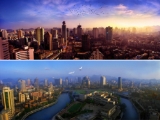
Guiyang is the capital of Guizhou
province of Southwest China
. It is located in the centre of the province, situated on the east of the Yunnan–Guizhou Plateau, and on the north bank of the Nanming River, a branch of the Wu River. The city has an elevation of about 1,100 meters. It has an area of 8,034 square kilometers.
Its population is 4,324,561 at the 2010 census whom 2,552,635 live in the built up area made of 7 urban districts.
. It was originally called Shunyuan (順元), meaning obeying the Yuan
(the Mongol rulers).
Originally the area was populated by non-Chinese
. The Sui Dynasty
(AD 581–618) had a commandery there, and the Tang dynasty
(618–907) a prefecture. They were, however, no more than military outposts, and it was not until the Yuan (Mongol) invasion of southwest China in 1279 that the area was made the seat of an army and a "pacification
office." Chinese settlement in the area also began at that time, and, under the Ming
(1368–1644) and Qing
(1644–1911) dynasties, the town became the seat of a superior prefecture named Guiyang.
Locally Guiyang was an important administrative and commercial center with two distinct merchant communities, consisting of the Sichuanese, who lived in the "new" northern part of the city, and those from Hunan
, Guangdong
, and Guangxi
province, who lived in the "old" southern part. Nevertheless, until the Sino-Japanese War
(1937–45), Guiyang was no more than the capital of one of China's least-developed provinces. As elsewhere in the southwest, considerable economic progress was made under the special circumstances of wartime. Road transport infrastructure with Kunming
in Yunnan province and with Chongqing
in Sichuan (China's wartime provisional capital) and into Hunan were established. Work was begun on a railway from Liuzhou
in Guangxi, and after 1949 this development was accelerated. Guiyang has subsequently become a major provincial city and industrial base. In 1959 the rail network in Guangxi was completed, allowing seamless connection from Guizhou to Chongqing to the north, to Kunming to the west, and Changsha to the east.
which had a large fountain at its center, until the fountain was paved over in early 2010 to help improve the flow of traffic.
The city is situated on the Nanming River, a headstream of the Wu River, which eventually joins the Yangtze River
at Fuling
in Sichuan
province. Guiyang is a natural transportation center, with comparatively easy access northward to Sichuan, eastward to Guangxi
and Guangdong
, westward to Yunnan
, and northeast to Hunan
province.
(Köppen
Cwa), tempered by its low latitude and high elevation. It has fairly mild winters, very warm summers and a monsoon
season, where the majority of the year's 1120 millimetres (44 in) of precipitation falls; the seasons are not particularly distinct. The mean temperature in January is 5.1 °C (41.2 °F) and for July 23.9 °C (75 °F). Rain is common throughout the year, with occasional flurries in winter. At only 1150 hours of sunshine, it is also one of China's least sunny cities. Relative humidity is consistent throughout the year.
 Guiyang is the economic and commercial hub of Guizhou Province. The GDP per capita was ¥24,585 (US$3,637) in 2009. The city is also a large center for retail and wholesale commercial activities with operations of major domestic and international general retailers such as Wal-Mart
, Carrefour
, RT-Mart, Beijing Hualian, Parkson
, and Xingli Group as well as consumer electronics and appliance sellers Gome and Suning. Wholesale operations include large regional produce, furniture, and industrial and construction machinery depots. Wal-Mart's southwest China regional vegetable and produce distribution center is located in Guiyang.
Hydro-electric power generators are located along the city's main rivers including the Wu River. By 2007, the city's hydro electric plants supplied over 70% of the city's electricity. Coal
is mined in the locality of Guiyang and Anshun
, and there are large thermal generating plants at Guiyang and Duyun
, supplying electricity
for a portion of the city's industry. A large iron and steel plant came into production in Guiyang in 1960, supplying the local machinery-manufacturing
industry.
Large deposits of bauxite
have been discovered to the north, and by the 1970s Guiyang had become a major producer of aluminum. Guiyang also manufactures aerospace engine parts and equipment, industrial and mining equipment, as well as railway vehicles and equipment. It has a large chemical industry
, producing fertilizers, and a rubber industry, manufacturing automobile tires. Guiyang also has a sizable domestic pharmaceuticals industry, producing traditional Chinese medicines as well as western medicines, textile plants, and makes glass, paper, and other consumer goods.
, in addition to the ethnic Han
.
As of 2008 , the total population of Guiyang municipality was 3.93 million, among which 2.72 million were urban residents.
with: Palmerston North, New Zealand Fort Worth, Texas
, USA
Guizhou
' is a province of the People's Republic of China located in the southwestern part of the country. Its provincial capital city is Guiyang.- History :...
province of Southwest China
Southwest China
Southwest China is a region of the People's Republic of China defined by governmental bureaus that includes the municipality of Chongqing, the provinces of Sichuan, Yunnan and Guizhou, and the Tibet Autonomous Region.-Provinces:-Municipalities:...
. It is located in the centre of the province, situated on the east of the Yunnan–Guizhou Plateau, and on the north bank of the Nanming River, a branch of the Wu River. The city has an elevation of about 1,100 meters. It has an area of 8,034 square kilometers.
Its population is 4,324,561 at the 2010 census whom 2,552,635 live in the built up area made of 7 urban districts.
History
The city was first constructed as early as 1283 AD during the Yuan DynastyYuan Dynasty
The Yuan Dynasty , or Great Yuan Empire was a ruling dynasty founded by the Mongol leader Kublai Khan, who ruled most of present-day China, all of modern Mongolia and its surrounding areas, lasting officially from 1271 to 1368. It is considered both as a division of the Mongol Empire and as an...
. It was originally called Shunyuan (順元), meaning obeying the Yuan
Yuan Dynasty
The Yuan Dynasty , or Great Yuan Empire was a ruling dynasty founded by the Mongol leader Kublai Khan, who ruled most of present-day China, all of modern Mongolia and its surrounding areas, lasting officially from 1271 to 1368. It is considered both as a division of the Mongol Empire and as an...
(the Mongol rulers).
Originally the area was populated by non-Chinese
Chinese people
The term Chinese people may refer to any of the following:*People with Han Chinese ethnicity ....
. The Sui Dynasty
Sui Dynasty
The Sui Dynasty was a powerful, but short-lived Imperial Chinese dynasty. Preceded by the Southern and Northern Dynasties, it ended nearly four centuries of division between rival regimes. It was followed by the Tang Dynasty....
(AD 581–618) had a commandery there, and the Tang dynasty
Tang Dynasty
The Tang Dynasty was an imperial dynasty of China preceded by the Sui Dynasty and followed by the Five Dynasties and Ten Kingdoms Period. It was founded by the Li family, who seized power during the decline and collapse of the Sui Empire...
(618–907) a prefecture. They were, however, no more than military outposts, and it was not until the Yuan (Mongol) invasion of southwest China in 1279 that the area was made the seat of an army and a "pacification
Peace
Peace is a state of harmony characterized by the lack of violent conflict. Commonly understood as the absence of hostility, peace also suggests the existence of healthy or newly healed interpersonal or international relationships, prosperity in matters of social or economic welfare, the...
office." Chinese settlement in the area also began at that time, and, under the Ming
Ming Dynasty
The Ming Dynasty, also Empire of the Great Ming, was the ruling dynasty of China from 1368 to 1644, following the collapse of the Mongol-led Yuan Dynasty. The Ming, "one of the greatest eras of orderly government and social stability in human history", was the last dynasty in China ruled by ethnic...
(1368–1644) and Qing
Qing Dynasty
The Qing Dynasty was the last dynasty of China, ruling from 1644 to 1912 with a brief, abortive restoration in 1917. It was preceded by the Ming Dynasty and followed by the Republic of China....
(1644–1911) dynasties, the town became the seat of a superior prefecture named Guiyang.
Locally Guiyang was an important administrative and commercial center with two distinct merchant communities, consisting of the Sichuanese, who lived in the "new" northern part of the city, and those from Hunan
Hunan
' is a province of South-Central China, located to the south of the middle reaches of the Yangtze River and south of Lake Dongting...
, Guangdong
Guangdong
Guangdong is a province on the South China Sea coast of the People's Republic of China. The province was previously often written with the alternative English name Kwangtung Province...
, and Guangxi
Guangxi
Guangxi, formerly romanized Kwangsi, is a province of southern China along its border with Vietnam. In 1958, it became the Guangxi Zhuang Autonomous Region of the People's Republic of China, a region with special privileges created specifically for the Zhuang people.Guangxi's location, in...
province, who lived in the "old" southern part. Nevertheless, until the Sino-Japanese War
Second Sino-Japanese War
The Second Sino-Japanese War was a military conflict fought primarily between the Republic of China and the Empire of Japan. From 1937 to 1941, China fought Japan with some economic help from Germany , the Soviet Union and the United States...
(1937–45), Guiyang was no more than the capital of one of China's least-developed provinces. As elsewhere in the southwest, considerable economic progress was made under the special circumstances of wartime. Road transport infrastructure with Kunming
Kunming
' is the capital and largest city of Yunnan Province in Southwest China. It was known as Yunnan-Fou until the 1920s. A prefecture-level city, it is the political, economic, communications and cultural centre of Yunnan, and is the seat of the provincial government...
in Yunnan province and with Chongqing
Chongqing
Chongqing is a major city in Southwest China and one of the five national central cities of China. Administratively, it is one of the PRC's four direct-controlled municipalities , and the only such municipality in inland China.The municipality was created on 14 March 1997, succeeding the...
in Sichuan (China's wartime provisional capital) and into Hunan were established. Work was begun on a railway from Liuzhou
Liuzhou
-History:thumb|Liuchow in 1945.Liuzhou has a history of more than 2,100 years. The city was founded in 111 B.C. when it was known as Tanzhong....
in Guangxi, and after 1949 this development was accelerated. Guiyang has subsequently become a major provincial city and industrial base. In 1959 the rail network in Guangxi was completed, allowing seamless connection from Guizhou to Chongqing to the north, to Kunming to the west, and Changsha to the east.
Geography
Guiyang has grown exponentially since the 1990s. The city's heart is around the 大十字 (literally "Big Ten") which is a cross, resembling the Chinese character for ten, and 喷水池 (literally "Fountain Pool") which is a traffic intersectionIntersection (road)
An intersection is a road junction where two or more roads either meet or cross at grade . An intersection may be 3-way - a T junction or fork, 4-way - a crossroads, or 5-way or more...
which had a large fountain at its center, until the fountain was paved over in early 2010 to help improve the flow of traffic.
The city is situated on the Nanming River, a headstream of the Wu River, which eventually joins the Yangtze River
Yangtze River
The Yangtze, Yangzi or Cháng Jiāng is the longest river in Asia, and the third-longest in the world. It flows for from the glaciers on the Tibetan Plateau in Qinghai eastward across southwest, central and eastern China before emptying into the East China Sea at Shanghai. It is also one of the...
at Fuling
Fuling District
Fuling District is a district in the middle of Chongqing Municipality, People's Republic of China. Its name means "Fu Cemetery" because some rulers of the State of Ba were originally buried there....
in Sichuan
Sichuan
' , known formerly in the West by its postal map spellings of Szechwan or Szechuan is a province in Southwest China with its capital in Chengdu...
province. Guiyang is a natural transportation center, with comparatively easy access northward to Sichuan, eastward to Guangxi
Guangxi
Guangxi, formerly romanized Kwangsi, is a province of southern China along its border with Vietnam. In 1958, it became the Guangxi Zhuang Autonomous Region of the People's Republic of China, a region with special privileges created specifically for the Zhuang people.Guangxi's location, in...
and Guangdong
Guangdong
Guangdong is a province on the South China Sea coast of the People's Republic of China. The province was previously often written with the alternative English name Kwangtung Province...
, westward to Yunnan
Yunnan
Yunnan is a province of the People's Republic of China, located in the far southwest of the country spanning approximately and with a population of 45.7 million . The capital of the province is Kunming. The province borders Burma, Laos, and Vietnam.Yunnan is situated in a mountainous area, with...
, and northeast to Hunan
Hunan
' is a province of South-Central China, located to the south of the middle reaches of the Yangtze River and south of Lake Dongting...
province.
Climate
Guiyang has a four-season, humid subtropical climateHumid subtropical climate
A humid subtropical climate is a climate zone characterized by hot, humid summers and mild to cool winters...
(Köppen
Köppen climate classification
The Köppen climate classification is one of the most widely used climate classification systems. It was first published by Crimea German climatologist Wladimir Köppen in 1884, with several later modifications by Köppen himself, notably in 1918 and 1936...
Cwa), tempered by its low latitude and high elevation. It has fairly mild winters, very warm summers and a monsoon
Monsoon
Monsoon is traditionally defined as a seasonal reversing wind accompanied by corresponding changes in precipitation, but is now used to describe seasonal changes in atmospheric circulation and precipitation associated with the asymmetric heating of land and sea...
season, where the majority of the year's 1120 millimetres (44 in) of precipitation falls; the seasons are not particularly distinct. The mean temperature in January is 5.1 °C (41.2 °F) and for July 23.9 °C (75 °F). Rain is common throughout the year, with occasional flurries in winter. At only 1150 hours of sunshine, it is also one of China's least sunny cities. Relative humidity is consistent throughout the year.
Administrative divisions
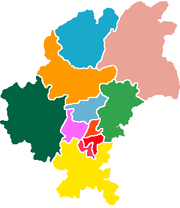
- Wudang DistrictWudang DistrictWudang District is a district of Guizhou, China. It is under the administration of Guiyang city....
(乌当区) - Nanming DistrictNanming DistrictNanming District is a district of Guizhou, China. It is under the administration of Guiyang city....
(南明区) - Yunyan DistrictYunyan DistrictYunyan District is a district of Guizhou, China. It is under the administration of Guiyang city....
(云岩区) - Huaxi DistrictHuaxi DistrictHuaxi District is a district in Guiyang, the capital city of Guizhou Province, China. It is a scenic resort and a national minority cultural center.Huaxi has an area of 957.6 square km and a population of 328,700...
(花溪区) - Baiyun DistrictBaiyun District, GuiyangBaiyun District, Guiyang is a district of Guizhou, China. It is under the administration of Guiyang city....
(白云区) - Xiaohe DistrictXiaohe DistrictXiaohe District is a district of Guizhou, China. It is under the administration of Guiyang city.It contains the famous Xiaohe Tomb complex with an ancient Bronze Age cemetery containing numerous well-preserved mummies.-External links:...
(小河区) - QingzhenQingzhenQingzhen is a county-level city under the administration of Guiyang in Guizhou province of the People's Republic of China.-External links:*...
City (清镇市) - Kaiyang CountyKaiyang CountyKaiyang County is a county of Guizhou, China. It is under the administration of Guiyang city....
(开阳县) - Xiuwen CountyXiuwen CountyXiuwen County is a county of Guizhou, China. It is under the administration of Guiyang city....
(修文县) - Xifeng County (息烽县)
- Jinyang New District (金阳新区)
Economy
Wal-Mart
Wal-Mart Stores, Inc. , branded as Walmart since 2008 and Wal-Mart before then, is an American public multinational corporation that runs chains of large discount department stores and warehouse stores. The company is the world's 18th largest public corporation, according to the Forbes Global 2000...
, Carrefour
Carrefour
Carrefour S.A. is an international hypermarket chain headquartered in Levallois-Perret, France. It is one of the largest hypermarket chains in the world...
, RT-Mart, Beijing Hualian, Parkson
Parkson
Parkson is a popular department store company in Malaysia which offers items at a medium rate. Parkson was established in 1987 as one of the largest retail chains in Malaysia at that time...
, and Xingli Group as well as consumer electronics and appliance sellers Gome and Suning. Wholesale operations include large regional produce, furniture, and industrial and construction machinery depots. Wal-Mart's southwest China regional vegetable and produce distribution center is located in Guiyang.
Hydro-electric power generators are located along the city's main rivers including the Wu River. By 2007, the city's hydro electric plants supplied over 70% of the city's electricity. Coal
Coal power in China
The People's Republic of China is the largest consumer of coal in the world, and is about to become the largest user of coal-derived electricity, generating 1.95 trillion kilowatt-hours per year, or 68.7% of its electricity from coal as of 2006...
is mined in the locality of Guiyang and Anshun
Anshun
Anshun is a prefecture-level city in China in the southwestern province of Guizhou where the famous Huangguoshu Waterfall is located. Within the borders of its prefecture one also finds attractions such as Long Gong Dragon Caves and the Getu River. As of 1999, it had a population of 217,215...
, and there are large thermal generating plants at Guiyang and Duyun
Duyun
Duyun is the capital of Qiannan Buyei and Miao Autonomous Prefecture in Guizhou province in the People's Republic of China.The area surrounding the city was affected by the Miao rebellion of 1736-36. The city participated in the uprising from the early stages until is was forcefully repressed the...
, supplying electricity
Electricity
Electricity is a general term encompassing a variety of phenomena resulting from the presence and flow of electric charge. These include many easily recognizable phenomena, such as lightning, static electricity, and the flow of electrical current in an electrical wire...
for a portion of the city's industry. A large iron and steel plant came into production in Guiyang in 1960, supplying the local machinery-manufacturing
Manufacturing
Manufacturing is the use of machines, tools and labor to produce goods for use or sale. The term may refer to a range of human activity, from handicraft to high tech, but is most commonly applied to industrial production, in which raw materials are transformed into finished goods on a large scale...
industry.
Large deposits of bauxite
Bauxite
Bauxite is an aluminium ore and is the main source of aluminium. This form of rock consists mostly of the minerals gibbsite Al3, boehmite γ-AlO, and diaspore α-AlO, in a mixture with the two iron oxides goethite and hematite, the clay mineral kaolinite, and small amounts of anatase TiO2...
have been discovered to the north, and by the 1970s Guiyang had become a major producer of aluminum. Guiyang also manufactures aerospace engine parts and equipment, industrial and mining equipment, as well as railway vehicles and equipment. It has a large chemical industry
Chemical industry
The chemical industry comprises the companies that produce industrial chemicals. Central to the modern world economy, it converts raw materials into more than 70,000 different products.-Products:...
, producing fertilizers, and a rubber industry, manufacturing automobile tires. Guiyang also has a sizable domestic pharmaceuticals industry, producing traditional Chinese medicines as well as western medicines, textile plants, and makes glass, paper, and other consumer goods.
Demographics
Guiyang is populated by 23 different minorities, the most populous of which is the Miao peopleMiao people
The Miao or ม้ง ; ) is an ethnic group recognized by the government of the People's Republic of China as one of the 55 official minority groups. Miao is a Chinese term and does not reflect the self-designations of the component nations of people, which include Hmong, Hmu, A Hmao, and Kho Xiong...
, in addition to the ethnic Han
Han Chinese
Han Chinese are an ethnic group native to China and are the largest single ethnic group in the world.Han Chinese constitute about 92% of the population of the People's Republic of China , 98% of the population of the Republic of China , 78% of the population of Singapore, and about 20% of the...
.
As of 2008 , the total population of Guiyang municipality was 3.93 million, among which 2.72 million were urban residents.
Transport
- Transportation in Guiyang consists of an extensive network of roads, railways, river and air transport as well as public transportation system with bus system and many taxis. Guiyang Urban Rail Transmit has been constructing since 2011. Based on the current planning, the whole network is formed by the 8 lines. Line 1 will be operational in 2016.
Air
- Guiyang is one of the important air transport hubs in Southwest China. Guiyang's main airport is the Guiyang Longdongbao International Airport(KWE) opened on May 28, 1997. It is located in east of Guiyang, 11 km away from the city center. The airport is connected to national and international destinations, such as Hong KongHong KongHong Kong is one of two Special Administrative Regions of the People's Republic of China , the other being Macau. A city-state situated on China's south coast and enclosed by the Pearl River Delta and South China Sea, it is renowned for its expansive skyline and deep natural harbour...
(canceled since 2009 ), TaipeiTaipeiTaipei City is the capital of the Republic of China and the central city of the largest metropolitan area of Taiwan. Situated at the northern tip of the island, Taipei is located on the Tamsui River, and is about 25 km southwest of Keelung, its port on the Pacific Ocean...
, SeoulSeoulSeoul , officially the Seoul Special City, is the capital and largest metropolis of South Korea. A megacity with a population of over 10 million, it is the largest city proper in the OECD developed world...
(Charter), PhuketPhuket ProvincePhuket , formerly known as Thalang and, in Western sources, Junk Ceylon , is one of the southern provinces of Thailand...
(Charter), SingaporeSingaporeSingapore , officially the Republic of Singapore, is a Southeast Asian city-state off the southern tip of the Malay Peninsula, north of the equator. An island country made up of 63 islands, it is separated from Malaysia by the Straits of Johor to its north and from Indonesia's Riau Islands by the...
(Charter), BangkokBangkokBangkok is the capital and largest urban area city in Thailand. It is known in Thai as Krung Thep Maha Nakhon or simply Krung Thep , meaning "city of angels." The full name of Bangkok is Krung Thep Mahanakhon Amon Rattanakosin Mahintharayutthaya Mahadilok Phop Noppharat Ratchathani Burirom...
(Charter), TaichungTaichung-Demographics:Taichung’s population was an estimated 1,040,725 in August 2006. There are slightly more females in the city than males.24.32% of residents are children, while 16.63% are young people, 52.68% are middle-age, and 6.73% are elderly....
& TaitungTaitung CityTaitung City is the county seat of Taitung County, Taiwan. It lies on the southeast coast of Taiwan facing the Pacific Ocean.The city is served by Taitung Airport. Taitung is a gateway to Green Island and Orchid Island, both of which are very popular among Taiwanese tourists.-History:Taitung...
(Charter), BeijingBeijingBeijing , also known as Peking , is the capital of the People's Republic of China and one of the most populous cities in the world, with a population of 19,612,368 as of 2010. The city is the country's political, cultural, and educational center, and home to the headquarters for most of China's...
, ShanghaiShanghaiShanghai is the largest city by population in China and the largest city proper in the world. It is one of the four province-level municipalities in the People's Republic of China, with a total population of over 23 million as of 2010...
, GuangzhouGuangzhouGuangzhou , known historically as Canton or Kwangchow, is the capital and largest city of the Guangdong province in the People's Republic of China. Located in southern China on the Pearl River, about north-northwest of Hong Kong, Guangzhou is a key national transportation hub and trading port...
, ShenzhenShenzhenShenzhen is a major city in the south of Southern China's Guangdong Province, situated immediately north of Hong Kong. The area became China's first—and one of the most successful—Special Economic Zones...
, ChengduChengduChengdu , formerly transliterated Chengtu, is the capital of Sichuan province in Southwest China. It holds sub-provincial administrative status...
. In 2010, the airport handled 6.2717 million passengers.
Railway
- Guiyang is a railway hub in southwest China. The Guizhou-Guangxi Railway (built in 1959, 2009 modified), the Sichuan-Guizhou railway (completed 1965), the Guiyang-Kunming Railway (completed 1970), and the Hunan-Guizhou Railway (completed 1975) are intersecting in Guiyang Railway Station. This main southern railway station is being rebuilt in 20082008 in rail transport- February events :* February 27** – Official opening of Santo Domingo Metro.** – National Express Group changes the name of the railway operating company one to National Express East Anglia as part of a company-wide rebranding exercise....
. - There are four high-speed railHigh-speed railHigh-speed rail is a type of passenger rail transport that operates significantly faster than the normal speed of rail traffic. Specific definitions by the European Union include for upgraded track and or faster for new track, whilst in the United States, the U.S...
lines to and from ChengduChengduChengdu , formerly transliterated Chengtu, is the capital of Sichuan province in Southwest China. It holds sub-provincial administrative status...
, ChongqingChongqingChongqing is a major city in Southwest China and one of the five national central cities of China. Administratively, it is one of the PRC's four direct-controlled municipalities , and the only such municipality in inland China.The municipality was created on 14 March 1997, succeeding the...
, GuangzhouGuangzhouGuangzhou , known historically as Canton or Kwangchow, is the capital and largest city of the Guangdong province in the People's Republic of China. Located in southern China on the Pearl River, about north-northwest of Hong Kong, Guangzhou is a key national transportation hub and trading port...
, KunmingKunming' is the capital and largest city of Yunnan Province in Southwest China. It was known as Yunnan-Fou until the 1920s. A prefecture-level city, it is the political, economic, communications and cultural centre of Yunnan, and is the seat of the provincial government...
, and Changsha and that will commence operations in 2012. The high speed railway lines will provide rapid freight service from two marshalling yards, and passenger service from a new high-speed railway station, called Guiyang North Railway Station, in the city's Jinyang New District.
Expressway
- The city is located at the junction of four major segments of the national highway grid: the Gui-Huang, Gui-Zun, Gui-Bi, and Gui-Xin Expressways.
- The Gui-Huang Expressway (G60) links Guiyang with the cities and tourist areas of central and western Guizhou including AnshunAnshunAnshun is a prefecture-level city in China in the southwestern province of Guizhou where the famous Huangguoshu Waterfall is located. Within the borders of its prefecture one also finds attractions such as Long Gong Dragon Caves and the Getu River. As of 1999, it had a population of 217,215...
, Guanling, and the Huangguoshu Waterfall. The expressway continues west to Yunnan Province as the Gui-Kun Expressway and terminates at Yunnan's capital city of KunmingKunming' is the capital and largest city of Yunnan Province in Southwest China. It was known as Yunnan-Fou until the 1920s. A prefecture-level city, it is the political, economic, communications and cultural centre of Yunnan, and is the seat of the provincial government...
. - The Gui-Zun Expressway (G75) begins in Guiyang and runs north 180 km to the regional Guizhou city of ZunyiZunyiZunyi is a prefecture-level city in Guizhou province in southwestern China. Along with Guiyang and Liupanshui, it is one of the most important cities of the province...
and is the most heavily travelled major highway in Guiyang. In Zunyi, the expressway becomes the Zunyi-Chongqing Expressway and runs a further 210 km north to its terminus in ChongqingChongqingChongqing is a major city in Southwest China and one of the five national central cities of China. Administratively, it is one of the PRC's four direct-controlled municipalities , and the only such municipality in inland China.The municipality was created on 14 March 1997, succeeding the...
. - The Gui-Bi Expressway (G76) links Guiyang with the regional cities of BijieBijie CityQixingguan District is the seat of the city of Bijie, Guizhou province, People's Republic of China. The total area of the district is , and the total population 1,275,300....
and DafangDafang CountyDafang County is a county of Guizhou, China. It is under the administration of Bijie city....
in northwest Guizhou province, southeastern Sichuan province, and the Sichuan cities of LuzhouLuzhou-History:The history of Luzhou dates back to Xia and Shang Dynasties. Luzhou became a prefecture level city in 1983.-History of Luzhou:...
, NeijiangNeijiangNeijiang is a prefecture-level city in the Southeast of Sichuan Province, in southwest of China, with a population of about 4,200,000. It is located on the Tuo River and is a transportation and food-processing center...
, and ChengduChengduChengdu , formerly transliterated Chengtu, is the capital of Sichuan province in Southwest China. It holds sub-provincial administrative status...
- Sichuan's provincial capital. The Gui-Bi Expresway begins at an interchange with the Gui-Zun Expressway in the city's Xiuwen CountyXiuwen CountyXiuwen County is a county of Guizhou, China. It is under the administration of Guiyang city....
approximately 20 km north of the city center, before terminating at the city of Bijie. In the city of Dafang, approximately 40 km east of Bijie, the Gui-Bi Expressway connects with the new Sichuan-Guizhou Expressway, a modern highway providing access to Luzhou and central Sichuan. - The Gui-Xin Expressway begins at the junction of the Guiyang Outer Ring Road (G75-G60.01) and the Tang Ba Guan Road, approximately 5 km southeast of the city center. The Gui-Xin Expressway (G60-G75) runs east and southeast through the Guangxi Zhuang Autonomous Region (G76) and its capital city of GuilinGuilinGuilin is a prefecture-level city in the northeast of the Guangxi Zhuang Autonomous Region of far southern China, sitting on the west bank of the Li River. Its name means "forest of Sweet Osmanthus", owing to the large number of fragrant Sweet Osmanthus trees located in the city...
before entering Guangdong Province and terminating at the city of GuangzhouGuangzhouGuangzhou , known historically as Canton or Kwangchow, is the capital and largest city of the Guangdong province in the People's Republic of China. Located in southern China on the Pearl River, about north-northwest of Hong Kong, Guangzhou is a key national transportation hub and trading port...
. - Approximately 170 km east of Guiyang in the regional city of Kaili, the Hunan-Guizhou Expressway (G56-G60) links with the Gui-Xin Expressway providing high-speed vehicular access to and from Guiyang to the eastern Guizhou city of TongrenTongren CityBijiang District , is the seat of the city of Tongren, Guizhou province, People's Republic of China. The area was known as Tongren City until November 2011, when it was renamed Bijiang District. The district has an area of and has a population of 340,000.-External links:*...
before continuing through Hunan Province to the major cities of HuaihuaHuaihua-Administration:* Hecheng District 鹤城区* Hongjiang City 洪江市* Hongjiang District 洪江区* Yuanling County 沅陵县* Chenxi County 辰溪县* Xupu County 溆浦县* Zhongfang County 中方县* Huitong County 会同县* Mayang Miao Autonomous County 麻阳苗族自治县...
, ChangdeChangdeChangde is a city in the north of Hunan Province, China, with a population of 5,717,218 inhabitants at the 2010 census whom 1,232,182 in the built up area made of 2 urban districts .-History:...
, and Changsha. - In 2009 Guiyang added a modern orbital expressway to its highway network. The Guiyang Outer Ring Road (Guiyang Orbital Highway) opened in December 2009 and is a six to eight lane divided high-speed expressway that provides efficient links to and from large employment centers in the Jinyang New District, Baiyun DistrictBaiyun District, GuiyangBaiyun District, Guiyang is a district of Guizhou, China. It is under the administration of Guiyang city....
, Huaxi DistrictHuaxi DistrictHuaxi District is a district in Guiyang, the capital city of Guizhou Province, China. It is a scenic resort and a national minority cultural center.Huaxi has an area of 957.6 square km and a population of 328,700...
, the Guiyang Longdongbao International Airport, the major multi-lane national highways, and the city's main roadways, allowing vehicular traffic to circumnavigate the heavy traffic of the city's inner city areas. - China National Highway 210China National Highway 210China National Highway 210 runs from Baotou, Inner Mongolia to Nanning, Guangxi Province. It is 3,097 kilometres in length and runs south from Baotou towards Shaanxi Province, Sichuan Province, Chongqing, Guizhou Province, and ends in Guangxi Province.- Route and distance:-References:*...
Education
The city is the cultural and educational center of Guizhou province and has a university, a teacher-training college, and a medical school.- Guizhou UniversityGuizhou UniversityGuizhou University is a public coeducational university, located in the suburban outskirts of Guiyang, the capital city of Guizhou Province, China. The university is one of the key 211 Project universities on mainland China....
- Guizhou Normal UniversityGuizhou Normal UniversityGuizhou Normal University is an institution of higher learning in Guiyang, Guizhou Province of the People's Republic of China....
- Guiyang Medical College
- Guizhou College of Finance and Economics
- Guizhou Nationalities College
- Guiyang College
- Commercial College of Guizhou
- Institute Of Geochemistry, Chinese Academy of Sciences
- Guiyang College of Traditional Chinese MedicineGuiyang College of Traditional Chinese MedicineGuiyang College of Traditional Chinese Medicine is a public university based in Guiyang, the capital of Guizhou province in China.- History :The university was established in 1965 as the Guiyang College of Traditional Chinese Medicine...
Religion
On October 15, 1696, the city was made the seat of the Roman Catholic Apostolic Vicariate of Kweichow. This was suppressed in 1715 and restored in 1846. In 1924 it was renamed as the Apostolic Vicariate of Guiyang, and in 1946 it was promoted to its current status as the Roman Catholic Archdiocese of Guiyang.Twin towns — Sister cities
Guiyang is twinnedTown twinning
Twin towns and sister cities are two of many terms used to describe the cooperative agreements between towns, cities, and even counties in geographically and politically distinct areas to promote cultural and commercial ties.- Terminology :...
with: Palmerston North, New Zealand Fort Worth, Texas
Fort Worth, Texas
Fort Worth is the 16th-largest city in the United States of America and the fifth-largest city in the state of Texas. Located in North Central Texas, just southeast of the Texas Panhandle, the city is a cultural gateway into the American West and covers nearly in Tarrant, Parker, Denton, and...
, USA