

Yi language

Encyclopedia
Nuosu also known as Northern Yi, Liangshan Yi, and Sichuan Yi, is the prestige language of the Yi people
; it has been chosen by the Chinese government as the standard Yi language (in Mandarin: Yí yǔ, 彝語/彝语) and, as such, is the only one taught in school, both in its oral and written form. It is spoken by two million people and is increasing; 60% are monolingual. Nuosu is the native Nuosu/Yi name for their own language and is not used in Mandarin Chinese; although it may sometimes be spelled out for pronunciation (nuòsū yǔ 诺苏语/諾蘇語), the Chinese characters for nuòsū have no meaning.
The occasional terms 'Black Yi' (Mandarin: hēi Yí 黑彝) and 'White Yi' (bái Yí 白彝) are castes of the Nuosu people not dialects.
Nuosu is one of several often mutually unintelligible varieties known as Yi, Lolo, Moso, or Noso; the six Yi languages recognized by the Chinese government hold only 25% to 50% of their vocabulary in common. They share a common traditional writing system
, though this is used for shamanism rather than daily accounting. The Yi people regard the traditional Western term Lolo (Luóluó 羅羅/罗罗) as pejorative.
system of 8,000–10,000 glyphs. Although similar to Chinese in function, the glyphs are independent in form, with little to suggest a direct relation.
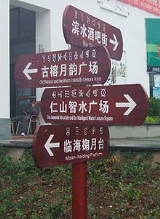
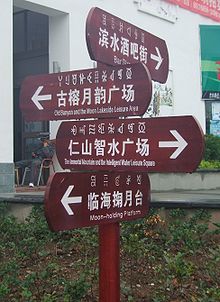
The Modern Yi script ( [nɔ̄sū bʙ̝̄mā] 'Nosu script') is a standardized syllabary
derived from the classic script in 1974 by the local Chinese government
. It was made the official script of the Yi languages in 1980. There are 756 basic glyphs based on the Liangshan dialect, plus 63 for syllables only found in Chinese borrowings.
In 1958 the Chinese government had introduced a Roman-based alphabet for use in Yi, based on the romanized script of Gladstone Porteous
of Sayingpan. (This was later replaced by the Yi script.)
* Identified with the vowel of the Mandarin 四 sì "four"
Yi people
The Yi or Lolo people are an ethnic group in China, Vietnam, and Thailand. Numbering 8 million, they are the seventh largest of the 55 ethnic minority groups officially recognized by the People's Republic of China...
; it has been chosen by the Chinese government as the standard Yi language (in Mandarin: Yí yǔ, 彝語/彝语) and, as such, is the only one taught in school, both in its oral and written form. It is spoken by two million people and is increasing; 60% are monolingual. Nuosu is the native Nuosu/Yi name for their own language and is not used in Mandarin Chinese; although it may sometimes be spelled out for pronunciation (nuòsū yǔ 诺苏语/諾蘇語), the Chinese characters for nuòsū have no meaning.
The occasional terms 'Black Yi' (Mandarin: hēi Yí 黑彝) and 'White Yi' (bái Yí 白彝) are castes of the Nuosu people not dialects.
Nuosu is one of several often mutually unintelligible varieties known as Yi, Lolo, Moso, or Noso; the six Yi languages recognized by the Chinese government hold only 25% to 50% of their vocabulary in common. They share a common traditional writing system
Yi script
The Yi script, also historically known as Cuan Wen or Wei Shu , is used to write the Yi languages.-Classical Yi:Classical Yi is a syllabic logographic system that was reputedly devised during the Tang dynasty by someone called Aki...
, though this is used for shamanism rather than daily accounting. The Yi people regard the traditional Western term Lolo (Luóluó 羅羅/罗罗) as pejorative.
Writing system
Classic Yi is a syllabic logographicLogogram
A logogram, or logograph, is a grapheme which represents a word or a morpheme . This stands in contrast to phonograms, which represent phonemes or combinations of phonemes, and determinatives, which mark semantic categories.Logograms are often commonly known also as "ideograms"...
system of 8,000–10,000 glyphs. Although similar to Chinese in function, the glyphs are independent in form, with little to suggest a direct relation.
The Modern Yi script ( [nɔ̄sū bʙ̝̄mā] 'Nosu script') is a standardized syllabary
Syllabary
A syllabary is a set of written symbols that represent syllables, which make up words. In a syllabary, there is no systematic similarity between the symbols which represent syllables with the same consonant or vowel...
derived from the classic script in 1974 by the local Chinese government
People's Republic of China
China , officially the People's Republic of China , is the most populous country in the world, with over 1.3 billion citizens. Located in East Asia, the country covers approximately 9.6 million square kilometres...
. It was made the official script of the Yi languages in 1980. There are 756 basic glyphs based on the Liangshan dialect, plus 63 for syllables only found in Chinese borrowings.
In 1958 the Chinese government had introduced a Roman-based alphabet for use in Yi, based on the romanized script of Gladstone Porteous
Gladstone Porteous
Gladstone Charles Fletcher Porteous, Chinese name 张尔昌 Zhāng Ěrchāng was an Australian missionary to China who served with the China Inland Mission from 1904 and became Superintendent of the work in East Yunnan...
of Sayingpan. (This was later replaced by the Yi script.)
Phonology
The written equivalents of the phonemes listed here are "Yi Pinyin". For information about the actual script used, see the section above entitled Writing System.Consonants
| Labial Labial consonant Labial consonants are consonants in which one or both lips are the active articulator. This precludes linguolabials, in which the tip of the tongue reaches for the posterior side of the upper lip and which are considered coronals... |
Alveolar Alveolar consonant Alveolar consonants are articulated with the tongue against or close to the superior alveolar ridge, which is called that because it contains the alveoli of the superior teeth... |
Retroflex Retroflex consonant A retroflex consonant is a coronal consonant where the tongue has a flat, concave, or even curled shape, and is articulated between the alveolar ridge and the hard palate. They are sometimes referred to as cerebral consonants, especially in Indology... |
Palatal Palatal consonant Palatal consonants are consonants articulated with the body of the tongue raised against the hard palate... |
Velar Velar consonant Velars are consonants articulated with the back part of the tongue against the soft palate, the back part of the roof of the mouth, known also as the velum).... |
Glottal Glottal consonant Glottal consonants, also called laryngeal consonants, are consonants articulated with the glottis. Many phoneticians consider them, or at least the so-called fricative, to be transitional states of the glottis without a point of articulation as other consonants have; in fact, some do not consider... |
||
|---|---|---|---|---|---|---|---|
| Nasal Nasal consonant A nasal consonant is a type of consonant produced with a lowered velum in the mouth, allowing air to escape freely through the nose. Examples of nasal consonants in English are and , in words such as nose and mouth.- Definition :... |
voiced | m /m/ | n /n/ | ny /ɲ/ | ng /ŋ/ | ||
| unvoiced | hm /m̥/ | hn /n̥/ | |||||
| Plosive | prenasalized | nb /mb/ | nd /nd/ | mg /ŋɡ/ | |||
| voiced | bb /b/ | dd /d/ | gg /ɡ/ | ||||
| unvoiced | b /p/ | d /t/ | g /k/ | ||||
| aspirated | p /pʰ/ | t /tʰ/ | k /kʰ/ | ||||
| Affricate Affricate consonant Affricates are consonants that begin as stops but release as a fricative rather than directly into the following vowel.- Samples :... |
prenasalized | nz /ndz/ | nr /ndʐ/ | nj /ndʑ/ | |||
| voiced | zz /dz/ | rr /dʐ/ | jj /dʑ/ | ||||
| unvoiced | z /ts/ | zh /tʂ/ | j /tɕ/ | ||||
| aspirated | c /tsʰ/ | ch /tʂʰ/ | q /tɕʰ/ | ||||
| Fricative Fricative consonant Fricatives are consonants produced by forcing air through a narrow channel made by placing two articulators close together. These may be the lower lip against the upper teeth, in the case of ; the back of the tongue against the soft palate, in the case of German , the final consonant of Bach; or... |
unvoiced | f /f/ | s /s/ | sh /ʂ/ | x /ɕ/ | h /x/ | hx /h/ |
| voiced | v /v/ | ss /z/ | r /ʐ/ | y /ʑ/ | w /ɣ/ | ||
| Lateral Lateral consonant A lateral is an el-like consonant, in which airstream proceeds along the sides of the tongue, but is blocked by the tongue from going through the middle of the mouth.... |
voiced | l /l/ | |||||
| unvoiced | hl /l̥/ |
Vowels
| Front Front vowel A front vowel is a type of vowel sound used in some spoken languages. The defining characteristic of a front vowel is that the tongue is positioned as far in front as possible in the mouth without creating a constriction that would be classified as a consonant. Front vowels are sometimes also... |
Central Central vowel A central vowel is a type of vowel sound used in some spoken languages. The defining characteristic of a central vowel is that the tongue is positioned halfway between a front vowel and a back vowel... |
Back Back vowel A back vowel is a type of vowel sound used in spoken languages. The defining characteristic of a back vowel is that the tongue is positioned as far back as possible in the mouth without creating a constriction that would be classified as a consonant. Back vowels are sometimes also called dark... |
|
|---|---|---|---|
| Close Close vowel A close vowel is a type of vowel sound used in many spoken languages. The defining characteristic of a close vowel is that the tongue is positioned as close as possible to the roof of the mouth without creating a constriction that would be classified as a consonant.This term is prescribed by the... |
i /i/ | y /z̞*/ | u /u/ |
| Close-mid Close-mid vowel A close-mid vowel is a type of vowel sound used in some spoken languages. The defining characteristic of a close-mid vowel is that the tongue is positioned two-thirds of the way from a close vowel to a mid vowel... |
ie /e/ | o /o/ | |
| Open-mid Open-mid vowel An open-mid vowel is a type of vowel sound used in some spoken languages. The defining characteristic of an open-mid vowel is that the tongue is positioned two-thirds of the way from an open vowel to a mid vowel... |
e /ə/ | uo /ɔ/ | |
| Open Open vowel An open vowel is defined as a vowel sound in which the tongue is positioned as far as possible from the roof of the mouth. Open vowels are sometimes also called low vowels in reference to the low position of the tongue... |
a /a/ |
Tones
- high [˥] – written -t
- mid falling [˧˨] or mid [˧] – written -x
- mid [˧] – unmarked
- low falling [˨˩] – written -p
Further reading
- Collective book, Ritual for Expelling Ghosts, A religious Classic of the Yi nationality in Liangshan Prefecture, Sichuan. The Taipei Ricci Institute (November 1998)
- Ma Linying, Dennis Elton Walters, Susan Gary Walters (editors). Nuosu Yi-Chinese-English Glossary. Nationalities Publishing House (1991). ISBN 7105090502.