
All Topics  
American Museum of Natural History


   Email Print
   Bookmark   Link


American Museum of Natural History


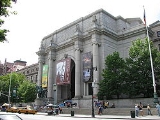
The American Museum of Natural History (AMNH), located on the Upper West Side
Upper West Side

The Upper West Side is a neighborhood of the borough of Manhattan in New York City that lies between Central Park and the Hudson River above 59th Street ....
, Manhattan
Manhattan

Manhattan is one of the five borough of New York City, located primarily on Manhattan Island at the mouth of the Hudson River.With a United States Census of 1,620,867 living in a land area of 22.96 square miles , Manhattan, coextensive with New York County, is the most population density county in the United States, w...
, New York
New York

The State of New York is a U.S. state in the Mid-Atlantic States and Northeastern United States regions of the United States and is the nation's List of U.S....
, USA, is one of the largest and most celebrated museum
Museum

A museum is a "permanent institution in the service of society and of its development, open to the public, which acquires, conserves, researches, communicates and exhibits the tangible and intangible heritage of humanity and its environment, for the purposes of education, study, and entertainment", as defined by the International Coun...
s in the world. Located in park-like grounds, the museum comprises 25 interconnected buildings that house 46 permanent exhibition halls, research laboratories, and its renowned library.

The collections contain over 32 million specimens, of which only a small fraction can be displayed at any given time.


Discussion
Ask a question about 'American Museum of Natural History'
Start a new discussion about 'American Museum of Natural History'
Answer questions from other users
Full Discussion Forum


Recent Posts


Encyclopedia


Amnh
The American Museum of Natural History (AMNH), located on the Upper West Side
Upper West Side

The Upper West Side is a neighborhood of the borough of Manhattan in New York City that lies between Central Park and the Hudson River above 59th Street ....
, Manhattan
Manhattan

Manhattan is one of the five borough of New York City, located primarily on Manhattan Island at the mouth of the Hudson River.With a United States Census of 1,620,867 living in a land area of 22.96 square miles , Manhattan, coextensive with New York County, is the most population density county in the United States, w...
, New York
New York

The State of New York is a U.S. state in the Mid-Atlantic States and Northeastern United States regions of the United States and is the nation's List of U.S....
, USA, is one of the largest and most celebrated museum
Museum

A museum is a "permanent institution in the service of society and of its development, open to the public, which acquires, conserves, researches, communicates and exhibits the tangible and intangible heritage of humanity and its environment, for the purposes of education, study, and entertainment", as defined by the International Coun...
s in the world. Located in park-like grounds, the museum comprises 25 interconnected buildings that house 46 permanent exhibition halls, research laboratories, and its renowned library.

The collections contain over 32 million specimens, of which only a small fraction can be displayed at any given time. The museum has a scientific staff of more than 200, and sponsors over 100 special field expeditions each year.

History

The museum was founded in 1869. Prior to construction of the present complex, the museum was housed in the old Arsenal building in Central Park
Central Park

Central Park is a large public, urban park in New York City, with about twenty-five million visitors annually. Most of the areas immediately adjacent to the park are known for impressive buildings and valuable real estate....
. Theodore Roosevelt, Sr.
Theodore Roosevelt, Sr.

Theodore Roosevelt, Sr. was the father of U.S. President Theodore Roosevelt and the paternal grandfather of American first lady Eleanor Roosevelt....
, the father of the 26th U.S. President
Theodore Roosevelt

Theodore Roosevelt , also known as T.R., and to the public as Teddy, was the List of Presidents of the United States President of the United States....
, was one of the founders along with John David Wolfe, William T. Blodgett, Robert L. Stuart, Andrew H. Green
Andrew Haswell Green

Andrew [Haswell] Green was a New York lawyer, city planner, civic leader and agitator for reform. Called by some historians a hundred years later "the 19th century Robert Moses," he held several offices and played important roles in many projects, including Riverside Drive , Morningside Park, Fort Washington , and Central Park....
, Robert Colgate, Morris K. Jesup
Morris Ketchum Jesup

Morris Ketchum Jesup , United States banker and philanthropist, was born at Westport, Connecticut.In 1842 he went to New York City, where after some experience in business he established a banking house in 1852....
, Benjamin H. Field, D. Jackson Steward, Richard M. Blatchford, J. Pierpont Morgan, Adrian Iselin, Moses H. Grinnell
Moses H. Grinnell

Moses Hicks Grinnell was a United States Navy officer, United States Congress representing New York, and Central Park Commissioner.Grinnell was born in New Bedford, Massachusetts, on March 3, 1803....
, Benjamin B. Sherman, Anson Greene Phelps
Anson Greene Phelps

Anson Greene Phelps was a co-founder of mining company Phelps Dodge, which he founded in 1833 along with his son-in-law William E. Dodge....
, William A. Haines, Charles A. Dana
Charles Anderson Dana

Charles Anderson Dana was an United States journalist, author, and government official, best known for his association with Ulysses S. Grant during the American Civil War and his aggressive political advocacy after the war....
, Joseph H. Choate
Joseph Hodges Choate

Joseph Hodges Choate , was an United States lawyer and diplomat....
, Henry G. Stebbins
Henry G. Stebbins

Henry George Stebbins was a United States House of Representatives from New York during the latter half of the American Civil War.Born in Ridgefield, Connecticut to John Stebbins and Mary Largin....
, Henry Parish, and Howard Potter. The founding of the Museum realized the dream of naturalist Dr. Albert S. Bickmore
Albert S. Bickmore

Albert Smith Bickmore was an American naturalist and one of the founders of the American Museum of Natural History....
. Bickmore, a one-time student of Harvard zoologist Louis Agassiz
Louis Agassiz

Jean Louis Rodolphe Agassiz was a paleontologist, glaciologist, and geologist, and was a prominent innovator in the study of the earth's natural history....
, lobbied tirelessly for years for the establishment of a natural history museum in New York. His proposal, backed by his powerful sponsors, won the support of the Governor of New York, John Thompson Hoffman, who signed a bill officially creating the American Museum of Natural History on April 6, 1869.

In 1874, the cornerstone was laid for the museum's first building, which is now hidden from view by the many buildings in the complex that today occupy most of Manhattan Square. The original Victorian Gothic
Gothic Revival architecture

The Gothic Revival is an Architectural style which began in the 1740s in England. Its popularity grew rapidly in the early nineteenth century, when increasingly serious and learned admirers of neo-Gothic styles sought to revive Middle Ages forms in contrast to the Neoclassical architecture styles which were then prevalent....
 building, which was opened in 1877, was designed by Calvert Vaux
Calvert Vaux

Calvert Vaux , was an architect and landscape designer. He is best remembered as the co-designer , of New York's Central Park.Little is known about Vaux's childhood and upbringing....
 and J. Wrey Mould, both already closely identified with the architecture of Central Park. It was soon eclipsed by the south range of the museum, designed by J. Cleaveland Cady
J. Cleaveland Cady

J Cleaveland Cady was a New York City-based architect whose most familiar surviving building is the south range of the American Museum of Natural History on New York's Upper West Side....
, a robust exercise in rusticated brownstone neo-Romanesque
Richardsonian Romanesque

File:Trinity_Church,_Boston,_Massachusetts_-_front_oblique_view.JPGRichardsonian Romanesque is a architectural style of Romanesque Revival architecture named after architect Henry Hobson Richardson, whose masterpiece is Trinity Church, Boston ....
, influenced by H. H. Richardson
Henry Hobson Richardson

Henry Hobson Richardson was a prominent United States architect of the 19th century whose work left a significant impact on Boston, Pittsburgh, Albany, New York and Chicago, among others....
. It extends along West 77th Street, with corner towers tall. Its pink brownstone and granite, similar to that found at Grindstone Island
Grindstone Island

Grindstone Island is the fourth largest of the Thousand Islands in the St. Lawrence River and the second largest American island. The island lies near Lake Ontario and is part of the United States of America....
 in the St. Lawrence River, came from quarries at Picton Island, New York. A triumphal Roman entrance on Central Park West
Central Park West

Central Park West is an avenue that runs north-south in the New York City borough of Manhattan, in the United States.As its name indicates, CPW forms the western edge of Central Park....
, the New York State Memorial to Theodore Roosevelt
Theodore Roosevelt

Theodore Roosevelt , also known as T.R., and to the public as Teddy, was the List of Presidents of the United States President of the United States....
 completed by John Russell Pope
John Russell Pope

John Russell Pope was an architecture most known for his designs of the Jefferson Memorial and the West Building of the National Gallery of Art in Washington, DC....
 in 1936, is an overscaled Beaux-Arts
Beaux-Arts architecture

Beaux-Arts architecture denotes the academic Neoclassical architecture architectural style that was taught at the ?cole des Beaux-Arts in Paris....
 monument. It leads to a vast Roman basilica, where a cast of a skeleton of a rearing Barosaurus
Barosaurus

Barosaurus meaning 'heavy lizard' was a giant, long-tailed, long-necked, herbivore dinosaur closely related to the more familiar Diplodocus....
 defending her young from an Allosaurus
Allosaurus

Allosaurus is a genus of large theropod dinosaur that lived 155 to 145 million years ago, in the late Jurassic Period . The name Allosaurus means "different lizard" and is derived from the Ancient Greek a????/allos and sa????/sauros ....
 is not lost in the general monumentality. Recently the museum's 77th street foyer, renamed the 'Grand Gallery' has been redone in gleaming white and is illuminated by classic Romanesque fixtures. The Haida
Haida

The Haida are an Indigenous peoples of the Pacific Northwest Coast of North America. The Haida territories comprise the archipelago of the Queen Charlotte Islands, known in the Haida language as Haida Gwaii , and the southern half of Prince of Wales Island in the southernmost Alaska Panhandle, which is the home of a subgroup called the '...
 canoe is now fully suspended, giving the appearance that it is floating above the viewer. The hall offers a dramatic entrance to the hall of Northwest Coast Indians, the oldest extant exhibit in the museum.

Famous names associated with the museum include the paleontologist and geologist
Geologist

For other uses, see Geologist .A geologist is a contributor to the science of geology, studying the physical structure and processes of the Earth and planets of the solar system ....
 Henry Fairfield Osborn
Henry Fairfield Osborn

Henry Fairfield Osborn was an United States geologist, paleontologist, and Eugenics, "a first-rate science administrator and a third-rate scientist."...
, president for many years; the dinosaur-hunter of the Gobi Desert
Gobi Desert

The Gobi is the largest desert region in Asia. It covers parts of northern and northwestern China, and of southern Mongolia. The desert basins of the Gobi are bounded by the Altai Mountains and the grasslands and steppes of Mongolia on the north, by the Hexi Corridor and Tibetan Plateau to the southwest, and by the North China Plain to the s...
, Roy Chapman Andrews
Roy Chapman Andrews

Roy Chapman Andrews was an United States explorer, adventurer and Natural history who became the director of the American Museum of Natural History....
 (one of the inspirations for Indiana Jones
Indiana Jones

Dr. Henry Walton "Indiana" Jones, Jr. is a fictional character adventurer, soldier, professor of archaeology, and the main protagonist of the Indiana Jones franchise....
); George Gaylord Simpson
George Gaylord Simpson

'George Gaylord Simpson' was an United States paleontologist. He was an expert on extinct mammals and their intercontinental migrations. Simpson was the most influential paleontologist of the twentieth century and a major participant in the modern evolutionary synthesis, contributing Tempo and Mode in Evolution and Principles of Classi...
; biologist Ernst Mayr; pioneer cultural anthropologists
Cultural anthropology

Cultural anthropology is one of four fields of anthropology as it developed in the United States. It is the branch of anthropology that has developed and promoted "culture" as a meaningful scientific concept, studied cultural variation among humans, and examined the impact of global economic and political processes on local cultural realiti...
 Franz Boas
Franz Boas

Franz Boas was a Germans-United States anthropologist and a pioneer of modern anthropology who has been called the "Father of American Anthropology"....
 and Margaret Mead
Margaret Mead

Margaret Mead was an United States cultural anthropology, who was frequently a featured writer and speaker in the mass media throughout the 1960s and 1970s....
; and ornithologist Robert Cushman Murphy
Robert Cushman Murphy

Robert Cushman Murphy was an United States ornithologist and former Lamont curator of birds for the American Museum of Natural History.Murphy was born in Brooklyn, New York, and was an undergraduate at Brown University, graduating in 1911....
. J. P. Morgan
J. P. Morgan

John Pierpont Morgan was an United States financier, banker and art collector who dominated corporate finance and industrial consolidation during his time....
 was also among the famous benefactors of the Museum. The philanthropist Harry Payne Whitney
Harry Payne Whitney

Harry Payne Whitney was an American businessman, thoroughbred horsebreeder, and member of the prominent Whitney family....
 financed the Whitney South Seas Expedition
Whitney South Seas Expedition

The Whitney South Seas Expedition to collect bird specimens for the American Museum of Natural History , under the initial leadership of Rollo Beck, was financed by Harry Payne Whitney, a thoroughbred horse-breeder and philanthropist....
 (1920-1932) for the Museum, greatly expanding its collection of biological and anthropological specimens from the south-west Pacific region
Oceania

Oceania is a geography, often geopolitics, region consisting of numerous lands—mostly islands in the Pacific Ocean and vicinity. The term "Oceania" was coined in 1831 by French explorer Jules Dumont d'Urville....
.

Library


From its founding in 1880, the Library of the American Museum of Natural History has grown into one of the world's great natural history collections. In its early years, the Library expanded its collection mostly through such gifts as the John C. Jay conchological
Conchology

Conchology is the science, semi-scientific, or amateur study of mollusc shell . In other words, it is the study of the exoskeletons of animals in the phylum Mollusca....
 library, the Carson Brevoort library on fishes and general zoology, the ornithological library of Daniel Giraud Elliot
Daniel Giraud Elliot

Daniel Giraud Elliot was an United States zoologist.Elliot was one of the founders of the American Museum of Natural History in New York and the American Ornithologists' Union....
, the Harry Edwards entomological library, the Hugh Jewett collection of voyages and travel and the Jules Marcou
Jules Marcou

Jules Marcou was an eminent Switzerland-United States geologist.He was born at Salins-les-Bains, in the d?partement in France of Jura , in France....
 geology
Geology

Geology is the science and study of the solid and liquid matter that constitute the Earth. The field of geology encompasses the study of the composition, structural geology, physical properties, dynamics, and History of the Earth of Earth materials, and the processes by which they are formed, moved, and changed....
 collection. In 1903 the American Ethnological Society
American Ethnological Society

The American Ethnological Society is the oldest professional anthropology association in the United States....
 deposited its library in the Museum and in 1905 the New York Academy of Sciences
New York Academy of Sciences

The New York Academy of Sciences is the third oldest scientific society in the United States. An independent, non-profit organization with more than 25,000 members in 140 countries, the Academy?s mission is to advance understanding of science and technology....
 followed suit by transferring its collection of 10,000 volumes. Today, the Library's collections contain over 450,000 volumes of monographs, serials, pamphlets and reprints, microforms, and original illustrations, as well as film, photographic, archives and manuscripts, fine art, memorabilia and rare book collections. The Library collects materials covering such subjects as mammalogy
Mammalogy

In zoology, mammalogy is the study of mammals ? a class of vertebrates with characteristics such as homeothermic metabolism, fur, four-chambered hearts, and complex nervous systems....
, geology, anthropology
Anthropology

Anthropology is the study of humans and humanity in its totality. Anthropology has origins in the natural sciences, and the humanities. In Great Britain it was originally divided into physical anthropology and cultural anthropology, which itself was divided into archaeology, technology, ethnology and sociology ....
, entomology, herpetology
Herpetology

Herpetology is the branch of zoology concerned with the study of amphibians and of reptiles .Herpetology is concerned with poikilothermic, or ectothermic, tetrapods....
, ichthyology
Ichthyology

Ichthyology is the branch of zoology devoted to the study of fish. This includes skeletal fish , cartilaginous fish , and jawless fish . At least 30,700 fish species have been described, comprising a majority of vertebrates....
, paleontology
Paleontology

File:Geological time spiral - sharper.pngPaleontology from Greek: pa?a??? "old, ancient", ??, ??t- "being, creature", and ????? "speech, thought" is the study of prehistory life, including organisms' evolution and interactions with each other and their environments ....
, ethology
Ethology

Ethology is the scientific study of animal behavior, and a branch of zoology .Although many naturalists have studied aspects of animal behavior through the centuries, the modern discipline of ethology is usually considered to have arisen with the work in the 1930s of Dutch biologist Nikolaas Tinbergen and Austrian biologist Konrad Lorenz,...
, ornithology, mineralogy
Mineralogy

Mineralogy is an Earth Science focused around the chemistry, crystal structure, and physical properties of minerals. Specific studies within mineralogy include the processes of mineral origin and formation, classification of minerals, their geographical distribution, as well as their utilization....
, invertebrates, systematics
Systematics

Biological systematics is the study of the diversification of life on the planet Earth, both past and present, and the relationships among living things through time....
, ecology
Ecology

Ecology is the science study of the distribution and Abundance of life and the interactions between organisms and their nature environment ....
, oceanography
Oceanography

Oceanography , also called oceanology or marine science, is the branch of Earth science that studies the ocean. It covers a wide range of topics, including marine organisms and ecosystem dynamics; ocean currents, waves, and geophysical fluid dynamics; plate tectonics and the geology of the sea floor; and fluxes of various chemi...
, conchology, exploration and travel, history of science, museology
Museology

Museology is the study of how to organize and manage museums and Collection . More generally, museum studies is a term used to denote academic programs, generally graduate programs, in the management, administration, or theory of museums....
, bibliography, and peripheral biological sciences. The collection is rich in retrospective materials — some going back to the 15th century — that are difficult to find elsewhere.

Features


The museum boasts habitat groups
Diorama

The word diorama can refer either to a nineteenth century mobile theatre device, or, in modern usage, a three-dimensional model, usually enclosed in a glass showcase for a museum....
 of African, Asian and North American mammals, the full-size model of a Blue Whale
Blue Whale

The Blue Whale is a marine mammal belonging to the suborder of baleen whales . At up to 32.9 metres in length and 172 metric tonnes or more in weight, it is the largest whale and the largest living animal and is believed to be the largest organism ever to have existed....
 suspended in the Milstein Family Hall of Ocean Life (reopened in 2003), the 62 foot (19 m) Haida carved and painted war canoe
Canoe

A canoe is a small narrow boat, typically human-powered, though it may also be powered by sails or small electric or gas motors. Canoes usually are pointed at both bow and stern and are normally open on top, but can be covered....
 from the Pacific Northwest
Pacific Northwest

The Pacific Northwest is a region in the northwest of North America . There are several partially overlapping definitions but the term Pacific Northwest should not be confused with the Northwest Territory or the Northwest Territories of Canada....
, a massive 34 ton piece of the Cape York meteorite
Cape York meteorite

The Cape York meteorite, which collided with Earth nearly 10,000 years ago, is named for Cape York, Greenland, the location of its discovery in Greenland, and is one of the largest iron meteorites in the world....
, and the "Star of India
Star of India (gem)

The Star of India is a 563.35 Carat star sapphire, probably the largest such gem in the world. It is almost flawless and unusual in that it has stars on both sides of the stone....
", the largest star sapphire
Sapphire

Sapphire refers to gem varieties of the mineral corundum, an aluminium oxide , when it is a color other than red, in which case the gem would instead be a ruby....
 in the world. The circuit of an entire floor is devoted to vertebrate
Vertebrate

Vertebrates are members of the subphylum Vertebrata, chordates with Vertebras or Vertebral columns. The grouping sometimes includes the hagfish, which have no vertebrae, but are genetically quite closely related to lampreys, which do have vertebrae....
 evolution
Evolution

In biology, evolution is change in the heritability trait of a population of organisms from one generation to the next. These changes are caused by a combination of three main processes: variation, reproduction, and selection....
.

The museum has extensive anthropological collections: Asian Peoples, Pacific Peoples, Man in Africa, Native Americans in the United States
Native Americans in the United States

Native Americans in the United States are the Indigenous peoples of the Americas from the regions of North America now encompassed by the continental United States United States, including parts of Alaska and the island state of Hawaii....
 collections, general Native American
Indigenous peoples of the Americas

The indigenous peoples of the Americas are the pre-Columbian inhabitants of the Americas, their descendants, and many ethnic groups who identify with those peoples....
 collections, and collections from Mexico
Mexico

The United Mexican States , commonly known as Mexico , is a federalism constitutionalism republic in North America. It is bordered on the north by the United States; on the south and west by the Pacific Ocean; on the southeast by Guatemala, Belize, and the Caribbean Sea; and on the east by the Gulf of Mexico....
 and Central America
Central America

Central America is a central geography region of the Americas. It is the southernmost, isthmus portion of the North American continent, which connects with South America on the southeast....
.

The Hayden Planetarium
Hayden Planetarium

|-| |-| |-| |}The Hayden Planetarium is a public planetarium located on Central Park West, New York City, next to and organizationally part of the American Museum of Natural History....
, connected to the museum, is now part of the Rose Center for Earth and Space
Rose Center for Earth and Space

The Rose Center for Earth and Space is a notable part of the American Museum of Natural History in New York City. The Center's complete name is The Frederick Phineas and Sandra Priest Rose Center for Earth and Space....
, housed in a glass cube containing the spherical Space Theater, designed by James Stewart Polshek. The Heilbrun Cosmic Pathway
Heilbrun Cosmic Pathway

The Heilbrunn Cosmic Pathway is an interactive exhibit located inside the Rose Center for Earth and Space located at the American Museum of Natural History in New York City....
 is one of the more popular exhibits in the Rose Center, which opened February 19, 2000.

Human Biology and Evolution


The Bernard and Anne Spitzer
Bernard Spitzer

Bernard Spitzer is a real estate developer and philanthropist in New York City who built several landmark buildings around the city including The Corinthian which was the largest individual apartment building in New York City when it was built....
 Hall of Human Origins, formerly The Hall of Human Biology and Evolution, opened on February 10, 2007. Originally known under the name "Hall of the Age of Man", at the time of its original opening it was the only major exhibit in the United States to present an in-depth investigation of human evolution. The displays traced the story of Homo sapiens, illuminated the path of human evolution and examined the origins of human creativity.

Many of the celebrated displays from the original hall can still be viewed in the present expanded format. These include life-size dioramas of our human predecessors Australopithecus afarensis
Australopithecus afarensis

'Australopithecus afarensis' is an extinct hominid which lived between 3.9 and 2.9 million years ago. In common with the younger Australopithecus africanus, A....
, Homo ergaster
Homo ergaster

Homo ergaster is an extinct hominin species which lived throughout eastern and southern Africa between 1.9 to 1.4 million years ago with the advent of the lower Pleistocene and the cooling of the global climate....
, Neanderthal
Neanderthal

The Neanderthal , or Neandertal, is an extinct member of the Homo genus that is known from Pleistocene specimens found in Europe and parts of western and central Asia....
, and Cro-Magnon
Cro-Magnon

Cro-Magnon is one of the main types of archaic Homo sapiens of the Paleolithic Europe Upper Paleolithic, living approximately 40,000 to 10,000 years ago....
, showing each species demonstrating the behaviors and capabilities that scientists believe they were cabable of. Also displayed are full-sized casts of important fossils, including the 3.2-million-year-old "Lucy
Lucy (Australopithecus)

Lucy is the common name of AL 288-1, the 40% complete skeleton of an Australopithecus afarensis specimen discovered in 1974 at Hadar, Ethiopia in the Awash Valley of Ethiopia's Afar Depression....
" skeleton and the 1.7-million-year-old "Turkana Boy
Turkana Boy

Turkana Boy or Nariokotome Boy is the designation given to fossil KNM-WT 15000, a nearly complete skeleton of an 11- or 12-year-old hominid boy who died 1.5 million years ago in the early Pleistocene....
," and Homo erectus
Homo Erectus

Homo Erectus is a 2007 comedy film about cavemen that was written and directed by Adam Rifkin, and starring Giuseppe Andrews, Gary Busey, David Carradine, Ron Jeremy, Ali Larter, Hayes MacArthur, Adam Rifkin, and Talia Shire....
 specimens including a cast of "Peking Man
Peking Man

Peking Man , also called Sinanthropus pekinensis , is an example of Homo erectus. A group of fossil specimens was discovered in 1923-27 during excavations at Zhoukoudian near Beijing , China....
."

The hall also features replicas of ice age
Ice age

The general term "ice age" or, more precisely, "glacial age" denotes a geological period of long-term reduction in the temperature of the Earth's surface and atmosphere, resulting in an expansion of continental ice sheets, polar ice sheets and alpine glaciers....
 art found in the Dordogne
Dordogne

Dordogne is a departments of France in central France named after the Dordogne River....
 region of southwestern France
France

France , officially the French Republic , is a country whose Metropolitan France is located in Western Europe and that also comprises various Overseas departments and territories of France....
. The limestone
Limestone

File:Limestone Formation In Waitomo.jpgLimestone is a sedimentary rock composed largely of the mineral calcite . The deposition of limestone strata is often a by-product and indicator of biological activity in the geology record....
 carvings of horses were made nearly 26,000 years ago and are considered to represent the earliest artistic expression of humans.

Halls of Minerals and Gems


The Harry Frank Guggenheim
Harry Frank Guggenheim

Harry Frank Guggenheim was a United States businessman, diplomat, publisher, philanthropist, and horseman....
 Hall of Minerals is a vast, darkened room in which hundreds of unusual and rare specimens glow under brilliant spotlights. It adjoins the Morgan Memorial Hall of Gems, which contains a variety of rare displays.

On display are many renowned pieces that are chosen from among the museum's more than 100,000 specimens. Included among these are the Patricia Emerald, a 632 carat (126 g), 12 sided stone that is considered to be one of the world's most fabulous emeralds. It was discovered during the 1920s in a mine high in the Colombian Andes and was named for the mine-owner's daughter. The Patricia is one of the few, large, gem quality emeralds that remains uncut. Also on display is the 563 carat (113 g) Star of India, the largest, and most famous, star sapphire in the world. It was discovered over 300 years ago in Sri Lanka
Sri Lanka

Sri Lanka, officially the Democratic Socialist Republic of Sri Lanka is an island country in South Asia, located about off the southern coast of India....
, most likely in the sands of ancient river beds from where star sapphires continue to be found today. It was donated to the museum by the financier J.P. Morgan. The thin, radiant, six pointed 'star', or 'asterism
Asterism (gemmology)

In gemmology, an asterism is an optical phenomenon displayed by some ruby, sapphires, and other gemstone of an enhanced reflective area in the shape of a "star" on the surface of a cabochon cut from the stone....
', is created by incoming light that reflects from needle-like crystals of the mineral rutile
Rutile

Rutile is a mineral composed primarily of titanium dioxide, titaniumoxygen2.Rutile is the most common natural form of TiO2....
 which are found within the sapphire. The Star of India is polished into the shape of a cabochon
Cabochon

A cabochon or cabachon, from the Middle French caboche , is a gemstone which has been shaped and polished as opposed to facetted. The resulting form is usually a convex top with a flat bottom....
, or dome, to enhance the star's beauty. Among other notable specimens on display are the 596 pound (270 kg), 21,327 carat Brazilian Princess topaz
Topaz

Topaz is a silicate mineral of aluminium and fluorine with the chemical formula aluminium2siliconoxygen42. Topaz crystallizes in the orthorhombic system and its crystals are mostly prismatic terminated by pyramidal and other faces, the basal pinacoid often being present....
, the largest cut stone in the world; a 4.5 ton specimen of blue azurite
Azurite

Azutite may also refer to a blue Green fluorescent protein#GFP derivatives.----Azurite is a soft, deep blue copper mineral produced by weathering of copper ore deposits....
/malachite
Malachite

Malachite is a Carbonate minerals normally known as "copper carbonate" with the chemical formula coppercarbonate.copperhydroxide2. This green-colored mineral crystallizes in the monoclinic crystal system, and most often forms botryoidal, fibrous, or stalagmite masses....
 ore that was found in the Copper Queen Mine
Copper Queen Mine

The Copper Queen Mine was the copper mine in Cochise County, Arizona, United States, that gave birth to the surrounding town of Bisbee, Arizona....
 in Bisbee, Arizona
Bisbee, Arizona

Bisbee is a city in Cochise County, Arizona, Arizona, United States, 82 miles southeast of Tucson, Arizona. According to 2005 Census Bureau estimates, the population of the city was 6,177....
 at the turn of the century; and a rare, 100 carat (20 g) orange-colored padparadschan sapphire from Sri Lanka, considered "the mother of all pads."

On October 29, 1964, the Star of India
Star of India (gem)

The Star of India is a 563.35 Carat star sapphire, probably the largest such gem in the world. It is almost flawless and unusual in that it has stars on both sides of the stone....
, along with several other precious gems including the Eagle Diamond
Eagle Diamond

The Eagle Diamond was discovered in Eagle, Wisconsin in 1876 by a man named Charles Woods while he was digging a well. The land in which he was digging was not his own, it belonged to Thomas Deveraux, and Charles and his wife Clarissa were renters....
 and the de Long Ruby, was stolen from the museum by several thieves. The group of burglars, which included Jack Murphy, gained entrance by climbing through a bathroom window they had unlocked hours before the museum was closed. The Star of India and other gems were later recovered from a locker in a Miami bus station, but the Eagle Diamond was never found; it may have been recut or lost.

Hall of Meteorites


The Arthur Ross
Arthur Ross (philanthropist)

Arthur Ross was an United States businessman and philanthropist. He was known for his philanthropic contributions to the arts and environmental causes, including New York City's Central Park, specifically the Great Lawn and Turtle Pond, Central Park....
 Hall of Meteorites contains some of the finest specimens in the world including Ahnighito, a section of the 200 ton Cape York
Cape York (Greenland)

Cape York is a headland on the northwestern coast of Greenland, in northern Baffin Bay. It was the one of many places visited in 1894 by Admiral Robert Peary during his second expedition to the Arctic....
 meteorite which was found at the location of that name in Greenland
Greenland

Greenland is a member country of the Kingdom of Denmark located between the Arctic Ocean and Atlantic Oceans, east of the Canadian Arctic Archipelago....
. The meteorite's great weight—indeed, at 34 tons, it is the largest meteorite on display at any museum in the world—requires support by columns that extend through the floor and into the bedrock below the museum. The hall also contains extra-solar nanodiamonds (diamonds with dimensions on the nanometer level) more than 5 billion years old. These were extracted from a meteorite sample through chemical means, and they are so small that many thousands of trillions of these fit into a volume smaller than a cubic centimeter.

Fossil Halls


Most of the museum's rich collections of mammalian and dinosaur fossil
Fossil

Fossils are the preserved remains or trace fossil of animals, plants, and other organisms from the remote past. The totality of fossils, both discovered and undiscovered, and their placement in fossiliferous Rock formations and sedimentary rock layers is known as the fossil record....
s remain hidden from public view. They are kept in numerous storage areas located deep within the museum complex. Among these many treasure troves, the most significant storage facility is the ten story Childs Frick
Childs Frick

Childs Frick was an United States Paleontology.He was a trustee of the American Museum of Natural History and a major benefactor of its Department of Paleontology, which in 1916 began a long partnership with him....
 Building which stands within an inner courtyard of the museum. During construction of the Frick, giant cranes were employed to lift steel beams directly from the street, over the roof, and into the courtyard, in order to ensure that the classic museum facade remained undisturbed. The predicted great weight of the fossil bones led designers to add special steel reinforcement to the building's framework. The fossil collections occupy the basement and lower seven floors of the Frick Building, while the top three floors contain laboratories and offices. It is inside this particular building that many of the museum's intensive research programs into vertebrate paleontology
Paleontology

File:Geological time spiral - sharper.pngPaleontology from Greek: pa?a??? "old, ancient", ??, ??t- "being, creature", and ????? "speech, thought" is the study of prehistory life, including organisms' evolution and interactions with each other and their environments ....
 are carried out.

Other areas of the museum contain equally fascinating repositories of life from thousands and millions of years in the past. The Whale
Whale

Whales are marine mammals of order Cetacea which are neither dolphinsmembers, in other words, of the families Oceanic dolphin or River dolphinnor porpoises....
 Bone Storage Room is a cavernous space in which powerful winches come down from the ceiling to move the giant fossil bones about. Upstairs in the museum attic there are yet more storage facilities including the Elephant
Elephant

Elephants are large land mammals of the order Proboscidea and the family Elephantidae. There are three living species: the African Bush Elephant, the African Forest Elephant and the Asian Elephant ....
 Room, and downstairs from that space one can find the tusk
Tusk

Tusks are unusually long teeth, usually but not always in pairs, that protrude well beyond the mouth of certain mammal species. They are most commonly canine tooth, as with warthogs, boar , and walruses, or, in the case of elephants and narwhals, elongated incisors....
 vault and boar
Boar

The wild boar , or colloquially simply called the boar, is an omnivorous, wikt:gregarious mammal of the family Suidae. It is native across much of Central Europe, the Mediterranean Basin and much of Asia as far south as Indonesia, and has been introduced elsewhere....
 vault.

The great fossil collections that are open to public view occupy the entire fourth floor of the museum as well as a separate spectacular exhibit that is on permanent display in the Theodore Roosevelt Memorial Hall, the museum's main entrance. The architecture of the fourth floor lends itself perfectly to the exhibits which are viewed by following a circuitous path that leads through several museum buildings. On the 77th street side of the museum the visitor begins in the Orientation Center which leads directly into the wonderful Moorish architecture of the museum's oldest building where the 'fossil tour' begins. A carefully marked path takes the visitor along an evolution
Evolution

In biology, evolution is change in the heritability trait of a population of organisms from one generation to the next. These changes are caused by a combination of three main processes: variation, reproduction, and selection....
ary tree of life
Tree of life

The concept of a many-branched tree illustrating the idea that all life on earth is related has been used in tree of life , religion, philosophy, mythology and other areas....
. As the tree 'branches' the visitor is presented the family relationships among vertebrate
Vertebrate

Vertebrates are members of the subphylum Vertebrata, chordates with Vertebras or Vertebral columns. The grouping sometimes includes the hagfish, which have no vertebrae, but are genetically quite closely related to lampreys, which do have vertebrae....
s. This evolutionary pathway is known as a cladogram; of which the museum's fourth floor is the world's largest and most dramatic.

To create a cladogram, scientists look for shared physical characteristics to determine the relatedness of different species
Species

In biology, a species is one of the basic units of biological classification and a taxonomic rank. A species is often defined as a group of organisms capable of interbreeding and producing fertile offspring....
. For instance a cladogram will show a relationship between amphibian
Amphibian

Amphibians , such as frogs, toads, salamanders, newts and caecilians, are cold-blooded animals that metamorphose from a juvenile, water-breathing form to an adult, air-breathing form....
s, mammal
Mammal

Mammals are a class of vertebrate animals whose name is derived from their distinctive feature, mammary glands, with which they feed their young....
s, turtle
Turtle

Turtles are reptiles of the Order Testudines , most of whose body is shielded by a special bone or cartilage animal shell developed from their ribs....
s, lizard
Lizard

Lizards are a large and widespread group of squamate reptiles, with nearly 5,000 species, ranging across all continents except Antarctica as well as most oceanic island chains....
s, and bird
Bird

Birds are wing, Bipedalismal, endothermic , vertebrate animals that lay egg . There are around 10,000 living species, making them the most numerous tetrapod vertebrates....
s since these apparently disparate groups share the trait of having 'four limbs with movable joints surrounded by muscle'. This makes them tetrapod
Tetrapod

Tetrapods are vertebrate animals having four feet, legs or leglike appendages. Amphibians, reptiles, dinosaurs/birds, and mammals are all tetrapods, and even the limbless snakes are tetrapods by descent....
s. A group of related species such as the tetrapods is called a 'clade
Clade

A clade is a term used in modern alpha taxonomy, the scientific classification of living and fossil organisms, to describe a monophyletic group, defined as a group consisting of a single common ancestor and all its descendants.The term "monophyletic group" is used in this article in the conventional sense of "an a...
'. Within the tetrapod group only lizards and birds display yet another trait: 'two openings in the skull behind the eye'. Lizards and birds therefore represent a smaller, more closely related clade known as diapsids. In a cladogram the evolutionary appearance of a new trait for the first time is known as a 'node'. Throughout the fossil halls the nodes are carefully marked along the evolutionary path and these nodes alert us to the appearance of new traits representing whole new branches of the evolutionary tree. Species showing these traits are on display in alcoves on either side of the path. A video projection on the Museum's fourth floor introduces visitors to the concept of the cladogram. It is popular among children and adults alike.

The updated fossil halls celebrate the museum's architecture. Grand windows overlook Central Park and classic fixtures provide light. Many of the fossils on display represent unique and historic pieces that were collected during the museum's golden era of worldwide expeditions (1930s through the 1950s). On a smaller scale, expeditions continue into the present and have resulted in additions to the collections from Vietnam
Vietnam

Vietnam , officially the Socialist Republic of Vietnam , is the easternmost country on the Indochina Peninsula in Southeast Asia. It is bordered by People's Republic of China to the north, Laos to the northwest, Cambodia to the southwest, and the South China Sea to the east....
, Madagascar
Madagascar

Madagascar, or Republic of Madagascar , is an island nation in the Indian Ocean off the southeastern coast of Africa. The main island, also called Madagascar, is the List of islands by area, and is home to 5% of the world's plant and animal species, of which more than 80% are Endemism to Madagascar....
, South America
South America

South America is the southern continent of the Americas, situated entirely in the Western Hemisphere and mostly in the Southern Hemisphere, with a relatively small portion in the Northern Hemisphere....
, and central and eastern Africa
Africa

Africa is the world's second-largest and second most-populous continent, after Asia. At about 30.2 million km? including adjacent islands, it covers 6% of the Earth's total surface area and 20.4% of the total land area....
.

The fourth-floor halls include the Hall of Vertebrate Origins, Hall of Saurischian Dinosaurs (recognized by their grasping hand, long mobile neck, and the downward/forward position of the pubis bone, they are forerunners of the modern bird), Hall of Ornithischian Dinosaurs (defined for a pubic bone that points toward the back), Hall of Primitive Mammal
Mammal

Mammals are a class of vertebrate animals whose name is derived from their distinctive feature, mammary glands, with which they feed their young....
s, and Hall of Advanced Mammals.

Amnh Fg08
Among the many outstanding fossils on display include:
  • Tyrannosaurus rex
    Tyrannosaurus

    Tyrannosaurus is a genus of theropod dinosaur. The famous species Tyrannosaurus rex , commonly abbreviated to T. rex, is a fixture in popular culture around the world....
    : Composed almost entirely of real fossil bones, it is mounted in a horizontal stalking pose beautifully balanced on powerful legs. The specimen is actually composed of fossil bones from two T. rex skeletons discovered in Montana in 1902 and 1908 by the legendary dinosaur hunter Barnum Brown.
  • Mammuthus: Larger than its relative the woolly mammoth
    Woolly mammoth

    The woolly mammoth , also called the tundra mammoth, is an extinct species of mammoth. This animal is known from bones and frozen carcasses from northern North America and northern Eurasia with the best preserved carcasses in Siberia....
    , these fossils are from an animal that lived 11 thousand years ago in India
    India

    India, officially the Republic of India , is a country in South Asia. It is the List of countries and outlying territories by total area country by geographical area, the List of countries by population country, and the most populous liberal democracy in the world....
    .
  • Apatosaurus
    Apatosaurus

    Apatosaurus , also formerly known as Brontosaurus, is a genus of sauropod dinosaur that lived about 150 Annum, during the Jurassic Period ....
     (Brontosaurus)
    : This giant specimen was discovered at the end of the 19th century. Although most of its fossil bones are original, the skull is not, since none was found on site. It was only many years later that the first Apatosaurus skull was discovered and so a plaster cast of that skull was made and placed on the museum's mount. A Camarasaurus
    Camarasaurus

    Camarasaurus meaning 'chambered lizard', referring to the holes in its vertebrae was a genus of quadrupedal, herbivore dinosaurs. It was the most common of the giant sauropods to be found in North America but only average in size: about 18 meters in length as adults, and weighing up to 18 metric ton ....
     skull had been used mistakenly until a correct skull was found.
  • Brontops
    Brontops

    Brontops is an extinct genus of rhinoceros-like perissodactyl mammal.According to one source, Brontops is subsumed into genus Megacerops....
    : Extinct mammal distantly related to the horse and rhinoceros. It lived 35 million years ago in what is now South Dakota. It is noted for its magnificent and unusual pair of horns.
  • Two skeletons of Anatotitan
    Anatotitan

    Anatotitan is a genus of flat-headed or hadrosaurine hadrosaurid ornithopod dinosaur from the very end of the Cretaceous Period , in what is now North America....
    , a large herbivorous ornithopod dinosaur.
  • On September 27, 2007, an 80-million-year-old, 2-feet-in-diameter fossil of ammonite
    Ammonite

    Ammonites are an Extinction group of marine animals of the Subclass Ammonoidea in the class Cephalopoda, phylum Mollusca. They are excellent index fossils, and it is often possible to link the rock layer in which they are found to specific Geologic time scale....
     made its debut at the Museum of Natural History. Neil Landman, curator, said that it became extinct 65 million years ago, at the time of the dinosaurs. Korite International
    Korite International

    Korite International is the largest commercial producer of ammolite. It is based in Alberta, Canada. The firm's sister company, Canada Fossils Ltd., provides it with ammonites and other fossils....
     donated it after its discovery in Alberta
    Alberta

    Alberta is one of Canada Canadian Prairies Provinces and territories of Canada. It became a province on September 1, 1905.Alberta is located in western Canada, bounded by the provinces of British Columbia to the west and Saskatchewan to the east, the Northwest Territories to the north, and the U.S....
    .
There are also a Triceratops
Triceratops

Triceratops is an extinct genus of herbivore Ceratopsidae dinosaur which lived during the Maastrichtian stage of the Late Cretaceous Period , around 68 to 65 mya in what is now North America....
 and a Stegosaurus
Stegosaurus

Stegosaurus is a genus of Stegosauria Thyreophora dinosaur from the Late Jurassic Period in what is now western North America. In 2006, a specimen of Stegosaurus was announced from Portugal, showing that they were present in Europe as well....
 on display.

The Art of the Diorama: Recreating Nature


Renowned naturalists, artists, photographers, taxidermists and other museum personnel have all blended their talents to create the great habitat dioramas
Diorama

The word diorama can refer either to a nineteenth century mobile theatre device, or, in modern usage, a three-dimensional model, usually enclosed in a glass showcase for a museum....
 which can be found in halls throughout the museum. These world famous dioramas represent an unparalleled melding of art and science, "designed to nurture a reverence for nature by creating an illusion of its beauty and grandeur" ; the dioramas recreate a specific site shown at a particular moment in the day and season of the year, combining the arts of taxidermy, model-making, painting, and lighting: "behind the glass, all of nature is locked in an instant of time for our close examination and study". Born in an era of black-and-white photography, when wildlife photography was in its earliest stages, the dioramas have themselves become major historic attractions. Notable among them is the Akeley Hall of African Mammals which opened in 1936. The enormous hall with its muted lighting creates a reverential space that showcases the vanishing wildlife of Africa, in spaces where the human presence is notably absent. A herd of eight enormous elephants appear to pause in the middle of the room, drawn protectively together and assessing the visitor's presence, while along the perimeter 28 brilliantly lighted windows usher the viewer into a world that many will never personally see. The hall is faced with in dark serpentinite
Serpentinite

Serpentinite is a Rock composed of one or more serpentine minerals. Minerals in this group are formed by serpentinization, a hydration and metamorphic rock transformation of ultramafic rock from the Earth's Mantle ....
, a volcanic stone that deepens the contrast with the diorama windows. Some of the displays are up to 18 feet (5 m) in height and 23 feet (7 m) in depth.

Carl Akeley
Carl Akeley

He was born in Clarendon, New York, and grew up on a farm, attending school for only three years. He learned taxidermy from David Bruce in Brockport, New York, and then entered an apprenticeship in taxidermy in Rochester, New York....
 was an outstanding taxidermist employed at the Field Museum in Chicago when the American Museum of Natural History sent him to Africa to collect elephant hides. Akeley fell in love with the rainforests of Africa and decried the encroachment of farming and civilization into formerly pristine natural habitats. Fearing the permanent loss of these natural areas, Akeley was motivated to educate the American public by creating the hall that bears his name. Akeley died in 1926 from infection while exploring the Kivu Volcanoes in his beloved Belgian Congo, an area near to that depicted by the hall's magnificent gorilla diorama.

With the 1942 opening of the Hall of North American Mammals, diorama art reached a pinnacle. It took more than a decade to create the scenes depicted in the hall which includes a 432 square foot (40 m²) diorama of the American bison.

Today, although the art of diorama has ceased to be a major exhibition technique, dramatic examples of this art form are still occasionally employed. In 1997 museum artists and scientists traveled to the Central African Republic to collect samples and photographs for the construction of a 3,000 square foot (300 m²) recreation of a tropical West African rainforest, the Dzanga-Sangha rain forest diorama in the Hall of Biodiversity.

Other notable dioramas, some dating back to the 1930s have recently been restored in the Milstein Hall of Ocean Life. The hall is a 29,000 square foot (2,700 m²) bi-level room that includes a delicately mounted 94 foot (29 m) long model of a blue whale swimming beneath and around video projection screens and interactive computer stations. The entire room is bathed in a blue shimmering light that gives a distinct feel of the vast oceans of our world. Among the hall's notable dioramas are the 'sperm whale and giant squid', which represents a true melding of art and science since an actual encounter between these two giant creatures at over one half mile depth has never been witnessed. Another celebrated diorama in the hall represents the 'Andros coral reef' in the Bahamas, a two-story-high diorama that features the land form of the Bahamas and the many inhabitants of the coral reef found beneath the water's surface.

Rose Center and Planetarium


The original Hayden Planetarium was founded in 1933 with a donation by philanthropist Charles Hayden
Charles Hayden (banker)

Charles Hayden was an United States financier and philanthropist. He was the senior partner of Hayden, Stone & Co. and his influence was such that James W....
. Opened in 1935, it was demolished and replaced in 2000 by the $210 million Frederick Phineas and Sandra Priest Rose Center for Earth and Space. Designed by James Stewart Polshek, the new building consists of a six-story high glass cube enclosing a illuminated sphere that appears to float — although it is actually supported by truss work. James Polshek has referred to his work as a 'cosmic cathedral'. The Rose center and its adjacent plaza, both located on the north facade of the museum, are regarded as one of Manhattan's most outstanding recent architectural additions. The facility encloses of research, education, and exhibition space as well as the Hayden planetarium. Also located in the facility is the Department of Astrophysics, the newest academic research department in the museum. Further, Polshek designed the Weston Pavilion, a high transparent structure of 'water white' glass along the museum's west facade. This structure, a small companion piece to the Rose Center, offers a new entry way to the museum as well as opening further exhibition space for astronomically related objects. The planetarium's magazine, 'The Sky', now 'Sky and Telescope' remains as a premier international resource for astronomical news.

Tom Hanks
Tom Hanks

Thomas Jeffrey "Tom" Hanks is an American film actor, film director, voice-over artist, writer and film producer. Hanks worked in television and family-friendly comedies before achieving success as a dramatic actor portraying several notable roles, including Andrew Beckett in Philadelphia , the title role in Forrest Gump, Commander J...
 provided the voice-over for the first planetarium show during the opening of the new Rose Center for Earth & Space in the Hayden Planetarium
Hayden Planetarium

|-| |-| |-| |}The Hayden Planetarium is a public planetarium located on Central Park West, New York City, next to and organizationally part of the American Museum of Natural History....
 in 2000. Since then such celebrities as Robert Redford
Robert Redford

Charles Robert Redford Jr. , better known as Robert Redford, is an Academy Award-winning United States film director, actor, film producer, businessman, model , environmentalism, philanthropist, and founder of the Sundance Film Festival....
 and Maya Angelou have been featured.

Access

The museum is located at 79th Street and Central Park West, accessible via the B
B (New York City Subway service)

The B Sixth Avenue Express is a rapid transit service of the New York City Subway. It is colored orange on route signs, station signs, and the official subway map, since it runs over the IND Sixth Avenue Line in Manhattan....
 and C
C (New York City Subway service)

The C Eighth Avenue Local is a rapid transit service of the New York City Subway. It is colored blue on route signs, station signs, and the official subway map, since it runs on the IND Eighth Avenue Line through Manhattan....
 lines of the New York City subway
New York City Subway

The New York City Subway is a rapid transit system owned by the City of New York and leased to the New York City Transit Authority, a subsidiary agency of the Metropolitan Transportation Authority and also known as MTA New York City Transit....
.

The museum also houses the stainless steel time capsule designed after a competition by Santiago Calatrava
Santiago Calatrava

Santiago Calatrava Valls is an internationally recognized and award-winning Valencian Community Spain architect, sculptor and structural engineer whose principal office is in Zurich, Switzerland....
, which was sealed at the end of 2000 to mark the millennium. It takes the form of a folded saddle-shaped volume, symmetrical on multiple axes, that explores formal properties of folded spherical frames, which Calatrava described as a flower. It stands on a pedestal outside the museum's Columbus Avenue entrance.

In popular culture


  • In J.D. Salinger's book The Catcher in the Rye
    The Catcher in the Rye

    The Catcher in the Rye is a 1951 in literature novel by J. D. Salinger. Originally published for adults, the novel has become a common part of high school and college curricula throughout the English-speaking world; it has also been translated into almost all of the world's major languages....
    , the protagonist Holden Caulfield
    Holden Caulfield

    Holden Caulfield is a fictional character, the protagonist and antihero of J.D. Salinger's 1951 novel The Catcher in the Rye....
     at one point finds himself heading towards the museum, reflecting on past visits and remarking that what he likes is the permanence of the exhibits there.
  • In many episodes of the Time Warp Trio
    Time Warp Trio

    Time Warp Trio is a series of stories written by Jon Scieszka, originally illustrated by Lane Smith and later illustrated by Adam McCauley, which chronicles the adventures of three boys - Joe, Sam, and Fred - who travel through time and space....
     on Discovery Kids
    Discovery Kids

    Discovery Kids / is an United States digital cable television channel, owned by Discovery Communications with programming for education of children....
    , Joe, Sam, and Fred are in the museum, in one episode they saw it 90 years into the future.
  • On early seasons of Friends
    Friends

    Friends is an American situation comedy created by David Crane and Marta Kauffman, which premiered on NBC on September 22, 1994. The series revolves around a group of friends in the area of Manhattan, New York City, who occasionally live together and share living expenses....
    , Ross Geller
    Ross Geller

    Ross Eustace Geller, Ph.D. is a fictional character on the popular United States television sitcom Friends , played by David Schwimmer....
     worked at the museum.


  • The museum in the film Night at the Museum
    Night at the Museum

    Night at the Museum is a 2006 in film American adventure comedy film. It is based on The Night at the Museum by Milan Trenc. It follows a divorced father trying to settle down, impress his son, and find his destiny....
     is based on the AMNH. The interior scenes were shot at a sound stage
    Sound stage

    A sound stage is a soundproof, hangar-like structure, building or room, used for the production of theatrical film and television shows, usually inside a movie studio....
     in Vancouver, Canada, but exterior shots of the museum's façade
    Facade

    A facade or fa?ade is generally one side of the exterior of a building, especially the front, but also sometimes the sides and rear. The Word comes from the French language, literally meaning "frontage" or "face"....
     were done at the actual AMNH. The museum in the film itself features a Hall of African Mammals, a Hall of Reptiles is mentioned, "Gems and Minerals" can be seen on a sign, there is a brief scene featuring the Milstein Hall of Ocean Life, and it is dedicated to Teddy Roosevelt. AMNH officials have credited the movie with increasing the number of visitors during the holiday season in 2006 by almost 20%. According to a museum official, there were 50,000 more visits during the period December 22, 2006 to January 2, 2007 over the previous year.


  • The museum has appeared repeatedly in the fiction of dark fantasy
    Dark Fantasy

    Dark Fantasy was an United Statesn old-time radio show featuring horror and suspense stories. It had a short run of 31 episodes, debuting on November 14, 1941 and ending on June 19, 1942....
     author Caitlín R. Kiernan
    Caitlin R. Kiernan

    Caitl?n Rebekah Kiernan is the author of many science fiction and dark fantasy works, including six novels, many comic books, more than one hundred published short stories, novellas, and Vignette s, and numerous scientific papers....
    , including appearances in her fifth novel Daughter of Hounds
    Daughter of Hounds

    Daughter of Hounds is a 2007 dark fantasy novel by Caitl?n R. Kiernan about the existence of a secret subterranean race of ghouls, set in New England....
    , her work on the DC/Vertigo comic book The Dreaming
    The Dreaming (comics)

    The Dreaming is a fictional place, the domain of Dream of the Endless in Neil Gaiman's The Sandman comic book series, and also a comic book series set in the fictional domain....
     (#47, "Trinket"), and many of her short stories, including "Valentia" and "Onion" (both collected in To Charles Fort, With Love
    To Charles Fort, With Love

    To Charles Fort, With Love is a short-story collection by fantasist Caitlin R. Kiernan, published by Subterranean Press in 2005. As the author explains in the preface, many of these stories were inspired by the writings of Charles Fort , and many of them have a Lovecraftian flavor....
    , 2005).


  • A scene in John Boorman
    John Boorman

    John Boorman is an England filmmaker, currently based in Ireland, best known for his feature films such as Point Blank , Deliverance, Excalibur , Hope and Glory , The General and Zardoz....
    's Exorcist II: The Heretic
    Exorcist II: The Heretic

    Exorcist II: The Heretic is a 1977 in film Cinema of the United States horror film and the sequel to the 1973 film The Exorcist . It was Film director by John Boorman from a screenplay officially credited to William Goodhart, and released by Warner Bros....
     is set before one of the dioramas.


  • Several scenes in the 2004 movie The Day After Tomorrow
    The Day After Tomorrow

    The Day After Tomorrow is a 2004 Apocalyptic and post-apocalyptic fiction film that depicts the catastrophic effects of both global warming and global cooling....
     were set in the museum's halls.


  • As the "New York Museum of Natural History", the museum is a favorite setting in many Douglas Preston
    Douglas Preston

    Douglas Preston is an author of several techno-thriller and horror fiction novels alone, as well as some with Lincoln Child. He also has authored some non-fiction books, both alone and one with Italy author Mario Spezi....
     and Lincoln Child
    Lincoln Child

    Lincoln Child is an author of techno-thriller and Horror fiction novels. Often paired with writing partner Douglas Preston, many of their novels have become bestsellers and one, Relic , was adapted into a feature film....
     novels, including Relic, Reliquary
    Reliquary (novel)

    Reliquary is the 1997 New York Times Best Seller sequel to Relic , by Douglas Preston and Lincoln Child. The legacy of the blood-maddened Mbwun lives on in "Reliquary", but the focus is shifted from the original museum setting to the tunnels beneath the streets of New York City....
    , The Cabinet of Curiosities
    The Cabinet of Curiosities

    The Cabinet of Curiosities is a 2002 novel by Douglas Preston and Lincoln Child....
    , and The Book of the Dead
    The Book of the Dead (novel)

    The Book of the Dead is a novel by Douglas Preston and Lincoln Child. It is the third and final installment to the trilogy concentrating on FBI Special Agent Aloysius X....
    . F.B.I. Special Agent Aloysius X. L. Pendergast plays a major role in all of these thrillers. However, the film version of Relic
    The Relic (film)

    The Relic is a film starring Tom Sizemore, Penelope Ann Miller, and Linda Hunt. This Peter Hyams-directed feature is based on the best-selling Relic and 1997's Reliquary , both by Douglas Preston and Lincoln Child....
     was not filmed at the AMNH; some filming took place at the Field Museum in Chicago
    Chicago

    Chicago is the largest city in the U.S. state of Illinois and the Midwestern United States, as well as the List of United States cities by population city in the United States with more than 2.8 million residents....
    .


  • The title of Noah Baumbach's 2005 film The Squid and the Whale
    The Squid and the Whale

    The Squid and the Whale is a 2005 in film dramatic film written and directed by Noah Baumbach. It tells the semi-autobiographical story of two boys in Brooklyn dealing with their parents' divorce in the 1980s....
     refers to a diorama in the Milstein Hall of Ocean Life. The diorama is shown at the end of the film.


  • Other novels in which the AMNH is featured include Murder at the Museum of Natural History by Michael Jahn (1994), Funny Bananas: The Mystery in the Museum by Georgess McHargue (1975), 'The Bone Vault' by Linda Fairstein and a brief scene in Motherless Brooklyn
    Motherless Brooklyn

    Motherless Brooklyn is a Jonathan Lethem novel published in 1999 in literature. It is ostensibly a detective story set in Brooklyn. The novel won the 1999 National Book Critics Circle Award for fiction and the 2000 Gold Dagger award for crime fiction....
     by Jonathan Lethem
    Jonathan Lethem

    Jonathan Allen Lethem is an American writer. Born in Brooklyn, New York, New York, Lethem trained to be an artist before moving to California and devoting his time to writing....
     (1999).


  • An ending for the film We're Back! A Dinosaur's Story
    We're Back! A Dinosaur's Story (film)

    We're Back! A Dinosaur's Story is an animated film, produced by Steven Spielberg's Amblimation animation studio, distributed by Universal Pictures, and originally released to movie theatres in 1993....
     shows all four dinosaurs finally reaching the AMNH.


  • Portions of the PlayStation game Parasite Eve
    Parasite Eve (video game)

    is a survival horror console role-playing game developed and published by Square Co. . The game is a sequel to the novel Parasite Eve, written by Hideaki Sena....
     take place within the AMNH.


  • The AMNH is featured in the film An American Tail: The Treasure of Manhattan Island
    An American Tail: The Treasure of Manhattan Island

    An American Tail: The Treasure of Manhattan Island, titled in the film as An American Tail III: The Treasure of Manhattan Island was the first direct-to-video and third film in the An American Tail series, but second installment chronologically....
    . Fievel Mousekewitz and Tony Toponi go to the AHMN to meet Dr. Dithering to decipher a treasure map they have found in an abandoned subway.


  • The AMNH appears as a Resistance-controlled building in the Sierra game Manhunter: New York
    Manhunter: New York

    Manhunter: New York is a post-apocalyptic adventure game designed by Barry Murry, Dave Murry and Dee Dee Murry of Evryware and published in 1988 by Sierra On-Line....
    .


  • A scene from Malcolm X
    Malcolm X

    Malcolm X , also known as Hajji Malik El-Shabazz , was an African American Muslim minister, public speaker, and human rights activist. To his admirers, he was a courageous advocate for the rights of African Americans, a man who indicted white America in the harshest terms for its crimes against black Americans....
     is filmed in the hall with prehistoric elephants.


  • The AMNH is featured in the video game GTA IV where it is known as the Liberty State Natural History Museum.


  • In the fourth volume of the Mirage's Teenage Mutant Ninja Turtles, Michelangelo
    Michelangelo (TMNT)

    Michelangelo is a fictional character, one of the Teenage Mutant Ninja Turtles . His mask is typically portrayed as Orange outwith the comic series and his weapons are two nunchakus, though he has also been portrayed using other weapons, such as a grappling hook and tonfa....
     acts as a tour guide for visiting aliens. His first assignment is the Saurian Regenta Seri and her Styracodon bodyguards who wish to see the Museum, specificaly the Dinosaur exhibit.


  • The museum was the setting for the 1970 novel The Great Dinosaur Robbery
    The Great Dinosaur Robbery

    The Great Dinosaur Robbery is a now out-of-print book released in 1970 in literature and written David Eliades and Robert Forrest Webb under the pseudonym of David Forrest ....
     by David Forrest
    David Forrest

    David Forrest is a pen-name used by Robert Forrest-Webb and David Eliades to write four books, After me, the deluge , The Great Dinosaur Robbery , And to my nephew Albert I leave the island what I won off Fatty Hagan in a poker game , and The undertaker's dozen ....
    , but was not featured in the film adaptation One of Our Dinosaurs Is Missing
    One of Our Dinosaurs is Missing

    One of Our Dinosaurs is Missing is a 1975 in film United Kingdom comedy film, which is set in the early 1920s, about the theft of a dinosaur skeleton from the Natural History Museum....
    , which was set in the Natural History Museum
    Natural History Museum

    The Natural History Museum is one of three large museums on Exhibition Road, South Kensington, London . Its main frontage is on Cromwell Road. The museum is a non-departmental public body sponsored by the Department for Culture, Media and Sport...
     in London
    London

    London is the capital of both England and the United Kingdom, and the most populous municipality in the European Union. An important settlement for two millennia, History of London goes back to its founding by the Roman Empire....
    , England
    England

    native_name =|conventional_long_name = England|common_name = England|image_flag = Flag of England.svg|image_coat = England COA.svg|symbol_type = Royal Coat of Arms...
    .


Images


See also

  • List of museums and cultural institutions in New York City
    List of museums and cultural institutions in New York City

    New York City is home to hundreds of cultural institutions and historic sites, many of which are internationally known. This List of New York City lists contains the most famous or well-regarded organizations, based on their mission....
  • Education in New York City
    Education in New York City

    Education in New York City is provided by a vast number of public and private institutions. The city's public school system, the New York City Department of Education, is the largest in the United States, and New York is home to some of the most important libraries, universities, and research centers in the world....
  • Margaret Mead Film Festival
    Margaret Mead Film Festival

    The Margaret Mead Film Festival is an annual film festival held at the American Museum of Natural History in New York. The festival specializes in ethnographic films or the field of visual anthropology....
  • Night at the Museum
    Night at the Museum

    Night at the Museum is a 2006 in film American adventure comedy film. It is based on The Night at the Museum by Milan Trenc. It follows a divorced father trying to settle down, impress his son, and find his destiny....
     - Feature film about the AMNH.
  • The Night at the Museum
    The Night at the Museum

    The Night at the Museum, published in 1993, is a children's book written by Milan Trenc. This book is Trenc's best known title, and in 2006 was produced as a feature film titled Night at the Museum....
     - Children's book about the AMNH.


External links

  • American Museum of Natural History main website
  • at About.com
  • Online graduate science courses for educators
  • AMNH's site for kids devoted to the various kinds of studies.
  • with a wide variety of gifts categorized by kind and price range.
  • is searchable online.
  • online databases.