

Gaur

Encyclopedia
The gaur also called Indian bison, is a large bovine
native to South Asia
and Southeast Asia
. The species is listed as vulnerable
on the IUCN Red List
since 1986 as the population decline in parts of the species' range is likely to be well over 70% over the last three generations. Population trends are stable in well-protected areas, and are rebuilding in a few areas which had been neglected.
The word gaur is pronounced icon.
The gaur is the largest species of wild cattle, bigger than the African buffalo
, the extinct aurochs
, and wild water buffalo. The domesticated form of the gaur, Bos frontalis, is called gayal
or mithun.
The Malayan gaur is called seladang, and the Burmese gaur is called pyoung.
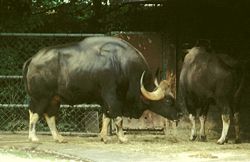
 The gaur has a head-and-body length of 250 to 330 cm (8.2 to 10.8 ft) with a 70 to 105 cm (27.6 to 41.3 in) long tail, and is 165 to 220 cm (5.4 to 7.2 ft) high at the shoulder. Weight is 650 to 1000 kg (1,433 to 2,204.6 lb). Males are about one-fourth larger and heavier than females. Body weight may reach 1500 kg (3,306.9 lb).
The gaur has a high convex ridge on the forehead between the horn
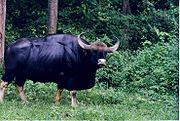
s, which bends forward, causing a deep hollow in the profile of the upper part of the head. There is a prominent ridge on the back. The ears are very large; the tail only just reaches the hocks, and in old bulls the hair becomes very thin on the back. In colour, the adult male gaur is dark brown, approaching black in very old individuals; the upper part of the head, from above the eyes to the nape of the neck, is, however, ashy gray, or occasionally dirty white; the muzzle is pale coloured, and the lower part of the legs are pure white or tan. The cows and young bulls are paler, and in some instances have a rufous tinge, which is most marked in individuals inhabiting dry and open districts.
The tail is shorter than in the typical oxen, reaching only to the hocks. The animals have a distinct ridge running from the shoulders to the middle of the back; the shoulders may be as much as 12 centimetres (4.7 in) higher than the rump. This ridge is caused by the great length of the spinous processes of the vertebrae of the fore-part of the trunk as compared with those of the loins. The hair is short, fine and glossy, and the hooves are narrow and pointed.
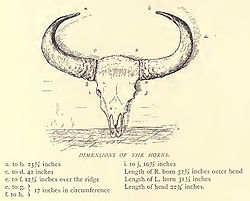
Horns grow to a length of 60 to 115 cm (23.6 to 45.3 in). Both sexes carry horns, which grow from the sides of the head, curving upwards. They are regularly curved throughout their length, and are bent inward and slightly backward at their tips. The colour of the horns is some shade of pale green or yellow throughout the greater part of their length, but the tips are black. A bulging grey-tan ridge connects the horns on the forehead. The horns are flattened to a greater or less degree from front to back, more especially at their bases, where they present an elliptical cross-section; this characteristic is more strongly marked in the bulls than in the cows.
Gaur have highly muscular bodies, with distinctive dorsal ridges and large dewlap
s, forming a very powerful appearance. Dorsal ridges and dewlaps of females are less developed.
Gaur are said to look like water buffalo
at the front and domestic cattle
at the back due to their heavily muscled and enlarged forequarters compared to their relatively small hindquarters. They are the heaviest and most powerful of all wild cattle, and are among the largest living land animals. Only elephant
s, rhinos and hippos
consistently grow larger, and the weight of the largest subspecies of gaur roughly matches that of the giraffe
.

 Gaur historically occurred throughout mainland South and Southeast Asia, including Vietnam
, Cambodia
, Laos
, China
, Thailand
, Peninsular Malaysia
, Myanmar
, Bangladesh
, Bhutan
, Nepal
, and India
. Today, the species is seriously fragmented within its range, and regionally extinct in Sri Lanka
.
They are largely confined to evergreen forests or semi-evergreen and moist deciduous forests, but also occur in dry deciduous forest areas at the periphery of their range. Gaur habitat is characterized by large, relatively undisturbed forest tracts, hilly terrain below an altitude of 5000 to 6000 ft (1,524 to 1,828.8 m), availability of water, and an abundance of forage in the form of grasses, bamboo
, shrubs, and trees. Their apparent preference for hilly terrain may be partly due to the earlier conversion of most of the plains and other low-lying areas to croplands and pastures. They occur from sea level up to at least 2800 m (9,186.4 ft) altitude. Low-lying areas seem to comprise optimal habitat.
In Vietnam, several areas in Dak Lak Province were known to contain gaur in 1997. Several herds persist in Cat Tien National Park
and in adjacent state forest enterprises. The current status of the gaur population is poorly known; they may be in serious decline.
In Cambodia, gaur declined considerably in the period from the late 1960s to the early 1990s. The most substantial population of the country remained in Mondulkiri Province, where up to 1000 individuals may have survived in a forested landscape of over 15000 km² (5,791.5 sq mi). Results of camera trap
ping carried out in 2009 suggested a globally significant population of gaur in the Mondulkiri Protected Forest
and the contiguous Phnom Prich Wildlife Sanctuary
.
In Laos, up to 200 individuals were estimated to inhabit protected area boundaries in the mid–1990s. They were reported discontinuously distributed in low numbers. Overhunting had reduced the population, and survivors occurred mainly in remote sites. Fewer than six National Biodiversity Conservation Areas held more than 50 individuals. Areas with populations likely to be nationally important included the Nam Theun
catchment and the adjoining plateau. Subsequent surveys carried out a decade later using fairly intensive camera trapping did not record any gaur any more, indicating a massive decline of the population.
In China, gaur occur in heavily fragmented populations in Yunnan
and southeast Tibet
. By the 1980s, they were extirpated in Lancang County, and the remaining animals were split into two populations, viz. in Xishuangbanna–Simao
and Cangyuan. In the mid-1990s, a population of 600–800 individuals may have lived in Yunnan Province, with the majority occurring in Xishuangbanna National Nature Reserve.
In Thailand, gaur were once found throughout the country, but less than 1,000 individuals were estimated to have remained in the 1990s. In the mostly semi-evergreen Dong Phayayen – Khao Yai Forest Complex
, they were recorded at low density at the turn of the century, with an estimated total of about 150 individuals.
In Bangladesh, a few gaur were thought to occur in the Chittagong Hill Tracts
, Sylhet
, and Mymensingh
areas in the early 1980s, but none had been seen in Pablakhali Wildlife Sanctuary situated in the Hill Tracts since the early 1970s. Individuals from Mizoram
and Tripura
cross into Bangladesh.
In Bhutan, they apparently persist all over the southern foothill zone, notably in Royal Manas National Park
, Phipsoo Wildlife Sanctuary and Khaling Wildlife Sanctuary
.
In Nepal, the gaur population was estimated to be 250–350 in the mid-1990s, with the majority in Chitwan National Park and the adjacent Parsa Wildlife Reserve
. Population trends appeared to be relatively stable. The Chitwan population has increased from 188 to 296 animals in the years 1997 to 2007; a census conducted in Parsa Wildlife Reserve confirmed the presence of 37 gaur in May 2008.
In India, the population was estimated to be 12,000–22,000 in the mid-1990s. The Western Ghats
and their outflanking hills in southern India constitute one of the most extensive extant strongholds of gaur, in particular in the Wynaad – Nagarahole – Mudumalai
– Bandipur
complex. The populations in India, Bhutan and Bangladesh are estimated to comprise 23,000–34,000 individuals. Major populations of about 2,000 individuals have been reported in both Nagarahole and Bandipur National Parks, over 1,000 individuals in Tadoba Andhari Tiger Project
, 500–1000 individuals in both Periyar Tiger Reserve and Silent Valley
and adjoining forest complexes, and over 800 individuals in Bhadra Wildlife Sanctuary
.
 Where gaur have not been disturbed, they are basically diurnal
. In other areas, they have become largely nocturnal due to molestation by people. In central India, they are most active at night, and are rarely seen in the open after 8 o'clock in the morning. During the dry season, herds congregate and remain in small areas, dispersing into the hills with the arrival of the monsoon
. While gaur depend on water for drinking, they do not seem to bathe or wallow.
In January and February, gaur live in small herds of eight to 11 individuals, one of which is a bull. In April or May, more bulls may join the herd for mating, and individual bulls may move from herd to herd, each mating with many cows. In May or June, they leave the herd and may form herds of bulls only or live alone. Herds wander 2–5 km (1.2–3.1 mi) each day. Each herd has a nonexclusive home range, and sometimes herds may join in groups of 50 or more. The average population density is about 0.6 animals per square kilometre (1.5 animals per square mile), with herds having home ranges of around 80 square kilometres (30.9 sq mi).
Gaur herds are led by an old adult female (the matriarch). Adult males may be solitary. During the peak of the breeding season, unattached males wander widely in search of receptive females. No serious fighting between males has been recorded, with size being the major factor in determining dominance. Males make a mating call of clear, resonant tones which may carry for more than 1.6 kilometre (0.994196378639691 mi). Gaur have also been known to make a whistling snort as an alarm call, and a low, cow-like moo.
In some regions in India where human disturbance is minor, the gaur is very timid and shy. When alarmed, gaur crash into the jungle at a surprising speed. However, in Southeast Asia
and South India, where they are used to the presence of humans, gaur are said by locals to be very bold and aggressive. They are frequently known to go into fields and graze alongside domestic cattle, sometimes killing them in fights. Gaur bulls may charge unprovoked, especially during summer, when the heat and parasitic insects make them more short-tempered than usual. To warn other members of its herd of approaching danger, the gaur lets out a high whistle for help.
Due to their formidable size and power, gaur have few natural enemies. Leopard
s and dhole
packs occasionally attack unguarded calves or unhealthy animals, but only the tiger
and the saltwater crocodile
have been reported to kill a full-grown adult. When confronted by a tiger, the adult members of a gaur herd often form a circle surrounding the vulnerable young and calves, shielding them from the big cat. A herd of gaur in Malaysia encircled a calf killed by a tiger and prevented it from approaching the carcass. In Nagarahole National Park, upon sensing a stalking tiger, a herd of gaur walked as a menacing phalanx towards it, forcing the tiger to retreat and abandon the hunt. Gaur are not as aggressive toward humans as wild Asian water buffalo
es.
There are several cases of tigers being killed by gaur. In one instance, a tiger was repeatedly gored and trampled to death by a gaur during a prolonged battle. A large male tiger carcass was found beside a small, broken tree in Nagarahole National Park, having been fatally struck against the tree by a large bull gaur a few days earlier.
.
During a survey in the Bhagwan Mahaveer Sanctuary and Mollem National Park
, 32 species of plants were identified as food for gaur. They consume herbs, young shoots, flowers, fruits of elephant apple
with a high preference for leaves. Food preference varies by season. In winter and monsoon
, they feed on preferably fine and fresh grasses and herb species of the legume family
, such as tick clover
, but also browse on leaves of shrub species such as karvy
, Indian boxwood
, mallow-leaved crossberry, East-Indian screw tree
and chaste tree
. In summer, they also feed on bark of teak, on fruit of golden shower tree, and on the bark and fruit of cashew. Gaur spent most of their daily time feeding. Peak feeding activity was observed between 6:30 and 8:30 am and between 5:30 and 6:45 pm. During the hottest hours of the day, 1:30 to 3:30 pm, they rest in the shade of big trees.
They may debark trees due to shortages of preferred food, and of minerals and trace elements needed for their nutrition, or for maintaining an optimum fiber/protein ratio for proper digestion of food and better assimilation of nutrients. They may turn to available browse species and fibrous teak bark in summer as green grass and herbaceous resources dry up. High concentrations of calcium (22400 ppm) and phosphorus (400 ppm) have been reported in teak bark, so consumption of teak bark may help animals to satisfy both mineral and other food needs. Long-term survival and conservation of these herbivores depend on the availability of preferred plant species for food. Hence, protection of the historically preferred habitats used by gaur is a significant factor in conservation biology
.
for trade
to supply international markets, but also by opportunistic hunting, and specific hunting for home consumption. In the 1990s, they were particularly sought by Vietnamese poachers for their commercial value.
In Thailand, gaurs are highly threatened by poaching for commercial trade in meat and trophies
.
 In his first description of 1804, Aylmer Bourke Lambert
applied the binomial
Bos frontalis to a domestic specimen probably from Chittagong
. In 1827, Charles Hamilton Smith
applied the binomial Bos gaurus to the wild species occurring near Mainpat in the Sarguja Tributary States of India. Later authors subordinated the species under either Bos or Bibos.
In 2003, the International Commission on Zoological Nomenclature
has fixed the first available
specific name based on a wild population that the name for this wild species is valid by virtue of its being antedated by a name based on a domestic form. Most authors have adopted the binomial Bos gaurus for the wild species as valid for the taxon
.
Traditionally, three subspecies
of Bos gaurus have been recognized:
This classification, based largely on differences in coloration and size, is no longer widely recognized.
In recognition of phenotypic differences between Indian and Southeast Asian specimens, the trinominals Bos gaurus gaurus and Bos gaurus laosiensis are provisionally accepted pending further morphometric and genetic
study.
animal that is a member of an endangered species
occurred, a gaur named Noah at Trans Ova Genetics in Sioux Center, Iowa. He was carried and brought successfully to term by a surrogate mother from another more common species, in this case a domestic cow
named Bessie. While healthy at birth, Noah died within 48 hours of a common dysentery
, likely unrelated to cloning.
The gaur is the mascot for Malaysian football team, Perak FA.
The popular energy drink "Red Bull" is made by an Austrian firm under licence from a Thailand company who originally invented and marketed it in Southeast Asia. The original name of the drink in Thai is "Gratin Daang" which means "Red Gaur" (gratin is "gaur" in Thai).
On 2nd August 2011, a 17-year old male gaur named "Mani" was found gored to death in his enclosure, by a younger male allegedly over fight for mate at the Arignar Anna Zoological Park
, Chennai. The zoo officials reported Mani was the oldest of the herd of gaur living in the zoo, and added that this is an unusual incident.
Bovinae
The biological subfamily Bovinae includes a diverse group of 10 genera of medium to large sized ungulates, including domestic cattle, the bison, African buffalo, the water buffalo, the yak, and the four-horned and spiral-horned antelopes...
native to South Asia
South Asia
South Asia, also known as Southern Asia, is the southern region of the Asian continent, which comprises the sub-Himalayan countries and, for some authorities , also includes the adjoining countries to the west and the east...
and Southeast Asia
Southeast Asia
Southeast Asia, South-East Asia, South East Asia or Southeastern Asia is a subregion of Asia, consisting of the countries that are geographically south of China, east of India, west of New Guinea and north of Australia. The region lies on the intersection of geological plates, with heavy seismic...
. The species is listed as vulnerable
Vulnerable species
On 30 January 2010, the IUCN Red List of Threatened Species identified 9694 Vulnerable species, subspecies and varieties, stocks and sub-populations.-References:...
on the IUCN Red List
IUCN Red List
The IUCN Red List of Threatened Species , founded in 1963, is the world's most comprehensive inventory of the global conservation status of biological species. The International Union for Conservation of Nature is the world's main authority on the conservation status of species...
since 1986 as the population decline in parts of the species' range is likely to be well over 70% over the last three generations. Population trends are stable in well-protected areas, and are rebuilding in a few areas which had been neglected.
The word gaur is pronounced icon.
The gaur is the largest species of wild cattle, bigger than the African buffalo
African Buffalo
The African buffalo, affalo, nyati, Mbogo or Cape buffalo is a large African bovine. It is not closely related to the slightly larger wild Asian water buffalo, but its ancestry remains unclear...
, the extinct aurochs
Aurochs
The aurochs , the ancestor of domestic cattle, were a type of large wild cattle which inhabited Europe, Asia and North Africa, but is now extinct; it survived in Europe until 1627....
, and wild water buffalo. The domesticated form of the gaur, Bos frontalis, is called gayal
Gayal
Gayal or mithun is the domestic gaur, probably a gaur-cattle hybrid breed.-Taxonomy:In his first description of 1804, Aylmer Bourke Lambert applied the binomial Bos frontalis to a domestic specimen probably from Chittagong....
or mithun.
The Malayan gaur is called seladang, and the Burmese gaur is called pyoung.
Characteristics
The gaur has a high convex ridge on the forehead between the horn
Horn (anatomy)
A horn is a pointed projection of the skin on the head of various animals, consisting of a covering of horn surrounding a core of living bone. True horns are found mainly among the ruminant artiodactyls, in the families Antilocapridae and Bovidae...
s, which bends forward, causing a deep hollow in the profile of the upper part of the head. There is a prominent ridge on the back. The ears are very large; the tail only just reaches the hocks, and in old bulls the hair becomes very thin on the back. In colour, the adult male gaur is dark brown, approaching black in very old individuals; the upper part of the head, from above the eyes to the nape of the neck, is, however, ashy gray, or occasionally dirty white; the muzzle is pale coloured, and the lower part of the legs are pure white or tan. The cows and young bulls are paler, and in some instances have a rufous tinge, which is most marked in individuals inhabiting dry and open districts.
The tail is shorter than in the typical oxen, reaching only to the hocks. The animals have a distinct ridge running from the shoulders to the middle of the back; the shoulders may be as much as 12 centimetres (4.7 in) higher than the rump. This ridge is caused by the great length of the spinous processes of the vertebrae of the fore-part of the trunk as compared with those of the loins. The hair is short, fine and glossy, and the hooves are narrow and pointed.
Horns grow to a length of 60 to 115 cm (23.6 to 45.3 in). Both sexes carry horns, which grow from the sides of the head, curving upwards. They are regularly curved throughout their length, and are bent inward and slightly backward at their tips. The colour of the horns is some shade of pale green or yellow throughout the greater part of their length, but the tips are black. A bulging grey-tan ridge connects the horns on the forehead. The horns are flattened to a greater or less degree from front to back, more especially at their bases, where they present an elliptical cross-section; this characteristic is more strongly marked in the bulls than in the cows.
Gaur have highly muscular bodies, with distinctive dorsal ridges and large dewlap
Dewlap
A dewlap is a longitudinal flap of skin that hangs beneath the lower jaw or neck of many vertebrates. While the term is usually used in this specific context, it can also be used to include other structures occurring in the same body area with a similar aspect, such as those caused by a double...
s, forming a very powerful appearance. Dorsal ridges and dewlaps of females are less developed.
Gaur are said to look like water buffalo
Water buffalo
The water buffalo is a domesticated bovid widely kept in Asia, Europe and South America.Water buffalo can also refer to:*Wild water buffalo , the wild ancestor of the domestic water buffalo...
at the front and domestic cattle
Cattle
Cattle are the most common type of large domesticated ungulates. They are a prominent modern member of the subfamily Bovinae, are the most widespread species of the genus Bos, and are most commonly classified collectively as Bos primigenius...
at the back due to their heavily muscled and enlarged forequarters compared to their relatively small hindquarters. They are the heaviest and most powerful of all wild cattle, and are among the largest living land animals. Only elephant
Elephant
Elephants are large land mammals in two extant genera of the family Elephantidae: Elephas and Loxodonta, with the third genus Mammuthus extinct...
s, rhinos and hippos
Hippos
Hippos is an archaeological site in Israel, located on a hill overlooking the Sea of Galilee. Between the 3rd century BC and the 7th century AD, Hippos was the site of a Greco-Roman city. Besides the fortified city itself, Hippos controlled two port facilities on the lake and an area of the...
consistently grow larger, and the weight of the largest subspecies of gaur roughly matches that of the giraffe
Giraffe
The giraffe is an African even-toed ungulate mammal, the tallest of all extant land-living animal species, and the largest ruminant...
.
Distribution and habitat
Vietnam
Vietnam – sometimes spelled Viet Nam , officially the Socialist Republic of Vietnam – is the easternmost country on the Indochina Peninsula in Southeast Asia. It is bordered by China to the north, Laos to the northwest, Cambodia to the southwest, and the South China Sea –...
, Cambodia
Cambodia
Cambodia , officially known as the Kingdom of Cambodia, is a country located in the southern portion of the Indochina Peninsula in Southeast Asia...
, Laos
Laos
Laos Lao: ສາທາລະນະລັດ ປະຊາທິປະໄຕ ປະຊາຊົນລາວ Sathalanalat Paxathipatai Paxaxon Lao, officially the Lao People's Democratic Republic, is a landlocked country in Southeast Asia, bordered by Burma and China to the northwest, Vietnam to the east, Cambodia to the south and Thailand to the west...
, China
China
Chinese civilization may refer to:* China for more general discussion of the country.* Chinese culture* Greater China, the transnational community of ethnic Chinese.* History of China* Sinosphere, the area historically affected by Chinese culture...
, Thailand
Thailand
Thailand , officially the Kingdom of Thailand , formerly known as Siam , is a country located at the centre of the Indochina peninsula and Southeast Asia. It is bordered to the north by Burma and Laos, to the east by Laos and Cambodia, to the south by the Gulf of Thailand and Malaysia, and to the...
, Peninsular Malaysia
Peninsular Malaysia
Peninsular Malaysia , also known as West Malaysia , is the part of Malaysia which lies on the Malay Peninsula. Its area is . It shares a land border with Thailand in the north. To the south is the island of Singapore. Across the Strait of Malacca to the west lies the island of Sumatra...
, Myanmar
Myanmar
Burma , officially the Republic of the Union of Myanmar , is a country in Southeast Asia. Burma is bordered by China on the northeast, Laos on the east, Thailand on the southeast, Bangladesh on the west, India on the northwest, the Bay of Bengal to the southwest, and the Andaman Sea on the south....
, Bangladesh
Bangladesh
Bangladesh , officially the People's Republic of Bangladesh is a sovereign state located in South Asia. It is bordered by India on all sides except for a small border with Burma to the far southeast and by the Bay of Bengal to the south...
, Bhutan
Bhutan
Bhutan , officially the Kingdom of Bhutan, is a landlocked state in South Asia, located at the eastern end of the Himalayas and bordered to the south, east and west by the Republic of India and to the north by the People's Republic of China...
, Nepal
Nepal
Nepal , officially the Federal Democratic Republic of Nepal, is a landlocked sovereign state located in South Asia. It is located in the Himalayas and bordered to the north by the People's Republic of China, and to the south, east, and west by the Republic of India...
, and India
India
India , officially the Republic of India , is a country in South Asia. It is the seventh-largest country by geographical area, the second-most populous country with over 1.2 billion people, and the most populous democracy in the world...
. Today, the species is seriously fragmented within its range, and regionally extinct in Sri Lanka
Sri Lanka
Sri Lanka, officially the Democratic Socialist Republic of Sri Lanka is a country off the southern coast of the Indian subcontinent. Known until 1972 as Ceylon , Sri Lanka is an island surrounded by the Indian Ocean, the Gulf of Mannar and the Palk Strait, and lies in the vicinity of India and the...
.
They are largely confined to evergreen forests or semi-evergreen and moist deciduous forests, but also occur in dry deciduous forest areas at the periphery of their range. Gaur habitat is characterized by large, relatively undisturbed forest tracts, hilly terrain below an altitude of 5000 to 6000 ft (1,524 to 1,828.8 m), availability of water, and an abundance of forage in the form of grasses, bamboo
Bamboo
Bamboo is a group of perennial evergreens in the true grass family Poaceae, subfamily Bambusoideae, tribe Bambuseae. Giant bamboos are the largest members of the grass family....
, shrubs, and trees. Their apparent preference for hilly terrain may be partly due to the earlier conversion of most of the plains and other low-lying areas to croplands and pastures. They occur from sea level up to at least 2800 m (9,186.4 ft) altitude. Low-lying areas seem to comprise optimal habitat.
In Vietnam, several areas in Dak Lak Province were known to contain gaur in 1997. Several herds persist in Cat Tien National Park
Cat Tien National Park
Cát Tiên National Park is an important national park located in the south of Vietnam, approximately 150 km north of Ho Chi Minh City. It has an area of about 720 km² and protects one of the largest areas of lowland tropical rainforests left in Vietnam.-History:Cát Tiên national park was...
and in adjacent state forest enterprises. The current status of the gaur population is poorly known; they may be in serious decline.
In Cambodia, gaur declined considerably in the period from the late 1960s to the early 1990s. The most substantial population of the country remained in Mondulkiri Province, where up to 1000 individuals may have survived in a forested landscape of over 15000 km² (5,791.5 sq mi). Results of camera trap
Camera trap
A camera trap is a remotely activated camera that is equipped with a motion sensor or an infrared sensor, or uses a light beam as a trigger. Camera trapping is a method for capturing wild animals on film when researchers are not present, and has been used in ecological research for decades...
ping carried out in 2009 suggested a globally significant population of gaur in the Mondulkiri Protected Forest
Mondulkiri Protected Forest
Mondulkiri Protected Forest is located in eastern Cambodia and is part of maybe the largest protected area complex in southeast Asia. The northwest part of the Mondulkiri Protected Forest borders Lomphat Wildlife Sanctuary, the southwest part borders Phnom Prich Wildlife Sanctuary, the southeast...
and the contiguous Phnom Prich Wildlife Sanctuary
Phnom Prich Wildlife Sanctuary
Phnom Prich Wildlife Sanctuary is located in eastern Cambodia and is part of maybe the largest protected area complex in southeast Asia. Phnom Prich Wildlife Sanctuary is one of several protected areas in Cambodia and Vietnam that borders Mondulkiri Protected Forest.- External :* - article in...
.
In Laos, up to 200 individuals were estimated to inhabit protected area boundaries in the mid–1990s. They were reported discontinuously distributed in low numbers. Overhunting had reduced the population, and survivors occurred mainly in remote sites. Fewer than six National Biodiversity Conservation Areas held more than 50 individuals. Areas with populations likely to be nationally important included the Nam Theun
Nam Theun
Nam Theun, also known as Khading, is a river in Laos, in Khammouane and Bolikhamsai Provinces. Together with its tributaries Nam One, Nam Noy, and Nam Theun it has total length of and drain an area of ....
catchment and the adjoining plateau. Subsequent surveys carried out a decade later using fairly intensive camera trapping did not record any gaur any more, indicating a massive decline of the population.
In China, gaur occur in heavily fragmented populations in Yunnan
Yunnan
Yunnan is a province of the People's Republic of China, located in the far southwest of the country spanning approximately and with a population of 45.7 million . The capital of the province is Kunming. The province borders Burma, Laos, and Vietnam.Yunnan is situated in a mountainous area, with...
and southeast Tibet
Tibet
Tibet is a plateau region in Asia, north-east of the Himalayas. It is the traditional homeland of the Tibetan people as well as some other ethnic groups such as Monpas, Qiang, and Lhobas, and is now also inhabited by considerable numbers of Han and Hui people...
. By the 1980s, they were extirpated in Lancang County, and the remaining animals were split into two populations, viz. in Xishuangbanna–Simao
Simao District
Simao District is a district under the jurisdiction of Pu'er Prefecture, Yunnan Province, China. It is the seat of Puer Prefecture....
and Cangyuan. In the mid-1990s, a population of 600–800 individuals may have lived in Yunnan Province, with the majority occurring in Xishuangbanna National Nature Reserve.
In Thailand, gaur were once found throughout the country, but less than 1,000 individuals were estimated to have remained in the 1990s. In the mostly semi-evergreen Dong Phayayen – Khao Yai Forest Complex
Dong Phaya Yen mountains
Dong Phaya Yen is a mountain range in central Thailand.-Description:Dong Phaya Yen is the southeastern extension of the Phetchabun mountains, dividing the Chao Phraya river valley of Central Thailand and the Khorat Plateau of the northeast...
, they were recorded at low density at the turn of the century, with an estimated total of about 150 individuals.
In Bangladesh, a few gaur were thought to occur in the Chittagong Hill Tracts
Chittagong Hill Tracts
The Chittagong Hill Tracts comprise an area of 13,295 km2 in south-eastern Bangladesh, and borders India and Myanmar . It was a single district of Bangladesh until 1984. In that year it was divided into three separate districts: Khagrachari, Rangamati and Bandarban. Topographically, this is the...
, Sylhet
Sylhet District
The district of Sylhet consists 6754 mosques, 453 temples, 96 churches and four Buddhist temples.-Places of Interests:-Historical:#The Shrine of Hazrat Shah Jalal#The Shrine of Hazrat Shah Paran#Shahi Eidgah#Gour Govinda Fort#Kean Bridge...
, and Mymensingh
Mymensingh District
Mymensingh is one of the districts of Dhaka division, Bangladesh, and is bordered on the north by Meghalaya state of India and Garo Hills, on the south by Gazipur district, on the east by districts of Netrokona and Kishoreganj, and on the west by districts of Sherpur, Jamalpur and Tangail...
areas in the early 1980s, but none had been seen in Pablakhali Wildlife Sanctuary situated in the Hill Tracts since the early 1970s. Individuals from Mizoram
Mizoram
Mizoram is one of the Seven Sister States in North Eastern India, sharing borders with the states of Tripura, Assam, Manipur and with the neighbouring countries of Bangladesh and Burma. Mizoram became the 23rd state of India on 20 February 1987. Its capital is Aizawl. Mizoram is located in the...
and Tripura
Tripura
Tripura is a state in North-East India, with an area of . It is the third smallest state of India, according to area. Tripura is surrounded by Bangladesh on the north, south, and west. The Indian states of Assam and Mizoram lie to the east. The capital is Agartala and the main languages spoken are...
cross into Bangladesh.
In Bhutan, they apparently persist all over the southern foothill zone, notably in Royal Manas National Park
Royal Manas National Park
Royal Manas National Park is Bhutan's oldest national park, and the Royal government considers it the "conservation showpiece of the Kingdom" and a "genetic depository" for valuable plants. It has an area of and covers eastern Sarpang District, the western half of Zhemgang District, and western...
, Phipsoo Wildlife Sanctuary and Khaling Wildlife Sanctuary
Khaling Wildlife Sanctuary
Khaling Wildlife Sanctuary is the smallest protected area of Bhutan covering in Samdrup Jongkhar District along the southern border with Assam. Its elevations range between and . Khaling Wildlife Sanctuary is, despite its small acreage, an important habitat for elephants, gaur , and other...
.
In Nepal, the gaur population was estimated to be 250–350 in the mid-1990s, with the majority in Chitwan National Park and the adjacent Parsa Wildlife Reserve
Parsa Wildlife Reserve
Parsa Wildlife Reserve is a protected area in the Inner Terai lowlands of south-central Nepal. Established in 1984, it covers an area of in the Parsa, Makwanpur and Bara districts and is the largest wildlife reserve in the country...
. Population trends appeared to be relatively stable. The Chitwan population has increased from 188 to 296 animals in the years 1997 to 2007; a census conducted in Parsa Wildlife Reserve confirmed the presence of 37 gaur in May 2008.
In India, the population was estimated to be 12,000–22,000 in the mid-1990s. The Western Ghats
Western Ghats
The Western Ghats, Western Ghauts or the Sahyādri is a mountain range along the western side of India. It runs north to south along the western edge of the Deccan Plateau, and separates the plateau from a narrow coastal plain along the Arabian Sea. The Western Ghats block rainfall to the Deccan...
and their outflanking hills in southern India constitute one of the most extensive extant strongholds of gaur, in particular in the Wynaad – Nagarahole – Mudumalai
Mudumalai National Park
The Mudumalai National Park and Wildlife Sanctuary Tamil:முதுமலை வனவிலங்கு காப்பகம், now also declared a Tiger Reserve, lies on the northwestern side of the Nilgiri Hills , in Nilgiri District, about north-west of Coimbatore in the westernmost part of Tamil Nadu, on the interstate boundaries with...
– Bandipur
Bandipur National Park
Bandipur National Park is one of India's best known protected areas and is an important Project Tiger reserve. It is located in the Chamarajanagar district of southern Karnataka in South India,...
complex. The populations in India, Bhutan and Bangladesh are estimated to comprise 23,000–34,000 individuals. Major populations of about 2,000 individuals have been reported in both Nagarahole and Bandipur National Parks, over 1,000 individuals in Tadoba Andhari Tiger Project
Tadoba Andhari Tiger Project
Tadoba Andheri Tiger Reserve is a Tiger reserves in Chandrapur district of Maharashtra state in central India , at distance of 40 km from Chandrapur. . Tadoba was established in 1935 and declared a National Park in 1955. Andhari Wildlife Sanctuary was created in 1986, and in 1995, both the...
, 500–1000 individuals in both Periyar Tiger Reserve and Silent Valley
Silent Valley National Park
Silent Valley National Park , is located in the Nilgiri Hills, Palakkad District in Kerala, South India...
and adjoining forest complexes, and over 800 individuals in Bhadra Wildlife Sanctuary
Bhadra Wildlife Sanctuary
Bhadra Wildlife Sanctuary is 38 km. northwest of Chikmagalur town in Karnataka state.It extends between 13º 25' and 13º 50' N latitude to 75º 15' and 75º 50' E longitude. The elevation gradient...
.
Ecology and behaviour
Diurnal animal
Diurnality is a plant or animal behavior characterized by activity during the day and sleeping at night.-In animals:Animals that are not diurnal might be nocturnal or crepuscular . Many animal species are diurnal, including many mammals, insects, reptiles and birds...
. In other areas, they have become largely nocturnal due to molestation by people. In central India, they are most active at night, and are rarely seen in the open after 8 o'clock in the morning. During the dry season, herds congregate and remain in small areas, dispersing into the hills with the arrival of the monsoon
Monsoon
Monsoon is traditionally defined as a seasonal reversing wind accompanied by corresponding changes in precipitation, but is now used to describe seasonal changes in atmospheric circulation and precipitation associated with the asymmetric heating of land and sea...
. While gaur depend on water for drinking, they do not seem to bathe or wallow.
In January and February, gaur live in small herds of eight to 11 individuals, one of which is a bull. In April or May, more bulls may join the herd for mating, and individual bulls may move from herd to herd, each mating with many cows. In May or June, they leave the herd and may form herds of bulls only or live alone. Herds wander 2–5 km (1.2–3.1 mi) each day. Each herd has a nonexclusive home range, and sometimes herds may join in groups of 50 or more. The average population density is about 0.6 animals per square kilometre (1.5 animals per square mile), with herds having home ranges of around 80 square kilometres (30.9 sq mi).
Gaur herds are led by an old adult female (the matriarch). Adult males may be solitary. During the peak of the breeding season, unattached males wander widely in search of receptive females. No serious fighting between males has been recorded, with size being the major factor in determining dominance. Males make a mating call of clear, resonant tones which may carry for more than 1.6 kilometre (0.994196378639691 mi). Gaur have also been known to make a whistling snort as an alarm call, and a low, cow-like moo.
In some regions in India where human disturbance is minor, the gaur is very timid and shy. When alarmed, gaur crash into the jungle at a surprising speed. However, in Southeast Asia
Southeast Asia
Southeast Asia, South-East Asia, South East Asia or Southeastern Asia is a subregion of Asia, consisting of the countries that are geographically south of China, east of India, west of New Guinea and north of Australia. The region lies on the intersection of geological plates, with heavy seismic...
and South India, where they are used to the presence of humans, gaur are said by locals to be very bold and aggressive. They are frequently known to go into fields and graze alongside domestic cattle, sometimes killing them in fights. Gaur bulls may charge unprovoked, especially during summer, when the heat and parasitic insects make them more short-tempered than usual. To warn other members of its herd of approaching danger, the gaur lets out a high whistle for help.
Due to their formidable size and power, gaur have few natural enemies. Leopard
Leopard
The leopard , Panthera pardus, is a member of the Felidae family and the smallest of the four "big cats" in the genus Panthera, the other three being the tiger, lion, and jaguar. The leopard was once distributed across eastern and southern Asia and Africa, from Siberia to South Africa, but its...
s and dhole
Dhole
The dhole is a species of canid native to South and Southeast Asia. It is the only extant member of the genus Cuon, which differs from Canis by the reduced number of molars and greater number of teats...
packs occasionally attack unguarded calves or unhealthy animals, but only the tiger
Tiger
The tiger is the largest cat species, reaching a total body length of up to and weighing up to . Their most recognizable feature is a pattern of dark vertical stripes on reddish-orange fur with lighter underparts...
and the saltwater crocodile
Saltwater Crocodile
The saltwater crocodile, also known as estuarine or Indo-Pacific crocodile, is the largest of all living reptiles...
have been reported to kill a full-grown adult. When confronted by a tiger, the adult members of a gaur herd often form a circle surrounding the vulnerable young and calves, shielding them from the big cat. A herd of gaur in Malaysia encircled a calf killed by a tiger and prevented it from approaching the carcass. In Nagarahole National Park, upon sensing a stalking tiger, a herd of gaur walked as a menacing phalanx towards it, forcing the tiger to retreat and abandon the hunt. Gaur are not as aggressive toward humans as wild Asian water buffalo
Wild Asian Water Buffalo
The wild water buffalo also called Asian buffalo and Asiatic buffalo is a large bovine native to Southeast Asia...
es.
There are several cases of tigers being killed by gaur. In one instance, a tiger was repeatedly gored and trampled to death by a gaur during a prolonged battle. A large male tiger carcass was found beside a small, broken tree in Nagarahole National Park, having been fatally struck against the tree by a large bull gaur a few days earlier.
Feeding
Wild gaur graze and browse on a wider variety of plants than any other ungulate species of India, with a preference for the upper portions of plants, such as leaf blades, stems, seeds and flowers of grass species, including kadamAdina Cordifolia
Haldina cordifolia, syn. Adina cordifolia, also known as Kadam or Kadamba in Hindi, is a flowering plant in the family Rubiaceae, the sole species in the genus Haldina. It is native to southern Asia, from India and Sri Lanka east to southern China and Vietnam.It is a deciduous tree that can grow...
.
During a survey in the Bhagwan Mahaveer Sanctuary and Mollem National Park
Bhagwan Mahaveer Sanctuary and Mollem National Park
Bhagwan Mahaveer Sanctuary and Mollem National Park is a protected area located in the Western Ghats of South India, in Sanguem taluk, Goa along the eastern border with Karnataka....
, 32 species of plants were identified as food for gaur. They consume herbs, young shoots, flowers, fruits of elephant apple
Dillenia
Dillenia is a genus of about 100 species of flowering plants in the family Dilleniaceae, native to tropical and subtropical regions of southern Asia, Australasia, and the Indian Ocean islands....
with a high preference for leaves. Food preference varies by season. In winter and monsoon
Monsoon
Monsoon is traditionally defined as a seasonal reversing wind accompanied by corresponding changes in precipitation, but is now used to describe seasonal changes in atmospheric circulation and precipitation associated with the asymmetric heating of land and sea...
, they feed on preferably fine and fresh grasses and herb species of the legume family
Fabaceae
The Fabaceae or Leguminosae, commonly known as the legume, pea, or bean family, is a large and economically important family of flowering plants. The group is the third largest land plant family, behind only the Orchidaceae and Asteraceae, with 730 genera and over 19,400 species...
, such as tick clover
Desmodium triflorum
Desmodium triflorum is an ornamental plant in the Fabaceae family....
, but also browse on leaves of shrub species such as karvy
Strobilanthes callosus
Strobilanthes callosus Nees is a shrub found mainly in the low hills of the western ghats all along the west coast of India. Its standardized Hindi language name is Maruadona by which it is called in the state of Madhya Pradesh where it is also found...
, Indian boxwood
Gardenia latifolia
Gardenia latifolia, Ait., also called Papra or Hindi:पापडा, is medium-sized to large, long-lived tree of family Rubiaceae. It is found in the forests of Madhya Pradesh in India, and has been widely cultivated elsewhere, to the point of naturalization, especially in Nigeria, West Africa where the...
, mallow-leaved crossberry, East-Indian screw tree
Helicteres
Helicteres is a genus of flowering plants belonging to the family Malvaceae, with 141 species.-Selected species:*Helicteres apetala*Helicteres isora...
and chaste tree
Vitex negundo
Vitex negundo, commonly known as the five-leaved chaste tree, is a large aromatic shrub with quadrangular, densely whitish, tomentose branchlets...
. In summer, they also feed on bark of teak, on fruit of golden shower tree, and on the bark and fruit of cashew. Gaur spent most of their daily time feeding. Peak feeding activity was observed between 6:30 and 8:30 am and between 5:30 and 6:45 pm. During the hottest hours of the day, 1:30 to 3:30 pm, they rest in the shade of big trees.
They may debark trees due to shortages of preferred food, and of minerals and trace elements needed for their nutrition, or for maintaining an optimum fiber/protein ratio for proper digestion of food and better assimilation of nutrients. They may turn to available browse species and fibrous teak bark in summer as green grass and herbaceous resources dry up. High concentrations of calcium (22400 ppm) and phosphorus (400 ppm) have been reported in teak bark, so consumption of teak bark may help animals to satisfy both mineral and other food needs. Long-term survival and conservation of these herbivores depend on the availability of preferred plant species for food. Hence, protection of the historically preferred habitats used by gaur is a significant factor in conservation biology
Conservation biology
Conservation biology is the scientific study of the nature and status of Earth's biodiversity with the aim of protecting species, their habitats, and ecosystems from excessive rates of extinction...
.
Reproduction
Gaur have one calf (or occasionally two) after a gestation period of about 275 days, about nine months, a few days less than domestic cattle. Calves are typically weaned after seven to 12 months. Sexual maturity occurs in the gaur's second or third year. Breeding takes place year-round, but typically peaks between December and June. The lifespan of a gaur in captivity is up to 30 years.Threats
In Laos, gaurs are highly threatened by poachingPoaching
Poaching is the illegal taking of wild plants or animals contrary to local and international conservation and wildlife management laws. Violations of hunting laws and regulations are normally punishable by law and, collectively, such violations are known as poaching.It may be illegal and in...
for trade
Wildlife trade
The international wildlife trade is a serious conservation problem, addressed by the United Nations' Convention of International Trade in Endangered Species of Wild Fauna and Flora CITES, which currently has 175 member countries called Parties. The 15th meeting of the Parties took place in Doha,...
to supply international markets, but also by opportunistic hunting, and specific hunting for home consumption. In the 1990s, they were particularly sought by Vietnamese poachers for their commercial value.
In Thailand, gaurs are highly threatened by poaching for commercial trade in meat and trophies
Trophy hunting
Trophy hunting is the selective hunting of wild game animals. Although parts of the slain animal may be kept as a hunting trophy or memorial , the carcass itself is sometimes used as food....
.
Conservation
Bos gaurus is listed in CITES Appendix I, and is legally protected in all range states.Taxonomy
Aylmer Bourke Lambert
Aylmer Bourke Lambert was a British botanist, one of the first fellows of the Linnean Society.He is best known for his work A description of the genus Pinus, issued in several parts 1803-1824, a sumptuously illustrated folio volume detailing all of the conifers then known...
applied the binomial
Binomial nomenclature
Binomial nomenclature is a formal system of naming species of living things by giving each a name composed of two parts, both of which use Latin grammatical forms, although they can be based on words from other languages...
Bos frontalis to a domestic specimen probably from Chittagong
Chittagong
Chittagong ) is a city in southeastern Bangladesh and the capital of an eponymous district and division. Built on the banks of the Karnaphuli River, the city is home to Bangladesh's busiest seaport and has a population of over 4.5 million, making it the second largest city in the country.A trading...
. In 1827, Charles Hamilton Smith
Charles Hamilton Smith
Lieutenant-Colonel Charles Hamilton Smith was an English artist, naturalist, antiquary, illustrator, soldier and spy.-Military service:...
applied the binomial Bos gaurus to the wild species occurring near Mainpat in the Sarguja Tributary States of India. Later authors subordinated the species under either Bos or Bibos.
In 2003, the International Commission on Zoological Nomenclature
International Commission on Zoological Nomenclature
The International Commission on Zoological Nomenclature is an organization dedicated to "achieving stability and sense in the scientific naming of animals". Founded in 1895, it currently comprises 28 members from 20 countries, mainly practicing zoological taxonomists...
has fixed the first available
specific name based on a wild population that the name for this wild species is valid by virtue of its being antedated by a name based on a domestic form. Most authors have adopted the binomial Bos gaurus for the wild species as valid for the taxon
Taxon
|thumb|270px|[[African elephants]] form a widely-accepted taxon, the [[genus]] LoxodontaA taxon is a group of organisms, which a taxonomist adjudges to be a unit. Usually a taxon is given a name and a rank, although neither is a requirement...
.
Traditionally, three subspecies
Subspecies
Subspecies in biological classification, is either a taxonomic rank subordinate to species, ora taxonomic unit in that rank . A subspecies cannot be recognized in isolation: a species will either be recognized as having no subspecies at all or two or more, never just one...
of Bos gaurus have been recognized:
- B. g. gaurus described by Smith in 1827 from central India; ranging to Nepal and Bhutan;
- B. g. readei described by LydekkerRichard LydekkerRichard Lydekker was an English naturalist, geologist and writer of numerous books on natural history.-Biography:...
in 1903 from the hill forests of Upper BurmaMyanmarBurma , officially the Republic of the Union of Myanmar , is a country in Southeast Asia. Burma is bordered by China on the northeast, Laos on the east, Thailand on the southeast, Bangladesh on the west, India on the northwest, the Bay of Bengal to the southwest, and the Andaman Sea on the south....
as ranging to Tenasserim; - B. g. hubbacki described by Lydekker in 1907 from PahangPahangPahang is the third largest state in Malaysia, after Sarawak and Sabah, occupying the huge Pahang River river basin. It is bordered to the north by Kelantan, to the west by Perak, Selangor, Negeri Sembilan, to the south by Johor and to the east by Terengganu and the South China Sea.Its state...
as ranging in peninsular MalaysiaPeninsular MalaysiaPeninsular Malaysia , also known as West Malaysia , is the part of Malaysia which lies on the Malay Peninsula. Its area is . It shares a land border with Thailand in the north. To the south is the island of Singapore. Across the Strait of Malacca to the west lies the island of Sumatra...
and probably northward to Tenasserim.
This classification, based largely on differences in coloration and size, is no longer widely recognized.
In recognition of phenotypic differences between Indian and Southeast Asian specimens, the trinominals Bos gaurus gaurus and Bos gaurus laosiensis are provisionally accepted pending further morphometric and genetic
Genetic
Genetic may refer to:*Genetics, in biology, the science of genes, heredity, and the variation of organisms**Genetic, used as an adjective, refers to heredity of traits**Gene, a unit of heredity in the genome of an organism...
study.
Cloning
At 7:30 pm on 8 January 2001, the first successful birth of a clonedCloning
Cloning in biology is the process of producing similar populations of genetically identical individuals that occurs in nature when organisms such as bacteria, insects or plants reproduce asexually. Cloning in biotechnology refers to processes used to create copies of DNA fragments , cells , or...
animal that is a member of an endangered species
Endangered species
An endangered species is a population of organisms which is at risk of becoming extinct because it is either few in numbers, or threatened by changing environmental or predation parameters...
occurred, a gaur named Noah at Trans Ova Genetics in Sioux Center, Iowa. He was carried and brought successfully to term by a surrogate mother from another more common species, in this case a domestic cow
Cattle
Cattle are the most common type of large domesticated ungulates. They are a prominent modern member of the subfamily Bovinae, are the most widespread species of the genus Bos, and are most commonly classified collectively as Bos primigenius...
named Bessie. While healthy at birth, Noah died within 48 hours of a common dysentery
Dysentery
Dysentery is an inflammatory disorder of the intestine, especially of the colon, that results in severe diarrhea containing mucus and/or blood in the faeces with fever and abdominal pain. If left untreated, dysentery can be fatal.There are differences between dysentery and normal bloody diarrhoea...
, likely unrelated to cloning.
Miscellaneous
The word gaur is cognate with the English word "cow".The gaur is the mascot for Malaysian football team, Perak FA.
The popular energy drink "Red Bull" is made by an Austrian firm under licence from a Thailand company who originally invented and marketed it in Southeast Asia. The original name of the drink in Thai is "Gratin Daang" which means "Red Gaur" (gratin is "gaur" in Thai).
On 2nd August 2011, a 17-year old male gaur named "Mani" was found gored to death in his enclosure, by a younger male allegedly over fight for mate at the Arignar Anna Zoological Park
Arignar Anna Zoological Park
Arignar Anna Zoological Park , also known as the Vandalur Zoo, is a zoological garden located in Vandalur, a suburb in the southwestern part of Chennai, India, about from the city centre and from Chennai Airport on GST Road. The zoo is contiguous with the Guindy National Park. Founded in 1855,...
, Chennai. The zoo officials reported Mani was the oldest of the herd of gaur living in the zoo, and added that this is an unusual incident.
See also
- AnoaAnoaAnoa, also known as Dwarf Buffalo and Sapiutan, are a subgenus of Bubalus comprising two species native to Indonesia: the Mountain Anoa and the Lowland Anoa . Both live in undisturbed rainforest, and are essentially miniature water buffalo...
- Wild water buffalo
- Drawings by Douglas HamiltonDrawings by Douglas HamiltonThere are at least two hundred and twelve detailed drawings by Douglas Hamilton of South Indian landscapes, game animals and forestry operations...
- Domestic Asian water buffalo
- BantengBantengThe banteng , also known as tembadau, is a species of wild cattle found in Southeast Asia.Banteng have been domesticated in several places in Southeast Asia, and there are around 1.5 million domestic banteng, which are called Bali cattle. These animals are used as working animals and for their meat...
- ZebuZebuZebu , sometimes known as humped cattle, indicus cattle, Cebu or Brahmin cattle are a type of domestic cattle originating in South Asia, particularly the Indian subcontinent. They are characterised by a fatty hump on their shoulders, drooping ears and a large dewlap...
, the common type of cattle from India: gaur may have contributed to some breeds. - AurochsAurochsThe aurochs , the ancestor of domestic cattle, were a type of large wild cattle which inhabited Europe, Asia and North Africa, but is now extinct; it survived in Europe until 1627....
- Largest organismsLargest organismsThe largest organism found on Earth can be measured using a variety of methods. It could be defined as the largest by volume, mass, height or length. Some organisms group together to form a superorganism, though this cannot truly be classed as one large organism...
- Manjampatti white bisonManjampatti White BisonManjampatti white bison are a type of gaur, occasionally seen in the Manjampatti Valley, a protected area at the eastern end of Indira Gandhi Wildlife Sanctuary and National Park in Coimbatore District, Tamil Nadu, South India. These gaur are notable for their distinctive ash-grey color as...
