
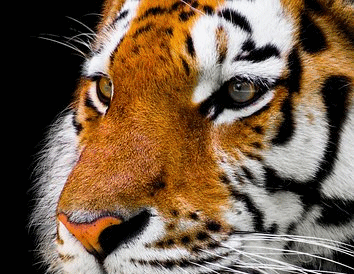
The
tiger is the largest
cat speciesFelidae is the biological family of the cats; a member of this family is called a felid. Felids are the strictest carnivores of the thirteen terrestrial families in the order Carnivora, although the three families of marine mammals comprising the superfamily pinnipedia are as carnivorous as the...
, reaching a total body length of up to 3.3 metres (10.8 ft) and weighing up to 306 kg (674.6 lb). Their most recognizable feature is a pattern of dark vertical stripes on reddish-orange fur with lighter underparts. They have exceptionally stout teeth, and their
caninesIn mammalian oral anatomy, the canine teeth, also called cuspids, dogteeth, fangs, or eye teeth, are relatively long, pointed teeth...
are the longest among living felids, with a
crownIn dentistry, crown refers to the anatomical area of teeth, usually covered by enamel. The crown is usually visible in the mouth after developing below the gingiva and then erupting into place.-References:...
height of up to 74.5 mm (2.9 in).
Tigers once ranged widely across
AsiaAsia is the world's largest and most populous continent, located primarily in the eastern and northern hemispheres. It covers 8.7% of the Earth's total surface area and with approximately 3.879 billion people, it hosts 60% of the world's current human population...
, from
TurkeyTurkey , known officially as the Republic of Turkey , is a Eurasian country located in Western Asia and in East Thrace in Southeastern Europe...
in the west to the eastern coast of
RussiaRussia or , officially known as both Russia and the Russian Federation , is a country in northern Eurasia. It is a federal semi-presidential republic, comprising 83 federal subjects...
. Over the past 100 years, they have lost 93% of their historic range, and have been extirpated from southwest and central Asia, from the islands of Java and
BaliBali is an Indonesian island located in the westernmost end of the Lesser Sunda Islands, lying between Java to the west and Lombok to the east...
, and from large areas of
SoutheastSoutheast Asia, South-East Asia, South East Asia or Southeastern Asia is a subregion of Asia, consisting of the countries that are geographically south of China, east of India, west of New Guinea and north of Australia. The region lies on the intersection of geological plates, with heavy seismic...
and Eastern Asia. Today, they range from the Siberian
taigaTaiga , also known as the boreal forest, is a biome characterized by coniferous forests.Taiga is the world's largest terrestrial biome. In North America it covers most of inland Canada and Alaska as well as parts of the extreme northern continental United States and is known as the Northwoods...
to open
grasslandGrasslands are areas where the vegetation is dominated by grasses and other herbaceous plants . However, sedge and rush families can also be found. Grasslands occur naturally on all continents except Antarctica...
s and tropical
mangroveMangroves are various kinds of trees up to medium height and shrubs that grow in saline coastal sediment habitats in the tropics and subtropics – mainly between latitudes N and S...
swamps. The remaining six tiger subspecies have been classified as
endangeredAn endangered species is a population of organisms which is at risk of becoming extinct because it is either few in numbers, or threatened by changing environmental or predation parameters...
by IUCN. The global population in the wild is estimated to number between 3,062 to 3,948 individuals, with most remaining populations occurring in small pockets that are isolated from each other. Major reasons for population decline include
habitat destructionHabitat destruction is the process in which natural habitat is rendered functionally unable to support the species present. In this process, the organisms that previously used the site are displaced or destroyed, reducing biodiversity. Habitat destruction by human activity mainly for the purpose of...
,
habitat fragmentationHabitat fragmentation as the name implies, describes the emergence of discontinuities in an organism's preferred environment , causing population fragmentation...
and
poachingPoaching is the illegal taking of wild plants or animals contrary to local and international conservation and wildlife management laws. Violations of hunting laws and regulations are normally punishable by law and, collectively, such violations are known as poaching.It may be illegal and in...
. The extent of area occupied by tigers is estimated at less than 1184911 km² (457,496.7 sq mi), a 41% decline from the area estimated in the mid-1990s.
They are territorial and generally
solitary but social"Solitary but social" is a type of social organization where individuals forage separately, yet some individuals sleep in the same location or share nests. Female home ranges usually overlap while those of males do not. Males usually do not associate with other males, and male offspring are usually...
animals, often requiring large contiguous areas of habitat that support their prey requirements. This, coupled with the fact that they are indigenous to some of the more densely populated places on earth, has caused significant conflicts with humans.
In zoos, tigers have lived for 20 to 26 years, which also seems to be their longevity in the wild.
Tigers are among the most recognisable and popular of the world's
charismatic megafaunaCharismatic megafauna are large animal species with widespread popular appeal that environmental activists use to achieve conservation goals well beyond just those species...
. They have featured prominently in ancient
mythologyThe term mythology can refer either to the study of myths, or to a body or collection of myths. As examples, comparative mythology is the study of connections between myths from different cultures, whereas Greek mythology is the body of myths from ancient Greece...
and
folkloreFolklore consists of legends, music, oral history, proverbs, jokes, popular beliefs, fairy tales and customs that are the traditions of a culture, subculture, or group. It is also the set of practices through which those expressive genres are shared. The study of folklore is sometimes called...
, and continue to be depicted in modern films and literature. Tigers appear on many
flagA flag is a piece of fabric with a distinctive design that is usually rectangular and used as a symbol, as a signaling device, or decoration. The term flag is also used to refer to the graphic design employed by a flag, or to its depiction in another medium.The first flags were used to assist...
s,
coats of armsA coat of arms is a unique heraldic design on a shield or escutcheon or on a surcoat or tabard used to cover and protect armour and to identify the wearer. Thus the term is often stated as "coat-armour", because it was anciently displayed on the front of a coat of cloth...
, and as
mascotThe term mascot – defined as a term for any person, animal, or object thought to bring luck – colloquially includes anything used to represent a group with a common public identity, such as a school, professional sports team, society, military unit, or brand name...
s for sporting teams. The
Bengal tigerThe Bengal tiger is a tiger subspecies native to the Indian subcontinent that in 2010 has been classified as endangered by IUCN...
is the national animal of Bangladesh and India.
Taxonomy and etymology
In 1758, Linnaeus first described the species in his work
Systema NaturaeThe book was one of the major works of the Swedish botanist, zoologist and physician Carolus Linnaeus. The first edition was published in 1735...
under the scientific name
Felis tigris. In 1929, the British taxonomist
Reginald Innes PocockReginald Innes Pocock F.R.S. was a British zoologist.Pocock was born in Clifton, Bristol, the fourth son of Rev. Nicholas Pocock and Edith Prichard. He began showing interest in natural history at St. Edward's School, Oxford. He received tutoring in zoology from Sir Edward Poulton, and was allowed...
subordinated the species under the genus
PantheraPanthera is a genus of the family Felidae , which contains four well-known living species: the tiger, the lion, the jaguar, and the leopard. The genus comprises about half of the Pantherinae subfamily, the big cats...
using the scientific name
Panthera tigris.
The word
Panthera is probably of Oriental origin and retraceable to the
Ancient GreekAncient Greek is the stage of the Greek language in the periods spanning the times c. 9th–6th centuries BC, , c. 5th–4th centuries BC , and the c. 3rd century BC – 6th century AD of ancient Greece and the ancient world; being predated in the 2nd millennium BC by Mycenaean Greek...
word
panther, the
LatinLatin is an Italic language originally spoken in Latium and Ancient Rome. It, along with most European languages, is a descendant of the ancient Proto-Indo-European language. Although it is considered a dead language, a number of scholars and members of the Christian clergy speak it fluently, and...
word
panthera, the
Old FrenchOld French was the Romance dialect continuum spoken in territories that span roughly the northern half of modern France and parts of modern Belgium and Switzerland from the 9th century to the 14th century...
word
pantere, most likely meaning "the yellowish animal", or from
pandarah meaning
whitish-yellow. The derivation from
GreekGreek is an independent branch of the Indo-European family of languages. Native to the southern Balkans, it has the longest documented history of any Indo-European language, spanning 34 centuries of written records. Its writing system has been the Greek alphabet for the majority of its history;...
pan- ("all") and
ther ("beast") may be folk etymology that led to many curious fables.
The word "tiger" is retraceable to the Latin word
tigris meaning
a spotted tigerhound of Actaeon. The Greek word
tigris is possibly derived from a
PersianPersian is an Iranian language within the Indo-Iranian branch of the Indo-European languages. It is primarily spoken in Iran, Afghanistan, Tajikistan and countries which historically came under Persian influence...
source.
Characteristics and evolution
The oldest remains of a tiger-like cat, called
Panthera palaeosinensisPanthera palaeosinensis was an early Pleistocene species from northern China. It is often incorrectly referenced as the ancestral tiger, Panthera tigris although it shares features with all living large cats...
, have been found in China and Java. This species lived about 2 million years ago, at the beginning of the
PleistoceneThe Pleistocene is the epoch from 2,588,000 to 11,700 years BP that spans the world's recent period of repeated glaciations. The name pleistocene is derived from the Greek and ....
, and was smaller than a modern tiger. The earliest fossils of true tigers are known from Java, and are between 1.6 and 1.8 million years old. Distinct fossils from the early and middle Pleistocene were also discovered in deposits from China, and Sumatra. A subspecies called the
Trinil tigerThe Trinil Tiger is an extinct subspecies of tiger dating from about 1.2 million years ago. This tiger was found at the locality of Trinil, Java, Indonesia. These fossils are now stored in the Dubois Collection of the National Museum of Natural History in Leiden, the Netherlands...
(
Panthera tigris trinilensis) lived about 1.2 million years ago and is known from fossils found at
TrinilTrinil is a palaeoanthropological site on the banks of the Bengawan Solo River in Ngawi Regency, East Java Province, Indonesia. It was at this site in 1891 that the Dutch anatomist Eugène Dubois discovered the first early hominid remains to be found outside of Europe: the famous "Java Man" specimen....
in
JavaJava is an island of Indonesia. With a population of 135 million , it is the world's most populous island, and one of the most densely populated regions in the world. It is home to 60% of Indonesia's population. The Indonesian capital city, Jakarta, is in west Java...
.
Tigers first reached India and northern Asia in the late Pleistocene, reaching eastern
BeringiaThe Bering land bridge was a land bridge roughly 1,000 miles wide at its greatest extent, which joined present-day Alaska and eastern Siberia at various times during the Pleistocene ice ages. Like most of Siberia and all of Manchuria, Beringia was not glaciated because snowfall was extremely light...
(but not the American Continent),
JapanJapan is an island nation in East Asia. Located in the Pacific Ocean, it lies to the east of the Sea of Japan, China, North Korea, South Korea and Russia, stretching from the Sea of Okhotsk in the north to the East China Sea and Taiwan in the south...
, and
SakhalinSakhalin or Saghalien, is a large island in the North Pacific, lying between 45°50' and 54°24' N.It is part of Russia, and is Russia's largest island, and is administered as part of Sakhalin Oblast...
. Fossils found in Japan indicate that the local tigers were, like the surviving island subspecies, smaller than the mainland forms. This may be due to the phenomenon in which body size is related to environmental space (see
insular dwarfismInsular dwarfism, a form of phyletic dwarfism, is the process and condition of the reduction in size of large animals – typically mammals – when their population's range is limited to a small environment, primarily islands. This natural process is distinct from the intentional creation of dwarf...
), or perhaps the availability of prey. Until the
HoloceneThe Holocene is a geological epoch which began at the end of the Pleistocene and continues to the present. The Holocene is part of the Quaternary period. Its name comes from the Greek words and , meaning "entirely recent"...
, tigers also lived in
BorneoBorneo is the third largest island in the world and is located north of Java Island, Indonesia, at the geographic centre of Maritime Southeast Asia....
, as well as on the island of
PalawanPalawan is an island province of the Philippines located in the MIMAROPA region or Region 4. Its capital is Puerto Princesa City, and it is the largest province in the country in terms of total area of jurisdiction. The islands of Palawan stretch from Mindoro in the northeast to Borneo in the...
in the
PhilippinesThe Philippines , officially known as the Republic of the Philippines , is a country in Southeast Asia in the western Pacific Ocean. To its north across the Luzon Strait lies Taiwan. West across the South China Sea sits Vietnam...
.
Characteristics
Tigers are muscular, have powerful forequarters, and especially in males, a large head. The ground coloration of their fur varies between tawny and
xanthineXanthine , is a purine base found in most human body tissues and fluids and in other organisms. A number of stimulants are derived from xanthine, including caffeine and theobromine....
orange or cinnamon brown in the southernmost populations, to between ochraceous-orange or zinc orange or
capucineCapucine was a French actress and fashion model best known for her comedic roles in The Pink Panther and What's New Pussycat? . She appeared in 36 films and 17 television productions between 1948 and 1990...
orange in the northernmost populations. The face is framed by long hairs that form whiskers, which are more conspicuous in males. The ventral parts are usually white. The body is marked with black or
chaeturaChaetura is a genus of needletail swifts found in the Americas in modern times. They resemble in general appearance and are commonly confused with swallows but they are not at all closely related to these...
black stripes of various length, breadth and form. The
pupilThe pupil is a hole located in the center of the iris of the eye that allows light to enter the retina. It appears black because most of the light entering the pupil is absorbed by the tissues inside the eye. In humans the pupil is round, but other species, such as some cats, have slit pupils. In...
s are circular with yellow
irisThe iris is a thin, circular structure in the eye, responsible for controlling the diameter and size of the pupils and thus the amount of light reaching the retina. "Eye color" is the color of the iris, which can be green, blue, or brown. In some cases it can be hazel , grey, violet, or even pink...
es. The rather small ears are rounded and black on their dorsal side with a conspicuous white central spot.
These spots, called
ocelliAn eyespot is an eye-like marking. They are found on butterflies, reptiles, birds and fish. In members of the Felidae family , the white circular markings on the backs of the ears are termed ocelli, and they are functionally similar to eyespots in other animals.Eyespots may be a form of...
, play an important role in intraspecific communication.
The pattern of stripes is unique to each animal, these unique markings can be used by researchers to identify individuals (both in the wild and captivity), much in the same way that
fingerprintA fingerprint in its narrow sense is an impression left by the friction ridges of a human finger. In a wider use of the term, fingerprints are the traces of an impression from the friction ridges of any part of a human hand. A print from the foot can also leave an impression of friction ridges...
s are used to identify humans. It seems likely that the function of stripes is
camouflageCamouflage is a method of concealment that allows an otherwise visible animal, military vehicle, or other object to remain unnoticed, by blending with its environment. Examples include a leopard's spotted coat, the battledress of a modern soldier and a leaf-mimic butterfly...
, serving to help tigers conceal themselves amongst the dappled shadows and long grass of their environment as they stalk their prey. The stripe pattern is also found on the skin of the tiger. If a tiger were to be shaved, its distinctive camouflage pattern would be preserved.
The tiger are the most variable in size of all big cats, even more so than the
leopardThe leopard , Panthera pardus, is a member of the Felidae family and the smallest of the four "big cats" in the genus Panthera, the other three being the tiger, lion, and jaguar. The leopard was once distributed across eastern and southern Asia and Africa, from Siberia to South Africa, but its...
and much more so than lions. The
BengalThe Bengal tiger is a tiger subspecies native to the Indian subcontinent that in 2010 has been classified as endangered by IUCN...
,
CaspianThe Caspian tiger, also known as the Turan tiger and Hyrcanian tiger, is an extinct tiger subspecies that has been recorded in the wild until the early 1970s, and used to inhabit the sparse forest habitats and riverine corridors west and south of the Caspian Sea, from Turkey, Iran and west through...
and Siberian tiger subspecies represent the largest living felids, and rank among the biggest felids that ever existed. Females vary in size from 240 to 275 cm (94.5 to 108.3 in), weigh 85 to 167 kg (187.4 to 368.2 lb) with a greatest length of skull ranging from 268 to 318 mm (10.6 to 12.5 in). Males vary in size from 270 to 330 cm (106.3 to 129.9 in), weigh 170 to 306 kg (374.8 to 674.6 lb) with a greatest length of skull ranging from 316 to 383 mm (12.4 to 15.1 in). Body size of different populations seems to be correlated with climate—
Bergmann's RuleBergmann's rule is an ecogeographic principle that states that within a broadly distributed genus, species of larger size are found in colder environments, and species of smaller size are found in warmer regions. Although originally formulated in terms of species within a genus, it has often been...
—and can be explained from the point of view of
thermoregulationThermoregulation is the ability of an organism to keep its body temperature within certain boundaries, even when the surrounding temperature is very different...
. Large male Siberian tigers can reach a total length of more than 3.5 m (11.5 ft) "over curves", 3.3 m (10.8 ft) "between pegs" and a weight of 306 kg (674.6 lb). This is considerably larger than the size reached by the smallest living tiger subspecies, the
Sumatran tigerThe Sumatran tiger is a tiger subspecies that inhabits the Indonesian island of Sumatra and has been classified as critically endangered by IUCN in 2008 as the population is projected at 176 to 271 mature individuals, with no subpopulation having an effective population size larger than 50...
, which reach a body weight of 75 to 140 kg (165.3 to 308.6 lb). At the shoulder, tigers may variously stand 0.7 to 1.22 m (2.3 to 4 ft) tall.
Tigresses are smaller than the males in each subspecies, although the size difference between male and female tigers tends to be more pronounced in the larger tiger subspecies, with males weighing up to 1.7 times more than the females. In addition, male tigers have wider forepaw pads than females. Biologists use this difference to determine gender based on tiger tracks. The skull of the tiger is very similar to that of the lion, though the frontal region is usually not as depressed or flattened, with a slightly longer postorbital region. The skull of a lion has broader nasal openings. However, due to the amount of skull variation in the two species, usually, only the structure of the lower jaw can be used as a reliable indicator of species.
Subspecies
There are nine
subspeciesSubspecies in biological classification, is either a taxonomic rank subordinate to species, ora taxonomic unit in that rank . A subspecies cannot be recognized in isolation: a species will either be recognized as having no subspecies at all or two or more, never just one...
of tiger, three of which are
extinctIn biology and ecology, extinction is the end of an organism or of a group of organisms , normally a species. The moment of extinction is generally considered to be the death of the last individual of the species, although the capacity to breed and recover may have been lost before this point...
. Their historical range in
BangladeshBangladesh , officially the People's Republic of Bangladesh is a sovereign state located in South Asia. It is bordered by India on all sides except for a small border with Burma to the far southeast and by the Bay of Bengal to the south...
,
SiberiaSiberia is an extensive region constituting almost all of Northern Asia. Comprising the central and eastern portion of the Russian Federation, it was part of the Soviet Union from its beginning, as its predecessor states, the Tsardom of Russia and the Russian Empire, conquered it during the 16th...
,
IranIran , officially the Islamic Republic of Iran , is a country in Southern and Western Asia. The name "Iran" has been in use natively since the Sassanian era and came into use internationally in 1935, before which the country was known to the Western world as Persia...
,
AfghanistanAfghanistan , officially the Islamic Republic of Afghanistan, is a landlocked country located in the centre of Asia, forming South Asia, Central Asia and the Middle East. With a population of about 29 million, it has an area of , making it the 42nd most populous and 41st largest nation in the world...
,
IndiaIndia , officially the Republic of India , is a country in South Asia. It is the seventh-largest country by geographical area, the second-most populous country with over 1.2 billion people, and the most populous democracy in the world...
,
ChinaChinese civilization may refer to:* China for more general discussion of the country.* Chinese culture* Greater China, the transnational community of ethnic Chinese.* History of China* Sinosphere, the area historically affected by Chinese culture...
, and
southeast AsiaSoutheast Asia, South-East Asia, South East Asia or Southeastern Asia is a subregion of Asia, consisting of the countries that are geographically south of China, east of India, west of New Guinea and north of Australia. The region lies on the intersection of geological plates, with heavy seismic...
, including three
Indonesian islandsIndonesia , officially the Republic of Indonesia , is a country in Southeast Asia and Oceania. Indonesia is an archipelago comprising approximately 13,000 islands. It has 33 provinces with over 238 million people, and is the world's fourth most populous country. Indonesia is a republic, with an...
is severely diminished today. The surviving subspecies, in descending order of wild population, are:
- The Bengal tiger
The Bengal tiger is a tiger subspecies native to the Indian subcontinent that in 2010 has been classified as endangered by IUCN...
(Panthera tigris tigris) lives in IndiaIndia , officially the Republic of India , is a country in South Asia. It is the seventh-largest country by geographical area, the second-most populous country with over 1.2 billion people, and the most populous democracy in the world...
, NepalNepal , officially the Federal Democratic Republic of Nepal, is a landlocked sovereign state located in South Asia. It is located in the Himalayas and bordered to the north by the People's Republic of China, and to the south, east, and west by the Republic of India...
, BhutanBhutan , officially the Kingdom of Bhutan, is a landlocked state in South Asia, located at the eastern end of the Himalayas and bordered to the south, east and west by the Republic of India and to the north by the People's Republic of China...
and BangladeshBangladesh , officially the People's Republic of Bangladesh is a sovereign state located in South Asia. It is bordered by India on all sides except for a small border with Burma to the far southeast and by the Bay of Bengal to the south...
, and is the most common subspecies with populations estimated at less than 2,500 adult individuals. It lives in alluvial grasslands, subtropical and tropical rainforests, scrub forests, wet and dry deciduous forests, and mangroves. Male Bengal tigers range in total body length including the tail from 270 to 310 cm (106.3 to 122 in), while females range from 240 to 265 cm (94.5 to 104.3 in). In 1972, Project TigerProject Tiger was launched in 1972 in India. The project aims at ensuring a viable population of tigers in their natural habitats and preserving areas of biological importance as a natural heritage for the people. The selection of areas for the reserves represented as close as possible the...
was founded in India aiming at ensuring a viable population of tigers in the country and preserving areas of biological importance as a natural heritage for the people. But the illicit demand for bones and body parts from wild tigers for use in Traditional Chinese medicine is the reason for the unrelenting poachingPoaching is the illegal taking of wild plants or animals contrary to local and international conservation and wildlife management laws. Violations of hunting laws and regulations are normally punishable by law and, collectively, such violations are known as poaching.It may be illegal and in...
pressure on tigers on the Indian subcontinent. Between 1994 and 2009, the Wildlife Protection Society of IndiaThe Wildlife Protection Society Of India was founded in 1994 by Belinda Wright, its Executive Director, who was an award-winning wildlife photographer and filmmaker till she took up the cause of conservation. From its inception, WPSI's main aim has been to bring a new focus to the daunting task of...
has documented 893 cases of tigers killed in India, which is just a fraction of the actual poaching and illegal trade in tiger parts during those years.An area of special conservation interest lies in the TeraiThe Terai is a belt of marshy grasslands, savannas, and forests located south of the outer foothills of the Himalaya, the Siwalik Hills, and north of the Indo-Gangetic Plain of the Ganges, Brahmaputra and their tributaries. The Terai belongs to the Terai-Duar savanna and grasslands ecoregion...
Arc Landscape in the Himalayan foothills of northern India and southern Nepal, where 11 protected areaProtected areas are locations which receive protection because of their recognised natural, ecological and/or cultural values. There are several kinds of protected areas, which vary by level of protection depending on the enabling laws of each country or the regulations of the international...
s comprising dry forest foothills and tall grass savannas harbor tigers in a 49000 square kilometre landscape. The goals are to manage tigers as a single metapopulationA metapopulation consists of a group of spatially separated populations of the same species which interact at some level. The term metapopulation was coined by Richard Levins in 1970 to describe a model of population dynamics of insect pests in agricultural fields, but the idea has been most...
, the dispersal of which between core refuges can help maintain genetic, demographic, and ecological integrity, and to ensure that species and habitat conservationHabitat conservation is a land management practice that seeks to conserve, protect and restore, habitat areas for wild plants and animals, especially conservation reliant species, and prevent their extinction, fragmentation or reduction in range...
becomes mainstreamed into the rural development agenda. In Nepal, a community-based tourism model has been developed with a strong emphasis on sharing benefits with local people and on the regeneration of degraded forests. The approach has been successful in reducing poaching, restoring habitats, and creating a local constituency for conservation.

- The Indochinese Tiger
The Indochinese tiger or Corbett's tiger is a subspecies of tiger found in Cambodia, Laos, Burma, Thailand, and Vietnam and formerly in China. Tigers in peninsular Malaysia, formerly classified as Indochinese, have recently been reclassified as a separate subspecies, Malayan tiger Panthera tigris...
(Panthera tigris corbetti), also called Corbett'sEdward James "Jim" Corbett was a British hunter, conservationist, author and naturalist, famous for slaying a large number of man-eating tigers and leopards in India....
tiger, is found in CambodiaCambodia , officially known as the Kingdom of Cambodia, is a country located in the southern portion of the Indochina Peninsula in Southeast Asia...
, ChinaChinese civilization may refer to:* China for more general discussion of the country.* Chinese culture* Greater China, the transnational community of ethnic Chinese.* History of China* Sinosphere, the area historically affected by Chinese culture...
, LaosLaos Lao: ສາທາລະນະລັດ ປະຊາທິປະໄຕ ປະຊາຊົນລາວ Sathalanalat Paxathipatai Paxaxon Lao, officially the Lao People's Democratic Republic, is a landlocked country in Southeast Asia, bordered by Burma and China to the northwest, Vietnam to the east, Cambodia to the south and Thailand to the west...
, Burma, ThailandThailand , officially the Kingdom of Thailand , formerly known as Siam , is a country located at the centre of the Indochina peninsula and Southeast Asia. It is bordered to the north by Burma and Laos, to the east by Laos and Cambodia, to the south by the Gulf of Thailand and Malaysia, and to the...
, and VietnamVietnam – sometimes spelled Viet Nam , officially the Socialist Republic of Vietnam – is the easternmost country on the Indochina Peninsula in Southeast Asia. It is bordered by China to the north, Laos to the northwest, Cambodia to the southwest, and the South China Sea –...
. These tigers are smaller and darker than Bengal tigers: Males weigh from 150 – while females are smaller at 110 –. Their preferred habitat is forests in mountainous or hilly regions. According to government estimates of national tiger populations, the subspecies numbers around a total of 350 individuals. All existing populations are at extreme risk from poachingPoaching is the illegal taking of wild plants or animals contrary to local and international conservation and wildlife management laws. Violations of hunting laws and regulations are normally punishable by law and, collectively, such violations are known as poaching.It may be illegal and in...
, prey depletion as a result of poaching of primary prey species such as deer and wild pigs, habitat fragmentationHabitat fragmentation as the name implies, describes the emergence of discontinuities in an organism's preferred environment , causing population fragmentation...
and inbreedingInbreeding is the reproduction from the mating of two genetically related parents. Inbreeding results in increased homozygosity, which can increase the chances of offspring being affected by recessive or deleterious traits. This generally leads to a decreased fitness of a population, which is...
. In Vietnam, almost three-quarters of the tigers killed provide stock for Chinese pharmacies.

- The Malayan Tiger
The Malayan tiger is a tiger subspecies that inhabits the southern and central parts of the Malay Peninsula and has been classified as endangered by IUCN in 2008 as the population was estimated at 493 to 1,480 adult individuals in 2003; none of the three subpopulations likely harbors more than 250...
(Panthera tigris jacksoni), exclusively found in the southern part of the Malay PeninsulaThe Malay Peninsula or Thai-Malay Peninsula is a peninsula in Southeast Asia. The land mass runs approximately north-south and, at its terminus, is the southern-most point of the Asian mainland...
, was not considered a subspecies in its own right until 2004. The new classification came about after a study by Luo et al. from the Laboratory of Genomic Diversity Study, part of the National Cancer InstituteThe National Cancer Institute is part of the National Institutes of Health , which is one of 11 agencies that are part of the U.S. Department of Health and Human Services. The NCI coordinates the U.S...
of the United States. According to official government figures, the population in the wild may number around 500 individuals, but is under considerable poaching pressure. The Malayan tiger is the smallest of the mainland tiger subspecies, and the second smallest living subspecies, with males averaging about 120 kg and females about 100 kg in weight. The Malayan tiger is a national icon in Malaysia, appearing on its coat of armsThe Coat of Arms of Malaysia is a coat of arms comprising a shield or escutcheon, two tigers for supporters, a crescent and fourteen point star for a crest and a motto)...
and in logos of Malaysian institutions, such as MaybankMaybank , a trade name for Malayan Banking Berhad is the largest bank and financial group in Malaysia, with significant banking operations in Singapore, Indonesia and the Philippines. The bank also has large interests in Islamic banking through Maybank Islamic Berhad and insurance via its Etiqa...
.


- The Sumatran Tiger
The Sumatran tiger is a tiger subspecies that inhabits the Indonesian island of Sumatra and has been classified as critically endangered by IUCN in 2008 as the population is projected at 176 to 271 mature individuals, with no subpopulation having an effective population size larger than 50...
(Panthera tigris sumatrae) is found only on the Indonesian island of SumatraSumatra is an island in western Indonesia, westernmost of the Sunda Islands. It is the largest island entirely in Indonesia , and the sixth largest island in the world at 473,481 km2 with a population of 50,365,538...
, and is critically endangered. It is the smallest of all living tiger subspecies, with adult males weighing between 100 – and females 75 –. Their small size is an adaptation to the thick, dense forests of the island of Sumatra where they reside, as well as the smaller-sized prey. The wild population is estimated at between 400 and 500, seen chiefly in the island's national parks. Recent genetic testing has revealed the presence of unique genetic markers, indicating that it may develop into a separate species, if it does not go extinct. This has led to suggestions that Sumatran tigers should have greater priority for conservation than any other subspecies. While habitat destructionHabitat destruction is the process in which natural habitat is rendered functionally unable to support the species present. In this process, the organisms that previously used the site are displaced or destroyed, reducing biodiversity. Habitat destruction by human activity mainly for the purpose of...
is the main threat to existing tiger population (logging continues even in the supposedly protected national parks), 66 tigers were recorded as being shot and killed between 1998 and 2000, or nearly 20% of the total population.
- The Siberian tiger (Panthera tigris altaica), also known as the Amur, Manchurian, Altaic, Korean or North China tiger, which is the most northernmost subspecies, is confined to the Amur-Ussuri
The Usuri ula is a river in the south of the Outer Manchuria and east of Inner Manchuria . It rises in the Sikhote-Alin range, flowing north, forming part of the Sino-Russian border based on the Sino-Russian Convention of Peking in 1860, until it joins the Amur River at Khabarovsk . It is...
region of Primorsky KraiPrimorsky Krai , informally known as Primorye , is a federal subject of Russia . Primorsky means "maritime" in Russian, hence the region is sometimes referred to as Maritime Province or Maritime Territory. Its administrative center is in the city of Vladivostok...
and Khabarovsk KraiKhabarovsk Krai is a federal subject of Russia , located in the Russian Far East. It lies mostly in the basin of the lower Amur River, but also occupies a vast mountainous area along the coastline of the Sea of Okhotsk, an arm of the Pacific Ocean. The administrative center of the krai is the...
in far eastern SiberiaSiberia is an extensive region constituting almost all of Northern Asia. Comprising the central and eastern portion of the Russian Federation, it was part of the Soviet Union from its beginning, as its predecessor states, the Tsardom of Russia and the Russian Empire, conquered it during the 16th...
, where it is now protected. The largest subspecies of tiger, it has a head and body length of 160–180 cm (63–71 in) for females and 190–230+ cm (75–91 in) for males, plus a tail of about 60–110 cm long (about 270–330 cm in total length) and an average weight of around 227 kilograms (500.4 lb) for males, the Amur tiger is also noted for its thick coat, distinguished by a paler golden hue and fewer stripes. The heaviest wild Siberian tiger on record weighed in at 384 kilograms (846.6 lb) but according to MazákVratislav Mazák was a Czech biologist. He specialised in paleoanthropology, mammalogy and taxonomy, and he was also a painter, often illustrating his books about animals and men....
these giants are not confirmed via reliable references. Even so, a six-month old Siberian tiger can be as big as a fully grown leopardThe leopard , Panthera pardus, is a member of the Felidae family and the smallest of the four "big cats" in the genus Panthera, the other three being the tiger, lion, and jaguar. The leopard was once distributed across eastern and southern Asia and Africa, from Siberia to South Africa, but its...
. The 1996 and 2005 censuses found 450–500 Amur tigers within their single, and more or less continuous, range making it one of the largest undivided tiger populations in the world. More recent (2011) estimates indicate a decline, with an estimated 360 individuals remaining in the wild. Genetic research in 2009 demonstrated that the Siberian tiger, and the western "Caspian tigerThe Caspian tiger, also known as the Turan tiger and Hyrcanian tiger, is an extinct tiger subspecies that has been recorded in the wild until the early 1970s, and used to inhabit the sparse forest habitats and riverine corridors west and south of the Caspian Sea, from Turkey, Iran and west through...
" (once thought to have been a separate subspecies that became extinct in the wild in the late 1950s) are actually the same subspecies, since the separation of the two populations may have occurred as recently as the past century due to human intervention.

- The South China tiger
The South China tiger is a tiger subspecies that originated in southern China and northern Indochina and has been classified as critically endangered by IUCN since 1996 as it is possibly extinct in the wild....
(Panthera tigris amoyensis), also known as the Amoy or Xiamen tiger, is the most critically endangered subspecies of tiger and is listed as one of the 10 most endangered animals in the world. One of the smaller tiger subspecies, the length of the South China tiger ranges from 2.2 – for both males and females. Males weigh between 127 and 177 kg (280 and 390.2 lb) while females weigh between 100 and 118 kg (220.5 and 260.1 lb). From 1983 to 2007, no South China tigers were sighted. In 2007 a farmer spotted a tiger and handed in photographs to the authorities as proof. The photographs in question, however, were later exposed as fake, copied from a Chinese calendar and digitally altered, and the “sighting” turned into a massive scandal.
In 1977, the Chinese government passed a law banning the killing of wild tigers, but this may have been too late to save the subspecies, since it is possibly already extinct in the wild. There are currently 59 known captiveAnimals that live under human care are in captivity. Captivity can be used as a generalizing term to describe the keeping of either domesticated animals or wild animals. This may include for example farms, private homes and zoos...
South China tigers, all within China, but these are known to be descended from only six animals. Thus, the genetic diversityGenetic diversity, the level of biodiversity, refers to the total number of genetic characteristics in the genetic makeup of a species. It is distinguished from genetic variability, which describes the tendency of genetic characteristics to vary....
required to maintain the subspecies may no longer exist. Currently, there are breeding efforts to reintroduce these tigers to the wild.
Extinct subspecies
- The Bali tiger
The Bali Tiger , harimau Bali in Indonesian, or referred to as samong in archaic Balinese language, was a subspecies of Tiger which was found solely on the small Indonesian island of Bali...
(Panthera tigris balica) was limited to the island of BaliBali is an Indonesian island located in the westernmost end of the Lesser Sunda Islands, lying between Java to the west and Lombok to the east...
. They were the smallest of all tiger subspecies, with a weight of 90–100 kg in males and 65–80 kg in females. These tigers were hunted to extinction—the last Balinese tiger is thought to have been killed at Sumbar Kima, West Bali on 27 September 1937; this was an adult female. No Balinese tiger was ever held in captivity. The tiger still plays an important role in Balinese HinduismHinduism is the predominant and indigenous religious tradition of the Indian Subcontinent. Hinduism is known to its followers as , amongst many other expressions...
.

- The Javan tiger
The Javan tiger is an extinct tiger subspecies that inhabited the Indonesian island of Java until the mid-1970s. It was one of the three subspecies limited to islands.Mazák, J.H., Groves, C.P....
(Panthera tigris sondaica) was limited to the Indonesian island of JavaJava is an island of Indonesia. With a population of 135 million , it is the world's most populous island, and one of the most densely populated regions in the world. It is home to 60% of Indonesia's population. The Indonesian capital city, Jakarta, is in west Java...
. It now seems likely that this subspecies became extinct in the 1980s, as a result of hunting and habitat destruction, but the extinction of this subspecies was extremely probable from the 1950s onwards (when it is thought that fewer than 25 tigers remained in the wild). The last confirmed specimen was sighted in 1979, but there were a few reported sightings during the 1990s. With a weight of 100–141 kg for males and 75–115 kg for females, the Javan tiger was one of the smaller subspecies, approximately the same size as the Sumatran tiger.

- The Caspian tiger
The Caspian tiger, also known as the Turan tiger and Hyrcanian tiger, is an extinct tiger subspecies that has been recorded in the wild until the early 1970s, and used to inhabit the sparse forest habitats and riverine corridors west and south of the Caspian Sea, from Turkey, Iran and west through...
(formerly Panthera tigris virgata), also known as the Persian tiger or Turanian tiger was the westernmost population of Siberian tiger, found in IranIran , officially the Islamic Republic of Iran , is a country in Southern and Western Asia. The name "Iran" has been in use natively since the Sassanian era and came into use internationally in 1935, before which the country was known to the Western world as Persia...
, IraqIraq ; officially the Republic of Iraq is a country in Western Asia spanning most of the northwestern end of the Zagros mountain range, the eastern part of the Syrian Desert and the northern part of the Arabian Desert....
, AfghanistanAfghanistan , officially the Islamic Republic of Afghanistan, is a landlocked country located in the centre of Asia, forming South Asia, Central Asia and the Middle East. With a population of about 29 million, it has an area of , making it the 42nd most populous and 41st largest nation in the world...
, TurkeyTurkey , known officially as the Republic of Turkey , is a Eurasian country located in Western Asia and in East Thrace in Southeastern Europe...
, MongoliaMongolia is a landlocked country in East and Central Asia. It is bordered by Russia to the north and China to the south, east and west. Although Mongolia does not share a border with Kazakhstan, its western-most point is only from Kazakhstan's eastern tip. Ulan Bator, the capital and largest...
, KazakhstanKazakhstan , officially the Republic of Kazakhstan, is a transcontinental country in Central Asia and Eastern Europe. Ranked as the ninth largest country in the world, it is also the world's largest landlocked country; its territory of is greater than Western Europe...
, the CaucasusThe Caucasus, also Caucas or Caucasia , is a geopolitical region at the border of Europe and Asia, and situated between the Black and the Caspian sea...
, TajikistanTajikistan , officially the Republic of Tajikistan , is a mountainous landlocked country in Central Asia. Afghanistan borders it to the south, Uzbekistan to the west, Kyrgyzstan to the north, and China to the east....
, TurkmenistanTurkmenistan , formerly also known as Turkmenia is one of the Turkic states in Central Asia. Until 1991, it was a constituent republic of the Soviet Union, the Turkmen Soviet Socialist Republic . Turkmenistan is one of the six independent Turkic states...
, and UzbekistanUzbekistan , officially the Republic of Uzbekistan is a doubly landlocked country in Central Asia and one of the six independent Turkic states. It shares borders with Kazakhstan to the west and to the north, Kyrgyzstan and Tajikistan to the east, and Afghanistan and Turkmenistan to the south....
until it apparently became extinctIn biology and ecology, extinction is the end of an organism or of a group of organisms , normally a species. The moment of extinction is generally considered to be the death of the last individual of the species, although the capacity to breed and recover may have been lost before this point...
in the late 1950s, though there have been several alleged more recent sightings of the tiger. Though originally thought to have been a distinct subspeciesSubspecies in biological classification, is either a taxonomic rank subordinate to species, ora taxonomic unit in that rank . A subspecies cannot be recognized in isolation: a species will either be recognized as having no subspecies at all or two or more, never just one...
, genetic research in 2009 suggest that the animal was largely identical to the Siberian tiger.
Hybrids
Hybridisation among the big cats, including the tiger, was first conceptualised in the 19th century, when zoos were particularly interested in the pursuit of finding oddities to display for financial gain.
LionThe lion is one of the four big cats in the genus Panthera, and a member of the family Felidae. With some males exceeding 250 kg in weight, it is the second-largest living cat after the tiger...
s have been known to breed with tigers (most often the Amur and
BengalThe Bengal tiger is a tiger subspecies native to the Indian subcontinent that in 2010 has been classified as endangered by IUCN...
subspecies) to create hybrids called
ligerThe liger is a hybrid cross between a male lion and a tigress . Thus, it has parents with the same genus but of different species. It is distinct from the similar hybrid tiglon. It is the largest of all known cats and extant felines.Ligers enjoy swimming, which is a characteristic of tigers, and...
s and
tigonA tiglon , tigon, and tion is a hybrid cross between a male tiger and a lioness . Thus, it has parents with the same genus but of different species. The tiglon is not currently as common as the converse hybrid, the liger; however, in the late 19th and early 20th centuries, tiglons were more...
s. Such hybrids were once commonly bred in zoos, but this is now discouraged due to the emphasis on conserving species and subspecies. Hybrids are still bred in private menageries and in zoos in
ChinaChinese civilization may refer to:* China for more general discussion of the country.* Chinese culture* Greater China, the transnational community of ethnic Chinese.* History of China* Sinosphere, the area historically affected by Chinese culture...
.
The liger is a cross between a male lion and a tigress. Because the lion sire passes on a growth-promoting gene, but the corresponding growth-inhibiting gene from the
femaleFemale is the sex of an organism, or a part of an organism, which produces non-mobile ova .- Defining characteristics :The ova are defined as the larger gametes in a heterogamous reproduction system, while the smaller, usually motile gamete, the spermatozoon, is produced by the male...
tiger is absent, ligers grow far larger than either parent. They share physical and behavioural qualities of both parent species (spots and stripes on a sandy background).
MaleMale refers to the biological sex of an organism, or part of an organism, which produces small mobile gametes, called spermatozoa. Each spermatozoon can fuse with a larger female gamete or ovum, in the process of fertilization...
ligers are sterile, but female ligers are often fertile. Males have about a 50% chance of having a mane, but, even if they do, their manes will be only around half the size of that of a pure lion. Ligers are typically between 10 to 12 feet in length, and can be between 800 and 1,000 pounds or more.
The less common tigon is a cross between the lioness and the male tiger.
White tigers
There is a well-known mutation that produces the
white tigerThe white tiger is a recessive mutant of the Bengal tiger, which was reported in the wild from time to time in Assam, Bengal, Bihar and especially from the former State of Rewa.-Color comparison:...
, technically known as
chinchilla albinistic, an animal which is rare in the wild, but widely bred in zoos due to its popularity. Breeding of white tigers will often lead to
inbreedingInbreeding is the reproduction from the mating of two genetically related parents. Inbreeding results in increased homozygosity, which can increase the chances of offspring being affected by recessive or deleterious traits. This generally leads to a decreased fitness of a population, which is...
(as the trait is
recessiveIn genetics, the term "recessive gene" refers to an allele that causes a phenotype that is only seen in a homozygous genotype and never in a heterozygous genotype. Every person has two copies of every gene on autosomal chromosomes, one from mother and one from father...
). Many initiatives have taken place in white and orange tiger mating in an attempt to remedy the issue, often mixing subspecies in the process. Such inbreeding has led to white tigers having a greater likelihood of being born with physical defects, such as cleft palates and
scoliosisScoliosis is a medical condition in which a person's spine is curved from side to side. Although it is a complex three-dimensional deformity, on an X-ray, viewed from the rear, the spine of an individual with scoliosis may look more like an "S" or a "C" than a straight line...
(curvature of the spine). Furthermore, white tigers are prone to having crossed eyes (a condition known as
strabismusStrabismus is a condition in which the eyes are not properly aligned with each other. It typically involves a lack of coordination between the extraocular muscles, which prevents bringing the gaze of each eye to the same point in space and preventing proper binocular vision, which may adversely...
). Even apparently healthy white tigers generally do not live as long as their orange counterparts. Recordings of white tigers were first made in the early 19th century. They can only occur when both parents carry the rare gene found in white tigers; this gene has been calculated to occur in only one in every 10,000 births. The white tiger is not a separate sub-species, but only a colour variation; since the only white tigers that have been observed in the wild have been Bengal tigers (and all white tigers in captivity are at least part Bengal), it is commonly thought that the recessive gene that causes the white colouring is probably carried only by Bengal tigers, although the reasons for this are not known. Nor are they in any way more endangered than tigers are generally, this being a common misconception. Another misconception is that white tigers are
albinosAlbinism is a congenital disorder characterized by the complete or partial absence of pigment in the skin, hair and eyes due to absence or defect of an enzyme involved in the production of melanin...
, despite the fact that pigment is evident in the white tiger's stripes. They are distinct not only because of their white hue; they also have blue eyes.
Golden tabby tigers
In addition, another recessive gene may create a very unusual "golden tabby" colour variation, sometimes known as "strawberry." Golden tabby tigers have light gold fur, pale legs and faint orange stripes. Their fur tends to be much thicker than normal. There are extremely few golden tabby tigers in captivity, around 30 in all. Like white tigers, strawberry tigers are invariably at least part Bengal. Some golden tabby tigers, called heterozygous tigers, carry the white tiger gene, and when two such tigers are mated, can produce some stripeless white offspring. Both white and golden tabby tigers tend to be larger than average Bengal tigers.
Other colour variations
There is no authenticated case of a black tiger, with the possible exception of one dead specimen examined in
ChittagongChittagong ) is a city in southeastern Bangladesh and the capital of an eponymous district and division. Built on the banks of the Karnaphuli River, the city is home to Bangladesh's busiest seaport and has a population of over 4.5 million, making it the second largest city in the country.A trading...
in 1846.
There are unconfirmed reports of a "blue" or slate-coloured tiger, the
Maltese tigerThe Maltese tiger, or blue tiger, is a sub species coloration morph of a tiger, reported mostly in the Fujian Province of China. It is said to have bluish fur with dark grey stripes. Most of the Maltese tigers reported have been of the South Chinese subspecies. The South Chinese tiger today is...
. Largely or totally
black tigersA black tiger is a rare colour variant of the tiger and is not a distinct species or geographic subspecies. There are reports and one painting of pure black non-striped tigers . Most black mammals are due to the non-agouti mutation. Agouti refers to the ticking of each individual hair...
are assumed, if real, to be intermittent mutations rather than distinct species.
Distribution and habitat
In the past, tigers were found throughout Asia, from the
CaucasusThe Caucasus, also Caucas or Caucasia , is a geopolitical region at the border of Europe and Asia, and situated between the Black and the Caspian sea...
and the
Caspian SeaThe Caspian Sea is the largest enclosed body of water on Earth by area, variously classed as the world's largest lake or a full-fledged sea. The sea has a surface area of and a volume of...
to
SiberiaSiberia is an extensive region constituting almost all of Northern Asia. Comprising the central and eastern portion of the Russian Federation, it was part of the Soviet Union from its beginning, as its predecessor states, the Tsardom of Russia and the Russian Empire, conquered it during the 16th...
and the
IndonesiaIndonesia , officially the Republic of Indonesia , is a country in Southeast Asia and Oceania. Indonesia is an archipelago comprising approximately 13,000 islands. It has 33 provinces with over 238 million people, and is the world's fourth most populous country. Indonesia is a republic, with an...
n islands of Java, Bali and
SumatraSumatra is an island in western Indonesia, westernmost of the Sunda Islands. It is the largest island entirely in Indonesia , and the sixth largest island in the world at 473,481 km2 with a population of 50,365,538...
. During the 20th century, tigers have been extirpated in western Asia and became restricted to isolated pockets in the remaining parts of their range. Today, their fragmented and partly degraded range extends from
IndiaIndia , officially the Republic of India , is a country in South Asia. It is the seventh-largest country by geographical area, the second-most populous country with over 1.2 billion people, and the most populous democracy in the world...
in the west to
ChinaChinese civilization may refer to:* China for more general discussion of the country.* Chinese culture* Greater China, the transnational community of ethnic Chinese.* History of China* Sinosphere, the area historically affected by Chinese culture...
and
Southeast AsiaSoutheast Asia, South-East Asia, South East Asia or Southeastern Asia is a subregion of Asia, consisting of the countries that are geographically south of China, east of India, west of New Guinea and north of Australia. The region lies on the intersection of geological plates, with heavy seismic...
. The northern limit of their range is close to the Amur River in south eastern
SiberiaSiberia is an extensive region constituting almost all of Northern Asia. Comprising the central and eastern portion of the Russian Federation, it was part of the Soviet Union from its beginning, as its predecessor states, the Tsardom of Russia and the Russian Empire, conquered it during the 16th...
. The only large island inhabited by tigers today is
SumatraSumatra is an island in western Indonesia, westernmost of the Sunda Islands. It is the largest island entirely in Indonesia , and the sixth largest island in the world at 473,481 km2 with a population of 50,365,538...
.
Tigers were extirpated on the island of Bali in the 1940s, around the Caspian Sea in the 1970s, and on Java in the 1980s. Loss of habitat and the persistent killing of tigers and tiger prey precipitated these extirpations, a process that continues to leave forests devoid of tigers and other large mammals across South and Southeast Asia. Since the beginning of the 21st century, their historical range has shrunk by 93%. In the decade from 1997 to 2007, the estimated area known to be occupied by tigers has declined by 41%.
FossilFossils are the preserved remains or traces of animals , plants, and other organisms from the remote past...
remains indicate that tigers were present in
BorneoBorneo is the third largest island in the world and is located north of Java Island, Indonesia, at the geographic centre of Maritime Southeast Asia....
and Palawan in the
PhilippinesThe Philippines , officially known as the Republic of the Philippines , is a country in Southeast Asia in the western Pacific Ocean. To its north across the Luzon Strait lies Taiwan. West across the South China Sea sits Vietnam...
during the late
PleistoceneThe Pleistocene is the epoch from 2,588,000 to 11,700 years BP that spans the world's recent period of repeated glaciations. The name pleistocene is derived from the Greek and ....
and
HoloceneThe Holocene is a geological epoch which began at the end of the Pleistocene and continues to the present. The Holocene is part of the Quaternary period. Its name comes from the Greek words and , meaning "entirely recent"...
.
Tiger
habitat* Habitat , a place where a species lives and grows*Human habitat, a place where humans live, work or play** Space habitat, a space station intended as a permanent settlement...
s will usually include sufficient
coverCamouflage is a method of concealment that allows an otherwise visible animal, military vehicle, or other object to remain unnoticed, by blending with its environment. Examples include a leopard's spotted coat, the battledress of a modern soldier and a leaf-mimic butterfly...
, proximity to
waterWater is a chemical substance with the chemical formula H2O. A water molecule contains one oxygen and two hydrogen atoms connected by covalent bonds. Water is a liquid at ambient conditions, but it often co-exists on Earth with its solid state, ice, and gaseous state . Water also exists in a...
, and an abundance of prey. Bengal tigers live in many types of forests, including wet,
evergreenIn botany, an evergreen plant is a plant that has leaves in all seasons. This contrasts with deciduous plants, which completely lose their foliage during the winter or dry season.There are many different kinds of evergreen plants, both trees and shrubs...
, the semi-evergreen of
AssamAssam , also, rarely, Assam Valley and formerly the Assam Province , is a northeastern state of India and is one of the most culturally and geographically distinct regions of the country...
and eastern
BengalBengal is a historical and geographical region in the northeast region of the Indian Subcontinent at the apex of the Bay of Bengal. Today, it is mainly divided between the sovereign land of People's Republic of Bangladesh and the Indian state of West Bengal, although some regions of the previous...
; the mangrove forest of the Ganges Delta; the deciduous forest of
NepalNepal , officially the Federal Democratic Republic of Nepal, is a landlocked sovereign state located in South Asia. It is located in the Himalayas and bordered to the north by the People's Republic of China, and to the south, east, and west by the Republic of India...
, and the thorn forests of the Western Ghats. Compared to the lion, the tiger prefers denser vegetation, for which its camouflage colouring is ideally suited, and where a single predator is not at a disadvantage compared with the multiple felines in a pride.
Territorial behaviour
Adult tigers lead solitary lives and congregate only on an
ad hoc and transitory basis when special conditions permit, such as plentiful supply of food. They establish and maintain home ranges. Resident adults of either sex tend to confine their movements to a definite area of habitat, within with they satisfy their needs, and in the case of tigresses, those of their growing cubs. Those sharing the same ground are well aware of each other’s movements and activities.
The size of a tiger's home range mainly depends on prey abundance, and, in the case of male tigers, on access to females. A tigress may have a territory of 20 km² (7.7 sq mi), while the territories of males are much larger, covering 60 to 100 km² (23.2 to 38.6 sqmi). The range of a male tends to overlap those of several females.
Tigers are strong
swimmersSwimming is biologically propelled motion through a liquid medium. Swimming has evolved a number of times in a range of organisms ranging from arthropods to fish to molluscs.-Evolution of swimming:...
, and are often found bathing in
pondA pond is a body of standing water, either natural or man-made, that is usually smaller than a lake. A wide variety of man-made bodies of water are classified as ponds, including water gardens, water features and koi ponds; all designed for aesthetic ornamentation as landscape or architectural...
s,
lakeA lake is a body of relatively still fresh or salt water of considerable size, localized in a basin, that is surrounded by land. Lakes are inland and not part of the ocean and therefore are distinct from lagoons, and are larger and deeper than ponds. Lakes can be contrasted with rivers or streams,...
s, and
riverA river is a natural watercourse, usually freshwater, flowing towards an ocean, a lake, a sea, or another river. In a few cases, a river simply flows into the ground or dries up completely before reaching another body of water. Small rivers may also be called by several other names, including...
s. During the extreme heat of the day, they often cool off in pools. They are able to carry prey through the water.

The relationships between individuals can be quite complex, and it appears that there is no set "rule" that tigers follow with regards to territorial rights and infringing territories. For instance, although for the most part tigers avoid each other, both male and female tigers have been documented sharing kills. George Schaller observed a male tiger share a kill with two females and four cubs. Females are often reluctant to let males near their cubs, but Schaller saw that these females made no effort to protect or keep their cubs from the male, suggesting that the male might have been the father of the cubs. In contrast to male lions, male tigers will allow the females and cubs to feed on the kill first. Furthermore, tigers seem to behave relatively amicably when sharing kills, in contrast to lions, which tend to squabble and fight. Unrelated tigers have also been observed feeding on prey together. The following quotation is from Stephen Mills' book
Tiger, as he describes an event witnessed by Valmik Thapar and Fateh Singh Rathore in Ranthambhore National Park:
A dominant tigress they called Padmini killed a 250 kg (551.2 lb) male nilgaiThe nilgai , sometimes called nilgau, is an antelope, and is one of the most commonly seen wild animals of central and northern India and eastern Pakistan; it is also present in parts of southern Nepal. The mature males appear ox-like and are also known as blue bulls...
– a very large antelope. They found her at the kill just after dawn with her three 14-month-old cubs and they watched uninterrupted for the next ten hours. During this period the family was joined by two adult females and one adult male – all offspring from Padmini's previous litters and by two unrelated tigers, one female the other unidentified. By three o'clock there were no fewer than nine tigers round the kill.
When young female tigers first establish a territory, they tend to do so fairly close to their mother's area. The overlap between the female and her mother's territory tends to wane with increasing time. Males, however, wander further than their female counterparts, and set out at a younger age to mark out their own area. A young male will acquire territory either by seeking out a range devoid of other male tigers, or by living as a transient in another male's territory until he is old and strong enough to challenge the resident male. The highest mortality rate (30–35% per year) amongst adult tigers occurs for young male tigers who have just left their natal area, seeking out territories of their own.


Male tigers are generally more intolerant of other males within their territory than females are of other females. For the most part, however, territorial disputes are usually solved by displays of intimidation, rather than outright aggression. Several such incidents have been observed, in which the subordinate tiger yielded defeat by rolling onto its back, showing its belly in a submissive posture. Once dominance has been established, a male may actually tolerate a subordinate within his range, as long as they do not live in too close quarters. The most violent disputes tend to occur between two males when a female is in
oestrusThe estrous cycle comprises the recurring physiologic changes that are induced by reproductive hormones in most mammalian placental females. Estrous cycles start after puberty in sexually mature females and are interrupted by anestrous phases or pregnancies...
, and may result in the death of one of the males, although this is a rare occurrence.
To identify his territory, the male marks trees by spraying of urine and anal gland secretions, as well as marking trails with
scatFeces, faeces, or fæces is a waste product from an animal's digestive tract expelled through the anus or cloaca during defecation.-Etymology:...
. Males show a grimacing face, called the
Flehmen responseThe flehmen response , also called the flehmen position, flehmen reaction, flehming, or flehmening , is a particular type of curling of the upper lip in ungulates, felids, and many other mammals, which facilitates the transfer of pheromones and other scents into the vomeronasal organ, also called the...
, when identifying a female's reproductive condition by sniffing their urine markings. Like the other
Panthera cats, tigers can roar. Tigers will roar for both aggressive and non-aggressive reasons. Other tiger vocal communications include moans, hisses, growls and
chuffsPrusten is a sound made by the tiger and the snow leopard, also known as chuffing or chuffle . It is a low-frequency equivalent to the purring found in domesticated cats. The animal's mouth is closed and it blows through the nostrils, producing a breathy snort...
.
Tigers have been studied in the wild using a variety of techniques. The populations of tigers were estimated in the past using plaster casts of their
pugmarkPugmark is the term used to refer to the footprint of most animals . "Pug" means foot in Hindi...
s. This method was criticized as being inaccuarte. Attempts were made to use camera trapping instead. Newer techniques based on
DNADeoxyribonucleic acid is a nucleic acid that contains the genetic instructions used in the development and functioning of all known living organisms . The DNA segments that carry this genetic information are called genes, but other DNA sequences have structural purposes, or are involved in...
from their scat are also being evaluated. Radio collaring has also been a popular approach to tracking them for study in the wild.
Hunting and diet
In the wild, tigers mostly feed on larger and medium sized
animalAnimals are a major group of multicellular, eukaryotic organisms of the kingdom Animalia or Metazoa. Their body plan eventually becomes fixed as they develop, although some undergo a process of metamorphosis later on in their life. Most animals are motile, meaning they can move spontaneously and...
s.
SambarThe Sambar ' is a large deer native to southern and southeast Asia. Although it primarily refers to R. unicolor, the name "Sambar" is also sometimes used to refer to the Philippine Deer and the Rusa Deer...
,
gaurThe gaur , also called Indian bison, is a large bovine native to South Asia and Southeast Asia. The species is listed as vulnerable on the IUCN Red List since 1986 as the population decline in parts of the species' range is likely to be well over 70% over the last three generations...
,
chitalThe chital or cheetal , also known as chital deer, spotted deer or axis deer is a deer which commonly inhabits wooded regions of Sri Lanka, Nepal, Bangladesh, Bhutan, India, and in small numbers in Pakistan...
,
barasinghaThe Barasingha or Swamp deer is a deer species currently found in isolated localities in north and central India, and southwestern Nepal, and is extinct in Pakistan and Bangladesh....
, wild boar,
nilgaiThe nilgai , sometimes called nilgau, is an antelope, and is one of the most commonly seen wild animals of central and northern India and eastern Pakistan; it is also present in parts of southern Nepal. The mature males appear ox-like and are also known as blue bulls...
and both
water buffaloThe wild water buffalo also called Asian buffalo and Asiatic buffalo is a large bovine native to Southeast Asia...
and domestic buffalo are the tiger's favoured prey in
IndiaIndia , officially the Republic of India , is a country in South Asia. It is the seventh-largest country by geographical area, the second-most populous country with over 1.2 billion people, and the most populous democracy in the world...
. Sometimes, they also prey on
leopardThe leopard , Panthera pardus, is a member of the Felidae family and the smallest of the four "big cats" in the genus Panthera, the other three being the tiger, lion, and jaguar. The leopard was once distributed across eastern and southern Asia and Africa, from Siberia to South Africa, but its...
s, pythons,
sloth bearsThe sloth bear , also known as the labiated bear, is a nocturnal insectivorous species of bear found wild within the Indian subcontinent. The sloth bear evolved from ancestral brown bears during the Pleistocene and shares features found in insect-eating mammals through convergent evolution...
and
crocodileA crocodile is any species belonging to the family Crocodylidae . The term can also be used more loosely to include all extant members of the order Crocodilia: i.e...
s. In Siberia the main prey species are
manchurian wapitiThe Manchurian wapiti is a subspecies of elk, native to eastern Asia.-Description:This deer is reddish brown during summer, and brownish gray in winter. It has dark hairs on the neck and dark underparts, followed by a light-colored rump patch...
, wild boar,
sika deerThe Sika Deer, Cervus nippon, also known as the Spotted Deer or the Japanese Deer, is a species of deer native to much of East Asia and introduced to various other parts of the world...
,
mooseThe moose or Eurasian elk is the largest extant species in the deer family. Moose are distinguished by the palmate antlers of the males; other members of the family have antlers with a dendritic configuration...
,
roe deerCapreolus pygargus, also known as the Siberian roe deer or eastern roe deer, is a species of roe deer found in northeastern Asia. In addition to Siberia and Mongolia, it is found in Kazakhstan, the Tian Shan Mountains, Eastern Tibet, the Korean peninsula, and northeastern China...
, and
musk deerMusk deer are artiodactyls of the genus Moschus, the only genus of family Moschidae. They are more primitive than the cervids, or true deer, in not having antlers or facial glands, in having only a single pair of teats, and in possessing a gall bladder, a caudal gland, a pair of tusk-like teeth...
. In Sumatra, sambar,
muntjacMuntjac, also known as Barking Deer and Mastreani Deer, are small deer of the genus Muntiacus. Muntjac are the oldest known deer, appearing 15–35 million years ago, with remains found in Miocene deposits in France, Germany and Poland....
, wild boar, and
malayan tapirThe Malayan Tapir , also called the Asian Tapir, is the largest of the four species of tapir and the only one native to Asia. The scientific name refers to the East Indies, the species' natural habitat...
are preyed on. In the former Caspian tiger's range, prey included
saiga antelopeThe saiga is a Critically Endangered antelope which originally inhabited a vast area of the Eurasian steppe zone from the foothills of the Carpathians and Caucasus into Dzungaria and Mongolia. They also lived in North America during the Pleistocene...
,
camelA camel is an even-toed ungulate within the genus Camelus, bearing distinctive fatty deposits known as humps on its back. There are two species of camels: the dromedary or Arabian camel has a single hump, and the bactrian has two humps. Dromedaries are native to the dry desert areas of West Asia,...
s,
caucasian wisentThe Caucasian Wisent was a subspecies of Wisent that inhabited the Caucasus Mountains of Eastern Europe.It was hunted by the Caspian Tiger and the Asiatic Lion in the Caucasus, as well as other predators such as wolves and bears.-Decline and extinction:In the 17th century, the Caucasian wisent...
,
yakThe yak, Bos grunniens or Bos mutus, is a long-haired bovine found throughout the Himalayan region of south Central Asia, the Tibetan Plateau and as far north as Mongolia and Russia. In addition to a large domestic population, there is a small, vulnerable wild yak population...
, and wild horses. Like many predators, they are opportunistic and will eat much smaller prey, such as
monkeyA monkey is a primate, either an Old World monkey or a New World monkey. There are about 260 known living species of monkey. Many are arboreal, although there are species that live primarily on the ground, such as baboons. Monkeys are generally considered to be intelligent. Unlike apes, monkeys...
s,
peafowlPeafowl are two Asiatic species of flying birds in the genus Pavo of the pheasant family, Phasianidae, best known for the male's extravagant eye-spotted tail, which it displays as part of courtship. The male is called a peacock, the female a peahen, and the offspring peachicks. The adult female...
s,
hareHares and jackrabbits are leporids belonging to the genus Lepus. Hares less than one year old are called leverets. Four species commonly known as types of hare are classified outside of Lepus: the hispid hare , and three species known as red rock hares .Hares are very fast-moving...
s, and
fishFish are a paraphyletic group of organisms that consist of all gill-bearing aquatic vertebrate animals that lack limbs with digits. Included in this definition are the living hagfish, lampreys, and cartilaginous and bony fish, as well as various extinct related groups...
.
Adult
elephantElephants are large land mammals in two extant genera of the family Elephantidae: Elephas and Loxodonta, with the third genus Mammuthus extinct...
s are too large to serve as common prey, but conflicts between tigers and elephants do sometimes take place. A case where a tiger killed an adult
Indian RhinocerosThe Indian Rhinoceros is also called Greater One-horned Rhinoceros and Asian One-horned Rhinoceros and belongs to the Rhinocerotidae family...
has been observed. Young elephant and rhino calves are occasionally taken. Tigers also sometimes prey on domestic animals such as dogs, cows, horses, and donkeys. These individuals are termed cattle-lifters or cattle-killers in contrast to typical game-killers.
Old tigers, or those wounded and rendered incapable of catching their natural prey, have turned into man-eaters; this pattern has recurred frequently across India. An exceptional case is that of the
SundarbansThe Sundarbans [Sundarban Tour Booking-9051115228] is the largest single block of tidal halophytic mangrove forest in the world.The name Sundarban can be literally translated as "beautiful jungle" or "beautiful forest" in the Bengali language...
, where healthy tigers prey upon fishermen and villagers in search of forest produce, humans thereby forming a minor part of the tiger's diet. Tigers will occasionally eat vegetation for
dietary fiberDietary fiber, dietary fibre, or sometimes roughage is the indigestible portion of plant foods having two main components:* soluble fiber that is readily fermented in the colon into gases and physiologically active byproducts, and* insoluble fiber that is metabolically inert, absorbing water as it...
, the fruit of the
Slow Match TreeCareya arborea is a species of tree in the Lecythidaceae family, in India. It is known as Kumbhi in Hindi, and Slow Match Tree in English....
being favoured.
Tigers are thought to be nocturnal predators, hunting at night. However, in areas where humans are absent, they have been observed via remote controlled, hidden cameras hunting during the daylight hours. They generally hunt alone and ambush their prey as most other cats do, overpowering them from any angle, using their body size and strength to knock large prey off balance. Even with their great masses, tigers can reach speeds of about 49–65 kilometres per hour (35–40 miles per hour), although they can only do so in short bursts, since they have relatively little stamina; consequently, tigers must be relatively close to their prey before they break their cover. Tigers have great leaping ability; horizontal leaps of up to 10 metres have been reported, although leaps of around half this amount are more typical. However, only one in twenty hunts ends in a successful kill.
When hunting large prey, tigers prefer to bite the throat and use their forelimbs to hold onto the prey, bringing it to the ground. The tiger remains latched onto the neck until its prey dies of
strangulationStrangling is compression of the neck that may lead to unconsciousness or death by causing an increasingly hypoxic state in the brain. Fatal strangling typically occurs in cases of violence, accidents, and as the auxiliary lethal mechanism in hangings in the event the neck does not break...
. By this method, gaurs and water buffalos weighing over a ton have been killed by tigers weighing about a sixth as much. With small prey, the tiger bites the
napeThe nape is the back of the neck. In technical anatomical/medical terminology, the nape is referred to by the word nucha, which also gives the adjective corresponding to "nape" in English, "nuchal"....
, often breaking the
spinal cordThe spinal cord is a long, thin, tubular bundle of nervous tissue and support cells that extends from the brain . The brain and spinal cord together make up the central nervous system...
, piercing the
windpipeIn tetrapod anatomy the trachea, or windpipe, is a tube that connects the pharynx or larynx to the lungs, allowing the passage of air. It is lined with pseudostratified ciliated columnar epithelium cells with goblet cells that produce mucus...
, or severing the
jugular veinThe jugular veins are veins that bring deoxygenated blood from the head back to the heart via the superior vena cava.-Internal and external:There are two sets of jugular veins: external and internal....
or
common carotid arteryIn human anatomy, the common carotid artery is an artery that supplies the head and neck with oxygenated blood; it divides in the neck to form the external and internal carotid arteries. - Structure :...
. Though rarely observed, some tigers have been recorded to kill prey by swiping with their paws, which are powerful enough to smash the skulls of domestic cattle, and break the backs of sloth bears.
During the 1980s, a tiger named "Genghis" in Ranthambhore National Park was observed frequently hunting prey through deep lake water, a pattern of behaviour that had not been previously witnessed in over 200 years of observations. Moreover, he appeared to be extraordinarily successful for a tiger, with as many as 20% of hunts ending in a kill.
Reproduction
Mating can occur all year round, but is generally more common between November and April. A female is only receptive for a few days and
matingIn biology, mating is the pairing of opposite-sex or hermaphroditic organisms for copulation. In social animals, it also includes the raising of their offspring. Copulation is the union of the sex organs of two sexually reproducing animals for insemination and subsequent internal fertilization...
is frequent during that time period. A pair will copulate frequently and noisily, like other cats. The gestation period is 16 weeks. The litter size usually consists of around 3–4 cubs of about 1 kilograms (2.2 lb) each, which are born blind and helpless. The females rear them alone, sheltering them in dens such as thickets and rocky crevices. The father of the cubs generally takes no part in rearing them. Unrelated wandering male tigers may even kill cubs to make the female receptive, since the tigress may give birth to another litter within 5 months if the cubs of the previous litter are lost. The mortality rate of tiger cubs is fairly high – approximately half do not survive to be more than two years old.
There is generally a dominant cub in each litter, which tends to be male but may be of either sex. This cub generally dominates its siblings during play and tends to be more active, leaving its mother earlier than usual. At 8 weeks, the cubs are ready to follow their mother out of the den, although they do not travel with her as she roams her territory until they are older. The cubs become independent around 18 months of age, but it is not until they are around 2–2½ years old that they leave their mother. Females reach sexual maturity at 3–4 years, whereas males reach sexual maturity at 4–5 years.
Over the course of her life, a female tiger will give birth to an approximately equal number of male and female cubs. Tigers breed well in captivity, and the captive population in the United States may rival the wild population of the world.
Interspecific predatory relationships
Tigers may kill such formidable predators as
leopardThe leopard , Panthera pardus, is a member of the Felidae family and the smallest of the four "big cats" in the genus Panthera, the other three being the tiger, lion, and jaguar. The leopard was once distributed across eastern and southern Asia and Africa, from Siberia to South Africa, but its...
s, pythons and even
crocodileA crocodile is any species belonging to the family Crocodylidae . The term can also be used more loosely to include all extant members of the order Crocodilia: i.e...
s on occasion, although predators typically avoid one another. When seized by a crocodile, a tiger will strike at the reptile's eyes with its paws. Eighteenth century Physician
Oliver GoldsmithOliver Goldsmith was an Irish writer, poet and physician known for his novel The Vicar of Wakefield , his pastoral poem The Deserted Village , and his plays The Good-Natur'd Man and She Stoops to Conquer...
described the frequent conflicts between
mugger crocodileThe mugger crocodile , also called the Indian, Indus, Persian, or marsh crocodile, is found throughout the Indian subcontinent and the surrounding countries...
s and tigers that occurred during that time. Thirsty tigers would frequently descend to the rivers to drink and on occasion were seized and killed by the muggers, though more often the tiger escaped and the reptile was disabled. Leopards dodge competition from tigers by hunting in different times of the day and hunting different prey. With relatively abundant prey, tigers and leopards were seen to successfully coexist without competitive exclusion or inter-species dominance hierarchies that may be more common to the savanna. Tigers have been known to suppress
wolfThe gray wolf , also known as the wolf, is the largest extant wild member of the Canidae family...
populations in areas where the two species coexist.
DholeThe dhole is a species of canid native to South and Southeast Asia. It is the only extant member of the genus Cuon, which differs from Canis by the reduced number of molars and greater number of teats...
packs have been observed to attack and kill tigers in disputes over food, though not usually without heavy losses. Lone
golden jackalThe golden jackal , also known as the common jackal, Asiatic jackal, thos or gold-wolf is a Canid of the genus Canis indigenous to north and northeastern Africa, southeastern and central Europe , Asia Minor, the Middle East and southeast Asia...
s expelled from their pack have been known to form
commensal relationshipIn ecology, commensalism is a class of relationship between two organisms where one organism benefits but the other is neutral...
s with tigers. These solitary jackals, known as
kol-bahl, will attach themselves to a particular tiger, trailing it at a safe distance in order to feed on the big cat's kills. A
kol-bahl will even alert a tiger to a kill with a loud
pheal. Tigers have been known to tolerate these jackals: one report describes how a jackal confidently walked in and out between three tigers walking together a few feet away from each other. Siberian tigers and
brown bearThe brown bear is a large bear distributed across much of northern Eurasia and North America. It can weigh from and its largest subspecies, the Kodiak Bear, rivals the polar bear as the largest member of the bear family and as the largest land-based predator.There are several recognized...
s can be competitors and usually avoid confrontation; however, tigers will kill bear cubs and even some adults on occasion. Bears (
Asiatic black bearThe Asian black bear , also known as the moon bear or white-chested bear is a medium-sized species of bear, largely adapted for arboreal life, which occurs through much of southern Asia, Korea, northeastern China, the Russian far east and Honshū and Shikoku islands of Japan...
s and brown bears) make up 5–8% of the tiger's diet in the
Russian Far EastRussian Far East is a term that refers to the Russian part of the Far East, i.e., extreme east parts of Russia, between Lake Baikal in Eastern Siberia and the Pacific Ocean...
. There are also a few records of brown bears killing tigers, either in self defense or in disputes over kills. Some bears emerging from hibernation will try to steal tigers' kills, although the tiger will sometimes defend its kill.
Sloth bearThe sloth bear , also known as the labiated bear, is a nocturnal insectivorous species of bear found wild within the Indian subcontinent. The sloth bear evolved from ancestral brown bears during the Pleistocene and shares features found in insect-eating mammals through convergent evolution...
s are quite aggressive and will sometimes drive young tigers away from their kills, although it is more common for Bengal tigers to prey on sloth bears.
Conservation efforts
PoachingPoaching is the illegal taking of wild plants or animals contrary to local and international conservation and wildlife management laws. Violations of hunting laws and regulations are normally punishable by law and, collectively, such violations are known as poaching.It may be illegal and in...
for fur and destruction of
habitat* Habitat , a place where a species lives and grows*Human habitat, a place where humans live, work or play** Space habitat, a space station intended as a permanent settlement...
have greatly reduced tiger populations in the wild. At the start of the 20th century, it is estimated there were over 100,000 tigers in the world but the population has dwindled to between 1,500 and 3,500 in the wild. Some estimates suggest that there are less than 2,500 mature breeding individuals, with no subpopulation containing more than 250 mature breeding individuals.
India
India is home to the world's largest population of tigers in the wild. According to the World Wildlife Fund, of the 3,500 tigers around the world, 1,400 are found in India. Only 11% of original Indian tiger habitat remains, and it is becoming significantly fragmented and often degraded.
A major concerted conservation effort, known as
Project Tiger, has been underway since 1973, initially spearheaded by
Indira GandhiIndira Priyadarshini Gandhara was an Indian politician who served as the third Prime Minister of India for three consecutive terms and a fourth term . She was assassinated by Sikh extremists...
. The fundamental accomplishment has been the establishment of over 25 well-monitored tiger reserves in reclaimed land where human development is categorically forbidden. The program has been credited with tripling the number of wild Bengal tigers from roughly 1,200 in 1973 to over 3,500 in the 1990s. However, a tiger census carried out in 2007, whose report was published on February 12, 2008, stated that the wild tiger population in India declined by 60% to approximately 1,411. It is noted in the report that the decrease of tiger population can be attributed directly to poaching.
Following the release of the report, the Indian government pledged $153 million to further fund the
Project TigerProject Tiger was launched in 1972 in India. The project aims at ensuring a viable population of tigers in their natural habitats and preserving areas of biological importance as a natural heritage for the people. The selection of areas for the reserves represented as close as possible the...
initiative, set up a Tiger Protection Force to combat poachers, and fund the relocation of up to 200,000 villagers to minimise human-tiger interaction. Additionally, eight new tiger reserves in India were set up. Indian officials successfully started a project to reintroduce the tigers into the
Sariska Tiger ReserveThe Sariska Tiger Reserve is a national park in India located in the Alwar district of the state of Rajasthan. The topography of Sariska supports scrub-thorn arid forests, dry deciduous forests, rocks and grasses. This area was a hunting preserve of the erstwhile Alwar state and it was declared a...
. The
Ranthambore National ParkRanthambore National Park or Ranthambhore National Park or simply Ranthambhore is one of the largest national parks in northern India. It is situated in Sawai Madhopur district of southeastern Rajasthan, about 180 km south east of Jaipur, which is also the nearest airport...
is often cited as a major success by Indian officials against poaching. In 2011 the census found 1,706 tigers Page text.
Tigers Forever is a collaboration between the
Wildlife Conservation SocietyThe Wildlife Conservation Society based at the Bronx Zoo was founded in 1895 as the New York Zoological Society and currently manages some of wild places around the world, with over 500 field conservation projects in 60 countries, and 200 scientists on staff...
and
Panthera CorporationPanthera Corporation is a charity organization devoted to preserving big cats and their ecosystems around the globe. Founded in 2006, Panthera focuses its efforts on conservation of the world’s largest, most imperiled cats—tigers, lions, jaguars and snow leopards—while also developing conservation...
to serve as both a science-based action plan and a business model to ensure that tigers live in the wild forever. Initial field sites of
Tigers Forever include the world’s largest tiger reserve, the 21756 km² (8,400 sq mi) Hukaung Valley in Myanmar, the
Western GhatsThe Western Ghats, Western Ghauts or the Sahyādri is a mountain range along the western side of India. It runs north to south along the western edge of the Deccan Plateau, and separates the plateau from a narrow coastal plain along the Arabian Sea. The Western Ghats block rainfall to the Deccan...
in India, Thailand’s Huai Khai Khaeng-Thung Yai protected areas, and other sites in Laos PDR, Cambodia, the Russian Far East and China covering approximately 260000 km² (100,386.6 sq mi) of critical tiger habitat.
Russia
The Siberian tiger was on the brink of extinction with only about 40 animals in the wild in the 1940s. Under the
Soviet UnionThe Soviet Union , officially the Union of Soviet Socialist Republics , was a constitutionally socialist state that existed in Eurasia between 1922 and 1991....
, anti-poaching controls were strict and a network of protected zones (zapovedniks) were instituted, leading to a rise in the population to several hundred. Poaching again became a problem in the 1990s, when the
economy of RussiaThe economy of Russia is the eleventh largest economy in the world by nominal value and the sixth largest by purchasing power parity . Russia has an abundance of natural gas, oil, coal, and precious metals...
collapsed, local hunters had access to a formerly sealed off lucrative Chinese market, and logging in the region increased. While an improvement in the local economy has led to greater resources being invested in conservation efforts, an increase of economic activity has led to an increased rate of development and deforestation. The major obstacle in preserving the species is the enormous territory individual tigers require (up to 450 km
2 needed by a single female and more for a single male). Current conservation efforts are led by local governments and NGO's in consort with international organisations, such as the World Wide Fund and the
Wildlife Conservation SocietyThe Wildlife Conservation Society based at the Bronx Zoo was founded in 1895 as the New York Zoological Society and currently manages some of wild places around the world, with over 500 field conservation projects in 60 countries, and 200 scientists on staff...
. The competitive exclusion of wolves by tigers has been used by Russian conservationists to convince hunters in the Far East to tolerate the big cats, as they limit ungulate populations less than wolves, and are effective in controlling the latter's numbers. Currently, there are about 400–550 animals in the wild.
Tibet
The trade in tiger skins is illegal in the
People's Republic of ChinaChina , officially the People's Republic of China , is the most populous country in the world, with over 1.3 billion citizens. Located in East Asia, the country covers approximately 9.6 million square kilometres...
, of which
TibetThe Tibet Autonomous Region , Tibet or Xizang for short, also called the Xizang Autonomous Region is a province-level autonomous region of the People's Republic of China , created in 1965....
is a part. However, the law banning the trade in endangered animal parts is not enforced in Tibet. An undercover investigation in 2000 by the
Wildlife Protection Society of IndiaThe Wildlife Protection Society Of India was founded in 1994 by Belinda Wright, its Executive Director, who was an award-winning wildlife photographer and filmmaker till she took up the cause of conservation. From its inception, WPSI's main aim has been to bring a new focus to the daunting task of...
produced much news about the tiger skin trade and pictures of
TibetansThe Tibetan people are an ethnic group that is native to Tibet, which is mostly in the People's Republic of China. They number 5.4 million and are the 10th largest ethnic group in the country. Significant Tibetan minorities also live in India, Nepal, and Bhutan...
wearing tiger skins. The tigers poached for their skins, subsequent investigations found, originated in India, in a "highly sophisticated" smuggling operation that crossed through
NepalNepal , officially the Federal Democratic Republic of Nepal, is a landlocked sovereign state located in South Asia. It is located in the Himalayas and bordered to the north by the People's Republic of China, and to the south, east, and west by the Republic of India...
, that "had less to do with old customs than new money" and even attracted European tourists for the tiger skin products of
LhasaLhasa is the administrative capital of the Tibet Autonomous Region in the People's Republic of China and the second most populous city on the Tibetan Plateau, after Xining. At an altitude of , Lhasa is one of the highest cities in the world...
. When in 2005, officials in Tibet intercepted "32 tiger, 579 leopard and 665 otter skins", the
14th Dalai LamaThe 14th Dalai Lama is the 14th and current Dalai Lama. Dalai Lamas are the most influential figures in the Gelugpa lineage of Tibetan Buddhism, although the 14th has consolidated control over the other lineages in recent years...
called on
exiled TibetansThe Tibetan diaspora is a term used to refer to the communities of Tibetan people living outside Tibet. Tibetan emigration happened in two waves: one in 1959 following the 14th Dalai Lama's self-exile in India, and the other in the 1980s when Tibet was opened to trade and tourism. The third wave...
, who are involved in the trade, to cease their activity. The 14th Dalai Lama had spoken out about wearing furs before, but he repeated his condemnation during the 2006
KalachakraKalachakra is a Sanskrit term used in Tantric Buddhism that literally means "time-wheel" or "time-cycles".The spelling Kalacakra is also correct....
festival in India to
expatriateAn expatriate is a person temporarily or permanently residing in a country and culture other than that of the person's upbringing...
Tibetans. Afterwards, the Dalai Lama issued a press release claiming to have received video of Tibetans burning their
animal skin coatsA chuba is a long sheepskin coat made of thick Tibetan wool worn by many of the nomadic peoples of high altitude in the cold mountains of Tibet....
, and reports of arrests of eight Tibetans involved for conspiring with the Dalai Lama's government.
Population estimate
The global wild tiger population is estimated at anywhere between 3,062 and 3,948 individuals. The
World Wide Fund for NatureThe World Wide Fund for Nature is an international non-governmental organization working on issues regarding the conservation, research and restoration of the environment, formerly named the World Wildlife Fund, which remains its official name in Canada and the United States...
estimates the tiger population at 3,200. The exact number of wild tigers is unknown, as many estimates are outdated or come from educated guesses. Few estimates are considered reliable, coming from comprehensive scientific censuses. The table shows estimates per country according to IUCN and range country governments.
| Country |
Estimate |
BangladeshBangladesh , officially the People's Republic of Bangladesh is a sovereign state located in South Asia. It is bordered by India on all sides except for a small border with Burma to the far southeast and by the Bay of Bengal to the south...
|
440 |
BhutanBhutan , officially the Kingdom of Bhutan, is a landlocked state in South Asia, located at the eastern end of the Himalayas and bordered to the south, east and west by the Republic of India and to the north by the People's Republic of China...
|
75 |
CambodiaCambodia , officially known as the Kingdom of Cambodia, is a country located in the southern portion of the Indochina Peninsula in Southeast Asia...
|
20 |
ChinaChinese civilization may refer to:* China for more general discussion of the country.* Chinese culture* Greater China, the transnational community of ethnic Chinese.* History of China* Sinosphere, the area historically affected by Chinese culture...
|
45 |
IndiaIndia , officially the Republic of India , is a country in South Asia. It is the seventh-largest country by geographical area, the second-most populous country with over 1.2 billion people, and the most populous democracy in the world...
|
1,706 |
IndonesiaIndonesia , officially the Republic of Indonesia , is a country in Southeast Asia and Oceania. Indonesia is an archipelago comprising approximately 13,000 islands. It has 33 provinces with over 238 million people, and is the world's fourth most populous country. Indonesia is a republic, with an...
|
325 |
LaosLaos Lao: ສາທາລະນະລັດ ປະຊາທິປະໄຕ ປະຊາຊົນລາວ Sathalanalat Paxathipatai Paxaxon Lao, officially the Lao People's Democratic Republic, is a landlocked country in Southeast Asia, bordered by Burma and China to the northwest, Vietnam to the east, Cambodia to the south and Thailand to the west...
|
17 |
Malaysia |
500 |
MyanmarBurma , officially the Republic of the Union of Myanmar , is a country in Southeast Asia. Burma is bordered by China on the northeast, Laos on the east, Thailand on the southeast, Bangladesh on the west, India on the northwest, the Bay of Bengal to the southwest, and the Andaman Sea on the south....
|
85 |
NepalNepal , officially the Federal Democratic Republic of Nepal, is a landlocked sovereign state located in South Asia. It is located in the Himalayas and bordered to the north by the People's Republic of China, and to the south, east, and west by the Republic of India...
|
155 |
North KoreaThe Democratic People’s Republic of Korea , , is a country in East Asia, occupying the northern half of the Korean Peninsula. Its capital and largest city is Pyongyang. The Korean Demilitarized Zone serves as the buffer zone between North Korea and South Korea...
|
n/a |
RussiaRussia or , officially known as both Russia and the Russian Federation , is a country in northern Eurasia. It is a federal semi-presidential republic, comprising 83 federal subjects...
|
360 |
ThailandThailand , officially the Kingdom of Thailand , formerly known as Siam , is a country located at the centre of the Indochina peninsula and Southeast Asia. It is bordered to the north by Burma and Laos, to the east by Laos and Cambodia, to the south by the Gulf of Thailand and Malaysia, and to the...
|
200 |
VietnamVietnam – sometimes spelled Viet Nam , officially the Socialist Republic of Vietnam – is the easternmost country on the Indochina Peninsula in Southeast Asia. It is bordered by China to the north, Laos to the northwest, Cambodia to the southwest, and the South China Sea –...
|
20 |
| Total |
3,948 |
Origin
Although the term "rewilding" was used in conservation in other contexts since at least 1990, it was first applied to the restoration of a single species of carnivores by conservationist and ex-carnivore manager of
Pilanesberg National ParkThe Pilanesberg Game Reserve is located in North West Province in South Africa, west of Pretoria. The park borders with the entertainment complex Sun City...
, Gus Van Dyk in 2003.
One noted attempt at
rewildingRewilding is large-scale conservation aimed at restoring and protecting core wilderness areas, providing connectivity between such areas, and protecting or reintroducing apex predators and keystone species...
was by Indian conservationist
Billy Arjan SinghKunwar "Billy" Arjan Singh was an Indian hunter turned conservationist and author. He was the first who tried to reintroduce tigers and leopards from captivity into the wild....
, who reared a zoo-born tigress named Tara, and released her in the wilds of
Dudhwa National ParkDudhwa National Park is located in the Terai of Uttar Pradesh, India and covers an area of 680 km2 with a buffer area of almost 190 km2. In altitude it ranges from about to . The international border with Nepal forms the northern boundary, and the River Suheli the southern boundary. Its...
in 1978. This was soon followed by a large number of people being eaten by a tigress who was later shot. Government officials claim that this tigress was Tara, an assertion hotly contested by Singh and conservationists. Later on, this rewilding gained further disrepute when it was found that the local
gene poolIn population genetics, a gene pool is the complete set of unique alleles in a species or population.- Description :A large gene pool indicates extensive genetic diversity, which is associated with robust populations that can survive bouts of intense selection...
had been sullied by Tara's introduction as she was partly Siberian tiger, a fact not known at the time of release, ostensibly due to poor record-keeping at
Twycross ZooTwycross Zoo is an zoo near the village of Twycross in Leicestershire, close to the border of Warwickshire . The zoo claims the largest collections of monkeys and apes in the World, and in 2006 re-launched itself as "Twycross Zoo – The World Primate Centre."The zoo attracts around 500,000 visitors...
, where she had been raised.
Save China's Tigers
The organisation Save China's Tigers, working with the Wildlife Research Centre of the State Forestry Administration of China and the Chinese Tigers South Africa Trust, secured an agreement on the reintroduction of Chinese tigers into the wild. The agreement, which was signed in
BeijingBeijing , also known as Peking , is the capital of the People's Republic of China and one of the most populous cities in the world, with a population of 19,612,368 as of 2010. The city is the country's political, cultural, and educational center, and home to the headquarters for most of China's...
on 26 November 2002, calls for the establishment of a Chinese tiger
conservationConservation biology is the scientific study of the nature and status of Earth's biodiversity with the aim of protecting species, their habitats, and ecosystems from excessive rates of extinction...
model through the creation of a pilot reserve in China where indigenous wildlife, including the South China Tiger, will be reintroduced. Save China's Tigers aims to rewild the critically endangered
South China TigerThe South China tiger is a tiger subspecies that originated in southern China and northern Indochina and has been classified as critically endangered by IUCN since 1996 as it is possibly extinct in the wild....
by bringing a few captive-bred individuals to South Africa for rehabilitation training for them to regain their hunting instincts. At the same time, a pilot reserve in China is being set up and the Tigers will be relocated and release back in China when the reserve in China is ready. The offspring of the trained tigers will be released into the pilot reserves in China, while the original animals will stay in
South AfricaThe Republic of South Africa is a country in southern Africa. Located at the southern tip of Africa, it is divided into nine provinces, with of coastline on the Atlantic and Indian oceans...
to continue breeding.
South Africa was chosen as a springboard thanks to its leadership in wildlife management, readily available land, and abundant gameSCT has also been working with the Chinese government to identify suitable for the establishment of pilot reserves in China. The
South China TigerThe South China tiger is a tiger subspecies that originated in southern China and northern Indochina and has been classified as critically endangered by IUCN since 1996 as it is possibly extinct in the wild....
s of the project has since been successfully rewilded and are fully capable of hunting and surviving on their own. This project is also very successful in the breeding of these rewilded South China Tigers and 5 cubs have been born in the project, these cubs of the 2nd generation would be able to learn their survival skills from their successfully rewilded mothers directly.
Success story of rewilding
Save China's Tigers' South China Tiger rewilding and reintroduction project has been deemed a success. Recently, renown
scientistA scientist in a broad sense is one engaging in a systematic activity to acquire knowledge. In a more restricted sense, a scientist is an individual who uses the scientific method. The person may be an expert in one or more areas of science. This article focuses on the more restricted use of the word...
s have confirmed the role of Rewilding captive populations to save the South China Tiger. A rewilding workshop conducted in the October of 2010, in Laohu Valley reserve,
South AfricaThe Republic of South Africa is a country in southern Africa. Located at the southern tip of Africa, it is divided into nine provinces, with of coastline on the Atlantic and Indian oceans...
to access the progress of the rewilding and reintroduction program of Save China's Tigers. The experts present includes Dr. Peter Crawshaw of Centro Nacional de Pesquisa e Conservacão de Mamiferos Carnivoros, Cenap/ICMBIO, Dr. Gary Koehler, Dr. Laurie Marker of Cheetah Conservation Fund, Dr. Jim Sanderson of Small Wild Cat Conservation Foundation, Dr. Nobuyuki Yamaguchi of Department of Biological and Environmental Sciences of Qatar University, and Dr. David Smith of Minnesota University, Chinese government scientists as well as representatives of Save China's Tigers.
The tigers involved, were born in captive conditions, in concrete cages and their parents are all captive animals who are unable to sustain in the wild. They were sent to South Africa as part of the Save China's Tigers project to rewilding and ensure that they regain the necessary skills needed for a predator to survive in the wild.
Results of the workshop confirmed the important role of the South China Tiger Rewilding Project in tiger conservation. ““Having seen the tigers hunting in an open environment at Laohu Valley Reserve, I believe that these rewilded tigers have the skill to hunt in any environment.” Dr. David Smith remarked. Furthermore, Save China's Tigers recovered natural habitat both in China and in South Africa during their attempt to reintroduce South China Tigers back into the wild.
The goal is of preparing tigers born in captivity for introduction to wild habitat in China where tigers once lived seems to be very possible in the near future based on the success of the rewilding and reintroduction program.
Tiger as prey
The tiger has been one of the
Big Five gameThe phrase Big Five game was coined by white hunters and refers to the five most difficult animals in Africa to hunt on foot. The term is still used in most tourist and wildlife guides that discuss African wildlife safaris. The collection consists of the lion, African elephant, cape buffalo,...
animals of
AsiaAsia is the world's largest and most populous continent, located primarily in the eastern and northern hemispheres. It covers 8.7% of the Earth's total surface area and with approximately 3.879 billion people, it hosts 60% of the world's current human population...
. Tiger hunting took place on a large scale in the early nineteenth and twentieth centuries, being a recognised and admired sport by the
BritishThe United Kingdom of Great Britain and Northern IrelandIn the United Kingdom and Dependencies, other languages have been officially recognised as legitimate autochthonous languages under the European Charter for Regional or Minority Languages...
in colonial India as well as the maharajas and aristocratic class of the erstwhile princely states of pre-independence India. Tiger hunting was done by some hunters on foot; others sat up on
machans with a goat or buffalo tied out as bait; yet others on elephant-back. In some cases, villagers beating drums were organised to drive the animals into the killing zone. Elaborate instructions were available for the skinning of tigers and there were taxidermists who specialised in the preparation of tiger skins.
Man-eating tigers
Although humans are not regular prey for tigers, they have killed more people than any other cat, particularly in areas where population growth, logging, and farming have put pressure on tiger habitats. Most man-eating tigers are old and missing teeth, acquiring a taste for humans because of their inability to capture preferred prey. Almost all tigers that are identified as man-eaters are quickly captured, shot, or poisoned. Unlike man-eating leopards, even established man-eating tigers will seldom enter human settlements, usually remaining at village outskirts. Nevertheless, attacks in human villages do occur. Man-eaters have been a particular problem in India and Bangladesh, especially in
KumaonFor Kumaoni/Kumauni People see Kumauni PeopleKumaon or Kumaun is one of the two regions and administrative divisions of Uttarakhand, a mountainous state of northern India, the other being Garhwal. It includes the districts of Almora, Bageshwar, Champawat, Nainital, Pithoragarh, and Udham Singh Nagar...
,
GarhwalGarhwal is the north-western region and administrative division of the northern Indian state of Uttarakhand which is home to the Garhwali people. Lying in the Himalayas, It is bounded on the north by Tibet, on the east by Kumaon region, on the south by Uttar Pradesh state, and on the north-west by...
and the
SundarbansThe Sundarbans [Sundarban Tour Booking-9051115228] is the largest single block of tidal halophytic mangrove forest in the world.The name Sundarban can be literally translated as "beautiful jungle" or "beautiful forest" in the Bengali language...
mangrove swamps of
BengalBengal is a historical and geographical region in the northeast region of the Indian Subcontinent at the apex of the Bay of Bengal. Today, it is mainly divided between the sovereign land of People's Republic of Bangladesh and the Indian state of West Bengal, although some regions of the previous...
, where some healthy tigers have been known to hunt humans. Because of rapid habitat loss due to
climate changeClimate change is a significant and lasting change in the statistical distribution of weather patterns over periods ranging from decades to millions of years. It may be a change in average weather conditions or the distribution of events around that average...
, tiger attacks have increased in the Sundarbans.
A female tiger
TatianaTwo tiger attacks at the San Francisco Zoo occurred on December 22, 2006 and December 25, 2007, both involving a 243-pound Siberian tiger named Tatiana . In the first incident, a zookeeper was bitten on the arm during a public feeding...
escaped from her enclosure in the San Francisco Zoo, killing one person and seriously injuring two more before being shot and killed by the police. The enclosure had walls that were lower than they were legally required to be, allowing the tiger to climb the wall and escape.
Traditional Asian medicine
Many people in China have a belief that various tiger parts have medicinal properties, including as pain killers and
aphrodisiacAn aphrodisiac is a substance that increases sexual desire. The name comes from Aphrodite, the Greek goddess of sexuality and love. Throughout history, many foods, drinks, and behaviors have had a reputation for making sex more attainable and/or pleasurable...
s. There is no scientific evidence to support these beliefs. The use of tiger parts in pharmaceutical drugs in China is already banned, and the government has made some offenses in connection with tiger poaching punishable by death. Furthermore, all trade in tiger parts is illegal under the Convention on International Trade in Endangered Species of Wild Fauna and Flora and a domestic trade ban has been in place in China since 1993. Still, there are a number of tiger farms in the country specialising in breeding the cats for profit. It is estimated that between 5,000 and 10,000 captive-bred, semi-tame animals live in these farms today.
In captivity
In recent years, captive breeding of tigers in China has accelerated to the point where the captive population of several tiger subspecies exceeds 4,000 animals. Three thousand specimens are reportedly held by 10–20 “significant” facilities, with the remainder scattered among some 200 facilities. This makes China home to the second largest captive tiger population in the world, after the USA, which in 2005 had an estimated 4,692 captive tigers. In a census conducted by the US based
Feline Conservation FederationThe Feline Conservation Federation is a 501 non-profit organization based in the United States dedicated to the preservation, protection, and propagation of all species of wild felines...
in 2011, 2,884 tigers were documented as residing in 468 American facilities.
Part of the reason for America's large tiger population relates to legislation. Only nineteen states have banned private ownership of tigers, fifteen require only a license, and sixteen states have no regulations at all.
The success of breeding programmes at American zoos and circuses led to an overabundance of cubs in the 1980s and 1990s, which drove down prices for the animals. The Society for the Prevention of Cruelty to Animals of Texas estimate there are now 500 lions, tigers and other big cats in private ownership just in the
Houston, TexasHouston is the fourth-largest city in the United States, and the largest city in the state of Texas. According to the 2010 U.S. Census, the city had a population of 2.1 million people within an area of . Houston is the seat of Harris County and the economic center of , which is the ...
. A private zoo in
Zanesville, OhioZanesville is a city in and the county seat of Muskingum County, Ohio, United States. The population was 25,586 at the 2000 census.Zanesville was named after Ebenezer Zane, who had constructed Zane's Trace, a pioneer road through present-day Ohio...
owned 18 Bengal tigers, all of which were shot dead by Ohio authorities after their owner released them, along with many other dangerous animals, before committing suicide on October 18, 2011.
Genetic ancestry of 105 captive tigers from 14 countries and regions was assessed by using Bayesian analysis and diagnostic
genetic markerA genetic marker is a gene or DNA sequence with a known location on a chromosome that can be used to identify cells, individuals or species. It can be described as a variation that can be observed...
s defined by a prior analysis of 134 voucher tigers of significant genetic distinctiveness. Of the 105 captive tigers, 49 specimen were assigned to one of five subspecies; 52 specimen had admixed subspecies origins.
The Tiger
Species Survival PlanThe American Species Survival Plan or SSP program was developed in 1981 by the Association of Zoos and Aquariums to help ensure the survival of selected species in zoos and aquariums, most of which are threatened or endangered in the wild....
devised by the
Association of Zoos and AquariumsThe Association of Zoos and Aquariums was founded in 1924 and is a nonprofit organization dedicated to the advancement of zoos and public aquariums in the areas of conservation, education, science, and recreation.The AZA headquarters is located in Silver...
has condemned the breeding of
white tigerThe white tiger is a recessive mutant of the Bengal tiger, which was reported in the wild from time to time in Assam, Bengal, Bihar and especially from the former State of Rewa.-Color comparison:...
s on the allegation that they are of mixed ancestry, hybridized with other subspecies and are of unknown lineage. The
geneA gene is a molecular unit of heredity of a living organism. It is a name given to some stretches of DNA and RNA that code for a type of protein or for an RNA chain that has a function in the organism. Living beings depend on genes, as they specify all proteins and functional RNA chains...
s responsible for white colour are represented by 0.001% of the population. The disproportionate growth in numbers of white tigers points to the relentless
inbreedingInbreeding is the reproduction from the mating of two genetically related parents. Inbreeding results in increased homozygosity, which can increase the chances of offspring being affected by recessive or deleterious traits. This generally leads to a decreased fitness of a population, which is...
resorted to among homozygous
recessiveIn genetics, the term "recessive gene" refers to an allele that causes a phenotype that is only seen in a homozygous genotype and never in a heterozygous genotype. Every person has two copies of every gene on autosomal chromosomes, one from mother and one from father...
individuals for selectively multiplying the white animals. This progressively increasing process will eventually lead to
inbreeding depressionInbreeding depression is the reduced fitness in a given population as a result of breeding of related individuals. It is often the result of a population bottleneck...
and loss of
genetic variabilityGenetic variability is a measure of the tendency of individual genotypes in a population to vary from one another. Variability is different from genetic diversity, which is the amount of variation seen in a particular population. The variability of a trait describes how much that trait tends to...
.
Cultural depictions
The tiger replaces the lion as King of the Beasts in cultures of eastern Asia, representing royalty, fearlessness and wrath. Its forehead has a marking which resembles the Chinese character 王, which means "king"; consequently, many cartoon depictions of tigers in China and Korea are drawn with 王 on their forehead.
Of great importance in Chinese myth and culture, the
tigerThe Tiger , is one of the 12-year cycle of animals which appear in the Chinese zodiac related to the Chinese calendar. The Year of the Tiger is associated with the earthly branch symbol 寅.- Years and the Five Elements :...
is one of the 12
Chinese zodiacChinese astrology is based on the traditional astronomy and calendars. The development of Chinese astrology is tied to that of astronomy, which came to flourish during the Han Dynasty ....
animals. Also in various
Chinese artChinese art is visual art that, whether ancient or modern, originated in or is practiced in China or by Chinese artists or performers. Early so-called "stone age art" dates back to 10,000 BC, mostly consisting of simple pottery and sculptures. This early period was followed by a series of art...
and martial art, the tiger is depicted as an earth symbol and equal rival of the
Chinese dragonChinese dragons are legendary creatures in Chinese mythology and folklore, with mythic counterparts among Japanese, Korean, Vietnamese, Bhutanese, Western and Turkic dragons. In Chinese art, dragons are typically portrayed as long, scaled, serpentine creatures with four legs...
- the two representing matter and spirit respectively. In fact, the Southern Chinese martial art Hung Ga is based on the movements of the Tiger and the Crane. In
Imperial ChinaChinese civilization originated in various regional centers along both the Yellow River and the Yangtze River valleys in the Neolithic era, but the Yellow River is said to be the Cradle of Chinese Civilization. With thousands of years of continuous history, China is one of the world's oldest...
, a tiger was the personification of war and often represented the highest army general (or present day
defense secretaryThe Secretary of Defense is the head and chief executive officer of the Department of Defense of the United States of America. This position corresponds to what is generally known as a Defense Minister in other countries...
), while the emperor and empress were represented by a
dragonA dragon is a legendary creature, typically with serpentine or reptilian traits, that feature in the myths of many cultures. There are two distinct cultural traditions of dragons: the European dragon, derived from European folk traditions and ultimately related to Greek and Middle Eastern...
and
phoenixFenghuang are mythological birds of East Asia that reign over all other birds. The males are called Feng and the females Huang. In modern times, however, such a distinction of gender is often no longer made and the Feng and Huang are blurred into a single feminine entity so that the bird can be...
, respectively. The
White TigerThe White Tiger is one of the Four Symbols of the Chinese constellations. It is sometimes called the White Tiger of the West , and is known as Baihu in Chinese, Byakko in Japanese, Baekho in Korean and Bạch Hổ in Vietnamese...
is one of the
Four SymbolsThe Four Symbols are four mythological creatures in the Chinese constellations. They are:*Azure Dragon of the East *Vermilion Bird of the South *White Tiger of the West *Black Tortoise of the North...
of the
Chinese constellationChinese constellations are the way the ancient Chinese grouped the stars. They are very different from the modern IAU recognized constellations. This is because the IAU was based on Greco-Roman astronomy instead of Chinese astronomy....
s. It is sometimes called the White Tiger of the West (西方白虎), and it represents the
westWest is a noun, adjective, or adverb indicating direction or geography.West is one of the four cardinal directions or compass points. It is the opposite of east and is perpendicular to north and south.By convention, the left side of a map is west....
and the autumn season.
In Buddhism, it is also one of the Three Senseless Creatures, symbolising anger, with the monkey representing greed and the deer lovesickness.
The Tungusic people considered the Siberian tiger a near-deity and often referred to it as "Grandfather" or "Old man". The Udege and Nanai called it "Amba". The Manchu considered the Siberian tiger as Hu Lin, the king.
The widely worshiped Hindu goddess
DurgaFor the 1985 Hindi Film of Rajesh Khanna see DurgaaIn Hinduism, Durga ; ; meaning "the inaccessible" or "the invincible"; , durga) or Maa Durga "one who can redeem in situations of utmost distress" is a form of Devi, the supremely radiant goddess, depicted as having eighteen arms, riding a lion...
, an aspect of
DeviDevī is the Sanskrit word for Goddess, used mostly in Hinduism, its related masculine term is deva. Devi is synonymous with Shakti, the female aspect of the divine, as conceptualized by the Shakta tradition of Hinduism. She is the female counterpart without whom the male aspect, which represents...
-
ParvatiParvati is a Hindu goddess. Parvati is Shakti, the wife of Shiva and the gentle aspect of Mahadevi, the Great Goddess...
, is a ten-armed warrior who rides the tigress (or lioness) Damon into battle. In southern India the god
AyyappanAyyappan is a Hindu deity worshiped in a number of shrines across India. Ayyappan is believed to be an incarnation of Dharma Sastha, who is the son of Shiva and Vishnu . The name "Ayyappan" is used as a respectful form of address in the Malayalam language, spoken in the Indian state of Kerala...
was associated with a tiger.
The
weretigerA werecat is a therianthropic creature of folklore, horror, and occultism, described as being a shape-shifter similar to a Werewolf....
replaces the
werewolfA werewolf, also known as a lycanthrope , is a mythological or folkloric human with the ability to shapeshift into a wolf or an anthropomorphic wolf-like creature, either purposely or after being placed under a curse...
in
shapeshiftingShapeshifting is a common theme in mythology, folklore, and fairy tales. It is also found in epic poems, science fiction literature, fantasy literature, children's literature, Shakespearean comedy, ballet, film, television, comics, and video games...
folklore in Asia; in India they were evil sorcerers while in Indonesia and Malaysia they were somewhat more benign.
The tiger continues to be a subject in literature; both
Rudyard KiplingJoseph Rudyard Kipling was an English poet, short-story writer, and novelist chiefly remembered for his celebration of British imperialism, tales and poems of British soldiers in India, and his tales for children. Kipling received the 1907 Nobel Prize for Literature...
, in
The Jungle BookThe Jungle Book is a collection of stories by British Nobel laureate Rudyard Kipling. The stories were first published in magazines in 1893–4. The original publications contain illustrations, some by Rudyard's father, John Lockwood Kipling. Kipling was born in India and spent the first six...
, and
William BlakeWilliam Blake was an English poet, painter, and printmaker. Largely unrecognised during his lifetime, Blake is now considered a seminal figure in the history of both the poetry and visual arts of the Romantic Age...
, in
Songs of Experience, depict the tiger as a menacing and fearful animal. In
The Jungle Book, the tiger,
Shere KhanShere Khan is a fictional tiger of the Indian jungle. He is the chief antagonist in two of Rudyard Kipling's Jungle Book stories featuring Mowgli. Shere Khan is named after an Afghan Prince Kipling encountered on his trips to Afghanistan...
, is the wicked mortal enemy of the protagonist,
MowgliMowgli is a fictional character from India who originally appeared in Rudyard Kipling's short story "In the Rukh" and then went on to become the most prominent and memorable character in his fantasies, The Jungle Book and The Second Jungle Book , which also featured stories about other...
. However, other depictions are more benign:
TiggerTigger is a fictional tiger-like character originally introduced in A. A. Milne's book The House at Pooh Corner. Like other Pooh characters, Tigger is based on one of Christopher Robin Milne's stuffed animals...
, the tiger from
A. A. MilneAlan Alexander Milne was an English author, best known for his books about the teddy bear Winnie-the-Pooh and for various children's poems. Milne was a noted writer, primarily as a playwright, before the huge success of Pooh overshadowed all his previous work.-Biography:A. A...
's
Winnie-the-PoohWinnie-the-Pooh, also called Pooh Bear, is a fictional anthropomorphic bear created by A. A. Milne. The first collection of stories about the character was the book Winnie-the-Pooh , and this was followed by The House at Pooh Corner...
stories, is cuddly and likable. In the
Man Booker PrizeThe Man Booker Prize for Fiction is a literary prize awarded each year for the best original full-length novel, written in the English language, by a citizen of the Commonwealth of Nations, Ireland, or Zimbabwe. The winner of the Man Booker Prize is generally assured of international renown and...
winning
novelA novel is a book of long narrative in literary prose. The genre has historical roots both in the fields of the medieval and early modern romance and in the tradition of the novella. The latter supplied the present generic term in the late 18th century....
"
Life of PiLife of Pi is a fantasy adventure novel by Yann Martel published in 2001. The protagonist, Piscine Molitor "Pi" Patel, an Indian boy from Pondicherry, explores issues of spirituality and practicality from an early age...
", the protagonist, Pi Patel, sole human survivor of a ship wreck in the
Pacific OceanThe Pacific Ocean is the largest of the Earth's oceanic divisions. It extends from the Arctic in the north to the Southern Ocean in the south, bounded by Asia and Australia in the west, and the Americas in the east.At 165.2 million square kilometres in area, this largest division of the World...
, befriends another survivor: a large
Bengal TigerThe Bengal tiger is a tiger subspecies native to the Indian subcontinent that in 2010 has been classified as endangered by IUCN...
. The famous comic strip
Calvin and HobbesCalvin and Hobbes is a syndicated daily comic strip that was written and illustrated by American cartoonist Bill Watterson, and syndicated from November 18, 1985, to December 31, 1995. It follows the humorous antics of Calvin, a precocious and adventurous six-year-old boy, and Hobbes, his...
features Calvin and his stuffed tiger, Hobbes. A tiger is also featured on the cover of the popular cereal
Frosted FlakesKellogg's Frosted Flakes is a breakfast cereal first introduced by the Kellogg Company. It consists of corn flakes "frosted" or coated with sugar. The "Frosted Flakes" name is used by Kellogg's in United States and Canada. The cereal was first introduced in 1951 as Sugar Frosted Flakes...
(also marketed as "Frosties") bearing the name "
Tony the TigerTony the Tiger is the advertising cartoon mascot for Kellogg's Frosted Flakes breakfast cereal, appearing on its packaging and advertising. More recently, Tony has also become the mascot for Tony's Cinnamon Krunchers and Tiger Power...
".
The Tiger is the national animal of
BangladeshBangladesh , officially the People's Republic of Bangladesh is a sovereign state located in South Asia. It is bordered by India on all sides except for a small border with Burma to the far southeast and by the Bay of Bengal to the south...
,
NepalNepal , officially the Federal Democratic Republic of Nepal, is a landlocked sovereign state located in South Asia. It is located in the Himalayas and bordered to the north by the People's Republic of China, and to the south, east, and west by the Republic of India...
,
IndiaIndia , officially the Republic of India , is a country in South Asia. It is the seventh-largest country by geographical area, the second-most populous country with over 1.2 billion people, and the most populous democracy in the world...
(Bengal Tiger),
Malaysia (Malayan Tiger),
North KoreaThe Democratic People’s Republic of Korea , , is a country in East Asia, occupying the northern half of the Korean Peninsula. Its capital and largest city is Pyongyang. The Korean Demilitarized Zone serves as the buffer zone between North Korea and South Korea...
and
South KoreaThe Republic of Korea , , is a sovereign state in East Asia, located on the southern portion of the Korean Peninsula. It is neighbored by the People's Republic of China to the west, Japan to the east, North Korea to the north, and the East China Sea and Republic of China to the south...
(Siberian Tiger).
World's favourite animal
In a poll conducted by
Animal PlanetAnimal Planet is an American cable tv specialty channel that launched on October 1, 1996. It is distributed by Discovery Communications. A high-definition simulcast of the channel launched on September 1, 2007.-History:...
, the tiger was voted the world's favourite animal, narrowly beating the
dogThe domestic dog is a domesticated form of the gray wolf, a member of the Canidae family of the order Carnivora. The term is used for both feral and pet varieties. The dog may have been the first animal to be domesticated, and has been the most widely kept working, hunting, and companion animal in...
. More than 50,000 viewers from 73 countries voted in the poll. Tigers received 21% of the vote, dogs 20%,
dolphinDolphins are marine mammals that are closely related to whales and porpoises. There are almost forty species of dolphin in 17 genera. They vary in size from and , up to and . They are found worldwide, mostly in the shallower seas of the continental shelves, and are carnivores, mostly eating...
s 13%,
horseThe horse is one of two extant subspecies of Equus ferus, or the wild horse. It is a single-hooved mammal belonging to the taxonomic family Equidae. The horse has evolved over the past 45 to 55 million years from a small multi-toed creature into the large, single-toed animal of today...
s 10%,
lionThe lion is one of the four big cats in the genus Panthera, and a member of the family Felidae. With some males exceeding 250 kg in weight, it is the second-largest living cat after the tiger...
s 9%,
snakeSnakes are elongate, legless, carnivorous reptiles of the suborder Serpentes that can be distinguished from legless lizards by their lack of eyelids and external ears. Like all squamates, snakes are ectothermic, amniote vertebrates covered in overlapping scales...
s 8%, followed by
elephantElephants are large land mammals in two extant genera of the family Elephantidae: Elephas and Loxodonta, with the third genus Mammuthus extinct...
s,
chimpanzeeChimpanzee, sometimes colloquially chimp, is the common name for the two extant species of ape in the genus Pan. The Congo River forms the boundary between the native habitat of the two species:...
s,
orangutanOrangutans are the only exclusively Asian genus of extant great ape. The largest living arboreal animals, they have proportionally longer arms than the other, more terrestrial, great apes. They are among the most intelligent primates and use a variety of sophisticated tools, also making sleeping...
s and
whaleWhale is the common name for various marine mammals of the order Cetacea. The term whale sometimes refers to all cetaceans, but more often it excludes dolphins and porpoises, which belong to suborder Odontoceti . This suborder also includes the sperm whale, killer whale, pilot whale, and beluga...
s.
Animal behaviourist Candy d'Sa, who worked with Animal Planet on the list, said: "We can relate to the tiger, as it is fierce and commanding on the outside, but noble and discerning on the inside".
Callum Rankine, international species officer at the World Wildlife Federation conservation charity, said the result gave him hope. "If people are voting tigers as their favourite animal, it means they recognise their importance, and hopefully the need to ensure their survival," he said.
See also
- 21st Century Tiger
21st Century Tiger raises funds for wild tiger conservation projects. It was formed in 1997 as a partnership between the Zoological Society of London , and Tusk Force so that the three groups could collaborate, rather than compete, in raising money for tigers in the UK...
, information about tigers and conservation projects
- Endangered subspecies of tiger
There were nine subspecies of Tiger in the world: the Siberian Tiger, the South China Tiger, Indochinese Tiger, the Sumatran Tiger, the Bengal Tiger, the Malayan Tiger, the Balinese Tiger, the Javan Tiger, and the Caspian Tiger or Persian Tiger...
- List of solitary animals
- Panthera Corporation
Panthera Corporation is a charity organization devoted to preserving big cats and their ecosystems around the globe. Founded in 2006, Panthera focuses its efforts on conservation of the world’s largest, most imperiled cats—tigers, lions, jaguars and snow leopards—while also developing conservation...
, big cat conservation organisation
- Siegfried & Roy
Siegfried & Roy are two German-American former entertainers who became known for their appearances with white lions and white tigers....
, two famous tamers of tigers
- Tiger in Chinese culture
Throughout Chinese history, the tiger has incited a sense of both awe and admiration: its prowess, its ferocity, its beauty, and the harmony of the opposites...
- Tiger penis
In traditional Chinese medicine, a tiger penis is said to have important therapeutic properties. However, modern science does not support the belief that the tiger penis possesses any special potency. Furthermore, the demand for tiger parts exacerbates the endangered status of the tiger by...
- Tiger Temple
Tiger Temple, or Wat Pha Luang Ta Bua, is a Theravada Buddhist temple in western Thailand that was founded in 1994 as a forest temple and sanctuary for wild animals, among them several tigers.-Location:...
, a Buddhist temple in Thailand famous for its tame tigers
- Tiger versus lion
Historically, the comparative merits of the tiger versus the lion was a popular topic of discussion by hunters, naturalists, artists, and poets, and it continues to inspire the popular imagination in the present day. Lions and tigers have competed in the wild where their ranges have overlapped...
External links