


Lion Feuchtwanger

Encyclopedia
Weimar Republic
The Weimar Republic is the name given by historians to the parliamentary republic established in 1919 in Germany to replace the imperial form of government...
, he influenced contemporaries including playwright Bertolt Brecht
Bertolt Brecht
Bertolt Brecht was a German poet, playwright, and theatre director.An influential theatre practitioner of the 20th century, Brecht made equally significant contributions to dramaturgy and theatrical production, the latter particularly through the seismic impact of the tours undertaken by the...
.
Feuchtwanger's fierce criticism of the Nazi Party—years before it assumed power—ensured that he would be a target of government-sponsored persecution after Adolf Hitler
Adolf Hitler
Adolf Hitler was an Austrian-born German politician and the leader of the National Socialist German Workers Party , commonly referred to as the Nazi Party). He was Chancellor of Germany from 1933 to 1945, and head of state from 1934 to 1945...
's appointment as chancellor of Germany in January 1933. Following a brief period of internment in France, and a harrowing escape from Continental Europe
Continental Europe
Continental Europe, also referred to as mainland Europe or simply the Continent, is the continent of Europe, explicitly excluding European islands....
, he sought asylum in the United States, where he died in 1958.
Feuchtwanger is often praised for his efforts to expose the brutality of the Nazis and occasionally criticized for his failure to acknowledge the brutality of the Soviets and the Communist Party under Joseph Stalin
Joseph Stalin
Joseph Vissarionovich Stalin was the Premier of the Soviet Union from 6 May 1941 to 5 March 1953. He was among the Bolshevik revolutionaries who brought about the October Revolution and had held the position of first General Secretary of the Communist Party of the Soviet Union's Central Committee...
.
Early life and education
Feuchtwanger's ancestors originated from the Middle FranconiaMiddle Franconia
Middle Franconia is one of the three administrative regions of Franconia in Bavaria, Germany. It is in the west of Bavaria and adjoins the state of Baden-Württemberg...
n city of Feuchtwangen
Feuchtwangen
Feuchtwangen is a city in Ansbach district in the administrative region of Middle Franconia in Bavaria, Germany.-Geography:Geographically and geologically the land around Feuchtwangen comprises the eastern part of the Swabian-Franconian Escarpment Land , also sometimes called the gypsum-keuper...
which, following a pogrom
Pogrom
A pogrom is a form of violent riot, a mob attack directed against a minority group, and characterized by killings and destruction of their homes and properties, businesses, and religious centres...
in 1555, expelled all its resident Jews. Some of the expellees subsequently settled in Fürth
Fürth
The city of Fürth is located in northern Bavaria, Germany in the administrative region of Middle Franconia. It is now contiguous with the larger city of Nuremberg, the centres of the two cities being only 7 km apart....
where they were called the Feuchtwangers, meaning those from Feuchtwangen. Feuchtwanger's grandfather Elkan moved to Munich
Munich
Munich The city's motto is "" . Before 2006, it was "Weltstadt mit Herz" . Its native name, , is derived from the Old High German Munichen, meaning "by the monks' place". The city's name derives from the monks of the Benedictine order who founded the city; hence the monk depicted on the city's coat...
in the middle of 19th century.
Lion Feuchtwanger was born in 1884 to Orthodox Jewish margarine manufacturer Sigmund Feuchtwanger and his wife Johanna nee Bodenheim. He was the oldest in a family of nine siblings of which two, Martin and Ludwig became authors; Ludwig's son is the London-based historian Edgar Feuchtwanger.
Lion studied literature and philosophy in the universities in Munich and Berlin
Berlin
Berlin is the capital city of Germany and is one of the 16 states of Germany. With a population of 3.45 million people, Berlin is Germany's largest city. It is the second most populous city proper and the seventh most populous urban area in the European Union...
. He made his first attempt at writing while still a student, earning a literary award. In 1903 he joined the school leaving exam at the grammar school Wilhelm Munich. He then studied history , philosophy and German philology in Munich and Berlin. He received his PhD in 1907 in Francis Muncker on Heinrich Heine
Heinrich Heine
Christian Johann Heinrich Heine was one of the most significant German poets of the 19th century. He was also a journalist, essayist, and literary critic. He is best known outside Germany for his early lyric poetry, which was set to music in the form of Lieder by composers such as Robert Schumann...
's The Rabbi of Bacharach.
Early career
After studying a variety of subjects, he became a theatre critic and founded the culture magazine, "Der Spiegel", in 1908. The first issue on 30 April appeared. After 15 issues and six months, they merged with Siegfried Jacobsohn 's journal The stage for which Feuchtwanger continued to write. In 1912 he married a Jewish merchant's daughter Marta Loeffler . She was pregnant at the wedding, but the child died shortly after birth.At the outbreak of the First World War in 1914 Feuchtwanger served in the German military service, but was released early for health reasons. Feuchtwanger's experience as a soldier in the German Army during World War I
World War I
World War I , which was predominantly called the World War or the Great War from its occurrence until 1939, and the First World War or World War I thereafter, was a major war centred in Europe that began on 28 July 1914 and lasted until 11 November 1918...
contributed to a leftist tilt in his writings.
In 1916, he published a play based on the story of Joseph Süß Oppenheimer
Joseph Süß Oppenheimer
Joseph Süß Oppenheimer was a Jewish banker and financial planner for Duke Karl Alexander of Württemberg in Stuttgart...
which premiered in 1917 but Feuchtwanter withdrew it a couple years later as he was dissatisfied with it.
During the November Revolution of 1918/1919, Feuchtwanger was ill and unable to participate.
Association with Bertolt Brecht
Feuchtwanger soon became a figure in the literary world, and was sought out by the young Bertolt BrechtBertolt Brecht
Bertolt Brecht was a German poet, playwright, and theatre director.An influential theatre practitioner of the 20th century, Brecht made equally significant contributions to dramaturgy and theatrical production, the latter particularly through the seismic impact of the tours undertaken by the...
, with whom he collaborated on drafts of Brecht's early work, The Life of Edward II of England
The Life of Edward II of England
The Life of Edward II of England , also known as Edward II, is an adaptation by the German modernist playwright Bertolt Brecht of the 16th-century historical tragedy by Marlowe, The Troublesome Reign and Lamentable Death of Edward the Second, King of England, with the Tragical Fall of Proud...
, in 1923-24. According to Feuchtwanger's widow, Marta, Feuchtwanger was a possible source for the titles of two other Brecht works, including Drums in the Night
Drums in the Night
Drums in the Night is a play by the German modernist playwright Bertolt Brecht. Brecht wrote it between 1918 and 1920, and it received its first theatrical production in 1922. It is in the expressionist style of Ernst Toller and Georg Kaiser...
(first called Spartakus by Brecht).
Shift from drama to novels
After some success as a playwright, Feuchtwanger shifted his emphasis to the historical novel . His most successful work in this genre was Jud SüßJud Süß (Feuchtwanger novel)
Jud Süß is a 1925 historical novel by Lion Feuchtwanger based on the life of Joseph Süß Oppenheimer.-Historical background:Joseph Süß Oppenheimer was an 18th century Court Jew in the employ of Duke Karl Alexander of Württemberg in Stuttgart...
(written 1921-22, published 1925), which was well-received internationally. His second great success was The Ugly Duchess Margarete Maultasch . For professional reasons, he moved to Berlin in 1925, and then to a large villa in Grunewald in 1932. In that same year, he published the first part of the trilogy Josephus The Jewish War .
Opposition to the Nazis
Feuchtwanger was one of the very first to recognize and warn against the dangers of Hitler and the Nazi Party. As early as 1920 published in the satirical text Conversations with the Wandering Jew, a vision of what would later become the reality of anti-Semitic racist mania:
Towers of Hebrew books were burned, and bonfires were erected high up in the clouds, and people burnt, innumerable priests and voices sang: Gloria in excelsis Deo. Traits of men, women, children dragged themselves across the square from all sides, they were naked or in rags, and they had nothing with them as corpses and the tatters of book rolls of torn, disgraced, soiled with feces Books roles. And they followed men and women in kaftans and dresses the children in our day, countless, endless.
Jud Süß
Feuchtwanger was already well-known throughout Germany in 1925, when his first popular novel, Jud SüßJud Süß (Feuchtwanger novel)
Jud Süß is a 1925 historical novel by Lion Feuchtwanger based on the life of Joseph Süß Oppenheimer.-Historical background:Joseph Süß Oppenheimer was an 18th century Court Jew in the employ of Duke Karl Alexander of Württemberg in Stuttgart...
(Jew Suss), appeared. The story of Joseph Süß Oppenheimer
Joseph Süß Oppenheimer
Joseph Süß Oppenheimer was a Jewish banker and financial planner for Duke Karl Alexander of Württemberg in Stuttgart...
had been the subject of a number of literary and dramatic treatments over the course of the past century; the earliest of these having been Wilhelm Hauff's 1827 novella. The most successful literary adaptation was Feuchtwanger's 1925 novel
Jud Süß (Feuchtwanger novel)
Jud Süß is a 1925 historical novel by Lion Feuchtwanger based on the life of Joseph Süß Oppenheimer.-Historical background:Joseph Süß Oppenheimer was an 18th century Court Jew in the employ of Duke Karl Alexander of Württemberg in Stuttgart...
titled Jud Süß based on a play that he had written in 1916 but subsequently withdrew. Feuchtwanger did not intend his portrayal of Süß as an antisemitic slur but as a study of the tragedy caused by the human weaknesses of greed, pride and ambition.
The novel was rejected by the major publishing houses and was only reluctantly taken on by a small publishing house. However, the novel was so well-received that it went through five printings of 39,000 copies within a year as well as being translated into 17 languages by 1931. The novel's success established Feuchtwanger as a major German author as well as giving him a royalty stream that afforded him a measure of financial independence for the rest of his life.
Persecution by the Nazis
He also published Erfolg (Success), a fictionalized account of the rise and fall of the Nazi Party (which he considered, in 1930, a thing of the past) during the inflation era. The new fascist regime soon began persecuting him, and while he was on a speaking tour of America, in Washington, D.C.Washington, D.C.
Washington, D.C., formally the District of Columbia and commonly referred to as Washington, "the District", or simply D.C., is the capital of the United States. On July 16, 1790, the United States Congress approved the creation of a permanent national capital as permitted by the U.S. Constitution....
, he was a guest of honor at a dinner hosted by then German ambassador Friedrich Wilhelm von Prittwitz und Gaffron
Friedrich Wilhelm von Prittwitz und Gaffron
Friedrich Wilhelm von Prittwitz und Gaffron was a German Ambassador to the United States under the Weimar Republic, from 1928 until April 14, 1933. He was in office at the time that Adolf Hitler came to power in Germany, and resigned from the diplomatic corps in protest the day after Hitler was...
. That same day (January 30, 1933) Hitler was appointed Chancellor. The next day, Prittwitz resigned from the diplomatic corps and called Feuchtwanger, recommending that he not return home.
In 1933, while Feuchtwanger was on the tour, his house was ransacked by government agents who stole or destroyed many items from his extensive library, including invaluable manuscripts of some of his projected works (one of the characters in The Oppermanns undergoes an identical experience). His books were burned in 1933 . In the summer of 1933, his name appeared on the first of Hitler's Germany Ausbürgerungsliste. During this time, he published the novel The Oppermann brothers.
Feuchtwanger and his wife did not return to Germany, moving instead to Southern France, settling in Sanary-sur-Mer
Sanary-sur-Mer
Sanary-sur-Mer is a commune in the Var department in the Provence-Alpes-Côte d'Azur region in southeastern France.It is located from Toulon and from Marseille.-Overview:The seafront location was part of the commune of Ollioules...
. His works were included among those burned during the May 10, 1933 Nazi book burning held across Germany. On August 25, 1933, the official government gazette, Reichsanzeiger, included Feuchtwanger's name on the first list of those whose German citizenship was revoked because of "disloyalty to the German Reich and the German people." Because Feuchtwanger had addressed and predicted many of their crimes even before they came to power, Hitler considered him a personal enemy and the Nazis designated Feuchtwanger as the "Enemy of the state number one", as mentioned in The Devil in France (Der Teufel in Frankreich).
In his writings, Feuchtwanger exposed Nazi racist policies years before the official London and Paris governments abandoned their policy of appeasement
Appeasement
The term appeasement is commonly understood to refer to a diplomatic policy aimed at avoiding war by making concessions to another power. Historian Paul Kennedy defines it as "the policy of settling international quarrels by admitting and satisfying grievances through rational negotiation and...
towards Hitler. He remembered that American politicians also had suggested that "Hitler be given a chance." With the publication of The Oppermanns in 1933, he became a prominent spokesman in opposition to the Third Reich. Within a year, the novel was translated into Czech
Czech language
Czech is a West Slavic language with about 12 million native speakers; it is the majority language in the Czech Republic and spoken by Czechs worldwide. The language was known as Bohemian in English until the late 19th century...
, Danish
Danish language
Danish is a North Germanic language spoken by around six million people, principally in the country of Denmark. It is also spoken by 50,000 Germans of Danish ethnicity in the northern parts of Schleswig-Holstein, Germany, where it holds the status of minority language...
, English
English language
English is a West Germanic language that arose in the Anglo-Saxon kingdoms of England and spread into what was to become south-east Scotland under the influence of the Anglian medieval kingdom of Northumbria...
, Finnish
Finnish language
Finnish is the language spoken by the majority of the population in Finland Primarily for use by restaurant menus and by ethnic Finns outside Finland. It is one of the two official languages of Finland and an official minority language in Sweden. In Sweden, both standard Finnish and Meänkieli, a...
, Hebrew
Hebrew language
Hebrew is a Semitic language of the Afroasiatic language family. Culturally, is it considered by Jews and other religious groups as the language of the Jewish people, though other Jewish languages had originated among diaspora Jews, and the Hebrew language is also used by non-Jewish groups, such...
, Hungarian
Hungarian language
Hungarian is a Uralic language, part of the Ugric group. With some 14 million speakers, it is one of the most widely spoken non-Indo-European languages in Europe....
, Norwegian
Norwegian language
Norwegian is a North Germanic language spoken primarily in Norway, where it is the official language. Together with Swedish and Danish, Norwegian forms a continuum of more or less mutually intelligible local and regional variants .These Scandinavian languages together with the Faroese language...
, Polish
Polish language
Polish is a language of the Lechitic subgroup of West Slavic languages, used throughout Poland and by Polish minorities in other countries...
and Swedish
Swedish language
Swedish is a North Germanic language, spoken by approximately 10 million people, predominantly in Sweden and parts of Finland, especially along its coast and on the Åland islands. It is largely mutually intelligible with Norwegian and Danish...
languages.
In 1936, still in Sanary, he wrote The Pretender (Der falsche Nero), in which he compared the Roman
Roman Empire
The Roman Empire was the post-Republican period of the ancient Roman civilization, characterised by an autocratic form of government and large territorial holdings in Europe and around the Mediterranean....
upstart Terentius Maximus
Terentius Maximus
Terentius Maximus was a Roman also known as the Pseudo-Nero who rebelled during the reign of Titus, but was suppressed. He resembled Nero in appearance and in action, as he was known to perform singing with the accompaniment of the lyre....
, who had claimed to be Nero
Nero
Nero , was Roman Emperor from 54 to 68, and the last in the Julio-Claudian dynasty. Nero was adopted by his great-uncle Claudius to become his heir and successor, and succeeded to the throne in 54 following Claudius' death....
, with Hitler.
The following year he traveled to the Soviet Union
Soviet Union
The Soviet Union , officially the Union of Soviet Socialist Republics , was a constitutionally socialist state that existed in Eurasia between 1922 and 1991....
. His notes about life in Moscow, Moskau 1937, show him praising life under Joseph Stalin
Joseph Stalin
Joseph Vissarionovich Stalin was the Premier of the Soviet Union from 6 May 1941 to 5 March 1953. He was among the Bolshevik revolutionaries who brought about the October Revolution and had held the position of first General Secretary of the Communist Party of the Soviet Union's Central Committee...
and approving of the Moscow Trials
Moscow Trials
The Moscow Trials were a series of show trials conducted in the Soviet Union and orchestrated by Joseph Stalin during the Great Purge of the 1930s. The victims included most of the surviving Old Bolsheviks, as well as the leadership of the Soviet secret police...
. The book has been criticized as a work of naive apologism.
Imprisonment and escape
After leaving Germany in 1933, Feuchtwanger lived in Sanary-sur-MerSanary-sur-Mer
Sanary-sur-Mer is a commune in the Var department in the Provence-Alpes-Côte d'Azur region in southeastern France.It is located from Toulon and from Marseille.-Overview:The seafront location was part of the commune of Ollioules...
, a center of German-speaking exiles in southern France. Due to the high circulation of his books, especially in the Anglo-Saxon world, he led a relatively comfortable life in exile. As a result of the lack of anti-Nazi attitude of Western powers, he approached Soviet communism. From November 1936 to February 1937 he travelled the Stalinist Soviet Union. In his travel impressions of Moscow in 1937, he justified the show trials against alleged Trotskyites, attracting outrage from Arnold Zweig
Arnold Zweig
Arnold Zweig was a German writer and anti-war activist.He is best known for his World War I tetralogy.-Life and work:Zweig was born in Glogau, Silesia son of a Jewish saddler...
, Franz Werfel
Franz Werfel
Franz Werfel was an Austrian-Bohemian novelist, playwright, and poet.- Biography :Born in Prague , Werfel was the first of three children of a wealthy manufacturer of gloves and leather goods. His mother, Albine Kussi, was the daughter of a mill owner...
and Frank Bruno
Frank Bruno
Franklin Roy Bruno MBE is an English former boxer whose career highlight was winning the WBC Heavyweight championship in 1995. Altogether, he won 40 of his 45 contests...
. His friendly attitude toward Stalin later delayed his naturalization in the United States.
When France declared war on Germany in 1939, Feuchtwanger was interned for a few weeks at Les Milles
Les Milles
Les Milles is a village, part of the commune of Aix-en-Provence, in southern France.-See also:* Camp des Milles...
(Camp des Milles
Camp des Milles
The Camp des Milles was a French internment camp, opened in September 1939, in a former tile factory near the village of Les Milles, part of the commune of Aix-en-Provence .-History:...
). When the Germans invaded France in 1940, Feuchtwanger was captured and again imprisoned at Les Milles. Later, the prisoners of Les Milles were moved to a makeshift tent camp near Nîmes due to the advance of German troops. From there he was smuggled to Marseilles disguised as a woman. After months of waiting in Marseilles, he was able to flee with his wife Marta to the United States via Spain and Portugal. He escaped with the help of Marta; Varian Fry
Varian Fry
Varian Mackey Fry was an American journalist. Fry ran a rescue network in Vichy France that helped approximately 2,000 to 4,000 anti-Nazi and Jewish refugees to escape Nazi Germany and the Holocaust.-Early life:...
, an American journalist who helped refugees escape from occupied France; Hiram Bingham IV
Hiram Bingham IV
Hiram "Harry" Bingham IV was an American diplomat. He served as a Vice-Consul in Marseille, France, during World War II, and helped over 2,500 Jews to flee from France as Nazi forces advanced.-Early life:...
, US Vice Consul in Marseilles; the Rev. Waitstill
Waitstill Sharp
Waitstill Hastings Sharp was a Harvard College graduate and Unitarian minister. He was the son of naturalist author and professor Dallas Lore Sharp and Grace Hastings and a descendant of Thomas Hastings who came from the East Anglia region of England to the Massachusetts Bay Colony in 1634...
and Mrs. Martha Sharp
Martha Sharp
Martha Ingham Dickie Sharp-Cogan was an American philanthropist who, along with her husband Waitstill Sharp, helped hundreds of Jews to escape Nazi persecution by sending them off through Czechoslovakia-Social Work:...
, a Unitarian minister and his wife who were in Europe on a similar mission as Fry. The Rev. Sharp volunteered to accompany Feuchtwanger by rail from Marseilles across Spain to Lisbon. If Feuchtwanger had been recognized at border crossings in France or Spain, he would have been detained and turned over to the Gestapo
Gestapo
The Gestapo was the official secret police of Nazi Germany. Beginning on 20 April 1934, it was under the administration of the SS leader Heinrich Himmler in his position as Chief of German Police...
. Realizing that Feuchtwanger was still not out of reach of the Nazis even in Portugal, Martha Sharp gave up her own berth on the Excalibur so Feuchtwanger could sail immediately for New York City with her husband.
Asylum in the United States
Feuchtwanger was granted political asylum in the United States, settled in Los Angeles in 1941. That same year, he published a memoir of his internment, The Devil in France (Der Teufel in Frankreich). In 1943, Feuchtwanger bought Villa Aurora in Pacific Palisades, California, and continued to write there until his death in 1958. In 1944, he co-founded the publishing house Aurora-Verlag in New York.Postwar
During the McCarthy era, he became the target of suspicion as a left-wing intellectual. In 1947 he wrote a play about the Salem Witch Trials, Delusion, or The Devil in Boston, which premiered in Germany in 1949 and 1953, translated by June Barrows Mussey (The Devil in Boston) in Los Angeles and was performed in New York City. At the end of life, he dealt with Jewish themes again ( The Jewess of ToledoThe Jewess of Toledo
The Jewess of Toledo is a play by Franz Grillparzer. Written in 1851, it was first performed in Prague in 1872, after Grillparzer's death.The play is based on the love affair between King Alfonso VIII of Castille and Rahel la Fermosa, a Jewish woman....
) and advocated a Jewish state as a refuge.
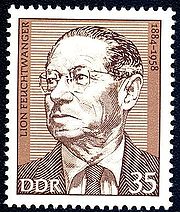
In 1953, Lion Feuchtwanger, the National Prize of East Germany first Class for art and literature. There he was as ardent anti-fascist and communist sympathizer held in high honor, even if the Jewish moments of his work was less appreciated.
Illness and death
Lion Feuchtwanger became ill with stomach cancer in 1957. After several operations he died from internal bleeding in late 1958. His wife Marta continued to live in their house on the coast and remained an important figure in the exile community, devoting the remainder of her life to the work of her husband. Before her death in 1987, Marta Feuchtwanger donated her husband's papers, photos and personal library to the Feuchtwanger Memorial Library, housed within the Special Collections of the Doheny Memorial Library at the University of Southern CaliforniaUniversity of Southern California
The University of Southern California is a private, not-for-profit, nonsectarian, research university located in Los Angeles, California, United States. USC was founded in 1880, making it California's oldest private research university...
.
Works

- Die häßliche Herzogin Margarete Maultasch (The Ugly Duchess), 1923—about Margarete MaultaschMargarete MaultaschMargarete Maultasch was the last Countess of Tyrol from the Meinhardiner dynasty of Görz . Upon her death, Tyrol became united with the hereditary lands of the House of Habsburg.- Biography :...
(14th century in TyrolCounty of TyrolThe County of Tyrol, Princely County from 1504, was a State of the Holy Roman Empire, from 1814 a province of the Austrian Empire and from 1867 a Cisleithanian crown land of Austria-Hungary...
) - Leben Eduards des Zweiten von England (The Life of Edward II of EnglandThe Life of Edward II of EnglandThe Life of Edward II of England , also known as Edward II, is an adaptation by the German modernist playwright Bertolt Brecht of the 16th-century historical tragedy by Marlowe, The Troublesome Reign and Lamentable Death of Edward the Second, King of England, with the Tragical Fall of Proud...
), 1924: written with Bertolt BrechtBertolt BrechtBertolt Brecht was a German poet, playwright, and theatre director.An influential theatre practitioner of the 20th century, Brecht made equally significant contributions to dramaturgy and theatrical production, the latter particularly through the seismic impact of the tours undertaken by the...
. - Jud SüßJud Süß (Feuchtwanger novel)Jud Süß is a 1925 historical novel by Lion Feuchtwanger based on the life of Joseph Süß Oppenheimer.-Historical background:Joseph Süß Oppenheimer was an 18th century Court Jew in the employ of Duke Karl Alexander of Württemberg in Stuttgart...
(Jew Suess, Power), 1925. - Marianne in Indien und sieben andere Erzählungen (Marianne in Indien, Höhenflugrekord, Stierkampf, Polfahrt, Nachsaison, Herrn Hannsickes Wiedergeburt, Panzerkreuzer Orlow, Geschichte des Gehirnphysiologen Dr. Bl.), 1934—title translated into English as Little Tales and as Marianne in India and seven other tales (Marianne in India, Altitude Record, Bullfight, Polar Expedition, The Little Season, Herr Hannsicke's Second Birth, The Armored Cruiser "Orlov", History of the Brain Specialist Dr. Bl.)
- Der falsche Nero (The Pretender), 1936—about Terentius MaximusTerentius MaximusTerentius Maximus was a Roman also known as the Pseudo-Nero who rebelled during the reign of Titus, but was suppressed. He resembled Nero in appearance and in action, as he was known to perform singing with the accompaniment of the lyre....
, the "False Nero" - Moskau 1937 (Moscow 1937), 1937
- Unholdes Frankreich (Ungracious France, Der Teufel in Frankreich, The Devil in France), 1941
- Die Brüder Lautensack (Die Zauberer, Double, Double, Toil and Trouble, The Lautensack Brothers), 1943
- Simone, 1944
- Die Füchse im Weinberg (Proud Destiny, Waffen für Amerika, Foxes in the Vineyard), 1947/48 - a novel mainly about Pierre BeaumarchaisPierre BeaumarchaisPierre-Augustin Caron de Beaumarchais was a French playwright, watchmaker, inventor, musician, diplomat, fugitive, spy, publisher, arms dealer, satirist, financier, and revolutionary ....
and Benjamin FranklinBenjamin FranklinDr. Benjamin Franklin was one of the Founding Fathers of the United States. A noted polymath, Franklin was a leading author, printer, political theorist, politician, postmaster, scientist, musician, inventor, satirist, civic activist, statesman, and diplomat...
beginning in 1776's Paris - Goya, 1951—a novel about the famous painter Francisco GoyaFrancisco GoyaFrancisco José de Goya y Lucientes was a Spanish romantic painter and printmaker regarded both as the last of the Old Masters and the first of the moderns. Goya was a court painter to the Spanish Crown, and through his works was both a commentator on and chronicler of his era...
in the 1790s in Spain - Narrenweisheit oder Tod und Verklärung des Jean-Jacques Rousseau (Tis folly to be wise, or, Death and transfiguration of Jean-Jaques Rousseau), 1952, a novel set before and during the Great French Revolution
- Die Jüdin von ToledoDie Jüdin von ToledoThis article describes the book by Lion Feuchtwanger. For the play by Franz Grillparzer, see The Jewess of Toledo.Die Jüdin von Toledo is a 1955 novel by German-Jewish writer Lion Feuchtwanger. The story focuses on the "Golden Age" of learning in medieval Spain. The novel also describes the...
(Spanische Ballade, Raquel, The Jewess of Toledo), 1955 - Jefta und seine Tochter (Jephthah and his Daughter, Jephta and his daughter), 1957
- The Wartesaal Trilogy
- Erfolg. Drei Jahre Geschichte einer Provinz (Success), 1930
- Die Geschwister Oppermann (The Oppermanns), 1933
- Exil, 1940
- The Josephus Trilogy—about Flavius Josephus beginning in the year 60 in RomeRoman EmpireThe Roman Empire was the post-Republican period of the ancient Roman civilization, characterised by an autocratic form of government and large territorial holdings in Europe and around the Mediterranean....
- Der jüdische Krieg (Josephus), 1932
- Die Söhne (The Jews of Rome), 1935
- Der Tag wird kommen (Das gelobte Land, The day will come, Josephus and the Emperor), 1942